Front matter (continued 4)
Reading edition
"That's what Murray says, and it encourages me. You 've studied it yourself, then?"
"Taught myself in odd hours; thought it might be useful some time, and it has been, many times. I can show you a lot of technical short cuts that will be of use to you, when you 're familiar with the regular method.'
"Oh, thank you--I'll be grateful. Come Polly--you 've cooled off--try a smooth little canter for a while."
At Grandfather Bell's Peter took Shirley down and sent her to roam about the great orchard, while he hunted up the old gentleman and had a talk with him. This consumed nearly an hour, and when they were off upon the road once more, Shirley discovered that the care-free look had vanished from her companion's face, and that his mouth had taken again the grave expression it had acquired after she went away to school.
She let him ride to the edge of the woods, four miles toward home, in the abstracted silence which had fallen upon him; but as they came under the first cool shadows, she brought Pretty Polly down to a walk, and began to talk lightly about Murray and Jane, and the successful way in which Jane had taken up the cares of managing the big house and its affairs. Peter obediently followed her lead, but after a short time she discovered that he gave her his attention only by an effort.
She longed to know what was the matter, for that something had gone wrong with him she was more than ever sure. Two years ago she would have demanded, with the familiarity of long acquaintance, an explanation of any cloud upon his brow, for she and Peter had been as good friends as seventeen and twenty-six may be, when the families of both are united by certain common interests. But somehow nineteen and twenty-eight had not yet recovered quite the old ground of mutual frankness, and Shirley's anxious questions halted upon her lips.
They had another gallop when they came to the smooth stretch, but this time, although Peter said, "That was a good one, was n't it?" his face did not clear.
Just before they reached home, however, he appeared to realise all at once that he must have been poor company, and said so, with a word of regret.
"I don't mind a bit," said Shirley. "One does n't always feel like talking. And I know in your position, you must have a good many cares."
"A few. I 'm afraid I 'm not good at carrying them, since I let myself keep them on my own shoulders, even on horseback. They fell off on the way out, but at the farm they climbed up Grayback's tail again. I 'm sorry, for you 've been jolly company, and I 've honestly enjoyed the ride more than anything that has happened in a year."
"We 'll go again, then, on another half-holiday, and next time we 'll leave Black Care behind altogether. Or, if you will take him along you shall introduce me. Will you?"
Her look was so girlishly sympathetic and inviting, Peter could hardly be blamed for finding a ray of comfort in it, although he only said stoutly:
"That would n't be fair."
"Indeed it would. What are one's friends for? And Black Care does n't like the society of two."
"That's true. But he's not a desirable acquaintance, and I don't mean to introduce him to you. Remember the pothooks--they 'll keep you busy."
He smiled as he said it, but Shirley persisted, more boldly, for she thought she detected the fact that it would be a relief to Peter to tell somebody his troubles, if his conscience would let him.
"I 've seen, ever since I came home, that something was worrying you. It's made me feel badly. Perhaps just telling would make it easier."
"I should imagine it might. I 'll think about it. Meanwhile, thank you for two fine hours. We 're back just in time for your dinner--and my supper. Will you go to the house door, or dismount here at the stable?"
"Here, please. And next Saturday we'll go again, if you really care to."
"I shall think about it through the week. Here you are--you don't half let me help you. Success to the pothooks! Good-bye!"
CHAPTER V
BLACK CARE
On the following Saturday it rained all day, and no horseback-riding or excursions of any sort were possible. Before another half-holiday had come round, an unusual and severe pressure of work had overtaken Peter, which shut him off from any leisure whatever for many successive weeks. Night after night, all through July and August, he came home late in the evening, too weary for anything but supper and bed. During all this time he saw little of the people in Worthington Square.
As for Shirley, although she thought often of Peter, and was sorry that no chance seemed to favour her getting at the secret of his burdens, whatever they might be, her own work absorbed her. She was proving a ready pupil, keen of intellect and quick of eye and hand. As she advanced in the mastery of stenography, she became more and more fascinated by its details, and spent more and more of her spare hours in practice. The typewriting she acquired in an unexpectedly short space of time, but her chief ambition was to achieve the ability to take dictation rapidly and accurately, and to this end she laboured with much zeal.
Nancy Bell was taken into confidence, and became an active and interested partner. Many were the hours she spent with Shirley, reading aloud to her from all sorts of books and papers, with a view to accustoming her to any kind of composition.
"You certainly can do anything now," Nancy said, one day in late September, when she had given Shirley an unusually trying test at top speed, and the worker had typewritten it without an error worth mentioning.
"I 'm not so sure." Shirley studied her paper. "I 'm used to you, and you don't flurry me much. But if I should go to father and offer myself for a trial, I 'm afraid I should bungle it."
"But you can't get office practice without office practice. Nothing can take its place or give you confidence, I should think. Why don't you let Murray try you? If he dictates as fast as he talks when he 's discussing business with Peter, he must be hard enough for anybody."
That evening, as Murray and Jane, in the library, were discussing certain household matters, Shirley, sitting at the big table with her notebook, turned a leaf and began to take down the conversation.
"Did I say that?" Murray asked, toward the close of the conference. "I thought I put it quite differently."
"You said, dear," said Jane, "that it ought to cost that, not that it did."
"Are you sure?"
"Quite sure."
"I must have been wandering in my mind. I seem to hear myself saying in a tone of great assurance that it actually did cost seventeen dollars. I could n't have said anything else, knowing the facts."
Jane merely smiled, sure of her ground, but not liking to dispute it further. Murray took a turn up and down the room, whistling softly. He himself would not insist upon the thing he was sure he had said, but he was none the less confident. It seemed to bring the discussion to a standstill, as such small differences of statement sometimes will.
Shirley began to read aloud from her note-book a reproduction of the conversation which had just taken place. Listening incredulously, Murray heard himself quoted as saying precisely that which Jane had asserted.
"Look here," said he, coming over to the table and seizing upon the note-book. "Are you sure you have that straight--that you 're not saying it from memory of what Jane said I said?"
"I did n't get every word you said, but I did get that sentence. You brought out the 'ought' so strenuously I put the exact sign down."
"I 'll give in, of course, but I 'll have to be careful of what I say in your hearing after this. You must be pretty good at it, if you caught all that off our tongues. We were talking fairly fast, if I remember."
"You were very nearly too fast for me--in spots. Conversation 's harder to take than anything else. Do you want to try me on a business letter?"
"With pleasure," and Murray promptly pulled a letter out of his pocket, glanced it over, and began to dictate a reply.
Before she had done two lines, Shirley realised that the actual receiving of dictation from a man of business, who was seriously putting her to a test, was quite different from any amount of practice with Nancy Bell. Murray's keen eyes were upon her, he was watching her fingers as they flew, he was using business terms with which she was not familiar. These technicalities she was forced to omit, but after a little she steadied under the consciousness that he was speaking not too rapidly, and that he paused now and then between sentences, as if studying the letter he was answering.
At the end she said, "I 'll make you a copy," and flew out of the room. Murray smiled at Jane, who had been an interested witness of the scene.
"I can't get used to the idea that the child is serious in all this," said he. "I know she's been working at it all summer, but I 've seen so little of it, and she 's been so quiet about it, I forget that she means business. If mother and Olive had been at home all this time I should have heard of little else."
"There 's no doubt of her being in earnest. She and Nan have practised by the hour," answered Jane. "I think you'll find her copy pretty correct."
"I doubt it. She certainly caught the gist of our conversation, but that 's comparatively easy, for her memory would help out on the sort of thing we were saying. But when it comes to getting it word for word, as a business letter must, she 'll find that 's another thing."
Shirley came back presently and handed her brother the letter. He read it through carefully. "By Jove!" he ejaculated, and looked at his sister.
"I had to leave spaces for the words you used that I had never heard," said she. "I did n't think of it before, but there must be a lot of such words in your correspondence. Would you mind making me out a list of them, or giving me a catalogue? Next time I 'll know them."
"I'll warrant you will. Except for them, you 've practically every word just as I gave it to you. See here, when have you done it? You have n't had time to accomplish so much. It takes at least six months to make a respectable stenographer. You 've been at it but four. Come here and let me look at you. By rights you ought to have grown thin. No, I can't see that you have."
"Of course I have n't. I 've never been so happy in my life."
"Miss Henley, who is in the office, is going to be married in October." He studied her face keenly.
She looked at him with eager eyes. He laughed.
"If you were a pauper with a family to support, you could n't look more appealing," he said. "Well, keep pegging away, and I 'll recommend you to father."
Mrs. Harrison Townsend did not come home at all that autumn. Instead, she sailed for Italy, taking Olive with her. From Europe Mrs. Townsend wrote Murray a letter which he showed to no one, but which gave him no little discomfort of mind.
"I am much better away," she wrote, "where I shall not be in the throes of the revolution which has overtaken my household. With Jane refusing many of her most important invitations, Forrest away, and Shirley casting herself into the business world, like any poor man's daughter, I should be too distressed to be able to play my own part with composure. I hear that Jane is not keeping up her calling list as conscientiously as she should do. Please try to impress her with her duty to our friends, even if she does not care to make them hers. When I return, I shall wish to take up my social life where I left it, and if I should find my friends alienated by the eccentricity of my daughter-in-law, I should feel that a wrong had been done which it would be difficult to overlook."
"About the hardest thing in the world," thought Murray, as he pondered these lines, "seems to be for one woman to get another's point of view. Here 's Jane, staying at home all summer to keep me company, when she might have gone off to the seaside or the mountains with Olive. She 's tackling big problems every day in the management of the house, to say nothing of looking after all mother's social correspondence. She 's entertained relatives of ours from in town and from out of town, to say nothing of making father's evenings pleasant and seeing to her own family. Yet because some woman on mother's list writes her that Jane has failed to pay a call within the required limit of time, the poor girl is 'eccentric.' Well, she shall not be taxed with it, if I can help it."
Feeling that Jane, although unconscious of the elder woman's dissatisfaction with her endeavours, should have amends made her after some fashion, Murray arranged to take her with him upon a week's business trip, a flying journey half-way across the continent and back. In the absence of Mrs. Townsend and Olive, this left Shirley and her father quite alone for a week.
One of the evenings of that week Mr. Townsend spent with Joseph Bell--as was now his frequent custom. On this evening Shirley settled down with a book before the library fire. She had been working harder and harder to perfect herself for the position which she had been assured should be hers upon the resignation of Miss Henley, a fortnight hence. And she had at last arrived at that state of confidence in her own powers which permitted an occasional indulgence in an idle evening without a twinge of conscience.
The book proved so entertaining that an hour passed, during which she took no note of time. She could not have told whether it was late or early, when a slight stir in the hall brought her attention to the fact that somebody was there, awaiting her recognition. She looked up to see Peter Bell standing in the doorway, his face so grave and worn that she gave a little cry of amazement.
"Why, Peter!" she said, and came forward to give him her hand. He looked down at her almost as if he did not see her. His hand was cold.
"You 've been out in the wet--you 're chilled," she said, eagerly drawing him toward the fire. "Why, you 're very wet! You did n't have an umbrella."
"I believe I did n't," Peter answered, glancing at his coat-sleeve, which was, indeed, almost dripping with dampness. "I 've been walking a long way--I don't know how far."
He took the big armchair which she offered him, but she stood regarding his moist condition with concern. His visits were too few to make her willing to run the risk of losing this one by suggesting that he ought not to sit down in his wet coat; and after a moment she ran away and came back with a house coat of Murray's.
"Please put this on," she said.
Peter protested that he had no need of taking such precautions, but Shirley persisted until he obeyed her and donned the coat, throwing his own upon a chair, whence she rescued it and hung it where it might have a chance to dry.
"Now rest and be comfortable," said she, drawing her own small chair into a friendly nearness to the big one, "and tell me what's wrong. It needs to be told at once, I know--or I 'd try to talk about something else first."
"I'm afraid I couldn't talk about anything else first," said Peter. "Yet I don't know that I can talk about this. But--I had to come. There was no one else I could go to. I 've stood all the rest by myself, but this----"
He stopped short, as if he could not go on. Something about his appearance made Shirley's heart begin to beat fast with apprehension. It must be a very bad trouble indeed which could make Peter act so unlike himself, Peter the strong, the self-reliant.
Her mind went back in a flash to the day, weeks before, when he had half promised to give her his confidence in regard to matters which it was evident were bothering him. But he had not looked then in the least like this. It had been merely business care which was heavy on his shoulders at that time. This was trouble, or she did not know the signs. His set face, upon which her welcome had brought no hint of an answering smile, the lines about his mouth, the suggestion of pallor which was already succeeding to the colour which had been the result of the tramp in the rain, all made her sure of her conclusions.
"I want to hear," began Shirley, very gently, controlling the anxiety in her voice. Then, suddenly, as a startling thought occurred to her, "Peter, it's not--Murray--or Jane?--or mother?"
"No, no," said Peter, quickly, turning to her. "No, it's not your trouble, it's mine--ours. Only the others don't know it yet. They must n't know it till it--comes. That's why I came here. It' s not right to burden you with it, I 'm afraid. But, somehow I----"
Shirley impulsively put out her hand, as if to touch his. He did not see it, and she withdrew it again. She longed to give him comfort in some way. Yet, until the story was told, she could not tell what to do. If only he would tell it quickly. But, plainly, it was hard to tell.
He drew a deep breath; then sat up straight, staring into the fire.
"There has been a long succession of misfortunes," he began, slowly. "I don't need to go into those, though I thought them bad enough--until now. Now--if it were nothing worse than those things, if I could just go back to them, I 'd shoulder them all gladly, and not mind. It was property business, all of it--foreclosure of a heavy mortgage threatening Grandfather Bell's farm, loss of the little money father had got together and put into stocks that have gone to pieces--that sort of thing. It was up to me to straighten it all out--and not much to do it with. And father--he seemed not very well--had two or three queer attacks of illness at the factory during the hot weather. I felt I could n't worry him with it. He seemed to be getting old--all at once. Finally, yesterday----"
Peter paused; then he went on in a lower voice:
"Yesterday he had another of those attacks--much worse than before. A man near him sent for me, and I sent for a doctor. The doctor brought him round, but it took some time. To-day I made him go to another doctor--a specialist. He examined father, and told me what it was."
Shirley, in a breathless silence, waited.
"Any over-exertion, excitement, worry--anything--may end it at any time. If he would give up and stay quietly at home, he might last a good while. But that's what he won't do. He knows it all--took it as coolly as if it were nothing at all, but won't give up. And he won't have anybody told. Says they 'd never know another happy moment--and that's true enough. He 'll just take his chances. It's brave of him, and I can understand how he feels, but the hard thing for me is--I 've got to keep still, and stand by, and--see it come."
With the last word Peter's voice almost broke. He turned his head away. Shirley got up and went to him. She laid one hand on his shoulder, standing still beside him, her heart aching with sympathy, but finding not a word to say. In all his unhappiness, Peter recognised the light touch, and putting up his cold hand grasped the warm one. He held it tight for a minute, for the sense of comradeship and comprehension it brought him gave him courage to go on.
Shirley understood the warm and close relations which had always existed between Peter and his father. And she realised, with a pang, that which Peter had not mentioned, but which must add its share to the poignancy of his apprehension--the fact that with the loss of the head of the family, the burden of the support of that family must fall upon the son's shoulders. Money problems were not to be mentioned in the same breath with the threatened loss of a dear parent, but the anxiety they were bound to cause would make Peter's trouble immeasurably more serious.
When Peter spoke his voice was steady again.
"Of course I 'm facing nothing harder than other people have to face every day, in one way or another. I mean to stand up to it, like a man, if I can--it would n't be worthy of a chap with a father like mine to be bowled over by what he bears with such courage. But it seemed to me I must tell somebody, and you--something you said weeks ago, when we went riding together, made me sure you would care."
"I do care, very, very much," Shirley answered. "I 've wished ever so many times since then that I knew what was the matter. If you had told me that, it would have been easier for you to come to me with this, I think. I 'm so glad you did. I only wish--oh, how I wish--there were something I could do!"
"You can. You 're doing it now. Just knowing you know makes it easier. If there were anything I could do myself I could bear it better."
She slipped out of the room. In a few minutes she came back, bearing a tray, upon which was a cup of chocolate with a little mound of whipped cream on top, and beside it a plate of sandwiches. She set her tray at Peter's elbow.
"Father is so fond of this, late in the evening, that Cook keeps a double boiler ready on the back of the range, and the rest of us make use of it," she explained. "You may not be hungry, but it will be good for you. Tell me, did you have your supper?"
"No, I haven't been home," he owned. "If a fellow could eat at all, he ought to be able to eat this."
To Shirley's satisfaction Peter consumed every one of the six thin sandwiches, and when she suggested a second cup of chocolate, he gratefully accepted it. He had been famishing, though he had not known it. The interview with the specialist had taken place before lunch time, and Peter had not remembered lunch at all.
Being human, and very weary, creature comforts did their part in strengthening him, in mind as well as body. When he had finished, and had spent another half-hour listening to Shirley's account of news from Forrest, who was in the West Indies now, he rose, a very different young man from the one who had come in out of the rain an hour before.
When he had exchanged the velvet house-coat for the rough tweed one, now dried by the fire, he stood before her, hat in hand. He looked down into her friendly uplifted face and something very appreciative showed in his own. He could summon only the suggestion of a smile, but his eyes were less heavy, his colour had come back, and resolution was once more in his bearing.
"You would put heart into a craven," he said, shaking hands.
"You 're no craven," answered Shirley, returning the look steadily with her frank eyes, "but one of the stoutest-hearted I ever knew. I know lots more about you than you think, and I know what you have been facing all these years in the way of sticking to work you did n't like."
"That's nothing. Everybody does that, if he amounts to any thing."
"Everybody doesn't. But it's made you strong and brave. You 're brave now--and you 're going to be braver yet."
He studied her a moment in silence. Then the smile she had missed shone briefly out upon her as Peter said fervently: "If I am, it will be thanks to you, my friend. Good night!"
CHAPTER VI
A BREAKDOWN
"Now make her come!" commanded Marian Hille, as her brother Brant brought his big green motor-car to a stand in front of the great building belonging to Townsend & Company. "Don't let her refuse. How she can spend her days down here, drudging away, I don't see! Brant, tell her I shall simply never forgive her if she does n't shut up that typewriter at once and come along."
"I 'll say what seems to me to suit the situation," declared her brother, sliding out of his seat and divesting himself of his motoring coat. "Whether it will make any impression I 'm not so sure."
He walked leisurely off, but when he was inside the building he made a short trip of it to the fifth floor and the offices. He was quite as anxious as his sister for the success of his errand.
Murray himself welcomed young Hille cordially, and when Brant asked for Shirley, he led his visitor into an inner office. Here Brant stood still, gazing with interest. He had not yet seen his old acquaintance at her new tasks.
Shirley sat before a typewriting machine, her fingers playing as lightly and swiftly over the keys, for all Brant could see, as those of any veteran at the business. The girl did not look up. Plainly she was much absorbed in her work, a little flush on her cheek, her eyes devouring the "copy" before her in the shape of her note-book, held open by a device above her machine.
Brant turned to look at Murray, and Murray smiled.
"She looks as if she enjoyed it!" Brant exclaimed, under his breath.
"She does. No question of that."
"It 'll wear off, don't you think?"
"I doubt it."
He walked over and stood at her elbow, waiting. Shirley paid him no attention while she finished the long business letter before her, and she would not have turned then if her brother had not said quietly, "A caller is waiting to see you, Miss Townsend."
Then she glanced up, and rose, pulling a glove finger from the forefinger of her right hand before she let the visitor take it. "I still seem to give this finger a bit of extra work," she said smiling.
Brant said a complimentary thing or two in recognition of her businesslike command of the typewriter, and then proceeded to put his case.
As she knew, a November house party was in progress at the Hildreth's country place, eighteen miles out. He and Marian had come in on an errand, and were going back. A particularly jolly evening was in prospect. Somebody had suggested that the Hilles bring Shirley back with them, just for the evening. They felt she owed them that much, after so resolutely declining the original invitation for the entire week. Would she not go? It was a rare evening for early November, the air mild, the moon magnificent, the roads like a floor.
The Hildreths wanted her to stay the night; but Brant would rise with the lark and bring her back to town before breakfast, that she might not miss so much as a semicolon of her day's work. Or--as Shirley continued to look doubtful--he urged that, if she preferred, he would actually get her back to-night. Some of the married people would drive in with them for the sake of the run in the moonlight. Please!
"Go, Shirley, and have a fine time," said her brother.
She was only human--and a girl--after all, and after many weeks of close and serious work the prospect of the little spin of an hour's duration, with the "jolly evening," appealed to her. Smiling at Brant's last proposition, Shirley yielded.
"I shall have to go to the house first," she said, setting the cover on her machine and putting away her work. The clock already indicated the end of the working-day in the Townsend office.
"Of course. We 'll take you right up in a jiffy." And Brant led the way to the elevator, his soul filled with satisfaction.
The green car was shortly chug-chugging in front of the Townsend house, while Shirley ran up to exchange her office clothes for the pretty dull red silk frock which seemed to her to fit the November evening.
A sense of exhilaration took possession of her as she pulled on her long driving-coat, and pinned in place the close hat and swathing gray veil which made her ready for the swift drive in the autumn air. To be really a working girl, and yet not to be shut out from an occasional taste of this sort of pleasure--it was certainly a pleasant combination. And Shirley had accomplished one of the best day's works that she had yet done, and felt as if she had earned whatever of jollity the evening might have in store for her.
"Well, I'm certainly thankful to see you acting like one of us again, if only for a few hours," asserted "Marie Anne," as they whirled away. "Shirley Townsend in a blue serge at four o'clock in the afternoon is an extraordinary sight. Now you look like yourself again. What have you got on? That Indian-red silk? When you like a thing you like it forever, don't you? I wonder how many times you came down to dinner last winter at Miss Cockburn's in that red silk!"
"Don't be brutal, Marian!" called her brother, over his shoulder. "As if it made any difference what she wears as long as she comes with us! Besides, I haven't seen the red silk."
But Shirley was only smiling at Marian's comments on her attire. She had not summered and wintered Miss Hille as a room-mate for two years in the English school not to have become inured to her style of intimate criticism. Besides, she knew perfectly that that Indian-red silk frock had been her friend's envy for the first six weeks of its existence, on account of its beauty and the way it became Shirley's colouring.
It does not take long for a motor-car of high horse-power driven by a young man with the usual dash of daring in his composition to cover eighteen miles of smooth roadway, and it was not yet six o'clock when the car shot up to the entrance of the Hildreth's country place. Half a dozen young people, returning from the golf links, hurried up to welcome Shirley Townsend back to the ranks of the pleasure-seekers, and she was borne into the house on a little wave of good-fellowship and merriment which she could not help decidedly enjoying.
"It's a shame to think of that girl throwing herself away on the sort of fad she 's taken up!" growled Somers Hildreth to Brant Hille, as the two came in, after dressing for dinner, to find Shirley Townsend the centre of a gay group before the great fireplace, which was the heart of the country house.
"I wonder what fault Marian had to find with that dress," Brant was thinking, as he caught its gleam in the firelight and saw the sparkling eyes and warm-tinted cheeks above it. "If she is n't by long odds the finest girl in that crowd I 'll go without my dinner." But aloud he responded, calmly, "It does n't seem to have dulled her charms. She never looked more as if she found things worth while, did she?"
"That's reaction," declared the other young man. "Shut any girl up in a cage, and she'll stretch her wings when she gets out. It will tell on her after a while, though, if she keeps it up. But she won't. That goes without saying."
"Don't you fool yourself!" muttered Brant, adopting Murray Townsend's view of the matter.
Shirley, indeed, did not look like a girl who was accustomed to adopt courses, only to abandon them when weary. Whatever her views of the "things worth while," she certainly enjoyed that evening. Those who had sent for her congratulated themselves on their foresight.
Without making herself in any way a conspicuous figure, or appearing to take the lead, Shirley's very presence seemed somehow to bring about that result most desirable to a hostess, the making things "go." The young people had been together for five successive evenings, and had about exhausted their resources and those of their entertainers in the way of diversion. But with Shirley Townsend's softly brilliant eyes looking on, her spirited mouth curving into mischief or merriment, her appreciative comments spurring them, the young men of the party at least found themselves stimulated to their best achievement, and exerted themselves to bring the response of her pleasure.
As for the girls, they all liked her, although not without here and there a touch of envy at the success of a style so free from affectation that nobody could accuse its possessor of not being genuine.
"You can't say you 're not having a good time," urged Hille, cornering Shirley as the evening went on.
"There 's no reason why I should want to say it. I 'm having a delightful time."
"I thought it was part of your code, from now on, to enjoy nothing but hard labour."
Her laugh rang out softly.
"You did n't believe anything of the sort. If all work and no play make Jack a dull boy, what would they do to Jill? She would be unendurable."
"She would. But anybody would have taken alarm at sight of you to-day, over your typewriter. You looked as if you were nothing short of carried away with it. You did n't so much as notice I was in the room."
"I 'm not supposed to notice people who come into Murray's office. I learned that at once, by watching Miss Henley. While I 'm there I 'm to be merely an intelligent machine."
"'Machine' doesn't strike me as exactly the word--in your case. As for the 'intelligence'--I suppose Townsend & Company are very exacting. Do you suppose they 'd take me on the force?"
"You!" It seemed to amuse her very much.
Brant looked nettled. He had asked the question in sport, but he did not like to be taken that way. "Look here, am I such a joke as that?"
"The notion of your working for anybody, even for yourself, is very interesting."
"You think I 'm not capable?"
"I think the mere thought of going to an office every morning at nine o'clock would be too much for you."
"You must have a pretty poor opinion of me."
"Not at all. But you have never needed to work, never expect to need to work, and have never shown the first sign of intending to work. Why shouldn't the idea of your working seem strange?"
"I might have said the same of you a few months ago." Brant was getting red.
"So you might. But I 'm a girl."
"Does my being a man--I'm twenty-four--make it a foregone conclusion that I should roll up my sleeves and tackle a shovel and pick, whether I need the money or not?"
Shirley surveyed him. "No, I don't think it does--with you."
The red which had begun to show above Brant's collar now spread toward his ears, extended his forehead, and finally suffused his entire face. He broke out hotly: "Look here, you used not to be sharp-tongued like that. If your taking up this sort of thing is going to make you not mind how you cut your friends, it 's my opinion you 'd be better at your embroidery."
Shirley bit her lip with a mischievous desire to say something which would make the angry gleam in his eyes light up still more vividly. She and Brant had played together and quarreled and made up since their nursery days, and this retort, which she would have resented from anybody else, merely delighted her from Brant.
She liked to wake him up, and considered that hurting his feelings on the score of his idleness was both salutary and justifiable. Ever since she had returned she had been feeling more and more annoyed with him for seeming to settle down so unconcernedly to a life of absolute ease and the spending of his share of the estate left him by a father who had toiled a lifetime to get his property together.
But she did not intend to be led into a serious argument with him now and here, nor did she wish to make him like her less on account of her new method of employing her time. She liked him for many good points, and she was rather wiser than most girls in perceiving when she had said enough. So after an instant's silence, she asked, with a bright glance, disarming because unexpected, "Shall we call it even?"
"Did my shot about the embroidery hit?" Brant exulted.
"Hard. It doesn't matter that I don't know how to embroider."
"Not in the least. Yes, I 'll call it even, though I got the worst of it. I was mad enough to bite something a minute ago, but you always did have a way of making a chap double up his fists, and then open them again, feeling foolish. Oh, here comes Mrs. Hildreth. You don't want to go back to-night, do you?"
"I 'll wait till morning. But we must be off early. I would n't miss being on time for a week's salary."
"Before breakfast?"
"Of course--if they'll let us. We'll have breakfast at home; the early morning run will make us hungry."
"It certainly will. See here, we don't have to get anybody up to go in with us, do we?"
Shirley looked doubtful. "I 'm afraid we do."
"Then I 'd rather take you in to-night," said Brant, promptly. "We 'll fill up the car with chaperons, and you can sit in front with me. They 'll be tickled to go, in this moonlight. I 'll ask Mrs. Hildreth and Miss Armitage; they 'll discuss dressmakers all the way in and leave us in peace."
Shirley let him arrange it, personally much preferring to reach home that night and get up at the usual hour in the morning, with an interval between her pleasure-making and her work. The hour was not late, and Brant professed to be able to make incredibly quick time, so he had no difficulty in arranging his party.
There were many sallies at Shirley's expense as her friends saw her depart. Her devotion to business was considered a caprice, likely at any time to give way to more rational behaviour, and she was assured of an enthusiastic welcome back to the company of sane beings when her "craze" should be over. She went away smiling at the thought of how little they understood her, and with a sense of having at hand resources of contentment at which they could not even guess.
With an empty road ahead, and the moonlight making all things clear, Brant sent his car humming. In the rush of air caused by their flight, all four travellers stopped talking, and it was upon a silence hitherto disturbed only by the muffled mechanism of the car that the startling bang of an exploding tire woke the echoes.
"Confound the luck!" burst from the young man in the driver's seat, as he brought the machine to a standstill. "That means stop and repair right here. We can't run her in on her rim. We 're not half way."
Shirley looked about her. Ten rods away, its big barns looming against the sky, its white house showing clearly in the moonlight, lay the farm of Mr. Elihu Bell, the grandfather of her friends. Although it was after eleven o'clock, there were lights showing in windows which she knew belonged to the front room of the farm-house.
"Shall you need help?" she asked, as Brant threw open the box which held his repair kit. "The noise has brought somebody to the door over there. It 's the Bell farm--my sister Jane's grandfather, you know."
"Is it? Then we'll pull over there into the yard, and you people can go inside, since they seem to be up. It may take me quite a while to get out of this scrape. I 'm not much of a mechanic, and I 've been lucky enough not to puncture many tires."
He got in again, and ran the car slowly over to the open gate of the Bell place. As he turned in, the two figures which had been standing in the doorway came out and crossed the yard.
Shirley recognized them both, one tall and slim, with the slight stoop and characteristic walk of age; the other also tall, but broad-shouldered and erect. She wondered what Peter Bell could be doing out here, calling on his grandfather at this late hour, and then remembered that Peter's time was so full by day that he must needs make his visits by night. She thought of the mortgage he had spoken of, and surmised that the visit, prolonged past the hour when farmhouses are usually dark and silent, was on business.
"Well, well!" called the kindly voice of the old man. "Broke down, have you? Anything we can do? Your lights are brighter than any we can furnish you."
Peter came close. "Will the ladies come into the house?" he asked. He could not see who they were.
Mrs. Hildreth and Miss Armitage accepted the offer, for the November air was not so mild as it had been during the day, and they had no great confidence in Brant's ability to repair his own machine.
Peter offered a helping hand. When the older ladies were out, he turned to the girl on the front seat. She sprang down, and stood still before him. She had pulled her gray veil closely about her face, and she spoke in a muffled whisper: "Guess who I am."
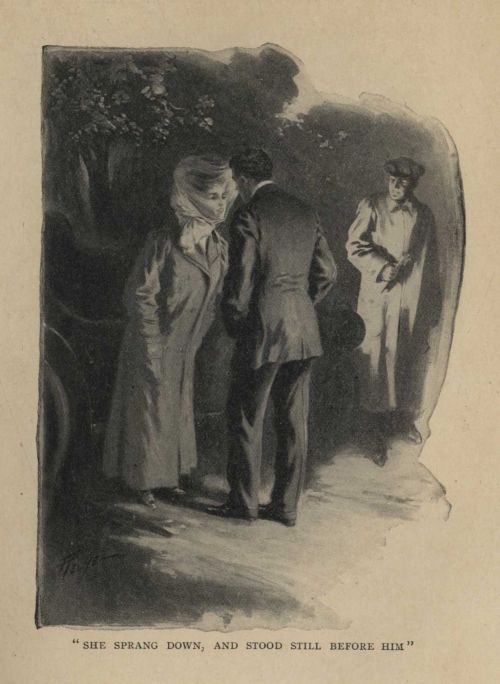
"SHE SPRANG DOWN, AND STOOD STILL BEFORE HIM"
Peter glanced toward Brant, who had now come around into the glare from his own headlights. Peter knew Brant, as anyone must who was included in the entertaining done in the Townsend house. But it had always been many leagues farther to Gay Street from the Hille home on the north side of Worthington Square than from that of Murray and Shirley Townsend on the south side.
"I'm afraid I can't guess," admitted Peter, who thought he knew that Shirley was at home that night, having noted a light in her window when, at nine o'clock, he had mounted his bicycle to make the trip to Grandfather Bell's. Her figure in the long coat and shrouding veil was not familiar to him, and the whisper had conveyed no note of Shirley's real tones.
"Then you shall never know," the sepulchral whisper assured him, and he found some difficulty in holding his hand from the desire forcibly to remove the provoking veil. The possibility that it was his sister Jane caused him to estimate sharply the height of the figure before him.
It was a little too tall for Jane, and Peter was about to hazard a guess that it was one of the least formidable of the girls of Shirley's set whom he occasionally met at her home, when Brant Hille called out, annoyance sounding in his voice:
"You 'd better go in with the others, Shirley--this is going to take time. I 've got to put on a new tire--worse luck!"
Peter's fingers grasped the veil and gently pulled it aside from the laughing face beneath, "No wonder you wanted to hide!" he jeered, under his breath. "A working-girl like you, off on midnight larks like this, with to-morrow ahead."
But there was a distinct hint of pleasure in his voice at the discovery of her here, thrown upon his hospitality. He led her away to the house, within whose open door the other ladies had disappeared.
"Grandmother has gone to bed long ago," he said, as they came up on the porch, "and I don't think I 'll disturb her. She 's deaf and won't hear, and she needs her sleep. But I can get you all something hot to drink, and something to eat, too, if there 's much delay."
Shirley presented him to Mrs. Hildreth and Miss Armitage, who were already making themselves at home in the low-ceiled, pleasant living-room which lay all across the front of the farm-house. A dying fire reddened the hearth, which Peter soon revived into a blaze. Then he went in search of refreshments. Thereafter, returning to the scene of the breakdown, he rendered Brant valuable assistance, proving handier at the process of replacing the injured tire than Brant himself. When they finally had done the work, and Brant pulled out his watch with a hand black with dirt and grease, he gave an exclamation of dismay.
"One A.M., by all that's unfortunate! Better let me take you back to Longacre, Shirley, and get you home comfortably in the morning. What difference does it make if you do miss part of a day?"
"Leave her here," said Mr. Elihu Bell. "We 'll take care of her to-night, and I 'll drive in with her in the morning, bright and early. That's the best way out, and you people can go back and go to bed. Grandma 'll be mightily pleased to wake up in the morning and find the little girl here."
Feeling it the simplest solution of a situation which was involving somebody's sacrifice, whatever she did, Shirley accepted the offer. Brant did not feel altogether pleased over driving away and leaving her standing on the porch beside Peter, but he was decidedly weary with his exercise, and sleepy after two brimming glasses of milk, and he resigned his charge with one murmured speech: "Shows what a fool thing it is for a girl like you to play at holding down a business position. You can't be either one thing or the other with any comfort, and it even gets your friends into trouble."
This surly farewell was punished by the girl's gay rejoinder:
"I suppose it was the weight of your cares that was too much for the car! I 'm sorry, and I 'll promise not to run away from my work again--with you."
When the car was off, Peter promptly brought round his bicycle. "This is n't quite so imposing a conveyance as Hille's automobile," he said, standing at the foot of the steps and looking up at Shirley, "and I can't invite anybody to share it with me and ride home. But it's very convenient for these little runs out to the farm, and I 'm glad I happened to be here to-night. Somehow, just the sight of you, without any chance to talk, does me good."
"If that is true, I should think you might take advantage of living so near just a bit oftener than you do. Do you know how long it is since you 've been over?"
"It seems six months to me," said Peter, smiling.
"It is six weeks. Are you so busy all your evenings?"
"Pretty busy. And I spend what little spare time I can make with father."
"Of course," she agreed, gently. "But I think you need a little more change of scene than you get."
"I 'd like it. But I can't be bothering a girl like you with entertaining an old chap like me."
"An old chap!" mused Shirley. "Is that the way you feel?"
"I was feeling forty, at least--till the tire blew up. Then I came down to thirty. When I found the girl under the veil, I dropped off several years more. But when I looked at that boy Hille I became a patriarch again."
"I wish he could hear you call him a boy! Suppose I give you a special invitation, and run the risk of your bothering me, will you accept it?"
"In a hurry!"
"Your first spare evening then?"
"You tempt me to cut everything and come to-morrow night. No--I 'll wait a decent interval, to let you get caught up after this midnight dissipation. May I come early?"
"The earlier the better."
"And you won't invite anybody else to help make it jolly for me? The last time I ventured over you had a roomful."
"I 'll invite nobody. Come, Peter Bell--do you know I 'm being much nicer to you than I ordinarily am to anybody? I let mother and Olive do the inviting, and I just look demure, as if I did n't care."
"You do care, then, this time?"
"It's time you were off, is n't it?" and she retreated, laughing, to the open door.
Peter looked back at her, an alluring figure, with the lamplight falling over the dull red silk of her frock, and wished he need not go at all. But Grandfather Bell's tall form appeared just behind Shirley's. This was an unheard-of hour for Grandfather Bell. So, with a friendly good night and a warm feeling at his heart, Peter bestrode his wheel and was off down the moonlit road toward home.
CHAPTER VII
CHRISTMAS GREENS
"Jane, I've the most charming plan in my head for Christmas week you ever heard of."
"Have you, Shirley dear? And are you going to tell it to me?"
"I am, indeed. Listen. Let's take cook and Norah, and go--all of us, your houseful and ours--and spend part of holiday week at Grasslands."
"Shirley! You take my breath away! Could we do it? Would n't it be fun if we could?"
"I don't see a thing in the way. When I stayed overnight, in November, your Grandmother Bell said she wished she could get her family together once more at Christmas there, instead of going in to have dinner in Gay Street, as they 've been doing since your family went to live in town. She said she 'd like to have us all if she were younger again, but she has no 'help,' and thought it would be a pity to ask us, and then have your mother and Nan do the work. I 've thought about it ever so many times since, but this idea has only just popped into my head."
"I should think it could be done," mused Jane. "There are rooms and rooms at the farm, and little open wood-stoves in every one. You and I could go out the day before, and get everything aired and ready."
"What if you and Mrs. Bell and Nan and I went, without telling any of the men? I 'm to have Christmas week for my first vacation, you know. Then when they came home in the evening, have a bouncing big sleigh ready to carry them off to the farm, and a jolly supper waiting? Then a tree that night, and Christmas next day, with coasting and skating and snowballing, if the weather is right?"
"You artful child!" exclaimed Jane. "It would do us all heaps of good--especially father and mother. Father looks to me so worn and tired. Have you noticed it?"
Shirley nodded. She had indeed noticed it, and a deep-laid plot, having for its beneficiary Mr. Joseph Bell, was at the back of the planning. But she did not intend that anybody should find that out. So she agreed lightly that Jane's father needed a holiday, as did all the others.
"If we can't get any of them to take more than Christmas day, we can at least bring them out there every night and back every morning," she said. "We 'll give them such good things to eat they won't mind the drive. With Grandfather Bell's big horses, all jingly with sleigh-bells, they certainly won't. Oh, will you go and speak to Cook now? I simply can't wait to get things under way."
"Do you mean to surprise Grandmother Bell, too?"
"Yes, if your grandfather agrees, as I 'm sure he will. If we told her she 'd tire herself all out, doing wholly unnecessary things. Everything in the house is always in apple-pie order, but she would n't think so."
"You 're quite right, I think. I 'll go and talk with Cook"--and Jane hurried away, looking as girlishly eager as Shirley herself.
She had small doubt of Cook. If Mrs. Murray Townsend had a friend in the house, it was Bridget. Mrs. Harrison Townsend had never considered Bridget a particularly amiable person, but Jane had won her completely by treating her always with consideration, and by showing the interest in her affairs, which is appreciated most by those who expect it least.
"Sure, then, we 'll go, Mrs. Murray, and take it as a holiday," agreed Cook, when her young mistress had explained her plans. "And we 'll take some of the fixings with us they 'll not be havin' at the farm."
During the week that intervened before Christmas, Shirley's head was so full of her schemes that for the first time since her initiation into office work she had considerable difficulty in keeping her mind upon her tasks. Christmas fell upon a Tuesday that year, fortunately for her plans, so after Saturday noon she was free to give her mind to the pleasures in prospect. Mrs. Bell and Nancy had agreed enthusiastically to every detail of the arrangements, and Grandfather Bell, when cautiously consulted over the telephone and urged to keep it all a secret from his wife, had responded as joyously as a boy that the party might occupy every nook and corner of the house and have things all their own way, if they would only come.
It proved necessary to let somebody into the plan at the last, in order that the men, returning to their homes on Monday evening, should be directed what to do. Rufus was selected for this office, an appointment which tickled him so that it was with difficulty he kept from bursting out with his secret. At night he was first at home, and as the others one by one arrived, he haled them to their rooms, bade them make themselves ready in short order, and surreptitiously packed away several travelling bags in the recesses of Grandfather Bell's capacious market-wagon, now on runners and fitted with seats.
"What on earth does it all mean?" asked Murray, taking his seat in the sleigh in which the energetic Rufus had stowed the male members of his own family, amidst a storm of questions and surmises, accompanied by much good humoured raillery at his own quite evident excitement.
"It means that you 're kidnapped, and may never see home again," responded Rufus, tucking a hot soapstone under his father's feet, for the night was sharp, and Shirley's orders imperative. "Warm, daddy? Want an extra rug over you? I 've enough here to wrap up a party of elephants."
"I'm very comfortable," Mr. Bell replied. His shoulder rested against Peter's, and Peter's arm lay along the low back of the seat behind him. Mr. Bell always felt a comfortable sense of support and protection when Peter was near--and Peter generally was near in these days. The elder man well understood why, and appreciated the devotion which showed itself in acts rather than in words.
"I've only one objection to make," declared Ross, as the sleigh moved briskly off, driven by Grandfather Bell's next neighbour, a man who did odd jobs for him when needed, and worked for him steadily during the summers. "I 'm hungry as a bear, and don't want to go more than fifty miles to supper."
"It would pay you to go a hundred, judging by my observations," asserted Rufus, from among the fur robes at Ross's feet. "And we 'll be there in a jiffy. Don't these boys go, though? They must get fed plenty of oats."
"They certainly do," agreed the driver. "Elihu Bell is n't the man to starve his horses, let alone humans."
"That's encouraging," and Murray, who also boasted a vigorous appetite, fell to conjecturing, after the manner of hungry man, what supper at the farm would be like. He knew nothing of the arrangements that had been made, and felt rather doubtful whether anything could take the place of the dinner of Jane's planning he had expected to find at home.
The ten miles were covered in a little more than an hour, for the sleighing was good, and the driver anxious to show what his horses could do. As they turned in at the gate and drew up at the side porch, they saw that the old house was aglow from top to bottom with lights in every window. At the jingle of their bells the door flew hospitably open, although no one was in sight, and only the roaring fire in the wide fireplace opposite the door seemed on hand to give them a welcome.
"It looks Christmas-sy enough in there, does n't it?" said Ross, catching sight of holly branches and ropes of ground-pine adorning the chimney-piece, and holly wreaths tied with scarlet ribbons in the windows.
"Well, well!" ejaculated Mr. Joseph Bell, slowly, as Peter gently pushed him ahead into the room, and his eyes fell upon a tree, its top touching the low ceiling, its branches twinkling with candles and loaded with packages. He blinked with astonishment, and sat abruptly down in the first chair that offered, looking as pleased as a boy.
"Where are they all?" and Rufus, putting his hands to his mouth, gave a ringing hail.
"Merry Christmas!" responded a chorus of gay voices, and a curtain fell aside. Grandmother Bell, her rosy old face beaming, advanced with outstretched hand, her husband close behind her. In the background appeared Mrs. Joseph Bell, Jane, Shirley and Nancy, all in white dresses, with holly berries gleaming in their hair.
"This is the best surprise ever heard of!" cried Peter, stooping to kiss Grandmother Bell's soft, wrinkled cheek, and then turning to wring his grandfather's hand. "This beats Christmas in town all to nothing."
"It is jolly!" and Murray saluted the old lady in his turn, for he was a favourite with her, not only because he was Jane's husband, but because, from the first, he had taken pains to be very good to her. He smiled at Jane as he stood straight again, thinking she had never looked prettier than she did to-night. But Murray was apt to think that, wherever he first caught sight of her after a day's absence.
"I 've been trying all day," said Ross, as he greeted the old people, "to make myself realise this was Christmas eve. But from this hour all difficulty leaves me. I smell Christmas in the air."
"It's the pumpkin pies, and mince, and doughnuts, and plum pudding you smell," laughed Nancy.
"The greens smell sweet and Christmas-sy, too," said Shirley. "We had such fun gathering them this morning. It seemed a pity to do it by ourselves."
"If I 'd known of it, I should have blown out through the factory roof and landed over in grandfather's woods!" declared Peter, coming up to shake hands. "Woods in winter! And to-morrow's a holiday! Are we to stay? I thought I fell over a grip as I got out of the sleigh."
"Indeed you are--for four days."
"Four days! I only wish I could!"
"You can--evenings and nights and mornings."
"Do you mean it? Are we invited?"
"We are."
"Who thought this magnificent scheme up?" demanded Peter. "Ah, you 're blushing! I might have----"
"I 've been out in the cold air more than half the day," and Shirley covered one brilliant cheek with her hand. "Are n't you hungry?"
"Famishing!"
"We 're to have supper right away. Your grandmother calls it supper, and Cook calls it dinner."
"Cook!"
"She 's here."
"Well, of all the----"
But Peter had to be hurried away by his sister Nancy to his room--his old room upstairs under the eaves, where he found his hand-bag awaiting him, and a brisk fire snapping in the old box stove. For the time being, he felt he could let himself forget that the old roof was encumbered by a heavy mortgage, due in six weeks now, and held by a man who had long coveted that farm. It was Christmas.
The meal spread in the long, low dining-room, to which a merry company presently sat down, was a delicious one. Grandmother Bell's old blue-and-white Canton plates and cups had never been more delectably filled, nor had her antique silver forks and spoons clinked to a livelier measure than the talk and laughter which went round as the supper proceeded.
"Does it seem like home here?" Shirley asked Mr. Joseph Bell.
"Home?" said he, with a glance from the old prints upon the walls to the antique side table below, with its turned-up leaf. "It's the only place in the world that will ever really seem like home to me. It 's just a makeshift, living in the city, to people who were brought up on a place like this. You see, though I went away from here when I was a young man, and lived a long time in the city, working up in the paper factory, we came back here again and stayed five years, while the children were little, on account of a breakdown in my health. Then when I grew strong again, we moved back and settled in Gay Street. But the farm is home--always will be. My wife feels the same way, though she was a city girl. She 'd like to live here now as much as ever."
"I don't wonder. It's one of the pleasantest farm-houses I ever saw." And Shirley smiled across the table at Peter as she spoke, meeting his eyes as he glanced from his father's face to hers, well pleased to see the elder man looking as if heartily enjoying himself.
"The tree is only to look at this evening," announced Jane, when they were all back in the living-room. "Nothing is to be taken off it till to-morrow evening."
"And we're to be tantalised all that while? I 'm willing to see it shorn of its fruit any time after I 've made a quick trip to town--which will be the first thing to-morrow morning," said Murray, with a meaning wink at Peter, who nodded, comprehending.
Rufus grinned at his father, and a general spirit of understanding appeared to prevail among the guests, who had been brought away to the party without a chance to get together the parcels they had stowed in sundry secret places.
"We 're glad you 're so clever at seeing our reasons for delay," said Nancy, gazing up into the thick branches of the tree, her eye upon various packages of her own, all tied in the same way, so that they were easily recognisable. She had worked for months over her gifts, having little money to spend, but possessing much love and ten skilful fingers.
"Meanwhile we must have something doing this evening," said Rufus. "What shall it be?"
"How will making candy suit your zest for sport?" asked Jane.
"Bully! We haven't made candy since we grew up--not real candy. I don't count Nan's caramels and Shirley's fudge. Let's make some real old-fashioned molasses candy, and pull it!"
"What else, at the old farm? As soon as the kitchen is clear we 'll go out," and Jane disappeared, to hasten operations in the kitchen by tying on an apron and wiping dishes herself with Norah. Her blithe talk, while her fingers flew, kept both Cook and Norah smiling while they worked, and the big farm-house kitchen was soon in spotless order.
"It does be after doin' me good to work in a place like this again," declared Cook, as she helped Jane measure out molasses and get the big kettle on. "It's not that I don't like the tiles and the copper and all the conveniences of my kitchen in the city. But when a person has been brought up in the country, there 's always the fondness clingin' to them for the old ways, even if they 're a bit inconvenient. See the gourd dipper, now, Norah. Will you say that water does n't taste better out of it than from granite ware?"
"I never saw a dipper like this before," answered Norah, who had been born in town, and could hardly share Cook's enthusiasm for these details of country living.
"She knows what I mean," said Cook, with a nod of the head after her young mistress, just departing. "Sure, I have n't seen such a sparkle in the eyes of her since she came to live at the house. She 's not born to be a great lady, just a home-keeping one. And that's the best sort, to my mind."
Then she beckoned Norah away, and they fled up the back stairs, just as the sounds of approaching feet warned them that the company were coming.
"Jolly! This is the stuff!" exulted Rufus, bursting first into the kitchen. "Doesn't that smell like the real thing? Tie an apron on me and let me take charge of the kettle. The rest of you can grease tins. I 'll offer a prize for the whitest candy. Secure your partners for the pulling!"
"May I have the honour?" and Peter made his best bow to Shirley as she appeared from the pantry, her hands full of shining tins.
"Of course you may, if you 'll show me how. I never pulled candy in my life."
"Your education has been appallingly insufficient, in spite of those two years in England. But I used to be pretty good at it, and we 'll take the prize if you follow directions. Please begin by taking off those rings!" commanded Peter.
Shirley obediently slipped off several pretty rings. Then she tied on a small and frivolous apron, at which Peter frowned.
"Do you call that absurdity of lace and ribbons an apron?" he demanded. "What do you suppose will happen to it if you drop a hunk of candy in the sticky stage on it? Here, I 'll get you one of grandma's--they 're worth something." Shirley presently found herself invested in a bountifully made apron of checked white material, with a bib and strings, which nearly covered her from sight. "Now you're safe--and so is the candy. The minute it's fairly cool, we 'll seize a generous portion and get away to some cool spot with it."
It was some time before this stage in the operations was reached, and meanwhile Peter found himself obliged to share his partner with Ross and Rufus, who had no idea of allowing monopolies, with no other girls present but Nancy.
The elder people, however, proved themselves nearly as good company as the younger ones, for everybody seemed to have adopted the spirit of the season and to be ready for as much fun-making as possible. And to the great satisfaction of both Peter and Shirley, not the least care-free of the company seemed Mr. Joseph Bell himself.
To Peter, especially, watching his father with an eye which took note, as the others could not, the very evident relaxation and refreshment of the occasion were a source of deep satisfaction. For once the son felt that he could himself relax and dare to get out of the hour all the joy there was in it. Happiness of this sort could not hurt, he was sure. It could only help.
"Our panful is cool enough!" declared Peter, flourishing the blue-and-white-checked gingham apron which veiled his long legs, as he returned from the porch, where the candy had been cooling. "Now, partner, hands buttered, courage good? Stand ready to take hold when I say the word, I 'll work the lump into malleable condition. Open the door into the wood-shed, please. We 'll do our pulling there, if it's not too cool for you; then we 'll not get stuck."
"Ooh-h-h!" Shirley gave a little shriek as Peter presently, with a deft pull of his big lump into a long, smooth skein, handed her one end with the injunction to draw it out quickly and swing it back to him. "But it's hot!"
"Of course it is, Miss Tender-Fingers! If we let it get comfortably cool we could n't pull it at all. Keep hold--keep it moving. Don 't let it stay in your fingers long enough to stick. Pull--swing--pull--swing! Hold on! You're getting stuck! Wait a minute!"
"I can't do anything but wait!" gasped Shirley, holding up ten fingers hopelessly embedded in a mass of uncomfortably warm material.
"What! Can this be the expert stenographer, all balled up in a couple of quarts of molasses? Hold still! Don't try to work out. I 'll pull you loose. Don't let the others see. Keep away from that kitchen door!"
But Rufus, pulling smoothly away from Jane, with the art acquired by much practice in past years, spied out the tangled ones. His shout of laughter brought all the others toward the wood-shed door.
Shirley and Peter were obliged to return to the kitchen to obtain butter for the stuck-up fingers. They fell into a state of great merriment over the situation, in which everybody else joined appreciatively, and the old kitchen rafters rang with the laughter.
"Where would the stage apron be now? This is no gallery play!" jeered Peter, rescuing one long string of brownish-yellow sweetness from the front of Shirley's big white apron. "Want a taste? Shut your eyes and open your mouth!"
"No, thank you. Eat it yourself."
"I will," and Peter tipped back his head.
At this interesting moment the door between dining-room and kitchen swung open. A figure appeared upon the threshold--a figure clad in silk and furs, topped by a Parisian bonnet. Over its shoulder showed the heads of two others--one wearing a wonderful hat covered with fine black ostrich-plumes, the other its own thin thatch of short, iron-gray hair.
"We have found you at last!" said the voice of Mrs. Harrison Townsend.
Behind her, Olive burst into a musical peal of laughter.
"Look at Shirley, mother! Don't you think it's about time we came home to prevent her quite returning to childhood?"
Then Mr. Harrison Townsend, from the background:--"This is rather stealing a march on you, good friends. But we found our own house dark--and this is Christmas eve!"
CHAPTER VIII
PETER READS RHYMES
"Stay? Of course you'll stay!" declared Grandfather Bell to Mr. and Mrs. Townsend. "It'll do you good after all your junketing, and we'll be mightily pleased to have you."
It had not taken much persuasion. There certainly was a charm pervading the old farmhouse, and the thought of resting quietly there for a few days appealed to Mrs. Townsend. Her husband was delighted at the plan, for he had been persuaded to join his wife abroad, and several months of European travel had wearied him. Everything simple and homelike attracted him now more than ever. It had been his restlessness which had brought his party home a month before the date originally set for their return.
If there had been a goodly number of packages upon the Christmas tree on Christmas eve, there were more than double that number by the evening of Christmas day. Not only had Murray and Peter made an excursion to town, but Mrs. Townsend, mindful of many intended gifts stored away in her trunks, had sent Olive in with the others to get them.
When the Christmas dinner was over, Rufus proposed that the clan go out for an hour's skating on a pond not far away. "We can enjoy that tree a lot better if we have some good brisk exercise beforehand," he asserted.
"I don't skate," said Olive, looking as if she wished she did.
"Come along with us just the same," urged Ross, "and we 'll take turns, not exactly 'sitting out' with you, but walking up and down the shore. Or--we'll teach you."
Olive declined to be taught, but agreed to accompany the others. Promenading along the bank, fur-wrapped, her dark beauty made brilliant by the frosty air which nipped her cheeks, she was a figure to compel attention. She had never seemed more companionable than now, and both Ross and Rufus enjoyed, with more zest than they had anticipated, the period allotted to them for bearing her company. Murray, observing her with brotherly penetration, found her decidedly improved, and wondered what had happened during the months of her absence to make her so much more appreciative of her family's society than she had been wont to be.
When Peter, in his turn, came to offer himself as partner in her exile from the gaieties going on upon the ice, she greeted him with a smile so radiant that he looked at her in wonder. The old friendship between the two, begun in the earlier days of their acquaintance, and carried on through several years, while they grew from boy and girl to man and woman, had waned and nearly died of neglect on both sides during the past two years. Each had become absorbed in pursuits so different that they had little in common, and Olive, especially, had seemed to outgrow the traits of frankness and friendliness which had made Peter like her in spite of many obvious faults. Before she went away, he had come to think of her as hopelessly spoiled and artificial. But now--had something changed her point of view?
"A few years ago." said Olive, as the two paced up and down, exchanging comments on the occurrences of the past months, "I was in a hurry to be grown up. When I look at Jane and Shirley and Nancy, after having been away from them for six months, I realise that their genius for remaining girls is going to be an advantage. What a trio they are! Shouldn't you say they were all three about sixteen?"
The three had just joined hands and skated away from Murray, Ross, and Rufus, who had promptly started in pursuit. All three wore skirts of ankle length, short jackets and close little caps, and none had considered furs a necessary article of apparel for lively exercise. A blue silk scarf about Jane's throat and a scarlet one floating to the breeze from Shirley's furnished notes of colour to the agile, dark-clad figures, and three health-tinted, winsome faces looked up at the two on the bank with a gay greeting as the trio swung lightly by.
"I certainly should," agreed Peter. "I don't think Jane will ever grow old. Nan is an infant, and will be for ten years yet, as far as settling down to consider herself too old for pranks like that, and I 'm glad of it. As for your sister Shirley----"
"Tell me what you think of Shirley. The child is a continual puzzle to me; I can't make her out. This idea of working steadily at earning a salary in the office seems to be a fixed one, though I had supposed it only a freak. Does she look as contented as this all the time, or is it just the relaxation of the holiday?"
"I should say it was a permanent condition of mind. She 's more interested to-day in her work than when she began, and is growing surprisingly expert. Murray told me yesterday she wants to tackle the special foreign correspondence--French, you know. That means a lot of extra labour."
Peter spoke as if he felt a personal pride in Shirley's achievements, an attitude which Shirley's sister was quick to note.
"I felt out of patience with you when she began, for I thought her zeal for making a working-girl of herself might be of your inspiring," said Olive, with a quick look at him.
"Not a bit of it. I never heard of it till she had been a week at her first studies. How should I have dared suggest such a course?"
"You and she seem to be great friends."
"Do we? It is an honour I appreciate very much," answered Peter, with a little touch of courtliness in his manner such as had often surprised her in the early days of their acquaintance, and which struck her now as decidedly interesting in a young man who spent his days in a factory, even if he was many degrees higher in position in that factory than when she had first known him. What his position was at present she did not guess, nor did she know that Murray had begun to look at him as a man to be desired in his own business, a man whose brain was undoubtedly to make him an important factor wherever he might be.
What she did recognise was that she had met few men anywhere who had the power to command her interest as Peter had always done, and seemed now more capable of doing than ever before. As for his looks--she owned to herself that she had never before realised quite how fine and resolute and altogether manly was his whole personality.
"Speaking of contentment," said Peter, breaking the little silence which had followed upon his last words, "don't you think it follows rather naturally upon feeling that you are accomplishing something worth the doing? It does n't make so much difference what it is; the point is, that you 're doing it. If it costs effort, so much the better."
"It depends on what you think is worth the doing," said Olive. "You and I would be apt to differ on that--as Shirley and I do."
"Not much question of that," admitted Peter, smiling. He gave her one of his clear-sighted glances, under which she shrank a little though she did not show it. It made her say, rather defiantly:
"Of course you think, as you always did, that I 'm the most useless creature living, and that my ideals are about as insignificant as the amount of actual work I do."
Their eyes met, hers black and sparkling, his gray and steady and cool. He studied her for an instant, with a quality in his intent scrutiny before which her eyes went down. She was used to admiration in men's observation of her, and though that element could hardly be lacking in Peter's, since he was human, and she a more than ordinarily charming young woman, there was also in his regard that appearance of taking her measure, which, quite unconsciously, he could never help exercising when brought into contact with men or women. But his words, when they came, were gentle.
"If you don't mind my saying so, I think you 're capable of things so well worth while that your life might be a wonderful thing to you. You could, if you cared to, do what you pleased with almost anybody. You have the art, the magnetism--whatever it may be--of the born leader. The only trouble is--you don't much mind--do you?--which way you lead."
This from Peter Bell! For a minute Olive was left speechless. Yet it was impossible to resent his frank putting of the case, for it conveyed something which gave her a distinct pleasure.
"I 'm not sure whether I ought to be angry with you or not," she said, after a minute.
"Please don't be."
"When did you take up the profession of preacher?"
"To the queen?" suggested Peter, with an odd smile. "But you 're at liberty to order my head off at any minute, you know. Or to preach back--which would be worse."
In spite of this passage-at-arms, they were both laughing when the others came up with the announcement that it was time to go back to the house. But Peter's keen speech sank in; Olive did not forget it soon. And somehow, she was more than ever sure that Peter himself was well worth cultivating.
"I never was so excited over a Christmas tree as over this one," confided Nancy to Shirley, as the two dressed for the evening. The Christmas dinner had taken place, after the country fashion, in the middle of the afternoon. It was now six o'clock, and the evening was before them. No supper was in order, after the tremendous banquet at three o'clock; but Jane had provided certain light refreshments of the decorative sort; salad and sandwiches, gay-coloured ices and bonbons, cakes and a great bowl of fruit punch, all of which waited in a cool spot ready for the serving by the young people themselves. Cook and Norah had been sent into town, for a celebration of their own with friends.
"Oh, oh! What a pretty frock!" cried Nancy, as her friend shook out a soft silken fabric of pale gray, lighted up here and there with small sprigs of scarlet flowers, with belt and long streamers of scarlet velvet to match.
"Do you like it? It's my one French gown, and an inexpensive one, too, but it looks festal, and I thought I 'd christen it to-night. Will you wear the one I have for you? I meant to put it on the tree, but it occurred to me you might like to wear it and keep me company," and Shirley pulled a long box from under the valance of the high 'four-poster' bed.
"You are the dearest thing that ever lived!" cried Nancy, going down on her knees before the box, and lifting out the frock of pale blue veiling, with its trimmings of flowered ribbon, a girlish creation of the sort to please young eyes.
It was a very happy pair of maids who descended the staircase together. They were happy, however, in two quite different ways. Nancy's cup was overflowing in the delight of her pretty finery; but it was a joy of another sort which made Shirley's heart beat high. Under the folds of gray with the scarlet flowers a small envelope lay hidden, over the contents of which the girl had spent an anxious hour.
There has not been room to tell of it in this brief chronicle, but for the last month Shirley had been having consultations with Murray over an important subject--the matter of an investment she wished to make. She owned not a small amount of property, in stocks and bonds, an inheritance from her grandfather, the management of which had been put into her hands by her father as a matter of education. Within a few weeks a chance for profitable investment of a portion of this holding had appealed to her, and after a spirited argument with her brother, she had received his sanction in the course she was eager to adopt.
The legal part of the transaction had been completed two days before Christmas, and since then Shirley had been greatly occupied in spare moments with the composition of something which might seem to have small connection with so prosaic a subject as the transfer of certain legal documents from one pair of hands to another. She was not yet satisfied with the result of her endeavours, being no poet, but the best burlesque production of which she had been capable had been carefully copied on her typewriter, and was now reposing where its presence considerably quickened the heart-beats under the scarlet flowers.
At a moment when she was alone in the room Shirley slipped round behind the tree, and extracting the envelope from its agitating position, quickly, although with fingers which mixed themselves up a little, tied it in an obscure place beneath a bough, where a gay golden ball nearly hid it from view.
"Come out! Come out!" commanded Rufus, as, arriving upon the scene, he spied her. "Absolutely not a feather's weight more allowed on that tree. There never was a tree so bowed down with care as that one. Nor another small boy so impatient to begin as this one. I caught sight of my name on that package six feet long under there, and I 've been delirious with suspense ever since."
"As soon as Santa Claus arrives," promised Jane, who had agreed with Shirley that no accompaniment of the traditional Christmas should be lacking, although there were no small children present to be edified by the sight of the patron saint. Older people, as she well knew, frequently enjoy a return to childish means of entertainment, and when Santa Claus, in full rig, walked into the room, she was not surprised to see the looks of greatest pleasure upon the faces of Grandfather and Grandmother Bell.
Peter made a capital Santa Claus, treating them all as children, and making speeches as he presented the gifts which brought forth peals of merriment. The gifts themselves were many and varied, from the mittens knit by Grandmother Bell's skilful fingers, to the silken scarfs and fans and foreign photographs which were the contributions of the travelled Townsends.
"Skees!" cried Rufus, going into contortions of ecstasy over Murray's present, and clumping up and down the room on the unwieldy articles. "Won't I get out to-morrow night on that hill back of the pond!"
"Such beautiful lace I never saw," said Mrs. Joseph Bell to Mrs. Townsend, her fingers caressing the exquisite tracery of the pattern lying in her lap, which had come to her "with the love of Eleanor Forrest Townsend."
"I thought it looked like you," returned Mrs. Townsend, who was looking very much pleased herself over a handkerchief wrought by Nancy's clever art. The others were busy over their gifts; it was a pandemonium of exclamations and congratulations, expressions of gratitude and observations of wonder and delight. Shirley, her lap full of parcels, tissue-paper, ribbons, and cards of presentation, talking and exclaiming with the rest, was yet keeping her eye on Santa Claus, as he stripped the tree. She was watching for the moment when he should find that envelope. When it came, she meant to be out of the room and away.
Meanwhile Santa Claus dropped a fresh package into her lap. She recognised the saint's own handwriting on the wrapper--a bolder, firmer hand than one would have expected from a gentleman with so long and snowy a beard. She opened it with strong anticipation, and found within a set of note-books of special style and quality, evidently made to order, for the binding was of a beautiful texture of leather, and the paper within of the best known to trade--the thin India, used only for fine work. Her name, delicately stenciled on the covers, completed a gift which appealed to the girl with a sense of the thought and care put into its make-up. She looked up, to find Santa Claus's eyes watching her from behind the tree, his lips smiling beneath the white beard, for her surprise and pleasure were plainly to be read upon her face. She nodded at him, colouring rosily--a picture, in her gray and scarlet frock, as she sat upon the floor surrounded by her gifts, the sight of which was quite sufficient to reward any giver.
Almost everything was off the tree. "Hello, here 's something I nearly missed!" murmured Santa Claus, catching sight of the corner of the white envelope beneath the golden ball. Shirley looked up quickly, saw him struggling with the red ribbon which tied the envelope in place, and rose to her feet, letting a lapful of miscellaneous articles slide to the floor.
Everybody was busy, and only Mrs. Bell noticed, and said, gently, "Look out, dear, you 're dropping things." But Shirley was gone, through the crowd of people and packages, to the door, and had closed it softly behind her.
Peter had already had a gift from Shirley, a little thing. She was not the girl to present any man with a keepsake more valuable than the small book of modern verse which had in it certain stirring lines that she knew would be a stimulus to him. So when he saw his own name in typewriting upon the envelope, he opened it without much consideration, thinking it a joke of Ross's or Rufus's. But a second envelope was fitted inside the first, and it was labeled, "Please don't read this in public."
His curiosity was awakened now, and slipping the communication into his pocket, he summarily finished his duties by distributing the few remaining parcels without comment, and then walked away out of the room. It had occurred to him that that note-paper was of a sort that he had seen once or twice before, when Shirley had had occasion to send him a note of invitation.
Outside in the hall, which was dimly lighted by an oil side-lamp screwed to the wall, Peter opened his inner envelope. Still in typewritten characters was a set of rhymes, cast in a popular fashion used by makers of humorous doggerel. His eye ran over them hurriedly, with a low ejaculation of astonishment and incredulity at the end; then he read them again more intently, looking as if he could not believe the evidence of his eyes, They ran thus:
A farm owned by people named Bell
Was a place where a Thorn would fain dwell.
So he bought up a mortgage,
Intending to war wage
On the property-owners named Bell.
Now one of the Bells, christened Peter,
Thought life would be fuller and sweeter
If the farm could be shorn
Of this sharp-pricking Thorn,
For he feared a foreclosure, did Peter.
A designing young person called Townsend
Was seeking investment (cash down), and
She purchased the mortgage.
She never will war wage,
She'll never foreclose, will S. Townsend.
Peter had noticed, if nobody else had, when Shirley went out of the room. He now understood her sudden disappearance. He made a quick trip through the lower part of the house, paper in hand, his questioning gaze penetrating every corner. She was not in the sitting-room, or the dining-room, or the kitchen--at least he thought she was not, although he even looked into the wood-shed. As he was returning through the kitchen, an expression of determination on his face not wholly obscured by his patriarchal beard, whose hitherto uncomfortable presence he had quite forgotten, a slight movement of the pantry door caught his eye. He seized the door-knob. It would not turn for a moment; then it slipped slowly round, for his fingers were stronger than hers.
The two confronted each other--the white-bearded gentleman, with the figure of an athlete and the eyes of an excited youth, and the slim girl in the gray silk, with cheeks like her scarlet ribbons.
"What does this mean?" demanded Santa Claus. He put forth one vigorous arm and drew the runaway out from the closet by her resisting hand.
"Just what it says, I should think," answered Shirley, bravely, although trembling. Had she offended him? Through the whole transaction that had been the one burden of her anxiety. "It doesn't say it very clearly, but she never tried writing limericks before. They 're not so easy as you might think."
"She! Who?"
"'S. Townsend.'"
"Do you mean to say you 've actually bought that mortgage?":
"Murray did the business. I didn't see Mr. Thorn."
"But you own the mortgage?"
"Yes."
"Thorn did n't want to sell it."
"No--but he had to take payment if it came when the mortgage matured."
"It is n't due for six weeks yet."
"He did n't mind being paid sooner, when he found all hope of the chance of foreclosing was gone."
"He would n't sell for the face of it?"
"I 'm not familiar with business terms," urged Shirley.
"Not? A girl who holds a position with Townsend & Company! Tell me, Shirley--you did n't get that mortgage six weeks before it was due, for the face value of it?"
"Not quite."
"How much did you pay?"
"Not more than it was worth."
"Please tell me how much more you paid."
"I think that's my affair," said Shirley, with her head up. But her eyes were down.
There was a silence. Peter put his hand to his mouth with intent to cover a sudden urgent and unwonted necessity to steady his lips. He encountered the beard, tore it off, and cast the wig beside it upon the floor. A young man with a face of mingled light and shadow emerged from the disguise of the elderly one.
"If I didn't know that, with this farm as security, you 'd made a safe investment, I could n't stand this." he said, in a low tone. "But I know that making a safe investment was the last thing you cared about. You wanted to stand by in a time of need--and you 've done it."
"You mustn't think," said Shirley, looking up eagerly, "that you 're under the least obligation to me. It's just as you say. The farm itself is more than security. It's merely a matter of business. You know, I 'm learning to manage my little affairs. Father thought it would be good for me. And a change of investment like this is great fun."
Peter looked at her steadily. "Oh, no, we 're not under the least obligation to you!" he answered. "It's very easy to find people to take a mortgage at terms that will induce a man to sell it who 's looking for a chance to foreclose--that's why I have n't done any worrying about the matter! Shirley--you 're----" he seized her hand. "You're----"
"It 's all right," said Shirley, turning her head away with a sudden access of shyness. There was no knowing what terms Peter might be going to use, when his voice dropped to that vibrating note.
But she did not escape. Peter was ordinarily a self-controlled young man, with a cool head not likely to be carried away by sudden emotion. But he had a warm heart, none the less, and the girl's friendly act had touched him deeply. Besides, he was, as has been admitted before, entirely human, and Shirley, in her gray and scarlet, with her brilliant cheeks and drooping eyes, was a very captivating figure. Tightening his grasp upon her hand he ended his impulsive speech half under his breath with--"You 're the--dearest--girl in the world!"
What he would have said--or done--next can only be conjectured, for upon this unexpected and most disconcerting demonstration Shirley pulled her hand away and ran--somewhere--anywhere--she did not just know where. In this indefinite region she remained for fully half an hour. In the end she had to come back to the living-room, but when she did it was not to look at Peter.