Volume 2 — WOMAN'S PART IN RELIGION
Reading edition
In these modern times and in Christian countries, we are accustomed to seeing religious matters take a more prominent place in the life of the women than in that of the men. This is because our form of religion concerns itself more with the emotions and with those subjects which appeal to sentiment than it does with the practical affairs of life. Wherever the details or the appliances of worship are brought into intimate relation with the common occupations in which a people are engaged, it at once becomes less peculiarly the province of women. For instance, where there is union between Church and State, according to the extent to which that union exists, and owing to the fact that women are to a large extent shut out of the management of State affairs, the Church more particularly engages the attention of the male portion of the population. Also, where, as in Asia, an undertaking is supposed to be liable to miscarriage unless entered into conformably with the prevailing religious rites, men are less likely to be negligent in paying their respects to the gods. When, as in mediæval Europe, every phase of human activity was under the supervision of the Church, the arts finding in it a large proportion of their subject matter, and every transaction needing its sanction, woman's influence in religion was much less predominant than it now is. All of which goes to show that there is less of material self-seeking in feminine worship than in that of men.
Never was the intimate relation between the material and the spiritual more strongly accentuated than in ancient Rome. The acts of the gods and goddesses were a part of the lives of the people. Nothing existed or came to pass in State, society, or private life without its cause being attributed to the supernatural. The consequence was that every Roman citizen looked upon the worship of his deities as a practical duty, the neglect of which entailed practical consequences. At the same time, the possession by woman of an important place in religion was assured, not only by her nature, but also by the fact that reverence for the supernatural was conjoined with every phase of life. Worship was no less a private interest than a public affair. It entered into everything. Consequently, a woman's religious duties and privileges were exactly coextensive with the activities of her life. According to Roman theology, the supernatural world was the precise counterpart of the natural world. Everything had its special deity. There were the powerful gods and goddesses who presided over the national interests, over war and peace, prosperity and chastisement, counsel and justice; there were the divinities who were to be depended upon for the natural phenomena, the seasons, the weather, germination, and harvest; there were also minor spirits upon whose pleasure depended the success of every human action.
According to the Roman conception, nothing took place without the assistance of some special divinity whose province it was to further that particular form of activity. It is said that Varro, at the close of the era of the Republic, was able to enumerate thirty thousand of these gods and goddesses. Roman life, public and private, was never for a moment dissociated from religion. The Senate met for deliberation in the temple of Jupiter; an important part of the general's duty on the battlefield was to invoke the god of war; the infliction of punishment on wrong-doers was a sacrifice to offended deity; all public entertainments were held in honor of the gods; all the ordered events in an individual's life were religious ceremonies; for even a family meal was not supposed to be partaken of without a portion being set apart for the household gods; and always on entering a house reverence was first made to the Lares. Hence it necessarily followed that the part woman took in religion was commensurate with her part in Roman life. It can hardly be said that her position in this respect was a subordinate one. If Mars, the god of battle, was the central object of Roman worship, an equal devotion was paid to Vesta at the communal hearth which symbolized the existence and the well-being of the city; and as it was more particularly the province of men to invoke the warlike deity, so from among the women, who were the home-keepers, were selected the honored guardians of the sacred fire. It is also important to observe another fact. Though there were priests appointed to conduct the ceremonies of public worship, they were in no sense intermediaries. Every suppliant addressed himself directly to the divinity. He might consider it to his advantage to consult the professional men, who were skilled in the knowledge of how most persuasively to approach the gods; but the act of intercession was each person's own affair, and did not need the intervention of a proxy. Therefore, the women were as free to address the gods as were the men; and, in fact, in the many matters which concerned their sex particularly, and in other things in which it seemed fitting, they alone could properly do so.
Bespeaking the favor of a particular deity consisted in paying that god more or less extra attention; generally it was a very simple process. There is in existence a painting, found at Rome, which represents two women offering incense to Mars, their husbands probably being absent with the army. Each of these matrons has brought a portable altar, and into the rising flames, before a small figure of the deity, they are dropping the fragrant oblation. This sacrifice may have taken place in the open air; probably in the Forum. Thus easy was it for women to pay their devotions and to invoke protection for those in whose welfare they were interested. The practical Romans looked upon their relations to the deities as partaking somewhat of the nature of commerce; for a certain amount of attention they were justified in expecting a corresponding amount of protection. They even practised what might truly be called pious frauds upon the powers whom they worshipped. In certain cases, it seemed to them that, inasmuch as the gods could not make use of the reality, an inexpensive substitute might well take its place. For instance, it is a relief to know that the yearly sacrifice of men which the Vestals made to Father Tiber from the Sublician Bridge had nothing in it more human than representations of men made out of osiers; but when we read of the heads of poppies and even onions being presented to Jupiter, in order that he might practise his thunderbolts upon them, instead of upon the heads of the citizens, the instinct of self-preservation is more apparent than is the reasoning faculty which they attributed to the god. The Romans studied economy in their religion. Their meat offerings constituted the family meal; and a pig seemed to them the more proper object to sacrifice to the gods, in that its flesh was a favorite article of diet with themselves.
In many instances, the Romans committed, as they believed, the fortunes of the State to the religious zeal of the women. There were several divine protectresses whose worship was the exclusive duty of the gentler sex. The most important of all was Vesta; to permit her sacred flame to expire was one of the greatest of public calamities. The fact that these offices held by women were looked upon by the Romans as of exceeding importance could but reflect a dignity upon womanhood and enhance the respect in which the sex was held. In fact, though women held no recognized place in civil and State affairs, in religion they attained much nearer to equal rights with the men. If a man were a priest, his wife was a priestess. So firmly did women assert the authority gained through possession of religious office, that in the reign of Tiberius it was deemed necessary to pass a law that in things sacred the priestess of Jupiter should be subject to her husband.
One of the most interesting features of Roman religion was the worship of Vesta and the institution of an order of virgins devoted to her service. Nothing more clearly illustrates than this the fact that Roman religion was suggested by racial customs. A study of the earliest history of the Aryan race shows that during the migrations of the tribes it would naturally fall to the duty of the young girls to kindle the camp fire whenever their people stopped to rest; and as the primitive method of procuring fire by rubbing together dry sticks rendered this no easy matter, it was important to preserve the flame when once it was produced. Then, too, the camp fire signified much; it stood for comfort, sustenance, health, family, and social community; it was either the source or the representation of the best in primeval life. The bright flame was to the tribesmen a beneficent deity, a goddess, of course; for by it the work of women was especially furthered--a chastity-loving goddess, for what so pure as fire? Hence the idea that virgins, such as those who enkindle the useful flame, should attend the communal hearth consecrated to the honor of the divinity and symbolical of the life of the tribe.
Numa Pompilius, the second of Rome's legendary kings, is said, as already mentioned, to have instituted the college of the Vestal Virgins and to have formulated the rules of the life to which they were bound. It seems probable, however, that the order was more ancient than even the city itself; reaching back, as has been indicated, to the prehistoric time when the ancestors of the Latin tribes migrated from the common Aryan home. At first the Roman Vestals were four in number, two for each of the original Roman tribes, the Ramnes and the Tities; after the addition of the Luceres, the number was increased to six. Maidens were made Vestals when between six and ten years of age. Whenever a vacancy occurred, the chief pontiff chose twenty girls from the patrician order, care being taken to select only those who were in perfect health, free from the least physical blemish, and showing promise of future beauty. Then the casting of lots was resorted to, in order that the goddess herself might have an opportunity to designate which of the number should be selected as her priestess. The maiden to whom fell this fortune gave her right hand to the pontiff, who said: "I take thee; thou shalt be priestess of Vesta, and shalt perform the sacred rites for the safety of the Roman people." Then the girl was conducted to the house of the sacred virgins, who cut off her hair and clothed her in the white robes of the order. The ceremony in many respects corresponded to that of the modern nun in taking the veil. The term of consecration was thirty years, thus giving the votaries ten years in which to learn their duties, ten for the practice of them as serving members, and ten in which they governed the order and enjoyed the highest honors in its gift. After thirty years, the Vestals were at liberty to return to their families, or to marry, if they so desired; but advantage was rarely taken of this permission, they preferring the service of the goddess to whom they had vowed their virginity.
The principal duty of the Vestals was to preserve the fire which burned day and night on the altar of their divinity. If through rare mischance it became extinguished, it was the rule that the sacred flame might only be rekindled by rubbing together pieces of wood from a particular tree which was resorted to with great and solemn ceremony. Later, however, there was adopted the method of concentrating the rays of the sun in a vase of burnished metal. The Vestals had other important functions, chief of which were the offering of certain sacrifices and the protection of records and important documents as well as of the venerable relics of the city. These were preserved in the most secret part of the temple; and among them were the fetiches which were said to have been brought to Troy by Dardanus, and from Troy to Italy by Æneas. These were believed by the Romans to be the guaranties for the existence of the Empire. No one but the Chief Vestal was permitted to enter the inner sanctuary, where they were kept. It is no wonder that, as the functions committed to their charge were believed to be fraught with such tremendous import to the State, to these priestesses was paid a respect as great if not greater than any Roman official might claim. They were most carefully guarded against insult or offence, anyone offering such being punished with death. Whenever a Vestal appeared in public, she was preceded by a lictor, before whom everyone made way, even the highest officer of the State. The fasces were always lowered in her presence. She was free from that guardianship by male relatives to which all other Roman women were subject. Consequently, a Vestal not only could receive legacies, but also enjoyed an untrammelled right in the disposal of her property. In a court of justice she could make a deposition without being required to take the oath. At all public games and religious banquets she had the seat of honor. If a criminal, even on the way to execution, met her by accident in the street, he was immediately set free.
On the other hand, if their privileges were great, the discipline was severe. If they transgressed the minor rules of the order, chastisement was administered by the Chief Vestal. If she herself were the offender, or if the offence were something of so serious a nature as permitting the extinction of the sacred fire, the delinquent maiden was stripped and then scourged by the chief pontiff in the gloom of a darkened room. If a Vestal broke her vow of chastity, a horrible death awaited her. In a place called campus sceleratus--the accursed field--an underground chamber was prepared. This chamber was carefully furnished with a bed, a lamp, a small quantity of oil, bread, water, and milk. The victim was placed upon a bier and borne with funeral pomp to the place of doom. There, in the presence of the multitude, after the priest had uttered certain prayers, the Vestal descended into her living tomb. The vault was quickly covered, and then roofed with brick; the earth was replaced and carefully levelled; thus all traces of the death chamber were obliterated, and the unfortunate victim was left to her fate. The witnesses of the execution turned away from the spot in the belief that the death of the criminal would avert dire evils from themselves and their families.
Though it may be they are not sufficiently well attested to preclude the doubt that the innocent were sometimes sacrificed, it is interesting to note that there are occasions on record when Vesta came to the rescue of her servants. Dionysius relates how, when Æmilia was about to be punished for intrusting the sacred fire to a novice, who let it go out, the Vestal, having first prayed to the goddess, tore a strip from her robe and cast it upon the ashes, when the fire immediately blazed up. Tuccia, who was accused of violating her vow of continence, appealed to the goddess and said: "O Vesta, if I have ever approached thee with clean hands, grant me a sign to prove my innocence." Then, as though by inspiration, she took a sieve, and going to the Tiber brought it back full of water, thus showing that miracles are never lacking in any religion when its votaries in after ages have sufficient faith to believe in them. This occurrence was made the subject of the engraving on the seal of the order, a specimen of which has been preserved to the present time. In the fourth century before Christ, Postumia was charged with a like offence. She succeeded in proving her innocence without summoning the gods as witnesses; but the chief pontiff, "by the instruction of the college, commanded her to refrain from indiscreet mirth, and to dress with more regard to sanctity than elegance."
The temple of Vesta stood at the east end of the Forum, the site being well authenticated by the ruins which remain. Tradition held that the first temple was built by Numa; this was destroyed in B.C. 390, when the city was burned by the Gauls. It was afterward rebuilt no less than four times, always on the exact site, the same form and size being adhered to. It was small and circular in shape, the domed roof being supported on columns which surrounded the inner wall. In the interior was the low, round altar where burned continually the sacred fire, to the care of which the virgin priestesses were devoted. The house in which the Vestals resided stood behind the temple, toward the Palatine hill. A few years ago, excavations were made in the accumulated soil at the foot of the hill, and a rich reward was gained in the discovery of this house, in a remarkably fine state of preservation. It has the large atrium, common to ancient Roman houses, and into which the rooms open from all sides. The stairs remain, and many of the rooms on the upper floor are still intact. That the Vestals lived in luxurious style is attested by the richness of the decorations and by the remains of bathrooms and hot-air flues. The latter were used for heating Roman buildings from a furnace, very much in the same manner as the method to which we are accustomed. That which interests us far more than anything else about this house, however, is the fact that there were found in it a large number of statues representing the Vestals themselves. Each statue originally stood upon a pedestal bearing the name and a dedicatory inscription. Presumably, the faces and the figures do not flatter the sacred maidens, for they are neither beautiful nor graceful; but they give us their names, and, what is perhaps of still greater interest, they represent the Vestal dress. This consisted of a long gown, with a cord around the waist, knotted in front. Over this there is a large mantle, so arranged as to be drawn over the head like a hood; this falls in great folds, with heavy tassels at the corners. Around the head is the characteristic diadem-like band of wool which always distinguished the Vestals, and was to them what the veil is to a nun. The feet are covered with boots of some soft material. The inscriptions on the pedestals are dated, the latest date being that of A.D. 364. This pedestal is particularly interesting because of the fact that the Vestal's name has been defaced, not, however, by an act of purposeless vandalism. It was evidently done with deliberate intent to obliterate the name; for the initial "C" has been left, in order that, though she were disowned, the identity of the offending virgin might not be forgotten. She was Claudia, who became a convert to the Christian faith.
The glorification of virginity in the Vestal order must have helped to sustain the high moral tone which prevailed among the women of early Rome. They constantly beheld, in the very centre of the civic life, a group of maidens who held a position of surpassing honor as a reward for absolute purity of character. Although celibacy was not esteemed for its own sake, nor in any instance save that of the votaries of Vesta and Ceres, in them it could but be effective as an example of virtue. And when to the sanctity essential to the office was added the personal reputation of those virgins whose fame for holiness was augmented by many years of devotion, the influence must have been all in favor of good morals. What need, it may pertinently be asked, had the Roman women to worship at the shrine of the goddess of chastity, when they had Occia, who, as Tacitus informs us, presided over the Vestals for fifty-seven years with the greatest sanctity? That such an example was not more effective than it really was must be attributed to the fact that the maids and matrons of Rome considered, as is quite consistent with human wont in all times, that the supererogatory virtue of the Vestals atoned for any deficiencies in their own. It may be that this attribution of a vicarious character thereto partly accounts for the high valuation set upon Vestal virginity. And though a time came when an untarnished reputation was contentedly dispensed with elsewhere, it was still rigidly demanded in the house of Vesta.
Yet, despite all this care, the order was not entirely immune from the counteracting influence of the times. As Roman morals relaxed, it became a less infrequent thing for scandals derogatory to the reputation of the Vestals to be whispered through the city. Toward the close of the Republic, an intrigue with one of these maidens was considered by the young nobility as all the more attractive on account of the difficulty and danger accompanying it; and there is evidence to support the belief that the attempt was not always unsuccessful. When Rome became infected with the turpitude which marked its decadence, the college of Vesta did not escape. There were occasions, however, down to the latest pagan times, when the priestesses were violently brought to a consciousness of the requirements of their office; as when Domitian severely punished them for delinquencies which, strange to say, had been overlooked by Vespasian and Titus.
Another cult closely affecting the feminine portion of Roman society was the worship of Ceres, one of the twelve great deities of the Capitol. She was the goddess of corn and the harvest, the mythical daughter of Saturn and Vesta, and, like her divine mother, demanded a virgin priestess; and the women who were devoted to her service enjoyed privileges almost equal to those of the Vestals. The Romans paid her great adoration, and her festival, lasting eight days, was celebrated by the matrons every year during the month of April. They bore lighted torches, in commemoration of the myth which describes the goddess as lighting torches at the flames of Mount Ætna, to go in search of Proserpine, her daughter, who had been carried off by Pluto. It was required of all the matrons who took part in her mysteries that they should undergo an initiation; to attend the festival without first being initiated was punishable with death.
As the Roman women worshipped Vesta and Ceres, so they also paid reverence to Bona Dea, the good goddess, who blessed matrimonial unions with fruitfulness. In her character, as conceived in the earliest times, was exemplified that chastity which at first was estimated so highly and later abandoned so lightly. The myth regarding her states that, after her marriage, she was seen by no man except her husband. In allusion to this, her festival was celebrated at night by the Roman matrons, in the houses of the highest officers of the State. On such occasions, the man of the house left his abode in the evening, and with him was sent forth every male creature. All the statues of men that were in the house were carefully veiled, and for that night the women were in sole possession. As to the nature of the ceremonies, we have no very definite information; for, though they were not always safe from male intrusion, the matrons seem at least to have succeeded well in preserving the secret of their mysteries; but, as the Roman method of doing honor to the gods always included entertainment for the worshippers, we may take it for granted that the festival of Bona Dea consisted principally of banqueting, music, and games. It is alleged, however, that in later times these developed into practices far less innocent.
Juvenal says: "The secrets of Bona Dea are well known. When the music excites them and they are inflamed with it and the wine, these Mænads of Priapus rush wildly around, and whirl their locks and howl." Then he goes on to accuse the participators in these celebrations of the most depraved excesses. But Juvenal's shafts of satire are not so greatly characterized by the sharpness of their point as by the force with which they are launched; and it is very apparent that, in order to make his invectives tell, he never hesitated in resorting to exaggeration. While all authorities agree that the rites employed in the worship of Bona Dea were accompanied in later times by unlicensed conduct on the part of the matrons, history gives no very conclusive proof of the veracity of the accusation. There is the intrusion of Clodius in the house of Julius Cæsar on such an occasion; but to cite this as evidence does not materially substantiate the charge, for the only woman who seemed willing to consent to his presence was Pompeia, and she did not have an opportunity to meet him, as the others very promptly drove him from the house.
The continual degeneration of Roman morals will compel us later on to depict a social life in which there is little to relieve the monotony of misconduct; hence it is only giving the Roman woman the full advantage of everything that may be said in her favor, if we glance back at an incident which happened in the times when virtuous matrons were still the rule and not the exception. In B.C. 295, the Senate, in order to avert evils predicted by the omens, decreed that two days should be spent in religious devotions. Livy relates that at this time a disagreement arose among the matrons who were worshipping at the Temple of Patrician Chastity. It is illustrative of the fact that it is difficult for women--though possibly the criticism should not be confined to their sex--to be faultless in essentials without being censorious in indifferent matters. We will allow the Roman historian to tell the story in his own fashion. "Virginia, daughter of Aulus, a patrician, but married to Volumnius the consul, a plebeian, was excluded by the other matrons from sharing in the sacred rites, because she had married out of the patrician order. A short altercation ensued, which was afterward, through the intemperance of passion incident to the sex, kindled into a flame of contention. Virginia boasted with truth that she had a right to enter the Temple of Patrician Chastity, as being of patrician birth and chaste in her character, and, besides, the wife of one husband, to whom she was betrothed a virgin, and, moreover, she had no reason to be dissatisfied either with her husband, his exploits, or his honors. To her high-spirited words she added importance by an extraordinary act. She enclosed with a partition a part of her house, of a size sufficient for a small shrine, and there erected an altar. Then, calling together the plebeian matrons, and complaining of the injurious behavior of the patrician ladies, she said: 'This altar I dedicate to Plebeian Chastity, and exhort you that the same degree of emulation which prevails among the men of the State on the point of valor may be maintained by the women on the point of virtue; and that you contribute your best care that this altar may have the credit of being attended with a greater degree of sanctity and by chaster women than the other, if possible.' Solemn rites were performed at this altar under almost the same regulations as those of the more ancient one, no person being allowed the privilege of taking part in the sacrifices unless a woman of approved chastity, and who was the wife of one husband."
Livy goes on to relate that the plebeian shrine did not maintain the high standard set by its founder; for it afterward received women who were very far from living up to the rules originally laid down. It eventually passed out of existence; but that the patrician temple of chastity stood as a rebuke to the license of later generations is shown by Juvenal when he says: "With what sort of scorn Tullia snuffs the air when she passes the ancient altar of chastity."
The piety of the Roman women added many to the great number of temples erected for the worship of the gods, and sacred edifices consecrated to goddesses were numerous. Sometimes temples were built by the State for the especial use of women. After the wrath of Coriolanus was appeased by women's instrumentality, the Temple of Female Fortune was presented to them as a reward. Another temple was consecrated to Fortuna virilis. The function of this goddess at first was to preserve to wives the affections of their husbands; but, as times changed, the divinity also forfeited her former good character, and degenerated into a patroness of the most unprincipled coquettes. This temple is one of the ancient edifices which have been preserved and turned to modern uses; for over a thousand years it has served as a Christian church, under the name of Saint Mary of Egypt. It belongs to Armenians of the Roman Catholic faith who reside in Rome; and the thought suggests itself that that vicissitude is not entirely inappropriate which has brought to pass that the temple, where ancient courtesans sought the aid of the goddess of chance, is now dedicated to Mary, the famous penitent of Egypt.
It was customary in imperial Rome for temples to be erected in honor of the emperors, but the memory of only one woman was ever thus celebrated; and in this case the devotion of the husband, rather than worthiness on the part of his wife, is indicated. This was the temple of Faustina, built after her death by the noble Antoninus Pius. If the historians of the time can be relied upon in the matter, there were no qualities in Faustina save her beauty which her imperial husband could justly commemorate. But Antoninus thought differently; and, in the history of the emperors, there is certainly nothing so affecting as the sanctity in which, to the day of his death, he held her memory. However faulty Faustina may have been, surely she was as worthy of being deified as most of the emperors who received that honor. This, undoubtedly, was the thought of her husband, who was too much of a philosopher to believe seriously in any of the Roman deities, human or supernatural. He simply adopted the popular method in his desire to pay the highest honor possible to his wife. This temple, parts of which still remain, was also used as a church during the Middle Ages; but its chief interest at the present day is found in the numerous ancient scribblings that have been discovered upon its columns and their bases.
During the earlier years of the Republic, religion had an extremely good effect upon the morals of the people. Men dared not invoke the aid of Jove in an unjust cause; women could hope for favors at the hands of Vesta, Ceres, or Bona Dea only by pledging the rectitude of their conduct. But as the people lived continually in the fear of the gods, their religion was more effective as a police institution than it was productive as a source of comfort. As is inevitable with all religions, the spirit demanded new forms before the people became conscious that the old were outgrown; and the time came when Roman worship became nothing more than tiresome, uninteresting ceremonies, which were conducted with incredibly slavish care respecting niceties of ritual. This ceased to appeal to the heart, and could no longer commend itself convincingly to the mind. Hence, when foreign deities and new forms of worship came to Rome in the triumphal processions of the victorious generals, the people were ready to receive them with that hope which always welcomes untried possibilities.
A new deity ushered into their well-filled pantheon always seemed to the Romans a valuable acquisition. A god in Rome was a god for Rome; and to extend cordial hospitality to all known divinities was a part of the national policy. As the conquering armies carried the fame of Rome further in the world, the women at home had an ever-widening range of divinities at whose altars they might make supplication for the success of the warriors. The city at last became as cosmopolitan in its pantheon as in its population. If the matrons tired of, or were disappointed with, time-honored Vesta and Ceres, they might turn to the passion-exciting rites of the Syrian Astarte, to the weird ceremonies of the Phrygian Cybele, or to the more intellectual mysteries of the Egyptian Isis. When Veii was captured, the most highly valued spoil was the statue of Matuta; and as fortune had forsaken the city, the goddess seemed content to depart with it. So at least the Romans believed; for they asserted that when the deity was asked if she were willing to take up her abode at Rome, she assented with a perceptible nod of the head. This was considered a piece of good fortune of almost equal worth with the gain of the city. The worship of Matuta being more peculiarly the function of the women, the fact that they outdid the men in their rejoicing is thus accounted for, history informing us that they crowded the temples to give thanks even before the people were ordered to do so by the Senate. Only married women, and of these only the freeborn, were allowed in the temple of Matuta, except when they carried thither their children for the blessing of the goddess.
But the first marked deterioration of the ancient Roman worship through the influence of foreign rites occurred with the advent of the Idæan Mother. In B.C. 203, the Romans, at the command of the Sybilline oracles, sent to Asia Minor for the famous Phrygian deity Cybele, the mythical mother of the gods. The Senate was required to appoint the most virtuous man in the Republic to the duty of receiving the image of the goddess. This honor was awarded to Publius Scipio; but it was reserved to a matron to derive from the incident a more lasting fame and a greater present advantage. The women of Rome went to Ostia to escort the deity to the city. The legend narrates that the vessel bearing the image ran upon a shoal at the mouth of the Tiber, and all efforts to get it off proved ineffectual. One of the noblest of the matrons present was Claudia Quinta. Whether justly or otherwise, this lady had been brought under suspicion in regard to her conduct. Seeing in the predicament of the goddess a grand opportunity, she adventured her reputation upon a daring chance for vindication. Making her way to the side of the vessel, it being close to the bank, she supplicated the divine mother to bear witness to her virtue by following the persuasion of her chaste hands. Then she fastened her girdle to the prow of the boat, and, to the wonder of all and to the overthrow of her slanderers, the vessel easily yielded to her slight exertion. As a proof of the truth of this, following generations could point to the statue of Claudia which the men of the time erected at the door of the temple of Cybele.
Victor Duruy, commenting on the change wrought by these new divinities, says, "they gave a new cast to the religious convictions of people to whom a very crude form of worship had so long sufficed. Born in the scorching East, these deities required savage rites and pious orgies. Dramatic spectacles, intoxicating ceremonies, affected violently the dull Roman mind, and excited religious frenzy; for the first time the Roman felt those transports which, according to the character of the doctrine and the condition of the mind, produce effects diametrically opposite,--absolute purity of life, or the excess of debauchery sanctified by religious belief." Lucretius bears testimony to the truth of this in the vivid picture he draws of the extravagancies which characterized the festival of Cybele. He describes her attendants in their pageants through the streets, dancing with ropes, leaping about to the sound of horrid music, while blood streams from their self-inflicted wounds. How this affected the women may be gathered from Juvenal, who pictures this furious chorus entering a house, and the priest threatening the matron with coming disasters, which she willingly seeks to avert with costly offerings. In another place he refers to the temple of "the imported mother of the gods" as being frequented by the abandoned women, who took part in the orgies performed in her honor. That the women were more addicted than the men to the worship of foreign deities is perhaps suggested by a passage in Tibullus. The poet is away from Rome, and sick. He complains: "There is no Delia here, who, when she was about to let me go from the city, first consulted all the gods.... Everything prognosticated my return, yet nothing could hinder her from weeping and turning to look after me as I went.... What does your Isis for me now, Delia? What avail me those brazen sistra of hers so often shaken by your hand? Now, goddess, succor me; for that man may be healed by thee is proved by many a picture in thy temples. Let my Delia, dressed in linen, sit before thy sacred doors, performing vigils vowed for me; and twice a day, with hair unbound, let her recite thy due praises. But be it my lot to celebrate my native Penates, and to offer monthly incense to my ancient Lar."
But the most injurious of all the foreign superstitions was the Bacchanalian cult, which was introduced into Rome during the second century before Christ by a lowborn Greek from Etruria. He professed himself to be a priest in charge of secret nocturnal rites. By appealing to the very worst propensities of which human nature is capable, he soon gathered around him a large following of men and women, and these included representatives of the noblest families. They engaged in certain religious performances; but the chief attraction was an unrestrained indulgence in wine, feasting, and passion. Naturally, this organization also became a hotbed for every sort of crime, including murder and conspiracy. Owing to the pledge of secrecy extorted from the initiates, the contagion had spread to a prodigious extent before it came to the notice of the Senate. In the manner of its discovery, we have an interesting drama which throws light, not only upon the matter itself, but also reveals somewhat of the position of a certain class of Roman women, of which history takes little personal account.
Publius Æbutius was a young man of knightly rank, whose father was dead and whose mother, Duronia, had married again. His stepfather, having abused the property of Æbutius, and being unwilling to give an account, conspired with the unnatural mother so to manage that her son would not be in a position to demand an accounting. They agreed that the Bacchanalian rites were the only way to effect the ruin of the young man. Accordingly, his mother informed him that during his sickness she had vowed that, if through the kindness of the gods he should recover, she would initiate him into the rites of the Bacchanalians. She instructed him for ten days how to prepare himself, and promised that on the tenth she would conduct him to the place of meeting. The youth very innocently agreed to this, thinking that it was only the due of the gods by whose favor he enjoyed his restored health. All would have gone as his mother desired, had it not been for the fact that he had formed a strong attachment for a courtesan named Hispala Fecenia. This young freedwoman was of a character far superior to the mode of life into which she had been forced while still a slave. Hispala knew more of the world than did Æbutius; and when he informed her that he was about to be initiated into the rites of the Bacchanalians, she declared that it would be better for him and also for her to lose their lives than that he should do such a thing. She told him that when she was a slave she had been taken to those rites by her mistress, though since her emancipation she had been exceedingly careful to avoid the place. She said that she knew it to be the haunt of all kinds of debauchery. Before they parted, the young man gave her his solemn promise that he would keep clear of those rites. The result of his adherence to this was that his mother and stepfather drove him from home, and he was goaded into telling the whole affair to the Consul Postumius, after first taking counsel with his aunt Æbutia.
After certain inquiries, Hispala was brought into the presence of the consul, to whom she gave a full account of the origin of the mysteries. She said that, at first, the rites were performed only by women. No man was admitted. At that time, they had three stated days in the year on which persons were initiated, but only in the daytime. The matrons then used to be appointed priestesses in rotation. Paculla Minia, a Campanian, when priestess, rearranged the whole system, alleging that she did so by the direction of the gods. She introduced men, the first being her own sons; she changed the time of celebration from day to night; and instead of three days in the year, appointed five days in each month for initiation. From the time that the rites were made thus common, and the licentious freedom of the night was added, there was nothing wicked, nothing flagitious, that had not been practised among them. To think nothing unlawful was the grand maxim of their religion.
After Hispala had made this revelation, Postumius proceeded to lay the whole matter before the Senate. A vigorous prosecution of the Bacchanalians ensued; and it was found that over seven thousand men and women had taken the oath of the association, thus proving that the rapid growth of a religion gives no assurance of the truth of its doctrines or the purity of its principles. Those who were found to be most deeply stained by evil practices were put to death; many put an end to themselves, so as to avoid punishment at the hands of the authorities; the others were imprisoned. The women who were condemned were delivered to their relations, or to those under whose guardianship they were, to be punished in private; but if there did not appear any proper person of the kind to execute the sentence, the punishment was nevertheless inflicted, but in private and by a person appointed by the court.
The Senate also passed a vote, on the suggestion of the Consul Postumius, that the city quæstors should give to both Æbutius and Hispala a certain goodly sum of money out of the public treasury, as a reward for discovering the iniquitous Bacchanalian ceremonies. Æbutius was exempted from compulsory service in the army; and to Hispala it was granted that she should enjoy the unique privileges of disposing in any way she chose of her property; that she should be at liberty to wed a man of honorable birth, and that there should be no disgrace to him who should marry her; and that it should be the business of the consuls then in office, and of their successors, to take care that no injury should ever be offered to her.
Though the Bacchanalian abuses were thus strenuously dealt with by the Roman authorities, this and other like parasitical growths which fastened themselves upon the religious instincts of the people were not to be shaken off. Among the many noxious developments that crept over and eventually choked the life out of the sturdy ancient stock, we find every vicious substitute for religion known to the ante-Christian world. During the decadence of Rome, the ancient national religion became disintegrated and almost wholly superseded. Many of the empresses patronized the foreign orgiastic cults; and, taking the many-sided development of Roman religion as a whole, the strange spectacle is presented of a remarkable improvement in philosophy accompanying a great deterioration in morals. On the one hand, there were those who were struggling to a conception of the transcendental nature of the deity and the unity of nature; on the other hand were those who were doing in the name of the gods everything that is considered unworthy of humanity. And in all the evil fructification of base conceptions of religion, as well as in the knowledge of the higher philosophy, woman had her full share. No Roman woman was irreligious, however great the obliquity of her moral character, though sometimes her piety took a form so bizarre that the fact outruns imagination. Agrippina the Younger, for an example, was created priestess to the deified Claudius, whom she had cajoled into marrying her despite the fact that he was her uncle.
It must not be imagined, however, that because Roman religion developed these excesses through the infusion of Oriental superstitions, it came to be devoid of those uplifting influences which are the province of faith in the divine. There were never wanting those who, loving the good, the beautiful, and the true, supported their aspirations by their belief in the providence of deity; and the doctrine of a future life, though held only with much vacillation by the philosophers, was continually resorted to for comfort by the multitude. How widespread were these ideas, and how greatly similar to our own were the thoughts of those ancient Romans, are matters lost sight of by people who need no further reason for dismissing a religion from their consideration than the mere fact that it is pagan. Plutarch, who defended the dogma of the unity of God, of His providence, and of the immortality of the soul, wrote to his wife: "You know that there are those who persuade the multitude that the soul, when once freed from the body, suffers no inconvenience nor evil." The more positive, though less philosophical, faith of the people is illustrated by the words a mother carved upon the sepulchre of her child: "We are afflicted by a cruel wound; but thou, renewed in thy existence, livest in the Elysian fields. The gods order that he who has deserved the light of day should return under another form; this is a reward which thy goodness has gained thee. Now, in a flowery mead, the blessed, marked with the sacred seal, admit thee to the flock of Bacchus, where the Naiades, who bear the sacred baskets, claim thee as their companion in leading the solemn processions by the light of the torches." Except for somewhat of the imagery, and the pagan names, this woman's faith might easily be accepted as Christian.
IV
THE PASSING OF OLD ROMAN SIMPLICITY
With the spread of her foreign conquests, Rome herself was subjugated by a rapid revolution in thought and habit. From the middle of the second century before Christ, we look in vain for the old Republic. Religion, manners, morals, occupations, amusements--all have changed. The old-time Roman character is passing away, like a tide, through the narrowing channel of the ever-decreasing number of those who cling to the ancient ideals. Morality has started upon that ebb of which the days of Caligula and Nero saw the lowest mark to which a civilized people ever fell. The Romans could not withstand the temptations incidental to conquest. Physically invincible, they were not armed against the onset of foreign vices. The State grew inordinately wealthy by pillage and exaction; a single campaign yielded booty to the value of nine million six hundred thousand dollars. Scipio wept when he took Carthage; for well he knew that his people were in no way prepared to assume such extensive dominion, except at the cost of national character. Polybius says that after the conquest of Macedon men believed themselves able to enjoy in all security the conquest of the world and the spoils thereof.
But wealth was not the sole constituent of the harvest gathered in by Roman swords. After the transmarine wars, new ideas and Greek learning became common among a people who were not adapted, as the Greeks, to mere theorizing, but carried out their thoughts, whether for good or ill, to the full extent of their powers. The consequence was that Rome plunged with deadly earnestness into newly acquired vices; and the novel teachings of Hellenism, instead of elevating the minds of the people, served only to create indifference to the ancient divinities. "You ask," says Juvenal, "whence arise our disorders? A humble life in other days preserved the innocence of the Latin women. Protracted vigils, hands hardened by toil, Hannibal at the gates of Rome, and Roman citizens in arms upon her walls, guarded from vice the modest dwellings of our fathers. Now we endure the evils of a long peace; luxury has fallen upon us, more formidable than the sword, and the conquered world has avenged itself upon us by the gift of its vices. Since Rome has lost her noble poverty, Sybaris and Rhodes, Miletus and Tarentum, crowned with roses and scented with perfumes, have entered our walls." All the ancient writers agree upon the same verdict. The old austerity of life was more the result of poverty than of conscience; the simple habits of the first centuries of the Republic were cherished only so long as there were no means to render them more luxurious. Had wealth come to Rome through industry, the slower process, which alone develops the power of appreciation, would have fitted the people to make good use of their better fortune.
But riches surprised them; and we see ostentatious depravity quickly taking the place of a pure, though meagre, life. To quote again from Polybius, who himself was carried from Macedon to Rome as a prisoner of war: "Most of the Romans live in strange dissipation. The young allow themselves to be carried away by the most shameful excesses. They are given to shows, to feasts, to luxury and disorder of every kind, which it is too evident they have learned from the Greeks during the war with Perseus." Cato calls attention to the new manners with that bitter scorn which was so strong in the old Roman. "See this Roman," he says; "he descends from his chariot, he pirouettes, he recites buffooneries and jokes and vile stories, then sings or declaims Greek verses, and then resumes his pirouettes." Imitation of the Greeks was zealously adopted in the education of the young. Scipio Æmilianus says: "When I entered one of the schools to which the nobles send their sons, great gods! I found there more than five hundred young girls and lads who were receiving among actors and infamous persons lessons on the lyre, in singing, in posturing; and I saw a child of twelve, the son of a candidate for office, executing a dance worthy of the most licentious slave." The school here referred to must not be understood as the regular institution for the imparting of knowledge to Roman children; the purpose of that described seems to have been the cultivation of what the Romans had come to regard as genteel accomplishments. There were other schools for instruction in reading, writing, and the usual branches of knowledge. These schools also were as free of access to girls as to boys, and were always conducted as private enterprises rather than by the State.
The remarkable revolution in thought and manners which Hellenism introduced into Rome could not fail profoundly to affect the existence of woman. That she was not far behind man in "running to every excess of riot" is abundantly shown by the historians and other writers of the time. In that city which was once remarkable for the purity of its morals, houses of ill repute became plentiful. These were occupied principally by women who had been slaves, but had gained their liberty by the sacrifice of their honor. Houses of this character are the scenes of nearly all the comedies of Plautus and Terence, who found all their material in Rome, though they located the brothels of which they write at Athens and used Greek names for their characters. Prostitution, however, was not confined to the freedwomen; women of all classes were necessarily drawn into the vortex of degeneracy. Notwithstanding the fact that in B.C. 141 the Senate made a serious effort to resist the increasing looseness of morals, going so far as to build a temple to Venus Verticordia, the Venus who was supposed to convert women's hearts to virtue, the character of the times devoted the whole sex too zealously to Aphrodite for anything noteworthy to result from the appeal to her nobler namesake.
Yet it must not be imagined that all the new impulses which came from victorious contact with foreign lands had no other than a detrimental effect upon the life of the women of Rome. The changes which were taking place provided a door to liberty, though to very many it meant nothing else but an egress to unrestrained license. In any case, the horizon of the Roman woman's outlook became greatly extended; her mind expanded as it busied itself about an increasing number of subjects, and the range of her activities was materially widened. As her husband now had other interests besides those of the warrior, the citizen, and the agriculturist, in the last of which she had alone been allowed a recognized part, a larger field was now provided in which she might be his companion; henceforward she became less an appendage and more an equal. Not, however, because new laws were passed in her favor; indeed, the laws were framed rather with the purpose of overcoming the results of those circumstances which were effecting her emancipation. But it is impossible to overcome a development which is the natural result of conditions that are welcomed by the people; so, in the new society by which the old order was superseded in Italy, women soon learned how, by means of legal fictions, they might accomplish ends which were still illegal. It is altogether a new woman that we find in the last century of the Republic, taking the place of the old-time matron. She drives about the city in an equipage befitting her wealth and position; she entertains in her sumptuous home learned men, with whom she studies the Greek authors; she brings such influence to bear on the Senate as to cause laws to be passed in her favor; she frequently intrigues in matters political; she is not unaccustomed to divorce and remarriage; and, thus engaged, she leaves the spinning of wool, the occupation from time immemorial esteemed honorable by matrons, entirely to her domestics and her slaves.
These great changes in the status of woman did not take place without a protest. They were the occasion of serious contentions in the Senate and of bitter reproaches on the part of the lovers of the old-fashioned ways, Hellenism being blamed for the mischief, on one occasion all Greek philosophers were driven from the city; but that was like removing the old seed after the well-matured plant had grown to depend upon its own roots. The people of Rome were in reality divided into three classes in respect to the new order of things. There were the younger men and women of the nobility, who welcomed the change, but who were intoxicated with the novel pleasures to which wealth gave them access, and into which they rushed with an utter disregard of propriety. Among them, however, were some thoughtful souls,--a class of a better character,--who, while they most cordially entertained that which Hellenism had to teach them in regard to a broader style of life, knew how to winnow the chaff from the grain and to feed their minds with the latter. These found their best representatives in the Scipio family, all of whom were zealous patrons of Greek learning. As we have noticed in a previous chapter, Cornelia, the daughter of Scipio Africanus, maintained her house at Misenum in a most liberal manner, making it a centre of erudition and gathering around her many of the learned men of her time. In opposition to both these classes were men whose type may be found in all ages, who were uncompromising in their conservatism and who could see nothing but a presage of national disaster in every change from the old methods of life. Their complete idea of what a woman should be and do was expressed in the formula: "She is virtuous; she stays at home; she spins wool." This party was ably headed by Cato the Censor, who was entirely incapable of understanding why the women of his day should desire anything other than that which satisfied their feminine antecedents in the poverty-pinched times of the early Republic.
The ultra-conservative ideal was, of course, incapable of realization, though there was still in the minds of the people a large residuum of sentiment which could be employed in its favor; but when the times are ready to change, the most powerful appeal is futile. The wiser course was taken by the Scipios and the Gracchi, who endeavored to steer the new movement in the way of betterment and reform. This, if successful, would have conserved the ancient principles by adapting them to the new conditions, and Rome would have maintained her moral greatness while still enhancing her material prestige; but the momentum given by the haste of the people to acquire what as yet they knew not how to enjoy carried Roman society past every turn in the right direction. Consequently, the mother of the Gracchi was honored as a prodigy of female excellence rather than, as she might have been, an example of what Roman matrons might become in the new liberty. Then began the loosening of moral restraint, by which Rome fell to a condition of savagery which was rendered all the more horrible by the presence of the material concomitants of civilization.
It must be remembered, however, that the common people of any age or country change their customs more slowly than do the more favored classes. Unfortunately, the historians have never regarded the lives of people of the ordinary populace as being worthy of record; hence, we have the names and the doings of only the women of the Roman nobility. Were it otherwise, it is probable that we should discover that among the matrons of the middle class in Italy there were in each generation many who maintained, in their quiet lives, the virtue of the ancient ideals, until the time came when their life principle was reinforced by new teaching, not from Greece, but from Galilee. Doubtless also, such as these were more greatly encouraged to perseverance by the stern conservatives who upheld the past--a model which they at least could comprehend--than they were by the high-minded progressivists, who led in paths which were as yet untried. For this reason, it may be well for us to take a glance at the home of Cato, who sturdily antagonized the new movement and was the uncompromising opposer of every effort to alter the fashion of female life. He was the valedictorian of ancient Roman simplicity. That the common people were in sympathy with him is shown by the fact that they erected his statue in the Temple of Health, and, instead of recounting his exploits in battle, simply placed upon the pedestal an inscription saying that he was Cato the Censor, who vigilantly watched over the moral health of the State.
If the house of Cato is to be regarded as an example of the ancient manner of life, the suspicion is forced upon us that the young Roman women of the time must have been thankful that in the great statesman's home they saw the last of the old régime. It was a small house, situated on the censor's lands in the Sabine country, where the luxuriousness of the city was unknown. Here his wife dwelt, superintending the agricultural and domestic activities, while her husband was absent at Rome or in the wars. We may be sure that Cato's wife remained at home; this her husband's antipathy to expense sufficiently guarantees. The man who sold his horse, which had carried him through a severe campaign, because he would not charge the State with the cost of conveying it from Spain, would doubtless, by reason of the extra expense, refrain from giving his wife an invitation to join him in his official residence at the metropolis. Moreover, detesting the growing profligacy of the times, he had no mind to bring her into contact with that luxury which, as censor, he strove so mightily to eradicate. For amusement, she was obliged to content herself with the rustic festivals, which were more cheerful than exciting, and knew nothing of the terrible scenes of the circus and the amphitheatre, which the fashionable ladies of the city were accustoming themselves to witness with a calmness unbecoming to their sex. Her religious devotions were performed before the household gods and in the simple country shrines, if not with as great satisfaction, certainly with as good effect as they might have been in the splendid temples at Rome. In the conduct of her house were observed the strictest rules of frugality. There was no waste; everything which the family could not use was sold, if only for a farthing.
Rectitude, justice, and thrift were the only ideals followed in this home. If Cato's wife possessed anything of the artistic in her temperament, she enjoyed little opportunity for its indulgence. Her husband was very far from the opinion that the gods and goddesses were more easily propitiated by devotions paid before beautiful Grecian statuary than when represented by the ill-shaped images of Roman creation. In the otherwise undecorated atrium were the Penates and the Lares--small and homely figures indeed, but endowed with all the accumulated glory of the family; for to them was attributed all the success of the past, and, if faithfully reverenced, as they were likely to be in such a household, they were pledges for the prosperity of the future. Religion must have been of especial value in Cato's family, for its offices were the only form of sentiment that was given any freedom of expression; all else was under the ban of the most arid practicality. There were no old retainers who, by many years of devoted service, had gained an established place in the affections of those upon whom they waited; and if the mistress had been inclined to cherish such natural regard, it was ruthlessly ignored, it being a rule with her husband to sell his slaves for anything they would bring, as soon as they became old and infirm. Even the bondwomen at whose breasts his children had been nursed had for him, no other than a monetary value. The signs of affection were, in his judgment, the marks of weakness. What a barren-hearted puritan he must have been who could expel an honored citizen from the Senate for no other reason than that he had kissed his own wife in the presence of their daughter! And what a husband, who could make his boast that he had never caressed his wife--presumably, he meant under circumstances where others might witness such flagitious conduct--except on the occasion of a severe thunderstorm, when he was obliged to resort to that means of soothing her! This was evidently, however, an affectation; for Cato admitted that it was a pleasure to him when Jove thundered. It is apparent that his idea of the good old Roman manner of treating a wife did not recognize the need of indulgence; and it is not likely that one who himself took great pride in wearing the most inexpensive quality of clothing, and was, as we shall see, the inveterate enemy of costliness and changing fashion in woman's attire, ever gratified his wife with a present of wearing apparel from the city--unless she, like himself, could rate the worth of an article by the cheapness of the bargain. Yet it is on record that he was an excellent husband, and that he greatly appreciated his wife, whom he married for her noble nature, despite the fact that she brought him but a small dowry and was not of a family high in position. Doubtless his good qualities were appreciated by his wife, especially if she was meek enough in disposition to submit willingly to an unceasing surveillance and interference in the minutest household matters, even, as Plutarch informs us, to the bathing and dressing of the infants.
Such was the family of Cato. It was modelled after what he conceived to be the best traditions of Roman society before it became corrupted by the pernicious foreign influence. He governed his own household by those same stern principles which he sought by precept, example, and authority to enforce upon the Roman people of his time. But his home was the last survival of the old simplicity. An age had dawned when Roman matrons were to become more of a factor in public life and would no longer be satisfied to abide in the shadow of domestic routine. In their newly gained liberty they ran to the furthest extreme of unreasonableness; but Cato's ideas were too illiberal for nature.
During the early part of the second century before Christ, there was enacted around the Forum a scene such as never before had been witnessed or dreamed of in Rome. Crowds of matrons were there assembled to implore, and to gain by their importunity, the repeal of a law which curtailed their expenditure on dress. This was the Oppian law, which had been passed a few years previously, during the Second Punic War, when money was needed for the public service, and the people, not excluding the women, had responded with unbounded enthusiasm. The law in question decreed that "No woman should possess more than half an ounce of gold, or wear a garment of various colors, or ride in a carriage drawn by horses, in a city or any town or any place nearer thereto than one mile, except on occasion of some public religious solemnity." It is assumed by all writers that the half-ounce of gold to which the women were restricted put a restraint, beyond that limit, on the ornamentation of their dress; this is based on the very natural supposition that whatever of the precious metal they possessed would surely be displayed upon their persons. It is a little doubtful whether the decree concerning vehicles was inserted into the measure in order that the horses might be placed at the disposal of the army, or whether this was a crafty interpolation for the purpose of restricting the growing ostentation of the ladies. However, the law had been passed without any objection, so far as is known, from the women. But patient, uncomplaining submission on the part of the Roman women to their male guardians, whether collective or individual, was now becoming a thing of the past. They could neither make nor repeal laws; but they were no longer afraid to bring their influence to bear on those in whom lay that power. Champions of their cause were found in the two plebeian tribunes, and these moved in the Senate for the repeal of the Oppian law. Then ensued such a turmoil as if Hannibal were again menacing the gates of Rome, except that there was no unanimity of mind as to what should be done. This, however, only describes the attitude of the men; the women were united and, what is more, they were determined. They adopted what has become a common method in modern times; not that of forwarding to the legislators a numerously signed petition,--which is always a stronger protest than an effective influence,--but the more powerful one of pertinacious "lobbying." Crowds of women, reinforced by many who came in from the country towns and villages, thronged the streets leading to the Forum and importuned the men who were to decide the matter in which they were concerned. But they found an inexorable opponent in the redoubtable Cato. Livy gives us what he conceives the forceful orator to have said on the occasion:
THE "NEW" WOMAN IN ROME After the painting by G. R. C. Boulanger
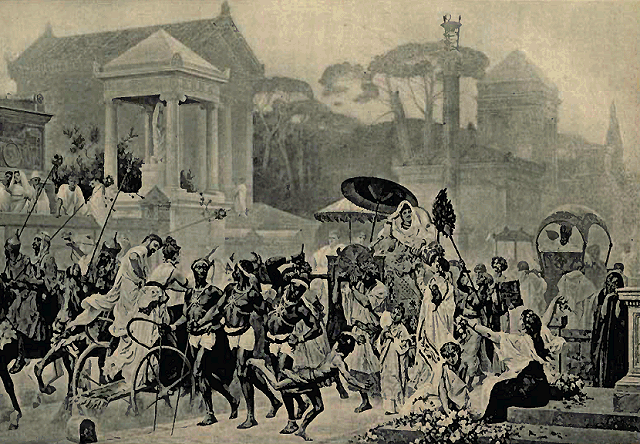
In the new society by which the old order was superseded in Italy, women soon learned how, by means of legal fictions, they might accomplish ends which were still illegal. It is altogether a new woman that we find in the last century of the Republic, taking the place of the old-time matron. She drives on the Appian Way and about the city in an equipage befitting her wealth and position; her naked African slaves wear silver collars and beat off the beggar boys, if she halts to purchase flowers; she entertains in her sumptuous home learned men, with whom she studies the Greek authors; she brings such influence to bear on the Senate as to cause laws to be passed in her favor; she frequently intrigues in matters political; she is not unaccustomed to divorce and remarriage; and, thus engaged, she leaves the spinning of wool, the occupation from time immemorial esteemed honorable by matrons, entirely to her domestics and her slaves.
"If, Romans, every individual among us had made it a rule to maintain the prerogative and authority of a husband with respect to his own wife, we should have less trouble with the whole sex. But now, our privileges, overpowered at home by female contumacy, are, even here in the Forum, spurned and trodden under foot; and because we are not able to withstand each separately, we now dread their collective body.... It was not without painful emotions of shame that I, just now, made my way to the Forum through the midst of a band of women. Had I not been restrained by respect for the modesty and dignity of some individuals among them, rather than of the whole number, and been unwilling that they should be seen rebuked by a consul, I should have said to them: 'What sort of practice is this, of running into public, besetting the streets, and addressing other women's husbands? Could not each have made the same request to her husband at home?. Are your blandishments more seducing in public than in private, and with other women's husbands than your own? Although, if the modesty of matrons confined them within the limits of their own rights, it did not become you, even at home, to concern yourselves about what laws might be passed or repealed here.' Our ancestors thought it not proper that women should perform any, even private, business, without a director; but that they should ever be under the control of parents, brothers, or husbands. We, it seems, suffer them now to interfere in the management of State affairs, and to introduce themselves into the Forum, into general assemblies, and into assemblies of election. For, what are they doing at this moment in your streets and lanes? What but arguing, some in support of the motion of the plebeian tribunes, others for the repeal of the law? Will you give the reins to their intractable nature, and their uncontrolled passions, and then expect that they themselves should set bounds to their lawlessness, when you have failed to do so? This is the smallest of the injunctions laid on them by usage or the laws, all of which women bear with impatience. They long for liberty, or rather, to speak the truth, for unbounded freedom in every particular. For what will they not attempt, if they now come off victorious?
"Recollect all the institutions respecting the sex, by which our forefathers restrained their undue freedom, and by which they subjected them to their husbands; and yet, even with the help of all these restrictions, you can hardly keep them within bounds. If, then, you suffer them to throw these off one by one, to tear them all asunder, and, at last, to set themselves on an equal footing with yourselves, can you imagine that they will be any longer tolerable by you? The moment that they have arrived at an equality with you, they will have become your superiors. But, forsooth, they only object to any new law being made against them; they mean not to deprecate justice, but severity. Nay, their wish is that a law which you have admitted, established by your suffrages, and confirmed by the practice and experience of so many years to be beneficial, should now be repealed; that is, by abolishing one law you should weaken all the rest. No law perfectly suits the convenience of every member of the community; the only consideration is, whether, upon the whole, it be profitable for the greater part.... I should like, however, to know what this important affair is which has induced the matrons thus to run out into public in this excited manner, scarcely restraining from pushing into the Forum and the assembly of the people.... What motive, that even common decency will allow to be mentioned, is pretended for this female insurrection? Why, say they, that we may shine in gold and purple; that, both on festal and common days, we may ride through the city in our chariots, triumphing over vanquished and abrogated law, after having captured and wrested from you your suffrages; and that there may be no bounds to our expenses and our luxury.
"Often have you heard me complain of the profuse expenses of the women--often of those of the men; and that not only of men in private stations, but of the magistrates; and that the State was endangered by two opposite vices--luxury and avarice, those pests which have been the ruin of all great empires. These I dread the more, as the circumstances of the commonwealth grow daily more prosperous and happy. As the Empire increases, as we have now passed over into Greece and Asia, places abounding with every kind of temptation that can inflame the passions, so much the more do I fear that these matters will bring us into captivity, rather than we them. Believe me, those statues from Syracuse were brought into this city with harmful effect. I already hear too many commending and admiring the decorations of Athens and Corinth, and ridiculing the earthen images of our Roman gods that stand on the fronts of their temples. For my part, I prefer these gods--propitious as they are, and I hope will continue to be, if we allow them to remain in their own mansions.... When the dress of all is alike, why should any one of you fear lest she should not be an object of observation? Of all kinds of shame, the worst, surely, is the being ashamed of frugality or of poverty; but this law relieves you with regard to both; since that which you have not it is unlawful for you to possess. This equalization, says the rich matron, is the very thing that I cannot endure. Why do I not make a figure, distinguished with gold and purple? Why is the poverty of others concealed under this cover of a law, so that it should be thought that, if the law permitted, they would have such things as they are not now able to procure? Romans, do you wish to excite among your wives an emulation of this sort, that the rich should wish to have what none other can have; and the poor, lest they be despised as such, should extend their expenses beyond their means? Be assured that when a woman once begins to be ashamed of what she ought not to be ashamed of, she will not be ashamed of what she ought. She who can will purchase out of her own purse; she who cannot will ask her husband. Unhappy is the husband, both he who complies with the request, and he who does not; for what he will not give himself he will see given by another.... So soon as the law shall cease to limit the expenses of your wife, you yourself will never be able to do so. Do not suppose that the matter will hereafter be in the same state in which it was before the law was made on the subject. It is safer that a wicked man should never be accused than that he should be acquitted; and luxury, if it had never been meddled with, would be more tolerable than it would be when, like a wild beast, irritated by being chained, it is let loose. My opinion is that the Oppian law ought, on no account, to be repealed."
The women, however, were not without their champion. In a debate on some ordinary affair of State, Lucius Valerius the Tribune would have been an inconsiderable antagonist for Cato; but, on this occasion, what he lacked in oratorical prestige was atoned for in that he had by far the more reasonable side of the argument. The fact that it was the custom of the Roman historians to compose, rather than report, the addresses of their orators renders any comparison of these two Senatorial speeches on woman's rights entirely uninteresting. Valerius is made to say: "Shall our wives alone reap none of the fruits of the public peace and tranquillity? Shall we men have the use of the purple? Shall our children wear gowns bordered with the same color, and shall we interdict the use of it to women alone? Shall your horse, even, be more splendidly caparisoned than your wife is clothed?" An appeal to the sympathy of the voters is made, as the matrons of Rome are represented as "seeing those ornaments allowed to the wives of the Latin confederates, of which they themselves have been deprived. They will behold those riding through the city in their carriages, and decorated with gold and purple, while they are obliged to follow on foot.... This would hurt the feelings even of men, and what do you think must be its effect on weak women, whom even trifles can disturb? Neither offices of State nor of the priesthood, nor triumphs, nor badges of distinction, nor military presents, nor spoils, may fall to their share. Elegance of appearance, and ornaments, and dress--these are the women's badges of distinction; in these they delight and glory; these our ancestors called the women's world."
The Oppian law was repealed, and Cato, as if he wished to escape the sight of the resulting disasters which he anticipated, took the command of a fleet of war vessels and sailed away to Spain. How the new liberty affected his own wife we are left to surmise; which is not difficult, in view of the opening sentences of his address.
While we are on the subject of the extraordinary fight of the women for the repeal of this sumptuary law, it will not be inappropriate to take a glance at the female dress of the time. There is ample evidence to show that the women of ancient Rome were as prone to changing fashions as are the ladies of our own day; but for several centuries the various parts of their attire remained very much the same, the varying style affecting chiefly the material and the quality. The costume of a Roman lady consisted of three principal garment?,--the under tunic, the stola, and the palla.
The under tunic was simply a sleeveless chemise, which was worn next to the body. Stays, of course, were utterly unknown to the ancients, as is shown by their statuary, which in these times affords us our only opportunity of knowing what a naturally developed female figure is like. A bosom band, or, as it was called, a strophium, made of leather, was frequently worn above the tunic.
The stola was a white garment with sleeves, which covered only the upper part of the arm; it was fastened above the shoulder with a clasp. The stola hung in large folds reaching to and covering the feet; around the bottom was sewn a broad flounce, called the instita. Above this instita was a purple band, which was the only color, other than white, ever used for the stola, except a colored stripe or sometimes gold around the neck. Among the Romans, the stola had a serious significance, beyond its use as an article of attire. Only matrons of unsullied reputation were permitted to wear it. Women of tarnished character were obliged to wear a dark-colored toga, somewhat similar to that of the men; we find Horace speaking of the togata,--in contradistinction to the matrons, and Tibullus writes of the prostitute with her toga.
The palla, the out-of-doors garment, was to the women what the toga was to the men. This was a large, white, and probably square, robe, or mantle,--later on, colors became fashionable,--and the complex manner of wearing it may best be understood by an examination of Roman statuary. The feet were protected by sandals in the house, and shoes for street or public wear; these were greatly ornamented. The shoes were of various colors, generally white, but frequently green or yellow, and fastened with red strings.
The Roman ladies, like those of modern times, exercised great care in the dressing and arranging of their hair; and it is not to be denied that they frequently sought, by artificial means, to rectify mistakes which they deemed nature had made in the selection of color. In the time of Juvenal, blonde seems to have had the preference. The ordinary style was to carry the hair in smooth braids to the back of the head and there fasten it in a knot, as usually seen in the statues. In ancient Rome the curling iron was no less an intimate and indispensable friend of the lady of fashion than it is at present; by this and other means, too intricate for explanation by the uninitiated, marvellous creations were produced. The satirist says: "Into so many tiers she forms her curls, so many stories high she builds her head; in front you will look upon an Andromache, behind she is a dwarf,--you would imagine her another person." History reveals no age in which attention to personal adornment was not such an intimate characteristic of female nature that women, when unendowed with remarkable beauty, have been able to refrain from unwisely seeking to attract notice by disfiguring themselves.
The Roman women wore ornaments in considerable profusion. These consisted principally of necklaces, arm bands, finger rings, and ear rings. Generally they were of gold, set with precious stones, and the workmanship was often of a most exquisite character. A necklace was found at Pompeii which was made of a band of plaited gold; on each half of the clasp there is a well-executed frog, and on the edges where the clasp joined were rubies, one of which still remains in its setting; suspended to the necklace are seventy-one small, artistically shaped pendants. Very many specimens of the jewelry worn by the women of ancient Rome are still in existence, and they indicate fine artistic taste on the part of the wearers, as well as great ability in design and execution on that of the makers.
On the dressing table of the fashionable Roman lady there appeared a wealth and a variety of cosmetics and costly essences in boxes and receptacles delicately formed of ivory and precious metals, as well as many other appliances for the toilet; so that her advantages in these respects were probably in no way inferior to those of her fair successors in modern times. An age was drawing near which, among many other examples of its monstrous luxuriousness, gave birth to efforts to enhance feminine attractiveness--efforts which doubtless were as futile as they were foolish.
The time, however, had already come when, notwithstanding that their manners were under the eye of such a censor as Cato, the women of Rome had entirely and forever abandoned their old simplicity of life. In the Epidicus of Plautus, written at about the time of the disturbance over the Oppian law, the matrons were represented on the stage as though decked out with valuable estates; the cost of a cloak was the price of a farm.
The new woman had begun to make her appearance in Rome. This proverbial phenomenon, so greatly talked of in our own time, is by no means a modern discovery. She is a principal and an inevitable accompaniment of progress in every age and race. She is either a natural evolution or a monstrosity, according to the social conditions of her time. When progress is normal and national development healthy, a more enlightened and more sanely independent type of woman is continually appearing; but so naturally and so quietly does she step into the higher position for which she has been enabled to prepare herself that her coming is without observation. On the other hand, where society is decadent, where abnormal growths are favored by the heat of unrestrained passions, and where volcanic revolutions in a nation may exalt characters which belong to the shades of inferiority to positions of high conspicuity, there appear feminine wonders upon earth; and men's hearts fail them for fear, as they await with consternation the things which are shortly to come to pass. Rome, during the latter years of the republican period, was in a condition favorable to the production of anything bizarre and phenomenal. The new wealth, the new learning, the new idleness, and the new vices were fit soil for the production of a new woman who would astonish the world for all time with her capacity for every excess of moral insanity.
We do not, however, mean to allege that with the greater privileges and increased freedom which entered into woman's life the old virtues and time-honored excellences entirely disappeared. As Cornelia graced with her learning and dignity the Rome of Cato's day, so did Cæcilia with her charity and her goodness the Rome of Cicero. That orator was undoubtedly prejudiced in her favor on account of the great kindness she showed to Roscius, his client; but he could not have eulogized this matron as he did, had not public opinion concurred with him in setting her up as a model for all other women. "An incomparable woman," her accomplished relations had no less honor conferred on them by her character than she received by their dignity. Thus an unbroken chain of noble-minded matrons may be traced through the darkest days of Rome's decadent morality. Nevertheless, though virtue did not cease to be exemplified by the few, or to be extolled by the writers, the growing depravity of the times made it constantly easier for unprincipled and impudent women to find their conduct accepted as the ordinary rule of life.
One chief cause--perhaps it is more correct to call it an accompaniment--of the breaking-down of the ancient ideals is found in the increasing tendency to deprecate the indissolubleness of marital bonds. Divorce became common and easy, so that the student of Roman biography finds it increasingly difficult to trace his characters through the many involutions of their various matrimonial alliances. Pompey married five times. Concerning his first two wives, Plutarch makes the following comment: "Sylla, admiring the valor and conduct of Pompey, ... sought means to attach him to himself by some personal alliance, and his wife Metella joining in his wishes, they persuaded Pompey to put away Antistia, and marry Æmilia, the stepdaughter of Sylla, she being at that very time the wife of another man, living with him, and with child by him. These were the very tyrannies of marriage, and much more agreeable to the times under Sylla than to the nature and habits of Pompey, that Æmilia, great with child, should be, as it were, ravished from the embraces of another for him, and that Antistia should be divorced with dishonor and misery by him for whose sake she had just before been bereft of her father--for Antistius was murdered in the Senate because he was suspected to be a favorer of Sylla for Pompey's sake. Antistia's mother, likewise, after she had seen all these indignities, made away with herself, a new calamity to be added to the tragic accompaniments of this marriage; and that there might be nothing wanting to complete them, Æmilia herself died, almost immediately after entering Pompey's house, in childbed."
Down to a very late date, a divorce is not met with in the annals of Rome; but with what unconcern the undoing of the marriage knot came to be regarded is well illustrated in the life of Cato the Younger. Attilia, his first wife, was put away for misconduct. Then he married Marcia, against whose reputation no blighting wind of scandal ever raged. Among the dearest friends of her husband was Hortensius, known as a man of good position and excellent character. Evidently, as the sequel shows, in all seriousness he sought to persuade Cato that the latter's daughter Portia, who was married to a man to whom she had borne two children, might be given to him. His argument was that she, as a fair plot of land, ought to bear fruit; but that it was not right that one man should be provided with a larger family than he could support, while another had none. Cato answered that he loved Hortensius very well, and much approved of uniting their houses; but he could not approve of forcibly taking away his daughter from her husband. Then Hortensius was bold enough to request that Cato, who, he thought, had enough children, should relinquish to him his own wife. Cato, seeing that he was in earnest, consented to do this, stipulating first that his wife's father should be consulted. No objection being raised in that quarter, a marriage was performed between Marcia and Hortensius, Cato assisting at the ceremony. In all this there is no mention made of Marcia's consent being given or even asked. Some years afterward, Cato, wanting someone to keep his house and take care of his daughters, took Marcia again, Hortensius being now dead and having left her all his estate. Cæsar, upon this, reproached Cato with covetousness; "for," he said, "if he had need of a wife, why did he part with her? And if he had not, why did he take her again? unless he gave her only as a bait to Hortensius, and lent her when she was young, to have her again when she was rich." The historian answers this by quoting the verse of Euripides:
'To speak of mysteries-the chief of these Surely were cowardice in Hercules.'
"For," he says, "it were much the same thing to reproach Hercules for cowardice and to accuse Cato of covetousness." The explanation of this singular action, the cold nature which Cato inherited from his grandfather the Censor being taken into consideration, seems to lie in the fact that the Roman idea of the necessary guardianship over women precluded any just conception of their rights in the disposal of their own persons. The giving and the taking of a woman in marriage was wholly the business of her father and her suitor; nothing was required of her in the transaction save thankful obedience. Cato was perfectly at liberty to give away his wife, if he so desired; this right was guaranteed to him by the simple fact that she was his property.
For the same reason, while chastity on the part of the wife was regarded as an absolute essential, the same virtue was by no means considered as necessary to the good character of the man. The demand for purity in the wife was largely based on the idea of proprietary rights which the husband had in her person; hence the man could divorce the woman for infidelity, but the reverse was not conceded. Plautus introduces upon the stage two matrons, one of whom complains of her husband, and the other consoles and exhorts her thus: "Listen to me. Do not quarrel with your husband; let him love whom, and let him do what, he pleases, since you have everything you want at home; keep in mind the fearful sentence: 'Begone, woman!'"
The new era which had dawned in Rome brought a certain freedom of circumstances and activity within the reach of women; but it did not give them in the marriage contract any more liberty than they had of old. The only women who were allowed the disposal of their own persons were the courtesans. There are many evidences that these were not regarded with the disrespect in which their class is held in modern times. For an example, Flora, who was famous in the last days of the Republic, received on account of her exquisite beauty the high honor of having her statue dedicated to the temple of Castor and Pollux; which may be regarded as a kind of precedent for artists who in an Italy of a much later date employed their mistresses as models for their Madonnas. That this class of women did not hesitate to place a high value upon themselves is proved by the instance of Tertia, to whom Verres presented a Sicilian city. Lucretius speaks of the cost of their favors, giving us also an interesting picture of the gayly dressed wanton:
"Amply though endowed. His wealth decays, his debts with speed augment, The post of duty never fills he more, And all his sick'ning reputation dies. Meanwhile rich unguents from his mistress laugh, Laugh from her feet sott Sicyon's shoes superb; The green-rayed emerald o'er her, dropt in gold, Gleams large and numerous; and the sea-blue silk; Deep-worn, enclasps her. What his sires amassed Now flaunts in ribbands, in tiaras flames Full o'er her front, and now to robes converts Of Chian loose, or Alidonian mould; While feasts and festivals of boundless pomp, And costliest viands, garlands, odors, wines, And scattered roses ceaseless are renewed."
The Voconian law, which had been enacted in the days of the elder Cato, the purpose of which was the prevention of large accumulations of property in female hands, did not prevent women from becoming rich in the manner suggested above. A man might give away all his property while alive; the law only vetoed excessive legacies. By its provisions, no woman was allowed to receive by inheritance property exceeding the value of one hundred thousand sesterces. "Since with the growing power of the Empire the riches of private persons were increasing, fear was felt lest the minds of women, being rather inclined by nature to luxury and the pursuit of a more elegant routine of life, and deriving from unbounded wealth incentives to desire, should fall into immoderate expenses and luxury, and should subsequently chance to depart from the ancient sanctity of manners, so that there would be a change of morals no less than of the manner of living." These were the reasons for the enactment of this measure. It was the kind of law which was dear to the heart of the Censor, and it was with great delight that he lent his aid to its passage. The people were a little doubtful as to its justice; but Cato put an end to all hesitation by inveighing, with his usual asperity, against the tyranny of women and their insufferable insolence when opulent. He complained that oftentimes, when they brought a rich dowry to their husbands, they kept back a large part of the money, and then made loans to their husbands as though these were mere debtors. The historian says that this assertion, enforced with a loud voice and good lungs, moved the people to indignation, and they voted to pass the law. It was exceedingly characteristic of the sentiments of the ancient Romans to be convinced by Cato as he strenuously objected to that in women which he strongly advocated as a rule for men.