Volume 2 — Illustrated
Reading edition
PHILADELPHIA GEORGE BARRIE & SONS, PUBLISHERS
PREFACE
The student of history does not proceed far in his researches before he discovers that human nature is a fixed quality. Other lands, other manners; other times, other customs. But the man behind the manner is essentially the same; the woman under the changed custom is not thereby rendered essentially different, any more than she is by a varying of costume. The women of ancient Rome exemplified the same virtues, and were impelled by the same foibles as are the women of to-day. And the difference in environment, the vanished conditions of Roman life, gain large scientific interest from the fact that they did not result in any dissimilarity of fundamental character. If, by the most violent exercise of the imagination, it were possible to transport a female infant of the twentieth century, and cause her to be reared among the women of the Augustan age, she would fit as naturally into her surroundings as she would into the present society of London or of New York. Her legal status would be different; her moral conceptions would be unlike those of the present age; her duties, pleasures, privileges, and limitations would combine to make the accidents of life very different. But underneath all this, the same humanity, the same femininity, the same habits of mind are revealed. Herein is the chief use of history--above that of gratifying natural curiosity--the ascertaining how human nature will comport itself under varying conditions. The author hopes that the following pages, wherein the Roman woman is taken as an illustration, will be found of use to the student of the science of humanity, and not uninteresting to the reader inquisitive as to the manner of the ancient civilization. ALFRED BRITTAIN.
I
THE WOMAN OF LEGENDARY ROME
The conditions which governed the life of woman in the earliest days of Roman history are too far removed from the searchlight of historical investigation for us to essay to indicate them with any degree of fulness and accuracy of detail. While it is true that the ancient writers have bequeathed to us records of historic events from the very founding of their nation, the source of their information is very questionable and its authenticity extremely doubtful. Rome did not cultivate literature until very late in her history; she was too greatly preoccupied in her rôle of conquering the world. At a time when every Greek was acquainted with the noblest poetry produced by his gifted race, Rome had not produced a single writer whose name has been preserved. And if at that time she had possessed any men of letters, it is quite certain that there were few of her citizens who would have been able to read their works. Hence, when the first attempt was made to write her history, the authors depended principally for their material on traditions and legends which, as is the case with all such lore, had gained greatly in marvellousness at the expense of historical value. In addition to these sources, it is probable that during the early centuries annals were kept of the principal happenings in the State. According to Cicero, they were written at the end of each year by the high priest. These records were used by the first historians; and it is likely that the latter were not so greatly restrained, by their literary conscience, from enlarging on the material, as they were tempted, according to the power of their imagination, to present a picture both interesting and satisfactory to the national pride. In many cases, as where the exact words of their characters are reported, the ancient historians evidently deemed that any deficiencies in the matter of proof were abundantly atoned for by the explicitness of the information given.
As to the historical value of legends, that is a question upon which modern writers are inclined to disagree. Since the inauguration of the higher criticism, it has been the fashion for extremists entirely to disown any belief in the dramatis personæ of ancient traditions. They claim that the names and the actions thus celebrated usually represent natural forces and historic evolutions; though, to the ordinary student, this would seem to require a remarkable amount of poetic inventiveness on the part of an undeveloped people. Moreover, it is not, perhaps, without reason that the student often looks upon the manner in which modern scholars reject the traditional contributions of the old historians as being a little arbitrary. What traveller has not found his patience sorely tried, while viewing with reverence the reputed site of some heroic or sacred occurrence of far-off days, as he recalled to memory the fact that the latest authorities hold that, while the thing might have taken place a few miles to the east or a short distance to the north, it, for certain erudite but unconvincing reasons, could not possibly have occurred on the spot where it has been located by the continuous belief of centuries?
The story of Rome from its founding to the end of the regal period, as it is told in the ancient classics, is no longer accepted as history. It is, for the most part, classified with those mythical creations with which an uncultured people endeavor to account for the origin and the evolution and revolutions of their race. Yet, passing over the marvellous and the manifestly impossible, why may we not at least claim the right to believe the compilers of these ancient legends, when they tell us of certain names that were great in the beginning of their nation? Modern criticism may be right in asserting that it is not likely that the city on the Tiber was called Roma because a man named Romulus selected an uninhabited site and built upon it. Yet why may we not be allowed to believe that in those early times there was one hero so strong and masterful that he came to be known as preëminently the "Man of Rome"? The character may have been a real one, even though the city gave him his name, instead of the reverse, as later generations surmised. And inasmuch as there is an Alexandria, not to speak of innumerable modern "villes" with well-known surnames for prefixes, it need not be thought a thing entirely incredible that the ancient city was really called after the man who established its importance.
It is the habit of modern historians to look with suspicion upon stories such as those which form our sole material for any personal illustration in this present chapter, because they are of a kind so generally found in the legends of all nations. But may not the multiplication of these long-lived narratives, instead of disproving the intrinsic truth of any given one, simply serve to illustrate the fact that, human nature being a permanent factor, the doings of men under similar circumstances, in any age or locality, will be marked by a uniformity of character? For our present purpose, however, if in such twilight as is given by long-preserved monuments and ancient relics, we choose to fancy that we perceive, moving about in their daily life, the feminine forms of traditional lore, the combination will only serve to form a more human, and really not less accurate, picture.
The limits of our subject do not require that we should go back so far as the epoch of Æneas, the hero of Troy; nor need we take into consideration the part which he and Lavinia, his wife, may have played upon the Latin shores. Their traditional coming to Italy simply serves to indicate the fact that nearly all the tribes which inhabited the country at the commencement of Roman history were of the same branch of the great Aryan race as the Greeks. The Romans were the brothers of the Greeks. The former were of that same lithe, supple-bodied, straight-featured type which the wonderful art of the latter has enthroned, for all the ages, as the noblest realization of ideal physical beauty.
But when we consider the rude conditions under which life was passed, it is probable that the highest examples of feminine grace would, in many respects, be open to severe criticism from the civilized and artificial taste which has prevailed in after ages. Those were the days of Arcadian simplicity, which poetry has peopled with sweet and enticing Phyllises and Chloes, whose only occupation was to listen to the pipings of languishing shepherds. But, in reality, though life was simple and wants were few, the women, as in all semi-civilized communities, gave an overplus of labor in return for the special exertions of the men in the chase and the combat. Hence, though the poetic conception may be alluring, we are compelled to believe that the reality possessed but few advantages that could arouse the envy of a modern village maiden. The woman of earliest Rome was wholly a product of nature, endowed only with the unfailing charms of femininity, which were solely reinforced with the perfect health and vigor which come from a simple life.
Of such a type we may imagine Rhea Sylvia, the legendary mother of Romulus and Remus. She was the daughter of a king, but one who was not a monarch in the later significance of the title. Of kings there were many in the Latium of those days. The title meant merely the patriarch of a clan, or the head man of a small city. The regal abode was probably a small, round structure, built of wood and roofed with straw. It may have consisted of only one room, with a hole in the ceiling to admit light and allow the smoke to escape. Of furniture there was little more than rude tables and grass or leaf covered couches, together with the Lares, or household gods. But though life conditioned by such meagre accessories was simple, it was by no means idle, and there existed no such contempt for labor and handicraft among the Latin tribesmen as grew up in later times. The king himself followed the plow, while his wife and daughters were busy with the distaff and spindle, the hand loom and the needle. It was the duty of the women to spin the wool and to make all the clothing for the household. Education consisted solely of the training in the requirements of this simple life, and was provided by no school other than the daily experience which the boys and girls gathered among their elders. The art of writing was in the earliest days not entirely unknown, though, during long years of slow development, it was employed only in painting public records on leaves and skins; or, if greater permanence was required, the records were scratched upon tablets of wood. The amusements of the people consisted mainly of the festivals and athletic games which were held in honor of the gods. If it might only be believed that this life was as pleasant as it is pictured by Virgil, it would be easy to sympathize with the poet when he declares that he pined for such an existence himself. "The husbandman cleaves the earth with the crooked plow.... Winter comes: the Sicyonian berry is pounded in the oil presses; and the autumn lays down its various productions.... Meanwhile, the sweet babes twine around their parents' necks; his chaste family maintain their purity. The swain himself celebrates festal days; and extended on the grass, where a fire is in the middle, and where his companions crown the bowl, invokes thee, O Lanæus, making libation. On an elm is set forth to the masters of the flock prizes to be contended for with the winged javelin; and they strip their rustic bodies for the friendly struggle." Elsewhere the poet describes a home scene, where the man is working by the light of the winter fire: "Meanwhile, his spouse, cheering by song her tedious labor, runs over the webs with the shrill shuttle; or over the fire boils down the liquor of the luscious must, and skims with leaves the tide of the trembling cauldron. This life of old the ancient Sabines followed; this, Remus and his brother strictly observed; thus Etruria grew in strength; and thus too did Rome become the glory and beauty of the world."
Unlike their sisters of Greece, the women of Rome were never secluded; yet their duties and responsibilities were strictly confined to domestic bounds. Here, however, while the husband was master, the wife was mistress. She took equal part with him in the worship of the family Lares, which worship was a prominent feature in every Roman household; and if he were a priest, she, by her marriage to him, became a priestess. But, except in certain religious institutions, she had not the slightest active connection with State or public affairs. That is, she had no such connection in theory and according to law; but it was in Rome as it has been in all ages and in all countries: there were no laws or customs that could prevent a woman who possessed gifts of mind and cherished ambitious projects from gaining some tool by means of whom her hand might turn the affairs of State to her will.
To this strenuous class of women, however, Rhea Sylvia did not belong. Her euphonious name has been preserved, not because of any active influence which she wielded over the destinies of men, but because, through the simple function of motherhood, she introduced into the history of the world a strong man. She was the daughter of Numitor, to whom his father had bequeathed the kingdom of the Sylvian clan. But Amulius, another son, had driven his brother into exile, and, in order to secure himself in his usurpation, had put all his nephews to death. Rhea was spared, probably on account of the fact that the law did not allow women to reign, and hence her existence held no threat. Nevertheless, since of the women of princely houses are born possible claimants to thrones. Amulius deemed it best that some preventive measure should be taken. He evidently did not wish to commit unnecessary barbarities; and he also liked, if possible, to cover his self-protective actions with a gloss of seeming generosity. Rhea Sylvia should be the priestess of Vesta. Hers should be the honorable duty of guarding the perpetual fire which burned on the sacred hearth of the city. Thus she, as was befitting the daughter of Numitor, would be held in as high regard among the people as the queen herself. Incidentally, this would also preclude the possibility of any grandson appearing to claim the throne of the exiled Numitor; for the Vestals were most rigidly pledged to a life of constant virginity. But how often have the gods, and sometimes even Nature herself, thwarted the most cunningly devised schemes of men! Upon this truism Amulius must have reflected, when, without any previous declaration of her intention, Rhea Sylvia introduced to the community a sturdy pair of twins. She declared that Mars was the father of her offspring; either, as Livy discreetly remarks, because she believed it to be so, or because a god seemed the most creditable author of her offence. In those times, the possibility and the frequent occurrence of such matches were devoutly believed, and the first historians freely availed themselves of this belief to enhance the glory of their race, or of a powerful family, by establishing for it the reputation of a divine origin. The idea of superhuman parentage was also a convenient means by which to account for, and sometimes excuse, the unusual character and extraordinary deeds of ancient heroes. In those days, when men's faith was simple and uncritical, belief in divine incarnation presented no serious difficulty.
It is evident, however, that Amulius was not greatly impressed with a sense of the sacredness of the children of the warrior-god. He threw the mother into prison, and ordered her sons to be drowned in the Tiber. But, as is usually and fortunately the case in legendary history, this order was intrusted to one who was either too pitiful or too careless to give it thorough execution. The infants, in their cradle or upon a rude raft, were set afloat on the river, which was at that time in flood; the waters, however, quickly subsided, and the boys were left alive on dry ground. Their cries attracted a shepherd named Faustulus, and by him they were carried to his home, where they were reared by his wife Laurentia. This woman is given a bad name by the ancients. They say that she was also called Lupa; and Lupa being the name applied to a woman of unchaste character, as well as the term used to designate a she-wolf, in this manner the sceptics accounted for the marvellous story of the sons of Rhea being suckled by a wolf. But whatever may have been the failings of Laurentia, if there be any truth whatever in the legend, she made atonement by preserving the life of the founder of Rome. We will not follow these traditions in their well-known details. Whether or not Romulus was indeed the first to select the site of the city which was to spread over seven hills by the Tiber and from them dominate the world is as impossible to determine as it would be unimportant to our subject if ascertained. The purpose before us is solely to inquire what part and lot woman had in the founding of the infant State. That her rôle was mainly a passive one may be taken for granted, as being in accordance with the status of the weaker sex in the childhood of every race and nation.
The ancient historians, who accepted the Romulus legend without question, portray for us the growing town, so sturdily and rapidly advancing in power and fame as to excite the wonder and the jealousy of neighboring communities. One cause to which is attributed this prosperity is interesting, since it led to a famous episode in which women played a leading though an unwilling part. We are told that Romulus opened within, the bounds of the city an asylum, or place of refuge, where fugitives from justice or from servitude were received under the protection of the gods. This attracted new citizens in great numbers, but such as contributed nothing to the respectability of the new State. The new-comers were, almost entirely, unmarried men; and soon the paucity of women in Rome gave cause for grave concern. Romulus had appointed a number of the leading citizens, whom he named as Senators, to assist him in the government. But it was not in the power of these city fathers to aid him materially in securing a continued growth of the community, unless wives could be provided. Ambassadors were despatched to the neighboring States, requesting treaties of alliance, and especially begging the privilege of intermarriage. Owing, doubtless, to the questionable character of the newly acquired inhabitants of Rome, this was a favor which no city was disposed to grant. Everywhere the ambassadors were confronted with the suggestion that an asylum be opened for women also, for only by such a plan could suitable mates be obtained for the men of Rome. Another reason, however, why wives were hard to obtain was the fact that women were comparatively scarce throughout Latium. The custom of exposing female infants to death was prevalent there, as in many other ancient races, daughters being looked upon as a source of weakness and expense to a family, as sons were a gain and a strength. Wives, however, being a necessity, the fathers of boys often secured as brides for their sons girls as soon as they were born. This laid upon the parents of the latter the obligation to spare their lives and rear them. There is no evidence that the purchase of wives was ever a custom among the Romans. Indeed, the opposite was from time immemorial the practice; a dower went with the bride. Hence it is easy to see why the Latin fathers were unwilling to bestow their daughters,--who were not likely to remain on their hands for lack of suitors,--and especially the dowers that went with them, upon the adventurous young men who had sought at Rome asylum from justice or vengeance.
But in those ages, and especially in such a matter as the winning of wives, diplomacy was a resource not wholly depended upon. Among the marriage ceremonies of later times, there was a custom of parting the hair of the Roman bride with a spear. In this we find a reminiscence of the period when marriage by capture was resorted to when there seemed urgent necessity. Thus Romulus determined that what could not be gained by fair means should be obtained by the best method which came to hand. At the festival of the god Consus, appropriately the deity who presided over hidden deliberations, the seizure of the Sabine maidens was planned and carried out; and thus the Romans took to themselves wives. How closely this well-known story corresponds with facts, of course, cannot be determined. Possibly many of its details are attempts of later ages to account for wedding customs, the origin of which had been forgotten. But it is very probable that marriage by capture was common in the embryonic civilization of early Rome. And there may have been one occasion when this rude method of wooing was adopted in so flagrant and wholesale a manner that it led to a war with the Sabines, by which the remembrance of the event was perpetuated in the traditions of the people. Michelet, commenting on this story in his brilliant manner, says: "The progress of humanity is striking. Springing in India from mystical love, the ideal of woman assumes in Germany the features of savage virginity and gigantic force; in Greece, those of grace and stratagem, to arrive among the Romans at the highest pagan morality, to virgin and conjugal dignity. The Sabines only follow their ravishers on compulsion, but, become Roman matrons, they refuse to return to the paternal mansion, disarm their fathers and their husbands, and unite them in one city." Plutarch says that it was in order to obtain forgiveness that the Romans assured certain privileges to their wives. No labor other than spinning should be demanded of them; they should take the inside of the path; nothing indecent should be done or said in their presence; they should not be summoned before the criminal judges; and their children should wear the pretexta and the bulla. Thus in the time of the Greek historian the barbarism of the old times was forgotten, and to the primitive constitution was attributed all the civilization which it required centuries to bring about.
As fair Helen brought woe to Troy, so the abduction of the Sabine maidens was followed by the bitter vengeance of their indignant masculine relatives. If we may believe the old historians, the women soon became reconciled to their enforced condition as wives of the Romans. Doubtless the writers drew this conclusion more from their knowledge of the yielding disposition of feminine nature than from any precise acquaintance with the facts. It being totally uncustomary for the woman to be allowed any decision in the matter, it was a thing of small importance to her whether she was taken by her husband, without either her consent or that of her father, or whether she was given by her father to her husband, equally without being consulted.
The Sabines waited patiently for a favorable opportunity; and when it came, they attacked the Romans with good success. They even gained possession of the strongest fortifications of the city. But, according to the legend, they could not have won such advantage had it not been for the love of gaud of Tarpeia, the daughter of one of the captains of Romulus. Tatius, the King of the Sabines, induced her to open for him the gates, promising as a reward the golden bracelets which his soldiers wore upon their left arms. It is noticeable that the difficulties which must have surrounded an interview between the king and the maiden are discreetly ignored by the tradition. She agreed to open the gate, on the pretence of going forth to draw water for the sacrifice, and the Sabine men were thereupon to rush in. Everything took place as arranged, except that the misguided Tarpeia received much more than she had bargained for. Her request was for "that which they wore upon their left arms," not remembering the fact that upon that arm they also carried their shields. The soldiers, as they entered, either through haste, or because they hated treachery though willing to avail themselves of it, threw at her their shields as well as their bracelets, and the girl was crushed to death beneath their weight. A part of the hill which the Sabines thus gained was ever afterward called the Tarpeian Rock; and it became a place of execution, traitors being hurled from its summit. There is much about this story which justifies the suspicion that it arose from, or at least was adopted by, a desire on the part of the Romans to explain a defeat, rather than from any verifiable historical foundation. It looks like a case of the natural vanity of warlike men saving itself by means of an ungallant slur on the characteristic vanity of women.
Taking the account as it stands, matters were now very serious for the Romans. The enemy had gained the citadel, and a bloody conflict ensued. But the women whose abduction had brought on these troubles were also to be the means of making peace. As the battle was raging, the two armies were astounded to behold the Sabine women rushing from the homes of the Romans, not to make their escape, but to throw themselves between the combatants. With tears, they entreated their fathers and brothers to hear them. Their plea was voiced by a captive named Hersilia, who some historians hold was the wife of that Hostilius who afterward became King of Rome, while others claim that she had been taken by Romulus himself. Plutarch gives us her speech--of course, drawing from his own imagination, though he is not far from what might have been the truth; for anyone may guess what would be likely on such an occasion. She said: "It is true we were ravished away unjustly and violently by those whose wives we now are; but that being done, we are bound to them by the strictest bonds, so that it is impossible for us not to weep and tremble at the danger of the men whom once we hated. You now come to force away wives from their husbands, and mothers from their children. Which shall we call the worse, their love making or your compassion? Restore to us our parents and kindred, but do not rob us of our husbands and children. We entreat you not to make us twice captive." Whereupon, the Sabines learning that their daughters were not yearning to be rescued, and having no other good reason for carrying on the fight, a truce was declared. With a zealous determination to leave nothing unaccounted for, the tradition relates how the women took their kindred into the city and proudly exhibited the comforts and indulgences they enjoyed with their husbands, whose wooing had been so unmannerly. This might well be, as the Sabines were a pastoral people and unaccustomed to what were to them the luxuries of city life. So peace was made; and we are told that it was in commemoration of this event that the ladies of Rome ever afterward celebrated the festival of the Matronalia on the first of March. It was their custom to ascend in the morning in procession to the temple of Juno, and place at the feet of the goddess the flowers with which their heads were crowned. In the evening, in memory of the tokens of gratitude which the Sabine women received from their Roman husbands, they remained at home, adorned in their best attire, waiting for the customary gifts of their husbands and friends. At a date far later, we find Tibullus debating with himself, in an exquisite little poem, what gift he shall send to his beloved Neæra on the Calends of March. With the customary valuation which an author sets upon his own productions, he decides that he can give her nothing more acceptable than a copy of his poems, beautifully bound and adorned.
Every nation has its traditional Golden Age, a period to which the poetic philosophers of degenerate after times love to refer in the assumption that then all things were at their best and men were perfectly happy. So all Roman ideals of civic concord are concentrated in and derived from the legendary reign of Numa Pompilius. He is described as not seeking the kingdom, but preferring the pleasures of reflection in a quiet life with Tatia, his like-minded and noble wife. But the honor was forced upon him, and he reigned in the spirit of a true philosopher. He formulated laws and established a system of morals in accordance with principles worthy of Marcus Aurelius. To him is given the credit of organizing the religious institutions of the Romans, and especially the college of Vestal Virgins. We have seen that, before his time, to certain maidens was assigned the duty of guarding the sacred fire, and at the same time their virgin purity. But Numa was said to have formulated the rules of the order, to have assigned precisely its duties, and to have built a house for Vesta. But there is not the least doubt that around the name Numa have clustered, and to him have been attributed, many advances in civilization which were the growth of centuries. This seems especially probable in view of the fact that Numa was a Sabine, one of the pastoral race which was naturally less advanced in culture than the people who were gathered in cities.
What improvement may have found its way into the conditions of feminine life during this period, it is difficult to determine. The useful arts are said to have grown greatly in favor. Numa is credited with having instituted guilds for the encouragement of flute blowers, goldsmiths, coppersmiths, carpenters, fullers, dyers, potters, and shoemakers. Life would thus become more comfortable, and also be brightened by that which was pleasurable and ornamental. This supposes an enlargement of the sphere of the home, a consequent increasing of the interests and responsibilities of the women, and a softening effect upon their nature. There is also an indication that, as in ancient Germany, though the women may have had no part in the direct government of the State, yet the counsels of certain of their sex were followed by the lawmakers with a reverence akin to religion. There is a strong suggestion of feminine influence in the legends concerning the marital relations of Numa. Plutarch relates that Tatia, Numa's estimable first wife, was separated from him by death after thirteen years of wedded felicity, and that after this he never married again, but sought to console himself by melancholy ramblings in the fields and woods. This gave rise to the story that, in a certain grove, he was accustomed to meet the goddess Egeria, who not only favored him with her love, but also endowed him with the wisdom to perform his duties with marvellous success. On the other hand, Livy, who probably knew neither more nor less about it, says that Numa consecrated this grove, with its grotto and spring of living water, to the Muses, who were accustomed there to meet his wife Egeria. Whether this Egeria is to be regarded as a mortal woman, perhaps the lawful wife of the king, or, what is considerably less likely, a divine being, cannot be decided from these traditions. But they surely have a value in that they indicate the willingness of the earliest Romans to attribute excellence in statesmanship on the part of their best men to the inspiration of members of the fair and gentle, sex.
After the death of Numa, the Romans elected as their king Tullus Hostilius, and thus a turbulent warrior succeeded the peace-loving lawgiver. In this reign, instead of the poetic anachronism which portrays an abnormally advanced civilization, we are brought back again to earth and to history and to a more accurate description of the progress of the people. Much is revealed in the story by which Livy, in his inimitable manner, accounts for the Sororium Tigillium, or the Sister's Post, a monument which he says was existent in his own day. Here we not only encounter the terrible right of the father of a family over the lives of his children, but we also see that the tender instincts of a woman's love were accounted as nothing in comparison with loyalty to the family and her duty of hatred to the enemies of the State. The heroic Horatius, single-handed after the death of his brothers, had slain the three champions of the Alban army, and thus provided the first taste of the delight of subjugation to the city which was destined to become the mistress of the world. In the triumphal return to Rome, Horatius marched foremost of all the army, carrying before him the spoils of the three Alban brothers. As they neared the Porto Capena, the Roman women came forth to welcome the victors home. Among the rest came Horatia, the sister of the youthful conqueror. As she ran to embrace him, she noticed upon his shoulder a familiar robe; in fact, it was a soldier's tunic which she had wrought with her own hands for one of the vanquished Curiatii, to whom she had been betrothed. The truth flashed upon the damsel's mind in an instant. Her lover was dead, and that by the hand of her brother. With tears and lamentations, she began to call upon the name of her betrothed. Possibly with her cries of grief she joined bitter upbraidings of her brother, who had saved himself and Rome at the cost of her bereavement. His sister's lamentations, in the midst of his own triumph and the great public rejoicing, so greatly angered the excited youth that he drew his sword and stabbed her to the heart. As he did this, he cried: "Go with thy unseasonable love; go and rejoin thy betrothed, thou who forgettest thy dead brothers, and him who remains, and thy country! So perish every woman who shall dare to lament the death of an enemy!" This atrocious murder raised, of course, a profound sensation among the people. They did not know which ought to outweigh the other: his awful crime or his brilliant exploit for the public good. The king appointed duumvirs to try him. By these he was condemned to be beaten with rods, within or without the walls of the city, and then to be hanged.
But the law gave to Horatius the right of appeal to the people, and in this second trial he found an effective advocate in his own father. The old man declared that he considered his daughter deservedly slain. Were it not so, he said, he would by his own authority as father have inflicted punishment on his son. It seems probable, however, that Horatius senior took this course of argument, not because he did not regret his daughter, but because he hoped thereby to save himself from being bereft of all his children. "Go, lictor," he said, "bind those hands which but a little while since, being armed, established sovereignty for the Roman people. Strike him within the town, if thou wilt, but in presence of these trophies and spoils; without the town, but in the midst of the tombs of the Curiatii. Into what place can you lead him where the monuments of his glory do not protest against the horror of his punishment?" The tears of the father and the intrepidity of the son won for the latter absolution; but the father was commanded to make expiatory sacrifices, and these were ever afterward continued in the Horatian family. As a further punishment, a beam was laid across the street and the young man made to pass under it, with veiled head, as under a yoke.
Chronologically, this seems to be the appropriate place to introduce some reference to another race which, to no small extent, affected the early history of Rome and also the status of the Roman woman. From Etruria came the ancestor of the Tarquins, that proud dynasty which provided two legends of the extreme opposite types of women: Tullia, the cruel and ambitious queen, and Lucretia, the ideal of conjugal faithfulness. Tanaquil, the never-forgotten helpmeet of an able man, also came from this people.
The Etruscans have ever been a puzzle to historians and one of the principal enigmas in ethnology. Entirely unlike the Hellenic or Italiote races in appearance as well as in customs, even the ancients were at a loss to surmise whence this remarkable people originated. Dionysius says, "they claimed alliance with no people in the world." Inquiry regarding them would not be so interesting, were it not that they have left such an abundance of proofs of their proficiency in art and advancement in civilized industry. At the time of which we are writing, they possessed the very respectable beginning of a literature. We have nearly two thousand of their inscriptions; but hardly a word are we able to interpret, for the Etruscan language is to-day what the Egyptian hieroglyphics were before Champollion. These people were the artists and the manufacturers for all Italy. In the museums of Europe are to be seen specimens of their art, such as statues, beautifully ornamented vases, bas-reliefs, and jewelry, which can but excite the wonder of the beholder by the richness of their execution. Their tombs have been found to contain great quantities of such treasures, which they were in the habit of burying with their chiefs. Reclining on one of these tombs are the carved effigies of a man and his wife, represented as though resting upon a couch. If these figures give as correct an idea of the appearance of the Etruscans as they indicate artistic ability, they were a thickset people, with retreating foreheads, aquiline noses, and eyes rather oblique--all suggestive of the Asiatic type. The barbarous religious ideas of the Etruscans rendered the race gloomy and fatalistic. Their priests were supposed to be experts in divining the future; and their gods often required to be propitiated with human sacrifices. Their civilization had a powerful effect upon that of Rome. In Etruria women were treated with a respect unusual among the races of that time; and it may have been owing to this influence that the women of Rome enjoyed so much more liberty than their sisters of Greece. On the other hand, to the Etruscans' characteristic delight in cruel sports has been attributed the introduction of gladiatorial contests in the arena at Rome.
The traditional account of the origin of the Tarquin family is very uncertain historical data, the founder being represented as the son of a foreigner in Tarquinii, a city of Etruria, and his name Lucumo; while history seems to indicate that the lucumon was an Etruscan chief magistrate. However, we will take the legendary account as it stands. In it we are told that Lucumo had married a noble maiden of Tarquinii, called Tanaquil, a name that in after times became a household word among the Romans. When they wished to hold before their daughters the ideal of a good housewife, they exhorted them to emulate Queen Tanaquil. She was also called Caia Cæcilia, "the good spinner"; and to her memory and industry all young brides paid honor. From what is told of her, however, she seems rather to have been an extraordinary type of the women whose ambitions urge their husbands in the quest of high political position and whose wise intuitions help to support their spouses in those positions when attained.
These Etruscans were wealthy; but Lucumo could hope for no place of influence in Etruria, for the reason that he was the son of a foreigner. It is to Tanaquil, however, that the credit is given of having persuaded him to migrate to Rome. We can imagine her argument to have been that, in the new State, where all the nobility were of recent origin and where men were elevated for merit rather than for family descent, the courage and energy of her husband would give him the best chances of success. The story relates that, as they were about to enter Rome, an eagle swooped down from the skies and seized Lucumo's cap in its talons. After flying around the chariot with loud screams, to their great astonishment the bird replaced the cap on the man's head. In those times, the movements of birds were looked upon as the surest kind of omens, as indeed they were so regarded for centuries afterward; and among the first historians, the tradition of the entrance into Rome of a man destined to be its king, in which there was no mention made of an omen, would simply indicate a defect in the narrative which literary justice would require them to make good. Tanaquil, availing herself of the science of augury, in which the Etruscans were especially expert, declared that this was a sign that the highest honors were to be heaped upon her husband's head. Down to very late times, Romans, even those of the keenest intellect, were largely influenced in their actions and decisions by such signs; and it is easy to see how omens might seem valid, inasmuch as they contributed in no small degree to their own fulfilment by encouraging or depressing those who thoroughly believed in them.
THE CONVERT After the painting by G. R. C. Boulanger
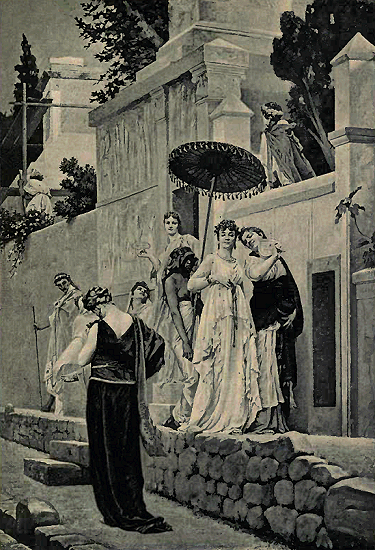
The noble matron Pomponia Græcina has been credited by tradition with having found consolation for the sorrows of the times in that new faith which was undermining old Rome, both literally in the catacombs and figuratively in the rapidity with which it was making converts; but we know not with certainty..... Græcina was accused of yielding to foreign superstitions. This may have been owing to the peculiarities of her manner. She had been the close friend of that Julia, daughter of Drusus, whom Messalina had forced to kill herself. From this time on, for the space of forty years, Græcina wore nothing but mourning, and was never seen to smile..... When the charge of entertaining foreign superstitions was laid against her, she was, in accordance with the ancient law, consigned to the adjudication of her husband..... She was adjudged innocent.
In the city, our legendary Etruscan changed his name to Lucius Tarquinius Priscus. His riches and talents soon availed with the Romans, and he was appointed guardian to the king's children. When Ancus died, Tarquin succeeded in persuading the people to elect him to the throne; and he was not mistaken in his estimation of his own fitness for that position, for his rule was in every way beneficial. He enlarged the territory of the State and undertook many worthy public works. To this period is attributed the building of the great subterranean sewers for draining the city. Lasting, though inelegant, monuments these; for after twenty-five centuries have passed away, and after so many Romes have arisen and fallen above them, the cloacae of Tarquinius Priscus still remain and admirably serve their purpose. The historians further tell us that this Etruscan introduced into the kingly style a magnificence hitherto unknown in Rome. This was especially manifested in his embroidered robes, which were the skilful work of Tanaquil the Spinner. Here was a queen who might have been taken for the model of the virtuous woman depicted in the Book of Proverbs. The heart of her husband could safely trust in her. She did him good and not evil all the days of her life. "She seeketh wool and flax, and worketh willingly with her hands." But Tanaquil was as well qualified to assist her husband in his political projects as to array him in a manner befitting his station. This is evidenced by her behavior at his death, which took place at the hand of assassins. We will allow Livy to relate in his own words what happened, "When those who were around had raised up the king in a dying state, the lictors seized on the men who were endeavoring to escape. Upon this followed an uproar and concourse of the people, wondering what the matter was. Tanaquil, during the tumult, orders the palace to be shut up, thrusts out all who were present; at the same time, she sedulously prepares everything necessary for dressing the wound, as if a hope still remained; yet, in case her hopes should disappoint her, she projects other means of safety. Sending immediately for Servius,--who had married her daughter,--after she had showed him her husband almost expiring, holding his right hand, she entreats him not to suffer the death of his father-in-law to pass unavenged, or his mother-in-law to be an object of insult to their enemies. 'Servius, she said, 'if you are a man, the kingdom is yours, not theirs, who, by the hands of others, have perpetrated the worst of crimes. Exert yourself, and follow the guidance of the gods. Now awake in earnest. We, too, though foreigners, have reigned. Consider who you are, not whence you have sprung. If your own plans are not matured by reason of the suddenness of this event, then follow mine.' When the uproar and violence of the multitude could scarcely be withstood, Tanaquil addressed the populace from the upper part of the palace through the windows facing the new street--for the royal family resided near the temple of Jupiter Stator. She bids them be of good courage; tells them that the king was stunned by the suddenness of the blow; that the weapon had not sunk deep into his body; that he was already come to himself again; that the wound had been examined, the blood having been wiped off; that all the symptoms were favorable; that she hoped they would see him very soon; and that, in the meantime, he commanded the people to obey the orders of Servius Tullius. That he would administer justice, and perform all the functions of the king. Servius comes forth with the trabea and the lictors, and, seating himself on the king's throne, decides some cases, but with respect to others pretends that he will consult the king. Therefore, the death being concealed for several days, though Tarquin had already expired, he, under pretence of discharging the duties of another, strengthened his own interest. Then, at length, the matter being made public, and lamentations being raised in the palace, Servius, supported by a strong guard, took possession of the kingdom by the consent of the Senate, being the first who did so without the orders of the people."
Of course, however much or little of all this may have really taken place, the effect of the account is greatly heightened by the brilliant imagination of the historian. But we believe that at least there is enough historical truth in it to show that the early Romans did not consider able statecraft on the part of women an entire impossibility. In regard to Tanaquil's after career as queen-dowager, the legends are totally and regrettably silent; and it is left to us to surmise without data as to how the new king held his own with such an extraordinarily clever mother-in-law; but, from what has just been related, he would seem to have had both the wisdom to appreciate her counsels and the ability to put them into effect.
The Tarquinian dynasty was prolific of remarkable women; and in the legendary history they are set over against each other in sharp contrast. We have had the good queen, now we encounter the bad. Again it is the story of a woman who was ambitious, but this time of one who possessed no moral sentiment to soften her methods, whose respect for that which is honorable in woman weighed nothing against her desire for position. Expediency being furthered by cruelty, she could easily overcome her feminine instincts. She was an exaggerated specimen of that type of which Shakespeare has given an unfading picture in Lady Macbeth. More than this, Tullia represented for the Romans the very acme of wickedness. All feminine virtue with them culminated in filial obedience and marital faithfulness; Tullia murdered her husband and plotted against her father, and was accessory to his death. The Romans were not abstract thinkers; and it is more than likely that this legend is an accumulation, in one imaginary concrete example, of all feminine depravity, rather than a veritable account of a historic personage. Yet we have no good reason to doubt that there was a vicious Tullia, on whose character this ideal of wickedness was erected.
Servius, the good king, had two daughters, Tullia being the younger. These young women were married to the two sons of Tarquinius Priscus, Lucius and Aruns; the eider daughter being given to the elder son. The consequence of this arbitrary choice on the part of the parents was that a most contrary assortment was made. A stirring and prideful man found himself coupled with a woman of easy, good-natured disposition; and a man of contented mind and contemplative habits was afflicted with a high-spirited and ambitious wife. The haughty Tullia could not endure the thought that there was no material in her husband either for daring or energetic action. She gave her regard to Lucius, who, as she considerately informed Aruns, was worthy to be called a man. She went so far as to intimate to Lucius that if the gods had been possessed of sufficient good judgment to have given her the only man who could appreciate her abilities she would soon see the crown in her own house, instead of in that of her father. This inspired the young man; and they both agreed that the mistakes of the deities should be rectified. It soon conveniently happened that two deaths gave the opportunity for a reassortment; and the nuptials of Lucius and Tullia were quickly celebrated.
Having thus far hurried forward the matter, it was not in the nature of the woman to wait patiently for death to make vacant the throne of the aged Servius. She said that she wanted a husband who would rather possess a throne than hope for it. She stimulated Lucius's courage by asking why he allowed himself to be called a prince, if he had not the spirit to take his own. She suggested that, his grandfather having been a merchant, perhaps it would be as well for him to return to Tarquinii, the original home of the family, and engage in the same peaceful occupation; which is evidence that the facile keenness of a woman's power of expression is not a development of modern education. Being thus encouraged, Lucius, as probably many another statesman has done, considered it more advisable to take the chances of public strife than to live in the certainty of domestic unrest. The time seeming propitious, he repaired with an armed band to the Senate house and seated himself on the throne. King Servius appeared, but no one thought it worth while to hinder Lucius from throwing the aged ruler down the steps of the Senate house; which he manfully did.
Tullia was the instigator of this coup d'état; and impatient to learn its success, she drove to the Forum, and, calling her husband from the Senate chamber, was the first to hail him as king. But Lucius commanded her to return home; and the tradition runs that as she was going thither her chariot wheels passed over the dead body of her royal father as it lay in the narrow street. More of the story of this Roman personification of filial iniquity we are not told, except that, in accordance with the inevitable rule of legendary history, she met the Nemesis of her crimes on a later day. The manner of it we shall see in the expulsion of her family from Rome.
The reign of Lucius Tarquin, surnamed Superbus on account of his extraordinary pride, was strong and tyrannous; but its effect was the aggrandizement of Rome and the increase of her power in Italy. He is credited with some extensive public works, the chief of which was the Capitol. This temple he erected upon the hill which had from time immemorial been held sacred to Jove; for thereupon the people had ofttimes beheld the deity, as Virgil says, "with his right hand shaking his black shield, and summoning the storm clouds to him." For his architectural undertakings the Roman king hired skilled Etruscan workmen, which indicates that his own subjects were as yet laggards in the pursuit of the arts and sciences. Indeed, everything goes to show that the only infant industries which the Romans zealously cultivated at this time were warfare and such agriculture as was necessary to supply the wants of their abstemious life. For their few artistic needs, they depended almost entirely upon the other Italian cities, which in these respects were further advanced.
In the traditional history of the reign of Tarquin Superbus there is included a legend concerning the Sibyl of Cumæ. Of those mysterious women called Sibyls, ten were reputed to have flourished in various parts of the ancient world. She of Cumæ was said to have lived one thousand years; seven hundred of which had expired when Æneas came to Italy and profited by her advice. The probable fact is that there existed a school, or at any rate a succession, of pythonesses at Cumæ, and it is borne out by the fact that to the Sibyl are given no less than seven different names by various ancient authors. These prophetic women used to write their predictions on leaves, which they placed at the entrance of their grotto; and it was very necessary to secure these leaves before they were dispersed by the wind, since, once scattered, they could never again be brought together. It seems, however, that the pythonesses at times transmitted their wisdom in a more substantial manner; for the Sibyl who came to the palace of Tarquin brought with her nine volumes, which she offered for sale at a very high price. On the monarch's refusal to buy them, she burned three of the books, and demanded the same amount for the remaining six. Tarquin declined to purchase these, and she immediately committed three more to the flames, asking the same sum of money for the remainder. This extraordinary conduct so excited the king's curiosity that he bought the books; and the Sibyl vanished, never again to be seen. It is very appropriate that the last of the Sibyls should disappear just as we begin to find verifiable history taking the place of traditional lore.
What the contents of these books were, or whether the king found reason very greatly to regret that he did not accept the Sibyl's first offer of the whole nine, we do not know. That they were highly valued by the Roman people is shown by the fact that a college of priests was instituted to have the care of them; and they remained in existence until the time of Sylla, when they were destroyed in the flames of the Capitol. The Sibylline verses now extant are universally deemed to be spurious.
The name of Tarquin has been placed on the world's roll of dishonor because of the part one of his family played in that sad story which describes how the rule of the kings of Rome came to an end under a cloud of blackness and blood. The tragedy of Lucretia is one of those pictures which are preserved forever on account of their simplicity and naturalness. The figures are almost titanic in their strength; but they will be recognized as typical of humanity in all time. The actions are coarse, because they proceed from the fundamental virtues and vices which are never separate from the hearts of men and women. The great English dramatist has idealized the workings of thought and conscience in the principal actors; but there was really nothing except bare, unadorned humanism in every situation. There was the tyranny which always accompanies unbridled power; there was the honest soldier's outspoken pride in the unrivalled beauty and goodness of his wife at home; there was the brutal animalism of the man who heeded no higher instincts; there was the wounded heart that saw no hope but to retrieve honor at the expense of life; there were ensuing grief and revenge. In all this there is nothing subtle, nothing strange, to human knowledge. It simply masses together all the general experiences of the universal man. Yet here is one of the world's most notable dramas; and the picture is interesting, because it portrays with strong colors in one scene all the great motives and traits which sway and color human life.
Lucretia was the daughter of a Roman noble, and she was the wife of Collatinus, one of the Tarquinian family. The Roman army was investing the city of Ardea, the capital of the Rutulians; and the young princes had too little to occupy their time, as the sequel shows, to keep them out of mischief. One day, they were drinking and conversing in the tent of Sextus, the king's son. Soldier fashion, being occupied with wine, their talk turned on the subject of women. Each man extolled the superior charms of his own wife or betrothed. Their conversation doubtless did not range beyond lawful wedded mates, or those who were such in prospect; for in the Rome of those days there existed no class of demi-monde, nor, indeed, were there many women whose reputation for chastity would be liable to criticism even in the freedom of a soldiers' camp. Life then was austere, and morality was intensive rather than extensive. The gallant contention waxed more and more enthusiastic among the comrades, until Collatinus said that there needed to be no dispute about the matter; that it could be easily seen in a few hours how far his Lucretia exceeded all the rest. Whereupon he challenged them all to ride to Rome and let the matter be decided as each one found his wife occupied on his unexpected arrival. To this they agreed, and immediately galloped to Rome, which they reached in the dusk of the evening. The king's sons found their wives spending their time in luxurious entertainments; whether or not they agreed on any one as being superior to the others, we are not told. But Collatinus's home was some miles out in the country, so that it was visited last of all. Late as it was, they found Lucretia, with her maids, spinning wool in the atrium, or middle hall of the house. Collatinus and his friends were gladly welcomed by the industrious Lucretia, and were provided with bountiful entertainment; and they were not slow to vote that she had easily won the contest. But the beauty of Lucretia's person and mind had made far too deep an impression on Sextus, the son of Tarquin. Throughout the journey back to camp he was revolving in his mind how he might again make a visit to the house at Collatia, in which he did not desire the company of its master.
A few days later, Sextus appeared at Lucretia's door and met a kindly welcome, in which her pure mind mingled no misgiving. There were no locks on the inner doors of the Roman house; for, as Shakespeare makes poor Lucretia tell her story:
"... to the dreadful dead of dark midnight, With shining falchion in my chamber came A creeping creature with a flaming light, And softly cried, 'Awake, thou Roman dame, And entertain my love; else lasting shame On thee and thine this night I will inflict, If thou my love's desire do contradict.'"
His threat was to murder both the lady and one of her male slaves, and to place them so that it would appear that he had killed them to avenge the honor of Collatinus. Thus we may see how poor Lucretia could truly plead:
"Mine enemy was strong, my poor self weak, And far the weaker with so strong a fear; My bloody judge forbad my tongue to speak; No rightful plea might plead for justice there; His scarlet lust came evidence to swear That my poor beauty had purloin'd his eyes, And when the judge is rob'd, the prisoner dies."
The next day, she sent messengers to call her husband and her father. They hastened to her at once, the former bringing with him Brutus, who was to be the leader in liberating Rome from the infamous race of Tarquin. When Lucretia had told her story, she made her relatives first swear that the criminal should not go unpunished. To this they savagely pledged themselves; but they tried to console her with the fact that, her mind being pure, she had incurred no guilt. Lucretia replied; "It remains for you to see to what is due to Tarquin. As for me, though I acquit myself of guilt, from punishment I do not discharge myself; nor shall any Roman woman survive her dishonor in pleading the example of Lucretia." Thus saying, she drew a knife which she had concealed in her garments, and plunged it into her heart.
Brutus, while they were all overcome with grief, gently drew the weapon from the wound; and holding it up, dripping as it was with Lucretia's life blood, he cried: "By this blood, most pure before the pollution of royal villainy, I swear, and I call you, O gods, to witness my oath, that I shall pursue Lucius Tarquin the Proud, his wicked wife, and all their race, with fire and sword, and all other means in my power; nor shall I ever suffer them or any other to reign at Rome." In this oath Collatinus and the others joined. They carried the dead body of Lucretia to Rome, and succeeded in giving the populace the last incentive necessary to drive out the already hated Tarquins. Thus the misfortunes of noble Lucretia brought vengeance upon the wickedness of Tullia; for the historian says that "she fled from her house, both men and women cursing her wherever she went and invoking on her the Furies, the avengers of parents."
What portion of these stories of the women of legendary Rome may be accepted as fact, and what must be relegated to the realm of fiction, it is not within the capacity of research to ascertain. Probably we shall not be far wrong if we consider these legends as moralizings founded on facts. Tullia represented to the Romans all the viciousness against which women were warned; in Lucretia, there were accumulated all the virtues to which a woman was taught to aspire. They were pictorial moral discourses; and, just as the moral character of a modern age might be discovered from the sermons of the period, so these legends represent what was lowest and highest in the ethical conceptions of earliest Rome.
II
NOBLE MATRONS OF THE REPUBLIC
After the revolution, of which the tragedy of Lucretia was the traditional cause and which ended forever monarchical rule in Rome, our subject begins to emerge from the haziness of legendary narratives into the clearer light of veritable history. It now becomes possible for us to catch glimpses of the women of Rome, living and moving amid scenes that were real and under conditions which undoubtedly prevailed.
Roman society at the beginning of the Republic was most distinctly and rigidly classified. Not only were the people divided by the circumstances of birth into separate classes, but the law preordained for every person his precise station, his duties, his privileges, and his limitations. The citizen could no more go beyond these than he could transfer himself into another order of creation; for law, in Rome, was as absolute as it was rigid. Speaking generally, there were two orders, the patrician and the plebeian. A common opinion of the old writers was that out of the influx of adventurers who crowded to Rome at its founding Romulus chose one hundred Senators, their qualification being that they could name their fathers. Their children were called patricians. In the third century before Christ, when the plebeians had wrested many privileges and offices from the unwilling higher class, Publius Decius, himself a plebeian, uses this theory of the origin of the patricians to great advantage. Contending in debate for the right of his order to serve in the priesthood, he said: "Have ye never heard that the first-created patricians were not men sent down from heaven, but such as could cite their fathers; that is, nothing more than freeborn? Well, I can cite my father; he was a consul; and my son will be able to cite a grandfather." This excessive pride which Roman citizens took in the fact that they could trace their paternity through more or less generations must not be understood as reflecting, in any way, upon the character of the early matrons; it arose simply from the fact that they could so surely name their ancestry as to eliminate possibility of descent from one of the common herd of unenfranchised inhabitants.
These latter were the plebeians. This class was made up of the descendants of the ancient people who of old had inhabited the country, ordinary foreigners who were attracted to the city, and the children of captives who had been given their liberty. At first, the plebeians enjoyed no rights whatever. They lived, it is true, under the shelter of the walls of the city, but on the outside. They possessed no right of suffrage, and were not allowed to interfere in any public affair. But they were free. They held property and engaged in handicrafts and in commerce. It soon came to pass that the increase of their number and their importance rendered their repression by the nobles more and more difficult. Under King Servius the plebeians became citizens; and, as is the case in every land, the internal history of Rome contains nothing more interesting than the indomitable and successful struggle of this lower class to wrest ever larger privileges from the tenacious rulers. It was not, however, until B.C. 444 that equality of rights had made sufficient progress for matrimonial alliances to be countenanced between patricians and plebeians. By the commencement of the Christian era all practical distinction between these two classes had vanished.
In addition to the two principal orders, there was that of the clients. These were in reality vassals, who preferred dependence on the great and wealthy to living independently in a precarious liberty. They were called by the names of their patrons and were numbered in the latter's tribe. By enactments of law, the patron was made responsible for the support and protection of his clients. In return, the patrician could depend upon his clients to fight his battles, support his cause, and prove themselves loyal retainers of his house in both good fortune and evil. The subservience of these clients, and the conscienceless zeal with which they furthered the designs, even the most wicked, of their masters, are well illustrated in the part which Marcus Claudius played in the persecution of Virginia by the decemvir Appius. Another dependent class was that of the slaves. At first the number of these was comparatively small; but as the conquering arms of Rome spread over the world her avaricious sway, the captives dragged in barbarous triumph to the city grew out of all proportion to the population. They enjoyed fewer rights and suffered under a regime more inhuman than in any other slaveholding nation in history.
That which distinguished one class from another in early Roman society had nothing whatever to do with the character of the occupation of the people comprising it. The noblest of the early patricians, as well as the commonest plebeians, tilled the soil with their own hands; nor did they disdain to engage in trade, or even in the letting of money on usury. Wealth was no more a consideration than occupation in determining to which order a man or a woman belonged. In course of time, the plebeians, despite the patricians' unneglected privilege of practising robbery under due process of law, numbered many families of great wealth; but no man could therewith purchase entrance to the higher class. It was the blood line that marked these distinctions; it was ancestry alone that could give the patent of nobility. Nor is it surprising that a people who believed in the divine origin of some of their tribes should acknowledge superior rights as attached to a well-authenticated pedigree.
In most societies, the advantages of class are more markedly displayed in the life of the women than in that of the men. This does not appear to have been the case in the early times of the Roman Republic. In fact, it is difficult to see how difference in class greatly distinguished the patrician matron from her plebeian sister. Neither had any legal part whatever in State affairs or in any public functions, excepting those of a religious nature. The duties of each were confined to the home, and no woman was relieved from the obligation of personal and diligent industry. On the epitaphs of many noble women were praises for their chastity and their proficiency in spinning. Indeed, the evidence seems to indicate that any other qualities than these two, and that of fertility, were deprecated rather than admired by the Romans of this period. The only advantages which a patrician woman could possess were her natural pride in the privileges of her family and what honor was reflected upon her from the positions held by her male relatives. The term "Head of the Family" never had so tyrannical a meaning as in most ancient Rome. It was a place which a woman could not hold. The husband was all in all; no one else was recognized by law. Wife, children, clients, and slaves were alike persons without will of their own. They were mancipia, under the hand of the father. He it was who answered for them to the State and who judged them. If a wife was accused of crime, she was committed to her husband for judgment. And this was the law even down to the time of Nero, when Pomponia Græcina, charged with embracing a foreign superstition, was "consigned to the adjudication of her husband." A man could even condemn his wife to death for certain offences, such as the violation of her marriage vows, or even for forging false keys in order to steal his wine. At her husband's death, the wife could not claim any of his property if he had bequeathed it to another, even though it were willed to an entire stranger. In this severely disciplined society, the woman never escaped from guardianship. She was looked upon as belonging to the family rather than to the State. The latter consisted only of men, to whom the women were merely necessary accessories. No one thought that a woman possessed any claim or right to independence of individuality. She was always under a master: her father, when she was a girl; her husband, when she was married; and her nearest male relative, if she became a widow. If she obtained any share in her father's property or in that of her husband, she could not transfer or bequeath it without the consent of her male guardian, unless she were a Vestal; nor could she marry without the same consent.
But, however dependent her position may have been, whether maid or matron, the Roman woman was always treated with reverence. The stola, the characteristic robe of the matron, corresponding to the toga of the male citizen, always ensured for its wearer respect, it being not merely an article of attire, but also an insignia which could only be retained by strict rectitude of life, market days or assembly days. In the villa--a miserable cabin made of mud, rafters, and branches--not a day, not a moment, was lost. Horace does not draw a more agreeable picture of ancient city manners. He tells us that "at Rome, for a long time a man knew no other pleasure and no other festival than to open his door at dawn, to explain the law to his clients, and to lay out his money on good security. They learned from their elders, and taught beginners, the art of increasing their savings." But when it is remembered that Cato was a sour and miserly Puritan, who adopted austerity as his pose, and that Horace was a poet, not untouched with cynicism, who lived in a society in which the charm of simple enjoyments was entirely forgotten, we may consider both pictures, though from differing causes, slightly overdrawn. Nevertheless they serve to indicate how circumscribed was the life of the wives of the early Romans.
Those strong-minded, intense, practical people were not, however, without their entertainments. Music, both vocal and instrumental, was cultivated. There were religious festivals, in which processions of boys and maidens sang pious hymns. We also learn from Cicero that it was the custom for the guests at a feast to sing the praises of their great men to the sound of the flute. It is easy for us to imagine a home scene in which Veturia, the mother of the youthful Cnæus Martius, tells over again to the inquiring boy those inspiring stories which he has heard chanted by his father's hearth and which are to prepare him to emulate heroic deeds at Corioli and earn for himself an honorable name.
But, habitually solemn and grave as were those old Romans, they were also much addicted to amusements of a coarse and grotesque nature. Even in their religious processions they included monstrous mechanical shapes, with formidable teeth and huge jaws which, by their opening and closing, frightened the women and children, to the great enjoyment of the men. Hideous masks were also worn for the same purpose. In fact, so little refinement characterized the minds of the people of these times, that they could find entertainment in only the rudest and coarsest of jests. Farces, which were nothing more than the absurd antics and personal witticisms of buffoons, had been introduced from Atella. But the beginning of Roman drama may be dated from B.C. 364, when, on account of a pestilence which devastated the city, Etruscan actors were imported to institute scenic games in honor of the gods. The pestilence ended; and consequently the games, being regarded as the efficacious remedy, were retained. These games consisted of combined dances and songs, which were accompanied by appropriate but not altogether proper gestures. Later, there was instituted the floral festival, the purpose of which was to induce the goddess of spring to grant that all the flowers which decked the fields at the time of blossoming should be represented by fruit in the harvest. In these games, dancing girls appeared upon the stage; and we may draw our own conclusions from the fact that in the time of Cato the scene was regarded as too frivolous for the eyes of so grave a personage. But the most popular of all the early festivals was that of Anna Perenna, the goddess of life. In this, restraint was abandoned. To drink extravagantly, and to listen to a recitation of the mistakes of Mars in taking a hideous goddess for the beautiful Minerva, were regarded as works of piety. Young girls were required to sing this story, which was full of the coarsest allusions. But the ancients did not consider the requirements of modesty in the same light as we do. They did not esteem that innocence born of ignorance, in which modern times deem it sacrificed to honor was the signal for the expulsion of tyranny.
It was not alone in the incitement of the populace to measures for her protection that the influence of woman was felt in matters of State. There were occasions when by her means calamities were averted, as well as times when civil strife was for her sake produced. The memory of the good service done for the city by Veturia, the mother, and Volumnia, the wife of Coriolanus, was never allowed to fade.
In the history of this brave and haughty warrior we have a picture of Roman political life. Rough politics they were; rock-faced episodes, befitting the character of the times, in which men knew nothing of finesse, and when appeal was made directly from reason to brute force and to the natural feelings of men. Perhaps it would be bordering on literary impiety to think that Shakespeare, in his Coriolanus, has not given the best interpretation possible of this fragment from the old Republic; but it is not one of his greatest pieces, because the material is lacking in those human qualities which are necessary to arouse profound interest. It is a drama with but one motive--filial respect. Yet the most is made of this; and the great dramatist has succeeded in vivifying the principal characters. In the portrayal of the mother of Coriolanus we see a matron who is worthy of such a son; the wife's part is that of passive resignation to the will of stronger spirits. Mrs. Jameson, in her Characteristics of Women, says: "In Volumnia, Shakespeare has given us the portrait of a Roman matron, conceived in the true antique spirit, and finished in every part. Although Coriolanus is the hero of the play, yet much of the interest of the action and the final catastrophe turn upon the character of his mother, and the power she exercised over his mind, by which, according to the story, 'she saved Rome and lost her son.' Her lofty patriotism, her patrician haughtiness, her maternal pride, her eloquence, and her towering spirit, are exhibited with the utmost power of effect; yet the truth of female nature is beautifully preserved, and the portrait, with all its vigor, is without harshness." We may well believe that Veturia--whom, following Plutarch, Shakespeare calls Volumnia--was a woman who could say: "When yet he was tender-bodied, and the only son of my womb ... I was pleased to let him seek danger where he was like to find fame. To a cruel war I sent him, whence he returned, his brows bound with oak." And when the wife tremblingly inquires: "But had he died in the business, madam--what then?" it was in the mother to reply: "Then, his good report should have been my son." This is in accord with the Greek historian's statement that Coriolanus fought heroically, not only for glory and the passion of battle, but to win the meed of praise from his mother.
The action in the story of Veturia and her son is entirely political. The balance of power between the patricians and the plebeians was very narrow, especially when hardship aroused the latter to make inquiry into the claims of the former. A famine was more than sufficient to incite the lower order to threaten the privileges of the upper class; and Rome was at that time suffering from a scarcity of corn. The populace was not entirely convinced by Menenius's parable that the whole duty of the patrician order consisted in being the belly of the State organism. The people clamored; their tribunes saw in this an opportunity to gain increased powers; the Senators were inclined to be subservient. But the haughty spirit of Coriolanus would yield nothing of the ancient privileges. For his mother's sake, he sought the consulship; nevertheless, he angered the commons, though he could not gain the office without their suffrages. The stress became so great that his patrician friends could not prevent his exile. He left Rome, only to return to wreak vengeance at the head of a Volscian army. This enemy being already a menace to Rome, the defection of the great leader to their ranks placed the disordered city at their mercy. Then it was that the Romans remembered that though women were incapacitated for political action and were unable to fight, yet they were powerful factors in the appeal to those feelings of the human heart whence flow justice and pity. The arguments of ambassadors and the behests of the priests had not availed; the authorities were constrained to adventure what might be effected by the tears of the women for whom alone, of all that was Roman, Coriolanus retained any regard. His mother and his wife were implored to make the last appeal. This plan had come by inspiration into the mind of Valeria, sister of the great Publicola, as she was praying with the other matrons in the temple of Jupiter. Veturia and Volumnia, leading the two sons of Coriolanus, went forth to the Voiscian camp. As they drew near, Coriolanus, though resolved to remain obdurate, showed himself not lacking in filial respect; he advanced to meet them, ordering the fasces to be lowered in the presence of his mother. The Roman historians clothe Veturia with noble dignity as she makes her appeal. "Before I receive your embrace, let me know if I have come to an enemy or to a son; whether I am in your camp a captive or a mother. Has length of life and a hapless old age reserved me for this--to behold you an exile and an enemy?... So then, had I not been a mother, Rome would not be besieged; had I not a son, I might have died free in a free country." The spirit of this is truly Roman. Even the women were trained to force the claims of blood and the natural affections into a place secondary to the duty of loyalty to the State. This appeal; joined with the embraces of his wife and the lamentations of the other matrons, prevailed over the anger of Coriolanus; and again Rome was saved by the Roman women. As a reward, a monumental temple was erected by the men of the city, and dedicated to Female Fortune.
It was not alone as peacemakers that the Roman matrons served the public interests of the city. On more than one occasion the treasury was rendered efficient by means of their generous contributions. More than once the golden ornaments of the wives became auxiliary to the iron arms of their husbands, and in one instance they accomplished that which the latter could not achieve. When the Gauls burned the city, and were only turned from the citadel by the payment of one thousand pounds of gold, with the sword of Brennus thrown on the Gallic side of the scale to insure good weight, the amount could not have been raised but for the self-sacrifice of the matrons. In gratitude for this, the Conscript Fathers voted that thenceforth funeral orations might be made for women. The gold was afterward repaid to the women out of Etrurian plunder. Again, when, in accordance with the vow of Camillus, a tribute was to be presented to Apollo, the matrons brought what they possessed of the precious metal, it was especially honored by being made into a golden bowl, which was carried to Delphos. On this occasion also they were rewarded; for the Senate conferred on them the privilege of riding to public worship and to the games in covered chariots, and on other errands in open carriages. The historian introduces this latter information with "they say"; whether or not, previous to this, the Roman ladies had been obliged to walk is left to be surmised without further evidence.
Some Idea of what those golden ornaments were may be gathered from the account of a voluntary contribution which was made in Rome at a later period. Funds were required to equip a fleet against Philip of Macedon, the ally of Hannibal. Lævinus the consul, urging upon his fellow Senators the duty to set an example of public generosity, says: "Let us bring into the treasury to-morrow all our gold, silver, and coined brass, each reserving rings for himself, his wife and children, and a bulla for his son; and he who has a wife or daughters, an ounce weight of gold for each. Let those who have sat in a curule chair have the ornaments of a horse, and a pound weight of silver, that they may have a salt-cellar, and a dish for the service of the gods ..." Notwithstanding the fact that, in response to this appeal, the needs of the fleet were abundantly provided for, the indication is that at this period, about B.C. 280, the decorative tastes of the Roman ladies had in no wise acquired that luxuriousness with which they afterward became characterized. There was no ornament so common as the ring, the place of which, in these early times when only one was worn, was the third finger of the left hand. It was used for the purpose of sealing letters and papers, and long before the end of the Republic the custom arose of setting rings with precious stones. Indeed, the people of the early Republic were not unacquainted with most exquisite work of the goldsmiths' art; but there was still prevalent that consciousness of the surpassing value of personal excellences which could afford to be independent of outward adornment, and of which Cornelia's reference to her sons as her jewels was a surviving echo.
But the times were soon to change. Hitherto we have seen the Roman matrons living the simple, diligent, unsophisticated lives of women who were fitting mates for men who held to the plow for support, but dared not let drop the sword. Until then, Rome had been nothing but a city struggling for existence--sometimes a precarious existence. Instances there were when her fortunes waned almost to the vanishing point; when the tide of progress seemed to hang at the ebb. The god of victory, though honored as the tutelary deity of Rome, was frequently partial to her Italian neighbors; her walls were entered and her houses razed by the barbarian Gauls; and once she was at the point of being deserted by her citizens, the majority of whom could hardly be restrained by the ideals of religion from removing the State and the Capitol to Veii. Yet her star of empire persisted and, despite temporary eclipses, remained in the ascendant.
How did those centuries of varying civic fortune affect the status of the women? They were, by the necessities of their circumstances, trained to endure hardship. The temple of Janus was never closed, for warfare was unceasing; and it was usual for the widow's wailing death dirge to be embittered by the fact that the husband had been slain in his strength and prime. Slavery and outrage, the concomitants of barbarous warfare, were always included within the possibilities of a Roman matron's fate. Under such circumstances civilization necessarily advanced slowly; it is only as life and liberty and leisure are secured that existence can acquire the social graces. Hence the probability is that, during the first two and a half centuries of the Republic,--that is, until Rome was fully launched upon her career of conquest,--the position and the habits and manner of life of the women did not greatly change. It is true that there was a continuous internal development of the State; but this manifested itself in an accentuation of those laws which reveal the hardness of the old Roman character, rather than in any tendency toward the easement of the individual lives of the citizens. Never has personal privilege been so completely subjugated to State prerogative. The laws, which were rigidly--even slavishly--interpreted according to the letter and never according to the spirit, considered the individual from the standpoint of his value to the State, and rarely from that of his own rights. The woman's value to the State was entirely submerged in that of her husband. Therefore, we find that it was only with the greatest difficulty that edicts granting privileges to woman could be passed, unless it were in payment for some special act of loyalty on her part to the State. Hard and inflexible in their ideas of life were those old Romans, practical and unsentimental in their relations with each other, narrow in their conceptions, proud to arrogance of their State, and reverencing only their institutions.
But in course of time they broke through their insularity with the force of their own arms. Victorious contact with other States gave them a larger acquaintance with the fruits of civilization, and the spoils of conquest afforded them the means to enjoy it. Hence, during the latter half of the republican period we see life in Rome rapidly undergoing a change. As typical of this new state of things, as it affected the character, status, and condition of women, there is only one woman whom we need to select. In Cornelia, the daughter of Scipio Africanus and the wife of Sempronius Gracchus, is found the ideal of Roman femininity of that day. She was in every way worthy of her patrician ancestry, which had produced a greater number of eminent men than any other family, twenty-one consulships being held by the Cornelii in eighty-six years. Cornelia lived in a Rome which we can understand and appreciate; we begin to recognize social features upon which the imagination can lay hold and from them piece together some idea of the reality. Hitherto the data has been too foreign and too meagre for any great success in this; but when we read of Cornelia providing herself with a country house, riding to public worship, listening to the gossip of her friends respecting each other's jewelry, and interesting herself in Greek literature, we discover that the main features of a Roman matron's life were not essentially dissimilar from those which characterize polite feminine society in our own time. Indeed, there is more to evoke our sympathetic appreciation in the Rome of B.C. 150 than in the Europe of A.D. 1000 or in the Asiatic civilizations of to-day. We feel more at home in the patrician villas than in the mediæval castles; just as we find more that is applicable to modern life in the Roman poets than we do in the bards of chivalry. In studying the period when the ancient civilization of Italy was at its best, we discover habits of thought, bits of life, and social customs, which really startle us with their similitude to those to which we ourselves are accustomed.
The city, in the time of Cornelia, showed few outward signs of the magnificence it was to acquire under the emperors. The houses were mostly of brick, though domestic architecture had become quite ambitious in its character, Cornelia herself having built, as has been said, a very expensive villa at Misenum; those of the wealthy were filled with costly furniture and precious works of art, which the Romans first learned to admire in the countries which they subdued; and having acquired a taste for beautiful things, they made no scruple of appropriating them. Rome had now grown wealthy with the spoils of her extensive victories, and, as always comes to pass with the advent of riches, there had been brought about a great differentiation in the condition of the population. Polybius gives us a picture of the extravagant style in which Æmilia, the mother of Cornelia, appeared in public. "When she left home to go to the temple," says he, "she seated herself in a glittering chariot, herself attired with extreme luxury. Before her were carried with solemn ceremony the vases of gold and silver required for the sacrifice, and a numerous train of slaves and servants accompanied her." And this notwithstanding the Oppian law, which limited matrons to a half-ounce of gold on their wearing apparel and prohibited them from riding in carriages in the city, and which had not yet been repealed. As this modish lady passed through the streets of Rome with her brilliant retinue, exciting the envy of other matrons, and bestowing gracious recognition upon white-robed, stately patricians, she must have beheld as many signs of abject, suffering poverty as are prevalent in our own great cities. By this time, the plebeian order had been raised to equal legal privilege with the patrician, and society had now come to be divided into the enormously rich and the extremely poor. The former rendered their position secure by means of extortion in the provinces; the condition of the latter was made hopeless by the fact that all labor was performed by slaves. A state of things unknown to the old times was now prevalent in Rome: men and women were idle, willingly or perforce, according to their circumstances.
The position of women had also changed. They were now beginning to make a stand for their rights--a thing undreamed of in the old days. The father of the family was no longer allowed to execute his arbitrary power entirely unquestioned. Livy narrates an incident which illustrates this development and bears interestingly upon the character of Æmilia and the history of Cornelia. He relates that "the Senators, happening to sup one day in the Capitol, rose up together and requested of Africanus, before the company departed, to betroth his daughter to Gracchus; the contract was accordingly executed in due form, in the presence of this assembly. Scipio, on his return home, told his wife Æmilia that he had concluded a match for her younger daughter. She, feeling her female pride hurt, expressed some resentment at not having been consulted in the disposal of their common child, adding that, even were he giving her to Tiberius Gracchus, her mother ought not to be kept in ignorance of his intention; to which Scipio, rejoiced that her judgment concurred so entirely with his own, replied that she was betrothed to that very man."
It has been well said that the words which Plautus puts into the mouth of Alcmena may be applied to the character of Cornelia, who was thus bestowed by her great father upon a no less worthy man: "My dower is chastity, modesty, and the fear of the gods; it is love to my kindred; it is to be submissive to my husband, kind toward good people, helpful to the brave." She also received a dot, an accompaniment of marriage which was beginning to be highly considered among the matrons of Rome as of more practical value than the above-mentioned moral qualities. It consisted of fifty talents of gold. But the time had not yet arrived when the riches of virtue and goodness were entirely unappreciated; there were still matrons who could enter, with faces neither brazen nor abashed, the temple erected to chastity; and upon the tombs of many of them might have been truthfully inscribed, as upon that of Claudia: Gentle in words, graceful in manner, she loved her husband devotedly; she kept her house, she spun wool. Among these chaste matrons Cornelia excelled; her fame remains as that of the highest type of the pure-principled, noble-minded, cultured Roman matron. She lived in entire sympathy with her husband; and we may well believe that it was partly owing to her influence that the generous Sempronius Gracchus found it in himself to command an army enlisted from among the slaves, and to emancipate them upon the battlefield as a reward for the bravery which his leadership incited.