Volume 2 — WOMAN'S PART IN RELIGION (continued 4)
Reading edition
The acme of female turpitude was attained by Messalina, whose name has ever since served as a byword for unparalleled incontinence. Valeria Messalina was the great-granddaughter of Octavia, the sister of Augustus, both on her father's and her mother's side; thus in her veins united a twofold stream of the sacred Julian blood, which fact she never allowed herself to forget while insisting upon her demands, though it had no restraining effect upon her conduct. When only sixteen years of age, she became the third wife of the feeble, half-imbecile Claudius; one of her predecessors was Plautia Urgulanilla, the daughter of that proud Urgulania whose debts Livia Augusta had been compelled to pay. Plautia was divorced for "scandalous lewdness" and on the suspicion of murder, after she had given birth to two children, the youngest of whom Claudius exposed, being convinced that it had no just claims upon his paternal authority. But his honor as a husband was far less safe with Messalina than it had been with Plautia. That she should have any affection for the doddering, gormandizing old man--he was nearly fifty--was hardly to be expected. During the first three years after the marriage, her position was comparatively private, her husband having no expectation of attaining to the imperial throne.
During the reign of the demented Caligula, the women of the court present no figure of political importance, and are not interesting except as they illustrate the depravity of the times. This emperor was possessed with an exaggerated idea of the divinity that was inherent in the Augustan race. Therefore he deemed that, like the kings of Egypt, he should conserve that dignity by marrying his own sister. Suetonius will have us believe that all three of the sisters of Caligula were dishonored by their brother; but Drusilla was his favorite. She had been given to Cassius Longinus, but Caligula took her from him and kept her as though she were his lawful wife. He made a will appointing her heiress of his private estates and also of the Empire; and at her death he ordered for her a public mourning, and threatened capital punishment against any person who should laugh or bathe or seek any amusement during the period. It was also declared that she had been received among the heavenly deities; and as Panthea, the universal goddess, her worship was enjoined upon all the cities of Italy and the provinces.
The other sisters, Agrippina and Julia, became involved in a conspiracy with Marcus Æmillius Lepidus against the life of their brother; and when the plot was discovered, though the lives of these women were spared,--probably owing to Caligula's intense respect for the Julian blood,--their property was confiscated and they were both sent into exile. Agrippina, however, was first compelled to perform a most unpleasant office. The family of Lepidus begged that his ashes might rest in the family mausoleum at Rome, and the disordered mind of Caligula recalled a journey which his mother had made, bearing the ashes of Germanicus. So he forced Agrippina, who had schemed to marry Lepidus in the hope of gaining for him the succession, to carry the urn that contained his remains from Germany to Rome, and never once allowed her, night or day, to rest from bearing her burden.
Of the wives of Caligula, Suetonius says: "Whether in repudiating them or retaining them he acted with greater infamy, it is difficult to say." Being at the wedding of Caius Piso with Livia Orestilla, he ordered the bride to be carried to his own house; but within a few days divorced her, and two years after banished her, because, as was thought, upon her divorce she had returned to her former husband. Lollia Paulina, who was married to a man of consular rank in command of an army, having been mentioned to Caligula as much resembling her grandmother, who had been a famous beauty, the emperor suddenly called her from the province where she resided with her husband, and married her; but he soon repudiated her, interdicting her from ever afterward marrying another man. He loved with a most passionate and constant affection Cæsonia, who was neither handsome nor young, and who was the mother of three daughters by another man; but she was a woman of excessive wantonness. He would frequently exhibit her to the soldiers, riding by his side, dressed in a military cloak, with shield and helmet. To his friends he showed her in a guise far less elaborate and much more improper. After she had borne a child to him, she was honored with the title of wife. Caligula named the infant Julia Drusilla, and, carrying it around the temples of all the goddesses, he laid it on the lap of Minerva, from whom he begged the care of bringing up and instructing this daughter. He considered her as his own child, for no better reason than that her temper was so savage that even in infancy she would attack with her nails the faces and eyes of the children at play with her.
Cæsonia could hardly have enjoyed her position, especially on those occasions when her demoniacal husband would amuse himself with the idea of having it in his power to sever her neck at any time that it might please him so to do. She was killed at the time of his assassination; and, fortunately, her vicious offspring perished with her. The manner in which Cæsonia met her death seems to indicate that the woman not only possessed courage, but also that she cherished some sort of affection for her husband. The conspirators hesitated over the question as to whether she should share his fate; but it was only for a few minutes. It was believed by many that it was through her love philtres and licentious practices that his mind had become disordered and that therefore she was, in a sense, the author of his evil doings. It being determined that she should die, the men who went in search of her found Cæsonia embracing the body of Caligula as it lay upon the ground, and they heard her bewailing the fact that he had not been governed by her advice. Whether that advice had been to restrain himself in his madness, or to follow with vengeful measures a clue which she had given him in regard to the conspiracy, those who heard her could not decide. Their minds were predisposed to believe in the latter explanation. When she saw Lupus, the man who had her death in charge, approaching, she sat up, all besmeared as she was with her husband's blood, and, baring her throat, requested the assassin not to be awkward in finishing the tragedy. She received the death stroke cheerfully, and the little daughter, who was by her mother's side, perished by the same sword.
To his own intense astonishment, Claudius suddenly found himself proclaimed and accepted as Emperor of the Romans. There is no evidence to show that Messalina had anticipated this change of fortunes any more than had her husband. Finding herself, however, in the position of empress, she had no mind to do otherwise than maintain herself secure in its enjoyment. The times were such that this could be done only by means of merciless expedients. This fact should constantly be kept in mind as we study the women of imperial Rome. No individual can be governed by the ideas that are prevalent in the society in which he lives and, at the same time, dispense with the methods ordinarily employed by that society. The Romans of the period which we are now reviewing believed that the best, as well as the easiest, way in which to placate an enemy or to outwit a rival was to destroy him. Messalina had no desire to do better than her surroundings warranted; in fact, she represents the climax of immorality. There were two causes which led her freely to dispense destruction among her associates. First, there were plenty of women who would gladly have rivalled her in the affection of the amorous Claudius; and while she did not in the least reciprocate her husband's affection, its retention was necessary to the maintenance of her position. Again, her innumerable amours were constantly furnishing weapons against herself, and it was only by inspiring dread that she could restrain her enemies from making use of them to her own destruction.
In such a position as she found herself, and among such surroundings, it is not surprising that Messalina was bad. Raised, when only a mere girl, to a dizzy height; flattered and sought after by all the most dissolute of the imperial court; the wife of a doting husband who, as she quickly discovered, was absolutely under her influence; all this would have tested a woman in whose character good impulses were perceptibly present. So far as can be learned, Messalina possessed no such impulses; on the contrary, everything in her contributed to the strength of the evil influences of her environment. Her glaring immoralities, combined with the consummate art with which she contrived to befool her husband, have rendered this woman's history a monument of conjugal infidelity for all the ages.
We may be fairly certain as to Messalina's personal appearance, for there are a number of cameos and busts of her in existence, though, of course, some of these are ideal and others are not well executed. Baring Gould, who has made a careful study of the sculptured portraits of the Cæsarian family, regards it as certain that in the onyx cameo which is in the Cabinet of Antiques at Vienna and in the bust now preserved in the Uffizi Palace we have what may be considered correct representations of Messalina. Of the former, he says: "The hair is arranged in small curls covered with a species of crown wreathed with corn. This is the usual mark of the deification of an empress as Ceres. The brow is low, the nose straight and a little retrousse at the end, the mouth remarkable for the thinness of the lips; the chin is not prominent, and a peculiar feature is the slope from the chin to the throat, forming a marked contrast in formation to that of Livia opposite. The mouth turns down, but there is a slight contraction in the corner." Of the bust, he tells us: "The profile there has a remarkable likeness to the type-giving face on the cameo. The hair is in curls, but hangs down in plaits behind, the brow is low, the eyes full, and the mouth with its thin lips and cruel expression seems thoroughly to express the character of the woman as known to us by history. The head is flat. There is insolence in the mouth, and a curl in the corner, noticeable also in the gem. One eye is larger than the other. They are not in line. The nose has been restored, so that we cannot compare it with that on the cameo. The rest agrees perfectly, though the slope from the chin is not so perceptible in the bust owing to the difference in position of the head. The brows are straight, not arched. Not only are the eyes of different shapes, but the chin is on one side. The end of the chin is square, the mouth is small, the lips fuller on the left side than on the right, and the right corner drawn up. The expression of the face is different when seen from each side, owing to the singular lack of uniformity in the sides of the face. In the same gallery is a so-called young Britannicus, and the resemblance of this child, as far as the formation of the lower part of the head goes, to the Messalina above described is remarkable. Still more remarkable is that of the beautiful statue in the Lateran, where the resemblance is very close. The boy's lips are fuller, but the whole structure of the jaws and chin, and the curl of the lower lip, are the same as in the Messalina of Florence. If this be Britannicus, then the bust at Florence is that of his mother; and it is hard to say who else can be intended by this charming statue in military costume.
"A medical man of large experience, who at my request studied the bust of Messalina in the Florence gallery, informs me that it is that of a woman physically unsound; the flattening of the top of the head indicates an imperfect mental development, and the general aspect of the face, evidently a close study from life without any attempt at hiding blemishes and idealizing, is that of a woman whose span of life would naturally be short. There would probably be malformation of the chest. The face is that of one with feverish blood, whose flame of life burnt too fast. The face is not in itself sensual, nor at all animal, but it is insolent and cruel. The low, flat brow as well as the low, flat head show that she was deficient in all the higher and nobler qualities. In this bust the formation of the throat is peculiar. M. Mayor remarks: 'Thin lips, evil smile, ears hardly visible, jaw advancing and remarkably massive, eyes close together, profoundly sunk under their arcade, nostrils fine and flexible, lips asymmetrical, the upper lip lifted on the right, as in a beast prepared to bite, the same characteristic feature observed in Caligula and commented on by Darwin. Facial asymmetry. The left eye highest and furthest from the nose (the same noticeable in Nero and Claudius, etc.). The look cruel rather than voluptuous. An ironical smile, the by no means uncommon mask worn by pathological corruption and nymphomania,'" M. Menière, in a book entitled Medical Studies from the Latin Poets, also gives it as his opinion that Messalina was a victim of nymphomania. He says: "At the Salpêtrière, there are Messalinas, cases which have absolutely nothing to do with morals." This probably may safely be accepted as the true explanation of the case, if one can rid one's mind of two suspicions. The first of these is that this much-talked-of asymmetry may be nothing other than inferior or careless artistic work. The sculptor may not have been able, or he may not have given himself the time, to carve both sides of the face so absolutely alike as to defy the criticism of sharp scientists, bent on discovering a cause for the poetical effect found in Juvenal and others. The mention of the satirist suggests our second suspicion, which is that in his astonishing account of the criminal appetites of Messalina he is straining after effect.
Now, in regard to the first of these suspicions, we have the assurance of eminent students of art that, in their sculpture, the Romans were exceedingly jealous of exact representation. Viktor Rydberg says: "It is impossible to reproach the Roman art of portraiture with flattery. It gave what the Romans insisted on--rigid fidelity to nature. It made no exception in favor of the Cæsars and their house, not even for the women. Proofs of this almost repulsive fidelity to nature are to be found. An empress, arrived at a more than mature age, is to be represented as Venus. It is possible that she would be glad to decline the honor. She belongs to that period in life when old ladies drape their withered beauties; but she has duties as Cæsar's spouse, and must resign herself to her fate. The goddess of love was the ancestress of the Julian race; and so her attributes, but not her beauty, descend to the empress. The artist has to immortalize her undraped charms, and he does it with almost brutal frankness, so that the little cupid, with finger to his mouth, at her feet, seems to sigh: 'Oh! for a curtain.'" All this may be very true of particular instances; but we know that there were cases when the artist did idealize, as would any sculptor who would place the head of a Cæsar on the trunk of a Greek god, if he were so required. Again, at no period of the world's history has the fraternity of artists been undiversified by members of varying ability, and the task of representing Messalina may have fallen into the hands of an inferior workman. Yet, after all, it is quite possible that the asymmetry in question may have characterized the face of the voluptuous empress; still, it should require something more than a little inequality of feature in a statue not absolutely identified to cause to accept, without a large grain of salt, Juvenal's statement in regard to the wife of Claudius. That Messalina was in the habit of stealing forth from the imperial palace at night to occupy a booth in a brothel as a common demirep under the name of Lycisca is almost too improbable for credence. It is possible that in this Juvenal enlarges on some allusion made by Agrippina the Younger, who wrote the empress's memoirs and who was never a friend to Messalina.
The palace of Claudius was full of freedmen--men who had been emancipated from slavery and had found the means to amass wealth and attain influence--and of Greek adventurers. These men performed services for the emperor and his wife which as yet were not submitted to by the aristocratic or even the equestrian families. Such men as these had been the only associates of Claudius before his advancement, and they retained great influence with him during his reign. Messalina also was obliged to consider them. Their silence, in regard to her intrigues, had to be purchased; she was obliged to ally herself with them, in order that she might retain her influence over her husband; their selling of appointments and taking of bribes she had to countenance; and at last she fell into their toils and was brought to ruin by their machinations.
At the commencement of the reign of Claudius, the two sisters of Caligula, Julia and Agrippina, were recalled from exile and their property restored to them. They were the daughters of Germanicus, descendants of the great Augustus; therefore, it was not long before they were the centre of a clique of dissatisfied nobles. Julia, who was as unprincipled as she was beautiful, seemed to attract the attention of Claudius. This was an offence which Messalina could not brook. Whatever might be the extent of her own failings, she could not afford to run the slightest risk of encountering a rival in the affections of the emperor. It is remarkable, in an age of unparalleled laxity of morals, that when means were sought by which to bring about the destruction of an enemy, an accusation of adultery was usually successful. Those Romans were human enough to condemn in others what they condoned in themselves. Think of Messalina preaching of morals! She preferred charges of incontinence against Julia, and induced the easily influenced emperor to send the unfortunate woman back to exile, where she was quickly followed by an assassin under the orders of the empress. This incident is all the more memorable on account of the fact that Seneca, whose conduct never very closely conformed to his teaching, was accused of being the accomplice of Julia and was banished at the same time. The fate of her sister was a warning to Agrippina. She saw how necessary it was to use wariness in order that she might not offend, or at least that she might not fall under the power of the empress; and Messalina, though she far outdid her in vice, was no match for the clever politician, Agrippina.
It would prove as tiresome as it would be unprofitable to recount all the instances with which history illustrates Messalina's cruelty and licentiousness; and even though our object be to show to what depths of iniquity woman may descend under certain conditions, we will only refer to a few incidents in the empress's profligate career. The first victim of her power and criminality was her own stepfather, Silanus; Suetonius conjectures that the reason for her resentment against her relative was that he disdained her improper advances. The manner of his taking-off was unique and indicates a genius for the invention of plots which may well be envied by the modern romancist. One morning, Narcissus, a favorite freedman, rushed into the presence of Claudius, showing signs of the intensest alarm. He had dreamed that the emperor had been killed by the hand of Silanus. Soon afterward, Messalina appeared and inquired with much perturbation of manner as to the safety of her husband. Her rest had been broken and her mind alarmed by a dream similar to that of Narcissus. Other things were insinuated which seemed to warrant this great and concurrent alarm on the part of the emperor's friends, so that, his fears being thus cunningly worked upon, he at once gave orders for the execution of Silanus.
Messalina was bent on acquiring for herself two desirable pieces of property. One was the beautiful gardens which had been commenced by Lucullus, and completed on a most magnificent scale by Valerius Asiaticus; the other was Mnester, a famous actor of that time. The gardens were owned by Asiaticus; and Poppæa, who was one of the most beautiful women of her day, seemed to interest the actor more than did the empress. The latter determined to remove both these hindrances to her desires at one stroke. She bribed Suillus, a man in high position and notoriously venal, to accuse Asiaticus and Poppæa of being engaged in an improper intrigue. Against the former, charges of a baser nature were included and acts prejudicial to the safety of the emperor were insinuated. Tacitus informs us that the unfortunate man was not allowed a hearing before the Senate, but was tried privately in a chamber of the palace and in the presence of Messalina. When speaking in his own defence, he wrought so powerfully upon the feelings of Claudius that he would certainly have been acquitted; but Messalina, who could not restrain her own tears, as she left the room, whispered to Vitellius: "Let not the accused escape." Then followed an exhibition of perfidy in which it is doubtful if a mere Judas would have been unprincipled enough to take the leading part. Vitellius began in the most sympathetic manner to plead with the emperor--who was already meditating the acquittal of Asiaticus--to remember the great services which had been rendered by the accused to the State, and to exercise clemency by allowing Asiaticus to choose his own mode of death; a sort of clemency to which Claudius readily consented. Thus Messalina's purpose was so far attained. "She hastened herself to accomplish the doom of Poppæa, by suborning persons to drive her to a voluntary end by the terrors of imprisonment; a catastrophe of which the emperor was so utterly unapprised, that a few days after, as her husband Scipio was at table with him, he asked why he had not brought his wife. Scipio answered that she was no more."
The Vitellius who accomplished the above described piece of finesse with such diplomacy was the father of the future emperor of the same name. His chief characteristic was his extraordinary facility and lack of conscience in the use of flattery. When asked by Caligula if Vitellius had not seen the emperor in conversation with Diana, Vitellius answered that it was not permitted to mere mortals like himself to witness the intercourse of deities. On one occasion, in the presence of Claudius, he begged the gift of one of Messalina's slippers. His request being granted by the empress, he placed his acquisition in his bosom, and ever afterward, at opportune moments, would draw it forth and kiss it in most devoted fashion. Thus he strongly entrenched himself in the favor of Messalina, and the modesty of his request did not lower him in the estimation of her husband.
In April of A.D. 47 occurred the centenary festival of the founding of Rome. Vitellius saluted the emperor with: "May you often repeat these celebrations." During the games, there took place an incident which was of special interest to Agrippina, the rival of Messalina, and which might easily have ended disastrously for her. The respective sons of these two women appeared in one of the games. Britannicus was then six years of age and Nero was nine; it was the first appearance of the latter upon that stage which it was afterward his unworthy ambition to hold. On this occasion, the populace were so inconsiderate as to place Agrippina and her son in a position of great jeopardy by showing for them the most enthusiastic partiality, while Britannicus was received in that silence which denoted ill will to his mother.
Messalina was at this time meditating an enterprise which eclipsed all her former exploits and which she probably thought would conclusively determine her own future and that of her son. Thus Tacitus recounts the story: "She was so vehemently enamored of Caius Silius, the handsomest of the Roman youth, that she obliged him to divorce his wife, Julia Silana, a lady of high quality, and had him to herself. Nor was Silius blind to the danger and the malignity of his crime; but, as it was certain destruction to decline her suit, and there were some hopes of beguiling Claudius, and great rewards being held out to him, he was content to enjoy the present advantages and take the chance of what might happen thereafter. The empress proceeded not stealthily, but went to his house frequently, with a numerous train, accompanied him incessantly abroad, loaded him with presents and honors; and at last, as if the fortune of the Empire had been transferred with the emperor's wife, at the house of Silius were now seen the slaves, freedmen, and equipage of the prince."
All this time, Claudius, ignorant of the conduct of his wife,--a fact which must be attributed to the complete subjection under which he was held by Messalina and the freedmen,--was exercising the functions of moral censor and rebuking the people for the immorality of their conduct. What a spectacle to men, not to speak of the ancient deities, must have been the Roman government of those days! It is easy to see the connection between the licentiousness of the times and the decline of the State.
Messalina, a course of the most promiscuous and unrestrained licentiousness having produced satiety, now proceeded to an act of which the emperors had many times set the example: she repudiated Claudius, and united herself with matrimonial solemnities to Silius. Caius Caligula had dismissed one wife to make room for another with scant if any ceremony; but for a woman to do the same thing was another matter. Tacitus says: "I am aware that it will appear fabulous that any human beings should have exhibited such recklessness of consequences; and that, in a city where everything was known and talked of, anyone, much more a consul-elect, should have met the emperor's wife, on a stated day, in the presence of persons called in to seal the deeds, and that she should have heard the words of the augurs, entered the house of the husband, sacrificed to the gods, sat down with the guests at the nuptial banquet, and in every way comported herself as though she had been given away in a marriage entirely lawful. But I would not dress up my narrative with fictions to give it an air of marvel, rather than relate what has been stated to me or written by my seniors."
There are indications which seem to warrant the belief that if this affair had succeeded in its object it would not have appeared so thoroughly atrocious in the eyes of those who recorded it. The whole matter is shrouded in that mystery which often characterizes the transactions of rulers. Suetonius declares that it is beyond all belief that Claudius himself, at the marriage of Messalina with Silius, should have actually signed the writings relative to her dowry, induced thereto by the design of diverting from himself and transferring to another the effect of certain bad omens relative to the husband of Messalina. But, considering the superstition of the time, of which Claudius had an abundant share, and the cunning with which Messalina appears to have been endowed, it seems entirely probable that here we have the key of the whole situation. As is suggested by Victor Duruy, Claudius, timid and credulous as he was, doubtless assured himself in accordance with the formalistic notions of those times, or was persuaded by others, that destiny would be satisfied with a marriage accomplished in conformity with legal formulas, but a union only in name. He expected that thereby he would save himself, and at the same time his honor might be avenged by the death of Silius, thus fulfilling the oracle.
But Messalina and her lover had other plans. By working on the old emperor's fears, she had induced him to sign the writing, so that afterward it might appear as though he had given his consent to his own repudiation. Presuming on her Julian descent, she may have persuaded herself that, once wedded to the young patrician and consul-elect, together they might wrest the government from the feeble hand of Claudius and share the imperial dignity.
While the emperor was away at Ostia, the nuptials were consummated. The marriage was solemnized in due and ample form, including all the ancient rites. Silius may have pretended to drag the seemingly unwilling bride from the embraces of her friends; but the yellow wedding veil was not necessary to hide any blushes that were likely to flush the cheek of Messalina. That the ceremonies were executed in due form may be concluded from the fact that Mnester, the popular actor, took part in them, probably as director.
If Messalina counted on the fidelity of the freedmen, to whose friendship she had many times confided her safety, she erred: for on this occasion they fatally betrayed her. When Claudius was not being guided by his wife for her own purposes, he was under the control of the freedmen; what their position under Silius might be was problematical. Narcissus, the most active of these courtiers, hurried at once to Ostia, taking with him Calpurnia and Cleopatra, two women who had witnessed the marriage. It was necessary that he should thoroughly arouse the phlegmatic emperor and bring upon Messalina speedy destruction, or his own doom would be accomplished. "The marriage has been made public," he said. "Unless you act promptly, Silius will be master of Rome." He induced Claudius to transfer the command of the prætorians to himself for a day. He hurried the emperor back to the city, taking every precaution that the latter should not be left alone with Messalina's friends and that she herself should not be afforded the opportunity of a personal interview.
This unwonted suddenness of action on the part of the emperor was precisely what Messalina and Silius did not anticipate. Instead of intrenching themselves by energetic preparations, they wasted the time in voluptuous revelry. It was the season of the grape harvest, and all Rome was engaged in the customary celebration of the vintage. Messalina, in the gardens of the palace, was enacting a Bacchanalian scene. Men were treading the grapes and wine was flowing into casks; women in the scant attire of Bacchantes were dancing around them; and Messalina, with the symbolic thyrsus in her hand, joined in the revelry, accompanied by Silius, who was crowned with ivy. The utmost licentiousness of speech and action was the order of the day. At last, Vettius Valens, who himself had been a lover of the empress, climbed to the top of a high tree. "What can you see from up there?" someone shouted. "I see," he replied, "a storm coming from Ostia." It was prophetic of what was soon to fall upon the chief participators in the scene. Rumors, quickly followed by the couriers of the emperor, announced that the latter was approaching in great indignation. Messalina was immediately deserted by all. The revellers went their own ways, and Silius repaired to the Forum as though with no thought but to attend to his official duties. The empress, thoroughly awakened at last to the gravity of her situation, began to make preparations for her defence. She saw that her only hope was in the easy, vacillating disposition of Claudius; she had never yet failed to manage him, and her assurance was great. Sending forth her two children, Octavia and Britannicus, to meet their father, she next induced Vibidia, the chief of the Vestals, to obtain audience with the emperor and implore his pardon for his guilty wife.
Deserted by all the court with the exception of three persons, Messalina traversed the city on foot; and finding on the outskirts one of the carts used to convey the rubbish of the streets and gardens, she got into it and started forth to meet her outraged husband. Coming within hearing of the emperor, she began to call upon him to listen to the mother of his children; but Narcissus drowned her voice with the story of her crime and placed in the hands of Claudius a paper reciting all Messalina's adulteries, so that, reading it, his eyes might not be turned upon his wife. Vibidia pleaded with the emperor that he should not allow the empress to be destroyed without a hearing; but she was sent away by the freedman, who advised her to attend to the proper duties of her vocation.
Had it not been for the hasty manner in which this affair was brought to a fatal termination by Narcissus, Messalina would probably have won a pardon from her doting husband. It is true that when the emperor was taken to the house of Silius and there shown valuable furniture, heirlooms from his own palace, his indignation was great; he allowed himself to be conducted to the camp, where he made a short speech to the soldiers and constituted them judges of the criminals; but after having partaken of a sumptuous repast, his good nature, or rather his indifference, returned, and he ordered his servants to go and "acquaint the miserable woman that to-morrow she may plead her cause." The freedman knew that if Messalina obtained the opportunity to talk with the emperor, her alluring methods would save her life, and Claudius would turn to make common cause with her against her accusers. Narcissus therefore hurried forth and commanded the tribune on duty to "despatch the execution," for such, he said, was the emperor's command.
The soldiers found Messalina in the gardens of Lucullus, lying upon the ground, and by her side her mother, Lepida, who was seeking to persuade her wretched daughter not to wait for the executioner, but to die becomingly by her own hand. This, however, the woman had not the courage to do. At times, she would recite to her mother the speeches with which she hoped to justify herself to her husband, and then she would give way to imprecations and vain lamentations. Thus she was employed when the door was burst open and the soldiers and Narcissus appeared before her. The freedman indulged his spite and taunted her with insolent reproaches. Then the unhappy woman, accepting the dagger from her mother's hand, held it to her breast, but dared not strike; so the tribune, in mercy as well as in justice, despatched her with his sword. The news was carried to Claudius that "Messalina was no more"; and without asking how she died or by whose hand, he called for a cup of wine and continued the feast.
Silius made no attempt to exonerate or defend himself, but simply asked for a speedy death. With him died a number of other illustrious knights, their offence being like his, though not so public or so heinous. Mnester the actor thought to save his life by reminding the emperor that it was by the latter's own command that he had been obliged to submit to the orders of Messalina; but though this plea caused some hesitation in the mind of Claudius, it was overruled by the merciless freedmen. It was thus also with Traulus Montanus, a young man of remarkable beauty; he could urge that only on one occasion had he been summoned to the apartments of the empress, and then immediately cast off; this plea, however, did not avail to save him.
It has been our purpose in this chapter to show how, in the midst of artistic surroundings, in a polished society, at a time when poetical and philosophical literature was universally cultivated, women, by the enormity of their excesses, touched the lowest depth of moral depravity. All that appeared necessary was to piece together the fragmentary information provided by the ancient historians and so present a picture of this single astounding character, Messalina. She was the ultimity of feminine vice. She did not stand alone; but in her there was a unique combination of extraordinary political power, unbounded opportunity for lawlessness, and inordinate concupiscence.
But one human life is not sufficient in which to display all the possible varieties of moral unrestraint. Messalina died, and Agrippina reigned in her stead. In the daughter of Germanicus was exemplified a character very different from that of the woman we have just dismissed. Agrippina was less wanton, but she was not more womanly. Messalina sacrificed human life in caprice, Agrippina assigned men to death in cold calculation. The aim of the one was pleasure, the object of the other was power. Messalina was a most unworthy mother; Agrippina contravened every other womanly instinct in order that her son might reign.
After Messalina's death, Claudius declared before the praetorians: "As I have been unhappy in my marriages, I am resolved henceforth to remain single; and if I should not, I give you leave to stab me." But he was not able to persist in this resolution; there were many women who, for the sake of bearing the name of empress, sought matrimonial union with him. Agrippina, however, had marked that position for her own, and she was intellectually the strongest, as well as one of the most beautiful women in Rome. She was now thirty-four years of age. It was no new undertaking for her to bestir herself in the search for a husband. At the age of thirteen she had been married to Cnæus Domitius Ahenobarbus; but he had died in A.D. 40, leaving her with Nero, their only child. On her retum from exile at the beginning of Claudius's reign, she had endeavored to form a union with a powerful patrician named Galba, who had a wife then living; but for her pains she got her face slapped by Galba's mother-in-law. She was soon married, however, to an orator called Passienus, who was a man remarkable for his wit, wealth, and good nature. He died before Agrippina had set her hopes upon a marriage with Claudius.
It was Agrippina's determination to be empress, in order that her son might be emperor. Some years previous, an astrologer had said of the boy that he would reign, but that he would be the death of his mother. "Let me die, then," said she, "so he but reign."
Her marriage with Claudius would be illegal and incestuous, he being her uncle. But Agrippina aroused the emperor's desire for the match by the endearments for which her relationship provided the opportunity, and the complacent Senate passed an enactment that henceforth such marriages should be lawful. Before the nuptials were celebrated, Agrippina obtained the promise of the hand of Octavia, the daughter of Claudius by Messalina, for her son, thus doubly securing her position; this was done despite the fact that Octavia had already been betrothed to another man. Being thus able to have her way before marriage, it is not wonderful that after that event Claudius should be wholly under his wife's rule. Tacitus says: "From this moment the city assumed a different character, and a woman had the control of everything. She, however, did not, like Messalina, mock and trample upon the interests of the State in the extravagance of her lewdness. The despotism exercised was as thorough as though it were under the direction of a man. In her public conduct she was grave and rigid, frequently haughty and overbearing. No departure was observable in her domestic deportment, unless it were necessary to support her power; but an insatiable thirst for money was veiled under the pretext of its being used to maintain the imperial authority."
As an instance of Agrippina's cruelty, it may be mentioned that she brought about the condemnation of Lollia, who had been her rival for the hand of Claudius, and compelled the unfortunate woman to destroy herself. Calpurnia, another illustrious lady, she also doomed to ruin, for no other reason than that the emperor once made a casual remark upon her beauty.
The advancement of her son was the object ever before the eyes of Agrippina; for this she lived and for the attainment of this consummation she spared no promising effort, whether lawful or otherwise. Through the influence of Pallas, one of the favorite freedmen, she brought it to pass that her son was adopted by the emperor as his own, and the historians aver that as a reward for this service Pallas received favors which belonged solely to Claudius. Step by step, Nero was preferred, and at the same time the son of Messalina and the emperor was depreciated. Britannicus seems to have been a boy of spirit. Because he persisted in addressing her son by the name Ahenobarbus [Brazenbeard], Agrippina placed over him tutors whose duty it was to teach him to respect the decree of the Senate, by which the more honorable name of Nero had been conferred on her offspring. Still, everything did not go forward quite to Agrippina's satisfaction. She found in Narcissus almost as great an enemy as had Messalina, and even the emperor was somewhat uncertain in his favor; on one occasion, he was heard to mutter something to the effect that he seemed fated to suffer the iniquities of his wives, and then to punish them. Nero was now seventeen years of age, and through the shrewd policy of his mother had not only been named by the emperor as his successor, but had been generally recognized as the heir-apparent by the people; it needed only the death of Claudius to raise him to the imperial throne.
New wants create new professions. In despotic governments, the lives of certain persons are often too prolonged in the opinion of others who have their own purposes to pursue, and there never have been lacking those who in such a juncture could make themselves extremely useful. In the time of Agrippina there lived a woman named Locusta, who, as Tacitus informs us, was a famous artist in the mixing of drugs. Her skill seems always to have had for its object, not the cure of patients who were confided to her care, but their judicious taking-off. The above-mentioned historian informs us that Agrippina allowed this woman to employ her art upon Claudius; and as no other writer approximate to that age seeks to purge the empress of this accusation, it must be reckoned to her account. "In fact," says Tacitus, "all the particulars of this transaction were soon afterward so thoroughly known, that the writers of those times are able to recount how the poison was poured into a dish of mushrooms, of which he was particularly fond; but whether it was that his senses were stupefied, or from the wine he had drunk, the effect of the poison was not immediately perceived." Agrippina therefore became dismayed; but as her life was at stake, she thought little of the odium of her present proceedings, and called in the aid of Xenophon the physician, whom she had already implicated in her guilty project. It is believed that he, as if he purposed to assist Claudius in his efforts to vomit, put down his throat a feather besmeared with deadly poison.
After the death of Claudius, Agrippina discovered that the day was ill-omened, so that she hesitated to have her son proclaimed. The fact of the emperor's death was therefore kept a secret for some hours. The people were so far imposed upon that they believed that Claudius was approving and desired to be entertained. Buffoons were Produced, who played their antics and cracked their jokes in the presence of the corpse; the empress, in the meantime, feigning to be overcome with grief, was clasping the young Britannicus in her arms and declaring that he was the very image of his father.
At noon, it being the thirteenth of October in the year 4, the death of Claudius was announced, and Nero was received by the soldiers with shouts of joy. The Senate confirmed his accession, and that night, when the tribune asked the new emperor for the watchword, he gave "the best of mothers."
Claudius, unless the Roman historians are to be considered entirely unworthy of credence, had been murdered by his wife; but, notwithstanding this fact and also that she had despised him while he lived, she hastened to propose his apotheosis as soon as he was dead. How much those divine honors which were decreed to deceased members of the imperial family meant to the Romans may be gathered from the fragments which have been preserved of a satire written by Seneca at this time; the satire also indicates the contempt into which the ancient religion had fallen. Seneca claims that from him who saw Drusilla, the sister of Caligula, ascend into heaven, he derived his information as to what happened in Olympus when "a respectable-looking old man, with shaking head, lame foot, and some kind of threat upon his lips" [Claudius] arrived thither. The Olympian Senate, notwithstanding the labors of Hercules on his behalf, voted that Claudius was not to be admitted.
After the inauguration of Nero's reign, there followed for the Empire five years of what seemed to the people, so accustomed were they to the worst horrors in the name of government, a wise and upright administration. Nero was to a certain extent under the influence of Seneca and Burrhus, men who perhaps were as good as any of their time. Credit must be given Agrippina for having at least selected the best men she could find to take charge of the education of her son. Nevertheless, during those five years occurred her own murder and that of Britannicus. After the death of the latter, Locusta--for whom Nero had found ample employment--was permitted to retire to the enjoyment of the immense wealth with which she had been rewarded for her services to those in power; it was stipulated, however, that she should train other women in the practice of her art.
Agrippina had done and suffered much to secure the Empire for her son; but she never contemplated that he would reign alone while she lived. She expected to occupy a throne by his side. Her officious dominance soon became intolerable to the young emperor. He also fell under the fascination of the beautiful but unprincipled Poppæa, who refused to share his palace with so jealous and imperious a mother-in-law. Bitter must have been the reflections of Agrippina when she found herself not only disappointed of this part of her ambition, but also saw that her son was impatiently awaiting her death. Indeed, he was devising means to bring it to pass; but she who was herself so well practised in the methods of assassination was not an easy victim. The sword was too open a method, and she was believed to have prepared herself, by taking antidotes, against all kinds of poisons. But there was a genius at the court. Anicetus, an enfranchised slave, now commander of the fleet, could construct a vessel that would fall to pieces at sea at any given moment. Agrippina was invited to join her son at Baise. He was all affection and again seemed willing to commit himself to her influence. A magnificent vessel was provided to convey her to and from the villa where he had provided an entertainment. As she was returning over the smooth waters, lighted by the brilliant stars, the roof of the cabin, which had been weighted with lead, suddenly fell in, killing a man who belonged to her train. Agrippina and Aceronia, her woman attendant, escaped from this part of the prearranged accident; but the boat then upsetting, they were thrown into the sea. Aceronia, in order that she might be rescued, cried out that she was the emperor's mother, and she was immediately killed by oars and boathooks in the hands of the crew. Her mistress, however, suspecting at once the real nature of what had taken place, remained quiet, and swam until she was picked up by passing boats and conveyed to her own villa.
At the prospect of his mother's death, Nero exclaimed: "At last I shall reign"; but when the news reached him that the cunningly contrived shipwreck had proved a failure, his fury knew no bounds. At that juncture, a messenger arrived from Agrippina to say that his mistress had been preserved--she deemed it prudent to appear to take it for granted that her son was not implicated in the attempt upon her life. While the messenger was speaking, Anicetus picked up a dagger from the floor and pretended that the man had dropped it; it was then declared that Agrippina must have sent him to assassinate her son. A party of men were at once sent to her villa. They broke into her bedchamber. "If you are come for murderous purposes," she cried, "I will not believe that it is by the order of my son." She was quickly despatched with many wounds.
In the busts and medal portraits of Agrippina that have been preserved we see a face remarkably suggestive of refinement of character. Looking at that face and remembering the accusations which have been laid against her, one is naturally inclined to take up a brief in her defence. It does not seem possible that she could have been guilty of these crimes; nor, indeed, in other times and circumstances would it have been possible. It was not a depraved will like that of Messalina that led Agrippina to the adoption of evil courses. The causes were several. She was proud; she had an insatiate craving for power; above all, her unyielding will was wholly bent on the project of placing her son upon the imperial throne. Had she lived at a time when violent measures were not permissible, her methods would probably have been more humane; but her ambition would doubtless have been as great and her determination as tenacious. In her age, murder was a common expedient for clearing the way to a prize. In her time, female modesty was a quality almost impossible to be retained, and but little valued in those few by whom it was preserved. To acquit Agrippina of murder and unchastity would be not only to fault history but to impute to the empress an innocence which in the nature of the case it was impossible she should possess.
X
THE WOMEN OF DECADENT ROME
At the period with which we are now engaged, the vast majority of the people of Rome were giving their attention to one all-absorbing occupation--that of amusing themselves. The wealthy had little else to do; the chief industries of the poor contributed to this end. Never in the history of the world has a nation been so completely given over to pleasure. Production was almost entirely limited to such occupations as had for their object the extravagant supply of the luxuries of art and entertainment; common necessaries, such as wheat, were extorted from the provinces. Agriculture had become almost unknown in Italy. The rich men no longer, like the great republican patricians, prided themselves on their skill in tilling the soil; it better suited their tastes, and was more lucrative, to farm taxes. "We have abandoned the care of our ground to the lowest of our slaves," said Columelia, "and they treat it like barbarians. We have schools of rhetoricians, geometers, and musicians. I have even seen where they teach the lowest trades, such as the art of cooking, or of dressing the hair; but nowhere have I found for agriculture a teacher or a pupil. Meanwhile, even in Latium, that we may avoid famine, we must bring our corn from foreign countries and our wine from the Cyclades, Boetica, and Gaul." The land had come to be held almost wholly by the few who were exceedingly rich. Their interests were in Rome. For the country they cared nothing, except as it provided them with luxurious retreats where they might, for a short space, renew their enervated faculties after the dissipations of the city. Their land they gave up to pasture and cattle raising, as being more profitable and requiring less care than tilling the soil. Thus there was no employment or means of subsistence for poor freedmen in the country; and so they flocked to the cities, crowding the wretched insulæ, or tenements, and depending mainly upon the free distributions of corn for their living. The mass of the people, however, were drawn to Rome and the other great Italian cities as much by their desire to participate in the feverish life of the times as they were driven thither by lack of employment in the country. These were the people who amused Nero by fighting for places in the Great Circus; these were the people who howled for bread and for games, and rewarded an ample supply of the same by supporting tyrants in their monstrous excesses. When it is remembered that all domestic labor, as well as all work belonging to many other branches of industry, was performed by slaves, we are necessarily left to suppose that the proletariat of Rome had little with which to occupy itself beyond the public exhibitions and the pothouses, of which there existed an enormous number; great numbers of men were, however, required for the immense armies which garrisoned the provinces.
Of the domestic life of the common people of Rome we have only the most meagre information. We know that they inhabited huge tenements, in which small apartments were rented at excessive rates. Housekeeping in these tenements must have been conducted on a very simple scale, as one of the comic writers pictures a poor family moving to other quarters and carrying all their effects in their hands at one journey. Yet the men who issued thence wore the toga of the Roman citizen, tattered though it might be and having no other significance than the mere fact that its wearers were not slaves. For these men there was little occupation except wandering about the city in search of amusement and the opportunity to make a little gain by any means that came to hand. Of course, there were trades and commerce, the workshop and the store; but slavery made it impossible for a large proportion of the impecunious citizens of Rome to make an honorable living by means of their own labor. There was a larger army of the unemployed than our modern cities can show. Yet the Roman government, laying tribute as it did upon the whole civilized world, could keep the citizens of Rome from starving. For the women, beyond their simple domestic duties, the field of honest industry was yet more limited. They were employed as professional mourners to sing songs of lamentation at funerals; they could work at some few mechanical trades, such as cloth weaving; they could keep a shop. Occasionally, there was a woman of exceptional talent who made large profits by means of decorative art; among the wall pictures of Pompeii there is one which represents a female artist engaged in painting upon canvas a figure of Bacchus from a statue which serves her for a model. We read of Iaia, who, though a Greek, lived in Rome and of whom Pliny says that she was very successful in painting portraits, and especially in engraving female figures upon ivory. One matron found a unique occupation; she made large sums yearly by fattening and selling thrushes for the tables of epicures. But the majority of women who were able to make a living did so by virtue of their personal attractions and by ministering to the voluptuousness of the wealthy, as harp players, dancers, and in other avocations still more questionable.
During the reign of Nero, there were no wars of any great moment. The old Roman passion for territorial expansion was in abeyance. The government was concentrated in the person of a man whose ambitions were histrionic rather than military. Nero was part actor, part clown, wholly debased; what could be expected from the associates of such a man, or from the people who tolerated him? If it be true that every nation has the government of which it is deserving, then the officers and people of the Roman Empire in Nero's time must be accounted as subordinates and supernumeraries in a fatuous burlesque which frequently deepened into mad tragedy. The way to the emperor's favor was not through victorious conflicts with the enemies of the State, but by means of the lavishment of fulsome applause of his own imbecile performances in the theatre and the circus. Nero never entered Rome in military triumph, as had his predecessors, followed by wagons filled with plunder and a train of captives who had been formidable to the State; he was content to win crowns from a debased people who hypocritically admired his voice and his acting, and to triumphantly enter Rome as conqueror in the Grecian games. "He made his entry into the city riding in the same chariot in which Augustus had triumphed. For the occasion he wore a purple tunic and a cloak embroidered with golden stars, having on his head the crown won at Olympia, and in his right hand that which was given him at the Parthian games; the rest were carried in a procession before him, with inscriptions denoting the places where they had been won, from whom, and in what plays or performances. A train followed him with loud acclamations, crying out that they were the emperor's attendants, and the soldiers of his triumph. He suspended the sacred crowns in his chambers, about his beds, and caused statues of himself to be erected, in the attire of a harper, and had his likeness stamped upon coins, in the same dress. He offered his friendship or avowed open enmity to many, according as they were lavish or sparing in giving him their applause." Thus the Roman historian describes the order of that day, and from this we may judge of the environment of the principal women of Rome in those times.
Virtue and womanly dignity were inconsiderable qualities in the days of Nero. The ladies of the court could only attain and hold their positions by means of their personal attractions and by taking part in excesses from which every vestige of virtue was eradicated. Prostitution had now become fashionable. It is possible to give Messalina the benefit of a doubt as to whether or not she were a mere freak of nature. Agrippina was monstrously ambitious and as merciless as a tigress whose young are threatened; but she adopted the only means which her times afforded. In Poppæa, however, we see the typical woman of decadent Rome--of ordinary intellect, intensely voluptuous, and devoid of natural affection.
Poppæa was the daughter of that beautiful but wanton lady of the same name whom Messalina had forced to seek death by her own hand. In this instance, heredity claimed its vindication; to the daughter descended the loveliness of person and also the lax principles which characterized the mother. "This woman," says Tacitus, "possessed everything but an honest mind. Her wealth was equal to the dignity of her birth; she had a fascinating conversation, and was not deficient in wit. She observed an outward decorum, but in her heart was wanton; she rarely appeared in public, and when she did she wore a veil, either because she did not want to glut people's eyes with her beauty, or because she thought a veil became her." It is said of her that she employed all the recipes at that time known--and they were very numerous--to prevent the inroads which age will make. She covered her face with a mask when out of doors, in order to shield it from the sun; and when at last her mirror informed her that the charms of that face were beginning to wane, she cried: "Let me die rather than lose my beauty!"--a wish by no means unnatural, for in the game which she so desperately played her beauty was her only stake. Nero married her solely for her loveliness of person. The conjugal fidelity which stands the test of changing years was not then common; and the law did not enforce it upon the unwilling. Juvenal doubtless truly pictures the contretemps which women like Poppsea had to fear:
"Sertorius what I say disproves, For though his Bibula is poor, he loves. True! but examine him; and on my life, You'll find he loves the beauty, not the wife. Let but a wrinkle on her forehead rise, And time obscure the lustre of her eyes; Let but the moisture leave her flaccid skin, And her teeth blacken, and her cheeks grow thin; And you shall hear the insulting freedman say: 'Pack up your trumpery, madam, and away! Nay, bustle, bustle; here you give offence, With snivelling night and day;--take your nose hence!'"
We have no very trustworthy representation of Poppæa's appearance. There are in existence medals showing her reputed portrait, especially a Greek coin with the head of Nero on one side and that of his wife on the other; but as the former is certainly not a good likeness, it is Reasonable to suppose that the other is no better. Her face, as it is here portrayed, is of the ideal Greek type--straight brows, and nose almost in a line with the forehead. There is also a bust in existence, which, according to archaeological students, may be held to represent either the mythical Clytie or the famous wife of Nero. Her hair is said to have been remarkably beautiful. It was very abundant and of a golden amber color. Nero composed verses upon it.
There were serious obstacles between Poppæa and the imperial throne which she speedily manifested an ambition to share--obstacles which, in more virtuous days, or among women possessing the slightest degree of modesty, would have been absolutely insurmountable; but with the rulers of Rome in those times nothing was impossible except self-control for the sake of honor. Nero was married to Octavia, the daughter of Messalina and Claudius. Poppæa was also married. She had been divorced from Rufus Crispinus, a Roman knight, to whom she had borne a son, and was now joined in matrimony to Otho, the profligate confidant of the young emperor. There are indications that Otho was fond of his unprincipled wife. She was the choicest treasure in his magnificently furnished house. He boasted of her beauty to Nero, and excited the young ruler's pride as well as his passion by telling him that though he were the emperor he could not vie with his subject in the possession of such an example of female loveliness. He even permitted Nero to visit his wife, but, in his self-esteem, did not count upon the result. Otho maintained Poppæa in inordinate splendor; but he was not the emperor. He could give her incalculable riches; but he could not make her the mistress of the world. Poppæa saw her opportunity. She lavished upon Nero all the powers of her coquetry; she intimated that she was smitten with regard for him; she allowed him to flatter himself that he had won her. But she would hear of nothing but marriage. Nero was at her feet; but, having so far attained her end, she would listen to no protestations until he removed all hindrances to their union. She would be empress or nothing. With her beauty for a bait, she led Nero on to the committal of the most heinous crimes. Agrippina was murdered because Poppæa taunted Nero with being under the care of a governess. "Why did he delay to marry her?" Tacitus represents her as asking. "Had he objections to her person or her ancestry? Or was he dissatisfied because she had given proof of her fertility? Did he doubt the sincerity of her affection? No; the truth must be that he was afraid that if she were his wife she would expose the insolence and the rapaciousness of his mother. But if Agrippina would bear no daughter-in-law who was not virulently opposed to her son, she desired to be sent to Otho. She was ready to withdraw to any quarter of the earth, rather than behold the emperor's degradation." Otho, in order that he might be out of the way, had been appointed Governor of Lusitania.
It was some time after the death of Agrippina before Octavia was removed, first by repudiation and then by death. We shall have occasion to notice the character of this estimable woman in a later chapter. In the meantime, the emperor did not have to wait wholly unrewarded by the favors of Poppæa. He was entirely under her influence; but the memory of the remorse which had seized him after the murder of his mother restrained him, for a while, from adding to that crime another of equal atrocity. Again, however, Poppæa cunningly worked upon his fears, insinuating that unless he reinstated Octavia, whom he hated, as empress, the people would give her another husband, whom they would make emperor. This sealed Octavia's doom; shortly afterward, her head was brought to Rome and laid at the feet of her infamous successor, Poppaea was at last the empress in name as well as in fact; and when she presented Nero with a daughter, he made a mockery of the title by naming ner, as well as the child, Augusta. But the little one soon died, and the Senate was obliged to console the father by decreeing that his infant daughter had become a goddess.
All the historians agree that subsequent to his connection with Poppæa, Nero deteriorated in his character, or at least in his conduct. The influence of the woman seemed to bring out and encourage the worst that was in him. For Poppæa, however, there was compensation; her principal gain, in her own estimation, may perhaps be best typified by the palace which Nero built. She cared little for political power; imperial magnificence was the attraction that enticed her. Surely never did woman have her wish in this respect so completely gratified as did the wife of Nero! He built himself a house, having first destroyed many another in order to furnish a site. The author of Rome of To-day and Yesterday says: "It was upon the palace for the emperor that Severus and Celer, the first architects ever mentioned by name in Roman history, lavished all the resources of his boundless wealth and their skill. It seems so extravagant to say that the Golden House extended over an area of nearly a square mile in the very midst of the city, that if there had not been left, from point to point, remains of it over a considerable part of this area, the statement of the old writers to that effect would not have seemed worthy of belief." By the Golden House is, of course, not meant one continuous building; but there was an enclosure by means of three colonnades, each a mile in length, and an entrance portico somewhat narrower on the side opposite the Forum. Within this enclosure were great courts resembling parks, fountains, and fishponds, besides the residence buildings and baths. "In parts," says Suetonius, "this house was entirely overlaid with gold and adorned with jewels and mother-of-pearl. The supper rooms were vaulted, and compartments of the ceilings, inlaid with ivory, were made to revolve and scatter flowers; moreover, they were provided with pipes which shed essences on the guests. The chief banqueting room was circular, and revolved perpetually, night and day, in imitation of the motion of the celestial bodies. The baths were supplied from the sea and from Albula. Upon the dedication of this magnificent house, when finished, all Nero said in approval of it was: 'Well, now at last I am housed as a man should be!'"
Amidst this magnificent splendor, Poppæa lived. We will endeavor to recount her manner of living as closely as we may, in order that we may know what was the ideal existence in the estimation of the majority of the women of her time.
The chief concern of Poppæa, as of all the women of that period whom age or nature had not unkindly relieved of this responsibility, was the preservation of her beauty. The Roman authors have mercilessly laid bare the methods and mysteries to which their ladies resorted for this purpose. No pains or discomforts were avoided in order to retain the freshness of complexion which was apt, in the dissipated life of the palace, quickly to disappear. Poppæa is reputed to have invented many cosmetics and face washes, and especially a mask which was worn at night, which was composed of dough mixed with ass's milk; while for the purpose of removing wrinkles another mask, composed of rice, was worn, Juvenal mocks at the appearance of the ladies with their faces thus encased, "ridiculous and swollen with the great poultice." He suggests that what is fomented so often, anointed with so many ointments, and receives so many poultices, ought to be considered a sore rather than a face. It was held to be of great importance that these applications should be washed off with ass's milk, and the old writers assert that Poppæa kept large herds of these animals in order that she might bathe in their warm milk every day. The Roman ladies were by no means averse to assisting nature in augmenting their charms; they used white and red paints with artistic effect. These were ordinarily moistened with saliva, possibly on account of the Roman superstition in regard to the efficacy of lustration. The brows and eyelashes were frequently dyed; and so careful were the women to render nature all the assistance possible, that even the delicate veins of the temples were heightened in their effect by a faint touch of blue. The teeth had always received most careful attention. There were many pastes and powders known to the Roman beauty. Artificial teeth made of ivory had been in use from very ancient times, for in the laws of the Twelve Tables there was one which prohibited the deposition of gold in the graves of the dead, excepting the material used for the fastening of false teeth. "You have your hair curled, Galla," says Juvenal, "at a hair dresser's in Suburra Street, and your eyebrows are brought to you every morning. At night, you remove your teeth as you do your dress. Your charms are enclosed in a hundred different pots, and your face does not go to bed with you." Many instances are recorded of the costliness of the attire of these Roman ladies. They wore silk which was sold at its weight in gold. There was a kind of muslin so transparent that it was known as "woven air." Tunics were ornamented with figures embroidered in gold thread, and encrusted with pearls and precious stones. Pliny relates that he saw Lollia Paulina wearing a dress which was covered with emeralds and pearls from her head to her feet. She carried with her the receipts to show that upon her person she wore a value of forty million sesterces; and this was not her best dress, for the occasion was only a second-class betrothal feast. At an entertainment given by Claudius on Lake Fucinus, Agrippina wore a garment which was woven entirely of gold thread.
The women of Poppæa's day seem to have been fully acquainted with the benefits to be derived from physical exercise. Agrippina, as we have seen, could swim with no less expertness than Cloelia of ancient renown. Indeed, Juvenal pictures the women breaking the ice and plunging into the river in the depth of winter, and diving beneath the eddies of the Tiber at early dawn. This, however, was for religious and propitiatory reasons. The same satirist refers with evident disapproval to women exercising with heavy dumb-bells in the same fashion as did the men when preparing for the bath. It is apparent that in this age women deemed it to be in keeping with their rights to share, as closely as nature would permit, in the pursuits and the privileges of the men; just as there were men who, beyond the boundary set by nature, usurped the position which belonged to women.
We have spoken of the bath; and it being so large a feature in Roman city life and so good an illustration--though the most innocent--of the luxury of the times, it will not be amiss to afford a little space to its description.
The Golden House and many of the palaces of the wealthy contained baths which, while not on so large a plan as the public thermæ, were doubtless even more luxuriously appointed. We will take, however, the public baths for our example. In the period of the early Republic, the Romans, though scrupulously cleanly as the warmth of their country required, contented themselves with washing in the Tiber. Every ninth day was deemed sufficient for a complete immersion. As the arts of civilization advanced, tubs were placed in the houses, and a daily bath before the evening meal became customary. The first aqueduct for the conveyance of water into the city was built by Appius Claudius about B.C. 310. Seven or eight others were afterward constructed, notably that of Agrippa; so that no city was ever better supplied with water than was ancient Rome. This made possible the public baths, which early made their appearance and which must have been such a boon to the people. At first these baths were solely for lavatory purposes, and were neither so magnificent nor so much a social feature as they afterward became. Seneca relates that at first the ædiles superintended not only the decorum of the bathers, but also the temperature of the baths. Under Augustus, these public conveniences began to be characterized with that magnificence of structure in which all the emperors delighted. A great many of these buildings were erected in various parts of the city; as many as eight hundred have been enumerated. Some of these were marvellous, not only for their dimensions, but also for the costliness of the material and the artistic decorations. The baths of Caracalla were adorned with two hundred columns of the finest marble and furnished with sixteen hundred seats of marble, and it is said that eighteen thousand persons might conveniently bathe there at one time. Yet these were excelled both in size and magnificence by the Thermæ Dioclesianæ. The gift of these establishments was one of the means by which the emperors kept themselves in favor with the people. For a trifling sum, a citizen of any degree could repair to this scene of magnificence and luxury, where there were crowds of slaves to minister to his comfort in a style which might arouse the envy of the proudest Oriental monarch. Besides the various kinds of hot and cold baths, swimming tanks, etc., there were stately porticoes for games and exercise, there were gymnasiums, magnificent galleries for the exhibition of specimens of painting and sculpture, and frequently there were libraries where the studious might rest and read after the refreshing luxury of the baths. The bathrooms proper were duplicated in each establishment, one part being open for the use of the men, the other set apart for the women. There is a hint, however, that, during the reign of some of the worst of the emperors, this propriety was not always strictly adhered to. Unless the Latin writers wilfully calumniate their own times, it was not a thing unknown for both men and women, in the private baths of palatial residences, to be waited on by slaves of the opposite sex.
Whether or not Poppæa condescended to make use of the public baths, it is impossible to ascertain. It is certain, however, that the emperors frequently joined the multitude in their sports and lavations. At two o'clock each day, the opening of the baths was announced by the ringing of a bell. Everybody repaired thither; it was the common rendezvous for gossip, recreation, and amusement. Authors frequently read at the baths their new productions to those of the crowds who cared to listen. Much of the afternoon was spent in this manner. Before taking the bath, exercise was indulged in, a favorite form of which was ball playing. Then one entered the caldarium, in which hot air was diffused by means of pipes leading from a furnace in the basement; then came the tepidarium, always followed by a plunge in cold water. While bathing, the skin was rubbed or scraped with a silver instrument called a strigula. The Romans concluded the toilet by rubbing the body with odoriferous ointments, and, thus refreshed and anointed, proceeded to the banquet.
In the early days of the Republic, meals were prepared with care, but there was no sumptuousness, no art. The first signs of Asiatic luxury made themselves noted on the table; delicacy and profusion were carried to excess, resulting in extravagance and gluttony. The cook, who had anciently been the lowest of the slaves, came to be the most important officer in the establishments of the rich; that which at first was only a low and necessary employment came to be a difficult and a highly esteemed art. The price of a cook, says Pliny, was rated at as much as would have formerly sufficed for the expense of a triumph, and a fish was bought at the price anciently paid for a cook.
To make provision for banquets seems to have been more the province of the master of a Roman house than it was that of the mistress. There is a great contrast between the position of a Roman matron and that of a modern lady in this respect; the responsibility for the entertainment of guests did not so peculiarly rest upon the former as it does upon the latter. We frequently read of banquets given by men in the account of which no mention whatever is made of the wife, and these were ordinary occasions when there can be no doubt as to her presence. The guests were usually invited solely in the master's name. In Petronius's account of Trimalchio's Feast, he represents one guest asking another who is the woman that so often scuttles up and down the room. He is told that she is Fortunata, Trimalchio's wife, that she counts her money by the bushel, but that she has an eye everywhere, and when you least think to meet her she is at your elbow. Her propensity for petty management seems to have been stronger than her love for the entertainment; for another visitor coming in later asks "why Fortunata sits not among us?" The host replies: "Till she has gotten her plate together and has distributed what we leave among the servants, not a sup of anything goes down her throat." But that this was unusual is shown by the inquirer threatening to leave unless the mistress sat down with them.
We have elsewhere described the Roman dining hall, or triclinium. Doubtless the Golden House had many of these splendid salons. Lucullus, who was famous for the enormous expense at which he lived, called each of his numerous dining halls by the name of some divinity, and every hall had a set rate of expense at which an entertainment in it was given; so that when he ordered his household steward to prepare a banquet in a certain salon, the servant knew exactly what to provide and at how great a cost his master wished to entertain. It is told that Cicero and Pompey once met Lucullus in the Forum and invited themselves to supper with him. They declared that they wished to share the meal of which he himself would partake if he were without company, and they would not allow him to give any directions to the servants, only permitting him to order his steward to prepare the table in the Triclinium Apollo. The man knew exactly what to do, and the supper was a great surprise to the guests, for a banquet in that hall was never served at an expense of less than fifty thousand drachmas [nearly nine thousand dollars].
In order that we may obtain as complete a picture as possible of the Roman woman's life, we must attend in imagination one of those banquets which she attended in reality.
On entering the dining hall, we notice that around the table,--or tables, for there will be many if the company is a large one,--in place of chairs, are couches with an abundance of soft pillows. These couches are placed on three sides of the table; for it was the custom of the Romans to recline at their meals. When this custom was first introduced from Asia, the women did not think that it comported with their modesty to adopt this new style, and until the end of the Republic they retained the old habit of sitting at table, while the men lay on the couches; but at the time of Poppæa women had entirely relinquished this relic of their former scrupulousness of demeanor and were accustomed to follow the habit for which the lassitude resulting from the bath prepared them and which these prolonged feasts made necessary for comfort.
Having taken our places at the table, our attention is first drawn to the fact that all the slaves, as they move about the room on their various errands, are singing in a low voice. This is the custom of the house; at the banquet everything must be done to the sound of music. All the guests receive a crown or a wreath of flowers, which is worn upon the head during the feast. Roses are to be seen everywhere in great profusion. We are first served with some dishes which are designed to excite rather than appease the appetite; these consist of dormice covered with honey and pepper, hot sausages, and a large pannier filled with both white and black olives. On the dishes in which these viands are served we notice not only the host's name, but also the number of ounces of silver of which the utensils are composed. An ostentatious display of excellence was always sought after by the Romans.
A banquet must always begin with eggs; so, having picked a little of the afore-mentioned dainties to sharpen our hunger, the repast really commences. A table is brought in, on which we see a large hen, carved in wood, sitting as on a nest. The slaves search in the straw and bring forth the eggs, which are handed around. The host, after examining these simple articles of diet, says that he commanded to have them placed under a hen for a short time, but he is afraid that they are half hatched. Just as we are inclined to put ours aside, we discover that what appears to be the shell is nothing but paste, and, breaking it open, find inside a delicately cooked little bird of the wheatear species. We must be prepared for such culinary surprises. Then the music strikes up, and the slaves clear the table, dancing instead of walking. If a slave drops a valuable dish, she will not be scolded so much for the loss as she will be if she stops to pick up the fragments, as though the loss were of consequence. Wine is now brought in. It is contained in sealed glass vessels, each with a label setting forth the age of the vintage. Wine is plentiful; it is even passed to us in place of water in which to wash our hands.
Now the viands are brought on in bewildering variety; and the marvellous conceits of the cook baffle description. Here is an immense silver charger, around which are carved the signs of the zodiac; and upon each sign there is something suited to it, either in reality or its image in pastry: a lobster, a goose, two pilchards, etc. There is a splendid fish, and upon the sides of the dish are four little images which spout a delicious sauce.
There must also be somewhat to amuse us; for this banquet is to be of long continuance, and there is a limit to one's eating. A lengthy interval occurs, during which a company of actors, women as well as men, take their places in the lower part of the hall, which is left clear for the purpose, and there enact a farce which ridicules the follies of the times and causes us much laughter. Other women perform upon the harp; some exhibit their marvellous acrobatic skill; and one girl, clothed only in a diaphanous, silky robe which reveals more of her person than it hides, performs a dance which is as remarkable for its grace as for its immodesty. We may be glad that we are not treated to a gladiatorial combat, as has sometimes been the case in this same house.
After these entertainments have been concluded, an enormous dish is set before us, and in it a great boar. On his tusks hang two baskets, one filled with dates, the other with almonds. About him are little pigs made of sweetmeats. They are presents which we are to carry away with us; for it is always the custom for the men at a banquet to carry some part of it home to those women of their families who have not been present. To our great astonishment, when the servant makes a hole in the side of this boar, as though to carve it, there fly out a number of blackbirds, which continue to flutter about the room until they are again captured.
While we are beguiling our time with wine and conversing with the ladies present, a large and entire hog is brought upon the table. Whereupon our host, having examined the animal closely, expresses it as his belief that it has not been disembowelled by the cook. That officer being sent for, he confesses that in his haste that part of the preparation had truly been forgotten. He is ordered to be flogged, and the executioners prepare to carry out the command upon the spot in the presence of us all; but mercy is implored for him by the women, and his master contents himself by ordering him to finish his work there upon the table. At this, the cook takes a knife and cuts open the hog's belly, and there immediately tumble out a heap of delicious sausages of various kinds and sizes. This done, all the slaves cheer their master, and a present of silver is made to the cook.
While we are discussing this and the various other interesting episodes of the feast, we are startled by the ceiling giving a great crack, and, as we gaze up in considerable alarm, the main beam opens in the middle. A large aperture appears, from which descends a great disk and upon it are hung many beautiful presents for the guests, also fruits of various kinds which when touched throw out a delicious liquid perfume.
Thus, eating and conversing and viewing these wonders and the various performances of the entertainers, the feast begun in the early evening has endured until the night has grown late. Wine has been flowing without stint, and its effect is to be seen among the company. The ladies present have indulged with almost as great freedom as the men. Tongues have become loosened and stories are told and allusions made which might bring the blush to some cheeks, were they not already flushed with wine. The feast is likely to end in a revel. Men take the wreaths of flowers from the heads of the women and dip them in the wine, which they then drink as a mark of gallantry. There is no longer need for the actors and female entertainers; the male guests play the buffoon, and matrons, throwing aside their robes, dance, though possibly with less grace, certainly with no more modesty than did the professional women who had been hired for that purpose. Pranks are played upon those who have fallen into an intoxicated stupor. Some are roaring bacchic songs, some are loudly arguing concerning politics, giving vent to opinions for which they may have to give an account to the emperor on another day; some are brawling, while others are conversing with the women in such unrestrained fashion as leaves no room for wonder at the numerous matrimonial readjustments which are characteristic of these times.
A ROMAN BANQUET After the painting by Albert Baur
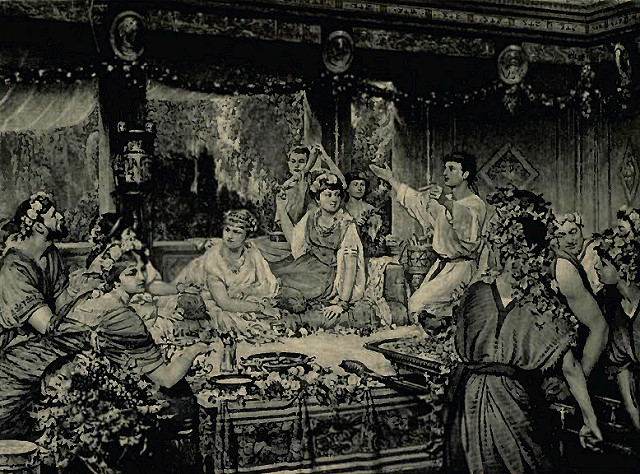
Around the tables, in place of chairs, are couches with an abundance of soft pillow. These couches are placed on three sides of the table; for it was the custom of the Romans to recline at their meals. When this custom was first introduced from Asia, the women did not think that it comported with their modesty to adopt this new style, and until the end of the Republic they retained the old habit of sitting at table.... After these entertainments have been concluded, an enormous disk is set, and in it a great boar. On his tusks, hang two baskets, one filled with dates, the other with almonds. About him are little pigs made of sweetmeats; they are presents to be carried away; it is the custom for men at a banquet to carry some part of it to those women of their families who have not been present..... when the servant makes a hole in the side of this boar, as though to carve it, out fly a number of blackbirds, which continue to flutter about the room until recaptured.
These are some of the features of such banquets as those to which the women of Poppæa's time were accustomed. We have drawn our description principally from Petronius's inimitable account. Though in Trimalchio's Feast there was, so far as it appears, no other woman besides his wife, yet we know from other sources that the presence of women at such entertainments was common. There is no evidence to the effect that they were in the habit of leaving the triclinium before the unrestrained indulgence in wine had made their presence there entirely inconsistent with any ideas of strict propriety; indeed, if the poets are to be credited, it often happened that love making of an ardent nature was carried on in the confusion which marked the termination of these feasts.
Poppæa had married an imperial actor. Even at so late a period as the days of Julius Cæsar, a citizen lost his civic rights by appearing on the stage; but now the whole Roman Empire bent in fulsome adulation before a crazy ruler who strained a wretched voice to sing Canace in Labor. The Forum had become silent; the temples were frequented, but with little faith or sincerity on the part of the worshippers. The public life of Rome centred in the theatre and the circus. "After the market place has been designed," says Vitruvius, "a very healthy spot must be chosen for the theatre, where the people can witness the dramas on the feast days of the immortal gods." In the days of Nero, the Roman people did not wait for a religious motive in order that they might indulge in shows which were certainly morally unhealthy, however salubrious may have been the site of the theatre. The most popular and best remunerated public servants were actors and actresses, dancing women and female musicians. Mommsen, commenting on the condition of theatrical art at an earlier time than that of Nero, says: "There was hardly any more lucrative trade in Rome than that of the actor and the dancing girl of the first rank. The princely estate of the tragic actor Æsopus amounted to two hundred thousand pounds sterling; his still more celebrated contemporary Roscius estimated his annual income at six thousand pounds, and Dionysia the dancer estimated hers at two thousand pounds." Later he adds, as indicating what was popular at the time: "It was nothing unusual for the Roman dancing girls to throw off at the finale the upper robe and to give a dance in undress for the benefit of the public."
There is in existence an epitaph of a girl named Licinia Eucharis, who is reputed to have been the first female to appear on the public Greek stage in Rome. She died at the age of fourteen; but, notwithstanding her tender years, she was "well instructed and taught in all arts by the Muses themselves."
The theatrical displays of the Romans had always been characterized by vulgarity and coarseness. The ancient Atellan farces were as full of obscenity as were the fescennine songs of broad allusions. This being so, even in the days when the Roman people deified chastity, it naturally follows that unbounded license must have prevailed in the degenerate days of the Empire. The surfeited taste of the licentious populace was gratified by hordes of women as well as men, who strove to give new piquancy to their exhibitions by the shamelessness of their performances.
There is some evidence, however, to show that now and again there was an actress who endeavored to "elevate the stage." Horace reports that when Arbuscula was hissed by the people, though doubtless she was giving a good performance, she had the courage to retort: "It is enough for me that the knight Mæcenas applauds"; but such a spirit was unusual, and the Roman theatre continued to deteriorate. As is always the case in such matters, the demand created the supply; but the supply also renewed and strengthened the taste from which sprung the demand. Watching some gladiators who had been condemned to mortal combat, a Roman argued with Seneca that they were criminals and deserved their fate. "Yes," answered the philosopher; "but what have you done that you should be condemned to witness such an exhibition?"
The moralist's stricture on their amusements was not concurred in by the great mass of his female compatriots. Patrician and plebeian, rich and poor, the women of Rome craved the realistic scenes of the theatre and the terrible excitements of the circus with as much avidity as did the men. Augustus had ordered that women should not be present at the exhibitions of wrestlers, and that they should only be allowed to witness gladiatorial combats from the upper and remote part of the theatre; but in the days of Nero, the sex was placed under no such restrictions. Augustus also severely punished an actor who allowed a married woman, dressed as a boy, to wait upon him at table; but afterward it became common for patrician ladies to be the paramours of gladiators and pantomimists, with no fear of punishment save the immortal lashings of the poetic satirists. These lashings, it is evident, had no deterrent effect; despite the sarcasms of Juvenal, the Ælias and Hispullas continued to be enamored of tragic actors. Hippia, though the wife of a Senator, accompanies a gladiator to Alexandria. She dines among the seamen, walks the deck in a rolling sea, and delights to take a hand at the ropes. What was the attribute that captivated her? Sergius was not handsome; "but then, he was a swordsman. The sword made its wielder as beautiful as Hyacinthus. It was this she preferred to her children, her native land, and her husband. It is the steel of which women are enamored. This same Sergius, if he were discharged from the arena, would be no better than her husband in her eyes."