O. Henry (continued 3)
Reading edition
“‘What do you want me to do?’ I asks George.
“‘Why,’ says he, ‘I want you to head her off. I want you to cut me out. I want you to come to the rescue. Suppose you seen a wildcat about for to eat me, what would you do?’
“‘Go for it,’ says I.
“‘Correct,’ says George. ‘Then go for this Mrs. De Clinton the same.’
“‘How am I to do it?’ I asks. ‘By force and awfulness or in some gentler and less lurid manner?’
“‘Court her,’ George says, ‘get her off my trail. Feed her. Take her out in boats. Hang around her and stick to her. Get her mashed on you if you can. Some women are pretty big fools. Who knows but what she might take a fancy to you.’
“‘Had you ever thought,’ I asks, ‘of repressing your fatal fascinations in her presence; of squeezing a harsh note in the melody of your siren voice, of veiling your beauty—in other words, of giving her the bounce yourself?’
“George sees no essence of sarcasm in my remark. He twists his moustache and looks at the points of his shoes.
“‘Well, Simms,’ he said, ‘you know how I am about the ladies. I can’t hurt none of their feelings. I’m, by nature, polite and esteemful of their intents and purposes. This Mrs. De Clinton don’t appear to be the suitable sort for me. Besides, I ain’t a marrying man by all means.’
“‘All right,’ said I, ‘I’ll do the best I can in the case.’
“So I bought a new outfit of clothes and a book on etiquette and made a dead set for Mrs. De Clinton. She was a fine-looking woman, cheerful and gay. At first, I almost had to hobble her to keep her from loping around at George’s heels; but finally I got her so she seemed glad to go riding with me and sailing on the lake; and she seemed real hurt on the mornings when I forgot to send her a bunch of flowers. Still, I didn’t like the way she looked at George, sometimes, out of the corner of her eye. George was having a fine time now, going with the whole bunch just as he pleased. Yes’m,” continued Bell, “she certainly was a fine-looking woman at that time. She’s changed some since, as you might have noticed at the supper table.”
“What!” I exclaimed.
“I married Mrs. De Clinton,” went on Bell. “One evening while we were up at the lake. When I told George about it, he opened his mouth and I thought he was going to break our traditions and say something grateful, but he swallowed it back.
“‘All right,’ says he, playing with his dog. ‘I hope you won’t have too much trouble. Myself, I’m not never going to marry.’
“That was three years ago,” said Bell. “We came here to live. For a year we got along medium fine. And then everything changed. For two years I’ve been having something that rhymes first-class with my name. You heard the row upstairs this evening? That was a merry welcome compared to the usual average. She’s tired of me and of this little town life and she rages all day, like a panther in a cage. I stood it until two weeks ago and then I had to send out The Call. I located George in Sacramento. He started the day he got my wire.”
Mrs. Bell came out of the house swiftly toward us. Some strong excitement or anxiety seemed to possess her, but she smiled a faint hostess smile, and tried to keep her voice calm.
“The dew is falling,” she said, “and it’s growing rather late. Wouldn’t you gentlemen rather come into the house?”
Bell took some cigars from his pocket and answered: “It’s most too fine a night to turn in yet. I think Mr. Ames and I will walk out along the road a mile or so and have another smoke. I want to talk with him about some goods that I want to buy.”
“Up the road or down the road?” asked Mrs. Bell.
“Down,” said Bell.
I thought she breathed a sigh of relief.
When we had gone a hundred yards and the house became concealed by trees, Bell guided me into the thick grove that lined the road and back through them toward the house again. We stopped within twenty yards of the house, concealed by the dark shadows. I wondered at this maneuver. And then I heard in the distance coming down the road beyond the house, the regular hoofbeats of a team of horses. Bell held his watch in a ray of moonlight.
“On time, within a minute,” he said. “That’s George’s way.”
The team slowed up as it drew near the house and stopped in a patch of black shadows. We saw the figure of a woman carrying a heavy valise move swiftly from the other side of the house, and hurry to the waiting vehicle. Then it rolled away briskly in the direction from which it had come.
I looked at Bell inquiringly, I suppose. I certainly asked him no question.
“She’s running away with George,” said Bell, simply. “He’s kept me posted about the progress of the scheme all along. She’ll get a divorce in six months and then George will marry her. He never helps anybody halfway. It’s all arranged between them.”
I began to wonder what friendship was, after all.
When we went into the house, Bell began to talk easily on other subjects; and I took his cue. By and by the big chance to buy out the business in Mountain City came back to my mind and I began to urge it upon him. Now that he was free, it would be easier for him to make the move; and he was sure of a splendid bargain.
Bell was silent for some minutes, but when I looked at him I fancied that he was thinking of something else—that he was not considering the project.
“Why, no, Mr. Ames,” he said, after a while, “I can’t make that deal. I’m awful thankful to you, though, for telling me about it. But I’ve got to stay here. I can’t go to Mountain City.”
“Why?” I asked.
“Missis Bell,” he replied, “won’t live in Mountain City, She hates the place and wouldn’t go there. I’ve got to keep right on here in Saltillo.”
“Mrs. Bell!” I exclaimed, too puzzled to conjecture what he meant.
“I ought to explain,” said Bell. “I know George and I know Mrs. Bell. He’s impatient in his ways. He can’t stand things that fret him, long, like I can. Six months, I give them—six months of married life, and there’ll be another disunion. Mrs. Bell will come back to me. There’s no other place for her to go. I’ve got to stay here and wait. At the end of six months, I’ll have to grab a satchel and catch the first train. For George will be sending out The Call.”
From The Rolling Stone
A DINNER AT –––– [3]
[The story referred to in this skit appears in “The Trimmed Lamp” under the same title—“The Badge of Policeman O’Roon.”]
The Adventures of an Author With His Own Hero
All that day—in fact from the moment of his creation—Van Sweller had conducted himself fairly well in my eyes. Of course I had had to make many concessions; but in return he had been no less considerate. Once or twice we had had sharp, brief contentions over certain points of behavior; but, prevailingly, give and take had been our rule.
His morning toilet provoked our first tilt. Van Sweller went about it confidently.
“The usual thing, I suppose, old chap,” he said, with a smile and a yawn. “I ring for a b. and s., and then I have my tub. I splash a good deal in the water, of course. You are aware that there are two ways in which I can receive Tommy Carmichael when he looks in to have a chat about polo. I can talk to him through the bathroom door, or I can be picking at a grilled bone which my man has brought in. Which would you prefer?”
I smiled with diabolic satisfaction at his coming discomfiture.
“Neither,” I said. “You will make your appearance on the scene when a gentleman should—after you are fully dressed, which indubitably private function shall take place behind closed doors. And I will feel indebted to you if, after you do appear, your deportment and manners are such that it will not be necessary to inform the public, in order to appease its apprehension, that you have taken a bath.”
Van Sweller slightly elevated his brows.
“Oh, very well,” he said, a trifle piqued. “I rather imagine it concerns you more than it does me. Cut the ‘tub’ by all means, if you think best. But it has been the usual thing, you know.”
This was my victory; but after Van Sweller emerged from his apartments in the “Beaujolie” I was vanquished in a dozen small but well-contested skirmishes. I allowed him a cigar; but routed him on the question of naming its brand. But he worsted me when I objected to giving him a “coat unmistakably English in its cut.” I allowed him to “stroll down Broadway,” and even permitted “passers by” (God knows there’s nowhere to pass but by) to “turn their heads and gaze with evident admiration at his erect figure.” I demeaned myself, and, as a barber, gave him a “smooth, dark face with its keen, frank eye, and firm jaw.”
Later on he looked in at the club and saw Freddy Vavasour, polo team captain, dawdling over grilled bone No. 1.
“Dear old boy,” began Van Sweller; but in an instant I had seized him by the collar and dragged him aside with the scantiest courtesy.
“For heaven’s sake talk like a man,” I said, sternly. “Do you think it is manly to use those mushy and inane forms of address? That man is neither dear nor old nor a boy.”
To my surprise Van Sweller turned upon me a look of frank pleasure.
“I am glad to hear you say that,” he said, heartily. “I used those words because I have been forced to say them so often. They really are contemptible. Thanks for correcting me, dear old boy.”
Still I must admit that Van Sweller’s conduct in the park that morning was almost without flaw. The courage, the dash, the modesty, the skill, and fidelity that he displayed atoned for everything.
This is the way the story runs. Van Sweller has been a gentleman member of the “Rugged Riders,” the company that made a war with a foreign country famous. Among his comrades was Lawrence O’Roon, a man whom Van Sweller liked. A strange thing—and a hazardous one in fiction—was that Van Sweller and O’Roon resembled each other mightily in face, form, and general appearance. After the war Van Sweller pulled wires, and O’Roon was made a mounted policeman.
Now, one night in New York there are commemorations and libations by old comrades, and in the morning, Mounted Policeman O’Roon, unused to potent liquids—another premise hazardous in fiction—finds the earth bucking and bounding like a bronco, with no stirrup into which he may insert foot and save his honor and his badge.
Noblesse oblige? Surely. So out along the driveways and bridle paths trots Hudson Van Sweller in the uniform of his incapacitated comrade, as like unto him as one French pea is unto a petit pois.
It is, of course, jolly larks for Van Sweller, who has wealth and social position enough for him to masquerade safely even as a police commissioner doing his duty, if he wished to do so. But society, not given to scanning the countenances of mounted policemen, sees nothing unusual in the officer on the beat.
And then comes the runaway.
That is a fine scene—the swaying victoria, the impetuous, daft horses plunging through the line of scattering vehicles, the driver stupidly holding his broken reins, and the ivory-white face of Amy Ffolliott, as she clings desperately with each slender hand. Fear has come and gone: it has left her expression pensive and just a little pleading, for life is not so bitter.
And then the clatter and swoop of Mounted Policeman Van Sweller! Oh, it was—but the story has not yet been printed. When it is you shall learn bow he sent his bay like a bullet after the imperilled victoria. A Crichton, a Crœsus, and a Centaur in one, he hurls the invincible combination into the chase.
When the story is printed you will admire the breathless scene where Van Sweller checks the headlong team. And then he looks into Amy Ffolliott’s eyes and sees two things—the possibilities of a happiness he has long sought, and a nascent promise of it. He is unknown to her; but he stands in her sight illuminated by the hero’s potent glory, she his and he hers by all the golden, fond, unreasonable laws of love and light literature.
Ay, that is a rich moment. And it will stir you to find Van Sweller in that fruitful nick of time thinking of his comrade O’Roon, who is cursing his gyrating bed and incapable legs in an unsteady room in a West Side hotel while Van Sweller holds his badge and his honor.
Van Sweller hears Miss Ffolliott’s voice thrillingly asking the name of her preserver. If Hudson Van Sweller, in policeman’s uniform, has saved the life of palpitating beauty in the park—where is Mounted Policeman O’Roon, in whose territory the deed is done? How quickly by a word can the hero reveal himself, thus discarding his masquerade of ineligibility and doubling the romance! But there is his friend!
Van Sweller touches his cap. “It’s nothing, Miss,” he says, sturdily; “that’s what we are paid for—to do our duty.” And away he rides. But the story does not end there.
As I have said, Van Sweller carried off the park scene to my decided satisfaction. Even to me he was a hero when he foreswore, for the sake of his friend, the romantic promise of his adventure. It was later in the day, amongst the more exacting conventions that encompass the society hero, when we had our liveliest disagreement. At noon he went to O’Roon’s room and found him far enough recovered to return to his post, which he at once did.
At about six o’clock in the afternoon Van Sweller fingered his watch, and flashed at me a brief look full of such shrewd cunning that I suspected him at once.
“Time to dress for dinner, old man,” he said, with exaggerated carelessness.
“Very well,” I answered, without giving him a clew to my suspicions; “I will go with you to your rooms and see that you do the thing properly. I suppose that every author must be a valet to his own hero.”
He affected cheerful acceptance of my somewhat officious proposal to accompany him. I could see that he was annoyed by it, and that fact fastened deeper in my mind the conviction that he was meditating some act of treachery.
When he had reached his apartments he said to me, with a too patronizing air: “There are, as you perhaps know, quite a number of little distinguishing touches to be had out of the dressing process. Some writers rely almost wholly upon them. I suppose that I am to ring for my man, and that he is to enter noiselessly, with an expressionless countenance.”
“He may enter,” I said, with decision, “and only enter. Valets do not usually enter a room shouting college songs or with St. Vitus’s dance in their faces; so the contrary may be assumed without fatuous or gratuitous asseveration.”
“I must ask you to pardon me,” continued Van Sweller, gracefully, “for annoying you with questions, but some of your methods are a little new to me. Shall I don a full-dress suit with an immaculate white tie—or is there another tradition to be upset?”
“You will wear,” I replied, “evening dress, such as a gentleman wears. If it is full, your tailor should be responsible for its bagginess. And I will leave it to whatever erudition you are supposed to possess whether a white tie is rendered any whiter by being immaculate. And I will leave it to the consciences of you and your man whether a tie that is not white, and therefore not immaculate, could possibly form any part of a gentleman’s evening dress. If not, then the perfect tie is included and understood in the term ‘dress,’ and its expressed addition predicates either a redundancy of speech or the spectacle of a man wearing two ties at once.”
With this mild but deserved rebuke I left Van Sweller in his dressing-room, and waited for him in his library.
About an hour later his valet came out, and I heard him telephone for an electric cab. Then out came Van Sweller, smiling, but with that sly, secretive design in his eye that was puzzling me.
I sprang up, angrily, at his words. This, then, was the paltry trick he had been scheming to play upon me. I faced him with a look so grim that even his patrician poise was flustered.
“You will never do so,” I exclaimed, “with my permission. What kind of a return is this,” I continued, hotly, “for the favors I have granted you? I gave you a ‘Van’ to your name when I might have called you ‘Perkins’ or ‘Simpson.’ I have humbled myself so far as to brag of your polo ponies, your automobiles, and the iron muscles that you acquired when you were stroke-oar of your ‘varsity eight,’ or ‘eleven,’ whichever it is. I created you for the hero of this story; and I will not submit to having you queer it. I have tried to make you a typical young New York gentleman of the highest social station and breeding. You have no reason to complain of my treatment to you. Amy Ffolliott, the girl you are to win, is a prize for any man to be thankful for, and cannot be equalled for beauty—provided the story is illustrated by the right artist. I do not understand why you should try to spoil everything. I had thought you were a gentleman.”
“What it is you are objecting to, old man?” asked Van Sweller, in a surprised tone.
“‘Must,’” I echoed, disdainfully; “why ‘must’? Who demands it?”
“The magazine editors,” answered Van Sweller, giving me a glance of significant warning.
“But why?” I persisted.
“To please subscribers around Kankakee, Ill.,” said Van Sweller, without hesitation.
“How do you know these things?” I inquired, with sudden suspicion. “You never came into existence until this morning. You are only a character in fiction, anyway. I, myself, created you. How is it possible for you to know anything?”
“Pardon me for referring to it,” said Van Sweller, with a sympathetic smile, “but I have been the hero of hundreds of stories of this kind.”
I felt a slow flush creeping into my face.
“I thought…” I stammered; “I was hoping… that is… Oh, well, of course an absolutely original conception in fiction is impossible in these days.”
“You will fail this time,” I said, emphatically.
“Perhaps so,” admitted Van Sweller, looking out of the window into the street below, “but if so it will be for the first time. The authors all send me there. I fancy that many of them would have liked to accompany me, but for the little matter of the expense.”
“I say I will be touting for no restaurant,” I repeated, loudly. “You are subject to my will, and I declare that you shall not appear of record this evening until the time arrives for you to rescue Miss Ffolliott again. If the reading public cannot conceive that you have dined during that interval at some one of the thousands of establishments provided for that purpose that do not receive literary advertisement it may suppose, for aught I care, that you have gone fasting.”
“I will take the consequences if there are to be any,” I replied. “I am not yet come to be sandwich man for an eating-house.”
I walked over to a table where I had left my cane and gloves. I heard the whirr of the alarm in the cab below and I turned quickly. Van Sweller was gone.
I rushed down the stairs and out to the curb. An empty hansom was just passing. I hailed the driver excitedly.
“See that auto cab halfway down the block?” I shouted. “Follow it. Don’t lose sight of it for an instant, and I will give you two dollars!”
If I only had been one of the characters in my story instead of myself I could easily have offered $10 or $25 or even $100. But $2 was all I felt justified in expending, with fiction at its present rates.
The cab driver, instead of lashing his animal into a foam, proceeded at a deliberate trot that suggested a by-the-hour arrangement.
I found Van Sweller at a table under a palm, just glancing over the menu, with a hopeful waiter hovering at his elbow.
“Come with me,” I said, inexorably. “You will not give me the slip again. Under my eye you shall remain until 11:30.”
Van Sweller countermanded the order for his dinner, and arose to accompany me. He could scarcely do less. A fictitious character is but poorly equipped for resisting a hungry but live author who comes to drag him forth from a restaurant. All he said was: “You were just in time; but I think you are making a mistake. You cannot afford to ignore the wishes of the great reading public.”
I took Van Sweller to my own rooms—to my room. He had never seen anything like it before.
“Sit on that trunk,” I said to him, “while I observe whether the landlady is stalking us. If she is not, I will get things at a delicatessen store below, and cook something for you in a pan over the gas jet. It will not be so bad. Of course nothing of this will appear in the story.”
“Jove! old man!” said Van Sweller, looking about him with interest, “this is a jolly little closet you live in! Where the devil do you sleep?—Oh, that pulls down! And I say—what is this under the corner of the carpet?—Oh, a frying pan! I see—clever idea! Fancy cooking over the gas! What larks it will be!”
“Think of anything you could eat?” I asked; “try a chop, or what?”
“Anything,” said Van Sweller, enthusiastically, “except a grilled bone.”
Two weeks afterward the postman brought me a large, fat envelope. I opened it, and took out something that I had seen before, and this typewritten letter from a magazine that encourages society fiction:
Your short story, “The Badge of Policeman O’Roon,” is herewith returned.
We are sorry that it has been unfavorably passed upon; but it seems to lack in some of the essential requirements of our publication.
The story is splendidly constructed; its style is strong and inimitable, and its action and character-drawing deserve the highest praise. As a story per se it has merit beyond anything that we have read for some time. But, as we have said, it fails to come up to some of the standards we have set.
Very truly yours, The Editors.
From The Rolling Stone
SOUND AND FURY
[O. Henry wrote this for Ainslee’s Magazine, where it appeared in March, 1903.]
PERSONS OF THE DRAMA
Mr. PenneAn Author
Miss Lore An Amanuensis
Scene—Workroom of Mr. Penne’s popular novel factory.
Mr. Penne—Good morning, Miss Lore. Glad to see you so prompt. We should finish that June installment for the Epoch to-day. Leverett is crowding me for it. Are you quite ready? We will resume where we left off yesterday. (Dictates.) “Kate, with a sigh, rose from his knees, and—”
Miss Lore—Excuse me; you mean “rose from her knees,” instead of “his,” don’t you?
Mr. Penne—Er—no—“his,” if you please. It is the love scene in the garden. (Dictates.) “Rose from his knees where, blushing with youth’s bewitching coyness, she had rested for a moment after Cortland had declared his love. The hour was one of supreme and tender joy. When Kate—scene that Cortland never—”
Miss Lore—Excuse me; but wouldn’t it be more grammatical to say “when Kate saw,” instead of “seen”?
Mr. Penne—The context will explain. (Dictates.) “When Kate—scene that Cortland never forgot—came tripping across the lawn it seemed to him the fairest sight that earth had ever offered to his gaze.”
Miss Lore—Oh!
Mr. Penne (dictates)—“Kate had abandoned herself to the joy of her new-found love so completely, that no shadow of her former grief was cast upon it. Cortland, with his arm firmly entwined about her waist, knew nothing of her sighs—”
Miss Lore—Goodness! If he couldn’t tell her size with his arm around—
Mr. Penne (frowning)—“Of her sighs and tears of the previous night.”
Miss Lore—Oh!
Mr. Penne (dictates)—“To Cortland the chief charm of this girl was her look of innocence and unworldiness. Never had nun—”
Miss Lore—How about changing that to “never had any?”
Mr. Penne (emphatically)—“Never had nun in cloistered cell a face more sweet and pure.”
Miss Lore—Oh!
Mr. Penne (dictates)—“But now Kate must hasten back to the house lest her absence be discovered. After a fond farewell she turned and sped lightly away. Cortland’s gaze followed her. He watched her rise—”
Miss Lore—Excuse me, Mr. Penne; but how could he watch her eyes while her back was turned toward him?
Mr. Penne (with extreme politeness)—Possibly you would gather my meaning more intelligently if you would wait for the conclusion of the sentence. (Dictates.) “Watched her rise as gracefully as a fawn as she mounted the eastern terrace.”
Miss Lore—Oh!
Mr. Penne (dictates)—“And yet Cortland’s position was so far above that of this rustic maiden that he dreaded to consider the social upheaval that would ensue should he marry her. In no uncertain tones the traditional voices of his caste and world cried out loudly to him to let her go. What should follow—”
Miss Lore (looking up with a start)—I’m sure I can’t say, Mr. Penne. Unless (with a giggle) you would want to add “Gallegher.”
Mr. Penne (coldly)—Pardon me. I was not seeking to impose upon you the task of a collaborator. Kindly consider the question a part of the text.
Miss Lore—Oh!
Mr. Penne (dictates)—“On one side was love and Kate; on the other side his heritage of social position and family pride. Would love win? Love, that the poets tell us will last forever! (Perceives that Miss Lore looks fatigued, and looks at his watch.) That’s a good long stretch. Perhaps we’d better knock off a bit.”
(Miss Lore does not reply.)
Mr. Penne—I said, Miss Lore, we’ve been at it quite a long time— wouldn’t you like to knock off for a while?
Miss Lore—Oh! Were you addressing me before? I put what you said down. I thought it belonged in the story. It seemed to fit in all right. Oh, no; I’m not tired.
Mr. Penne—Very well, then, we will continue. (Dictates.) “In spite of these qualms and doubts, Cortland was a happy man. That night at the club he silently toasted Kate’s bright eyes in a bumper of the rarest vintage. Afterward he set out for a stroll with, as Kate on—”
Miss Lore—Excuse me, Mr. Penne, for venturing a suggestion; but don’t you think you might state that in a less coarse manner?
Mr. Penne (astounded)—Wh-wh—I’m afraid I fail to understand you.
Miss Lore—His condition. Why not say he was “full” or “intoxicated”? It would sound much more elegant than the way you express it.
Mr. Penne (still darkly wandering)—Will you kindly point out, Miss Lore, where I have intimated that Cortland was “full,” if you prefer that word?
Miss Lore (calmly consulting her stenographic notes)—It is right here, word for word. (Reads.) “Afterward he set out for a stroll with a skate on.”
Mr. Penne (with peculiar emphasis)—Ah! And now will you kindly take down the expurgated phrase? (Dictates.) “Afterward he set out for a stroll with, as Kate on one occasion had fancifully told him, her spirit leaning upon his arm.”
Miss Lore—Oh!
Mr. Penne (dictates)—Chapter thirty-four. Heading—“What Kate Found in the Garden.” “That fragrant summer morning brought gracious tasks to all. The bees were at the honeysuckle blossoms on the porch. Kate, singing a little song, was training the riotous branches of her favorite woodbine. The sun, himself, had rows—”
Miss Lore—Shall I say “had risen”?
Mr. Penne (very slowly and with desperate deliberation)—“The—sun—himself—had—rows—of—blushing—pinks—and—hollyhocks—and—hyacinths—waiting—that—he—might—dry—their—dew-drenched—cups.”
Miss Lore—Oh!
Mr. Penne (dictates)—“The earliest trolley, scattering the birds from its pathway like some marauding cat, brought Cortland over from Oldport. He had forgotten his fair—”
Miss Lore—Hm! Wonder how he got the conductor to—
Mr. Penne (very loudly)—“Forgotten his fair and roseate visions of the night in the practical light of the sober morn.”
Miss Lore—Oh!
Mr. Penne (dictates)—“He greeted her with his usual smile and manner. ‘See the waves,’ he cried, pointing to the heaving waters of the sea, ‘ever wooing and returning to the rockbound shore.’” “‘Ready to break,’ Kate said, with—”
Miss Lore—My! One evening he has his arm around her, and the next morning he’s ready to break her head! Just like a man!
Mr. Penne (with suspicious calmness)—There are times, Miss Lore, when a man becomes so far exasperated that even a woman—But suppose we finish the sentence. (Dictates.) “‘Ready to break,’ Kate said, with the thrilling look of a soul-awakened woman, ‘into foam and spray, destroying themselves upon the shore they love so well.”
Miss Lore—Oh!
Mr. Penne (dictates)—“Cortland, in Kate’s presence heard faintly the voice of caution. Thirty years had not cooled his ardor. It was in his power to bestow great gifts upon this girl. He still retained the beliefs that he had at twenty.” (To Miss Lore, wearily) I think that will be enough for the present.
Miss Lore (wisely)—Well, if he had the twenty that he believed he had, it might buy her a rather nice one.
Mr. Penne (faintly)—The last sentence was my own. We will discontinue for the day, Miss Lore.
Miss Lore—Shall I come again to-morrow?
Mr. Penne (helpless under the spell)—If you will be so good.
(Exit Miss Lore.)
ASBESTOS CURTAIN
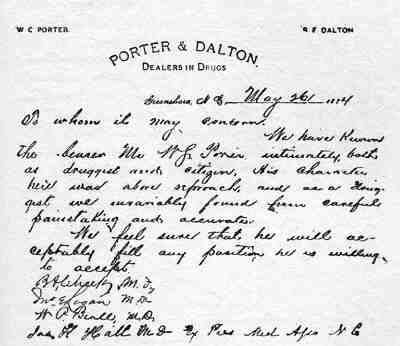
This and the following letter were the credentials
that the boy Will Porter brought along from
North Carolina to Texas.
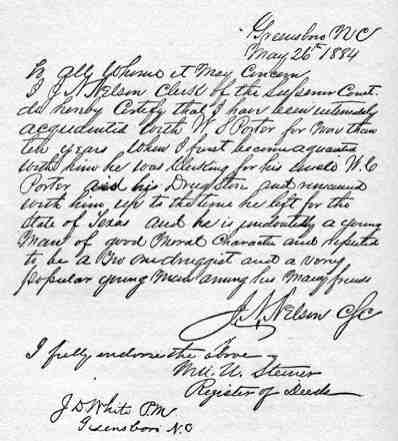
“A young man of good moral character
and an A No. 1 Druggist.”
TICTOCQ
[These two farcical stories about Tictocq appeared in The Rolling Stone. They are reprinted here with all of their local references because, written hurriedly and for neighborly reading, they nevertheless have an interest for the admirer of O. Henry. They were written in 1894.]
THE GREAT FRENCH DETECTIVE, IN AUSTIN