Chapter III
Reading edition
Tictocq’s room in the Avenue Hotel.
A knock is heard at the door.
Tictocq opens it and looks at his watch.
“Ah,” he says, “it is just six. Entrez, Messieurs.”
The messieurs entrez. There are seven of them; the Populist Candidate who is there by invitation, not knowing for what purpose; the chairman of the Democratic Executive Committee, platform No. 2, the hotel proprietor, and three or four Democrats and Populists, as near as could be found out.
“I don’t know,” begins the Populist Candidate, “what in the h––––”
“Excuse me,” says Tictocq, firmly. “You will oblige me by keeping silent until I make my report. I have been employed in this case, and I have unravelled it. For the honor of France I request that I be heard with attention.”
“Certainly,” says the chairman; “we will be pleased to listen.”
Tictocq stands in the centre of the room. The electric light burns brightly above him. He seems the incarnation of alertness, vigor, cleverness, and cunning.
The company seat themselves in chairs along the wall.
“When informed of the robbery,” begins Tictocq, “I first questioned the bell boy. He knew nothing. I went to the police headquarters. They knew nothing. I invited one of them to the bar to drink. He said there used to be a little colored boy in the Tenth Ward who stole things and kept them for recovery by the police, but failed to be at the place agreed upon for arrest one time, and had been sent to jail.
“I then began to think. I reasoned. No man, said I, would carry a Populist’s socks in his pocket without wrapping them up. He would not want to do so in the hotel. He would want a paper. Where would he get one? At the Statesman office, of course. I went there. A young man with his hair combed down on his forehead sat behind the desk. I knew he was writing society items, for a young lady’s slipper, a piece of cake, a fan, a half emptied bottle of cocktail, a bunch of roses, and a police whistle lay on the desk before him.
“‘Can you tell me if a man purchased a paper here in the last three months?’ I said.
“‘Yes,’ he replied; ‘we sold one last night.
“‘Can you describe the man?’
“‘Accurately. He had blue whiskers, a wart between his shoulder blades, a touch of colic, and an occupation tax on his breath.’
“‘Which way did he go?’
“‘Out.’
“I then went—”
“Wait a minute,” said the Populist Candidate, rising; “I don’t see why in the h––––”
“Once more I must beg that you will be silent,” said Tictocq, rather sharply. “You should not interrupt me in the midst of my report.”
“I made one false arrest,” continued Tictocq. “I was passing two finely dressed gentlemen on the street, when one of them remarked that he had ‘stole his socks.’ I handcuffed him and dragged him to a lighted store, when his companion explained to me that he was somewhat intoxicated and his tongue was not entirely manageable. He had been speaking of some business transaction, and what he intended to say was that he had ‘sold his stocks.’
“I then released him.
“An hour afterward I passed a saloon, and saw this Professor von Bum drinking beer at a table. I knew him in Paris. I said ‘here is my man.’ He worshipped Wagner, lived on limburger cheese, beer, and credit, and would have stolen anybody’s socks. I shadowed him to the reception at Colonel St. Vitus’s, and in an opportune moment I seized him and tore the socks from his feet. There they are.”
With a dramatic gesture, Tictocq threw a pair of dingy socks upon the table, folded his arms, and threw back his head.
With a loud cry of rage, the Populist Candidate sprang once more to his feet.
“Gol darn it! I WILL say what I want to. I—”
The two other Populists in the room gazed at him coldly and sternly.
“Is this tale true?” they demanded of the Candidate.
“No, by gosh, it ain’t!” he replied, pointing a trembling finger at the Democratic Chairman. “There stands the man who has concocted the whole scheme. It is an infernal, unfair political trick to lose votes for our party. How far has thing gone?” he added, turning savagely to the detective.
“All the newspapers have my written report on the matter, and the Statesman will have it in plate matter next week,” said Tictocq, complacently.
“All is lost!” said the Populists, turning toward the door.
“For God’s sake, my friends,” pleaded the Candidate, following them; “listen to me; I swear before high heaven that I never wore a pair of socks in my life. It is all a devilish campaign lie.”
The Populists turn their backs.
“The damage is already done,” they said. “The people have heard the story. You have yet time to withdraw decently before the race.”
All left the room except Tictocq and the Democrats.
“Let’s all go down and open a bottle of fizz on the Finance Committee,” said the Chairman of the Executive Committee, Platform No. 2.
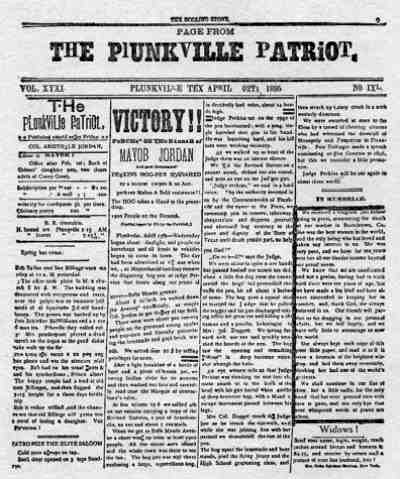
O. Henry himself always went over the type of this page (a feature of The Rolling Stone) and carefully made the right kind of typographical errors.
TRACKED TO DOOM
OR THE MYSTERY OF THE RUE DE PEYCHAUD
’Tis midnight in Paris.
A myriad of lamps that line the Champs Elysées and the Rouge et Noir, cast their reflection in the dark waters of the Seine as it flows gloomily past the Place Vendôme and the black walls of the Convent Notadam.
The great French capital is astir.
It is the hour when crime and vice and wickedness reign.
Hundreds of fiacres drive madly through the streets conveying women, flashing with jewels and as beautiful as dreams, from opera and concert, and the little bijou supper rooms of the Café Tout le Temps are filled with laughing groups, while bon mots, persiflage and repartee fly upon the air—the jewels of thought and conversation.
Luxury and poverty brush each other in the streets. The homeless gamin, begging a sou with which to purchase a bed, and the spendthrift roué, scattering golden louis d’or, tread the same pavement.
When other cities sleep, Paris has just begun her wild revelry.
The first scene of our story is a cellar beneath the Rue de Peychaud.
The room is filled with smoke of pipes, and is stifling with the reeking breath of its inmates. A single flaring gas jet dimly lights the scene, which is one Rembrandt or Moreland and Keisel would have loved to paint.
A garçon is selling absinthe to such of the motley crowd as have a few sous, dealing it out in niggardly portions in broken teacups.
Leaning against the bar is Carnaignole Cusheau—generally known as the Gray Wolf.
He is the worst man in Paris.
He is more than four feet ten in height, and his sharp, ferocious looking face and the mass of long, tangled gray hair that covers his face and head, have earned for him the name he bears.
His striped blouse is wide open at the neck and falls outside of his dingy leather trousers. The handle of a deadly looking knife protrudes from his belt. One stroke of its blade would open a box of the finest French sardines.
“Voilà, Gray Wolf,” cries Couteau, the bartender. “How many victims to-day? There is no blood upon your hands. Has the Gray Wolf forgotten how to bite?”
“Sacrè Bleu, Mille Tonnerre, by George,” hisses the Gray Wolf. “Monsieur Couteau, you are bold indeed to speak to me thus.
“By Ventre St. Gris! I have not even dined to-day. Spoils indeed. There is no living in Paris now. But one rich American have I garroted in a fortnight.
“Bah! those Democrats. They have ruined the country. With their income tax and their free trade, they have destroyed the millionaire business. Carrambo! Diable! D––––n it!”
“Hist!” suddenly says Chamounix the rag-picker, who is worth 20,000,000 francs, “some one comes!”
The cellar door opened and a man crept softly down the rickety steps. The crowd watches him with silent awe.
He went to the bar, laid his card on the counter, bought a drink of absinthe, and then drawing from his pocket a little mirror, set it up on the counter and proceeded to don a false beard and hair and paint his face into wrinkles, until he closely resembled an old man seventy-one years of age.
He then went into a dark corner and watched the crowd of people with sharp, ferret-like eyes.
Gray Wolf slipped cautiously to the bar and examined the card left by the newcomer.
“Holy Saint Bridget!” he exclaims. “It is Tictocq, the detective.”
Ten minutes later a beautiful woman enters the cellar. Tenderly nurtured, and accustomed to every luxury that money could procure, she had, when a young vivandière at the Convent of Saint Susan de la Montarde, run away with the Gray Wolf, fascinated by his many crimes and the knowledge that his business never allowed him to scrape his feet in the hall or snore.
“Parbleu, Marie,” snarls the Gray Wolf. “Que voulez vous? Avez-vous le beau cheval de mon frère, ou le joli chien de votre père?”
“No, no, Gray Wolf,” shouts the motley group of assassins, rogues and pickpockets, even their hardened hearts appalled at his fearful words. “Mon Dieu! You cannot be so cruel!”
“Tiens!” shouts the Gray Wolf, now maddened to desperation, and drawing his gleaming knife. “Voilà! Canaille! Tout le monde, carte blanche enbonpoint sauve que peut entre nous revenez nous a nous moutons!”
The horrified sans-culottes shrink back in terror as the Gray Wolf seizes Maria by the hair and cuts her into twenty-nine pieces, each exactly the same size.
As he stands with reeking hands above the corpse, amid a deep silence, the old, gray-bearded man who has been watching the scene springs forward, tears off his false beard and locks, and Tictocq, the famous French detective, stands before them.
Spellbound and immovable, the denizens of the cellar gaze at the greatest modern detective as he goes about the customary duties of his office.
He first measures the distance from the murdered woman to a point on the wall, then he takes down the name of the bartender and the day of the month and the year. Then drawing from his pocket a powerful microscope, he examines a little of the blood that stands upon the floor in little pools.
“Mon Dieu!” he mutters, “it is as I feared—human blood.”
He then enters rapidly in a memorandum book the result of his investigations, and leaves the cellar.
Tictocq bends his rapid steps in the direction of the headquarters of the Paris gendarmerie, but suddenly pausing, he strikes his hand upon his brow with a gesture of impatience.
“Mille tonnerre,” he mutters. “I should have asked the name of that man with the knife in his hand.”
It is reception night at the palace of the Duchess Valerie du Bellairs.
The apartments are flooded with a mellow light from paraffine candles in solid silver candelabra.
The company is the most aristocratic and wealthy in Paris.
Three or four brass bands are playing behind a portière between the coal shed, and also behind time. Footmen in gay-laced livery bring in beer noiselessly and carry out apple-peelings dropped by the guests.
Valerie, seventh Duchess du Bellairs, leans back on a solid gold ottoman on eiderdown cushions, surrounded by the wittiest, the bravest, and the handsomest courtiers in the capital.
“Ah, madame,” said the Prince Champvilliers, of Palais Royale, corner of Seventy-third Street, “as Montesquiaux says, ‘Rien de plus bon tutti frutti’—Youth seems your inheritance. You are to-night the most beautiful, the wittiest in your own salon. I can scarce believe my own senses, when I remember that thirty-one years ago you—”
“Saw it off!” says the Duchess peremptorily.
The Prince bows low, and drawing a jewelled dagger, stabs himself to the heart.
“The displeasure of your grace is worse than death,” he says, as he takes his overcoat and hat from a corner of the mantelpiece and leaves the room.
“Voilà,” says Bèebè Francillon, fanning herself languidly. “That is the way with men. Flatter them, and they kiss your hand. Loose but a moment the silken leash that holds them captive through their vanity and self-opinionativeness, and the son-of-a-gun gets on his ear at once. The devil go with him, I say.”
“Ah, mon Princesse,” sighs the Count Pumpernickel, stooping and whispering with eloquent eyes into her ear. “You are too hard upon us. Balzac says, ‘All women are not to themselves what no one else is to another.’ Do you not agree with him?”
“Cheese it!” says the Princess. “Philosophy palls upon me. I’ll shake you.”
“Hosses?” says the Count.
Arm and arm they go out to the salon au Beurre.
Armande de Fleury, the young pianissimo danseuse from the Folies Bergère is about to sing.
She slightly clears her throat and lays a voluptuous cud of chewing gum upon the piano as the first notes of the accompaniment ring through the salon.
As she prepares to sing, the Duchess du Bellairs grasps the arm of her ottoman in a vice-like grip, and she watches with an expression of almost anguished suspense.
She scarcely breathes.
Then, as Armande de Fleury, before uttering a note, reels, wavers, turns white as snow and falls dead upon the floor, the Duchess breathes a sigh of relief.
The Duchess had poisoned her.
Then the guests crowd about the piano, gazing with bated breath, and shuddering as they look upon the music rack and observe that the song that Armande came so near singing is “Sweet Marie.”
Twenty minutes later a dark and muffled figure was seen to emerge from a recess in the mullioned wall of the Arc de Triomphe and pass rapidly northward.
It was no other than Tictocq, the detective.
The network of evidence was fast being drawn about the murderer of Marie Cusheau.
It is midnight on the steeple of the Cathedral of Notadam.
It is also the same time at other given points in the vicinity.
The spire of the Cathedral is 20,000 feet above the pavement, and a casual observer, by making a rapid mathematical calculation, would have readily perceived that this Cathedral is, at least, double the height of others that measure only 10,000 feet.
At the summit of the spire there is a little wooden platform on which there is room for but one man to stand.
Crouching on this precarious footing, which swayed, dizzily with every breeze that blew, was a man closely muffled, and disguised as a wholesale grocer.
Old François Beongfallong, the great astronomer, who is studying the sidereal spheres from his attic window in the Rue de Bologny, shudders as he turns his telescope upon the solitary figure upon the spire.
“Sacrè Bleu!” he hisses between his new celluloid teeth. “It is Tictocq, the detective. I wonder whom he is following now?”
While Tictocq is watching with lynx-like eyes the hill of Montmartre, he suddenly hears a heavy breathing beside him, and turning, gazes into the ferocious eyes of the Gray Wolf.
Carnaignole Cusheau had put on his W. U. Tel. Co. climbers and climbed the steeple.
“Parbleu, monsieur,” says Tictocq. “To whom am I indebted for the honor of this visit?”
The Gray Wolf smiled softly and depreciatingly.
“You are Tictocq, the detective?” he said.
“I am.”
“Then listen. I am the murderer of Marie Cusheau. She was my wife and she had cold feet and ate onions. What was I to do? Yet life is sweet to me. I do not wish to be guillotined. I have heard that you are on my track. Is it true that the case is in your hands?”
“It is.”
“Thank le bon Dieu, then, I am saved.”
The Gray Wolf carefully adjusts the climbers on his feet and descends the spire.
Tictocq takes out his notebook and writes in it.
“At last,” he says, “I have a clue.”
Monsieur le Compte Carnaignole Cusheau, once known as the Gray Wolf, stands in the magnificent drawing-room of his palace on East 47th Street.
Three days after his confession to Tictocq, he happened to look in the pockets of a discarded pair of pants and found twenty million francs in gold.
Suddenly the door opens and Tictocq, the detective, with a dozen gensd’arme, enters the room.
“You are my prisoner,” says the detective.
“On what charge?”
“The murder of Marie Cusheau on the night of August 17th.”
“Your proofs?”
“I saw you do it, and your own confession on the spire of Notadam.”
The Count laughed and took a paper from his pocket. “Read this,” he said, “here is proof that Marie Cusheau died of heart failure.”
Tictocq looked at the paper.
It was a check for 100,000 francs.
Tictocq dismissed the gensd’arme with a wave of his hand.
“We have made a mistake, monsieurs,” he said, but as he turns to leave the room, Count Carnaignole stops him.
“One moment, monsieur.”
The Count Carnaignole tears from his own face a false beard and reveals the flashing eyes and well-known features of Tictocq, the detective.
Then, springing forward, he snatches a wig and false eyebrows from his visitor, and the Gray Wolf, grinding his teeth in rage, stands before him.
The murderer of Marie Cusheau was never discovered.
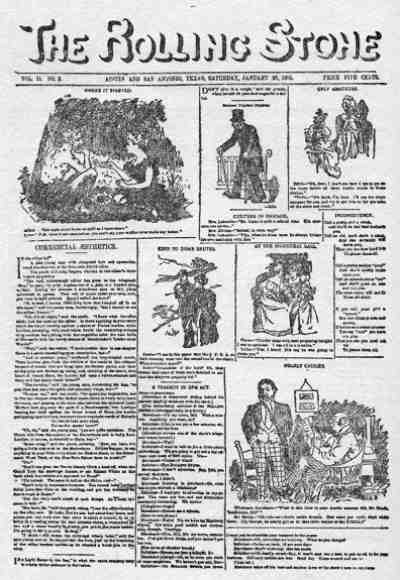
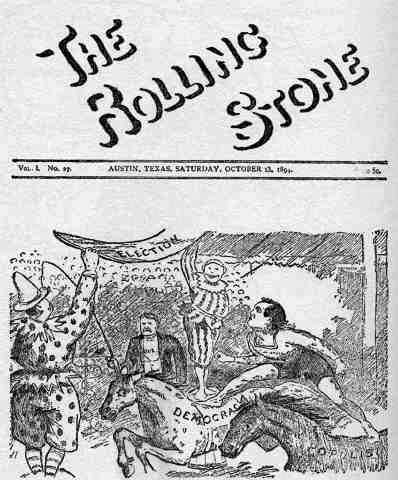
A front page of The Rolling Stone
A SNAPSHOT AT THE PRESIDENT
[This is the kind of waggish editorial O. Henry was writing in 1894 for the readers of The Rolling Stone. The reader will do well to remember that the paper was for local consumption and that the allusions are to a very special place and time.]
(It will be remembered that about a month ago there were special rates offered to the public for a round trip to the City of Washington. The price of the ticket being exceedingly low, we secured a loan of twenty dollars from a public-spirited citizen of Austin, by mortgaging our press and cow, with the additional security of our brother’s name and a slight draught on Major Hutchinson for $4,000.
We purchased a round trip ticket, two loaves of Vienna bread, and quite a large piece of cheese, which we handed to a member of our reportorial staff, with instructions to go to Washington, interview President Cleveland, and get a scoop, if possible, on all other Texas papers.
Our reporter came in yesterday morning, via the Manor dirt road, with a large piece of folded cotton bagging tied under each foot.
It seems that he lost his ticket in Washington, and having divided the Vienna bread and cheese with some disappointed office seekers who were coming home by the same route, he arrived home hungry, desiring food, and with quite an appetite.
Although somewhat late, we give his description of his interview with President Cleveland.)
I am chief reporter on the staff of The Rolling Stone.
About a month ago the managing editor came into the room where we were both sitting engaged in conversation and said:
“Oh, by the way, go to Washington and interview President Cleveland.”
“All right,” said I. “Take care of yourself.”
Five minutes later I was seated in a palatial drawing-room car bounding up and down quite a good deal on the elastic plush-covered seat.
I shall not linger upon the incidents of the journey. I was given carte blanche to provide myself with every comfort, and to spare no expense that I could meet. For the regalement of my inside the preparations had been lavish. Both Vienna and Germany had been called upon to furnish dainty viands suitable to my palate.
I changed cars and shirts once only on the journey. A stranger wanted me to also change a two-dollar bill, but I haughtily declined.
The scenery along the entire road to Washington is diversified. You find a portion of it on one hand by looking out of the window, and upon turning the gaze upon the other side the eye is surprised and delighted by discovering some more of it.
There were a great many Knights of Pythias on the train. One of them insisted upon my giving him the grip I had with me, but he was unsuccessful.
On arriving in Washington, which city I instantly recognized from reading the history of George, I left the car so hastily that I forgot to fee Mr. Pullman’s representative.
I went immediately to the Capitol.
In a spirit of jeu d’esprit I had had made a globular representation of a “rolling stone.” It was of wood, painted a dark color, and about the size of a small cannon ball. I had attached to it a twisted pendant about three inches long to indicate moss. I had resolved to use this in place of a card, thinking people would readily recognize it as an emblem of my paper.
I had studied the arrangement of the Capitol, and walked directly to Mr. Cleveland’s private office.
I met a servant in the hall, and held up my card to him smilingly.
I saw his hair rise on his head, and he ran like a deer to the door, and, lying down, rolled down the long flight of steps into the yard.
“Ah,” said I to myself, “he is one of our delinquent subscribers.”
A little farther along I met the President’s private secretary, who had been writing a tariff letter and cleaning a duck gun for Mr. Cleveland.
When I showed him the emblem of my paper he sprang out of a high window into a hothouse filled with rare flowers.
This somewhat surprised me.
I examined myself. My hat was on straight, and there was nothing at all alarming about my appearance.
I went into the President’s private office.
He was alone. He was conversing with Tom Ochiltree. Mr. Ochiltree saw my little sphere, and with a loud scream rushed out of the room.
President Cleveland slowly turned his eyes upon me.
He also saw what I had in my hand, and said in a husky voice:
“Wait a moment, please.”
He searched his coat pocket, and presently found a piece of paper on which some words were written.
He laid this on his desk and rose to his feet, raised one hand above him, and said in deep tones:
“I die for Free Trade, my country, and—and—all that sort of thing.”
I saw him jerk a string, and a camera snapped on another table, taking our picture as we stood.
“Don’t die in the House, Mr. President,” I said. “Go over into the Senate Chamber.”
“Peace, murderer!” he said. “Let your bomb do its deadly work.”
“I’m no bum,” I said, with spirit. “I represent The Rolling Stone, of Austin, Texas, and this I hold in my hand does the same thing, but, it seems, unsuccessfully.”
The President sank back in his chair greatly relieved.
“I thought you were a dynamiter,” he said. “Let me see; Texas! Texas!” He walked to a large wall map of the United States, and placing his finger thereon at about the location of Idaho, ran it down in a zigzag, doubtful way until he reached Texas.
“Oh, yes, here it is. I have so many things on my mind, I sometimes forget what I should know well.
“Let’s see; Texas? Oh, yes, that’s the State where Ida Wells and a lot of colored people lynched a socialist named Hogg for raising a riot at a camp-meeting. So you are from Texas. I know a man from Texas named Dave Culberson. How is Dave and his family? Has Dave got any children?”
“He has a boy in Austin,” I said, “working around the Capitol.”
“Who is President of Texas now?”
“I don’t exactly—”
“Oh, excuse me. I forgot again. I thought I heard some talk of its having been made a Republic again.”
“Now, Mr. Cleveland,” I said, “you answer some of my questions.”
A curious film came over the President’s eyes. He sat stiffly in his chair like an automaton.
“Proceed,” he said.
“What do you think of the political future of this country?”
“I will state that political exigencies demand emergentistical promptitude, and while the United States is indissoluble in conception and invisible in intent, treason and internecine disagreement have ruptured the consanguinity of patriotism, and—”
“One moment, Mr. President,” I interrupted; “would you mind changing that cylinder? I could have gotten all that from the American Press Association if I had wanted plate matter. Do you wear flannels? What is your favorite poet, brand of catsup, bird, flower, and what are you going to do when you are out of a job?”
“Young man,” said Mr. Cleveland, sternly, “you are going a little too far. My private affairs do not concern the public.”
I begged his pardon, and he recovered his good humor in a moment.
“You Texans have a great representative in Senator Mills,” he said. “I think the greatest two speeches I ever heard were his address before the Senate advocating the removal of the tariff on salt and increasing it on chloride of sodium.”
“Tom Ochiltree is also from our State,” I said.
“Oh, no, he isn’t. You must be mistaken,” replied Mr. Cleveland, “for he says he is. I really must go down to Texas some time, and see the State. I want to go up into the Panhandle and see if it is really shaped like it is on the map.”
“Well, I must be going,” said I.
“When you get back to Texas,” said the President, rising, “you must write to me. Your visit has awakened in me quite an interest in your State which I fear I have not given the attention it deserves. There are many historical and otherwise interesting places that you have revived in my recollection—the Alamo, where Davy Jones fell; Goliad, Sam Houston’s surrender to Montezuma, the petrified boom found near Austin, five-cent cotton and the Siamese Democratic platform born in Dallas. I should so much like to see the gals in Galveston, and go to the wake in Waco. I am glad I met you. Turn to the left as you enter the hall and keep straight on out.” I made a low bow to signify that the interview was at an end, and withdrew immediately. I had no difficulty in leaving the building as soon as I was outside.
I hurried downtown in order to obtain refreshments at some place where viands had been placed upon the free list.
I shall not describe my journey back to Austin. I lost my return ticket somewhere in the White House, and was forced to return home in a manner not especially beneficial to my shoes. Everybody was well in Washington when I left, and all send their love.
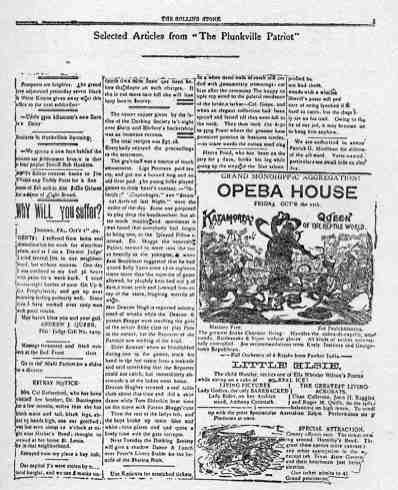
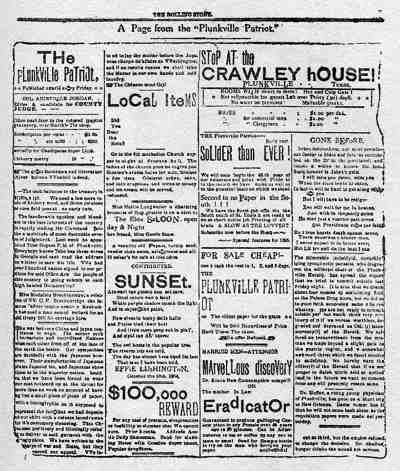
The editor of The Rolling Stone collected old, quaint cuts of which this page from “The Plunkville Patriot” shows several specimens.
AN UNFINISHED CHRISTMAS STORY
[Probably begun several years before his death. Published, as it here appears, in Short Stories, January, 1911.]
Now, a Christmas story should be one. For a good many years the ingenious writers have been putting forth tales for the holiday numbers that employed every subtle, evasive, indirect and strategic scheme they could invent to disguise the Christmas flavor. So far has this new practice been carried that nowadays when you read a story in a holiday magazine the only way you can tell it is a Christmas story is to look at the footnote which reads: [“The incidents in the above story happened on December 25th.—Ed.”]
There is progress in this; but it is all very sad. There are just as many real Christmas stories as ever, if we would only dig ’em up. Me, I am for the Scrooge and Marley Christmas story, and the Annie and Willie’s prayer poem, and the long lost son coming home on the stroke of twelve to the poorly thatched cottage with his arms full of talking dolls and popcorn balls and—Zip! you hear the second mortgage on the cottage go flying off it into the deep snow.
So, this is to warn you that there is no subterfuge about this story—and you might come upon stockings hung to the mantel and plum puddings and hark! the chimes! and wealthy misers loosening up and handing over penny whistles to lame newsboys if you read further.
Once I knocked at a door (I have so many things to tell you I keep on losing sight of the story). It was the front door of a furnished room house in West ’Teenth Street. I was looking for a young illustrator named Paley originally and irrevocably from Terre Haute. Paley doesn’t enter even into the first serial rights of this Christmas story; I mention him simply in explaining why I came to knock at the door—some people have so much curiosity.
The door was opened by the landlady. I had seen hundreds like her. And I had smelled before that cold, dank, furnished draught of air that hurried by her to escape immurement in the furnished house.
She was stout, and her face and lands were as white as though she had been drowned in a barrel of vinegar. One hand held together at her throat a buttonless flannel dressing sacque whose lines had been cut by no tape or butterick known to mortal woman. Beneath this a too-long, flowered, black sateen skirt was draped about her, reaching the floor in stiff wrinkles and folds.
The rest of her was yellow. Her hair, in some bygone age, had been dipped in the fountain of folly presided over by the merry nymph Hydrogen; but now, except at the roots, it had returned to its natural grim and grizzled white.
Her eyes and teeth and finger nails were yellow. Her chops hung low and shook when she moved. The look on her face was exactly that smileless look of fatal melancholy that you may have seen on the countenance of a hound left sitting on the doorstep of a deserted cabin.
I inquired for Paley. After a long look of cold suspicion the landlady spoke, and her voice matched the dingy roughness of her flannel sacque.
Paley? Was I sure that was the name? And wasn’t it, likely, Mr. Sanderson I meant, in the third floor rear? No; it was Paley I wanted. Again that frozen, shrewd, steady study of my soul from her pale-yellow, unwinking eyes, trying to penetrate my mask of deception and rout out my true motives from my lying lips. There was a Mr. Tompkins in the front hall bedroom two flights up. Perhaps it was he I was seeking. He worked of nights; he never came in till seven in the morning. Or if it was really Mr. Tucker (thinly disguised as Paley) that I was hunting I would have to call between five and—
But no; I held firmly to Paley. There was no such name among her lodgers. Click! the door closed swiftly in my face; and I heard through the panels the clanking of chains and bolts.
I went down the steps and stopped to consider. The number of this house was 43. I was sure Paley had said 43—or perhaps it was 45 or 47—I decided to try 47, the second house farther along.
I rang the bell. The door opened; and there stood the same woman. I wasn’t confronted by just a resemblance—it was the same woman holding together the same old sacque at her throat and looking at me with the same yellow eyes as if she had never seen me before on earth. I saw on the knuckle of her second finger the same red-and-black spot made, probably, by a recent burn against a hot stove.
I stood speechless and gaping while one with moderate haste might have told fifty. I couldn’t have spoken Paley’s name even if I had remembered it. I did the only thing that a brave man who believes there are mysterious forces in nature that we do not yet fully comprehend could have done in the circumstances. I backed down the steps to the sidewalk and then hurried away frontward, fully understanding how incidents like that must bother the psychical research people and the census takers.
Of course I heard an explanation of it afterward, as we always do about inexplicable things.
The landlady was Mrs. Kannon; and she leased three adjoining houses, which she made into one by cutting arched doorways through the walls. She sat in the middle house and answered the three bells.
I wonder why I have maundered so slowly through the prologue. I have it! it was simply to say to you, in the form of introduction rife through the Middle West: “Shake hands with Mrs. Kannon.”
For, it was in her triple house that the Christmas story happened; and it was there where I picked up the incontrovertible facts from the gossip of many roomers and met Stickney—and saw the necktie.
Christmas came that year on Thursday, and snow came with it.
Stickney (Harry Clarence Fowler Stickney to whomsoever his full baptismal cognominal burdens may be of interest) reached his address at six-thirty Wednesday afternoon. “Address” is New Yorkese for “home.” Stickney roomed at 45 West ’Teenth Street, third floor rear hall room. He was twenty years and four months old, and he worked in a cameras-of-all-kinds, photographic supplies and films-developed store. I don’t know what kind of work he did in the store; but you must have seen him. He is the young man who always comes behind the counter to wait on you and lets you talk for five minutes, telling him what you want. When you are done, he calls the proprietor at the top of his voice to wait on you, and walks away whistling between his teeth.
I don’t want to bother about describing to you his appearance; but, if you are a man reader, I will say that Stickncy looked precisely like the young chap that you always find sitting in your chair smoking a cigarette after you have missed a shot while playing pool—not billiards but pool—when you want to sit down yourself.
There are some to whom Christmas gives no Christmassy essence. Of course, prosperous people and comfortable people who have homes or flats or rooms with meals, and even people who live in apartment houses with hotel service get something of the Christmas flavor. They give one another presents with the cost mark scratched off with a penknife; and they hang holly wreaths in the front windows and when they are asked whether they prefer light or dark meat from the turkey they say: “Both, please,” and giggle and have lots of fun. And the very poorest people have the best time of it. The Army gives ’em a dinner, and the 10 a. m. issue of the Night Final edition of the newspaper with the largest circulation in the city leaves a basket at their door full of an apple, a Lake Ronkonkoma squab, a scrambled eggplant and a bunch of Kalamazoo bleached parsley. The poorer you are the more Christmas does for you.
But, I’ll tell you to what kind of a mortal Christmas seems to be only the day before the twenty-sixth day of December. It’s the chap in the big city earning sixteen dollars a week, with no friends and few acquaintances, who finds himself with only fifty cents in his pocket on Christmas eve. He can’t accept charity; he can’t borrow; he knows no one who would invite him to dinner. I have a fancy that when the shepherds left their flocks to follow the star of Bethlehem there was a bandy-legged young fellow among them who was just learning the sheep business. So they said to him, “Bobby, we’re going to investigate this star route and see what’s in it. If it should turn out to be the first Christmas day we don’t want to miss it. And, as you are not a wise man, and as you couldn’t possibly purchase a present to take along, suppose you stay behind and mind the sheep.”
So as we may say, Harry Stickney was a direct descendant of the shepherd who was left behind to take care of the flocks.
Getting back to facts, Stickney rang the doorbell of 45. He had a habit of forgetting his latchkey.
Instantly the door opened and there stood Mrs. Kannon, clutching her sacque together at the throat and gorgonizing him with her opaque, yellow eyes.
(To give you good measure, here is a story within a story. Once a roomer in 47 who had the Scotch habit—not kilts, but a habit of drinking Scotch—began to figure to himself what might happen if two persons should ring the doorbells of 43 and 47 at the same time. Visions of two halves of Mrs. Kannon appearing respectively and simultaneously at the two entrances, each clutching at a side of an open, flapping sacque that could never meet, overpowered him. Bellevue got him.)
“Evening,” said Stickney cheerlessly, as he distributed little piles of muddy slush along the hall matting. “Think we’ll have snow?”
“You left your key,” said—
[Here the manuscript ends.]
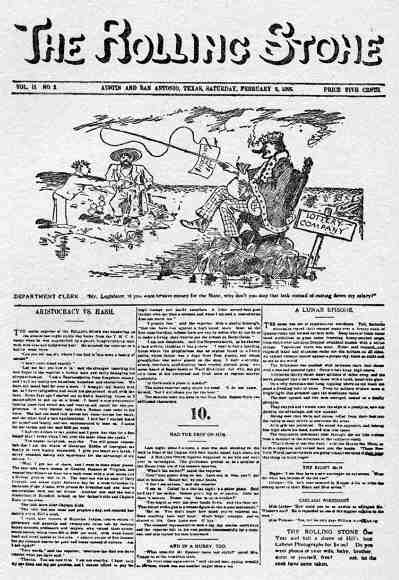
A front page of The Rolling Stone.
THE UNPROFITABLE SERVANT
[Left unfinished, and published as it here appears in Everybody’s Magazine, December, 1911.]
I am the richer by the acquaintance of four newspaper men. Singly, they are my encyclopedias, friends, mentors, and sometimes bankers. But now and then it happens that all of them will pitch upon the same printworthy incident of the passing earthly panorama and will send in reportorial constructions thereof to their respective journals. It is then that, for me, it is to laugh. For it seems that to each of them, trained and skilled as he may be, the same occurrence presents a different facet of the cut diamond, life.
One will have it (let us say) that Mme. André Macarté’s apartment was looted by six burglars, who descended via the fire-escape and bore away a ruby tiara valued at two thousand dollars and a five-hundred-dollar prize Spitz dog, which (in violation of the expectoration ordinance) was making free with the halls of the Wuttapesituckquesunoowetunquah Apartments.
My second “chiel” will take notes to the effect that while a friendly game of pinochle was in progress in the tenement rooms of Mrs. Andy McCarty, a lady guest named Ruby O’Hara threw a burglar down six flights of stairs, where he was pinioned and held by a two-thousand-dollar English bulldog amid a crowd of five hundred excited spectators.
My third chronicler and friend will gather the news threads of the happening in his own happy way; setting forth on the page for you to read that the house of Antonio Macartini was blown up at 6 a. m., by the Black Hand Society, on his refusing to leave two thousand dollars at a certain street corner, killing a pet five-hundred-dollar Pomeranian belonging to Alderman Rubitara’s little daughter (see photo and diagram opposite).
Number four of my history-makers will simply construe from the premises the story that while an audience of two thousand enthusiasts was listening to a Rubinstein concert on Sixth Street, a woman who said she was Mrs. Andrew M. Carter threw a brick through a plate-glass window valued at five hundred dollars. The Carter woman claimed that some one in the building had stolen her dog.
Now, the discrepancies in these registrations of the day’s doings need do no one hurt. Surely, one newspaper is enough for any man to prop against his morning water-bottle to fend off the smiling hatred of his wife’s glance. If he be foolish enough to read four he is no wiser than a Higher Critic.
I remember (probably as well as you do) having read the parable of the talents. A prominent citizen, about to journey into a far country, first hands over to his servants his goods. To one he gives five talents; to another two; to another one—to every man according to his several ability, as the text has it. There are two versions of this parable, as you well know. There may be more—I do not know.
When the p. c. returns he requires an accounting. Two servants have put their talents out at usury and gained one hundred per cent. Good. The unprofitable one simply digs up the talent deposited with him and hands it out on demand. A pattern of behavior for trust companies and banks, surely! In one version we read that he had wrapped it in a napkin and laid it away. But the commentator informs us that the talent mentioned was composed of 750 ounces of silver—about $900 worth. So the chronicler who mentioned the napkin, had either to reduce the amount of the deposit or do a lot of explaining about the size of the napery used in those days. Therefore in his version we note that he uses the word “pound” instead of “talent.”
A pound of silver may very well be laid away—and carried away—in a napkin, as any hotel or restaurant man will tell you.
But let us get away from our mutton.
When the returned nobleman finds that the one-talented servant has nothing to hand over except the original fund entrusted to him, he is as angry as a multi-millionaire would be if some one should hide under his bed and make a noise like an assessment. He orders the unprofitable servant cast into outer darkness, after first taking away his talent and giving it to the one-hundred-per cent. financier, and breathing strange saws, saying: “From him that hath not shall be taken away even that which he hath.” Which is the same as to say: “Nothing from nothing leaves nothing.”
And now closer draw the threads of parable, precept, allegory, and narrative, leading nowhere if you will, or else weaving themselves into the little fiction story about Cliff McGowan and his one talent. There is but a definition to follow; and then the homely actors trip on.
Talent: A gift, endowment or faculty; some peculiar ability, power, or accomplishment, natural or acquired. (A metaphor borrowed from the parable in Matt. XXV. 14-30.)
In New York City to-day there are (estimated) 125,000 living creatures training for the stage. This does not include seals, pigs, dogs, elephants, prize-fighters, Carmens, mind-readers, or Japanese wrestlers. The bulk of them are in the ranks of the Four Million. Out of this number will survive a thousand.
Nine hundred of these will have attained their fulness of fame when they shall dubiously indicate with the point of a hatpin a blurred figure in a flashlight photograph of a stage tout ensemble with the proud commentary: “That’s me.”
Eighty, in the pinkest of (male) Louis XIV court costumes, shall welcome the Queen of the (mythical) Pawpaw Isles in a few well-memorized words, turning a tip-tilted nose upon the nine hundred.
Ten, in tiny lace caps, shall dust Ibsen furniture for six minutes after the rising of the curtain.
Nine shall attain the circuits, besieging with muscle, skill, eye, hand, voice, wit, brain, heel and toe the ultimate high walls of stardom.
One shall inherit Broadway. Sic venit gloria mundi.
Cliff McGowan and Mac McGowan were cousins. They lived on the West Side and were talented. Singing, dancing, imitations, trick bicycle riding, boxing, German and Irish dialect comedy, and a little sleight-of-hand and balancing of wheat straws and wheelbarrows on the ends of their chins came as easy to them as it is for you to fix your rat so it won’t show or to dodge a creditor through the swinging-doors of a well-lighted café—according as you may belong to the one or the other division of the greatest prestidigitators—the people. They were slim, pale, consummately self-possessed youths, whose fingernails were always irreproachably (and clothes seams reproachfully) shiny. Their conversation was in sentences so short that they made Kipling’s seem as long as court citations.
Having the temperament, they did no work. Any afternoon you could find them on Eighth Avenue either in front of Spinelli’s barber shop, Mike Dugan’s place, or the Limerick Hotel, rubbing their forefinger nails with dingy silk handkerchiefs. At any time, if you had happened to be standing, undecisive, near a pool-table, and Cliff and Mac had, casually, as it were, drawn near, mentioning something disinterestedly, about a game, well, indeed, would it have been for you had you gone your way, unresponsive. Which assertion, carefully considered, is a study in tense, punctuation, and advice to strangers.
Of all kinships it is likely that the closest is that of cousin. Between cousins there exist the ties of race, name, and favor—ties thicker than water, and yet not coagulated with the jealous precipitations of brotherhood or the enjoining obligations of the matrimonial yoke. You can bestow upon a cousin almost the interest and affection that you would give to a stranger; you need not feel toward him the contempt and embarrassment that you have for one of your father’s sons—it is the closer clan-feeling that sometimes makes the branch of a tree stronger than its trunk.
Thus were the two McGowans bonded. They enjoyed a quiet celebrity in their district, which was a strip west of Eighth Avenue with the Pump for its pivot. Their talents were praised in a hundred “joints”; their friendship was famed even in a neighborhood where men had been known to fight off the wives of their friends—when domestic onslaught was being made upon their friends by the wives of their friends. (Thus do the limitations of English force us to repetends.)
So, side by side, grim, sallow, lowering, inseparable, undefeated, the cousins fought their way into the temple of Art—art with a big A, which causes to intervene a lesson in geometry.
One night at about eleven o’clock Del Delano dropped into Mike’s place on Eighth Avenue. From that moment, instead of remaining a Place, the café became a Resort. It was as though King Edward had condescended to mingle with ten-spots of a different suit; or Joe Gans had casually strolled in to look over the Tuskegee School; or Mr. Shaw, of England, had accepted an invitation to read selections from “Rena, the Snow-bird” at an unveiling of the proposed monument to James Owen O’Connor at Chinquapin Falls, Mississippi. In spite of these comparisons, you will have to be told why the patronizing of a third-rate saloon on the West Side by the said Del Delano conferred such a specific honor upon the place.
Del Delano could not make his feet behave; and so the world paid him $300 a week to see them misconduct themselves on the vaudeville stage. To make the matter plain to you (and to swell the number of words), he was the best fancy dancer on any of the circuits between Ottawa and Corpus Christi. With his eyes fixed on vacancy and his feet apparently fixed on nothing, he “nightly charmed thousands,” as his press-agent incorrectly stated. Even taking night performance and matinée together, he scarcely could have charmed more than eighteen hundred, including those who left after Zora, the Nautch girl, had squeezed herself through a hoop twelve inches in diameter, and those who were waiting for the moving pictures.
But Del Delano was the West Side’s favorite; and nowhere is there a more loyal Side. Five years before our story was submitted to the editors, Del had crawled from some Tenth Avenue basement like a lean rat and had bitten his way into the Big Cheese. Patched, half-starved, cuffless, and as scornful of the Hook as an interpreter of Ibsen, he had danced his way into health (as you and I view it) and fame in sixteen minutes on Amateur Night at Creary’s (Variety) Theatre in Eighth Avenue. A bookmaker (one of the kind that talent wins with instead of losing) sat in the audience, asleep, dreaming of an impossible pick-up among the amateurs. After a snore, a glass of beer from the handsome waiter, and a temporary blindness caused by the diamonds of a transmontane blonde in Box E, the bookmaker woke up long enough to engage Del Delano for a three-weeks’ trial engagement fused with a trained-dog short-circuit covering the three Washingtons—Heights, Statue, and Square.
By the time this story was read and accepted, Del Delano was drawing his three-hundred dollars a week, which, divided by seven (Sunday acts not in costume being permissible), dispels the delusion entertained by most of us that we have seen better days. You can easily imagine the worshipful agitation of Eighth Avenue whenever Del Delano honored it with a visit after his terpsichorean act in a historically great and vilely ventilated Broadway theatre. If the West Side could claim forty-two minutes out of his forty-two weeks’ bookings every year, it was an occasion for bonfires and repainting of the Pump. And now you know why Mike’s saloon is a Resort, and no longer a simple Place.
Del Delano entered Mike’s alone. So nearly concealed in a fur-lined overcoat and a derby two sizes too large for him was Prince Lightfoot that you saw of his face only his pale, hatchet-edged features and a pair of unwinking, cold, light blue eyes. Nearly every man lounging at Mike’s bar recognized the renowned product of the West Side. To those who did not, wisdom was conveyed by prodding elbows and growls of one-sided introduction.
Upon Charley, one of the bartenders, both fame and fortune descended simultaneously. He had once been honored by shaking hands with the great Delano at a Seventh Avenue boxing bout. So with lungs of brass he now cried: “Hallo, Del, old man; what’ll it be?”
Mike, the proprietor, who was cranking the cash register, heard. On the next day he raised Charley’s wages five a week.
Del Delano drank a pony beer, paying for it carelessly out of his nightly earnings of $42.85-5/7. He nodded amiably but coldly at the long line of Mike’s patrons and strolled past them into the rear room of the café. For he heard in there sounds pertaining to his own art—the light, stirring staccato of a buck-and-wing dance.
In the back room Mac McGowan was giving a private exhibition of the genius of his feet. A few young men sat at tables looking on critically while they amused themselves seriously with beer. They nodded approval at some new fancy steps of Mac’s own invention.
At the sight of the great Del Delano, the amateur’s feet stuttered, blundered, clicked a few times, and ceased to move. The tongues of one’s shoes become tied in the presence of the Master. Mac’s sallow face took on a slight flush.
From the uncertain cavity between Del Delano’s hat brim and the lapels of his high fur coat collar came a thin puff of cigarette smoke and then a voice:
“Do that last step over again, kid. And don’t hold your arms quite so stiff. Now, then!”
Once more Mac went through his paces. According to the traditions of the man dancer, his entire being was transformed into mere feet and legs. His gaze and expression became cataleptic; his body, unbending above the waist, but as light as a cork, bobbed like the same cork dancing on the ripples of a running brook. The beat of his heels and toes pleased you like a snare-drum obligato. The performance ended with an amazing clatter of leather against wood that culminated in a sudden flat-footed stamp, leaving the dancer erect and as motionless as a pillar of the colonial portico of a mansion in a Kentucky prohibition town. Mac felt that he had done his best and that Del Delano would turn his back upon him in derisive scorn.
An approximate silence followed, broken only by the mewing of a café cat and the hubbub and uproar of a few million citizens and transportation facilities outside.
Mac turned a hopeless but nervy eye upon Del Delano’s face. In it he read disgust, admiration, envy, indifference, approval, disappointment, praise, and contempt.
Thus, in the countenances of those we hate or love we find what we most desire or fear to see. Which is an assertion equalling in its wisdom and chiaroscuro the most famous sayings of the most foolish philosophers that the world has ever known.
Del Delano retired within his overcoat and hat. In two minutes he emerged and turned his left side to Mac. Then he spoke.
“You’ve got a foot movement, kid, like a baby hippopotamus trying to side-step a jab from a humming-bird. And you hold yourself like a truck driver having his picture taken in a Third Avenue photograph gallery. And you haven’t got any method or style. And your knees are about as limber as a couple of Yale pass-keys. And you strike the eye as weighing, let us say, 450 pounds while you work. But, say, would you mind giving me your name?”
“McGowan,” said the humbled amateur—“Mac McGowan.”
Delano the Great slowly lighted a cigarette and continued, through its smoke:
“In other words, you’re rotten. You can’t dance. But I’ll tell you one thing you’ve got.”
“Throw it all off of your system while you’re at it,” said Mac. “What’ve I got?”
“Genius,” said Del Delano. “Except myself, it’s up to you to be the best fancy dancer in the United States, Europe, Asia, and the colonial possessions of all three.”
“Smoke up!” said Mac McGowan.
“Genius,” repeated the Master—“you’ve got a talent for genius. Your brains are in your feet, where a dancer’s ought to be. You’ve been self-taught until you’re almost ruined, but not quite. What you need is a trainer. I’ll take you in hand and put you at the top of the profession. There’s room there for the two of us. You may beat me,” said the Master, casting upon him a cold, savage look combining so much rivalry, affection, justice, and human hate that it stamped him at once as one of the little great ones of the earth—“you may beat me; but I doubt it. I’ve got the start and the pull. But at the top is where you belong. Your name, you say, is Robinson?”
“McGowan,” repeated the amateur, “Mac McGowan.”
“It don’t matter,” said Delano. “Suppose you walk up to my hotel with me. I’d like to talk to you. Your footwork is the worst I ever saw, Madigan—but—well, I’d like to talk to you. You may not think so, but I’m not so stuck up. I came off of the West Side myself. That overcoat cost me eight hundred dollars; but the collar ain’t so high but what I can see over it. I taught myself to dance, and I put in most of nine years at it before I shook a foot in public. But I had genius. I didn’t go too far wrong in teaching myself as you’ve done. You’ve got the rottenest method and style of anybody I ever saw.”
“Oh, I don’t think much of the few little steps I take,” said Mac, with hypocritical lightness.
“Don’t talk like a package of self-raising buckwheat flour,” said Del Delano. “You’ve had a talent handed to you by the Proposition Higher Up; and it’s up to you to do the proper thing with it. I’d like to have you go up to my hotel for a talk, if you will.”
In his rooms in the King Clovis Hotel, Del Delano put on a scarlet house coat bordered with gold braid and set out Apollinaris and a box of sweet crackers.
Mac’s eye wandered.
“Forget it,” said Del. “Drink and tobacco may be all right for a man who makes his living with his hands; but they won’t do if you’re depending on your head or your feet. If one end of you gets tangled, so does the other. That’s why beer and cigarettes don’t hurt piano players and picture painters. But you’ve got to cut ’em out if you want to do mental or pedal work. Now, have a cracker, and then we’ll talk some.”
“All right,” said Mac. “I take it as an honor, of course, for you to notice my hopping around. Of course I’d like to do something in a professional line. Of course I can sing a little and do card tricks and Irish and German comedy stuff, and of course I’m not so bad on the trapeze and comic bicycle stunts and Hebrew monologues and—”
“One moment,” interrupted Del Delano, “before we begin. I said you couldn’t dance. Well, that wasn’t quite right. You’ve only got two or three bad tricks in your method. You’re handy with your feet, and you belong at the top, where I am. I’ll put you there. I’ve got six weeks continuous in New York; and in four I can shape up your style till the booking agents will fight one another to get you. And I’ll do it, too. I’m of, from, and for the West Side. ‘Del Delano’ looks good on bill-boards, but the family name’s Crowley. Now, Mackintosh—McGowan, I mean—you’ve got your chance—fifty times a better one than I had.”
“I’d be a shine to turn it down,” said Mac. “And I hope you understand I appreciate it. Me and my cousin Cliff McGowan was thinking of getting a try-out at Creary’s on amateur night a month from to-morrow.”
“Good stuff!” said Delano. “I got mine there. Junius T. Rollins, the booker for Kuhn & Dooley, jumped on the stage and engaged me after my dance. And the boards were an inch deep in nickels and dimes and quarters. There wasn’t but nine penny pieces found in the lot.”
“I ought to tell you,” said Mac, after two minutes of pensiveness, “that my cousin Cliff can beat me dancing. We’ve always been what you might call pals. If you’d take him up instead of me, now, it might be better. He’s invented a lot of steps that I can’t cut.”
“Forget it,” said Delano. “Mondays, Wednesdays, Fridays, and Saturdays of every week from now till amateur night, a month off, I’ll coach you. I’ll make you as good as I am; and nobody could do more for you. My act’s over every night at 10:15. Half an hour later I’ll take you up and drill you till twelve. I’ll put you at the top of the bunch, right where I am. You’ve got talent. Your style’s bum; but you’ve got the genius. You let me manage it. I’m from the West Side myself, and I’d rather see one of the same gang win out before I would an East-Sider, or any of the Flatbush or Hackensack Meadow kind of butt-iners. I’ll see that Junius Rollins is present on your Friday night; and if he don’t climb over the footlights and offer you fifty a week as a starter, I’ll let you draw it down from my own salary every Monday night. Now, am I talking on the level or am I not?”
Amateur night at Creary’s Eighth Avenue Theatre is cut by the same pattern as amateur nights elsewhere. After the regular performance the humblest talent may, by previous arrangement with the management, make its debut upon the public stage. Ambitious non-professionals, mostly self-instructed, display their skill and powers of entertainment along the broadest lines. They may sing, dance, mimic, juggle, contort, recite, or disport themselves along any of the ragged boundary lines of Art. From the ranks of these anxious tyros are chosen the professionals that adorn or otherwise make conspicuous the full-blown stage. Press-agents delight in recounting to open-mouthed and close-eared reporters stories of the humble beginnings of the brilliant stars whose orbits they control.
Such and such a prima donna (they will tell you) made her initial bow to the public while turning handsprings on an amateur night. One great matinée favorite made his debut on a generous Friday evening singing coon songs of his own composition. A tragedian famous on two continents and an island first attracted attention by an amateur impersonation of a newly landed Scandinavian peasant girl. One Broadway comedian that turns ’em away got a booking on a Friday night by reciting (seriously) the graveyard scene in “Hamlet.”
Thus they get their chance. Amateur night is a kindly boon. It is charity divested of almsgiving. It is a brotherly hand reached down by members of the best united band of coworkers in the world to raise up less fortunate ones without labelling them beggars. It gives you the chance, if you can grasp it, to step for a few minutes before some badly painted scenery and, during the playing by the orchestra of some ten or twelve bars of music, and while the soles of your shoes may be clearly holding to the uppers, to secure a salary equal to a Congressman’s or any orthodox minister’s. Could an ambitious student of literature or financial methods get a chance like that by spending twenty minutes in a Carnegie library? I do not not trow so.
But shall we look in at Creary’s? Let us say that the specific Friday night had arrived on which the fortunate Mac McGowan was to justify the flattering predictions of his distinguished patron and, incidentally, drop his silver talent into the slit of the slot-machine of fame and fortune that gives up reputation and dough. I offer, sure of your acquiescence, that we now forswear hypocritical philosophy and bigoted comment, permitting the story to finish itself in the dress of material allegations—a medium more worthy, when held to the line, than the most laborious creations of the word-milliners…
[Page of (O. Henry’s) manuscript missing here.]
…easily among the wings with his patron, the great Del Delano. For, whatever footlights shone in the City-That-Would-Be-Amused, the freedom of their unshaded side was Del’s. And if he should take up an amateur—see? and bring him around—see? and, winking one of his cold blue eyes, say to the manager: “Take it from me—he’s got the goods—see?” you wouldn’t expect that amateur to sit on an unpainted bench sudorifically awaiting his turn, would you? So Mac strolled around largely with the nonpareil; and the seven waited, clammily, on the bench.
A giant in shirt-sleeves, with a grim, kind face in which many stitches had been taken by surgeons from time to time, i. e., with a long stick, looped at the end. He was the man with the Hook. The manager, with his close-smoothed blond hair, his one-sided smile, and his abnormally easy manner, pored with patient condescension over the difficult program of the amateurs. The last of the professional turns—the Grand March of the Happy Huzzard—had been completed; the last wrinkle and darn of their blue silkolene cotton tights had vanished from the stage. The man in the orchestra who played the kettle-drum, cymbals, triangle, sandpaper, whang-doodle, hoof-beats, and catcalls, and fired the pistol shots, had wiped his brow. The illegal holiday of the Romans had arrived.
While the orchestra plays the famous waltz from “The Dismal Wife,” let us bestow two hundred words upon the psychology of the audience.
The orchestra floor was filled by People. The boxes contained Persons. In the galleries was the Foreordained Verdict. The claque was there as it had originated in the Stone Age and was afterward adapted by the French. Every Micky and Maggie who sat upon Creary’s amateur bench, wise beyond their talents, knew that their success or doom lay already meted out to them by that crowded, whistling, roaring mass of Romans in the three galleries. They knew that the winning or the losing of the game for each one lay in the strength of the “gang” aloft that could turn the applause to its favorite. On a Broadway first night a wooer of fame may win it from the ticket buyers over the heads of the cognoscenti. But not so at Creary’s. The amateur’s fate is arithmetical. The number of his supporting admirers present at his try-out decides it in advance. But how these outlying Friday nights put to a certain shame the Mondays, Tuesdays, Wednesdays, Thursdays, Saturdays, and matinées of the Broadway stage you should know…
[Here the manuscript ends.]
ARISTOCRACY VERSUS HASH
[From The Rolling Stone.]
The snake reporter of The Rolling Stone was wandering up the avenue last night on his way home from the Y.M.C.A. rooms when he was approached by a gaunt, hungry-looking man with wild eyes and dishevelled hair. He accosted the reporter in a hollow, weak voice.
“‘Can you tell me, Sir, where I can find in this town a family of scrubs?’
“‘I don’t understand exactly.’
“‘Let me tell you how it is,’ said the stranger, inserting his forefinger in the reporter’s buttonhole and badly damaging his chrysanthemum. ‘I am a representative from Soapstone County, and I and my family are houseless, homeless, and shelterless. We have not tasted food for over a week. I brought my family with me, as I have indigestion and could not get around much with the boys. Some days ago I started out to find a boarding house, as I cannot afford to put up at a hotel. I found a nice aristocratic-looking place, that suited me, and went in and asked for the proprietress. A very stately lady with a Roman nose came in the room. She had one hand laid across her stom—across her waist, and the other held a lace handkerchief. I told her I wanted board for myself and family, and she condescended to take us. I asked for her terms, and she said $300 per week.
“‘I had two dollars in my pocket and I gave her that for a fine teapot that I broke when I fell over the table when she spoke.’
“‘You appear surprised,’ says she. ‘You will please remembah that I am the widow of Governor Riddle of Georgiah; my family is very highly connected; I give you board as a favah; I nevah considah money any equivalent for the advantage of my society, I—’
“‘Well, I got out of there, and I went to some other places. The next lady was a cousin of General Mahone of Virginia, and wanted four dollars an hour for a back room with a pink motto and a Burnet granite bed in it. The next one was an aunt of Davy Crockett, and asked eight dollars a day for a room furnished in imitation of the Alamo, with prunes for breakfast and one hour’s conversation with her for dinner. Another one said she was a descendant of Benedict Arnold on her father’s side and Captain Kidd on the other.
“‘She took more after Captain Kidd.
“‘She only had one meal and prayers a day, and counted her society worth $100 a week.
“‘I found nine widows of Supreme Judges, twelve relicts of Governors and Generals, and twenty-two ruins left by various happy Colonels, Professors, and Majors, who valued their aristocratic worth from $90 to $900 per week, with weak-kneed hash and dried apples on the side. I admire people of fine descent, but my stomach yearns for pork and beans instead of culture. Am I not right?’
“‘Your words,’ said the reporter, ‘convince me that you have uttered what you have said.’
“‘Thanks. You see how it is. I am not wealthy; I have only my per diem and my perquisites, and I cannot afford to pay for high lineage and moldy ancestors. A little corned beef goes further with me than a coronet, and when I am cold a coat of arms does not warm me.’
“‘I greatly fear,’ said the reporter, with a playful hiccough, ‘that you have run against a high-toned town. Most all the first-class boarding houses here are run by ladies of the old Southern families, the very first in the land.’
“‘I am now desperate,’ said the Representative, as he chewed a tack awhile, thinking it was a clove. ‘I want to find a boarding house where the proprietress was an orphan found in a livery stable, whose father was a dago from East Austin, and whose grandfather was never placed on the map. I want a scrubby, ornery, low-down, snuff-dipping, back-woodsy, piebald gang, who never heard of finger bowls or Ward McAllister, but who can get up a mess of hot cornbread and Irish stew at regular market quotations.’
“‘Is there such a place in Austin?’
“The snake reporter sadly shook his head. ‘I do not know,’ he said, ‘but I will shake you for the beer.’
“Ten minutes later the slate in the Blue Ruin saloon bore two additional characters: 10.”
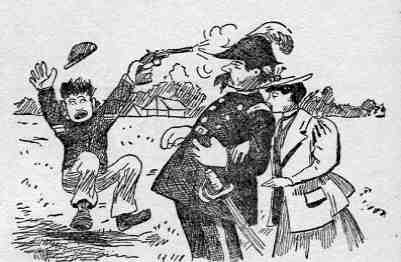
Visitor—“Dear me, General, who is that dreadful man?” General—“Oh, that’s only the orderly sergeant.”
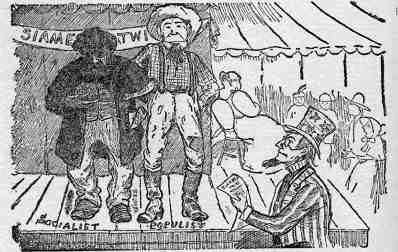
UNCLE SAM—“Well, I declare, those gentlemen must be brothers.”
THE PRISONER OF ZEMBLA
[From The Rolling Stone.]
So the king fell into a furious rage, so that none durst go near him for fear, and he gave out that since the Princess Ostla had disobeyed him there would be a great tourney, and to the knight who should prove himself of the greatest valor he would give the hand of the princess.
And he sent forth a herald to proclaim that he would do this.
And the herald went about the country making his desire known, blowing a great tin horn and riding a noble steed that pranced and gambolled; and the villagers gazed upon him and said: “Lo, that is one of them tin horn gamblers concerning which the chroniclers have told us.”
And when the day came, the king sat in the grandstand, holding the gage of battle in his hand, and by his side sat the Princess Ostla, looking very pale and beautiful, but with mournful eyes from which she scarce could keep the tears. And the knights which came to the tourney gazed upon the princess in wonder at her beauty, and each swore to win so that he could marry her and board with the king. Suddenly the heart of the princess gave a great bound, for she saw among the knights one of the poor students with whom she had been in love.
The knights mounted and rode in a line past the grandstand, and the king stopped the poor student, who had the worst horse and the poorest caparisons of any of the knights and said:
“Sir Knight, prithee tell me of what that marvellous shacky and rusty-looking armor of thine is made?”
“Oh, king,” said the young knight, “seeing that we are about to engage in a big fight, I would call it scrap iron, wouldn’t you?”
“Ods Bodkins!” said the king. “The youth hath a pretty wit.”
About this time the Princess Ostla, who began to feel better at the sight of her lover, slipped a piece of gum into her mouth and closed her teeth upon it, and even smiled a little and showed the beautiful pearls with which her mouth was set. Whereupon, as soon as the knights perceived this, 217 of them went over to the king’s treasurer and settled for their horse feed and went home.
“It seems very hard,” said the princess, “that I cannot marry when I chews.”
But two of the knights were left, one of them being the princess’ lover.
“Here’s enough for a fight, anyhow,” said the king. “Come hither, O knights, will ye joust for the hand of this fair lady?”
“We joust will,” said the knights.
The two knights fought for two hours, and at length the princess’ lover prevailed and stretched the other upon the ground. The victorious knight made his horse caracole before the king, and bowed low in his saddle.
On the Princess Ostla’s cheeks was a rosy flush; in her eyes the light of excitement vied with the soft glow of love; her lips were parted, her lovely hair unbound, and she grasped the arms of her chair and leaned forward with heaving bosom and happy smile to hear the words of her lover.
“You have foughten well, sir knight,” said the king. “And if there is any boon you crave you have but to name it.”
“Then,” said the knight, “I will ask you this: I have bought the patent rights in your kingdom for Schneider’s celebrated monkey wrench, and I want a letter from you endorsing it.”
“You shall have it,” said the king, “but I must tell you that there is not a monkey in my kingdom.”
With a yell of rage the victorious knight threw himself on his horse and rode away at a furious gallop.
The king was about to speak, when a horrible suspicion flashed upon him and he fell dead upon the grandstand.
“My God!” he cried. “He has forgotten to take the princess with him!”
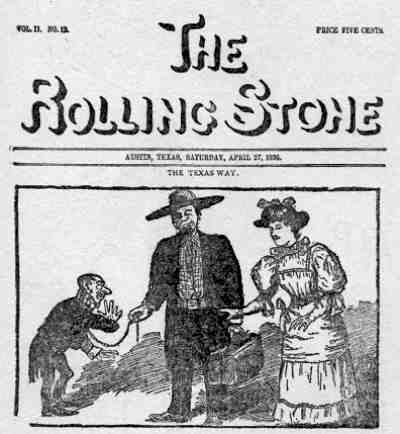
Miss Potter: “Oh papa, what is that?” Mr. Potter of Texas: “That’s a live Count I bought for you in New York.” Miss Potter: “Oh, how nice, and Uncle George gave me a new six shooter, and the dogs haven’t had any exercise in a week. Won’t it be fun?”
A STRANGE STORY
[From The Rolling Stone.]
In the northern part of Austin there once dwelt an honest family by the name of Smothers. The family consisted of John Smothers, his wife, himself, their little daughter, five years of age, and her parents, making six people toward the population of the city when counted for a special write-up, but only three by actual count.
One night after supper the little girl was seized with a severe colic, and John Smothers hurried down town to get some medicine.
He never came back.
The little girl recovered and in time grew up to womanhood.
The mother grieved very much over her husband’s disappearance, and it was nearly three months before she married again, and moved to San Antonio.
The little girl also married in time, and after a few years had rolled around, she also had a little girl five years of age.
She still lived in the same house where they dwelt when her father had left and never returned.
One night by a remarkable coincidence her little girl was taken with cramp colic on the anniversary of the disappearance of John Smothers, who would now have been her grandfather if he had been alive and had a steady job.
“I will go downtown and get some medicine for her,” said John Smith (for it was none other than he whom she had married).
“No, no, dear John,” cried his wife. “You, too, might disappear forever, and then forget to come back.”
So John Smith did not go, and together they sat by the bedside of little Pansy (for that was Pansy’s name).
After a little Pansy seemed to grow worse, and John Smith again attempted to go for medicine, but his wife would not let him.
Suddenly the door opened, and an old man, stooped and bent, with long white hair, entered the room.
“Hello, here is grandpa,” said Pansy. She had recognized him before any of the others.
The old man drew a bottle of medicine from his pocket and gave Pansy a spoonful.
She got well immediately.
“I was a little late,” said John Smothers, “as I waited for a street car.”
FICKLE FORTUNE OR HOW GLADYS HUSTLED
[From The Rolling Stone.]
“Press me no more Mr. Snooper,” said Gladys Vavasour-Smith. “I can never be yours.”
“You have led me to believe different, Gladys,” said Bertram D. Snooper.
The setting sun was flooding with golden light the oriel windows of a magnificent mansion situated in one of the most aristocratic streets west of the brick yard.
Bertram D. Snooper, a poor but ambitious and talented young lawyer, had just lost his first suit. He had dared to aspire to the hand of Gladys Vavasour-Smith, the beautiful and talented daughter of one of the oldest and proudest families in the county. The bluest blood flowed in her veins. Her grandfather had sawed wood for the Hornsbys and an aunt on her mother’s side had married a man who had been kicked by General Lee’s mule.
The lines about Bertram D. Snooper’s hands and mouth were drawn tighter as he paced to and fro, waiting for a reply to the question he intended to ask Gladys as soon as he thought of one.
At last an idea occurred to him.
“Why will you not marry me?” he asked in an inaudible tone.
“Because,” said Gladys firmly, speaking easily with great difficulty, “the progression and enlightenment that the woman of to-day possesses demand that the man shall bring to the marriage altar a heart and body as free from the debasing and hereditary iniquities that now no longer exist except in the chimerical imagination of enslaved custom.”
“It is as I expected,” said Bertram, wiping his heated brow on the window curtain. “You have been reading books.”
“Besides that,” continued Gladys, ignoring the deadly charge, “you have no money.”
The blood of the Snoopers rose hastily and mantled the cheek of Bertram D. He put on his coat and moved proudly to the door.
“Stay here till I return,” he said, “I will be back in fifteen years.”
When he had finished speaking he ceased and left the room.
When he had gone, Gladys felt an uncontrollable yearning take possession of her. She said slowly, rather to herself than for publication, “I wonder if there was any of that cold cabbage left from dinner.”
She then left the room.
When she did so, a dark-complexioned man with black hair and gloomy, desperate looking clothes, came out of the fireplace where he had been concealed and stated:
As the reader has doubtless long ago discovered, this man was no other than Henry R. Grasty. Mr. Grasty then proceeded to gloat some more, and then with a sardonic laugh left for New York.
Fifteen years have elapsed.
Of course, our readers will understand that this is only supposed to the the case.
It really took less than a minute to make the little stars that represent an interval of time.
We could not afford to stop a piece in the middle and wait fifteen years before continuing it.
We hope this explanation will suffice. We are careful not to create any wrong impressions.
Gladys Vavasour-Smith and Henry R. Grasty stood at the marriage altar.
Mr. Grasty had evidently worked his rabbit’s foot successfully, although he was quite a while in doing so.
Just as the preacher was about to pronounce the fatal words on which he would have realized ten dollars and had the laugh on Mr. Grasty, the steeple of the church fell off and Bertram D. Snooper entered.
The preacher fell to the ground with a dull thud. He could ill afford to lose ten dollars. He was hastily removed and a cheaper one secured.
Bertram D. Snooper held a Statesman in his hand.
“Aha!” he said, “I thought I would surprise you. I just got in this morning. Here is a paper noticing my arrival.”
He handed it to Henry R. Grasty.
Mr. Grasty looked at the paper and turned deadly pale. It was dated three weeks after Mr. Snooper’s arrival.
“Foiled again!” he hissed.
“Speak, Bertram D. Snooper,” said Gladys, “why have you come between me and Henry?”
“I have just discovered that I am the sole heir to Tom Bean’s estate and am worth two million dollars.”
With a glad cry Gladys threw herself in Bertram’s arms.
Henry R. Grasty drew from his breast pocket a large tin box and opened it, took therefrom 467 pages of closely written foolscap.
“What you say is true, Mr. Snooper, but I ask you to read that,” he said, handing it to Bertram Snooper.
Mr. Snooper had no sooner read the document than he uttered a piercing shriek and bit off a large chew of tobacco.
“All is lost,” he said.
“What is that document?” asked Gladys. “Governor Hogg’s message?”
“It is not as bad as that,” said Bertram, “but it deprives me of my entire fortune. But I care not for that, Gladys, since I have won you.”
“What is it? Speak, I implore you,” said Gladys.
“Those papers,” said Henry R. Grasty, “are the proofs of my appointment as administrator of the Tom Bean estate.”
With a loving cry Gladys threw herself in Henry R. Grasty’s arms.
Twenty minutes later Bertram D. Snooper was seen deliberately to enter a beer saloon on Seventeenth Street.
AN APOLOGY
[This appeared in The Rolling Stone shortly before it “suspended publication” never to resume.]
The person who sweeps the office, translates letters from foreign countries, deciphers communications from graduates of business colleges, and does most of the writing for this paper, has been confined for the past two weeks to the under side of a large red quilt, with a joint caucus of la grippe and measles.
We have missed two issues of The Rolling Stone, and are now slightly convalescent, for which we desire to apologize and express our regrets.
Everybody’s term of subscription will be extended enough to cover all missed issues, and we hope soon to report that the goose remains suspended at a favorable altitude. People who have tried to run a funny paper and entertain a congregation of large piebald measles at the same time will understand something of the tact, finesse, and hot sassafras tea required to do so. We expect to get out the paper regularly from this time on, but are forced to be very careful, as improper treatment and deleterious after-effects of measles, combined with the high price of paper and presswork, have been known to cause a relapse. Any one not getting their paper regularly will please come down and see about it, bringing with them a ham or any little delicacy relished by invalids.
can he make the jump?
LORD OAKHURST’S CURSE
[This story was sent to Dr. Beall of Greensboro, N. C., in a letter in 1883, and so is one of O. Henry’s earliest attempts at writing.]
I
Lord Oakhurst lay dying in the oak chamber in the eastern wing of Oakhurst Castle. Through the open window in the calm of the summer evening, came the sweet fragrance of the early violets and budding trees, and to the dying man it seemed as if earth’s loveliness and beauty were never so apparent as on this bright June day, his last day of life.
His young wife, whom he loved with a devotion and strength that the presence of the king of terrors himself could not alter, moved about the apartment, weeping and sorrowful, sometimes arranging the sick man’s pillow and inquiring of him in low, mournful tones if anything could be done to give him comfort, and again, with stifled sobs, eating some chocolate caramels which she carried in the pocket of her apron. The servants went to and fro with that quiet and subdued tread which prevails in a house where death is an expected guest, and even the crash of broken china and shivered glass, which announced their approach, seemed to fall upon the ear with less violence and sound than usual.
Lord Oakhurst was thinking of days gone by, when he wooed and won his beautiful young wife, who was then but a charming and innocent girl. How clearly and minutely those scenes rose up at the call of his memory. He seemed to be standing once more beneath the old chestnut grove where they had plighted their troth in the twilight under the stars; while the rare fragrance of the June roses and the smell of supper came gently by on the breeze. There he had told her his love; how that his whole happiness and future joy lay in the hope that he might win her for a bride; that if she would trust her future to his care the devotedness of his lifetime should be hers, and his only thought would be to make her life one long day of sunshine and peanut candy.
How plainly he remembered how she had, with girlish shyness and coyness, at first hesitated, and murmured something to herself about “an old bald-headed galoot,” but when he told her that to him life without her would be a blasted mockery, and that his income was £50,000 a year, she threw herself on to him and froze there with the tenacity of a tick on a brindled cow, and said, with tears of joy, “Hen-ery, I am thine.”
And now he was dying. In a few short hours his spirit would rise up at the call of the Destroyer and, quitting his poor, weak, earthly frame, would go forth into that dim and dreaded Unknown Land, and solve with certainty that Mystery which revealeth itself not to mortal man.
II
A carriage drove rapidly up the avenue and stopped at the door. Sir Everhard FitzArmond, the famous London physician, who had been telegraphed for, alighted and quickly ascended the marble steps. Lady Oakhurst met him at the door, her lovely face expressing great anxiety and grief. “Oh, Sir Everhard, I am so glad you have come. He seems to be sinking rapidly. Did you bring the cream almonds I mentioned in the telegram?”
Sir Everhard did not reply, but silently handed her a package, and, slipping a couple of cloves into his mouth, ascended the stairs that led to Lord Oakhurst’s apartment. Lady Oakhurst followed.
Sir Everhard approached the bedside of his patient and laid his hand gently on this sick man’s diagnosis. A shade of feeling passed over his professional countenance as he gravely and solemnly pronounced these words: “Madam, your husband has croaked.”
Lady Oakhurst at first did not comprehend his technical language, and her lovely mouth let up for a moment on the cream almonds. But soon his meaning flashed upon her, and she seized an axe that her husband was accustomed to keep by his bedside to mangle his servants with, and struck open Lord Oakhurst’s cabinet containing his private papers, and with eager hands opened the document which she took therefrom. Then, with a wild, unearthly shriek that would have made a steam piano go out behind a barn and kick itself in despair, she fell senseless to the floor.
Sir Everhard FitzArmond picked up the paper and read its contents. It was Lord Oakhurst’s will, bequeathing all his property to a scientific institution which should have for its object the invention of a means for extracting peach brandy from sawdust.
Sir Everhard glanced quickly around the room. No one was in sight. Dropping the will, he rapidly transferred some valuable ornaments and rare specimens of gold and silver filigree work from the centre table to his pockets, and rang the bell for the servants.
III—THE CURSE
Sir Everhard FitzArmond descended the stairway of Oakhurst Castle and passed out into the avenue that led from the doorway to the great iron gates of the park. Lord Oakhurst had been a great sportsman during his life and always kept a well-stocked kennel of curs, which now rushed out from their hiding places and with loud yelps sprang upon the physician, burying their fangs in his lower limbs and seriously damaging his apparel.
Sir Everhard, startled out of his professional dignity and usual indifference to human suffering, by the personal application of feeling, gave vent to a most horrible and blighting CURSE and ran with great swiftness to his carriage and drove off toward the city.
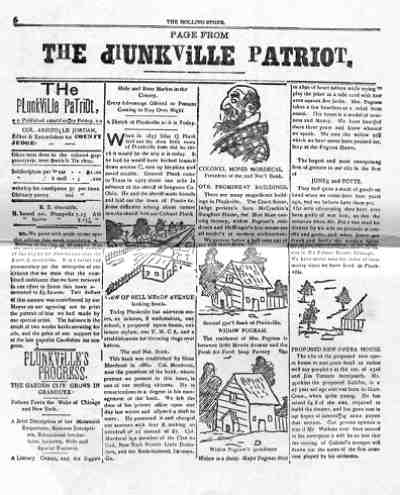
BEXAR SCRIP NO. 2692
[From The Rolling Stone, Saturday, March 5, 1894.]
Whenever you visit Austin you should by all means go to see the General Land Office.
As you pass up the avenue you turn sharp round the corner of the court house, and on a steep hill before you you see a mediæval castle.
You think of the Rhine; the “castled crag of Drachenfels”; the Lorelei; and the vine-clad slopes of Germany. And German it is in every line of its architecture and design.
The plan was drawn by an old draftsman from the “Vaterland,” whose heart still loved the scenes of his native land, and it is said he reproduced the design of a certain castle near his birthplace, with remarkable fidelity.
Under the present administration a new coat of paint has vulgarized its ancient and venerable walls. Modern tiles have replaced the limestone slabs of its floors, worn in hollows by the tread of thousands of feet, and smart and gaudy fixtures have usurped the place of the time-worn furniture that has been consecrated by the touch of hands that Texas will never cease to honor.
But even now, when you enter the building, you lower your voice, and time turns backward for you, for the atmosphere which you breathe is cold with the exudation of buried generations.
The building is stone with a coating of concrete; the walls are immensely thick; it is cool in the summer and warm in the winter; it is isolated and sombre; standing apart from the other state buildings, sullen and decaying, brooding on the past.
Twenty years ago it was much the same as now; twenty years from now the garish newness will be worn off and it will return to its appearance of gloomy decadence.
People living in other states can form no conception of the vastness and importance of the work performed and the significance of the millions of records and papers composing the archives of this office.
The title deeds, patents, transfers and legal documents connected with every foot of land owned in the state of Texas are filed here.
Volumes could be filled with accounts of the knavery, the double-dealing, the cross purposes, the perjury, the lies, the bribery, the alteration and erasing, the suppressing and destroying of papers, the various schemes and plots that for the sake of the almighty dollar have left their stains upon the records of the General Land Office.
No reference is made to the employees. No more faithful, competent and efficient force of men exists in the clerical portions of any government, but there is—or was, for their day is now over—a class of land speculators commonly called land sharks, unscrupulous and greedy, who have left their trail in every department of this office, in the shape of titles destroyed, patents cancelled, homes demolished and torn away, forged transfers and lying affidavits.
Before the modern tiles were laid upon the floors, there were deep hollows in the limestone slabs, worn by the countless feet that daily trod uneasily through its echoing corridors, pressing from file room to business room, from commissioner’s sanctum to record books and back again.
The honest but ignorant settler, bent on saving the little plot of land he called home, elbowed the wary land shark who was searching the records for evidence to oust him; the lordly cattle baron, relying on his influence and money, stood at the Commissioner’s desk side by side with the preëmptor, whose little potato patch lay like a minute speck of island in the vast, billowy sea, of his princely pastures, and played the old game of “freeze-out,” which is as old as Cain and Abel.
The trail of the serpent is through it all.
Honest, earnest men have wrought for generations striving to disentangle the shameful coil that certain years of fraud and infamy have wound. Look at the files and see the countless endorsements of those in authority:
“Transfer doubtful—locked up.”
“Certificate a forgery—locked up.”
“Signature a forgery.”
“Patent refused—duplicate patented elsewhere.”
“Field notes forged.”
“Certificates stolen from office”—and so on ad infinitum.
The record books, spread upon long tables, in the big room upstairs, are open to the examination of all. Open them, and you will find the dark and greasy finger prints of half a century’s handling. The quick hand of the land grabber has fluttered the leaves a million times; the damp clutch of the perturbed tiller of the soil has left traces of his calling on the ragged leaves.
Interest centres in the file room.
This is a large room, built as a vault, fireproof, and entered by but a single door.
There is “No Admission” on the portal; and the precious files are handed out by a clerk in charge only on presentation of an order signed by the Commissioner or chief clerk.
In years past too much laxity prevailed in its management, and the files were handled by all comers, simply on their request, and returned at their will, or not at all.
In those days most of the mischief was done. In the file room, there are about –––– files, each in a paper wrapper, and comprising the title papers of a particular tract of land.
You ask the clerk in charge for the papers relating to any survey in Texas. They are arranged simply in districts and numbers.
He disappears from the door, you hear the sliding of a tin box, the lid snaps, and the file is in your hand.
Go up there some day and call for Bexar Scrip No. 2692.
The file clerk stares at you for a second, says shortly:
“Out of file.”
It has been missing twenty years.
The history of that file has never been written before.
Twenty years ago there was a shrewd land agent living in Austin who devoted his undoubted talents and vast knowledge of land titles, and the laws governing them, to the locating of surveys made by illegal certificates, or improperly made, and otherwise of no value through non-compliance with the statutes, or whatever flaws his ingenious and unscrupulous mind could unearth.
He found a fatal defect in the title of the land as on file in Bexar Scrip No. 2692 and placed a new certificate upon the survey in his own name.
The law was on his side.
Every sentiment of justice, of right, and humanity was against him.
The certificate by virtue of which the original survey had been made was missing.
It was not be found in the file, and no memorandum or date on the wrapper to show that it had ever been filed.
Under the law the land was vacant, unappropriated public domain, and open to location.
The land was occupied by a widow and her only son, and she supposed her title good.
The railroad had surveyed a new line through the property, and it had doubled in value.
Sharp, the land agent, did not communicate with her in any way until he had filed his papers, rushed his claim through the departments and into the patent room for patenting.
Then he wrote her a letter, offering her the choice of buying from him or vacating at once.
He received no reply.
One day he was looking through some files and came across the missing certificate. Some one, probably an employee of the office, had by mistake, after making some examination, placed it in the wrong file, and curiously enough another inadvertence, in there being no record of its filing on the wrapper, had completed the appearance of its having never been filed.
Sharp called for the file in which it belonged and scrutinized it carefully, fearing he might have overlooked some endorsement regarding its return to the office.