Chapter III · (continued 2)
Reading edition
On the back of the certificate was plainly endorsed the date of filing, according to law, and signed by the chief clerk.
If this certificate should be seen by the examining clerk, his own claim, when it came up for patenting, would not be worth the paper on which it was written.
Sharp glanced furtively around. A young man, or rather a boy about eighteen years of age, stood a few feet away regarding him closely with keen black eyes. Sharp, a little confused, thrust the certificate into the file where it properly belonged and began gathering up the other papers.
The boy came up and leaned on the desk beside him.
“A right interesting office, sir!” he said. “I have never been in here before. All those papers, now, they are about lands, are they not? The titles and deeds, and such things?”
“Yes,” said Sharp. “They are supposed to contain all the title papers.”
“This one, now,” said the boy, taking up Bexar Scrip No. 2692, “what land does this represent the title of? Ah, I see ‘Six hundred and forty acres in B–––– country? Absalom Harris, original grantee.’ Please tell me, I am so ignorant of these things, how can you tell a good survey from a bad one. I am told that there are a great many illegal and fraudulent surveys in this office. I suppose this one is all right?”
“No,” said Sharp. “The certificate is missing. It is invalid.”
“That paper I just saw you place in that file, I suppose is something else—field notes, or a transfer probably?”
“Yes,” said Sharp, hurriedly, “corrected field notes. Excuse me, I am a little pressed for time.”
The boy was watching him with bright, alert eyes.
It would never do to leave the certificate in the file; but he could not take it out with that inquisitive boy watching him.
He turned to the file room, with a dozen or more files in his hands, and accidentally dropped part of them on the floor. As he stooped to pick them up he swiftly thrust Bexar Scrip No. 2692 in the inside breast pocket of his coat.
This happened at just half-past four o’clock, and when the file clerk took the files he threw them in a pile in his room, came out and locked the door.
The clerks were moving out of the doors in long, straggling lines.
It was closing time.
Sharp did not desire to take the file from the Land Office.
The boy might have seen him place the file in his pocket, and the penalty of the law for such an act was very severe.
Some distance back from the file room was the draftsman’s room now entirely vacated by its occupants.
Sharp dropped behind the outgoing stream of men, and slipped slyly into this room.
The clerks trooped noisily down the iron stairway, singing, whistling, and talking.
Below, the night watchman awaited their exit, ready to close and bar the two great doors to the south and cast.
It is his duty to take careful note each day that no one remains in the building after the hour of closing.
Sharp waited until all sounds had ceased.
It was his intention to linger until everything was quiet, and then to remove the certificate from the file, and throw the latter carelessly on some draftsman’s desk as if it had been left there during the business of the day.
He knew also that he must remove the certificate from the office or destroy it, as the chance finding of it by a clerk would lead to its immediately being restored to its proper place, and the consequent discovery that his location over the old survey was absolutely worthless.
As he moved cautiously along the stone floor the loud barking of the little black dog, kept by the watchman, told that his sharp ears had heard the sounds of his steps.
The great, hollow rooms echoed loudly, move as lightly as he could.
Sharp sat down at a desk and laid the file before him.
In all his queer practices and cunning tricks he had not yet included any act that was downright criminal.
He had always kept on the safe side of the law, but in the deed he was about to commit there was no compromise to be made with what little conscience he had left.
There is no well-defined boundary line between honesty and dishonesty.
The frontiers of one blend with the outside limits of the other, and he who attempts to tread this dangerous ground may be sometimes in one domain and sometimes in the other; so the only safe road is the broad highway that leads straight through and has been well defined by line and compass.
Sharp was a man of what is called high standing in the community. That is, his word in a trade was as good as any man’s; his check was as good as so much cash, and so regarded; he went to church regularly; went in good society and owed no man anything.
He was regarded as a sure winner in any land trade he chose to make, but that was his occupation.
The act he was about to commit now would place him forever in the ranks of those who chose evil for their portion—if it was found out.
More than that, it would rob a widow and her son of property soon to be of great value, which, if not legally theirs, was theirs certainly by every claim of justice.
But he had gone too far to hesitate.
His own survey was in the patent room for patenting. His own title was about to be perfected by the State’s own hand.
The certificate must be destroyed.
He leaned his head on his hands for a moment, and as he did so a sound behind him caused his heart to leap with guilty fear, but before he could rise, a hand came over his shoulder and grasped the file.
He rose quickly, as white as paper, rattling his chair loudly on the stone floor.
The boy who land spoken to him earlier stood contemplating him with contemptuous and flashing eyes, and quietly placed the file in the left breast pocket of his coat.
“So, Mr. Sharp, by nature as well as by name,” he said, “it seems that I was right in waiting behind the door in order to see you safely out. You will appreciate the pleasure I feel in having done so when I tell you my name is Harris. My mother owns the land on which you have filed, and if there is any justice in Texas she shall hold it. I am not certain, but I think I saw you place a paper in this file this afternoon, and it is barely possible that it may be of value to me. I was also impressed with the idea that you desired to remove it again, but had not the opportunity. Anyway, I shall keep it until to-morrow and let the Commissioner decide.”
Far back among Mr. Sharp’s ancestors there must have been some of the old berserker blood, for his caution, his presence of mind left him, and left him possessed of a blind, devilish, unreasoning rage that showed itself in a moment in the white glitter of his eye.
“Give me that file, boy,” he said, thickly, holding out his hand.
“I am no such fool, Mr. Sharp,” said the youth. “This file shall be laid before the Commissioner to-morrow for examination. If he finds—Help! Help!”
Sharp was upon him like a tiger and bore him to the floor. The boy was strong and vigorous, but the suddenness of the attack gave him no chance to resist. He struggled up again to his feet, but it was an animal, with blazing eyes and cruel-looking teeth that fought him, instead of a man.
Mr. Sharp, a man of high standing and good report, was battling for his reputation.
Presently there was a dull sound, and another, and still one more, and a blade flashing white and then red, and Edward Harris dropped down like some stuffed effigy of a man, that boys make for sport, with his limbs all crumpled and lax, on the stone floor of the Land Office.
The old watchman was deaf, and heard nothing.
The little dog barked at the foot of the stairs until his master made him come into his room.
Sharp stood there for several minutes holding in his hand his bloody clasp knife, listening to the cooing of the pigeons on the roof, and the loud ticking of the clock above the receiver’s desk.
A map rustled on the wall and his blood turned to ice; a rat ran across some strewn papers, and his scalp prickled, and he could scarcely moisten his dry lips with his tongue.
Between the file room and the draftsman’s room there is a door that opens on a small dark spiral stairway that winds from the lower floor to the ceiling at the top of the house.
This stairway was not used then, nor is it now.
It is unnecessary, inconvenient, dusty, and dark as night, and was a blunder of the architect who designed the building.
This stairway ends above at the tent-shaped space between the roof and the joists.
That space is dark and forbidding, and being useless is rarely visited.
Sharp opened this door and gazed for a moment up this narrow cobwebbed stairway.
After dark that night a man opened cautiously one of the lower windows of the Land Office, crept out with great circumspection and disappeared in the shadows.
One afternoon, a week after this time, Sharp lingered behind again after the clerks had left and the office closed. The next morning the first comers noticed a broad mark in the dust on the upstairs floor, and the same mark was observed below stairs near a window.
It appeared as if some heavy and rather bulky object had been dragged along through the limestone dust. A memorandum book with “E. Harris” written on the flyleaf was picked up on the stairs, but nothing particular was thought of any of these signs.
Circulars and advertisements appeared for a long time in the papers asking for information concerning Edward Harris, who left his mother’s home on a certain date and had never been heard of since.
After a while these things were succeeded by affairs of more recent interest, and faded from the public mind.
Sharp died two years ago, respected and regretted. The last two years of his life were clouded with a settled melancholy for which his friends could assign no reason. The bulk of his comfortable fortune was made from the land he obtained by fraud and crime.
The disappearance of the file was a mystery that created some commotion in the Land Office, but he got his patent.
It is a well-known tradition in Austin and vicinity that there is a buried treasure of great value somewhere on the banks of Shoal Creek, about a mile west of the city.
Three young men living in Austin recently became possessed of what they thought was a clue of the whereabouts of the treasure, and Thursday night they repaired to the place after dark and plied the pickaxe and shovel with great diligence for about three hours.
At the end of that time their efforts were rewarded by the finding of a box buried about four feet below the surface, which they hastened to open.
The light of a lantern disclosed to their view the fleshless bones of a human skeleton with clothing still wrapping its uncanny limbs.
They immediately left the scene and notified the proper authorities of their ghastly find.
On closer examination, in the left breast pocket of the skeleton’s coat, there was found a flat, oblong packet of papers, cut through and through in three places by a knife blade, and so completely soaked and clotted with blood that it had become an almost indistinguishable mass.
With the aid of a microscope and the exercise of a little imagination this much can be made out of the letter; at the top of the papers:
B–xa– ––rip N– 2–92.
QUERIES AND ANSWERS
[From The Rolling Stone, June 23, 1894.]
Can you inform me where I can buy an interest in a newspaper of some kind? I have some money and would be glad to invest it in something of the sort, if some one would allow me to put in my capital against his experience.
College Graduate.
Telegraph us your address at once, day message. Keep telegraphing every ten minutes at our expense until we see you. Will start on first train after receiving your wire.
Who was the author of the line, “Breathes there a man with soul so dead?”
G. F.
This was written by a visitor to the State Saengerfest of 1892 while conversing with a member who had just eaten a large slice of limburger cheese.
Where can I get the “Testimony of the Rocks”?
Geologist.
See the reports of the campaign committees after the election in November.
Please state what the seven wonders of the world are. I know five of them, I think, but can’t find out the other two.
Scholar.
The Temple of Diana, at Lexington, Ky.; the Great Wall of China; Judge Von Rosenberg (the Colossus of Roads); the Hanging Gardens at Albany; a San Antonio Sunday school; Mrs. Frank Leslie, and the Populist party.
What day did Christmas come on in the year 1847?
Constant Reader.
The 25th of December.
What does an F. F. V. mean?
Ignorant.
What does he mean by what? If he takes you by the arm and tells you how much you are like a brother of his in Richmond, he means Feel For Your Vest, for he wants to borrow a five. If he holds his head high and don’t speak to you on the street he means that he already owes you ten and is Following a Fresh Victim.
Please decide a bet for us. My friend says that the sentence, “The negro bought the watermelon of the farmer” is correct, and I say it should be “The negro bought the watermelon from the farmer.” Which is correct?
R.
Neither. It should read, “The negro stole the watermelon from the farmer.”
When do the Texas game laws go into effect?
Hunter.
When you sit down at the table.
Do you know where I can trade a section of fine Panhandle land for a pair of pants with a good title?
Land Agent.
We do not. You can’t raise anything on land in that section. A man can always raise a dollar on a good pair of pants.
Name in order the three best newspapers in Texas.
Advertiser.
Well, the Galveston News runs about second, and the San Antonio Express third. Let us hear from you again.
Has a married woman any rights in Texas?
Prospector.
Hush, Mr. Prospector. Not quite so loud, if you please. Come up to the office some afternoon, and if everything seems quiet, come inside, and look at our eye, and our suspenders hanging on to one button, and feel the lump on the top of our head. Yes, she has some rights of her own, and everybody else’s she can scoop in.
Who was the author of the sayings, “A public office is a public trust,” and “I would rather be right than President”?
Eli Perkins.
Is the Lakeside Improvement Company making anything out of their own town tract on the lake?
Inquisitive.
Yes, lots.
POEMS
[This and the other poems that follow have been found in files of The Rolling Stone, in the Houston Post’s Postscripts and in manuscript. There are many others, but these few have been selected rather arbitrarily, to round out this collection.]
THE PEWEE
In the hush of the drowsy afternoon, When the very wind on the breast of June Lies settled, and hot white tracery Of the shattered sunlight filters free Through the unstinted leaves to the pied cool sward; On a dead tree branch sings the saddest bard Of the birds that be; ’Tis the lone Pewee. Its note is a sob, and its note is pitched In a single key, like a soul bewitched To a mournful minstrelsy. “Pewee, Pewee,” doth it ever cry; A sad, sweet minor threnody That threads the aisles of the dim hot grove Like a tale of a wrong or a vanished love; And the fancy comes that the wee dun bird Perchance was a maid, and her heart was stirred By some lover’s rhyme In a golden time, And broke when the world turned false and cold; And her dreams grew dark and her faith grew cold In some fairy far-off clime. And her soul crept into the Pewee’s breast; And forever she cries with a strange unrest For something lost, in the afternoon; For something missed from the lavish June; For the heart that died in the long ago; For the livelong pain that pierceth so: Thus the Pewee cries, While the evening lies Steeped in the languorous still sunshine, Rapt, to the leaf and the bough and the vine Of some hopeless paradise.
NOTHING TO SAY
“You can tell your paper,” the great man said, “I refused an interview. I have nothing to say on the question, sir; Nothing to say to you.” And then he talked till the sun went down And the chickens went to roost; And he seized the collar of the poor young man, And never his hold he loosed. And the sun went down and the moon came up, And he talked till the dawn of day; Though he said, “On this subject mentioned by you, I have nothing whatever to say.” And down the reporter dropped to sleep And flat on the floor he lay; And the last he heard was the great man’s words, “I have nothing at all to say.”
THE MURDERER
“I push my boat among the reeds; I sit and stare about; Queer slimy things crawl through the weeds, Put to a sullen rout. I paddle under cypress trees; All fearfully I peer Through oozy channels when the breeze Comes rustling at my ear. “The long moss hangs perpetually; Gray scalps of buried years; Blue crabs steal out and stare at me, And seem to gauge my fears; I start to hear the eel swim by; I shudder when the crane Strikes at his prey; I turn to fly, At drops of sudden rain. “In every little cry of bird I hear a tracking shout; From every sodden leaf that’s stirred I see a face frown out; My soul shakes when the water rat Cowed by the blue snake flies; Black knots from tree holes glimmer at Me with accusive eyes. “Through all the murky silence rings A cry not born of earth; An endless, deep, unechoing thing That owns not human birth. I see no colors in the sky Save red, as blood is red; I pray to God to still that cry From pallid lips and dead. “One spot in all that stagnant waste I shun as moles shun light, And turn my prow to make all haste To fly before the night. A poisonous mound hid from the sun, Where crabs hold revelry; Where eels and fishes feed upon The Thing that once was He. “At night I steal along the shore; Within my hut I creep; But awful stars blink through the door, To hold me from my sleep. The river gurgles like his throat, In little choking coves, And loudly dins that phantom note From out the awful groves. “I shout with laughter through the night: I rage in greatest glee; My fears all vanish with the light Oh! splendid nights they be! I see her weep; she calls his name; He answers not, nor will; My soul with joy is all aflame; I laugh, and laugh, and thrill. “I count her teardrops as they fall; I flout my daytime fears; I mumble thanks to God for all These gibes and happy jeers. But, when the warning dawn awakes, Begins my wandering; With stealthy strokes through tangled brakes, A wasted, frightened thing.”
SOME POSTSCRIPTS
TWO PORTRAITS
Wild hair flying, in a matted maze, Hand firm as iron, eyes all ablaze; Bystanders timidly, breathlessly gaze, As o’er the keno board boldly he plays. —That’s Texas Bill. Wild hair flying, in a matted maze, Hand firm as iron, eyes all ablaze; Bystanders timidly, breathlessly gaze, As o’er the keyboard boldly he plays. —That’s Paderewski.
A CONTRIBUTION
There came unto ye editor A poet, pale and wan, And at the table sate him down, A roll within his hand. Ye editor accepted it, And thanked his lucky fates; Ye poet had to yield it up To a king full on eights.
THE OLD FARM
Just now when the whitening blossoms flare On the apple trees and the growing grass Creeps forth, and a balm is in the air; With my lighted pipe and well-filled glass Of the old farm I am dreaming, And softly smiling, seeming To see the bright sun beaming Upon the old home farm. And when I think how we milked the cows, And hauled the hay from the meadows low; And walked the furrows behind the plows, And chopped the cotton to make it grow I’d much rather be here dreaming And smiling, only seeming To see the hot sun gleaming Upon the old home farm.
VANITY
A Poet sang so wondrous sweet That toiling thousands paused and listened long; So lofty, strong and noble were his themes, It seemed that strength supernal swayed his song. He, god-like, chided poor, weak, weeping man, And bade him dry his foolish, shameful tears; Taught that each soul on its proud self should lean, And from that rampart scorn all earth-born fears. The Poet grovelled on a fresh heaped mound, Raised o’er the clay of one he’d fondly loved; And cursed the world, and drenched the sod with tears And all the flimsy mockery of his precepts proved.
THE LULLABY BOY
The lullaby boy to the same old tune Who abandons his drum and toys For the purpose of dying in early June Is the kind the public enjoys. But, just for a change, please sing us a song, Of the sore-toed boy that’s fly, And freckled and mean, and ugly, and bad, And positively will not die.
CHANSON DE BOHÊME
Lives of great men all remind us Rose is red and violet’s blue; Johnny’s got his gun behind us ’Cause the lamb loved Mary too. —Robert Burns’ “Hocht Time in the aud Town.” I’d rather write this, as bad as it is Than be Will Shakespeare’s shade; I’d rather be known as an F. F. V. Than in Mount Vernon laid. I’d rather count ties from Denver to Troy Than to head Booth’s old programme; I’d rather be special for the New York World Than to lie with Abraham. For there’s stuff in the can, there’s Dolly and Fan, And a hundred things to choose; There’s a kiss in the ring, and every old thing That a real live man can use. I’d rather fight flies in a boarding house Than fill Napoleon’s grave, And snuggle up warm in my three slat bed Than be André the brave. I’d rather distribute a coat of red On the town with a wad of dough Just now, than to have my cognomen Spelled “Michael Angelo.” For a small live man, if he’s prompt on hand When the good things pass around, While the world’s on tap has a better snap Than a big man under ground.
HARD TO FORGET
I’m thinking to-night of the old farm, Ned, And my heart is heavy and sad As I think of the days that by have fled Since I was a little lad. There rises before me each spot I know Of the old home in the dell, The fields, and woods, and meadows below That memory holds so well. The city is pleasant and lively, Ned, But what to us is its charm? To-night all my thoughts are fixed, instead, On our childhood’s old home farm. I know you are thinking the same, dear Ned, With your head bowed on your arm, For to-morrow at four we’ll be jerked out of bed To plow on that darned old farm.
DROP A TEAR IN THIS SLOT
He who, when torrid Summer’s sickly glare Beat down upon the city’s parched walls, Sat him within a room scarce 8 by 9, And, with tongue hanging out and panting breath, Perspiring, pierced by pangs of prickly heat, Wrote variations of the seaside joke We all do know and always loved so well, And of cool breezes and sweet girls that lay In shady nooks, and pleasant windy coves Anon Will in that self-same room, with tattered quilt Wrapped round him, and blue stiffening hands, All shivering, fireless, pinched by winter’s blasts, Will hale us forth upon the rounds once more, So that we may expect it not in vain, The joke of how with curses deep and coarse Papa puts up the pipe of parlor stove. So ye Who greet with tears this olden favorite, Drop one for him who, though he strives to please Must write about the things he never sees.
TAMALES
This is the Mexican Don José Calderon One of God’s countrymen. Land of the buzzard. Cheap silver dollar, and Cacti and murderers. Why has he left his land Land of the lazy man, Land of the pulque Land of the bull fight, Fleas and revolution. This is the reason, Hark to the wherefore; Listen and tremble. One of his ancestors, Ancient and garlicky, Probably grandfather, Died with his boots on. Killed by the Texans, Texans with big guns, At San Jacinto. Died without benefit Of priest or clergy; Died full of minie balls, Mescal and pepper. Don José Calderon Heard of the tragedy. Heard of it, thought of it, Vowed a deep vengeance; Vowed retribution On the Americans, Murderous gringos, Especially Texans. “Valga me Dios! que Ladrones, diablos, Matadores, mentidores, Caraccos y perros, Voy a matarles, Con solos mis manos, Toditas sin falta.” Thus swore the Hidalgo Don José Calderon. He hied him to Austin. Bought him a basket, A barrel of pepper, And another of garlic; Also a rope he bought. That was his stock in trade; Nothing else had he. Nor was he rated in Dun or in Bradstreet, Though he meant business, Don José Calderon, Champion of Mexico, Don José Calderon, Seeker of vengeance. With his stout lariat, Then he caught swiftly Tomcats and puppy dogs, Caught them and cooked them, Don José Calderon, Vower of vengeance. Now on the sidewalk Sits the avenger Selling Tamales to Innocent purchasers. Dire is thy vengeance, Oh, José Calderon, Pitiless Nemesis Fearful Redresser Of the wrongs done to thy Sainted grandfather. Now the doomed Texans, Rashly hilarious, Buy of the deadly wares, Buy and devour. Rounders at midnight, Citizens solid, Bankers and newsboys, Bootblacks and preachers, Rashly importunate, Courting destruction. Buy and devour. Beautiful maidens Buy and devour, Gentle society youths Buy and devour. Buy and devour This thing called Tamale; Made of rat terrier, Spitz dog and poodle. Maltese cat, boarding house Steak and red pepper. Garlic and tallow, Corn meal and shucks. Buy without shame Sit on store steps and eat, Stand on the street and eat, Ride on the cars and eat, Strewing the shucks around Over creation. Dire is thy vengeance, Don José Calderon. For the slight thing we did Killing thy grandfather. What boots it if we killed Only one greaser, Don José Calderon? This is your deep revenge, You have greased all of us, Greased a whole nation With your Tamales, Don José Calderon. Santos Esperiton, Vincente Camillo, Quitana de Rios, De Rosa y Ribera.
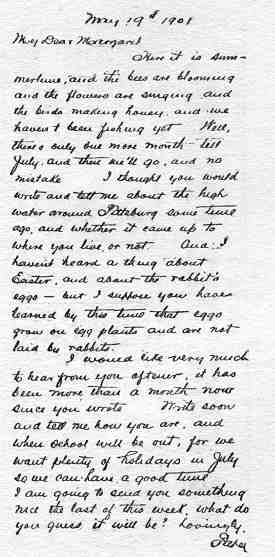
A letter to his daughter Margaret.
LETTERS
[Letter to Mr. Gilman Hall, O. Henry’s friend and Associate Editor of Everybody’s Magazine.]
“the Callie”—
Excavation Road— Sundy.
my dear mr. hall:
in your october E’bodys’ i read a story in which i noticed some sentences as follows:
“Day in, day out, day in, day out, day in, day out, day in, day out, day in, day out, it had rained, rained, and rained and rained & rained & rained & rained & rained till the mountains loomed like a chunk of rooined velvet.”
And the other one was: “i don’t keer whether you are any good or not,” she cried. “You’re alive! You’re alive! You’re alive! You’re alive! You’re alive! You’re alive! You’re alive! You’re alive! You’re alive! You’re alive! You’re alive! You’re alive! You’re alive! You’re alive! You’re alive! You’re alive!”
I thought she would never stop saying it, on and on and on and on and on and on and on and on and on and on and on and on. “You’re alive! You’re alive! You’re alive! You’re alive! You’re alive! You’re alive! You’re ALIVE!
“You’re alive! You’re alive! You’re alive! You’re alive! You’re alive! You’re alive! You’re alive! You’re ALIVE!
“YOU’RE ALIVE!”
Say, bill; do you get this at a rate, or does every word go?
i want to know, because if the latter is right i’m going to interduce in compositions some histerical personages that will loom up large as repeeters when the words are counted up at the polls.
Yours truly O. henry 28 West 26th St., West of broadway
Mr. hall, part editor of everybody’s.
Kyntoekneeyough Ranch, November 31, 1883.
[Letter to Mrs. Hall, a friend back in North Carolina. This is one of the earliest letters found.]
Dear Mrs. Hall:
As I have not heard from you since the shout you gave when you set out from the station on your way home I guess you have not received some seven or eight letters from me, and hence your silence. The mails are so unreliable that they may all have been lost. If you don’t get this you had better send to Washington and get them to look over the dead letter office for the others. I have nothing to tell you of any interest, except that we all nearly froze to death last night, thermometer away below 32 degrees in the shade all night.
You ought by all means to come back to Texas this winter; you would love it more and more; that same little breeze that you looked for so anxiously last summer is with us now, as cold as Callum Bros. suppose their soda water to be.
My sheep are doing finely; they never were in better condition. They give me very little trouble, for I have never been able to see one of them yet. I will proceed to give you all the news about this ranch. Dick has got his new house well under way, the pet lamb is doing finely, and I take the cake for cooking mutton steak and fine gravy. The chickens are doing mighty well, the garden produces magnificent prickly pears and grass; onions are worth two for five cents, and Mr. Haynes has shot a Mexican.
Please send by express to this ranch 75 cooks and 200 washwomen, blind or wooden legged ones perferred. The climate has a tendency to make them walk off every two or three days, which must be overcome. Ed Brockman has quit the store and I think is going to work for Lee among the cows. Wears a red sash and swears so fluently that he has been mistaken often for a member of the Texas Legislature.
If you see Dr. Beall bow to him for me, politely but distantly; he refuses to waste a line upon me. I suppose he is too much engaged in courting to write any letters. Give Dr. Hall my profoundest regards. I think about him invariably whenever he is occupying my thoughts.
Influenced by the contents of the Bugle, there is an impression general at this ranch that you are president, secretary, and committee, &c., of the various associations of fruit fairs, sewing societies, church fairs, Presbytery, general assembly, conference, medical conventions, and baby shows that go to make up the glory and renown of North Carolina in general, and while I heartily congratulate the aforesaid institutions on their having such a zealous and efficient officer, I tremble lest their requirements leave you not time to favor me with a letter in reply to this, and assure you that if you would so honor me I would highly appreciate the effort. I would rather have a good long letter from you than many Bugles. In your letter be certain to refer as much as possible to the advantages of civilized life over the barbarous; you might mention the theatres you see there, the nice things you eat, warm fires, niggers to cook and bring in wood; a special reference to nice beef-steak would be advisable. You know our being reminded of these luxuries makes us contented and happy. When we hear of you people at home eating turkeys and mince pies and getting drunk Christmas and having a fine time generally we become more and more reconciled to this country and would not leave it for anything.
I must close now as I must go and dress for the opera. Write soon.
Yours very truly, W. S. Porter.
To Dr. W. P. Beall
[Dr. Beall, of Greensboro, N.C., was one of young Porter’s dearest friends. Between them there was an almost regular correspondence during Porter’s first years in Texas.]
La Salle County, Texas, December 8, 1883.
Dear Doctor: I send you a play—a regular high art full orchestra, gilt-edged drama. I send it to you because of old acquaintance and as a revival of old associations. Was I not ever ready in times gone by to generously furnish a spatula and other assistance when you did buy the succulent watermelon? And was it not by my connivance and help that you did oft from the gentle Oscar Mayo skates entice? But I digress. I think that I have so concealed the identity of the characters introduced that no one will be able to place them, as they all appear under fictitious names, although I admit that many of the incidents and scenes were suggested by actual experiences of the author in your city.
You will, of course, introduce the play upon the stage if proper arrangements can be made. I have not yet had an opportunity of ascertaining whether Edwin Booth, John McCullough or Henry Irving can be secured. However, I will leave all such matters to your judgment and taste. Some few suggestions I will make with regard to the mounting of the piece which may be of value to you. Discrimination will be necessary in selecting a fit person to represent the character of Bill Slax, the tramp. The part is that of a youth of great beauty and noble manners, temporarily under a cloud and is generally rather difficult to fill properly. The other minor characters, such as damfools, citizens, police, customers, countrymen, &c., can be very easily supplied, especially the first.
Let it be announced in the Patriot for several days that in front of Benbow Hall, at a certain hour, a man will walk a tight rope seventy feet from the ground who has never made the attempt before; that the exhibition will be FREE, and that the odds are 20 to 1 that the man will be killed. A large crowd will gather. Then let the Guilford Grays charge one side, the Reidsville Light Infantry the other, with fixed bayonets, and a man with a hat commence taking up a collection in the rear. By this means they can be readily driven into the hall and the door locked.
I have studied a long time about devising a plan for obtaining pay from the audience and have finally struck upon the only feasible one I think.
After the performance let some one come out on the stage and announce that James Forbis will speak two hours. The result, easily explainable by philosophical and psychological reasons, will be as follows: The minds of the audience, elated and inspired by the hope of immediate departure when confronted by such a terror-inspiring and dismal prospect, will collapse with the fearful reaction which will take place, and for a space of time they will remain in a kind of comatose, farewell-vain-world condition. Now, as this is the time when the interest of the evening is at its highest pitch, let the melodious strains of the orchestra steal forth as a committee appointed by the managers of lawyers, druggists, doctors, and revenue officers, go around and relieve the audience of the price of admission for each one. Where one person has no money let it be made up from another, but on no account let the whole sum taken be more than the just amount at usual rates.
As I said before, the characters in the play are purely imaginary, and therefore not to be confounded with real persons. But lest any one, feeling some of the idiosyncrasies and characteristics apply too forcibly to his own high moral and irreproachable self, should allow his warlike and combative spirits to arise, you might as you go, kind of casually like, produce the impression that I rarely miss my aim with a Colt’s forty-five, but if that does not have the effect of quieting the splenetic individual, and he still thirsts for Bill Slax’s gore, just inform him that if he comes out here he can’t get any whiskey within two days’ journey of my present abode, and water will have to be his only beverage while on the warpath. This, I am sure, will avert the bloody and direful conflict.
Accept my lasting regards and professions of respect.
Ever yours, Bill Slax
To Dr. W. P. Beall
My Dear Doctor: I wish you a happy, &c., and all that sort of thing, don’t you know, &c., &c. I send you a few little productions in the way of poetry, &c, which, of course, were struck off in an idle moment. Some of the pictures are not good likenesses, and so I have not labelled them, which you may do as fast [as] you discover whom they represent, as some of them resemble others more than themselves, but the poems are good without exception, and will compare favorably with Baron Alfred’s latest on spring.
I have just come from a hunt, in which I mortally wounded a wild hog, and as my boots are full of thorns I can’t write any longer than this paper will contain, for it’s all I’ve got, because I’m too tired to write any more for the reason that I have no news to tell.
I see by the Patriot that you are Superintendent of Public Health, and assure you that all such upward rise as you make like that will ever be witnessed with interest and pleasure by me, &c., &c. Give my regards to Dr. and Mrs. Hall. It would be uncomplimentary to your powers of perception as well as superfluous to say that I will now close and remain, yours truly,
W. S. Porter
To Dr. W. P. Beall
La Salle County, Texas, February 27, 1884
My Dear Doctor: Your appreciated epistle of the 18th received. I was very glad to hear from you. I hope to hear again if such irrelevant correspondence will not interfere with your duties as Public Health Eradicator, which I believe is the office you hold under county authority. I supposed the very dramatic Shakespearian comedy to be the last, as I heard nothing from you previous before your letter, and was about to write another of a more exciting character, introducing several bloody single combats, a dynamite explosion, a ladies’ oyster supper for charitable purposes, &c., also comprising some mysterious sub rosa transactions known only to myself and a select few, new songs and dances, and the Greensboro Poker Club. Having picked up a few points myself relative to this latter amusement, I feel competent to give a lucid, glittering portrait of the scenes presented under its auspices. But if the former drama has reached you safely, I will refrain from burdening you any more with the labors of general stage manager, &c.
If long hair, part of a sombrero, Mexican spurs, &c., would make a fellow famous, I already occupy a topmost niche in the Temple Frame. If my wild, untamed aspect had not been counteracted by my well-known benevolent and amiable expression of countenance, I would have been arrested long ago by the Rangers on general suspicions of murder and horse stealing. In fact, I owe all my present means of lugubrious living to my desperate and bloodthirsty appearance, combined with the confident and easy way in which I tackle a Winchester rifle. There is a gentleman who lives about fifteen miles from the ranch, who for amusement and recreation, and not altogether without an eye to the profit, keeps a general merchandise store. This gent, for the first few months has been trying very earnestly to sell me a little paper, which I would like much to have, but am not anxious to purchase. Said paper is my account, receipted. Occasionally he is absent, and the welcome news coming to my ear, I mount my fiery hoss and gallop wildly up to the store, enter with something of the sang froid, grace, abandon and récherché nonchalance with which Charles Yates ushers ladies and gentlemen to their seats in the opera-house, and, nervously fingering my butcher knife, fiercely demand goods and chattels of the clerk. This plan always succeeds. This is by way of explanation of this vast and unnecessary stationery of which this letter is composed. I am always in too big a hurry to demur at kind and quality, but when I get to town I will write you on small gilt-edged paper that would suit even the fastidious and discriminating taste of a Logan.
When I get to the city, which will be shortly, I will send you some account of this country and its inmates. You are right, I have almost forgotten what a regular old, gum-chewing, ice-cream destroying, opera ticket vortex, ivory-clawing girl looks like. Last summer a very fair specimen of this kind ranged over about Fort Snell, and I used to ride over twice a week on mail days and chew the end of my riding whip while she “Stood on the Bridge” and “Gathered up Shells on the Sea Shore” and wore the “Golden Slippers.” But she has vamoosed, and my ideas on the subject are again growing dim.
If you see anybody about to start to Texas to live, especially to this part, if you will take your scalpyouler and sever the jugular vein, cut the brachiopod artery and hamstring him, after he knows what you have done for him he will rise and call you blessed. This country is a silent but eloquent refutation of Bob Ingersoll’s theory: a man here gets prematurely insane, melancholy and unreliable and finally dies of lead poisoning, in his boots, while in a good old land like Greensboro a man can die, as they do every day, with all the benefits of the clergy.
W. S. Porter
Austin, Texas, April 21, 1885.
Dear Dave: I take my pen in hand to let you know that I am well, and hope these few lines will find you as well as can be expected.
I carried out your parting injunction of a floral nature with all the solemnity and sacredness that I would have bestowed upon a dying man’s last request. Promptly at half-past three I repaired to the robbers’ den, commonly known as Radams Horticultural and Vegetable Emporium, and secured the high-priced offerings, according to promise. I asked if the bouquets were ready, and the polite but piratical gentleman in charge pointed proudly to two objects on the counter reposing in a couple of vases, and said they were.
I then told him I feared there was some mistake, as no buttonhole bouquets had been ordered, but he insisted on his former declaration, and so I brought them away and sent them to their respective destinations.
I thought it a pity to spoil a good deck of cards by taking out only one, so I bundled up the whole deck, and inserted them in the bouquet, but finally concluded it would not be right to violet (JOKE) my promise and I rose (JOKE) superior to such a mean trick and sent only one as directed.
I have a holiday to-day, as it is San Jacinto day. Thermopylae had its messenger of defeat, but the Alamo had none. Mr. President and fellow citizens, those glorious heroes who fell for their country on the bloody field of San Jacinto, etc.
There is a bazaar to-night in the representatives’ hall. You people out in Colorado don’t know anything. A bazaar is cedar and tacks and girls and raw-cake and step-ladders and Austin Grays and a bass solo by Bill Stacy, and net profits $2.65.
Albert has got his new uniform and Alf Menille is in town, and the store needs the “fine Italian hand” of the bookkeeper very much, besides some of his plain Anglo-Saxon conversation.
Was interviewed yesterday by Gen’l Smith, Clay’s father. He wants Jim S. and me to represent a manufactory in Jeff. City: Convict labor. Says parties in Galveston and Houston are making good thing of it. Have taken him up. Hope to be at work soon. Glad, by jingo! Shake. What’ll you have? Claret and sugar? Better come home. Colorado no good.
Strange thing happened in Episcopal Church Sunday. Big crowd. Choir had sung jolly tune and preacher come from behind scenes. Everything quiet. Suddenly fellow comes down aisle. Late. Everybody looks. Disappointment. It is a stranger. Jones and I didn’t go. Service proceeds.
Jones talks about his mashes and Mirabeau B. Lamar, daily. Yet there is hope. Cholera infantum; Walsh’s crutch; Harvey, or softening of the brain may carry him off yet.
Society notes are few. Bill Stacey is undecided where to spend the summer. Henry Harrison will resort at Wayland and Crisers. Charlie Cook will not go near a watering place if he can help it.
If you don’t strike a good thing out West, I hope we will see you soon.
Yours as ever, W. S. P.
Austin, Texas, April 28, 1885.
Dear Dave: I received your letter in answer to mine, which you never got till sometime after you had written.
I snatch a few moments from my arduous labors to reply. The Colorado has been on the biggest boom I have seen since ’39. In the pyrotechnical and not strictly grammatical language of the Statesman—“The cruel, devastating flood swept, on a dreadful holocaust of swollen, turbid waters, surging and dashing in mad fury which have never been equalled in human history. A pitiable sight was seen the morning after the flood. Six hundred men, out of employment, were seen standing on the banks of the river, gazing at the rushing stream, laden with débris of every description. A wealthy New York Banker, who was present, noticing the forlorn appearance of these men, at once began to collect a subscription for them, appealing in eloquent terms for help for these poor sufferers by the flood. He collected one dollar, and five horn buttons. The dollar he had given himself. He learned on inquiry that these men had not been at any employment in six years, and all they had lost by the flood was a few fishing poles. The Banker put his dollar in his pocket and stepped up to the Pearl Saloon.”
As you will see by this morning’s paper, there is to be a minstrel show next Wednesday for benefit of Austin Grays.
I attended the rehearsal last night, but am better this morning, and the doctor thinks I will pull through with careful attention.
The jokes are mostly mildewed, rockribbed, and ancient as the sun. I can give you no better idea of the tout ensemble and sine die of the affair than to state that Scuddy is going to sing a song.
Mrs. Harrell brought a lot of crystallized fruits from New Orleans for you. She wants to know if she shall send them around on Bois d’arc or keep them ’til you return. Answer.
Write to your father. He thinks you are leaving him out, writing to everybody else first. Write.
We have the boss trick here now. Have sold about ten boxes of cigars betting on it in the store.
Take four nickels, and solder them together so the solder will not appear. Then cut out of three of them a square hole like this: (Illustration.) Take about twelve other nickels, and on top of them you lay a small die with the six up, that will fit easily in the hole without being noticed. You lay the four nickels over this, and all presents the appearance of a stack of nickels. You do all this privately so everybody will suppose it is nothing but a stack of five-cent pieces. You then lay another small die on top of the stack with the ace up. You have a small tin cup shaped like this (Illustration) made for the purpose. You let everybody see the ace, and then say you propose to turn the ace into a six. You lay the tin cup carefully over the stack this way, and feel around in your pocket for a pencil and not finding one…
[The rest of this letter is lost]
Austin, Texas, May 10, 1885.
Dear Dave: I received your two letters and have commenced two or three in reply, but always failed to say what I wanted to, and destroyed them all. I heard from Joe that you would probably remain in Colorado. I hope you will succeed in making a good thing out of it, if you conclude to do so, but would like to see you back again in Austin. If there is anything I can do for you here, let me know.
Town is fearfully dull, except for the frequent raids of the Servant Girl Annihilators, who make things lively during the dead hours of the night; if it were not for them, items of interest would be very scarce, as you may see by the Statesman.
Our serenading party has developed new and alarming modes of torture for our helpless and sleeping victims. Last Thursday night we loaded up a small organ on a hack and with our other usual instruments made an assault upon the quiet air of midnight that made the atmosphere turn pale.
After going the rounds we were halted on the Avenue by Fritz Hartkopf and ordered into his salon. We went in, carrying the organ, etc. A large crowd of bums immediately gathered, prominent among which, were to be seen Percy James, Theodore Hillyer, Randolph Burmond, Charlie Hicks, and after partaking freely of lemonade we wended our way down, and were duly halted and treated in the same manner by other hospitable gentlemen.
We were called in at several places while wit and champagne, Rhein Wine, etc., flowed in a most joyous and hilarious manner. It was one of the most recherché and per diem affairs ever known in the city. Nothing occurred to mar the pleasure of the hour, except a trifling incident that might be construed as malapropos and post-meridian by the hypercritical. Mr. Charles Sims on attempting to introduce Mr. Charles Hicks and your humble servant to young ladies, where we had been invited inside, forgot our names and required to be informed on the subject before proceeding.
Yours W. S. P.
Austin, Texas, December 22, 1885.
Dear Dave: Everything wept at your departure. Especially the clouds. Last night the clouds had a silver lining, three dollars and a half’s worth. I fulfilled your engagement in grand, tout ensemble style, but there is a sad bon jour look about the thirty-eight cents left in my vest pocket that would make a hired man weep. All day long the heavens wept, and the heavy, sombre clouds went drifting about over head, and the north wind howled in maniacal derision, and the hack drivers danced on the pavements in wild, fierce glee, for they knew too well what the stormy day betokened. The hack was to call for me at eight. At five minutes to eight I went upstairs and dressed in my usual bijou and operatic style, and rolled away to the opera. Emma sang finely. I applauded at the wrong times, and praised her rendering of the chromatic scale when she was performing on “c” flat andante pianissimo, but otherwise the occasion passed off without anything to mar the joyousness of the hour. Everybody was there. Isidor Moses and John Ireland, and Fritz Hartkopf and Prof. Herzog and Bill Stacy and all the bong ton elight. You will receive a draft to-day through the First National Bank of Colorado for $3.65, which you will please honor.
There is no news, or there are no news, either you like to tell. Lavaca Street is very happy and quiet and enjoys life, for Jones was sat on by his Uncle Wash and feels humble and don’t sing any more, and the spirit of peace and repose broods over its halls. Martha rings the matin bell, it seems to me before cock crow or ere the first faint streaks of dawn are limned in the eastern sky by the rosy fingers of Aurora. At noon the foul ogre cribbage stalks rampant, and seven-up for dim, distant oysters that only the eye of faith can see.
The hour grows late. The clock strikes! Another day has vanished. Gone into the dim recesses of the past, leaving its record of misspent hours, false hopes, and disappointed expectations. May a morrow dawn that will bring recompense and requital for the sorrows of the days gone by, and a new order of things when there will be more starch in cuff and collar, and less in handkerchiefs.
Come with me out into the starlight night. So calm, so serene, ye lights of heaven, so high above earth; so pure and majestic and mysterious; looking down on the mad struggle of life here below, is there no pity in your never closing eyes for us mortals on which you shine?
Come with me on to the bridge. Ah, see there, far below, the dark, turbid stream. Rushing and whirling and eddying under the dark pillars with ghostly murmur and siren whisper. What shall we find in your depths? The stars do not reflect themselves in your waters, they are too dark and troubled and swift! What shall we find in your depths? Rest?—Peace?—catfish? Who knows? ’Tis but a moment. A leap! A plunge!—and—then oblivion or another world? Who can tell? A man once dived into your depths and brought up a horse collar and a hoop-skirt. Ah! what do we know of the beyond? We know that death comes, and we return no more to our world of trouble and care—but where do we go? Are there lands where no traveler has been? A chaos—perhaps where no human foot has trod—perhaps Bastrop—perhaps New Jersey! Who knows? Where do people go who are in McDade? Do they go where they have to fare worse? They cannot go where they have worse fare!
Let us leave the river. The night grows cold. We could not pierce the future or pay the toll. Come, the ice factory is deserted! No one sees us. My partner, W. P. Anderson, will never destroy himself. Why? His credit is good. No one will sue a side-partner of mine!
You have heard of a brook murmuring, but you never knew a sewer sighed! But we digress! We will no longer pursue a side issue like this. Au revoir. I will see you later.
Yours truly,
WILLIAM SHAKESPEARE INGOMAR JUNIUS BRUTUS CALLIOPE SIX-HANDED EUCHRE GROVER CLEVELAND HILL CITY QUARTETTE JOHNSON.
AN EARLY PARABLE
[In one of his early letters, written from Austin, O. Henry wrote a long parable that was evidently to tell his correspondent some of the local gossip. Here it is:]
Once upon a time there was a maiden in a land not far away—a maiden of much beauty and rare accomplishments. She was beloved by all on account of her goodness of heart, and her many charms of disposition. Her father was a great lord, rich and powerful, and a mighty man, and he loved his daughter with exceeding great love, and he cared for her with jealous and loving watchfulness, lest any harm should befall her, or even the least discomfort should mar her happiness and cause any trouble in her smooth and peaceful life. The cunningest masters were engaged to teach her from her youngest days; she played upon the harpsichord the loveliest and sweetest music; she wrought fancy work in divers strange and wonderful forms that might puzzle all beholders as to what manner of things they might be; she sang; and all listeners hearkened thereunto, as to the voice of an angel; she danced stately minuets with the gay knights as graceful as a queen and as light as the thistledown borne above the clover blossoms by the wind; she could paint upon china, rare and unknown flowers the like unto which man never saw in colors, crimson and blue and yellow, glorious to behold; she conversed in unknown tongues whereof no man knew the meaning and sense; and created wild admiration in all, by the ease and grace with which she did play upon a new and strange instrument of wondrous sound and structure which she called a banjo.
She had gone into a strange land, far away beyond the rivers that flowed through her father’s dominion—farther than one could see from the highest castle tower—up into the land of ice and snow, where wise men, famous for learning and ancient lore had gathered together from many lands and countries the daughters of great men. Kings and powerful rulers, railroad men, bankers, mighty men who wished to bring up their children to be wise and versed in all things old and new. Here, the Princess abode for many seasons, and she sat at the feet of old wise men, who could tell of the world’s birth, and the stars, and read the meaning of the forms of the rocks that make the high mountains and knew the history of all created things that are; and here she learned to speak strange tongues, and studied the deep mysteries of the past—the secrets of the ancients; Chaldic lore; Etruscan inscription; hidden and mystic sciences, and knew the names of all the flowers and things that grow in fields or wood; even unto the tiniest weed by the brook.
In due time the Princess came back to her father’s castle. The big bell boomed from the high tower; the heavy iron gates were thrown open; banners floated all along the battlemented walls, and in the grand hall, servants and retainers hurried to and fro, bearing gold dishes, and great bowls of flaming smoking punch, while oxen were roasted whole and hogsheads of ale tapped on the common by the castle walls, and thither hied them the villagers one and all to make merry at the coming of the dear Princess again. “She will come back so wise and learned,” they said, “so far above us that she will not notice us as she did once,” but not so: the Princess with a red rose in her hair, and dressed so plain and neat that she looked more like a farmer’s daughter than a great king’s, came down among them from her father’s side with nods of love and welcome on her lips, and a smile upon her face, and took them by the hands as in the old days, and none among them so lowly or so poor but what received a kind word from the gracious Princess, and carried away in their hearts glad feelings that she was still the same noble and gracious lady she always was. Then night came, and torches by thousands lit up the great forest, and musicians played and bonfires glowed, with sparks flying like myriads of stars among the gloomy trees.
In the great castle hall were gathered the brave knights and the fairest ladies in the kingdom. The jolly old King, surrounded by the wise men and officers of state moved about among his guests, stately and courteous, ravishing music burst forth from all sides, and down the hall moved the fair Princess in the mazy dance, on the arm of a Knight who gazed upon her face in rapt devotion and love. Who was he that dared to look thus upon the daughter of the King, sovereign prince of the kingdom, and the heiress of her father’s wealth and lands.
He had no title, no proud name to place beside a royal one, beyond that of an honorable knight, but who says that that is not a title that, borne worthily, makes a man the peer of any that wears a crown?
He had loved her long. When a boy they had roamed together in the great forest about the castle, and played among the fountains of the court like brother and sister. The King saw them together often and smiled and went his way and said nothing. The years went on and they were together as much as they could be. The summer days when the court went forth into the forest mounted on prancing steeds to chase the stags with hounds; all clad in green and gold with waving plumes and shining silver and ribbons of gay colors, this Knight was by the Princess’ side to guide her through the pathless swamps where the hunt ranged, and saw that no harm came to her. And now that she had come back after years of absence, he went to her with fear lest she should have changed for her old self, and would not be to him as she was when they were boy and girl together. But no, there was the same old kindly welcome, the same smiling greeting, the warm pressure of the hand, the glad look in the eyes as of yore. The Knight’s heart beat wildly and a dim new-awakened hope arose in him. Was she too far away, after all?
He felt worthy of her, and of any one in fact, but he was without riches, only a knight-errant with his sword for his fortune, and his great love his only title; and he had always refrained from ever telling her anything of his love, for his pride prevented him, and you know a poor girl even though she be a princess cannot say to a man, “I am rich, but, let that be no bar between us, I am yours and will let my wealth pass if you will give up your pride.” No princess can say this, and the Knight’s pride would not let him say anything of the kind and so you see there was small chance of their ever coming to an understanding.
Well, the feasting and dancing went on, and the Knight and the Princess danced and sang together, and walked out where the moon was making a white wonder of the great fountain, and wandered under the rows of great oaks, but spoke no word of love, though no mortal man knows what thoughts passed in their heads; and she gave long accounts of the wonders she had seen in the far, icy north, in the great school of wise men, and the Knight talked of the wild and savage men he had seen in the Far West, where he had been in battles with the heathen in a wild and dreary land; and she heard with pity his tales of suffering and trials in the desert among wild animals and fierce human kings; and inside the castle the music died away and the lights grew dim and the villagers had long since gone to their homes and the Knight and the Princess still talked of old times, and the moon climbed high in the eastern sky.
One day there came news from a country far to the west where lay the possessions of the Knight. The enemy had robbed him of his treasure, driven away his cattle, and he found it was best to hie him away and rescue his inheritance and goods. He buckled on his sword and mounted his good war-horse. He rode to the postern gate of the castle to make his adieus to the Princess. When he told her he was going away to the wild western country to do battle with the heathen, she grew pale and her eyes took on a look of such pain and fear that the Knight’s heart leaped and then sank in his bosom, as his pride still kept him from speaking the words that might have made all well.
She bade him farewell in a low voice, and tears even stood in her eyes, but what could she say or do?
The Knight put spurs to his horse, and dashed away over the hills without ever looking back, and the Princess stood looking over the gate at him till the last sight of his plume below the brow of the hill. The Knight was gone. Many suitors flocked about the Princess. Mighty lords and barons of great wealth were at her feet and attended her every journey. They came and offered themselves and their fortunes again and again, but none of them found favor in her eyes. “Will the Princess listen to no one?” they began to say among themselves. “Has she given her heart to some one who is not among us?” No one could say.
A great and mighty physician, young and of wondrous power in his art, telephoned to her every night if he might come down. How his suit prospered no one could tell, but he persevered with great and astonishing diligence. A powerful baron who assisted in regulating the finances of the kingdom and who was a direct descendant of a great prince who was cast into a lion’s den, knelt at her feet.
A gay and lively lord who lived in a castle hung with ribbons and streamers and gay devices of all kinds, with other nobles of like character, prostrated themselves before her, but she would listen to none of them.
The Princess rode about in quiet ways in the cool evenings upon a gray palfrey, alone and very quiet, and she seemed to grow silent and thoughtful as time went on and no news came from the western wars, and the Knight came not back again.
[Written to his daughter Margaret.]
Toledo, Ohio, Oct. 1, 1900.
Dear Margaret: I got your very nice, long letter a good many days ago. It didn’t come straight to me, but went to a wrong address first. I was very glad indeed to hear from you, and very, very sorry to learn of your getting your finger so badly hurt. I don’t think you were to blame at all, as you couldn’t know just how that villainous old “hoss” was going to bite. I do hope that it will heal up nicely and leave your finger strong. I am learning to play the mandolin, and we must get you a guitar, and we will learn a lot of duets together when I come home which will certainly not be later than next summer, and maybe earlier.
I suppose you have started to school again some time ago. I hope you like to go, and don’t have to study too hard. When one grows up, a thing they never regret is that they went to school long enough to learn all they could. It makes everything easier for them, and if they like books and study they can always content and amuse themselves that way even if other people are cross and tiresome, and the world doesn’t go to suit them.
You mustn’t think that I’ve forgotten somebody’s birthday. I couldn’t find just the thing I wanted to send, but I know where it can be had, and it will reach you in a few days. So, when it comes you’ll know it is for a birthday remembrance.
I think you write the prettiest hand of any little girl (or big one, either) I ever knew. The letters you make are as even and regular as printed ones. The next time you write, tell me how far you have to go to school and whether you go alone or not.
I am busy all the time writing for the papers and magazines all over the country, so I don’t have a chance to come home, but I’m going to try to come this winter. If I don’t I will by summer sure, and then you’ll have somebody to boss and make trot around with you.
Write me a letter whenever you have some time to spare, for I am always glad and anxious to hear from you. Be careful when you are on the streets not to feed shucks to strange dogs, or pat snakes on the head or shake hands with cats you haven’t been introduced to, or stroke the noses of electric car horses.
Hoping you are well and your finger is getting all right, I am, with much love, as ever, Papa.
My Dear Margaret: Here it is summertime, and the bees are blooming and the flowers are singing and the birds making honey, and we haven’t been fishing yet. Well, there’s only one more month till July, and then we’ll go, and no mistake. I thought you would write and tell me about the high water around Pittsburg some time ago, and whether it came up to where you live, or not. And I haven’t heard a thing about Easter, and about the rabbit’s eggs—but I suppose you have learned by this time that eggs grow on egg plants and are not laid by rabbits.
I would like very much to hear from you oftener, it has been more than a month now since you wrote. Write soon and tell me how you are, and when school will be out, for we want plenty of holidays in July so we can have a good time. I am going to send you something nice the last of this week. What do you guess it will be?
Lovingly, Papa.
The Caledonia
Wednesday.
My Dear Mr. Jack:
I owe Gilman Hall $175 (or mighty close to it) pussonally—so he tells me. I thought it was only about $30, but he has been keeping the account.
He’s just got to have it to-day. McClure’s will pay me some money on the 15th of June, but I can’t get it until then. I was expecting it before this—anyhow before Gilman left, but they stick to the letter.
I wonder if you could give me a check for that much to pay him to-day. If you will I’ll hold up my right hand—thus: that I’ll have you a first-class story on your desk before the last of this week.
I reckon I’m pretty well overdrawn, but I’ve sure got to see that Hall gets his before he leaves. I don’t want anything for myself.
Please, sir, let me know right away, by return boy if you’ll do it.
If you can’t, I’ll have to make a quick dash at the three-ball magazines; and I do hate to tie up with them for a story.
The Same Sydney Porter
Mr. J. O. H. Cosgrave [at this time editor of Everybody’s Magazine.]
[A letter to Gilman Hall, written just before the writer’s marriage to Miss Sara Lindsay Coleman of Asheville, N. C.]
Wednesday
Dear Gilman:
Your two letters received this a.m. Mighty good letters, too, and cheering.
Mrs. Jas. Coleman is writing Mrs. Ball to-day. She is practically the hostess at Wynn Cottage where the hullabaloo will occur.
Say, won’t you please do one or two little things for me before you leave, as you have so kindly offered?
(1) Please go to Tiffany’s and get a wedding ring, size 5¼. Sara says the bands worn now are quite narrow—and that’s the kind she wants.
(2) And bring me a couple of dress collars, size 16½. I have ties.
(3) And go to a florist’s—there is one named Mackintosh (or something like that) on Broadway, East side of street five or six doors north of 26th St., where I used to buy a good many times. He told me he could ship flowers in good shape to Asheville—you might remind him that I used to send flowers to 36 West 17th Street some time ago. I am told by the mistress of ceremonies that I am to furnish two bouquets—one of lilies of the valley and one of pale pink roses. Get plenty of each—say enough lilies to make a large bunch to be carried in the hand, and say three or four dozen of the roses.
I note what you say about hard times and will take heed. I’m not going into any extravagances at all, and I’m going to pitch into hard work just as soon as I get the rice grains out of my ear.
I wired you to-day “MS. mailed to-day, please rush one century by wire.”
That will exhaust the Reader check—if it isn’t too exhausted itself to come. You, of course, will keep the check when it arrives—I don’t think they will fall down on it surely. I wrote Howland a pretty sharp letter and ordered him to send it at once care of Everybody’s.
When this story reaches you it will cut down the overdraft “right smart,” but if the house is willing I’d mighty well like to run it up to the limit again, because cash is sure scarce, and I’ll have to have something like $300 more to see me through. The story I am sending is a new one; I still have another partly written for you, which I shall finish and turn in before I get back to New York and then we’ll begin to clean up all debts.
Just after the wedding we are going to Hot Spring, N. C., only thirty-five miles from Asheville, where there is a big winter resort hotel, and stay there about a week or ten days. Then back to New York.
Please look over the story and arrange for bringing me the $300 when you come—it will still keep me below the allowed limit and thereafter I will cut down instead of raising it.
Just had a ’phone message from S. L. C. saying how pleased she was with your letter to her.
I’m right with you on the question of the “home-like” system of having fun. I think we’ll all agree beautifully on that. I’ve had all the cheap bohemia that I want. I can tell you, none of the “climbers” and the cocktail crowd are going to bring their vaporings into my house. It’s for the clean, merry life, with your best friends in the game and a general concentration of energies and aims. I am having a cedarwood club cut from the mountains with knots on it, and I am going to stand in my hallway (when I have one) and edit with it the cards of all callers. You and Mrs. will have latchkeys, of course.
Yes, I think you’d better stay at the hotel—Of course they’d want you out at Mrs. C’s. But suppose we take Mrs. Hall out there, and you and I remain at the B. P. We’ll be out at the Cottage every day anyhow, and it’ll be scrumptious all round.
I’m simply tickled to death that “you all” are coming.
The protoplasm is in Heaven; all’s right with the world. Pippa passes.
Yours as ever, Bill.
Friday.
My Dear Col. Griffith:
Keep your shirt on. I found I had to re-write the story when it came in. I am sending you part of it just so you will have something tangible to remind you that you can’t measure the water from the Pierian Spring in spoonfuls.
I’ve got the story in much better form; and I’ll have the rest of it ready this evening.
I’m sorry to have delayed it; but it’s best for both of us to have it a little late and a good deal better.
I’ll send over the rest before closing time this afternoon or the first thing in the morning.
In its revised form I’m much better pleased with it.
Yours truly, Sydney Porter.
[Mr. Al. Jennings, of Oklahoma City, was an early friend of O. Henry’s. Now, in 1912, a prominent attorney, Mr. Jennings, in his youth, held up trains.]
28 W. 26. N. Y. Sunday.
Algie Jennings, Esq., The West.
Dear Bill:
Glad you’ve been sick too. I’m well again. Are you?
Well, as I had nothing to do I thought I would write you a letter; and as I have nothing to say I will close.
How are ye, Bill? How’s old Initiative and Referendum? When you coming back to Manhattan? You wouldn’t know the old town now. Main Street is building up, and there is talk of an English firm putting up a new hotel. I saw Duffy a few days ago. He looks kind of thoughtful as if he were trying to calculate how much he’d have been ahead on Gerald’s board and clothes by now if you had taken him with you. Mrs. Hale is up in Maine for a 3 weeks’ vacation.
Say, Bill, I’m sending your MS. back by mail to-day. I kept it a little longer after you sent for it because one of the McClure & Phillips firm wanted to see it first. Everybody says it is full of good stuff, but thinks it should be put in a more connected shape by some skilful writer who has been trained to that sort work.
It seems to me that you ought to do better with it out there than you could here. If you can get somebody out there to publish it it ought to sell all right. N. Y. is a pretty cold proposition and it can’t see as far as the Oklahoma country when it is looking for sales. How about trying Indianapolis or Chicago? Duffy told me about the other MS sent out by your friend Abbott. Kind of a bum friendly trick, wasn’t it?
Why don’t you get “Arizona’s Hand” done and send it on? Seems to me you could handle a short story all right.
My regards to Mrs. Jennings and Bro. Frank. Write some more.
Still Bill.
N. Y., May 23, ’05.
Dear Jennings:
Got your letter all right. Hope you’ll follow it soon.
I’d advise you not to build any high hopes on your book—just consider that you’re on a little pleasure trip, and taking it along as a side line. Mighty few MSS. ever get to be books, and mighty few books pay.
I have to go to Pittsburg the first of next week to be gone about 3 or 4 days. If you decide to come here any time after the latter part of next week I will be ready to meet you. Let me know in advance a day or two.
Gallot is in Grand Rapids—maybe he will run over for a day or two.
In haste and truly yours, W. S. P.
[It was hard to get O. Henry to take an interest in his books. He was always eager to be at the undone work, to be writing a new story instead of collecting old ones. This letter came from North Carolina. It shows how much thought he gave always to titles.]
Land o’ the Sky, Monday, 1909.
My dear Colonel Steger: As I wired you to-day, I like “Man About Town” for a title.
But I am sending in a few others for you to look at; and if any other suits you better, I’m agreeable. Here they are, in preferred order:
The Venturers. Transfers. Merry-Go-Rounds. Babylonica. Brickdust from Babel. Babes in the Jungle.
If none of these hit you right, let me know and I’ll get busy again. But I think “Man About Town” is about the right thing. It gives the city idea without using the old hackneyed words.
I am going to write you a letter in a day or so “touchin’ on and appertainin’ to” other matters and topics. I am still improving and feeling pretty good. Colonel Bingham has put in a new ash-sifter and expects you to come down and see that it works all right.
All send regards to you. You seem to have made quite a hit down here for a Yankee.
Salutations and good wishes.
Yours, S. P.
[This letter was found unfinished, among his papers after his death. His publishers had discussed many times his writing of a novel, but the following letter constitutes the only record of his own opinions in the matter. The date is surely 1909 or 1910.]
My dear Mr. Steger: My idea is to write the story of a man—an individual, not a type—but a man who, at the same time, I want to represent a “human nature type,” if such a person could exist. The story will teach no lesson, inculcate no moral, advance no theory.
I want it to be something that it won’t or can’t be—but as near as I can make it—the true record of a man’s thoughts, his description of his mischances and adventures, his true opinions of life as he has seen it and his absolutely honest deductions, comments, and views upon the different phases of life that he passes through.
I do not remember ever to have read an autobiography, a biography, or a piece of fiction that told the truth. Of course, I have read stuff such as Rousseau and Zola and George Moore and various memoirs that were supposed to be window panes in their respective breasts; but, mostly, all of them were either liars, actors, or posers. (Of course, I’m not trying to belittle the greatness of their literary expression.)
All of us have to be prevaricators, hypocrites and liars every day of our lives; otherwise the social structure would fall into pieces the first day. We must act in one another’s presence just as we must wear clothes. It is for the best.
The trouble about writing the truth has been that the writers have kept in their minds one or another or all of three thoughts that made a handicap—they were trying either to do a piece of immortal literature, or to shock the public or to please editors. Some of them succeeded in all three, but they did not write the truth. Most autobiographies are insincere from beginning to end. About the only chance for the truth to be told is in fiction.
It is well understood that “all the truth” cannot be told in print—but how about “nothing but the truth”? That’s what I want to do.
I want the man who is telling the story to tell it—not as he would to a reading public or to a confessor—but something in this way: Suppose he were marooned on an island in mid-ocean with no hope of ever being rescued; and, in order to pass away some of the time he should tell a story to himself embodying his adventure and experiences and opinions. Having a certain respect for himself (let us hope) he would leave out the “realism” that he would have no chance of selling in the market; he would omit the lies and self-conscious poses, and would turn out to his one auditor something real and true.
So, as truth is not to be found in history, autobiography, press reports (nor at the bottom of an H. G. Wells), let us hope that fiction may be the means of bringing out a few grains of it.
The “hero” of the story will be a man born and “raised” in a somnolent little southern town. His education is about a common school one, but he learns afterward from reading and life. I’m going to try to give him a “style” in narrative and speech—the best I’ve got in the shop. I’m going to take him through all the main phases of life—wild adventure, city, society, something of the “under world,” and among many characteristic planes of the phases. I want him to acquire all the sophistication that experience can give him, and always preserve his individual honest human view, and have him tell the truth about everything.
It is time to say now, that by the “truth” I don’t mean the objectionable stuff that so often masquerades under the name. I mean true opinions a true estimate of all things as they seem to the “hero.” If you find a word or a suggestive line or sentence in any of my copy, you cut it out and deduct it from the royalties.
I want this man to be a man of natural intelligence, of individual character, absolutely open and broad minded; and show how the Creator of the earth has got him in a rat trap—put him here “willy nilly” (you know the Omar verse); and then I want to show what he does about it. There is always the eternal question from the Primal Source—“What are you going to do about it?”
Please don’t think for the half of a moment that the story is going to be anything of an autobiography. I have a distinct character in my mind for the part, and he does not at all
[Here the letter ends. He never finished it.]
THE STORY OF “HOLDING UP A TRAIN”
[In “Sixes and Sevens” there appears an article entitled “Holding Up a Train.” Now the facts were given to O. Henry by an old and dear friend who, in his wild avenging youth, had actually held up trains. To-day he is Mr. Al. Jennings, of Oklahoma City, Okla., a prominent attorney. He has permitted the publication of two letters O. Henry wrote him, the first outlining the story as he thought his friend Jennings ought to write it, and the second announcing that, with O. Henry’s revision, the manuscript had been accepted. From W. S. Porter to Al. Jennings, September 21st (year not given but probably 1902).]
Dear Pard:
In regard to that article—I will give you my idea of what is wanted. Say we take for a title “The Art and Humor of the Hold-up”—or something like that. I would suggest that in writing you assume a character. We have got to respect the conventions and delusions of the public to a certain extent. An article written as you would naturally write it would be regarded as a fake and an imposition. Remember that the traditions must be preserved wherever they will not interfere with the truth. Write in as simple, plain and unembellished a style as you know how. Make your sentences short. Put in as much realism and as many facts as possible. Where you want to express an opinion or comment on the matter do it as practically and plainly as you can. Give it life and the vitality of facts.
Now, I will give you a sort of general synopsis of my idea—of course, everything is subject to your own revision and change. The article, we will say, is written by a typical train hoister—one without your education and powers of expression (bouquet) but intelligent enough to convey his ideas from his standpoint—not from John Wanamaker’s. Yet, in order to please John, we will have to assume a virtue that we do not possess. Comment on the moral side of the proposition as little as possible. Do not claim that holding up trains is the only business a gentleman would engage in, and, on the contrary, do not depreciate a profession that is really only financiering with spurs on. Describe the facts and details—all that part of the proceedings that the passenger sitting with his hands up in a Pullman looking into the end of a tunnel in the hands of one of the performers does not see. Here is a rough draft of my idea: Begin abruptly, without any philosophizing, with your idea of the best times, places and conditions for the hold-up—compare your opinions of this with those of others—mention some poorly conceived attempts and failures of others, giving your opinion why—as far as possible refer to actual occurrences, and incidents—describe the manner of a hold-up, how many men is best, where they are stationed, how do they generally go into it, nervous? or joking? or solemnly. The details of stopping the train, the duties of each man of the gang—the behavior of the train crew and passengers (here give as many brief odd and humorous incidents as you can think of). Your opinions on going through the passengers, when is it done and when not done. How is the boodle gotten at? How does the express clerk generally take it? Anything done with the mail car? Under what circumstances will a train robber shoot a passenger or a train man—suppose a man refuses to throw up his hands? Queer articles found on passengers (a chance here for some imaginative work)—queer and laughable incidents of any kind. Refer whenever apropos to actual hold-ups and facts concerning them of interest. What could two or three brave and determined passengers do if they were to try? Why don’t they try? How long does it take to do the business. Does the train man ever stand in with the hold-up? Best means of getting away—how and when is the money divided. How is it mostly spent. Best way to manœuvre afterward. How to get caught and how not to. Comment on the methods of officials who try to capture. (Here’s your chance to get even.)
These ideas are some that occur to me casually. You will, of course, have many far better. I suggest that you make the article anywhere from 4,000 to 6,000 words. Get as much meat in it as you can, and, by the way—stuff it full of western genuine slang—(not the eastern story paper kind). Get all the quaint cowboy expressions and terms of speech you can think of.
Information is what we want, clothed in the peculiar western style of the character we want to present. The main idea is to be natural, direct, and concise.
I hope you will understand what I say. I don’t. But try her a whack and send it along as soon as you can, and let’s see what we can do. By the way, Mr. “Everybody” pays good prices. I thought I would, when I get your story, put it into the shape my judgment decides upon, and then send both your MS. and mine to the magazine. If he uses mine, we’ll whack up shares on the proceeds. If he uses yours, you get the check direct. If he uses neither, we are out only a few stamps.
Sincerely your friend, W. S. P.
[And here is the letter telling his “pard” that the article had been bought by Everybody’s Magazine. This is dated Pittsburg, October 24th, obviously the same year:]
Dear Pard:
You’re It. I always told you you were a genius. All you need is to succeed in order to make a success.
I enclose pubrs letter which explains itself. When you see your baby in print don’t blame me if you find strange ear marks and brands on it. I slashed it and cut it and added lots of stuff that never happened, but I followed your facts and ideas, and that is what made it valuable. I’ll think up some other idea for an article and we’ll collaborate again some time—eh?
I have all the work I can do, and am selling it right along. Have averaged about $150 per month since August 1st. And yet I don’t overwork—don’t think I ever will. I commence about 9 a. m. and generally knock off about 4 or 5 p. m.
As soon as check mentioned in letter comes I’ll send you your “sheer” of the boodle.
By the way, please keep my nom de plume strictly to yourself. I don’t want any one to know, just yet.
Give my big regards to Billy. Reason with him and try to convince him that we believe him to be pure merino and of more than average width. With the kindest remembrances to yourself I remain,
Your friend, W. S. P.
[At this time O. Henry was unknown and thought himself lucky to sell a story at any price.]