WHG Kingston (continued 5)
Reading edition
“Dead as a door-mat,” answered Mr Sleech, “you may depend on that; and as to how I came into possession of Stanmore, I came in by right of law. I don’t want to hurt your feelings, Captain Everard, but you know that legitimacy takes precedence over illegitimacy. It is not a man’s fault when his mother has forgotten to get the marriage ceremony performed; but her children have to take the consequences. You understand me, I need not be more explicit.”
“What do you mean?” exclaimed Captain Everard, leaning on a chair to support himself, for though a strong man, late events had shaken him. He was yet more completely overcome by the news he had just heard.
“Mean, sir, that your father, Lieutenant Everard, of the Royal Navy, brother of the late Colonel Everard, and of my beloved and departed wife, was never married to your French mother; no witnesses are to be found, and no documents exist to prove that any such marriage ever took place. By right of law, therefore, when my excellent brother-in-law, Colonel Everard, departed this life, I, as the representative of his sister—he having no direct heir—became possessed of this very fine and beautiful estate. It is not my fault that your father was not married; it is not your fault; nor could I forego the privileges and advantages which accrue from possessing this estate.”
“You should know, sir, that my father was married. The colonel always believed that he was, and treated me as his heir,” answered Captain Everard, with all the calmness he could command. “But, as you say, the law must decide, and if it decide against me, I must submit. You, by some means, have got into possession; I cannot, therefore, turn you out. I can only judge of the way you have treated those dear to me by the manner in which you have received me.”
The captain drew himself up, and was about to retire from the room.
“Come, we are relations, though you bear the name of Everard by courtesy,” said Mr Sleech, putting out his hand; “I don’t want to quarrel about the matter; your ill-luck is my good fortune; that’s the view of the case I take.”
Captain Everard drew back his hand.
“No, sir, no. I cannot impute wrong motives to you; but, at the same time, I cannot pretend friendship to a person who, without apology, casts a stigma on the names of my father and mother.”
“As you please, as you please,” said Mr Sleech, in an apparently indifferent tone; “I wish to do you good, but I cannot make a silk purse out of a sow’s ear. If you won’t receive my kindness, that’s your look-out, and not mine.”
Captain Everard had always felt an especial dislike to his aunt’s husband; it now, very naturally, increased considerably. Still he spoke calmly.
“I must bid you good-day, sir,” he said. “For my daughter’s sake and my own, you must expect that I will use every means to regain the property which I believe to be rightfully mine.”
“And I will do my best to keep what I have got, and I rather think I shall succeed,” answered the attorney, as the captain left the room without deigning to cast another look upon his relative.
The door had been left open, and the conversation had been heard by several of the servants and workmen. They were mostly creatures of Mr Sleech, for he only patronised those he thought likely to serve him in any way he might require. They had collected in the hall as the captain passed through it—some to gaze at him with curiosity, not unmixed perhaps with pity; others holding their hands to their mouths, as if to hide their laughter.
“I told you what was true, captain, although you did not believe me,” said the man who had admitted him. “I hope you won’t be for doubting a gentleman’s word again when he speaks the truth.”
The captain made no answer to the fellow’s insolence; but, stepping into the post-chaise, ordered the man to drive instantly to Lynderton.
Madam Everard received her nephew with an anxious countenance.
“Where is Mabel?” he exclaimed; “has anything, too, happened to her?”
“She is alive, and I hope well,” answered his aunt. “The poor girl, her feelings have been sorely tried, first by her anxiety about you, and then by the fearful position in which Harry Tryon has been placed.”
She then told him of the mutiny, and of the way in which Harry had been implicated.
“She knows also that he saved your life, and that of course has not tended to decrease her love for him.”
“Harry Tryon saved my life!” exclaimed the captain. “I have not seen him since I met him at Stanmore, that I am aware of.”
“But you knew a young seaman called Andrew Brown; did you not recognise Harry Tryon in him?”
“How extraordinary!” exclaimed the captain. “I several times saw the likeness, but could not believe in the possibility of his having come to sea with me. Yes, indeed, he did save my life in a gallant way, and I longed to hear of the lad again, that I might show my gratitude.”
“I fear that if he suffers, Mabel’s heart will break,” said Madam Everard. “Executions of the misguided men are taking place every day. She has, therefore, had no time to lose, for we know not how soon the unhappy young man may have to share the fate of his companions. My heart sickens at having to utter such words. A week has passed since she left me, and I have not since heard of her. I am very anxious as it is, but I should be still more so were she not under the charge of so trustworthy an attendant as Paul Gauntlett.”
Captain Everard had been so anxious to hear about his daughter that he had not hitherto inquired of Madam Everard further particulars regarding the circumstances which had compelled her and his daughter to leave Stanmore. They were briefly told.
“I must see Wallace,” he said, “and ascertain whether any certificate of my father’s marriage exists.”
While he was speaking the servant entered, to say that two gentlemen were at the door, and the Baron de Ruvigny and Captain Rochard were announced. The latter in his delight, as he entered, seized Captain Everard in his arms.
“My dear friend, I am overjoyed to meet you!” he exclaimed. “What have I heard? Ah! it is too true that you have been deprived of your estate; but though the sun be hidden by a thick cloud, it is sure to burst forth again. Be not troubled about it; I have longed to show how deeply grateful I feel to you for saving my life. Your daughter has told me that you require evidence of your father’s marriage to my relative, and I trust that, even now, though so many years have passed, it may be obtained. It shall be my care, at every risk, to search for it. You could not possibly travel in my distracted country. There may be danger for me, but less danger than there would be for you. If I do not return you will know that I have fallen, and you must then get some one to supply my place. Believe me, though, that it will be my joy and satisfaction to serve you.”
“I trust you, count; I feel sure that you will not fail to do your utmost for me.”
It was with somewhat painful feelings, not unmixed with contempt, that Madam Everard watched the carriages proceeding down the street towards Stanmore, on the evening of the ball. The spinster ladies had either to walk or to club together to hire the only public vehicle in the place, which was constantly kept moving backwards and forwards, from the first moment at which they could with decency appear at the hall, till a late hour in the evening. Miss Sleech, and Miss Anna Maria Sleech and her sisters, of all ages, were dressed out in what they conceived the height of fashion to receive their guests. A few ladies in pattens and high hoods, attended by their maid-servants with umbrellas and lanterns, arrived at an early hour. The Misses Sleech were not afraid of them, as they were their old acquaintances, and they now treated them with that condescending kindness which they felt was due from themselves in their position. Their dresses were admired; the roses on their cheeks and the patches which they had stuck on their faces. They had time also to exhibit the decorations, and the alterations which they had made in the rooms. Mr Sleech, in small clothes and pumps, his hair freshly powdered, a huge frill to his shirt, and the neck-cloth of many turns round his throat, with a coat, put on for the first time, with a high collar, almost hiding his ears, stood ready to make his bows to those he considered worthy of receiving them. For a few minutes he stood practising flourishes with his cocked hat, having received lately a few private lessons from his daughter’s dancing-master, to fit him, as he hoped, for his exalted situation. One thing only was wanting to fill up his cup of happiness, his satisfaction, and pride. He could not help wishing that the eldest scion of his house—the heir of Stanmore—had been present. Even now he thought it possible he might come. At length some guests of greater distinction began to arrive. The officers of the foreign legion of course came, although they were perfectly well aware of the difference between the old and new families; but there was no reason why they should lose an evening’s entertainment. The Misses Coppinger also came with an aunt, a Mrs Simmons, who always went out as their chaperone. They were not aware of the connection between their host and their father’s clerk. It is just possible, had they been so, they might have declined the invitation, that gentleman not standing in any way high in their estimation. Before long, Admiral Wallace hobbled in, his voice sounding loud and cheery through the half-filled rooms, as Mr Sleech bowed and salaamed to him with due respect, and the Misses Sleech performed the courtesies they had learned from M. Millepied, their dancing-master.
“Well, Sleech, you have done the thing well,” cried the admiral. “I little thought to see anybody else than an Everard in this house. However, the world’s turned upside down; rogues get into honest men’s places, and honest men come to the wall—that’s the way affairs go at present.”
“I am obliged to you for the compliment, Sir James,” answered Mr Sleech, again bowing, and not knowing whether to take offence.
“I don’t mean to call you a rogue, Sleech, of course,” answered the admiral, intending to exculpate himself. “Never think of calling a man a rogue in his own house, whatever I may think about the matter.”
Happily for both parties, the conversation was cut short by the entrance of General and Mrs Perkins, whose tall figures completely overwhelmed that of the somewhat diminutive lawyer. Again he bowed as before, now to the lady, now to the gentleman, who returned his salutations in a somewhat cold manner, and passed on, looking round the rooms with inquisitive glances, and making remarks as they passed along. The Misses Sleech curtseyed as before. Mrs Perkins returned their salutes with one of her stiffest bows. Now the people came trooping in more rapidly, and the music at length struck up, to call the dancers into the ball-room, where M. Millepied had been engaged as master of the ceremonies. Bowing to the guests, he assumed his responsible office. Still Mr Sleech looked round in vain for those he would most have delighted to see. There were several whose names he would not have valued much at the back of a bill, and not a few ladies whose characters would certainly have ill borne any very minute examination. Still he hoped that they would not be observed in the crowd, or attempt to make themselves conspicuous. Vain hope. Their names were quickly buzzed about, and they took good care to be seen dancing with the most dashing of the officers, while they paid constant and especial attention to the Misses Sleech.
At length a real English countess arrived.
She had lately come to Lynderton, and knew very little of the politics of the place, but having received the Misses Sleech’s card and an invitation to Stanmore, which she knew to be the principal house in the neighbourhood, her ladyship had accepted the invitation. It is possible that she might have been surprised at the appearance of Mr Sleech and his family, but was certainly too well-bred to exhibit her opinion. She passed on with her daughters, hoping to take up a retired position, where she could observe what was going on without herself attracting attention. Mr Sleech, however, was far too delighted at the honour done him to allow her to carry out her intention, and every instant he was coming up and making one of his flourishing bows, either with offers of refreshment, or with a request of being allowed the honour of introducing most eligible partners to Lady Mary and Lady Grace. They, however, from the first, declined dancing, after which, even had they desired it, they could not, without offending those who had first offered, have accepted other partners.
Mr Sleech was on his way, for about the twentieth time, to the countess, when his eldest daughter came up to him, and, in a hurried voice, said that a person wished to see him on important business.
“Tell him to come in, then; I cannot come out to see him. If he has got any message to deliver he must deliver it here,” answered Mr Sleech, scarcely knowing what he was saying.
His daughter hurried off. Soon afterwards a man was seen in a horseman’s suit passing among the gaily-dressed throng towards the master of the house.
“Who do you come from?” asked Mr Sleech, eyeing him narrowly.
“From Mr Coppinger,” answered the messenger. “It is about a matter of importance, and he told me to see you immediately.”
“What is it? Is it about my son?” asked Mr Sleech, in a nervous voice.
“I believe so; but that will tell you,” said the man, delivering the letter he held in his hand. Mr Sleech, in his eagerness, tore it open, forgetting at the moment by whom he was surrounded. His eyes ran rapidly over the paper. With unrepressed anger he broke silence, exclaiming—
“My son accused of forgery! It is a lie. Mr Coppinger is a base liar; I will bring an action against him for defamation of character.”
The Misses Coppinger, unfortunately, were standing near at the time, and were very naturally indignant at hearing their father thus spoken of.
“The letter says true enough, I have no doubt,” observed Mr Gilby, who had been dancing with one of the young ladies. “If the son he speaks of is Silas Sleech, a more arrant rogue does not exist. I am very certain that he led that young Harry Tryon purposely into all sorts of scrapes, and drove him off at last to sea. Poor fellow! I don’t think I told you what I know about him.”
His remarks were cut short by the confusion which ensued in consequence of Mr Sleech’s behaviour. The letter he had received, although sent in kindness, had completely overcome him. Had he been in his usual state of composure he would probably have put it in his pocket, and kept its contents secret; but being already excited, having paid constant visits to the refreshment-room in order to keep up his spirits, it drove him beside himself. In vain his friends tried to pacify him. He rushed round the room, exclaiming again, “It is a lie! It is a base lie! My son a rogue! The heir of Stanmore accused of forgery! It is impossible; it is impossible! I defy any one to prove it.”
Thus the wretched man went on proclaiming his son’s infamy and his own disgrace. Several of the guests, who had been somewhat unwilling to come, on this ordered their carriages. Even the most heartless felt that they could not with propriety remain, and thus the greater part of the company followed the example of the first.
The Misses Coppinger and their aunt got away immediately, attended by Mr Gilby; and in a short time the gaily-bedecked and highly-lighted rooms were deserted by all the guests, while his children could with difficulty get their father to his room, still but little pacified. The people said, not without reason, that the balls at Stanmore were destined to have a disastrous termination.
Chapter Twenty Five.
A Journey, and what Befell the Travellers.—A Visit to Windsor, and its result.
The days were long, the weather was fine, and Mabel and her companion hoped by starting at dawn to reach London at an early hour on the third day of their journey. They were crossing Hounslow Heath, a part of the country, in those days especially, and even in later years, notorious for the number of robberies committed on travellers. In the far distance were seen dangling in the air two objects, the wretched remnants of humanity, suspended in chains, intended as a warning to evil-doers, but having about as much effect as scarecrows have generally on bold birds who have discovered that they can do them no harm. Mabel turned away her eyes to avoid the hideous spectacle. Paul said nothing, but pulled out his pistols one by one, carefully surveying their locks. Then restoring them to their holsters, he continued trotting on at a rapid pace behind his young mistress.
“We shall be in town, Miss Mabel, long before your godfather sits down to his early dinner, I hope,” observed Paul. “You might spare Beauty a little, for we shall have some steep bits of road soon, and a steady pace will bring us to our journey’s end, maybe, as soon as a rapid one.”
As Paul spoke he caught sight of three men crouching down under some bushes a short distance ahead. Had he been alone, he would have dashed forward and easily have eluded them, should they prove to be footpads, as he thought likely. He was afraid, however, should Mabel make the attempt, that they might succeed in stopping her horse, and then, if going at full speed, he would be less able to take steady aim, or to defend her. At the same time, he did not wish to alarm her before it was necessary. She, however, directly afterwards caught sight of the same objects. They were not left long in doubt as to the intention of those they saw, for as they approached, live men sprang up, and rushing forward seized Mabel’s rein. Paul, drawing a pistol, fired. One of his assailants fell, but this did not deter the others from their purpose. While one of the ruffians held Mabel’s horse, the other three attacked him, endeavouring to pull him from his saddle. Before they had time to seize his arm, he drew another pistol. He fired, but it flashed in the pan. He endeavoured to reprime it, but having no time to do so, he seized it by the muzzle, and began to lay about him with right good will, striking one fellow on the head and another on the shoulder, and compelling them to let go their hold, at the same time shouting at the top of his voice, “To the rescue! to the rescue! Off with you, villains!” and similar cries, which were not without the effect of distracting the attention of his assailants. Still, as they were three to one, and had also firearms, though they had not hitherto used them, it was too evident that they must ultimately succeed in their purpose. Still undaunted, however, the old soldier fought on, continuing to strike with a rapidity which astonished his assailants. One, however, more savage than the others, springing back, drew a pistol from his belt, and was levelling it at Paul, when his eye caught sight of two men, who, at that instant had jumped out of a gravel-pit a little way ahead, and were rushing towards them, flourishing thick sticks which they held in their hands.
“Don’t let the fellows sheer off, Paul, and we will make prizes of the whole,” shouted one of the new comers, springing forward and bringing his thick stick down on the head of one of Paul’s assailants. The fellow dropped as if shot, when the other three men, seeing that their opponents were even in number, let go the horses’ reins and took to flight.
The men who had so opportunely arrived were dressed as sailors. In the most active of them Paul recognised his old acquaintance, Jacob Tuttle. The other was a stranger.
“Well, this is fortunate!” exclaimed Jacob, in astonishment. “Why, Mr Gauntlett, I little thought to see you and Miss Mabel out here. Why, please miss, you are the very lady I was coming all the way to Lynderton to see. Only yesterday I could get leave from my ship to come ashore, and started away up to London, where we stopped a few houts, and then came along south-west, keeping a course for Lynderton.”
Mabel had been so agitated by the attack of the footpads that she had been unable to speak. She now eagerly asked Jacob why he wished to see her.
“It is about a shipmate of mine, please you, miss, as true-hearted a lad as ever stepped—one Harry Tryon, though in speaking to you, miss, I ought to call him Master Harry.”
“Go on, I entreat you,” said Mabel, eagerly.
“You have heard talk of the mutiny, miss, and how the seamen thought they had not got their rights, and how they held out against their officers? Well, the chief of the mutineers, and I have not much to say in his favour, was aboard our ship, and because Harry was a gentleman and could write a good hand, he made him act as his secretary. Now do you see Harry did not wish to do so, to my certain knowledge, but somehow or other, after Parker, who was the chief in the business, was tried and hung, Harry was brought in guilty of helping him. I don’t know how it was I was not called as a witness, or I could have proved that Parker held a pistol to Harry’s head and made him write what he told him. The long and short, however, of it is that poor Harry has been condemned to death, and lies on board the prison ship with a number of other fellows, to be run up one of these days to the yard-arm. Now I thought to myself, he has got friends down at Lynderton who I know would help him. As I could not get away from the ship to give the news, I got a messmate, howsomdever, to write to my Mary, you know her, miss, and tell her all about it. At last, however, yesterday morning, Jack Veal here and I got leave to come ashore and spend a fortnight at home. We lost no time as soon as we stepped on shore, you may depend on it, miss, but came along as fast as our two legs would carry us, and a pretty good job it is we did come, or we should have missed the chance of knocking those fellows on the head and doing you a service, miss.”
“It is indeed most fortunate, and I have to thank you very heartily,” answered Mabel; “and if, instead of going on to Lynderton you will accompany us, you may be of still greater service. I am going up to London, on purpose to see what can be done for Mr Tryon. If nobody else can assist me, I will go to our good King, and ask him to grant his pardon. If you are able to bear evidence that he did not willingly join the mutineers, I am sure his Majesty will grant our request.”
“With all the pleasure in life, miss,” answered Jacob. “I would go a hundred miles to give a helping hand to any shipmate, much more to so true-hearted a chap as Harry Tryon, or Andrew Brown, for that’s the name he goes by. I told you when I wrote through him to Mary how he had saved your honoured father’s life, and if he was in England all things would go right, for he would be able to prove what an obedient well-behaved seaman Harry always was with him.”
“I am right glad to hear you say that, Jacob,” put in Paul. “To my mind, Miss Mabel, it is fortunate we fell in with these two lads, but let us lose no further time. They must keep alongside our horses till we can get a cart or coach of some sort to carry them on. It is very clear there is no time to be lost, and if we get in early to London something may be done even to-day.”
“Make sail ahead, then,” cried Jacob; “Jack and I will keep up with you, and if we can we will lay hands on a craft of some sort to carry us on.”
They had not gone far when they saw the footpads return and carry off their wounded companions. Under other circumstances Paul would have given notice of what had occurred, but he knew by so doing they might have to undergo considerable delay, which for Harry’s sake it was most important should be avoided. They therefore pushed on till they arrived at a small inn on the London side of the heath, where Paul had on several occasions stopped. The landlord knew him, and he was able, therefore, without difficulty, to hire a horse on which the two sailors might proceed. It was the only one in the stable, but as it had an unusually long back, Jacob and Jack agreed that it would answer their purpose quite as well as two.
“Each can take his trick at the helm by turns,” observed Jacob, “though seeing that when a little boy I used often to ride the horses to water, I may be the better hand of the two.”
The stable boy was about to put on a saddle.
“No, no, off with that thing,” observed Jacob, throwing himself on the animal’s back. “Here, Jack, give us your hand. Now sit yourself astern. That will do. Good-bye, Master Gibson, we will send the horse back to you safe and sound, never fear.”
Saying this, Jack and his companion rode out of the stable-yard, and followed Mabel and Gauntlett, who had just before left it.
As Mabel approached London, her eagerness to see her godfather and Mr Kyffin increased. She could scarcely refrain from urging on her steed to its topmost speed, though restrained every now and then by Paul’s voice requesting her to proceed at a more leisurely pace, both for her own sake and for that of Jacob and his companion, who were following on their rough-trotting horse. Before noon she drew rein at the door of Mr Thornborough’s house. She threw herself from her horse, and ran up the steps. Miss Thornborough stood ready to receive her in her arms.
“My dear Mabel, we have heard all about it from Mr Kyffin,” she said. “He is up-stairs with your godfather, and will do all he can; but, my dear child, what a journey for you to take!”
Mabel, thanking her kind old friend, explained that she had brought companions who might be of great service, and begged that they and their horses might be looked after.
“That shall be attended to. And now, my dear Mabel, you must come and rest yourself, and after dinner you shall hear what your friends propose doing.”
“Oh, let me hear at once,” answered Mabel, unconsciously lifting up her hands to Miss Thornborough; “I cannot endure any longer this suspense. Do they think that Harry can be saved? I must see my godfather and Mr Kyffin, and hear what they propose from their own lips.”
Mistress Barbara accordingly conducted Mabel up-stairs. Mr Kyffin came forward in a kind and courteous manner to conduct her to a seat, before taking which, however, she hurried up to her godfather, who kissed her affectionately.
“You must not be cast down, my child,” he said; “Harry’s guardian and I will do all that we can for the lad.”
Mabel felt her spirits somewhat raised on hearing this. Still she saw that Mr Kyffin’s countenance was very grave, as if his hopes of success were but small. As, however, she described having fallen in with Jacob Tuttle and another shipmate of Harry’s, his looks brightened somewhat.
“Yes, I see it,” he answered; “there is hope if we have them as witnesses, but we must be quick in our movements.”
“Oh! yes, yes,” exclaimed Mabel. “I am ready to go down to Windsor at once, where I hear the King is. He may remember me. I little thought that his visit to Stanmore would have been of so much consequence.”
“You will be over-fatiguing yourself, young lady,” said Mr Kyffin, looking compassionately at Mabel. “After a ride of nearly one hundred miles, you are scarcely fit to undertake another journey.”
“Oh, yes, I would mount my horse this instant,” answered Mabel. “I care not for food or rest, when Harry’s life hangs in the balance.”
“To relieve your mind we will go at once, then, I promise you,” answered Mr Kyffin. “A coach and four will be in readiness within an hour. In the meantime you must take some refreshment and rest, and we shall be in time to see the King this very afternoon. After that we must be guided by his Majesty’s reply.”
The road from London to Windsor, as it was traversed frequently by royalty, was in those days one of the best in the country.
A carriage was proceeding along it in the early part of the afternoon, drawn by four horses galloping at a furious rate. Its passengers were Mabel, Mistress Barbara, who had come to take care of her, and Mr Kyffin, while outside was Paul Gauntlett, who would not lose sight of his young mistress, and Jacob Tuttle with his companion, who sat on the box and frequently leant forward urging the postillions to drive faster and faster.
The more Jacob thought of the peril in which Harry was placed, the more anxious he became about him. He had already seen many unhappy men run up at the yard-arms of their respective ships in consequence of their active participation in the dangerous mutiny lately quelled, and he could not help feeling that Harry Tryon might be among the next victims. Many of them were young men, strong, active, intelligent fellows, misled by designing knaves. It is especially painful to see such men, who, though criminal, differ greatly from ordinary culprits, suddenly launched into eternity. Such has been the fate demanded by stern justice of many fine seamen, and undoubtedly those executions had struck a wholesome terror into the minds of British seamen generally. From that day forward no mutiny of any consequence has ever occurred in the British fleet.
At length the numerous towers of Windsor’s proud castle were seen by the travellers. Mabel’s heart beat even quicker than before as the carriage dashed on. At length they reached the foot of the ascent which leads to the terrace. On one side were the walls of the castle, on the other stretched away the greensward, the wide-spreading trees, and the long glades of Windsor forest. Along the terrace were scattered numerous groups of persons, some standing on either side, others walking slowly up and down in conversation, now bowing to those they passed, now stopping to speak a few words to acquaintances. Below, the park was crowded with persons of every degree, all of them in gala costume. The eyes of the greater number turned frequently up towards the terrace, where some object especially attracted their attention. Mistress Barbara and Mabel, with Mr Kyffin, had no difficulty in passing the guards, but their attendants were stopped and told that they could not be admitted on the terrace.
“Oh, but we want them especially to come; it is a matter of greatest importance,” exclaimed Mabel. “We want them to see the King.”
“What is it? who do you want to see?” said a middle-aged gentleman, stepping forward from among several younger people by whom he was surrounded.
“The King,” answered Mabel, advancing. “Your Majesty—it is yourself!” she added, looking up and discovering that she was in the presence of George the Third, who, with several of his own family and three or four of his favourite courtiers and visitors, had just reached the end of the terrace.
“Ah! surely I have seen your face, young lady,” said the King, in his kind, gentle way. “Tell me all about it.”
“I had the honour of seeing your Majesty at Stanmore, the house of my uncle, Colonel Everard,” answered Mabel, “when your Majesty was last there.”
“Ah, yes, and I never forget a face,” said the King; “and how is your uncle?—he is an old friend of mine.”
“He has been called hence, your Majesty,” answered Mabel; “he is dead.”
“Ah! dear, dear,” said the King; “I had heard of it; my friends die quickly, and there are few to replace them; I ought to have remembered. But tell me what you require of me—what can I do for you?”
Mabel endeavoured to explain in a few words, and as clearly as possible, the object of her visit to the King. He listened attentively.
“A sad thing that mutiny, though; but are you certain that young man is not guilty? Can you prove it? There’s the question,” said the King. “People want proofs in these matters. We must not be governed by our feelings.”
“Oh, yes, your Majesty, I know, I am sure he is not guilty!” exclaimed Mabel, clasping her hands, and looking up imploringly at the King. “My liege, you have the power of saving him; oh! let me entreat you to do so. Exert your royal prerogative, and save the life of one who is innocent of the fearful charges brought against him.”
“I should like to do so, young lady, indeed I should,” said the King, kindly, “but I want proofs. Those are what the lawyers require. What proofs can you bring forward?”
“Here, your Majesty, are two men who were on board the ship in which Mr Tryon served, and they are able to bear evidence that he was compelled by the ringleader to perform the acts for which he has been condemned.”
“Ah! let them come forward, and I will hear what they have to say,” said the King. “Are those the men outside who came with you? Let them be admitted immediately!”
On this Jacob and Jack Veal were allowed instantly to go on the terrace, Paul Gauntlett slipping in with them. The King beckoned them forward. Doffing their hats, they stood in a row before his Majesty, Paul a little behind the others ready to make a military salute, while Jacob and Jack kept hauling away at one of the love-locks with which their foreheads were bedecked.
“Let me hear all about it. What have you got to say, my man?” asked the King, looking at Jacob.
“Please your Majesty, he no more wanted to mutiny against your Majesty than the babe unborn,” began Jacob. “Please your Majesty, there’s not a more loyal subject of your Majesty’s in England, not except old Pike, whom your Majesty recollects at Lynderton, and who used to get drunk regularly on your Majesty’s birthday drinking your Majesty’s health.”
“What, do you know old Pike?” exclaimed the King, laughing; “I hope he is well.”
“Oh! bless you, your Majesty, he was well and as merry as a cricket when I was last at home. I have been foreign since then, and have not seen him or my old mother for many a day.”
“Ah, well, I wish all my subjects were as loyal as old Pike,” observed the King, turning round and narrating the anecdote of the prostration performed by the old mace-bearer before him. “And now about this young man, you say he is innocent, but how can you prove it?”
“Why, your Majesty, I can swear my Bible oath that I saw Richard Parker clap a pistol to his head and tell him if he did not obey orders he would blow his brains out. Now, your Majesty, do you see, he thought to himself, ‘If my brains are blown out I can never serve the King again, and if I merely write as I am made to do there can be no great harm in that, and the time will come when I may be able to serve my good King as before.’ Now, your Majesty, I ask if a man was to treat you like that, whether you would not think it was wiser to obey him than to kick up a row about it?”
“As to that, it would depend very much upon what the man wanted me to do,” answered the King. “However, it is clear your young friend acted on compulsion, if your oath is of any value; and what does your shipmate there say?”
“Please your Majesty, I can swear the same thing,” answered Jack Veal, “and what is more, we can bring several other men to prove that what we say is the truth.”
“And what do you say, my tall friend?” said the King, looking up at Paul.
“Please your Majesty, I have known the lad from his boyhood. He is true and loyal to the backbone,” answered Paul, making a salute. “His grandfather, General Tryon, served your Majesty, and perhaps your Majesty remembers the ride he took with you through the forest after your Majesty’s visit to Stanmore.”
“Ah! yes, yes, let me see. I remember the youth well,” said the King. “A well-mannered, intelligent lad. It would be a great pity to have him hung, of course it would,” he remarked, turning round, to the Queen and princesses who were standing with him. “But, my dear young lady, I cannot act in this matter without the advice of my ministers. You must go and see Mr Pitt, and learn what he has to say. If he consents, I will pardon the lad with all my heart.”
“Most deeply do I thank your Majesty for those kind words,” answered Mabel; “but time is precious. Any instant he may be led out to execution, and some time would pass before we could apply to the minister.”
“Oh, that gentleman will help you,” answered the King, turning to Mr Kyffin, “he looks like a lawyer, a clever man, I am sure. You will help the young lady, will you not?” said the King.
“Armed with a line signed by your Majesty I certainly could do so,” answered Mr Kyffin, bowing. “We will hasten back to town and see Mr Pitt, and in the meantime, provided with the order to stay the execution, we will proceed to the ship where the prisoner is confined.”
“Come along, then,” said the King, with a kind encouraging glance at Mabel. “You shall have the paper; I hope it is not unconstitutional. What is the lad’s name?”
“Harry Tryon,” answered Mabel.
“Please your Majesty, that is his real name,” put in Jacob Tuttle, hearing the answer; “but the name he is to be hung by is Andrew Brown; and please your Majesty, if you only give the order to stop Harry Tryon being hung, poor Andrew Brown may be hung up notwithstanding.”
“I see, I see,” said the King. “Well, then, as you are in a hurry, my dear young lady, we will draw out the paper.”
On this the King, with several members of the royal family, attended by Mabel and Mr Kyffin, entered the castle by the side door. The King walked rapidly on through several passages till he entered his private room. Sitting down at a desk he began to write, the rest of the party standing at a respectful distance round him.
“There, my dear young lady, this, I believe, will have its effect,” he observed, as he finished the papers and handed them to Mabel. “You will not lose them, eh? The one you can send on board the ship and the other to the minister. He will attend to my request, I hope. Now speed ye well, and God bless you.”
Chapter Twenty Six.
The Prison Ship.—The Great Minister.—A Gleam of Sunshine.
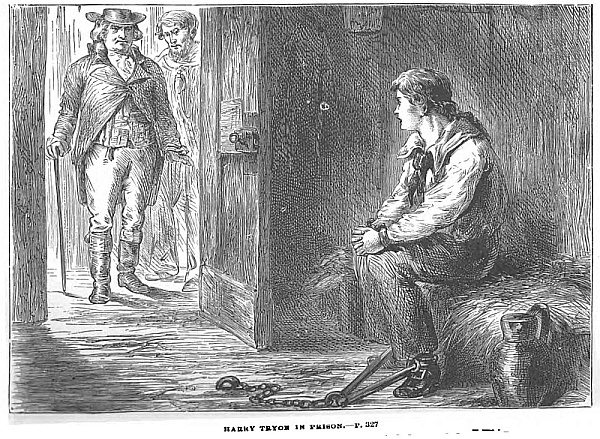
Some way up the Thames lay a large hulk. Her decks were housed in, her hulk was black; she bore but little resemblance to the stout ship she had once been, except from the ports which were to be seen on either side. They were very thickly grated. It was the prison ship. Low down in one of the dark cells below the water-line, with manacles on his ankles, lay Harry Tryon. His cheeks had become pale, his eye had lost much of its brightness, but hope had not altogether died within him. Still he was fully sensible of the dangerous position in which he was placed. He had become of late a wiser and a sadder man than he had ever been before. Still as day after day passed by and no friends came near him, his spirits sank lower and lower.
“Have they all deserted me?” he said to himself, clasping his hands. “Mr Kyffin would not, I am sure, and Mabel—she knows nothing of my desperate state. Would that I had written to her. Some effort might have been made to save me; but I could not bear the thought of writing to her as a felon, to let her hand touch the paper smelling of this foul prison. Better far that I should die unknown. When the wretched Andrew Brown is run up to the yard-arm there will be no one to mourn him, and Harry Tryon may disappear without a stain of disgrace upon the name.”
He attempted to rise—he could do so with difficulty—to take a few turns up and down the narrow cell. Scarcely ever was he left in silence. There was the ripple of the water against the ship’s side; above him the steps of other prisoners as they, like him, paced to and fro. Now and then there were shouts and cries of men driven to despair by their approaching fate, others singing and shouting with careless indifference. It was weary work, that prison walk, for the chains were heavy. The gyves hurt his legs. Again he sat himself down, and clasped his hands upon his knees.
“Death! death will be welcome!” he exclaimed, “the only termination to my misery and shame.”
As he thus sat his ears caught the sound of footsteps moving along the passage outside. The lock in the heavy door moved, it opened, and a bright light which dazzled his eyes burst in.
“They are come,” he thought, “to carry me off.”
“I am ready,” he said, starting up, expecting to see the gaoler and the guard of soldiers. Instead, as his eyes recovered their vision, he saw standing before him his ever faithful guardian Roger Kyffin. He sprang forward, then stopped for a moment and hung down his head.
“You cannot come to own a wretched convict like me,” he exclaimed, in a tone of sadness.
“Do not say that, Harry,” answered Mr Kyffin, stepping forward and taking his hands. “Not a moment’s rest or happiness have I enjoyed since I learned the dangerous position in which you were placed. Do not doubt the regard I must ever have for you. I have discovered how you have been deceived, and how you were induced to desert your truest friend; I have therefore every excuse for you. I have learned that even in this instance you are guiltless of disloyalty, and, believe me, Harry, however guilty you have been, I should still have looked upon you as a son.”
“You make me desire once more to live,” exclaimed Harry, for the first time perhaps in his life bursting into tears. “I thought no one cared for me. I was prepared to die unknown and unlamented; and oh! tell me, Mr Kyffin, does Mabel know of my condition?—has she discarded me?”
His voice trembled. He looked eagerly in his guardian’s face for a reply.
“No, Harry, indeed she has not discarded you. She is true-hearted.”
“Is there any hope for me—must I suffer as so many unhappy men have done?” gasped out Harry.
“There is hope, my boy. I cannot say for a certainty that you will be saved. Mabel herself obtained from the King a request to his ministers that your life should be spared, and I have seen the governor of the prison, and he believes it confers sufficient authority on him not to deliver you up till his Majesty’s pleasure shall be further known.”
Mr Kyffin then explained to Harry more clearly the particulars of which the reader is already aware. Harry Tryon sank down on his knees, and thanked Heaven from the depth of his heart for the prospect of a release from the ignominious death for which he had been prepared. Alas! he had not often truly prayed. His grandmother had not attempted to teach him even a form of prayer, and seldom, during the life he spent in London had he ever dared to kneel to ask a blessing of his Heavenly Father. He had now, however, learned an important lesson. He had felt his utter helplessness and weakness, and had discovered that when lifting up his heart to God he received a strength and courage which he could by no other means have obtained.
“And Mabel! bless her for what she has done for me! But oh! Mr Kyffin, tell me where is she, how is she?”
“She bears up wonderfully,” answered Mr Kyffin, “and even now she and her kind friend Mrs Barbara Thornborough have gone to Mr Pitt to endeavour, if possible, to see him, and obtain his warrant for your liberation.”
“Then I am sure she will succeed,” exclaimed Harry, joyfully.
“Do not raise your hopes too high, my boy, and yet I would wish to support and encourage you,” remarked Mr Kyffin. “My stay with you now must be short, as I promised to meet Miss Everard after she had had an interview with the minister. Even should he refuse, we must not lose heart. We must bring other influence to bear on him. However, Harry, I know you too well to think that there is any necessity to urge you not to despair. And now farewell. I purpose to return before long. I hope to bring good news, but you must not be disappointed if it is not as good as we wish. This mutiny, so happily quelled has been very serious, and might have proved most disastrous to the country. The nation therefore is naturally little inclined to look with leniency on those who took a part in it, especially on the leaders; and from your having been associated with Parker, you, in the ordinary course, could scarcely expect a pardon.”
Mr Kyffin was gone, and Harry was once more left to his own thoughts. The hours passed wearily by, they seemed longer than any during his imprisonment. Sleep would not visit his eyelids. Anxiously he listened for every sound, hoping for the speedy return of his friend.
Meantime Mabel, who had parted from Mr Kyffin at Mr Thornborough’s house after their return from Windsor, prepared to set out with Mrs Barbara, attended by the two seamen and Paul,—to Mr Pitt’s house at Putney. She waited but a short time to obtain a little refreshment which Mistress Barbara urged on her, and together they drove towards the residence of the minister, while Mr Kyffin proceeded down the river to pay the visit to Harry which has been described.
It was late in the evening when they arrived at the villa. The two ladies, sending up their names, earnestly requested that they might be admitted. Mr Pitt was very much engaged, and could receive no visitors.
“Is Lady Hester at home?” asked Mrs Barbara. “Her Ladyship may remember me,” she observed, turning to Mabel; “if she does, she will, I think, see us, and through her we may press our suit on her uncle.”
The two ladies waited anxiously for the return of the servant.
“Lady Hester will see you, ladies,” was the reply, and Mabel and her friend descended from the carriage.
They were ushered into a handsome drawing-room, where Lady Hester was seated alone at a writing-table.
“I remember you, Mistress Thornborough,” she said, rising and coming forward in a gracious manner. “Tell me, to what cause am I indebted for the honour of this visit?”
“My young friend here will explain it to you,” said Mrs Barbara, now introducing Mabel. “One in whom she is deeply interested has been implicated in the late mutiny at the Nore, and in consequence of proper evidence not having been brought forward which would have proved that he acted under compulsion, he has been condemned to death. We have seen his Majesty, who was acquainted with the young gentleman, and have now come, wishing to see Mr Pitt, with two seamen of the ship on board which he served, who can clearly prove that he was an unwilling participator in what took place. Still time is pressing.”
“I can hold out but slight hopes of Mr Pitt’s interference,” answered Lady Hester. “He sees the importance of preventing the recurrence of such a mutiny by striking a wholesome terror into the minds of the seamen.”
“But surely he would not wish an innocent person to suffer!” exclaimed Mabel. “He can be proved innocent, believe me, your ladyship. The King himself is convinced that he is so. Let me entreat you to beg Mr Pitt to grant a pardon to this young man.”
“You take a warm interest in him,” said Lady Hester, looking at Mabel somewhat harshly.
“Yes, indeed I do, I have known him from his youth,” answered Mabel. “He is true and loyal, and would never have aided so dangerous a conspiracy as this appears to have been, to destroy the naval power of England.”
Lady Hester seemed to relent as she gazed at the young girl. “I am ready to believe you,” she answered, “that this young man is innocent. Tell me, how came he to be on board ship in the capacity of an ordinary seaman?”
Mabel blushed and hesitated.
“Oh, I see how it was,” said Lady Hester; “and now you repent. I will see Mr Pitt, and give him your statement of the case.”
“Then may I beg you to deliver this letter from his Majesty at the same time?” said Mabel, presenting the King’s note.
Lady Hester took the paper, and remarked, as she rose to leave the room, “It may have weight with my uncle, but, at the same time, even the King himself cannot turn him from his will when he has once made up his mind.”
Once more the ladies were left in doubt and anxiety. Mabel could not hope much from Lady Hester’s manner. Mrs Barbara, who had seen her before, argued favourably. Lady Hester was some time absent.
At length the door opened, and she returned, followed by a slightly-built gentleman, scarcely yet of middle age, whose bright eye and broad forehead betokened intellect of no ordinary kind. His manner was somewhat stiff and formal as, bowing to the ladies, who had risen at the entrance of Lady Hester, he took his seat near them.
“You come with a request from his Majesty, I understand, to beg me to interfere in the case of one of the mutineers of the Nore. His Majesty’s commands have always great influence with me; at the same time, you must understand that the matter is one of a most serious character. A great many men have been pardoned who really took a part in the mutiny by supporting their leaders. If the leaders themselves are pardoned, the men will think that, after all, the crime they committed was a slight one,” he observed, in a tone of voice which made Mabel’s heart sink within her.
“But, oh! sir,” she exclaimed, pressing her hands before her in a pleading attitude, “but this young man, Andrew Brown, for by that name he is known, was not guilty of any evil intentions.”
Mabel repeated the statement she had already made to the King.
“You plead his cause earnestly young lady,” said the minister, “and right well, too. Let me see these witnesses, and if they give a satisfactory statement, I will recommend the young man as a fit subject for his Majesty’s clemency. I cannot reverse the judgment of the court, you must remember. If that condemned him, condemned he must be, but his Majesty can exert his prerogative of mercy, and both save his life and obtain his release.”
“Oh! thank you, sir, thank you,” exclaimed Mabel, expressing by her looks more than by her words what she felt.
The minister rang the bell, and ordered the two seamen to be admitted. In a short time there was a scuffling outside. The door opened, and Jacob Tuttle and Jack Veal appeared, one urging on the other, as if neither liked to be the first to enter. They held their hats in their hands, pulling away at their locks as they would have done addressing an officer on the quarter-deck. Lady Hester looked on with an amused countenance as the minister cross-questioned them as to the part their shipmate had taken in the mutiny.
“He took no part at all, please you, sir, for I don’t call writing letters with a pistol held at a man’s head taking part in the mutiny, and I know for certain that he hated it as much as any one. Besides, sir, when we proposed striking the red flag, and carrying the ship up the river, he heartily joined the loyal part of the crew, and a pretty severe tussle we had, too, before we got possession of the ship and handed it over to the officers.”
Jack Veal corroborated what Jacob had said, and Mr Pitt drew forth a considerable amount of further evidence which satisfied him that if these witnesses spoke the truth, Andrew Brown’s guilt was not of a nature to merit death. At last he turned to Mabel.
“I have no hesitation in recommending his Majesty to pardon the young man in whom you are interested. His story is, I have no doubt, a romantic one, and I do not wish to add to the romance by allowing him to finish his career at the yard-arm. You need have no fear, therefore, young lady, on that score. I will send down a reprieve, and will also give you a paper, which will secure a full pardon for your friend on being signed by his Majesty. I must wish you good evening, and I am glad that my niece, Lady Hester, who is staying with me for a few days, has brought the matter before my notice.”
Without waiting to hear the expressions of gratitude which Mabel and Mrs Barbara felt disposed to pour forth, the great minister left the room. Lady Hester warmly congratulated them on the success of their mission, and assured them that she cordially sympathised with them. Jacob, forgetting where he was, on hearing that Harry was to be pardoned, threw up his hat, and in his delight uttered a loud shout exclaiming—
“Bless you, my lady! Bless Mr Pitt, and the King, and all the Royal Family! If I had as many lives as a cat, I would gladly spend them all in the service of so good a King and so noble a minister.”
On entering the carriage, Mabel sank back into the arms of Mrs Barbara, and gave way to her feelings in a flood of tears.
“Oh, he will be saved!” she exclaimed; “I scarcely dared hope it till now.”
At length Mabel appeared somewhat to recover her composure, and worn out by anxiety of mind and the fatigue she had gone through, at length sank to sleep in the arms of her friend. They did not reach home till a late hour. Scarcely conscious, Mabel was carried to bed. Her dreams were far more happy than they had been for many a day. She and her kind friend looked forward with anxiety to the return of Mr Kyffin on the following day. He arrived before noon with the intelligence that the governor of the prison had received the minister’s reprieve for Harry. That afternoon had been fixed for the review of the volunteers in Hyde Park. Mabel felt sure that his Majesty would, if he had an opportunity, immediately sign the pardon which the minister had given her.
It was a lovely day. The sun shone brightly forth from an unclouded sky, and from the various avenues of approach troops marched up to the ground preceded by their bands of music and colours flying—infantry, cavalry, and artillery. The most numerous corps was that of the City Light Horse. Some of the companies, however, were dismounted and marched on foot. Others came in long cars, with their rifles between their knees, while a band of well-equipped horsemen rode up at the head of the regiment, their glittering arms and handsome dresses distinguishing them from the men of other corps. The privates, as well as the officers, were all gentlemen, a considerable number of them men of fortune and independence. One spirit animated every regiment alike—ardent love of their country, and a determination, if called upon, to fight bravely and to die in her defence.
Mr Kyffin and Mabel waited for a favourable opportunity of approaching the King, for Mabel’s anxiety would brook no delay, and she was afraid that he might return to Windsor without signing the paper.
At length the King drew up, preparatory to the troops marching past. The time seemed favourable, as there was an open space near his Majesty by which she could approach. Dressed in deep mourning, and leaning on Mr Kyffin’s arm, her countenance radiant with beauty, her colour heightened by excitement, she drew near to the King. One of the equerries observing her, inquired what she wanted.
“It is not the right moment to approach his Majesty,” he answered.
The King, hearing what was said, turned his head, and seeing her, exclaimed—
“Ah! my dear young lady, how can I help you? What is it? Will not Mr Pitt advise me to pardon the young mutineer?”
“Oh! yes, your Majesty. He has given me a proper document which only requires your Majesty’s signature, but every moment is of consequence. It is cruel to have him kept in that dreadful prison, and I dread lest by any mistake he may be carried off and executed.”
Mabel could scarcely bring herself to utter these words. The King smiled.
“No fear of that, I trust, my sweet young lady, but I will sign the paper. Go and wait for me at Saint James’s; as soon as this affair is over I will come there. Lord So-and-so,” he said, turning to one of his equerries, “remind me that I have a paper to sign; it is for that young lady; you will not forget it now.”
The equerry turned to Mabel and bowed low.
The colour which had left her cheeks rose again in them, for the look cast on her was full of intense admiration. Mr Kyffin whispered to Mabel that she must not press the matter further, and bowing to the King, who gave a kind parting word to Mabel, they retired from among the glittering throng of military officers.
Chapter Twenty Seven.
Silas Sleech Departs from the Scene.—How Mr Sleech enjoyed his Possession of Stanmore.
Prisons even in those days were fearful dens, although considerably improved by the exertions of the noble Howard. In an ill-ventilated room with grated windows, on a straw pallet, sat a young man. His cheeks had gained the prison paleness. A frown was on his brow, and an expression on his countenance, which betokened numerous bad passions. Several other persons were in the room, which was closed by a strong door, barred and locked. Five or six other pallets, a rickety table, and several three-legged stools completed the furniture of the apartment. The young man’s companions had apparently been amusing themselves at his expense. The more angry he became, the more they laughed and jeered.
“Laugh while you may,” he growled out. “You will laugh on the wrong side of your mouth when dragged out to Tyburn. I can, even now, fancy I see you dangling on the gibbet, and more thorough jailbirds have never been taken out to be hung!”
These remarks, of course, produced retorts of equal bitterness.
“As to me, I have no fear of the sort,” at length exclaimed the young man. “To be accused of a crime and to be proved guilty are two different things. No evidence can be brought against me—of that I am certain.”
While he was speaking, the door opened, and the jailer appeared, a couple of armed guards standing behind him. The prisoners gazed at him anxiously; although none of them were convicted, yet all of them in that chamber were accused of capital offences, and each supposed that it might be his turn to be led forth for trial. Most of them knew pretty well that it would be the last scene but one of their existence. The last would be on the scaffold at Tyburn.
“It is an old gentleman wants to see you,” said the jailer, looking at the young man on the pallet bed. “Now you others, behave civilly to him, or I will be down upon you,” he added, turning to the other prisoners.
As he spoke, Mr Sleech, the owner of Stanmore, entered the prison room.
“Oh! is it you?” said the young man, looking at Mr Sleech. “Well, I am glad you have come at last. Here, there’s room for two of us; sit down. It is not a handsome reception-room, and my attendants are somewhat noisy. We must take things as they are. Well, what news?”
Old Mr Sleech was no stranger to similar scenes. He had often visited jails professionally to consult with his clients, but the case in this instance was somewhat altered. The prisoner he now came to see was his own son Silas. It might have occurred to him that he had not brought him up in the way that an honest man should go. The other prisoners, hardened villains most of them, were gathering round with the intention of mocking at the old man.
“He is my father!” said Silas, rising with a greater approach to dignity than he had yet exhibited. “Some of you have fathers. If one of them was to come and see you, you would not like the others to stand round and see him insulted.”
The address had its effect, and the ruffians, in spite of the inclination exhibited by one or two to continue their sport, retired to the farther end of the room, where they sat down at the rickety table. One of them pulling out a greasy pack of cards, they commenced playing.
“How did you manage to get yourself into this trouble?” asked old Sleech; “I thought you were too wise for that.”
“My wisdom will be shown in getting out of it,” answered Silas. “I played a somewhat bold game, and might have made a false move or two, but it cannot be helped now. There will be no evidence brought against me, I am very sure of that Young Harry Tryon went aboard ship, you know that. Well, besides, he was on board the ‘Sandwich,’ and Parker mixed him well up in the mutiny. He was seen with him at the dockyard at Sheerness. I learned all that from an acquaintance of mine—young Gilby. He saw him with his own eyes, so there’s no doubt about it.”
“He may have been mistaken,” observed old Sleech.
“Not a bit of it,” said his son, “he knows Harry almost as well as I do. He has met him scores of times, both at Mr Coppinger’s house and at some of the places which Harry used to frequent. Never fear, it is all right; I shall soon be out of this, and down at Stanmore to enjoy myself. I say, father, we shall want a little ready money to keep up the game. We must make the old trees fall right and left, and you know, at a pinch, you and I can sell a few dirty acres. In my opinion there is nothing like enjoying a thing when we have got it.”
The further conversation between the father and his estimable son need not be repeated. Silas had fallen considerably in his parent’s estimation since he had so committed himself as to get into prison. He was, also, not quite so sanguine as his son was as to the result of the trial; but he performed a parent’s part in securing the best counsel to be obtained. He also made interest with the governor to procure a better room and superior food for his son. Silas did not, however, exhibit the gratitude which might have been expected.
“It would not do to let the heir of Stanmore dangle on a gibbet, eh, dad, would it?” he observed, when his father told him what he had done. “No chance of that, or I could not joke on the subject.”
The day of the trial arrived. Silas Sleech stood at the bar. He gazed round the court with an air of confidence, and nodded familiarly to some of his acquaintances. His eye fell for a moment as he encountered the stern glance of Mr Coppinger, Mr Kyffin, and other persons who had been brought in as evidence against him. The case was gone into. He was ably defended, and his counsel laid great stress on the non-appearance of the person whose signature he was said to have forged, and whose ruin it appeared he had taken great pains to effect. Silas smiled as he heard these remarks, and attempted to throw an expression of injured innocence into his countenance. The counsel for the Crown replied; but the defence made by the defendant’s counsel seemed to have great weight with the jury, when there was a slight movement in the court. A slip of paper was put into the hand of the Crown counsel. He turned round and spoke a few words to a well-dressed young man, who had at that time entered.
“The defendant declares,” he observed, “that no evidence can be brought forward to prove that he forged the signature of Mr Stephen Coppinger, asserting that it was the act of another person. Here stands that other person, whose statement you will hear. I produce him as a witness; should you consider him unworthy of belief, you will acquit the prisoner; if not, I am ready to prove that no other person than Silas Sleech, the prisoner at the bar, could have committed the forgery.”
As Silas caught sight of the countenance of the young man, he gazed at him as at one risen from the dead, and a sudden tremor seized his frame.
“He knows I did not do it; he knows I did not,” he gasped out; but Harry Tryon took no notice of him.
Harry briefly and clearly gave an account of the circumstances with which the reader is already acquainted.
The jury were perfectly satisfied of the guilt of the prisoner.
“But he is a convicted felon, he cannot be brought as evidence against me. He was one of the mutineers of the Nore. He ought to have been hung with his companion Parker.”
“The prisoner is mistaken, my lord,” said Mr Kyffin; “the young gentleman is as free as any one in this court. He is my ward, and I am sure that his name will not be found among the mutineers of the Nore.”
The jury returned a verdict of guilty, but recommended the prisoner to mercy. In spite of Sleech’s criminality, Mr Coppinger and others exerted themselves, and the sentence of death was commuted to that of transportation for life, and Mr Silas Sleech was among the next batch of prisoners shipped off on board a convict ship for Botany Bay. Mr Tony Sleech did not allow his heart to break at the loss of his son. He was legally dead, and his next boy must, therefore, be the heir of Stanmore. He was of a somewhat more hopeful character than Silas, though not possessing the same amount of talent. He was a dunce, indeed, in his father’s estimation, and had been so in that of his school companions. He had, however, sense enough to appreciate the change of position from a younger son to that of the heir of a fine estate, and very soon gave himself so many airs that his brothers and sisters could not help having a secret wish that he might be despatched after Silas.
The cost of his son’s defence had been very considerable, and Mr Sleech therefore considered it desirable to repay himself by cutting down more of the Stanmore trees, although the proceeds were not to be expended in the way Silas had proposed.
He was one day, soon after his return to Stanmore, superintending this proceeding, when Mr Wallace arrived at the park, and proceeded into the grounds to look for him. The two lawyers bowed stiffly to each other.
“I have come, Mr Sleech,” said the other, “on the part of my client, to warn you of the danger of your proceeding. For every tree that falls you will be made responsible. I have thorough confidence that Captain Everard will ere long prove his right to the property.”
“No danger at all about the matter, my good sir,” answered Mr Sleech, with an air of indifference which he did not altogether feel. “I have a right over these trees, and have determined to cut them down, and therefore, I say, let any man interfere with me if he dare.”
“We are not going to proceed by force, Mr Sleech,” answered Mr Wallace, “we are not driven to that; but I again repeat that, not only will you be compelled to pay the value of every tree which you cut down, but also you will be heavily fined for the damage which you have committed on the property.”
“I will stand the consequences,” repeated Sleech, but his voice somewhat failed him as he spoke.
Mr Wallace marked it.
“Well,” he said, “my good sir, we are fellow-townsmen, and though often professionally opposed to each other, I speak to you as a friend. Be warned in time. Your son has been dealt leniently with, and has escaped death, but depend upon it, if you persist in injuring this estate, you will be made to pay heavily in purse. No mercy will be shown you, I can assure you.”
Saying this, Mr Wallace bowed to his brother lawyer, and without further ceremony took his way back to the house. Mr Sleech soon afterwards proceeded in the same direction, doubtful, apparently, what course to pursue.
“I won’t be bullied,” he said to himself, “and yet they seem pretty confident. I don’t quite like the look of matters.”
Scarcely had Mr Sleech left the wood when another person appeared on the scene. Paul Gauntlett was well known to all the labourers around. He walked up, armed as usual with a stout cudgel. He might have been seen day after day since his return from London walking round and round the grounds, just outside, evidently considering that he was acting in some way as guardian of the place.
Madam Everard had warned him that he could not legally enter it. As, however, he saw from a distance the tall boughs of the trees falling towards the ground, he could resist no longer.
“You are employed on a fine work, my friends,” he said, gazing round him. “What now would you say if you saw the colonel standing in the midst of you? He would be wonderfully pleased at seeing these shady trees which he loved so well cut down one after the other at the beck of a pettifogging attorney. That is what Mr Sleech is, even though he has got into the big house here. That is what he will ever remain. But I tell you what, lads, he will not hold Stanmore long. Of that I am very certain. The captain will have his own again before many weeks are over, mark me. Now I say, I don’t want to take the bread out of your mouths, but if any of you can get better work than this, I say go and take it. I shall mark every man who stays on here, and he may never expect another day’s work on Stanmore as long as I live, if he lays his hand against one of these trees after I have warned him. There never was a better master than the colonel; and the captain, his nephew, is likely to be every bit as good a one. Now, boys, just take your own course, you have heard what I have got to say. What will you do? There is Farmer Giles and Farmer Jobson, and Mr Timmins, down at the mill, and twenty others want hands. You will all get as good wages as this old skinflint can pay you, and be employed in an honest way.”
Paul’s address had a great effect among the labourers. They consulted together for some time, and one after the other agreed that they would not again lay an axe against the root of one of the trees of Stanmore. A few held out. They had got work and did not see why some old trees should not come down at the bidding of one man as well as that of another.
“Take your own way,” answered Paul. “If the trees fall, some one will have to pay, and you will not forget my words.”
Several of the men shouldered their axes and prepared to move.
“I would sooner lose a week’s work than offend the captain,” exclaimed one.
“Well said, John Hobby, you are a true man,” exclaimed Paul. “To my mind none of you will have to lose a day’s work. I don’t make promises for other people, but my opinion is that a generous, open-handed man like the captain would not let a fellow suffer for being true to him.”
“Hurrah! I will not lift an axe against another tree in this place till the captain orders me,” cried Hobby.
“Nor I, nor I, nor I,” answered others.
The whole party with one accord, headed by Paul Gauntlett, marched off the ground, leaving four or five trees where they lay, with their branches still attached to them. There seemed no probability of more of the timber of Stanmore being felled that day, or perhaps for some days to come.
We must now return to Mr Thornborough’s house in London. Mabel was staying with her godfather and his kind sister. After she had obtained the King’s signature for his pardon, though feeling certain that he would be released, her nerves at length gave way, and she was utterly unable to accompany Mr Kyffin, as she wished to do, to carry the pardon down to him. She therefore returned to Mr Thornborough’s house, while Mr Kyffin again went down the banks of the Thames to the prison ship. Mr Kyffin had a double reason for haste. He was less anxious, possibly, than Mabel, on account of Harry’s safety, for he felt sure that that was secured; but the next day had been fixed for the trial of Silas Sleech, and he wished to obtain his ward’s evidence, without which he foresaw that the conviction of the culprit was very uncertain. Harry could scarcely believe that he was at liberty, though he saw the prison door open, and his guardian, accompanied by the governor of the prison and other officials who had come to set him at liberty. They were soon on shore, and at the inn where Mr Kyffin had left his carriage. He had thoughtfully brought a suit of clothes for Harry, who, with a satisfaction which can be best understood by those who have suffered as he had done, having gone through a thorough ablution, once more dressed himself as a gentleman. He was pale, but in other respects greatly improved. His figure was fuller, and his appearance more manly. His arrival in court, in time to secure Silas Sleech’s conviction, has already been described. Mabel was all day in a state of nervous agitation. Frequently when Mrs Barbara addressed her she scarcely understood what was said. When she took up a book, her eyes ran over the pages without reading a line. She tried to work, but her fingers refused to move. Mrs Barbara observed her state. “Poor girl,” she thought, “how wonderful it is that she should love that young man so much.” A carriage stopped at the door. She endeavoured to rise, but found it impossible to move. She drew her breath quickly. The door opened, and a middle-aged gentleman entered. She lifted up her head. In an instant she was in his arms.
“Oh! papa, this is almost too much for me,” she exclaimed, as Captain Everard returned her embrace. In a few words he told her what had occurred. “But the loss of Stanmore is a severe blow,” he observed.
“Oh! for me it is nothing,” answered Mabel; “I feel for you, though that cannot take away your position as a post-captain.”
“No, indeed,” answered the captain, “it is a position a man may well be proud of.”
“And as for the fortune, my little god-daughter must not be without something,” observed Mr Thornborough. “Here, Barbara, give her that paper. A present is better than a bequest, and I have had the amount transferred to her name in the funds.”
Mabel’s eyes were too full of tears to distinguish clearly what was written on the paper, though she could make out the sum of 10,000 pounds. She was springing forward to thank her godfather, when another carriage drove up to the door. Again the drawing-room door opened, and two gentlemen entered. This time Mabel did not spring into the arms of either of them, but she stood for an instant motionless till the youngest advanced towards her. Then unconsciously forgetting that any one else was present, she lifted up her arms and let them fall on the young man’s shoulders.
“What! Andrew Brown, the brave seaman who saved my life?” exclaimed Captain Everard. “But can it be? I wonder that all that time I did not recognise my young friend Harry Tryon.”
Chapter Twenty Eight.
The Wreck of the Lugger, and what came of it.
For upwards of a week Roger Kyffin had been absent from Idol Lane, during which time he had never left his house at Hampstead. The doctor, however, paid frequent visits, sometimes thrice a day; once he remained during the greater part of the night. The Misses Coppinger also frequently drove over, and on one occasion Mr Coppinger himself rode all the way to Hampstead to inquire for Mr Kyffin’s sick friend, for Mr Kyffin himself was in perfect health; indeed, he had never had an hour’s illness since he was a boy. No mother could have attended a child with more care and solicitude than did Roger Kyffin his guest. That guest was Harry Tryon. The day after his release from the prison ship he was seized with illness—his tongue was parched, his limbs ached, he was unable to raise his head from his pillow. The doctor thought that he was suffering, it might be, from the jail fever. Harry’s nerves had also been severely tried. What with the fatigue and anxiety he had gone through, the feeling of shame and remorse for his folly had at length completely overcome him. For several days he appeared to be hovering between life and death.
“Oh! Mr Kyffin, I am unworthy of you, I feel that I have disgraced you, and Mabel, too; when she knows about me, she, too, will see that I am unworthy of her love. How can she ever have confidence in a man who has shown himself so weak, who has committed so many follies, and who has been so easily led astray by designing knaves? How could I for a moment have trusted such a person as that unhappy man Sleech? Why did I not at once perceive the aims of Parker, who, however, was a thousand times superior to the other fellow?”
“My dear boy,” said Mr Kyffin, ”‘let bygones be bygones.’ You have had a good deal of experience in life, and have paid dearly for it, and now I pray God that you may be restored to health and be wiser for the future.”
“I see no hope for life in me,” answered Harry, “Mabel can never be mine.”
This was said as the fever was coming upon him before he broke down altogether. Mr Kyffin saw that reasoning or expostulation under the circumstances would avail nothing. He did his best therefore merely to soothe the poor lad. From his heart he pitied him, and loved him more than ever. Mabel had returned to Lynderton with her father. She was not told of Harry’s desperate illness. Indeed, she could not be permitted to see him for fear of catching the fever. She had fully expected that he would write, and perhaps she suffered more from being left in doubt than if she had been told the truth. At length, a fine constitution, under the doctor’s care, by God’s mercy brought him through. As soon as he was sufficiently recovered to be moved, Mr Kyffin was anxious to give him change of air. The cottage where he was born was vacant, and Mr Kyffin begged his old friend Doctor Jessop to fit it up for him. “His native air, and the doctor who knows him so well, will afford him the best chance of perfect recovery,” the kind man thought to himself, so he and Harry set forth towards Lynderton. Once more Harry took up his abode at the cottage where he first saw the light. He sat in the room with his old friend where his mother had died. A faint recollection of her came across him. He could even fancy he saw her slight figure as she sat in the porch watching his gambols on the lawn, or as she stood at the gate while he and the nursemaid set forth on their daily walk. The fresh autumn air soon restored vigour to his limbs and sent new life through his veins. Doctor Jessop prescribed frequent walks on the open downs above the cliffs.
“All fear of infection will by that time be blown away,” he observed. “For my part, I believe there has been no real danger since you left London. However, we cannot be too cautious in such matters.”
“And may I then see Mabel—Miss Everard?” he asked.
The doctor smiled.
“That may be as her father wishes,” he answered. “Certainly you will run no risk of giving her the fever, if that is what you mean. Perhaps I may be able to drive you there some day, not just yet though, and you are certainly not strong enough to walk so far.”
The weather had changed lately, and become very boisterous, but the stronger it blew the more Harry enjoyed his walks on the cliffs.—Generally Mr Kyffin accompanied him. One evening, however, it having rained all the afternoon, he went out later than usual. The air was fresh and pure, and he was tempted to continue his walk much farther than he generally went. At length, growing somewhat weary, he sat himself down in a hollow of the downs. The sun had hitherto been concealed, but at length it shone forth below a mass of clouds which hung overhead, and appeared floating as it were above the horizon, a vast ball of liquid fire. Gradually it sank over Portland Head, leaving the western sky glowing with a ruddy hue. Harry sat on, lost in thought. Now a fresh bank of clouds rose out of the horizon, and joining those that hung overhead, completely obscured the sky. Twilight came on more rapidly than usual, it seemed, as the wind increased, and the clouds rushed by in thick masses overhead. At last Harry became conscious that time had sped by, and the waning light warned him of the rapid approach of night. He knew the way well enough. At the same time there were several difficult places which he would have preferred passing in daylight. He hurried homeward along the cliff, but the darkness increased, and at length, reaching a path which led down to the beach, and recollecting that the tide was out, he descended by it, intending to continue his walk that way homeward. It was soon so dark that he could with difficulty see his way along the shore. Still, he found it somewhat tedious work walking along the beach, and upwards of an hour passed away after it became dark before, according to his calculation, he had reached that part of the beach which lay below the cottage. Just as he was about to turn away inland the sound of a gun came in from the sea. Another and another report followed. He stood for a few minutes wondering from what vessel the guns were fired. Presently his eye caught sight of the flashes. Several others followed. The vessel firing was drawing nearer and nearer. He could not bring himself to leave the shore, hoping that Mr Kyffin would not be alarmed by his absence. The wind whistled loudly. The seas came rolling in heavily on the beach, bursting with loud roars, throwing up the white spray, which was driven in showers inland. Harry was soon pretty well drenched, but he had been too much accustomed to a wet jacket to think of it. Suddenly the clouds parted, and the moon burst forth, shedding a pale light over the wild, dancing waters. Just on the spot where her beams fell he distinguished a vessel running in towards the shore. That short glance showed him that she was a lugger. She seemed to be carrying a press of sail, considering the heavy gale blowing. Again the clouds parted, and at some distance astern of her, his keen seaman’s eye caught sight of a larger vessel. It was from her the guns were fired, for at that instant a flash was soon followed by the dull report of a gun, sounding even above the roar of the ocean. The position of both vessels was perilous in the extreme. In a few minutes the lugger must inevitably run on shore; but being probably a light craft, by being driven high upon the beach her crew might be saved; but if the larger vessel struck, it would be at a considerable distance farther out, and the seas would with terrific force instantly break over her and wash all the people off her decks. He longed to have the means of making a signal to the vessels of their danger. That seemed impossible. At no great distance were several cottages inhabited by fishermen and other seafaring people.
“I will go and collect them,” Harry said to himself, “and get them to bring ropes and spars. We may save the lives of some of these poor fellows. Without help they must nearly all be washed off again, even should they be thrown on the beach.”
Harry was not mistaken as to his position, and after some time, though not without difficulty, he found his way up the cliff and saw a light burning in one of the cottages which he was endeavouring to reach. He shouted out to the inmates, and at length a door opened and a light streamed forth. By its means he got to the front of the cottage, and told the men what was likely to occur. In a short time they were all on foot and hurrying down with him to the beach, laden with the poles and ropes he advised them to bring. At that moment a light burst forth from the top of a neighbouring cliff, and it was repeated by another from a beacon a little way inland. The guns then had been heard by the coastguards. By the time Harry had returned to the beach, a number of persons were collecting from all sides. Numerous other beacons in a short time blazed forth. The crowd were uttering various cries and exclamations.
“It is a French fleet,” cried one; “the French are coming.”
“To arms! to arms!” shouted others.
“What is to be done?” asked some of the more timid. Several hurried back, declaring it was time to get out of harm’s way. Harry was glad at last to hear Mr Kyffin’s voice. He made his way up to him. “I was afraid you would be anxious about me,” he said; “but I felt that I ought not to come home to let you know till I had collected the people, in case there should be a shipwreck, to help the sufferers.”
“She will be lost to a certainty,” cried the seamen in the crowd.
Just then the dark sail of the lugger was seen, now lifted up, as she rose on the top of the sea, now sinking down into the trough. On she came. Those on board must have been well aware of the fate awaiting them. Still they made no attempt to haul off.
Harry, calling to the people assembled, formed a party of men with ropes and spars who, secured one to the other, were to rush into the sea, and endeavour to drag out those who were washed overboard. Others were to stand by, ready to carry them up the beach out of the reach of the waves. The arrangements were made not a moment too soon. With a loud crash the lugger was seen rushing up the beach. In another instant, the following sea, with a loud roar, washed completely over her, and she was driven broadside on to the shore.
Chapter Twenty Nine.
Happy News.
Several persons were carried off the decks of the wreck, and had it not been for the hardihood of those who rushed into the water, would inevitably have been swept away. Some of the crew, as the sea receded, leaped overboard and endeavoured to gain the shore. They also were helped in the same manner. Several poor fellows, however, were unable to reach the friendly hands held out to them, and were carried out by the waves. One of the number was, in another minute, dimly seen to be struggling forward on the curling summit of a foaming sea. Harry, who had ever been a bold swimmer, casting a rope about himself, now dashed in towards the almost exhausted man. Bravely he swam forward. He clasped him in his arms, and then shouting to his companions, was hauled up the beach in safety. A few more seas, came rushing in, and scarce a plank or timber of the lugger hung together. The greater number of the persons on board had been saved. They seemed, however, to be no strangers to most of the people on the beach. For some minutes Harry had been so busily engaged in rescuing others that he had not had time to speak to the person he had drawn out of the water. Great was his surprise, on returning to the drier part of the beach, when the light of a lantern fell on a man’s countenance he recognised—the features of his old acquaintance, Captain Falwasser. Several other persons were seated near him: one was a female, and the other an old man.
“What, my friend Harry Tryon!” exclaimed the captain, grasping him. “My life, I know, is not the first you have saved. Harry, I have news for you,” he said, as if recollecting himself. “You shall have it by-and-bye. But these poor people require to be housed. They are shivering with the cold, and I must confess that I should like to find myself before a warm fire.”
“Our cottage is at the service of as many as can get into it,” said Mr Kyffin, coming up to the captain. “Our friends here will, I have no doubt, take care of the rest.”
The lugger had come across empty, greatly to the disappointment of most of the bystanders.
“As fine a craft as ever floated has come to her end this night,” observed one of them. “Well, lads, there is nothing more to be done, so we will back to our homes and get some of these poor fellows put into warm beds.”
The captain and two old French people, with two or three more persons, accompanied Mr Kyffin and Harry to the cottage. As they reached the top of the cliffs, they saw, far and near, the beacon fires bursting forth, and heard the sound of guns firing in the distance.
“Why the people must suppose that the French are coming,” observed Mr Kyffin. “Depend upon it that is the idea. We shall have the whole army of volunteers down upon us before long, and when they find that you, captain, and your two old friends are the only invaders, they may be apt to feel rather irate; our safest plan will be to get housed comfortably before they come. It will do the young soldiers no harm to give them some useful exercise. I only hope, should the enemy ever come, that the guardians of our native land may be as wide awake as they appear to be to-night.”
The cottage was shortly reached. Susan, Harry’s old nurse, now grown into a comely matron, acted as housekeeper; a blazing fire in the kitchen soon restored warmth to their limbs, while all the garments which the house could furnish were brought forth to supply them with dry clothes. A steaming hot supper was after this placed on the table, round which Mr Kyffin’s guests thankfully assembled.
“Well, Harry, you wish to know the news I have brought, I doubt not,” said the captain, when at length he was sufficiently recovered to find the use of his tongue. “Had you not come down to-night to assist in saving me and these two country people of mine, in all human probability your friend Captain Everard would not have recovered possession of Stanmore. I am thankful to say, after much risk and anxiety, I succeeded in getting a copy of the marriage certificate which was of such importance, and to make security doubly sure, I brought over these two old people who were witnesses to his father’s marriage.”