WHG Kingston (continued 4)
Reading edition
“As you like, Ann, as you like,” exclaimed Mr Sleech, swinging about his hat, which he had lifted from the ground. “It won’t be for long, I can tell you; we shall soon be back again, I have an idea.”
Silas endeavoured to shake hands with Mabel with a smile which he intended to be insinuating, but she indignantly turned from him.
“Oh, oh, proud as ever,” he muttered, as he followed his father out of the room, at the door of which Paul was standing sentry. He had seen them returning to the house, and it would have fared ill with either of them had they ventured to proceed much further in their insulting remarks to the ladies. Not a muscle of his countenance moved as he opened the hall-door; but his eyes glared down upon them with an expression which made even Silas wince and keep close behind his father’s heels.
“Well, that old fellow’s the essence of glumness,” observed Silas, as they got beyond hearing.
“She threatened me, she did,” muttered his father, between his teeth, not attending to what Silas had said. “But we will be even with them, or my name’s not Tony Sleech.”
Lynderton was at that time a place of fashionable resort during the summer season. People came down there to enjoy the sea breezes and the bathing in salt water, to listen to the band of the foreign legion, and to enjoy the pleasant society which was to be found in the town and its neighbourhood. During the lifetime of his sister, Lady Tryon, Mr Coppinger had declined going there; but he now acceded to the urgent entreaties of his daughters, and had taken a house for them, at which they had arrived. He himself, however, could only occasionally get down. One of the very few visitors admitted at Stanmore was the young Baron de Ruvigny. He also had soon become acquainted with the Miss Coppingers, and from the account he gave of them, as well as from the way Harry had before spoken of his cousins, Mabel more than ever was anxious to see them. Indeed, she consulted with her aunt whether she might not with propriety call upon them. The matter was discussed several times; but Madam Everard could not yet bring herself to see strangers.
“They are charming young ladies,” said the young baron, “so full of life and spirits, and so sweet and gentle; so refined in manners, so lovely in appearance.”
“What! are the six sisters all charming?” asked Mabel, innocently.
The young baron hesitated, blushed, confessed that one in particular was even more than he had described—a lovely pearl. Her name Sybella—what a sweet name. Her voice, too—she sang exquisitely.
“I have heard of her,” said Mabel, at length, “from her cousin Harry. He described her as a very interesting girl, so pray tell them, baron, that I hope soon to make their acquaintance.”
This was said before the visit of the Mr Sleeches to Stanmore, which has just been described.
The Miss Coppingers thought Lynderton a most delightful place, and were not at all surprised that Harry had praised it so much to them; their only sorrow was that he was not there. Their father, with kind consideration, had not told them that he had strong grounds for suspecting Harry’s honesty, nor had he given any reason for his absence. All he had said was that Harry had suddenly left the counting-house and had not returned, and they all thought too well of him to suspect him of any dishonourable conduct. They consequently spoke of him openly at Lynderton as their cousin. He seemed to have many friends, but only two appeared to know what had become of him: one was the Baron de Ruvigny, who was a very frequent visitor at their house, and the other was Captain Rochard, who came once or twice with the baron. He was, he told them, an old friend of Captain Everard’s, and was therefore particularly interested in the place.
Silas Sleech had obtained a holiday for the purpose of visiting Lynderton, not at all aware at the time that Mr Coppinger was about to proceed there himself. Great was the merchant’s astonishment when, the day after he came down, his eyes fell on his clerk, dressed in the height of fashion, walking up and down among the gay company assembled under an avenue of trees at the outside of the town to hear the band play. His amazement was increased when he saw him bow with a most familiar glance at his own daughters. Directly afterwards his clerk’s eye met his. Now Silas possessed as much impudence and assurance as most men, but his glance sank abashed before the stern look of the dignified Mr Coppinger. The young ladies were, they declared, utterly ignorant who he was. He had introduced himself as a friend of the officers of the legion, on the previous evening, without giving his name, while they had seen him dancing with several young ladies. Silas was ambitious. He was endeavouring to work his way into good society, in the outside circles of which only his family had hitherto moved, in spite of their connection by marriage with the Everards.
Meantime Roger Kyffin had returned from Ireland. His grief at finding that Harry had gone away with so grievous an imputation on his character was very great. Still he did not, he could not, believe Harry to be guilty. He found no letter, however, from him at Idol Lane, nor was there one at his own house.
“Surely the boy would have written to me,” he thought, “and told me where he was going. With all his faults, I believe he regarded me with sincere affection. I am sure he would have written.”
On speaking to his housekeeper one day about some letter which had been left during his absence, she mentioned that Mr Silas Sleech had on one occasion come to the house and requested to see Mr Kyffin’s letters, stating that he had been desired to forward some of them to him.
“I never gave any such directions,” said Mr Kyffin. “Did he take any letter?”
“Yes, sir, there was one—a particularly thick one, too—and the direction was in a good bold hand, just such as I have seen Master Harry write. I thought at the time, ‘Surely that’s the very letter master would like to have,’ so I let Mr Sleech take it off, making sure that he was going to send it on to you.”
Chapter Seventeen.
The Old Family Driven from their Home.
Paul Gauntlett watched the Mr Sleeches till they disappeared at the farther end of the avenue, amid the shadows of the trees.
“I am thankful they’re gone without me doing them a mischief; but the colonel said to me, ‘Paul, take charge of this place till you deliver it up to my nephew, the captain.’ And that is what I hope to do,” soliloquised the old soldier.
He stood for some minutes inside the porch, with his hands clasped before him in a stand-at-ease position. His plans were speedily formed. There were four stout fellows he could rely on generally employed about the grounds. He placed them, with thick oaken cudgels in their hands, two at a time, to watch the approaches to the hall, while he himself, armed in a similar manner, continued at intervals night and day to pace round and round the house, to see, as he said to himself, that the sentries were on the alert.
Once or twice Mabel caught sight of him, and wondered what he was about; but he did not think it necessary to inform her and her aunt of his plans. His chief post was the front porch, where he would sit the livelong day, keeping a watchful eye up and down the avenue. His only entertainment was reading the newspaper, which was brought by a man on horseback from Lynderton. It was a very different production from the large sheet of news at the present day.
Whatever were Mr Sleech’s plans, he seemed to have some hesitation in putting them into execution; for day after day Paul was allowed to keep his post unmolested.
One morning the groom brought the paper which had arrived the evening before from London, and as the ladies were out in the grounds, Paul took upon himself to peruse it first. He had spelt down two or three columns, when his eye fell on a paragraph in which the name of his Majesty’s frigate the “Brilliant” was mentioned. He read it eagerly. The paper trembled in his hands. “We regret to state” (so it ran) “that we have received information of the loss of H.M.’s frigate the ‘Brilliant,’ on her passage out to the North American station. She struck on an iceberg, and soon afterwards foundered, eight persons only in one of her boats being saved, out of the whole ship’s company, including one lieutenant and a midshipman. Captain Everard and the rest of the officers and ship’s company met a watery grave.” (The names of the survivors were then mentioned.) “The boat reached Halifax, those in her having suffered fearful hardships, and they have now been brought home in the ‘Tribune.’” The old soldier let the paper sink down by his side.
“The captain gone!” he murmured, in a low voice—“the captain gone, and no one to stand by Miss Mabel; and that poor lad, too, on whom she had set her young heart. He lost! Oh, it will break it, it will break it.”
Paul’s courage failed him when he had to tell the two ladies of their grievous bereavement.
While still trying to bring his mind to consider what he should do, he saw a person approaching the house by the avenue. He clutched his stick and threw up his head. It might be Mr Sleech or one of his myrmidons. He would do battle with them to the death, at all events. The stranger approached; Paul kept eyeing him. His scrutiny was more satisfactory than he had expected.
“He does not look like one of Mr Sleech’s villains,” he said to himself.
The stranger came close up, without hesitation, to Paul, whose aspect was, however, somewhat threatening.
“I think I know you, my friend,” said the stranger, with a kind expression, though his look was sad. “I have come to inquire about a young man in whom I am deeply interested. I find that he was here some time back. I have been enabled to trace him. I speak of Harry Tryon. Do you know anything of him?”
“If you will tell me who you are, sir, it may be I will answer that question,” said Paul.
“I am Roger Kyffin, Harry Tryon’s guardian. Will that satisfy you, my friend?” was the answer.
“Ah, that it will, sir,” answered Paul, in a tone of sadness which struck Mr Kyffin.
“Can you give me any account of the lad?” asked Mr Kyffin, in an anxious voice.
“He went and entered aboard the ‘Brilliant,’ and now he’s gone, sir; gone!” answered Paul. “He and the captain both together. They lie many fathom deep in the cold ocean out there. I have been over the spot. There, sir, read what is writ there; that tells all about it.” And the old soldier handed Mr Kyffin the newspaper.
Roger Kyffin read it with moistened eyes, and a choking sensation came in his throat.
“It is too true, I am afraid. The account is fearfully circumstantial!” he ejaculated, as he read on, searching about for any further notice of the event.
“But are you certain my dear boy was on board the ‘Brilliant’? What evidence have you?”
“Certain sure, sir,” answered Paul. “Our Mary, who was going to marry Jacob Tuttle, saw him just as the ship was sailing, and our Miss Mabel knows all about it. She knew he was with the captain. Poor dear young lady! it will break her heart, and Mary’s, too, and Madam Everard’s, too, and mine if it was not too tough. I wish that I had received marching orders with the colonel not to see this day; and yet it is a soldier’s duty to stand fast at his post, and that’s what the colonel told me to do, and that’s what, please God, I will do, and look after these poor ladies, and little Mary, too, and widow Tuttle: they will all want help. Oh, sir! when a battle’s fought or a ship goes down with all her crew it’s those on shore feel it. I used not to think about that when I was fighting, but now I know how poor women feel, and children left at home.”
“Rightly spoken, my friend,” said Roger Kyffin, grasping Paul’s hand. “You feel for the fatherless and widow. It is a right feeling; it’s a divine feeling; it’s as our Father in heaven feels. Have all my hopes come to this?—thus early cut off, my boy, my Harry! Let me look at that paper again. I must try and see the people who are mentioned here. They may tell us how it happened. Might they, notwithstanding this account, by some means have escaped?”
“I know what it is to be on board a foundering ship in the midst of the stormy ocean, darkness around, strong men crying out for fear of death, the boats swamped alongside. Words of command scarcely heard, or if heard not attended to, and then, when the ship goes down, down, too, go all things floating round her. No, sir, no, I cannot hope, and that’s the fact of it.”
“Have you told the ladies?” asked Mr Kyffin. “It will be a fearful thing breaking the matter to them.”
“I have not, sir, and I would as lief have my head blown off at the cannon’s mouth,” answered Paul; “but it must be done, and what we have to do is to consider the best way of breaking it to them. Never flinch from what must be done; that’s what the colonel always said.”
Roger Kyffin at first thought of requesting Dr Jessop to communicate the sad intelligence; but he was afraid lest in the meantime it might in a more abrupt manner reach the ears of Miss Everard and her aunt. He determined, therefore, to introduce himself, and in the presence of Paul to mention the account he had seen in the papers, expressing at the same time a hope which he himself could not help entertaining, that those in whom they were most interested might have escaped.
While Roger Kyffin and Paul were still discussing the matter, a carriage rapidly approached the house. Three persons got out of it. One of them started with a look of astonishment when he saw Mr Kyffin. It was Silas Sleech. He, however, quickly recovered his self-possession.
“Sad news this, sir, the death of our relative the captain,” he said; “it’s what sailors are liable to, though. Allow me to introduce my father, Mr Tony Sleech—Mr Roger Kyffin. Although fortune may smile on me, I don’t purpose yet deserting business and Idol Lane. ‘Business is business,’ as you’ve often observed, Mr Kyffin, and I love it for itself.”
“I really don’t understand what you mean,” said Mr Kyffin. “How can Captain Everard’s death affect you?”
“Ah! I see you are not acquainted with the state of the case,” said Mr Silas. “We won’t trouble you with it. My father and I have come to condole with the ladies who are now staying here, on their bereavement, and to tell them that we, who are heirs-at-law, beg that they will not trouble themselves to move for the next two or three days. After that, you see, it would be very inconvenient for us to be kept out of the property.”
Silas evidently said this more for Paul Gauntlett’s information than for Mr Kyffin’s, though his eye dared not meet that of the old soldier. Paul clutched the stick which seldom left his grasp. The moment for action had arrived. In another instant the Mr Sleeches—father and son—would have felt its force, had not a third person, who had got out of the carriage, stepped forward. He had from the first kept his eye upon Paul, and now saw by the movement of his hand that he meditated mischief.
“I am an officer of the law, and have been brought to see that the law is respected,” he said, stepping up to Paul. “You had better not use that stick, that’s all. Mr Sleech has sworn that he expects forcibly to be, kept out of this property, which is legally his; therefore let any one at his peril attempt to interfere with his proceedings.”
“He never swore a truer word in his life,” exclaimed Paul, clutching his stick. “I care for the law, and I respect the law, but I don’t respect such sneaking scoundrels as you and he,” exclaimed the old soldier, lifting his stick with a savage look.
Silas sprang down the steps, knocking over his father in his descent.
The constable eyed the old soldier. Though his locks were grey, he looked like no mean antagonist. The man seemed doubtful whether it would be wise to attack him.
“I call all here to witness that I have been assaulted in the execution of my duty by this man, the attendant of the late Colonel Everard,” he said, as he also retreated more slowly down the steps.
“Do you intend to prevent the rightful owners from taking possession of this their rightful property?” he exclaimed, from a safe position at the bottom of the steps, at the top of which stood Paul, still flourishing his stick.
“The rightful owners have got the property, and the rightful owners will keep it,” answered Paul.
The Mr Sleeches and their companion on this retired to a distance, to consult apparently what steps they would next take.
“You must not attempt to impede the officer in the execution of his duty, my friend,” said Mr Kyffin, “you will gain nothing by so doing.”
“I don’t expect to gain anything,” answered Paul. “I am only obeying the colonel’s orders in keeping the house against all intruders. If these people aren’t intruders, I don’t know who are.”
“If they have the law with them we must not interfere,” again repeated Mr Kyffin. “I am anxious to break the sad news to the ladies before these men do so abruptly. I should have thought better of Silas Sleech; but I suppose he has been urged on by his father.”
“One’s no better than the other, in my opinion,” muttered Paul. “However, sir, if you will tell the poor ladies what has happened in as gentle a way as possible, I will bless you for it. As for me, I could not do it, that I could not.”
With a sad heart Mr Kyffin took his way through the grounds, hoping to fall in with Mabel and her aunt. Paul Gauntlett in the meantime kept guard at the door, while two other stout fellows with bludgeons appearing round the corner of the house, induced the besiegers to keep at a respectful distance.
Mr Kyffin soon met the two ladies. He had no doubt who they were, and at once introduced himself. The result of his announcement, though made as cautiously as possible, can better be imagined than described.
“If it is so, God’s will be done!” said Madam Everard, whose whole thoughts were centred in her niece, whom she and Roger Kyffin with difficulty bore to the house. The news soon flew around the place, and Dr Jessop hearing it at once repaired to Stanmore, where he found his old friend Roger Kyffin.
For several days Mabel lay almost unconscious, attended carefully by Dr Jessop, through whose speedy arrival, in all human probability, her life had been saved.
Scarcely had she begun to recover, than Mr Sleech, armed with further authority, arrived at the Park. Mr Wallis was in consultation with Madam Everard. She and her niece must remove at the bidding of her brother-in-law.
“Nothing can be done,” said Mr Wallis. “At all events, no attempt must be made to prevent his being admitted into the house.” With a heavy heart Paul Gauntlett heard the lawyer’s decision, though even then he seemed very doubtful whether he ought to submit to Madam Everard’s orders.
“I would rather a thousand times have fought it out to the last, and died in the breach,” he exclaimed, dashing his stick on the floor. “However, if it must be, it must be, and it’s not the first time a scoundrel has gained the day and got into the place of an honest man.”
Paul had abundance of occupation for the remainder of his stay at Stanmore.
With a countenance in which sorrow, anger, and indignation were blended, he assisted in packing up the property belonging to Madam Everard and her niece. This was at once conveyed to Lynderton, where a house had been secured for them. In as short a time as possible they removed from Stanmore Park with everything they possessed. Scarcely were they out of the house than Mr Sleech and his family took possession.
Silas, however, lost the satisfaction of taking up his abode at the Park as the owner, for Mr Coppinger informed him that he must either give up his situation or return to the counting-house. He selected the latter alternative, greatly to Mr Kyffin’s surprise. The estimation in which that gentleman held Mr Silas Sleech had of late been considerably lowered. He once had thought him a hard-working, plodding, honest fellow who could be thoroughly trusted—a valuable man in a counting-house. Several circumstances had of late come under Mr Kyffin’s notice with regard to Silas Sleech’s mode of life. What he saw of him at Stanmore and heard of him at Lynderton had also yet further lowered him in his estimation. His mind was one especially addicted to forming combinations. He put several things he had seen and heard of Mr Sleech together. To this he added his own opinion on certain documents which Mr Sleech had produced, with apparent unwillingness, to criminate Harry.
He also found from the porter in Idol Lane that the two young men had been in the constant habit of going out together, and very often not returning till a late hour. These and other circumstances which need not be narrated, made Mr Kyffin resolve to watch very narrowly the proceedings of Mr Sleech for the future. Suspicion is more easily aroused than quieted. On further inquiries he had no doubt that the letter for which Silas Sleech had called during his absence, addressed to his house at Hampstead, was from Harry, and that it had been purposely withheld, although Silas declared, when taxed with receiving it, that he had forwarded it to Ireland. Altogether there was a fair prospect that the rogueries of Mr Silas Sleech would be brought to light. Still, however, he sat at his desk, working on with apparently the greatest diligence, and the same unmoved countenance as usual.
In the meantime Mr Sleech had taken possession of Stanmore for his son, and he and his family were making themselves thoroughly at home in their own fashion. They were somewhat indignant that the neighbourhood did not immediately call and pay that respect which their relatives had been accustomed to receive. It cannot be supposed that Mr Wallis, nor even Dr Jessop, had been silent with regard to the way Mr Sleech had behaved to his sister-in-law and niece, while Paul Gauntlett took every opportunity of describing how he had defended the house, and how they had ultimately outmanoeuvred him.
Chapter Eighteen.
On the Raft.
We must now go back to a solitary raft which bore Captain Everard, Harry Tryon, and Jacob Tuttle tossing on the bosom of the wide Atlantic. The sea, after the foundering of the frigate, had gone down, and several casks had floated, which had been secured by the occupants of the raft. One contained bread, another meat, and a third, more valuable still, water. By these means there seemed a prospect that those on the raft might preserve their lives. Still, as day after day passed by, and their provisions decreased, the fate from which they had at one time expected to escape, again appeared to approach them.
Eagerly they strained their eyes, in the hope of seeing a sail, but the sun rose and the sun went down again and still they floated all lonely on the ocean. The last drop of water was expended, not a particle of food remained. They knew that a few days might probably end their existence. Harry Tryon kept up his spirits, and endeavoured to sustain those of Captain Everard, who felt acutely the loss of his ship. Harry, however, had not made himself known to him, while Jacob Tuttle always addressed him by the name of Brown. One of their number was sinking fast, another poor fellow had become delirious. It seemed too likely that they would drop off one by one till none remained upon the raft. Again the weather became threatening. A dense mist lay over the water. Few of those on the raft expected to see another daybreak. At length, however, the dawn appeared, but still the mist surrounded them. Suddenly it broke, and the bright sun burst forth and shed his rays on the white canvas of a vessel close to them. They shouted and waved. Their voices could not have been heard, but they were seen. The vessel bore down upon them, and in a few minutes they were hoisted safely on board.
The vessel was from the Saint Lawrence, homeward bound. They were treated with kindness. The weather was fine. For many days they made good progress. They were expecting in the course of another day to sight the Irish coast. A gale sprung up. They were driven off the coast. The brig was dismasted, and lay helpless on the tossing ocean. Just when about to get up jury masts, a strange sail hove in sight. She was a French privateer, and the battered vessel became her prize. The officers of the merchantman, with Captain Everard and part of the English crew, were taken on board the privateer; but several men, among whom were Jacob Tuttle and Harry, were left on board the brig to assist the prize-master in navigating her into port. Fortunately, however, on her voyage the prize was separated from the privateer, and was recaptured by a British man-of-war, to whose decks Harry and Tuttle, with several other able-bodied seamen, were transferred, while the prize was sent into Falmouth.
Harry soon discovered that all ships in the British navy were not alike, and he and Tuttle often wished themselves on board the “Brilliant,” under the command of Captain Everard.
Chapter Nineteen.
The Mutiny at the Nore, and how the Hero became implicated in it.
Once more Harry gazed on the coast of England. He felt an earnest longing to go on shore and see Mabel. He wished to tell her that her father had escaped death, and that, although a prisoner, he might soon return home. The “Latona,” the frigate on board which Harry found himself, sailed swiftly up the Channel, and rounding the Isle of Wight, came to an anchor at Spithead. A large fleet lay there, under the command of Lord Bridport. Harry, with several others, asked leave to go on shore. He was sternly refused. The captain of the frigate was one of those men who seemed to take delight in tyrannising over their crews and in making them miserable. No, not although Harry pleaded his shipwreck and the suffering he had gone through. The captain turned a deaf ear to his entreaties. Several ships’ companies had similar causes of complaint.
Harry soon discovered that something was going forward among the men, but he was not trusted. Disaffection rapidly spread among the crews of the ships. At length they began to speak openly of their grievances. Harry, finding it impossible to get on shore, wrote two letters: one to Mabel, the other to Roger Kyffin. He told Mabel, that in all the dangers he had gone through, he was true to her as ever. He described the sinking of the ship, and his satisfaction at having been the means of saving her father’s life. His chief disappointment was at not finding himself, as yet, on the quarter-deck, but still he trusted that an opportunity would occur to enable him to make his way there. To Mr Kyffin he wrote as before, assuring him that he had heartily repented the follies he had committed, and that he trusted he might have the means of clearing his character from any imputation which his sudden flight might have cast on it. It must be remembered that Harry was not aware of the accusations brought against him, and that Sleech, instead of defending him, had done his utmost to confirm the idea of his guilt. The letter addressed to Mabel reached Lynderton, but being addressed to Stanmore Park, was sent there by the postmaster, an especial ally of Mr Sleech. That gentleman received it, and he had an idea that it might contain some information: at all events, it might be worth perusal. His colour changed somewhat as he read on.
“The captain alive!” he exclaimed. “So ho! That may give trouble. I wish he was fathoms deep down in the ocean. And this young fellow, this Mistress Mabel loves him! Well, if she marries him, there will be a couple of beggars wedded. And she disdains my son Silas, the creature! We will pull her proud heart down yet, in spite of her father. I don’t like the captain coming to life again, though; I must consult Silas. Tom’s a fool: there is no use talking to him. I must send for Silas post haste. He has got more wits than all the family put together.”
The result of the letter Mr Kyffin received has already been seen at the commencement of the narrative. Before that he had begun to fear that his ward was really dead. The letter had reassured him, but left him very much in the dark as to where Harry was to be found.
Harry had another letter to write; it was, however, not on his own account, but on that of his friend Jacob, who was ignorant of an art not generally possessed by seamen in those days. It was addressed to Mary Tanner, Mabel’s waiting-maid.
“Well, Jacob,” said Harry, as he sat down on the maindeck alongside a gun with a piece of board as table, “I will write, gladly, but you must tell me what to say.”
“Tell her I love her as much as ever, and that I am glad to come to life again, if it was only for the sake of seeking her. And now just write down, ‘I am glad to say that fine young chap, Harry T. (you know who I mean, Mary), saved our captain’s life when the ship went down, and we were on the raft; leaped overboard, swam ever so far, and brought him safe to it. The captain, however, does not know to this day who he is, and thinks he’s one Andrew Brown.’”
“I don’t think I can say so much: it’s like sounding my own praises,” observed Harry.
“No, I tell you; it isn’t you sounding them; it’s me writing the letter, and you just puts down what I say; so go ahead, Harry!”
Harry continued. The letter was almost as long as his own, but he did not grudge the trouble. It was at once despatched, but instead of being addressed to Stanmore Park, it was directed to Widow Tuttle’s cottage, where, Jacob stated, it was his belief that Mary would frequently go, and she might then give his mother the first account of his safety.
Sailors’ letters in those days often went astray. This, however, after considerable delay, reached its destination; and sure enough, on that very day, Mary was paying the widow a visit. Thus her sorrow was quickly turned into joy; although somewhat subdued, when she found that Jacob had no chance of leaving his ship to come and see her. After she had read the letter two or three times to the widow, she hastened back with it to rejoice the heart of poor Mabel.
Important events were at this time taking place on board the fleet. Some time before, petitions had been sent up from all the line-of-battle ships at Portsmouth to Lord Howe, making various not unreasonable requests. It had been observed, however, by one of the red-tape officials, that all the petitions were written by one person, and couched in the same language, and therefore it was believed that they were the productions of some factious or mad-brained individual, who was not worthy of notice. They were accordingly thrown on one side, and no answers were returned. After this the fleet put to sea. On its return, the seamen finding that their petitions had not been replied to, were much irritated, justly feeling that those who were fighting their country’s battles were worthy of respect. Several violent and disaffected persons were found on board every ship, and these worked on the minds of the other seamen. A general correspondence was established throughout the whole fleet, and at length it was unanimously agreed by the respective crews, that no ship should lift an anchor till a redress of grievances was obtained.
The morning of the 13th of April arrived. Lord Bridport ordered the signal for weighing to be thrown out on board the flag-ship. Instead of obeying it, the seamen of the “Queen Charlotte” ran up the shrouds, and gave three cheers as the signal for mutiny. This was answered in the same manner by every ship in the fleet. The captains and their officers, although taken by surprise by this sudden act of disobedience, used every means in their power to persuade the men to return to their duty, but all their exertions were ineffectual. They were, however, treated with every respect, the seamen declaring that they were ready to obey their orders as soon as they had received ample assurance from the Government that their grievances would immediately be redressed.
On the following day, two delegates were appointed from each ship, to represent the whole fleet, and the admiral’s cabin on the “Queen Charlotte” was fixed as a place where they should meet to hold their deliberations. On the 15th every man in the fleet was sworn to support the cause in which he had embarked. They next proceeded to reeve ropes at the foreyard-arms, as a sign that they intended to run up any who disobeyed them, and after this they turned all officers out of the fleet who had by their behaviour in any way offended them. The day after this a committee of the Board of Admiralty arrived at Portsmouth, and made several propositions to the delegates, hoping to induce them to return to their duty. Nothing, however, would satisfy the seamen, unless the arrangements were sanctioned by the King and Parliament, and a general pardon guaranteed by proclamation. After this several admirals visited them with the same want of success. Lord Bridport, in consequence, struck his flag, declaring that he would not again hoist it. The ships on this loaded all their guns, kept watch as at sea, and put everything in a state of defence, confining all the officers to their respective ships. Happily wise counsels prevailed on shore. The King especially urged his Ministers to yield to the just demands of the seamen, and Lord Bridport was sent on board the fleet, informing the men that all their grievances were redressed, and that his Majesty had granted a pardon to all offenders. These events took place while the “Latona,” on board which Harry and Jacob then were, was at Spithead. She was soon afterwards sent round to the Thames. On her passage she encountered a heavy gale, and was run into by another ship, and reduced almost to a wreck. Being afterwards driven on shore, she received so much damage that she was towed up, not without difficulty, into Sheerness, to undergo a thorough repair. Her crew in the meantime were turned over to other ships, Harry and Jacob being sent on board the “Sandwich,” then one of the ships forming the fleet at the Nore. Several of the most mutinously disposed of the frigate’s crew were also sent on board the same ship.
Grievously had poor Harry’s expectation of rising in the service been disappointed! Sent about from ship to ship, he had no means of becoming known to his superior officers, nor had any opportunity been afforded him for distinguishing himself. The romance, too, which he expected to find in a life at sea had terribly worn off. He was among rough, uneducated men, and although many of them were kind-hearted, generous, and humane, there were not a few ruffians and villains of all sorts.
Some of these, when they discovered that he was a gentleman by birth, took especial pleasure in annoying him. He had not failed, however, in obtaining a certain amount of position among them, while he was respected by those who knew him best. One of the men on board especially took notice of him: his name was Richard Parker. He was a clever fellow; had been, Harry heard, a petty officer; but for disrespectful conduct to his superiors had been disrated. This seemed to rankle in his heart. He possessed, too, a certain amount of education, and he felt himself, and perhaps really was, equal in that respect to many officers.
Parker had made it his business to discover all the most mutinously disposed men in his own ship, as also by degrees on board the other ships of the fleet—thus, in course of time, there were several hundred men scattered about the fleet ready to obey any commands he might issue. What his ultimate aims were Harry could not discover. Parker soon saw that he must proceed carefully with Harry, if he wished to secure his assistance. To Harry, indeed, his plans appeared very moderate, and all calculated really to forward the best interests of the seamen.
“I must trust to you, Brown, then to help me,” said Parker. “You are just the fellow I want for a right-hand man, on whom I may thoroughly rely. If men like you and I, and others of sense and education, don’t watch over the welfare of our poor fellow-seamen, depend upon it they will soon again be treated as they were before. To my mind, although we have gained something by the little outbreak of the fleet at Spithead, we have not gained enough, and more must be done. Brown, I know you will help me. I want to send letters round to each ship in the fleet, and advise the men to select delegates, as was done at Spithead.”
Harry saw no reason for refusing, and wrote letters, which Parker sighed. His advice was implicitly followed, and in a short time delegates from all the ships arrived on board the “Sandwich,” which at that time carried the flag of Vice-Admiral Buckner. A council of delegates was formed, and Richard Parker was appointed president. Certain petitions were drawn up, which were sent to the Admiralty. The principal part of them were refused, but the men were promised forgiveness if they would at once return to their duty. Admiral Buckner, who delivered this message, was laughed at in return, and the boats of the fleet being instantly manned, the crews went into the harbour, and brought out all the gunboats, and proceeded to the Great Nore. As they passed the fort at Sheerness, they fired at it in defiance, though without doing any damage. On their return they struck the flag of Vice-Admiral Buckner, and hoisted the red flag for mutiny in its stead. All the ships also which lay near Sheerness were compelled to drop down to the Great Nore, in order to concentrate the scene of their operations. Among them was the “Saint Fiorenzo,” which had just been fitted up to carry one of the royal princesses, just married to the Prince of Wurtemburg, over to Germany. Harry and Jacob talked over the proceedings of their shipmates. They could not but perceive that they were very dangerous, and, indeed, more serious grievances having been so speedily redressed, utterly unjustifiable. Still Harry was unfortunately committed to the cause of the mutineers, especially from having written the letters, and otherwise aided Parker.
Parker doubted him, but still treated him with considerable attention. Vain were all the efforts made by the Commissioners of the Admiralty to bring the crews back to obedience. So bold, indeed, did the delegates become, that they landed in various places, and supplied themselves with the provisions they required. It was their constant custom to land at Sheerness, where they held conferences with the greatest publicity, and afterwards paraded the streets, with flags flying and music playing, Parker, as the admiral of the rebel fleet, marching at the head of the procession. They went on board, also, all the ships they could visit, persuading the crews to join them. In spite of Harry’s objections to go on shore, Parker insisted on several occasions that he should accompany him.
“I tell you, my lad, I am your friend, and will bear you harmless,” answered the rebel chief; “and go you must. I want you.”
Harry knew that it would be dangerous to disobey, but he did not consider the still greater danger of being seen in company with the most desperate of the mutineers.
On one occasion, when he was on shore with Parker, after the delegates, as usual, had paraded the streets, they entered the dockyard, where Lord Keith, Sir Charles Grey, Admiral Buckner, and several other naval officers, who had just come down from London, were assembled.
The seamen were proceeding in their usual swaggering style across the dockyard, when they came face to face with the venerable Admiral. He fixed his stern gaze on them, asking them how mutineers and enemies of their king and country thus dared to enter one of the royal dockyards? Even Parker, bold and daring as he was, for an instant was staggered, and found no words to reply. Just then, drums and fifes were heard, and an infantry militia regiment marched into the dockyard. The delegates, nothing daunted, drew up, facing them.
Parker had taken the precaution to leave orders on board the ships that should he and his companions be seized, two officers on board every ship should instantly be taken hold of, and ropes rove at the end of the foreyard-arm be made fast round their necks.
Harry, who was among the delegates, found himself placed near several of the officers of the militia regiment. Among them he saw a face he knew. It was that of young Gilby, he was certain. The recognition appeared mutual. Gilby nodded to him.
“I heard that you were at sea, old fellow, but didn’t quite expect to find you in such company,” he cried out.
Harry made no answer, and endeavoured to avoid his gaze. Never had he felt so humbled and annoyed.
Among the group of naval officers were the captains of some of the ships who had come on shore. One of them was the captain of the “Saint Fiorenzo.” A young midshipman of the same ship, standing near Lord Keith, on seeing all the principal leaders of the mutineers together, exclaimed—
“Why not make one bold cast, and catch them all in the same net? It would quickly put a stop to the mutiny.”
The admiral turned round as he heard the voice:
“You don’t know what you are talking about youngster,” he observed, recollecting that the mutineers had their officers in their power on the ships.
In consequence of this they behaved with the greatest boldness and audacity in the presence of the Lords of the Admiralty, and in spite of the troops arrayed against them. A board was held by their lordships at the Commissioner’s house, when the delegates were invited to attend. All expostulations, however, proved ineffectual. The mutineers increased their demands, and grew more insolent in their behaviour. At length their lordships, signifying to the seamen that no further concessions would be granted, returned to town.
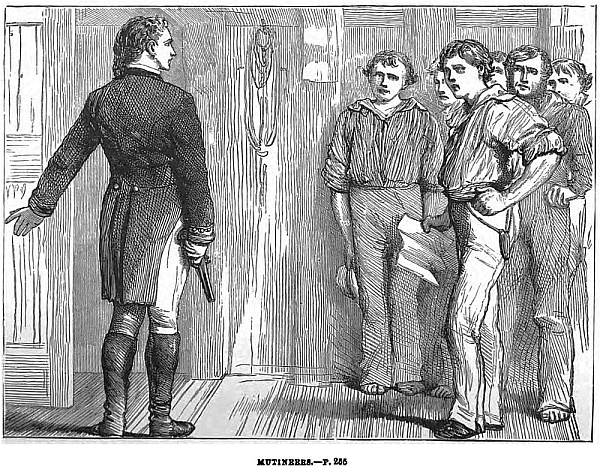
On this, further meetings were held on board the ships, at which Harry was compelled by Parker to attend as his secretary. One day, in the presence of Tuttle and several other seamen, Harry expostulated, telling Parker that he did not approve of holding out after so many concessions had been made.
“The first man who disobeys my orders will have a bullet sent through his head,” exclaimed Parker, drawing a pistol. “Disobey me at your peril, Andrew Brown,” he continued, levelling the weapon.
Harry stood firm. A murmur of disapprobation broke out among the men.
“I don’t care whether you agree or disagree, but I ask you again, Brown, whether you will attend me as I order you or not?”
“I will attend you if you force me, but again protest against your proceedings.”
“Come into the cabin then,” exclaimed Parker, fiercely, “and do as I order you.”
Harry was compelled to obey.
The delegates having assembled, a fierce discussion took place as to their future proceedings. Some were for yielding: others, led by Parker, determined to hold out; while a considerable number proposed, in case their demands were still refused, to carry the fleet over to a French port. This traitorous proposition was happily over-ruled by the majority—indeed, many thought that if it was proposed to the men, they themselves would refuse to obey. Finally it was determined to hold out, in the hope of compelling the Government to yield. One of the means taken by the mutineers was to blockade the Thames, and several ships were moored across the river, to prevent a free passage up to London or down. In order to concentrate their force also, the fleet which lay at Sheerness was compelled to drop down to the Great Nore. The line-of-battle ships were then drawn up in a line, about half a mile from each other, with their broadsides abreast. In the space between the line-of-battle ships, the merchantmen and other vessels which had been detained were moored. As all communication was stopped with the shore, the mutineers supplied themselves with water and provisions from these vessels.
All this time, strange as it may seem, the behaviour of the seamen towards their officers, with a few exceptions, was perfectly respectful.
One, however, was tarred and feathered. Two midshipmen were ducked, and some few officers who were especially obnoxious to the mutineers were sent on shore. Four seamen also were severely flogged for speaking disrespectfully of the delegates.
Chapter Twenty.
The Mutiny Quelled.
The report of the commencement of the mutiny at Spithead had caused great alarm among the merchants in London, as well as throughout the country. This second, and far more serious, outbreak at the Nore made many dread the very worst results. The courage and determination exhibited by the King and others in authority soon restored confidence, and active measures were taken to compel the rebellious crews to submit. The shores on each side of the river were lined with batteries, the forts at Tilbury and Sheerness and Gravesend were furnished with furnaces for red-hot shot. The buoys at the Nore and along the coast were taken up, so that the ships would have had considerable difficulty in getting away. Many, indeed, would probably have been stranded in the attempt.
Off Woolwich lay the “Neptune,” a 98-gun Ship, which was manned by volunteers raised by the subscriptions of the merchants of London. A little lower down was the “Lancaster,” 64, whose crew had returned to their duty; as also the “Agincourt,” with several gunboats. A number of merchant vessels were also fitted up as gunboats, and manned by volunteer crews. These were placed under the command of Sir Erasmus Gower, as Commodore, and ordered to drop down the river, and to proceed forthwith to attack the rebels.
We must now return on board the “Sandwich.” Parker, who had assumed the title of Admiral, was still implicitly obeyed by the crews of most of the ships. Notice was brought to him, however, that a few were showing signs of disaffection. This, possibly, might have made him tremble for the stability of his power, and he resolved to collect all the ships he had reason to suspect closer round him. In shore lay two ships at this time: the “Clyde,” commanded by Captain Cunningham, and the “Saint Fiorenzo,” commanded by Sir Harry Burrard Neale.
The “Saint Fiorenzo” had sent delegates to the fleet, but they had from the first voted for moderate measures. Accordingly, Parker sent an order to the two ships to come in and anchor close to the “Sandwich.” Not long afterwards they were seen to get under weigh.
One of them, however, the “Saint Fiorenzo,” soon afterwards brought up again; and the other, instead of obeying Parker’s orders, stood up the river towards Sheerness. Parker, in a great rage, ordered a body of delegates to go on board the “Saint Fiorenzo,” and to bring her in and place her between the “Inflexible” and “Director,” when her sails were to be unbent, and her gunpowder sent on board the “Sandwich.” The delegates, on going on board the “Saint Fiorenzo,” abused her crew for allowing the “Clyde” to escape them without firing into her, and threatened them with the vengeance of Admiral Parker, if they did not obey his orders. In spite of the threatening aspect of the “Saint Fiorenzo’s” crew, her delegates expressed their readiness to comply, and at length the mutineers took their departure. A short time afterwards the “Saint Fiorenzo” was seen to get under weigh, and to stand out under all sail towards the fleet. On she came till she got in between the two line-of-battle ships. By the orders of Parker, who seems to have suspected her intentions, the crews of the different ships stood at their guns, which were double-shotted, with the lanyards in their hands, ready to sink her. Her crew had been made aware of this by the delegates. Suddenly all her sheets were let fly, her helm was put hard aport, and she shot ahead of the “Inflexible.” The moment afterwards her brave captain, Sir Harry Burrard Neale, sprang on deck, crying out, “Well done, my lads!” A loud shout rose from the deck of the “Saint Fiorenzo.” On seeing this, Parker ran up the signal to fire, the “Sandwich” herself setting the example; and immediately the whole fleet of thirty-two sail began blazing away at the “Saint Fiorenzo.” The shot fell as thick as hail round her. Still she stood on, though of course without returning the fire. There was a strong breeze, and she was a fast ship. Though so many guns were firing at her, and she was frequently hulled, not a rope was shot away, nor was a single man killed, or even hurt.
On she stood, and not till she had got to some distance did Parker think of ordering any ship to pursue her. He walked the deck for some minutes in a state of agitation. He was afraid of getting under weigh himself, lest during his absence other ships might desert. He possibly thought it very likely that if he ordered any other ship to pursue, her crew might refuse to return. The seamen formed their own opinions on this transaction, and came to the conclusion that there was not that unanimity in the counsels of their leaders, which they boasted of possessing. Even now they desired to evince their loyalty, and on the 4th of June, which was his Majesty’s birthday, the whole fleet fired a royal salute, and dressed the ships with flags as usual. The red flag was, however, kept flying at the maintopmast head of the “Sandwich.”
One of the captains most beloved by the seamen was the Earl of Northesk, commanding the “Monmouth,” a 64-gun ship. The mutineers having their confidence somewhat shaken, determined to request him to try and effect a reconciliation with the Government. The delegates went on board the “Monmouth,” and invited him to meet the mutineer committee on board the “Sandwich.” His lordship accordingly went on board, attended by one officer, and found sixty delegates seated in the state cabin, with Parker at their head. He undertook to carry up their terms to the Government, pledging his honour to return on board, with a clear and positive answer, within fifty-four hours. He told them, however, that from the unreasonableness of their demands, they must not expect success. He immediately proceeded to London, where, after conferring with the Admiralty, he accompanied Earl Spencer to the King.
As might have been expected, the demands of the seamen were rejected as exorbitant and unreasonable. An officer immediately carried down the refusal of the Lords of the Admiralty to the rebel fleet. Soon after this was known, several ships attempted to make their escape from the mutineers. One, the “Leopard,” succeeded and got up the Thames. Another, the “Repulse,” unfortunately ran aground, when she was fired on by the “Monmouth;” and one of the officers lost his leg, and a seaman was wounded. The “Ardent,” the third ship, effected her escape, but passing the “Monmouth” was fired at, and several of her crew were killed and wounded. Confusion and discord now pervaded the rebel councils. On the 10th of June, many other mutinous ships struck the red flag, and the merchant vessels were allowed to proceed up the river. On the 12th, most of the other ships also hauled down the rebel flag, only seven keeping it flying. The next day the remainder intimated an inclination to submit. However, the crews in all cases were not unanimous, and many desperate struggles took place on board the ships between the partisans of the officers and those who still wished to hold out. Happily at this juncture of affairs an officer arrived on board the “Sandwich,” with the King’s proclamations and Acts of Parliament, of which it appeared that Parker had kept the crews ignorant.
The deception which had been practised on the men by the delegates so enraged them, that the crew of the “Sandwich” carried the ship under the guns of the fort of Sheerness. As soon as she anchored, a boat with a guard of soldiers came off, and making their way on deck, ordered Parker to deliver himself up. As they appeared, one of the delegates belonging to the “Standard,” who was on board, pointing a pistol at his own head, shot himself dead. Parker, as soon as he heard that a boat had come off, placed himself under the protection of four of the ship’s crew, the rest of the seamen threatening forthwith to hang him. He and about thirty more delegates were immediately handed over to the soldiers, and they were landed amidst the hisses of the surrounding multitude, and committed to the prison in the garrison of Sheerness. The first batch of mutineers having been so easily captured, the rest of the ringleaders, and all others in any way implicated in the mutiny on board the various ships, were immediately placed under arrest. In the list of the unhappy men to be tried for their lives was the name of Andrew Brown.
Poor Harry! he felt grievously his position. He had protested against the proceedings of the mutineers, but how could he prove this? He could not deny that he had written out a number of documents issued by Parker, and the excuse that he had done so under compulsion was too commonly made by others to allow him to have much hope of its being believed in his case. Up the Thames was the prison ship. Here Harry, with a number of mutineers, was conveyed. Many of his companions were desperate characters, who seemed only to dread the punishment they might receive. He felt that unless he could be proved innocent, death was the only alternative he could desire. Yet it was hard to die. He had looked forward to a life of happiness with one to whom his undivided heart was given; one well worthy of the affections of the best of men. His honour was gone. His name, if it was known, would be blasted, and he must die the death of the worst of criminals. One gleam of hope alone remained. As he was led off by the soldiers sent to apprehend the mutineers, Jacob Tuttle had shaken his hand, and though he did not speak, had given him a significant look, which had evidently been intended to keep up his spirits. Happily Tuttle had taken no part in the mutiny, and had been among the first to urge his shipmates to return to their duty. Still how could an illiterate seaman, unable even to write, be able to help him?
The trial of Richard Parker very soon after this took place on board the “Neptune,” of 98 guns, off Greenhithe, a few days having been allowed him to prepare for his defence. No trial could have been more fair or just. Parker defended himself with considerable ability. Nothing, however, could be stronger than the evidence brought to prove that he was one of the chief instigators of the mutiny, and that he had acted as the chief of the mutineers. The court accordingly adjudged him to death. Parker heard his sentence with a degree of fortitude and composure which excited the astonishment of all present. He submitted, he said, still asserting the rectitude of his intention.
“Whatever offences may have been committed,” he added, “I hope my life will be the only sacrifice. Pardon, I beseech you, the other men. I know that they will return with alacrity to their duty.”
On the 29th of June, Parker was conveyed on board the “Sandwich,” the ship on board which he had acted so prominent a part. On being conducted to the quarter-deck, the chaplain informed him that he had selected two psalms appropriate to his situation. Parker assenting, said, “And with your permission, sir, I will add a third,” and named Psalm thirty-one. Prayers being ended, he arose from his knees and asked the captain if he might be indulged with a glass of white wine. On its being presented to him, he exclaimed, lifting up his eyes, “I drink, first, to the salvation of my soul; and next, to the forgiveness of all my enemies.” He then begged that Captain Moss would shake hands with him. This the captain did. He then desired that he might be remembered to his companions on board the “Neptune,” with his last dying entreaty to them to prepare for their destiny and to refrain from unbecoming levity. On being led to the scaffold on the forecastle, he asked whether he might be allowed to speak.
“I am not going to address the ship’s company,” he added; “I only wish to acknowledge the justice of the sentence under which I suffer, and to pray that my death may be considered a sufficient atonement for the lives of others.”
Turning round, he then asked if any person would lend him a white handkerchief. This, after a little delay, was handed to him. He then begged that a minute might be allowed him to recollect himself, when he kneeled down about that space of time. Then rising up, he said, with considerable dignity, and perfect coolness, “I am ready,” and firmly walked to the extremity of the scaffold. For an instant he stood there, full of life and strength, with a head to plan, and nerve to carry out his objects. He dropped his handkerchief, the gun was fired, and he was run up to the yard-arm. A struggle, and he was dead.
For more than a month the court-martial continued sitting and trying the other mutineers. A considerable number received sentence of death; among them was Andrew Brown. Several were ordered to be flogged from ship to ship, and others were confined in the Marshalsea prison for certain periods.
Parker’s was the first death, but many of the other ringleaders were directly afterwards executed at the yard-arms of their respective ships. The prisoners were tried in succession, and the sentence was forthwith carried out on those who were condemned to death. Harry fully expected ere long to be called forth to undergo his sentence, and he came to the resolution of not attempting any effort to escape his doom.
Chapter Twenty One.
Mabel’s Resolve.
Mabel and her aunt had taken up their residence for some time at the small bow-windowed house in the upper part of the town of Lynderton. It had been described as a very genteel residence for a spinster lady. To say that it had neat wooden railings before it, and steps leading up to the front door, kept scrupulously clean, will be sufficient to give an idea of Mabel’s new abode. The style of life the two ladies led was very different to what they had been accustomed to. Mary remained as general servant, while the cook, who had grown fat and aged at Stanmore, entreated that she might accompany her old mistress. Paul Gauntlett declared that the day he should be separated from them would be his last. So he also was allowed to take up his abode in the bow-windowed house, though his accommodation was limited in the extreme. All he wanted was house-room. Wages he would not receive, and he had been too long accustomed to forage for himself to require being fed. It cannot be said that the family were reduced to complete poverty, still their means were very scanty. Mabel had literally nothing, but an annuity had been secured to Madam Everard on the Stanmore estates, which Mr Sleech could not touch, though he did his best to make it as small as possible by putting her to considerable expense before she could obtain it.
Strange to say, when Mabel heard that her father and Harry were still alive, her regret for her loss of property was greater than it had been previously. She had formed all sorts of plans for her future career. As long as her aunt lived, she would attend to her. When she was called away she would go out and teach, or enter some family as a governess. Now, however, the case was altered. Her father would never consent to her doing that, while she could no longer hope, as she had hoped, to become the well-dowered wife of Harry Tryon. She loved him—that she knew. Would he continue to love her? She had no doubt about that, but would he have the power of giving her a home? Would he be able to return to the position he had abandoned in Mr Coppinger’s counting-house, and, with the assistance of his guardian, labour till he had gained an independence? She thought Harry would be capable of anything. Her father would, at all events, be ready to help him by every means in his power. He surely could refuse nothing to the man who had saved his life so bravely at the risk of his own. Her father had always been looked upon as a man of great influence. It did not occur to her that this arose from his being supposed to be the heir of Stanmore—the owner of the borough, who could return two members at his will. Poor girl! Captain Everard as he had been, and Captain Everard, though a very good officer, without a vote in Parliament, and with his pay only to support him, were very different persons.
The Everards had always been Tories. Mr Sleech supported the opposite party, and was now giving all his influence to the Whig interest.
The people in the neighbourhood, however, called very frequently at Madam Everard’s door to inquire after her. Among the few admitted was the Baron de Ruvigny. Each time he came he talked more and more of the Coppingers, and Mabel could not help discovering that he was completely captivated by the charms of Sybella Coppinger. He brought also all the news of the day. From Paul Gauntlett, however, who read the paper through, they learned chiefly the progress of the mutiny.
Mabel at length became very anxious about Harry. She did not know in what ship he was serving, and though she felt sure that he would not join the mutineers, she could not help dreading that he might be placed in danger in consequence of what was occurring. Her anxiety was increased by not hearing from him as she had expected. She was certain that he had not forgotten her. Her confidence, indeed, in his faith and love remained unshaken. At last Mary received a letter in an unknown hand. It was very unlike the one which Harry had written at Tuttle’s dictation, but this also professed to be from Jacob. It was short, for the writer was evidently not much accustomed to the use of the pen. It ran thus: “Dear Mary,—This comes to tell you that we’re in a mess. Some of our fellows have been holding out against the Government, and have got nothing for their pains. We have had a number of delegates going about from ship to ship, and they have been and got some of themselves hung, and not a few flogged round the fleet. Sarves them right, say I. I should not mind it, if it was not for a shipmate, you knows who, who has been put in limbo. His name abroad is Andrew Brown, but your young lady knows him, and knows that that is not his name. Worser still, he’s going to be hung. If I could get liberty, I’d go and see you and tell you all. It’s a sad thing, and I would give my eyes to save the young chap.—Yours to command, Jacob Tuttle—his cross X.”
Mary, who had not deciphered the letter very clearly, brought it to her mistress. As Mabel finished it, the paper fell from her hands. A deadly pallor overspread her countenance, and she fell back fainting into the arms of her attendant. Happily, Paul at that moment came into the sitting-room, and assisted the damsel in placing her mistress on a sofa. While Mary ran to get restoratives, and to call Madam Everard, his eye fell on the paper. Seeing the rough style of handwriting, he thought that he might with propriety read it over.
“That’s it,” he said to himself; “it’s that young gentleman, he’s gone and done something desperate. We must get him out of the scrape, or it will be the death of Miss Mabel.”
Mabel quickly returned to consciousness and found Paul and Mary standing near her. Madam Everard had gone out.
“I know all about it, Miss Mabel,” said Paul, “and I want to help you.”
“Do you think this can allude to Harry?” she asked; “I mean Mr Tryon.”
“Too likely,” said Paul; “I won’t deny it, because it’s clear to my mind that something must be done to save him. Cheer up, Miss Mabel. We will do it if it can be done. There’s that old gentleman who takes an interest in Master Harry—his guardian, you call him. I would go to him. He would be the best man to say what can be done, and I am sure he would do it.”
“Oh! that he would, for I am confident that Harry is innocent. He never would have done anything worthy of death. I will go up to the Admiralty and plead for him; I will tell them who he is. They would never allow him to be executed; or if they will not listen to me, I will go to the King himself. I will plead with his Majesty; he will surely have power to save him.”
Chapter Twenty Two.
Unexpected Evidence.
At an early hour of the day, towards the end of June, two persons on horseback might have been seen proceeding through the New Forest. The sun, just rising, cast his rays amid the boughs of the trees, throwing long shadows over the greensward. Here and there light-footed deer, cropping the dewy grass, started as they heard the footsteps of the horses, and went bounding away farther into the depths of the forest. One of the persons was a young lady mounted on a light, active palfrey; while the other, a tall old man, bestrode a large, strong steed, well capable of bearing his weight. A brace of formidable-looking pistols were stuck in his holsters, while another pair of smaller dimensions were placed in the belt he wore round his waist. In his hand he carried a thick stick, which might have proved no bad substitute for a broadsword.
“It was indeed thoughtful of you, Paul,” said the young lady, looking round at her companion, without in any way checking the rapid speed at which she was proceeding. “I little expected to mount Beauty again, and could not have accomplished our journey so well, I am sure, on any other horse.”
“Why, Miss Mabel, do you see, when we had to surrender Stanmore to Old Sleech, I thought to myself, neither he nor any of his young cubs shall ever mount the horse my dear young mistress has ridden; so as soon as it was dark one night, I trotted him off to my good friend Farmer Gilpin, and says I to the farmer, ‘You take care of this horse, and let no one have him till I come and fetch him away; he’s not stolen, and you need not be afraid of the halter. I will pay you for his keep when I fetch him away.’ Mr Sleech, cunning as he is, had not made a list of the horses, so did not miss Beauty; besides, she was yours, and not his, though he would have claimed her; and that’s the long and short of my story, Miss Mabel.”
“Thank you, thank you, indeed,” answered Mabel. “Do you think Beauty will get through the journey in a couple of days?”
“I am afraid not, Miss Mabel,” answered Paul. “I would advise you to sleep twice on the road, and then you will get in fresh the third day, and be able at once to go to Mr Thornborough’s. He was a friend of the colonel, I know, and from what you tell me, I am sure he will give you as much assistance as anybody.”
Madame Everard, when she heard the dangerous situation in which Harry Tryon was placed, could not bring herself to refuse Mabel’s wish to set off immediately to try what could be done to assist him. She, however, had advised her going at once to her godfather, Mr Thornborough, who, being a man of influence, and possessing great knowledge of the world, was able to render her more help than Mr Kyffin could. She had, however, wisely written to Harry’s guardian, telling him what she knew, and also her purpose of going to the house of Mr Thornborough. She was too anxious to speak much during her ride.
From the rapid rate at which she proceeded it was evident that she knew the road thoroughly, as she had never even to ask her companion which way to take. The two travellers had nearly reached the confines of the forest, when suddenly she came upon a large party of men, surrounding several light waggons. They were sitting on the ground with bottles and provisions near them, while their horses stood tethered at green spots close at hand.
On being suddenly surprised by Mabel and old Paul, several of them started up and seized their bridles. Paul’s stick was instantly raised in the air, as if about to come down on the heads of his assailants.
“Avast there, mate!” sung out one of the men, “we’re not going to ill-treat you if you behave peaceably, but we want to know where you and the young lady are going.”
“Oh, pray let us go!” exclaimed Mabel; “we are simply going to London on a matter of great importance, and whoever you are we cannot do you any harm.”
“Well, young lady, that may be true enough,” answered one of the men; “but you must just come and have a word with our captain. If he has no objection, we don’t want to keep you.”
“Pray let him come and see us immediately,” said Mabel; “we are anxious to be liberated without delay.”
The men, without heeding her request, led her horse and that of Paul a little distance on one side, where, seated on the grass, enjoying a long pipe, with a book at his elbow, and a cup of coffee before him, was a person whose appearance betokened nothing of the smuggler or brigand. As soon as he saw Mabel he started up, and inquired if he could be of any service to her. She told him of the interruption she and her attendant had received, and begged that she might be no longer detained. “Yes, sir, I say it’s a great shame, and times are very bad when a young lady like Miss Everard, with her attendant, cannot ride through the forest without being stopped by a gang of smugglers.”
“Miss Everard, I beg you many pardons,” exclaimed the smuggler captain. “My scoundrels are unable to distinguish one person from another. If you will allow me I will accompany you some way on your road, so that I may protect you from any similar annoyances.”
Saying this the captain sent for his horse, which he immediately mounted, and rode alongside Mabel through the remainder of the forest.
“I must ask your confidence, Miss Everard,” he said; “I am an especial friend of your father’s. Indeed, I owe my life to his courage and gallantry, and I shall be thankful of an opportunity to render you any service in my power.”
“I know, sir, what you say is true,” observed Paul, glancing at the stranger. “I remember your coming to Stanmore that sad night, when Miss Lucy was taken ill, and I was close by when Captain Everard and you were speaking together. Are you not Captain Rochard?”
“You are right, my friend,” said the stranger. “By that name Captain Everard knew me. Necessity, and not my will, compels me to associate with these people,” he continued; “not for the sake of making money, but for another motive, believe me. You do not suppose that your father would allow me his friendship did he believe that I was the leader of a band of outlaws. I may some day tell you my motives of associating with these men. To your father I owe my life, and that alone would make me take an interest in you, young lady; but I may also tell you that I have another reason. We are related, although not very nearly. Your father’s mother was a relation of my father. I never saw her, for she died when I was very young; indeed, I am but a few years older than your father.”
“You related to us? You know then the facts of the marriage of my grandfather to my grandmother. How little did I expect to hear this. You may be of the very greatest assistance to us.”
Captain Rochard assured Mabel that it would be a great satisfaction to him to be so. She then told him of the loss of the certificate, and the successful scheme which their relative Mr Sleech had set up for obtaining possession of the property.
“For my own sake,” she observed, “I care little for what has occurred; but it will be a bitter thing for my father when he returns to find that he has been deprived of the property he thought his own.”
Captain Rochard was silent for some minutes; then turning to Paul, he asked suddenly—
“Do you know in what year the colonel’s brother married?”
“Yes, sir, I mind it well; it was the beginning of the war with France, and much about the time that Frederick of Prussia opened his seven years’ war, and Admiral Byng did not beat the French in the first action, and was shot in consequence. A difficult job Lieutenant Everard had, too, to bring home his young baby, and escape the French cruisers. I mind his coming home as well as if it had been yesterday, and Madam Everard taking care of the little motherless boy, that’s the captain now—this young lady’s father—as if he had been her own child, and the poor lieutenant going to sea, and getting shot the next year. He died as a brave officer might wish to die, on the deck of his ship, lashing the enemy’s bowsprit to his own mainmast, that she might not get away—”
“But I forget dates; in what year was that?” asked Captain Rochard, interrupting the old man, who might otherwise have run on to a much further length in his recollections.
“That was in the year ’56 or ’57 to the best of my mind,” answered Paul. “The captain’s a little above forty, and it’s about that time ago.”
“Thank you, my friend,” said Captain Rochard; “I shall remember the dates, and will put them down by-and-by. Your grandfather, I believe,” he continued, addressing Mabel, “married in the south of France, where my relatives were residing at the time. Alas! this fearful revolution has swept off many of them; but still some few, especially among the older ones, survive. The young, and strong, and healthy were the chief victims. I’ll say no more. I’ll do my best to aid your father, and enable him to recover his rights. I wish that he was in England at present, that I might consult with him first. I am quite willing, at all risks, to go over to France, and to endeavour to bring over the witnesses to the marriage, or the documents which may prove it.”
Mabel expressed her thanks to Captain Rochard, who now inquired what business took her to London. She hesitated for some time. At last she thought, “He’s true and kind, and though he may not be able to assist me, I shall have his sympathy and good wishes.” She then told him frankly of the dangerous position in which Harry Tryon was placed, of course asserting her belief in his innocence.
“That fine young fellow? I know him well,” said the captain. “I am sure he would not commit an unworthy action. I have more power to help him than you may suppose. Give me all the particulars with which you are acquainted, and I will try what can be done. Do you, however, proceed in your undertaking; I have great hopes that your efforts will not be without a happy result. That boy must not be put to death. I would go through anything to save him.”
By this time they had reached the confines of the forest. Captain Rochard said he must go back to his companions. He bade Mabel a kind farewell, when she and Paul continued their journey towards London. Beauty seemed to understand that he was on an important journey, for never had he trotted so swiftly over the ground. Mabel knew the importance of reserving his strength too much to allow him to break into a canter, or to push him on in a gallop, though her own feelings might have prompted her to do so. It was absolutely necessary during the heat of the day to rest. A small inn appeared close to the road. Mabel threw herself down on a little sofa in the room appropriated to her, at the door of which Paul kept ward and watch till it was time again to start. The horses, well groomed and fed, were then led forth, looking almost as fresh as when they started in the morning. Thus, before nightfall a large portion of the distance to London had been accomplished.
Chapter Twenty Three.
In Mr Coppinger’s Counting-House.
Mr Stephen Coppinger had been for some time in town, leaving his family at Lynderton. It was not a time when a mercantile man could neglect his business. There was a great deal to do, for confidence had been restored in the mercantile world after the mutiny of the fleet had been completely put down.
Silas Sleech was at his desk, and, like the rest of his companions, busily employed.
Mr Kyffin did his best to attend to business, but his mind was greatly disturbed. He could gain no tidings of his ward. All he could learn was that he had left the ship in which he had returned to England, and had gone on board another man-of-war. Too probably she was one of the mutinous fleet. Mr Kyffin heard of many men losing their lives in the scuffles which ensued on board the ships when the loyal part of the crew were struggling to restore the power into the hands of their officers. Too probably Harry, on one side or the other—he hoped on the loyal side—might have lost his life in one of these scuffles. He was sure otherwise that the lad would have written to him. One letter might possibly have miscarried, but he would not have gone so long without writing a second or a third time. He was instituting, in the meantime, all the inquiries in his power, but he could not hear the name of Harry Tryon on board any of the ships. He was not aware, of course, that Harry had changed his name, nor that it was a common custom with seamen in those days to do so, for various reasons. Had he known of the existence of Jacob Tuttle he might have applied to him, and he therefore had not the same means of learning about him which Mabel possessed.
On the arrival of the post one morning at Idol Lane Mr Sleech received a letter from his “respected father.” The ordinary observer would have discovered nothing in the countenance of Silas to indicate its contents. He, however, folding it up, put it in his pocket, and forthwith betook himself to the door of Mr Coppinger’s private room, at which he humbly knocked. On being admitted, he explained to his principal that he had received notice of the illness of his father and one of his sisters, and that his presence, as the eldest son of the family, would be greatly required. He therefore entreated that Mr Coppinger would allow him to set forth without delay for Stanmore.
Mr Coppinger was a kind-hearted man, and would on no account detain him if Mr Kyffin could manage to have his duties performed during his absence.
Silas, thanking his principal, withdrew, and in a humble tone of voice entreated Mr Kyffin to make the necessary arrangements. The head clerk looked hard at Silas, who, though not easily abashed, let his eyes drop before him.
“Yes; if Mr Coppinger gives you leave, I will certainly not detain you,” answered Mr Kyffin.
Silas was in a great hurry to be off. Quickly putting the books at which he had been working in their places, he closed his desk and hurried out of the office. Mr Kyffin looked after him.
“So great a villain never darkened that door before,” he said to himself. “May it be the last time he ever passes through it!”
Under where Silas Sleech’s hat and cloak had hung Mr Kyffin saw a bunch of keys. He had evidently dropped them in his hurry to leave the house.
“I am the fittest person to take charge of these,” said Mr Kyffin to himself, and he forthwith retired with them into Mr Coppinger’s room. He there held a consultation of some length; then once more entering the office, he waited till the hour of closing. The clerks were dismissed. He and Mr Coppinger alone remained in the office. Mr Sleech’s desk was opened with one of the keys. Within was a strange assortment of articles, and among others a small iron box, with Mr Silas Sleech’s name painted outside. There were lottery tickets, and pawnbrokers’ duplicates, and packs of cards—some curiously marked—and dice which had a suspicious tendency to fall with the higher numbers uppermost, and letters from dames of scarcely doubtful character.
“I have suspected as much for long,” said Mr Kyffin, “but I could not well bring the proof home. This, however, will convince you that Silas Sleech is not a trustworthy person.”
“Indeed it does,” exclaimed Mr Coppinger; “but see what this strong box contains. Probably if he leaves such articles as this scattered about, without thinking it necessary to conceal them, the contents of that box are of a more damaging character.”
The box was opened by one of the keys of the bunch.
“Ah!” exclaimed Mr Kyffin, “here is a letter directed to me. It is the one I have long missed from my unfortunate young ward, Harry Tryon. Excuse me, sir, while I read its contents.”
Mr Kyffin ran his eye over the letter.
“The poor lad here gives an explanation of his conduct, and his reasons for quitting London. He weakly yielded to the temptation thrown in his way by Silas Sleech, that is very evident, but in no other respect do I believe that he was criminal. However, we will look over the remainder of these papers, and I trust then we shall have the means of exonerating him still further. What do you think of these papers?” asked Mr Kyffin, holding a sheet up to Mr Coppinger.
On it was written over and over again the name of the firm, as signed by Mr Coppinger himself. Evidently the writer had been endeavouring to imitate Mr Coppinger’s signature. He had done so very successfully. Indeed, another paper was found containing a signature which Mr Coppinger declared to be genuine. It was clearly the copy for the others.
“Now I feel sure,” said Mr Kyffin, “that Silas Sleech forged that paper which he wished it to be supposed Harry had forged, while it’s very possible that he may also have forged Harry’s signature to some of the bills which he showed us when he endeavoured to prove Harry’s guilt.”
“I indeed think your account very likely to be true,” said Mr Coppinger. “I am ashamed at having allowed such a scoundrel as Mr Sleech undoubtedly is, to have remained so long in my office undetected; yet so plausible are his manners, that had this evidence against him not been discovered, I should have been unwilling to believe him guilty.”
“You will not let him escape, surely, sir,” said Mr Kyffin; “justice demands that he should be brought to trial, so that the character of your nephew may be vindicated.”
The two gentlemen examined all the papers thoroughly, making notes of their contents, and then locked them carefully up in the safe in Mr Coppinger’s room. Mr Kyffin having accompanied Mr Coppinger to Broad Street, and supped with him, returned at night to the office, where he occasionally occupied a bedroom. He had been in bed for some time, though not asleep, thinking over Harry’s affairs, when he was aroused by a knocking at the door. He heard the porter go out of his room and admit some one. It immediately struck him that it was Silas Sleech; for as the porter knew nothing of his proceedings, he would naturally, without hesitation, admit him. Rapidly dressing, therefore, he struck a light, and putting the pistol, which he usually carried to and from Hampstead, in his pocket, he proceeded down-stairs. The person who had come in did not go to Mr Sleech’s room; but after a few minutes’ conversation entered the counting-house. Mr Kyffin heard him wish the porter good-night, and say that he should not be long.
“Call me at an early hour, there’s a good fellow, for I have to be off betimes,” he added.
Mr Kyffin waited a minute, and then proceeded down-stairs into the office. A light was burning on the desk. By it he saw Mr Sleech hunting about in all directions, evidently looking for his keys. The search was, of course, in vain. He seemed to think so, for producing a cold iron from his pocket, with as little noise as possible he wrenched open the desk. He seized the light and looked in. Dismay was depicted on his countenance. At that instant Mr Kyffin entered the room.
“Wretched scoundrel, confess your villainies!” he exclaimed. “Was it to betray an honest youth, and to blast his character through a miserable feeling of jealousy and revenge, that you pretended to be his friend? Confess what you have done, or prepare to be given over into the hands of justice.”
On hearing Mr Kyffin’s voice Silas dropped the lid of the desk, and slipping off his stool, went down on his knees, holding up his hands with a look of the most abject terror. “I did not intend to injure him, indeed I did not!” he exclaimed, in a whining voice.
“Oh! Mr Kyffin, you know how long I have toiled for the house, and how our employer’s interests were as dear to me as my own; then how can you accuse me of doing such things as you say I have done?”
“Don’t kneel to me,” answered Mr Kyffin, sternly; “don’t add additional falsehood to your other villainies. Expect no leniency from me. Of all bad characters, I hate a hypocrite the most. I will make no promise, but if you will confess in a court of justice what you have done, I may possibly endeavour to have your punishment mitigated, and no other promise can I make.”
“I will do all you ask, indeed I will,” answered Silas, “only don’t look so fierce; don’t shoot me,” he exclaimed, looking at the pistol which, unconsciously, Mr Kyffin had taken from his pocket.
“I have no intention of shooting you, but again say I will make no promises. Mr Coppinger will decide what is to be done with the man who has robbed him, and so cruelly treated his nephew.”
Saying this, Mr Kyffin returned the pistol to his pocket. The round eyes of Silas had been watching him all the time. He now hung down his head as if ashamed to meet Mr Kyffin’s glance. His eye, however, was glancing upward all the time. Suddenly he made a spring, and rushed towards Mr Kyffin.
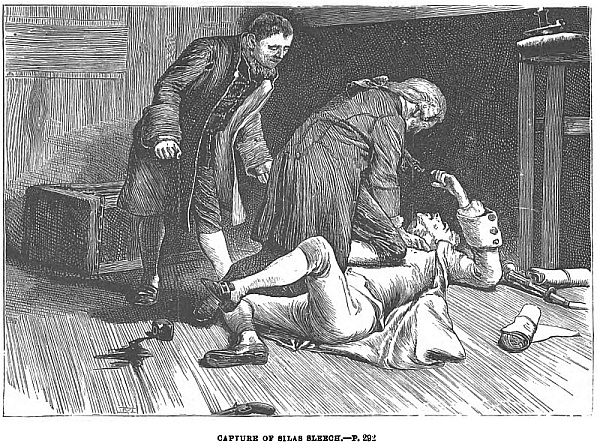
“I will have my revenge!” he exclaimed, grappling with him.
Mr Kyffin, though advanced in life, was as active as ever. His muscles and nerves had never been unstrung by dissipation, as were those of Silas, who found that he had met almost his match. The young man, however, struggled desperately, as a fierce desire seized him to destroy his opponent. He felt for the pistol in his pocket. With insane satisfaction he grasped it, and was drawing it forth, with a determination of shooting the owner, when he found his arm seized, and directly afterwards he lay on the ground with the sturdy porter and Mr Kyffin standing over him.
Chapter Twenty Four.
A Ball at Stanmore, and what took Place at it.
Mr Sleech and his family were enjoying their possession of Stanmore. He had begun to cut down the trees which he and his son had marked, and as many of them were very fine and old, he was delighted to find that they would fetch the full amount he had anticipated. This encouraged him to proceed further.
“I have often heard that trees about houses are not wholesome,” he observed. “The more space we can clear away the better, and really a five-pound note to my mind is better than an old tree, with its boughs spreading far and wide over the ground, and shutting out the sunlight. Nothing will grow under old trees except fungi, and the ground may be much better occupied.”
A sufficient time had now elapsed, in the opinion of Mr Sleech, since the death of Colonel Everard, his predecessor, to allow him to give a party at Stanmore without impropriety. The Misses Sleech were busily employed in sending out invitations. They asked everybody, whether they had called or not. “The chances are they will come,” they observed, “and it will not do to be too particular.” They were rather surprised to find that several of the principal families in the neighbourhood declined. However, their rooms were sure to be filled, there was no doubt of that. The foreign officers had no scruple about coming, and at a distance there were several families with whom Mr Sleech was more or less acquainted, who would be glad to accept the invitation. Miss Sleech, Miss Anna Maria Sleech, and Miss Martha, who were out, were very anxious to have their brother Silas. They agreed to write to get him down. They could not ask Mr Coppinger to allow him to come merely for the sake of a ball; they therefore begged their father from his fertile brain to invent an excuse, which that gentleman had no scruple whatever in doing. The result of that letter has been seen. At the hour he was expected to arrive, the carriage was sent over to meet the coach, but neither in the inside nor on the out was Silas Sleech to be seen.
“Of course he will come to-morrow in plenty of time for the ball,” observed his sisters, consoling themselves. Old Mr Sleech, however, wanted his son’s advice and assistance.
The morning before the intended fête, when workmen were busy in different parts of the house preparing the rooms, placing tents outside the windows, and arranging flowers and taking up the carpets, a carriage drove up to the door. A gentleman stepped out of it in a naval undress. He looked about him with an air of mute astonishment.
“Who is here? what is taking place?” he asked of the servant who opened the door.
“Why, we are going to have a ball to-night,” was the answer. “Who do you want to see?”
“A ball!” exclaimed the stranger. “My aunt and daughter giving a ball! Has Colonel Everard so completely recovered?”
“Why, bless you, Colonel Everard has been dead ever so long, and the Misses Everard are not in the house. My master is Mr Sleech, the owner of Stanmore. If you want to see him I will take in your name.”
“Are you mocking me, man?” exclaimed the stranger. “Where are Madam and Miss Everard?”
“Why, I rather fancy they have gone to live in the town since they were turned out of this,” answered the man, with an impudent look.
“Let me see Mr Sleech immediately, then,” said the stranger, entering the house. “I must learn clearly what has taken place without delay. Where is Mr Sleech?”
“Who wants me?” asked a voice from the study, the door of which faced the entrance. The stranger, advancing with rapid step, entered the room.
“I am Captain Everard, sir,” he said, facing Mr Sleech, who had risen from his chair with a newspaper in his hand. “Let me know, I entreat you, by what means you have come into possession of Stanmore, and tell me did I hear rightly that my uncle is dead?”