WHG Kingston (continued 3)
Reading edition
“When I was young I should not have been contented with what now pleases me. Harry will soon have had enough of this sort of life, and then will take to more useful pastimes.”
“Come, Harry, let’s be off,” said Mr Sleech, taking him by the arm.
Harry did not resist. Mr Sleech gave him a capital dinner at the “Blue Posts,” and looked in afterwards at the “Pearl Drinkers’ Club.”
“Come now,” he said, “we will steer for the ‘Saracen’s Head,’ Gerard Street, Soho. I will introduce you there to some liberal-minded men, who will make you open your eyes a little.”
Mr Sleech was a rapid walker, and they quickly got over the ground. Giving his name, they were admitted into a large room, already full of persons. A considerable number were young men, but there were some already advanced in life. In address and appearance the greater number had imitated the French Republicans, while all, as a sign of their liberality, kept on their hats. A young man was on his legs, his hair escaping from under his hat, hanging over his shoulders. His eyes rolled wildly, while he flung his arms about in every direction, every now and then bringing his doubled fist down upon the palm of his other hand. His oratory was fluent and bold.
“The past must be buried in oblivion!” he exclaimed. “We dare not look at it. A hideous system of the domination of one class over the souls and minds and bodies of the vast majority. A new era must be organised, but before a better system can be raised up, the ancient must be levelled with the dust. On a new foundation—the whole of the people—we must build up a glorious temple, a superb superstructure, in which people of all nations, united in the bonds of fraternity, must come and worship together the great Goddess of Reason.”
Chapter Twelve.
In Dangerous Company.
Harry’s visit to the Jacobin Club was several times repeated. He met there more than one man of note. The members were, however, chiefly those who, carried away by their ardent love of freedom, which in France had degenerated into unbridled licence, and their hatred of tyranny, failed to perceive the happy mean where a settled government and just laws exist.
It would have been surprising had Harry not felt somewhat of the enthusiasm of the speakers. Silas Sleech only once or twice took a part in the debates, and on these occasions he advocated the most extreme measures; and although the assassination of the King of England was not mentioned, the regicides of the first Charles were lauded to the skies, as among the truest patriots of which history makes note.
“I wonder what your old mentor would say, if he heard of your attending our meetings,” said Sleech, as they were walking home. “However, it’s your own fault if he finds out. To-morrow we’ll play a different sort of game. I am sadly in want of a few hundred pounds, and I have an idea that I shall get them; if you will stand by me, Harry, I will explain matters you by-and-bye.”
The next evening Silas led Harry to one of the haunts which they had of late frequented. They entered in the same cautious way as before. At that time the police were actively engaged in endeavouring to destroy the numerous gambling-houses, not improperly known as hells, in London. Harry knew very well that he had no business to be there, and nearly every day he persuaded himself that he would refuse to go again; but as the evening came round, the tempter’s persuasion overcame his scruples. On this occasion a considerable number of well-dressed men were present, many of them evidently men of rank and position. If they went, why should not he? He had hitherto been wonderfully successful, and he had made up his mind not to stake more than he had won. There was an abundance of sparkling wine and other refreshments on the sideboard. The room also was brilliantly lighted with wax candles, and Harry felt himself in remarkably good spirits. Silas was already playing, and placing somewhat heavy stakes on the table. Harry approached him, and followed the example of his friend. Fortune seemed to have turned against him. He lost stake after stake. Still Silas signed to him to go on; a strange infatuation seized him. He lost still more. Suddenly he looked up, when he saw the countenance of young Gilby, who was watching him narrowly. The young man came round to him, and placed his hand on his shoulder.
”‘Still waters run deep,’ old boy. I thought so,” he whispered. “I am glad to see you are not such a muff as I took you for. I don’t know what our friends in Broad Street would say to you, if they saw you here. However, mum’s the word with me. Go on and prosper.”
Harry felt himself abashed. He could make no reply.
“If one or two hundred pounds are of any use to you, you are welcome to them, young one,” said Gilby, in a tone which he intended to be good-natured.
“No, thank you,” said Harry; “I don’t intend to lose more than my purse can bear.”
“Oh, oh! the young one has a touch of pride about him!” Gilby whispered, loud enough, however, for Harry to hear him.
Harry drew out his last five guineas. He staked them and lost. Sleech came up to him, and put a roll of gold into his hand.
“You can pay me at your convenience. Don’t stop now, or it would ruin all.”
Harry fully believed that he should recover his loss. One hundred, two hundred pounds soon went. Again Sleech was by his side, and repeated his offer.
“Nonsense; I will take no refusal.”
Harry took the gold and lost it. He retained his countenance wonderfully. Gilby smiled.
“You had better borrow of me,” he whispered.
“No, thank you; my friend has my purse,” answered Harry, with a certain amount of prevarication.
It was getting late. Harry lost still more. Sleech poured out a tumbler of wine, which Harry tossed off. Silas led him away to a desk in a recess.
“Here,” he said, “between friends we do not want acknowledgment, but business is business.”
Harry signed the paper put before him.
“You need not be afraid of being cross-questioned, Harry,” observed Silas, as they walked home. “It is a comfort to think that your straight-laced guardian is safe across the seas in old Ireland. I am afraid you would think I was talking blasphemy, if I was to pray that he might never come back again, always provided he has left you his heir, which I have an idea he intends to do. In that case, my boy, we each should benefit. You would get his fortune, and I should step into his shoes.”
“Don’t talk so, Sleech,” said Harry. “He’s the best friend I ever had, and I don’t expect to get another like him; and as to his fortune, I pray that he may live to a green old age, and enjoy it himself. I only hope you were joking.” And Harry felt himself getting angry, not the less so that he could not help secretly acknowledging that he had been led by the nose by such an arch-hypocrite as Sleech.
“Of course, of course, I was joking,” said that individual, in the bland tone he could so well assume. “There’s no man I esteem more than our managing clerk, Mr Kyffin, and I admire you for your affection for him, only I don’t think he would be quite satisfied if he knew the way you spend your spare hours.”
Some important business with regard to a heavy mortgage on an estate had taken Mr Kyffin to Ireland; and from the state of the country and other circumstances it seemed probable that he might be detained there for a considerable time. He little thought how serious an influence his absence would have in the destiny of the youth in whose welfare he was so deeply interested.
Not till the next morning did Harry reflect how completely he had put himself in Mr Sleech’s power. He was to dine that day at his uncle’s. He was far from happy; he felt ill; he looked pale. It was not surprising, for he had had but little sleep. His cousins rallied him.
“A London life does not seem to suit you,” said Mr Coppinger. “You stick closely to business, and I am pleased with your diligence. If you apply to me I will allow you a few days’ run down to Hampshire.”
Harry thanked his uncle. After dinner Mr Gilby left the table before the rest of the gentlemen. Harry followed some little time afterwards. When he got into the drawing-room he found Mr Gilby stationed before the young ladies, talking eagerly. Looking up, they saw him. They were silent. Harry heard his own name mentioned.
“I could not help it,” exclaimed Gilby, as he approached. “I have been telling them what a deep fellow you are, Tryon. Why, there’s not a more rollicking blade about town, I suspect, if we come to follow you into all your haunts. I have met you two or three times when you did not see me. Ah! ah! old boy. Well, don’t blush and be ashamed; I don’t set up to be straight-laced. I am not a punctual man of business, no prim knight in buckram.”
Harry felt very much annoyed, but he restrained his temper.
“Mr Gilby is making merry at my expense,” he remarked. “However, he is welcome to do so. I can only say that I wish I had never been to some of the places he speaks of. Until one has been to a place, one cannot tell that it is objectionable.”
Harry was beginning to practise some of the lessons in hypocrisy which he had learned from Silas Sleech. He was very uncomfortable all the rest of the evening. Gilby’s mocking eye constantly fell on him, and he fancied that even his cousins regarded him with looks of suspicion. He returned home. Silas Sleech was sitting up for him.
“I am glad you have come at last,” he said. “I have been fearfully troubled by a business of great importance, and I really do not know how to settle it. You can help me. Indeed, I rather think that you are bound to do so. I handed over to you a pretty large sum last night. I little thought that not twenty-four hours would pass before I myself should be in want of it.”
Sleech dropped his voice.
“Harry, you are a good, honest fellow. I must take you into my confidence. Don’t be horrified—I’m an utterly ruined man.”
“I’m sorry to hear it,” said Harry.
“There’s little use expressing sorrow unless you are disposed to help me. You can do it if you please, I can assure you. All I want you to do is to put your name to a few bits of paper and ask no questions. I know it’s like begging you to put unbounded confidence in me. Perhaps you will say I don’t deserve it, and yet I wish you knew my heart, Harry, how anxious I am to serve you.”
Several decanters stood on the table before Mr Sleech. Harry had already taken a good deal of wine at his uncle’s. Sleech urged him to take more. The weather was hot. He felt thirsty. Those were drinking days, the virtue of temperance was seldom inculcated. On the contrary, the more a man could drink, the better he was thought of by his ordinary companions. Sleech smiled as he saw Harry toss off tumbler after tumbler of wine. It was cool claret, and tasted like water. The tempter had now his victim more than ever in his hands. The papers were brought out. Harry put his name to several.
“I wish you could write old Kyffin’s name as well as you do your own,” observed Sleech, “or your uncle’s. I say, Harry, why were you not called Stephen Coppinger? Your grandmother’s name was Coppinger, wasn’t it? In my opinion it’s a better name than Tryon. Better, at all events, on ’change—Tryon’s not worth much there, I have a notion, and Coppinger is worth whatever amount Stephen Coppinger chooses to put above it. Don’t trouble yourself about that amount you owe me—a few hundreds only. You forget all about it now, very likely. However, just let me get these papers in circulation, and I will never trouble you again about it.”
“Give it me,” said Harry; “I wish I had never signed it,” a sudden flash of sense coming across his mind.
“So ho! boy, be calm, my dear fellow,” answered Sleech. “You will find that you have got to deal with your master.”
Harry Tryon never knew what papers he signed that fatal night, nor what names he had written on them. He had a faint idea that he had moved his hand according to Sleech’s guidance.
The next day Mr Sleech declared himself indisposed, and told Harry he should not go out that evening. They were alone in the office. It was the business of Mr Sleech to see it closed. Harry’s head ached fearfully. He had never felt so depressed. Several bills had come in, and he had already spent every farthing of his salary for the quarter. Silas Sleech approached him.
“I rather think, Harry Tryon, this is the last day you will be at this office—that is to say, if you take my advice.”
“What do you mean?” asked Harry.
“Why just this, my dear fellow, listen to reason. There are certain papers to which you have put your hand. These will be brought before your uncle in the course of a day or two, and will be strong evidence against you, that you have aided in a serious fraud. You are in my debt for 500 pounds. I have your acknowledgment. You owe your tailor and other tradesmen no small amount. Now, you don’t know Mr Coppinger as I do. When he finds all this out, he will come down upon you with a severity to which you are little accustomed. I tell you, Harry, he would, without the slightest compunction, have you shut up in Newgate, and see you sent to the scaffold, even though you were his own son, instead of his grand-nephew. Thus you see your character is blasted, and all hopes of success in business cut off.”
Harry had sat with his hands clenched and his eyes fixed on Silas Sleech while he made these remarks.
“Sleech, you are a villain!” he exclaimed with vehemence; “a cunning, hypocritical scoundrel!”
“Very likely,” answered the other. “Go on, young one, what else am I?”
“You have deceived me, and led me into all sorts of vice,” cried Harry, clenching his fist.
“You are quite right. You followed my lead. I had an object, and I have succeeded. I wished to ruin you in our worthy principal’s estimation, and you’ll find by to-morrow that he looks upon you as a hopeless profligate. You have no longer any chance of supplanting me. As to Mr Kyffin, I rather think that he will consider himself mistaken with regard to you, and that you will no longer as of yore be precious in his sight. Thus you see, Harry, I have check-mated you completely.”
“You have shown me clearly that I am a fool, and that you are a consummate villain,” exclaimed Harry. “I will acknowledge my own fault and exhibit your knavery.”
“As you please,” said Sleech, in an unmoved tone. “You must remember that in acknowledging your own folly you run the certainty of being convicted of felony. I have no especial personal dislike to you, except that I have reason to believe you a rival in more cases than one, and that you have been received on friendly terms by a family who have looked upon me, though a relative, with haughty contempt. You understand me, Harry Tryon. There is as good blood runs in my veins as in yours, and do you think with that knowledge that I would consent to be cut out and trampled upon without taking vengeance when I have it in my own power?”
“Sleech, are you in earnest in what you say?” asked Harry, almost aghast at this declaration of his companion. “You are either mad or a most fearful villain.”
“You have called me so twice already,” exclaimed Sleech, in the same cool tone; “I don’t mind it a bit. Again I say, stay if you like and brave your uncle’s anger. My character stands high with him, and I know too many of the secrets of the house for him to venture to quarrel with me, even should he wish it. You see I know the ground I stand on, and I again say, take your own course. It’s really a matter of indifference to me.”
Harry dared not longer trust himself with Sleech. Seizing his candle, he rushed up-stairs into his own room. What should he do? Had he known more of the world he would have remained, and, acknowledging everything he had done since he came to London, have repeated Mr Sleech’s threats; but he did not know the world, nor Mr Coppinger’s character, while he could not take advice of the friend who, he ought to have known, at all events, if he did not, would certainly have given him such advice as a wise father would give his best beloved son. For a long time Harry could not close his eyes. At length, overcome by the violence of his feelings, he dropped off to sleep. The shutters were not closed.
It will make matters more clear if the full amount of Silas Sleech’s villainy is explained. For several reasons he wished to get rid of Harry. He had induced him to put his signature to several I O U’s, not, however, to himself, but to different unknown persons. On a part of the very same paper he had himself forged Mr Coppinger’s signature in a way by which it would, he thought, make it evident that it had been written by Harry. This made him more than ever anxious to induce the young man to hurry away from London, knowing that his flight would assist in fixing the crime on him. Mr Kyffin’s absence would assist his object.
When Harry awoke the grey dawn was stealing into the room. He sprang up. On his table was a purse; it contained ten guineas. By it was a paper, on which was written, “Take the advice of a friend, and go!”
It was not signed, and the handwriting was disguised. “He has been too cunning to give me the slightest proof of his villainy,” he said to himself.
“Go I must, I see it too clearly, but I will write to Mr Kyffin, and tell him all.”
He packed a few articles of dress into a bag which he could easily carry, and taking a stout stick in his hand, left his room. He knocked at Sleech’s door as he went by.
“Close the door after me, I am going out,” he said.
“Ah! you are wise,” answered a voice from within.
Harry withdrew the bars and bolts. He waited outside till he heard them replaced. Few people were in the streets at that early hour. He walked on rapidly westward. He might be in time to catch the coach, which started at an early hour from Piccadilly. It would have carried him by night for a considerable part of the journey. He might hire a horse for the following day, or proceed on foot. He ran rather than walked along the streets; there were no hackney coaches out at that hour, and he had his legs alone to depend on. The heavy coach was beginning to move just as he reached its place of departure. There was one seat vacant. He had just time to climb into it, when the vehicle commenced its rumbling, rolling progress to the south-west. The inside, which carried six people, was full. One person sat by the coachman on the box, and four others were perched up behind him. Harry’s seat was facing the guard, who was known by the large red coat, ornamented by yellow lace, and the huge blunderbuss which was slung by his side. Harry was not inclined for conversation. The guard eyed him narrowly for some time.
“You are all right,” he said at last. “It is necessary to be awake, when people come as you did without booking their names. We were robbed three days ago by a gentleman on a fine horse, and even I took him for a nobleman, till he cried, ‘Stand and deliver,’ and somehow or other my blunderbuss would not go off, and the passengers inside only screamed and cried, and those outside only roared and swore. However, if I thought you were up to any tricks, I would just shoot you through the head with my blunderbuss, as if you were a savage beast in Exeter Change.”
Harry thanked the guard for his kind intentions, and begged that he would keep his ammunition for another object. As the coach moved along, during the day, Harry could not help looking out in the expectation of seeing a horseman in pursuit, sent by his uncle to bring him back. Again and again he cursed his folly and his weakness, for having yielded to the temptations thrown in his way by Silas Sleech. As the evening closed in, the heavily laden vehicle reached the end of its journey. It was the same inn at which he had stopped more than once with his grandmother, and the landlord recognised him. He had, therefore, no difficulty in obtaining a horse, by which he might proceed at a more rapid rate to Lynderton. He desired to be called before daylight, that he might start with the first streaks of dawn. What object was to be gained by his going to Lynderton? There was one person there, who he knew would, at all events, believe him innocent. He wished to tell Mabel of the trouble into which he had been plunged; to confess his folly, and to entreat her, whatever she might hear, not to think too ill of him. He would release her from her engagement, for what right had he, a penniless outcast, with his character blasted, still to hope to unite himself to one so lovely and pure, and the heiress of a good fortune. His heart might break in the struggle. He should never cease to love her, but free she must be. Before noon next day he was galloping along a green glade in the New Forest. He saw before him a horseman mounted on a stout cob proceeding at a leisurely pace. He was about to dart past the stranger, when turning round he caught a glimpse of features which he remembered well. They were those of Captain Falwasser, or rather of Captain Rochard. Supposing that he was not recognised he was going to pass on, when the captain hailed him.
“Harry Tryon, my lad, where are you going so fast? Is it your usual custom thus to cut old friends?”
Harry pulled up; an idea struck him.
“No, indeed,” he answered, “but I am afraid my old friends will cut me. Captain Falwasser, I am an unfortunate man. I am in great difficulties; I need not tell you what they are. I ask you, will you let me join your vessel as one of the crew, if you still command her? I care not where I go, but I want to leave England. I should be ready to start with you to-morrow, or the next day at the very furthest.”
“You seem in a desperate hurry to take a plunge into something, Harry,” answered Captain Falwasser.
“I know the world better than you do, so let me advise you to reflect well before you leap off firm ground. I would not ask what has gone wrong with you, but I will wager you are not worse off than hundreds of other young men have been. Some who took leaps in the dark are bitterly repenting their folly. Those who paused before they jumped are happy and prosperous. Think of what I say, my dear boy. Then, again, I cannot promise to receive you on board the lugger. I command her occasionally, I confess. I have my reasons for doing so, though I am not the lawless person you suppose. Some day you may know more about me than you do now. In the meantime, come and stay at my cottage on the borders of the forest, unless you are going to visit your friends at Lynderton.”
“Thank you,” said Harry, “I accept your offer, for my plans are very uncertain. All I want to do is to keep in hiding for some time. If you are not afraid of housing me, I shall be more secure with you than with anybody else.”
“I am obliged to you for your confidence,” answered the captain, “and as I do not believe you have been guilty of a felony, I will gladly afford you an asylum as long as you choose to take advantage of it. When I am absent, my old housekeeper, Dame Tricot, will look after you.”
The captain’s cottage was a very humble one. It stood deep back in a recess of the forest, and was built of yellow clay dug from a neighbouring pit, and thickly thatched with straw. It was, however, whitewashed. In front was a neat porch, over which clematis had been taught to climb, while the interior was fitted up with considerable attention to comfort, though it had but two apartments. One served as the kitchen and Dame Tricot’s dormitory, the other as the owner’s parlour and bedroom. Harry would have guessed by the appearance of the room that the occupier was a gentleman. On one side was a table with a handsome writing-desk. On the other, an easel with drawing apparatus. On the walls were several good pictures, and in the bookcase a few well-bound volumes. There was a table in the centre, which was large enough to admit of two or three persons sitting round it, while the narrow truckle bed in one corner showed that though the owner possessed refined tastes, his habits were far from luxurious.
Chapter Thirteen.
A Look at the Old Place.
A tidy, active, intelligent little woman placed a plain but abundant repast before the captain and his guest.
“I have taken to English customs,” said the captain, “and Dame Tricot is willing to please my taste, however much she may pity it. She cannot talk much English, but you may talk French to her, and if you make her your confidant I am sure that you will win her affections. There’s nothing an old woman likes so much as to be trusted by the young. I believe that if you had committed a highway robbery and confessed it to her she would not betray your confidence. I shall have to go into Lynderton, and perhaps shall not return for some days; but you can remain here, and I’m sure she will take very good care of you.”
Harry, however, was anxious to see Mabel. If he did not go at once, something might prevent him. He told the captain, therefore, that he wished to visit his friends at Stanmore.
“Ah! you’ll only find the colonel and Miss Everard there, for the captain has got a ship, and gone away again to sea. My young friend, the Baron de Ruvigny, is, I am told, a constant visitor there, undoubtedly attracted by the beaux yeux of Miss Mabel.”
Harry felt uncomfortable. He thought that his friend was wrong in his suspicions; at the same time, he did not like to hear them uttered. The captain agreed to take his horse to Lynderton that it might be sent back, while he proceeded on foot towards Stanmore. Harry set forth soon. From a height which he reached he saw the blue sea stretching before him, the rays of the setting sun lighting up the snowy cliffs of the western end of the Isle of Wight, which rose like a lofty buttress out of the glittering ocean. Several vessels were sailing in and out of the narrow passage between the island and the main land. Some with lofty canvas were standing out into mid channel, others were creeping along in shore, lest during darkness an enemy’s cruiser might approach and carry them off as prizes. He was about to take a cut across the fields, when he saw below him a figure sitting on a stile. A rich manly voice burst forth with a stave of a ditty—
“British sailors have a knack, Haul away ye ho, boys, Of hauling down a Frenchman’s Jack ’Gainst any one you know, boys. “Come three to one, right sure am I If we can’t beat them, still we’ll try To make old England’s colours fly, Haul away, haul away, haul away ye ho, boys.”
“That fellow has not much care at his heart,” thought Harry, rather disposed to avoid the singer.
Harry went on. He had, however, to ask him to move on one side to let him pass.
“With all the pleasure in my life, my hearty,” was the answer. “Why, Master Harry Tryon, on my life!” exclaimed the singer, as Harry jumped over the stile. “Stop, you are not going to cut an old friend, are you?”
“I should scarcely have known you, Jacob Tuttle, if you had not spoken to me,” said Harry, taking the seat the other had vacated; “you are grown into such a big burly fellow.”
“Yes; a life at sea browns a fellow’s phiz, and plenty of beef fills him out; not that ours isn’t often tough enough, and more likely covered the bones of an old horse than an ox. But where are you bound to, Master Harry?”
“I am going to pay a farewell visit to some friends, and then I have a great mind to go to sea. I am sick of a shore life, and wish I had gone three or four years ago.”
“Not too late now,” answered Tuttle. “You are rather old for an officer, and I suppose you would be too proud to go before the mast.”
“No, indeed I would not,” answered Harry. “I am ready to go anyhow. If I’m worth anything I hope to work my way up, as others have done, and if I am worth nothing I must take my chance with the rest.”
“Very rightly said, Harry; active hands like you are wanted. I am thinking of going to Portsmouth to look out for a ship, and if you take my advice you will volunteer on board the same. I will soon teach you your duties, and you will be a petty officer before many months are over. There were plenty of gentlemen’s sons on board the last ship I served in, or at all events they said they were. Some of them were pretty wild blades, to be sure, and were ‘King’s hard bargains;’ but that’s not your style, I have a notion, and so, as I said before, come along with me. I will rig you out as a seaman. And now I come to think on’t, you are a better one already than many a chap who has been two or three years afloat. There are some cut out for sailors, and there are others nothing can be made of.”
This proposition jumped exactly with Harry’s present notions.
“I have no time to lose,” said Harry, “and I want to get rid of my present long shore toggery as soon as possible.”
“Well, then, mate,” said Jacob, “my old mother’s cottage, where I am stopping, is not far from here, and if you like to come, I’ll rig you out in a seaman’s suit, which I only got the other day, and never yet put on. You can pay me for it or not, as you think fit; you are welcome to it, at all events.”
Rapid action was to Harry’s taste. Within half an hour of the time he fell in with Jacob Tuttle few would have recognised in the smart, young, sailor-like-looking lad, the sedate London-dressed merchant’s clerk. Harry felt freer than before in his new dress, and promising to return to old Dame Tuttle’s cottage, he hurried away towards Stanmore. It was dusk when he approached the house; but he knew every path and sylvan glade in the grounds, and had already thought of the best place in which to watch for a chance of meeting Mabel. By climbing a high paling he got round to the garden side of the house. Lights were in several windows. He could, he thought, approach the drawing-room—Mabel might be there alone. He would then ask her to come out and talk with him. The most secure approach to it was by a long straight avenue overshadowed by trees which led up one side of the grounds. He hurried along it, keeping as much as possible on the turf on one side, that he might run no risk of making a noise, when he heard footsteps approaching, and presently a man’s figure appeared in the centre of the walk. Who could it be? It might possibly, he thought, be the colonel, though it was not his custom to walk out at night. Harry drew behind a tree by which he was completely concealed. The person passed on, but so thick was the gloom that Harry could not distinguish his features. By his height it was certainly not the colonel. The person went up the avenue, then turned, and walked once more in the direction of the house. Harry did not move for fear of being discovered: he watched the person narrowly. A gleam of light came through an opening in the trees. He saw clearly the outline of the figure. His jealous feelings told him at once that it was the Baron de Ruvigny.
“I thought he loved poor Lucy,” he muttered to himself. “But Mabel! can it be to see her that he comes here? I might give her up for her own sake, but I would never yield her to a Frenchman.”
He came forward from his concealment, and confronted the young Frenchman.
“We don’t allow people in England to skulk about houses,” he whispered, seizing the young man’s arm.
“Why, I know that voice—you are Harry Tryon. Surely you would not mock me?” answered the baron, not attempting to withdraw his arm from Harry’s grasp.
“Mock you! no; but what brings you here? I ask,” exclaimed Harry. “I have a right to know that.”
“To indulge in my grief,” answered the baron. “I have lost one who had won my deepest affections, and I come here, like an uneasy spirit, to wander over the ground on which she trod. Harry Tryon, I thought you knew how I loved her.”
“I thought you did, and I now feel sure you did,” answered Harry, his anger vanishing. “You know also that I love her cousin; I wish even now to see her. I am very unhappy. I cannot venture into the house. Will you, therefore, act the part of a true friend, and bear a message from me to her? and also will you pass your word of honour not to try and win her affections during my absence? Your attentions might annoy her, and yet you might be tempted to pay them.”
“Again you mock me, Tryon,” said the young baron. “Can you suppose that my affections, which are buried in the grave of her sweet cousin, should so soon be restored to life? I will, however, give you my promise as you desire it.”
It is possible that the young baron’s affections were not so deeply buried as he supposed. However, he spoke with sincerity, and Harry believed him. He agreed to go round to the front door, and enter as an evening visitor, and to deliver Harry’s message, should he have an opportunity of doing so without being overheard by the colonel or Madame Everard.
Lucy had constructed an arbour with woodwork, interspersed with flowers and paths winding among it. A rustic bridge crossed a sparkling stream, which ran murmuring down in front towards the lake. There was but one approach, so that strangers could not easily find it. Here Harry begged that Mabel would come to him. He sat down in the bower, anxiously waiting her approach. More than once he started up, thinking that he heard her footsteps, but his senses had deceived him. At length he could restrain his anxiety no longer. Had the baron deceived him, or could not Mabel venture out? He wished he had not trusted to another person. He might have written, or he might, by watching patiently, have seen her during the day as she walked about the grounds. He was going once more towards the house, when he saw a figure coming along the gravel walk towards him. He was sure it was Mabel. At the risk of being mistaken he hurried to meet her.
“Speak, speak! Is it Miss Everard? is it Mabel?” he asked.
“Oh, Harry, your voice has relieved me, for not expecting to see you in the dress you wear, as the moonlight fell on you I feared that I might be mistaken. Oh! tell me, what has brought you down so suddenly. The Baron de Ruvigny’s manner made me very anxious.”
“Come and sit down here, and I will tell you all,” said Harry, taking her hand and leading her to the arbour. “I have folly to confess. I am lowered in my own sight, and I fear I must be in yours,” said Harry, in a trembling voice, very unlike his usual tone.
“What is it you have done?” asked Mabel, much agitated. “Nothing wrong, surely; nothing wrong?”
“Yes, I have done much that is wrong. I was wrong to trust to a false friend, to visit scenes of dissipation with him, to stake money I could not afford to lose, to lose my senses so as no longer to have command over my actions. He plied me with wine till I knew not what I was about, and during that time I put my name to papers which have brought irretrievable ruin on me. My honour, oh! Mabel, my honour is lost! No one will again trust me.”
“But who is the person of whom you speak, Harry? who could gain such influence over you—surely not Mr Kyffin?”
“Oh! no, no. Had I remained with him, this would not have happened. He is one whose name I scarcely like to mention to you, Mabel; for he is, I believe, related to you. He is Silas Sleech, the son of the lawyer at Lynderton.”
“Oh, he is a man I never could endure, even as a girl. His countenance alone made me always fancy he must be a hypocrite. But how could such a man gain an influence over you, Harry?”
Harry had to enter more into details than he had before done. Still, “blessed in the faith of woman,” Mabel could not believe him as guilty as he was inclined to consider himself.
“Such is my history,” he said at last, “since I parted from you; and now, Mabel, I come to set you free. I have no right to bind you to so lost, so penniless a wretch as I am; and yet with the thought that I might still be worthy of you, I feel confident that I could once more rise to a position in which I might be worthy of your love. I am still young. I have resolved to enter the navy, and work my way up to the quarter-deck. Once there, I may rise to the rank your father holds. He was a post-captain when still a young man, and why should not I be, Mabel?—fame and fortune are before me. For your sake I feel sure that I may achieve them. Mabel, it was this I came to tell you. I could not go away without seeing you, and bidding you farewell. Mabel, pray for me; pray that my life may be saved, and that I may win a name worthy to offer to you. Still believe me, I could love no one but you, though you are free.”
Neither spoke for some time.
“I dare not urge you to take any other course,” Mabel said at last, “but I wish you could have consulted my kind uncle. He is too ill, however, I fear, to see you; still, he would give you wise counsel, I am sure. I would rather, indeed, that you had remained in London, and, braving the anger of Mr Coppinger, have exposed the villainy of that wretched man, Silas Sleech.”
“It is too late now, Mabel,” said Harry; “there are many things I ought to have done, and ought not to have done.”
Much more the lovers spoke to the same effect. Mabel did not in any way express her thanks to Harry for offering to give her up. On the contrary, she spoke as if she was more firmly bound to him than ever.
At last, as they sat in the bower, forgetting everything else, the light of a lantern fell upon them. They started and saw before them the tall figure of Paul Gauntlet.
“Why, Master Harry, no one knew you were in these parts,” he said, letting the light of the lantern fall on his face; “but you should not have been keeping the young lady out so long as this. Miss Mabel, Madam Everard has been quite in a taking about you for the last quarter of an hour. You must come in at once, and wish this young gentleman good-bye, unless he wants to come in, too.”
Harry knew very well that the old soldier would not betray him if he put confidence in him. He therefore at once told him the reason of his visit to Stanmore.
“Ah! Master Harry,” said Paul, “the only advice I can give you is to come in and talk the matter over with the colonel. He will tell you what to do better than any other man. That’s more than I can do. I have learned to obey orders, and I know how to obey them, but I never was much of a hand at giving orders. You, Master Harry, as I say, just come and tell your troubles to the colonel. He is so wise and good that he is sure to show you the best thing to be done.”
“I cannot, I dare not tell the colonel,” answered Harry. “I thank you sincerely, Gauntlett, but you don’t know how he would look on these things.”
“Well, well, Mr Tryon, you must act as you think best, if you won’t take the advice of an old soldier who loves you as if you were his son.”
Saying this, Paul walked on ahead, as if to show the way with his lantern, though it is just possible he might have suspected the young people would rather be by themselves for a few minutes, without the bright light of his lantern falling on them.
When Paul got close to the house, he stopped, intending once more to urge his advice on Harry, but when he looked round Mabel was alone. Harry had bade her a hurried farewell and rushed off, unable any longer to trust his feelings, and unwilling to take the advice which he suspected the old soldier would again proffer.
Paul let Mabel come up with him before entering the house.
“Do you know where he has gone to, Miss Mabel?” he asked. “I am afraid he has got some wrong notion into his head, and will be doing something desperate when there’s no necessity for it. There are often two ways of looking at the same thing, and in my mind he has been looking the wrong way.”
“I think indeed that he has,” answered Mabel; “but I tried also to get him to speak to my uncle. His guardian, Mr Kyffin, is away in Ireland. I fear they are the only two people who could have persuaded him to act differently. He told me that he intended to remain for the night at the cottage of Dame Tuttle. You might find him there to-morrow morning, and perhaps his mind may by that time be calmer.”
Mabel found her aunt very anxious about her long absence. The baron had gone away some little time before she quitted the drawing-room, so that she knew that Mabel had not gone out to speak to him. She was so thankful, however, at seeing her back, that she did not press her with questions, merely observing: “Since that fearful evening, the commencement of poor Lucy’s illness, I have been so nervous, dear, that I am anxious even when you are more than a few minutes absent from me.”
Mabel, however, had no wish to conceal the fact of her having met Harry Tryon; for she knew that her aunt would sympathise with her in her sorrow. She felt somewhat relieved when she had told her grief; but though the two ladies talked the matter over, they could see no immediate way of extricating Harry from his difficulties. Mabel was for writing at once to Mr Kyffin. At length she bethought her of her godfather, Mr Thornborough. “He knows Mr Kyffin, Harry has told me, and he would be able to intercede both with him and Mr Coppinger.” Many other plans were thought of and discussed. The two ladies, however, agreed to wait till the following morning before they settled the one they would adopt.
Chapter Fourteen.
Manning the Navy in the Old Time.
Often during the night, as Harry lay on Widow Tuttle’s spare truckle bed, he repented him of his resolution to start off immediately to sea.
Common sense said, “Wait till you can hear from your kind guardian, or still better, till you have had an interview with him. Explain the state of the case clearly to Mr Coppinger, acknowledging that you were drunk, and put your name to papers with the contents of which you were not acquainted. Let him know that Silas Sleech is a consummate hypocrite, and in all probability a thorough rogue. Brave the worst. Surely nothing can be so bad as running away, and leaving your name and credit and character in the hands of such a fellow as Sleech, who has acknowledged himself your enemy, and who will, like his master—Satan—if you bravely face him, succumb before you.” Then rose up again Harry’s desire to go to sea, his dislike of having to acknowledge his weakness and folly to Mr Coppinger, and his doubts whether his uncle would believe his statements. Sleep scarcely visited his eyelids. He was just dozing off when he heard Tuttle’s rough voice exclaiming—
“Turn out there, mate, we’ll have some breakfast, and then be off before the sun’s up. We have a long voyage before us, and only our own legs to depend on.” Harry had wished to go to Portsmouth by sea.
“And I’ll tell you what would happen if we did,” said Jacob. “As soon as we set foot on shore the press-gang would be upon us, and whether we liked it or not would carry us on board their ship to serve his Majesty. I was very nearly caught once; had twenty fellows after me as hard as they could pelt. Fortunately it was dusk, and I bolted down an alley and into a court, and up a stair, and right under an old woman’s bed, and there I lay while the whole gang hunted about without finding me. I know a place or two where we can lie hid till we learn what ships are fitting out, and who are to command them. It’s a great thing to get a good captain, Harry. There are several captains I would like to sail with well enough; but there are not a few whose ships are like hells afloat, and you may depend on’t I’ll stand clear of them.”
Jacob gave his old mother a hearty kiss, as putting a stick into his bundle, he threw it over his shoulder.
“Don’t take on, dame, now,” he said. “I’ll be back soon and bring you no end of the rhino. Most of it, to be sure, slipped away from me at the end of the last cruise before I got home; but I will take better care of it this time for your sake, mother.”
The old woman shook her head. She had been too long accustomed to find that Jacob’s money had slipped away before he got home to expect much, though he had generally contrived to bring enough for his board while he remained. Harry wrote a note, which he got a boy to carry to Captain Falwasser, saying that he was going off to sea, and begging him to take care of his bag till his return. With brisk steps, though Harry’s heart was heavy, the two young men took their way through the forest. They looked like two active young seamen any captain would be glad to get hold of. They cautiously approached the village of Hythe, opposite Southampton, lest the press-gang might be there on the look-out for men. The coast being clear, they ran across the beautiful estuary of the Southampton Water in a wherry, and landing on the western side near Itchin, pushed on towards Gosport. Night had closed in before they had got to the end of their journey. Harry had seldom taken so long a walk; but his muscles were well knit, and he might have gone still farther.
“We must keep a sharp look-out, mate,” said Jacob; “the gangs are sure to be about, and if they were to fall in with us, we might say good-bye to liberty. But come along; there’s a house I know of not far off, and we shall be all right there if we once get inside the door.”
Jacob led Harry down several lanes and alleys in which scenes of drunkenness and vice met his eye, which, even accustomed to London as he was, made his heart turn sick.
“And this is the way the defenders of our country spend their time on shore!” he said to himself. “No wonder they are treated like brutes, when they live like beasts without souls.”
Harry’s reasoning might possibly not have been correct as to what cause produced the effect. Might he not more justly have reasoned, “If they are treated like brutes, like brutes they will live?” That question has been solved in later days. Since thought has been taken for seamen they have essayed, and not unsuccessfully, to attend to the welfare of their souls. In those days little regard was paid to that subject.
They stopped before the door of a low house with not many windows looking into the street. Such as there were were closed with shutters.
“She’s a good old creature,” whispered Jacob, “though maybe by this hour she’s a little lushy; but you must not mind that. She knows me and my ways, and will treat us well. Her husband is sure to be drunk; but then he will be in bed and out of the way, and she’s never so bad but what she can get supper ready. We may trust Sally Hoggart for that. You will see I am right.”
Jacob gave two or three knocks on the door, but no one came to it.
“Maybe she’s had a drop or two more than usual,” observed Jacob. “She will wake up in time, only I hope no press-gang will be coming along the street before she opens the door. If we see them we must run for it, Harry. You stick by me. I know a place to hide away in.”
Jacob repeated his blows on the door. At last a slide was moved in one of the panels, and a light streamed through it.
“All right, Sally,” said Jacob. “You know me, and I have brought a mate. Open the door, and let us in; we have enough to pay for our board, so don’t be afraid.”
The door opened, and the two young men entered, the bolts and bars being instantly replaced. The person who came to the door might have possessed many excellent qualities, but her appearance was not in her favour. Her figure was stout and shapeless; her dress, wanting greatly in hooks and eyes and strings, worn and stained, looked ready to slip off her shoulders. Her hair, already sprinkled with white, escaped in dishevelled locks from beneath her mob cap, destitute of all stiffness, and darkened by soot and dust, while her thick lips and watery bloodshot eye showed that she not unfrequently indulged in potations deep and strong. Jacob, however, on entering, chucked her under the chin, and giving her a hearty smack on her flabby cheeks, told her to be a good old soul, and to get supper ready for two hungry wayfarers. At first she declared that she had dressed suppers for twenty men already, and that she was too sleepy to put another saucepan on the fire; but Jacob, after a little persuasion, made her promise to exert herself, and he then led the way into a room at the back part of the house. Here some dozen or more men were sitting round a table, most of them with pipes in their mouths, others with pots of ale or glasses of spirits before them, while several were playing at cards. They looked up at the new comers, who took their seats at the other end of the table. Jacob soon entered into conversation with those nearest him, and learned what ships were fitting out. The characters of various captains were discussed.
“The ‘Brilliant,’ Captain Everard, has just come in to refit, and is in want of hands. He’s a right sort of officer. If I wanted to go afloat, I would volunteer on board his ship as soon as any other,” remarked a seaman who was sitting opposite to them.
“What do you say, Harry? Would you like to volunteer on board the ‘Brilliant’?” asked Jacob.
“No, she would not suit me,” answered Harry. “I have my reasons for not wishing to join her.”
“Run from her, maybe, once in a time?” observed a seaman.
“Well, then there’s the ‘Nymph,’ Captain Cook. He’s a good seaman, and not over-harsh with his men; and there’s the ‘Saint Fiorenzo,’ Captain Sir Harry Neale. Never a man has sailed with him who’s worth his salt who would not wish to sail with him again. I wish there were many other captains in the navy like him. We should not have cause to complain as we have now.”
Harry and Jacob agreed therefore to volunteer on board the “Saint Fiorenzo.” While this discussion was going on Sally placed a smoking supper before her two lately arrived guests. They did ample justice to it, for although the cookery was of a somewhat coarser character than that to which Harry had been accustomed, his long walk had given him an appetite. He soon began to feel a great longing to lie down and go to sleep. For three nights, indeed, he had scarcely closed his eyes for ten minutes together. Even before he had finished supper his head began to nod. Jacob observed his condition, and asked Sally for a bed.
“Why,” was her reply, “every one I have got are more than full already; you must prick for the softest plank you can find. Not the first time either of you youngsters have had to do that.”
Jacob knew there was no use remonstrating, and so drawing a bench up to a corner of the room, he placed his bundle under Harry’s head, and led him to it. Scarcely had Harry stretched himself on the bench, hard as it was, than he was fast asleep. Jacob, however, was not so happy as he intended to be, and calling for come more liquor—he was not very particular what it was—he and his new friend opposite were soon engaged in plying each other with tumblers of grog.
There was a knocking at the door. Sally having by this time slept off some of her evening potations again went to it. Another seaman begged for admittance. He had nowhere to lodge, and he was afraid the press-gang who were about would be getting hold of him. He had plenty of shiners to spend, as Sally should soon know by the glitter of one with which he would at once cross her hand. This argument had great effect upon her gentle heart. Opening the door she admitted her visitor. He was a stout-looking man in a thick pea-coat, with a tarpaulin hat firmly fixed on his head, while his hand clutched a stout walking-stick. As she was about to close the door behind him great was her indignation to find a crowbar inserted. There was a trampling of feet. She shrieked out with several unfeminine oaths, “Murder! murder! the press-gang is upon us.” Her visitor, however, very ungallantly seized her by the arm as she attempted to close the door, and shoved a thick handkerchief into her mouth. In the meantime the door was forced completely back, and two or three men who had been lying down close under the walls, had sprung to their feet and entered with their leader. They were quickly joined by others of their party, who had been coming at a quick run down the street. In an instant the inmates were aroused, and the whole house was in a fearful uproar. Some tried to force their way out by a back door, but no sooner had they opened it than they found themselves in the power of a strong body of armed seamen. The men who were in bed threw on their clothes, some trying to jump from the windows; but seeing by the number of the press-gang outside that they would be certainly caught if they did so, rushed down-stairs and joined in the fray which was going forward in the public room. Some were armed with bludgeons, others with fire-irons; some seized chairs and benches, and various other articles of Sally’s furniture. She, to do her justice, with her female attendants, fought as heroically as her guests, in a vain endeavour to secure their personal safety.
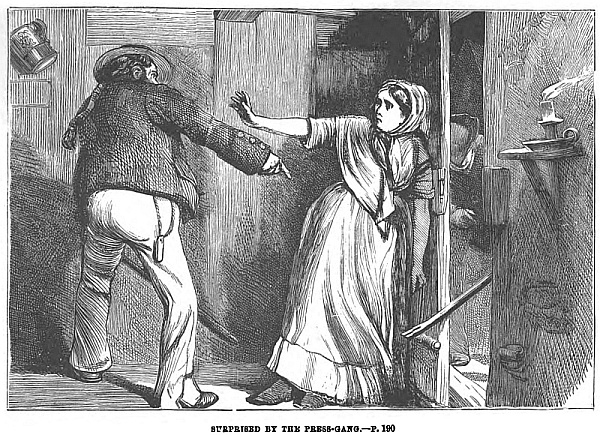
Harry had slept through the first part of the combat, but at length the fearful uproar aroused him. He started to his feet, not knowing where he was or what had happened. The room was almost in total darkness, for the lights had instantly been extinguished, and only here and there fell the glare of the men-of-war’s men’s lanterns as they held them up in the hopes of distinguishing friends from foes. Harry seized Jacob’s bundle with one hand, and the stick with which he had carried it in the other, and attempted to defend himself from the blows which were dealt freely round. He thought he distinguished Jacob’s voice not far from him, and he made his way up to his friend. At that instant, however, a further party of the press-gang arriving, the seamen were completely overpowered. In vain Sally and her attendants fought on, in the hopes of enabling some of their friends to escape. Every outlet was too strictly guarded. The officer and many of the men composing the press-gang probably knew the house as well as its inmates, and had taken their measures accordingly.
In the course of a few minutes, although some heads had received pretty hard cracks, yet no blood was spilt, every man in the house, with the exception of old Tony Hoggart, was in the power of the press-gang. It was a most successful haul. Upwards of thirty prime seamen had been captured, Jacob and Harry among them. Not till the fight was over did old Tony find his way down-stairs, at the foot of which he stood with a light in his hand, his red nightcap set on one side of his bullet head, his trousers held up by one suspender, his stockingless feet in shoes down at heel, while from his blear eyes he glared out on the intruders into his abode. As if at length aware of what had occurred, he commenced a series of his vituperative remarks, which increased in vehemence as he proceeded, his curses and oaths being first directed towards the head of the officer in command of the party and his men, the captain of the ship, and the navy in general coming in for their share.
“We’re in for it, Harry,” said Jacob; “keep up your courage, however; if we put a good face on the matter, we shan’t be so much worse off than if we had volunteered. We can tell the first-lieutenant when he examines us to-morrow morning that we intended to do so. I’ll just learn what ship we have been taken for.”
Jacob made the inquiry of the seaman who had charge of him.
“The ‘Brilliant,’ Captain Everard,” was the answer; “he’s a good captain, and you may bless your stars that you have been taken for his ship.”
Harry’s heart sank when he heard this.
He would at once be recognised by the captain.
What account could he give of himself? The boats were in waiting in the harbour. The men hurried down to them immediately. Some resisting were dragged along. A cuff on the head, or a blow with the butt end of a pistol, generally silenced those who cried out in the hopes of being rescued.
Harry and Jacob walked along quietly. Neither were disposed to struggle. As soon as the prisoners were got into the boats they shoved off. In a quarter of an hour afterwards Harry found himself for the first time in his life on board a man-of-war.
Chapter Fifteen.
The Hero’s First Trip to Sea.—The Fate of the “Brilliant.”
Harry and the other pressed men stood for some time on the deck of the frigate, awaiting the appearance of the commanding officer. Harry dreaded his coming, believing that Captain Everard would immediately recognise him. At length an officer appeared from below, accompanied by the master-at-arms, who held a ship’s lantern in his hand. The officer commenced his inspection at the other end of the line. The light not falling on him, Harry could not see his features, but his figure was like that of the captain.
“I must brave it out,” he thought. “What shall I call myself? It must be a name I can recollect. Andrew Brown will, do as well as any other.”
Jacob was standing at a little distance from him. He had just time to step round and whisper, “I shall take the name of Andrew Brown,” before the officer approached. He was greatly relieved on finding it was not the captain. Jacob Tuttle gave his real name. He entered himself as Andrew Brown.
As soon as the inspection was over, the men were ordered down below, being told that they would be entered more regularly the next morning. They were told that they might lie down between the guns on the main deck, sentries being placed over them as if they were prisoners.
Harry was only too thankful to find a quiet spot where he might stretch his weary limbs and finish his slumbers, which had been so rudely broken during the first part of the night. He was too sleepy even to think. He dreamed that the fray was renewed, for the most strange, wild, and unearthly sounds assailed his ears: shrill whistles, hoarse bawlings, fierce oaths, the stamping of feet and rattling of ropes, and shouts of all sorts, creating the wildest uproar he had ever heard.
“Yes, he’s alive, only drunk, maybe,” said a gruff voice in his ear.
“No, he’s not drunk, only worn out pretty well, as you or I would be if we had not had a sleep for three or four nights. He’s young, you see.”
These words were spoken by Jacob Tuttle, who, putting his arm under Harry’s shoulders, helped him to get up, and saved him from knocking his head against the gun-carriage under which he had been sleeping. For some seconds he felt stupefied. The whole ship, which was so quiet when he lay down, was now in a state of what appeared to him the wildest confusion—officers issuing their orders in no very gentle voices or refined language, and men rushing here and there, stamping along the decks with their bare feet, swaying up yards, and bending sails, hoisting in stores, and lowering casks and cases into the hold. Harry, when he saw the number of men and size of the ship, began to hope that he might avoid the recognition of the captain.
“I’ll keep out of his way,” he thought, “and if Mabel does not tell him of my intention of going to sea, though he may think Andrew Brown very like Harry Tryon, he may possibly not dream of asking questions on the subject.”
After breakfast the first-lieutenant went through the usual examination of the pressed men, and entered them under different ratings in the ship’s books. In those days muscle and activity were the qualifications most valued. Harry was able to answer in a satisfactory way the questions put to him, and was at once rated as an able-bodied seaman, and, greatly to Jacob’s satisfaction, was placed in the same watch and mess with him.
“I’ll show you what to do, Harry,” he said, “and you’ll turn out as good a seaman as any on board.”
The following day the ship went out to Spithead.
Harry wrote two letters, no easy task amid the multitude of persons on board, male and female visitors of all sorts, at whose language and conduct Harry’s heart sickened. It was well that it did so. Better be disgusted with vice than witness it unconcerned. Very often our young sailor was interrupted, his paper saved with difficulty from profane hands. Still at last the letters were finished. One was to Mabel. He did not describe the scene by which he was surrounded. He told her simply that he had taken the final plunge, was now a seaman sworn to serve his king and country, but hoped soon to be an officer, entreating her not to mention his name to her father, and sent a message to Madam Everard and Paul Gauntlett. He entreated her to think kindly of him, and assured her that his own heart would be faithful to death.
Poor Mabel! the letter did not give her much pleasure. “As if I should ever cease to think of him,” she said to herself. “Oh, that he had been better guided.”
He wrote also to Mr Kyffin, directing the letter wisely to his private house, for he thought it more than probable that Silas Sleech would otherwise take possession of it. The letter was a long one, tolerably coherent on the whole. He confessed all that had occurred, made no excuses for himself, nor did he accuse Sleech. He dated his letter from the “Brilliant,” begging his guardian to reply to it, in the hope that an answer might reach him before the ship sailed. Day after day passed by, and no answer came.
Harry heard with some considerable trepidation that Captain Everard was expected on board. He saw his gig coming off. The sides were manned, and the captain passed through the gangway to the quarter-deck, touching his hat in return for the salute offered him by the marines drawn up on either side. He glanced his eye aloft, and then along the deck. Everything was in excellent order. Harry, who was nearer than he could have wished, stood his gaze steadily. He spoke a few words of approval to the first-lieutenant, and then went down below. Harry saw at a glance that Captain Everard on shore and Captain Everard in command of a frigate were two somewhat different characters. As the captain disappeared, Blue Peter was run up to the mast-head. It became generally known that the ship was to sail the next day; her destination, the North American Station and the West Indies. Harry’s heart sank when he heard this.
“I may be away then three, perhaps four long years,” he said to himself. “What changes may take place in the meantime! Yet I may have better opportunities of distinguishing myself than on the home station. I ought to be thankful.”
Harry, as he looked round the decks, could not conceive how order could ever spring out of the fearful disorder which had seemed to prevail.
The ship was crowded with visitors. Boats in great numbers hung alongside, in which the boatmen were quarrelling with each other, while eager Jews endeavoured to find their way on deck to obtain payment of debts which they alleged were due to them from the seamen. Harry had little fear at this time of being recognised, the captain being generally employed in the cabin. He was watching what was going forward, when he saw a wherry standing up under sail from the westward towards the ship.
“Is that the ‘Brilliant’?” asked a voice from the boat, in which sat three persons—the boatman, his boy, and a young woman.
“Ay, ay,” was the answer.
The sail was lowered and the boat stood up alongside.
“May I come on board?” asked a gentle female voice, as the boat reached the gangway ladder.
“That you may, and welcome,” was the answer; “but you will not have long to stay, as the ship’s going to sea directly.”
Harry thought he recognised the countenance of the speaker. Assisted up gallantly by the quartermaster stationed at the gangway, the young woman stood on the deck. She looked round with a somewhat scared and astonished gaze, but no sooner did her eye fall on Harry, who was watching her, than she ran towards him.
“Oh! Mr Tryon, is it you, indeed? Can you tell me if Jacob Tuttle is on board? He came away without telling me that he was again going to join his ship, and I only heard just now from a friend of his at Portsmouth that he was on board the ‘Brilliant.’ He would never wish, I know, to go and leave me without one farewell, and so I cannot make it out.”
Harry recognised in the speaker Mary Cull, Mabel’s trim little waiting-maid. Jacob was aloft at the time, engaged in some work on the maintop-gallant yard. He had been too busily occupied to see the different boats coming to the ship. Now, however, the task completed, he happened to cast his eyes down on deck, and even at that distance recognised the figure though he could not have seen the pretty features of Mary. He observed, however, that she was talking to Harry. The knife he was using, which hung round his neck by a rope yarn, was thrust into the breast of his shirt, and quick as lightning he came gliding down the backstay close to where the two were standing. Mary gave a shriek of terror when she saw him, thinking that he was falling. Before even she could utter another exclamation of alarm, he sprang nimbly on deck and stood by her side.
“Mary,” he said, “have you come to look for me? I would not have come away without wishing you good-bye if I had thought I was not going to be back again pretty soon, but I was pressed aboard this ship, and had no chance of going back to see you and mother. You know I am a poor hand at writing, and I could not ask my friend here to trouble himself about the matter, and so, Mary, that’s the long and the short of it. I love you, girl, that I do, and love you now more than I ever thought I would; but, Mary, I did not think you cared for me, that’s the truth on’t, and now I know you do,” and Jacob took Mary’s willing hand in his, and looked into her eyes with an honest glance which must have convinced her that he spoke the truth, whatever he might before have done.
“Jacob, I did not tell you I loved you before, because you did not ask me, but still I thought you knew I did, and as for Tom Hodson you was jealous of, I never cared a pin for him, and he’s gone and ’listed for a soldier.”
Harry listened to this conversation not unamused. He understood the whole history in a minute. Jacob had left home in a huff, jealous of the attentions Mary was receiving from a rival, and now he was going away, to be parted from her for many years, perhaps never to return. He could not help comparing Jacob’s position to his own. Poor Mary was in tears. Jacob was vowing with earnestness that he would from henceforth ever be faithful to her.
“No, Mary, no, I am going among negresses and foreigners, black and brown girls of all sorts, and do you think I would take up with one of them and leave you?” And Jacob laughed at his own suggestion. “No, that I would not, not to be made port admiral, nor a king on his throne either. Mary, I was a fool to come away and leave you and poor mother, but it’s too late now, I must go this cruise. The king himself could not get me off. There’s no use asking the captain. Why he would only laugh at me. If he was to let me go, half the ship’s company would want to go and marry their sweethearts. I tell you a plain and solemn truth, Mary; but cheer up, dear girl. Never fear, I will be true and faithful to you.”
Mary was too much occupied with her own grief to think much of Harry. However, she at last turned towards him.
“Mr Tryon,” she said, “are you going, too? Surely that cannot be. What shall I tell Miss Mabel?”
“Tell her, Mary, what Jacob has said to you. I trust the time will quickly pass. I hope to do my duty faithfully to my king and country, and to obey my captain.”
Mary was about to ask further questions, but the boatswain’s whistle was heard, uttering the stern order for all visitors to leave the ship. Jacob gave Mary an affectionate embrace, and assisted her down the side, Harry especially being very unwilling to detain her lest she should be seen by the captain. She had come away, Jacob told him, having got a holiday for a week to see her friends. The boatman, who knew Jacob, wished him farewell, for though he stared at Harry, he did not appear to recognise him in the dress of a seaman, so different to what he had been accustomed to wear. In a few minutes afterwards the merry pipe was sounding. Harry and others were tramping round with the capstan-bars, and the anchor was slowly hove up to the bows. The proud frigate, under all sail, stood down the Solent toward the Needle passage.
Harry turned his aching eyes toward Lynderton as the frigate glided by. Though the sea was bright, the air fresh, and everything round him looked beautiful, his heart sank low, and often and often he bitterly repented the step he had taken. He quickly, however, learned his duty as a seaman, and Captain Everard more than once remarked to the first-lieutenant that he had seldom seen a more active and promising lad.
“You speak of Andrew Brown, sir?” was the answer. “Yes, he’s one of our pressed men, but he at once seemed reconciled to his fate. He will make a prime seaman.”
“Curious, I cannot help fancying that I have seen him before,” observed the captain, “or else he is very like a lad I know, of a family residing in my part of the country. However, that is fancy.”
Probably from that moment Captain Everard thought little more of the likeness between Andrew Brown and Harry Tryon.
The frigate met with remarkably fine weather during her passage across the Atlantic. As she neared the American coast, however, thick weather came on—such as is often found in those latitudes. It was night. The starboard watch was on deck—that to which Jacob and Harry belonged. The ship was under easy sail—a fresh breeze but fair. The captain was below. A bright look-out ought to have been kept, but bright look-outs are not always kept, even on board men-of-war.
“How cold it feels,” observed Harry to Jacob. “What’s that white cloud ahead?”
Scarcely had the words left his mouth than there was a fearful crash. Every timber quivered. Down came the foremast. The bowsprit also was carried away.
“She’s on an iceberg!” was shouted out.
Dismay seized the hearts of the stoutest. In an instant all was confusion and disorder. In the midst of it, a voice sounding above even the wild uproar ordered the men to their stations. The ship had bounded off, and now glided by, leaving the iceberg on the starboard side. Still the sea drove her against the base. Twice she struck with fearful violence. The mainmast followed the foremast, speedily carrying the mizenmast with it. The gallant frigate lay a helpless wreck on the dark tossing waters. The captain ordered the carpenter and his mates to sound the well. In a few short minutes he reported ten feet of water in the hold, increasing fast. Starboard bow stove in, many planks alongside ripped off! The ship must inevitably founder.
In an unskaken voice the captain announced the dreadful fact.
“Remain calm and collected, and do your duty to the last, lads,” he cried.
Orders were given to get out the boats.
Rafts also must be made, though there was short time for building them. The crew worked with a will. Had they been wearied out with pumping they might have given in. They had good reason now for working hard. The ship laboured heavily. The officers and many of the older seamen knew well, from the slow heavy movements, that she had not long to float. The carpenter by another report confirmed their fears. Harry, with other seamen, was engaged in making a raft on the quarter-deck. It was smaller than the rest, and nearly completed. The captain’s voice was again heard ordering the boats to be lowered without delay. While the men were engaged in obeying the order the stern of the frigate seemed to lift up. Down sank the bows, and with one awful plunge the proud frigate rushed downward into the ocean depths. A wild cry arose, such as even the bravest utter in a moment of extreme peril. Jacob and Harry leaped on the small raft. The grey dawn had just before broke. Some of the larger rafts, not yet completed, were sucked down with the sinking ship. Several boats suffered the same fate. Others were swamped. The small raft was whirled round and round, a few men clinging to it, Harry and Jacob among them keeping their hold. Here and there were despairing faces gazing their last at the sky ere they sank beneath the water. Now and then an arm was seen uplifted grasping at air. Broken spars and planks escaped from the unfinished rafts, drowning men clinging to them, though many of those who clung there soon dropped off.
Harry and Jacob had helped three shipmates to climb up on to the raft. Not far off a man was struggling to gain a spar which floated near. Even by that light he was seen to be an officer.
“It’s the captain!” cried Harry; “I must save him.”
Springing from the raft, he swam out towards the captain. The officer was close to a spar, but his hand failed to clutch it, and he sank. Harry dived rapidly. His hand grasped the captain’s collar, and with an upward stroke he returned to the surface. He looked around. The spar was not an arm’s length from him. Placing the captain across it, he pushed it towards the raft. The captain was saved from immediate death. But what prospect had those poor fellows, on that small raft out on the stormy ocean, of being saved? No sail was in sight. One boat only had escaped destruction. She was already at some distance. Those in her did not perceive the raft. Already, probably, she was overloaded. Soon a sail was hoisted and she stood away to the westward. The saddest sight of all was to see the poor fellows clinging to the pieces of wreck one by one dropping off. The sun rose, the mist cleared away. Six men on the raft alone remained on the waste of waters.
Chapter Sixteen.
A New Claimant for Stanmore.
Colonel Everard lay on his bed propped up with pillows. The window was open. He gazed forth over the green lawn, the bright blue sea and the Isle of Wight smiling in the distance. Three persons were in the room. Near his head stood his faithful attendant and old companion-in-arms; on the other side was his sister. Tears were in her eyes, while Mabel stood near the foot of the bed with her hands clasped, gazing on that venerated countenance. The sand of life was ebbing fast, a few grains alone remained.
“Paul, we have fought together. We have served our country well when we had youth and strength,” whispered the old officer, holding the hand of his faithful attendant. “You don’t forget that day when our brave general fell. Ere he died he heard that the enemy were put to flight, the victory won. Sister, he died happy, and so do I; for I may say with all humbleness, I have fought the good fight. I have tried to do my duty, but I trust in One mighty to save.” Then returning to old recollections, “You remember that day, Paul; that battle, the most glorious of our many fields. And now, Paul, we shall never fight again. You must look after these two here, sister Ann and my sweet Mabel. They want a trustworthy protector. I never knew you to fail me, Paul.”
His voice as he spoke was sinking lower and lower. A few more words he spoke expressive of the Christian’s hope. Then his hands relaxed their grasp, and those who watched him knew that the noble old man was dead.
The colonel’s will was opened. By his express desire no funeral pomp attended him to the grave. Paul, with eight of his older tenants, simple cottagers, several of whom had been soldiers, bore his coffin.
Seldom, however, has a longer line of mourners attended a plume-bedecked hearse than than which followed on foot the remains of Colonel Everard. Not only did all the inhabitants of Lynderton join the procession, but vast numbers of persons from the surrounding districts came to show their respect to the memory of one who had so long dwelt among them, and whose many virtues had won their love.
The estates were entailed on the next heir-at-law, while such property as the colonel could leave was given to his well-beloved sister, Madam Everard.
He had not, however, been a saving man; indeed, the expenses of his position had been considerable, and the sum was but small. Mabel and her aunt were to remain in possession of Stanmore Park till the return of Captain Everard from sea.
The funeral was over, and once more the household settled down into their usual ways. Paul was more active than ever: his eye was everywhere, feeling that he was obeying his master’s behests in watching over the interests of the captain and his daughter.
The same coach which a few months before had brought Harry Tryon southward, had now among its passengers no less a person than Mr Silas Sleech. He was in deep mourning—a proper respect to the memory of his late uncle, Colonel Everard. Yet his countenance bore no signs of grief. On the contrary, some pleasant thoughts seemed to occupy his mind, as he frequently rubbed his hands together and smiled complacently.
He was received with cordiality by his respected parent, the elder Mr Sleech, though the rest of the family, consisting of several brothers and four fair sisters, welcomed him apparently with less affection. Silas had brought but little luggage, but he held a tin case of considerable size which he had never allowed to quit his hand. The family greetings over, he and his father retired to the inner office. With intense interest they examined the contents of the case.
“It’s all right, father, I tell you,” exclaimed Silas. “Stanmore is ours, as sure as fate. My mother was the elder sister next to the colonel, and the captain’s father never had any marriage lines to show. I tell you the captain has no more right to the name of Everard than old Pike the mace-bearer. If the captain has a certificate, where is it? Let him show it; but he has not; and that little jade Mabel, who looks so proudly down upon me especially, must now be brought down a peg or two herself. She will be humble enough before long, or I am mistaken.”
“Silas, you ought to be Lord Chancellor,” exclaimed his father; “you have managed this affair with wonderful acuteness and judgment. I always thought there was a screw loose about Tom Everard’s foreign marriage, his wife dying suddenly, and he coming home with a small baby and a strange nurse, who could not speak a word of English or tell anybody what had happened. However, now we have got the law on our side, the sooner we take possession of our rights the better. You and I will see to that to-morrow. We will behave handsomely to Madam Everard. Indeed, I rather suspect that she won’t be so badly off, and whatever she has will go to Mabel, so there’s no use falling out too much with them. However, if your mother’s husband and children ought to be at Stanmore, why to Stanmore we will go, so that is settled.”
“Don’t tell the rest of them, though, father,” said Silas. “They will be blabbing it out, and Madam Everard will be getting wind of it, and we shan’t have the pleasure of giving them the little surprise I long for; come, you must not baulk me in that, daddy. A Lord Chancellor knows what’s what, and if I don’t kick up a pretty shindy in Stanmore Park before long, my name’s not Silas Sleech.”
Madam Everard and niece were seated in the study after breakfast. It had been the colonel’s sitting-room, and they occupied it with fond affection, no one, however, making use of his arm-chair. It seemed as if his spirit was often there, come down from the realms of the blest, while they talked of him and their lost Lucy.
The servant entered, and Madam Everard heard with no small dissatisfaction the names of her little-esteemed brother-in-law and his eldest son. They entered the room not with quite so much confidence as might have been expected.
“Why, Ann, you look somewhat solemn this fine morning,” observed the elder, as he took a seat, not very close to Madam Everard. Silas drew somewhat nearer to Mabel, but rising, she placed herself on the sofa near her aunt, and continued the embroidery at which she was working, scarcely looking up. The elder Sleech turned his hat about several times. He did not look as if he felt himself a member of the Everard family.
Silas had more impudence than his father, and this enabled him to overcome a certain feeling which would intrude, in spite of his assumed confidence.
“I have come about business, Ann,” at last said Mr Sleech the elder, “Silas and I. We wish to do everything pleasant and to give no annoyance; but you must know, Ann, when your elder sister married me, she married the family lawyer that was. You have always supposed that Tom Everard—the captain’s father—had married abroad; at all events the captain was brought home as a baby by Tom, who said he was his lawful child. Now it turns out that either Tom was mistaken, or else he told a fib—I don’t like to use strong language. If a man cannot prove his marriage he is not married; that’s what the law says. Now Tom to his death never had any marriage certificate to exhibit. It follows, therefore, in the eye of the law, that he was not married, and so you see your sister Jane became heir-at-law of her late brother, and I, as her representative, am—or rather my son Silas is—the rightful possessor of Stanmore Park. It’s as clear as a pike-staff, Ann, and so there’s no use making any ado about it.”
While Mr Sleech, senior, was speaking, Madam Everard had maintained a perfect composure. Poor Mabel’s colour came and went. She felt a choking sensation in her throat. Not for herself did she care, she was thinking of her gallant father, away from home fighting his country’s battles—when he returned to find himself disinherited. It would be a grievous blow. She felt, too, that she could no longer, when she gave her hand, endow her husband with the wealth she thought she should value more for his sake than for her own.
“You say you called on a matter of business,” said Madam Everard, with becoming dignity. “As a man of business we will treat you. I will send for Mr Wallace, my late brother’s solicitor, and should he be satisfied that you are the rightful owner of Stanmore, and that Captain Everard has no claim on it, my niece and I will quit the house. Till then I must request you to leave us at peace. You must be aware that the information you bring us is not pleasant.”
Mabel kept her lips pressed together. She dared not trust her voice, she simply bowed her assent to her aunt’s request.
“Well, well, Ann, I am not surprised that you are annoyed,” said Mr Sleech, rising from his seat; “that is but natural. Of course, we are gentlemen, and wish to treat you as ladies. We will just take a look round the park and grounds. I have a notion a good many trees should be cut down. The colonel was over-squeamish about felling timber; and Mabel, my dear, I wish you would not look so glum. Perhaps if you play your cards well, you may still be mistress of Stanmore, eh? Silas, you rogue, you used to admire your pretty little cousin.”
Silas rolled his round eyes and gave a glance at Mabel which she, at least, thought bespoke very little affection, for she turned a way from him with a feeling of loathing, not deigning to make any remark.
“You know your way,” said Madam Everard; “you must do as you think fit. We cannot interfere.”
Without putting out her hand, she gave a stately bow to her brother-in-law and nephew. A chuckle reached her ears as the door closed behind them.
“Jane, Jane, what have you brought upon us?” she exclaimed, apostrophising her deceased sister.
The marriage had been a hateful one from the first. Old Sleech had, even as a young man, been almost as odious as his son, and no one could account for Jane Everard’s infatuation and bad taste when she insisted on marrying him.
Madam Everard rang the bell, and begged that Paul Gauntlett would come to her. He obeyed the summons, and was soon afterwards trotting off on the horse with which he always accompanied the colonel to Lynderton. Mr Wallace was at home, and very quickly made his appearance at Stanmore, escaping an encounter with the Sleeches, who were still making their round of the park, notching trees which they agreed might come down to advantage and clear a pretty penny.
Mr Wallace heard Madam Everard’s statement with a grave face.
“I do not see much that is hopeful about it, but we will try what the law can do. If the law decides that Captain Everard is not the heir, we have no help for it. I will look over all the deeds deposited with me, but to my recollection I have no certificate or copy of certificate of Mr Tom Everard’s marriage. He must have been very young at the time, at all events. An older man would probably have taken more care of so important a document. However, I will see Mr Sleech, and endeavour to persuade him that he cannot justly at present push his claims. We must proceed cautiously, for although you are in possession, I fear that he can prove himself to be heir-at-law.”
Mr Wallace had left the house some time before the Sleeches returned. They came in by the garden entrance, and walked without ceremony into the study, where Mabel and her aunt were still sitting.
“Well, we have had a good look round the grounds, Ann, and I have come to the conclusion that the colonel did not make half as much of the property as he might have done. Why, I can tell you, eight thousand pounds’ worth of timber might be cut down—Silas says ten thousand, but I think that he is a little over the mark—without doing any harm to the place, and there are no end of improvements he and I have been proposing.”
“No one must venture to cut down timber on this property without the leave of my nephew, the captain,” said Madam Everard, drawing herself up.
“Well, that’s as may be, Ann,” answered Mr Sleech, with a forced laugh. “He who has the right to the property will have the right to cut down the trees, or law’s not law. However, that’s neither here nor there. What I want to know, Ann, is when you and Mabel will be ready to pack up bag and baggage and turn out. There’s that bow-windowed house in the town, half-way up the street, which would just suit you two spinster ladies, and the fact is that my daughters and my sons and I have rather a fancy to come and take up our quarters here. We have been kept out of the place a pretty long number of years, and you see, in my opinion, it’s time we had our rights.”
“When our legal adviser considers that we have no longer a right to remain in this house, Mabel and I will immediately leave it,” answered the old lady, with dignity. “I am sure such would be Captain Everard’s wish. In the meantime, I must request, Mr Sleech, that you and your son will bring this interview to a conclusion. As relatives I would have made you welcome; but I cannot feel that you are justified in thus coming to insult my niece and me. I must therefore request that you will take your departure.”