PLANT COMMUNITIES
Reading edition
Below 9,000 Feet
In the lower slopes of the park, below approximately 9,000 feet altitude, usually described as the Montane zone, the climate is relatively warm and dry. This type of climate has encouraged a fairly consistent pattern of vegetation that may be considered climax. The forests in this zone are open. The trees are likely to be scattered in characteristically parklike stands and are made up mostly of ponderosa pine. On cool north slopes the stands are thicker, with Douglas-fir sprinkled in or even dominant. With the ponderosa pine on drier sites is juniper (commonly called “cedar”), and above 8,000 feet thick stands of lodgepole pine are sometimes admixed. Along the streams are the distinctive and graceful Colorado blue spruce, associated with willows, birch, and alder. Aspen groves and, in lower altitudes, cottonwoods appear here and there. Many types of shrubs, some characteristic of the foothills, grow in the Montane zone.
The most characteristic forest tree of the lower part of this zone is PONDEROSA PINE. It has dull-green needles from 3 to 6 inches long—longer than those of other pines in the park—which are usually in bundles of three. Although the bark on young trees is black, the mature trees have a yellow-brown bark in characteristically rectangular plates. The cones are about 3 inches long, with prickles on the tips of the cone scales. Capable of growing in warm, dry environments, it is an evergreen of south-facing slopes and is widespread as a forest tree in the southwestern United States. On the cooler, north-facing slopes, DOUGLAS-FIR mingles with the ponderosa pine. Douglas-fir is easily identified by its needles, which grow singly along the branch instead of in sheaths. The needles are flat, blunt, and about 1 inch long; and they have a narrow stalk at the base that pulls off with the needle. This distinguishes it from the blue spruce often found in the same vicinity. The bark is smooth and gray on young trees, but rough, brownish, and deeply furrowed on older trees. The cones are about 2 inches long, made up of broad scales each with a projecting 3-pronged bract. Here, Douglas-fir seldom attains the great size for which it is noted in the Pacific Northwest.
Another conifer growing in this zone, usually along streams or in such other wet locations, is BLUE SPRUCE, one of the most admired evergreens 13 of the West. Its needles produce a bloom, or powder, which gives the tree a distinctive bluish or silver aspect, especially noticeable in midsummer. The cones are from 3 to 5 inches long, tan-colored, with many scales, which have narrow tips but no prickles.
In the upper parts of the Montane zone grow dense forests of LODGEPOLE PINE, so named because the Indians used it for tepee (or lodge) poles. It is characterized by tall, slender, straight trunks, with most of the foliage near the top. Its trunk is usually much smaller than the other conifers of the region—seldom exceeding 20 inches. The bark is much thinner than that of the ponderosa pine; gray scales on the bark of young trees become brown with age. The cones are about 2 inches long and are borne in clusters of two or three, tightly attached to the branch. Cones often remain on the tree for years, the seeds retaining their vitality. After a light forest fire, the undamaged cones will open, releasing the seeds. This is nature’s way of reseeding a fire-swept area and explains the extremely dense stands of lodgepole pine which, for example, you will see near Many Parks Curve.
ROCKY MOUNTAIN JUNIPER can be seen on dry hills and rocky canyon walls in the park. Its scalelike leaves (not needles) are small and flattened against the innumerable branches. It has no cones, but bears little, bluish berries, which require two seasons to ripen. Usually this juniper grows in a squat and sprawling manner.
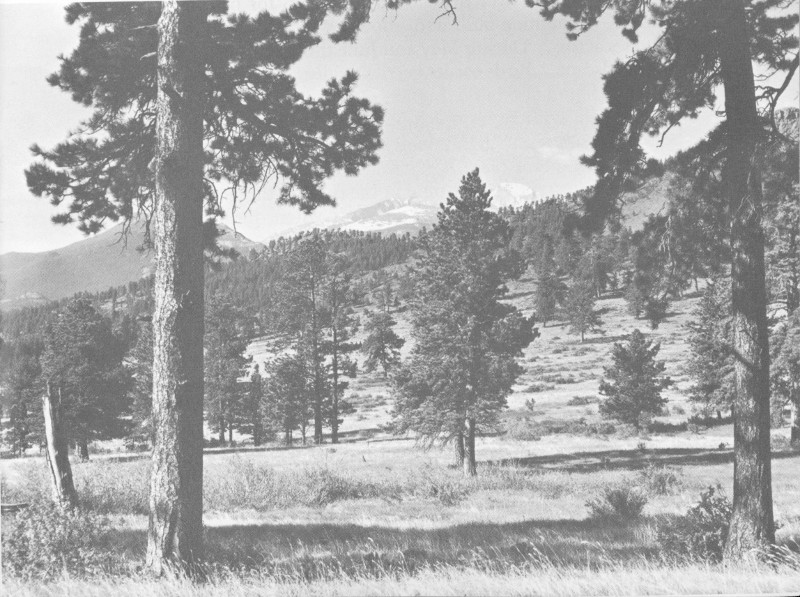
Open stands of ponderosa pine are typical of the lower areas of the park.
14
The most common deciduous tree in the park is QUAKING ASPEN. It is immediately recognized by its smooth, white bark and small, green leaves that tremble with the slightest breeze, because of the curious flattening of the petiole, or leaf stalk, at right angles to the leaf blade. Aspen grows to considerable size in beautiful groves of tall trees, where the moisture and shelter are sufficient, but is more often seen in scrubby thickets on rocky, drier slopes. In September the leaves turn to a golden color, giving early autumn travelers a matchless visual experience. NARROW-LEAF COTTONWOOD grows along streams in the lower altitudes of the park. Many willows also occupy streambank environments, the most common being SCOULER WILLOW with characteristic willow leaves and large oval catkins, which are quite conspicuous in May and early June.
WATER BIRCH is a thin-leaved, graceful shrub, sometimes growing to tree size, commonly seen along streams in the lower forests. It can be recognized by its graceful, almost delicate appearance. THINLEAF ALDER, also abundant along streams, often grows in great clumps with many stems growing from the same root. Widespread throughout the West, the alder provides habitat for many bird groups. You may also recognize, by its leaf, ROCKY MOUNTAIN MAPLE, which grows here and there in the park up to about 11,000 feet.
The shrubs most commonly observed by the visitor are:
ANTELOPE BITTERBRUSH—a low, tough, much-branched shrub, with many fragrant, pale-yellow blossoms in May and June. Its leaves are less than 1 inch long, wedge-shaped and 3-toothed at the apex. The spindle-shaped seeds are important food for chipmunks and ground squirrels, and mule deer depend on the shrub for browse. BOULDER RASPBERRY—a common bush with showy, 5-petaled white blossoms, up to 3 inches across. During May and June this shrub adds much beauty to the landscape. Birds eat its berries avidly. WAX CURRANT—a common shrub found also in the highest forests—forms rounded clumps, 1 to 3 feet high, with rigid, much-branched stems and rounded leaves. The red berries ripen in summer and are eaten by many birds and small rodents. This plant is alternate host to blister rust (a disease which may affect the limber pine in the park in the near future), and much of it has been eradicated in areas where limber pine grows. SAGEBRUSH—a familiar plant in much of the West—in this park grows in a dwarf form, and is common in Glacier Basin and on the southwest slopes of Deer Mountain. This woody shrub, about 1 foot high, with 3-toothed, wedge-shaped, silvery leaves, is good forage for mule deer.
Conspicuous wildflowers that grow below 9,000 feet in the park and that will attract attention in their blossoming season are:
Early in the season—as early as March—AMERICAN PASQUEFLOWER exhibits its large lavender blossoms as a sign of spring. As the season advances, its blossoming follows the melting snow up the mountain 15 slopes, where it may be seen into July. This flower (without petals—the sepals resemble petals—but with a golden center) looks somewhat like the garden crocus. It is covered with silky hairs—almost “fur-covered.” Another early-blooming flower is COMMON STARLILY, often called “sandlily”, which displays narrow grasslike leaves and white, stemless flowers in early spring. It is rare in the park, but abundant near the village of Estes Park during May.
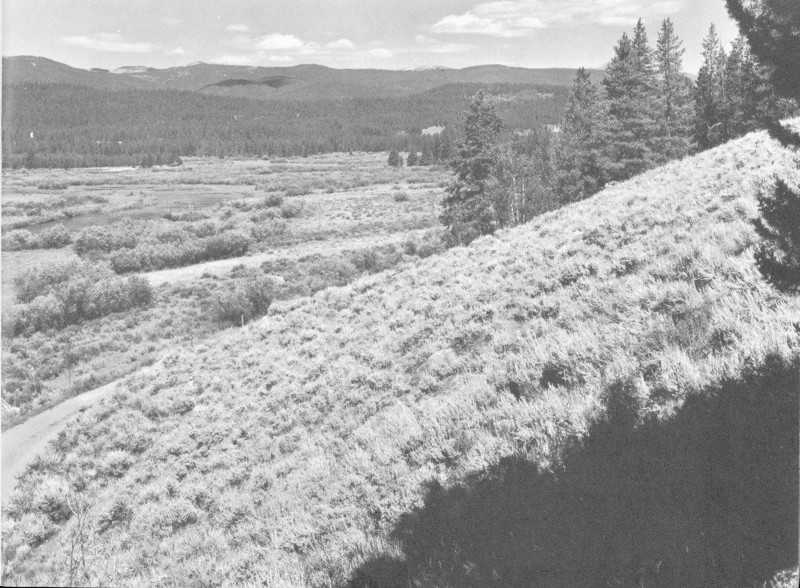
Sagebrush is one of the shrubs heavily browsed by mule deer.
STEMLESS TOWNSENDIA, locally called Easter-daisy, is another early bloomer—most abundant in May. The inch-wide flower heads are pale pink or white with yellow centers and are clustered on the crowns of the plant. It is one of the composite family and is easily recognized by the general similarity of the flower heads to those of the larger, taller oxeye-daisy. The arnicas have several representatives in the park region. An early-blooming variety is HEARTLEAF ARNICA which is common in the moist fields and open ponderosa pine forests in May and June. It has large, yellow composite blossoms, from 2 to 3 inches across; the heart-shaped leaves are best developed at the base of the stem. ROCKY MOUNTAIN IRIS is common in meadows of this zone, with its light-blue flower adding color to the “parks” of the region, where moist conditions permit its growth. SPREADING THERMOPSIS, or “golden banner,” carpets the open areas with yellow during June and July. This common plant is a pea, as its flowers suggest, and as the 16 long, flat seed pods prove. The flowers appear in clusters along the top of the stem. PLAINS ERYSIMUM, better known locally as “western wallflower,” is also yellow, common, and conspicuous during June and early July. Sometimes mistaken for golden banner by visitors who drive rapidly past the meadows, it has quite a different flower pattern, being a mustard with spikes of many small, 4-petaled flowers.
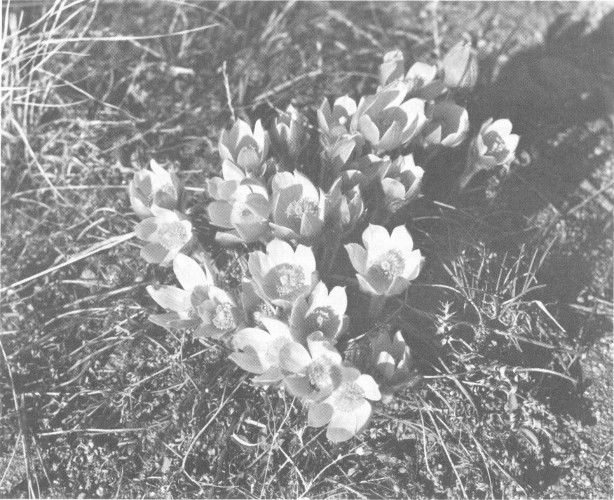
Spreading pasqueflower heralds the arrival of spring.
As summer advances, other flowers become abundant. Penstemons present their showy purple spikes of flowers during July. Most abundant and conspicuous is ONESIDE PENSTEMON, usually a foot or more in height, which often colors the meadows blue. All penstemons are easily recognized by their lobed, generally bell-shaped flowers. The common name beardtongue is applied to certain species which have a flattened and bearded sterile stamen on the inside of the flower tube. This fifth sterile stamen, whether smooth or bearded, is the source of the generic name Penstemon. LAMBERT CRAZYWEED, also known as “Colorado locoweed,” is abundant through July. It can be recognized by its spike of reddish-purple blossoms and the narrow, pinnately compound leaves. Curiously enough, locoweed blooms twice during the summer, the August period of blossoming being less noticeable. FREMONT GERANIUM, or wild pink geranium, is 17 a lovely plant of the open pine forests, with typical 5-petaled pink geranium blossoms. COMMON PERENNIAL GAILLARDIA is a showy composite. The flower heads are 2 to 3 inches across, with deep-maroon to brownish centers and bright-yellow rays, often with dark bases. The tips of these ray flowers have three distinct indentations, serving to help distinguish this plant from BLACK-EYED-SUSAN, which is also common in the mountain meadows.
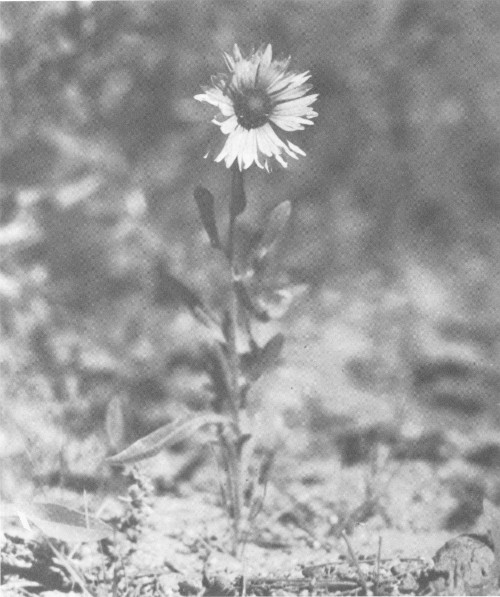
Gaillardia is one of the showiest composites.
FIREWEED, as its name suggests, commonly blooms on areas devastated by forest fire or other destructive agencies. Its silky seeds are easily carried by the wind to these areas, where it becomes dominant. It 18 blooms from early July into September, and the deep-pink, 4-petaled flowers are borne in long, graceful spikes. It is a common roadside plant. MINER’S CANDLE is a hairy-stemmed plant with innumerable close-set clusters of small, white flowers throughout its stout, straight stem. It also is common along roadsides.
Autumn flowers become increasingly abundant in late summer. Conspicuous are the shrubby composites, including groundsels, sunflowers, and purple asters. While the peak of the flower display comes during July for this lower zone, many attractive wildflowers can be seen until mid-September.
The Middle Belt
Above an altitude of approximately 9,000 feet, the forests show a different aspect. This is another zone, called the Subalpine by some botanists and Canadian by others. It is characterized by forests of stately ENGELMANN SPRUCE and SUBALPINE FIR. You can tell one from the other by touching the needles. Spruce needles are 4-sided, rigid to the touch, and sharp-pointed; fir needles are flattened and softer to the touch. From your car, you can spot the firs by their erect, dark-colored cones, mostly high in the tree. This type of forest is the climax developed in this climatic belt, which receives twice as much snow and rain as the zone below. This relatively abundant moisture (much less, however, than in most of the Eastern States with their broadleaf forests) supports a luxuriant conifer cover. Wildflower gardens of rare beauty and startling luxuriance are found in natural openings within the forest. The distinctive blue COLORADO COLUMBINE, which ranges from the lowest elevations up to 13,000 feet, seems to reach its best development here.
Other plants of the open forests in this zone include WHITE GLOBE-FLOWER with its cream-colored, cup-shaped flower; COLUMBIA MONKSHOOD, with its helmeted blue or white flowers; ELKSLIP MARSH-MARIGOLD, with numerous oval white sepals often mistaken for petals; and the strikingly beautiful PARRY PRIMROSE, with clusters of brilliant purple flowers, often growing along the edge of a stream. Common shrubs include GREENES MOUNTAIN-ASH, whose large clusters of white flowers are replaced by bright red berries in autumn; BEARBERRY HONEYSUCKLE, better known in the Rockies as twinberry, a honeysuckle with large ovate leaves 3 to 5 inches long and pairs of yellow flowers; and wild AMERICAN RED RASPBERRY, with prickly stems, 5-petaled white flowers, and delicious red fruit, relished by birds and hikers alike.
In the cool, shadowed depths of the forest where light is dim, another community of plants is found, including CALYPSO, or “fairy-slipper,” a dainty orchid with rose-colored blossoms formed in a curious slipperlike shape; the PYROLAS, a group of low, hardy perennial herbs with 19 white or pink flowers having 5 thick petals and 10 stamens; SPOTTED CORALROOT, a plant which, getting its nourishment from decaying vegetation, has no green leaves, but bears purple-spotted flowers on its brown stem; and AMERICAN TWINFLOWER, a trailing plant of the honeysuckle family, often forming dense mats with upright, forked flower stems bearing a pair of pink, bell-shaped flowers.
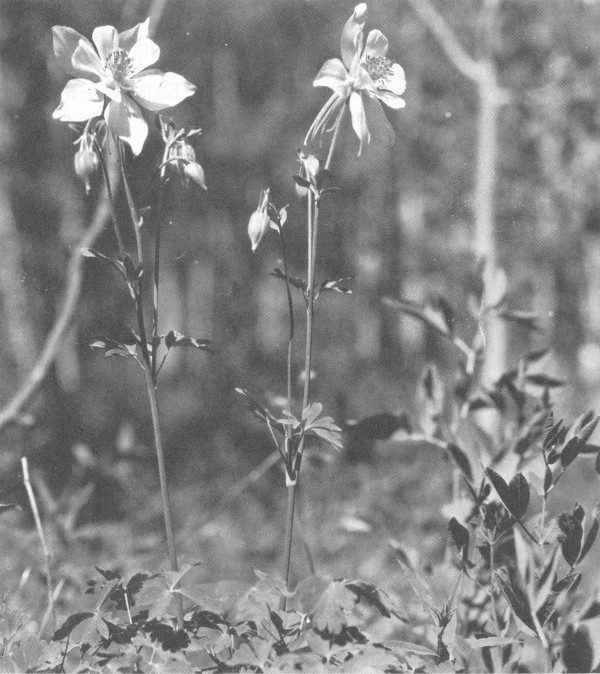
Blue columbine—Colorado’s State flower.
After fire or other catastrophe wipes out the spruce-fir forests, a cycle of natural revegetation must take place before the climax forest again becomes established. The first step in this recovery process is the appearance of fireweed and many annual herbs, among which shrubs such as CLIFF JAMESIA, or “waxflower,” become established, and aspens begin to appear as succession plant types. They are replaced 20 eventually by longer-lived lodgepole pines, also sunloving and tolerant of burned or denuded sites. The trees increase the wetness of the forest floor, provide the shady sites necessary for seeds to grow in, and shelter the young spruce and firs as they slowly increase and approach maturity. Eventually, the spruces and firs crowd out the pioneers which have helped them get established. This dense spruce-fir forest seems to resist competition of other species and will maintain itself indefinitely by gradual replenishment of its own kind, unless it is again fire-swept or there is a change of climate. The spruce-fir forests of the park seem to be as nearly fixed and static as forests can be; or, in the scientists’ words, they are the climax forest for the sites they occupy.
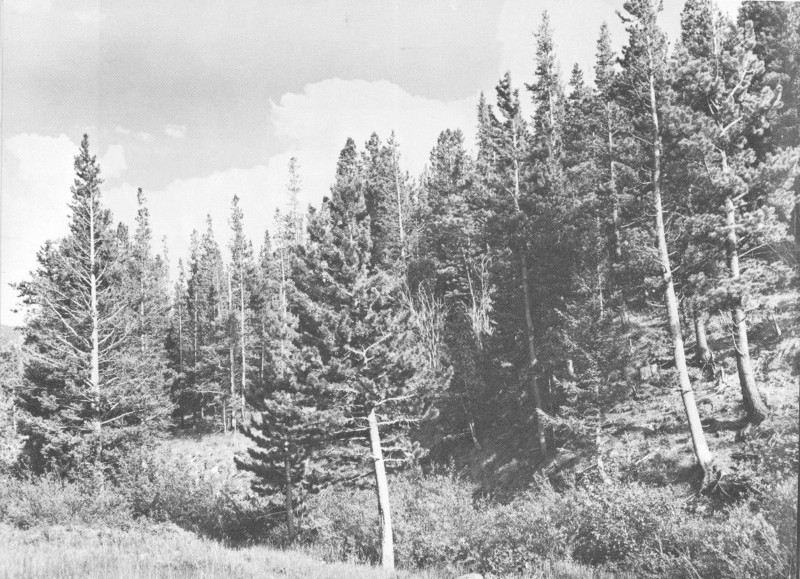
Lodgepole pine forests along Trail Ridge Road.
The higher part of the Subalpine zone (10,500 to 11,500 feet) is often called Hudsonian for its biological similarity to the region around Hudson Bay. It is a sort of frontier zone where the climate is more severe. Not only is it colder, but it is much windier, and loss of water by evaporation is much greater than it is a thousand feet lower. Although spruce and fir remain the dominant species, they are usually shorter and less symmetrical in appearance. Near the upper limits of this zone the trees are twisted and grotesque, often flat and ground-hugging, sprawled behind boulders or fingering into the dwarf willow clumps so characteristic of the alpine mountaintops. 21 Here, also, the only 5-needle pine in the park, LIMBER PINE, a rocky-soil tree of the Subalpine zone, assumes its most picturesque aspect. Limber pine at treeline is readily identified by its grotesque, twisted, ragged appearance. Several splendid specimens can be seen beside Trail Ridge Road about a half mile above Rainbow Curve. The name, limber pine, comes from the ease with which the branches can be bent without breaking. The cones are often 6 inches long, the largest of any conifer in Colorado.
The limber pine stands in the shadow of threatened extermination by blister rust. This fungus disease, which attacks, girdles, and destroys all species of 5-needled pines, has wrought havoc in many parts of the country. Like so many virulent forest diseases, it was introduced from abroad. Since no known natural checks on it exist in this country, it is almost impossible to eradicate. It spreads to pines only from its alternate hosts, wax currant and other species of Ribes; if these are eradicated from the vicinity, the pines can be preserved. Though such control measures are costly, without them the limber pine might be lost forever from the park. The Government has been doing this work in selected forests on the northeast slope of Longs Peak and near Estes Cone, where many splendid specimens of this tree occur.
Above Treeline
Above the Subalpine zone, whose upper limit is treeline, lies the Alpine, or Arctic-Alpine, zone. This is the distinctive “Land of Lilliput” of the plant kingdom, the alpine tundra, where nearly all existing plant species are in dwarf form. Some of the zone is barren rock, with only algae and lichen growth. Vast expanses of it, however, are covered with a cold, wet soil mantle which, during the brief summertime, presents a myriad of low, cushionlike flower clumps. Sometimes—usually through July—the effect is that of a vast carpet of flowers. The list of plant species is great. Showiest of the alpine flowers are ALPINE BUTTERCUP, with large, yellow, poppylike flowers, often blooming at the very edges of snowbanks; ALPINE FORGET-ME-NOT, which grows in dense, low clumps and presents thick patches of bright-blue flowers; MOSS SILENE (“moss campion”), a mosslike cushion plant with pink flowers (also found in Greenland and Alaska); GRAYLOCKS ACTINEA, sometimes called “Old Man of the Mountain,” with bright-yellow flower heads, usually wind-blown and ragged, almost as broad as the plant is tall; TUFTED PHLOX, better known here as “alpine phlox,” the cushion of which is sometimes entirely covered with pale-blue or white flowers; AMERICAN BISTORT, with dense spikes of tiny flowers standing like miniature bottle brushes above the tundra grasses; KINGS CROWN, a fleshy plant with dark-red blossoms, 22 the whole plant often turning completely red in late summer; and MT. WASHINGTON DRYAD, with its curious 8-petaled, cream-colored flowers.
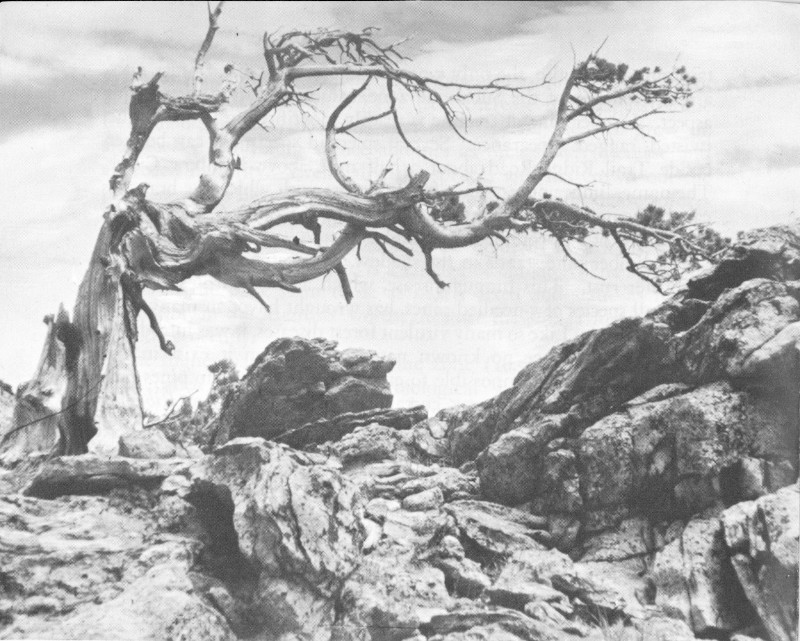
Limber pine at treeline.
Tundra is characteristically composed of grasses, sedges, herbs, and a few dwarfed shrubs. Many lichens and mosses also grow in tundra. The plants are typically small, low-growing, and compact, and often have showy flowers. There seems to be an abundance of blossoms in proportion to the size and amount of foliage of the plants. Their small leaves are protected from excessive water loss by masses of hairs or waxy substances, and they frequently contain high amounts of red pigment. Most of these plants are exceedingly slow-growing; some of those you see may be a hundred to several thousand years old.
The story of the park’s trees and flowers is intensely interesting, but can best be understood by more careful study than is possible in this booklet. Several excellent botanical bulletins are available, and we urge you to invest in one of them.
23