ROBIN HOOD. Part I.
Reading edition
I. A LYTELL GESTE OF ROBYN HODE.
This ancient legend is printed from the copy of an edition, in 4to and black letter, by Wynken de Worde, preserved in the public library at Cambridge; compared with, and, in some places, corrected by, another impression (apparently from the former), likewise in 4to and black letter, by William Copland, a copy of which is among the late Mr. Garrick’s old plays, now in the British Museum. The full title of the first edition is as follows: “Here beginneth a mery geste of Robyn Hode and his meyne, {2} and of the proude sheryfe of Notyngham;” and the printer’s colophon runs thus: “Explycit. Kynge Edwarde and Robyn hode and Lytell Johan Enprented at London in Flete strete at the sygne of the sone By Wynken de Worde.” To Copland’s edition is added “a newe playe for to be played in Maye games very plesaunte and full of pastyme;” which will be found at large in another place. No other copy of either edition is known to be extant; but, by the favour of the Reverend Dr. Farmer, the editor had in his hands and gave to Mr. Douce a few leaves of an old 4to black letter impression by the above Wynken de Worde, probably in 1489, and totally unknown to Ames and Herbert. Another edition was printed at Edinburgh by Androw Myllar and Walter Chepman in 1508, a fragment whereof is in the Advocates’ Library there. This is probably the edition noticed among the tales enumerated in Wedderburn’s Complainte of Scotland, printed at St. Andrews in 1549, under the title of “Robene Hude and litil Jhone.” Among the Doctor’s numerous literary curiosities was likewise another edition, “printed,” after Copland’s, “for Edward White” (4to, black letter, no date, but entered in the Stationers’ books 13 May 1594), which hath been collated, and every variation worthy of notice either adopted or remarked in the margin. The only deviation from all the copies (except in necessary corrections) is the division of stanzas, the indenting of the lines, the addition of points, the disuse of abbreviations, and the occasional introduction or rejection of a capital letter; liberties, if they may be so called, which have been taken with most of the other poems in this collection.
Lithe and lysten, gentylmen,
That be of frebore blode ;
I shall you tell of a good yemàn,
His name was Robyn Hode. {3}
Robyn was a proude outlawe,
Whyles he walked on grounde,
So curteyse an outlawe as he was one
Was never none yfounde.
Robyn stode in Bernysdale,
And lened hym to a tree,
And by hym stode Lytell Johan,
A good yeman was he ;
And also dyde good Scathelock,
And Much the millers sone ;
There was no ynche of his body,
But it was worthe a grome.
Than bespake hym Lytell Johan
All unto Robyn Hode,
Mayster, yf ye wolde dyne betyme,
It wolde do you moch good.
Then bespake good Robyn,
To dyne I have no lust,
Tyll I have some bolde baròn,
Or some unketh gest,
[Or els some byshop or abbot] 119
That may paye for the best ;
Or some knyght or some squyere
That dwelleth here by west. {4}
A good maner than had Robyn,
In londe where that he were,
Every daye or he woulde dyne
Thre messes wolde he here :
The one in the worshyp of the fader,
The other of the holy goost,
The thyrde was of our dere lady,
That he loved of all other moste.
Robyn loved our dere lady,
For doute of dedely synne ;
Wolde he never do company harme
That only woman was ynne.
Mayster, than sayd Lytell Johan,
And we our borde shall sprede,
Tell us whether we shall gone,
And what lyfe we shall lede ;
Where we shall take, where we shall leve,
Where we shall abide behynde,
Where we shall robbe, where we shall reve,
Where we shall bete and bynde.
Ther of no fors, sayd Robyn,
We shall do well ynough ;
But loke ye do no housbonde harme
That tylleth with his plough ; {5}
No more ye shall no good yemàn,
That walketh by grene wode shawe,
Ne no knyght, ne no squyèr,
That wolde be a good felawe.
These bysshoppes, and thyse archebysshoppes,
Ye shall them bete and bynde ;
The hye sheryfe of Notynghame,
Hym holde in your mynde.
This worde shall be holde, sayd Lytyll Johan,
And this lesson shall we lere ;
It is ferre dayes, god sende us a gest,
That we were at our dynere.
Take thy good bowe in thy hande, said Robyn,
Let Moche wende with the,
And so shall Wyllyam Scathelocke,
And no man abyde with me ;
And walke up to the Sayles,
And so to Watlynge-strete,120
And wayte after some unketh gest,
Up-chaunce ye mowe them mete. {6}
Be he erle or ony baròn,
Abbot or ony knyght,
Brynge hym to lodge to me,
Hys dyner shall be dyght.
They wente unto the Sayles,
These yemen all thre,
They loked est, they loked west,
They myght no man see.
But as they loked in Barnysdale,
By a derne strete,
Then came there a knyght rydynge,
Full sone they gan hym mete.
All dreri then was his121 semblaunte,
And lytell was hys pryde,
Hys one fote in the sterope stode,
That other waved besyde.
Hys hode hangynge over hys eyen two,
He rode in symple aray ;
A soryer man than he was one
Rode never in somers-day.
Lytell Johan was curteyse,
And set hym on his kne :
Welcome be ye, gentyll knyght,
Welcome are you to me.
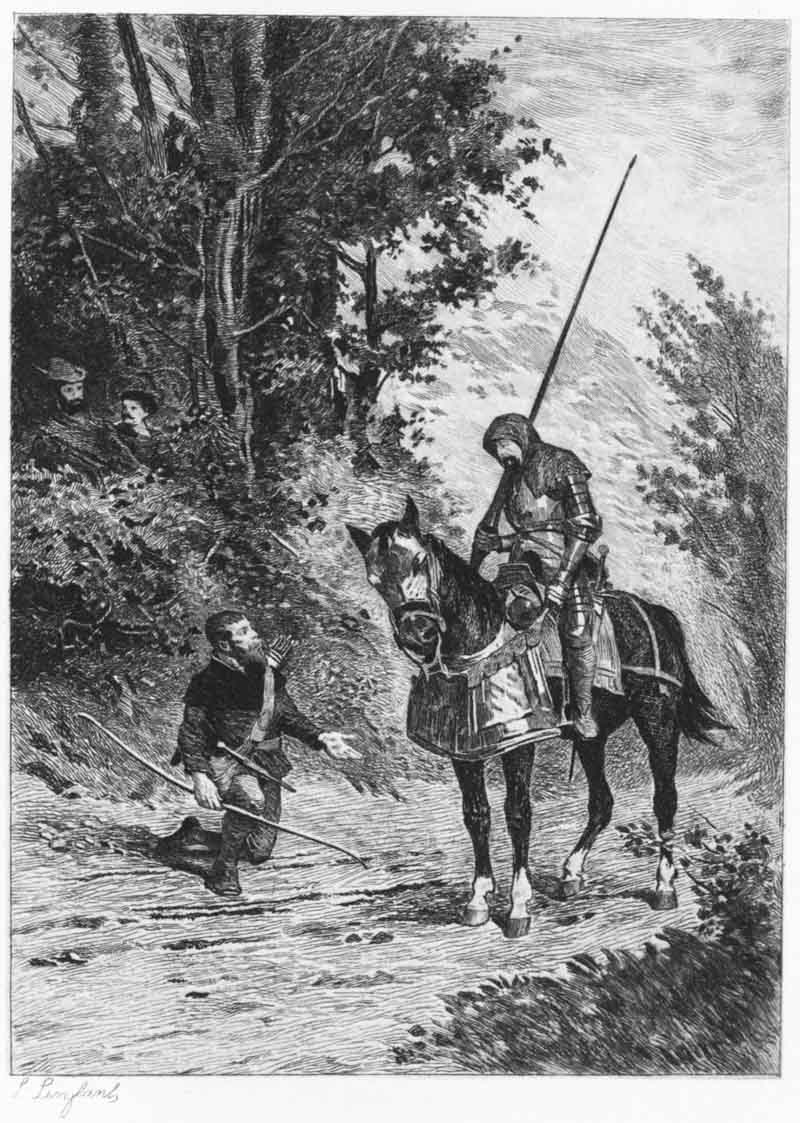
COURTESY OF LITTLE JOHN.
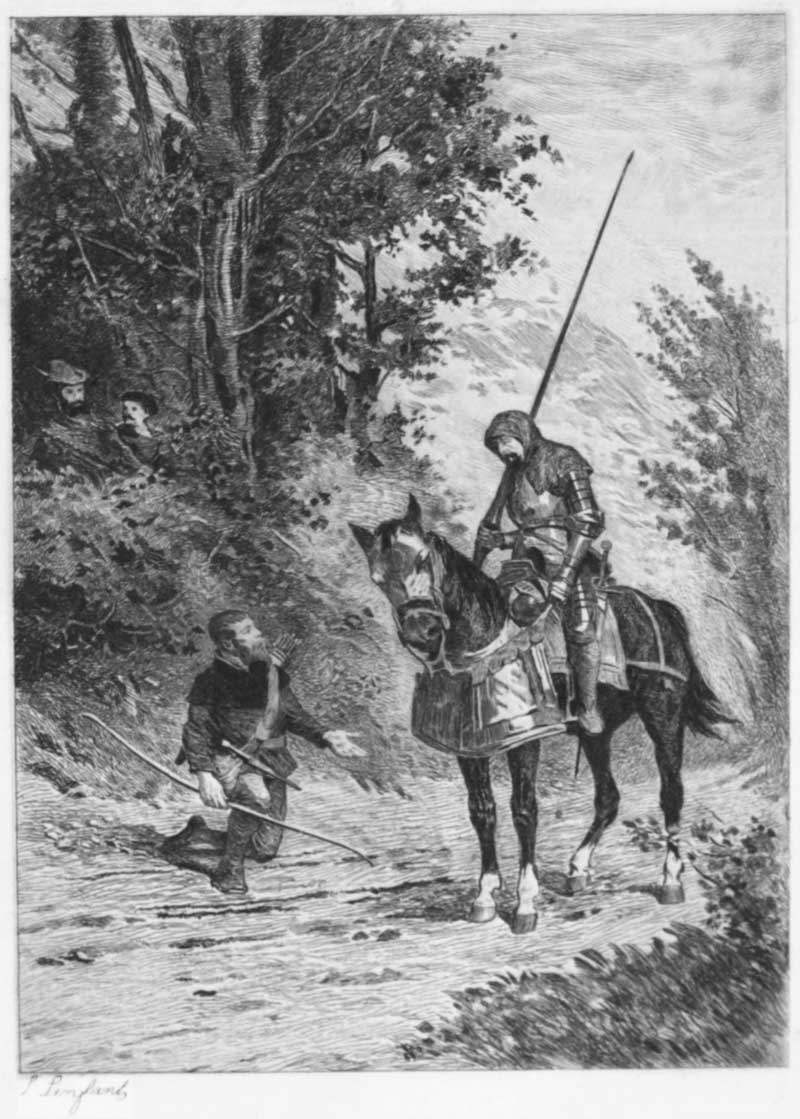
COURTESY OF LITTLE JOHN.
{7}
Welcome be thou to grene wood,
Hende knyght and fre ;
My mayster hath abyden you fastynge,
Syr, all these oures thre.
Who is your mayster ? sayd the knyght.
Johan saydé, Robyn Hode.
He is a good yeman, sayd the knyght,
Of hym I have herde moch good.
I graunte, he sayd, with you to wende,
My brethren all in-fere ; 122
My purpose was to have deyned to day
At Blythe or Dankastere.
Forthe than went this123 gentyll knyght,
With a carefull chere,
The teres out of his eyen ran,
And fell downe by his lere.124
They brought hym unto the lodge dore,
When Robyn gan hym se,
Full curteysly dyde of his hode,
And set hym on his kne.
Welcome, syr knyght, then said Robyn,
Welcome thou arte to me,
I haue abyde you fastynge, syr,
All these houres thre.
Then answered the gentyll knyght,
With wordes fayre and fre,
God the save, good Robyn,
And all thy fayre meynè.
They washed togyder and wyped bothe,
And set tyll theyr dynere ;
Brede and wyne they had ynough,
And nombles of the dere ;
Swannes and fesauntes they had full good,
And foules of the revere ;
There fayled never so lytell a byrde,
That ever was bred on brere.
Do gladly, syr knyght, sayd Robyn.
Gramercy, syr, sayd he,
Suche a dyner had I not
Of all these wekes thre ;
If I come agayne, Robyn,
Here by this countrè,
As good a dyner I shall the make,
As thou hast made to me.
Gramercy, knyght, sayd Robyn,
My dyner whan I have,
I was never so gredy, by dere worthy god,
My dyner for to crave. {9}
But pay or ye wende, sayd Robyn,
Me thynketh it is good ryght ;
It was never the maner, by dere worthy god,
A yeman to pay125 for a knyght.
I have nought in my cofers, sayd the knyght,
That I may profer for shame.
Lytell Johan, go loke, sayd Robyn,126
Ne let not for no blame.
Tell me trouth, sayd Robyn,
So god hath parte of the.
I have no more but ten shillings, sayd the knyght,
So god hath parte of me.
Yf thou have no more, sayd Robyn,
I wyll not one peny ;
And yf thou have nede of ony more,
More shall I len the.
Go now forth, Lytell Johan,
The trouthe tell thou me,
Yf there be no more but ten shillings,
Not one peny that I se.
Lytell Johan spred downe his mantèll
Full fayre upon the grounde,
And there he founde in the knyghtes cofer
But even halfe a pounde. {10}
Lytyll Johan let it lye full styll,
And went to his mayster full lowe.
What tydynge Johan ? sayd Robyn.
“Syr, the knyght is trewe inough.”
Fyll of the best wyne, sayd Robyn,
The knyght shall begynne ;
Moch wonder thynketh me
Thy clothynge is so thynne.
Tell me one worde, sayd Robyn,
And counsell shall it be ;
I trowe thou were made a knyght of forse,
Or elles of yemanry ;
Or elles thou hast ben a sory housband,
And leved in stroke and stryfe ;
An okerer, or elles a lechoure, sayd Robyn,
With wronge hast thou lede thy lyfe.
I am none of them, sayd the knyght,
By god that made me ;
An hondreth wynter here before,
Myne aunsetters knyghtes have be.
But ofte it hath befal, Robyn,
A man hath be dysgrate ;
But god that syteth in heven above
May amend his state. {11}
Within two or thre yere,127 Robyn, he sayd,
My neyghbores well it ‘kende,’ 128
Foure hondreth pounde of good money
Full wel than myght I spende.
Now have I no good, sayd the knyght,
But my chyldren and my wyfe ;
God hath shapen such an ende,
Tyll god ‘may amende129 my lyfe.’
In what maner, sayd Robyn,
Hast thou lore thy rychès ?
For my grete foly, he sayd,
And for my kindenesse.
I had a sone, for soth, Robyn,
That sholde have ben my eyre,
When he was twenty wynter olde,
In felde wolde juste full feyre ;
He slewe a knyght of Lancastshyre,130
And a squyre bolde ;
For to save hym in his ryght
My goodes beth sette and solde ;
My londes beth set to wedde, Robyn,
Untyll a certayne daye,
To a ryche abbot here besyde,
Of Saynt Mary abbay. {12}
What is the somme ? sayd Robyn,
Trouthe than tell thou me.
Syr, he sayd, foure hondred pounde,
The abbot tolde it to me.
Now, and thou lese thy londe, sayd Robyn,
What shall fall of the ?
Hastely I wyll me buske, sayd the knyght,
Over the salte see,
And se where Cryst was quycke and deed,
On the mounte of Caluarè.
Fare well, frende, and have good daye,
It may noo131 better be
Teeres fell out of his eyen two,
He wolde haue gone his waye―
Farewell, frendes, and have good day,
I ne have more to pay.
Where be132 thy friendes ? sayd Robyn.
“Syr, never one wyll me know ; 133
Whyle I was ryche inow at home
Grete bost then wolde they blowe,
And now they renne awaye fro me,
As bestes on a rowe ;
They take no more heed of me
Then they me never sawe.” 134 {13}
For ruthe then wepte Lytell Johan,
Scathelocke and Much ‘in fere.’ 135
Fyll of the best wyne,136 sayd Robyn,
For here is a symple chere.
Hast thou ony frendes, sayd Robyn,
Thy borowes that wyll be ?
I have none, then sayd the knyght,
But god that dyed on a tree.
Do waye thy japes, sayd Robyn,
Therof wyll I right none ;
Wenest thou I wyll have god to borowe ?
Peter, Poule or Johan ?
Nay, by hym that me made,
And shope both sonne and mone,
Fynde a better borowe, sayd Robyn,
Or mony getest thou none.
I have none other, sayd the knyght,
The sothe for to say,
But yf it be our dere lady,
She fayled me never or this day.
By dere worthy god, sayd Robyn,
To seche all Englond thorowe,
Yet founde I never to my pay,
A moch better borowe. {14}
Come now forthe, Lytell Johan,
And goo to my tresourè,
And brynge me foure hondred pounde,
And loke that it well tolde be.
Forthe then wente Lytell Johan,
And Scathelocke went before,
He tolde out foure houndred pounde,
By eyghtene score.137
Is this well tolde ? sayd lytell Much.
Johan sayd, What greveth the ?
It is almes to helpe a gentyll knyght
That is fall in povertè.
Mayster, than sayd Lytell Johan,
His clothynge is full thynne,
Ye must gyve the knyght a lyveray,
To ‘lappe’ 138 his body ther in.
For ye have scarlet and grene, mayster,
And many a ryche aray,
There is no marchaunt in mery Englònde
So ryche, I dare well saye.
Take hym thre yerdes of every coloure,
And loke that well mete it be.
Lytell Johan toke none other mesure
But his bowe tre,
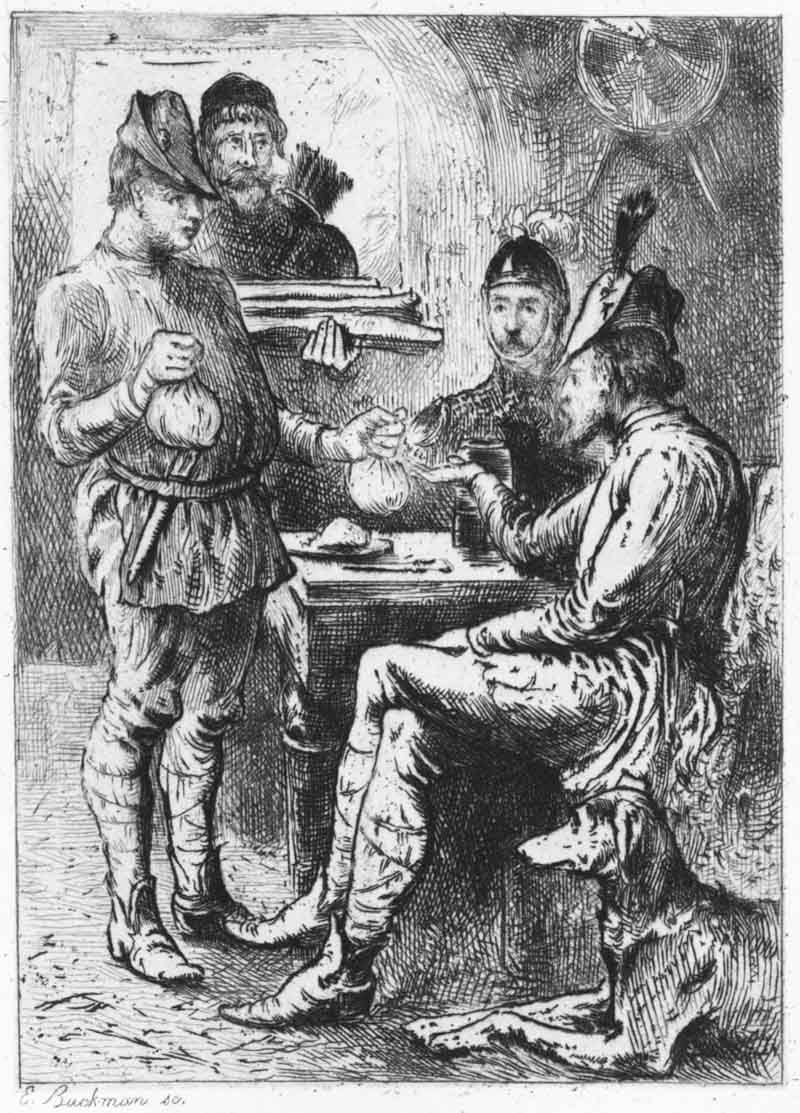
LITTLE JOHN AND THE KNIGHT.
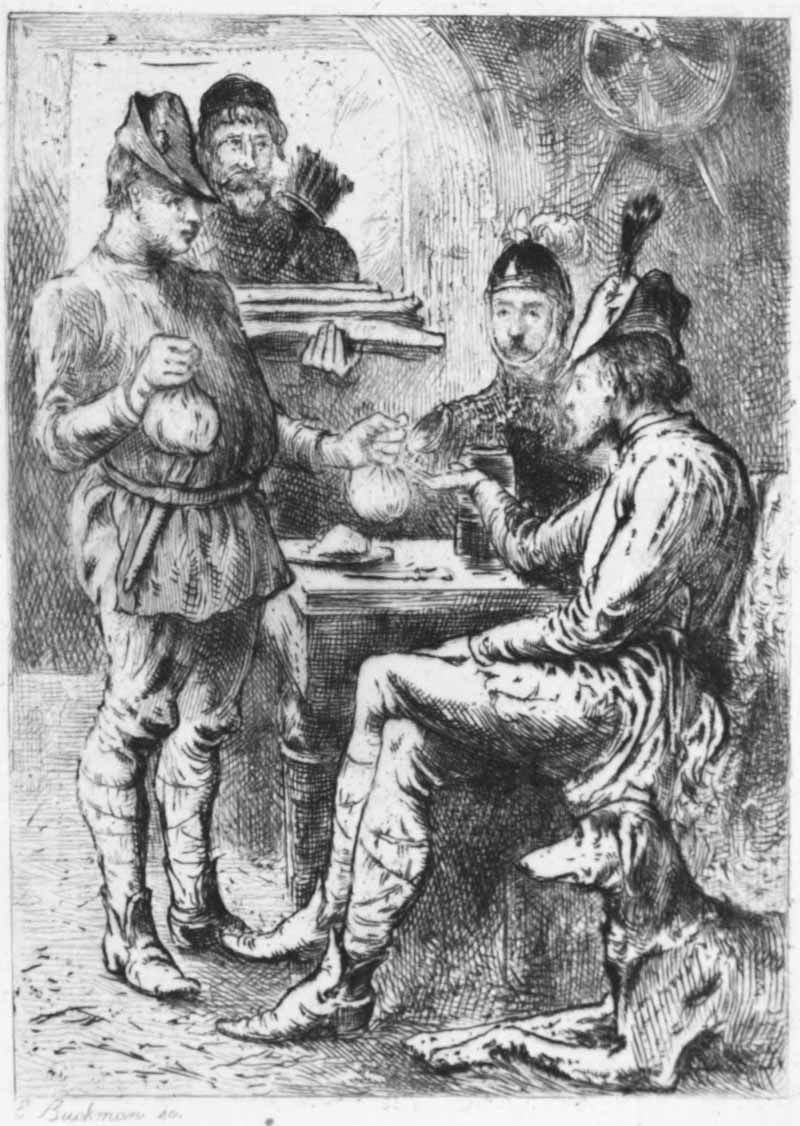
LITTLE JOHN AND THE KNIGHT.
{15}
And of every handfull that he met
He lept ouer fotes thre.
What devilkyns draper, sayd litell Much,
Thynkyst thou to be ?
Scathelocke stoode full styll and lough,
And sayd, By god allmyght,
Johan may gyve hym the better mesure,
By god, it cost him but lyght.
Mayster, sayd Lytell Johan,
All unto Robyn Hode,
Ye must gyve that knight an hors,
To lede home al this good.
Take hym a gray courser, sayd Robyn,
And a sadell newe ;
He is our ladyes messengere,
God lene139 that he be true.
And a good palfraye, sayd lytell Moch,
To mayntayne hym in his ryght.
And a payre of botes, sayd Scathelocke,
For he is a gentyll knyght.
What shalt thou gyve hym, Lytel Johan ? sayd Robyn.
Syr, a payre of gylte spores clene,
To pray for all this company :
God brynge hym out of tene ! {16}
Whan shall my daye be, sayd the knyght,
Syr, and your wyll be ?
This daye twelve moneth, sayd Robyn,
Under this grene wode tre.
It were grete shame, sayd Robyn,
A knyght alone to ryde,
Without squyer, yeman or page,
To walke by hys syde.
I shall the lene Lytyll Johan my man,
For he shall be thy knave ;
In a yemans steed he may the stonde,
Yf thou grete nede have.
THE SECONDE FYTTE.
Nowe is the knyght went on this way,
This game he thought full good,
When he loked on Bernysdale,
He blyssed Robyn Hode ;
And whan he thought on Bernysdale,
On Scathelock, Much, and Johan,
He blyssed them for the best company
That ever he in come. {17}
Then spake that gentyll knyght,
To Lytel Johan gan he saye,
To morowe I must to Yorke toune,
To Saynt Mary abbay ;
And to the abbot of that place
Foure hondred pounde I must pay :
And but I be there upon this nyght
My londe is lost for ay.
The abbot sayd to his covent,
There he stode on grounde,
This day twelfe moneth came there a knyght
And borowed foure hondred pounde.
[He borowed foure hondred pounde,]
Upon all his londe fre,
But he come this ylke day
Dysherytye shall he be.
It is full erely, sayd the pryoure,140
The day is not yet ferre gone,
I had lever to pay an hondred pounde,
And lay it downe a none.
The knyght is ferre be yonde the see,
In Englonde is his ryght,
And suffreth honger and colde
And many a sory nyght ; {18}
It were grete pytè, sayd the pryoure,
So to have his londe,
And ye be so lyght of your conseyence
Ye do to him moch wronge.
Thou arte euer in my berde, sayd the abbot,
By god and saynt Rycharde.141
With that cam in a fat-heded monke,
The heygh selerer ;
He is dede or hanged, sayd the monke,
By god that bought me dere,
And we shall have to spende in this place
Foure hondred pounde by yere.
The abbot and the hy selerer,
Sterte forthe full bolde,
The high justyce of Englonde
The abbot there dyde holde. {19}
The hye justyce and many mo
Had take into their honde
Holy all the knyghtes det,
To put that knyght to wronge.
They demed the knyght wonder sore,
The abbot and hys meynè :
“But he come this ylke day
Dysheryte shall he be.”
He wyll not come yet, sayd the justyce,
I dare well undertake.
But in sorowe tyme for them all
The knyght came to the gate.
Than bespake that gentyll knyght
Untyll hys meynè,
Now put on your symple wedes
That ye brought fro the see.
[They put on their symple wedes,]
And came to the gates anone,
The porter was redy hymselfe,
And welcomed them everychone.
Welcome, syr knyght, sayd the portèr,
My lorde to mete is he,
And so is many a gentyll man,
For the love of the. {20}
The porter swore a full grete othe,
By god that made me,
Here be the best coresed hors
That ever yet sawe I me.
Lede them into the stable, he sayd,
That eased myght they be.
They shall not come therin, sayd the knyght,
By god that dyed on a tre.
Lordes were to mete isette
In that abbotes hall,
The knyght went forth and kneled downe,
And salved them grete and small.
Do gladly, syr abbot, sayd the knyght,
I am come to holde my day.
The fyrst word the abbot spake,
Hast thou brought my pay ?
Not one peny, sayd the knyght,
By god that maked me.
Thou art a shrewed dettour, sayd the abbot :
Syr justyce, drynke to me.
What doost thou here, sayd the abbot,
But thou haddest brought thy pay ?
For god, than sayd the knyght,
To pray of a lenger daye. {21}
Thy daye is broke, sayd the justyce,
Londe getest thou none.
“Now, good syr justyce, be my frende,
And fende me of my fone.”
I am holde with the abbot, sayd the justyce,
Bothe with cloth and fee.
“Now, good syr sheryf, be my frende.”
Nay for god, sayd he.
“Now, good syr abbot, be my frende,
For thy curteysè,
And holde my londes in thy honde
Tyll I have made the gree ;
And I wyll be thy true servaunte,
And trewely serve the,
Tyl ye have foure hondred pounde
Of money good and free.”
The abbot sware a full grete othe,
By god that dyed on a tree,
Get the londe where thou may,
For thou getest none of me.
By dere worthy god, then sayd the knyght,
That all this worlde wrought,
But I have my londe agayne
Full dere it shall be bought ; {22}
God, that was of a mayden borne
Lene us142 well to spede !
For it is good to assay a frende
Or that a man have nede.
The abbot lothely on hym gan loke
And vylaynesly hym gan ‘call ;’ 143
Out, he sayd, thou false knyght,
Spede the out of my hall !
Thou lyest, then sayd the gentyll knyght,
Abbot in thy hal ;
False knyght was I never,
By god that made us all.
Up then stode that gentyll knyght,
To the abbot sayd he,
To suffre a knyght to knele so longe,
Thou canst no curteysye ;
In joustes and in tournement
Full ferre than have I be,
And put myselfe as ferre in prees
As ony that ever I se.
What wyll ye gyve more ? sayd the justyce,
And the knyght shall make a releyse ;
And elles dare I safly swere
Ye holde never your londe in pees. {23}
An hondred pounde, sayd the abbot.
The justyce said, Gyve him two.
Nay, be god, sayd the knyght,
Yet gete144 ye it not soo :
Though ye wolde gyve a thousande more,
Yet were ‘ye’ 145 never the nere :
Shall there never be myn eyre,
Abbot, justyse, ne frere.
He sterte hym to a borde anone,
Tyll a table rounde,
And there he shoke out of a bagge
Even foure hondred pounde.
Have here thy golde, syr abbot, sayd the knyght,
Which that thou lentest me ;
Haddest thou ben curteys at my comynge,
Rewarde sholdest thou have be.
The abbot sat styll, and ete no more,
For all his ryall chere,
He caste his hede on his sholdèr,
And fast began to stare.
Take me my golde agayne, sayd the abbot,
Syr justyce, that I toke the.
Not a peny, sayd the justyce,
By god, that dyed on a tree. {24}
“Syr abbot, and ye men of lawe,
Now have I holde my daye,
Now shall I have my londe agayne,
For ought that you can saye.”
The knyght stert out of the dore,
Awaye was all his care,
And on he put his good clothynge,
The other he lefte there.
He wente hym forthe full mery syngynge,
As men have tolde in tale,
His lady met hym at the gate,
At home in ‘Wierysdale.’ 146
Welcome, my lorde, sayd his lady ;
Syr, lost is all your good ?
Be mery, dame, sayd the knyght,
And praye for Robyn Hode,
That ever his soule be in blysse,
He holpe me out of my tene ;
Ne had not be his kyndenesse,
Beggers had we ben.
The abbot and I acordyd ben,
He is served of his pay,
The good yeman lent it me,
As I came by the way. {25}
This knyght than dwelled fayre at home,
The soth for to say,
Tyll he had got foure hondreth pounde
All redy for too paye.
He purveyed hym an hondred bowes,
The strenges [were] welle dyght,
An hondred shefe of arowes good,
The hedes burnyshed full bryght,
And every arowe an elle longe,
With pecocke well ydyght,
Inocked all with whyte sylvèr,
It was a semly syght.
He purveyed hym an hondreth men,
Well harneysed in that stede,
And hymselfe in that same sete,147
And clothed in whyte and rede.
He bare a launsgay in his honde,
And a man ledde his male,
And reden with a lyght songe,
Unto Bernysdale.
As he went at a brydge ther was a wrastelyng,
And there taryed was he,
And there was all the best yemèn,
Of all the west countree. {26}
A full fayre game there was upset,
A whyte bull up ipyght ; 148
A grete courser with sadle and brydil,
With golde burneyshed full bryght ;
A payre of gloves, a rede golde rynge,
A pype of wyne, in good fay :
What man bereth him best, I wys,
The pryce shall bere away.
There was a yeman in that place,
And best worthy was he,
And for he was ferre and frend bestad,
Islayne he sholde have be.
The knyght had reuth of this yemàn,
In place where that he stode,
He said that yoman sholde have no harme,
For love of Robyn Hode.
The knyght presed into the place,
An hondred folowed hym ‘fre,’ 149
With bowes bent, and arowes sharpe,
For to shende that company.
They sholdred all, and made hym rome,
To wete that he wolde say,
He toke the yeman by the honde,
And gave hym all the playe ; {27}
He gave hym fyve marke for his wyne,
There it laye on the molde,
And bad it sholde be sette a broche,
Drynke who so wolde.
Thus longe taryed this gentyll knyght,
Tyll that playe was done,
So longe abode Robyn fastynge,
Thre houres after the none.
THE THYRDE FYTTE.
Lyth and lysten, gentyll men,
All that now be here,
Of Lytell Johan, that was the knyghtes man,
Good myrthe ye shall here.
It was upon a mery day,
That yonge men wolde go shete,150
Lytell Johan fet his bowe anone,
And sayd he wolde them mete.
Thre tymes Lytell Johan shot about,
And alway cleft151 the wande,
The proude sheryf of Notyngham
By the markes gan stande. {28}
The sheryf swore a full grete othe,
By hym that dyed on a tree,
This man is the best archere
That yet sawe I me.
Say me now, wyght yonge man,
What is now thy name ?
In what countre were thou152 born,
And where is thy wonnynge wan ?
“In Holdernesse I was bore,
I wys all of my dame,
Men call me Reynolde Grenelefe,
Whan I am at hame.”
“Say me, Reynaud Grenelefe,
Wolte thou dwell with me ?
And every yere I wyll the gyve
Twenty marke to thy fee.”
I have a mayster, sayd Lytell Johan,
A curteys knyght is he,
May ye gete leve of hym,
The better may it bee.
The sheryfe gate Lytell Johan
Twelve monethes of the knyght,
Therfore he gave him ryght anone
A good hors and a wyght. {29}
Now is Lytel Johan the sheryffes man,
He gyve us well to spede,
But alway thought Lytell Johan
To quyte hym well his mede.
Now so god 153 me helpe, sayd Lytel Johan,
And be my trewe lewtè,
I shall be the worste servaunte to hym
That ever yet had he.
It befell upon a wednesday,
The sheryfe on hontynge was gone,
And Lytel Johan lay in his bed,
And was foryete at home.
Therfore he was fastynge
Tyl it was past the none,
Good syr stuard, I pray the,
Geve me to dyne, sayd Lytel Johan,
It is to long for Grenelefe,
Fastynge so long to be ;
Therfore I pray the, stuarde,
My dyner gyve thou me.
Shaly thou never ete ne drynke, sayd the stuarde,
Tyll my lord be come to towne.
I make myn avowe to god, sayd Lytell Johan,
I had lever to cracke thy crowne. {30}
The butler was ful uncurteys,
There he stode on flore,
He sterte to the buttery,
And shet fast the dore.
Lytell Johan gave the buteler such a rap,
His backe yede nygh on two,
Tho he lyved an hundreth wynter,
The wors he sholde go.
He sporned the dore with his fote,
It went up wel and fyne,
And there he made a large lyveray
Both of ale and wyne.
Syth ye wyl not dyne, sayd Lytel Johan,
I shall gyve you to drynke,
And though ye lyve an hondred wynter,
On Lytell Johan ye shall thynk.
Lytell Johan ete, and Lytell [Johan] dronke,
The whyle that he wolde.
The sheryfe had in his kechyn a coke,
A stoute man and a bolde.
I make myn avowe to god, sayd the coke,
Thou arte a shrewde hynde,
In an housholde to dwel,
For to ask thus to dyne. {31}
And there he lent Lytel Johan,
Good strokes thre.
I make myn avowe, sayd Lytell Johan,
These strokes lyketh well me.
Thou arte a bolde man and an hardy,
And so thynketh me ;
And or I passe fro this place,
Asayed better shalt thou be.
Lytell Johan drewe a good swerde,
The coke toke another in honde ;
They thought nothynge for to fle,
But styfly for to stonde.
There they fought sore togyder,
Two myle way and more,154
Myght neyther other harme done,
The mountenaunce of an houre.
I make myn avowe to god, sayd Lytell Johan,
And be my trewe lewtè,
Thou art one of the best swerdemen,
That ever yet sawe I me.
Coowdest thou shote as well in a bowe,
To grene wood thou sholdest with me,
And two tymes in the yere thy clothynge
Ichaunged sholde be ; {32}
And every yere of Robyn Hode
Twenty marke to thy fee.
Put up thy swerde, sayd the coke,
And felowes wyll we be.
Then he fette to Lytell Johan
The numbles of a doo,
Good brede and full good wyne,
They ete and dranke therto.
And whan they had dronken well,
Ther trouthes togyder they plyght,
That they wolde be with Robyn
That ylke same day at nyght.
The dyde155 them to the tresure hous,
As fast as they myght gone,
The lockes that were of good stele
They brake them everychone ;
They toke away the sylver vessell,
And all that they myght get,
Peces, masars, and spones,
Wolde they non forgete ;
Also they toke the good pence,
Thre hondred pounde and three ;
And dyde them strayt to Robyn Hode,
Under the grene wode tre. {33}
“God the save, my dere maystèr,
And Cryst the save and se.”
And than sayd Robyn to Lytell Johan,
Welcome myght thou be ;
And also be that fayre yemàn
Thou bryngest there with the.
What tydynges fro Notyngham ?
Lytell Johan, tell thou me.
“Well the greteth the proude sheryfe,
And sende the here by me
His coke and his sylver vessell,
And thre hondred pounde and thre.”
I make myn avow to god, sayd Robyn,
And to the trenytè,
It was never by his good wyll,
This good is come to me.
Lytell Johan hym there bethought,
On a shrewed wyle,156
Fyve myle in the forest he ran,
Hym happed at his wyll ;
Than he met the proud sheryf,
Huntynge with hounde and horne,
Lytell Johan coud his curteysye,
And kneled hym beforne : {34}
“God the save, my dere maystèr,
And Cryst the save and see.”
Raynolde Grenelefe, sayd the sheryfe,
Where hast thou nowe be ?
“I have be in this forest,
A fayre syght can I se,
It was one of the fayrest syghtes157
That ever yet sawe I me ;
Yonder I se a ryght fayre hart,
His coloure is of grene,
Seven score of dere upon an herde
Be with hym all bedene ;
His tynde are so sharp, maystèr,
Of sexty and well mo,
That I durst not shote for drede
Lest they wolde me sloo.”
I make myn avowe to god, sayd the sheryf,
That syght wolde I fayn se.
“Buske you thyderwarde, my dere maystèr,
Anone, and wende with me.”
The sheryfe rode, and Lytell Johan
Of fote he was full smarte,
And whan they came afore Robyn :
“Lo, here is the mayster harte !” {35}
Styll stode the proude sheryf,
A sory man was he :
“Wo worthe the,158 Raynolde Grenelefe !
Thou hast now betrayed me.”
I make myn avowe to god, sayd Lytell Johan,
Mayster, ye be to blame,
I was mysserved of my dynere,
When I was with you at hame.
Soone he was to super sette,
And served with sylver whyte ;
And whan the sheryf se his vessell,
For sorowe he myght not ete.
Make good chere, sayd Robyn Hode,
Sheryfe, for charytè,
And for the love of Lytell Johan,
Thy lyfe is graunted to the.
When they had supped well,
The day was all agone,
Robyn commaunded Lytell Johan
To drawe of his hosen and his shone,
His kyrtell and his cote a pye,
That was furred well fyne,
And take him a grene mantèll,
To lappe his body therin. {36}
Robyn commaunded his wyght yong men,
Under the grene wood tre,
They shall lay in that same sorte ;
That the sheryf myght them se.
All nyght laye that proud sheryf,
In his breche and in his sherte,
No wonder it was in grene wode,
Tho his sydes do smerte.
Make glad chere, sayd Robyn Hode,
Sheryfe, for charytè,
For this is our order I wys,
Under the grene wood tre.
This is harder order, sayd the sheryfe,
Than ony anker or frere ;
For al the golde in mery Englonde
I wolde not longe dwell here.
All these twelve monethes, sayd Robyn,
Thou shake dwell with me ;
I shall the teche, proud sheryfe,
An outlawe for to be.
Or I here another nyght lye, sayd the sheryfe,
Robyn, nowe I praye the,
Smyte of my hede rather to-morne,
And I forgyve it the. {37}
Lete me go, then sayd the sheryf,
For saynt Charytè,
And I wyll be thy best frende
That ever yet had the.
Thou shalte swere me an othe, sayd Robyn,
On my bryght bronde,
Thou shalt never awayte me scathe,
By water ne by londe ;
And if thou fynde ony of my men,
By nyght or by day,
Upon thyne othe thou shalt swere,
To helpe them that thou may.
Now have the sheryf iswore his othe,
And home he began to gone,
He was as full of grene wode
As ever was hepe of stone.
THE FOURTH FYTTE.
The sheryf dwelled in Notynghame,
He was fayne that he was gone,
And Robyn and his mery men
Went to wode anone. {38}
Go we to dyner, sayd Lytell Johan.
Robyn Hode sayd, Nay ;
For I drede our lady be wroth with me,
For she sent me not my pay.
Have no dout, mayster, sayd Lytell Johan,
Yet is not the sonne at rest,
For I dare saye, and saufly swere,
The knyght is trewe and trust.
Take thy bowe in thy hande, sayd Robyn,
Let Moch wende with the,
And so shall Wyllyam Scathelock,
And no man abyde with me,
And walke up into the Sayles,
And to Watlynge-strete,
And wayte after ‘some’ 159 unketh gest,
Up-chaunce ye may them mete.
Whether he be messengere,
Or a man that myrthes can,
Or yf he be a pore man,
Of my good he shall have some.
Forth then stert Lytel Johan,
Half in tray and tene,
And gyrde hym with a full good swerde,
Under a mantel of grene. {39}
They went up to the Sayles,
These yemen all thre ;
They loked est, they loked west,
They myght no man se.
But as ‘they’ 160 loked in Bernysdale,
By the hye waye,
Than were they ware of two blacke monkes,
Eche on a good palferay.
Then bespake Lytell Johan,
To Much he gan say,
I dare lay my lyfe to wedde,
That these monkes have brought our pay.
Make glad chere, sayd Lytell Johan,
And frese our bowes of ewe,
And loke your hertes be seker and sad,
Your strynges trusty and trewe.
The monke hath fifty two men,
And seven somers full stronge,
There rydeth no bysshop in this londe
So ryally, I understond.
Brethern, sayd Lytell Johan,
Here are no more but we thre :
But we brynge them to dyner,
Our mayster dare we not se. {40}
Bende your bowes, sayd Lytell Johan,
Make all yon161 prese to stonde,
The formost monke, his lyfe and his deth
Is closed in my honde.
Abyde, chorle monke, sayd Lytell Johan,
No ferther that thou gone ;
Yf thou doost, by dere worthy god,
Thy death is in my honde.
And evyll thryfte on thy hede, sayd Lytell Johan,
Ryght under thy hattes bonde,
For thou hast made our mayster wroth,
He is fastynge so longe.
Who is your mayster ? sayd the monke.
Lytell Johan sayd, Robyn Hode.
He is a stronge thefe, sayd the monke,
Of hym herd I never good.
Thou lyest, than sayd Lytell Johan,
And that shall rewe the ;
He is a yeman of the forèst,
To dyne he hath bode the.
Much was redy with a bolte,
Redly and a none,
He set162 the monke to fore the brest,
To the grounde that he can gone. {41}
Of fyfty two wyght yonge men,163
There abode not one,
Saf a lytell page, and a grome
To lede the somers with Johan.164
They brought the monke to the lodge dore,
Whether he were loth or lefe,
For to speke with Robyn Hode,
Maugre in theyr tethe.
Robyn dyde adowne his hode,
The monke whan that he se ;
The monke was not so curteyse,
His hode then let he be.
He is a chorle, mayster, by dere worthy god,
Than said Lytell Johan.
Thereof no force, sayd Robyn,
For curteysy can he none.
How many men, sayd Robyn,
Had this monke, Johan ?
“Fyfty and two whan that we met,
But many of them be gone.”
Let blowe a horne, sayd Robin,
That felaushyp may us knowe ;
Seven score of wyght yemen,
Came pryckynge on a rowe, {42}
And everych of them a good mantèll
Of scarlet and of raye,
All they came to good Robyn,
To wyte what he wolde say.
They made the monke to wasshe and wype,
And syt at his denere,
Robyn Hode and Lytel Johan
They served ‘him’ 165 bothe in fere.
Do gladly, monke, sayd Robyn.
Gramercy, syr, said he.
“Where is your abbay, whan ye are at home,
And who is your avowè ?”
Saynt Mary abbay, sayd the monke,
Though I be symple here.
In what offyce ? sayd Robyn.
“Syr, the hye selerer.”
Ye be the more welcome, sayd Robyn,
So ever mote I the.
Fyll of the best wyne, sayd Robyn,
This monke shall drynke to me.
But I have grete mervayle, sayd Robyn,
Of all this longe day,
I drede our lady be wroth with me,
She sent me not my pay. {43}
Have no doute, mayster, sayd Lytell Johan,
Ye have no nede I saye,
This monke it hath brought, I dare well swere,
For he is of her abbay.
And she was a borowe, sayd Robyn,
Betwene a knyght and me,
Of a lytell money that I hym lent,
Under the grene wode tree ;
And yf thou hast that sylver ibroughte,
I praye the let me se,
And I shall helpe the eftsones,
Yf thou have nede of 166 me.
The monke swore a full grete othe,
With a sory chere,
Of the borowehode thou spekest to me,
Herde I never ere.
I make myn avowe to god, sayd Robyn,
Monke, thou arte to blame,
For god is holde a ryghtwys man,
And so is his dame.
Thou toldest with thyn owne tonge,
Thou may not say nay,
How thou arte her servaunt,
And servest her every day : {44}
And thou art made167 her messengere,
My money for to pay,
Therfore I cun the more thanke,
Thou arte come at thy day.
What is in your cofers ? sayd Robyn,
Trewe than tell thou me.
Syr, he sayd, twenty marke,
Al so mote I the.
Yf there be no more, sayd Robyn,
I wyll not one peny ;
Yf thou hast myster of ony more,
Syr, more I shall lende to the ;
And yf I fynde more, sayd Robyn,
I wys thou shalte it forgone ;
For of thy spendynge sylver, monk,
Therof wyll I ryght none.
Go nowe forthe, Lytell Johan,
And the trouth tell thou me ;
If there be no more but twenty marke,
No peny that I se.
Lytell Johan spred his mantell downe,
As he had done before,
And he tolde out of the monkes male,
Eyght hundreth pounde168 and more. {45}
Lytell Johan let it lye full styll,
And went to his mayster in hast ;
Syr, he sayd, the monke is trewe ynowe,
Our lady hath doubled your cost.
I make myn avowe to god, sayd Robyn,
Monke, what tolde I the ?
Our lady is the trewest womàn,
That ever yet founde I me.
By dere worthy god, sayd Robyn,
To seche all Englond thorowe,
Yet founde I never to my pay
A moche better borowe.
Fyll of the best wyne, do hym drynke, sayd Robyn ;
And grete well thy lady hende,
And yf she have nede of 169 Robyn Hode,
A frende she shall hym fynde ;
And yf she nedeth ony more sylvèr,
Come thou agayne to me,
And, by this token she hath me sent,
She shall have such thre.
The monke was going to London ward,
There to holde grete mote,
The knyght that rode so hye on hors,
To brynge hym under fote. {46}
Whether be ye away ? sayd Robyn.
“Syr, to maners in this londe,
Too reken with our reves,
That have done moch wronge.”
“Come now forth, Lytell Johan,
And harken to my tale,
A better yeman I knowe none
To seke a monkes male.”
How moch is in yonder other ‘cofer ?’ 170 sayd Robyn,
The soth must we see.
By our lady, than sayd the monke,
That were no curteysye,
To bydde a man to dyner,
And syth hym bete and bynde.
It is our olde maner, sayd Robyn,
To leve but lytell behynde.
The monke toke the hors with spore,
No lenger wolde he abyde.
Aske to drynke, than sayd Robyn,
Or that ye forther ryde.
Nay, for god, than sayd the monke,
Me reweth I cam so nere,
For better chepe I myght have dyned,
In Blythe or in Dankestere. {47}
Grete well your abbot, sayd Robyn,
And your pryour, I you pray,
And byd hym send me such a monke,
To dyner every day.
Now lete we that monke be styll,
And speke we of that knyght,
Yet he came to holde his day
Whyle that it was lyght.
He dyde hym streyt to Bernysdale,
Under the grene wode tre,
And he founde there Robyn Hode,
And all his mery meynè.
The knyght lyght downe of his good palfrày,
Robyn whan he gan see,
So curteysly he dyde adoune his hode,
And set hym on his knee.
“God the save, good Robyn Hode,
And al this company.”
“Welcome be thou, gentyll knyght,
And ryght welcome to me.”
Than bespake hym Robyn Hode,
To that knyght so fre,
What nede dryveth the to grene wode ?
I pray the, syr knyght, tell me. {48}
And welcome be thou, gentyl knyght,
Why hast thou be so longe ?
“For the abbot and the hye justyce
Wolde have had my londe.”
Hast thou thy lond agayne ?171 sayd Robyn,
Treuth than tell thou me.
Ye, for god, sayd the knyght,
And that thanke I god and the.
But take not a grefe, I have be so longe ; 172
I came by a wrastelynge
And there I dyd holpe a pore yemàn,
With wronge was put behynde.
Nay, for god, sayd Robyn,
Syr knyght, that thanke I the ;
What man that helpeth a good yemàn,
His frende than wyll I be.
Have here foure hondred pounde, than sayd the knyght,
The whiche ye lent to me ;
And here is also twenty marke
For your curteysy.
Nay, for god, than sayd Robyn,
Thou broke it well for ay,
For our lady, by her selerer,
Hath sent to me my pay ;
{49}
And yf I toke it twyse,173
A shame it were to me :
But trewely, gentyll knyght,
Welcom arte thou to me.
Whan Robyn had tolde his tale,
He leugh and had good chere.
By my trouthe, then sayd the knyght,
Your money is redy here.
Broke it well, sayd Robyn,
Thou gentyll knyght so fre ;
And welcome be thou, gentill knyght,
Under my trystell 174 tree.
But what shall these bowes do ? sayd Robyn,
And these arowes ifedered fre ?
By god, than sayd the knyght,
A pore present to the.
“Come now forth, Lytell Johan,
And go to my treasurè,
And brynge me there foure hondred pounde,
The monke over-tolde it me.
Have here foure hondred pounde,
Thou gentyll knyght and trewe,
And bye hors and harnes good,
And gylte thy spores all newe : {50}
And yf thou fayle ony spendynge,
Com to Robyn Hode,
And by my trouth thou shalt none fayle
The whyles I have any good.
And broke well thy four hundred pound,
Whiche I lent to the,
And make thy selfe no more so bare,
By the counsell of me.”
Thus than holpe hym good Robyn,
The knyght all of his care.175
God, that sytteth176 in heven hye,
Graunte us well to fare.
THE FYFTH FYTTE.
Now hath the knyght his leve itake,
And wente hym on his way ;
Robyn Hode and his mery men
Dwelled styll full many a day.
Lyth and lysten, gentil men,
And herken what I shall say,
How the proud sheryfe of Notyngham
Dyde crye a full fayre play ; {51}
That all the best archers of the north
Sholde come upon a day,
And ‘he’ that shoteth ‘alder’ best177
The game shall bere away.
“He that shoteth ‘alder’ 178 best
Furthest fayre and lowe,
At a payre of fynly buttes,
Under the grene wode shawe,
A ryght good arowe he shall have,
The shaft of sylver whyte,
The heade and the feders of ryche red golde,
In Englond is none lyke.”
This then herde good Robyn,
Under his trystell tre :
“Make you redy, ye wyght yonge men,
That shotynge wyll I se.
Buske you, my mery yonge men,
Ye shall go with me ;
And I wyll wete the shryves fayth,
Trewe and yf he be.”
Whan they had theyr bowes ibent,
Theyr takles fedred fre,
Seven score of wyght yonge men
Stode by Robyns kne. {52}
Whan they cam to Notyngham,
The buttes were fayre and longe,
Many was the bolde archere
That shoted with bowes stronge.
“There shall but syx shote with me,
The other shal kepe my hede,
And stande with good bowes bent
That I be not desceyved.”
The fourth outlawe his bowe gan bende,
And that was Robyn Hode,
And that behelde the proude sheryfe,
All by the but he stode.
Thryes Robyn shot about,
And alway he slist179 the wand,
And so dyde good Gylberte,
With the whyte hande.
Lytell Johan and good Scatheloke
Were archers good and fre ;
Lytell Much and good Reynolde,
The worste wolde they not be.
Whan they had shot aboute,
These archours fayre and good,
Evermore was the best,
Forsoth, Robyn Hode. {53}
Hym was delyvered the goode aròw,
For best worthy was he ;
He toke the yeft so curteysly,
To grene wode wolde he.
They cryed out on Robyn Hode,
And great hornes gan they blowe.
Wo worth the, treason ! sayd Robyn,
Full evyl thou art to knowe.
And we be thou, thou proud sheryf,
Thus gladdynge thy gest,
Other wyse thou behote me
In yonder wylde forest ;
But had I the in grene wode,
Under my trystell tre,
Thou sholdest leve me a better wedde
Than thy trewe lewtè.
Full many a bowe there was bent,
And arowes let they glyde,
Many a kyrtell there was rent,
And hurt many a syde.
The outlawes shot was so stronge,
That no man myght them dryve,
And the proud sheryfes men
They fled away full blyve.180 {54}
Robyn sawe the busshement to-broke,
In grene wode he wolde have be,
Many an arowe there was shot
Amonge that company.
Lytell Johan was hurte full sore,
With an arowe in his kne,
That he myght neyther go nor ryde ;
It was full grete pytè.
Mayster, then sayd Lytell Johan,
If ever thou lovest me,
And for that ylke lordes love,
That dyed upon a tre,
And for the medes of my servyce
That I have served the,
Lete never the proude sheryf
Alyve now fynde me ;
But take out thy browne swerde,
And smyte all of my hede,
And gyve me woundes dede and wyde,
No lyfe on me be lefte.181
I wolde not that, sayd Robyn,
Johan, that thou were slawe,
For all the golde in mery Englond,
Though it lay now on a rawe {55}
God forbede, sayd lytell Much,
That dyed on a tre,
That thou sholdest, Lytell Johan,
Parte our company.
Up he toke him on his backe,
And bare hym well a myle,
Many a tyme he layd hym downe
And shot another whyle.
Then was there a fayre castèll,
A lytell within the wode,
Double-dyched it was about,
And walled, by the rode ;
And there dwelled that gentyll knyght,
Syr Rychard at the Lee,
That Robyn had lent his good,
Under the grene wode tree.
In he toke good Robyn,
And all his company :
“Welcome be thou, Robyn Hode,
Welcome arte thou [to] me ;
And moche [I] thanke the of thy comfort,
And of thy curteysye,
And of thy grete kyndenesse,
Under the grene wode tre ; {56}
I love no man in all this worlde
So moch as I do the ;
For all the proud sheryf of Notyngham,
Ryght here shalt thou be.
Shyt the gates, and drawe the bridge,
And let no man com in ;
And arme you well, and make you redy,
And to the walle ye wynne.
For one thyng, Robyn, I the behote,
I swere by saynt Quyntyn,
These twelve dayes thou wonest with me,
To suppe, ete, and dyne.”
Bordes were layed, and clothes spred,
Reddely and anone ;
Robyn Hode and his mery men
To mete gan they gone.
THE SYXTE FYTTE.
Lythe and lysten, gentylmen,
And herken unto your songe ;
How the proude sheryfe of Notyngham,
And men of armes stronge, {57}
Full faste came to the hye sheryfe,
The countre up to rout,
And they beset the knyghts castèll,
The walles all about.
The proude sheryf loude gan crye,
And sayd, Thou traytour knyght,
Thou kepeste here the kynges enemye,
Agayne the lawes and ryght.
“Syr, I wyll avowe that I have done,
The dedes that here182 be dyght,
Upon all the londes that I have,
As I am a trewe knyght.
Wende forthe, syrs, on your waye,
And doth no more to me,
Tyll ye wytte our kynges wyll
What he woll say to the.”
The sheref thus had his answere,
With out ony leasynge,
Forthe he yode to London toune,
All for to tel our kynge.
There he tolde him of that knyght,
And eke of Robyn Hode,
And also of the bolde archeres,
That noble were and good. {58}
“He wolde avowe that he had done,
To mayntayne the outlawes stronge,
He wolde be lorde, and set you at nought,
In all the north londe.”
I woll be at Notyngham, sayd the kynge,
Within this fourtynyght,
And take I wyll Robyn Hode,
And so I wyll that knyght.
Go home, thou proud sheryf,
And do as I bydde the,183
And ordayne good archeres inowe,
Of all the wyde countree.
The sheryf had his leve itake,
And went hym on his way :
And Robyn Hode to grene wode [went]
Upon a certayn day ;
And Lytell Johan was hole of the arowe,
That shote was in his kne,
And dyde hym strayte to Robyn Hode,
Under the grene wode tre.
Robyn Hode walked in the foreste,
Under the leves grene,
The proude sheryfe of Notyngham,
Therfore he had grete tene.
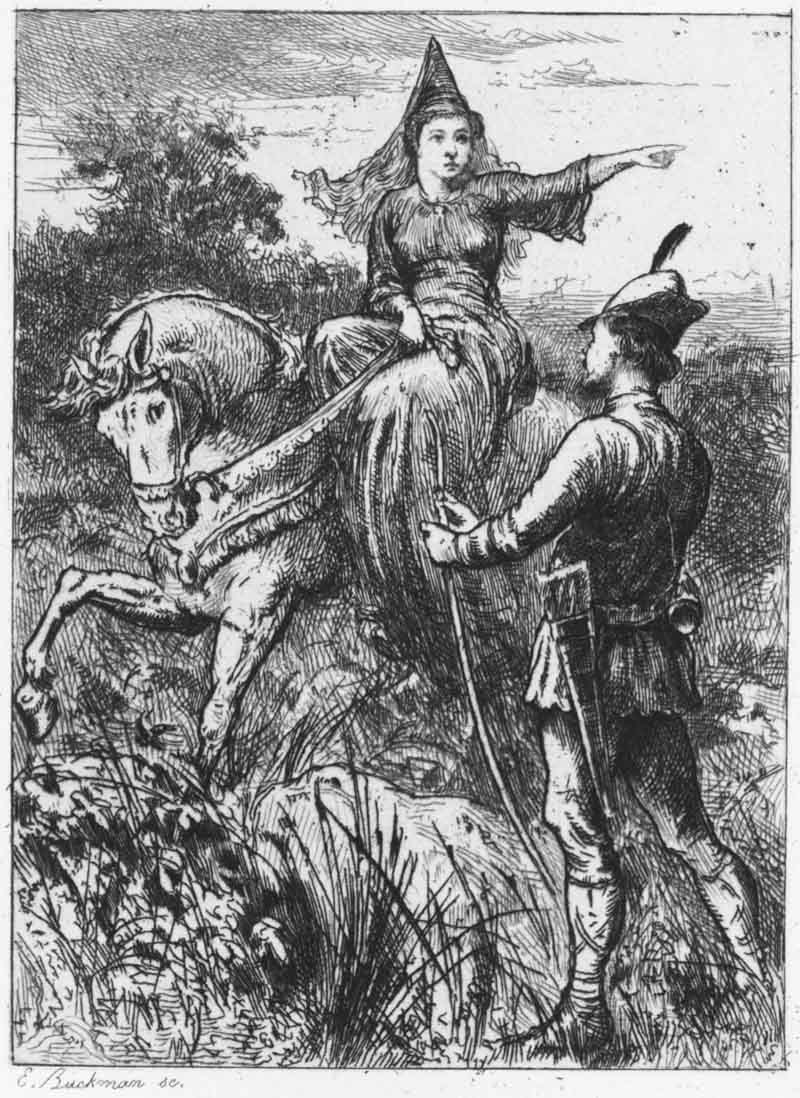
ROBIN HOOD AND THE LADY.
ROBIN HOOD AND THE LADY.
{59}
The sheryf there fayled of Robyn Hode,
He myght not have his pray,
Then he awayted that gentyll knyght,
Bothe by nyght and by daye.
Ever he awayted that gentyll knyght,
Syr Rychard at the Lee ;
As he went on haukynge by the ryver syde,
And let his haukes flee,
Toke he there this gentyll knyght,
With men of armes stronge,
And lad hym home to Notyngham warde,
Ibonde both fote and honde.184
The sheryf swore a full grete othe,
By hym that dyed on a tre,
He had lever than an hondrede pounde,
That Robyn Hode had he.185
Then the lady, the knyghtes wyfe,
A fayre lady and fre,
She set her on a gode palfrày,
To grene wode anon rode she.
When she came to the forèst,
Under the grene wode tre,
Founde she there Robyn Hode,
And all his fayre meynè. {60}
“God the save, good Robyn Hode,186
And all thy company ;
For our dere ladyes187 love,
A bone graunte thou me.
Let188 thou never my wedded lorde
Shamfully slayne to be ; 189
He is fast ibounde to Notyngham warde,
For the love of the.”
Anone then sayd good Robyn,
To that lady fre,
What man hath your lorde itake ?
The proude shirife, than sayd she.190
[The proude sheryfe hath hym itake]
Forsoth as I the say ;
He is not yet thre myles,
Passed on ‘his’ 191 waye.
Up then sterte good Robyn,
As a man that had be wode :
“Buske you, my mery younge men,
For hym that dyed on a rode ; {61}
And he that this sorowe forsaketh,
By hym that dyed on a tre,
And by him that al thinges maketh,
No lenger shall dwell with me.” 192
Sone there were good bowes ibent,
Mo than seven score,
Hedge ne dyche spared they none,
That was them before.
I make myn avowe to god, sayd Robyn,
The knyght wolde I fayn se,
And yf I may hym take,
Iquyt than shall he193 bee.
And whan they came to Notyngham,
They walked in the strete,
And with the proud sheryf, I wys,
Sone gan they mete.
Abyde, thou proud sheryf, he sayd,
Abyde and speake with me,
Of some tydynges of our kynge,
I wolde fayne here of the.
This seven yere, by dere worthy god,
Ne yede I so fast on fote,
I make myn avowe to god, thou proud sheryfe,
‘It’ 194 is not for thy good. {62}
Robyn bent a good bowe,
An arrowe he drewe at his wyll,
He hyt so the proud sheryf,
Upon the grounde he lay full styll ;
And or he myght up aryse,
On his fete to stonde,
He smote of the sheryves hede,
With his bryght bronde.
“Lye thou there, thou proud sheryf,
Evyll mote thou thryve ;
There myght no man to the trust,
The whyles thou were alyve.”
His men drewe out theyr bryght swerdes,
That were so sharpe and kene,
And layde on the sheryves men,
And dryved them downe bydene.
Robyn stert to that knyght,
And cut a two his bonde,195
And toke hym in his hand a bowe,
And bade hym by hym stonde.
“Leve thy hors the behynde,
And lerne for to renne ;
Thou shalt with me to grene wode,
Through myre, mosse and fenne ; {63}
Thou shalt with me to grene wode,
Without ony leasynge,
Tyll that I have gete us grace,
Of Edwarde our comly kynge.”
THE SEVENTH FYTTE
The kynge came to Notynghame,
With knyghtes in grete araye,
For to take that gentyll knyght,
And Robyn Hood, yf 196 he may.
He asked men of that countrè,
After Robyn Hode,
And after that gentyll knyght,
That was so bolde and stout.
Whan they had tolde hym the case,
Our kynge understonde ther tale,
And seased in his honde
The knyghtes londes all,
All the passe of Lancasshyre,
He went both ferre and nere,
Tyll he came to Plomton parke,
He faylyd many of his dere {64}
There our kynge was wont to se
Herdes many one,
He coud unneth fynde one dere,
That bare ony good horne.
The kynge was wonder wroth withall,
And swore by the trynytè,
“I wolde I had Robyn Hode,
With eyen I myght hym se ;
And he that wolde smyte of the knyghtes hede
And brynge it to me,
He shall have the knyghtes londes,
Syr Rycharde at the Le ;
I gyve it hym with my chartèr,
And sele it with my honde,
To have and holde for ever-more,
In all mery Englonde.”
Than bespake a fayre olde knyght,
That was treue in his fay,
A, my lege lorde the kynge,
One worde I shall you say ;
There is no man in this countrè
May have the knyghtes londes,
Whyle Robyn Hode may ryde or gone,
And here a bowe in his hondes ; {65}
That he ne shall lese his hede,
That is the best ball in his hode :
Give it no man, my lorde the kynge,
That ye wyll any good.
Half a yere dwelled our comly kynge,
In Notyngham, and well more,
Coude he not here of Robyn Hode,
In what countre that he were ;
But alway went good Robyn
By halke and eke by hyll,
And alway slewe the kynges dere,
And welt them at his wyll.
Than bespake a proude fostere,
That stode by our kynges kne,
If ye wyll se good Robyn,
Ye must do after me ;
Take fyve of the best knyghtes
That be in your lede,
And walke downe by ‘yon’ 197 abbay,
And gete you monkes wede.
And I wyll be your ledes man,
And lede you the way,
And or ye come to Notyngham,
Myn hede then dare I lay, {66}
That ye shall mete with good Robyn,
On lyve yf that he be,
Or ye come to Notyngham,
With eyen ye shall hym se.
Full hastly our kynge was dyght,
So were his knyghtes fyve,
Everych of them in monkes wede,
And hasted them thyder blyth.
Our kynge was grete above his cole,
A brode hat on his crowne,
Ryght as he were abbot-lyke,
They rode up in-to the towne.
Styf botes our kynge had on,
Forsoth as I you say,
He rode syngynge to grene wode,
The covent was clothed in graye,
His male hors, and his grete somèrs,
Folowed our kynge behynde,
Tyll they came to grene wode,
A myle under the lynde,
There they met with good Robyn,
Stondynge on the waye,
And so dyde many a bolde archere,
For soth as I you say. {67}
Robyn toke the kynges hors,
Hastely in that stede,
And sayd, Syr abbot, by your leve,
A whyle ye must abyde ;
We be yemen of this foreste,
Under the grene wode tre,
We lyve by our kynges dere,
Other shyft have not we ; 198
And ye have chyrches and rentes both,
And gold full grete plentè ;
Gyve us some of your spendynge,
For saynt Charytè.199
Than bespake our cumly kynge,
Anone than sayd he,
I brought no more to grene wode,
But forty pounde with me ; {68}
I have layne at Notyngham,
This fourtynyght with our kynge,
And spent I have full moche good,
On many a grete lordynge ;
And I have but forty pounde,
No more than have I me,
But yf I had an hondred pounde,
I would geve it to the.200
Robyn toke the forty pounde,
And departed it in two partye,
Halfendell he gave his mery men,
And bad them mery to be.
Full curteysly Robyn gan say,
Syr, have this for your spendyng,
We shall mete a nother day.
Gramercy, than sayd our kynge ;
But well the greteth Edwarde our kynge,
And sent to the his seale,
And byddeth the com to Notyngham,
Both to mete and mele.
He toke out the brode tarpe,201
And sone he lete hym se ;
Robyn coud his courteysy,
And set hym on his kne : {69}
“I love no man in all the worlde
So well as I do my kynge,
Welcome is my lordes seale ;
And, monke, for thy tydynge,
Syr abbot, for thy tydynges,
To day thou shalt dyne with me,
For the love of my kynge,
Under my trystell tre.”
Forth he lad our comly kynge,
Full fayre by the honde,
Many a dere there was slayne,
And full fast dyghtande.
Robyn toke a full grete horne,
And loude he can blowe,
Seven score of wyght yonge men,
Came redy on a rowe,
All they kneeled on theyr kne,
Full fayre before Robyn.
The kygne sayd hymselfe untyll,
And swore by saynt Austyn,
Here is a wonder semely syght,
Me thynketh, by goddes pyne ;
His men are more at his byddynge,
Then my men be at myn. {70}
Full hastly was theyr dyner idyght,
And therto gan they gone,
They served our kynge with al theyr myght,
Both Robyn and Lytell Johan.
Anone before our kynge was set
The fatte venyson,
The good whyte brede, the good red wyne,
And therto the fyne ale browne.202
Make good chere, sayd Robyn,
Abbot, for charytè ;
And for this ylke tydynge,
Blyssed mote thou be.
Now shalte thou se what lyfe we lede,
Or thou hens wende,
Than thou may enfourme our kynge,
Whan ye togyder lende.
Up they sterte all in hast,
Theyr bowes were smartly bent,
Our kynge was never so sore agast,
He wende to have be shente.
Two yerdes there were up set,
There to gan they gange ;
By fifty pase, our kynge sayd,
The merkes were to longe. {71}
On every syde a rose garlonde,
They shot under the lyne.
Who so fayleth of the rose garlonde, sayd Robyn,
His takyll he shall tyne,
And yelde it to his mayster,
Be it never so fyne,
For no man wyll I spare,
So drynke I ale or wyne.
And bere a buffet on his hede
I wys203 ryght all bare.
And all that fell in Robyns lote,
He smote them wonder sare.
Twyse Robyn shot aboute,
And ever he cleved the wande,
And so dyde good Gylberte,
With the whyte204 hand.
Lytell Johan and good Scathelocke,
For nothyng wolde they spare,
When they fayled of the garlonde,
Robyn smote them full sare.
At the last shot that Robyn shot,
For all his frendes fare,
Yet he fayled of the garlonde,
Thre fyngers and mare. {72}
Than bespake good Gylberte,
And thus he gan say :
Mayster, he sayd, your takyll is lost,
Stand forth and take your pay.
If it be so, sayd Robyn,
That may no better be ;
Syr abbot, I delyver the myn arowe,
I pray the, syr, serve thou me.
It falleth not for myn order, sayd our kynge,
Robyn, by thy leve,
For to smyte no good yemàn,
For doute I sholde hym greve.
Smyte on boldely, sayd Robyn,
I give the large leve.
Anone our kynge, with that worde,
He folde up his sleve,
And sych a buffet he gave Robyn,
To grounde he yede full nere.
I make myn avowe to god, sayd Robyn,
Thou arte a stalworthe frere ;
There is pith in thyn arme, sayd Robyn,
I trowe thou canst well shote.
Thus our kynge and Robyn Hode
Togeder than they met. {73}
Robyn behelde our comly kynge
Wystly in the face,
So dyde syr Richarde at the Le,
And kneled downe in that place ;
And so dyde all the wylde outlawes,
Whan they se them knele.
“My lorde the kynge of Englonde,
Now I knowe you well.”
Mercy, then Robyn sayd to our kynge,
Under your trystyll tre,
Of thy goodnesse and thy grace,
For my men and me !
Yes, for god, sayd Robyn,
And also god me save ;
I aske mercy, my lorde the kynge,
And for my men I crave.
Yes, for god, than sayd our kynge,
Thy peticion I graunt the,
With that thou leve the grene wode,
And all thy company :
And come home, syr, to my courte,
And there dwell with me.205
I make myn avowe to god, sayd Robyn,
And ryght so shall it be ; {74}
I wyll come to your courte,
Your servyse for to se,
And brynge with me of my men
Seven score and thre.
But me lyke well your servyse,
I come agayne full soone,
And shote at the donne dere,
As I am wonte to done.
THE EIGHTH FYTTE.
Haste thou ony grene cloth, sayd our kynge,
That thou wylte sell nowe to me ?
Ye, for god, sayd Robyn,
Thyrty yerdes and thre.
Robyn, sayd our kynge,
Now pray I the,
To sell me some of that cloth,
To me and my meynè.
Yes, for god,206 then sayd Robyn,
Or elles I were a fole ;
Another day ye wyll me clothe,
I trowe, ayenst the Yole. {75}
The kynge kest of his cote then,
A grene garment he dyde on,
And every knyght had so, I wys,
They clothed them full soone.207
Whan they were clothed in Lyncolne grene,
They kest away theyr graye.
Now we shall to Notyngham,
All thus our kynge gan say.
Theyr bowes bente and forth they went,
Shotynge all in-fere,
Towarde the towne of Notyngham,
Outlawes as they were.
Our kynge and Robyn rode togyder,
For soth as I you say,
And they shote plucke-buffet,
As they went by the way ;
And many a buffet our kynge wan
Of Robyn Hode that day ;
And nothynge spared good Robyn
Our kynge in his pay.
So god me helpe, sayd our kynge,
Thy game is nought to lere,
I sholde not get a shote of the,
Though I shote all this yere. {76}
All the people of Notyngham
They stode and behelde,
They sawe nothynge but mantels of grene
That covered all the felde ;
Than every man to other gan say,
I drede our kynge be slone ;
Come Robyn Hode to the towne, I wys,
On lyve he leveth not one.208
Full hastly they began to fle,
Both yemen and knaves,
And olde wyves that myght evyll goo,
They hypped on theyr staves.
The kynge loughe209 full fast,
And commanded theym agayne ;
When they se our comly kynge,
I wys they were full fayne.
They ete and dranke, and made them glad,
And sange with notes hye.
Than bespake our comly kynge
To syr Rycharde at the Lee :
He gave hym there his londe agayne,
A good man he bad hym be.
Robyn thanked our comly kynge,
And set hym on his kne. {77}
Had Robyn dwelled in the kynges courte
But twelve monethes and thre,
That he had spent an hondred pounde,
And all his mennes fe.
In every place where Robyn came,
Ever more he layde downe,
Both for knyghtes and for squyres,
To gete hym grete renowne.
By than the yere was all agone,
He had no man but twayne,
Lytell Johan and good Scathelocke,
Wyth hym all for to gone.
Robyn sawe yonge men shote,
Full fayre210 upon a day,
Alas ! than sayd good Robyn,
My welthe is went away.
Somtyme I was an archere good,
A styffe and eke a stronge,
I was commytted 211 the best archere,
That was in mery Englonde.
Alas ! then sayd good Robyn,
Alas and well a woo !
Yf I dwele lenger with the kynge,
Sorowe wyll me sloo. {78}
Forth than went Robyn Hode,
Tyll he came to our kynge :
“My lorde the kynge of Englonde,
Graunte me myn askynge.
I made a chapell in Bernysdale,
That semely is to se,
It is of Mary Magdalene,
And thereto wolde I be ;
I myght never in this seven nyght,
No tyme to slepe ne wynke,
Nother all these seven dayes,
Nother ete ne drynke.
Me longeth sore to Bernysdale,
I may not be therfro,
Barefote and wolwarde I have hyght
Thyder for to go.”
Yf it be so, than sayd our kynge,
It may no better be ;
Seven nyght I gyve the leve,
No lengre, to dwell fro me.
Gramercy, lorde, then sayd Robyn,
And set hym on his kne ;
He toke his leve full courteysly,
To grene wode then went he. {79}
Whan he came to grene wode,
In a mery mornynge,
There he herde the notes small
Of byrdes mery syngynge.
It is ferre gone, sayd Robyn,
That I was last here,
Me lyste a lytell for to shote
At the donne dere.
Robyn slewe a full grete harte,
His horne than gan he blow,
That all the outlawes of that forèst,
That horne coud they knowe,
And gadred them togyder,
In a lytell throwe,
Seven score of wight yonge men,
Came redy on a rowe ;
And fayre dyde of theyr hodes,
And set them on theyr kne :
Welcome, they sayd, our maystèr,
Under this grene wode tre.
Robyn dwelled in grene wode,
Twenty yere and two,
For all drede of Edwarde our kynge
Agayne wolde he not goo. {80}
Yet he was begyled, I wys,
Through a wycked womàn,
The pryoresse of Kyrkesly,
That nye was of his kynne,
For the love of a knyght,
Syr Roger of Donkestèr,212
That was her owne speciall,
Full evyll mote they ‘fare.’ 213
They toke togyder theyr counsell
Robyn Hode for to sle,
And how they myght best do that dede,
His banis for to be.
Than bespake good Robyn,
In place where as he stode,
To morow I muste to Kyrkesley,
Craftely to be leten blode.
Sir Roger of Donkestere,
By the pryoresse he lay,
And there they betrayed good Robyn Hode
Through theyr false playe.
Cryst have mercy on his soule,
That dyed on the rode !
For he was a good outlawe,
And dyde pore men moch god.
II. ROBYN HODE [AND THE POTTER].
This curious, and hitherto unpublished, and even unheard of, old piece is given from a manuscript among Bishop More’s collections, in the public library of the University of Cambridge (Ee. 4. 35). The writing, which is evidently that of a vulgar and illiterate person, appears to be of the age of Henry the Seventh, that is, about the year 1500; but the composition (which he has irremediably corrupted) is probably of an earlier period, and much older, no doubt, than “The Play of Robyn Hode,” which seems allusive to the same story. At the end of the original is “Expleycyt Robyn Hode.” {82}
In schomer, when the leves spryng,
The bloschems on every bowe,
So merey doyt the berdys syng,
Yn wodys merey now.
Herkens, god yemen,
Comley, cortessey, and god,
On of the best that yever bar bou,
Hes name was Roben Hode.
Roben Hood was the yemans name,
That was boyt corteys and fre ;
For the loffe of owr ladey,
All wemen werschep ‘he.’ 214
Bot as the god yeman stod on a day,
Among hes mery manèy,
He was war of a prowd potter,
Cam dryfyng owyr the ‘ley.’ 215
Yonder comet a prod potter, seyde216 Roben,
That long hayt hantyd this wey,
He was never so corteys a man
On peney of pawage to pay. {83}
Y met hem bot at Wentbreg, seyde217 Lytyll John,
And therfor yeffell mot he the,
Seche thre strokes he me gafe,
Yet they cleffe by my seydys.
Y ley forty shillings, seyde Lytyll John,
To pay het thes same day,
Ther ys nat a man among hus218 all
A wed schall make hem ley.219
Her ys forty shillings, seyde Robèn,
Mor, and thow dar say,
That y schall make that prowde pottèr,
A wed to me schall he ley.
Ther thes money they leyde,
They toke het a yeman to kepe ;
Roben befor the potter he breyde,
‘And up to hem can lepe.’ 220
Handys apon hes horse he leyde,
And bad ‘hem’ 221 stonde foll stell.
The potter schorteley to hem seyde,
Felow, what ys they well ?
All thes thre yer, and mor, potter, he seyde,
Thow hast hantyd thes wey,
Yet wer tow never so cortys a man
One peney of pauage to pay. {84}
What ys they name, seyde the potter,
For pauage thow aske of me ?
“Roben Hod ys mey name,
A wed schall thow leffe me.”
Wed well y non leffe, seyde the potter,
Nor pavag well y non pay ;
Awey they honde fro mey horse,
Y well the tene eyls, be mey fay.
The potter to hes cart he went,
He was not to seke,
A god to-hande staffe therowt he hent,
Befor Roben he ‘lepe.’ 222
Roben howt with a swerd bent,
A bokeler on hes honde [therto] ;
The potter to Roben he went,
And seyde, Felow, let mey horse go.
Togeder then went thes two yemen,
Het was a god seyt to se ;
Therof low Robyn hes men,
Ther they stod onder a tre.
Leytell John to hes felowhes223 seyde,
Yend potter welle steffeley stonde.
The potter, with a caward stroke,
Smot the bokeler owt of hes honde ; {85}
And 224 ar Roben meyt get hen agen,
Hes bokeler at hes fette,
The potter yn the neke hem toke,
To the gronde sone he yede.
That saw Roben hes men,
As thay stode ender a bow ;
Let us helpe owr master, seyed Lytell John,
Yonder potter els well 225 hem sclo.
These yemen went226 with a breyde,
To ‘ther’ 227 master they cam.
Leytell John to hes master seyde,
Ho haet the wager won ?
Schall y haff yowr forty shillings, seyde Lytel 228 John,
Or ye, master, schall haffe myne ?
Yeff they wer a hundred, seyde Robèn,
Y feythe, they ben all theyne.
Het ys fol leytell cortesey, seyde the potter,
As y haffe harde weyse men saye,
Yeff a por yeman com drywyng ower the wey,
To let hem of hes gorney.
Be mey trowet, thow seys soyt, seyde Roben,
Thow seys god yemenrey ; 229
And thow dreyffe forthe yevery day,
Thow schalt never be let for me. {86}
Y well prey the, god potter,
A felischepe well thow haffe ?
Geffe me they clothyng, and thow schalt hafe myne ;
Y well go to Notynggam.
Y grant230 therto, seyde the potter,
Thow schalt feynde me a felow gode ;
Bot thow can sell mey pottes well,
Com ayen as thow yode.231
Nay, be mey trowt, seyde Roben,
And then y bescro mey hede,
Yeffe y bryng eney pottes ayen,
And eney weyffe well hem chepe.
Than spake Leytell John,
And all hes felowhes heynd,
Master, be well war of the screffe of Notynggam,
For he ys leytell howr frende.
Thorow the helpe of howr ladey,
Felowhes, let me alone ;
Heyt war howte, seyde Roben,
To Notynggam well y gon.
Robyn went to Notynggam,
Thes pottes for to sell ;
The potter abode with Robens men,
Ther he fered not eylle.232 {87}
Tho Roben droffe on hes wey,
So merey ower the londe.
Heres mor and affter ys to saye,
The best ys beheynde.
[THE SECOND FIT.]
When Roben cam to Notynggam,
The soyt yef y scholde saye,
He set op hes horse anon,
And gaffe hem hotys and haye.
Yn the medys of the towne,
Ther he schowed hes war,
Pottys ! pottys ! he gan crey foll sone,
Haffe hansell for the mar.
Foll effen agenest the screffeys gate,
Schowed he hes chaffar ;
Weyffes and wedowes abowt hem drow,
And chepyd fast of hes war.
Yet, Pottys, gret chepe ! creyed Robyn,
Y loffe yeffell thes to stonde.
And all that saw233 hem sell,
Seyde he had be no potter long. {88}
The pottys that wer werthe pens feyfte,
He solde tham for pens thre :
Preveley seyde man and weyffe,
Ywnder potter schall never the.
Thos Roben solde foll fast,
Tell he had pottys bot feyffe ;
Op he hem toke of his car,
And sende hem to the screffeys weyffe.
Therof sche was foll fayne,
Gereamarsey, sir, than seyde sche,234
When ye com to thes contre ayen,
Y schall bey of ‘they’ 235 pottys, so mot y the.
Ye schall haffe of the best, seyde Roben,
And swar be the treneytè.
Foll corteysley ‘she’ 236 gan hem call,
Come deyne with the screfe and me.
Godamarsey, seyde Roben,
Yowr bedyng schall be doyn.
A mayden yn the pottys gan ber,
Roben and the screffe weyffe folowed anon.
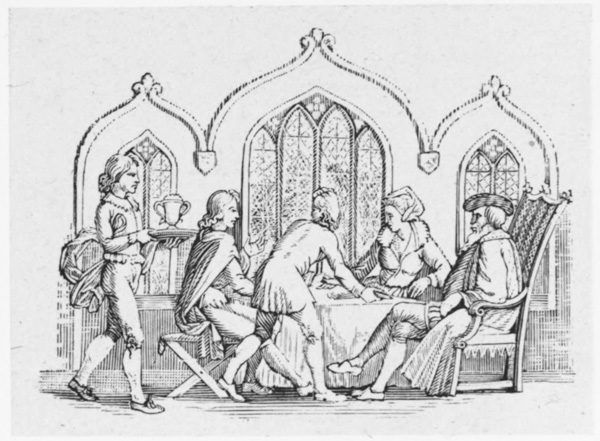
Whan Roben ynto the hall cam,
The screffe sone he met,
The potter cowed of corteysey,
And sone the screffe he gret.
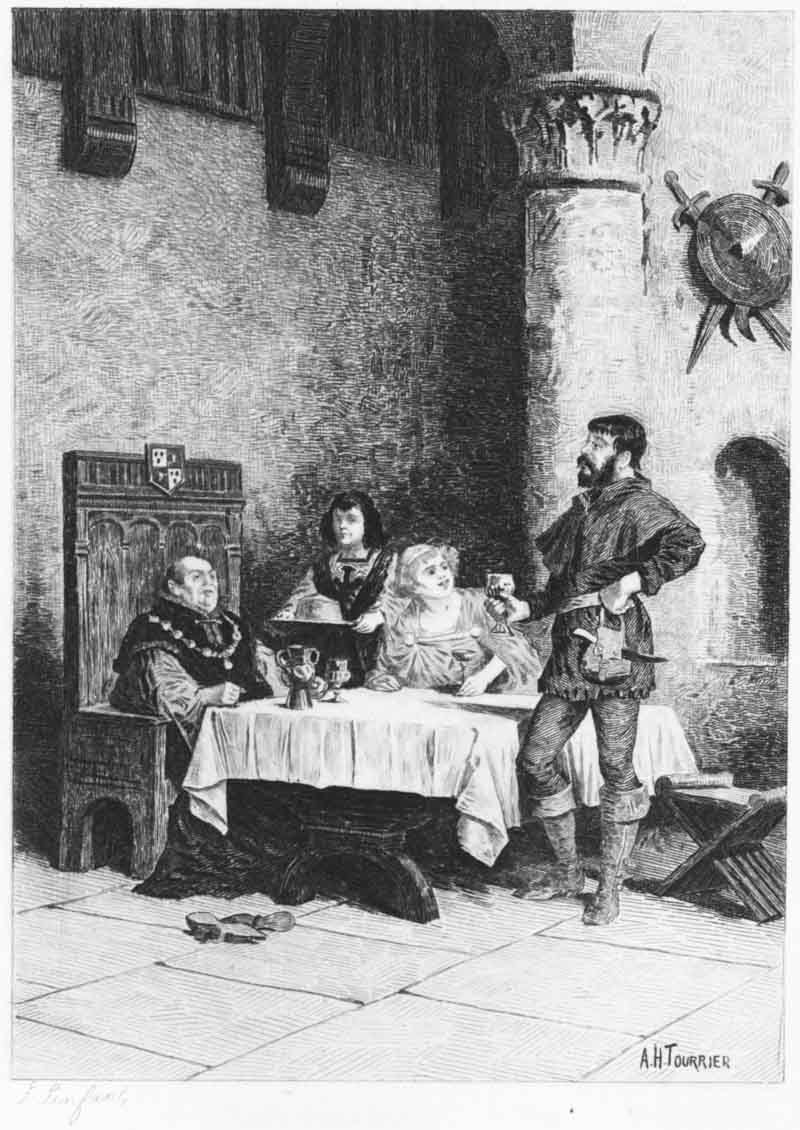
THE BANQUET.
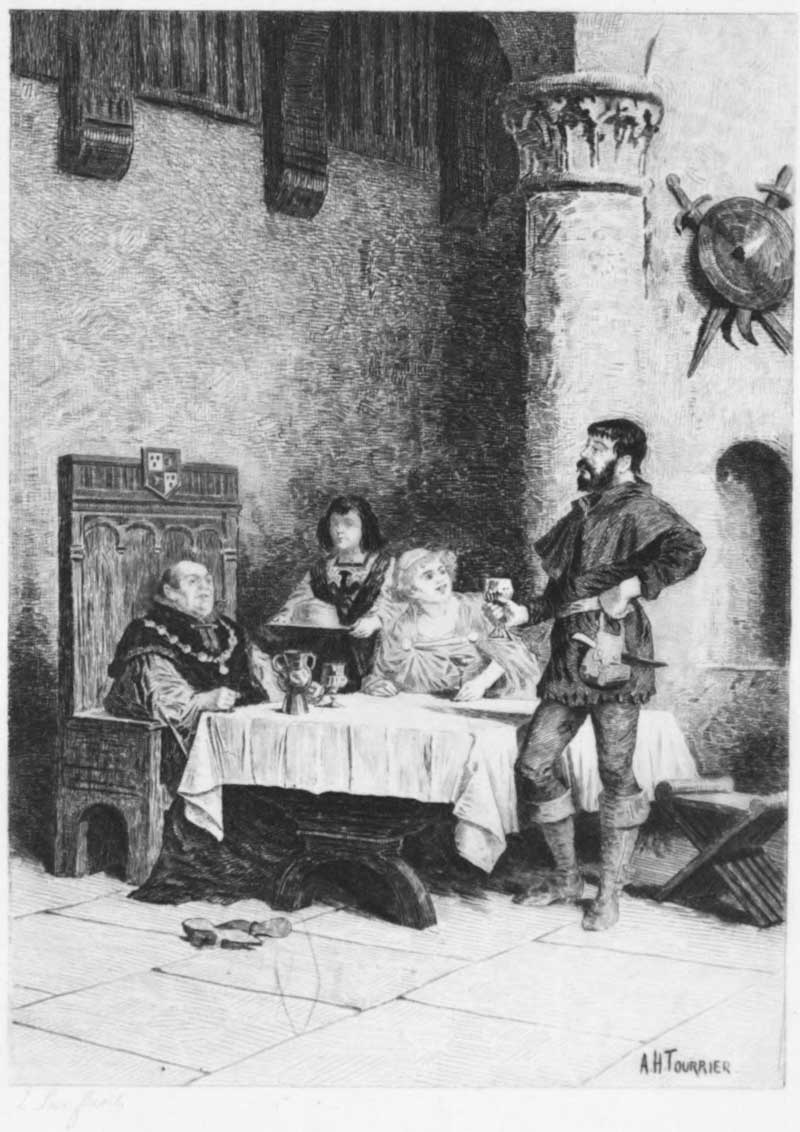
THE BANQUET.
{89}
“Loketh237 what thes potter hayt geffe yow and me !
Feyffe pottys smalle and grete !”
He ys fol welcom, seyd the screffe,
Let os was, and ‘go’ 238 to mete.
As they sat at her methe,
With a nobell cher,
Two of the screffes men gan speke
Off a gret wagèr,
Was made the thother daye,
Off a schotyng was god and feyne,239
Off forty shillings, the soyt to saye,
Who scholde thes wager wen.
Styll than sat thes prowde potter,
Thos than thowt he,
As y am a trow Cerstyn man,
Thes schotyng well y se.
When they had fared of the best,
With bred and ale and weyne,
To the ‘bottys they’ 240 made them prest,
With bowes and boltys241 foll feyne.
The screffes men schot foll fast,
As archares that weren godde,
Ther cam non ner ney the marke
Bey halfe a god archares bowe. {90}
Stell then stod the prowde potter,
Thos than seyde he,
And y had a bow, be the rode,
On schot scholde yow se.
Thow schall haffe a bow, seyde the screffe,
The best that thow well cheys of thre :
Thow semyst242 a stalward and a stronge,
Asay schall thow be.
The screffe comandyd a yeman that stod hem bey
Affter bowhes to wende ;
The best bow that the yeman browthe
Roben set on a stryng.
“Now schall y wet and thow be god,
And polle het op to they ner.”
So god me helpe, seyde the prowde pottèr,
Thys ys bot rygzt weke ger.
To a quequer Roben went,
A god bolt owthe he toke,
So ney on to the marke he went,
He fayled not a fothe.
All they schot abowthe agen,
The screffes men and he,
Off the marke he welde not fayle,
He cleffed the preke on thre. {91}
The screffes men thowt gret schame,
The potter the mastry wan ;
The screffe lowe and made god game,
And seyde, Potter, thow art a man ;
Thow art worthey to ber a bowe,
Yn what plas that thow ‘gang.’ 243
Yn mey cart y haffe a bowe,
Forsoyt, he seyde, and that a godde ;
Yn mey cart ys the bow
That ‘I had of Robyn Hode.’ 244
Knowest thow Robyn Hode ? seyde the screffe,
Potter, y prey the tell thou me.
“A hundred torne y haffe schot with hem,
Under hes tortyll tre.”
Y had lever nar a hundred ponde, seyde the screffe,
And swar be the trenitè,
[Y had lever nar a hundred ponde, he seyde,]
That the fals owtelawe stod be me.
And ye well do afftyr mey red, seyde the potter,
And boldeley go with me,
And to morow, or we het bred,
Roben Hode wel we se. {92}
Y well queyt the, kod the screffe,
And swere be god of meythe.245
Schetyng thay left, and hom they went,
Her scoper was redey deythe.
Upon the morow, when het was day,
He boskyd hem forthe to reyde ;
The potter hes carte forthe gan ray,
And wolde not [be] leffe beheynde.
He toke leffe of the screffys wyffe,
And thankyd her of all thyng :
“Dam, for mey loffe, and ye well thys wer,
Y geffe yow her a golde ryng.”
Gramarsey, seyde the weyffe,
Sir, god eylde het the.
The screffes hart was never so leythe,
The feyr forest to se.
And when he cam ynto the foreyst,
Yonder the leffes grene,
Berdys ther sange on bowhes prest,
Het was gret goy to sene.
Her het ys merey to be,246 seyde Roben,
For a man that had hawt to spende :
Be mey horne ‘we’ 247 schal awet
Yeff Roben Hode be ‘ner hande.’ {93}
Roben set hes horne to hes248 mowthe,
And blow a blast that was foll god,
That herde hes men that ther stode,
Fer249 downe yn the wodde.
I her mey master, seyde Leytyll John :
They ran as thay wer wode.
Whan thay to thar master cam,
Leytell John wold not spar :
“Master, how haffe yow far yn Notynggam ?
Haffe250 yow solde yowr war ?”
“Ye, be mey trowthe, Leytyll 251 John,
Loke thow take no car ;
Y haffe browt the screffe of Notynggam,
For all howr chaffar.”
He ys foll wellcom, seyde Lytyll John,
Thes tydyng ys foll godde.
The screffe had lever nar a hundred ponde
[He had never sene Roben Hode].
“Had I west252 that beforen,
At Notynggam when we wer,
Thow scholde not com yn feyr forest
Of all thes thowsande eyr.” {94}
That wot y well, seyde Roben,
Y thanke god that y be253 her ;
Therfor schall ye leffe yowr horse with hos,
And all your hother ger.
That fend I godys forbode, kod the screffe,
So to lese mey godde.
“Hether ye254 cam on horse foll hey,
And hom schall ye go on fote ;
And gret well they weyffe at home,
The woman ys foll godde.
Y schall her sende a wheyt palffrey,255
Het hambellet as the weynde ;
Ner for the loffe of yowr weyffe,
Off mor sorow scholde yow seyng.”
Thes parted Robyn Hode and the screffe,
To Notynggam he toke the waye ;
Hes weyffe feyr welcomed hem hom,
And to hem gan sche saye :
Seyr, how haffe yow fared yn grene foreyst ?
Haffe ye browt Roben hom ?
“Dam, the deyell spede hem, bothe bodey and bon,
Y haffe hade a foll grete skorne. {95}
Of all the god that y haffe lade to grene wod,
He hayt take het fro me,
All bot this feyr palffrey,
That he hayt sende to the.”
With that sche toke op a lowde lawhyng,
And swhar be hem that deyed on tre :
“Now haffe you payed for all the pottys
That Roben gaffe to me.
Now ye be com hom to Notynggam,
Ye schall haffe god ynowe.”
Now speke we of Roben Hode,
And of the pottyr onder the grene bowhe.256
“Potter, what was they pottys worthe
To Notynggam that y ledde with me ?”
They wer worth two nobellys, seyd he,
So mot y treyffe or the ;
So cowde y had for tham,
And y had ther be.257
Thow schalt hafe ten ponde, seyde Roben,
Of money feyr and fre :
And yever whan thow comest to grene wod,
Wellcom, potter, to me. {96}
Thes partyd Robyn, the screffe, and the potter,
Ondernethe the grene wod tre.
God haffe mersey on Roben Hodys solle,
And saffe all god yemanrey ! {97}
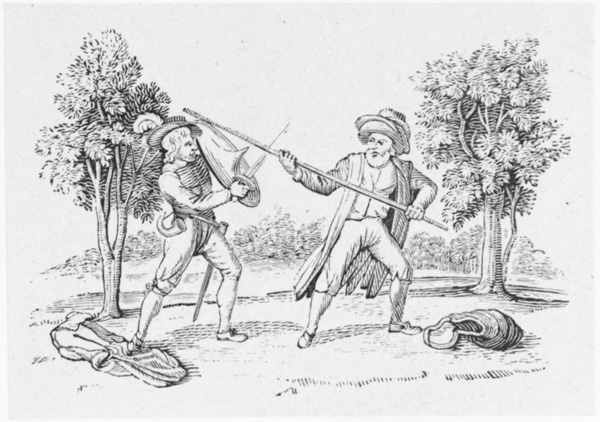
III. ROBIN HOOD AND THE BEGGAR.
This poem, a North-country (or perhaps Scotish) composition of some antiquity, is given from a modern copy printed at Newcastle, where it was accidentally picked up: no other edition having been ever seen or heard of. The corruptions of the press being equally numerous and minute, some of the most trifling have been corrected without notice. But it may be proper to mention that each line of the printed copy is here thrown into two: a step which, though absolutely necessary from the narrowness of the page, is sufficiently justified by the frequent recurrence of the double rime. The division of stanzas was conceived to be a still further improvement.—The original title is, “A Pretty Dialogue betwixt Robin Hood and a Beggar.”
A similar story (“Comment un moine se débarasse des voleurs”) may be found in “Le Moyen de Parvenir,” i. 304 (edit. 1739). {98}
Lyth and listen, gentlemen,
That be of high born blood,
I’ll tell you of a brave bootìng
That befell Robin Hood.
Robin Hood upon a day,
He went forth him alone,
And as he came from Barnsdale
Into fair evenìng,
He met a beggar on the way,
Who sturdily could gang ;
He had a pike-staff in his hand
That was both stark and strang ;
A clouted clock about him was,
That held him frae the cold,
The thinnest bit of it, I guess,
Was more than twenty fold.
His meal-poke hang about his neck,
Into a leathern whang,
Well fasten’d to a broad bucle,
That was both stark and ‘strang.’
He had three hats upon his head,
Together sticked fast,
He car’d neither for wind nor wet,
In lands where’er258 he past. {99}
Good Robin cast him in the way,
To see what he might be,
If any beggar had monèy,
He thought some part had he.
Tarry, tarry, good Robin says,
Tarry, and speak with me.
He heard him as he heard him not,
And fast on his way can hy.
’Tis be not so, says [good] Robìn,
Nay, thou must tarry still.
By my troth, said the bold beggàr,
Of that I have no will.
It is far to my lodging house,
And it is growing late,
If they have supt e’er I come in
I will look wondrous blate.
Now, by my truth, says good Robìn,
I see well by thy fare,
If thou shares well to thy suppèr,
Of mine thou dost not care,
Who wants my dinner all this day
And wots not where to ly,
And would I to the tavern go,
I want money to buy. {100}
Sir, you must lend me some monèy
Till we meet again.
The beggar answer’d cankardly,
I have no money to lend :
Thou art a young man as I,
And seems to be as sweer ;
If thou fast till thou get from me,
Thou shalt eat none this year.
Now, by my truth, says [good] Robìn,
Since we are assembled so,
If thou hast but a small farthìng,
I’ll have it e’er thou go.
Come, lay down thy clouted cloak,
And do no longer stand,
And loose the strings of all thy pokes,
I’ll ripe them with my hand.
And now to thee I make a vow,
If ‘thou’ make any din,
I shall see a broad arròw,
Can pierce a beggar’s skin.
The beggar smil’d, and answer made,
Far better let me be ;
Think not that I will be afraid,
For thy nip crooked tree ; {101}
Or that I fear thee any whit,
For thy curn nips of sticks,
I know no use for them so meet
As to be puding-pricks.
Here I defy thee to do me ill,
For all thy boisterous fair,
Thou’s get nothing from me but ill,
Would’st thou seek evermair.
Good Robin bent his noble bow,
He was an angery man,
And in it set a broad arròw ;
Lo ! e’er ’twas drawn a span,
The beggar, with his noble tree,
Reach’d him so round a rout,
That his bow and his broad arròw
In flinders flew about.
Good Robin bound him to his brand,
But that prov’d likewise vain,
The beggar lighted on his hand
With his pike-staff again :
[I] wot he might not draw a sword
For forty days and mair.
Good Robin could not speak a word,
His heart was ne’er so sair. {102}
He could not fight, he could not flee,
He wist not what to do ;
The beggar with his noble tree
Laid lusty slaps him to.
He paid good Robin back and side,
And baist him up and down,
And with his pyke-staff laid on loud,
Till he fell in a swoon.
Stand up, man, the beggar said,
’Tis shame to go to rest ;
Stay till thou get thy money told,
I think it were the best :
And syne go to the tavern house,
And buy both wine and ale ;
Hereat thy friends will crack full crouse,
Thou hast been at the dale.
Good Robin answer’d ne’er a word,
But lay still as a stane ;
His cheeks were pale as any clay,
And closed 259 were his een.
The beggar thought him dead but fail,
And boldly bound his way.—
I would ye had been at the dale,
And gotten part of the play. {103}
THE SECOND PART.
Now three of Robin’s men, by chance,
Came walking by the way,
And found their master in a trance,
On ground where that he lay.
Up have they taken good Robìn,
Making a piteous bear,
Yet saw they no man there at whom
They might the matter spear.
They looked him all round about,
But wound on him saw ‘nane,’
Yet at his mouth came bocking out
The blood of a good vain.
Cold water they have gotten syne,
And cast unto his face ;
Then he began to hitch his ear,
And speak within short space.
Tell us, dear master, said his men,
How with you stands the case.
Good Robin sigh’d e’er he began
To tell of his disgrace. {104}
“I have been watchman in this wood
Near hand this twenty year,
Yet I was never so hard bestead
As ye have found me here ;
A beggar with a clouted clock,
Of whom I fear’d no ill
Hath with his pyke-staff cla’d my back,
I fear ’twill never be well.
See, where he goes o’er yon hill,
With hat upon his head ;
If e’er ye lov’d your master well,
Go now revenge this deed ;
And bring him back again to me,
If it lie in your might,
That I may see, before I die,
Him punish’d in my sight :
And if you may not bring him back,
Let him not go loose on ;
For to us all it were great shame
If he escape again.”
“One of us shall with you remain,
Because you’re ill at ease,
The other two shall bring him back,
To use him as you please.” {105}
Now, by my truth, says good Robìn,
I true there’s enough said ;
And he get scouth to wield his tree,
I fear you’ll both be paid.
“Be not fear’d, our mastèr,
That we two can be dung
With any bluter base beggàr,
That has nought but a rung.
His staff shall stand him in no stead,
That you shall shortly see,
But back again he shall be led,
And fast bound shall he be,
To see if ye will have him slain,
Or hanged on a tree.”
“But cast you sliely in his way,
Before he be aware,
And on his pyke-staff first hands lay,
Ye’ll speed the better far.”
Now leave we Robin with this man,
Again to play the child,
And learn himself to stand and gang
By halds, for all his eild.
Now pass we to the bold beggàr,
That raked o’er the hill,
Who never mended his pace more,
Then he had done no ill. {106}
And they have taken another way,260
Was nearer by miles three.
They stoutly ran with all their might,
Spared neither dub ‘nor’ mire,
They started at neither how nor height,
No travel made them tire,
Till they before the beggar wan,
And cast them in his way ;
A little wood lay in a glen,
And there they both did stay ;
They stood up closely by a tree,
In each side of the gate,
Untill the beggar came them nigh,
That thought of no such late :
And as he was betwixt them past,
They leapt upon him baith ;
The one his pyke-staff gripped fast,
They feared for its skaith.
The other he held in his sight
A drawen durk to his breast,
And said, False ‘carel,’ quit thy staff,
Or I shall be thy priest. {107}
His pyke-staff they have taken him frae,
And stuck it in the green,
He was full loath to let it gae,
An better might it been.
The beggar was the feardest man
Of any that e’er might be,
To win away no way he can,
Nor help him with his tree.
Nor wist he wherefore he was ta’en,
Nor how many was there ;
He thought his life days had been gane,
He grew into dispair.
Grant me my life, the beggar said,
For him that dy’d on the tree,
And hold away that ugly knife,
Or else for fear I’ll die.
I griev’d you never in all my life,
Neither by late or air,
You have great sin if you would slay
A silly poor beggàr.
Thou lies, false lown, they said again,
For all that may be sworn ;
Thou hast ‘near’ slain the gentlest man
Of one that e’er was born ; {108}
And back again thou shall be led,
And fast bound shalt thou be,
To see if he will have thee slain,
Or hanged on a tree.
The beggar then thought all was wrong,
They were set for his wrack,
He saw nothing appearing then
But ill upon warse back.
Were he out of their hands, he thought,
And had again his tree,
He should not be led back for nought,
With such as he did see.
Then he bethought him on a wile,
If it could take effect,
How he might the young men beguile,
And give them a begeck.261
Thus to do them shame for ill
His beastly breast was bent,
He found the wind blew something shrill,
To further his intent.
He said, Brave gentlemen, be good,
And let a poor man be :
When ye have taken a beggar’s blood,
It helps you not a flee. {109}
It was but in my own defence,
If he has gotten skaith ;
But I will make a recompence
Is better for you baith.
If ye will set me fair and free,
And do me no more dear,
An hundred pounds I will you give,
And much more odd silvèr,
That I have gather’d this many years,
Under this clouted cloak,
And hid up wonder privately,
In bottom of my poke.
The young men to the council yeed,262
And let the beggar gae ;
They wist full well he had no speed
From them to run away.
They thought they would the money take,
Come after what so may ;
And yet they would not take him back,
But in that place him slay.
By that good Robin would not know
That they had gotten coin,
It would content him [well] to show
That there they had him slain, {110}
They said, False carel, soon have done,
And tell forth thy monèy,
For the ill turn that thou hast done
It’s but a simple plee.
And yet we will not have thee back,
Come after what so may,
If thou will do that which thou spak,263
And make us present pay.
O then he loosed his clouted clock,
And spread it on the ground,
And thereon lay he many a poke,
Betwixt them and the wind.
He took a great bag from his hals,264
It was near full of meal,
Two pecks in it at least there was,
And more, I wot full well.
Upon this cloak he set it down,
The mouth he opened wide,
To turn the same he made him bown,265
The young men ready spy’d ;
In every hand he took a nook
Of that great leathren ‘mail,’ 266
And with a fling the meal he shook
Into their face all hail : {111}
Wherewith he blinded them so close,
A stime they could not see ;
And then in heart he did rejoice,
And clap’d his lusty tree.
He thought if he had done them wrong,
In mealing of their cloaths,267
For to strike off the meal again
With his pyke-staff he goes.
E’er any of them could red their een,
Or a glimmring might see,
Ilke one of them a dozen had,
Well laid on with his tree.
The young men were right swift of foot,
And boldly bound away,
The beggar could them no more hit,
For all the haste he may.
What’s all this haste ? the beggar said,
May not you268 tarry still,
Untill your money be received ?
I’ll pay you with good will.
The shaking of my pokes, I fear,
Hath blown into your een ;
But I have a good pyke-staff here
Can ripe them out full clean. {112}
The young men answered never a word,
They were dum as a stane ;
In the thick wood the beggar fled,
E’er they riped their een :
And syne the night became so late,
To seek him was in vain :
But judge ye if they looked blate
When they cam home again.
Good Robin speer’d how they had sped.269
They answered him, Full ill.
That can not be, good Robin says,
Ye have been at the mill.
The mill it is a meat-rife part,
They may lick what they please,
Most like ye have been at the art,
Who would look at your ‘claiths.’ 270
They hang’d their heads, they drooped down,
A word they could not speak.
Robin said, Because I fell a-sound,
I think ye’ll do the like.
Tell on the matter, less or more,
And tell me what and how
Ye have done with the bold beggàr
I sent you for right now. {113}
And when they told him to an end,
As i have said before,
How that the beggar did them blind,