ROBIN HOOD. Part I. (continued 2)
Reading edition
What ‘mister’ presses more ?
And how in the thick woods he fled,
E’er they a stime could see ;
And how they scarcely could win home,
Their bones were baste so sore ;
Good Robin cry’d, Fy ! out ! for shame !
We’re sham’d for evermore.
Altho good Robin would full fain
Of his wrath revenged be,
He smil’d to see his merry young men
Had gotten a taste of the tree.
IV. ROBIN HOOD AND GUY OF GISBORNE,
is reprinted from the “Reliques of Ancient English Poetry,” published by Dr. Percy (vol. i. p. 81), who there gives it from his “folio MS.” as “never before printed, and ‘carrying’ marks of much greater antiquity than any of the common popular songs on this subject.”
As for Guy of Gisborne, the only further memorial which has occurred concerning him is in an old satirical piece by William Dunbar, a celebrated Scotish poet of the 15th century, on one “Schir Thomas Nory” (MS. Maitland, p. 3; MSS. More, Ll. 5, 10), where he is named along with our hero, Adam Bell, and other worthies, it is conjectured, of a similar stamp, but whose merits have not, less fortunately, come to the knowledge of posterity. {115}
“Was nevir WEILD ROBEINE under bewch,
Nor yitt Roger of Clekkinslewch,
So bauld a bairne as he ;
GY OF GYSBURNE, na Allane Bell,
Na Simones sones of Quhynsell,
Off thocht war nevir so slie.”
Gisborne is a market-town in the West Riding of the county of York, on the borders of Lancashire.
In the fourth edition of the publication above referred to, which appeared in July 1795, it is acknowleged that “some liberties were, by the editor, taken with this ballad, which in this edition hath been brought nearer to the folio MS.” The new readings have therefore been introduced into the present text.
Whan shaws beene sheene, and shraddes271 full fayre,
And leaves both large and longe,
Itt’s merrye walkyng in the fayre forrèst
To heare the small birdes songe.
The woodweele sang, and wold not cease,
Sitting upon the spraye,
Soe lowde, he wakened Robin Hood,
In the greenwood where he lay.
Now, by my faye, sayd jollye Robìn,
A sweaven I had this night ;
I dreamt me of tow wighty yemèn,
That fast with me can fight. {116}
Methought they did me beate and binde,
And tooke my bowe me froe ;
Iff I be Robin alive in this lande,
Ile be wroken on them towe.
Sweavens are swift, master, quoth John,
As the wind that blowes ore a hill ;
For iff itt be never so loude this night,
To-morrow it may be still.
“Buske yee, bowne yee, my merry men all,
And John shall goe with mee,
For Ile goe seeke yond wighty yeomèn,
In greenwood where they bee.”
Then they cast on theyr gownes of grene,
And tooke theyr bowes each one ;
And they away to the greene forrèst
A shooting forth are gone ;
Untill they came to the merry greenwood,
Where they had gladdest to bee,
There they were ware of a wight yeomàn,
His body leaned to a tree.
A sword and a dagger he wore by his side,
Of manye a man the bane ;
And he was clad in his capull hyde,
Topp and tayll and mayne. {117}
Stand you still, master, quoth Little John,
Under this tree so grene,
And I will go to yond wight yeomàn,
To know what he doth meane.
“Ah ! John, by me thou settest noe store,
And that I farley finde :
How offt send I my men before,
And tarry my selfe behinde ?
It is no cunning a knave to ken,
And a man but heare him speake ;
And it were not for bursting of my bowe,
John, I thy head wold breake.”
As often wordes they breeden bale,
So they parted Robin and John :
And John is gone to Barnesdale ;
The gates he knoweth eche one.
But when he came to Barnesdale,
Great heavinesse there he hadd,
For he found tow of his own fellòwes,
Were slaine both in a slade.
And Scarlette he was flying a-foote
Fast over stocke and stone,
For the proud sheriffe with seven score men
Fast after him is gone. {118}
One shoote now I will shoote, quoth John,
With Christ his might and mayne ;
Ile make yond sheriffe that flyes soe fast,
To stopp he shall be fayne.
Then John bent up his long bende-bowe,
And fetteled him to shoote :
The bow was made of tender boughe,
And fell downe at his foote.
“Woe worth, woe worth thee, wicked wood,
That ever thou grew on a tree !
For now this day thou art my bale,
My boote when thou shold bee.”
His shoote it was but loosely shott,
Yet flewe not the arrowe in vaine,
For itt mett one of the sheriffes men,
Good William a Trent was slaine.
It had bene better of William a Trent
To have bene abed with sorrowe,
Than to be that day in the greenwood slade
To meet with Little Johns arrowe.
But as it is said, when men be mett
Fyve can doe more than three,
The sheriffe hath taken Little John,
And bound him fast to a tree. {119}
“Thou shalt be drawen by dale and downe,
And hanged hye on a hill.”
But thou mayst fayle of thy purpose, quoth John,
If it be Christ his will.
Lett us leave talking of Little John,
And thinke of Robin Hood,
How he is gone to the wight yeomàn,
Where under the leaves he stood.
Good morrowe, good fellowe, sayd Robin so fayre,
Good morrowe, good fellow, quo’ he :272
Methinkes by this bowe thou beares in thy hande,
A good archere thou sholdst bee.
I am wilfulle of my waye, quo’ the yemàn,
And of my morning tyde.
Ile lead thee through the wood, sayd Robin ;
Good fellow, Ile be thy guide.
I seeke an outlawe, the straunger sayd,
Men call him Robin Hood ;
Rather Ild meet with that proud outlàwe
Than fortye pound soe good. {120}
“Now come with me, thou wighty yemàn
And Robin thou soone shalt see ;
But first let us some pastime find
Under the greenwood tree.
First let us some masterye make
Among the woods so even,
We may chance to meet with Robin Hood
Here at some unsett steven.”
They cutt them down two summer shroggs,
That grew both under a breere,
And sett them threescore rood in twaine,
To shoote the prickes y-fere.
Leade on, good fellowe, quoth Robin Hood,
Leade on, I do bidd thee.
Nay, by my faith, good fellowe, hee sayd,
My leader thou shalt bee.
The first time Robin shot at the pricke,
He mist but an inch it fro :
The yeoman he was an archer good,
But he cold never shoote soe.
The second shoote had the wightye yemàn,
He shot within the garlànd :
But Robin he shott far better than hee,
For he clave the good pricke-wande. {121}
A blessing upon thy heart, he sayd ;
Good fellowe, thy shooting is goode ;
For an thy hart be as good as thy hand,
Thou wert better than Robin Hoode.
Now tell me thy name, good fellowe, sayd he,
Under the leaves of lyne.
Nay, by my faith, quoth bold Robin,
Till thou have told me thine.
I dwell by dale and downe, quoth hee,
And Robin to take Ime sworne ;
And when I am called by my right name
I am Guy of good Gisbòrne.
My dwelling is in this wood, sayes Robin,
By thee I set right nought :
I am Robin Hood of Barnèsdale,
Whom thou so long hast sought.
He that had neyther beene kythe nor kin,
Might have seen a full fayre fight,
To see how together these yeomen went
With blades both browne and bright.
To see how these yeomen together they fought
Two howres of a summers day :
Yett neither Robin Hood nor sir Guy
Them fettled to flye away. {122}
Robin was reachles on a roote
And stumbled at that tyde ;
And Guy was quicke and nimble withall,
And hitt him ore the left syde.
Ah, deere ladye, sayd Robin Hood tho,
Thou art both273 mother and may,
I think it was never mans destinye
To dye before his day.
Robin thought on our ladye deere,
And soone leapt up againe,
And strait he came with a[n] awkwarde274 stroke,
And he sir Guy275 hath slayne.
He took sir Guys head by the hayre,
And sticked itt upon his bowes end :
“Thou hast beene a traytor all thy life,
Which thing must have an end.” {123}
Robin pulled forth an Irish knife,
And nicked sir Guy in the face,
That he was never on woman born
Cold tell whose head it was.
Sayes, Lye there, lye there, now sir Guye,
And with me be not wrothe ;
Iff thou have had the worst strokes at my hand,
Thou shalt have the better clothe.
Robin did off his gown of greene,
And on sir Guy did it throwe,
And he put on that capull hyde,
That cladd him topp to toe.
“The bowe, the arrowes, and little horne,
Now with me I will beare ;
For I will away to Barnèsdale,
To see how my men doe fare.”
Robin Hood sett Guyes horne to his mouth,
And a loude blast in it did blow :
That beheard the sheriffe of Nottingham,
As he leaned under a lowe.
Hearken, hearken, sayd the sheriffe,
I heare nowe tydings good,
For yonder I heare sir Guyes horne blow,
And he hath slaine Robin Hoode. {124}
Yonder I heare sir Guyes horne blowe,
Itt blowes soe well in tyde,
And yonder comes that wightye yeomàn,
Cladd in his capull hyde.
Come hyther, come hyther, thou good sir Guy,
Aske what thou wilt of mee.
O I will none of thy gold, sayd Robin,
Nor I will none of thy fee :
But now I have slaine the master, he sayes,
Let me goe strike the knave ;
For this is all the meede I aske ;
Nor no other will I have.
Thou art a madman, sayd the sheriffe,
Thou sholdst have had a knightes fee :
But seeing thy asking hath beene soe bad,
Well granted it shal bee.
When Little John heard his master speake,
Well knewe he it was his steven :
Now shall I be looset, quoth Little John,
With Christ his might in heaven.
Fast Robin hee hyed him to Little John,
He thought to loose him belive ;
The sheriffe and all his companye
Fast after him did drive. {125}
Stand abacke, stand abacke, sayd Robìn ;
Why draw you mee so neere ?
It was never the use in our countryè,
Ones shrift another shold heere.
But Robin pulled forth an Irish knife,
And losed John hand and foote,
And gave him sir Guyes bow into his hand,
And bade it be his boote.
Then John he took Guyes bow in his hand,
His boltes and arrowes eche one :
When the sheriffe saw Little John bend his bow,
He fettled him to be gone.
Towards his house in Nottingham towne,
He fled full fast away ;
And soe did all the companye :
Not one behind wold stay.
But he cold neither runne soe fast,
Nor away soe fast cold ryde,
But Little John with an arrowe soe broad,
He shott him into the ‘backe’-syde.276
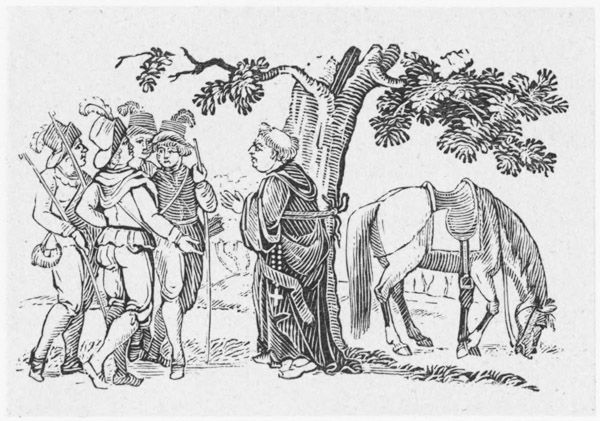
V. A TRUE TALE OF ROBIN HOOD: OR,
A briefe touch of the life and death of that renowned outlaw Robert earl of Huntingdon, vulgarly called Robin Hood, who lived and dyed in A. D. 1198,277 being the 9th year of king Richard the first, commonly called Richard Cœur de Lyon.
Carefully collected out of the truest writers of our English Chronicles: and published for the satisfaction of those who desire truth from falshood.
BY MARTIN PARKER. {127}
This poem, given from an edition in black letter printed for I. Clarke, W. Thackeray, and T. Passinger, 1686, remaining in the curious library left by Anthony a Wood, appears to have been first entered on the hall-book of the Stationers’ Company the 29th of February 1631.
Martin Parker was a great writer of ballads, several of which, with his initials subjoined, are still extant in the Pepysian and other collections. (See “Ancient Songs,” 1829, ii. p. 263.) Dr. Percy mentions a little miscellany intitled, “The garland of withered roses, by Martin Parker, 1656.” The editor has, likewise, seen “The nightingale warbling forth her own disaster, or the rape of Philomela: newly written in English verse by Martin Parker, 1632;” and, on the 24th of November 1640, Mr. Oulton enters at Stationers’ Hall “a book called The true story of Guy earle of Warwicke, in prose, by Martyn Parker.”
At the end of this poem the author adds “The epitaph which the prioress of the monastry of Kirkslay in Yorkshire set over Robin Hood, which,” he says, “(as is before mentioned) was to be read within these hundred years, though in old broken English, much to the same sence and meaning.” He gives it thus:
“Decembris quarto die, 1198. anno regni Richardi primi 9.
“Robert earl of Huntington
“Lies under this little stone,
“No archer was like him so good;
“His wildness named him Robin Hood;
“Full thirteen years, and something more,
“These northern parts he vexed sore;
“Such outlaws as he and his men
“May England never know again.”
“Some other superstitious words,” he adds, “were in, which I,” says he, “thought fit to leave out.” Now, under this precise gentleman’s favour, one would be glad to know what these same “superstitious words” were; there not being anything of the {128} kind in Dr. Gale’s copy, which seems to be the original, and which is shorter by two lines than the above. Thirteen should be thirty.
Both gentlemen, and yeomen bold,
Or whatsoever you are,
To have a stately story told
Attention now prepare :
It is a tale of Robin Hood,
Which i to you will tell ;
Which, being rightly understood,
I know will please you well.
This Robin (so much talked on)
Was once a man of fame,
Instiled earl of Huntington,
Lord Robin Hood by name.
In courtship and magnificence
His carriage won him praise,
And greater favour with his prince
Than any in ‘those’ 278 days.
In bounteous liberality
He too much did excell,
And loved men of quality
More than exceeding well. {129}
His great revenues all he sold
For wine and costly chear ;
He kept three hundred bow-men bold,
He shooting lov’d so dear.
No archer living in his time
With him might well compare ;
He practis’d all his youthful prime
That exercise most rare.
At last, by his profuse expence,
He had consum’d his wealth ;
And, being outlaw’d by his prince,
In woods he liv’d by stealth.
The abbot of Saint Maries rich,
To whom he money ought,
His hatred to the earl was such
That he his downfal wrought.
So being outlaw’d (as ’tis told)
He with a crew went forth
Of lusty cutters stout and bold,
And robbed in the North.
Among the rest one Little John,
A yeoman bold and free,
Who could (if it stood him upon)
With ease encounter three. {130}
One hundred men in all he got,
With whom (the story says)
Three hundred common men durst not
Hold combat any waies.
They Yorkshire woods frequented much,
And Lancashire also,
Wherein their practises were such
That they wrought muckle woe.
None rich durst travel to and fro,
Though ne’r so strongly arm’d,
But by these thieves (so strong in show)
They still were rob’d and harm’d.
His chiefest spight to th’ clergy was,
That liv’d in monstrous pride :
No one of them he would let pass
Along the highway side,
But first they must to dinner go,
And afterwards to shrift :
Full many a one he served so,
Thus while he liv’d by theft.
No monks nor fryers he would let go
Without paying their fees :
If they thought much to be used so,
Their stones he made them lese. {131}
For such as they the country fill’d
With bastards in those days :
Which to prevent, these sparks did geld
All that came in their ways.279
But Robin Hood so gentle was,
And bore so brave a mind,
If any in distress did pass,
To them he was so kind,
That he would give and lend to them,
To help them in their need ;
This made all poor men pray for him,
And wish he well might speed.
The widow and the fatherless
He would send means unto ;
And those whom famine did oppress
Found him a friendly foe. {132}
Nor would he do a woman wrong,
But see her safe convey’d :
He would prótect with power strong
All those who crav’d his aid.
The abbot of Saint Maries then,
Who him undid before,
Was riding with two hundred men,
And gold and silver store :
But Robin Hood upon him set,
With his couragious sparks,
And all the coyn perforce did get,
Which was twelve thousand marks.
He bound the abbot to a tree,
And would not let him pass,
Before that to his men and he
His lordship had said mass :
Which being done, upon his horse
He set him fast astride,
And with his face towàrds his a—
He forced him to ride.
His men were forced to be his guide,
For he rode backward home :
The abbot, being thus villify’d,
Did sorely chafe and fume.
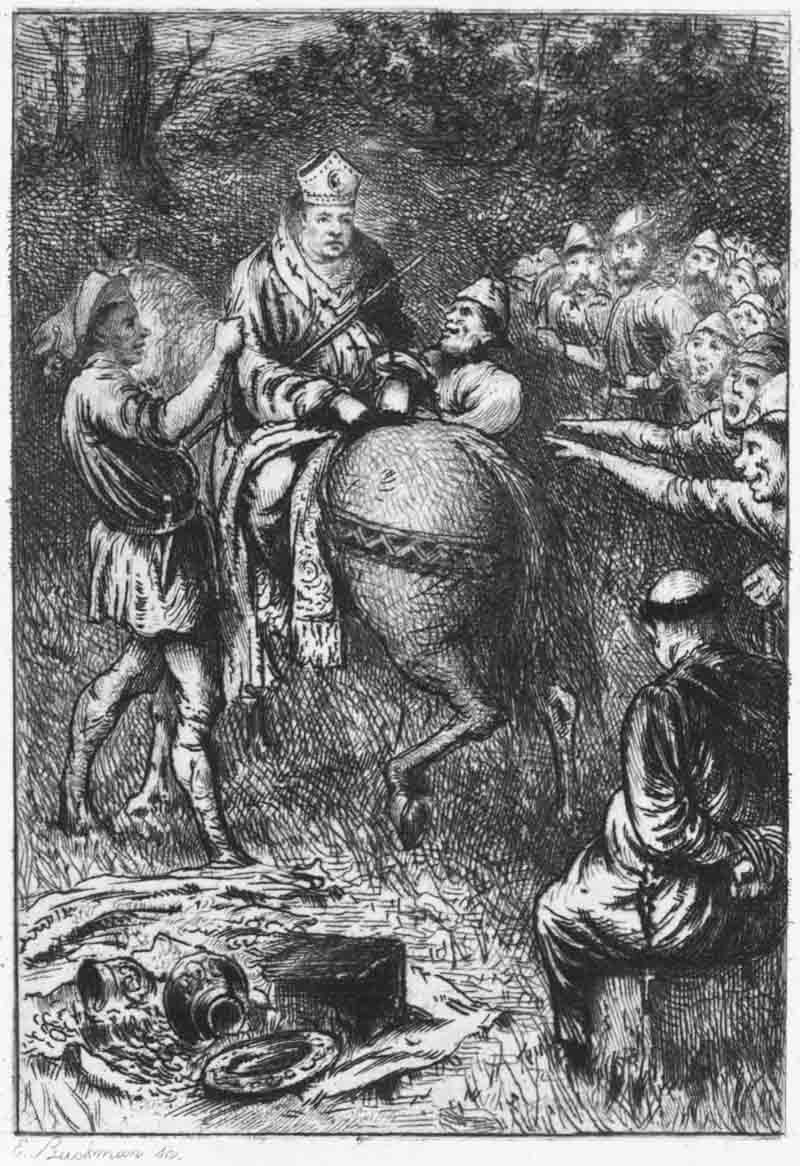
ROBIN HOOD AND THE ABBOT.
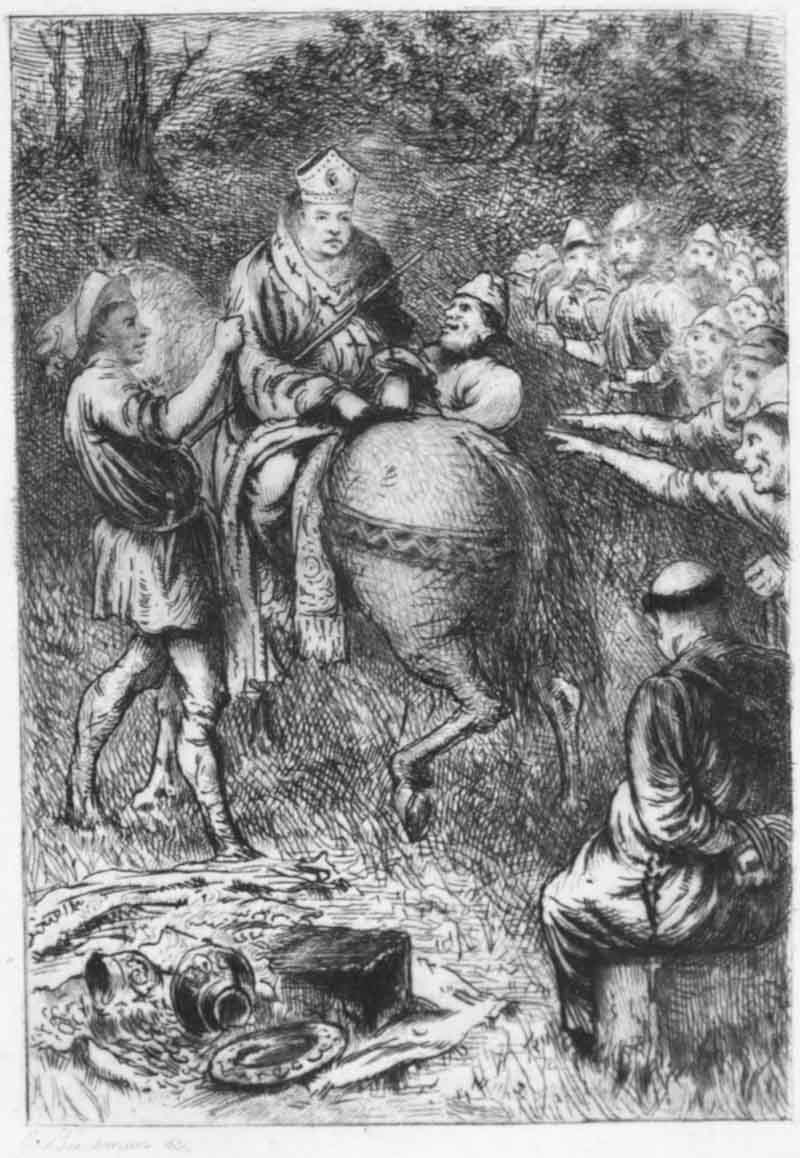
ROBIN HOOD AND THE ABBOT.
{133}
Thus Robin Hood did vindicate
His former wrongs receiv’d :
For ’twas this covetous prelàte
That him of land bereav’d.
The abbot he rode to the king,
With all the haste he could ;
And to his grace he every thing
Exactly did unfold :
And said that if no course were ta’n,
By force or stratagem,
To take this rebel and his train,
No man should pass for them.
The king protested by and by
Unto the abbot then,
That Robin Hood with speed should dye,
With all his merry men.
But e’re the king did any send,
He did another feat,
Which did his grace much more offend,
The fact indeed was great :
For in a short time after that
The kings receivers went
Towards London with the coyn they got
For’s highness northern rent : {134}
Bold Robin Hood and Little John,
With the rest of their train,
Not dreading law, set them upon,
And did their gold obtain.
The king much moved at the same,
And the abbots talk also,
In this his anger did proclaim,
And sent word to and fro,
That whosoever alive or dead
Could bring bold Robin Hood,
Should have one thousand marks well paid
In gold and silver good.
This promise of the king did make
Full many yeomen bold
Attempt stout Robin Hood to take
With all the force they could.
But still when any came to him
Within the gay green wood,
He entertainment gave to them
With venison fat and good ;
And shew’d to them such martial sport
With his long bow and arrow,
That they of him did give report,
How that it was great sorow {135}
That such a worthy man as he
Should thus be put to shift,
Being a late lord of high degree,
Of living quite bereft.
The king to take him more and more
Sent men of mickle might ;
But he and his still beat them sore,
And conquered them in fight :
Or else with love and courtesie,
To him he won their hearts.
Thus still he liv’d by robbery
Throughout the northern parts ;
And all the country stood in dread
Of Robin Hood and’s men :
For stouter lads ne’r liv’d by bread
In those days, nor since then.
The abbot, which before i nam’d,
Sought all the means he could
To have by force this rebel ta’n,
And his adherents bold.
Therefore he arm’d five hundred men,
With furniture compleat ;
But the outlaws slew half of them,
And made the rest retreat, {136}
The long bow and the arrow keen
They were so us’d unto
That still he kept the forrest green
In spight o’ th’ proudest foe.
Twelve of the abbots men he took,
Who came to have him ta’n,
When all the rest the field forsook,
These he did entertain
With banqueting and merriment,
And, having us’d them well,
He to their lord them safely sent,
And will’d them him to tell,
That if he would be pleas’d at last
To beg of our good king,
That he might pardon what was past,
And him to favour bring,
He would surrender back again
The mony which before
Was taken by him ‘and his’ men
From him and many more.
Poor men might safely pass by him,
And some that way would chuse,
For well they knew that to help them
He evermore did use. {137}
But where he knew a miser rich
That did the poor oppress,
To feel his coyn his hands did itch,
He’d have it, more or less :
And sometimes, when the high-way fail’d,
Then he his courage rouzes,
He and his men have oft assaild
Such rich men in their houses :
So that, through dread of Robin then,
And his adventurous crew,
The misers kept great store of men,
Which else maintain’d but few.
King Richard, of that name the first,
Sirnamed Cœur de Lyon,
Went to defeat the Pagans curst,
Who kept the coasts of Sion.
The bishop of Ely, chancellor,
Was left a vice-roy here,
Who, like a potent emperor,
Did proudly domineer.
Our chronicles of him report,
That commonly he rode
With a thousand horse from court to court,
Where he would make abode. {138}
He, riding down towards the north,
With his aforesaid train,
Robin and his men did issue forth,
Them all to entertain ;
And with the gallant gray-goose wing
They shew’d to them such play
That made their horses kick and fling,
And down their riders lay,
Full glad and fain the bishop was,
For all his thousand men,
So seek what means he could to pass
From out of Robins ken.
Two hundred of his men were kill’d,
And fourscore horses good,
Thirty, who did as captives yield,
Were carried to the green wood ;
Which afterwards were ransomed,
For twenty marks a man :
The rest set spurs to horse and fled
To th’ town of Warrington.
The bishop, sore inraged, then
Did, in king Richards name,
Muster up a power of northern men,
These outlaws bold to tame. {139}
But Robin with his courtesie
So won the meaner sort,
That they were loath on him to try
What rigour did import.
So that bold Robin and his train
Did live unhurt of them,
Until king Richard came again
From fair Jerusalem :
And then the talk of Robin Hood
His royal ears did fill ;
His grace admir’d that i’ th’ green wood
He was continued still.
So that the country far and near
Did give him great applause ;
For none of them need stand in fear,
But such as broke the laws.
He wished well unto the king,
And prayed still for his health,
And never practis’d any thing
Against the common-wealth.
Only, because he was undone
By th’ cruel clergy then,
All means that he could think upon
To vex such kind of men, {140}
He enterpriz’d with hateful spleen ;
For which he was to blame,
For fault of some to wreak his teen
On all that by him came.
With wealth that he by roguery got
Eight alms-houses he built,
Thinking thereby to purge the blot
Of blood which he had spilt.
Such was their blind devotion then,
Depending on their works ;
Which if ’twere true, we Christian men
Inferiour were to Turks.
But, to speak true of Robin Hood,
And wrong him not a jot,
He never would shed any mans blood
That him invaded not.
Nor would he injure husbandmen,
That toil at cart and plough ;
For well he knew wer’t not for them
To live no man knew how.
The king in person, with some lords,
To Nottingham did ride,
To try what strength and skill affords
To crush this outlaws pride. {141}
And, as he once before had done,
He did again proclaim,
That whosoever would take upon
To bring to Nottingham,
Or any place within the land,
Rebellious Robin Hood,
Should be preferr’d in place to stand
With those of noble blood.
When Robin Hood heard of the same,
Within a little space,
Into the town of Nottingham
A letter to his grace
He shot upon an arrow head,
One evening cunningly ;
Which was brought to the king, and read
Before his majesty.
The tenour of this letter was
That Robin would submit,
And be true liegeman to his grace
In any thing that’s fit,
So that his highness would forgive
Him and his merry men all ;
If not, he must i’ th’ green wood live,
And take what chance did fall. {142}
The king would feign have pardoned him,
But that some lords did say,
This president will much condemn
Your grace another day.
While that the king and lords did stay
Debating on this thing,
Some of these outlaws fled away
Unto the Scottish king.
For they suppos’d, if he were ta’n
Or to the king did yield,
By th’ commons all the rest of ’s train
Full quickly would be quell’d.
Of more than full an hundred men,
But forty tarried still,
Who were resolv’d to stick to him,
Let Fortune work her will.
If none had fled, all for his sake
Had got their pardon free ;
The king to favour meant to take
His merry men and he.
But e’re the pardon to him came
This famous archer dy’d :
His death and manner of the same
I’le presently describe. {143}
For, being vext to think upon
His followers revolt,
In melancholy passiòn
He did recount his fault.
Perfidious traytors ! said he then,
In all your dangers past
Have i you guarded as my men,
To leave me thus at last !
This sad perplexity did cause
A feaver, as some say,
Which him unto confusion draws,
Though by a stranger way.
This deadly danger to prevent,
He hie’d him with all speed
Unto a nunnery, with intent
For his healths-sake to bleed.
A faithless fryer did pretend
In love to let him blood,
But he by falshood wrought the end
Of famous Robin Hood.
The fryer, as some say, did this
To vindicate the wrong
Which to the clergy he and his
Had done by power strong. {144}
Thus dyed he by treachery,
That could not die by force ;
Had he liv’d longer, certainly
King Richard, in remorse,
Had unto favour him receiv’d,
‘His’ brave men elevated :
’Tis pitty he was of life bereav’d
By one which he so hated.
A treacherous leach this fryer was,
To let him bleed to death ;
And Robin was, methinks, an ass
To trust him with his breath.
His corps the prioress of the place,
The next day that he dy’d,
Caused to be buried, in mean case,
Close by the high-way side.
And over him she caused a stone
To be fixt on the ground,
An epitaph was set thereon,
Wherein his name was found ;
The date o’ th’ year and day also,
She made to be set there :
That all, who by the way did go,
Might see it plain appear. {145}
That such a man as Robin Hood
Was buried in that place ;
And how he lived in the green wood
And robbed for a space.
It seems that though the clergy he
Had put to mickle woe,
He should not quite forgotten be
Although he was their foe.
This woman, though she did him hate,
Yet loved his memory ;
And thought it wondrous pitty that
His fame should with him dye.
This epitaph, as records tell,
Within this hundred years,
By many was discerned well,
But time all things out-wears.
His followers, when he was dead,
Were some repriev’d to grace ;
The rest to foreign countries fled,
And left their native place.
Although his funeral was but mean,
This woman had in mind,
Least his fame should be buried clean
From those that came behind. {146}
For certainly, before nor since,
No man e’re understood,
Under the reign of any prince,
Of one like Robin Hood.
Full thirteen years, and something more,
These outlaws lived thus ;
Feared of the rich, loved of the poor :
A thing most marvellous.
A thing impossible to us
This story seems to be ;
None dares be now so venturous,
But times are chang’d we see.
We that live in these later days
Of civil government,
If need be, have an hundred ways
Such outlaws to prevent.
In those days men more barbarous were,
And lived less in awe ;
Now (god be thanked) people fear
More to offend the law.
No waring guns were then in use,
They dreamt of no such thing ;
Our Englishmen in fight did use
The gallant gray-goose wing ; {147}
In which activity these men,
Through practise, were so good,
That in those days none equal’d them,
Especially Robin Hood.
So that, it seems, keeping in caves,
In woods and forests thick,
They’d beat a multitude with staves,
Their arrows did so prick :
And none durst neer unto them come,
Unless in courtesie ;
All such he bravely would send home
With mirth and jollity :
Which courtesie won him such love,
As i before have told,
’Twas the chief cause that he did prove
More prosperous than he could.280
Let us be thankful for these times
Of plenty, truth and peace ;
And leave our great and horrid crimes,
Least they cause this to cease.
I know there’s many feigned tales
Of Robin Hood and ’s crew ;
But chronicles, which seldome fails,
Reports this to be true. {148}
Let none then think this is a lye,
For, if ’twere put to th’ worst,
They may the truth of all descry
I’ th’ reign of Richard the first.
If any reader please to try,
As i direction show,
The truth of this brave history,
He’l find it true I know.
And i shall think my labour well
Bestow’d to purpose good,
When’t shall be said that i did tell
True tales of Robin Hood.