NOTES AND ILLUSTRATIONS REFERRED TO IN THE FOREGOING LIFE.
Reading edition
Another piece of biography, from which much will not be expected, is “The lives and heroick atchievements of the renowned Robin Hood and James Hind, two noted robbers and highwaymen. London, 1752.” 8vo. This, however, is probably nothing more than an extract from Johnson’s “Lives of the Highwaymen,” in which, as a specimen of the authors historical authenticity, we have the life and actions of that noted robber, Sir John Falstaff.
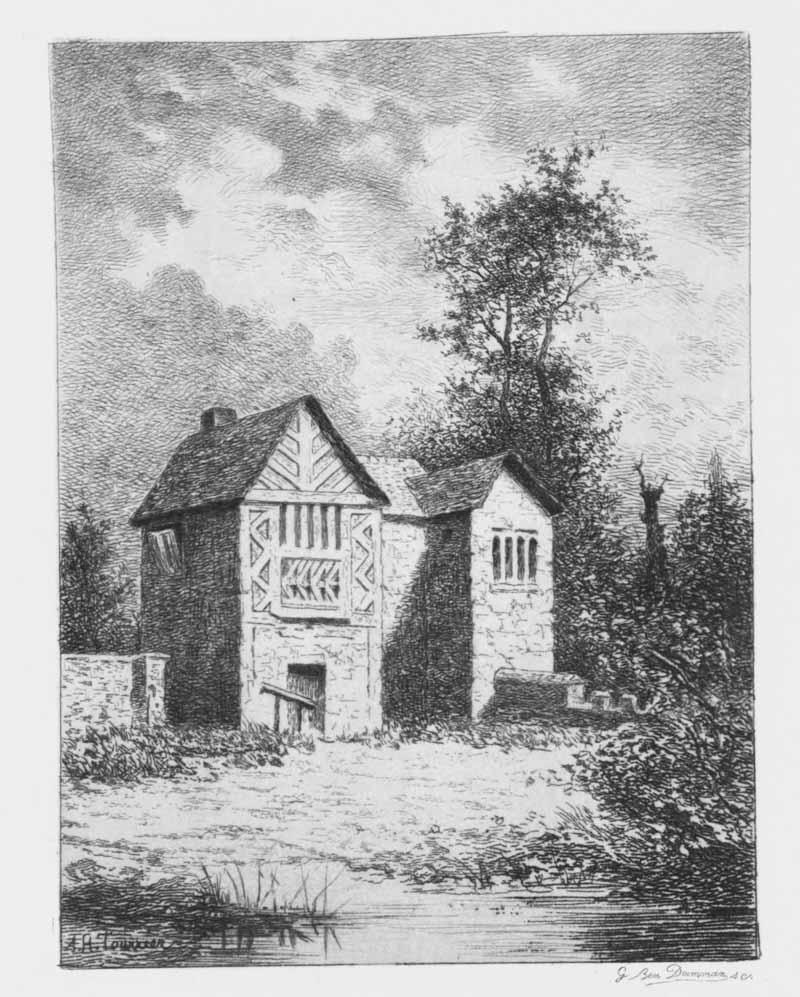
KIRKLEY HALL.
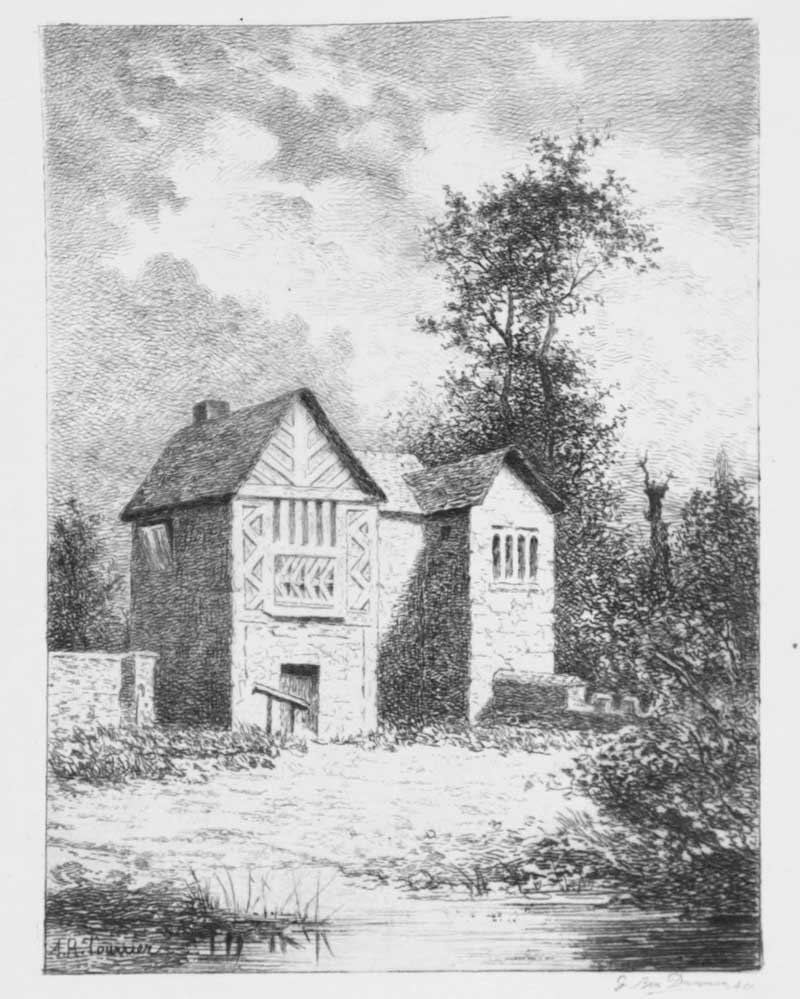
KIRKLEY HALL.
{xv}
The principal if not sole reason why our hero is never once mentioned by Matthew Paris, Benedictus Abbas, or any other ancient English historian, was most probably his avowed enmity to churchmen; and history, in former times, was written by none but monks. They were unwilling to praise the actions which they durst neither misrepresent nor deny. Fordun and Major, however, being foreigners, have not been deterred by this professional spirit from rendering homage to his virtues.
“In Locksly town, in merry Nottinghamshire,
In merry sweet Locksly town,
There bold Robin Hood was born and was bred,
Bold Robin of famous renown.” 4
Dr. Fuller (Worthies of England, 1662, p. 320) is doubtful as to the place of his nativity. Speaking of the “Memorable Persons” of Nottinghamshire, “Robert Hood,” says he, “(if not by birth) by his chief abode this country-man.”
The name of such a town as Locksley, or Loxley (for so we sometimes find it spelled), in the county of Nottingham or of York, does not, it must be confessed, occur either in Sir Henry Spelman’s Villare Anglicum. in Adams’s Index Villaris, in Whatley’s England’s Gazetteer,5 in Thoroton’s History of Nottinghamshire, or in the Nomina Villarum Eboracensium (York, 1768, 8vo). The silence of these authorities is not, however, to be regarded as a conclusive proof that such a place never existed. The names of towns and villages, of which no trace is now to be found but in ancient writings, would fill a volume.
{xvi}
“Lytil Jhon and Robyne Hude
Wayth-men were commendyd gud:
In Yngil-wode and Barnysdale
Thai oysyd all this tyme thare trawale.”
A modern writer (History of Whitby, by Lionel Charlton, York, 1779, 4to), though of no authority in this point, has done well enough to speak of him as living “in the days of abbot Richard and Peter his successor;” that is, between the years 1176 and 1211. The author of the two plays upon the story of our hero, of which a particular account will be hereafter given, makes him contemporary with King Richard, who, as well as his brother Prince John, is introduced upon the scene; which is confirmed by another play, quoted in Note 5. Warner, also, in his Albion’s England, 1602, p. 132, refers his existence to “better daies, first Richard’s daies.” This, to be sure, may not be such evidence as would be sufficient to decide the point in a court of justice; but neither judge nor counsel will dispute {xvii} the authority of that oracle of the law Sir Edward Coke, who pronounces that “This Robert Hood lived in the reign of King R. I.” (3 Institute, 197).
We must not therefore regard what is said by such writers as the author of “George a Greene, the pinner of Wakefield,” 1599 (see Note 9), who represents our hero as contemporary with King Edward IV.,7 and the compiler of a foolish book called “The noble birth, &c. of Robin Hood” (see Note 1), who commences it by informing us of his banishment by King Henry VIII. As well, indeed, might we suppose him to have lived before the time of Charlemagne, because Sir John Harington, in his translation of the Orlando Furioso, 1590, p. 391, has made
“Duke ’Ammon in great wrath thus wise to speake:
This is a Tale indeed of Robin Hood,
Which to beleeve, might show my wits but weake;”
or to imagine his story must have been familiar to Plutarch, because in his Morals, translated by Dr. Philemon Holland, 1603, p. 644, we read the following passage:—“Evenso [i.e. as the crane and fox serve each other in Æsop], when learned men at a table plunge and drowne themselves (as it were), in subtile problemes and questions interlaced with logicke, which the vulgar sort are not able for their lives to comprehend and conceive; whiles they also againe for their part come in with their foolish songs, and vain ballads of Robin-Hood and Little John, telling tales of a tubbe, or of a roasted horse, and such like.” Who, indeed, would be apt to think that his skill in archery was known to Virgil? And yet, as interpreted by our facetious friend Mr. Charles Cotton, he tells us that
“Cupid was a little tyny,
Cogging, lying, peevish nynny;
But with a bow the shit-breecht elf
Would shoot like Robin Hood himself.”
In a word, if we are to credit translators, he must have {xviii} existed before the siege of Troy; for thus, according to one of Homer’s:
“Then came a choice companion
Of Robin Hood and Little John,
Who many a buck and many a doe,
In Sherwood forest, with his bow,
Had nabb’d; believe me it is true, sir,
The fellow’s Christian name was Teucer.”
Iliad, by Bridges, 4to, p. 231.8
This last supposition, indeed, has even the respectable countenance of Dan Geoffrey Chaucer:
“Pandarus answerde, it may be well inough,
And held with him of all that ever he saied,
But in his hart he thought, and soft lough,
And to himselfe full soberly he saied,
From hasellwood there Jolly Robin plaied,
Shall come all that thou abidest here,
Ye, farewell all the snow of ferne yere.”
Troilus (B. 5), Speght’s edition, 1602.
A writer in the Gentleman’s Magazine for March 1793, under the signature D. H.,9 pretends that Hood is only a corruption of “o’ th’ wood, q.d. of Sherwood.” This, to be sure, is an absurd conceit; but, if the name were a matter of conjecture, it might be probably enough referred to some particular sort of hood our hero wore by way of distinction or disguise. See Scot’s Discoverie of Witchcraft, 1584, p. 522. In Jonson’s masque of “The king’s entertainment at Welbeck” (Works, 1756, vii. 53), certain characters are introduced “in livery hoods,” of whom Fitz-ale says,
“Six hoods they are, and of the blood,
They tell of ancient Robin Hood.”
It may be remembered that Hugh Capet, the first king of France of the third and last race, obtained that surname from a similar circumstance. It is unnecessary to add that Hood is a common surname at this day, as well as a place in Yorkshire, formerly Hode; and that Edward the Third, in the tenth year of his reign, confirmed to Thomas, the son of Robert de Hode, of Hoveden, in tail-general, certain places of moorland, &c. in vasto de Incklesmore, &c. (Ro. Pa. 10 E. 3. m. 31).
In the MS. note (Bib. Har. 1233) is the following passage: “It is said that he was of noble blood no lesse then an earle.” Warner, in his Albion’s England, already cited, calls him “a county.” The titles of Mundy’s two plays are: “The downfall” and “The death of Robert earle of Huntington.” He is likewise introduced in that character in the same author’s Metropolis Coronata, hereafter cited. In his epitaph we shall find him expressly styled “Robert, Earl of Huntingtun.”
In “A pleasant commodie called Looke about you,” printed in 1600, our hero is introduced, and performs a principal part. He is represented as the young Earl of Huntington, and in ward to Prince Richard, though his brother Henry, the young king, complains of his having “had wrong about his wardship.” He is described as
“A gallant youth, a proper gentleman;”
and is sometimes called “pretty earle” and “little wag.” One of the characters thus addresses him:
“But welcome, welcome, and young Huntington,
Sweet Robyn Hude, honor’s best flowing bloome,”
and calls him
“an honourable youth,

Vertuous and modest, Huntington’s right heyre.”
It is also said that
“His father Gilbert was the smoothst fac’t lord
That ere bare armes in England or in Fraunce.”
In one scene, “Enter Richard and Robert with coronets.”
“Rich. Richard the Prince of England, with his ward,
The noble Robert Hood, earle Huntington,
Present their service to your majestie.”
Dr. Percy’s objection, that the most ancient poems make no mention of this earldom,10 but only call him a yeoman, will be considered in another place. How he founded his pretensions to this title will be seen in his pedigree. Here it is. {xxi}
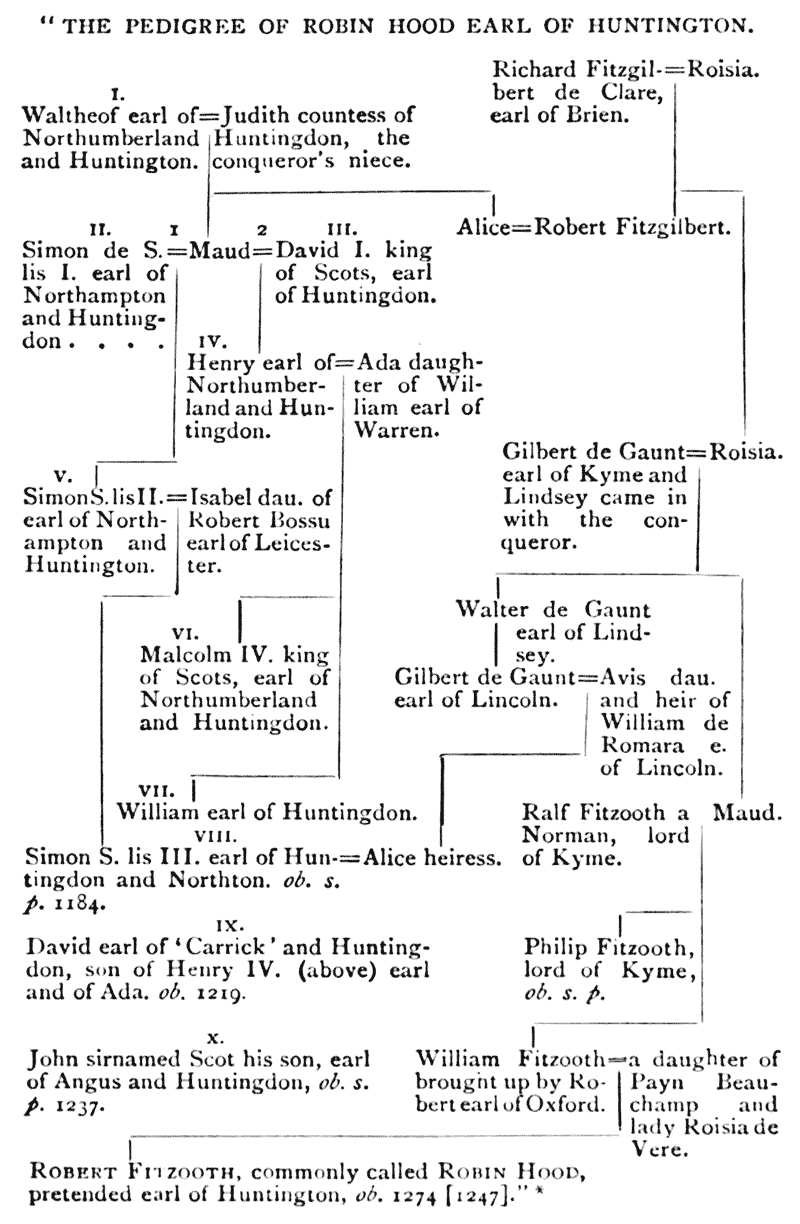
The Pedigree of Robin Hood Earl of Huntington. [The footnote referenced in the figure is here. A transcription of this chart using the genealogical numbering system of Robert B. Henry is here.]
{xxii}
That he lurked or infested the woods is agreed by all. “Circa hæc tempora,” says Major, “Robertus Hudus Anglus & parvus Joannes, latrones famatissimi, in nemoribus latuerunt.”
Dr. Stukeley says that “Robin Hood took to this wild way of life in imitation of his grandfather Geoffrey de Mandeville, who being a favorer of Maud empress, King Stephen took him prisoner at S. Albans, and made him give up the tower of London, Walden, Plessis, &c., upon which he lived on plunder” (MS. note in his copy of Robin Hood’s Garland).
“They haunted about Barnsdale forrest, Compton [r. Plompton] parke,15 and such other places” (MS. Sloane).
“His principal residence,” says Fuller, “was in Shirewood forrest in this county [Notts], though he had another haunt (he is no fox that hath but one hole) near the sea in the North Riding in Yorkshire, where Robin Hood’s Bay still retaineth his name: not that he was any pirat, but a land-thief, who retreated to those unsuspected parts for his security” (Worthies of England, p. 320). {xxv}
In Thoroton’s Nottinghamshire, p. 505, is some account of the ancient and present state of Sherwood forest; but one looks in vain through that dry detail of land-owners for any particulars relating to our hero. “In anno domini 1194, King Richard the First, being a hunting in the forrest of Sherwood, did chase a hart out of the forrest of Sherwood into Barnesdale in Yorkshire, and because he could not there recover him, he made proclamation at Tickill in Yorkshire, and at divers other places there, that no person should kill, hurt, or chase the said hart, but that he might safely retorne into forrest againe, which hart was afterwards called a hart-royall proclaimed” (Manwood’s Forest Laws, 1598, p. 25, from “an auncient recorde” found by him in the tower of Nottingham Castle).16
With respect to Frier Tuck, “thogh some say he was an other kynd of religious man, for that the order of freyrs was not yet sprung up” (MS. Sloan.), yet as the Dominican friers (or friers preachers) came into England in the year 1221, upward of twenty years before the death of Robin Hood, and several orders of these religious had flourished abroad for some time, there does not seem much weight in that objection: nor, in fact, can one pay much regard to the term frier, as it seems to have been the common title given by the vulgar (more especially after the Reformation) to all the regular clergy, of which the friers were at once the lowest and most numerous. If Frier Tuck be the same person who, in one of the oldest songs, is called the curtail frier of Fountains-dale, he must necessarily have been one of the monks of that abbey, which was of the Cistercian order. However this may be, Frier Tuck is frequently noticed by old writers as one of the companions of Robin Hood, and as such was an essential character in the morris-dance (see Note 34). He is thus mentioned by Skelton, laureat, in his “goodly interlude” of Magnificence, written about the year 1500, and with an evident allusion to some game or practice now totally forgotten and inexplicable:
“Another bade shave halfe my berde,
And boyes to the pylery gan me plucke,
And wolde have made me freer Tucke,
To preche oute of the pylery hole.”
In the year 1417, as Stow relates, “one, by his counterfeite name, called Frier Tucke, with manie other malefactors, committed many robberies in the counties of Surrey & Sussex, whereupon the king sent out his writs for their apprehension” (Annales, 1592).
George a Green is George o’ the green, meaning perhaps the town-green, in which the pound or pinfold stood of which he had the care. He has been particularly celebrated, and {xxvii} “As good as George a Green” is still a common saying.17 Drayton, describing the progress of the river Calder, in the West Riding of Yorkshire, has the following lines:
“It chanc’d she in her course on ‘Kirkley’ cast her eye,
Where merry Robin Hood, that honest thief, doth lie;
Beholding fitly too before how Wakefield stood,
She doth not only think of lusty Robin Hood,
But of his merry man, the pindar of the town
Of Wakefield, George a Green, whose fames so far are blown
For their so valiant fight, that every freeman’s song
Can tell you of the same; quoth she, be talk’d on long,
For ye were merry lads, and those were merry days.”
Thus, too, Richard Brathwayte, in his poetical epistle “to all true-bred northerne sparks of the generous society of the Cottoneers” (Strappado for the Divell, 1615):
“But haste, my muse, in colours to display
Some auncient customes in their high-roade way,
At least such places labour to make knowne
As former times have honour’d with renowne.
The first whereof that I intend to show
Is merry Wakefield, and her pindar too,
Which fame hath blaz’d with all that did belong,
Unto that towne in many gladsome song,
The pindar’s valour, and how firme he stood
In th’ townes defence ’gainst th’ rebel Robin Hood,
How stoutly he behav’d himselfe, and would,
In spite of Robin, bring his horse to th’ fold,
His many May-games which were to be seene
Yearly presented upon Wakefield greene,
Where lovely Jugge and lustie Tib would go,
To see Tom-lively turne upon the toe;
Hob, Lob, and Crowde the fidler would be there,
And many more I will not speake of here.
Good God! how glad hath been this hart of mine,
To see that towne, which hath, in former time,
So flourish’d and so gloried in her name,
Famous by th’ pindar who first rais’d the same!
Yea, I have paced ore that greene and ore
And th’ more I saw’t I tooke delight the more, {xxviii}
For where we take contentment in a place,
A whole daies walke seemes as a cinquepace.
Yet as there is no solace upon earth
Which is attended evermore with mirth,
But when we are transported most with gladnesse,
Then suddenly our joy’s reduc’d to sadnesse;
So far’d with me to see the pindar gone,
And of those jolly laddes that were not one
Left to survive: I griev’d more then Ile say:
(But now for Bradford I must hast away).
Unto thy task, my muse, and now make knowne
The jolly shoo-maker of Bradford towne,
His gentle craft so rais’d in former time
By princely journey-men his discipline,
Where he was wont with passengers to quaffe,
But suffer none to carry up their staffe
Upon their shoulders, whilst they past through town,
For if they did he soon would beat them downe;
(So valiant was the souter) and from hence
Twixt Robin Hood and him grew th’ difference;
Which, cause it is by most stage-poets writ,
For brevity I thought good to omit.”
In the latter part of this extract, honest Richard evidently alludes to “A pleasant conceyted comedie of George a Greene, the pinner of Wakefield; as it was sundry times acted by the servants of the right honourable the earle of Sussex,” 1599, 4to, which has been erroneously ascribed to Heywood the epigrammatist, and is reprinted, with other trash, in the late edition of Dodsley’s Old Plays; only it unluckily happens that Robin Hood is almost the only person who has no difference with the souter (or shoemaker) of Bradford. The play, in short (or at least that part of it which we have any concern with), is founded on the ballad of Robin Hood and the Pinder of Wakefield (see part ii. song 3), which it directly quotes, and is, in fact, a most despicable performance.18 King Edward (the Fourth) having taken King James of Scotland prisoner, after a most bloody battle near Middleham Castle, from which of 30,000 Scots not 5000 had escaped, comes with his royal captive in disguise to Bradford, where they {xxix} meet Robin Hood and George a Green, who have just had a stout affray: and after having read this, and a great deal more such nonsensical stuff, Captain Grose sagaciously “supposes that this play has little or no foundation in history;” and very gravely sits down and debates his opinion in form.
“The history of George a Green, pindar of the town of Wakefield,” 4to, no date,19 is a modern production, chiefly founded on the old play just mentioned, of neither authority nor merit.
Our gallant pinder is thus facetiously commemorated by Drunken Barnaby:
“Hinc diverso cursu, sero
Quod audissem de pindero
Wakefeeldensi; gloria mundi,
Ubi socii sunt jucundi,
Mecum statui peragrare
Georgii fustem visitare.”
“Turning thence, none could me hinder
To salute the Wakefield pindar;
Who indeed is the world’s glory,
With his comrades never sorry.
This was the cause, lest you should miss it,
George’s club I meant to visit.”
“Veni Wakefield peramænum,
Ubi quærens Georgium Greenum,
Non inveni, sed in lignum
Fixum reperi Georgii signum,
Ubi allam bibi feram
Donec Georgio fortior eram.”
“Strait at Wakefield I was seen a,
Where I sought for George a Green a;
But could find not such a creature,
Yet on a sign I saw his feature,
Where strength of ale had so much stir’d me,
That I grew stouter far than Jordie.”
Besides the companions of our hero enumerated in the text, and whose names are most celebrated and familiar, we find those of William of Goldsbrough (mentioned by Grafton), Right-hitting Brand (by Mundy), and Gilbert with the white {xxx}
hand, who is thrice named in the Lyttell Geste of Robyn Hode (i. 52, 71), and is likewise noticed by Bishop Gawin Douglas in his Palice of Honour, printed at Edinburgh in 1579, but written before 1518:
“Thair saw I Maitlaind upon auld Beird Gray,
Robene Hude, and Gilbert with the quhite hand,
How Hay of Nauchton slew, in Madin land.” 20
As no mention is made of Adam Bell, Clim of the Clough, and William of Cloudeslie, either in the ancient legend or in more than one of the numerous songs of Robin Hood, nor does the name of the latter once occur in the old metrical history of those famous archers reprinted in Percy’s Reliques, and among pieces of ancient popular poetry, it is to be concluded that they flourished at different periods, or at least had no connection with each other. In a poem, however, intitled, “Adam Bell, Clim of the Clough, and young William of Cloudesley, the second part,” 1616, 4to, b. l. (Bib. Bod. Art. L. 71, being a more modern copy than that in Selden C. 39, which wants the title, but was probably printed with the first part, which it there accompanies, in 1605; differing considerably therefrom in several places, and containing many additional verses), are the following lines (not in the former copy):
“Now beare thy father’s heart, my boy,
Said William of Cloudesley then,
When i was young i car’d not for
The brags of sturdiest men.
The pinder of Wakefield, George a Green,
I try’d a sommer’s day,
Yet he nor i were victors made
Nor victor’d went away.
Old Robin Hood, nor Little John,
Amongst their merry men all,
Nor fryer Tuck, so stout and young,
My courage could appall.”
In the First Part of King Henry IV. Falstaff says to the hostess, “There’s no more faith in thee than in a stew’d prune; nor no more truth in thee than in a drawn fox; and for womanhood, Maid Marian may be the deputy’s wife of the ward to thee;” upon which Dr. Johnson observes, that “Maid Marian is a man dressed like a woman, who attends the dancers of the morris.” “In the ancient songs of Robin Hood,” says Percy, “frequent mention is made of Maid Marian, who appears to have been his concubine. I could quote,” adds he, “many passages in my old MS. to this purpose, but shall produce only one:22
‘Good Robin Hood was living then,
Which now is quite forgot,
And so was fayre Maid Marian,’ &c.”
Mr. Steevens, too, after citing the old play of “The downfall of Robert earl of Huntington,” 1601, to prove “that Maid Marian was originally a name assumed by Matilda, the daughter of Robert, Lord Fitzwater, while Robin Hood remained in a state of outlawry,” observes, that “Shakespeare speaks of Maid Marian in her degraded state, when she was {xxxii} represented by a strumpet or a clown;” and refers to figure 2 in the plate at the end of the play, with Mr. Tollet’s observations on it. The widow, in Sir W. Davenant’s “Love and Honour,” says, “I have been Mistress Marian in a maurice ere now;” and Mr. Warton23 quotes an old piece, entitled “Old Meg of Herefordshire for a Maid Marian, and Hereford town for a morris-dance: or 12 morris-dancers in Herefordshire of 1200 years old,” London, 1609, 4to, which is dedicated, he says, to one Hall, a celebrated tabourer in that country.24 See Note 34.
Their archery, indeed, was unparalleled, as both Robin Hood and Little John have frequently shot an arrow a measured mile, or 1760 yards, which it is supposed no one, either before or since, was ever able to do. “Tradition,” says Master Charlton, “informs us that in one of ‘Robin Hood’s’ peregrinations, he, attended by his trusty mate Little John, went to dine [at Whitby Abbey] with the abbot Richard, who, having heard them often famed for their great dexterity in shooting with the long bow, begged them after dinner to shew him a specimen thereof; when, to oblige the abbot, they went up to the top of the abbey, whence each of them shot an arrow, which fell not far from Whitby-laths, but on the contrary side of the lane; and in memorial thereof, a pillar was set up by the abbot in the place where each of the arrows was found, which are yet standing in these our days; that field where the pillar for Robin Hood’s arrow stands being still called Robin Hood’s field, and the other where the pillar for Little John’s arrow is placed, still preserving the name of John’s field. Their distance from Whitby Abbey is more than a measured mile, which seems very far for the flight of an arrow, and is a circumstance that will stagger the faith of many; but as to the credibility of the story, every reader may judge thereof as he thinks proper; only I must here beg leave to observe that these very pillars are mentioned, and the fields called by the aforesaid names, in the old deeds for that ground, now in the possession of Mr. Thomas Watson” (History of Whitby, York, 1779, p. 146).25 {xxxiv}
Dr. Meredith Hanmer, in his Chronicle of Ireland (p. 179), speaking of Little John, says, “There are memorable acts reported of him, which I hold not for truth, that he would shoot an arrow a mile off and a great deale more; but them,” adds he, “I leave among the lyes of the land.” 26 See Note 39. {xxxv}
“Robin Hood and May-game.
“23 Hen. 7. To the menstorell upon May-day 0 0 4
For paynting of the mores garments and for sarten gret leveres85 0 2 4
For paynting of a bannar for Robin Hode 0 0 3
For 2 M. & ½ pynnys 0 0 10
For 4 plyts and ½ of laun for the mores garments 0 2 11
For orseden86 for the same 0 0 10
For a goun for the lady 0 0 8
For bellys for the dawnsars 0 0 12
24 Hen. 7. For little John’s cote 0 8 0
1 Hen. 8. For silver paper for the mores dawnsars 0 0 7
For Kendall for Robyn Hode’s cote 0 1 3
For 3 yerds of white for the frere’s87 cote 0 3 0
For saten of sypers for the same huke 0 0 6
For 2 payre of glovys for Robin Hode and mayde Maryan 0 0 3
For 6 brode arovys 0 0 6
To mayde Maryan for her labour for two years 0 2 0
To Fygge the taborer 0 6 0
Recd for Robyn Hod’s gaderyng 4 marks90
5 Hen. 8. Recd for Robin Hood’s gaderyng at Croydon 0 9 4
11 Hen. 8. Paid for three broad yerds of rosett for maykng the frer’s cote 0 3 6
Shoes for the mores daunsars, the frere and mayde Maryan at 7d a payre 0 5 4
13 Hen. 8. Eight yerds of fustyan for the mores daunsars coats 0 16 0
A dosyn of gold skynnes for the morres91 0 0 10
15 Hen. 8. Hire of hats for Robynhode 0 0 16
Paid for the hat that was lost 0 0 10
16 Hen. 8. Recd at the church-ale and Robyn-hode all things deducted 3 10 6
Paid for 6 yerds ¼ of satyn for Robyn Hode’s coyts 0 12 6
For makyng the same 0 2 0
For 3 ells of locram92 0 1 6
21 Hen. 8. For spunging and brushing Robyn-hode’s cotys 0 0 2
28 Hen. 8. Five hats and 4 porses for the daunsars 0 0 4½
4 yerds of cloth for the fole’s cote 0 2 0
2 ells of worstede for mayde Maryans kyrtle 0 6 8
For 6 payre of double sollyd showne 0 4 6
To the mynstrele 0 10 8
To the fryer and the piper for to go to Croydon 0 0 8
29 Hen. 8. Mem. Lefte in the keping of the wardens nowe beinge.
A fryers cote of russet and a kyrtele of worstyde weltyd with red cloth, a mowrens93 cote of buckram, and 4 morres {cv} daunsars cotes of white fustian spangelyd and two gryne saten cotes and a dysardd’s94 cote of cotton and 6 payre of garters with bells.”
These games appear to have been discontinued at Kingston, as a parochial undertaking at least, after the above period, as the industrious inquirer found no further entries relating to them.
Some of the principal characters of the morris seem to have gradually disappeared, so that at length it consisted only of the dancers, the piper, and the fool. In Mr. Tollet’s window we find neither Robin Hood nor Little John, though Marian and the frier are still distinguished performers.95 But in the scene of one, introduced in the old play of Jacke Drum’s Entertainment, first printed in 1601, there is not the least symptom of any of the four.96 “The taber and pipe strike up a morrice. A shoute within: A lord, a lord, a lord, who ! 97
Ed. Oh, a morrice is come, observe our country sports,
’Tis Whitson tyde,98 and we must frolick it.
Enter the morrice.
The song.
Skip it, and trip it, nimbly, nimbly,
Tickle it, tickle it lustily,
Strike up the taber, for the wenches favour,
Tickle it, tickle it lustily.
Let us be seen, on Hygate greene,
To dance for the honour of Holloway.
Since we are come hither, let’s spare for no leather,
To dance for the honour of Holloway.
Ed. Well said, my boyes, I must have my lord’s livory: what is’t? a maypole? Troth, ’twere a good body for a courtier’s impreza, if it had but this life, Frustra florescit. Hold, cousin, hold. [He gives the fool money.
Foole. Thankes, cousin, when the lord my father’s audit comes, wee’l repay you againe. Your benevolence too, sir.
Mam. What! a lord’s sonne become a begger!
Foole. Why not? when beggers are become lord’s sons. Come, ’tis but a trifle.
Mam. Oh, sir, many a small make a great.
Foole. No, sir, a few great make a many small. Come, my lords, poore and neede hath no law.
S. Ed. Nor necessitie no right. Drum, downe with them into the celler. Rest content, rest content; one bout more, and then away.
Foole. ‘Spoke’ like a true heart: I kisse thy foote, sweet knight. The morrice sing and dance and exeunt.”
It is therefore highly probable, as hath been already suggested, that the May-game of Robin Hood and the morris-dance had originally no sort of connection; that the performers had united their forces, because their joint efforts proved more successful, lucrative, or agreeable; and that, in fine, the latter gradually shook off companions from whose association they no longer derived any advantage.99
An old writer, describing a country bridal show exhibited before Queen Elizabeth at Kenilworth Castle in 1575, {cvii} mentions “a lively moris dauns, according too the auncient manner, six daunsers, mawd Marion, and the fool.”
Stubbs’s chapter, upon “Lords of mis-rule” (Anatomie of Abuses, 1583) contains a singular description of a grand parochial morris-dance, which is worthy of perusal.
It is observable that, in the sham second part of Hudibras, published 1663, this place is said to be
“Highly famed for Hocktide games.”
(Grey’s edition of Hudibras, ii. 90.) Of what nature these were (at Kingston) we are not informed. See Plot’s Natural History of Oxfordshire; Leland’s Collectanea, v. Roas.
Hocktide or Hock-day was the Tuesday fortnight after Easter. Two falsehoods are asserted of this festival: one, that its celebration was owing to the general joy excited by the death of Hardecnute, which in fact took place on the 8th of June: the other, that it was the anniversary of the general slaughter of the Danes in 1042; which Henry of Huntingdon and others expressly fix on St. Brice’s day, being the 13th of November.
It plainly appears, by these extracts, that Robyn Hode, Little John, the frere, and mayde Maryan were fitted out at the same time with the mores daunsars, and, consequently, it would seem, united with them in one and the same exhibition.100
“Also it was said, that the ladie hir selfe, the same daie hir husband and she should be crowned, said that she feared they should prove but as a summer king and queene, such as in countrie townes the yoong folks choose for short to danse about maipoles” (Holinshed, at the year 1306).
As to the original institution of May-poles, or king and queen of May,—in a word, of the primitive purpose and celebration of a popular festival at that season,—nothing {cviii} satisfactory or consequential can be discovered. The curious reader, at the same time, may consult Spelman’s Glossary, voce MAIUMA, and Ducange, vv. MAJUMA, MAIUS.
In an old manuscript music-book given lately by Mr. Dalziel to the Advocates’ Library are the following scraps of songs about Robin Hood:
“First when Robin good bow bare,
Was never bairne so bold,
Doune, doune, berrie, doune, doune.”
“Now will ye hear a jollie jest,
How Robin Hood was pope of Rome,
And Wallace king of France.”
“Jolly Robin goe to the green wood to thy lemman.”
“The nock is out of Johnes bow, Joly, joly,” &c.
Much curious matter on the subject of the morris-dance is to be found in “Mr. Tollet’s opinion concerning the Morris-dancers upon his Window.” (See Steevens’s Shakespeare, v. 425, edition 1778, or viii. 596, edition 1793. See also Mr. Waldron’s notes upon the Sad Shepherd, 1783, p. 255.) Morris-dancers are said to be yet annually seen in Norfolk,101 and make their constant appearance in Lancashire.102
In Scotland, “The game of Robin Hood was celebrated in the month of May. The populace assembled previous to {cvix} the celebration of this festival, and chose some respectable103 member of the corporation to officiate in the character of Robin Hood, and another in that of Little John his squire. Upon the day appointed, which was a Sunday or holyday, the people assembled in military array, and went to some adjoining field, where, either as actors or spectators, the whole inhabitants of the respective towns were convened. In this field they probably amused themselves with a representation of Robin Hood’s predatory exploits, or of his encounters with the officers of justice [rather, perhaps, in feats of archery or military exercises].
“As numerous meetings for disorderly mirth are apt to engender tumult, when the minds of the people came to be agitated with religious controversy, it was found necessary to repress the game104 of Robin Hood by public statute. The populace were by no means willing to relinquish their favourite amusement. Year after year the magistrates of Edinburgh were obliged to exert their authority105 in repressing this game; often ineffectually. In the year 1561, the mob were so enraged at being disappointed in making a Robin Hood, that they rose in mutiny, seized on the city gates, committed robberies upon strangers; and one of the {cx} ringleaders being condemned by the magistrates to be hanged, the mob forced open the jail, set at liberty the criminal and all the prisoners, and broke in pieces the gibbet erected at the cross for executing the malefactor. They next assaulted the magistrates, who were106 sitting in the council-chamber, and who fled to the Tolbooth for shelter, where the mob attacked them, battering the doors, and pouring stones through the windows. Application was made to the deacons of the corporations to appease the tumult. Remaining, however, unconcerned spectators, they made this answer: ‘They will be magistrates alone; let them rule the people alone.’ The magistrates were kept in confinement till they made proclamation be published, offering indemnity to the rioters upon laying down their arms. Still, however, so late as the year 1592, we find the General Assembly complaining of the profanation of the sabbath, by making107 of Robin Hood plays” (Arnot’s History of Edinburgh, p. 77).
Notwithstanding the above representation, it is certain that these amusements were considerably upon the decline before the year 1568. This appears from a poem by Alexander Scot, preserved in the Hyndford MS. (in the Advocates’ Library, compiled and written in that identical year), and inaccurately printed in The Evergreen:
“In May quhen men zeid everichone
With Robene Hoid and Littill Johne,
To bring in bowis and birkin bobbynis:
Now all sic game is fastlingis gone,
But gif it be amangis clovin Robbynis.”
“Having pleased ourselves with the antiquities of ‘Notingham,’ we took horse and went to visit the well and {cxi} ancient chair of Robin Hood, which is not far from hence, within the forest of Sherwood. Being placed in the chair, we had a cap, which they say was his, very formally put upon our heads, and having performed the usual ceremonies befitting so great a solemnity, we receiv’d the freedom of the chair, and were incorporated into the society of that renowned brotherhood” (Brome’s Travels over England, &c., 1700, p. 85).
“On one side of this forest [sci. of Sherwood] towards Nottingham,” says the author of “The Travels of Tom Thumb over England and Wales” (i.e. Robert Dodsley), “I was shewn a chair, a bow, and arrow, all said to have been his [Robin Hood’s] property” (p. 82).
“I was pleased with a slipper, belonging to the famous Robin Hood, shewn me, fifty years ago, at St. Ann’s well, near Nottingham, a place upon the borders of Sherwood forest, to which he resorted” (Journey from Birmingham to London, by W. Hutton, Bir. 1785, p. 174).
Near Gloucester is “a famous hill” called “Robin Hood’s hill,” concerning which there is a very foolish modern song. Another hill of the same name exists in the neighbourhood of Castleton, Derbyshire.
“Over a spring call’d Robin Hoods well (3 or 4 miles [on] this side [i.e. north] of Doncaster, and but a quarter of a mile only from 2 towns call’d Skelbrough and Bourmallis) is a very handsome stone arch, erected by the Lord Carlisle, where passengers from the coach frequently drink of the fair water, and give their charity to two people who attend there” (Gent’s History of York. York, 1730, p. 234).109 {cxiii}
Though there is no attendance at present, nor is the water altogether so fair as it might and should be, the case was otherwise in the days of honest Barnaby.
“Veni Doncaster, &c.
Nescit sitis artem modi,
Puteum Roberti Hoodi
Veni, & liquente vena
Vincto110 catino catena,
Tollens sitim, parcum odi,
Solvens obolum custodi.”
“Thence to Doncaster, &c.
Thirst knowes neither meane nor measure,
Robin Hood’s well was my treasure;
In a111 common dish enchained,
I my furious thirst restrained:
And because I drunk the deeper,
I paid two farthings to the keeper.”
{cxiv}
He mentions it again:
“Nunc longinquos locus odi,
Vale fons Roberti Hoodi.”
“Now I hate all foreign places,
Robin Hood’s well, and his chaces.”
A different well, sacred either to Robin Hood or to St. Ann, has been already mentioned.
“Not far [off Bitham, in Lincolnshire] is Robyn Huddes cros, a limes of the shires” (Leland’s Itinerary, i. 25).
“The reader will excuse my giving him another instance . . . . which still more strikingly displays the extreme sensibility of these islanders, in respect to their king’s dignity. Robin Hood (who seemed to act as prime minister, and negotiate most of the king’s concerns with our agent-victualler) was one day transacting business with another gentleman of the squadron, and they happened to differ so much about the value of a certain commodity, that high words arose, and at length Robin Hood in the greatest agitation started from the ground where he was sitting, and swore that he would immediately acquaint the king of Baba with what had passed. Our English gentleman, too much heated with this threat, and the violent altercation which had preceded it, unguardedly replied, ‘D―n the king of Baba.’ The eyes of Robin Hood flashed like lightning, and in the most violent wrath he retorted, ‘D―n King George.’ At the same instant he left the spot, hurrying away towards the Madagascarian cottages. Our countryman was soon struck with the impropriety of his behaviour, followed and overtook the disputant, and having {cxv} made all proper concessions, the affair was happily terminated.” 112
These Roberdsmen are mentioned in Pierce the Ploughman’s Crede, written about 1400:
“And right as Robartesmen raken aboute.” 113
{cxvi}
Mr. Warton, who had once thought that the friers Robertines were here meant, observes that “the expression of Robin Hoode’s men, in Bishop Latimer’s sermon, is not without an allusion to the bad sense of Roberdsmen” (H. E. P. ii. additions, sig. d. 4). It does not, however, appear that the latter word has been ever used in a good one; nor is there, after all, sufficient ground for concluding that these people were so named after Robin Hood.
“In the yeare one thousand one hundred foure score and nine, there ranged three robbers and outlaws in England, among which Robert Hood and Little John weere cheefeteins, of all theeves doubtlesse the most courteous. Robert Hood being betrayed at a nunrie in Scotland called Bricklies, the remnant of the crue was scattered, and everie man forced to shift for himselfe. Whereupon Little John was faine to flee the realme by sailing into Ireland, where he sojornied for a few daies at Dublin. The citizens being doone to understand the wandering outcast to be an excellent archer, requested him hartilie to trie how far he could shoot at random; who yeelding to their behest, stood on the bridge of Dublin, and shot to that mole hill, leaving behind him a monument, rather by his posteritie to be woondered, than possiblie by anie man living to be counterscored. But as the repaire of so notorious a champion to anie countrie would soone be published, so his abode could not be long concealed: and therefore to eschew the danger of [the] lawes, he fled into Scotland, where he died at a towne or village called Moravie.” 117 Thus Stanihurst, who is quoted by Dr. Hanmer in his Chronicle of Ireland, p. 179, but Mr. Walker, after observing that “poor Little John’s great practical skill in archery could not save him from an ignominious fate,” says, “it appeared, from some records in the Southwell family, that {cxviii} he was publicly executed for robbery on Arbor Hill, Dublin.” 118
(“Ye boasted worthies of the knuckle,
To Maggs and to the Nailor truckle.”)
But however this, or the fact itself may be, a bow, said to have belonged to Little John, with the name of Naylor upon it, is now, as the editor is informed, in the possession of a gentleman in the West Riding of Yorkshire.
The quotation about whetstones is from the Sloane MS. Those, indeed, who recollect the equivocal meaning of the word may think that this production has not been altogether confined to the grave of Little John.
FOOTNOTES TO “NOTES AND ILLUSTRATIONS”, pp. xiv–cxviii
Or skip this, Fly to Page 1
“greate Apollo, who’s as good
At pricks and buts as Robin Hood.”
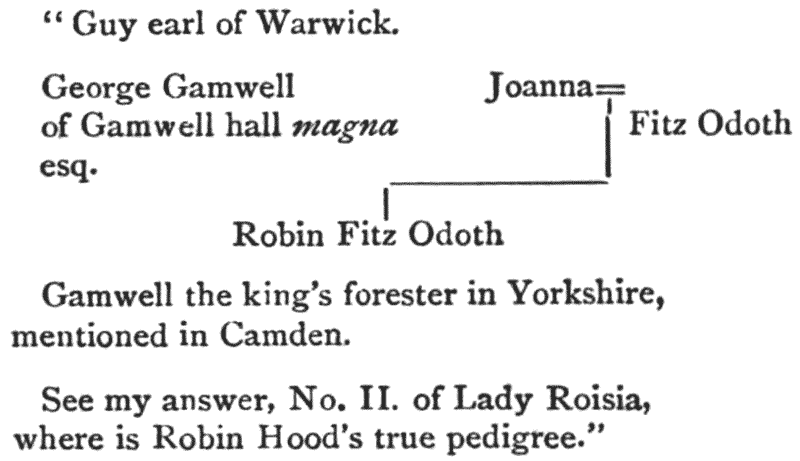
The Doctor seems, by this pedigree, to have founded our hero’s pretensions on his descent from Roisia, sister of Robert Fitzgilbert, husband of Alice, youngest daughter of Judith, Countess of Huntingdon, which, whatever it might do in those times, would scarcely be thought sufficient to support such a claim at present. Beside, though John the Scot died without issue, he left three sisters, all married to powerful barons, either in Scotland or in England, none of whom, however, assumed the title. It is, therefore, probable, after all, that Robin Hood derived his earldom by some other channel.
Dr. Stukeley, whose learned labours are sufficiently known and esteemed, was a professed antiquary, and a beneficed clergyman of the Church of England. He has not, it is true, thought it necessary to cite any ancient or other authority in support of the above representations; nor is it in the editor’s power to supply the deficiency. Perhaps, indeed, the Doctor might think himself entitled to expect that his own authority would be deemed sufficient: upon that, however, they must be content to rest. Sit fides penes auctorem! Mr. Parkin, who published “A reply to the peevish, weak, and malevolent objections brought by Dr. Stukeley in his Origines Roystonianæ, No. 2” (Norwich, 1748, 4to), terms “his pedigree of Robin Hood, quite jocose, an original indeed!” (See pp. 27, 32.)
Otho and Fitz-Otho, it must be confessed, were common names among the Anglo-Normans,* but no such name as Othes, Ooth, Fitz-Othes, or Fitz-Ooth, has been elsewhere met with. Philip de Kime, also, was certainly a considerable landholder in the county of Lincoln in the time of King Henry II., but it nowhere appears, except from Dr. Stukeley, that his surname was Fitz-Ooth.
The Doctor likewise informs us that the arms of Ralph Fitz-Ooth, and consequently of our hero, were “g. two bendlets engrailed, o.”
* “Filius Roberti filii Odonis est in custodia Domini Regis, et est vj annorum, et ipse est heres decime partis unius militis, et vix possunt inde habere victum suum ipse et mater sua.” Rotulus de vidius, &c. (31 H. 2) MSS. Har. 624.
Drayton (Polyolbion, song 26) introduces Sherwood in the character of a nymph, who, out of disdain at the preference shown by the poet to a sister-forest,
“All self praise set apart, determineth to sing
That lusty Robin Hood, who long time like a king
Within her compass liv’d, and when he list to range,
For some rich booty set, or else his air to change,
To Sherwood still retir’d, his only standing court.”
“Were he as good as George a Greene, I would strike him sure.”
What Mr. Barrington “thinks” may be true enough, perhaps, of the Toxophilite Society and other modern archers; but people should not talk of Robin Hood who never shot in his bow. The above ingenious writer’s censure of Dr. Hanmer’s credulity and ignorance, seems to be misapplied, since he cannot be supposed to believe what he holds not for truth, and actually leaves among the lyes of the land.
See also the old song, printed in the Appendix, No. 3. Drayton, who wrote before archery had fallen into complete disuse, says—
“At marks full forty score they us’d to prick and rove.”
That Mr. Barrington, indeed, was very ill informed on the subject is evident from a most scarce book in the editor’s possession, intitled “Aime for the archers of St. George’s fields, containing the names of all the marks in the same fields, with their true distances according to the dimensuration of the line. Formerly gathered by Richard Hannis, and now corrected by Thomas Bick and others. London, Printed by N. Howell for Robert Minehard and Benjamin Brownsmith, and are to be sold at the sign of the man in the moon in Blackman street, 1664,” 16mo, where the distance from Alpha to Bick’s memorial is 18 score 16 yards; and 11 score 7 yards (though there are inferior numbers, the lowest being 9, 12) appears to be a very moderate shot indeed. Two of these marks are Robin Hood and Little John. See also Shakespeare’s Second Part of K. Henry IV., act iii. scene 2, where it is said that Old Double “would have clapp’d i’ the clout at twelve score; and carry’d you a forehand shaft a fourteen and fourteen and a half;” and the notes upon the passage in Steevens’s edition, 1793. It is probable, after all, that the word forty in Drayton is an error, of the transcriber or pressman, for fourteen.
Whatever Robin Hood’s father might do, there can be no question that the author of the old ballad in which he is mentioned (part ii. song 1) has “shot in a lusty strong bow” when he speaks of
“Two north-country miles and an inch at a shot.”
“She got on her holyday kirtle and gown
They were of a light Lincolne green.”
“And farewell all gaie garments now,
With jewels riche of rare devise:
Like Robin Hood, I wot not how,
I must goe raunge in woodmen’s wyse,
Cladde in a cote of greene or gray,
And gladde to get it if i maye.”
The workes of a young wyt, Done by N. B. Gent. 1577, 4to, b. l.
“Because I do that,” said the pirate to Alexander, “with a single ship which thou dost with a great fleet, I am called a thief, and thou art called a king.”
“—pacisque imponere morem.”
One might, to the same purpose, address our hero in the words of Plautus (Trinummus, act iv. scene x):
“Atque hanc tuam gloriam jam ante auribus acceperam, et nobiles apud homines,
Pauperibus te parcere solitum, divites damnare atque domare.
Abi, laudo, scis ordine, ut æquom’st,
Tractare homines, hoc dis dignum’st, semper mendicis modesti sint.”
“I’ve heard before
This commendation of you, and from great ones,
That you were wont to spare the indigent,
And crush the wealthy.—I applaud your justice
In treating men according to their merits.—
’Tis worthy of the gods to have respect
Unto the poor.”
“Here, under this memorial stone,
Lies Robert earl of Huntingdon;
As he, no archer e’er was good,
And people call’d him Robin Hood:
Such outlaws as his men and he
Again may England never see.”
“Feb. 1597–8.
The first part of Robin Hood, by Anthony Mundy.
The second part of the downfall of earl Huntington, sirnamed Robinhood, by Anthony Mundy and Henry Chettle.”
In a subsequent page is the following entry: “Lent unto Robarte Shawe, the 18 of Novemb. 1598, to lend unto Mr. Cheattle, upon the mending of the first part of Robart Hoode, the sum of xs.;” and afterwards—“For mending of Robin Hood for the corte.” See Malone’s edition of “The Plays and Poems of William Shakespeare,” 1790, vol. i. part ii. (Emendations and additions.)
“Item, . . . . i green gown for Maryan.
Item, vi grene cottes for Roben Hoode, and iiii knaves sewtes.
Item, i hatte for Robin Hoode, i hobihorse.
Item, Roben Hoodes sewtte.
Item, the fryers trusse in Roben Hoode.”
Malone’s Shak. II. ii. (Emen. & ad.)
When Julius Cæsar here was king,
About my neck he put this ring;
Whosoever doth me take,
Let me go for Cæsar’s sake.”
In The Midwife, or Old Woman’s Magazine (vol. i. p. 250), Mrs. Midnight, in a letter “To the venerable society of antiquarians,” containing a description of Cæsar’s camp on Windsor forest, has the following passage: “There have been many extraordinary things discovered about this camp. One thing, I particularly remember, was a deer of about sixteen hundred years old. . . . . . This deer it seems was a favourite of Cæsar’s, and on that account he bedecked her neck with a golden collar and an inscription, which I shall by and by take notice of; she had been frequently taken, but when the hunters, the peasants, and poor people saw the golden collar on her neck, they readily let her go again. However, as she continually increased in strength and in bulk, as well as in age, after the course of about fifteen or sixteen centuries, the flesh and skin were entirely grown over this collar, so that it could not be discover’d till after she was kill’d, and then to the surprise of the virtuosi it appear’d with this inscription:
When Julius Cæsar reigned here,
Then was I a little deer;
If any man should me take,
Let me go for Cæsar’s sake.
“This collar, which is of pure gold, I am told weighs thirty ounces, and as the blood of the creature still appears fresh upon it, I believe it may be as valuable as any of your gimcracks; however, there will be no harm in my sending of it to you; and if I can procure it, you may depend on my taking the utmost care of it.” As no notice is announced of this wonderful piece of antiquity in the voluminous and important lucubrations of the above learned body, it most probably never came into their possession; which is very much to be lamented, as it would have been an admirable companion for Hardecnute’s chamber-pot, King Edward the first’s finger, and other similar curiosities.
Juvenal des Ursins gravely relates that in the year 1380 a hart was taken at Senlis with a chain about his neck inscribed “Cæsar hoc me donavit.”*
Upton, to be even with him, supposes a hart to have been taken at Bagshot near Windsor, with a motto on the collar in the French language, which proves the ancient Romans were familiar therewith long before it existed:
“Julius Cæsar, quant jeo fus petis,
Cest coler suz mon col ad mys.Ӡ
This dictator perpetuo, in fact, seems to have collared every hart he took. The family of Pompei in Italy use two harts for their supporters on whose collars were the letters N. M. T., in memory of one on whose collar were these words: “Nemo Me Tangat, Cæsaris sum.” Anstis, ii. 113.
The original of all these stories is to be found in Pliny, who says: “It is generally held and confessed that the stagge or hind live long; for an hundred yeer after Alexander the great, some were taken with golden collars about their necks, overgrowne now with haire and growne within the skin: which collars the said king had done upon them” (Naturall Historie, by Holland, 1601, B. 8, c. 32). Pausanias, moreover, speaking of one Leocydas, who fought for the Megalopolitans, in conjunction with Lydiades, against the Lacedæmonians (about the year 243 before Christ), says he was reported to be the descendant in the ninth degree of that Arcesilaus, who living in Lycosura saw that stag which is sacred to the goddess Despoine worn out with old age. This stag, he adds, had a collar on its neck with the following inscription:
Caught young, when Agapenor sail’d for Troy.
By which, he concludes, it is evident that a stag lives much longer than an elephant (B. 8, c. 10).
* Histoire de Charles VI.
† Upton de re militari, p. 119.
“Whether he be messengere,
Or a man that myrthes can,
Or yf he be a pore man,
Of my good he shall have some.”
The reading of the original edition is confirmed by a very old manuscript in the Cotton Library (Vespasian, B. XVI.) differing considerably from the printed copies, which gives the passage thus:
“I can nouzt perfiitli my pater-noster as a prest it syngeth:
I can rymes of Robyn Hood, of Rondolf erl of Chestre,
Ac of oure lorde ne of oure ladi the leste that ever was maked.”
(See also Caligula, A. XI.)
The speaker himself could have told Mr. Warton he was no frier:
“I have ben prieste & person passynge thyrty winter,
Yet can I nether solfe, ne singe, ne sayntes lyves read;
But I can find in a fielde or in a furlong an hare,
Better than in Beatus vir or in Beati omnes
Construe one clause well, & kenne it to my parishens.”
“Veni Nottingham tyrones
Sherwoodenses sunt latrones.
Instar Robin Hood, & servi
Scarlet & Joannis Parvi;
Passim, sparsim, peculantur,
Cellis, sylvis deprædantur.”
“Thence to Nottingham, where rovers,
Highway riders, Sherwood drovers,
Like old Robin Hood and Scarlet,
Or like Little John his varlet;
Here and there they shew them doughty,
In cells and woods to get their booty.”
Whitlock relates that “the [parliament] committee who carried the propositions of peace to Oxford, had the king’s answer sealed up and sent to them. They, upon advice together, thought it not fit for them to receive an answer in that manner . . . and made an address to his majesty that they might know what his answer was, and have a copy of it: to which his majesty replied, What is that to you, who are but to carry what I send, and if I will send the song of Robin Hood and Little John, you must carry it? To which the commissioners only said, that the business about which they came was of somewhat more consequence than that song” (Memorials, p. 115).
“Robin Hood upon Greendale stood” (State-trials, iii. 634).
A third corruption has taken place in Parker, p. 131 (King v. Cotton), though expressly cited from Yelverton, viz.
“Robin Hood in Barnwell stood.”
The following most vulgar and indecent rime, current among the peasantry in the North of England, may have been intended to ridicule the perpetual repetition of “Robin Hood in greenwood stood:”
Robin Hood
In green-wood stood.
With his back against a tree;
He fell flat
Into a cow-plat,
And all besh—n was he
“O sleepst thou, or wakst thou, Jeffery Cooke?”
occurs, likewise, in a medley of a similar description, in Pammelia 1609.
“Bills, bows, and axes, quoth Robin Hood,
But I have not time to tell;
Yonder’s the sheriff and his company,
But I hope all will be well.
Hei, down, derry, derry, down;”
and says, “I hope I may sing of old Robin without offending a grand jury, or being presented for disuniting Protestants.”
In The Gentleman’s Magazine for December 1790 is the first verse of a song used by the inhabitants of Helston in Cornwall on the celebration of an annual festivity on the 8th of May, called the Furry-day, supposed Flora’s day, not, it is imagined, “as many have thought, in remembrance of some festival instituted in honour of that goddess, but rather from the garlands commonly worn on that day.” (See the same publication for June and October 1790.) This verse was the whole that Mr. Urban’s correspondent could then recollect, but he thought he might be afterwards able “to send all that is known of it, for,” he says, “it formerly was very long, but is now much forgotten.” The stanza is as follows:
“Robin Hood and Little John
They are both gone to fair O;
And we will go to the merry green-wood,
To see what they do there O.
With hel an tow,
And rum-be-low,
And chearily we’ll get up,
As soon as any day O,
All for to bring the summer home,
The summer and the May O.”
“After which,” he adds, “there is something about the grey goose wing; from all which,” he concludes, “the goddess Flora has nothing to say to it.” She may have nothing to say to the song, indeed, and yet a good deal to do with the thing. But the fact is, that the first eight days of May, or the first day and the eighth, seem to have been devoted by the Celtic nations to some great religious ceremony. Certain superstitious observances of this period still exist in the Highlands of Scotland, where it is called the Bel-tein; Beltan, in that country, being a common term for the beginning of May, as “between the Beltans” is a saying significant of the first and eighth days of that month. The games of Robin Hood, as we shall elsewhere see, were, for whatever reason, always celebrated in May.—N.B. “Hel-an-tow,” in the above stanza, should be heave and how. Heave and how, and Rumbelow, was an ordinary chorus to old ballads, and is at least as ancient as the reign of Edward II., since it occurs in the stanza of a Scotish song, preserved by some of our old historians, on the battle of Bannockburn.
To lengthen this long note: Among the Harleian MSS. (num. 367) is the fragment of “a tale of Robin Hood dialouge-wise beetweene Watt and Jeffry. The morall is the overthrowe of the abbyes; the like being attempted by the Puritane, which is the wolfe, and the politician, which is the fox, agaynst the bushops. Robin Hood, bushop; Adam Bell, abbot; Little John, colleagues of the university.” This seems to have been a common mode of satirising both the old Church and the reformers. In another MS. of the same collection (N. 207), written about 1532, is a tract entitled “The banckett of John the reve, unto Peirs Ploughman, Laurens Laborer, Thomlyn Tailyor, and Hobb of the Hille, with others;” being, as Mr. Wanley says, a dispute concerning transubstantiation by a Roman Catholic. The other, indeed, is much more modern: it alludes to the indolence of the abbots, and their falling off from the original purity in which they were placed by the bishops, whom it inclines to praise. The object of its satire seems to be the Puritans; but here it is imperfect, though the lines preserved are not wholly destitute of poetical merit.—“Robin Hood and the Duke of Lancaster, a ballad, to the tune of The Abbot of Canterbury,” 1727, is a satire on Sir Robert Walpole.
The late Dr. Johnson, in controverting the authenticity of Fingal, a composition in which the author, Mr. Macpherson, has made great use of some unquestionably ancient Irish ballads, said, “He would undertake to write an epick poem on the story of Robin Hood, and half England, to whom the names and places he should mention in it are familiar, would believe and declare they had heard it from their earliest years” (Boswell’s Journal, p. 486).
“Of the 24 songs in what is now called ‘Robin Hood’s Garland,’ many are so modern as not to be found in Pepys’s collection, completed only in 1700. In the [editor’s] folio MS. are ancient fragments of the following, viz.—Robin Hood and the beggar.—Robin Hood and the butcher.—Robin Hood and fryer Tucke.—Robin Hood and the pindar.—Robin Hood and queen Catharine, in two parts.—Little John and the four beggars, and “Robine Hood his death.” This last, which is very curious, has no resemblance to any that have yet been published; [it is probably num. xxviii. of part ii.], and the others are extremely different from the printed copies; but they unfortunately are in the beginning of the MS. where half of every leaf hath been torn away.”
As this MS. “contains several songs relating to the civil war in the last century,” the mere circumstance of its comprising fragments of the above ballads is no proof of a higher antiquity; any more than its not containing “one that alludes to the Restoration” proves its having been compiled before that period; or than, because some of these 24 songs are not to be found in Pepys’s collection, they are more modern than 1700. If the MS. could be collated, it would probably turn out that many of its contents have been inaccurately and unfaithfully transcribed, by some illiterate persons, from printed copies still extant, and, consequently, that it is, so far, of no authority. See the advertisement prefixed.
“Is not my reason good?
Good—even good—Robin Hood.”
(His. En. po. vol. ii.)
“Your knowledge is great, your judgement is good,
The most of your study hath ben of Robyn Hood;
And Bevys of Hampton, and syr Launcelot de Lake,
Hath taught you full oft your verses to make.”
“The gentry to the King’s-head,
The nobles to the crown,” &c.
“My beer is stout, my ale is good,
Pray stay and drink with Robin Hood;
If Robin Hood abroad is gone,
Pray stay and drink with Little John.”
In an old circular woodcut, preserved on the title of Robin Hood’s Garland, 1670, as well as on that of Adam Bell, &c., printed at Newcastle in 1772, is the apparent representation of a May-game, consisting of the following personages: 1. A bishop. 2. Robin Hood. 3. The potter (or beggar). 4. Little John. 5. Frier Tuck. 6. Maid Marian. Figures 2 and 4 are distinguished by their bows and different size. The frier holds out a cross; and Marian has flowing hair, and wears a sort of coronet. But the execution of the whole is too rude to merit a copy.
At Lord Fitzwilliams’s at Richmond there is, or lately was, a curious painting by Vinckenbooms, representing old Richmond palace, with a group of morris-dancers. It has been badly engraved by Godfrey, who reduced the figures to too small a scale. Mr. Douce has a tracing from the original picture with all the figures distinctly marked. See a poem at the end of Hall’s Downfall of May-games, 1661, 4to.
It may seem, perhaps, from a passage in Browne’s Britannia’s Pastorals (Song 4), that Robin Hood’s bower was prepared for the reception of himself and his Marian, as king and queen of May. The lines are these:
“As I have seene the lady of the May
Set in an arbour, on a holy-day,
Built by the May-pole, where the jocund swains,
Dance with the maidens to the bagpipe’s strains.”
“At Baptis-day with ale and cakes bout bonfires neighbours stood,
At Martle masse wa turnd a crabbe, thilke told of Roben Hood,
Till after long time myrke, when blest were windowes, dares and lights,
And pails were fild, and hathes were swept, gainst fairie elves and sprits:
Rock and plow Mondaies gams . . . with saint-feasts and kirk-lights.”
A very learned and ingenious gentleman conceives that the enumeration of characters in the passage quoted in the text belongs solely to the May, and has no relation whatever to the morrise. That the two games, however, though essentially distinct in their origin, got somehow or other blended together appears unquestionable.
“As fit as a morris for May-day” is one of the clown’s similes in All’s well that ends well (act ii. scene 2).
15 C. of leveres for Robin Hode 0 5 0
For leveres, paper and sateyn 0 0 20
For pynnes and leveres 0 6 5
For 13 C. of leverys 0 4 4
For 24 great lyvereys 0 0 4
We are told that formerly, in the celebration of May-games, the youth divided themselves into two troops, the one in winter livery, the other in the habit of the spring. See Brand’s Popular Antiquities, p. 261.” This quotation is misapplied. Liveries, in the present instance, are pieces of paper or sateyn with some device thereon, which were distributed for money among the spectators. So in a passage which will be shortly quoted from Jack Drum’s Entertainment: “Well said, my boyes, I must have my lord’s livory; what is’t? a May-pole?” See also Stubbs’s Anatomie of Abuses, 1583, sig. M. 2 b, and Skelton’s Don Quixote, part ii. chap. 22.
“Her huke of Lyncole grene.”
“All women in generall,” says Moryson, speaking of the Netherlands, “when they goe out of the house, put on a hoyke or vaile, which covers their heads, and hangs downe vpon their backs to their legges,” &c. (Itinerary, 1617, part 3, p. 169).
Sir John Cullum seems to have mistaken Rose Sparkes’ “best hook” for a “hook worn at the bottom of the stays, to regulate the sitting of the apron” (History of Hawsted, p. 25). Morione, in Italian, signifies a murrion or scull-cap; and though the derivation alluded to appears to have the sanction of Blount’s Glosographia, nothing can be more completely absurd. Marian is Mary.
“And Marian’s nose looks rede and raw.”
“Coc. Oh the lord! what be these? . . .
Clo. They should be morris-dancers by their gingle, but they have no napkins.
Coc. No, nor a hobby-horse.
Clo. Oh, he’s often forgotten, that’s no rule; but there is no maid Marian nor friar amongst them, which is the surer mark.
Coc. Nor a fool that I see.”—(Tollet’s Memoir.)
“Nympha fui quondam latronibus hospita sylvæ
Heu nimium sociis nota, Robine, tuis.
Me pudet innocuos latices fudisse scelestis,
Jamque viatori pocula tuta fero,
En pietatis honos! Comes hanc mihi Carliolensis
Ædem sacravit quâ bibis, hospes, aquas.”
The same author (Gent), in his “long and pathetick prologue,” setting forth “the contingencies, vicissitudes or changes of this transitory life,” “spoken, for the most part, on Wednesday and Friday the 18th and 20th of February 1761, at the deep tragedy of beautiful, eloquent, tender-hearted, but unfortunate Jane Shore, . . . . uttered and performed at his benefit” . . . (being then ætatis 70, and far declined into the vale of sorrow,*) has very artfully contrived to introduce our hero and his famous well.
“The concave hall, ’mongst sources never view’d,
Nor heard the goddesses, in merry mood,
At their choice viands sing bold Robin Hood:†
Whose tomb at Kirkley’s nunnery display’d,
A false, hard-hearted, irreligious maid,
Who bled, and to cold death that earl betray’d.
But fame still lasts, while country folks display
His limpid fountain, and loud-surging bay.”
* He died in 1778, aged 87.
†
“Omnes agnovere deam; lætique receptant
Alcæum musæ comitem, ponuntur Iâcchi
Crateres; flaventque scyphis Cerealia vina:
Accedunt vultus hilares; festique lepores,
Et jocus, et risus: dulci testudine Naias
Pulchra modos variat; furtisque insignis et arcu
Hodi latronis, fluvios bene nota per istos,
Ludicra gesta canit: resonant laquearia plausu.”
“And ryse wyth ribaudy as Rebertes knaves.”
“The famous Little John (Robin Hood’s companion) lyes buried in Fethersedge churchyard, in the peak of Derbyshire, one stone at his head, another at his feet, and part of his bow hangs up in the chancell. Anno 1652.” H. E[llis]. European Magazine, October 1794, p. 295.
ROBIN HOOD.
Part I.