Front matter
Reading edition
Cover
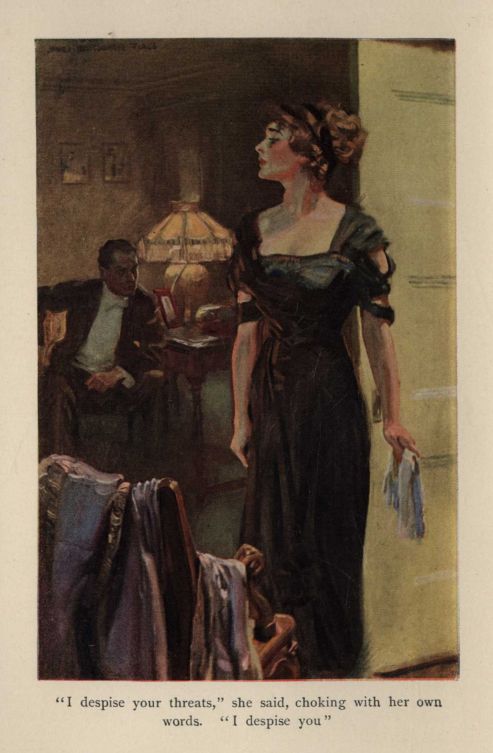
I despise your threats," she said choking with her own words. "I despise you."
ROBERT KIMBERLY
BY FRANK H. SPEARMAN
ILLUSTRATED BY JAMES MONTGOMERY FLAGG
TORONTO McLEOD & ALLEN PUBLISHERS
COPYRIGHT, 1911, BY CHARLES SCRIBNER'S SONS
Published February, 1911
TO MY WIFE
ILLUSTRATIONS
I despise your threats," she said choking with her own words. "I despise you." . . . . . . Frontispiece
Kimberly placed it without hesitation on her shoulders
She sang for him "Caro Mio Ben"
An acolyte, entering in the gray of the early morning, saw on the last of the kneeling benches a man resting with bowed head
Robert Kimberly
CHAPTER I
The dancing pavilion, separated from the Casino itself by an arched passageway and affording another pretty view of the lake in the moonlight, was filled with young people when Alice entered.
"It will be cool here, I think," suggested Dolly De Castro, leading the way for her guest. "The Hickories is by no means a gay place," she continued, seating herself beside Alice where they could see the dancers moving in and out of the long room. "And it isn't a club. There is just this Casino and the fields for golf and polo. It is a neighborhood affair--and really the quietest place of the kind in the Lake country. Too bad you could not have been here three weeks ago for the Kermess."
"So Miss Venable said. They are great fun."
"We revive one occasionally to preserve the Dutch traditions of the family," continued Dolly. "Mrs. Charles Kimberly--Imogene--gave it this year. Last year I gave it. You would have seen everybody, especially the Sea Ridge people. Fritzie, dear?" Dolly paused to stay a slender young woman who was passing. "Miss Venable," she explained, still speaking to Alice, "is our favorite cousin and will make you acquainted with every one."
Fritzie Venable whose lively, brown eyes escaped beauty only through a certain keenness of expression, stopped with a smile and waited on Dolly's word.
"I want Mrs. MacBirney to go over to the Nelsons' after a while. This dance is really a young people's affair," Dolly went on, turning to Alice. "These are friends of Grace's and Larrie's and I don't know half of them. Take care of Mrs. MacBirney a moment, Fritzie, will you, while I find Arthur?" asked Dolly, rising and leaving the two together.
Alice looked after Dolly as she walked away. Dolly had the Kimberly height and preserved it with a care that gave dignity to her carriage. Her dignity, indeed, showed in her words as well as in her manner; but in both it battled with a mental intensity that fought for immediate expression. Dolly persuaded and dictated unblushingly, though it could not be said, unpleasingly.
"I know you are enjoying Mrs. De Castro and her lovely home," said Fritzie to Alice. "Of course," she added as Alice assented, "The Towers is on a much grander scale. But I think Black Rock is the 'homiest' place on Second Lake. I suppose since I saw you yesterday you have been all around?"
"Not quite; but I've met many lovely people."
"You can't help liking Second Lake people. They are a kind-hearted, generous set--notably so for people of means."
"Aren't such people usually generous?"
Fritzie looked doubtful: "People of large means, perhaps, yes. Indeed, the only trouble here is, there are too many of that sort. Everybody is prosperous and everybody, with, I think, two exceptions, contented. I," laughed Fritzie, "am one of the exceptions. There being no possibility of preëminence in the line of means, I believe I have in my rôle of discontent a certain distinction; and as far as I can see, as much fun as anybody. In fact, I've often thought the only place where I should care to be rich would be among the poor. Where every one overflows with luxury distinctions are necessarily lost--and I like distinctions. Isn't this pretty for dancing?"
"Everything over here is pretty," said Alice.
"The place takes its name, 'The Hickories,' from the grove back of it. You see there was nothing about the Lake itself to serve the purpose of a country club--no golf course, no polo field. All this stretch of the eastern shore is a part of The Towers estate, but Mr. Kimberly was good enough to set it apart for the rest of us--you have met Mr. Robert Kimberly?"
"Neither of the Mr. Kimberlys as yet."
"There is Charles now." Fritzie indicated a smooth-faced, youthful-looking man coming in through one of the veranda openings. "That is he speaking to Dolly. They call him the handsome Kimberly."
Alice smiled: "For a man that's rather a severe handicap, isn't it?"
"To be called handsome?"
"It suggests in a way that good looks are exceptional in the family, and they are not, for their sister, Mrs. De Castro is very handsome, I think. Which brother is this?"
"The married brother; the other is Robert. They call him the homely Kimberly. He isn't really homely, but his face in repose is heavy. He is the bachelor."
"Mr. MacBirney tells me he is completely wrapped up in business."
"Rather--yes; of late years."
"That, I presume, is why he has never married."
"Perhaps," assented Fritzie with a prudent pause. "Some men," she went on somewhat vaguely, "get interested, when they are young, in women in general. And afterward never settle down to any one woman, you know."
"I should think that kind of a man would be tiresome."
Fritzie looked at young Mrs. MacBirney somewhat in surprise, but there was nothing in Alice's frank eyes to provoke criticism. They met Fritzie's with an assurance of good-nature that forestalled hostility. Then, too, Fritzie remembered that Mrs. MacBirney was from the West where people speak freely. "Robert is deliberate but not a bit tiresome," was all Fritzie said in answer. "Indeed, he is not communicative."
"I didn't mean in that way," explained Alice. "I should only be afraid a man like that would take himself so seriously."
Fritzie laughed: "He wouldn't know what that meant. You had music at your dinner to-night."
"Lovely music: the Hawaiian singers."
"I was sorry I couldn't be there. They always come out to sing for Robert when they are in the States, and they are always in dreadful financial straits when they get as far from home as this, and he is always making up their deficits. They used to sing at The Towers, from barges on the lake. But The Towers is hardly ever opened nowadays for a function. The music over the water with the house illuminated was simply superb. And the evening winding up with fireworks!" sighed Fritzie in pleasing retrospect.
"There is Robert now," she continued.. "Do you see him? With Mrs. Charles Kimberly. They are devoted. Isn't she a slip? And the daintiest little thing. Robert calls her his little Quakeress--her people were Quakers. She seems lost among the Kimberlys--though Robert isn't quite so tall as his brother, only more muscular and slower."
Robert Kimberly with Imogene on his arm entered from the opposite side of the room and walked across the floor to take her to her husband. His face was darker than that of Charles and heavier eyebrows rendered his expression less alert. Fritzie waved a hand at Imogene, who answered with her fan and greeted Alice.
"And there comes Mrs. Nelson--the pale brunette. Heroic woman, I call her. She has been fighting her advancing weight for ten years. Isn't she trim? Heavens, she ought to be. She lives in Paris half the time and does nothing but dress and flirt."
"And who is it with her?"
"The stately creature with her is Dora Morgan. She is a divorcée. She likewise lives in Paris and is quite a singer. I haven't heard her lately but she used to sing a little off the key; she dresses a little off the key yet, to say nothing of the way she acts sometimes. They are going to dance."
A small orchestra of stringed instruments with a French horn, hidden somewhere in a balcony, began the faint strains of a German waltz. The night was warm. Young people in white strolling through dim veranda openings into the softly lighted room moved at once out upon the floor to the rhythm of the music. Others, following, paused within the doorways to spin out ends of small talk or persist in negligible disputes. The dancers wore the pretty Hawaiian leis in honor of the Island singers.
"There were some interesting men at the dinner to-night," said Alice.
"You mean the German refiners? Yes, they are Charles Kimberly's guests," remarked Fritzie as the floor filled. "There they are now, in that group in the archway with Mr. Nelson."
"But the smaller man was not at the dinner."
"No, that is Guyot, the French representative of the Kimberlys. He and George Doane, the bald, good-looking man next to him, have the party in charge. You met the immense man, Herr Gustav Baumann, at dinner. He is a great refiner and a Hawaiian planter. They are on their way to Honolulu now and leave within an hour or two in Robert Kimberly's car for San Francisco. The Baumanns have known the Kimberlys for generations. Should you ever think Herr Baumann could dance? He is as light as a cat on his feet, but he waltzes in the dreadful European round-and-round way. The black-haired man with the big nose is Lambert, a friend of his, a promoter and a particularly famous chemist whom Robert Kimberly, by the way, hates--he is a Belgian. I can't bear him, either--and, Heavens, Guyot is bringing him over here now to ask me to dance!"
Fritzie's fear proved true. However, she accepted graciously as Lambert was brought forward and bowed in making his request. But she did not fail to observe that though he bowed low, Lambert's bold eyes were glued on Alice even while he was begging Fritzie for the dance. Something in Alice's slender face, the white hardly touched enough with pink, except under animation, held Lambert's glance. Alice, already prejudiced, directed her eyes as far away as possible under the inspection and was glad that Fritzie rose at once.
Robert Kimberly joined Baumann and Edward Nelson. "You have not told me yet, Robert," Baumann began, "how you put in your time here in the country."
"I have a good secretary and do a great deal of my work here, Gustav."
"But one does not always work. What else? I remember," he continued, turning to Nelson, "the stories my father used to tell about the Kimberlys--your father, Robert, and especially your Uncle John." Baumann radiated interest in everything American. "Those men were busy men. Not alone sugar-refining, but horses, steamboats, opera-houses, women--always, always some excitement."
"Other times, other manners, Baumann," suggested Nelson. "In those days a fine horse had a national interest; to-day, everybody's horse does his mile in two minutes. The railroads long ago killed the steamboats; newsboys build the opera-houses now; sugar refines itself. Mere money-making, Baumann, has become so absorbing that a Kimberly of this generation doesn't have time to look at a woman."
"Nelson!" protested the good-natured and perspiring German, "no time to look at a woman? That, at least, cannot be true, can it, Robert?"
"Not quite. But I imagine the interest has waned," said Kimberly. "When a man took his life in his hand on such a venture the excitement gave it a double zest--the reflection that you were an outlaw but prepared, if necessary, to pay the price with your life. Nowadays, the husband has fallen lower than the libertine. If you break up his home--he sues you. There is nothing hair-raising in that. Will you dance, Gustav?"
"I want very much to dance. Your women dance better than ours."
"Why, your women dance beautifully. Nelson will find you a partner," suggested Kimberly. "I must hunt up Mrs. Nelson. I have a dance with her, myself."
Alice sat for a moment alone. Among the dancers, Robert Kimberly moved past her with Lottie Nelson on his arm. Alice noticed how handsome and well poised Lottie was on her feet; Kimberly she thought too cold to be an attractive partner.
Within a moment Dolly came back. "I can't find Arthur anywhere."
"He isn't on the floor, Mrs. De Castro."
"No matter, I will let him find me. Isn't it a pretty company? I do love these fresh faces," remarked Dolly, sitting down. "The young people complain of our being exclusive. That is absurd. We have to keep quiet, otherwise why live in the country? Besides, what would be gained by opening the doors?"
Dolly had a pleasing way of appealing in difficulties, or what seemed such, even to a stranger. "We don't want ambitious people," she went on; "they are killing, you know--and we certainly don't want any more like ourselves. As Arthur says," Dolly laughed a little rippling laugh, "'we have social liabilities enough of our own.'"
Arthur De Castro came up just in time to hear his name: "What's that Arthur says, Dolly?"
"Oh, here you are!" exclaimed his wife. "No matter, dear, what it was."
"It is certain Arthur never said anything of the kind, Mrs. MacBirney," interposed De Castro. "If any one said it, it must have been you, Dolly."
Alice laughed at the two. "No matter who said it," remarked Dolly, dismissing the controversy, "somebody said it. It really sounds more like Robert than anybody else."
"You will be aware very soon, Mrs. MacBirney," continued De Castro, "that the Kimberlys say all manner of absurd things--and they are not always considerate enough to father them on some one else, either."
Alice turned to her hostess with amused interest: "You, of course, are included because you are a Kimberly."
"She is more Kimberly than the Kimberlys," asserted her husband. "I am not a Kimberly." Arthur De Castro in apologizing bowed with so real a deprecation that both women laughed.
"Of course, the young people rebel," persisted Dolly, pursuing her topic, and her dark hair touched with gray somehow gave an authority to her pronouncements, "young people always want a circle enlarged, but a circle never should be. What is it you want, Arthur?"
"I am merely listening."
"Don't pretend that you leave the men just to listen to me. You want Mrs. MacBirney to dance."
"She is always like that," declared De Castro to Alice, whom he found pleasing because her graciousness seemed to invite its like. "Just such bursts of divination. At times they are overwhelming. I remember how stunned I was when she cried--quite before I could get my breath: 'You want to marry me!'"
"Was she right?" laughed Alice, looking from one to the other.
"Absolutely."
"Is she right now?"
"Dolly is always right."
"Then I suppose I must dance."
"Not, of course, unless you want to."
Alice appealed to Dolly: "What did you do?"
"I said I wouldn't marry him."
"But you did," objected her companion.
"He was so persistent!"
Alice laughingly rose: "Then it would be better to consent at once."
Dolly rose with her. Two of the dancers stopped before them: a tall, slender girl and a ruddy-faced, boyish young man.
"Grace," said Dolly to the blue-eyed girl, "I want you to meet Mrs. MacBirney. This is my niece, Grace De Castro."
The young girl looked with pretty expectancy into Alice's face, and frankly held out her hand.
"Oh, what a bloom!" exclaimed Alice, looking at the delicate features and transparent skin. Grace laughed happily. Alice kept her hand a moment: "You are like a bit of morning come to life, Grace."
"And this is my cousin, Mrs. MacBirney--Mr. Morgan," said Grace shyly.
Larrie Morgan, a bit self-conscious, stood for an instant aloof. Alice said nothing, but her eyes in the interval worked their spell. He suddenly smiled.
"I'm mightily pleased to meet you, Mrs. MacBirney," he exclaimed with heartiness. "We've all heard about you. Is Mr. MacBirney here?" he continued, tendering the biggest compliment he could think of.
"He is somewhere about, I think."
"We shall lose our waltz, Mrs. MacBirney," urged Arthur De Castro.
"Oh, we mustn't do that. Let's run," whispered Alice, taking his arm.
"Who is Mrs. MacBirney?" asked Grace of Larrie with an appealing look as Alice moved away.
"Why, don't you know? Her husband owns some beet plants."
"What lovely manners she has." Grace spoke under her breath. "And so quiet. Where are their refineries, Larrie?"
"In the West."
"Where in the West?"
"Somewhere out toward the Rocky Mountains," hazarded Larrie.
"Denver?" suggested Grace doubtfully.
"I fancy that's it. Anyway," explained Larrie coldly, "we are buying them."
"Are you?" asked Grace, lifting her soft eyes timidly.
To her, Larrie was the entire Kimberly sugar interest; and at the moment of making the MacBirney purchase he looked, to Grace, the part.
CHAPTER II
Edward Nelson, the counsel, in some measure the political adviser and, as to the public, the buffer of the Kimberly sugar interests, was fond of entertaining. Being naturally an amiable gourmet, his interests suited his tastes. Moreover, his wife, Lottie Nelson, pleasing of face, with a figure well proportioned and with distinction in her bright, indolent eyes, loved to entertain. And she loved to entertain without working hard to do so. Morningside, her country home at Second Lake, though both attractive and spacious, and designed with a view to entertaining, was already being replaced with a new home more attractive and more spacious, and meant to be filled with still more guests.
Observation and experience had convinced Lottie that the easiest way to keep people in hand is to feed them well. And she quite understood that a vital part of the feeding in such a philosophy is the drinking. There were difficulties, it is true, but which of us has not difficulties?
People--provided, they were people of consequence--diverted Lottie. She had no children--children had no place in her view of life--nor was she vitally interested in her husband. The companionship of those whom she called her friends thus became a necessity; the annoyance being that not always would the particular friends whom she wanted--men chiefly--gather to her.
On the evening of the De Castro dinner and dance, Lottie was in better than her usual spirits. She had brought home Charles Kimberly--who as a yachtsman bore the title of Commodore--and his wife, Imogene. Imogene, the little Quakeress, did not like her, as Lottie was aware, but Charles Kimberly was always in sorts and always tractable--different in that respect from Robert. Charles and his wife took MacBirney and Fritzie Venable to the Nelsons' with them and Alice was to follow with the De Castros.
When Lottie reached home, Dora Morgan had already come over with George Doane, one of the Kimberly stock brokers. These two assured the evening. In the dining-room only a few--of the right sort--were needed for good company.
But more was in prospect for this evening--Robert Kimberly was expected. Nelson came down from the library with MacBirney and left him with Imogene while he followed Charles to a smoking-room. Fritzie and Mrs. Nelson joined Doane and Dora Morgan in the music-room. Cards were proposed, but no one had the energy to get at them.
A servant passed in the hall to answer the door and Lottie Nelson at once left the room. When she reached the vestibule the footman was taking Robert Kimberly's coat. She walked well up to Robert before she spoke: "At last!"
"I went back to The Towers for a moment," said Kimberly in explanation. "Are Charles and Nelson here?"
"And is that all after a month--'Are Charles and Nelson here?'!" echoed Lottie patiently and with a touch of intimate reproach.
"We have a conference to-night, you know, Lottie. How are you?"
She put back her abundant hair: "Why didn't you call up last week when you were home to find out?"
"I was home only overnight. And I came late and left before you were awake. You know I have been at the new refinery for a week. We began melting yesterday."
"At the big one?"
"At the big one."
She took hold of the lei that he had worn over from the dance and in a leisurely way made a pretence of braiding the stem of a loose rose back into it. "This is the prettiest I've seen," said Lottie. "Who gave it to you?"
"Grace. What is the matter with it?" he asked looking down at her white fingers.
"You are losing your decoration," she murmured with leisurely good-nature. "Nobody to do anything for you."
Kimberly looked at the parting lei with some annoyance, but if he entertained doubts as to its needing attention he expressed none. "These things are a nuisance anyway," he declared at length, lifting the lei impatiently over his head and depositing it without more ado on a console. "We will leave it there."
"Where else have you been all this time?" demanded Lottie with an indolent interest.
"All over the country--even across the Rockies."
"Across the Rockies! And a whole big car to yourself! You must love solitude. And now you are buying a lot of refineries."
"Not I--the companies are."
"Oh, it's all the same."
"Not precisely; this MacBirney purchase is not by my advice or with my approval."
"He is in there now, Imogene is talking with him."
"The trip was extremely tedious," said Kimberly, casting his eyes slowly around for means of escape.
"How could it be anything else with no friends along?"
"With McCrea and two secretaries and a stenographer, I hadn't time to take any friends."
"What is time for?"
"I should say in the West it is valuable for getting home with."
"And when you do get home?"
"To build more; borrow more; control more; sell more; spend more. I'm speaking for all the rest of you, not for myself. I'm just the centrifugal to throw the money out."
"Never by any chance to live more, I suppose?"
"You mean to eat and drink more? How could we?"
"I don't mean to eat and drink more. I mean just what I say, to live more!"
They were at the threshold of the music room. He laughed good-naturedly, but Lottie declined to be appeased.
"Lord, but I'm sick of it all!" she exclaimed petulantly.
Kimberly used care not to offend, yet he always interposed a screen between himself and her, and however delicate the barrier, Lottie Nelson had never been able to penetrate it.
"No sicker of it than I am," he returned. "But I'm a part of the machine; I can't get out. I suppose you are, and you can't get out. But you are too young to talk like that; wait till the new home is finished. Then you will shine."
She uttered a contemptuous exclamation, not quite loud enough for the others to hear, as she reëntered the room. The others, in fact, scarcely would have heard. Fritzie, Doane, and Dora Morgan were laughing immoderately. Imogene at the piano was playing softly. Kimberly stopped to speak to her.
"I forgot, by the way, to ask you when you sail, Imogene," he said.
She answered with one hand running over the keys: "That depends on you, doesn't it, Robert? I do hope you'll get through soon."
"Anxious to get away, are you?"
"You know I always am."
"Where are you going this time?"
"To the Mediterranean, I suppose."
"You are fond of the Mediterranean."
"Every place else seems so savage after it."
"Lottie says you have been talking with MacBirney."
"Just a few minutes."
"How do you like him?" asked her brother-in-law.
Imogene laughed a little: "He is very intelligent. He confuses me a little, though; he is so brisk."
"Is he entertaining?"
Imogene shrugged her shoulders: "Yes. Only, he rather makes you feel as if he were selling you something, don't you know. I suppose it's hardly fair to judge of one from the first interview. His views are broad," smiled Imogene in retrospect. "'I can't understand,' he said 'why our American men should so unceasingly pursue money. What can more than a million or two possibly be good for--unless to give away?'" Imogene looked with a droll smile into Kimberly's stolid face. "When he said, 'a million or two,' I thought of my wretched brother-in-law struggling along with thirty or forty that he hasn't yet managed to get rid of!"
"You don't think, then, he would accept a few of them?" suggested Kimberly.
"Suppose you try him some time," smiled Imogene as she walked with Kimberly to the card-table where Fritzie and Dora Morgan sat with Doane.
"Travelling agrees with you, Robert," observed Doane.
"The country agrees with you," returned Kimberly. "Good company, I suppose, George, is the secret."
"How is the consolidation getting along?"
"There isn't any consolidation."
"Combination, then?"
"Slowly. How is the market?"
"Our end of it is waiting on you. When shall you have some news for us?"
"You don't need news to make a market," returned Kimberly indifferently, as he sat down. He looked at those around the table. "What are you doing?"
"Tell your story again, Dora," suggested Doane.
Dora Morgan looked at Kimberly defiantly. "No," she said briefly.
"Pshaw, tell it," urged Doane. "It's about the Virgin Mary, Robert."
Dora was firm: "It's not a bachelor's story," she insisted.
"Most of your stories are bachelors' stories, Dora," said Kimberly.
Dora threw away her cigarette. "Listen to that! Didn't I tell you?" she asked appealing to Doane. "Robert is getting to be a real nice man."
In an effort to appease both sides, Doane laughed, but somewhat carefully.
"I got into trouble only the other day in telling that story," continued Dora, with the same undercurrent of defiance.
Effectively dressed, though with a tendency to color, and with dark, regular features, flushed a little at night, Dora Morgan had a promise of manner that contrasted peculiarly with her freedom of tongue.
"Tell us about it, Dora?" said Lottie Nelson.
"It was over at The Towers. I was telling the story to Uncle John. His blood is red, yet," she added without looking at Robert Kimberly to emphasize her implication.
"Uncle John!" echoed Fritzie, at fault. "Did Uncle John object?"
"Oh, no, you misunderstand. It wasn't Uncle John." Every one but Kimberly laughed. "I was telling Uncle John the story, and his nurse--your protégé, what's his name? I never can remember--Lazarus? the queer little Italian," she said, appealing to Kimberly.
"Brother Francis," he answered.
"He's not so awfully little," interposed Fritzie.
"Well, he was in the room," continued Dora, "and he got perfectly furious the moment he heard it."
"Furious, Dora? Why, how funny!" exclaimed Lottie Nelson, languidly.
"He turned on me like a thunder-cloud. Poor Uncle John was still laughing--he laughs on one side of his face since his stroke, and looks so fiendish, you know--when Lazarus began to glower at me. He was really insulting in his manner. 'Oh, I didn't know you were here,' I said to hush him up. 'What difference should that make?' he asked, and his eyes were flashing, I can tell you."
"'The Virgin Mary is no relation of yours, is she?' I demanded frigidly. You ought to have seen the man. You know how sallow he is; he flushed to the roots of his hair and his lips snapped like a trap. Then he became ashamed of himself, I dare say, and his eyes fell; he put his hand on his breast and bowed to me as if I had been a queen--they certainly have the prettiest manners, these poor Italians--haven't they, Imogene?"
"But what did he say?" asked Fritzie.
"'Madame,' he exclaimed, as if I had stabbed him to the heart, 'the Blessed Virgin is my mother.' You really would have thought I had insulted his own mother. They have such queer ideas, these foreigners. My, but he was mad! Then, what do you think? The next day I passed him walking up from the lake and he came over with such apologies! He prayed I would overlook his anger--he professed to have been so shocked that he had forgotten himself--no doubt he was afraid he would lose his job."
"George, you look sleepy," Lottie Nelson complained, looking at Doane. "You need something to wake you up. Suppose we adjourn to the dining-room?"
Imogene returned to the piano. Kimberly walked to the door of the dining-room with the others. "I will go upstairs," he said to Lottie Nelson.
"Don't stay all night," she returned peremptorily. "And come have something before you go up."
"Perhaps when I come down."
Fritzie caught his arm, and walked with him into the hall. They talked for a moment. "You must meet her," declared Fritzie at length, "she is perfectly lovely and will be over after a while with Dolly." Then she looked at him suddenly: "I declare, I don't believe you've heard a word of what I've been saying."
"I'm afraid not, Fritzie, but no matter, listen to what I say. Don't go in there and drink with that bunch."
"I won't."
"Whiskey makes a fool of you."
Fritzie put up her hand: "Now don't scold."
Upstairs, Nelson and Charles Kimberly, facing each other, were seated at a big table on which lay a number of type-written sheets, beautifully clear and distinct. These they were examining.
"What are you going over?" asked Robert, taking the chair Nelson drew up for him.
"The Colorado plants."
"Our own or the MacBirney?"
"Both."
Charles Kimberly with one hand in his pocket, and supporting his head with the other as his elbow rested on the table, turned to Robert with a question.
"You've seen the MacBirney figures. What do you think of them?"
"They are high. But I expected that."
"Do you really need the MacBirney plants to control the Western market?" asked Charles Kimberly. With eyes half closed behind his glasses he studied his brother's face, quite as occupied with his thoughts as with his words.
Robert did not answer at once. "I should hate to say so, personally," he remarked at length.
"McCrea," continued Charles, "contends that we do need them to forestall competition. That is, he thinks with the MacBirney crowd out of the field we can have peace for ten years out there."
Nelson asked a question. "What kind of factories have they got?"
"Old-fashioned," answered Robert Kimberly.
"What kind of influence?"
"In public affairs, I don't know. In trade they are not dangerous, though MacBirney is ambitious and full of energy. The father-in-law was a fine old fellow. But he died just before the reorganization. I don't know how much money they've got now."
"They haven't much," remarked Nelson.
"We bother them a good deal from San Francisco," continued Robert Kimberly, reflecting, "but that is expensive. Ultimately we must own more factories in Colorado. Of course, as far as that goes, I would rather build new plants than remodel rat-hospitals."
Charles Kimberly straightened up and turned himself in his chair. "Ten years of peace is worth a good deal to us. And if MacBirney can insure that, we ought to have it. All of this," he appealed to Robert, as he spoke, "is supposing that you are willing to assent."
"I do not assent, chiefly because I distrust MacBirney. If the rest of you are satisfied to take him in, go ahead."
"The others seem to be, Robert."
"Then there is nothing more to be said. Let's get at the depreciation charges and the estimates for next year's betterments, so we can go over the new capitalization."
While the conference went on, the muffled hum of gathering motor-cars came through the open windows.
Robert Kimberly leaving the two men, walked downstairs again. The rooms were filling with the overflow from the dance. They who had come were chiefly of the married set, though boys and girls were among them.
After the manner of those quite at home, the dancers, still wearing their flower leis, were scattered in familiar fashion about small tables where refreshment was being served.
At one end of the music room a group applauded a clever young man, who, with his coat cuffs rolled back, was entertaining with amateur sleight-of-hand.
At the other end of the room, surrounded by a second group, Fritzie Venable played smashing rag-time. About the tables pretty, overfed married women, of the plump, childless type, with little feet, fattening hands, and rounding shoulders, carried on a running chatter with men younger than their husbands.
A young girl, attended at her table by married men, was trying to tell a story, and to overcome unobserved, her physical repugnance to the whiskey she was drinking.
In the dining-room Lottie Nelson was the centre of a lively company, and her familiar pallor, which indulgence seemed to leave untouched, contrasted with the heightened color in Dora Morgan's face.
Robert Kimberly had paused to speak to some one, when Fritzie Venable came up to ask a question. At that moment Arthur and Dolly De Castro, with Alice on Dolly's left, entered from the other end of the room. Kimberly saw again the attractive face of a woman he had noticed dancing with Arthur at the Casino. The three passed on and into the hall. Kimberly, listening to Fritzie's question, looked after them.
"Fritzie, who is that with Dolly?" he asked suddenly.
"That is Mrs. MacBirney."
"Mrs. MacBirney?" he echoed. "Who is Mrs. MacBirney?"
"Why, Mr. MacBirney's wife, of course. How stupid of you! I told you all about her before you went upstairs. He has brought his wife on with him. Dolly knew her mother and has been entertaining Alice for a week."
"Alice! Oh, yes. I've been away, you know. MacBirney's wife? Of course. I was thinking of something else. Well--I suppose I ought to meet her. Come, Fritzie."
CHAPTER III
They found Alice with the De Castros in the hall. Dolly looked pleased as her brother came forward. Alice collected herself. She felt a momentary trepidation at meeting this man, from whom, she was already aware, much of what she had seen and most of the people whom she had met at Second Lake in some degree derived.
She had heard for years, since girlhood, indeed, of the house of Kimberly. Her own father's struggle through life had been in the line of their business, and the name of the Kimberlys could not but be haloed wherever refiners discussed their affairs. Moreover, at the moment her own husband was seeking, and with prospects of success, an alliance with them.
Yet in a moment she found it all very easy. Kimberly's manner as he met her was simplicity itself. His words were few and did not confuse her, yet they were sufficient to relieve the necessity of any effort on her part to avoid embarrassing pauses. She only noticed that the others rather waited for Kimberly to speak; giving him a chance to say without interruption whatever he pleased to say. Beyond this, that the conversation was now reserved for herself and Kimberly, she was at ease and wondered why she had been a little afraid of him. The surprise was that he was younger than she had supposed. She began to wonder that his name should at times command so much of the public interest. Nor could any but those who knew him have realized that under his restraint Alice was experiencing his most gracious manner.
But those who did know him saw instantly how interested he was in her youth and inexperience. Her cheeks were already flooded with pink, as if she realized she must do her best to please and was conscious that she was not wholly failing. Timidity reflected itself in her answers, yet this was no more than an involuntary compliment, pleasing in itself. And whenever possible, Alice took refuge from the brother's more direct questions by appealing to his sister Dolly. Kimberly was diverted to see her seek escape in this fashion from his directness.
She expressed presently her admiration for the decorations at the Casino and the talk turned upon the Hawaiian singers; from them to Hawaii and Honolulu. Word at that moment came from the music room that the singing was beginning. Kimberly without any sign of giving up Alice, followed Dolly and her husband down the hall to where the guests were gathering.
The group paused near the foot of the stairs. Alice asked an explanation of the chant that they had heard at the Casino and Kimberly interpreted the rhythm for her. "But I should have thought," he added, "you would be familiar with it."
"Why so?"
"Because you have been at the Islands."
"Pray, how did you know that?"
"By your pronunciations."
"Ah, I see. But I was there only once, when I was quite young, with my father."
"And yet you have no lei to-night? That is hardly loyal, is it?"
"We came late and they had all been given out, I suppose."
"I have one in reserve. You must show your good-will to the musicians. Permit me." He turned with dignity to the console where he had so unceremoniously discarded his own lei and picked the garland up to lay it upon Alice's shoulders.
"But Robert," Fritzie cried, "you mustn't! That is a rose lei."
"What is the difference?" asked Kimberly.
"There's a superstition, you know, about a rose lei."
"Mercy, what is it?" demanded Alice, pink and smiling.
"If a man gives you a rose lei you must marry him or you will die."
"Fortunately," remarked Kimberly, lifting the decoration quickly above Alice's head and placing it without hesitation on her shoulders, "neither Mrs. MacBirney nor I are superstitious. And the roses harmonize perfectly with your gown, Mrs. MacBirney. Don't you love the Islands?"
"I've always wanted to go back to them to stay. I don't think if I had my choice I should ever leave them."
"Neither should I. We must get up a party and have a yacht meet us in San Francisco for the trip. This fall would be a good time to get away."
His decisive manner was almost startling; the trip seemed already under way. And his mannerisms were interesting. A certain halting confidence asserted itself under the affected indifference of his utterance. Whatever he proposed seemed as easy as if done. He carried his chin somewhat low and it gave a dogmatism to his words. While he seemed to avoid using them obtrusively, his eyes, penetrating and set under the straight heavy brows which contracted easily, were a barometer from which it was possible to read his intent.
"You have been frequently at the Islands?" returned Alice.
"Years ago I knew them very well."
"Father and I," Alice went on, "spent a month at Honolulu." And again the softness of her long vowels fell agreeably on Kimberly's ear. Her voice, he thought, certainly was pretty. "It is like a paradise. But they have their sorrows, do they not? I remember one evening," Alice turned toward Fritzie to recount the incident, "just at the sunset of a rarely perfect day. We were walking along the street, when we heard the most piercing cries from a little weeping company of women and children who were coming down the esplanade. In front of them walked a man all alone--he was a leper. They were taking him away from his family to be sent to Molokai. It was the most distressing thing I ever saw." She turned to Kimberly. "You have never been at Molokai?"
"I have cruised more or less around it. Do you remember the windward cliffs just above the leper settlement? They are superb from the sea. We put in once at Kalawao for a night and I called on the priest in charge of the mission."
"It must have been very, very dreadful."
"Though like all dreadful places, disappointing at first; nothing, apparently, to inspire horror. But after we had breakfasted with the priest in the morning, we went around with him to see his people." Kimberly's chin sank and his eyes closed an instant as he moved his head. "I remember," he added slowly, "a freezing up around the heart before we had gone very far." Then he dismissed the recollection. "The attendant at home who takes care of my uncle--Francis--" he continued, "had a brother in the leper missions. He died at Molokai. Francis has always wanted to go there."
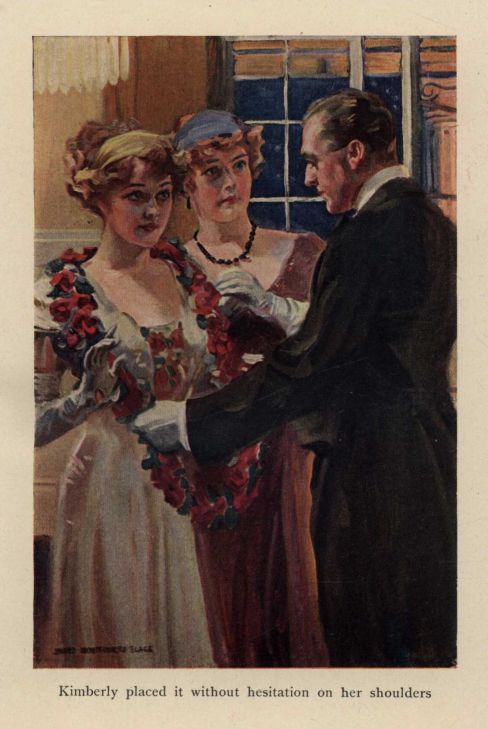
Kimberly placed it without hesitation on her shoulders
The conversation waited a few moments on the singing. "Miss Venable tells me," said Alice, presently, "these singers always come out to sing for you when they visit this country."
"I have met most of them at one time or another in Hawaii. You know they are the gentlest, most grateful people in the world. Sha'n't we have some refreshment, Mrs. MacBirney?"
CHAPTER IV
"I am hoping it will all be settled satisfactorily soon," said Dolly De Castro to Alice one afternoon a few weeks afterward. She had invited Alice out from town for a fortnight at Black Rock while MacBirney, with McCrea and the active partners of the Kimberly interests were working on the negotiations for the purchase of the MacBirney factories.
"And when it is settled, I can congratulate you, I think, my dear, most sincerely on any issue that associates your husband and his interests with those of my brothers."
"Indeed, I realize that it would be a matter for congratulation, Mrs. De Castro. I hope if they do come to terms, your brothers will find Mr. MacBirney's Western acquaintance and experience of some value. I am sorry you haven't seen more of my husband----"
"I understand perfectly how engaged he has been."
"He is an unceasing worker. I told him yesterday, when he was leaving home, that Mrs. De Castro would think I had no husband."
"Then," continued Dolly, pursuing her topic, "if you can secure the little Cedar Lodge estate on the west shore--and I think it can be arranged--you will be very comfortable."
Dolly had suggested a drive around the lake, and as she made an admirable guide Alice looked forward with interest to the trip. If it should be objected that Dolly was not a good conversationalist, it could be maintained that she was a fascinating talker.
It is true that people who talk well must, as a penalty, say things. They can have no continued mental reserves, they must unburden their inner selves. They let you at once into the heart of affairs about them--it is the price that the brilliant talker must pay. Such a one gives you for the moment her plenary confidence, and before Alice had known Dolly a month, she felt as if she had known her for years.
On their drive the orders were to follow the private roads, and as the villas around the entire lake connected with one another, they were obliged to use the high-roads but little. Each of the places had a story, and none of these lost anything in Dolly's dramatic rendering.
From the lower end of the lake they drove to Sunbury, the village--commonplace, but Colonial, Dolly explained--and through it. Taking the ridge road back of the hills, they approached another group of the country places. The houses of these estates belonged to an older day than those of the lake itself. Their type indicated the descent from the earlier simplicity of the Colonial, and afforded a melancholy reminder of the architectural experiments following the period of the Civil War.
"Our families have been coming out here for a hundred years," observed Dolly. "These dreadful French roofs we have been passing, give you the latest dates on this side of the ridge." As she spoke they approached a house of brown sandstone set in an ellipse of heavy spruces.
"This was the Roger Morgan place. Mrs. Morgan, Bertha, was our half-sister, dear, the only child of my father's first marriage--she died seven years ago. This villa belongs to Fritzie Venable. She was Roger Morgan's niece. But she hasn't opened it for years--she just keeps a caretaker here and makes her home with Imogene. To me, spruces are depressing."
"And what is that?" asked Alice, indicating an ivy-covered pile of stone in the midst of a cluster of elms at some distance to the left of the house and on a hill above it. "How odd and pretty!"
"That is the Morgan chapel."
"Oh, may we see it?"
"Of course," assented Dolly, less enthusiastically. "Do you really want to see it?"
It was Alice's turn to be interested: "Why, yes, if we may. How quaint-looking," she pursued, scrutinizing the façade.
"It is, in fact, a mediæval style," said Dolly.
The car was turned into the driveway leading up to the chapel. When the two women had alighted and walked up the steps to the porch, Alice found the building larger than it had appeared from below the Morgan house.
Dolly led the way within. "It really is a beautiful thing," she sighed as they entered. "A reproduction in part--this interior--of a little church in Rome, that Mrs. Morgan was crazy about, Santa Maria in--dear me, I never can remember, Santa Maria in something or other. But I want you to look at this balustrade, and to walk up into one of these ambones. Can't you see some dark-faced Savonarola preaching from one on the sins of society?" Dolly ascended the steps of one ambone as she spoke, while Alice walked up into the other.
"You look as if you might do very well there yourself on that topic," suggested Alice.
"But I don't have to get into an ambone to preach. I do well anywhere, as long as I have an audience," continued Dolly as she swept the modest nave with a confident glance.
They walked back toward the door: "Here's a perfect light on the chancel window," said Dolly pausing. "Superb coloring, I think."
Alice, held by the soft rich flame of the glass, halted a moment, and saw in a niche removed from casual sight the bronze figure of a knight standing above a pavement tomb. "Is this a memorial?"
"Poor Bertha," continued Dolly; "ordered most of these windows herself."
"But this bronze, Mrs. De Castro, what is it?"
"A memorial of a son of Bertha's, dear."
The shield of the belted figure bore the Morgan arms. An inscription set in the tomb at his feet took Alice's attention, and Dolly without joining her waited upon her interest.
"And in whose memory do you say this is?" persisted Alice.
"In memory of one of Bertha's sons, dear."
"Is he buried here?"
"No, he lies in Kimberly Acre, the family burial-ground on The Towers estate--where we shall all with our troubles one day lie. This poor boy committed suicide."
"How dreadful!"
"It is too sad a story to tell."
"Of course."
"And I am morbidly sensitive about suicide."
"These Morgans then were relatives of the Mrs. Morgan I met last night?"
"Relatives, yes. But in this instance, that signifies nothing. These, as I told you, were Fritzie's people and are very different."
They reëntered the car and drove rapidly down the ridge. In the distance, to the south and east, the red gables of a cluster of buildings showed far away among green, wooded hills.
"That is a school, is it?" asked Alice.
"No, it is a Catholic institution. It is a school, in a way, too, but not of the kind you mean--something of a charitable and training school. The Catholic church of the village stands just beyond there. There are a number of Catholics over toward the seashore--delightful people. We have none in our set."
The ridge road led them far into the country and they drove rapidly along ribboned highways until a great hill confronted them and they began to wind around its base toward the lake and home. Half-way up they left the main road, turned into an open gateway, and passing a lodge entered the heavy woods of The Towers villa.
"The Towers is really our only show-place," explained Dolly, "though Robert, I think, neglects it. Of course, it is a place that stands hard treatment. But think of the opportunities on these beautiful slopes for landscape gardening."
"It is very large."
"About two thousand acres. Robert, I fancy, cares for the trees more than anything else."
"And he lives here alone?"
"With Uncle John Kimberly. Uncle John is all alone in the world, and a paralytic."
"How unfortunate!"
"Yes. It is unfortunate in some ways; in others not so much so. Don't be shocked. Ours is so big a family we have many kinds. Uncle John! mercy! he led his poor Lydia a life. And she was a saint if ever a wife was one. I hope she has gone to her reward. She never saw through all the weary years, never knew, outwardly, anything of his wickedness."
Dolly looked ahead. "There is the house. See, up through the trees? We shall get a fine view in a minute. I don't know why it has to be, but each generation of our family has had a brainy Kimberly and a wicked Kimberly. The legend is, that when they meet in one, the Kimberlys will end."
CHAPTER V
To afford Alice the effect of the main approach to The Towers itself, Dolly ordered a roundabout drive which gave her guest an idea of the beauties of the villa grounds.
They passed glades of unusual size, bordered by natural forests. They drove among pleasing successions of hills, followed up valleys with occasional brooks, and emerged at length on wide, open stretches of a plateau commanding the lake.
A further drive along the bluffs that rose high above the water showed the bolder features of an American landscape unspoiled by overtreatment. The car finally brought them to the lower end of a long, formal avenue of elms that made a setting for the ample house of gray stone, placed on an elevation that commanded the whole of Second Lake and the southern country for many miles.
Its advantage of position was obvious and the castellated effect, from which its name derived, implied a strength of uncompromising pride commonly associated with the Kimberlys themselves.
At Dolly's suggestion they walked around through the south garden which lay toward the lake. At the garden entrance stood a sun-dial and Alice paused to read the inscription:
Per ogni ora che passa, im ricordo.
Per ogni ora che batte, una felicità.
Per ogni ora che viene, una speranza.
"It is a duplicate of a dial that Robert fancied in the garden of the Kimberly villa on Lago Maggiore," Dolly explained. "Come this way, I want you to see the lake and the terrace."
From the terrace they looked back again at the house. Well-placed windows and ample verandas afforded views in every direction of the surrounding country. Retracing their way to the main entrance, they ascended a broad flight of stone steps and entered the house itself.
Following Dolly into the hall, Alice saw a chamber almost severe in spaciousness and still somewhat untamed in its oak ruggedness. But glimpses into the apartments opening off it were delightfully satisfying.
They peeped into the dining-room as they passed. It was an old-day room, heavily beamed in gloomy oak, with a massive round table and high chairs. The room filled the whole southern exposure of its wing and at one end Alice saw a fireplace above which hung a great Dutch mirror framed in heavy seventeenth-century style. Dolly pointed to it: "It is our sole heirloom, and Robert won't change it from the fireplace. The Kimberly mirror, we call it--from Holland with our first Kimberly. The oak in this room is good."
Taken as a whole, however, Dolly frankly considered The Towers too evidently suggestive of the old-fashioned. This she satisfactorily accounted for by the fact that the house lacked the magic of a woman's presence.
Alice, walking with her, slowly and critically, found nowhere any discordant notes. The carpets offered the delicate restraints of Eastern fancy, and the wall pictures, seen in passing, invited more leisurely inspection.
There was here something in marble, something there Oriental, but nowhere were effects confused, and they had been subdued until consciousness of their art was not aroused.
Alice, sensitive to indefinable impressions, had never seen anything comparable to what she now saw, and an interior so restful should have put her at ease.
Yet the first pleasing breath in this atmosphere brought with it something, she could not have told what, of uneasiness, and it was of this that she was vaguely conscious, as Dolly questioned the servant that met them.
"Is Mr. De Castro here yet?" she asked.
"Yes, Mrs. De Castro. He is with Mr. Kimberly. I think they are in the garden."
"Tell them we are here. We will go up and speak to Uncle John."
They were at the foot of the stairs: "Sha'n't I wait for you?" suggested Alice.
"By no means. Come with me. He is really the head of the family, you know," Dolly added in an undertone, "and mustn't be slighted."
Alice, amused at the importance placed upon the situation, smiled at Dolly's earnestness. As she ascended the stairs with her hostess, a little wave of self-consciousness swept over her.
On the second floor was a long gallery opening at the farther end upon a western belvedere, lighted just then by the sun. The effect of the room, confusing at first in its arrangement, was, in fact, that of a wide and irregular reception hall for the apartments opening on the second floor. At the moment the two women reached the archway, a man walked in at the farther end from the terrace.
"There is Robert, now!" Dolly exclaimed. He was opening the door of a room near at hand when he saw his sister with Alice, and came forward to meet them. As he did so, a door mid-way down the hall opened and a man clad in a black habit crossed between Kimberly and Alice.
"That is Francis, who takes care of Uncle John," said Dolly. Francis, walked toward the balcony without seeing the visitors, but his ear caught the tones of Dolly's voice and she waved a hand at him as he turned his head. He paused to bow and continued his way through a balcony door.
As Kimberly came forward his face was so nearly without a smile that Alice for a moment was chilled.
"I brought Mrs. MacBirney in to see Uncle John a moment, Robert. How are you?" Dolly asked.
"Thank you, very well. And it is a pleasure to see Mrs. MacBirney, Dolly."
He looked into Alice's eyes as he spoke. She thanked him, simply. Dolly made a remark but Alice did not catch it. In some confusion of thought she was absurdly conscious that Kimberly was looking at her and that his eyes were gray, that he wore a suit of gray and that she now, exchanging compliments with him, was clad in lavender. The three talked together for some moments. Yet something formal remained in Kimberly's manner and Alice was already the least bit on the defensive.
She was, at any rate, glad to feel that her motoring rig would bear inspection, for it seemed as if his eyes, without offensively appearing to do so, took in the slightest detail of her appearance. His words were of a piece with his manner. They were agreeable, but either what he said lacked enthusiasm or preoccupation clouded his efforts to be cordial.
"They told us," said Dolly, at length, "you were in the garden."
"Arthur is down there somewhere," returned Kimberly. "We will go this way for Uncle John," he added. "Francis is giving him an airing."
They walked out to the belvedere. Facing the sunset, Alice saw in an invalid chair an old man with a wrinkled white face. Dolly, hastening forward, greeted him in elevated tones. Kimberly turned to Alice with a suggestion of humor as they waited a little way from Dolly's hand. "My sister, curiously enough," said he, "always forgets that Uncle John is not deaf. And he doesn't like it a bit."
"Many people instinctively speak louder to invalids," said Alice. Uncle John's eyes turned slowly toward Alice as he heard her voice. Dolly, evidently, was referring to her, and beckoned her to come nearer. Alice saw the old man looking at her with the slow care of the paralytic--of one who has learned to distrust his physical faculties. Alice disliked his eyes. He tried to rise, but Dolly frowned on his attempt: it looked like a failure, anyway, and he greeted Alice from his chair.
"You are getting altogether too spry, Uncle John," cried Dolly.
His eyes turned slowly from Alice's face to Dolly's and he looked at his talkative niece quizzically: "Am I?" Then, with the mildly suspicious smile on his face, his eyes returned to Alice. Kimberly watched his uncle.
"They say you want to ride horseback," continued Dolly, jocularly. He looked at her again: "Do they?" Then he looked back at Alice.
Kimberly, his hands half-way in the pockets of his sack-coat, turned in protest: "I think you two go through this every time you come over, Dolly." Dolly waved her hand with a laugh. Uncle John this time did not even take the trouble to look around. He continued to smile at Alice even while he returned to Robert his non-committal: "Do we?"
Alice felt desirous of edging away from Uncle John's kind of Kimberly eyes. "You ought to get better here very fast, Mr. Kimberly," she said to him briskly. "This lovely prospect!" she exclaimed, looking about her. "And in every direction."
"It is pretty toward the lake," Robert volunteered, knowing that Uncle John would merely look at Alice without response.
He led the way as he spoke toward the mirrored sheet of water and, as Alice came to his side, pointed out the features of the landscape. Dolly sat a moment with Uncle John and joined Kimberly and Alice as they walked on.
They encountered the attendant, Brother Francis, who had retreated as far as he could from the visitors. Dolly, greeting him warmly, turned to Alice. "Mrs. MacBirney, this is Brother Francis who takes care--and such excellent care!--of Uncle John."
Brother Francis's features were spare. His slender nose emphasized the strength of his face. But if his expression at the moment was sober, and his dark eyes looked as if his thoughts might be away, they were kindly. His eyes, too, fell almost at the instant Dolly spoke and he only bowed his greeting to Alice. But with Francis a bow was everything. Whether he welcomed, tolerated, or disapproved, his bow clearly and sufficiently signified.
His greeting of Alice expressed deference and sincerity. But there was even more in it--something of the sensible attitude of a gentleman who, in meeting a lady in passing, and being himself an attendant, desires to be so considered and seeks with his greeting to dismiss himself from the situation. To this end, however, Francis's efforts were unsuccessful.
"He is the most modest man in the world," murmured Dolly, in concluding a eulogium, delivered to Alice almost in the poor Brother's face.
"Then why not spare his feelings?" suggested Kimberly.
"Because I don't believe in hiding a light under a bushel," returned Dolly, vigorously. "There is so little modesty left nowadays----"
"That you want to be rid of what there is," suggested Kimberly.
"That when I find it I think it a duty to recognize it," Dolly persisted.
Brother Francis maintained his composure as well as he could. Indeed, self-consciousness seemed quite lacking in him. "Surely," he smiled, bowing again, "Madame De Castro has a good heart. That," he added to Alice, italicizing his words with an expressive forefinger, "is the real secret. But I see danger even if one should possess a gift so precious as modesty," he continued, raising his finger this time in mild admonition; "when you--how do you say in English--'trot out' the modesty and set it up to look at"--Francis's large eyes grew luminous in pantomime--"the first thing you know, pff! Where is it? You search." Brother Francis beat the skirt of his black gown with his hands, and shook it as if to dislodge the missing virtue. Then holding his empty palms upward and outward, and adding the dismay of his shoulders to the fancied situation, he asked: "Where is it? It is gone!"
"Which means we shouldn't tempt Brother Francis's modesty," interposed Alice.
Francis looked at Alice inquiringly. "You are a Catholic?" he said, "your husband not."
Alice laughed: "How did you know?"
Francis waved his hand toward his informant: "Mr. Kimberly."
The answer surprised Alice. She looked at Kimberly.
There was an instant of embarrassment. "Francis feels our pagan atmosphere so keenly," Kimberly said slowly, "that I gave him the news about you as a bracer--just to let him know we had a friend at court even if we were shut out ourselves."
"He told me," continued Francis, with humor, "that a Catholic lady was coming this afternoon, and to put on my new habit."
"Which, of course, you did not do," interposed Kimberly, regaining the situation.
Brother Francis looked deprecatingly at his shiny serge.
Dolly and Alice laughed. "Mr. Kimberly didn't understand that you kept on your old one out of humility," said Alice. "But how did you know anything about my religion?" she asked, turning to Kimberly.
Francis took this chance to slip away to his charge.
"Arthur De Castro is the culprit," answered Kimberly. "He told me some time ago."
"You have a good memory."
"For some things. Won't you pour tea for Mrs. MacBirney, Dolly? Let us go downstairs, anyway."
He walked with Alice into the house, talking as they went.
Dolly bent over Uncle John's chair. "Isn't she nice?" she whispered, nodding toward Alice as Alice disappeared with Kimberly. "You know Madame De Castro went to school in Paris with her mother, who was a De Gallon, and her father--Alice's grandfather--was the last man in Louisville to wear a queue."
Uncle John seemed not greatly moved at this information, but did look reminiscent. "What was her father's name?"
"Alice's father was named Marshall. He and her mother both are dead. She has no near relatives."
"I remember Marshall--he was a refiner."
"Precisely; he met with reverses a few years ago."
Uncle John looked after Alice with his feeble, questioning grin. "Fine looking," he muttered, still looking after her much as the toothless giant looked after Christian as he passed his cave. "Fine looking."
Dolly was annoyed: "Oh, you're always thinking about fine looks! She is nice."
Uncle John smiled undismayed. "Is she?"
CHAPTER VI
Alice had been married five years--it seemed a long time. The first five years of married life are likely to be long enough to chart pretty accurately the currents of the future, however insufficient to predict just where those currents will carry one.
Much disillusioning comes in the first five years; when they have passed we know less of ourselves and more of our consort. Undoubtedly the complement of this is true, and our consort knows more of us; but this thought, not always reassuring, comes only when we reflect concerning ourselves, which fortunately, perhaps, is not often. Married people, if we may judge from what they say, tend to reflect more concerning their mates.
Alice, it is certain, knew less of herself. Much of the confidence of five years earlier she had parted with, some of it cruelly. Yet coming at twenty-five into the Kimberly circle, and with the probability of remaining in it, of its being to her a new picture of life, Alice gradually renewed her youth. Some current flowing from this joy of living seemed to revive in her the illusions of girlhood. All that she now questioned was whether it really was for her.
Her husband enjoyed her promise of success in their new surroundings without realizing in the least how clearly those about them discriminated between his wife and himself. She brought one quality that was priceless among those with whom she now mingled--freshness.
Among such people her wares of mental aptness, intelligence, amiability, not to discuss a charm of person that gave her a place among women, were rated higher than they could have been elsewhere. She breathed in her new atmosphere with a renewed confidence, for nothing is more gratifying than to be judged by what we believe to be the best in us; and nothing more reassuring after being neglected by stupid people than to find ourselves approved by the best.
Walter MacBirney, her husband, representing himself and his Western associates, and now looked on by them as a man who had forced recognition from the Kimberly interests, made on his side, too, a favorable impression among the men with whom his affairs brought him for the first time in contact.
If there was an exception to such an impression it was with Robert Kimberly, but even with him MacBirney maintained easily the reputation accorded to Western men for general capacity and a certain driving ability for putting things through.
He was described as self-made; and examined with the quiet curiosity of those less fortunate Eastern men who were unwilling or unable to ascribe their authorship to themselves, he made a satisfactory showing.
In the Kimberly coterie of men, which consisted in truth more of the staff associates in the Kimberly activities than of the Kimberlys themselves, the appearance of MacBirney on the scene at Second Lake was a matter of interest to every one of the fledgling magnates, who, under the larger wing of the Kimberlys, directed the commercial end of their interests.
McCrea, known as Robert Kimberly's right-hand man; Cready Hamilton, one of the Kimberly bankers, and brother of Doctor Hamilton, Robert's closest friend; Nelson, the Kimberly counsel--all took a hand in going over MacBirney, so to say, and grading him up. They found for one thing that he could talk without saying anything; which in conducting negotiations was an excellent trait. And if not always a successful story-teller, he was a shrewd listener. In everything his native energy gave him a show of interest which, even when factitious, told in his favor.
Soon after the call on Uncle John, Dolly arranged a dinner for the MacBirneys, at which Charles Kimberly and his wife and Robert Kimberly were to be the guests. It followed a second evening spent at the Nelsons', whence Robert Kimberly had come home with the De Castros and MacBirneys. Alice had sung for them. After accepting for the De Castro dinner, Robert at the last moment sent excuses. Dolly masked her feelings. Imogene and Charles complained a little, but Arthur De Castro was so good a host that he alone would have made a dinner go.
MacBirney, after he and Alice had gone to their rooms for the night, spoke of Robert's absence. "I don't quite understand that man," he mused. "What do you make of him, Alice?"
Alice was braiding her hair. She turned from her table. "I've met him very little, you know--when we called at his house, and twice at the Nelsons'. And I saw very little of him last night. He was with that drinking set most of the evening."
MacBirney started. "Don't say 'that drinking set.'"
"Really, that describes them, Walter. I don't see that they excel in anything else. I hate drinking women."
"When you're in Rome, do as the Romans do," suggested MacBirney, curtly.
Alice's tone hardened a trifle. "Or at least let the Romans do as they please, without comment."
"Exactly," snapped her husband. "I don't know just what to make of Kimberly," he went on.
"Charles, or the brother?"
"Robert, Robert. He's the one they all play to here." MacBirney, sitting in a lounging-chair, emphasized the last words, as he could do when impatient, and shut his teeth and lips as he did when perplexed. "I wonder why he didn't come to-night?"
Alice had no explanation to offer. "Charles," she suggested, tying her hair-ribbon, "is very nice."
"Why, yes--you and Charles are chummy already. I wish we could get better acquainted with Robert," he continued, knitting his brows. "I thought you were a little short with him last night, Alice."
"Short? Oh, Walter! We didn't exchange a dozen words."
"That's just the way it struck me."
"But we had no chance to. I am sure I didn't mean to be short. I sang, didn't I? And more on his account, from what Dolly had said to me, than anybody else's. He didn't like my singing, but I couldn't help that. He didn't say a single word."
"Why, he did say something!"
"Just some stiff remark when he thanked me."
Alice, rising, left her table. MacBirney laughed.
"Oh, I see. That's what's the matter. Well, you're quite mistaken, my dear." Catching Alice in his arms as she passed, in a way he did when he wished to seem affectionate, MacBirney drew his wife to him. "He did like it. He remarked to me just as he said good-night, that you had a fine voice."
"That does not sound like him--possibly he was ironical."
"And when I thanked him," continued MacBirney, "he took the trouble to repeat: 'That song was beautifully sung.' Those were his exact words."
In spite of painful experiences it rarely occurred to Alice that her husband might be deceiving her, nor did she learn till long afterward that he had lied to her that night. With her feelings in some degree appeased she only made an incredulous little exclamation: "He didn't ask me to sing again," she added quietly.
MacBirney shrugged his shoulders. "He is peculiar."
"I try, Walter," she went on, lifting her eyes to his with an effort, "to be as pleasant as I can to all of these people, for your sake."
"I know it, Alice." He kissed her. "I know it. Let us see now what we can do to cultivate Robert Kimberly. He is the third rail in this combination, and he is the only one on the board of directors who voted finally against taking us in."
"Is that true?"
"So Doane told Lambert, in confidence, and Lambert told me."
"Oh, Lambert! That detestable fellow. I wouldn't believe anything he said anyway."
MacBirney bared his teeth pleasantly. "Pshaw! You hate him because he makes fun of your Church."
"No. I despise him, because he is a Catholic and ridicules his own."
Her husband knew controversy was not the way to get a favor. "I guess you're right about that, Allie. Anyway, try being pleasant to Kimberly. The way you know how to be, Allie--the way you caught me, eh?" He drew her to him with breezy enthusiasm. Alice showed some distress.
"Don't say such things, please."
"That was only a joke."
"I hate such jokes."
"Very well, I mean, just be natural," persisted MacBirney amiably, "you are fascinating enough any old way."
Alice manifested little spirit. "Does it make so much difference to you, Walter, whether we pay attention to him?"
MacBirney raised his eyebrows with a laughing start. "What an innocent you are," he cried in a subdued tone. And his ways of speech, if ever attractive, were now too familiar. "Difference!" he exclaimed cheerily. "When they buy he will name the figure."
"But I thought they had decided to buy."
"The executive committee has authorized the purchase. But he, as president, has been given the power to fix the price. Don't you see? We can afford to smile a little, eh?"
"It would kill me to smile if I had to do it for money."
"Oh, you are a baby in arms, Allie," exclaimed her husband impatiently, "just like your father! You'd starve to death if it weren't for me."
"No doubt."
MacBirney was still laughing at the idea when he left his wife's room, and entering his own, closed the door.
Alice, in her room, lay in the darkness for a long time with open eyes.
CHAPTER VII
The test of Alice's willingness to smile came within a brief fortnight, when with the De Castros, she was the guest of Imogene Kimberly at The Cliffs, Imogene's home.
"This is all most informal," said Imogene, as she went downstairs arm-in-arm with Alice; "as you see, only one-half the house is open."
"The open half is so lovely," returned Alice, "that I'm glad to take the other half on faith."
"It was my only chance--this week, and as Dolly says, I 'jumped at it'! I am sorry your husband has disappointed us."
"He was called to town quite unexpectedly."
"But Providence has provided a substitute. Robert Kimberly is coming." Alice almost caught her breath. "He is another of those men," continued Imogene, "whom you never can get when you want them. Fortunately he telephoned a moment ago saying he must see Charles. I answered that the only possible way to see him was to come over now, for he is going fishing and leaves at midnight. The guides wired this morning that the ice is out. And when the ice goes out," Imogene raised her hands, "neither fire nor earthquake can stop Charles. Here is Robert now. Oh, and he has Doctor Hamilton with him. All the better. If we can get both we shall have no lack of men."
Robert Kimberly and Doctor Hamilton were coming down the hall. "How delightful!" cried Imogene, advancing, "and I am so glad you've come, doctor."
Kimberly paused. He saw Alice lingering behind her hostess and the De Castros with Fritzie Venable coming downstairs.
"You have a dinner on," he said to Imogene.
"Only a small one."
"But you didn't tell me----"
"Just to give you a chance to show your indifference to surprises, Robert."
She introduced Doctor Hamilton to Alice. "These two are always together," she explained to Alice, lifting her fan toward the doctor and her brother-in-law. "But any hostess is fortunate to capture them like this, just the right moment."
Hamilton, greeting Alice, turned to Imogene: "What is this about your husband's going to Labrador to-morrow?"
"He is going to-night. The salmon are doing something or other."
"Deserted Gaspé, has he?"
"Temporarily," said Imogene, pausing to give an order to a butler. Robert waited a moment for her attention. "I brought the doctor," he explained, "because I couldn't leave him to dine alone. And now----"
"And now," echoed Imogene, "you see how beautifully it turns out. The Nelsons declined, Mr. MacBirney disappoints me, Charles goes fishing, and can't get home to-night in time to dine. But there are still seven of us--what could be better? Mrs. De Castro will claim the doctor. Arthur won't desert me, and, Robert, you may give an arm to Fritzie and one to Mrs. MacBirney."
There was now no escape from a smile, and Alice resolved to be loyal to her hostess. The party moved into the drawing-room.
Fritzie Venable tried to engage Kimberly in answering her questions about a saddle-horse that one of his grooms had recommended. Kimberly professed to know nothing about it. When it became apparent that he really did know nothing of the horse, Fritzie insisted on explaining.
Her spirited talk, whether concerning her own troubles or those of other people, was not uninteresting. Soon she talked more especially to Alice. Kimberly listened not inattentively but somewhat perfunctorily, and the manner, noticeable at their second meeting, again impressed Alice.
Whether it was a constraint or an unpleasing reserve was not clear; and it might have been the abstraction of a busied man, one of that type familiar in American life who are inherently interesting, but whose business affairs never wholly release their thought.
Whatever the cause, Fritzie was sufficiently interested in her own stories to ignore it and in a degree to overcome the effect of it. She was sure of her ground because she knew her distinguished connection had a considerate spot in his heart for her. She finally attacked him directly, and at first he did not go to the trouble of a defence. When she at length accused him, rather sharply, of letting business swallow him up, Kimberly, with Alice listening, showed a trace of impatience.
"The old sugar business!" Fritzie exclaimed reproachfully, "it is taking the spirituality completely out of the Kimberly family."
Robert looked at her in genuine surprise and burst into a laugh. "What's that?" he demanded, bending incredulously forward.
Fritzie tossed her head. "I don't care!"
"Spirituality?" echoed Kimberly, with a quiet malice. His laugh annoyed Fritzie, but she stuck to her guns: "Spirits, then; or gayety, or life!" she cried. "I don't care what you call it. Anything besides everlastingly piling up money. Oh, these almighty dollars!"
"You tire of them so quickly, is it, Fritzie? Or is it that they don't feel on familiar terms enough to stay long with you?" he asked, while Alice was smiling at the encounter.
Fritzie summoned her dignity and pointed every word with a nod. "I simply don't want to see all of my friends--ossify! Should you?" she demanded, turning to Alice for approval.
"Certainly not," responded Alice.
"Bone black is very useful in our business," observed Kimberly.
Fritzie's eyes snapped. "Then buy it! Don't attempt to supply the demand out of your own bones!"
It would have been churlish to refuse her her laugh. Kimberly and Alice for the first time laughed together and found it pleasant.
Fritzie, following up her advantage, asked Doctor Hamilton whether he had heard Dora Morgan's latest joke. "She had a dispute," continued Fritzie, "with George Doane last night about Unitarians and Universalists----"
"Heavens, have those two got to talking religion?" demanded Kimberly, wearily.
"George happened to say to Cready Hamilton that Unitarians and Universalists believed just about the same doctrine. When Dora insisted it was not so, George told her she couldn't name a difference. 'Why, nonsense, George,' said Dora, 'Unitarians deny the divinity of Christ, but Universalists don't believe in a damned thing.' And the funny part of it was, George got furious at her," concluded Fritzie with merriment.
"I suppose you, too, fish," ventured Alice to Kimberly as the party started for the dining-room.
"My fishing is something of a bluff," he confessed. "That is, I fish, but I don't get anything. My brother really does get the fish," he said as he seated her. "He campaigns for them--one has to nowadays, even for fish. I can't scrape up interest enough in it for that. I whip one pool after another and drag myself wearily over portages and chase about in boats, and my guides fable wisely but I get next to nothing."
Alice laughed. Even though he assumed incompetence it seemed assumed. And in saying that he got no fish one felt that he did get them.
Arthur was talking of Uncle John's nurse--whom the circle had nicknamed "Lazarus." He referred to the sacrifices made sometimes by men.
"It won't do to say," De Castro maintained, "that these men are mere clods, that they have no nerves, no sensitiveness. The first one you meet may be such a one; the next, educated or of gentle blood."
"'Lazarus,'" he continued, "is by no means a common man. He is a gentleman, the product of centuries of culture--this is evident from five minutes' talk with him. Yet he has abandoned everything--family, surroundings, luxuries--for a work that none of us would dream of undertaking."
"And what about women, my dear?" demanded Dolly. "I don't say, take a class of women--take any woman. A woman's life is nothing but sacrifice. The trouble is that women bear their burdens uncomplainingly. That is where all women make a mistake. My life has been a whole series of sacrifices, and I propose people shall know it."
"No matter, Dolly," suggested Imogene, "your wrongs shall be righted in the next world."
"I should just like the chance to tell my story up there," continued Dolly, fervently.
Kimberly turned to Alice: "All that Dolly fears," said he, in an aside, "is that heaven will prove a disappointment. But to change the subject from heaven abruptly--you are from the West, Mrs. MacBirney."
"Do you find the change so abrupt? and must I confess again to the West?"
"Not if you feel it incriminates you."
"But I don't," protested Alice with spirit.
"Has your home always been there?"
"Yes, in St. Louis; and it is a very dear old place. Some of my early married life was spent much farther West."
"How much farther?"
"So much that I can hardly make anybody comprehend it--Colorado."
"How so?"
"They ask me such wild questions about buffalos and Indians. I have found one woman since coming here who has been as far West as Chicago, once."
"In what part of Colorado were you?"
"South of Denver."
"You had beautiful surroundings."
"Oh, do you know that country?"
"Not nearly as well as I should like to. It is beautiful."
Alice laughed repentantly as she answered: "More beautiful to me now, I'm afraid, than it was then."
"Any town is quiet for a city girl, of course. Was it a small town?"
"Quite small. And odd in many ways."
"I see; where the people have 'best clothes'----"
"Don't make fun."
"And wear them on Sunday. And there is usually one three-story building in the town--I was marooned over Sunday once in a little Western town, with an uncle. I saw a sign on a big building: 'Odd Fellows' Hall.' Who are the Odd Fellows, uncle?' I asked. He was a crusty old fellow: 'Optimists, my son, optimists,' he growled, 'They build three-story buildings in two-story towns.' What was your town, by the way?"
"Piedmont."
"Piedmont?" Kimberly paused a moment. "I ought to know something of that town."
Alice looked surprised. "You?"
"The uncle I spoke of built a railroad through there to the Gulf. Isn't there a town below Piedmont named Kimberly?"
"To be sure there is. How stupid! I never thought it was named after your uncle."
"No, that uncle was a Morgan,", interposed Imogene, listening, "the town was named after your next neighbor."
"How interesting! And how could you make such fun of me--having me tell you of a country you knew all about! And a whole town named after you!"
"That is a modest distinction," remarked Kimberly. "As a boy I was out there with an engineering party and hunted a little. My uncle gave me the town as a Christmas present."
"A town for a Christmas present!"
"I suspected after I began paying taxes on my present that my uncle had got tired of it. They used to sit up nights out there to figure out new taxes. In the matter of devising taxes it is the most industrious, progressive, tireless community I have ever known. And their pleas were so ingenious; they made you feel that if you opposed them you were an enemy to mankind."
"Then they beguiled Robert every once in a while," interposed Fritzie, "into a town hall or public library or a park or electric lighting plant. Once they asked him for a drinking fountain." Fritzie laughed immoderately at the recollection. "He put in the fountain and afterward learned there was no water within fifteen miles; they then urged him to put in a water-works system to get water to it."
"I suggested a brewery to supply the fountain," said Arthur, looking over, "and that he might work out even by selling the surplus beer. There were difficulties, of course; if he supplied the fountain with beer, nobody would buy it in bottles. Then it was proposed to sell the surplus beer to the neighboring towns. But with the fountain playing in Kimberly, these would pretty certainly be depopulated. Per contra, it was figured that this might operate to raise the price of his Kimberly lots. But while we were working the thing out for him, what do you think happened?"
"I haven't an idea," laughed Alice.
"The town voted for prohibition."
"Fancy," murmured Imogene, "and named Kimberly!"
"And what became of the fountain?"
"Oh, it is running; he put in the water-works."
"Generous man!"
"Generous!" echoed Hamilton. "Don't be deceived, Mrs. MacBirney. You should see what he charges them for water. I should think it would be on his conscience, if he has one. He is Jupiter with the frogs. Whatever they ask, he gives them. But when they get it--how they do get it!"
"Don't believe Doctor Hamilton, Mrs. MacBirney," said Robert Kimberly. "I stand better with my Western friends than I do with these cynical Easterners. And if my town will only drink up the maintenance charges, I am satisfied."
"The percentage of lime in the water he supplies is something fierce," persisted the doctor. "It is enough to kill off the population every ten years. I suggested a hospital."
"But didn't Mr. MacBirney tell me they have a sugar factory there?" asked Alice.
"They have," said De Castro. "One of Robert's chemists was out there once trying to analyze the taxes. Incidentally, he brought back some of the soil, thinking there might be something in it to account for the tax mania. And behold, he found it to be fine for sugar beets! Irrigation ditches and a factory were put in. You should see how swell they are out there now."
"Robert has had all kinds of resolutions from the town," said Fritzie.
Kimberly turned to Alice to supplement the remark. "Quite true, I have had all kinds--they are strong on resolutions. But lately these have been less sulphurous."
"Well, isn't it odd? My father's ranch once extended nearly all the way from Piedmont to the very town you are speaking of!" exclaimed Alice.
Kimberly looked at her with interest. "Was that really yours--the big ranch north of Kimberly?"
"I spent almost every summer there until I was fifteen."
"That must have been until very lately."
Alice returned his look with the utmost simplicity. "No, indeed, it is ten years ago."
Kimberly threw back his head and it fell forward a little on his chest. "How curious," he said reflectively; "I knew the ranch very well."
When they were saying good-night, Imogene whispered to Alice: "I congratulate you."
Alice, flushed with the pleasure of the evening, stood in her wraps. She raised her brows in pleased surprise. "Pray what for?"
"Your success. The evening, you know, was in your honor; and you were decidedly the feature of it."
"I really didn't suspect it."
"And you made a perfect success with your unexpected neighbor."
"But I didn't do anything at all!"
"It isn't every woman that succeeds without trying. We have been working for a long time to pull Robert out of the dumps." Imogene laughed softly. "I noticed to-night while you were talking to him that he tossed back his head once or twice. When he does that, he is waking up! Here is your car, Dolly," she added, as the De Castros came into the vestibule.
"Arthur is going to take Doctor Hamilton and Fritzie in our car, Imogene," explained Dolly. "Robert has asked Mrs. MacBirney and me to drive home around the south shore with him."
CHAPTER VIII
Charles Kimberly was at The Towers the morning after the return from his fishing trip, to confer with Uncle John and his brother upon the negotiations for the MacBirney properties. In the consideration of any question each of the three Kimberlys began with a view-point quite distinct from those of the others.
John Kimberly, even in old age and stricken physically to an appalling degree, swerved not a hair's-breadth from his constant philosophy of life. He believed first and last in force, and that feeble remnant of vitality which disease, or what Dolly would have termed, "God's vengeance," had left him, was set on the use of force.
To the extent that fraud is an element of force, he employed fraud; but it was only because fraud is a part of force, and whoever sets store by the one will not always shrink from the other. Any disposition of a question that lacked something of this complexion seemed to Uncle John a dangerous one.
Charles had so long seen bludgeoning succeed that it had become an accepted part of his business philosophy. But in the day he now faced, new forces had arisen. Public sentiment had become a factor in industrial problems; John was blind to its dangerous power; Charles was quite alive to it.
New views of the problem of competition had been advanced, and in advocating them, one of the Kimberlys, Robert, was known to be a leader. This school sought to draw the sting of competitive loss through understandings, coöperation, and peace, instead of suspicion, random effort, and war.
Charles saw this tendency with satisfaction; Uncle John saw it sceptically. But Charles, influenced by the mastery of his uncle, became unsettled in his conclusions and stood liable to veer in his judgment to one side or the other of the question, as he might be swayed by apprehensions concerning the new conditions or rested in confidence in the policies of the old.
Between these two Kimberly make-ups, the one great in attack, the other in compromise, stood Robert. "Say what you please," Nelson often repeated to McCrea, "John may be all right, but his day is past. Charlie forgets every day more than the opposition know, all told. But I call Robert the devil of the family. How does he know when to be bold? Can you tell? How does he know when to be prudent? I know men, if I do anything, McCrea--but I never can measure that fellow."
Whatever Robert liked at least enlisted all of his activities and his temperament turned these into steam cylinders. John Kimberly influenced Robert in no way at all and after some years of profanity and rage perceived that he never should. This discovery was so astounding that after a certain great family crisis he silently and secretly handed the sceptre of family infallibility over to his nephew.
Left thus to himself, Robert continued to think for himself. The same faculties that had served John a generation earlier now served Robert. John had forgotten that when a young man he had never let anybody think for him, and the energy that had once made John, also made his younger nephew.
The shrewdness that had once overcome competition by war now united with competitors to overcome the public by peace. The real object of industrial endeavor being to make money, a white-winged and benevolent peace, as Nelson termed it, should be the policy of all interests concerned. And after many hard words, peace with eighty per cent. of the business was usually achieved by the united Kimberlys.
It had cost something to reach this situation; and now that the West had come into the sugar world it became a Kimberly problem to determine how the new interests should be taken care of.
On the morning that Charles called he found Uncle John in his chair. They sent for Robert, and pending his appearance opened the conference. At the end of a quarter of an hour Robert had not appeared. Charles looked impatiently at his watch and despatched a second servant to summon his brother. After twenty-five minutes a third call was sent.
During this time, in the sunniest corner of the south garden, sheltered by a high stone wall crested with English ivy and overgrown with climbing roses, sat Robert Kimberly indolently watching Brother Francis and a diminutive Skye terrier named Sugar.
Sugar was one of Kimberly's dogs, but Francis had nursed Sugar through an attack after the kennel keepers had given him up. And the little dog although very sick and frowsy had finally pulled through. The intimacy thus established between Sugar and Francis was never afterward broken but by death.
In this sunny corner, Kimberly, in a loose, brown suit of tweed, his eyes shaded by a straw hat, sat in a hickory chair near a table. It was the corner of the garden in which Francis when off duty could oftenest be found. A sheltered walk led to the pergola along which he paced for exercise. Near the corner of the wall stood an oak. And a bench, some chairs and a table made the spot attractive. Sugar loved the bench, and, curled up on it, usually kept watch while Francis walked. On cold days the dog lay with one hair-curtained eye on the coming and going black habit. On warm days, cocking one ear for the measured step, he dozed.
Francis, when Sugar had got quite well, expressed himself as scandalized that the poor dog had never been taught anything. He possessed, his new master declared, neither manners nor accomplishments, and Francis amid other duties had undertaken, in his own words, to make a man of the little fellow.
Robert, sitting lazily by, instead of attending the conference call, and apparently thinking of nothing--though no one could divine just what might be going on under his black-banded hat--was watching Francis put Sugar through some of the hard paces he had laid out for him.
"That dog is naturally stupid, Francis--all my dogs are. They continually cheat me on dogs," said Kimberly presently. "You don't think so? Very well, I will bet you this bank-note," he took one from his waistcoat as he spoke, "that you cannot stop him this time on 'two'."
"I have no money to bet you, Robert."
"I will give you odds."
"You well know I do not bet--is it not so?"
"You are always wanting money; now I will bet you the bank-note against one dollar, Francis, that you cannot stop him on 'two'."
Francis threw an eye at the money in Kimberly's hand. "How much is the bank-note, Robert?"
"One hundred dollars."
Francis put the temptation behind him. "You would lose your money. Sugar knows how to stop. In any case, I have no dollar."
"I will bet the money against ten cents."
"I have not even ten cents."
"I am sorry, Francis, to see a man receiving as large a salary as you do, waste it in dissipation and luxury. However, if you have no money, I will bet against your habit."
"If I should lose my habit, what would I do?"
"You could wear a shawl," argued Kimberly.
"All would laugh at me. In any case, to bet the clothes off my back would be a sin."
"I am so sure I am right, I will bet the money against your snuff-box, Francis," persisted Kimberly.
"My snuff-box I cannot bet, since Cardinal Santopaolo gave it to me."
"Francis, think of what you could do for your good-for-nothing boys with one hundred dollars."
Francis lifted his dark eyes and shook his head.
"I will bet this," continued the tempter, "against the snuff in your box, that you can't stop him this time on 'two'."
"Sugar will stop on 'two'," declared Francis, now wrought up.
"Dare you bet?"
"Enough! I bet! It is the snuff against the money. May my poor boys win!"
The sunny corner became active. Kimberly straightened up, and Francis began to talk to Sugar.
"Now tell me again," said Kimberly, "what this verse is."
"I say to him," explained Francis, "that the good soldier goes to war----"
"I understand; then you say, 'One, two, three!'"
"Exactly."
"When you say 'three,' he gets the lump?"
"Yes."
"But the first time you say the verse you stop at 'two.' Then you repeat the verse. If the dog takes the lump before you reach the end the second time and say 'three'----"