Front matter (continued 5)
Reading edition
"I have thought of what you said last night. Cutting you say, has failed. Try something else. To-morrow advance all of your standard brands one quarter. Be bold; cut with your own outside refineries. The profit from the one hand pays the cost of the war on the other."
Kimberly stopped. "How childish of you to waste your life in a shabby black gown, nursing people! Absolutely childish! If you will go into the sugar business, I tell you again, Francis, I will pay you twenty thousand dollars a year for ten years and set aside as much more preferred stock for you."
"Nonsense, Robert."
"You are a merchant. You could make a name for yourself. The world would respect you. There are enough to do the nursing, and too few brains in the sugar business. To-night I will give the orders and the advance shall be made when the market opens."
"But your directors?"
"We will direct the directors. They have had two months to figure how to fight the scalpers; you show me in twenty-four hours. Some monks were in to see me this morning; I was too busy. They told my secretary they were building an asylum for old men. I told him to say, not a dollar for old men; to come to me when they were building an asylum for old women. What do you say to my offer, Francis?"
"What do I say? Ah, Robert, although you are a very big paymaster, I am working for a Paymaster much bigger than you. What do I say? I say to you, give up this sugar business and come with me to the nursing. I will give you rags in place of riches, fasting in place of fine dinners, toil in place of repose, but my Paymaster--He will reward you there for all you endure here."
"Always deferred dividends. Besides, I should make a poor nurse, Francis, and you would make a good sugar man. And you seem to imply I am a bad man in the sugar business. I am not; I am a very excellent man, but you don't seem to know it."
"I hope so; I hope you are. God has given you splendid talents--he has given you more reason, more heart, more judgment than he has given to these men around you. If you waste, you are in danger of the greater punishment."
"But I don't waste. I build up. What can a man do in this world without power? He must have the sinews of empire to make himself felt. Francis, what would Cromwell, Frederick, Napoleon have been without power?"
"Ah! These are your heroes; they are not mine. I give glory to no man that overcomes by force, violence, and worse--fraud, broken faith, misrule, falsehood. What is more detestable than the triumph of mere brains? Your heroes, do they not tax, extort, pillage, slaughter, and burn for their own glory? Do they not ride over law, morality, and justice, your world's heroes? They are not my heroes. When men shrink at nothing to gain their success--what shall we say of them? But to hold law, morality, and justice inviolable; to conquer strength but only by weakness, to vanquish with pity, to crush with mercy--that alone is moving greatness."
"Where do you find it?" demanded Kimberly sharply.
"Never where you look for your heroes; often where I look for mine--among the saints of God. Not in men of bronze but in men of clay. It is only Christ who puts the souls of heroes into hearts of flesh and blood."
"But you have, along with your saints, some very foolish rules in your church, Francis. Take the case of Mrs. MacBirney. There is a woman who has done evil to no one and good to every one. She finds herself married to a man who thenceforth devotes himself to but one object in life--the piling up of money. She is forgotten and neglected. That is not the worst; he, with no religion of his own, makes it his business to harass and worry her in the practice of hers. He is filled with insane jealousies, and moved by equally insane hatreds of whatever she desires. I come into their lives. I see this proud and unhappy woman struggling to keep her trials hidden. I break down the barriers of her reserve--not easily, not without being repulsed and humiliated as I never before have been by a woman--and at last make her, unwillingly, tell me the truth. Meantime her husband, after a scene--of which I have never yet learned the real facts--has left her. I say such a woman has the right to free herself from a brute such as this; your church says 'no.'"
"Robert, I see what you are coming to. But do not make the case harder than it is. She may free herself from him if she cannot live in peace with him; she may leave him under intolerable conditions. But not marry again."
"Precisely. And I offer her my devotion and a home and only ask to make her truly my wife and restore to her the religion he has robbed her of. And this very religion that he has trampled on and throttled, what does it say? 'No.'"
"You state a hard case. Your reasoning is very plausible; you plead for the individual. There is no law, human or divine, against which the individual might not show a case of hardship. The law that you find a hardship protects society. But to-day, society is nothing, the individual everything. And while society perishes we praise the tolerant anarchism that destroys it."
"Francis, you invoke cruelty. What do I care for society? What has society done for me?"
"No, I invoke responsibility, which none of us can forever escape. You seek remarriage. Your care is for the body; but there is also the soul."
"Your law is intolerant."
"Yours is fatal. How often have you said to me--for you have seen it, as all thoughtful men see it--that woman is sinking every day from the high estate to which marriage once lifted her. And the law that safeguards this marriage and against which you protest is the law of God. I cannot apologize for it if I would; I would not if I could. Think what you do when you break down the barrier that He has placed about a woman. It is not alone that the Giver of this law died a shameful death for the souls of men. You do not believe that Christ was God, and Calvary means nothing to you.
"But, Robert, to place woman in that high position, millions of men like you and me, men with the same instincts, the same appetites, the same passions as yours and mine, have crucified their desires, curbed their appetites, and mastered their passions--and this sacrifice has been going on for nineteen hundred years and goes on about us every day. Who realizes it?
"Faith is ridiculed, fasting is despised, the very idea of self-denial is as absurd to pagan to-day as it was nineteen hundred years ago to pagan Rome. And with its frivolous marriages and easy divorces the world again drags woman back to the couch of the concubine from which Christianity with so much blood and tears lifted her up nineteen hundred years ago."
"Francis, you are a dreamer. Society is gone; you can't restore it. I see only a lovely woman its victim. I am not responsible for the condition that made her one and I certainly shall not stand by and see her suffer because the world is rotten--nor would you--don't protest, I know you, too. So I am going to raise her as high as man can raise a woman. She deserves it. She deserves infinitely more. I am only sorry I can't raise her higher. I am going to make her my wife; and you, Francis, shall dance at the wedding. Oh, you needn't throw up your hands--you are going to dance at the wedding."
"Non posso, non posso. I cannot dance, Robert."
"You don't mean, Francis," demanded Kimberly severely suspicious, "to tell me you would like me the less--that you would be other than you have been to me--if you saw me happily married?"
"How could I ever be different to you from what I have been? Every day, Robert, I pray for you."
Kimberly's brows contracted. "Don't do it."
Francis's face fell. "Not?"
"For the present let me alone. I'm doing very well. The situation is delicate."
Francis's distress was apparent, and Kimberly continued good-naturedly to explain. "Don't stir God up, Francis; don't you see? Don't attract his attention to me. I'm doing very well. All I want is to be let alone."
CHAPTER XXXIV.
"By the way, how does it seem to be quite a free woman?" said Kimberly one evening to Alice.
"What do you mean?"
"Your decree was granted to-day."
She steeled herself with an exclamation. "That nightmare! Is it really over?"
He nodded. "Now, pray forget it. You see, you were called to the city but once. You spent only ten minutes in the judge's chambers, and answered hardly half a dozen questions. You have suffered over it because you are too sensitive--you are as delicate as Dresden. And this is why I try to stand between you and everything unpleasant."
"But sha'n't you be tired of always standing between me and everything unpleasant?"
He gazed into her eyes and they returned his searching look with the simplicity of faith. In their expression he felt the measure of his happiness. "No," he answered, "I like it. It is my part of the job. And when I look upon you, when I am near you, even when I breathe the fragrance of your belongings--of a glove, a fan, a handkerchief--I have my reward. Every trifle of yours takes your charm upon itself."
He laid a bulky package in her lap. "Here are the maps and photographs."
"Oh, this is the villa." Alice's eye ran with delight over the views as she spread them before her. "Tell me everything about it."
"I have not seen it since I was a boy. But above Stresa a pebbled Roman highway winds into the northern hills. It is flanked with low walls of rotten stone and shaded with plane trees. Half an hour above the town an ilex grove marks a villa entrance."
He handed her a photograph. "This is the grove, these are the gates--they are by Krupp, and you will like them. Above them are the Dutch Kimberly arms--to which we have no right whatever that I can discover. But wasn't it delightfully American for Dolly to appropriate them?
"The roadway grows narrower as it climbs. Again and again it sinks into the red hill-side, leaving a wall tapestried with ivy. Indeed, it winds about with hardly any regard for a fixed destination, but the air is so bland and the skies at every turn are so soft, that pretty soon you don't care whether you ever get anywhere or not. The hills are studded with olives and oranges.
"When you have forgotten that you have a destination the road opens on a lovely pineto. You cross it to a casino on the eastern edge and there is the lake, two hundred feet below and stretching away into the Alps.
"Above the casino you lose yourself among cedars, chestnuts, magnolias, and there are little gorges with clumps of wild laurel. Figs and pomegranates begin beyond the gorge. The arbors are hidden by oleander trees and terraces of camellias rise to the belvedere--the tree you see just beside it there is a magnolia.
"Back of this lies the garden, laid out in the old Italian style, and crowning a point far above the lake stands the house. The view is a promise of paradise--you have the lake, the mountains, the lowlands, the walnut groves, yellow campaniles, buff villas, and Alpine sunsets."
"You paint a lovely picture."
"But incomplete; to-night you are free to tell me when I can take you. Make it an early day, Alice. The moment we are married, we start. We will land at any little port along the Riviera that strikes your fancy, have a car to meet us, and drive thence by easy stages to the lake. From the moment we touch at Gibraltar you will fall in love with everything anew; there is only one Mediterranean--one Italy, cara mia ben. Let us go in. I want you to sing my song."
They walked into the house and to the dimly lighted music room. There they sat down together on the piano bench and she sang for him, "Caro Mio Ben."
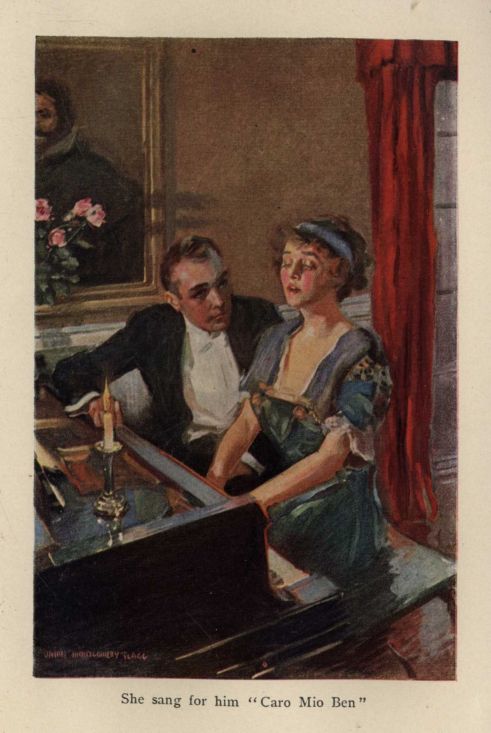
She sang for him "Caro Mio Ben"
CHAPTER XXXV
Not every day brought unalloyed happiness. Moments of depression asserted themselves with Alice and, if tolerated, led to periods of despondency. She found herself seeking a happiness that seemed to elude her.
Even her depression, banished by recreation, left behind something of a painful subconsciousness like the uneasy subsidence of a physical pain. Activity thus became a part of her daily routine and she gained a reputation for lively spirits.
Kimberly, whose perception was not often at fault, puzzled over the strain of gayety that seemed to disclose a new phase in Alice's nature. Once, after a gay day at Sea Ridge, he surprised her at home in the evening and found her too depressed to dissemble.
"Now," he said, taking both her hands, "you are going to tell me what the matter is."
"Robert, nothing is the matter."
"Something is the matter," he persisted. "Tell me what it is."
"It is less than nothing. Just a miserable spectre that haunts me sometimes. And when I feel in that way, I think I am still his wife. Now you are vexed with me."
"Not for an instant, darling; only perplexed. Your worries are mine and we must work out some relief for them, that is all. And when things worry me you will help me do away with my spectres, won't you?"
He soothed and quieted her, not by ridicule and harshness but by sympathy and understanding, and her love for him, which had found a timid foothold in the frailest response of her womanly reserve, now sent its roots deep into her nature.
It was nothing to her that he was great in the world's eyes; that in itself would have repelled her--she knew what the world would say of her ambition in marrying him. But he grew in her eyes because he grew in her heart as she came to realize more and more his solicitude for her happiness--the only happiness, he told her, in which he ever should find his own.
"I know how it will end, Robert." They were parting after a moment the most intense they had ever allowed themselves together. She was putting away his unwilling arms, as she looked in the darkness of the garden up into his face.
"How will it end?" he asked.
"In my loving you as much as you love me."
Winter passed and the spring was again upon them before they realized it. In the entertaining around the lake they had been fêted until it was a relief to run away from it all, as they often did. To escape the park-like regularity of their own domains, they sought for their riding or driving the neglected country below the village. Sometimes on their horses they would explore the backwoods roads and attempt swampy lanes where frogs and cowslips disputed their entry and boggy pools menaced escape.
Alice, hatless and flushed with laughter and the wind, would lead the way into abandoned wood-paths and sometimes they found one that led through a forest waste to a hidden pond where the sun, unseen of men, mirrored itself in glassy waters and dogwood reddened the margin where their horses drank.
In the woods, if she offered a race, Kimberly could never catch Alice no matter what his mount. She loved to thread a reckless way among sapling trees, heedless of branches that caught her neck and kissed her cheeks as she hurried on--riding gave them delightful hours.
They were coming into the village one May morning after a long cross-country run when they encountered a procession of young girls moving across the road from the parish school to the church and singing as they went. The church itself was en fête. Country folk gathered along the road-side and clustered about the church door where a priest in surplice waited the coming procession.
Kimberly and Alice, breathing their horses, halted. Dressed in white, like child brides, the little maidens advanced in the sunshine, their eyes cast down in recollection and moving together in awkward, measured step. From their wrists hung rosaries. In their clasped hands they carried prayer-books and white flowers, and white veils hung from the rose wreaths on their foreheads.
"How pretty!" exclaimed Kimberly as the children came nearer.
"Robert," asked Alice suddenly, "what day is this?"
"Thursday, isn't it?"
"It is Ascension Thursday."
The church-bells began to ring clamorously and the little girls, walking slowly, ceased their song. The lovers waited. Childhood, hushed with expectancy and moving in the unconscious appeal of its own innocence, was passing them.
The line met by the young priest reached the open door. Kimberly noted the wistful look in Alice's eyes as the little band entered the church. She watched until the last child disappeared and when she spoke to her horse her eyes were wet. Her companion was too tactful to venture a question. They rode until his silence told her he was aware of her agitation and she turned to him.
"Do you know," she said, slowly searching his eyes, "that you are awfully good?"
"If I am," he responded, "it is a discovery. And the honor, I fear, is wholly yours."
"It is something," she smiled, her voice very sweet, "to have lived to give that news to the world."
They rode again in silence. She felt it would be easier if he were to question her, but it was only after some time that he said: "Tell me what the little procession was about."
"I am ashamed to have acted in this way. But this was the day of my First Communion, Ascension Thursday. It was only a coincidence that I should see a First Communion class this morning."
"What is First Communion?"
"Oh, don't you know?" There was a sadness in the tone. "You don't, of course, you dear pagan. It is you who should have been the Christian and I a pagan. You would never have fallen away."
"You only think you have fallen away, Alice. You haven't. Sometimes you seem to act as if you had fallen from some high estate. You have not; don't think it. You are good enough to be a saint--do you give me credit for no insight? I tell you, you haven't fallen away from your religion. If you had, you would be quite at ease, and you are very ill at ease over it. Alice," he turned about in his saddle, "you would be happier if our marriage could be approved by your church."
"It never can be."
"I have led a number of forlorn hopes in my day. I am going to try this one. I have made up my mind to see your archbishop--I have spoken with Francis about it. I am going to find out, if nothing more, exactly where we stand."
CHAPTER XXXVI
In response to a request from Kimberly, Hamilton came out to spend the night at The Towers. Dolly was leaving just as the doctor arrived. She beckoned him to her car.
"You are to save the sixteenth for us, doctor; don't forget to tell Mrs. Hamilton," she said. "We have persuaded Robert to give a lawn fête for Grace and Larrie and we want you. Then, too--but this is a secret--Robert's own wedding occurs two weeks later. That will be private, of course, so the affair on the sixteenth will include all of our friends, and we want you to be sure to be here."
When the doctor sat down with Kimberly in the library after dinner, the latter spoke of his coming marriage. "You know," he said briefly, as the doctor took a book from the table, "I am going to make Mrs. MacBirney my wife."
"I do. I rejoice in it. You know what I think of her."
"She has at last set the date and we are to be married on the thirtieth of June. It will be very quiet, of course. And, by the way, save the sixteenth of June for us, doctor."
"Mrs. De Castro has told me. We shall be glad to come out."
"You, I know, do not approve of marriages made through divorce," continued Kimberly, bluntly.
"No, nor do you," returned the doctor. "Not as a general proposition. In this case, frankly, I look on it as the most fortunate thing that has happened in the Kimberly family since your own mother married into it."
"She was a Whitney," muttered Kimberly, leaning back and lifting his chest as he often did when talking. "Arthur De Castro has a strain of that blood. He has all her refinement. The Kimberlys are brutes.
"MacBirney," he went on abruptly, "complained to McCrea yesterday--among other things that he wants to quarrel about--that I had broken up his home. I have not; I think you know that."
"A man came to me the other day"--the doctor laid aside his book--"to say he was going to stand on his 'rights' and sue for alienation a man who had run off with his wife. He asked me what I thought of it. 'I suppose you want my honest opinion,' I replied. 'Yet I am afraid it won't comfort you much. What "rights" have you established in your marriage that anybody is bound to respect?' He looked at me astonished. 'The rights of a husband,' he answered. 'Doesn't the law, doesn't society give them to me?' 'A man that asks equity from society,' said I, 'ought to come into court with clean hands.' I should like to know whose hands are cleaner than mine,' he replied, 'I married, made a home for my wife and supported her.'"
Kimberly leaning further back let his chin sink on his breast, but his eyes shining under his black brows showed that he followed the story.
"'But where are the fruits of your marriage?' I asked," continued the doctor, narrating. "'Don't stare at me--where are the children? How have you lived with your wife? As nature and law and society intended you should--or as a mere paramour? Children would have protected your wife as a woman; the care of children would have filled her life and turned her mind from the distraction of listening to another man. Why didn't you make a wife and mother of the woman you married instead of a creature? In that case you might have pleaded "rights." But you thought you could beat the game; and the game has beaten you. You thought you could take the indulgence of marriage without its responsibilities. Either you debased your wife to your level or allowed her to debase you to hers. Don't talk about "rights," you haven't any.'"
Hamilton ceased.
"What did the fellow say?" asked Kimberly.
"What could he say?" demanded Hamilton.
They sat a moment in silence.
Kimberly broke it. "It is a humiliating fact, Hamilton--I often think of it," he said moodily--"that the only way in which we can determine our own moral standing is by measuring the standards of our vicious classes. I mean by our vicious classes the social driftwood who figure in the divorce courts and the scandal of the day and should be placed in a social penitentiary.
"What is really alarming to-day is that our standards of what constitutes vice have fallen so low. We speak of husbands; has there ever been a period in the history of our race when husbands have fallen so low? There was a time when the man that spoke the English tongue would defend his home with his life----"
"In those days they had homes to defend."
"--when it meant death to the man that crossed the threshold of his honor----"
"They had honor, too."
"But consider the baseness the American husband has reached. When he suspects his wife's infidelity, instead of hiding his possible disgrace, he employs detectives to make public the humiliating proofs of it. He advertises himself in the bill he files in the courts. He calls on all men to witness his abasement. He proclaims his shame from the housetops and wears his stripes as a robe of honor. And instead of killing the interloper he brands the woman that bears his name, perhaps the mother of his children, as a public creature--isn't it curiously infamous? And this is what our humane, enlightened, and progressive social views have brought us to--we have fallen too low to shoot!
"However," concluded Kimberly, shaking himself free from the subject, "my own situation presents quite other difficulties. And, by the way, Francis is still ailing. He asked the superior yesterday for a substitute and went home ill. You have seen Uncle John?"
"A moment, before dinner."
"Is he failing, Hamilton?"
"Mentally, no; physically, he loses ground lately."
"We die hard," said Kimberly, reflecting, "we can't help it. The old gentleman certainly brightened up after he heard of my coming marriage. Not that I told him--Dolly did so. It pleased him marvellously. I couldn't understand exactly why, but Dolly suggested it was one of the natural instincts of Uncle John coming out. His eyes sparkle when the subject is mentioned," continued Kimberly dryly. "I really think it is the covetous instinct in him that is gratified. He has always disliked MacBirney and always itched to see him 'trimmed.' This seems to satisfy, heroically, Uncle John's idea of 'trimming' him. He is as elated as if he were doing the 'trimming' himself."
Kimberly explained to Hamilton why he had sent for him and asked him for a letter of introduction to the archbishop, whom he desired to meet.
"You are on one or two executive boards with him, I think," suggested Kimberly. "Do you know him well enough to oblige me?"
"I know him very well," returned Hamilton. "And you, too, ought to know him."
The surgeon wrote the note at once.
"MOST REVEREND AND DEAR ARCHBISHOP:
CHAPTER XXXVII
Kimberly was lunching next day at the city office when MacBirney's name came in with a request for an interview. He was admitted without delay and while a valet removed the trays and the table, Kimberly greeted his visitor and, indicating a chair, asked him to sit down. He saw at a glance the suppressed feeling in MacBirney's manner; the latter, in fact, carried himself as a man fully resolved to carry out a course yet fearful of the results.
"I have come to give notice of my withdrawal from the June pool in common," began MacBirney without preface.
"I am not the one to give notice to," returned Kimberly civilly, "inasmuch as I am not in the June pool and not in touch with its operations."
"Well, I've sold--I am selling," MacBirney corrected himself hastily, "my allotment, no matter who is at interest."
"McCrea and my brother are the organizers----"
"I understand," interjected MacBirney, "that you made a good deal of talk about my action in the December pool a year ago--I give you no chance to say I haven't served ample notice this time."
"On the contrary, I quieted a great deal of talk about your action a year ago. It was so grossly unfair to your associates that I ascribed your unloading of your stock without notifying them to rank ignorance, and was disposed to overlook it on that ground."
MacBirney smiled with some sarcasm. "Though you were careful enough to say publicly that you would never be caught in another pool with me."
"I never have been, have I? And I did not 'say publicly'; I said so to McCrea, who had my permission to tell you. It cost me six hundred thousand dollars at that time to support the market against you for three days. And while I like to see my associates make money, I object to their making it out of me."
"You didn't say so to poison my wife against me?"
"I have never, MacBirney, spoken of that or of any other of your business affairs to your wife. I never have spoken even your name to your wife, in praise or in blame, until you left her--except twice to ask her if she loved you. Even that she treated as an insult."
"You must have made some progress since then."
Kimberly's head began to move slowly from side to side. "I am told," added MacBirney, in a thin, hard voice, "you are getting ready to marry her."
"Quite true, I am."
MacBirney's rage forced him to his feet. "I am beginning to understand now, Kimberly," he framed the words slowly and carefully, "the way you have plotted against me from the start. I was warned before I ever saw you that you had no respect for the law of God or man where a woman was concerned. I was warned that no woman was safe near you."
Kimberly eyed his enraged associate calmly. "You are travelling far in a few words, MacBirney. I hope you understand, once for all, that certain limits cover a situation even such as this. I don't like your last phrase. It might be made to apply unpleasantly to a woman now very dear to me. I am used to angry men, and what you say about me----"
"What I say about----"
"What you say about me is allowable, no matter what I think of it. But understand this, if you say one word about her--here or elsewhere, now or hereafter--I will stop you, if I have to choke you with my own hands."
"You can't scare me, Kimberly."
"I don't want to; I don't want to choke you; but if you wish to see me try it, pass that limit just once. Now go on, MacBirney."
"I could have nothing to say against Alice."
Kimberly nodded heartily in approval.
"But I have something to say about a man who pretended to be my friend----"
"I never pretended to be your friend."
"--And played traitor to me as you have done. But it's of a piece with your whole record. First you got me down here----"
"I never got you down here."
"--Then you began to lay your plans to ruin my home."
"What were you doing all this time? Trying to circumvent me by making your home happy or trying to help me by neglecting it?"
MacBirney shook his finger at Kimberly in rage. "You can't escape with smooth phrases. You broke up my home!"
Kimberly had regained his coolness. "No, you broke it up. Long before I ever saw you, you broke up your home. It was broken up and only waiting for some one to save your wife from the wreck. MacBirney, you have made a success of your business; one one-hundredth of the effort you have given to your business would have saved your home. Yet you thought you could treat your wife like a servant, humiliate and abuse her and still hold her forth a figurehead for your 'home'!" muttered Kimberly with scorn.
"You, yourself, put her up to the divorce. Deny that, will you?"
"No, I will not deny it," retorted Kimberly relapsing into indifference. "After I came into her life she followed my advice. I believe I have advised her for the best."
"I see your finger trailing through every turn of my trouble now. I saw it too late. But I'm not done with you. And I'm not the only man that understands your trickery. Lambert will have you on your knees in the sugar business before you are very much older. Now, I have come to you with a straight proposition. I want the escrow control of the Western refineries. If you are ready to give it to me we will make a working agreement and have peace. If you are not, I will back Lambert in a string of modern plants that will drive you out of the Western field. We are ready; the question for you to consider is whether you want to compromise."
At this threat Kimberly, so far as the words could be used of him, went to pieces. To be outfaced in his own headquarters by one whom he would have termed a hare-brained upstart in the refining world was too much for his poise. The only outward indication of his surprise and disgust was a smile; but it was a dangerous smile. "I am afraid I am not enough of a business man to compromise, MacBirney," he responded in low tones. "You can't have the escrow control of the Western refineries."
"Very good. That decision suits me. I am now practically out of your stock; we shall see what we shall see."
"One moment, MacBirney," said Kimberly, moved by some sudden impulse of mercy following his rage, as if MacBirney were really too small fry to pit himself against. "You have brought a personal affair and a business affair before me. The business affair, as you are still my associate, I may say a word on. Don't put any money you can't afford to lose behind Lambert, for it will all go. I myself have not got resources enough to give that man a free hand. He has a genius in one direction--that of talking men out of their money.
"Moreover, in this case there is a personal friction of long standing between him and me, and I will never let him lift his head in the sugar business in this country while I am at the head of these companies, not if I have to work twenty-four hours a day to clean him out. But that would not be necessary--for he will not only attend to ruining himself but to ruining every man that goes with him. If you want to quit us, do so. Build as many refineries as you like and we will try to get on peaceably with you--though I myself would not put a dollar into new refineries to-day. You are rich; you had eight hundred thousand dollars when I paid you for your junk, and you made two million dollars in the December pool alone--a good part of it out of me. You will take from these offices eight million dollars in less than three years."
MacBirney's alarm at Kimberly's intimate knowledge of his resources showed in his face. "In railroads you might make it forty millions in the next ten years, with even average prudence," continued Kimberly calmly. "Sugar will be a load, anyway you go into it; but sugar and Lambert will beat you to a frazzle."
Charles Kimberly walked into the room as his brother concluded. "Talk a few moments with Charles about this," suggested Kimberly, coolly, ringing for his office secretary.
"MacBirney," explained Robert Kimberly to his brother, "has sold out his common and has a lot of money loose. I am telling him to go in for railroads."
The secretary entered. Robert Kimberly after giving him some directions, got into his car and was driven up-town to the residence of the archbishop. He alighted before a large, remodelled city house not far from the cathedral. A messenger had already delivered Hamilton's letter of introduction and Kimberly was presenting himself by appointment.
At the door a man-servant took his card and he was met in the reception room by a young clergyman, who conducted him to the second floor. As Kimberly entered the large room into which he was ushered he saw the prelate rising from his table. He was a grave man and somewhat spare in his height, slightly stooped with the passing of seventy years, and bearing in the weariness of his face an expression of kindliness and intelligence.
"This is a pleasure, Mr. Kimberly," he said, extending his hand.
"It is a pleasure for me, your grace."
"Come this way," continued the archbishop, indicating a divan in one corner of the room.
"I brought no letter of introduction other than that from Doctor Hamilton, which I sent you," Kimberly began as the archbishop seated himself.
"Surely, you did not consider even Doctor Hamilton's note necessary," returned the archbishop, while his secretary withdrew. "Your name and that of your family have been familiar to me for many years. And I fear those of my people who venture in upon you with their petitions do not always bring letters."
"You have occupied this see for many years," suggested Kimberly in compliment.
"As priest and bishop I have lived in this diocese more than forty years. It seems a long time. Yet the name of Kimberly was very old here when I came, and without ever meeting one of your family, I have heard much of you all since. So if there were no other reason, I should welcome your call as an opportunity to tell you how grateful I am, and the charities of the archdiocese are, for your repeated generosities. You know we are not blessed among our own people with many benefactors of large means. And the calls come upon us with surprising frequency."
"My father," responded Kimberly, "who was more of a philosopher than a merchant, impressed me very early with the truth that your church was a bulwark of social order--one which to that extent laid all thoughtful men under a debt to it."
"You are a man of wide interests, Mr. Kimberly."
"The country grows too fast, your grace. There seems no escape from expansion."
"Yet you find time for all of your work?"
Kimberly made a deprecatory gesture. "My chief affair is to find men to do my work for me. Personally, I am fairly free."
"From all save responsibility, perhaps. I know how hard it is to delegate that. And you give all of your energy to business. You have no family?"
"No, and this brings me to the object of my visit." Kimberly paused a moment. "I shall soon enter into marriage."
"Ah, I see!"
"And the subject is a difficult one to lay before your grace."
The archbishop saw an indefinable embarrassment in his visitor's manner and raised his thin hand. "Then it has every claim to sympathetic consideration. Forget for a moment that I am almost a stranger--I am certainly no stranger to difficulties. And do no longer address me formally. I said a moment ago that I was glad to meet you if only to thank you for your responses to our numerous needs. But there is another reason.
"When I was a young man, first ordained, my charge was the little village of Sunbury up in the lake country. You may imagine how familiar the Kimberly estates became to me in my daily rounds of exercise. I heard much of your people. Some of their households were of my congregation. Your mother I never met. I used to hear of her as exceedingly frail in health. Once, at least, I recall seeing her driving. But her servants at The Towers were always instructed not alone to offer me flowers for the altar but diligently to see that the altar was generously provided from her gardens and hot-houses.
"I once learned," the archbishop's head drooped slightly in the reminiscence and his eyes rested full upon his visitor, "that she was passing through a dreaded ordeal, concerning which many feared for her. It was on a Sunday before mass that the word came to me. And at the mass I told my little flock that the patroness to whom we owed our constant offering of altar flowers was passing that morning through the valley of the shadow of death, and I asked them to pray for her with me. You were born on a Sunday, Mr. Kimberly." Kimberly did not break the silence and the archbishop spoke on. "You see I am quite old enough myself to be your father. I remember reading an account of your baptism."
Kimberly looked keenly into the clear, gray eyes. Not a shade of thought in the mind of the man before him was lost upon his penetration. "Any recollection of my mother," he said slowly, "touches me deeply. To think that you recall her so beautifully is very grateful to me--as you may well imagine. And that was my birthday! Then if my mother was, or I have ever been, able to help you I am sure we are repaid in being so remembered all these years. I lost my father and my mother many years ago----"
He paused. "It is very pleasant to be remembered," he repeated uncertainly, as if collecting himself. "I shall never forget what you have just told me. And I thank you now for the prayers you said for my mother when she brought me into the world. Your grace," he added abruptly, "I am greatly perplexed."
"Tell me frankly, how and why."
"I came here with some confidence of getting what I should ask for. I am naturally a confident man. Yet my assurance deserts me. It seems, suddenly, that my mission here is vain, that my hopes have deluded me--I even ask myself why I have come. I could almost say I am sorry that I have come."
The archbishop lifted his hand to speak. "Believe me, it is not other than for good that you have come," he said.
Kimberly looked at him questioningly. "I cannot tell for what good," added the archbishop as if to say he could not answer the unspoken question. "But believe me, you have done right and not wrong in coming--of that I am sure. Tell me, first, what you came to tell me, what it is in your heart that has brought you here."
CHAPTER XXXVIII
"I must tell you," began Kimberly, "that while seemingly in a wide authority in directing the business with which I am connected I am not always able to do just as I please. Either voluntarily or involuntarily, I yield at times to the views of those associated with me. If my authority is final, I prefer not to let the fact obtrude itself. Again, circumstances are at times too strong for any business man to set his mere personal views against. Yielding some years ago to the representations of my associates I took into our companies a group of Western factories controlled by a man whom I distrusted.
"To protect our interests it was necessary to move, in the premises, in one of two ways. I favored the alternative or driving him out of the business then and there. There were difficulties in either direction. If we ruined him we should be accused of 'trust methods,' of crushing a competitor, and should thus incur added public enmity. On the other hand, I contended if the man were untrustworthy he would grow more dangerous with power. I need hardly explain to an intelligent man, regardless of his views on trusts, that any man of integrity, no matter how threatening or violent a competitor he may be in the beginning, is a man we welcome as an associate into our business. We need him just as he needs us--but that is aside. We took the man in----"
"Against your judgment?"
"Against my judgment. I never met him until he came East. My estimates of him were made wholly on his record, and I knew what is known to but few--that he had ruined his own father-in-law, who died a bankrupt directly through this man's machinations, and without ever suspecting him. This seemed to me so unspeakable, so cannibalistic, that I never needed to know anything further of the man. Yet I took him in, determined only to add a new care in watching him and still to keep him in my power so that I could crush him if he ever played false.
"He came to us--and brought his wife. I knew the man thoroughly the instant I set eyes on him. His appearance confirmed my impression. But I met his wife, and found in her a woman to engage respect, homage, and devotion, one with a charm of manner and person to me unequalled; with a modesty coupled with spirit and humor that confounded my ideas of women--a woman, in a word, like my own mother. I am keeping nothing from you----"
"Your confidence is safely bestowed."
"I was moved the moment I saw her. But unhappy experiences had checked and changed me somewhat. I did not disclose my feelings though I already knew how she affected me. If I had misjudged her husband I would make amends--on her account. Then as I watched them the question came to me--how is he treating her? I will make, for her sake, a new judgment of him, I said. But I saw him as indifferent to her as if she did not exist. I saw him neglect her and go out of his way to humiliate her with attentions to women of our circle that were not fit to be her servants. I asked myself whether she could be happy--and I saw that as far as affection was concerned she sat at a hearthstone of ashes.
"Even her religion--she was a Catholic--with petty and contemptible persecutions he had robbed her of. She was wretched and I knew it before I let even her suspect my interest. After that I vacillated, not knowing what I should do. I advanced and retreated in a way I never did before. But one day--it was an accident--her ankle turned as she stepped out of her car and as she fell forward I caught her on my arm. She repelled me in an instant. But from that moment I determined to win her for my wife."
The archbishop regarded him in silence.
"I am telling you the exact truth. It would profit me nothing to deceive you, nor have I ever deceived myself or her. She fought my persistence with all her strength. I tried to make her see that I was right and she was wrong, and my best aid came from her own husband. I knew it would be said I was to blame. But this man never had made a home in any sense for his wife. And if it could be urged that he ever did do so, it was he, long before I ever saw him, who wrecked it--not his wife--not I."
"You say she was a Catholic. Has this poor child lost her faith?"
Kimberly paused. "I do not know. I should say that whatever her faith was, he robbed her of it."
"Do not say exactly that. You have said we must not deceive ourselves and you are right--this is of first importance. And for this reason alone I say, no one can deprive me of my faith without my consent; if I part with it, I do so voluntarily."
"I understand, quite. Whatever I myself might profess, I feel I should have no difficulty in practising. But here is a delicate woman in the power of a brute. There is an element of coercion which should not be lost sight of and it might worry such a woman out of the possession of her principles. However, whatever the case may be, she does not go to church. She says she never can. But some keen unhappiness lies underneath the reason--if I could explain it I should not be here."
"Has she left her husband?"
"No. He, after one of his periodical fits of abuse, and I suspect violence, left her, and not until he knew he had lost her did he make any effort to claim her again. But he had imperilled her health--it is this that is my chief anxiety--wrecked her happiness, and made himself intolerable by his conduct. She divorced him and is free forever from his brutality.
"So I have come to you. I am to make her my wife--after I had thought never to make any woman my wife--and for me it is a very great happiness. It is a happiness to my brother and my sister. Through it, the home and the family which we believed was fated to die with this generation--my brother is, unhappily, childless--may yet live. Can you understand all this?"
"I understand all."
"Help me in some way to reconcile her religious difficulties, to remove if possible, this source of her unhappiness. Is it asking too much?"
The archbishop clasped his hands. His eyes fixed slowly upon Kimberly. "You know, do you not, that the Catholic Church cannot countenance the remarriage of a wife while the husband lives."
"I know this. I have a profound respect for the principles that restrain the abuses of divorce. But I am a business man and I know that nothing is impossible of arrangement when it is right that it should be arranged. This, I cannot say too strongly, is the exceptional case and therefore I believe there is a way. If you were to come to me with a difficult problem within the province of my affairs as I come to you bringing one within yours, I should find a means to arrange it--if the case had merit."
"Unhappily, you bring before me a question in which neither the least nor the greatest of the church--neither bishop nor pope--has the slightest discretionary power. The indissolubility of marriage is not a matter of church discipline; it is a law of divine institution. Christ's own words bear no other meaning. 'What God hath joined together let not man put asunder.' He declared that in restoring the indissolubility of marriage he only reëstablished what was from the beginning, though Moses because of Jewish hardness of heart had tolerated a temporary departure. No consent that I could give, Mr. Kimberly, to a marriage such as you purpose, would in the least alter its status. I am helpless to relieve either of you in contracting it.
"It is true that the church in guarding sacredly the marriage bond is jealous that it shall be a marriage bond that she undertakes to guard. If there should have been an impediment in this first marriage--but I hardly dare think of it, for the chances are very slender. A prohibited degree of kindred would nullify a marriage. There is nothing of this, I take it. If consent had clearly been lacking--we cannot hope for that. If her husband never had been baptized----"
"What difference would that make?"
"A Christian could not contract marriage with a pagan--such a union would be null."
"Would a good Catholic enter into such a union?"
"No."
Kimberly shook his head. "Then she would not. If she had been a disgrace to her religion she might have done it. If she had been a woman of less character, less intelligence it might be. If she had been a worse Catholic," he concluded with a tinge of bitterness, "she might stand better now."
"Better perhaps, as to present difficulties; worse as to that character which you have just paid tribute to; which makes, in part, her charm as a woman--the charm of any good woman to a good man. You cannot have and not have. When you surrender character a great deal goes with it."
The archbishop's words sounded a knell to Kimberly's hopes, and his manner as he spoke reflected the passing of his momentary encouragement. "There is nothing then that you can do."
"If there be no defect--if this first marriage was a valid marriage--I am powerless in the circumstances. I can do nothing to allow her to remarry while her husband lives."
Kimberly arose. "We cannot, of course, kill him," he said quietly. "And I am sorry," he added, as if to close the interview, "not to be able to relieve her mind. I have made an effort to lay before you the truth and the merit of the case as far as she is concerned. I had hoped by being absolutely unreserved to invoke successfully something of that generosity which you find edifying in others; to find something of that mercy and tolerance which are always so commendable when your church is not called on to exercise them."
The archbishop, too, had risen. The two men faced each other. If the elder felt resentment, none was revealed in his manner or in his answer. "You said a few moments ago that you could not always do as you pleased," he began; "I, too, am one under authority." His fingers closed over the cross on his breast. "All generosity, all mercy, all tolerance that lie within His law, nothing could prevent my granting to you, and to less than you--to the least of those that could ask it. I know too much of the misery, the unhappiness of a woman's life and of the love she gives to man, to withhold anything within my power to alleviate her suffering.
"I have wounded you, and you rebuke me with harsh words. But do not carry harshness against me in your heart. Let us be sure that these words mean the same thing to both of us. If generosity and tolerance are to override a law given by God, of what use am I? Why am I here to be appealed to? On the other hand, if by generosity or tolerance you mean patience toward those who do not recognize the law that binds me, if you mean hesitancy in judging those whose views and practices differ from my own, then I have the right to ask you to grant these qualities to me.
"But if you appeal to the laws and principles of Catholic truth, they are intolerant, because truth cannot compromise. My church, which you rebuke with this intolerance, is the bearer of a message from God to mankind. If men already possessed this message there would be little reason for the existence of such a church. The very reason of her being is to convince men of the truth of which they are not yet convinced.
"Either she is the divinely commissioned messenger of God or she is not--and if not, her pretensions are the most arrogant the world has ever seen and her authority is the cruelest mockery. And so you view the church, so the world views it--this I well know. It is painful sometimes, it is at this moment, to insist upon a law that I have no power to set aside--but to do less would be simply a betrayal of my trust. And if this were the price of what you term 'tolerance,' I must rest with my church under the stigmas you put upon us."
Kimberly's anger rose rather than abated with the archbishop's words. "Of course," he retorted without trying to conceal his anger, "it makes a difference who seeks relief. Your church can find no relief for a helpless woman. As I remember, you accommodated Napoleon quickly enough."
"Certain unworthy ecclesiastics of my church, constituting an ecclesiastical court, pretended to find his marriage with Josephine invalid; the church never confirmed their verdict. Thirteen of its cardinals suffered Napoleon's penalties because of their protest against his remarriage. Let us parallel the case. Suppose I could offer to join with you in a conspiracy. Suppose we should assure this suffering soul that she is free to remarry. Assume that I could make myself a party to deceiving her--would you be party with me, to it? Do I mistake, if I believe you could not conspire in such a baseness?"
"I do not deal in deceptions."
"Do you admire Napoleon's methods?"
"Not all of them."
"Let us, then, Mr. Kimberly, bear our burdens without invoking his duplicity."
"We can do that, your grace," answered Kimberly coldly. "But we shall also be obliged to bear them without relief from where we had the most right to look for it. It was not for myself that I came to you. I sought to restore to your church one who has been driven from it by a wretch. I should have been better advised; I was too hopeful. Your policy is, as it always has been, hopelessly fixed and arbitrary. You encourage those who heap upon you the greatest abuse and contempt and drive from your doors those disposed to meet you upon any reasonable composition of a difficulty. I should only wound you if I attempted to answer your last rebuke."
"You are going----"
"Yes."
"And you go with bitterness. Believe me, it is not pleasant to be without the approbation of the well-disposed who think and believe differently from ourselves. But if as Catholics we regard it a privilege to possess the truth we must be prepared to pay the price it exacts. The world will always think us wrong, a peculiar people and with principles beyond its comprehension. We cannot help it. It has always been so, it always must be so. Good-by."
"Good-by."
"If dividing a burden lightens it, remember you have three now to bear yours instead of two. I shall not forget either of you in my prayers, certainly not this dear soul of whom you have told me. This is my poor offering to you and to her for all you have done for those that come to you in my name."
CHAPTER XXXIX
Following the visit to the archbishop, McCrea, who had been on nettles to get hold of Kimberly for a trip of inspection, whisked him away for two days among the seaboard refineries.
Instead, however, of the two days planned by McCrea, the inspection kept Kimberly, much to his annoyance, for three days. The date set for Grace's fête found him still inspecting, but growing hourly more unmanageable, and before breakfast was over on the third morning McCrea began to feel the violence of Kimberly's protests.
By the most ingenious activity on the part of the alert McCrea and his powerful railroad friends the day's programme for the party was hastened to completion and the indignant magnate was returned by train to Second Lake in time for dinner.
He drove home by way of Cedar Point, and Alice, who had been constantly in touch with him on the telephone, felt the elation of his presence when she saw him alight from his car and walk across the terrace to where she and Fritzie, dressed for the evening, were feeding the goldfish.
Kimberly took her hands as she ran forward to meet him. "I thought you were never coming!" she exclaimed.
"For a while I thought so myself."
"And you saw the archbishop?" she murmured eagerly. "He could do nothing?"
He regarded her with affection. "I had set my heart on bringing back good news."
"I knew there was no chance," said Alice as if to anticipate a failure. "But it was like you to try. You are always doing unpleasant things for me."
He saw the disappointment under her cheerfulness. "And though I did fail--you love me just the same?"
She looked into his searching eyes simply. "Always."
"And we marry two weeks from to-night?"
"Two weeks from to-night," she answered, smiling still, but with a tremor in her steady voice. Then she clasped her hands.
"What is it?" he asked.
Standing in the sunset before him--and he always remembered her as she stood then--Kimberly saw in her eyes the fires of the devotion he had lighted. "I hope," she whispered, "I can make you happy."
"You would make a stone happy," he murmured, breathing the fragrance of her being as she looked up at him.
It was evening when he saw her again and he stood with Dolly and Imogene who were receiving.
The night was warm and the guests sought the lawns, the garden, and the groves. When a horn blown across the terrace announced dancing, slight and graceful women, whose draperies revealed mere delicate outlines of breathing creatures, came like fairies out of the night. The ballroom, in candle-light, was cool, and only the ceiling frescoes, artfully heightened by lights diffused under ropes of roses, were brighter than the rest of the room.
As the last guests arrived from town--Cready Hamilton and his wife with Doctor Hamilton and the Brysons--Kimberly walked into the ballroom. He caught Alice's eye and made his way toward her.
She smiled as he asked for a dance. "Do you realize," said he as she rose, "that this is your first--and your last--dance at The Towers as a guest? Next time you will be hostess--won't you?"
A sound of breaking glass crashing above the music of the violins took Alice's answer from her lips. Every one started. Women looked questioningly at the men. Alice shrank to Kimberly's side. "Merciful Heaven!" she whispered, "what was that?"
He answered lightly. "Something has smashed. Whatever it is, it is of no consequence."
The music continuing without interruption reassured the timid. There was no sequence to the alarming sound, the flow of conversation reasserted itself and in a moment the incident was forgotten.
But Kimberly perceived by Alice's pallor that she was upset. "Come out into the air," he said, "for a moment."
"But don't you want to see what it was?"
"Some one else will do that; come."
She clung to his arm as they passed through an open door. "You don't seem just well, dearie," he said, taking her hand within his own. "Let us sit down."
He gave her a chair. She sank into it, supporting her head on her other hand. "I haven't been quite well for a day or two, Robert. I feel very strange."
Kimberly with his handkerchief wiped the dampness from her forehead. Her distress increased and he realized that she was ill. "Alice, let me take you upstairs a moment. Perhaps you need a restorative."
The expression on her face alarmed him. They rose just as Dolly hastened past. "Oh, you are here!" she cried, seeing Kimberly. "Why, what is the matter with Alice?"
Alice herself answered. "A faintness, dear," she said with an effort. "I think that awful crash startled me. What was it?"
Dolly leaned forward with a suppressed whisper. "Don't mention it! Robert, the Dutch mirror in the dining-room has fallen. It smashed a whole tableful of glass. The servants are frightened to death."
"No one was hurt?" said Kimberly.
"Fortunately no one. I must find Imogene."
She hurried on. Alice asked Kimberly to take her back to the ballroom. He urged her to go upstairs and lie down for a moment.
The music for the dance was still coming from within and against Kimberly's protest Alice insisted on going back. He gave way and led her out upon the floor. For a few measures, with a determined effort, she followed him. Then she glided mechanically on, supported only by Kimberly and leaning with increasing weakness upon his arm.
When he spoke to her, her answers were vague, her words almost incoherent. "Take me away, Robert," she whispered, "I am faint."
He led her quietly from the floor and assisted her up a flight of stairs to his mother's apartment. There he helped her to lie down on a couch. Annie was hurriedly summoned. A second maid was sent in haste for Doctor Hamilton and Dolly.
Alice could no longer answer Kimberly's questions as he knelt. She lay still with her eyes closed. Her respiration was hardly perceptible and her hands had grown cold. It was only when Kimberly anxiously kissed her that a faint smile overspread her tired face. In another moment she was unconscious.
CHAPTER XL
When Hamilton hastily entered the room, Annie, frightened and helpless, knelt beside her mistress, chafing her hands. On the opposite side of the couch Kimberly, greatly disturbed, looked up with relief.
Taking a chair at her side, the doctor lifted Alice's arm, took her pulse and sat for some time in silence watching her faint and irregular respiration.
He turned after a moment to Kimberly to learn the slight details of the attack, and listening, retracted the lids of Alice's eyes and examined the pupils. Reflecting again in silence, he turned her head gently from side to side and afterward lifted her arms one after the other to let them fall back beside her on the couch.
Even these slight efforts to obtain some knowledge of Alice's condition seemed to Kimberly disquieting and filled him with apprehension. The doctor turned to Annie. "Has your mistress ever had an experience like this before, Annie?"
"No, doctor, never. She has never been in this way before."
Imogene came hurrying upstairs with Dolly to learn of Alice's condition. They looked upon her unconsciousness with fear and asked whispered questions that intensified Kimberly's uneasiness.
"Do you think we could take her home, doctor?" asked Annie, timidly.
The doctor paused. "I don't think we will try it to-night, Annie. It is quite possible for her to remain here, isn't it?" he asked, looking at Dolly and Kimberly.
"Certainly," returned Dolly. "I will stay. Alice can have these rooms and I will take the blue rooms connecting."
"Then put your mistress to bed at once," said Hamilton to Annie.
"And telephone home, Annie," suggested Dolly, "for whatever you need. I will see the housekeeper right away about the linen."
Kimberly listened to the concise directions of the doctor for immediate measures of relief and followed him mechanically into the hall. Only one thought came out of the strange confusion--Alice was at least under his roof and in his mother's room.
When he returned with the doctor the lights were low and Alice lay with her head pillowed on her loosened hair. The maid and Dolly had hastened away to complete their arrangements for the emergency and for a few moments the two men were alone with their charge.
"Doctor, what do you make of this?" demanded Kimberly.
Hamilton, without taking his eyes from the sick woman, answered thoughtfully: "I can hardly tell until I get at something of the underlying cause. Bryson will be here in a moment. We will hear what he has to say."
Doctor Bryson appeared almost on the word. Hamilton made way for him at Alice's side and the two conferred in an undertone.
Bryson asked many questions of Hamilton and calling for a candle retracted Alice's eyelids to examine the pupils for reaction to the light. The two doctors lost not an unnecessary moment in deliberation. Consulting rapidly together, powerful restoratives were at once prepared and administered through the circulation.
Reduced to external efforts to strengthen the vital functions the two medical men worked as nurses and left nothing undone to overcome the alarming situation. Then for an hour they watched together, closely, the character and frequency of Alice's pulse and breathing.
To Kimberly the conferences of the two men seemed unending. Sometimes they left the room and were gone a long time. He walked to a window to relieve his suspense. Through the open sash came the suppressed hum of motors as the cars, parked below the stables, moved up the hill to receive departing guests and made their way down the long, dark avenue to the highway.
On the eastern horizon a dull gray streak crossed a mirror that lay in the darkness below. Kimberly had to look twice to convince himself that the summer night was already waning.
Annie came into the room and, he was vaguely conscious, was aiding the doctors in a painstaking examination of their patient. Through delicacy Kimberly withdrew, as they persistently questioned the maid in the hope of obtaining the much-needed information concerning her mistress's previous condition; for what Annie could not supply of this they knew they must work without.
Plunged in the gloom of his apprehensions, he saw the doctors coming down the hall toward him and stopped them. "Speak before me," he said with an appeal that was a command. "You both know what I have at stake."
The three retired to the library and Kimberly listened attentively to every phase of the discussion between the two master clinicians as they laid their observations before him. The coma was undisguisedly a serious matter. It seemed to them already ingravescent and, taken in connection with the other symptoms, was even ominous. The two men, without a satisfactory history, and without a hope of obtaining one from the only available source--the suffering woman herself--discussed the case from every side, only to return unwillingly to the conclusion to which everything pointed--that a cerebral lesion underlay the attack.
Their words sent a chill to Kimberly's heart. But the lines of defence were mapped out with speed and precision; a third eminent man, an authority on the brain, was to be sent for at once. Nurses, equal almost in themselves to good practitioners, were to be called in, and finally Hamilton and Bryson arranged that either one or the other should be at the sick-bed every instant to catch a possible moment of consciousness.
Hamilton himself returned to his patient. Bryson at the telephone took up the matter of summoning aid from town, and when he had done threw himself down for a few hours' sleep. Kimberly followed Hamilton and returned to Alice's side. He saw as he bent over her how the expression of her face had changed. It was drawn with a profound suffering. Kimberly sitting noiselessly down took her hand, waiting to be the first to greet her when she should open her eyes.
All Second Lake knew within a day or two of Alice's critical illness. The third doctor had come in the morning and he remained for several days.
Hamilton questioned Annie repeatedly during the period of consultations. "Try to think, Annie," he said once, "has your mistress never at any time complained of her head?"
"Indeed, sir, I cannot remember. She never complained about herself at all. Stop, sir, she did last summer, too--what am I thinking of? I am so confused. She had a fall one night, sir. I found her in her dressing-room unconscious. Oh, she was very sick that night. She told me that she had fallen and her head had struck the table--the back of her head. For days she suffered terribly. Could it have been that, do you think?"
"Put your hand to the place on your head where she complained the pain was."
"How did she happen," Hamilton continued, when Annie had indicated the region, "to fall backward in her own room, Annie?"
"She never told me, doctor. I asked her but I can't remember what she said. It was the night before Mr. MacBirney left Cedar Lodge."
The doctors spent fruitless days in their efforts to overcome the unconsciousness. There was no longer any uncertainty as to the seat of the trouble. It lay in the brain itself and defied every attempt to relieve it. Even a momentary interval of reason was denied to the dumb sufferer.
Kimberly, on the evening of the third day, had summoned his medical advisers to his own room and asked the result of their consultation. The frail and eminent man whom Hamilton and Bryson had brought from town told Kimberly the story. He could grasp only the salient points of what the specialist said: That in a coma such as they faced it was the diagnosis of the underlying conditions that was always important. That this was often difficult; sometimes, as now, impossible. That at times they encountered, as now, a case so obscure as to defy the resources of clinical medicine. Kimberly asked them their judgment as to the issue; the prognosis, they could only tell him, was doubtful, depending wholly upon the gravity of the apoplectic injury.
The Kimberly family rose to the emergency. Aware of the crisis that had come, through Alice, into Robert's life, Imogene and Dolly, on hand day and night, were mother and sister to him and to her. Nowhere in the situation was there any failure or weakening of support.
Hamilton, undismayed in the face of the physical catastrophe he had been called upon so unexpectedly to retrieve, and painfully aware of what the issue meant to his near and dear friend, never for an instant relaxed his efforts.
Seconded by his nurses, reinforced by his counsel and strengthened by Bryson's close co-operation, Hamilton faced the discouragement steadily, knowing only too well that the responsibility must rest, in the end, on him alone.
Absorbed, vigilant, tireless--pouring the reserve energy of years into the sustained struggle of the sleepless days and nights--he strove with every resource of his skill and watched unremittingly for an instant's abatement of the deadly lethargy that was crushing the vitality of the delicate woman before him.
Kimberly, following the slightest details of the sick-room hours, spent the day and the night at the bedside or in pacing the long hall. If he slept it was for an hour and after leaving orders to summon him instantly if Alice woke. They who cared for her knew what he meant by "waking." They knew how long and mutely, sometimes in the day, sometimes in the silence of the night, he watched her face for one returning instant of reason.
They knew how when hope burned low in every other eye it shone always steadily in his. The rising of the sun and its setting meant to him only another day of hope, another night of hope for her; every concern had passed from him except that which was centered in the fight for her life.
Considerate as he was to those about him they feared him, and his instinctive authority made itself felt more keenly in his silence than in his words. The heavy features, the stubborn brow, the slow, steady look became intensified in the long, taciturn vigil. Every day Dolly walked with him and talked with him. She made a bond between him and the world; but she saw how little the world meant when danger came between him and the woman he loved.
One evening the nurses told him that Alice was better. They hoped for a return of consciousness and he sat all night waiting for the precious instant. The next day while he slept, wearied and heartsick, Alice sank. For ten minutes those about her endured a breathless, ageing suspense that sapped their energy and strength, until it was known that the doctor had won the fight and the weary heart had returned to its faint and labored beat. They told Kimberly nothing of it. When he awoke he still thought she was better.
When he came into the room he was so hopeful that he bent over her and fondly called her name. To his consternation and delight her eyes opened at the sound of his voice; it seemed as if she were about to speak. Then her eyes closed again and she lay still. The incident electrified him and he spoke hopefully of it for hours. At midnight he sent Hamilton away, saying he himself was fresh and would be on duty with the nurse until daylight.
The air was sultry. Toward morning a thunder-storm broke violently. Kimberly walked out into the hall to throw the belvedere doors open to the fresh air. As he turned to go back, his heart stopped beating. In the gloom of the darkened gallery a slender, white figure came from the open door of the sick-room and Kimberly saw Alice, with outstretched hands, walking uncertainly toward him. He stood quite still and taking her hands gently as they touched his own he murmured her name.
"Alice! What is it, darling?" She opened her eyes. Their vacancy pierced his heart.
"Baby is crying," she faltered; "I hear my baby. Walter." Her hands groped pitifully within his own. "Walter! Let me go to her!"
She tried to go on but Kimberly restrained and held her for a moment trembling in his arms. "Come with me," he said, leading her slowly back to her pillow. "Let us go to her together."
CHAPTER XLI
When the sun burst upon The Towers in the freshness of the morning, Kimberly's eyes wore another expression. The pleading of her words still rang in his ears. The tears in her voice had cost him his courage. Before another night fell they told him but a slender hope remained. He seemed already to have realized it.
After the doctors had spoken and all knew, Annie crept into Kimberly's room. His head was bowed on the table between his arms. With her little wet handkerchief and her worn beads crushed in her hands, she ventured to his side. Her sobs aroused him. "What is it, Annie?"
"Oh, Mr. Kimberly; she is so sick!"
"Yes, Annie."
"Don't you think you should call a priest for her?"
"A priest?" He opened his eyes as if to collect his thoughts.
"Oh, yes, a priest, Mr. Kimberly."
"Go yourself for him, Annie."
Tears were streaming down the maid's cheeks. She held out an ivory crucifix. "If her eyes should open, dear Mr. Kimberly, won't you give this to her? It is her own." Kimberly took the crucifix in silence and as Annie hurried away he buried his head again in his arms.
The timid young clergyman from the village responded within half an hour. Hamilton spoke kindly to him and explained to him Alice's condition; for unless consciousness should return Hamilton knew that nothing could be done.
After trying in vain to speak to her the priest asked leave to wait in an adjoining room. His youthfulness and timidity proved no detriment to his constancy, for he sat hour after hour relieved only by Annie's messages and declining to give up. In the early morning finding there had been no change he left, asking that he be sent for if consciousness should return.
With a strength that the doctors marvelled at, Alice rallied after the bad night. She so held her improvement during the day that Hamilton at nightfall felt she still might live.
While the doctors and the family were at dinner Kimberly was kneeling upstairs beside Alice. She lay with her eyes closed, as she had lain the night she was stricken, but breathing more quietly. The racking pain no longer drew her face. Kimberly softly spoke her name and bent over her. He kissed her parched lips tenderly and her tired eyes opened. A convulsion shook him. It seemed as if she must know him, but his pleading brought no response.
Then as he looked, the light in her eyes began to fade. With a sudden fear he took her in his arms and called to Annie on the other side of the bed. The nurse ran for Hamilton. Annie with a sob that seemed to pierce Alice's stupor held up the ivory crucifix and the eyes of her dying mistress fixed upon it.
Reason for an instant seemed to assert itself. Alice, her eyes bent upon the crucifix, and trying to rise, stretched out her hands. Kimberly, transfixed, supported her in his arms. Annie held the pleading symbol nearer and Alice with a heart-rending little cry clutched it convulsively and sank slowly back.
CHAPTER XLII
She died in his arms. In the stillness they heard her name again and again softly spoken, as if he still would summon her from the apathy of death. They saw him, in their sobbing, wait undiscouraged for his answer from the lips that never would answer again.
If he had claimed her in her life he claimed her doubly in her death; now, at least, she was altogether his. He laid her tenderly upon the pillow and covering her hands, still clasping the crucifix, in his own hands he knelt with his face buried in the counterpane.
Day was breaking when he kissed her and rose to his feet. When Dolly went to him in the morning to learn his wishes she found him in his room. Alice was to lie, he said, with the Kimberlys on the hill, in the plot reserved for him. His sister assented tearfully. As to the funeral, he asked Dolly to confer with the village priest. He directed that only Annie and her own women should make Alice ready for the burial and forbade that any stranger's hand should touch his dead.
She lay in the sunshine, on her pillow, after Annie had dressed her hair, as if breathing. Kimberly went in when Annie came for him. He saw how the touch of the maid's loving hands had made for her dead mistress a counterfeit of sleep; how the calm of the great sleep had already come upon her, and how death, remembering the suffering of her womanhood, had restored to her face its girlish beauty. Hamilton, who was with him, followed him into the room. Kimberly broke the silence.
"What is First Communion, Hamilton?" he asked.
Hamilton shook his head.
"I think," Kimberly said, pausing, "it must be the expression upon her face now."
During the day he hardly spoke. Much of the time he walked in the hall or upon the belvedere and his silence was respected. Those of his household asked one another in turn to talk with him. But even his kindness repelled communication.
In the early morning when the white couch had been placed to receive her for the grave he returned to the room with Dolly and they stood beside Alice together.
"This is my wedding day, Dolly. Did you remember it?"
"Robert!"
"I tried for once to do better; to treat Alice as a woman should be treated. This is my reward--my wedding day."
He lifted her in his arms like a child and as he laid her in her coffin looked at her stonily. "My bride! My Alice!"
Dolly burst into tears. The harshness of his despair gave way as he bent over her for the last time and when he spoke again the tenderness of his voice came back. "My darling! With you I bury every earthly hope; for I take God to witness, in you I have had all my earthly joy!" He walked away and never saw her face again.
The unintelligible service in the church did not rouse him from his torpor and he was only after a long time aware of a strange presence on the altar. Just at the last he looked up into the sanctuary. Little clouds of incense rising from a swinging thurible framed for an instant the face of a priest and Kimberly saw it was the archbishop.
The prelate stood before the tabernacle facing the little church filled with people. But his eyes were fixed on the catafalque and his lips were moving in prayer. Kimberly watched with a strange interest the slender, white hand rise in a benediction over the dead. He knew it was the last blessing of her whom he had loved.
Dolly had dreaded the scene at the grave but there was no scene. Nor could Kimberly ever recollect more than the mournful trees, the green turf, and the slow sinking of a flowered pall into the earth. And at the end he heard only the words of the archbishop, begging that they who remained might, with her, be one day received from the emptiness of this life into one that is both better and lasting.
CHAPTER XLIII
In the evening of the day on which they had buried Alice, and the family were all at The Towers, Dolly, after dinner, asked Doctor Hamilton to walk with her. Robert Kimberly had dined upstairs and Hamilton upon leaving Dolly went up to Kimberly's rooms.
The library door was closed. Hamilton, picking up a book in an adjoining room, made a place under the lamp and sat down to read. It was late when Kimberly opened the closed door. "Do you want to see me, doctor?" he asked abruptly.
"Not particularly. I am not sleepy."
Kimberly sat down in the corner of a davenport. "Nor am I, doctor. Nor am I talkative--you understand, I know."
"I have been reading this pretty little French story." Hamilton had the book in his hand. "Mrs. MacBirney gave it to you. I have been thinking how like her it seems--the story itself--elevated, delicate, refined----"
"It happens to be the only book she ever gave me."
Hamilton looked again at the inscription on the fly-leaf, and read in Alice's rapid, nervous hand:
"From Alice, To Robert."
"What slight chances," the doctor went on, "contribute sometimes to our treasures. You will always prize this. And to have known and loved such a woman--to have been loved by her--so much does not come into every man's life."
Kimberly was silent. But Hamilton had come to talk, and disregarding the steady eyes bent suspectingly upon him he pursued his thought. "To my mind, to have known the love of one woman is the highest possible privilege that can come to a man. And this is the thought I find in this book. It is that which pleases me. What surprises me in it is the light, cynical view that the man takes of the responsibility of life itself."
"All sensualists are cynical."
"But how can a man that has loved, or treasures, as this man professes to treasure, the memory of a gifted woman remain a sensualist?"
Kimberly shrugged his shoulders. "Men are born sensualists. No one need apologize for being a sensualist; a man should apologize for being anything else."
"But no matter what you and I are born, we die something other."
"You mean, we progress. Perhaps so. But that we progress to any more of respect for man or for life, I have yet to learn. We progress from a moment of innocence to an hour of vanity, and from an hour of vanity to an eternity of ashes."
"You are quoting from the book."
"It is true."
"She did not believe it true. She died clinging to a crucifix."
Kimberly shrank under the surgeon's blade.
"A memory is not vanity," persisted Hamilton. "And the day some time comes when it embodies all the claim that life has upon us; but it is none the less a valid claim. In this case," the surgeon held up the book, "Italy and work proved such a claim."
"My work would be merely more money-getting. I am sickened of all money-getting. And my Italy lies to-night--up there." His eyes rolled toward the distant hill. "I wish I were there with her."
"But between the wishing and the reality, Robert--you surely would not hasten the moment yourself."
Kimberly made no answer.
"You must think of Alice--what would she wish you to do? Promise me," Hamilton, rising, laid his hand on Kimberly's shoulder, "that to-night you will not think of yourself alone. Suicide is the supreme selfishness--remember your own words. There was nothing of selfishness in her. Tell me, that for to-night, you will think of her."
"That will not be hard to do. You are very kind. Good-night."
In the morning Kimberly sent for Nelson and later for Charles. It was to discuss details concerning their business, which Robert, conferring with his brother, told him frankly he must now prepare to take up more actively. Charles, uneasy, waited until they had conferred some time and then bluntly asked the reason for it.
Kimberly gave no explanation beyond what he had already given to Nelson, that he meant to take a little rest. The two worked until Charles, though Robert was quite fresh, was used up. He rose and going to an open window looked out on the lake, saying that he did not want to work any longer.
The brothers were so nearly of an age that there seemed no difference in years between them. Robert had always done the work; he liked to do it and always had done it. To feel that he was now putting it off, appalled Charles, and he hid his own depression only because he saw the mental strain reflected in Robert's drawn features.
Charles, although resolutely leaving the table and every paper on it, looked loyally back after a moment to his brother. "It's mighty good of you, Bob," he said slowly, "to explain these things all over again to me. I ought to know them--I'm ashamed that I don't. But, somehow, you always took the load and I like a brute always let you take it. Then you are a lot brainier than I am."
Robert cut him off. "That simply is not true, Charlie. In matter of fact, that man has the most brains who achieves happiness. And you have been supremely happy."
"While you have done the work!"
"Why not? What else have I been good for? If I could let you live--if even one of us could live--why shouldn't I?"
The elder brother turned impulsively. "Why? Because you have the right to live, too. Because sunshine and bright skies are as much for you as they are for me."
They were standing at the window together. Robert heard the feeling in the words.
"Yes," he answered, "I know the world is full of sunshine, and flowers are always fresh and life is always young and new hands are always caressing. This I well know, and I do not complain. The bride and the future are always new. But Charlie," he laid his hand on his brother's shoulder, "we can't all play the game of life with the same counters; some play white but some must play black. It's the white for you, the black for me. The sun for you, the shadow for me. Don't speak; I know, I have chosen it; I know it is my fault. I know the opportunities wasted. I might have had success, I asked for failure. But it all comes back to the same thing--some play the white, some the black."
CHAPTER XLIV
A second shock within a week at The Towers found Kimberly still dazed. In the confusion of the household Uncle John failed one morning to answer Francis's greeting. No word of complaint had came from him. He lay as he had gone to sleep.
Hamilton stood in the room a moment with Kimberly beside his dead uncle.
"He was an extraordinary man, Robert," said the surgeon, breaking the silence at last. "A great man."
"He asked no compromise with the inevitable," responded Kimberly, looking at the stern forehead and the cruel mouth. "I don't know"--he added, turning mechanically away, "perhaps, there is none."
After the funeral Dolly urged Robert to take Hamilton to sea and the two men spent a week together on the yacht. Between them there existed a community of mental interest and material achievement as well as a temperamental attraction. Hamilton was never the echo of any expression of thought that he disagreed with. Yet he was acute enough to realize that Kimberly's mind worked more deeply than his own and was by this strongly drawn to him.
Moreover, to his attractive independence Hamilton united a tenderness and tact developed by long work among the suffering--and the suffering, like children, know their friends. Kimberly, while his wound was still bleeding, could talk to Hamilton more freely than to any one else.
The day after their return to The Towers the two men were riding together in the deep woods over toward the Sound when Kimberly spoke for the first time freely of Alice. "You know," he said to Hamilton, "something of the craving of a boy's imagination. When we are young we dream of angels--and we wake to clay. The imagination of childhood sets no bounds to its demands, and poor reality, forced to deliver, is left bankrupt. From my earliest consciousness my dreams were of a little girl and I loved and hungered for her. She was last in my sleeping and first in my waking thoughts.
"It grew in me, and with me, this pictured companion of my life. It was my childish happiness. Then the time came when she left me and I could not call her back. An old teacher rebuked me once. 'You think,' said he, 'that innocence is nothing; wait till you have lost it.'
"I believed at last, as year after year slipped away, that I had created a being of fancy too lovely to be real. I never found her--in all the women I have ever known I never found her until one night I saw Alice MacBirney. Dolly asked me that night if I had seen a ghost. She was my dream come true. Think of what it means to live to a reality that can surpass the imagination--Alice was that to me.
"To be possessed of perfect grace; that alone means so much--and grace was but one of her natural charms. I thought I knew how to love such a woman. It was all so new to her--our life here; she was like a child. I thought my love would lift me up to her. I know, too late, it dragged her down to me."
"You are too harsh. You did what you believed right."
"Right?" echoed Kimberly scornfully. "What is right? Who knows or cares? We do what we please--who does right?"
They turned their horses into a bridle-path toward the village and Kimberly continued to speak. "Sometimes I have thought, what possibilities would lie in moulding a child to your own ideas of womanhood. It must be pleasing to contemplate a girl budding into such a flower as you have trained her to be.
"But if this be pleasing, think what it is to find such a girl already in the flower of her womanhood; to find in her eyes the light that moves everything best within you; to read in them the answer to every question that springs from your heart. This is to realize the most powerful of all emotions--the love of man for woman."
The horses stopped on the divide overlooking the lakes and the sea. To the left, the village lay at their feet, and beyond, the red roofs of the Institute clustered among clumps of green trees. The sight of the Institute brought to Kimberly's mind Brother Francis, who, released from his charge at The Towers, had returned to it.
He had for a time wholly forgotten him. He reflected now that after Hamilton's departure the companionship of Francis might help to relieve his insupportable loneliness. The men rode together past the village and parted when they reached the lake, Hamilton returning to The Towers and Kimberly riding south to the Institute to take, if possible, Brother Francis home with him. He expected some objection, but was prepared to overcome it as he dismounted at the door of the infirmary and rang. A tall, shock-haired brother answered.
"I have come to see Brother Francis."
"You mean Brother Francis, who was at The Towers? He has gone, I am sorry to say."
"Where has he gone?"
"Brother Francis has gone to the leper mission at Molokai."
Kimberly stared at the man: "Molokai! Francis gone to Molokai? What do you mean?"
A wave of amazement darkening Kimberly's features startled the red-haired brother. "Who sent him?" demanded Kimberly angrily. "Why was I not notified? What kind of management is this? Where is your Superior?"
"Brother Ambrose is ill. I, Mr. Kimberly, am Brother Edgar. No one sent Brother Francis. Surely you must know, for years he has wished to go to the Molokai Mission? When he was once more free he renewed his petition. The day after it was granted he left to catch the steamer. He went to The Towers to find you to say good-by. They told him you had gone to sea."