Front matter (continued 6)
Reading edition
Kimberly rode slowly home. He was unwilling to admit even to himself how hateful what he had now heard was to him and how angrily and inexplicably he resented it.
He had purposed on the day that he made Alice his wife to give Brother Francis as a foundation for those higher schools that were the poor Italian's dream, a sum of money much larger than Francis had ever conceived of. It was to have been one of those gifts the Kimberlys delighted in--of royal munificence, without ceremony and without the slightest previous intimation; one of those overwhelming surprises that gratified the Kimberly pride.
Because it was to have been in ready money even the securities had previously been converted, and the tons of gold lay with those other useless tons that were to have been Alice's on the same day--in the bank vaults. And of the two who were to have been made happy by them, one lay in her grave and the other with his own hand had opened the door of his living tomb.
Kimberly in the weariness of living returned to the empty Towers. Dolly and her husband had gone home and Hamilton now returning to town was to dine with Charles Kimberly. Robert, welcoming isolation, went upstairs alone.
His dinner was brought to his room and was sent down again untasted. He locked his doors and sat down to think. The sounds about the house which at best barely penetrated the heavy walls of his apartment died gradually away. A clock within the room chiming the hour annoyed him and he stopped it. His thoughts ran over his affairs and the affairs of his brother and his sister and partners and turned to those in various measure dependent upon his bounty.
His sense of justice, never wholly obscured, because rooted in his exorbitant pride, was keenly alive in this hour of silent reckoning. No injustice, however slight, must be left that could be urged against his memory, and none, he believed, could now thus be urged. If there were a shock on the exchanges at the news of his death, if the stocks of his companies should be raided, no harm could come to the companies themselves. The antidote to all uneasiness lay in the unnecessarily large cash balances, rooted likewise in the Kimberly pride, that he kept always in hand for the unexpected.
His servants, to the least, had been remembered and he was going over his thought of them when, with a pang, he reflected that he had completely forgotten the maid, Annie. It was a humiliation to think that of all minor things this could happen--that the faithful girl who had been closer than all others to her who was dearest to him could have been neglected. However, this could be trusted to a letter to his brother, and going to a table he wrote a memorandum of the provisions he wished made for Annie.
Brother Francis and his years of servitude came to his mind. Was there any injustice to this man in leaving undone what he had fully intended to do in providing for the new school? He thought the subject over long and loosely. What would Francis say when he heard? Could he, stricken sometime with a revolting disease, ever think of Kimberly as unjust?
The old fancy of Francis in heaven and Dives begging for a drop of water returned. But the thought of lying for an eternity in hell without a drop of water was more tolerable than the thought of this faithful Lazarus' accusing finger pointing to a tortured Dives who had been in the least matter unjust. If there were a hereafter, pride had something at stake in this, too.
And thus the thought he most hated obtruded itself unbidden--was there a hereafter?
Alice rose before him. He hid his face in his hands. Could this woman, the very thought of whom he revered and loved more than life itself--could she now be mere dissolving clay--or did she live? Was it but breathing clay that once had called into life every good impulse in his nature?
He rose and found himself before his mother's picture. How completely he had forgotten his mother, whose agony had given him life! He looked long and tenderly into her eyes. When he turned away, dawn was beating at the drawn shades. The night was gone. Without even asking what had swayed him he put his design away.
CHAPTER XLV
Kimberly took up the matters of the new day heavy with thought. But he sent none the less immovably for Nelson and the troublesome codicil for the school was put under immediate way. He should feel better for it, he assured himself, even in hell. And whether, he reflected, it should produce any relief there or not, it would silence criticism. With his accustomed reticence he withheld from Nelson the name of the beneficiaries until the final draught should be ready, and in the afternoon rode out alone.
McCrea and Cready Hamilton came out later with the treasurer. They had brought a messenger who carried balance sheets, reports, and estimates to be laid before Kimberly. He kept his partners for dinner and talked with them afterward of the affairs most on their minds. He told them he would go over the estimates that night alone and consult with them in the morning. The type-written sheets were spread with some necessary explanations on his table in the library upstairs and after his usual directions for their comfort for the night he excused his associates.
He closed his door when they had gone. The table lamp was burning and its heavy shade shrouded the beamed ceiling and the distant corners of the sombre room. But the darkness suited Kimberly's mood. He seated himself in a lounging chair to be alone with his thoughts and sat motionless for an hour before he moved to the table and the papers. The impressive totals of figures before him failed to evoke any possible interest; yet the results were sufficient to justify enthusiasm or, at least, to excite a glow of satisfaction. He pushed the reports back and as he stared into the gloom Alice's deathbed rose before him. He heard her sharp little cry, the only cry during that fortnight of torture. He saw her grasp the crucifix from Annie's hand and heard Annie's answering cry, "Christ, Son of God, have mercy!"
Christ, Son of God! Suppose it were true? The thought urged itself. He walked to a window and threw it open. The lake, the copses and fields lay flooded with moonlight, but his eyes were set far beyond them. What if it were true? He forced himself back to the lamp and doggedly took up the figures.
Mechanically he went over and over them. One result lost its meaning the moment he passed to the next and the question that had come upon him would not down. It kept knocking disagreeably and he knew it would not be put away until the answer was wrung from him.
The night air swept in cool from the lake and little chills crept over him. He shook them off and leaned forward on the table supporting his head with his hands. "It is not true," he cried stubbornly. There was a savage comfort in the words. "It is not true," he muttered. His hands tightened and he sat motionless.
His head sank to the table, and supporting it on his forearm, with the huge typewritten sheets crumpled in his hands, he gave way to the exhaustion that overcame him. "It is not true," he whispered. "I never will believe it. He is not the Son of God. There is no God."
Yet he knew even as he lost consciousness that the answer had not yet come.
CHAPTER XLVI
When Charles came over in the morning, Robert made a pretence of discussing the budget with his associates. It was hardly more than a pretence. Figures had palled upon him and he dragged himself each day to his work by force of will.
The city offices he ceased to visit. Every matter in which his judgment was asked or upon which his decision was needed was brought to The Towers. His horses were left to fret in the stables and he walked, usually alone, among the villa hills.
Hamilton, even when he felt he could not penetrate the loneliness of Kimberly's moods, came out regularly and Kimberly made him to know he was welcome. "It isn't that I want to be alone," he said one night in apology to the surgeon. "The only subjects that interest me condemn me to loneliness. Charles asked me to meet a Chicago friend of his last night--and he talked books to me and pictures! How can I talk pictures and books? McCrea brought out one of our Western directors the other day," as Kimberly continued his chin went down to where it sank when matters seemed hopeless, "and he talked railroads!"
"Go back to your books," urged Hamilton.
"Books are only the sham battles of life."
"Will you forego the recreation of the intellect?"
"Ah! The intellect. We train it to bring us everything the heart can wish. And when our fairy responds with its gifts the appetite to enjoy them is gone. Hamilton, I am facing an insupportable question--what shall I do with myself? Shall I stop or go on? And if I go on, how? This is why I am always alone."
"You overlook the simplest solution. Take up life again; your difficulties will disappear."
"What life? The one behind me? I have been over that ground. I should start out very well--with commendable resolutions to let a memory guide me. And I should end--in the old way. I tell you I will never do it. There is a short cut to the end of that road--one I would rather take at the beginning. I loathe the thought of what lies behind me; I know the bitterness of the flesh." His hands were stretched upon the table and he clenched them slowly as he drew them up with his words, "I never will embrace or endure it again."
"Yet, for the average man," he went on, "only two roads lie open--Christianity or sensuality--and I am just the average man. I cannot calmly turn back to what I was before I knew her. She changed me. I am different. Christians, you know," his voice dropped as if he were musing, "have a curious notion that baptism fixes an indelible mark on the soul. If that is so, Alice was my baptism."
"Then your choice is already made, Robert."
"Why do you say that? When I choose I shall no longer be here. What I resent is being forced to choose. I hate to bow to law. My life has been one long contempt for it. I have set myself outside every law that ever interfered with my desires or ambitions. I have scorned law and ignored it--and I am punished. What can a man do against death?"
"Even so, there is nothing appalling in Christianity. Merely choose the form best adapted to your individual needs."
"What would you have me do? Fill myself with sounding words and echoing phrases? I am doing better than that where I am. There is only one essential form of Christianity--you know what it is. I tell you I never will bow to a law that is not made for every man, rich or poor, cultured or crude, ignorant or learned. I never will take up the husks of a 'law adapted to individual needs.' That is merely making my own law over again, and I am leaving that. I am sick of exploiting myself. I despise a law that exploits the individual. I despise men in religious thought that exploit themselves and their own doctrines. I need wholly another discipline and I shall never bring myself to embrace it."
"You are closer to it than you think. Yet, for my part, I hate to see you lose your individuality--to let some one else do your thinking for you."
"A part of my individuality I should be gainer for losing. A part of it I wish to God some one had robbed me of long ago. But I hate to see you, Hamilton, deceive yourself with phrases. 'Let some one else do your thinking for you,'" Kimberly echoed, looking contemptuously away. "If empty words like that were all!"
"You are going a good way, Robert," said the surgeon, dryly.
"I wish I might go far."
"Parting company with a good many serious minds--not to say brilliant ones."
"What has their brilliancy ever done for me? I am tired of this rubbish of writing and words. Francis was worth libraries. I esteem what he did with his life more than I do the written words of ten thousand. He fought the real battle."
"Did he win?"
Kimberly's hand shot out. "If I knew! If I knew," he repeated doggedly. And then more slowly. "If I knew--I would follow him."
CHAPTER XLVII
Kimberly no longer concealed from his family the trend of his thinking nor that which was to them its serious import. Dolly came to him in consternation. "My dear brother!" she wept, sitting down beside him.
His arm encircled her. "Dolly, there is absolutely nothing to cry about."
"Oh, there is; there is everything. How can you do it, Robert? You are turning your back on all modern thought."
"But 'modern thought,' Dolly, has nothing sacred about it. It is merely present-day thought and, as such, no better than any other day thought. Every preposterous thought ever expressed was modern when it first reached expression. The difficulty is that all such 'modern' thought delights in reversing itself. It was one thing yesterday and is wholly another to-day; all that can with certainty be predicated of it is, that to-morrow it will be something quite else. Present day modern thought holds that what a man believes is of no moment--what he does is everything. Four hundred years ago 'modern' thought announced that what a man did was of no moment, what he believed was everything. Which was right?"
"Well, which was right?" demanded Dolly, petulantly. "You seem to be doing the sermonizing."
"If you ask me, I should say neither. I should say that what a man believes is vital and what he does is vital as well. I know--if my experience has taught me anything--that what men do will be to a material degree modified by what they believe. It is not I who am sermonizing, Dolly. Francis often expressed these thoughts. I have only weighed them--now they weigh me."
"I don't care what you call it. Arthur says it is pure mediævalism."
"Tell Arthur, 'mediævalism' is precisely what I am leaving. I am casting off the tatters of mediæval 'modern' thought. I am discarding the rags of paganism to which the modern thought of the sixteenth century has reduced my generation and am returning to the most primitive of all religious precepts--authority. I am leaving the stony deserts of agnosticism which 'modern' thought four hundred years ago pointed out as the promised land and I am returning to the path trodden by St. Augustine. Surely, Dolly, in this there is nothing appalling for any one unless it is for the man that has it to do."
Yet Kimberly deferred a step against which every inclination in his nature fought. It was only a persistent impulse, one that refused to be wholly smothered, that held him to it. He knew that the step must be taken or he must do worse, and the alternative, long pondered, was a repellent one.
Indeed, the alternative of ignoring a deepening conviction meant, he realized, that he must part with his self-respect. He went so far as seriously to ask himself whether he could not face putting this away; whether it was not, after all, a fanciful thing that he might do better without. He considered that many men manage to get on very well in this world without the scruple of self-respect.
But honesty with himself had been too long the code of his life to allow him to evade an unanswered question and he forced himself gradually to the point of returning to the archbishop. One night he stood again, by appointment, in his presence.
"I am at fault in not having written you," Kimberly said simply. "It was kind of you to remember me in my sorrow last summer. Through some indecision I failed to write."
"I understand perfectly. Indeed, you had no need to write," returned the archbishop. "Somehow I have felt I should see you again."
"The knot was cruelly cut."
The archbishop paused. "I have thought of it all very often since that day on the hill," he said. "'Suppose,' I have asked myself, 'he had been taken instead. It would have been easier for him. But could he really wish it? Could he, knowing what she once had suffered, wish that she be left without him to the mercies of this world?'" The archbishop shook his head. "I think not. I think if one were to be taken, you could not wish it had been you. That would have been not better, but worse."
"But she would not have been responsible for my death. I am for hers."
"Of that you cannot be certain. What went before your coming into her life may have been much more responsible."
"I am responsible for another death--my own nephew, you know, committed suicide. And I would, before this, have ended my mistakes and failures," his voice rose in spite of his suppression "--put myself beyond the possibility of more--but that she believed what you believe, that Christ is the Son of God."
The words seemed wrung from him. "It is this that has driven me to you. I am sickened of strife and success--the life of the senses. It is Dead Sea fruit and I have tasted its bitterness. If I can do nothing to repair what I have already done, then I am better done with life."
"And do not you, too, believe that Christ is the Son of God?"
"I do not know what I believe--I believe nothing. Convince me that He was the Son of God and I will kneel to him in the dust."
"My dear son! It is not I, nor is it another, that can convince you. God, alone, extends the grace of faith. Have you ever asked for it?"
Kimberly started from his apathy. "I?" He relapsed again into moodiness. "No." The thought moved him to a protest. "How can I reach a far-off thing like faith?" he demanded with angry energy---"a shadowy, impalpable, evasive, ghostly thing? How can I reach, how can I grasp, what I cannot see, what I cannot understand?"
"You can reach it and you can grasp it. Such questions spring from the anger of despair; despair has no part in faith. Faith is the death of despair. From faith springs hope. It is despair that pictures faith to you as a far-off thing."
"Whatever it may be, it is not for me. I have no hope."
"What brought you to-night? Can you not see His grace in forcing you to come against your own inclination? His hope has sustained you when you least suspected it. It has stayed your hand from the promptings of despair. Faith a far-off thing? It is at your side, trembling and invisible. It is within your reach at every moment. You have but to put forth your hand to touch it."
Kimberly shook his bowed head.
"Will you stretch forth your hand--will you touch the hem of His garment?"
Kimberly sat immovable. "I cannot even stretch forth a hand."
"Will you let me stretch forth mine?" His silence left the archbishop to continue. "You have come to me like another Nicodemus, and with his question, unasked, upon your lips. You have done wrong--it is you who accuse yourself, not I. Your own words tell me this and they can spring only from an instinct that has accused you in your own heart.
"Christianity will teach you your atonement--nothing else can or will. You seem to picture this Christianity as something distant, something of an unreal, shadowy time and place. It is not. It is concrete, clear, distinct, alive, all about you every day, answering the very questions you have asked in your loneliness. It is hidden in the heart of the servant that waits at your call, locked in the breast of the man that passes you in the street. It is everywhere, unseen, unapprehended about you. I am going to put it before you. Stay with me to-night. In that room, my own little chapel," the archbishop rose as he indicated the door, "spend the time until you are ready to sleep. You have given many years to the gratification of yourself. Give one hour to-night to the contemplation of God. May I tell you my simple faith? The night before He suffered, He took bread and blessed and broke it, and gave it to His disciples. And He said, in substance, 'Take and eat of this, for this is my body, broken for your sins. And as often as ye shall do this, do it in commemoration of me.' And on these words I ground my faith in this mystery of His presence; this is why I believe He is here to-night, and why I leave you with Him in this tabernacle before you. If you feel that you have done wrong, that you want to atone for it, ask Him to teach you how."
The archbishop opened the chapel door. In the darkness of the cool room, the red sanctuary lamp gleamed above the altar. The archbishop knelt for a moment beside his questioner; then he withdrew, closing the door behind him, and the silence of the night remained unbroken.
An acolyte, entering in the gray of the early morning, saw on the last of the kneeling benches a man resting with bowed head. In the adjoining room the archbishop himself had slept, within call, in his chair. He entered the chapel and an assistant robed him to say his mass before his single auditor. The service over, he made his thanksgiving, walked to where the man knelt and, touching him on the shoulder, the two left the room together.
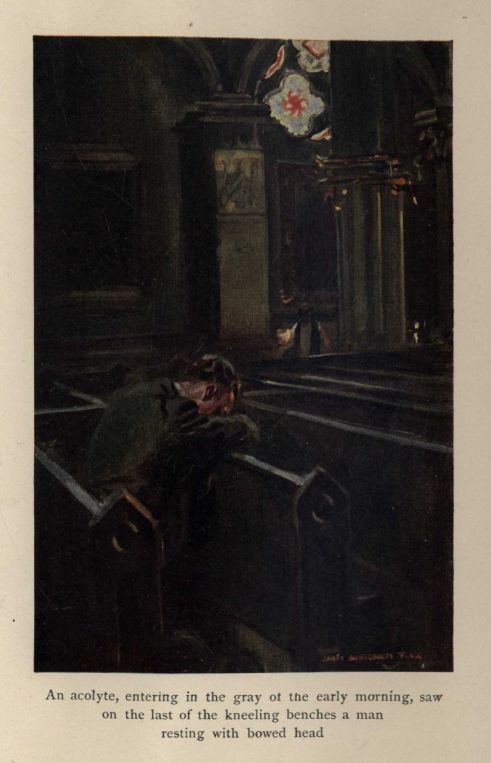
An acolyte, entering in the gray of the early morning, saw on the last of the kneeling benches a man resting with bowed head
CHAPTER XLVIII
The apprehension that had long waited upon Robert Kimberly's intentions weighed upon his circle. It was not enough for those about him to assure themselves that their affairs of business or of pleasure must move on whether Robert should determine to move on with them or not. His aloofness carried with it an uncertainty that was depressing.
If he were wholly gone it would be one thing; but to be not gone and not of them was quite another. When Nelson brought the codicil providing for the school, satisfactorily framed, Kimberly had changed his intention and resolved, instead of incorporating the foundation in his will, to make immediate provision for an endowment. When the details were worked out, Nelson left to bring his wife home from Paris. Lottie's first visit was to Dolly's home, and there she found Imogene and Fritzie. She tiptoed in on the surprised group with a laugh.
They rose in astonishment, but Lottie looked so trim and charming in her French rig that she disarmed criticism. For a moment every one spoke at once. Then Dolly's kind heart gave way as she mentally pronounced Lottie faultless.
"You never looked so well in your life," she exclaimed with sincerity. "I declare, Lottie, you are back to the sprightliness of girlhood. Paris certainly agrees with you."
Lottie smiled. "I have had two great rejuvenators this year--Paris and a good conscience."
Fritzie could not resist. "Do they go together, Lottie?" she asked.
Lottie responded with perfect ease: "Only when one is still young, dear. I shouldn't dare recommend them to mature persons."
"You felt no risk in the matter yourself?" suggested Fritzie.
"Not in the least," laughed Lottie, pushing down her slender girdle. But she was too happy to quarrel and had returned resolved to have only friends. "You must tell me all about poor Robert." She turned, as she spoke to Dolly, with a sudden sympathy in her tender eyes. "I have thought so much about his troubles. And I am just crazy to see the poor fellow. What is he doing?"
"He is in town for a few days, just now. But he has been away for two months--with the yacht."
"Where?"
"No one knows. Somewhere along the coast, I suppose."
"With whom?"
"Alone."
Lottie threw her eyes upward. "What does he mean? What do you all mean by letting him get into such a rut? Such isolation; such loneliness! He needs to be cheered up, poor fellow. Dolly, I should think you would be frightened to death----"
"What could I possibly do that I haven't done?" demanded Dolly. "No one can do a thing with Robert when he is set. I have simply had to give up."
"You mustn't give up," protested Lottie courageously. "It is just the giving up that ruins everything. Personally, I am convinced that no one can long remain insensible to genuine and sincere sympathy. And certainly no one could accuse poor Robert of being unresponsive."
"Certainly not--if you couldn't," retorted Fritzie.
Lottie turned with amiability. "Now, Fritzie dear, you are not going to be unkind to me. I put myself entirely out of the case. It is something we ought all to work for together. It is our duty, I think."
She spoke very gently but paused to give the necessary force to her words. "Truly, it would be depressing to any one to come back to a gay circle and find it broken up in the way ours is. We can't help the past. Its sorrows belong to it alone. We must let the dead bury the dead and all work together to restore the old spirit when everybody was happy--don't you feel so, Arthur?" she asked, making that sudden kind of an appeal to Arthur De Castro to which it is difficult to refuse assent.
"Certainly we should. And I hope you will be successful, Lottie, in pulling things together."
"Robert is at home now, isn't he?"
"He has been at home a fortnight," returned Arthur, "but shut up with the new board of directors all the time. MacBirney walked the plank, you know, last fall when Nelson went on the board."
"I think it was very nice of Robert to confer such an honor on Nelson," observed Lottie simply, "and I intend to tell him so. He is always doing something for somebody," she continued, rising to go. "And I want to see what the constant kindness he extends to others will do if extended to him."
"She also wants to see," suggested Fritzie to Imogene, as Dolly and Arthur walked with Lottie to the door, "what Paris and a good conscience, and a more slender figure, will do for him."
"Now, Fritzie!"
"If Robert Kimberly," blurted Fritzie hotly, "ever takes up again with Lottie Nelson, I'll never speak to him as long as I live."
"Again? When did he ever take up with her?"
"I don't care. You never can tell what a man will do."
Imogene, less easily moved, only smiled. "Dolly entertains the Nelsons to-morrow evening, and Robert will be asked very particularly to come."
Kimberly did not return home, as was expected, that night. At The Towers they had no definite word as to whether he would be out on the following day. Dolly called up the city office but could only leave a message for him. As a last resort she sent a note to The Towers, asking Robert to join them for the evening in welcoming Lottie. Her failure to receive an answer before the party sat down to dinner rather led Dolly to conclude that they should not see him and she felt no surprise when a note was handed her while the coffee was being served. She tore it open and read:
"DEAR DOLLY:
"I am just home and have your note. I am sorry not to be with you to-night to join in welcoming the Nelsons. I send all good wishes to the little company, but what I have now to tell you will explain my absence.
"I had already made an appointment before I learned of your arrangements for the evening. Father Pauly, the village clergyman, sleeps to-night at The Towers and I am expecting him as I write. He does not know of my intention, but before he leaves I shall ask him to receive me into the Roman Catholic Church.
"ROBERT."
Dolly handed the note to Arthur. He asked if he should read it aloud. She nodded assent.
Fritzie, next morning, crossing the lake with flowers for Alice, was kneeling at her grave when Kimberly came up. She rose hastily but could not control herself and burst into tears. Kimberly took her hands as she came to him. "Dear Fritzie," he murmured, "you haven't forgotten."
"I loved you both, Robert."
They walked down the hill together. Fritzie asked questions and Kimberly met her difficulties one after another. "What great difference does it make, Fritzie, whether I work here or elsewhere? I want a year, possibly longer, of seclusion--and no one will bother me at the Islands. Meantime, in a year I shall be quite forgotten."
Charles Kimberly was waiting at The Towers for a conference. The brothers lunched together and spent the afternoon in the library. Dolly came over as they were parting. "Is it true, Robert," she asked piteously, "that you are going to Molokai?"
"Not for weeks yet, Dolly. Much remains to be arranged here."
"To the lepers?"
"Only for a year or two." He saw the suffering in her face and bent over her with affectionate humor. "I must go somewhere for a while, Dolly. You understand, don't you?"
She shook the tears from her long lashes. "You need not tell me. Robert, you will never come back."
He laughed tenderly. "My heart is divided, Dolly. Part of it is here with you who love me; part of it, you know, is with her. If I come back, I shall find you here. If I do not come back, I shall find her THERE."
In a distant ocean and amid the vastness of a solitude of waters the winter sun shines warm upon a windward cliff. From the face of this gigantic shape, rising half a mile into the air, springs a tapestry of living green, prodigal with blossoms and overhanging at intervals a field of flowers.
On the heights of the crumbling peak the wild goat browses in cool and leafy groves. In its grassy chimneys rabbits crouch with listening ears, and on the sheer face of the precipice a squirrel halts upon a dizzy vine. Above its crest a seabird poises in a majesty of flight, and in the blue distance a ship sails into a cloudless sky. This is Molokai.
At the foot of the mountain the morning sun strikes upon a lowland, thrust like a tongue of fire into the cooling sea, and where the lava meets the wave, breakers beat restlessly.
On one shore of this lowland spit, and under the brow of the cliff, a handful of white cottages cluster. On the opposite shore lies a whitewashed hamlet brightened by tropical gardens and shaded with luxuriant trees; it is the leper port. Near the sea stands a chapel surmounted by a cross. Beyond it a larger and solitary cross marks a second village--the village of the leper dead.
An island steamer whistled one summer evening for the port, and a landing boat put out from the pier. It was the thirtieth of June. Three passengers made ready to disembark, two of them women, Sisters of St. Francis, who had offered themselves for the leper mission, and the third a man, a stranger, who followed them over the steamer's side and, rearranging their luggage, made a place for the two women in the stern of the weather-beaten craft.
It was the close of the day and the sun flowed in a glory of gold over the sea. On one edge of the far horizon a rain cloud drifted. In the east the moon was rising full and into a clear sky. A heavy swell lifted the boat from the steamer's side. The three passengers steadied themselves as they rose on its crest, and the brown oarsmen, catching the sweep of the sea, headed for the long line of foam that crawled upon the blackened rocks.
On the distant beach a black-robed figure outlined against the evening sky watched with straining eyes the sweep of the dripping oars and with arm uplifted seemed to wait with beating heart upon their stroke for him who was coming. Along the shore, cripples hastening from the village crowded the sandy paths toward the pier. In the west, the steamer was putting out again upon its course, and between the two the little boat, a speck upon the waves, made its way stoutly through the heaving sea.
THE END
* * * * * * * *
TITLES SELECTED FROM GROSSET & DUNLAP'S LIST
May be had wherever books are sold. Ask for Grosset & Dunlap's list
THE SIEGE OF THE SEVEN SUITORS. By Meredith Nicholson. Illustrated by C. Coles Phillips and Reginald Birch.
Seven suitors vie with each other for the love of a beautiful girl, and she subjects them to a test that is full of mystery, magic and sheer amusement.
THE MAGNET. By Henry C. Rowland. Illustrated by Clarence F. Underwood.
The story of a remarkable courtship involving three pretty girls on a yacht, a poet-lover in pursuit, and a mix-up in the names of the girls.
THE TURN OF THE ROAD. By Eugenia Brooks Frothingham.
A beautiful young opera singer chooses professional success instead of love, but comes to a place in life where the call of the heart is stronger than worldly success.
SCOTTIE AND HIS LADY. By Margaret Morse. Illustrated by Harold M. Brett.
A young girl whose affections have been blighted is presented with a Scotch Collie to divert her mind, and the roving adventures of her pet lead the young mistress into another romance.
SHEILA VEDDER, By Amelia E. Barr. Frontispiece by Harrison Fisher.
A very beautiful romance of the Shetland Islands, with a handsome, strong willed hero and a lovely girl of Gaelic blood as heroine. A sequel to "Jan Vedder's Wife,"
JOHN WARD, PREACHER. By Margaret Deland.
The first big success of this much loved American novelist. It is a powerful portrayal of a young clergyman's attempt to win his beautiful wife to his own narrow creed.
THE TRAIL OF NINETY-EIGHT. By Robert W. Service. Illustrated by Maynard Dixon.
One of the best stories of "Vagabondia" ever written, and one of the most accurate and picturesque of the stampede of gold seekers to the Yukon. The love story embedded in the narrative is strikingly original.
The Master's Violin
By MYRTLE REED
A Love Story with a musical atmosphere. A picturesque, old German virtuoso is the reverent possessor of a genuine Cremona. He consents to take as his pupil a handsome youth who proves to have an aptitude for technique, but not the soul of the artist. The youth has led the happy, careless life of a modern, well-to-do young American, and he cannot, with his meagre past, express the love, the longing, the passion and the tragedies of life and its happy phases as can the master who has lived life in all its fulness. But a girl comes into his existence, a beautiful bit of human driftwood that his aunt had taken into her heart and home; and through his passionate love for her, he learns the lessons that life has to give--and his soul awakens.
Founded on a fact well known among artists, but not often recognized or discussed.
If you have not read "LAVENDER AND OLD LACE" by the same author, you have a double pleasure in store--for these two books show Myrtle Reed in her most delightful, fascinating vein--indeed they may be considered as masterpieces of compelling interest.
The Prodigal Judge
By VAUGHAN KESTER
This great novel--probably the most popular book in this country to-day--is as human as a story from the pen of that great master of "immortal laughter and immortal tears," Charles Dickens.
The Prodigal Judge is a shabby outcast, a tavern hanger-on, a genial wayfarer who tarries longest where the inn is most hospitable, yet with that suavity, that distinctive politeness and that saving grace of humor peculiar to the American man. He has his own code of morals--very exalted ones--but honors them in the breach rather than in the observance.
Clinging to the Judge closer than a brother, is Solomon Mahaffy--fallible and failing like the rest of us, but with a sublime capacity for friendship; and closer still, perhaps, clings little Hannibal, a boy about whose parentage nothing is known until the end of the story. Hannibal is charmed into tolerance of the Judge's picturesque vices, while Miss Betty, lovely and capricious, is charmed into placing all her affairs, both material and sentimental, in the hands of this delightful old vagabond.
The Judge will be a fixed star in the firmament of fictional characters as surely as David Harum or Col. Sellers. He is a source of infinite delight, while this story of Mr. Kester's is one of the finest examples of American literary craftmanship.
TITLES SELECTED FROM GROSSET & DUNLAP'S LIST
May be had wherever books are sold. Ask for Grosset & Dunlap's list.
HIS HOUR. By Elinor Glyn. Illustrated.
A beautiful blonde Englishwoman visits Russia, and is violently made love to by a young Russian aristocrat. A most unique situation complicates the romance.
THE GAMBLERS. By Charles Klein and Arthur Hornblow. Illustrated by C. E. Chambers.
A big, vital treatment of a present day situation wherein men play for big financial stakes and women flourish on the profits--or repudiate the methods.
CHEERFUL AMERICANS. By Charles Battell Loomis. Illustrated by Florence Scovel Shinn and others.
A good, wholesome, laughable presentation of some Americans at home and abroad, on their vacations, and during their hours of relaxation.
THE WOMAN OF THE WORLD. By Ella Wheeler Wilcox.
Clever, original presentations of present day social problems and the best solutions of them. A book every girl and woman should possess.
THE LIGHT THAT LURES. By Percy Brebner. Illustrated. Handsomely colored wrapper.
A young Southerner who loved Lafayette, goes to France to aid him during the days of terror, and is lured in a certain direction by the lovely eyes of a Frenchwoman.
THE RAMRODDERS. By Holman Day. Frontispiece by Harold Matthews Brett.
A clever, timely story that will make politicians think and will make women realize the part that politics play--even in their romances.
Ask for compete free list of G. & D. Popular Copyrighted Fiction
GROSSET & DUNLAP, 526 WEST 26th ST., NEW YORK