MAPS.
Reading edition
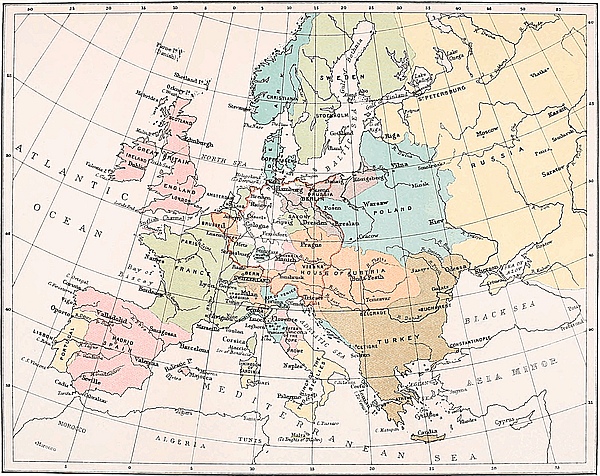
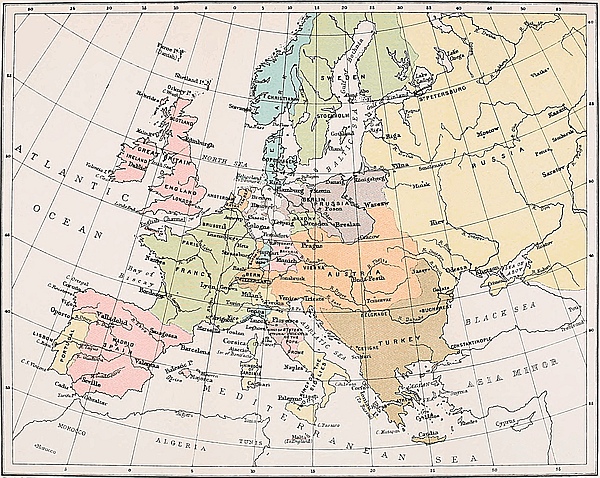
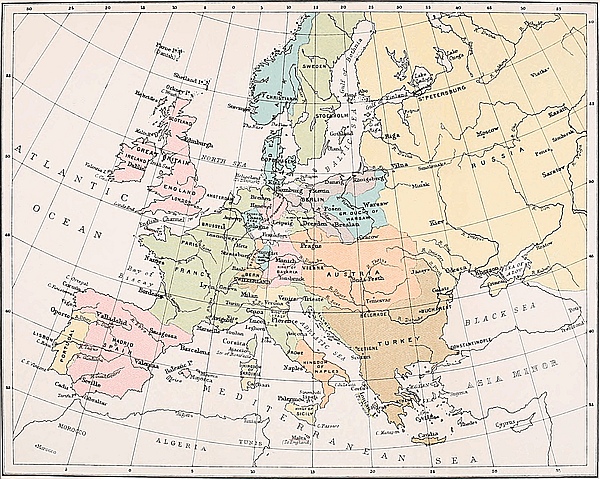
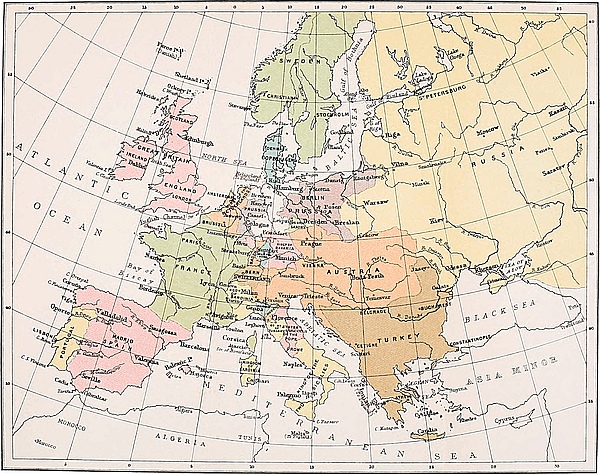
Map 1. Europe in 1789. 〃 2. Europe in 1803. 〃 3. Europe in 1810. 〃 4. Europe in 1815.
These maps are intended to show the limits of the principal states of Europe at the beginning of 1789, after the rearrangement in 1803, at the height of Napoleon’s power in 1810, and according to the settlement made by the Congress of Vienna in 1815.
The same colouring has been preserved through the series of maps in order that the boundaries of each country may be compared at these different dates.
The red line in Map 1 marks the boundary of the Holy Roman Empire.
The area in Germany left uncoloured—in all four maps—was occupied by various states too small in size to be indicated by colours.
EUROPE in 1789.
Period VII.
John Bartholomew & Co., Edinr.
The Red line marks the limits of the Holy Roman Empire.
[See larger version]
EUROPE in 1803.
Period VII.
John Bartholomew & Co., Edinr.
[See larger version]
EUROPE in 1810.
Period VII.
John Bartholomew & Co., Edinr.
[See larger version]
EUROPE in 1815.
Period VII.
John Bartholomew & Co., Edinr.
[See larger version]
INDEX
The dates given in brackets are those of the birth and death of the person indexed; where only the date of death is known it is preceded by a ♰.
Full names and titles are given.
Proper names commencing with ‘da,’ ‘de,’ ‘d’,’ are indexed under the succeeding initial letter.
Abdul Hamid (1725–89), Sultan of Turkey, 44.
Abensberg, battle of (20 April 1809), 272.
Abercromby, Sir Ralph, English general (1735–1801), 224.
Aberdeen, George Gordon, Earl of, English diplomatist (1784–1860), 301, 311, 316, 323.
Abo, treaty of (April 1812), 302.
Aboukir Bay, French fleet defeated in, by Nelson (1 August 1798), 195.
Abrantes, Duke of. See Junot.
Abrial, André Joseph, Comte, French statesman (1750–1828), 216.
Acre, siege of (1799), 208.
Acton, Joseph, Neapolitan statesman (1737–1808), 23.
Adda, the, Bonaparte forces the passage of, at Lodi (1796), 174;
Suvórov, at Cassano (1799), 203.
Addington, Henry, Viscount Sidmouth, English statesman (1757–1844), 225.
Additional Act, the, declared by Napoleon (23 April 1815), 352.
Adige, the, Italy up to, ceded to Austria by treaty of Campo-Formio (1797), 192;
by treaty of Lunéville (1801), 220;
Austrian positions on, turned by Macdonald (1800), 219.
Adlersparre, George, Baron, Swedish general (1760–1837), 279.
Aix-la-Chapelle, a free city of the Holy Roman Empire, 35, 150, 230, 344.
Albuera, battle of (16 May 1811), 297.
Albufera, battle of (26 Dec. 1811), 297.
—— Duke of. See Suchet.
Aldenhoven, battle of (2 Oct. 1794), 150.
Alessandria, fortress built at, by Victor Amadeus iii., 27, 203, 204, 218.
Alexander i., Emperor of Russia (1777–1825), attitude at his accession, 234;
joins coalition against France, 242, 243;
defeated at Austerlitz, 244;
at Eylau and Friedland, 248, 249;
interview with Napoleon at Tilsit, 249, 250;
makes treaty of Tilsit, 250;
conquers Finland, 254, 278;
acquisitions in Poland, and dislike of Grand Duchy of Warsaw, 261;
interview with Napoleon at Erfurt, 262;
conduct in 1809, 274;
war with Turkey, 281;
makes treaty of Bucharest, 281;
refuses a sister to Napoleon, 294;
causes of dissension with Napoleon, 299–301;
makes treaty of Abo with Bernadotte, 302;
summons Stein to his Court, 304;
his policy of retreat before Napoleon (1812), 305;
fights battle of Borodino, 305;
negotiates with Napoleon, 306;
forms friendship with Frederick William III. of Prussia, 308;
distrust of Napoleon, 310;
agrees to Proposals of Frankfort, 316;
desires to invade France, 317;
refuses to retreat, 319, 320;
enters Paris, 329;
influenced by Talleyrand, 329, 330;
speech to the French Senate, 330, 331;
greatness of his share in overthrowing Napoleon, 334;
at the Congress of Vienna, 337;
his desire for the whole of Poland, 339;
forced to give way, 340, 341;
gave constitution to Poland, 342;
protected Murat and Eugène de Beauharnais, 345;
signs treaty against Napoleon (1815), 350;
opposes partition of France, 354;
joins the Holy Alliance, 355.
Alexandria, 195, 224.
Alicante, Bentinck repulsed at (1812), 307.
Alkmaar, Convention of (18 Oct. 1799), 205.
Almeida, siege of (1811), 296.
Alps, French reach the summit of Mont Cenis (1795), 151;
Suvórov crosses (1799), 204, 205;
Bonaparte (1800), 218;
Macdonald (1800), 219.
Alsace, rights of the Princes of the Empire in, 79;
proposals of Mirabeau and Merlin, 80;
letter of Leopold on, 89, 90;
conclusion of the Diet of the Empire on, 108;
invaded by Würmser, 130, 139;
recovered by the French (1794), 140;
proposal to detach from France (1815), 354.
Altdorf, Suvórov reaches (1799), 204.
Altenkirchen, battle of (20 Sept. 1796), 178.
Alton, Richard, Count d’, Austrian general (1732–90), 43, 47, 48, 63, 64.
Alvensleben, Philip Charles, Count von, Prussian statesman (1745–1802), 153, 170, 179.
Alvinzi (Alvinczy), Joseph, Austrian general (1735–1810), 176.
America, South, 264, 358.
—— United States of. See United States.
Ami du Peuple, Marat’s journal, 61.
Amiens, treaty of (1802), 225.
Amnesty, general, decreed by the Convention (1795), 166.
—— law of, promulgated (1815), 357.
Amsterdam, 32, 149, 255.
Ancients, Council of. See Council.
Ancona, 175, 207, 277.
Angoulême, Maria Thérèse Charlotte, Duchess of, daughter of Louis XVI. (1778–1851), 168.
—— Louis Antoine, Duke of, son of the Comte d’Artois (1775–1844), 326, 327.
Anhalt, the Dukes of, Princes of the Empire (1789), 34, 343.
Anhalt-Köthen, Louis, Duke of (1761–1819), 293.
Anhalt-Zerbst, the Empress Catherine, a princess of, 18.
Ankarström, John James, Swedish officer (1761–1792), 110.
Anselme, Jacques Bernard Modeste d’, French general (1740–1812), 117.
Anspach, Napoleon violates Prussian neutrality by marching through (1805), 244.
Antwerp, riot against the Austrians suppressed at (1788), 47;
abandoned to the Belgian patriots (1789), 64;
Napoleon’s buildings at, 276;
Carnot’s defence of (1814), 321;
its retention cause of Napoleon’s fall, 324.
Aoust, Eustache, Comte d’, French general (1764–94), 140.
Appenzell, democratic canton of Switzerland, maintained by Bonaparte (1803), 228.
Aranda, Don Pedro Pablo Abaracay Bolea, Count of, Spanish statesman (1718–99), 4, 21, 126.
Archbishop-Electors of the Holy Roman Empire, 34, 39, 40.
Arcis-sur-Aube battle of (20 March 1814), 328.
Arcola, battle of (16 Nov. 1796), 176.
Aremberg, Louis Engelbert, Duke of (1750–1820), 93.
—— Prosper Louis, Duke of (1785–1863), 282.
Argau, canton of Switzerland, formed by Bonaparte (1803), 228;
recognised by Congress of Vienna (1815), 344.
Aristocracy, Napoleon’s, 286.
Armistices: Cherasco (1796), 174;
Foligno (1796), 175;
Giurgevo (1790), 88; Pleswitz (1813), 309.
Arndt, Ernest Maurice, German poet (1769–1862), 291.
Arragon, Suchet’s campaigns in, 275, 295.
Arras, atrocities of Le Bon at (1794), 139.
Artois, Charles Philippe, Comte d’, younger brother of Louis XVI., afterwards King Charles X. of France (1757–1836), 55, 59, 102, 139, 167, 172, 351.
Aschaffenburg, principality of, granted to the Elector of Mayence, 225, 260.
Aspern or Essling, battle of (21, 22 May 1809), 273.
Assignats issued in France, 74;
their effect, 98.
Aubert-Dubayet, Jean Baptiste Annibal, French general (1759–1797), 166, 182.
Auckland, William Eden, Lord, English diplomatist (1744–1814), 65, 93.
Auerstädt, battle of (14 Oct. 1806), 247.
—— Duke of. See Davout.
Augereau, Charles Pierre François, Duke of Castiglione, French general (1757–1816), 191, 219, 321;
App. iv.
Augsburg, Bishop of, an ecclesiastical prince of the Holy Roman Empire, 34.
—— bishopric of, merged in Bavaria (1803), 227.
—— city of, a free city of the Empire (1789), 35;
taken by Moreau (1800), 219;
maintained as a free city (1803), 226;
Masséna’s headquarters (1809), 272.
Augusta, Princess, of Bavaria married to Eugène de Beauharnais, 258.
Augustus, Prince, of Prussia (1779–1843), 337.
Aulic Council, the, 35.
Austerlitz, battle of (2 Dec. 1805), 244.
Austria, position in 1789, 14–17;
influence in the Empire, 35;
obtained cessions by the treaty of Sistova (1791), 88;
got nothing in the second partition of Poland (1793), 122;
received Cracow, etc. at third partition of Poland (1795), 152;
received Venice for Lombardy by treaty of Campo-Formio (1797), 192;
and by treaty of Lunéville (1801), 220;
obtained Trent and Brixen, but lost much influence in the resettlement of Germany (1803), 226;
formed into an empire (1805), 236;
lost Venice, Istria, the Tyrol, etc. by treaty of Pressburg (1805), 245;
lost Trieste, Galicia, Salzburg, etc. by treaty of Vienna (1809), 274;
at Congress of Vienna (1814) got back Cracow, 342, and Lombardy and Venetia, 347.
See Francis II., Joseph II., Leopold II.
Austrian Netherlands. See Belgium.
Auvergne, movement against the Convention in (1793), 131.
Avignon, city of, wishes to join France (1790), 76;
secured to France by first treaty of Paris (1814), 333;
and by second treaty of Paris (1815), 354.
Babeuf, François Noël (Gracchus), French socialist (1764–97), 181.
Badajoz, treaty of (1801), 223;
taken by Soult (1810), 296;
by Wellington (1812), 306.
Baden, condition in 1789, 37;
made an electorate (1803), 225;
increased by the secularisations (1803), 227;
made a grand duchy (1806), 245;
received Ortenau and the Breisgau (1809), 258;
a state of the Confederation of the Rhine (1808), 260;
of the Germanic Confederation (1815), 342.
See Charles Frederick, Charles Louis Frederick.
Bagration, Peter, Prince, Russian general (1762–1812), 281, 305.
Bailly, Jean Sylvain, French statesman (1736–93), 53, 59, 138.
Baird, Sir David, English general (1757–1829), 224.
Ball, Sir Alexander John, English admiral (1759–1809), 195.
Baltic Sea, effort to exclude English commerce from, 222;
command of, given to Russia and Prussia by the Congress of Vienna, 347.
Bamberg, Bishop of, an ecclesiastical prince of the Holy Roman Empire, 34.
—— bishopric of, merged in Bavaria (1803), 227.
Bank of France, founded by Bonaparte, 215.
Bantry Bay, French expedition to (1796), 185.
Barbé-Marbois, François, Comte de, French statesman (1745–1837), 188, 191, 214.
Barclay de Tolly, Michael, Prince, Russian general (1755–1818), 305, 309, 313.
Barentin, Charles Louis François de
Paule de, French minister (1738–1819), 51.
Barère, Bertrand, French orator (1755–1841), 117, 133, 134, 145, 149, 155.
Barnave, Antoine Pierre Joseph
Marie, French politician (1761–93), 100.
Barras, Paul François Jean Nicolas,
Comte de, French statesman (1755–1829), 147, 164, 165;
nominates Bonaparte to command the armyof Italy, 174;
his attitude as a Director, 181;
co-operates in coup d’état of Fructidor 1797, 191;
only original Director left (July 1799), 209, 210;
resigns (Nov. 1799), 211.
Barrosa, battle of (5 March 1811), 297.
Bartenstein, treaty of (April 1807), 248.
Barthélemy, François, Marquis de,
French diplomatist (1747–1830), 156, 188, 189, 191.
Basire, Claude, French politician (1764–94), 117.
Basle, Bishop of, an ecclesiastical
prince of the Holy Roman Empire, 34, 41;
with fiefs in Alsace, 79.
—— bishopric of, part ceded to Baden (1803), 227;
part to canton of Berne (1815), 345.
—— canton of Switzerland, maintained by Bonaparte (1803), 228.
—— treaties of (1795), 156, 157.
Basque Roads, affair in the (1809), 276.
Bassano, Duke of. See Maret.
Bastille, capture of the (14 July 1789), 57, 58.
Batavian Republic founded (1795), 150;
imitates the French constitutions, 193;
turned into the kingdom of Holland (1806), 254, 255.
Battles: Abensberg (1809), 272;
Albuera (1811), 297;
Albufera (1811), 297;
Aldenhoven (1794), 150;
Alexandria (1801), 224;
Altenkirchen (1796), 178;
Arcis-sur-Aube (1814), 328;
Arcola (1796), 176;
Aspern (Essling) (1809), 273;
Auerstädt (1806), 247;
Austerlitz (1805), 244;
Barrosa (1811), 297;
Bautzen (1813), 309;
Bergen (1799), 205;
Biberach (1800), 219;
Borodino (1812), 305;
Braila (1809), 281;
Brienne (1814), 319;
Burgos (1808), 269;
Busaco (1810), 296;
Cairo (1799), 208;
Caldiero (1796), 176;
Caldiero (1805), 244;
Camperdown (1797), 194;
Cassano (1799), 203;
Castiglione (1796), 175;
Ceva (1796), 174;
Champaubert (1814), 319;
Copenhagen (1801), 222;
Corunna (1809), 270;
Craonne (1814), 328;
Dego (1796), 174;
Dennewitz (1813), 313;
Dresden (1813), 312;
Dubienka (1792), 122;
Eckmühl (1809), 273;
Elchingen (1805), 244;
Engen (1800), 219;
Espinosa (1808), 269;
Essling (Aspern) (1809), 273;
Ettlingen (1796), 178;
Eylau (1807), 248;
Famars (1793), 130;
Figueras (1794), 150;
First of June (1794), 145;
Fleurus (1794), 144;
Foksany (1788), 45;
Friedland (1807), 249;
Fuentes de Onor (1811), 297;
the Geisberg (1793), 140;
Genola (1799), 204;
Giurgevo (1790), 88;
Gross-Beeren (1813), 312;
Gross-Gorschen (Lützen) (1813), 309;
Hanau (1813), 314;
Heliopolis (1800), 224;
Hohenlinden (1800), 219;
Hondschoten (1793), 140;
Jemmappes (1792), 118;
Jena (1806), 247;
Kaiserslautern (1794), 144;
the Katzbach (1813), 312;
Kioge (1807), 252;
Laon (1814), 328;
Leipzig (1813), 314;
Ligny (1815), 352;
Loano (1795), 151, 173;
Lodi (1796), 174;
Lützen (Gross-Gorschen) (1813), 309;
Maciejowice (1794), 152;
Magnano (1799), 202;
Maida (1806), 256;
Marengo (1800), 218;
Matchin (1791), 96;
Medellin (1809), 275;
Medina del Rio Seco (1808), 267;
Millesimo (1796), 174;
the Mincio (1814), 322;
Mœskirchen (1800), 219;
Mondovi (1796), 174;
Montebello (1800), 218;
Montenotte (1796), 174;
Montereau (1814), 319;
Montmirail (1814), 319;
Mount Tabor (1799), 208;
Nangis (1814), 319;
Neerwinden (1793), 127;
Neumarkt (1797), 186;
the Nile (Aboukir Bay) (1798), 195;
the Nive (1813), 316;
the Nivelle (1813), 316;
Novi (1799), 204;
Ocana (1809), 276;
Orthez (1814), 321;
Pacy-sur-Eure (1793), 131;
Paris (1814), 329;
the Pyramids (1798), 195;
Quatre Bras (1815), 352;
Raab (1809), 273;
Raclawice (1794), 151;
Rivoli (1797), 176;
Roliça (1808), 265;
the Rymnik (1788), 45;
Sacilio (1809), 273;
St. Vincent (1797), 183;
Salamanca (1812), 306;
Saorgio (1794), 144;
Silistria (1809), 281;
Stockach (1799), 202;
Svenska Sound (1790), 95;
Talavera (1809), 275, 276;
Tobac (1788), 45;
Tolentino (1815), 346;
Toulouse (1814), 332;
Trafalgar (1805), 245;
the Trebbia (1799), 203;
Tudela (1808), 269;
Unzmarkt (1797), 186;
Valmy (1792), 115;
Valsarno (1813), 315;
Vauchamps (1814), 319;
Vimeiro (1808), 265, 266;
Vittoria (1813), 315;
Wagram (1809), 274;
Waterloo (1815), 353;
Wattignies (1793), 140;
Zielence (1792), 121, 122;
Zurich (1799), 204.
Bautzen, battle of (20 May 1813), 309.
Bavaria, the Emperor Joseph’s designs on, 16, 17;
its Elector also Elector Palatine, 34;
condition in 1789, 37;
invaded by Moreau (1796), 178;
treaty of Pfaffenhofen, 180;
promised to Austria by Bonaparte (1797), 193;
occupied by Moreau (1800), 219;
increased by the secularisations (1803), 227;
invaded by the Austrians (1805), 243;
receives the Tyrol and becomes a kingdom (1806), 245;
receives Salzburg (1809), 257;
member of the Confederation of the Rhine, 260;
invaded by the Austrians (1809), 272;
great internal reforms, 289;
member of the Germanic Confederation (1815), 342;
receives Mayence for the Tyrol (1815), 344. See Charles Theodore, Maximilian Joseph.
Baylen, capitulation of (1808), 267, 268.
Bayonne besieged by the English (1813, 1814), 316, 321.
Beauharnais, Eugène de, step-son of Napoleon (1781–1824), 236, 238, 239, 244, 255, 256, 273, 308, 315, 321, 322, 345.
Beaulieu, Jean Pierre, Baron de, Austrian general (1725–1820), 174.
Beccaria, Cæsar Bonesana, Marquis de, Italian philosopher (1738–94), 26.
Belgium, opposition to the Emperor Joseph’s reforms in (1788), 15;
his apparent success, 43;
armed resistance in, 47;
abolition of Belgian liberties, 47, 48;
the Austrians driven from (1789), 64;
the Belgian Republic formed (Jan. 1790), 65;
struggle between the Van der Nootists and Vonckists, 92, 93;
reconquered by the Austrians (Dec. 1790), 94;
conquered by the French under Dumouriez (1792), 118;
annexed to the French Republic, 118;
rises against the French (1793), 126;
Dumouriez driven from (1793), 127;
reconquered by the French (1794), 144;
organised as part of the French Republic, 150;
cession to France agreed to by Austria at Leoben, 186;
and at Campo-Formio (1797), 192, 193;
organised into nine French departments, 230;
England insists on its separation from France, 318;
invaded by the Prince of Orange (1814), 321;
Napoleon refuses to give up, 324;
united with Holland into the kingdom of the Netherlands (1815), 344, 360.
Belgrade, taken by the Austrians (1789), 45.
Bellegarde, Henri, Comte de, Austrian general (1755–1831), on the Mincio (1814), 322.
Belluno, Duke of. See Victor.
Bender, city of, taken by the Russians (1789), 45.
—— Blaise Colombeau, Baron, Austrian general (1713–98), 65, 93, 94.
Benevento, principality of, belonged to the Pope in 1789, 24;
Talleyrand made prince of, 277.
Benezech, Pierre, French administrator (1745–1802), 166.
Benningsen, Levin Augustus Theophilus, Count, Russian general (1745–1826), 221, 248, 249, 311.
Bentinck, Lord William Charles Cavendish, English general (1774–1839), 307, 315, 322, 346.
Beresford, William Carr, Viscount, English general (1770–1856), 266, 297.
Berg, grand duchy of, created for Murat (1806), its extent, 252;
member of the Confederation of the Rhine, 260;
conferred on son of Louis Bonaparte (1808), 283.
Bergen, battles of (19 Sept. and 2 Oct. 1799), 205.
Bergen-op-Zoom, English repulsed from (1814), 321.
Berlin, occupied by Napoleon (1806), 247;
decree issued at (1807), 251;
University of, founded, 303, 304;
the French driven from (1813), 308.
Bernadotte, Jean Baptiste Jules, Prince of Ponte Corvo (1806), Prince Royal of Sweden (1810), King Charles XIV. of Sweden (1818), (1764–1844), French ambassador to Austria (1798), 197;
insulted at Vienna, 198;
Minister of War (1799), 210;
attacked by the Russians (1807), 247;
commanded the Saxons at Wagram (1809), 274;
Prince of Ponte Corvo, 277;
elected Prince Royal of Sweden (1810), 279;
signs treaty of Abo with Emperor Alexander (1812), 302;
intrigues with Napoleon, 307, 308;
invaded Germany (1813), 309;
wins battle of Gross-Beeren, 312;
and of Dennewitz, 313;
defeated the Danes and exchanged Pomerania for Norway (1814), 320;
rejected for throne of France, 330;
got Norway, but had to give up Guadeloupe (1815), 347;
one of Napoleon’s marshals, App. iv.
Bernard, Great St., Bonaparte crosses (1800), 218.
—— Little St., French reach the summit of (1795), 151.
—— of Saintes, Adrien Antoine, French politician (1750–1819), 139.
Berne, chief oligarchical canton of Switzerland in 1789, 41;
occupies Geneva (1792), 125;
occupied by the French (1798), 199;
Vaud and Argau separated from (1803), 228;
obtained part of the Bishopric of Basle (1815), 345.
Bernis, François Joachim de Pierre, Cardinal de, French statesman (1715–94), 19.
Bernstorf, Count Andrew, Danish statesman (1735–97), 32, 46, 120.
—— Count Christian, Danish statesman (1769–1835), 338.
Berthier, Louis Alexandre, Prince of Neufchâtel and Wagram, French general (1753–1815), 200, 216, 241, 239, 283, App. iv.
—— de Sauvigny, Louis Bénigne François, French administrator (1742–89), 59.
Bessarabia, conquered by the Russians under Potemkin (1789), 45;
under Bagration (1810), 281;
part of, ceded to Russia by treaty of Bucharest, 281.
Bessières, Jean Baptiste, Duke of Istria, French general (1768–1813), 267, 297, 309, App. iv.
Beugnot, Jacques Claude, Comte, French administrator (1761–1835), 331.
Biberach, battle of (9 May 1800), 219.
Bidassoa, the passage of, forced by the Spaniards (1739), 130;
by the French (1794), 140.
Bigot de Préameneu, Félix Julien Jean, Comte, French jurist (1747–1825), 215.
Bilbao, taken by the French (1795), 151.
Billaud-Varenne, Jacques Nicolas, French statesman (1756–1819), 193, 134, 138, 139, 147, 149, 155.
Biron, Armand Louis de Gontaut, Duc de, French general (1747–93), 138.
Bischofswerder, Hans Rudolf, Baron von, Prussian statesman (♰1803), 31, 87.
Bishops, the Prince of Germany, 34, 39.
Black Legion of Brunswick raised, 293.
Blake, Joachim, Spanish general (♰1827), defeated at Albufera (1811), 247.
Blücher, Gebhard Lebrecht von, Prince of Wahlstatt, Prussian general (1742–1819), 309, 312, 318, 319, 328, 329, 350, 352, 353, 355.
Boeckh, Augustus, German scholar (1785–1861), 304.
Bohemia, opposition to Joseph’s reforms in, 15;
the reforms suspended, 66;
pacified by Leopold, 84.
Boissy-d’Anglas, François Antoine, Comte, French statesman (1756–1826), 155, 165, 168, 182.
Bologna, belonged to the Pope, 24;
occupied by Bonaparte (1796), 175;
merged in the Cisalpine Republic, 192;
in the kingdom of Italy, 255;
restored to the Pope (1815), 347.
Bonaparte, Caroline, Queen of Naples. See Caroline.
Bonaparte, Elisa (1777–1820), 283.
—— Jerome (1784–1860), King of Westphalia. See Jerome.
—— Joseph (1768–1844), 239 (1806), 255. See Joseph.
—— Louis (1778–1846), 239, 254, 255. See Louis.
—— Lucien (1775–1840), 210, 216, 223.
—— Napoleon (1769–1821) at the siege of Toulon (1793), 140;
brings up artillery for the defence of the Convention (1795), 164;
defeats the insurgents of Vendémiaire, 165;
appointed to the command of the army of Italy (1796), 174;
defeats the Sardinians, 174;
conquers Lombardy, 174;
makes armistice with the Pope, 175;
defeats the Austrians at Castiglione, 175, at Arcola and Rivoli, 176;
invades the Tyrol and signs Preliminaries of Leoben, 186;
opposed the Clichians, 189;
sends Augereau to Paris to help the Directors, 191;
formed the Cisalpine Republic, 192;
signs treaty of Campo-Formio (1797), 192;
commands army of the Interior, 194;
takes Malta and invades Egypt (1798), 195;
campaign in Syria (1799), 208;
returns to France, 208;
makes coup d’état of 18 Brumaire, 210, 211;
provisional First Consul, 211;
First Consul, 214;
internal policy, 215;
forms the Bank of France and Code Civil, 215;
foreign policy, 216, 217;
wins battle of Marengo and conquers Italy, 218;
First Consul of the Cisalpine Republic, 220;
his Spanish policy, 223;
concludes the treaty of Amiens (1802), 225;
reorganises Switzerland, 228;
Mediator of the Swiss Confederation, 229;
makes Concordat with the Pope, 229;
forms the prefectures, 230;
educational reforms, 231;
First Consul for life (1802), 232;
arrests the English in France and occupies Hanover (1803), 233;
execution of the Duc d’Enghien (1804), 235;
Emperor of the French (1804), 236. See Napoleon.
—— Pauline, Princess Borghese (1780–1825), 283.
Bonn, the university of, 40, 150.
Bonnier-d’Alco, Ange Elisabeth Louis Antoine, French politician (1749–1799), 202.
Bordeaux, 131, 327.
Borodino, battle of (7 Sept. 1812), 305.
Bosnia, invaded by the Austrians (1788), 43.
Bouillé, François Claude Amour, Marquis de, French general (1739–1800), 72, 97, 98, 100.
Boulogne, Napoleon’s camp at (1804–5), 241, 242.
Bourbon, Isle of (Réunion), restored to France (1815), 348.
Bourdon, Léonard Jean Joseph, French politician (1758–1816), 147.
Bourdon de Vatry, Marc Antoine, French administrator (1761–1828), 210.
Bourges, federalist army proposed to be formed at (1793), 131, 132.
Bournonville, Pierre de Riel, Comte de, French general (1752–1821), 330.
Brabant, Constitution of, abolished by the Emperor Joseph (1789), 47.
Braila, battle of (1810), 281.
Branicki, Francis Xavier, Polish statesman (♰1819), 121.
Braschi, Giovanni Angelo. See Pius VI., Pope.
Breda, 48, 64.
Breisgau, the, granted to the Duke of Modena (1803), 226;
to the Grand Duke of Baden (1805), 258.
Bremen, a free city of the Holy Roman Empire, 35;
retained its independence (1803), 226;
annexed to Napoleon’s Empire (1810), 282;
one of the four free cities of the Germanic Confederation (1815), 343.
Brescia formed part of the Cisalpine Republic, 192.
Brest, blockaded by English fleet, 184;
French fleet at, unable to break the blockade (1805), 242.
Brienne, battle of (29th Jan. 1814), 319.
Brigandage rife in France under the Directory, 181;
put down by the Consulate, 215;
rife in Calabria, 256.
Brissot, Jean Pierre, French politician (1754–1793), 101, 106, 107, 116, 129.
Brissotin section of the Girondin party in the Convention, 116.
Brittany, opposition to the Convention in, 131;
pacified by Hoche, 180, 181.
Brixen, bishopric of, united to Austria (1803), 226.
Broglie, Victor François, Duc de, French general (1718–1804), 56.
Bruges, 64.
Bruix, Eustache, French admiral (1759–1805), 196.
Brumaire, coup d’état of the 18th (1799), 210, 211.
Brune, Guillaume Marie Anne, French general (1763–1815), 199, 205, 219, 254, 356, App. iv.
Brunswick, Duchy of, merged in kingdom of Westphalia (1806), 258;
a member of the Germanic Confederation (1815), 342.
Brunswick-Lüneburg, Duke of. See Charles William Ferdinand.
Brunswick-Oels, Duke of. See Frederick William.
Brussels, 15, 47, 48, 64, 94, 118, 144.
Bucharest, 45, 281.
Buenos Ayres, 264.
Bülow, Frederick William von, Prussian general (1755–1816), 309, 312, 313;
detached to join Blücher in France (1814), 319, 320, 328.
Burgos, battle of (10 Nov. 1808), 269;
Wellington fails to take (1812), and retreats from, 307.
Burke, Edmund, English orator (1730–97), 120.
Burrard, Sir Harry, English general (1755–1815), 266.
Busaco, battle of (27 Sept. 1810), 296.
Buttmann, Philip Charles, German scholar (1764–1829), 304.
Buzot, François Nicolas Léonard, French politician (1760–94), 116.
Buzotins, a section of the Girondins, 116.
Cabarrus, François, Spanish statesman (1752–1810), 21.
Cadiz, besieged by the French (1810–12), 296, 297.
Cadore, Duke of. See Champagny.
Cadoudal, Georges, Chouan leader (1771–1804), 234, 235.
Caen, army organised by the Girondins against the Convention at (1793), 131.
Caillard, Antoine Bernard, French diplomatist (1737–1807), 215.
Cairo, taken by Bonaparte (1798), 195;
the Mamelukes defeated at (1799), 208;
taken by the English (1801), 224.
Caisse d’amortissement founded, 287, 288.
Calabria, brigandage in, encouraged by the English, 256.
Calder, Sir Robert, English admiral (1745–1818), his action (1805), 242.
Caldiero, battle of (12 Nov. 1796), 176;
battle of (30 Oct. 1805), 244.
Cambacérès, Jean Jacques Régis, Duke of Parma, French statesman (1753–1824), 156, 159, 166, 182, 210, 214, 239, 287, 357.
Cambon, Joseph, French statesman (1754–1820), 129, 133, 288.
Cambrai, 353.
Camperdown, battle of (11 Oct. 1797), 194.
Campo-Chiaro, Duke of, Neapolitan statesman, 338, 346.
Campo-Formio, treaty of (17 Oct. 1797), 192, 193.
Campomanes, Don Pedro Rodriguez, Count of, Spanish statesman (1723–1802), 21.
Canning, George, English statesman (1770–1827), 295.
Cantons of Switzerland, 228, 345.
Cape of Good Hope taken by the English (1805), 264;
retained by them (1815), 348.
Capitulations: of Ulm (1805), 243;
of Baylen (1808), 267, 268;
of Kulm (1813), 313.
Capo d’Istria, John, Count, Greek statesman (1776–1831), 337.
Carniola ceded to Napoleon (1809), 274.
Carnot, Lazare Nicolas Marguerite, French statesman (1753–1823), 133, 134, 140, 148, 165, 177, 181, 191, 214, 216, 321, 352, 357.
Caroline, Marie, Queen of the Two Sicilies (1752–1814), 23.
—— Murat, Queen of Naples (1782–1839), 322, 345.
Carrier, Jean Baptiste, French politician (1756–1794), 139, 141, 149.
Cassano, battle of (27 April 1799), 203.
Castiglione, battle of (15 Aug. 1796), 175.
—— Duke of. See Augereau.
Castlereagh, Robert Stewart, Viscount, Marquis of Londonderry, English statesman (1769–1822), his views on the way to carry on the war with Napoleon, 295;
returns to office (1812), 301;
his policy to form a fresh coalition, 301, 302;
efforts to get Austria to join (1813), 311;
sends expedition to Holland, 314;
sent with full powers to France (1814), 318;
persists in the war and calls up reinforcements for Blücher, 319, 320;
opposition to the retention of Belgium by France, 324;
signs treaty of Chaumont, 327;
friendship with Metternich, 331;
signs treaty of Paris, 332;
one of the two men who did most to overthrow Napoleon, 334;
English representative at the Congress of Vienna (1814), 337;
signs treaty with France and Austria against Russia and Prussia, 340;
disavows Bentinck’s Italian proclamation, 346;
gets the Slave Trade condemned, 349;
succeeded by Wellington at Vienna, 349;
opposes Prussia’s schemes for punishing France (1815), 354;
refuses to join the Holy Alliance, 355.
Catalonia, 144, 150, 151, 275.
Cathcart, William Schaw, Lord, English general (1755–1843), 264, 301, 323, 337.
Catherine ii., Empress of Russia (1729–96) a benevolent despot, 4;
attitude to other Powers of Europe (1789), 12, 13;
alliance with Joseph II., 17;
extension of Russia under, 18;
policy in Poland, 18;
internal policy, 19;
war with the Turks (1789–90), 43–45;
with the Swedes (1789–90), 45, 46;
deprived of the Austrian alliance by Leopold, 95;
makes peace with Sweden at Verela (1790), 95, 96;
with the Turks at Jassy (1792), 96;
attitude towards the French Revolution, 109, 121;
invades Poland (1793), 121;
signs second partition of Poland, 122;
asserts she is fighting Jacobinism in Poland, 125;
invades Poland (1795), 151;
extinguishes independence of Poland, 152;
receives the Comte d’Artois, 172;
death (1796), 185.
Catherine, Grand Duchess of Oldenburg, Queen of Würtemburg (1788–1819), 300, 337.
—— Princess, of Würtemburg (1783–1835), marries Jerome Bonaparte, King of Westphalia (1807), 258.
Cattaro, mouths of the river, ceded by Russia to France at Tilsit (1807), 250.
Caulaincourt, Armand Augustin Louis de, Duke of Vicenza, French statesman (1772–1827), 234, 239, 311, 316, 317, 323, 324, 329, 331, 332.
Cayenne restored to France (1814), 348.
Ceva, battle of (16 April 1796), 174.
Ceylon, taken by the English (1796), 264;
retained in 1815, 348.
Chabot, François, French politician (1759–94), 117.
Chalier, Marie Joseph, French politician (1747–93), 131.
Chambéry, annexed to France (1814), 333;
restored to King of Sardinia (1815), 354.
‘Chambre Introuvable’ (1815), 357, 358.
Champagny, Jean Baptiste Nompère de, Duke of Cadore, French statesman (1756–1834), 241.
Champaubert, battle of (10 Feb. 1814), 319.
Champ de Mars, Paris, massacre of (17 July 1791), 101.
Championnet, Jean Etienne, French general (1762–1800), 200, 203, 204.
Chaptal, Jean Antoine, Comte, French administrator (1756–1832), 216, 241.
Charles III., King of Spain (1716–88), benevolent despot, his reforms, 4, 21;
commenced his career as a reforming monarch at Naples, 23.
—— IV., King of Spain (1748–1819), 21, 77, 79, 193, 126, 157, 183, 223, 232, 252, 253, 267.
—— XIII., King of Sweden, formerly Duke of Sudermania (1748–1818), 46, 110, 120, 171, 253, 279.
—— II., King of Etruria (1799–1863), 253, 347.
Charles Augustus, Duke of Saxe-Weimar (1757–1828), 38, 337, 342.
—— Emmanuel IV., King of Sardinia (1751–1819), 200.
—— Eugène, Duke of Würtemburg, (1728–93), 37, 38.
—— Frederick, Margrave of Baden-Baden and Baden-Durlach (1728–1811), 37, 79, 167, 180, 225, 227, 245, 258, 260.
—— Louis Frederick, Grand Duke of Baden (1786–1816), 258, 337, 342.
—— Theodore, Elector of Bavaria and Elector Palatine (1729–99), 37, 172, 180.
—— William Ferdinand, Duke of Brunswick-Lüneburg, Prussian general (1735–1806), 32, 113, 114, 115, 116, 126, 246.
—— Archduke, Austrian general (1771–1847), elected Grand Duke of Belgium (1790), 94;
commands the Austrian army in Germany (1796), 177;
repulses Jourdan and Moreau, 178;
effect of his success, 180;
commands Austrian army in the Tyrol (1797), 185;
defeated by Bonaparte, and signs Preliminaries of Leoben, 186;
defeats Jourdan (1799), 202;
and advances to the Rhine, 204;
forced to retreat, 205;
campaign against Moreau (1800), superseded, 219;
invades Italy (1805), 243;
defeated at Caldiero, 244;
reorganises Austrian army, 271;
invades Bavaria (1809), 272;
defeated at Eckmühl, 273;
fights battle of Aspern, 273;
defeated at Wagram, 274.
Charter, the, of 4 June 1814, 350.
Chatham, John Pitt, Earl of, English general (1756–1820), 276.
Châtillon, Congress of (1814), 323, 324.
Chaumette, Pierre Gaspard, French politician (1763–94), 141.
Chaumont, treaty of (1 March 1814), 327, 328.
Chauvelin, François Bernard, Marquis de, French politician (1766–1832), 120.
Cherasco, armistice of (28 April 1796), 174.
Chernishev, Alexander, Count, Russian general, 308, 312, 313, 337.
Chestret, M., elected burgomaster of Liége (1789), 49.
Chiaramonti, Gregorio Barnaba Luigi. See Pius VII., Pope.
Choczim, taken by the Austrians and Russians (1788), 43.
Choiseul, Etienne François, Duc de, French statesman (1719–85), made the ‘Pacte de Famille’ with Spain, 14.
Christian VII., King of Denmark (1749–1808), 32, 46, 171.
Cintra, Convention of (30 Aug. 1808), 266.
Circles, the executive divisions of the Holy Roman Empire, 36;
abolished (1803), 225.
Cisalpine Republic, 192, 203, 220, 255.
Ciudad Rodrigo, taken by Wellington (Jan. 1812), 306.
Clancarty, Richard Trench, Earl of, English diplomatist (1767–1837), 337.
Clarke, Henri Jacques Guillaume, Duke of Feltre, French general (1765–1818), 241.
Clavière, Etienne, French politician (1735–93), 41, 114, 125.
Clement Wenceslas of Saxony, Archbishop-Elector of Trèves in 1789, 40.
Clementine Museum at Rome reorganised by Pope Pius VI., 24.
Clerfayt, François Sébastien Charles Joseph de Croix, Comte de, Austrian general (1733–98), 88, 150, 172.
Clichian party, 182, 187, 188, 189, 190, 191.
Club, Cordeliers. See Cordeliers.
—— de Clichy, 182, 187.
—— Jacobin. See Jacobin.
—— of 1789, 101.
Cobenzl, Count Louis, Austrian statesman (1753–1808), 192, 220, 233, 243, 270.
—— Count Philip, Austrian statesman (1741–1810), 126.
Coblentz, 150, 230, 344.
Coburg, Frederick Josias of Saxe-Coburg-Saalfeld, Prince of, Austrian general (1737–1815), 43, 44, 45, 88, 127, 130, 144.
Cochon de Lapparent, Charles, French administrator (1749–1825), 182, 191.
Cochrane, Thomas, Lord, Earl of Dundonald, English admiral (1775–1860), 276.
Code, Civil, bases of, laid by the Convention, 156;
Bonaparte’s commission to draw up, 215.
Codes of law promulgated by Napoleon, 287.
Colli, Louis Leonard Gaspard Venance, Baron, Sardinian general (1760–1811), 174.
Colloredo, Count Jerome, Prince-Archbishop of Salzburg in 1789, 39.
Collot-d’Herbois, Jean Marie, French politician (1750–96), 117, 133, 134, 138, 147, 149, 155.
Cologne, Archbishop of, an Elector in the Holy Roman Empire, 34.
—— archbishopric of, excellently ruled in 1789, 40;
merged in France, 225;
ceded to Prussia (1815), 344.
—— city of, a free city of the Holy Roman Empire, 35;
taken by the French (1794), 150;
ceded to Prussia (1815), 344.
Committee of General Defence, 127.
—— of General Security, 135, 136, 146, 148.
—— of Mercy, 143.
—— of Public Safety, the first chosen (April 1793), 127, 128;
its work, 132, 133;
formation of the Great, 133;
growth of its power, 134;
its system of government—the Reign of Terror, 135;
its instruments—the Committee of General Security, 135, 136;
the deputies on mission, 136, 137;
laws of the Suspects and the Maximum, 137;
the Revolutionary Tribunal, 137, 138;
its power organised, 138, 139;
its success, 139–141;
opposition to, 141–143;
overthrows the Hébertists, 142;
the Dantonists, 145;
its triumphs on land, 143, 144;
failure at sea, 144, 145;
Robespierre’s position in, 146;
renewed by a quarter monthly after Robespierre’s fall, 148;
its supremacy maintained, but its system changed, 148, 149;
filled by members of the Plain, 156.
Commune of Paris overthrows the monarchy (Aug. 1792), 115;
its energy, 114;
insists on expulsion of the Girondins (June 1793), 129;
becomes Hébertist and opposes the Committee of Public Safety, 141;
becomes Robespierrist, and is decimated by the Convention, 147.
Conclusum of the Empire, how arrived at, 33, 34.
Concordat between the Pope and Bonaparte (1802), 229, 230, 277.
Condé, taken by the Austrians (1793), 130.
Condé, Louis Joseph de Bourbon, Prince de, French general (1736–1818), 106, 167, 178, 206, 207.
Condillac, Etienne-Bonnot, Abbé de, French philosopher (1715–80), 25.
Conegliano, Duke of. See Moncey.
Confederation, Germanic. See Germanic.
—— of the Rhine. See Rhine.
—— of Switzerland. See Switzerland.
—— of Targovitsa, asks Catherine to intervene in Poland (1795), 121.
Conferences:
Erfurt (1808), 262;
Pilnitz (1791), 102;
Reichenbach, (1790), 87;
Tilsit (1807), 249, 250.
Congresses:
Châtillon (1814), 323, 324;
the Hague (1799), 93, 94;
Prague (1813), 311;
Rastadt (1798), 186, 192, 202;
Reichenbach (1790), 87;
Sistova (1790), 88;
Vienna (1814–15), 336–350.
Consalvi, Hercules, Cardinal, Italian statesman (1757–1824), 277, 337.
Conscription, established in France (1798), 201;
in Germany, 289.
Constance, Bishop of, an ecclesiastical Prince of the Holy Roman Empire, 34.
—— bishopric of, merged in Grand Duchy of Baden (1803), 227.
—— city of, taken by Massena (1799), 205.
Constantine, Grand Duke, brother of the Emperor Alexander (1779–1831), 312, 337.
Constantinople, great riot at (1807), 281.
Constituent Assembly:
the Tiers Etat declares itself the National Assembly (June 1789), 53;
oath of the Tennis Court, and Séance Royale, 54;
session of 4 August, 60;
makes the Constitution of 1791, 68–73;
authority passed to, 97;
discredited the executive, 98;
dissolved (1791), 105.
Constitution, the French, of 1791, 68–73;
revised, 101;
completed, 103;
compared with the Polish of 1791, 104, 105;
its local arrangements confirmed by the Constitution of the Year III., 162.
—— the French, of 1793, 132, 138, 141.
—— the French, of the Year III. (1795), 156, 159, 160, 161, 162.
—— the French, of the Year VIII. (1799), 212–214;
the Consulate, 213;
the Legislature, 214, 215.
—— the French, of the Empire (1805), 240.
—— the French, promised by the Charter (1814), 350.
—— the Polish, of 1791, 104, 105;
abrogated, 122.
Consulate, the, in France, 213.
Consuls, the (1799–1804), Bonaparte, Cambacérès, Le Brun, 214.
—— the Provisional (1799), Bonaparte, Sieyès, Roger Ducos, 211.
Continental Blockade against England, 250, 251, 255, 261, 282, 300, 301.
Convention, National, 116, 117, 118, 119, 120, 127, 132, 134, 147, 155, 163, 164, 165, 166.
Conventions: Alexandria (1800), 218;
Alkmaar (1799), 205;
Cintra (1808), 268;
Leoben (1797), 186;
Reichenbach (1790), 87, 88;
Tauroggen (1812), 308.
Copenhagen, battle of (2 April 1801), 222;
bombarded and the Danish fleet seized by the English (1807), 252.
Cordeliers Club at Paris, 101, 141.
Corfu, occupied by the French (1797), 192.
See Ionian Islands.
Cornwallis, Charles, Marquis, English general (1738–1805), 197.
Corsica, ceded to France by Genoa (1768), 27;
occupied by the English (1793), 145;
abandoned by them (1796), 183.
Corunna, battle of (16 Jan. 1809), 270.
Corvée, or forced labour, 5, 6, 16.
Council of Ancients, established in France (1795), 161, 162, 189, 190, 209, 210, 211.
Council of Five Hundred, established in France (1795), 161, 162, 182, 189, 190, 209, 210, 211.
—— of State, established in France under the Consulate (1799), 213, 231, 240.
Court, Napoleon’s, 238, 239, 285, 286.
Couthon, Georges Auguste, French politician (1756–94), 133, 135, 147.
Cracow, university of, reorganised, 104;
Kosciuszko raises standard of Polish independence at (1794), 151;
given to Austria at third partition of Poland (1795), 152;
joined to Grand Duchy of Warsaw (1809), 274;
given to Austria as a free city (1815), 342.
Cradock, Sir John Francis, Lord Howden, English general (1762–1839), 269, 275.
Craonne, battle of (7 March 1814), 328.
Croatia ceded to Napoleon (1809), 274.
Cuesta, Don Gregorio Garcia de la, Spanish general (1740–1812), 267, 275, 276.
Curaçao, restored to Holland by England (1815), 348.
Custine, Adam Philippe, Comte de, French general (1740–93), 118, 138.
Czartoryski, Prince Adam George, Polish statesman (1770–1865), 337, 339.
Dalberg, Charles Theodore de, German prelate (1744–1817), Co-adjutor-Archbishop-Elector of Mayence in 1789, 39;
retained as Arch-Chancellor of the Empire with new territory (1803), 225;
Grand Duke of Frankfort (1806), 259;
received Fulda and Hanau and became Prince Primate of the Confederation of the Rhine, 260;
suggested that Napoleon should be Emperor of Germany, 302;
lost his territorial sovereignty (1815), 343.
—— Emeric Joseph, Duc de, French statesman (1773–1833), 330, 338.
Dalmatia, belonged to Venice in 1789, 27;
ceded to Austria (1797), 192;
annexed by Napoleon (1805), 245.
See Illyrian Provinces.
—— Duke of. See Soult.
Dalrymple, Sir Hew Whiteford, English general (1750–1830), 266.
Danton, George Jacques, French statesman (1759–94), 101, 107, 114, 117, 120, 127, 129, 133, 134, 135, 136, 142, 143.
Dantzic promised to Prussia by the treaty of Warsaw, 85;
the Poles refuse to surrender, 87;
given to Prussia at second partition of Poland (1793), 122;
besieged and taken by the French (1806), 247, 248;
French garrison left in 1812, 308;
besieged (1812–14), 319.
—— Duke of. See Lefebvre.
Danubian Principalities, the, promised to Alexander by Napoleon (1807), 250.
Dardanelles, the, forced by an English fleet (1807), 280.
Daru, Pierre Antoine Noël Bruno, Comte, French administrator (1767–1829), 241.
Daunou, Pierre Claude François, French politician (1761–1840), 156.
Dauphiné, influence of the Assembly in (1788), on the elections to the States-General in France, 51.
David, Jacques Louis, French painter (1748–1825), 357.
Davout, Louis Nicolas, Duke of Auerstädt, Prince of Eckmühl, French general (1770–1823), 247, 272, 319, 320, App. iv.
Debry, Jean Antoine, French politician (1760–1834), 202.
Declaration of the Rights of Man (1789), 60.
—— of Saint Ouen (1814), 332, 333.
Decrès, Denis, Duke, French admiral (1761–1820), 216, 240.
Defermon, Joseph, Comte, French administrator (1756–1831), 240.
Dego, battle of (15 April 1796), 174.
Delacroix, Charles, French politician (1740–1805), 166, 189, 190.
Demarcation, line of, protecting Northern Germany, agreed to at treaty of Basle between France and Prussia (1795), 157;
its effect on the position of Prussia, 170;
proposal to extend (1796), 179;
violated by the occupation of Hanover (1804), 242;
this violation leads Prussia to prepare for war, 246.
Denmark, under Russian influence in 1789, 13;
its prosperity and reforms, 32;
the king a member of the Holy Roman Empire as Duke of Holstein, 34;
attacks Sweden (1788), but forced to make peace, 46;
remains neutral during the general war with France, 120, 124, 171;
joins League of the North and is attacked by England (1801), 222;
Copenhagen bombarded and the Danish fleet seized by England (1807), 254;
Sweden declares war against (1808), 279;
a faithful ally of Napoleon, 302;
invaded by Bernadotte and forced to exchange Norway for Swedish Pomerania (1814), 320;
gets the Duchy of Lauenburg for Swedish Pomerania (1815), 347;
cedes Heligoland to England (1815), 348.
Dennewitz, battle of (6 Sept. 1813), 313.
Deputies of the Convention sent on mission, 128;
put down the Girondin movement, 131;
an instrument of the Reign of Terror; their work—in the provinces, 136;
with the armies, 136, 137.
Desaix, Louis Charles Antoine, French general (1768–1800), 178, 208, 219.
Desmoulins, Camille, French politician (1762–94), 56, 133, 142, 143.
Despots, the benevolent, of the eighteenth century, 4, 5;
the Emperor Joseph II., 15, 16;
the Empress Catherine of Russia, 19;
Charles III. of Spain, 21;
Leopold of Tuscany, 24;
Ferdinand of Parma, 25;
Frederick the Great of Prussia, 29;
Gustavus III. of Sweden, 33;
Charles Theodore of Bavaria and Charles Frederick of Baden, 37.
Deux-Ponts (Zweibrücken), duchy of, 38, 79;
merged in France (1803), 227.
Diderot, Denis, French philosopher (1713–84), 4, 9, 19.
Diet, the Imperial, of the Holy Roman Empire (Reichstag), 33, 35.
Diet, the, of the Confederation of the Rhine (1806), 260.
—— the, of the Germanic Confederation (1815), 343.
Dignitaries, the Grand, of Napoleon’s Empire, 239.
Dillon, Arthur, French general (1750–94), 115.
—— Theobald, French general (1743–92), 111.
Directors, the, of the French Republic (1795–99): elected Oct. 1795, Barras, Carnot, Letourneur, Revellière-Lépeaux, Reubell, 165, 166;
May 1797, Barthélémy succeeds Letourneur, 188;
Sept. 1797, François de Neufchâteau and Merlin of Douai succeed Barthélémy and Carnot, 191;
May 1798, Treilhard succeeds François de Neufchâteau, 195;
May 1799, Sieyès succeeds Reubell, 209;
June 1799, Ducos, Gohier, and Moulin succeed Merlin of Douai, Revellière-Lépeaux, and Treilhard, 211.
Directory, the, its functions as established by the Constitution of the Year III., 160, 161;
foreign policy left to Reubell, 169, 179;
military affairs to Carnot, 177;
its internal policy, 180, 181;
struggle with the Clichians, 189, 190;
coup d’état of Fructidor 1797, 191;
interferes in the elections of 1798 to the Legislature, 196;
its weakness (1799), 209;
struggle with the Legislature (1799), 209;
abolished 18 Brumaire (1799), 211.
Dombrowski, John Henry, Polish general (1755–1818), 206.
‘Dotations,’ 286.
Dresden, battle of (27 Aug. 1813), 312.
Drouet, Jean Baptiste, French politician (1763–1824), 168.
Dubienka, battle of (17 July 1792), 122.
Dubitza taken by the Austrians (1788), 43.
Dubois-Crancé, Edmond Louis Alexis, French politician (1747–1814), 210.
Duckworth, Sir John Thomas, English admiral (1747–1817), 280.
Ducos, Roger, French politician (1754–1816), 209, 211.
Dugommier, Jean François Coquille, French general (1721–94), 140, 144, 150, 151.
Dumont, André, French politician (1764–1836), 139.
Dumouriez, Charles François, French general (1739–1823), 110, 111, 112, 114, 115, 116, 118, 119, 120, 126, 127.
Duncan, Adam, Viscount, English admiral (1731–1804), 193, 194.
Dunkirk besieged by the Duke of (1793), 130;
relieved by Houchard, 140.
‘Duodecimo duchies’ of Germany in 1789, 40.
Duphot, Léonard, French general (1770–97), 200.
Dupont de l’Étang, Pierre, Comte, French general (1765–1838), 267, 268, 331.
Dufort, Amédee Bretagne Malo, Comte de, French courtier (1770–1836), 99.
Duroc, Géraud Christophe Michel, Duke of Friuli, French general (1772–1813), 217, 234, 239.
Düsseldorf, 37, 172, 259.
Ecclesiastical princes of the Holy Roman Empire, 34, 39, 40;
their states secularised (1803), 170.
Eckmühl, battle of (22 April 1809), 273.
—— Prince of. See Davout.
Education, national system established before 1789 in Spain, 21;
in Portugal, 22;
in Tuscany, 24;
in Parma, 25;
in Lombardy, 26;
in Denmark, 32;
in Baden, 37;
attempted in Poland, 104;
reforms in, attempted by the Convention in France, 156;
Bonaparte’s scheme of, 231;
Napoleon’s system of, 258;
established in Prussia by Humboldt, 303, 304.
Egypt, conquered by Bonaparte (1798), 195;
his administration of, and reconquest (1799), 208;
French expelled from, by the English (1801), 224;
failure of English expedition to (1808), 264.
Ehrenbreitstein, fortress, taken by Marceau (1795), 172.
Elba, declared a French island, 230;
granted to Napoleon (1814), 332;
his escape from (1815), 349, 351.
Elchingen, battle of (20 Oct. 1805), 244.
—— Duke of. See Ney.
Elections, the, to the States-General in France (1789), 50, 51.
Electors, the eight, of the Holy Roman Empire in 1789, 34;
the ten established in 1803, 225.
Elizabeth, Madame, sister of Louis XVI. (1764–94), 61, 68.
Elliot, Hugh, English diplomatist (1752–1830), 78.
Elsinore, batteries at, passed by the English fleet (1801), 222.
Elten, abbey of, merged in Prussia (1803), 227;
and again (1815), 344.
Elwangen, the Abbot of, an ecclesiastical Prince of the Holy Roman Empire, 34.
Emigrés, Belgian, strong measures taken against (1789), 48.
—— French, 59, 63, 81, 97, 106, 108, 109, 113, 137, 154, 166, 167, 169, 172, 188, 214, 215, 351, 357, 358.
See Condé.
Emperor of the French, Napoleon declares himself (1804), 236;
refuses to be Emperor of Germany, 302.
—— Holy Roman, position of, 34;
Francis II. abandons the title of (1804), 236.
See Francis II., Joseph II., Leopold II.
Empire, Holy Roman, 17, 33–36, 79–80, 108, 121, 193, 225–227.
—— Napoleon’s, its establishment, 237, 238;
Grand Dignitaries of, 239;
institutions and administrative system, 240;
greatest extension of (1810), 282, 283.
Engen, battle of (3 May 1800), 219.
Enghien, Louis Antoine Henri de Bourbon, Duc d’ (1722–1804), shot at Vincennes, 235.
England, condition of, 8;
Member of the Triple Alliance, 13, 32;
alliance with Portugal, 21;
condition in 1789, 27, 28;
looks favourably on the French Revolution, 63;
the affair of Nootka Sound, 77, 78;
the Emperor Leopold appeals to, 86;
attitude towards the French Republic, 120;
France declares war against (1793), 120;
paymaster of the coalition against France, 125, 126;
occupies Toulon, 139;
and Corsica, 145;
withdrew subsidies from Prussia, 153;
national feeling in, against France, 154;
supported the French émigrés, 154, 166, 167;
did not wish for peace with France, 169;
Spain declares war against, 183;
attempts at peace, 184, 190;
blockades and defeats the Dutch fleet, 193, 194;
takes Minorca and Malta, 195;
forms the second coalition, 197;
Bonaparte attacks her commerce through the Neutral League of the North, 222;
drives the French out of Egypt, 224;
the Peace of Amiens, 225;
recommencement of the war with France, 233;
Napoleon’s project of invading, 241, 242;
forms the third coalition, 243;
the Continental Blockade against and its effect, 251;
seizes the Danish fleet, 252;
decides to actively intervene on the Continent, 263, 295;
hitherto contented with taking colonies and detached expeditions, 264;
sends an army to Portugal, 265, 266;
promises subsidies to Austria (1809), 271;
the Walcheren Expedition, 276;
Castlereagh’s and Canning’s theories, 295;
forms fresh coalition, 301, 302;
greatness of her share in overthrowing Napoleon, 334;
colonial gains made at the Congress of Vienna, 348;
insists on abolition of the Slave Trade, 348, 349;
refuses to join the Holy Alliance, 355. See Castlereagh, Pitt.
Erfurt, bishopric of, merged in Prussia (1803), 227.
—— conference at (1808), 262.
Erthal, Baron Francis Louis of, Prince-Bishop of Bamberg and Würtzburg in 1789, 39.
—— Baron Frederick Charles of, Archbishop-Elector of Mayence and Prince-Bishop of Worms in 1789, 39.
Espinosa, battle of (11 Nov. 1808), 269.
Essen, abbey of, merged in Prussia (1803), 227.
Essling or Aspern, battle of (21, 22 May 1809), 273.
—— Prince of. See Massena.
Esterhazy, Nicholas Joseph, Prince (1714–90), 91.
Etruria, kingdom of, 220, 253. See Louis.
Ettlingen, battle of (June 1796), 178.
Eugène de Beauharnais, Viceroy of Italy. See Beauharnais.
Ewart, Joseph, English diplomatist (1760–92), English representative at the Congress of Reichenbach (1790), 87.
Eylau, battle of (8 Feb. 1807), 248.
Fabry, M., elected burgomaster of Liége (1789), 49.
Famars, battle of (24 May 1793), 130.
Faypoult, Guillaume Charles, French administrator (1752–1817), 166, 182.
Felino, Marquis of. See Tillot.
Feltre, Duke of. See Clarke.
Féraud, Jean, French politician (1764–1795), killed in rising of 1 Prairial, 155.
Ferdinand VII., King of Spain (1784–1833), 267, 358.
—— IV., King of the Two Sicilies (1751–1825), 23, 120, 121, 171, 200, 203, 256, 264, 346, 359.
—— III., Grand Duke of Tuscany, second son of the Emperor Leopold (1769–1824), 83, 120, 157, 171, 200, 206, 220, 225, 226, 260, 347.
—— Duke of Parma and Piacenza, 25, 174, 175.
—— Archduke, third son of Maria Theresa (1754–1806), 26.
Ferrara, Legation of, belonged to the Pope in 1789, 24;
occupied by Bonaparte (1796), 175;
part of the Cisalpine Republic (1797), 192;
of the kingdom of Italy (1805), 255;
restored to the Pope (1815), 347.
Ferrari, Raphael di, Doge of Genoa in 1789, 27.
Fersen, Axel, Count (1759–1810), 113, 152.
Fesch, Joseph, uncle of Napoleon (1763–1839), 239, 277.
Feudalism, 3, 6, 8, 28, 60, 199, 256, 259, 288, 289, 290, 297, 303, 361.
Fichte, John Theophilus, German philosopher (1762–1814), 304.
Figueras, battle of (20 Nov. 1794), 150, 151.
Filangieri, Gaetano, Neapolitan political writer (1752–88), 23.
Finance, Napoleon’s system of, 287, 288.
Finland, belonged to Sweden (1789), 32;
campaigns of Gustavus III. in 1788, 45, 46;
(1790), 95;
conquered by the Emperor Alexander (1808), 250, 254, 279;
ceded to Russia by Bernadotte in exchange for Norway (1812), 302.
Firmian, Charles Joseph, Count, Austrian statesman (1716–82), 26.
Fitzherbert, Alleyne, Lord St. Helens, English diplomatist (1753–1839), 78.
Five Hundred, Council of. See Council.
Flanders, the Estates of, declare their independence of Austria (1789), 64.
Flesselles, Jacques de, French administrator (1721–89), 58.
Fleurus, battle of (26 June 1794), 144.
Florence, 200, 283.
See Tuscany.
Florida Blanca, Joseph Monino, Count of, Spanish statesman (1728–1809), 21, 77, 78.
Flushing taken by the English (1809), 276.
Foksany, battle of (31 July 1789), 45.
Foligno, armistice of, between the Pope and Bonaparte (1796), 175.
Fontainebleau, treaty of (1808), 252, 253;
Pope Pius VII. taken to, 278;
Napoleon abdicates at (1814), 331.
Fontanes, Louis de, French writer (1757–1821), 288.
Forfait, Pierre Alexandre Laurent, French administrator (1752–1807), 216.
Fouché, Joseph, Duke of Otranto, French politician (1763–1820), 210, 216, 241, 357.
Foullon de Doué, Joseph François, French administrator (1715–89), 59.
Fox, Charles James, English statesman (1749–1806), 245, 247, 264.
France, serfdom and feudalism practically extinct, 6;
why the Revolution broke out, 8;
position in 1789>, 19, 20;
elections to the States-General (1789), 49, 51;
result of the capture of the Bastille in (July 1789), 59, 60;
divided into departments, 68, 69;
state of, in 1791, 98;
effect of the flight to Varennes on, 101, 102;
wishes for war, 107;
exasperated by Brunswick’s proclamation, 113;
invaded (1792), 114;
(1793), 130;
opposition to the Convention (1793), 131, 132;
submits to the Reign of Terror, 141;
becomes a vast arsenal, 143;
after the victory of Fleurus rejects the Terror, 148;
detests the Convention because of the Terror (1795), 163;
but would not rise against it, 164;
internal peace established (1796), 180;
state of (1796), 181;
acquiesced in the coup d’état of Fructidor (1797), 191;
state of (1798), weary of politics, 196;
welcomed Bonaparte’s return (1799), 210;
pacified under the Consulate, 215;
organisation into prefectures, 230;
popularity of Bonaparte in (1802), 231;
enthusiastically welcomes the Empire, 237;
conduct to the Pope damaged Napoleon’s popularity in, 278;
Napoleon’s autocratic rule in, abolition of individual liberty and representative institutions, 284;
indisposed to support Napoleon (1813), 315;
would not rise to defend France in 1814 as in 1793, 322;
weary of the military policy of Napoleon and physically exhausted, 324–326;
reduced to its limits of 1792, 333;
distrusts Louis XVIII., 351;
welcomes Napoleon back (1815), 351, 352;
difference of its attitude in 1814 and 1815, 353, 354;
reduced to its limits of 1789, 354;
reactionary government of Louis XVIII., 357, 358.
Francis ii., Holy Roman Emperor, i. Emperor of Austria (1768–1835), succeeded his father Leopold (1792), 110;
elected and crowned Emperor, 112;
war with France, 112, 113;
loses Belgium, 118;
regarded himself as duped by being left out of second partition of Poland (1793), 122;
makes Thugut his Foreign Minister, 126;
his armies invade France, 130, 139;
repulsed, 140;
receives Cracow and rest of Galicia at final partition of Poland (1795), 152;
change in his attitude towards France, 153, 154;
exchanges French prisoners for Madame Royale, 168;
appealed to his people’s patriotism against Bonaparte (1796), 176;
signs Convention of Leoben (1797), 186;
and treaty of Campo-Formio (1797), 192;
again prepares for war with France (1798), 197, 201;
was more afraid of Russia than France, 206;
signs treaty of Lunéville and dismisses Thugut (1801), 220;
declares himself Emperor of Austria (1804), 236;
forms coalition with Russia and England, and invades Italy and Bavaria (1805), 243;
signs treaty of Pressburg, 245;
prepares for a fresh war, and tries to rouse a national German spirit, 270, 271;
invades Italy and Bavaria (1809), 272;
makes treaty of Vienna, and dismisses Stadion, 274;
appoints Metternich State Chancellor, 275;
gives his daughter Marie Louise to Napoleon, 294;
invades Russia as Napoleon’s ally (1812), 303;
attempts to mediate between Napoleon and the allies, 310;
declares war against Napoleon (1813), 311;
does not want to overthrow Napoleon (1814), 316, 317, 324;
signs treaty of Chaumont, 327;
inclined to side with England against Russia and Prussia, 334;
receives the allied monarchs at Vienna (1814), 337;
signs secret treaty with England and France (3 Jan. 1815), 340;
obtains the duchy of Parma for his daughter Marie Louise, 346, 347;
joins the Holy Alliance, 355;
greatly weakened actually if not territorially by the great war, 359.
Francis IV., of Este, grandson of Hercules III., Duke of Modena (1779–1846), 347.
—— Prince, of Prussia, (1797), 189.
François de Neufchâteau, Nicolas, Comte, French politician (1750–1828), 190, 191, 195, 196.
Franconia invaded by Jourdan (1796), 177, 178;
by Napoleon (1805), 244.
Frankenberg, Cardinal, Archbishop of Malines, 47, 65.
Frankfort-on-the-Main, a free city of the Holy Roman Empire, 35;
Leopold crowned Emperor at (1790), 89;
Francis crowned Emperor at (1792), 112;
held to ransom by Custine (1792), 118;
taken by Jourdan (1796), 177;
maintained as a free city (1803), 226;
the Proposals of (1813), 316;
maintained as a free city and member of the Germanic Confederation (1815), 343.
Frankfort, Grand Duchy of, created (1806), 259, 260.
Frederick II., King of Prussia, ‘the Great’ (1712–86), typical benevolent despot, 4, 29;
decay of Prussia after his reign, 5;
opposed Austrian scheme of exchanging Belgium for Bavaria, 16, 17;
Joseph’s admiration for, 17;
suggested the partition of Poland, 18;
his policy, 30.
—— VI., King of Denmark (1768–1839), 32, 302, 320, 337, 347.
—— I., Duke, afterwards King, of Würtemburg (1754–1816), 225, 245, 258, 347.
—— Augustus I., Elector, afterwards King, of Saxony (1750–1827), 38, 179, 250, 259, 261, 274, 341.
—— Eugène, Duke of Würtemburg (♰1797), 180.
—— William II., King of Prussia (1744–97), his character and policy, 30, 31;
intrigues with the Turks against Austria, 45;
encourages the Belgian patriots, 48, 64;
occupies Liége, 63;
sends help to the Belgians, 65;
makes treaty with the Poles, 85;
intrigues against Austria, 85, 86;
makes Convention of Reichenbach (1790), 87;
won over by Leopold, 88;
signs Declaration of Pilnitz with Leopold, 105;
and treaty with Leopold, 109;
refuses to break with Austria, 111;
directed the policy of the Emperor Francis (1792), 112;
orders retreat from France, 116;
invades Poland and signs second partition (1793), 122;
makes Haugwitz his minister, 126;
driven from Warsaw (1794), 151;
receives Warsaw in final partition of Poland (1795), 152;
yields to the anti-Austrian party at his Court, and becomes slack in the war against France, 153;
signs treaty of Basle with France (1795), 157;
refuses to make alliance with France (1796), 170;
signs secret supplement to the treaty of Basle, 179;
death, 197.
Frederick William III., King of Prussia (1770–1840), accession (1797), 197;
insists on strict neutrality, 197;
attitude in 1799, 206;
admires Bonaparte, but refuses to make alliance with him, 217;
his territorial accessions (1803), 227;
persists in his neutrality, 234, 242;
inclines to war (1805), 246;
utterly defeated by Napoleon at Jena, 247;
signs treaty of Bartenstein with Russia, 248;
spared by Napoleon on the intercession of Alexander, 250;
summoned Stein and Scharnhorst to office, 290;
forced to dismiss Stein, 301;
obliged to sign alliance with Napoleon (1812), 304;
calls out the Landwehr and declares war against Napoleon (1813), 308;
desires to be revenged on France, 317;
enters Paris (1814), 329;
his intimacy with the Emperor Alexander, 334;
present at the Congress of Vienna, 337;
desires the whole of Saxony, 339, 340;
gets a portion only, 341;
with part of Poland, but not Warsaw, 342;
and Rhenish Prussia, 344;
joins the Holy Alliance, 355.
Frederick William, Duke of Brunswick-Oels (1771–1815), 293, 337.
Free Cities of the Holy Roman Empire in 1789, their College in the Diet, 34, 35;
reduced to six (1803), 226;
reduced to four (1815), 343.
Freisingen, bishopric of, merged in Bavaria (1803), 227.
Fréjus, Napoleon landed at, on his return from Egypt (1799), 209.
French philosophers of the 18th century contrasted with the German, 9.
Fréron, Louis Stanislas, French politician (1765–1802), 147, 155, 182.
Fribourg, canton of Switzerland, 228.
Friedland, battle of (14 June 1807), 249.
Friuli, Duke of. See Duroc.
Fructidor, coup d’état of 18th (4th Sept. 1797), 191.
Fuentes de Onor, battle of (5 May 1811), 297.
Fulda, bishopric of (1803), 227, 260.
Gaeta, siege and capture by the French (1806), 256.
—— Duke of. See Gaudin.
Galicia, Western, obtained by Austria at third partition of Poland (1795), 152;
ceded to the Grand Duchy of Warsaw (1809), 274;
restored to Austria (1815), 342.
Gambier, James, Lord, English admiral (1756–1833), 277.
Gasparin, Thomas Augustin de, French politician (1750–93), 133.
Gaudin, Martin Michel Charles, Duke of Gaeta, French statesman (1756–1844), 215, 216, 240, 287.
Geisberg, battle of the (26 Dec. 1793), 140.
Geneva, its condition as an independent republic in 1789, 41;
occupied by the Bernese troops (1792), 125;
united to France, 228, 230;
made a canton of Switzerland by the Congress of Vienna (1815), 345.
Genoa, its position in 1789, 27;
formed into the Liguria Republic (1797), 192;
besieged by the Austrians (1799), 203, 206, 218;
annexed to Napoleon’s Empire, 243, 255;
capital of a French department, 283;
occupied by the English (1814), 315;
his proclamation at, 322;
united to the kingdom of Sardinia (1815), 346.
Genola, battle of (4 Nov. 1799), 204.
Gensonné, Armand, French politician (1758–93), 106.
Gentz, Friedrich von, German statesman (1764–1832), 291, 292, 337.
George III., King of England (1738–1820), 120.
Germanic Confederation formed (1815), 342, 343.
Germany, condition of, in 1789, 33–40;
spread of revolutionary ideas in, 109;
resettlement of (1803), 225–227;
Napoleon’s rearrangement of (1806), 257–261;
Stadion’s attempt to rouse a national spirit in, 270, 271;
reforms made in, under French influence, 288, 289;
growth of a national spirit against the French in, 291–295;
national rising in, 314;
resettled at Congress of Vienna, 342, 345.
See Austria, Baden, Bavaria, Hanover, Prussia, Saxony, Würtemburg.
German literary movement at Weimar, 38.
German philosophers of the 18th century compared with the French, 9.
Germinal, Riot of the 12th (1 April 1795), in Paris, 155.
Ghent, 64, 341, 352.
Girondins, French political party, in the Legislative Assembly, 106;
in favour of war, 107;
their sections in the Convention, 116;
attacked the Mountain, 117;
views on the King’s trial, 119;
struggle with the Mountain, 128, 129;
overthrown (2 June 1793), 129;
attempt to raise the provinces of France against the Convention, 131;
the leaders guillotined, 138;
recall of the survivors to the Convention (1795), 154;
they obtain power, 155.
Giurgevo, battle of (8 July 1790), 88;
armistice of (19 Sept. 1790), 88.
Glarus, 228.
Gnesen, province of, ceded to Prussia at second partition of Poland (1793), 123.
Goa, 224.
Gobel, Jean Baptiste Joseph, French bishop (1727–94), 70, 141.
Godoy, Don Manuel de, Prince of the Peace, Spanish statesman (1767–1851), 77, 126, 154, 157, 183, 255, 266, 267.
Goethe, Johann Wolfgang von, German poet (1749–1832), 9, 10, 38.
Gohier, Louis Jerome, French politician (1746–1830), 209, 211.
Goltz, Bernhard William, Baron von, Prussian statesman (1730–95), 86.
Göttingen, university of, 39.
Gouvion-Saint-Cyr, Laurent, French general (1764–1830), 275, App. iv.
Graham, Sir Thomas, Lord Lynedoch, English general (1751–1843), 314, 321.
Grand Elector, proposed by Sieyès in 1799 but rejected by Bonaparte, 213.
Grand Livre, Cambon’s creation of, continued by Napoleon, 288.
Greece, 257.
Grégoire, Henri, French politician (1750–1831), 53.
Grenelle, plot to attack the camp of (1796), 181.
Grenville, Thomas, English diplomatist (1755–1846), 197.
—— William Wyndham, Lord, English statesman (1759–1834), Pitt’s foreign secretary (1790–1801), 120, 166, 167, 169.
Grisons, republic of the, 41;
occupied by the Archduke Charles (1799), 202;
Suvórov in, 205;
Macdonald invades (1800), 218, 219;
formed into a canton of Switzerland by Bonaparte (1803), 228;
and retained by the Congress of Vienna (1815), 344.
Grodno, Diet of (24 Sept. 1793), second partition of Poland agreed to at, 122.
Gross-Beeren, battle of (23 Aug. 1813), 312.
Gross-Gorschen (Lützen), battle of (2 May 1813), 309.
Grouchy, Emmanuel, Marquis de, French general (1766–1847), 353, App. iv.
Guadeloupe, French West India island, conquered by the English, 154;
restored to France by treaty of Amiens (1802), 232;
reconquered by the English (1810), 276;
returned to France by Sweden (1815), 347.
Guadet, Marguerite Élie, French politician (1758–94), 106, 129.
Guastalla, duchy of, granted to Pauline Bonaparte by Napoleon, 283;
granted with Parma to the Empress Marie Louise (1815), 347.
Guerilla warfare against the French in Spain, 268, 297.
Guiana, 155, 191, 223, 232, 348.
Gustavus III., King of Sweden (1746–92), a benevolent despot of the 18th century, 4;
his coup d’état of 1772 and reforms, 33;
invades Russian Finland (1788), 45;
makes peace with Denmark (1789), 46;
overthrows the power of the nobility, 46;
sympathy with Marie Antoinette, 67, 68;
defeated by the Russians (1790), 95;
makes treaty of Verela with the Empress Catherine (1790), 95, 96;
proposes to rescue the French royal family, 109;
murdered, 110.
Gustavus IV., King of Sweden (1778–1837), 110, 243, 253, 254, 279.
Hague, the, the Stadtholder driven from (1787), 31;
congress at (1790), 93, 94;
capital moved from, to Amsterdam by Louis Bonaparte, 255.
Hainault, Estates of, suppressed by the Emperor Joseph (1789), 47.
Hamburg, a free city of the Holy Roman Empire, 35;
English trade removed from Amsterdam to, 184;
retained its independence (1803), 226;
annexed by Napoleon (1810), 282;
taken by the Russians (1813), 308;
recovered by Vandamme, 309;
defended by Davout (1813–14), 319, 320;
a free city of the Germanic Confederation (1815), 343.
Hanau granted to Dalberg, Grand Duke of Frankfort (1806), 260;
battle of (30 Oct. 1813), 314.
Hanover, Electorate of, independently administered under the King of England, 38, 39;
bishopric of Osnabrück merged in (1803), 227;
occupied by the French under Mortier (1803), 233, 242;
promised to Prussia and offered to England by Napoleon (1806), 247;
part of, merged in kingdom of Westphalia, 258;
and part annexed by Napoleon (1810), 282;
a state of the Germanic Confederation (1815), 342.
Hanriot, François, French politician (1761–94), 129, 147.
Hardenberg, Charles Augustus, Count afterwards Prince von, Prussian statesman (1750–1822), negotiated treaty of Basle (1795), 157;
opposed alliance with France (1796), 170;
became Minister for Foreign Affairs (1803), 234;
and State Chancellor (1807), 248;
completes the work of Stein (1809), 303;
accedes to the Proposals of Frankfort (1813), 316;
signs Provisional Treaty of Paris (1814), 332;
Prussian Plenipotentiary at the Congress of Vienna (1814–15), 337.
—— William, Count von, Hanoverian statesman (1754–1826), 337.
Harris, Sir James, Earl of Malmesbury. See Malmesbury.
Hassan Pasha, Turkish admiral, 45.
Hatry, Jacques Maurice, French general (1740–1802), 193.
Haugwitz, Christian Henry Charles, Count von, Prussian statesman, (1752–1832) a partisan of France and enemy of Austria, 111;
appointed Foreign Minister (1792), 126;
in favour of peace with the French Republic, 153;
but against an alliance (1796), 170;
advocated a compromise, 179;
dismissed as too friendly to France (1803), 234;
signs treaty of Schönbrunn (1805), 247;
finally dismissed (1807), 248.
Hébert, Jacques René, French politician (1755–94), 141, 142.
Hébertists, the, 141, 142.
Heidelberg ceded to Baden, 227.
Heligoland, ceded by Denmark to England (1815), 348.
Heliopolis, battle of (20 March 1800), 224.
Helvetian Republic founded (1798), 199;
replaced by the Confederation of Switzerland (1803), 228.
Henry, Prince, of Prussia (1726–1802), 111.
Hérault-Séchelles, Marie Jean, French politician (1760–94), 133.
Hercules III., Duke of Modena (1727–1803), 25, 26, 174, 175, 192, 226.
Herder, Johann Gottfried, German philosopher (1744–1803), 9, 38.
Herford, abbey of, merged in Prussia (1803), 227.
Hermann, Russian general, defeated at Bergen (1799), 205.
Hertzberg, Ewald Frederick, Count von, Prussian statesman (1725–1795), 30, 31, 85, 87, 88.
Hesse-Cassel, its condition in 1789, 38;
made an electorate (1803), 225;
increased in size, 227;
merged in the kingdom of Westphalia, 250, 258;
a state of the Germanic Confederation (1815), 342.
See William IX.
Hesse-Darmstadt, increased in size (1803), 227;
made a Grand Duchy (1806), 259;
a state of the Confederation of the Rhine (1806), 260;
of the Germanic Confederation (1815), 342.
See Louis X.
Hesse-Homburg, a state of the Germanic Confederation (1815), 343.
Hildesheim, Bishop of, an ecclesiastical Prince of the Holy Roman Empire, 34.
Hildesheim, bishopric of, merged in Prussia (1803), 227;
in the kingdom of Westphalia (1807), 258.
Hiller, John, Baron von, Austrian general (1754–1819), 315.
Hoche, Lazare, French general (1768–97), 140, 154, 180, 181, 185, 186, 189, 191, 193, 194.
Hoensbroeck, Count Cæsar Constantine Francis de, Prince-Bishop of Liége, 39, 49, 95.
Hofer, Andrew, Tyrolese patriot (1767–1810), 273.
Hohenlinden, battle of (3 Dec. 1800), 219.
Hohenlohe-Bartenstein, Prince of, one of the chief Princes of the Empire in Alsace, 79.
Hohenlohe-Kirchberg, Prince of, Austrian general, 45.
Hohenzollern, two principalities of, states of the Germanic Confederation (1815), 343.
Holland [the United Netherlands], a member of the Triple Alliance, 13;
position in 1789, 31;
revolution in (1787) 31, 32;
put down by Prussia, 32;
designs of Dumouriez on, 119, 120;
France declares war against (1793), 120;
failure of Dumouriez to invade (1793), 126;
conquered by Pichegru (1794–95), 149;
organised as the Batavian Republic, 150;
effect of its conquest on England, 184;
Delacroix sent as ambassador to, 190;
Hoche’s scheme of invading England from, 193;
its fleet destroyed at Camperdown (1797), 194;
invaded by English and Russians (1799), 205;
its changes of government, 254;
Louis Bonaparte, King of (1806), 254, 255;
colonies taken by England, 264;
annexed by Napoleon (1810), 282;
rises against the French (1813–14), 314, 320, 321;
joined to Belgium as the kingdom of the Netherlands (1815), 344.
—— kingdom of, formed for Louis Bonaparte, 254;
his administration (1806–1810), 254, 255.
Holstein, duchy of, 34, 343.
Holstein-Gottorp, Prince Peter of, Prince-Bishop of Lübeck in 1789, 39.
Holy Alliance, the, 355.
Hondschoten, battle of (7 Sept. 1793), 140.
Hood, Samuel, Lord, English admiral (1724–1816), 139.
Houchard, Jean Nicolas, French general (1740–93), 138, 140.
Howe, Richard, Earl, English admiral (1725–99), 145.
Humbert, Jean Joseph Amable, French general (1755–1823), 197.
Humboldt, William, Baron von, Prussian statesman (1767–1835), 303, 304, 323;
at the Congress of Vienna (1814–15), 338.
Hundred Days, the (March-June 1815), 351–353.
Hungary, opposition to the Emperor Joseph’s reforms in, 15, 16;
abolition of serfdom, 16;
Joseph’s dying concessions to, 66;
policy of the Emperor Leopold in, 90–92;
looked with favour on Napoleon, 270.
Huningen, fortress to be dismantled by second treaty of Paris (1815), 354.
Hutchinson, John, Lord, afterwards Earl of Donoughmore, English general (1757–1832), 224.
Igelström, Joseph, Count, Russian general (♰1817), 151, 152.
Illyrian Provinces, Napoleon’s, formed (1805), ruled by Marmont, 245, 256;
the Ionian islands added to (1807), 256;
increased (1809), 274;
given to Austria (1815), 347.
Income tax imposed in France (1800), 215.
India, Bonaparte’s projects on (1798), 194;
the Emperor Paul’s plans for invading, 220, 221.
‘Infernal Columns’ despatched to La Vendée, 141.
‘Infernal Machine,’ plot of the (1800), 231.
Inquisition, the Holy, 21, 22, 25, 297, 358.
Ionian Islands belonged to Venice in 1789, 27;
ceded to France (1797), 192;
taken by the Russians (1798), 207;
ceded to France by the treaty of Tilsit (1807), 250;
added to the Illyrian Provinces, 256;
given to England (1815), 348.
Ireland, Hoche’s expedition to (1796), 185;
Humbert’s (1798), 197.
Iron crown of Italy assumed by Napoleon (1805), 238.
Ismail, besieged by the Russians (1789), 45;
stormed (1790), 96.
Istria ceded to Austria (1797), 192;
annexed by Napoleon, 245.
—— Duke of. See Bessières.
Italian unity, idea of, in the 18th century, 22;
promised by Bentinck (1813), 322;
defended by Murat (1814), 344.
Italy, condition of, in 1789, 22–27;
Bonaparte’s arrangements in North, 192;
conquered by the French (1798–99), 200;
reconquered by Bonaparte (1800), 218, 219;
kingdom of, Napoleon’s, 238, 255;
rises against Napoleon (1813–14), 314, 315;
settlement of, at Vienna (1815), 345–347.
See Genoa, Lombardy, Lucca, Modena, Naples, Parma, Rome, Sardinia, Sicily, Tuscany, Venice.
Jablonowski, Ladislas, Polish statesman (1769–1802), 87.
Jachvill, Prince, 221.
Jacobin Club, growth of its importance in France, 100, 105;
debates on the war question in, 107;
Hébertists expelled from (1793), 142;
the headquarters of Robespierre’s party, 147;
closed (1794), 149.
Jaffa taken by Bonaparte (1799), 208.
Jahn, Frederick Louis, German publicist (1778–1852), 291.
Janissaries, the, dethrone the Sultan Selim III. (1807), 280;
fight the new militia in Constantinople, 281.
Janssens, John William, Dutch general (1762–1835), 155.
Jassy, treaty of (9 Jan. 1792), 96.
Jaucourt, Arnail François, Marquis de, French statesman (1757–1852), 330.
Java, taken by the English (1811), 264;
restored to Holland (1815), 348.
Javogues, Claude, French politician (1759–96), 139.
Jeanbon or Jean Bon (André) called Saint-André. See Saint-André.
Jehu, companies of, ravage the south of France in 1796, 181;
in 1815, 356.
Jemmappes, battle of (6 Nov. 1792), 118.
Jena, university of, 38;
battle of (14 Oct. 1806), 247.
Jerome Bonaparte, King of Westphalia (1784–1860), 258, 259.
Jervis, Sir John, Earl St. Vincent, English admiral (1734–1823), 183.
Jesuits expelled from Spain by Aranda, 21;
from Portugal by Pombal, 22;
from Naples by Tanucci, 23.
Jeunesse Dorée or Fréronienne, important political part played by, in Paris (1794–95), 155.
Jews, toleration to, insisted on by Napoleon, 289.
John VI., King of Portugal (1769–1826), 22, 120, 223, 252, 253.
—— Archduke, seventh son of the Emperor Leopold (1782–1863), 219, 272, 273, 274.
Jomini, Henri, Baron, French general (1779–1862), 312.
Joseph II., Emperor (1741–90), typical benevolent despot of the 18th century, 4;
preferred Russia to France, 12;
position in 1789, 14–17;
internal policy, 15, 16;
abolition of serfdom, 16;
foreign policy, 16, 17;
German policy, 17, 35;
alliance with Russia, 17;
attacks the Turks, 17;
the Pope’s visit to, 24;
defeated by the Turks (1788), 43;
prophecy in Jan. 1789, 44;
policy in Belgium, 46–48;
death and character, 66;
why he failed, 67;
comparison between, and Louis XVI., 67, 68.
Joseph Bonaparte, elder brother of Napoleon (1768–1844), King of Naples (1806), his good administration, 256;
King of Spain (1808), 267;
his reforms, 289, 297;
driven from Madrid (1812), 306;
returned, 307;
finally retired from Madrid, defeated at Vittoria (1813), 315.
Joseph, Archduke, fourth son of the Emperor Leopold (1776–1847), 270.
Josephine, the Empress, first wife of Napoleon (1763–1814), 285, 293, 332.
Joubert, Barthélemy Catherine, French general (1769–99), 186, 200, 204.
Jourdan, Jean Baptiste, Comte, French general (1762–1833), 140, 144, 150, 172, 177, 178, 202, 315, App. iv.
Journalists, rise of their importance in Paris (1789), 61.
Jovellanos, Don Gaspar Melchior de, Spanish statesman (1744–1811), 21.
Joyeuse Entrée or Constitution of Brabant, abrogated by the Emperor Joseph (1789), 47.
Junot, Andoche, Duke of Abrantes, French general (1771–1813), 253, 265, 266, 296.
Kaiserslautern, battle of (19 Aug. 1794), 144.
Kalisch, ceded to Prussia in second partition of Poland (1793), 122;
treaty of (27 Feb. 1813), 308.
Kalkreuth, Frederick Adolphus, Count von, Prussian general (1737–1818), 153.
Kant, Immanuel, German philosopher (1724–1804), 9.
Katt, Lieutenant, Prussian officer, attacked Magdeburg (1809), 293.
Katzbach, battle of the (25 Aug. 1813), 312.
Kaunitz, Wenceslas, Prince von, Austrian statesman (1711–94), made the treaty of 1756 with France, 19;
at the Congress of Reichenbach (1790), 87;
wrote the despatch and letter which led to war with France, 108, 109;
practically succeeded by Thugut (1792), 126.
Keller, Dorotheus Louis Christopher, Count, Prussian statesman (1757–1827), 65, 93.
Kellermann, François Christophe, Duke of Valmy, French general (1735–1820), 115, App. iv.
—— François Étienne, French general (1770–1835), 218.
Kempten, Abbot of, an ecclesiastical Prince of the Holy Roman Empire, 34.
Kiel, treaty of (14 Jan. 1814), 320.
Kioge, Danes defeated at, by the English (1807), 252.
Klagenfurt, Joubert joins Bonaparte at (1797), 186.
Kléber, Jean Baptiste, French general (1753–1800), 150, 172, 208, 224.
Knesebeck, Charles Frederick, Baron von, Prussian general (1768–1844), 33.
Knights of the Holy Roman Empire, 40;
deprived of their sovereign rights by Napoleon, 260.
Kolichev, Nicholas, Russian diplomatist (♰1813), 198, 217.
Kollontai, Hugh, Polish statesman (1752–1812), 104, 122.
Königsberg, Estates of East Prussia summoned at, by Stein (1813), 308.
Körner, Charles Theodore, German poet (1791–1813), 291.
Korsakov, Alexander Rymski, Russian general (1753–1840), 204.
Kosciuszko, Thaddeus, Polish patriot (1746–1817), defeated by Suvórov at Dubienka (1792), 122;
raises standard of Polish independence at Cracow, and takes Warsaw (1794), 151;
defeated by the Russians, wounded and taken prisoner at Maciejowice (1795), 152;
welcomed in Paris, 206.
Kray, Paul, Baron, Austrian general (1735–1804), 202.
Kulm, capitulation of (1813), 313.
Kutuzov, Michael Larivonovitch Golenitchev, Prince, Russian general (1745–1813), 96, 281, 305;
death (1813), 309.
Labrador, Pedro Gomez Ravelo, Count of, Spanish statesman (1775–1850), 338, 347.
Lacuée de Cessac, Gérard Jean, Comte, French administrator (1752–1841), 241.
Lafayette, Marie Jean Paul Roch Yves Gilbert Motier, Marquis de, French general (1757–1834), leads the minority of the nobility in the States-General to join the Tiers État (June 1789), 54;
commandant of the National Guard of Paris, 59;
brings Louis XVI. to Paris (6 Oct. 1789), 62;
got Mirabeau’s proposition on ministers rejected, 72;
most influential man in France (1790), 73;
fires on the people (17 July 1791), on the Champ de Mars, 101;
placed in command of an army on the frontier (1792), 107;
offers to help the king (July 1792), 112;
deserts, 114.
Lagarde, Marie Jacques Martin, French general (♰1815), 356.
La Harpe, Frederick Cæsar de, Swiss statesman (1754–1838), 234.
La Marck, Auguste Marie Raymond, Comte de (1753–1833), 72, 73.
Lambesc, Charles Eugène de Lorraine, Prince de, French officer (1751–1825), 57.
Lambrechts, Charles Joseph Mathieu, Comte, French politician (1753–1823), 191.
Lameth, Alexandre Theodore Victor, Vicomte de, French politician (1760–1829), 100.
Lampredi, Giovanni Maria, Italian jurist (1732–93), 24.
Landau, siege of, relieved by Pichegru (1793), 140.
Lanjunais, Jean Denis, Comte, French politician (1753–1827), 154.
Lannes, Jean, Duke of Montebello, French general (1769–1809), 218, 269, App. iv.
Laon, battle of (9 March 1814), 328.
La Place, Pierre Simon, French astronomer (1749–1827), 216.
La Tour du Pin Gouvernet, Frédéric, Marquis de, French diplomatist (1750–1837), 338.
Lauenburg, Duchy of, a state of the Germanic Confederation, granted to the King of Denmark (1815), 347.
League of the Princes, formed by Frederick the Great, 30, 35;
joined by the Archbishop-Elector of Mayence, 39.
La Bon, Ghislain Joseph François, French politician (1765–95), 139.
Le Brun, Charles François, Duke of Piacenza, French statesman (1739–1824), 214, 239, 287.
Lebrun Tondu, Pierre Henri Hélène, French politician (1763–93), 114.
Le Chapelier, Isaac Gui René, French politician (1754–94), 52, 100.
Leclerc, Victor Emmanuel, French general (1772–1802), 223, 232.
Lecourbe, Claude Joseph, Comte, French general (1760–1815), 204.
Leeds, Francis Godolphin Osborne, Duke of, English statesman (1751–99), 28.
Lefebvre, François Joseph, Duke of Dantzic, French general (1755–1820), 248, 329, App. iv.
Legations, the. See Bologna, Ferrara.
Leghorn, its prosperity promoted by the Grand Duke Leopold, 27;
capital of a French department, 283.
Legion of Honour, the, 284.
Legislative Assembly, the, in France (1791–92), 105, 106, 108, 111, 113, 114.
—— Body, the (Corps Législatif), 214, 240, 285, 322, 326.
Legislature, the French, under the Constitution of the Year III. See Council of Ancients, Council of Five Hundred.
—— the French, under the Constitution of the Year VIII. See Legislative Body, Senate, Tribunate.
Leiningen, the Prince of, one of chief princes holding fiefs of the Empire in Alsace, 79.
Leipzig, battle of (16–19 Oct. 1813), 314.
Lenoir-Laroche, Jean Jacques, French administrator (1749–1825), 190.
Leoben, the Preliminaries of, signed 17th April 1797, 186;
arrangements of, followed in the treaty of Campo-Formio, 192.
Leopold II., Emperor (1747–92), typical benevolent despot of the 18th century, 4;
considered the French the enemies of Austria, 12;
his administration as Grand Duke of Tuscany (1765–90), 24, 25, 83;
implored by Marie Antoinette to interfere in France, 81;
succeeds Joseph II. (1790), 83;
his internal policy, 83, 84;
position of Austria, 84;
appeals to England against Prussia, 86;
signs Convention of Reichenbach (1790), 87, 88;
makes armistice with the Turks, 88;
and treaty of Sistova (1791), 89;
elected and crowned Emperor, 89;
letter to Louis XVI. on the rights of the Princes of the Empire in Alsace, 89, 90;
his policy towards Hungary, 90–92;
crowned King of Hungary, 91;
reconquers Belgium (1790), 94;
occupies Liége, 95;
his position in 1791, 97;
promises to intervene in France, 99;
issues Manifesto of Padua, 102;
signs Declaration of Pilnitz, 103;
his letter and despatch to Louis XVI., 108, 109;
makes an alliance with Prussia against France, 109;
death (1 March 1792), 110.
Leopold, Archduke, fourth son of the Emperor Leopold (1774–94), 91.
Le Quesnoy, besieged by the Austrians (1793), 130.
Lessart, Antoine de Valdec de, French statesman (1742–92), 109.
Letourneur, Charles Louis François Honoré, French statesman (1751–1817), 165, 182, 188.
Letourneux, Pierre, French administrator (1761–1805), 191.
‘Liberum Veto,’ the, in Poland, 18;
abolished by Polish Constitution of 1791, 104.
Lichtenstein, a state of the Germanic Confederation (1815), 343.
Liége, revolution in (Aug. 1789), 49;
occupied by the Prussians (1790), 63;
by the Austrians (1791), 94, 95;
by Dumouriez (1792), 118.
Ligne, Charles Joseph, Prince de, Austrian general (1734–1814), 65.
Ligny, battle of (16 June 1815), 352.
Ligurian Republic founded by Bonaparte (1797), 192;
the Doge appointed by France (1801), 220;
annexed to Napoleon’s Empire, 243, 283.
Lille, besieged by the Austrians (1792), 114, 118;
conference at (1797), 190.
Limburg, occupied by the Austrians under Bender (1790), 93.
—— Count Augustus of, Prince-Bishop of Spires in 1789, 39.
Limon, Geoffroi, Marquis de, French émigrés (♰1799), 113.
Lindet, Jean Baptiste Robert, French statesman (1743–1825), 132, 133, 148, 210.
Lippe, two principalities of, states of the Germanic Confederation (1815), 343.
Lisbon, occupied by the French under Junot (1807), 253.
Lithuania, conquered by Napoleon (1812), 305;
absorbed in Russia, 342.
Llanos, Don Juan Gomez, minister of the Duke of Parma, 25.
Loano, battle of (24 Nov. 1795), 151, 173.
Lobau, Napoleon in the island of (1809), 273.
Locke, John, English philosopher (1632–1704), 9.
Lodi, battle of (10 May 1796), 174.
Lombardy, belonged to Austria in 1789, its good administration, 26;
conquered by Bonaparte (1796), 174;
formed part of the Cisalpine Republic (1797), 192;
occupied by the Austrians (1799), 206;
reconquered by Bonaparte (1800), 218;
formed part of the kingdom of Italy (1805), 255;
restored to Austria (1815), 347.
Loménie de Brienne, Étienne Charles, Cardinal de, French statesman (1727–1794), 49, 51, 70.
Longwy, taken by the Prussians (27 Aug. 1792), 114.
Loudon, Gideon Ernest, Count, Austrian general (1716–90), 43, 45, 88.
Louis XV., King of France (1710–1774), 19.
—— XVI., King of France (1754–93), 20, 49, 54, 55, 56, 58, 59, 61, 62, 67, 68, 75, 76, 99, 100, 103, 106, 108, 111, 112, 113, 139.
—— XVII., de jure King of France (1785–95), 168.
—— XVIII., King of France (1755–1824), 26, 102, 166, 167, 188, 206, 217, 332, 333, 340, 341, 350, 351, 352, 353, 355, 356–358.
—— I., King of Etruria (1773–1803), 220, 232.
—— Bonaparte, King of Holland (1777–1846), 254, 255, 282, 283.
—— X., Landgrave, afterwards Grand Duke, of Hesse-Darmstadt (1753–1830), 79, 227, 259, 260, 342.
—— Philippe, Duke of Orleans, afterwards King of the French (1773–1850), 189.
—— Louis Dominique, Baron, French statesman (1755–1837), 240, 331.
Louisa, Queen of Prussia (1776–1810), 246, 304.
Louisiana, ceded by Spain to France (1801), 232;
sold by Napoleon to the United States, 242.
Loustalot, Elysée, French journalist (1762–90), 61.
Louvain, 15, 48, 64.
Louverture, Toussaint (1743–1803), 232.
Louvet, Jean Baptiste, French politician (1760–97), 117, 154.
Löwenhielm, Gustavus Charles Frederick, Count von, Swedish diplomatist (1771–1856), 338.
Lübeck, a free city of the Holy Roman Empire, 35;
retained its independence (1803), 226;
annexed by Napoleon (1810), 302;
as a free city member of the Germanic Confederation (1815), 343.
Lucca, Republic of, in 1789, 27;
annexed by Napoleon (1805), 243, 255;
Elisa Bonaparte, Duchess of, 283;
made a Grand Duchy for the King of Etruria with reversion to Tuscany (1815), 347.
Lucchesini, Jerome, Prussian diplomatist (1752–1825), 31, 85, 87, 88, 89, 153.
Lucerne, canton of Switzerland maintained by Bonaparte (1803), 228;
one of the three meeting-places of the Helvetian Diet (1815), 345.
Lückner, Nicolas, Baron, French general (1722–94), 107.
Ludovica, the Empress, third wife of the Emperor Francis II. (1772–1816), 271.
Lunéville, treaty of (9 Feb. 1801), 219, 220.
Lusatia, annexed to Saxony (1806), 259;
to Prussia (1815), 341.
Lützen (Gross-Gorschen), battle of (2 May 1813), 309.
Luxembourg, the Austrians retreat to, from Belgium (1789), 64;
made into a Grand Duchy (1815), 343;
and given to the King of the Netherlands, 344.
Lynedoch, Sir Thomas Graham, Lord. See Graham.
Lyons rises in insurrection against the Convention (1793), 131;
taken, 140.
Macdonald, Jacques Étienne Joseph Alexandre, Duke of Taranto, French general (1765–1840), 203, 219, 273, 305, 306, 308, 312, 329, 331, 332.
Maciejowice, battle of (12 Oct. 1794), 152.
Mack, Charles, Baron, Austrian general (1752–1828), 200, 243, 244.
Mackintosh, Sir James, English statesman (1765–1832), 233.
Madame Royale. See Angoulême, Duchess of.
Madeira, occupied by the English (1801), 223, 224.
Maestricht, besieged by Miranda (1793), 126;
taken by Kléber (1794), 150.
Magdeburg formed part of the kingdom of Westphalia, 258;
Katt’s attack on, 293;
French garrison in, besieged (1814), 319.
Magnano, battle of (5 April 1799), 202.
Mahmoud II., Sultan of Turkey (1785–1839), 281.
Maida, battle of (4 July 1806), 256.
Maillard, Stanislas, French politician (1763–94), 62.
Maillebois, Yves Marie Desmarets, Comte de, French general (1715–1791), 31, 32.
Maitland, Sir Frederick Lewis, English captain (1779–1839), 353.
Malet, Claude François, French general (1754–1812), 306.
Malines, riots against Joseph’s reforms at (1788), 47;
abandoned to the Belgian patriots, 64.
Malmaison, château of, settled on the Empress Josephine, 293.
Malmesbury, Sir James Harris, Earl of, English diplomatist (1746–1820), 32, 184, 190.
Malta, taken by Bonaparte (1798), 195;
by the English (1800), 195, 204;
the Emperor Paul Grand Master of the Knights of, 207, 217;
a cause of the rupture of the treaty of Amiens, 225;
England refuses to surrender, 233;
granted to England at the Congress of Vienna (1815), 348.
Mamelukes defeated by Bonaparte at the battle of the Pyramids (1798), 195;
at the battle of Cairo (1799), 208.
Manifesto of Padua issued by the Emperor Leopold (5 July 1791), 102.
Mannheim, university of, 37;
taken by Pichegru (1795), 172;
given to Baden (1803), 227.
Mantua, Leopold’s interview with Durfort at, 99;
besieged by Bonaparte (1796–97), 175, 176;
part of the Cisalpine Republic, 192;
besieged by Suvórov (1799), 203.
Marat, Jean Paul, French statesman (1744–93), 61, 101, 107, 117, 155.
Marceau, François Séverin Desgraviers, French general (1769–96), 172;
killed at Altenkirchen (1796), 178.
Marengo, battle of (14 June 1800), 218.
Maret, Hugues Bernard, Duke of Bassano, French statesman (1763–1839), 241, 316.
Maria I., Queen of Portugal (1734–1816), 22, 253.
—— Beatrice of Este, heiress of Modena, married to the Archduke Ferdinand, 25, 26.
—— Theresa, the Empress (1717–80), 19.
Marie, Grand Duchess of Saxe-Weimar, sister of the Emperor Alexander, present at the Congress of Vienna, 337.
—— Amélie, Duchess of Parma, daughter of Maria Theresa, 25.
—— Antoinette, Queen of France, daughter of Maria Theresa (1755–93), disliked in France as an Austrian, 12;
opposes Necker, 55;
urges Louis XVI. to oppose the Assembly, 61, 68;
wishes her brother Leopold to interfere in France, 75, 80, 81;
unpopularity increased by Prussian intrigues, 86;
admiration of Gustavus III. of Sweden for, 95;
demands Leopold’s aid, 99;
escapes to Varennes, 99, 100;
reveals French plan of campaign to Austria, 112;
ordered to be sent before the Revolutionary Tribunal for trial, 134;
guillotined, 138.
—— Caroline, Queen of the Two Sicilies, daughter of Maria Theresa. See Caroline.
—— Louise, the Empress, Napoleon’s second wife (1791–1847), 294, 330, 332, 346, 347.
—— —— Queen of Spain (1754–1819), 77, 267.
Marmont, Auguste Frédéric Louis Viesse de, Duke of Ragusa, French general (1774–1852), 245, 256, 306, 329, 331, App. iv.
Marseillaise, the, 113.
Marseilles opposes the Convention (1793), 151.
Marshals, Napoleon’s, 239;
list of, App. iv.
Martinique, French West India island, taken by the English, 154;
restored to France (1802), 252;
again taken by the English (1809), 276;
restored to France (1815), 348.
Massa, Duke of. See Regnier.
—— Principality of, merged in the Duchy of Modena, 25.
Massacres in the prisons of Paris (Sept. 1792), 115.
Masséna, André, Duke of Rivoli, Prince of Essling, French general (1758–1817), 204, 218, 221, 244, 272, 296, 297, App. iv.
Matchin, battle of (9 July 1791), 96.
Maubeuge besieged by the Austrians (1793), 140.
Mauprat, M. de, reforming minister in Parma, 25.
Mauritius, the island of the, taken by the English (1809), 264, 276;
ceded to England by the first Treaty of Paris (1814), 333;
by the Congress of Vienna (1815), 348.
Maximilian, Archduke, third son of Maria Theresa, Elector-Archbishop of Cologne in 1789, 40.
—— Joseph, Elector, afterwards King, of Bavaria (1770–1825), his power increased by the secularisations (1803), 227;
receives Swabia and the Tyrol and takes the title of king (1806), 245;
receives Salzburg (1809), 257;
marries a daughter to Eugène de Beauharnais, 258;
member of the Confederation of the Rhine, 260;
sends troops to serve under Napoleon at Wagram, 274;
signs Treaty of Ried against Napoleon (8 Oct. 1813), 313, 314;
attacks Napoleon and is defeated at Hanau, 314;
opens the passes through the Tyrol into Italy to the Austrians, 321;
agrees to support Austria and England against Russia and Prussia (1815), 341;
member of the Germanic Confederation, 342;
gives up the Tyrol and Salzburg to Austria, and receives Rhenish Bavaria (1815), 344.
Maximum, Law of the, in France, 128;
an instrument of the Terror, 137;
abolished by the Thermidorians, 149;
temporarily imposed by Napoleon, 285.
Mayence, the Archbishop-Elector of, Chancellor of the Holy Roman Empire, and President of the College of Prince, 54.
—— archbishopric-electorate of, condition in 1789>, 39;
merged in France (1801), 193;
given to Bavaria (1815), 344.
—— city of, taken by the French under Custine (1792), 118;
by the Prussians after a long siege (1793), 130;
besieged by Kléber in vain (1795), 172;
taken by the French under Hatry (1797), 193;
capital of a French department, 230;
ceded to Bavaria (1815), 344.
Mecklenburg, the duchies of, their backward state in 1789, 38;
made grand duchies and members of the Germanic Confederation (1815), 342.
Medellin, battle of (28 March 1809), 275.
Medina del Rio Seco, battle of (14 July 1808), 267.
Melas, Michael Baron von, Austrian general (1730–1806), 175, 204, 218.
Menou, Jacques François, Baron de, French general (1750–1810), 156, 224.
Mercy-Argenteau, Florimond Claude, Comte de, Austrian diplomatist (1722–94), 93, 94, 99.
Merlin [de Douai], Philippe Antoine, Comte, French statesman (1754–1838), 80, 137, 148, 149, 156, 159, 166, 182, 191, 209, 357.
—— [de Thionville], Antoine Christophe, French politician (1762–1833), 117.
Methuen Treaty, its effect on Portugal, 14, 21, 252.
Metternich, Clement Wenceslas Lothaire, Count, afterwards Prince, von, Austrian statesman (1773–1859), becomes State Chancellor of Austria (1809), 275;
opposes Stein’s idea of rousing the national spirit of Germany against Napoleon, 310, 311;
brings terms agreed on at Reichenbach to Napoleon at Dresden (1813), 311;
lays down the Proposals of Frankfort, 316;
intrigues with Murat, 322;
presses terms offered at Châtillon, 324;
becomes intimate with Castlereagh, 331;
signs Provisional Treaty of Paris, 332;
Austrian representative at the Congress of Vienna (1814–15), 338;
signs treaty of alliance with England and France against Russia and Prussia (3 Jan. 1815), 340.
Middle classes in Europe in the 18th century, 7.
Milan, university of, 26;
taken by Bonaparte (1796), 174;
meeting of Lombard delegates at, 175;
taken by Suvórov (1799), 203;
by Bonaparte (1800), 218;
Napoleon crowned King of Italy at (1805), 238;
issues Decree of, establishing the Continental Blockade against England (1808), 251.
Milanese, the. See Lombardy.
Miles, William Augustus, English diplomatist (1754–1817), 78.
Millesimo, battle of (13 April 1796), 174.
Mincio, battle of the (8 Feb. 1814), 322.
Ministers of the French Directory, 166, 182, 190, 191, 210;
of the Consulate, 216;
of the Empire, 240, 241.
Minorca taken by the English (1798), 195, 264.
Minsk, province of, ceded to Russia at the second partition of Poland (1793), 122.
Miollis, Sextius Alexandre François, Comte, French general (1759–1829), 277.
Miot de Melito, André François, Comte, French administrator (1762–1841), 256.
Mirabeau, Honoré Gabriel Riqueti, Comte de, French statesman (1749–1791), 54, 56, 60, 61, 72, 73, 75, 76, 78, 79, 80, 98, 99.
Mirabeau, Victor Riqueti, Marquis de, French economist (1715–89), 25.
Miranda, Don Francisco, French general (1750–1816), 126, 127.
Mirandola, principality of, united with Modena in 1789, 25.
Mittau, Louis XVIII. settled at, by the Emperor Paul (1797), 206;
ordered to leave (1802), 217.
Modena, duchy of, condition in 1789, 25, 26;
conquered by Bonaparte (1796), 174;
part of the Cisalpine Republic, 192;
of the kingdom of Italy, 255;
granted to Ferdinand IV., 347.
Moeskirch, battle of (5 May 1800), 218.
Moldavia, conquered by the Austrians (1789), 45;
by the Russians (1810), 281;
part of, ceded to Russia (1812), 281.
Möllendorf, Richard Joachim Heinrich, Count von, Prussian general (1725–1816), 153.
Moncey, Bon Adrien Jeannot de, Duke of Conegliano, French general (1754–1842), 151, 275, 356, App. iv.
Mondovi, battle of (22 April 1796), 174.
Monge, Gaspard, Comte, French mathematician (1746–1818), 114.
Montbéliard, ceded by Würtermburg to France, 227;
merged in the department of the Doubs, 230;
secured to France by the first treaty of Paris, 333.
Mont-Blanc, Savoy organised as the French department of the, 230.
—— Cenis, 151.
Montebello, battle of (4 June 1800), 218.
—— Duke of. See Lannes.
Montenotte, battle of (12 April 1796), 174.
Montereau, battle of (18 Feb. 1814), 319.
Montesquieu, Charles de Secondat, Baron de, French philosopher (1689–1755), 9.
Montesquiou-Fézensac, Anne Pierre, Marquis de, French general (1739–98), 117.
—— —— François Nicolas, Abbé-Duc de, French politician (1757–1832), 330.
Monte Video, English expedition to (1806), 264.
Montgelas, Maximilian Joseph Garnerin, Comte de, Bavarian statesman (1759–1838), 289.
Montluçon, Bonaparte’s treaty with the Vendéan leaders at (1800), 215.
Montmirail, battle of (11 Feb. 1814), 319.
Montmorin-Saint-Hérem, Armand Marc, Comte de, French statesman (1745–92), 78.
Mont-Terrible, department of, merged in the department of the Haut-Rhin, 230.
Moore, Sir John, English general (1761–1809), 254, 266, 269, 270.
Moreau, Jean Victor, French general (1761–1813), 168, 178, 186, 193, 194, 203, 211, 218, 219, 234, 235, 312.
Moreaux, Jean René, French general (1758–95), 144, 150.
Morkov, Arcadius Ivanovitch, Count, Russian diplomatist, (♰1827), 243.
Mortier, Adolphe Edouard Casimir Joseph, Duke of Treviso, French general (1768–1835), 233, 329, App. iv.
Moscow, occupied by Napoleon (1812), 306.
Moskowa, Prince of the. See Ney.
Moulin, Jean François Auguste, French general (1752–1810), 209.
Mounier, Jean Joseph, French statesman (1758–1806), 51, 55.
Mountain, the French political party, germs in the Jacobin Club (1792), 107;
the party in the Convention, 116, 117;
attacked by the Girondins, 117;
struggle with the Girondins, 128, 129;
as a party ceases to exist (1795), 156.
Mount Tabor, battle of (16 April 1799), 208.
Mulhouse, Republic of, merged in the Haut-Rhin, 230;
secured to France (1814), 333.
Müller, Jacques Léonard, Baron, French general (1749–1824), 140.
—— Johann von, German historian (1752–1809), 259.
Munich, taken by the French under Moreau (1800), 219.
Münster, Bishop of, an ecclesiastical Prince of the Holy Roman Empire, 34.
—— bishopric of, part of, merged in Prussia (1803), 227;
in the Grand Duchy of Berg (1806), 259;
part of, annexed by Napoleon (1810), 282.
—— city of, capital of a French department, 282.
—— Ernest Frederick, Count von, Hanoverian diplomatist (1766–1841), 337.
Murat, Joachim, Grand Duke of Berg, King of Naples, French general (1771–1815), 239, 259, 267, 283, 306, 322, 345, 346, App. iv.
Murbach, the Abbot of, one of the chief Princes of the Empire in Alsace, 79.
Murray, Sir John, English general (♰1827), 307.
Musæus, John Charles Augustus, German author (1735–87), 38.
Mustapha IV., Sultan of Turkey (1779–1808), 280, 281.
Mysticism in the 18th century, 10.
Namur, riots against Joseph’s reforms at (1789), 48.
Nancy, Bouillé suppresses a military mutiny at (Aug. 1790), 72, 97, 98.
Nangis, battle of (17 Feb. 1814), 319.
Nantes, Carrier’s atrocities at (1793), 139, 141.
Naples, reforms of Tanucci in, 23;
occupied by the French (1798), and the Parthenopean Republic founded, 200;
evacuated by the French (1799), and the revenge of Ferdinand, 203;
attacked by Napoleon (1804), 242;
Joseph Bonaparte’s rule in, 256;
Murat king of, 283;
Ferdinand returns to (1814), 346, 359;
behaves moderately, 359.
Napoleon (1769–1821), crowned Emperor, 238;
his Court, 239;
his ministers, 240, 241;
the camp at Boulogne, 241;
organises the Grand Army, 241, 242;
wins the battle of Austerlitz, 244;
crushes Prussia at Jena, 247;
defeats the Russians at Eylau and Friedland, 248, 249;
holds interview with Alexander at Tilsit, 249, 250;
the Continental Blockade against England, 251;
his rearrangement of Europe, 254–257;
Protector of the Confederation of the Rhine, 260;
his Polish policy, 261;
the Conference at Erfurt, 262;
makes his brother King of Spain, 267;
takes Madrid, 269;
defeats the Austrians (1809), 272–274;
quarrel with the Pope, 277, 278;
greatest extension of his Empire (1810), 282, 283;
his administration, 283–285;
belief in heredity, 285, 286;
aristocracy, 286, 287;
reforms, 287, 288;
divorces Josephine, 293;
marries Marie Louise, 294;
his differences with Alexander, 299–301;
invades Russia (1812), 305;
his retreat, 306;
first campaign of 1813 in Saxony, 309;
refuses the terms offered him by the allies, 311;
second campaign of 1813 in Saxony, 312, 313;
defeated at Leipzig, 314;
first defensive campaign of 1814 in France, 319;
rejects the terms offered by the allies at Châtillon, 323, 324;
second defensive campaign of 1814 in France, 328, 329;
abdicates, 331;
leaves Elba and returns to France (1815), 351;
defeated at Waterloo, 353;
sent to St. Helena, 355.
See Bonaparte.
Napoleon, King of Rome, birth of, 294;
granted succession to Parma by the Provisional Treaty of Paris (1814), 332;
but not by the Congress of Vienna (1815), 347.
Narbonne-Lara, Comte Louis de, French politician (1755–1813), 106, 107, 109.
Nassau, duchy of, increased in 1803, 227;
merged in the Grand Duchy of Berg (1806), 259;
a state of the Germanic Confederation (1815), 342.
Nassau-Siegen, Prince Charles Henry Nicholas Otho of, Russian admiral (1745–1809), 44, 95.
National Assembly. See Constituent Assembly.
—— Guards formed in Paris, 57;
throughout France, 59.
Nationality, the principle of, 2, 3;
extinct in 18th-century Germany, 40;
made the French successful and the Poles fail, 153;
roused against Napoleon in Spain, 298;
in Germany, 293, 314;
rejected by the Congress of Vienna, 360.
Natural limits of France, the Rhine and the Alps, claimed at Basle (1795), 157;
demanded by the Directory, 170;
recognised secretly by Prussia, 179;
by the Preliminaries of Leoben, 186;
by the Treaty of Campo-Formio, 192;
by the Treaty of Lunéville, 220;
abandoned by Napoleon’s annexations, 282;
offered by the allies at Dresden, 311;
at Frankfort, 316;
opposed by Castlereagh, 318, 324.
Necker, Jacques, French statesman (1732–1804), 49, 51, 56, 58, 61, 74.
Neipperg, Albert Adam, Count (1774–1829), 346, 347.
Nelson, Horatio, Viscount, English admiral (1758–1805), 183, 195, 222, 242, 244, 245.
Nesselrode, Charles Robert, Count, Russian statesman (1780–1863), 301, 332, 337.
Netherlands, Austrian. See Belgium.
—— The Protestant, or the United Provinces. See Holland.
—— Kingdom of the, formed (1815), 344.
Neufchâtel, belonged to Prussia in 1789, 41;
Berthier created Prince-Duke of, 283, 286;
made a Canton of Switzerland (1815), 345.
Neumarkt, battle of (20 March 1797), 186.
Neutral League of the North, the, 222.
Ney, Michel, Duke of Elchingen, Prince of the Moskowa, French general (1769–1815), 244, 296, 306, 313, 329, 332, 351, 352, 356, App. iv.
Nice, port of, improved by Victor Amadeus III., 26;
taken by the French (1792), 117;
annexed, 118;
formally ceded to France, 174;
formed into a department, 230;
restored to Sardinia (1814), 333.
Niebuhr, Barthold George, German historian (1776–1831), 304.
Nile, battle of the (1 Aug. 1798), 195.
Nimeguen, 149.
Nive, battle of the (9–13 Dec. 1813), 316.
Nivelle, battle of the (10 Nov. 1813), 316.
Noailles, Comte Alexis de, French diplomatist (1783–1835), 338.
Nobility, the European, in the 18th century, 7.
Nootka Sound, 77–79.
Nore, mutiny at the, 183, 193.
Normal School of Paris, founded by Napoleon, 288.
Normandy, the rising in, against the Convention, suppressed, 132, 133.
Norway, 32, 302, 320, 347.
Novi (Bosnia) taken by Loudon (1788), 43.
—— (Italy), battle of (15 Aug. 1799), 204.
Noyades at Nantes, 139.
Nuremberg, a free city of the Holy Roman Empire, 35;
retained its independence (1803), 226;
granted to Bavaria (1806), 257.
Oath of the Tennis Court (20 June 1789), 54.
Ocana, battle of (12 Nov. 1809), 276.
Ochakov (Oczakoff), 43, 44, 96.
Oldenburg, duchy of (1815), 282, 300, 342.
Olivenza ceded by Portugal to Spain (1801), 223;
left to Spain by the Congress of Vienna, 348.
Oporto, rising against the French at (1808), 265;
taken by Soult, 270;
recaptured by Wellesley (1809), 275.
Orange, Prince of. See William V., William VI.
Orleans, Louis Philippe Joseph, Duke of (1747–93), 57, 138.
Orsova besieged by the Austrians (1789), 45;
taken by the Prince of Coburg (1789), 88;
ceded to Austria (1791), 88.
Ortenau given to Baden (1807), 258.
Orthez, battle of (27 Feb. 1814), 321.
Osnabrück, the Duke of York bishop of, in 1789, 39;
merged in Hanover (1803), 227;
annexed by Napoleon (1810), 282.
Ostend taken by the Belgian patriots (1789), 64.
Otranto, Duke of. See Fouché.
Oudinot, Nicolas Charles, Duke of Reggio, French general (1767–1847), 312, 329, App. iv.
Paciaudi, Paolo Maria, Italian scholar (1710–85), 25.
Pacte de Famille, the, between France and Spain, 14, 20, 77–79.
Pacy, the Norman insurgents against the Convention defeated at (13 July 1793), 131.
Paderborn, Bishop of, an ecclesiastical Prince of the Holy Roman Empire, 34.
—— bishopric of, merged in Prussia (1803), 227;
in the kingdom of Westphalia (1807), 258.