7: THE HOSPICE
Reading edition

The wind that screamed between the high peaks which kept a grim vigil over both sides of St. Bernard Pass proclaimed itself monarch.
Man was the trespasser here, the wind said, and let who trespassed look to himself. The only kindness he could expect was a quick and painless death. This was the haunt of the elements.
Overawed and more than a little afraid, Franz tried to speak to Father Benjamin, who was leading the way. The wind snatched the words from his teeth, whirled them off on its own wings and hurled mocking echoes back into the boy's ears. Franz dropped a hand to the massive head of Caesar, who was pacing beside him, and found some comfort there.
Franz thought back over the way they had come.
The inn at Cantine, where he had passed the night with Father Benjamin, was not a half hour's travel time behind them, yet it was an entire world away. The inn was still civilization. This was a lost territory. The Alpine meadows had given way to rocks and boulders, among which grew only moss and lichens. The wind was right and no man belonged here.
Franz shuddered. They had skirted chasms where a fall meant death. They had passed beneath rising cliffs whereupon lay boulders so delicately balanced that it was almost as though an incautious breath would set them to rolling, and an avalanche with them. In the shadier places there had been deep snow, and at no point was the permanent snow line more than a few hundred yards above them.
With a mighty effort, Franz banished his fears and regained his self-control. This was the Grand St. Bernard Pass, one of the easiest of all ways to cross the Alps. The altitude was only about eight thousand feet. When Franz stood on the summit of Little Sister he had been almost a mile higher. The old, the crippled and children used this Pass regularly.
Franz told himself that he had been overwhelmed by the reputation of the Pass, rather than by any real danger. It went without saying that so many perished here simply because so many came here. The boy fastened his thoughts on practical matters.
Supplies for the Hospice, Father Benjamin had told him, were brought to Cantine on mules and carried from there by monks and maronniers. It was not that mules were unable to reach the Hospice—sometimes they did—but, at best, it was a highly uncertain undertaking. From about the middle of June until the autumn storms began, the Pass was considered safe enough so that rescue work might be halted during that period, but an unexpected blizzard might come any time. Thus, though in due course the muleteer probably would be able to get his animals back down, as long as they were marooned at the Hospice they'd be consuming valuable and hard-to-gather hay.
Father Benjamin turned and spoke, and Franz heard clearly. "We have a fine day for our journey."
Franz tried to answer, could not, and Father Benjamin smiled and waved him ahead. The boy grinned sheepishly. He should have remembered that it is almost impossible to speak against such a wind but relatively easy to speak, and be heard, with it. He edged past Father Benjamin and said, "Indeed we have."
He was suddenly calm and no longer afraid. This was no foreign land and it was not a place of devils. It was his homeland. It was St. Bernard Pass, where, of his own free will, he had wanted to become a maronnier. He belonged here.
Father Benjamin put his mouth very close to Franz's ear and shouted, "Do you still think you have chosen well?"
Franz answered sincerely, "Very well."
"Good!"
Father Benjamin indicated that he wanted to pass and Franz let him do so. The monk turned to the icecapped peaks on the right of the Pass.
"There are Rheinquellhorn, Zappothorn, Fil Rosso and Pizzo Rotondo," he said, then turned to the left. "There we see Pizzo della Lumbreda, Pizzo Tambo and Pizzo dei Piani. They will become your firm friends."
Franz shouted, "They are already my friends."
When Father Benjamin frowned questioningly, Franz smiled to show that he understood and the pair went on. The wind suddenly sang a song instead of snarling threats. Lowlanders who understood nothing except a warm sun might flinch from such weather. But, as Father Benjamin had said, it was indeed a fine day—if one happened to be a mountaineer.
Presently Father Benjamin stopped again. "The Hospice," he said.
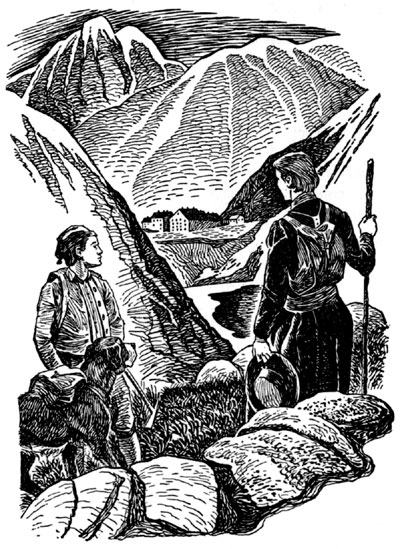
Franz looked, more than a little astonished. He hadn't had the faintest notion of what he might expect, but certainly it was not the massive, fortresslike structure that, though still a long ways off, seemed as prominent as any of the peaks. Presently the boy understood.
The Hospice must be visible from as great a distance as possible. Many an exhausted traveler, coming this far and sure he could go no farther, would find the strength to do so if he could see a refuge.
Father Benjamin pointed out the principal buildings. "The chapel," he said. "The refectory, where meals are eaten and guests entertained, the sleeping quarters, the house of the dead—"
Franz looked questioningly at him and Father Benjamin explained. "The mortal remains of many who die in the snows are never claimed. At first they were interred beneath the Hospice floor. Now, in the event that someone will claim them some time, they go into the house of the dead. Some have been there for a hundred years."
Franz felt a proper awe. A hundred years was a long time to be dead. But to be dead a hundred years in a place such as this, which was shunned by even the cliff and cold-loving edelweiss, must indeed be dreadful! Franz consoled himself with the thought that the dead have no feeling. No doubt those who rested in warm valleys and those who waited in this grim house would both awaken when Gabriel blew his trumpet.
They drew nearer, and Franz saw a little lake from which the ice had not yet melted. That was fitting and proper and altogether in keeping. Some of these Alpine lakes were ice-free for fewer than thirty days out of the whole year.
Then they came to a stable beneath one of the buildings and Franz met his immediate superior.
He was big as a mountain and bald as a hammer. His eyes were blue as glacier ice that has been swept clean by the broom of the wind, and at first glance they seemed even colder. His face, for all his size, was strangely massive. Perhaps because of his very lack of other hair, his curling mustaches seemed far longer than their eight inches. For all the cold, he wore only a sleeveless leather jacket on his upper body. It hung open, leaving his midriff, chest and biceps bare. Rippling muscles furnished more than a hint of great strength.
Presently the boy understood.... The Hospice must be visible from as great a distance as possible
Franz thought at first glance that he was a dedicated man, one who is absolutely devoted to his work, for he treated Father Benjamin with vast respect.
"Anton," Father Benjamin said, "I want you to meet the new maronnier, Franz Halle. Franz, this is Anton Martek. He will instruct you in your duties here."
"Is good to have you." Anton Martek extended a hand the size of a small ham. "Your dog work? Yah?"
"Oh, yes!" Franz said eagerly. "See for yourself that he carries a pack even now!"
Caesar wagged up to Anton Martek, who ruffled the dog's ears but continued to look at Franz.
"Packing is not all of work." He scowled. "Is he a spit dog, too?"
"A what?" Franz wrinkled puzzled brows.
With a sweeping circle of his right arm, Anton offered a near-perfect imitation of a dog walking around and around while the meat on a spit roasted. Franz warmed to this huge man. Anton's ice was all on the outside. Inwardly, he was gentle as the fawn of a chamois.
"Not yet," Franz said. "But I know we can teach him."
"Yah," said Anton. "We teach him."
Father Benjamin laughed. "You two seem to be getting along very well together, so I'll leave you alone."
Anton said respectfully, "As you will, Father," and turned to Franz. "Come."
Franz followed him into the stable, that was windowless, except for rectangles of wood hung on wooden hinges that now swung open to admit the sunlight. The place had a familiar smell the boy was unable to define until he remembered that the same odor dominated his mother's kitchen, and that it was the odor of complete cleanliness.
"Where are the cattle?" he asked.
Anton replied, "Down in the pasture."
"Down?"
"Yah. You villagers bring them up. We take them down. There is no pasture here."
He led Franz to a great pile of hay at one end of the stable and gestured. "You sleep here."
Franz laid his pack down and relieved Caesar of his, not at all displeased. There are, as he knew from experience, sleeping places not nearly as comfortable as a pile of hay.
"We get you some more covers soon," Anton promised. "But for now there is work. You will clean the stable."
"But—" Franz looked in bewilderment at the already spotless stable. "It is clean!"
"Ha!" Anton snorted. He stalked to a rafter, ran one huge finger along it, discovered a tiny speck of dust and showed it to Franz. "See? You will clean the stable."
Franz said meekly, "Yes, Anton."