14: THE MESSAGE
Reading edition

The fire in the refectory's great fireplace roared. The Prior, the Canons, the Sacristan, and everyone else who lived at the Hospice of St. Bernard and did not have to be away on some urgent business, were gathered around it.
Jean Greb, who felt well enough to sit up by now, occupied a chair in front of the fire. Shaken and thoroughly chilled, but not seriously injured, Professor Luttman lay on Jean's pallet.
The Prior said, "Let us have the dog brought forth. Even though he cannot understand it, he should hear the message."
All eyes turned to Franz, beside whom Caesar had been sitting only recently. The boy looked toward the door.
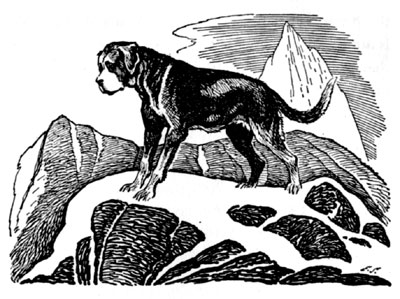
Caesar, who had accepted the stable but found the refectory much too hot, was waiting just inside the door. His jaws were spread and his tongue lolled. He wagged his tail at Franz and whined, obviously an invitation for his master to open the door and let him out into the comfortable snow.
"He finds the fire much too hot." The boy spoke with a free tongue from a happy heart. He wondered now why he had ever been overawed by the Prior or anyone else at the Hospice. Beneath their somber habits beat very warm and wonderful hearts. If it were any other way, they would not be here. Franz finished, "He wants me to let him out."
"A true dog of the high pass," the Prior said. "Very well, Franz. You may let him out."
The boy walked to the door, opened it, and Caesar trotted out gratefully. He began to roll in the snow. Franz returned to his place.
The Prior said, "All of us know of the miracle, a miracle wrought by a young maronnier and his dog. Now we shall hear the message Professor Luttman carries."
"I have imparted the message to you," Professor Luttman protested. "You are the proper person to tell Franz."
"Not I!" The Prior laughed. "I am merely an onlooker here, and I must say that, for once, I thoroughly enjoy the spectator's role. Proceed, Professor Luttman."
"Very well." The Professor turned to Franz. "Do you know what I really thought the day I expelled you from my school?"
"You thought I was too stupid to learn," Franz replied.
"No such thing!" Professor Luttman denied. "I thought, 'There goes an Alpinist, one who can never discover in my beloved books any of the inspiration that he finds in his beloved mountains. It is truly unjust to keep him in school when he does not belong here.' I thought also that, one day, you would make your mark in the world."
"I am just a maronnier at St. Bernard Hospice," Franz protested.
"And how grateful I am because you are 'just a maronnier,'" Professor Luttman said. "Were you not, I would have died in the snow."
"They would have found you," Franz insisted.
"We would not!" Anton Martek spoke up. "We would have continued digging where we thought he was. It never occurred to any of us that he might be three hundred feet away and down the wall of snow."
"That is true," Father Benjamin agreed.
"Very true," said Father Mark.
"So I am alive today because of you and Caesar," Professor Luttman continued. "Emil Gottschalk lives for the same reason. He wanted to give you—" Professor Luttman named a greater sum of money than the boy had ever thought existed.
"I would not accept his money," Franz asserted firmly.
Professor Luttman said, "So I told him, so your father told him, too, but both of us agreed that the Hospice of St. Bernard might well use it. Now the Prior and I have talked, and the Prior declares that you shall decide how that money may be spent."
Franz murmured, "I would like enough to keep Caesar in food, so that he will not be sent away from the Hospice."
The Prior laughed. "If there was any danger of Caesar being sent away—and there isn't the slightest—there is enough money to feed him for the next hundred years and a vast sum besides."
Franz looked appealingly at the Prior. "I am not worthy to spend a sum so huge!"
"You must," the Prior told him. "No one else can."
Franz turned his troubled eyes to the floor. After a moment, he looked up.
"There is only one thing I would do," he said finally. "I would go down into the villages, the mountain villages where people and animals alike must learn the arts of the snow. I would buy more Alpine Mastiffs, dogs such as Caesar, and bring them to the Hospice. I am sure you may find someone with sufficient skill to train them properly."
"And I am equally sure we already have someone," the Prior declared. "His name is Franz Halle. This is a day of great joy for all of us. Think of the lives that would have been lost but will be saved after we have these—
"These dogs of St. Bernard."
JIM KJELGAARD
was born in New York City. Happily enough, he was still in the pre-school age when his father decided to move the family to the Pennsylvania mountains. There young Jim grew up among some of the best hunting and fishing in the United States. He says: "If I had pursued my scholastic duties as diligently as I did deer, trout, grouse, squirrels, etc., I might have had better report cards!"
Jim Kjelgaard has worked at various jobs—trapper, teamster, guide, surveyor, factory worker and laborer. When he was in his late twenties he decided to become a full-time writer. No sooner decided than done! He has published several hundred short stories and articles and quite a few books for young people and adults.
His hobbies are hunting, fishing, dogs and questing for new stories. He tells us: "Story hunts have led me from the Atlantic to the Pacific and from the Arctic Circle to Mexico City. Stories, like gold, are where you find them. You may discover one three thousand miles from home or, as in The Spell of the White Sturgeon, (winner of the Boys' Life—Dodd, Mead Prize Competition) right on your own door step." And he adds: "I am married to a very beautiful girl and have a teen-age daughter. Both of them order me around in a shameful fashion, but I can still boss the dog! We live in Phoenix, Arizona."