10: THE HOUSE OF THE DEAD
Reading edition

Franz braced the sole of his shoe against the blade of his shovel, took a big bite of snow and threw it high above his head. Even cows, Anton Martek had told him—or especially cows—might lose their faith if they could never see daylight.
How could they see daylight if the windows of their stable were darkened by snow? And how could the snow be removed unless someone shoveled it away? Franz thought grimly that, at last, he knew why the handles of the shovels at St. Bernard Hospice were a full three feet longer than any in Dornblatt.
Caesar, lying on the snow six feet above the boy's head, wagged an amiable tail and grinned a canine grin. Franz glared at him.
"You might well smile!" he glowered. "You do no work at all! You refuse even to turn the spit!"
Caesar's tail wagged harder and his jaws parted a bit more. A little worm of worry gnawed at Franz's heart. Since the deep snows had started, except to go down to the rest house with Father Benjamin whenever it was the latter's turn to go, the mastiff had been idle.
Anton had worked patiently and endlessly to make him turn the spit—and he was still working at it. But Caesar had discovered a simple ruse that foiled the most cunning scheme Anton could devise; he merely lay down, wagged his tail, beamed agreeably and refused to move at all. Not even Anton cared to drag a hundred-and-fifty-pound dog around and turn the spit with him.
Franz looked beseechingly up at the big mastiff, who was still lying on the snow and interestedly observing his master.
"You should learn to do it!" he begged. "Father Benjamin already knows that you will not work! Soon Father Martin or Father Stephen will discover that Anton and I have been taking turns revolving the spit for you. They will inform one of the Canons, who is sure to tell the Prior. Then you will be sent away from the Hospice, which is entirely right and good and as it should be. The Fathers are not men of wealth, who can afford to maintain such a big, lazy loafer as yourself in idleness!"
Caesar wagged his tail a little harder, as though he were being complimented. Franz looked sternly at him, but could not find it in his heart to scold any more.
"It will be very right and very just if you are sent away," he said sadly, "but it will leave me so very lonesome. Caesar, you must try!"
Franz turned back to his shoveling, fastening his heart and mind on the one ray of hope that remained to him. Since the day of the blizzard, when Caesar had brought them safely to the Hospice, Father Benjamin had emphatically declared that any dog able to do such a thing was priceless. But he was not going to be readily accepted.
There had been dogs at the Hospice since its founding; tradition said that Bernard de Menthon himself had had one. But tradition said also that it was the work of the priests and maronniers at the Hospice to succor travelers. That was why only men born to the mountains and skilled in mountain arts could be accepted for service there.
It had been that way for seven hundred years, said Father Benjamin, and anything that has existed for seven centuries is not lightly discarded. Franz should be of good cheer, and while so being, though he needn't dishonestly conceal the fact that Caesar was doing no work, he needn't advertise it either. Gentle persuasion, according to Father Benjamin, was far more effective than raging or bullying when it came to breaking a wall of custom that was seven hundred years old.
Meanwhile, whenever it was Father Benjamin's turn to go down to either rest house, he would take Caesar with him. Sooner or later, he would prove the dog's value.
Franz sighed and dug his shovel blade into the last of the snow. Caesar had accompanied Father Benjamin on every trip. But on every trip Father Benjamin made, the weather had been so fine that there had been no need for a rescue or any other kind of work. Franz threw the last of the snow out of the hole, climbed out himself and at once slipped his feet into the skis that awaited him.
The snow at this altitude was hard and granular and not at all similar to the soft stuff that often covered the lower reaches. The hard snow, plus Caesar's huge paws, kept him from sinking more than a few inches, and he rose to greet his master with furiously-wagging tail. Franz caught up his shovel, smoothed the snow he had thrown out and turned to look about him.
The Grand St. Bernard Pass was indeed locked in the grip of winter, with snow piled high about the Hospice and drifts lying at intervals. But the day had started out very well, and Fathers Stephen and Martin had gone down to the rest houses on the north and south slopes, in order to bring up any travelers waiting there.
Franz turned uneasily on his skis. The day was still fine, but there were a few clouds where none had been earlier and an undercurrent that spoke of fury to be. It was a hint that only a born mountaineer could feel at all—but Franz resolutely banished his fears. Father Stephen had had three years of experience at the Hospice and Father Martin seven. They were well able to take care of themselves.
Franz moved to the stable door, slipped out of his skis and entered. Anton Martek, sitting on a pile of hay and honing an ax, looked up and grinned.
"Tomorrow," he prophesied, "you shall have all of it to do over again."
"So you sense the storm coming, too?" Franz asked.
"I sense nothing," Anton said serenely, "for to do so is very silly. I live for the moment that is, not the one that will be, and that proves me either a great fool or a very wise man. I do not know which and do not care, but anyone knows that snow may fall at any time now in Grand St. Bernard Pass. Therefore, it is evident that you will do your shoveling all over again tomorrow."
Franz said, "It is very great labor."
"It is life at the Hospice," returned Anton. He patted Caesar's massive head. "If you did not like the life, you would not be here. As for this great loafer, it is no wonder he enjoys it, for he has nothing whatever to do."
"If the Prior finds out," Franz said worriedly, "Caesar will not be living at the Hospice any more."
"Trust in God and Father Benjamin," Anton advised. "By the time the Prior discovers the supposed worthlessness of this mighty eater, Caesar's worth will be known."
"It should be known by this time," Franz pointed out. "Father Benjamin told of how Caesar prevented his falling into the crevasse and then found a safe path. Some of the Fathers smiled at him, for they said it was no great blizzard, anyhow."
"As it was not," Anton remarked.
Franz went on, "Some said it was God Who saved us."
"And do you doubt that it was?" Anton asked.
"No," Franz admitted, "but Caesar had something to do with it, too. Why cannot he be given due credit?"
"You have not learned the lesson of patience," Anton told him. "That is not surprising, because no youth has. I tell you everything will be all right."
"I hope so," Franz said gloomily. "Now, since all this thinking has pained me, I will clean the stable."
"A worthy endeavor," Anton said, "and one well calculated to remove your mind from your own troubles."
Caesar threw himself down on a pile of hay, pillowed his head on his paws and went to sleep. Franz started cleaning the stable. He sighed again. It would be nice if he were wise, like Father Benjamin or even like Anton, for then he would know so many things that otherwise he could never hope to know.
Since he was stupid and knew nothing except how to work with his hands, he must find contentment in such work. Presently he found it and became so absorbed in what he was doing that he was startled by Anton's voice, saying, "We must close the shutters, for it is starting to snow."
Franz looked up to discover that the stable, never bright as long as snow was heaped around the shutter openings, had grown noticeably dimmer. He hurried to help close the shutters. Anton lighted his candle lantern and hung it on the peg. With the shutters closed, the scream of the wind died to a soft moaning.
Caesar rose to pace beside Franz, as though in so doing he was somehow standing between his master and the storm. The four gentle cows, never doubting that they would be cared for, munched their hay. In the fitful light of the candle lantern, Anton's massive face looked strangely sober.
"It will be well for one of us to have his supper and then the other, little Franz," he said. "The storm will not grow less, and one of us should be here to reassure the cows if the wind screams too loudly. Do you want to go first?"
"No, you go," Franz urged.
"Very well."
The giant opened the stable door, braced against the wind, slipped into his skis, closed the door and was gone. Franz huddled very close to Caesar while the four cows stamped and munched. He shuddered, not in fear but with awe. This was what winter in St. Bernard Pass truly meant. The wind that sounded inside the stable as a doleful moan, was a screaming demon outside. A strong man would have to struggle just to stand against it.
Twenty minutes later, the stable door opened and Anton came back. He carried a bowl and a dish.
"I have brought your supper, little Franz, for you must remain here," he said. "There is very great trouble. Father Stephen has only now come into the refectory. He is almost spent. A traveler missing from the rest house has not arrived at the Hospice and Father Stephen has been searching for him."
"What now?" Franz asked, with some alarm.
Anton replied, "We all go, little Franz. The Fathers and the maronniers alike, all search for that traveler until he is found. That is our only reason for being here."
"I will eat quickly and be ready at once," Franz said.
Anton smiled gently. "Not you, little Franz. You stay here."
"It was Caesar and I who found Emil Gottschalk!" Franz asserted. "We've searched for lost travelers before!"
"But never in St. Bernard Pass during a storm," Anton reminded him.
"Please—" Franz began.
Anton said shortly, "You stay here."
Anton left and Franz looked dejectedly at the closed stable door. He ate his supper and blew the candle out, for candles must not be wasted. A dozen times during the night he awakened, sure that Anton had returned.
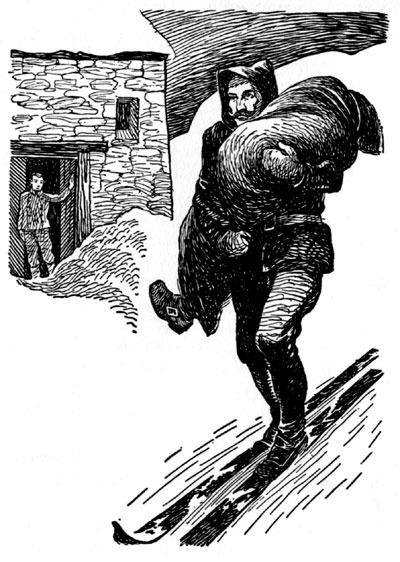
But it was not until past noon of the following day, during a lull in the storm, that Anton did return. From the stable door Franz watched the giant maronnier and two priests of the Hospice. All three were on skis and Anton carried a blanket-wrapped object that had the size and shape of a man. It couldn't possibly be a man, for men were not like that.
Franz watched with staring eyes as the three went to the House of the Dead. When they left it, Anton no longer carried his burden.
But it was not until past noon of the following day, during a lull in the storm, that Anton did return