IV.[34] CARNOT’S THEORY OF THE MOTIVE POWER OF HEAT.[35] WITH NUMERICAL RESULTS DEDUCED FROM REGNAULT’S EXPERIMENTS ON STEAM.[36]
Robert Henry Thurston translation
IV.[34] CARNOT’S THEORY OF THE MOTIVE POWER OF HEAT.[35] WITH NUMERICAL RESULTS DEDUCED FROM REGNAULT’S EXPERIMENTS ON STEAM.[36]
By Sir William Thomson [Lord Kelvin].
1. The presence of heat may be recognized in every natural object; and there is scarcely an operation in nature which is not more or less 128affected by its all-pervading influence. An evolution and subsequent absorption of heat generally give rise to a variety of effects; among which may be enumerated, chemical combinations or decompositions; the fusion of solid substances; the vaporization of solids or liquids; alterations in the dimensions of bodies, or in the statical pressure by which their dimensions may be modified; mechanical resistance overcome; electrical currents generated. In many of the actual phenomena of nature several or all of these effects are produced together; and their complication will, if we attempt to trace the agency of heat in producing any individual effect, give rise to much perplexity. It will, therefore, be desirable, in laying the foundation of a physical theory of any of the effects of heat, to discover or to imagine phenomena free from all such complication, and depending on a definite thermal agency; in which the relation between the cause and effect, traced 129through the medium of certain simple operations, may be clearly appreciated. Thus it is that Carnot, in accordance with the strictest principles of philosophy, enters upon the investigation of the theory of the motive power of heat.
2. The sole effect to be contemplated in investigating the motive power of heat is resistance overcome, or, as it is frequently called, “work performed,” or “mechanical effect.” The questions to be resolved by a complete theory of the subject are the following:
(1) What is the precise nature of the thermal agency by means of which mechanical effect is to be produced, without effects of any other kind?
(2) How may the amount of this thermal agency necessary for performing a given quantity of work be estimated?
3. In the following paper I shall commence by giving a short abstract of the reasoning by which Carnot is led to an answer to the first of these questions; I shall then explain the investigation by which, in accordance with his theory, the experimental elements necessary for answering the second question are indicated; and, in conclusion, I shall state the data supplied by Regnault’s recent observations on steam, and apply them to obtain, as approximately as the present state of experimental 130science enables us to do, a complete solution of the question.
I. On the nature of Thermal agency, considered as a motive power.
4. There are [at present known] two, and only two, distinct ways in which mechanical effect can be obtained from heat. One of these is by means of the alterations of volume, which bodies may experience through the action of heat; the other is through the medium of electric agency. Seebeck’s discovery of thermo-electric currents enables us at present to conceive of an electro-magnetic engine supplied from a thermal origin, being used as a motive power; but this discovery was not made until 1821, and the subject of thermo-electricity can only have been generally known in a few isolated facts, with reference to the electrical effects of heat upon certain crystals, at the time when Carnot wrote. He makes no allusion to it, but confines himself to the method for rendering thermal agency available as a source of mechanical effect, by means of the expansions and contractions of bodies.
5. A body expanding or contracting under the action of force may, in general, either produce mechanical effect by overcoming resistance, or receive mechanical effect by yielding to the action 131of force. The amount of mechanical effect thus developed will depend not only on the calorific agency concerned, but also on the alteration in the physical condition of the body. Hence, after allowing the volume and temperature of the body to change, we must restore it to its original temperature and volume; and then we may estimate the aggregate amount of mechanical effect developed as due solely to the thermal origin.
6. Now the ordinarily-received, and almost universally-acknowledged, principles with reference to “quantities of caloric” and “latent heat” lead us to conceive that, at the end of a cycle of operations, when a body is left in precisely its primitive physical condition, if it has absorbed any heat during one part of the operations, it must have given out again exactly the same amount during the remainder of the cycle. The truth of this principle is considered as axiomatic by Carnot, who admits it as the foundation of his theory; and expresses himself in the following terms regarding it, in a note on one of the passages of his treatise:[37]
“In our demonstrations we tacitly assume that after a body has experienced a certain number of transformations, if it be brought identically to its 132primitive physical state as to density, temperature, and molecular constitution, it must contain the same quantity of heat as that which it initially possessed; or, in other words, we suppose that the quantities of heat lost by the body under one set of operations are precisely compensated by those which are absorbed in the others. This fact has never been doubted; it has at first been admitted without reflection, and afterwards verified, in many cases, by calorimetrical experiments. To deny it would be to overturn the whole theory of heat, in which it is the fundamental principle. It must be admitted, however, that the chief foundations on which the theory of heat rests, would require a most attentive examination. Several experimental facts appear nearly inexplicable in the actual state of this theory.”
7. Since the time when Carnot thus expressed himself, the necessity of a most careful examination of the entire experimental basis of the theory of heat has become more and more urgent. Especially all those assumptions depending on the idea that heat is a substance, invariable in quantity; not convertible into any other element, and incapable of being generated by any physical agency; in fact the acknowledged principles of latent heat,—would require to be tested by a most 133searching investigation before they ought to be admitted, as they usually have been, by almost every one who has been engaged on the subject, whether in combining the results of experimental research, or in general theoretical investigations.
8. The extremely important discoveries recently made by Mr. Joule of Manchester, that heat is evolved in every part of a closed electric conductor, moving in the neighborhood of a magnet,[38] and 134that heat is generated by the friction of fluids in motion, seem to overturn the opinion commonly held that heat cannot be generated, but only produced from a source, where it has previously existed either in a sensible or in a latent condition.
In the present state of science, however, no operation is known by which heat can be absorbed into a body without either elevating its temperature or becoming latent, and producing some alteration in its physical condition; and the fundamental axiom adopted by Carnot may be considered as still the most probable basis for an investigation of the motive power of heat; although this, and with it every other branch of the theory of heat, may ultimately require to be reconstructed upon another foundation, when our experimental data are more complete. On this understanding, and to avoid a 135repetition of doubts, I shall refer to Carnot’s fundamental principle, in all that follows, as if its truth were thoroughly established.
9. We are now led to the conclusion that the origin of motive power, developed by the alternate expansions and contractions of a body, must be found in the agency of heat entering the body and leaving it; since there cannot, at the end of a complete cycle, when the body is restored to its primitive physical condition, have been any absolute absorption of heat, and consequently no conversion of heat, or caloric, into mechanical effect; and it remains for us to trace the precise nature of the circumstances under which heat must enter the body, and afterwards leave it, so that mechanical effect may be produced. As an example, we may consider that machine for obtaining motive power from heat with which we are most familiar—the steam-engine.
10. Here, we observe, that heat enters the machine from the furnace, through the sides of the boiler, and that heat is continually abstracted by the water employed for keeping the condenser cool. According to Carnot’s fundamental principle, the quantity of heat thus discharged, during a complete revolution (or double stroke) of the engine, must be precisely equal to that which enters the water of 136the boiler;[39] provided the total mass of water and steam be invariable, and be restored to its primitive physical condition (which will be the case rigorously, if the condenser be kept cool by the external application of cold water instead of by injection, as is more usual in practice), and if the condensed water be restored to the boiler at the end of each complete revolution. Thus we perceive that a certain quantity of heat is let down from a hot body, the metal of the boiler, to another body at a lower temperature, the metal of the condenser; and that there results from this transference of heat a certain development of mechanical effect.
11. If we examine any other case in which mechanical effect is obtained from a thermal origin, by means of the alternate expansions and contractions of any substance whatever, instead of the water of a steam-engine, we find that a similar transference of heat is effected, and we may therefore answer the first question proposed, in the following manner:
The thermal agency by which mechanical effect may be obtained is the transference of heat from one body to another at a lower temperature.
13711. On the measurement of Thermal Agency, considered with reference to its equivalent of mechanical effect.
12. A perfect thermodynamic engine of any kind is a machine by means of which the greatest possible amount of mechanical effect can be obtained from a given thermal agency; and, therefore, if in any manner we can construct or imagine a perfect engine which may be applied for the transference of a given quantity of heat from a body at any given temperature to another body at a lower given temperature, and if we can evaluate the mechanical effect thus obtained, we shall be able to answer the question at present under consideration, and so to complete the theory of the motive power of heat. But whatever kind of engine we may consider with this view, it will be necessary for us to prove that it is a perfect engine; since the transference of the heat from one body to the other may be wholly, or partially, effected by conduction through a solid,[40] without the development of 138mechanical effect; and, consequently, engines may be constructed in which the whole or any portion 139of the thermal agency is wasted. Hence it is of primary importance to discover the criterion of a perfect engine. This has been done by Carnot, who proves the following proposition:
13. A perfect thermodynamic engine is such that, whatever amount of mechanical effect it can derive from a certain thermal agency, if an equal amount be spent in working it backwards, an equal reverse thermal effect will be produced.[41]
14. This proposition will be made clearer by the applications of it which are given later (§ 29), in the cases of the air-engine and the steam-engine, than it could be by any general explanation; and it will also appear, from the nature of the operations described in those cases, and the principles of Carnot’s reasoning, that a perfect engine may be constructed with any substance of an indestructible texture as the alternately expanding and contracting medium. Thus we might conceive thermodynamic engines founded upon the expansions and contractions of a perfectly elastic solid, or of a liquid; or upon the alterations of volume experienced by substances in passing from the liquid to the solid state,[42] each of which being perfect, would 140produce the same amount of mechanical effect from a given thermal agency; but there are two cases which Carnot has selected as most worthy of minute attention, because of their peculiar appropriateness for illustrating the general principles of his theory, no less than on account of their very great practical importance: the steam-engine, in which the substance employed as the transferring medium is water, alternately in the liquid state and in the state of vapor; and the air-engine, in which the transference is effected by means of the alternate expansions and contractions of a medium always in the gaseous state. The details of an actually practicable engine of either kind are not contemplated by Carnot in his general theoretical reasonings, but he confines himself to the ideal construction, in the simplest possible way in each case, of an engine in which the economy is perfect. He thus determines the degree of perfectibility which cannot be surpassed; and by describing a conceivable method of attaining to this perfection by an air-engine or a steam-engine, he points out the proper objects to be kept in view in the practical construction and working of such machines. I now proceed to give an outline of these investigations.
141
Carnot’s Theory of the Steam-Engine.
15. Let CDF2E2 be a cylinder, of which the curved surface is perfectly impermeable to heat, with a piston also impermeable to heat, fitted in it; while the fixed bottom CD, itself with no capacity for heat, is possessed of perfect conducting power. Let K be an impermeable stand, such that when the cylinder is placed upon it the contents below the piston can neither gain nor lose heat. Let A and B be two bodies permanently retained at constant temperatures, S° and T°, respectively, of which the former is higher than the latter. Let the cylinder, placed on the impermeable stand, K, be partially filled with water, at the temperature S, of the body A, and (there being no air below it) let the piston be placed in a position EF, near the surface of the water. The pressure of the vapor above the water will tend to push up the piston, and must be resisted by a force applied to the piston,[43] till 142the commencement of the operations, which are conducted in the following manner:
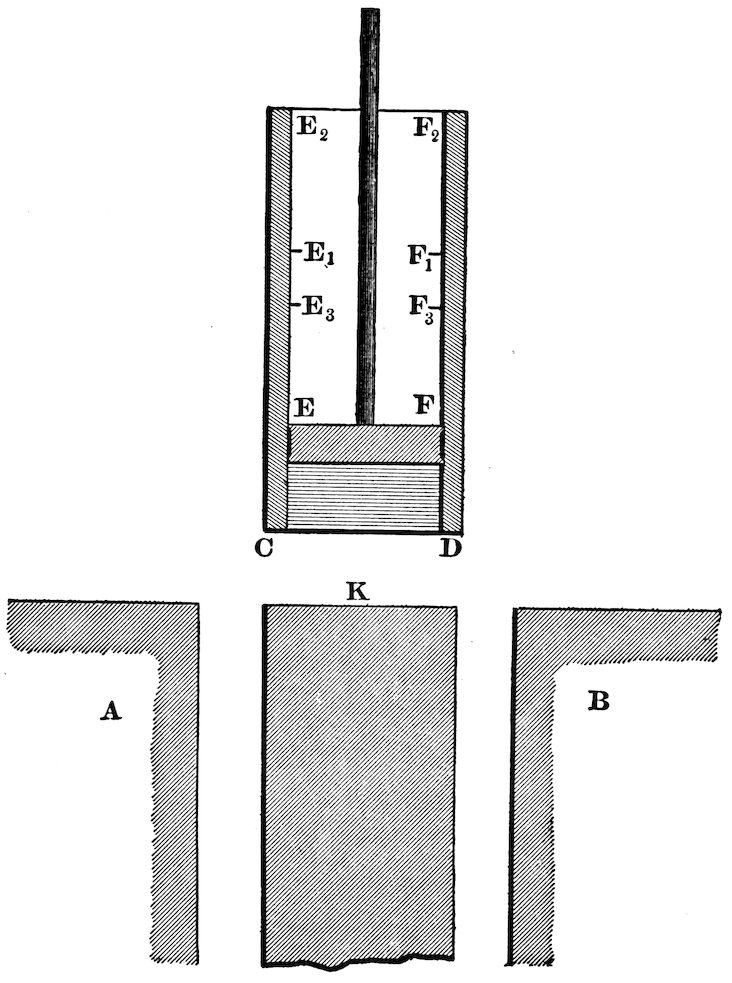
(1) The cylinder being placed on the body A, so that the water and vapor may be retained at the temperature S, let the piston rise any convenient 143height EE1, to a position E1F1, performing work by the pressure of the vapor below it during its ascent.
[During this operation a certain quantity, H, of heat, the amount of latent heat in the fresh vapor which is formed, is abstracted from the body A.]
(2) The cylinder being removed, and placed on the impermeable stand K, let the piston rise gradually, till, when it reaches a position E2F2, the temperature of the water and vapor is T, the same as that of the body B.
[During this operation the fresh vapor continually formed requires heat to become latent; and, therefore, as the contents of the cylinder are protected from any accession of heat, their temperature sinks.]
(3) The cylinder being removed from K, and placed on B, let the piston be pushed down, till, when it reaches the position E3F3, the quantity of heat evolved and abstracted by B amounts to that which, during the first operation, was taken from A.
[Note of Nov. 5, 1881. The specification of this operation, with a view to the return to the primitive condition, intended as the conclusion to the four operations, is the only item in which Carnot’s temporary and provisional assumption of the materiality of heat has effect. To exclude this hypothesis, Prof. James Thomson has suggested the following 144corrected specification for the third operation: Let the piston be pushed down, till it reaches a position E3F3, determined so as to fulfil the condition, that at the end of the fourth operation the primitive temperature S shall be reached:[44]]
[During this operation the temperature of the contents of the cylinder is retained constantly at T°, and all the latent heat of the vapor which is condensed into water at the same temperature is given out to B.]
(4) The cylinder being removed from B, and placed on the impermeable stand, let the piston be pushed down from E3F3 to its original position EF.
[During this operation, the impermeable stand preventing any loss of heat, the temperature of the water and air must rise continually, till (since the quantity of heat evolved during the third operation was precisely equal to 145that which was previously absorbed) at the conclusion it reaches its primitive value, S, in virtue of Carnot’s fundamental axiom.]
[Note of Nov. 5, 1881. With Prof. James Thomson’s correction of operation (3), the words in virtue of “Carnot’s Fundamental Axiom” must be replaced by “the condition fulfilled by operation (3),” in the description of the results of operation (4).]
16. At the conclusion of this cycle of operations[45] the total thermal agency has been the letting down of H units of heat from the body A, at the temperature S, to B, at the lower temperature T; and the aggregate of the mechanical effect has been a certain amount of work produced, since during the ascent of the piston in the first and second operations, the temperature of the water and vapor, and therefore the pressure of the vapor on the piston, was on the whole higher than during the descent, in the third and fourth operations. It remains for us actually to evaluate this aggregate amount of work performed; and for this purpose the following 146graphical method of representing the mechanical effect developed in the several operations, taken from Mons. Clapeyron’s paper, is extremely convenient.
17. Let OX and OY be two lines at right angles to one another. Along OX measure off distances ON1, N1N2, N2N3, N3O, respectively proportional to the spaces described by the piston during the four successive operations described above; and, with reference to these four operations respectively, let the following constructions be made:
(1) Along OY measure a length OA, to represent the pressure of the saturated vapor at the temperature S; and draw AA1 parallel to OX, and let it meet an ordinate through N1, in A1.
(2) Draw a curve A1PA such that, if ON represent, at any instant during the second operation, the distance of the piston from its primitive position, NP shall represent the pressure of the vapor at the same instant.
(3) Through A2 draw A2A3 parallel to OX, and let it meet an ordinate through N3 in A3.
(4) Draw the curve A3A such that the abscissa and ordinate of any point in it may represent respectively the distances of the piston from its primitive position, and the pressure of the vapor, at each instant during the fourth operation. The 147last point of this curve must, according to Carnot’s fundamental principle, coincide with A, since the piston is, at the end of the cycle of operations, again in its primitive position, and the pressure of the vapor is the same as it was at the beginning.
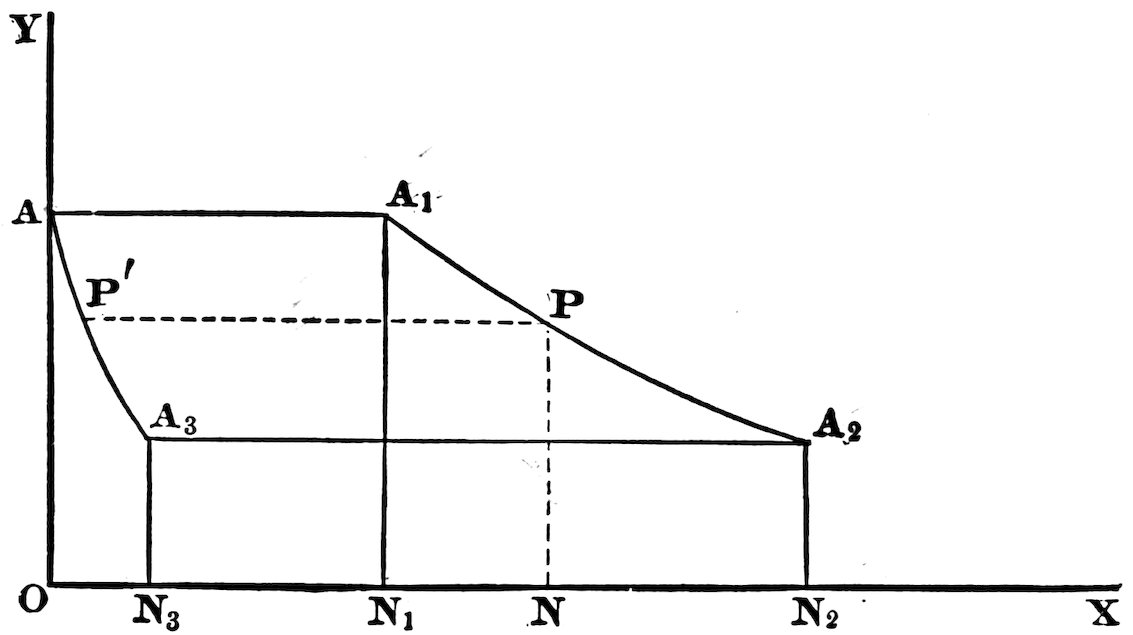
18. Let us now suppose that the lengths, ON1, N1N2, N2N3, and N3O, represent numerically the volumes of the spaces moved through by the piston during the successive operations. It follows that the mechanical effect obtained during the first operation will be numerically represented by the area AA1N1O; that is, the number of superficial units in this area will be equal to the number of “foot-pounds” of work performed by the ascending piston during the first operation. The work performed by the piston during the second operation will be similarly represented by the area 148A1A2N2N1. Again, during the third operation a certain amount of work is spent on the piston, which will be represented by the area A2A3N3N2; and lastly, during the fourth operation, work is spent in pushing the piston to an amount represented by the area A3AON3.
19. Hence the mechanical effect (represented by the area OAA1A2N2) which was obtained during the first and second operations, exceeds the work (represented by N2A2A3AO) spent during the third and fourth, by an amount represented by the area of the quadrilateral figure AA1A2A3; and, consequently, it only remains for us to evaluate this area, that we may determine the total mechanical effect gained in a complete cycle of operations. Now, from experimental data, at present nearly complete, as will be explained below, we may determine the length of the line AA1 for the given temperature S, and a given absorption H, of heat, during the first operation; and the length of A2A3 for the given lower temperature T, and the evolution of the same quantity of heat during the fourth operation: and the curves A1PA2, A3P′A may be drawn as graphical representations of actual observations. The figure being thus constructed, its area may be measured, and we are, therefore, in possession of a graphical 149method of determining the amount of mechanical effect to be obtained from any given thermal agency. As, however, it is merely the area of the figure which it is required to determine, it will not be necessary to be able to describe each of the curves A1PA2, A3P′A, but it will be sufficient to know the difference of the abscissas corresponding to any equal ordinates in the two; and the following analytical method of completing the problem is the most convenient for leading to the actual numerical results.
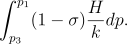
20. Draw any line PP′ parallel to OX, meeting the curvilinear sides of the quadrilateral in P and P′. Let ξ denote the length of this line, and p its distance from OX. The area of the figure, according to the integral calculus, will be denoted by the expression

where p1 and p3 (the limits of integration indicated according to Fourier’s notation) denote the lines OA and N3A3, which represent respectively the pressures during the first and third operations. Now, by referring to the construction described above, we see that ξ is the difference of the volumes below the piston at corresponding instants of the second and fourth operations, or instants at which 150the saturated steam and the water in the cylinder have the same pressure p, and consequently the same temperature, which we may denote by t. Again, throughout the second operation the entire contents of the cylinder possess a greater amount of heat by H units than during the fourth; and, therefore, at any instant of the second operation there is as much more steam as contains H units of latent heat than at the corresponding instant of the fourth operation. Hence if k denote the latent heat in a unit of saturated steam at the temperature t, the volume of the steam at the two corresponding instants must differ by H k. Now, if σ denote the ratio of the density of the steam to that of the water, the volume H k of steam will be formed from the volume σ H k of water; and consequently we have, for the difference of volumes of the entire contents at the corresponding instants,
ξ = (1 - σ)H k.
Hence the expression for the area of the quadrilateral figure becomes
151Now, σ, k, and p, being quantities which depend upon the temperature, may be considered as functions of t; and it will be convenient to modify the integral so as to make t the independent variable. The limits will be from t = T to t = S, and, if we denote by M the value of the integral, we have the expression
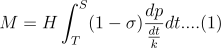
for the total amount of mechanical effect gained by the operations described above.
21. If the interval of temperatures be extremely small,—so small that (1 − σ)dp dt/k will not sensibly vary for values of t between T and S,—the preceding expression becomes simply

This might, of course, have been obtained at once by supposing the breadth of the quadrilateral figure AA1A2A to be extremely small compared with its length, and then taking for its area, as an approximate value, the product of the breadth into 152the line AA1, or the line A3A2, or any line of intermediate magnitude.
The expression (2) is rigorously correct for any interval S − T, if the mean value of (1 − σ)((dp/dt)/k) for that interval be employed as the coefficient of H(S − T).
Carnot’s Theory of the Air-engine.
22. In the ideal air-engine imagined by Carnot four operations performed upon a mass of air or gas enclosed in a closed vessel of variable volume constitute a complete cycle, at the end of which the medium is left in its primitive physical condition; the construction being the same as that which was described above for the steam-engine, a body A, permanently retained at the temperature S, and B at the temperature T; an impermeable stand K; and a cylinder and piston, which in this case contains a mass of air at the temperature S, instead of water in the liquid state, at the beginning and end of a cycle of operations. The four successive operations are conducted in the following manner:
(1) The cylinder is laid on the body A, so that the air in it is kept at the temperature S; and the piston is allowed to rise, performing work.
153(2) The cylinder is placed on the impermeable stand K, so that its contents can neither gain nor lose heat, and the piston is allowed to rise farther, still performing work, till the temperature of the air sinks to T.
(3) The cylinder is placed on B, so that the air is retained at the temperature T, and the piston is pushed down till the air gives out to the body B as much heat as it had taken in from A, during the first operation.
[Note of Nov. 5, 1881. To eliminate the assumption of the materiality of heat, make Professor James Thomson’s correction here also; as above in § 15; or take Maxwell’s rearrangement of the cycle described in the foot-note to § 15, p. 144.]
(4) The cylinder is placed on K, so that no more heat can be taken in or given out, and the piston is pushed down to its primitive position.
23. At the end of the fourth operation the temperature must have reached its primitive value S, in virtue of Carnot’s axiom.
24. Here, again, as in the former case, we observe that work is performed by the piston during the first two operations; and during the third and fourth work is spent upon it, but to a less amount, since the pressure is on the whole less during the third and fourth operations than during the first 154and second, on account of the temperature being lower. Thus, at the end of a complete cycle of operations, mechanical effect has been obtained; and the thermal agency from which it is drawn is the taking of a certain quantity of heat from A, and letting it down, through the medium of the engine, to the body B at a lower temperature.
25. To estimate the actual amount of effect thus obtained, it will be convenient to consider the alterations of volume of the mass of air in the several operations as extremely small. We may afterwards pass by the integral calculus, or, practically, by summation to determine the mechanical effect whatever be the amplitudes of the different motions of the piston.
26. Let dq be the quantity of heat absorbed during the first operation, which is evolved again during the third; and let dv be the corresponding augmentation of volume which takes place while the temperature remains constant, as it does during the first operation.[46] The diminution of volume 155in the third operation must be also equal to dv, or only differ from it by an infinitely small quantity of the second order. During the second operation we may suppose the volume to be increased by an infinitely small quantity φ; which will occasion a diminution of pressure and a diminution of temperature, denoted respectively by ω and τ. During the fourth operation there will be a diminution of volume and an increase of pressure and temperature, which can only differ, by infinitely small quantities of the second order, from the changes in the other direction, which took place in the second operation, and they also may, therefore, be denoted by φ, ω, and τ, respectively. The alteration of pressure 156during the first and third operations may at once be determined by means of Mariotte’s law, since in them the temperature remains constant. Thus, if, at the commencement of the cycle, the volume and pressure be v and p, they will have become v + dv and pv/(v + dv) at the end of the first operation. Hence the diminution of pressure during the first operation is p − pv/(v + dv) or pdv/(v + dv) and therefore, if we neglect infinitely small quantities of the second order, we have pdv/v for the diminution of pressure during the first operation; which to the same degree of approximation, will be equal to the increase of pressure during the third. If t + τ and t be taken to denote the superior and inferior limits of temperature, we shall thus have for the volume, the temperature, and the pressure at the commencements of the four successive operations, and at the end of the cycle, the following values respectively:
(1) v, t + τ, p;
(2) v + dv, t + τ, p(1 − dv v);
(3) v + dv + φ, t, p(1 − dv v) − ω;
(4) v + φ, t, p − ω;
(5) v, t + τ, p.
157Taking the mean of the pressures at the beginning and end of each operation, we find
(1)
p(1 − ½dv v),
(2)
p(1 − dv v) − ½ω,
(3)
p(1 − ½dv v)) − ω,
(4)
p − ½ω,
which, as we are neglecting infinitely small quantities of the second order, will be the expressions for the mean pressures during the four successive operations. Now, the mechanical effect gained or spent, during any of the operations, will be found by multiplying the mean pressure by the increase or diminution of volume which takes place; and we thus find
(1)
p(1 − ½dv v)dv,
(2)
{p(1 − dv v) − ½ω}φ,
(3)
{p(1 − ½dv v) − ω}dv,
(4)
(p − ½ω)φ.
158for the amounts gained during the first and second, and spent during the third and fourth operations; and hence, by addition and subtraction, we find
ωdv − pφdv v, or (vω − pφ)dv v,
for the aggregate amount of mechanical effect gained during the cycle of operations. It only remains for us to express this result in terms of dq and τ, on which the given thermal agency depends. For this purpose we remark that φ and ω are alterations of volume and pressure which take place along with a change of temperature τ, and hence, by the laws of compressibility and expansion, we may establish a relation[47] between them in the following manner:
Let p0 be the pressure of the mass of air when reduced to the temperature zero, and confined in a volume v0; then, whatever be v0, the product p0v0 will, by the law of compressibility, remain constant; and, if the temperature be elevated from 0 to t + τ, and the gas be allowed to expand freely without any change of pressure, its volume will be 159increased in the ratio of 1 to 1 + E(t + τ), where E is very nearly equal to .00366 (the Centigrade scale of the air-thermometer being referred to), whatever be the gas employed, according to the researches of Regnault and of Magnus on the expansion of gases by heat. If, now, the volume be altered arbitrarily with the temperature continually at t + τ, the product of the pressure and volume will remain constant; and therefore we have
pv = p0v0{1 + E(t + τ)}.
Similarly,
(p − ω)(v + φ) = p0v0{1 + Et}.
Hence, by subtraction, we have
vω − pφ + ωφ = p0v0Eτ,
or, neglecting the product ωφ,
vω − pφ = p0v0Eτ.
Hence the preceding expression for mechanical effect, gained in the cycle of operations, becomes
p0v0. Eτ . dv/v.
Or, as we may otherwise express it,
Ep0v0 vdq/dv. dq. τ.
Hence, if we denote by M the mechanical effect due to H units of heat descending through the same interval τ, which might be obtained by repeating 160the cycle of operations described above, H dq times, we have
M = Ep0v0 vdq/dv. Hτ. (3)
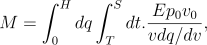
27. If the amplitudes of the operations had been finite, so as to give rise to an absorption of H units of heat during the first operation, and a lowering of temperature from S to T during the second, the amount of work obtained would have been found to be expressed by means of a double definite integral thus:[48]
or . (4)

this second form being sometimes more convenient.
16128. The preceding investigations, being founded on the approximate laws of compressibility and expansion (known as the law of Mariotte and Boyle, and the law of Dalton and Gay-Lussac), would require some slight modifications to adapt them to cases in which the gaseous medium employed is such as to present sensible deviations from those laws. Regnault’s very accurate experiments show that the deviations are insensible, or very nearly so, for the ordinary gases at ordinary pressures; although they may be considerable for a medium, such as sulphurous acid, or carbonic acid under high pressure, which approaches the physical condition of a vapor at saturation; and therefore, in general, and especially in practical applications to real air-engines, it will be unnecessary to make any modification in the expressions. In cases where it may be necessary, there is no difficulty in making the modifications, when the requisite data are supplied by experiment.
29.[49] Either the steam-engine or the air-engine, according to the arrangements described above, gives all the mechanical effect that can possibly be obtained from the thermal agency employed. For 162it is clear that in either case the operations may be performed in the reverse order, with every thermal and mechanical effect reversed. Thus, in the steam-engine, we may commence by placing the cylinder on the impermeable stand, allow the piston to rise, performing work, to the position E3F3; we may then place it on the body B, and allow it to rise, performing work, till it reaches E2F2 after that the cylinder may be placed again on the impermeable stand, and the piston may be pushed down to E1F1; and, lastly, the cylinder being removed to the body A, the piston may be pushed down to its primitive position. In this inverse cycle of operations a certain amount of work has been spent, precisely equal, as we readily see, to the amount of mechanical effect gained in the direct cycle described above; and heat has been abstracted from B, and deposited in the body A, at a higher temperature, to an amount precisely equal to that which in the direct style was let down from A to B. Hence it is impossible to have an engine which will derive more mechanical effect from the same thermal agency than is obtained by the arrangement described above; since, if there could be such an engine, it might be employed to perform, as a part of its whole work, the inverse cycle of operations, upon an engine of the 163kind we have considered, and thus to continually restore the heat from B to A, which has descended from A to B for working itself; so that we should have a complex engine, giving a residual amount of mechanical effect without any thermal agency, or alteration of materials, which is an impossibility in nature. The same reasoning is applicable to the air-engine; and we conclude, generally, that any two engines, constructed on the principles laid down above, whether steam-engines with different liquids, an air-engine and a steam-engine, or two air-engines with different gases, must derive the same amount of mechanical effect from the same thermal agency.
30. Hence, by comparing the amounts of mechanical effect obtained by the steam-engine and the air-engine from the letting down of the H units of heat from A at the temperature (t + τ) to B at t, according to the expressions (2) and (3), we have
M = (1 − σ)dp kdt. Hτ = Ep0v0 vdq/dv. Hτ. (5)
If we denote the coefficient of Ητ in these equal expressions by μ, which maybe called “Carnot’s coefficient,” we have
μ = (1 − σ)dp kdt = Ep0v0 vdq/dv, (6)
164and we deduce the following very remarkable conclusions:
(1) For the saturated vapors of all different liquids, at the same temperature, the value of (1 − σ)(dp/kdt) must be the same.
(2) For any different gaseous masses, at the same temperature, the value of Ep0v0/(vdq/dv) must be the same.
(3) The values of these expressions for saturated vapors and for gases, at the same temperature, must be the same.
31. No conclusion can be drawn a priori regarding the values of this coefficient μ for different temperatures, which can only be determined, or compared, by experiment. The results of a great variety of experiments, in different branches of physical science (Pneumatics and Acoustics), cited by Carnot and by Clapeyron, indicate that the values of μ for low temperatures exceed the values for higher temperatures; a result amply verified by the continuous series of experiments performed by Regnault on the saturated vapor of water for all temperatures from 0° to 230°, which, as we shall see later, give values for μ gradually diminishing from the inferior limit to the superior limit of 165temperature. When, by observation, μ has been determined as a function of the temperature, the amount of mechanical effect, M, deducible from H units of heat descending from a body at the temperature S to a body at the temperature T, may be calculated from the expression
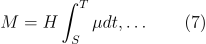
which is, in fact, what either of the equations (1) for the steam-engine, or (4) for the air-engine, becomes, when the notation μ, for Carnot’s multiplier, is introduced.
The values of this integral may be practically obtained, in the most convenient manner, by first determining, from observation, the mean values of μ for the successive degrees of the thermometric scale, and then adding the values for all the degrees within the limits of the extreme temperatures S and T.[50]
32. The complete theoretical investigation of the motive power of heat is thus reduced to the experimental determination of the coefficient μ; and may be considered as perfect, when, by any series of experimental researches whatever, we can 166find a value of μ for every temperature within practical limits. The special character of the experimental researches, whether with reference to gases or with reference to vapors, necessary and sufficient for this object, is defined and restricted in the most precise manner, by the expressions (6) for μ, given above.
33. The object of Regnault’s great work, referred to in the title of this paper, is the experimental determination of the various physical elements of the steam-engine; and when it is complete, it will furnish all the data necessary for the calculation of μ. The valuable researches already published in a first part of that work make known the latent heat of a given weight, and the pressure, of saturated steam for all temperatures between 0° and 230° Cent. of the air-thermometer. Besides these data, however, the density of saturated vapor must be known, in order that k, the latent heat of a unit of volume, may be calculated from Regnault’s determination of the latent heat of a given weight.[51] Between the limits of 0° and 100°, 167it is probable, from various experiments which have been made, that the density of vapor follows very closely the simple laws which are so accurately verified by the ordinary gases;[52] and thus it may be calculated from Regnault’s table giving the pressure at any temperature within those limits. Nothing as yet is known with accuracy as to the density of saturated steam between 100 and 230°, and we must be contented at present to estimate it by calculation from Regnault’s table of pressures; although, when accurate experimental researches on the subject shall have been made, considerable deviations from the laws of Boyle and Dalton, on which this calculation is founded, may be discovered.
34. Such are the experimental data on which the mean values of μ for the successive degrees of the air-thermometer, from 0 to 230°, at present laid before the Royal Society, is founded. The unit of length adopted is the English foot; the unit of weight, the pound; the unit of work, a 168“foot-pound;” and the unit of heat that quantity which, when added to a pound of water at 0°, will produce an elevation of 1° in temperature. The mean value of μ for any degree is found to a sufficient degree of approximation by taking, in place of σ, dp/dt and k; in the expression
(1 − σ). dp kdt;
the mean values of those elements; or, what is equivalent to the corresponding accuracy of approximation, by taking, in place of σ and k respectively, the mean of the values of those elements for the limits of temperature, and in place of dp/dt, the difference of the values of p, at the same limits.
35. In Regnault’s work (at the end of the eighth memoir), a table of the pressures of saturated steam for the successive temperatures 0°, 1°, 2°, ... 230°, expressed in millimetres of mercury, is given. On account of the units adopted in this paper, these pressures must be estimated in pounds on the square foot, which we may do by multiplying each number of millimetres by 2.7896, the weight in pounds of a sheet of mercury, one millimetre thick, and a square foot in area.
36. The value of k, the latent heat of a cubic foot, for any temperature t, is found from λ, the 169latent heat of a pound of saturated steam, by the equation
k = p 760. 1 + .00366 × 100 1 + .00366 × t. × .036869[53] . λ,
where p denotes the pressure in millimetres, and λ the latent heat of a pound of saturated steam; the values of λ being calculated by the empirical formula[54]
λ = (606.5 + 0.305t) − (t + .00002t2 + 0.0000003t3),
given by Regnault as representing, between the 170extreme limits of his observations, the latent heat of a unit weight of saturated steam.
Explanation of Table I.
37. The mean values of μ for the first, for the eleventh, for the twenty-first, and so on, up to the 231st[55] degree of the air-thermometer, have been calculated in the manner explained in the preceding paragraphs. These, and interpolated results, which must agree with what would have been obtained, by direct calculation from Regnault’s data, to three significant places of figures (and even for the temperatures between 0° and 100°, the experimental data do not justify us in relying on any of the results to a greater degree of accuracy), are exhibited in Table I.
To find the amount of mechanical effect due to a unit of heat, descending from a body at a temperature S to a body at T, if these numbers be integers, we have merely to add the values of μ in Table I. corresponding to the successive numbers.
T + 1, T + 2, ... S − 2, S − 1.
171
Explanation of Table II.
38. The calculation of the mechanical effect, in any case, which might always be effected in the manner described in § 37 (with the proper modification for fractions of degrees, when necessary), is much simplified by the use of Table II., where the first number of Table I., the sum of the first and second, the sum of the first three, the sum of the first four, and so on, are successively exhibited. The sums thus tabulated are the values of the integrals

and, if we denote by the letter M, Table II. may be regarded as a table of the value of M.

To find the amount of mechanical effect due to a unit of heat descending from a body at a temperature S to a body at T, if these numbers be integers, we have merely to subtract the value of M, for the number T, from the value for the number S, given in Table II.
172
TABLE I.[56]
Mean Values of μ for the successive Degrees of the Air-Thermometer from 0° to 230°.
° μ
1 4.960
2 4.946
3 4.932
4 4.918
5 4.905
6 4.892
7 4.878
8 4.865
9 4.852
10 4.839
11 4.826
12 4.812
13 4.799
14 4.786
15 4.773
16 4.760
17 4.747
18 4.735
19 4.722
20 4.709
21 4.697
22 4.684
23 4.672
24 4.659
25 4.646
26 4.634
27 4.621
28 4.609
29 4.596
30 4.584
31 4.572
32 4.559
33 4.547
34 4.535
35 4.522
36 4.510
37 4.498
38 4.486
39 4.474
40 4.462
41 4.450
42 4.438
43 4.426
44 4.414
45 4.402
46 4.390
47 4.378
48 4.366
49 4.355
50 4.343
51 4.331
52 4.319
53 4.308
54 4.296
55 4.285
56 4.273
57 4.262
58 4.250
59 4.239
60 4.227
61 4.216
62 4.205
63 4.194
64 4.183
65 4.172
66 4.161
67 4.150
68 4.140
69 4.129
70 4.119
71 4.109
72 4.098
73 4.088
74 4.078
75 4.067
76 4.057
77 4.047
78 4.037
79 4.028
80 4.018
81 4.009
82 3.999
83 3.990
84 3.980
85 3.971
86 3.961
87 3.952
88 3.943
89 3.934
90 3.925
91 3.916
92 3.907
93 3.898
94 3.889
95 3.880
96 3.871
97 3.863
98 3.854
99 3.845
100 3.837
101 3.829
102 3.820
103 3.812
104 3.804
105 3.796
106 3.788
107 3.780
108 3.772
109 3.764
110 3.757
111 3.749
112 3.741
113 3.734
114 3.726
115 3.719
116 3.712
117 3.704
118 3.697
119 3.689
120 3.682
121 3.675
122 3.668
123 3.661
124 3.654
173125 3.647
126 3.640
127 3.633
128 3.627
129 3.620
130 3.614
131 3.607
132 3.601
133 3.594
134 3.586
135 3.579
136 3.573
137 3.567
138 3.561
139 3.555
140 3.549
141 3.543
142 3.537
143 3.531
144 3.525
145 3.519
146 3.513
147 3.507
148 3.501
149 3.495
150 3.490
151 3.484
152 3.479
153 3.473
154 3.468
155 3.462
156 3.457
157 3.451
158 3.446
159 3.440
160 3.435
161 3.430
162 3.424
163 3.419
164 3.414
165 3.409
166 3.404
167 3.399
168 3.394
169 3.389
170 3.384
171 3.380
172 3.375
173 3.370
174 3.365
175 3.361
176 3.356
177 3.351
178 3.346
179 3.342
180 3.337
181 3.332
182 3.328
183 3.323
184 3.318
185 3.314
186 3.309
187 3.304
188 3.300
189 3.295
190 3.291
191 3.287
192 3.282
193 3.278
194 3.274
195 3.269
196 3.265
197 3.261
198 3.257
199 3.253
200 3.249
201 3.245
202 3.241
203 3.237
204 3.233
205 3.229
206 3.225
207 3.221
208 3.217
209 3.213
210 3.210
211 3.206
212 3.202
213 3.198
214 3.195
215 3.191
216 3.188
217 3.184
218 3.180
219 3.177
220 3.173
221 3.169
222 3.165
223 3.162
224 3.158
225 3.155
226 3.151
227 3.148
228 3.144
229 3.141
230 3.137
231 3.134
174
TABLE II.
Mechanical Effect in Foot-Pounds due to a Thermic Unit Centigrade, passing from a Body, at any Temperature less than 230° to a Body at 0°.
Superior Limit of Temperature. Mechanical Effect.
° Ft.-Pounds.
1 4.960
2 9.906
3 14.838
4 19.756
5 24.661
6 29.553
7 34.431
8 39.296
9 44.148
10 48.987
11 53.813
12 58.625
13 63.424
14 68.210
15 72.983
16 77.743
17 82.490
18 87.225
19 91.947
20 96.656
21 101.353
22 106.037
23 110.709
24 115.368
25 120.014
26 124.648
27 129.269
28 133.878
29 138.474
30 143.058
31 147.630
32 152.189
33 156.736
34 161.271
35 165.793
36 170.303
37 174.801
38 179.287
39 183.761
40 188.223
41 192.673
42 197.111
43 201.537
44 205.951
45 210.353
46 214.743
47 219.121
48 223.487
49 227.842
50 232.185
51 236.516
52 240.835
53 245.143
54 249.439
55 253.724
56 257.997
57 262.259
58 266.509
59 270.748
60 274.975
61 279.191
62 283.396
63 287.590
64 291.773
65 295.945
66 300.106
67 304.256
68 308.396
69 312.525
70 316.644
71 320.752
72 324.851
73 328.939
74 333.017
75 337.084
76 341.141
77 345.188
78 349.225
79 353.253
80 357.271
81 361.280
82 365.279
83 369.269
84 373.249
85 377.220
86 381.181
87 385.133
88 389.076
89 393.010
90 396.935
91 400.851
92 404.758
93 408.656
94 412.545
95 416.425
96 420.296
97 424.159
98 428.013
99 431.858
100 435.695
101 439.524
102 443.344
103 447.156
104 450.960
105 454.756
106 458.544
107 462.324
108 466.096
109 469.860
110 473.617
111 477.366
175112 481.107
113 484.841
114 488.567
115 492.286
116 495.998
117 499.702
118 503.399
119 507.088
120 510.770
121 514.445
122 518.113
123 521.174
124 525.428
125 529.075
126 532.715
127 536.348
128 539.975
129 543.595
130 547.209
131 550.816
132 554.417
133 558.051
134 561.597
135 565.176
136 568.749
137 572.316
138 575.877
139 579.432
140 582.981
141 586.524
142 590.061
143 593.592
144 597.117
145 600.636
146 604.099
147 607.656
148 611.157
149 614.652
150 618.142
151 621.626
152 625.105
153 628.578
154 632.046
155 635.508
156 638.965
157 642.416
158 645.862
159 649.302
160 652.737
161 656.167
162 659.591
163 663.010
164 666.424
165 669.833
166 673.237
167 676.636
168 680.030
169 683.419
170 686.803
171 690.183
172 693.558
173 696.928
174 700.293
175 703.654
176 707.010
177 710.361
178 713.707
179 717.049
180 720.386
181 723.718
182 727.046
183 730.369
184 733.687
185 737.001
186 740.310
187 743.614
188 746.914
189 750.209
190 753.500
191 756.787
192 760.069
193 763.347
194 766.621
195 769.890
196 773.155
197 776.416
198 779.673
199 782.926
200 786.175
201 789.420
202 792.661
203 795.898
204 799.131
205 802.360
206 805.585
207 808.806
208 812.023
209 815.236
210 818.446
211 821.652
212 824.854
213 828.052
214 831.247
215 834.438
216 837.626
217 840.810
218 843.990
219 847.167
220 850.340
221 853.509
222 856.674
223 859.836
224 862.994
225 866.149
226 869.300
227 872.448
228 875.592
229 878.733
230 881.870
231 885.004
176
Note on the curves described in Clapeyron’s graphical method of exhibiting Carnot’s Theory of the Steam-Engine.
39. At any instant when the temperature of the water and vapor is t, during the fourth operation (see above, § 16, and suppose, for the sake of simplicity, that at the beginning of the first and at the end of the fourth operation the piston is absolutely in contact with the surface of the water), the latent heat of the vapor must be precisely equal to the amount of heat that would be necessary to raise the temperature of the whole mass, if in the liquid state, from t to S.[57] Hence, if v′ denote the volume of the vapor, c the mean capacity for heat of a pound of water between the temperatures S 177and t, and W the weight of the entire mass, in pounds, we have
kv′ = c(S − t)W.
Again, the circumstances during the second operation are such that the mass of liquid and vapor possesses H units of heat more than during the fourth; and consequently, at the instant of the second operation, when the temperature is t, the volume v of the vapor will exceed v′ by an amount of which the latent heat is H, so that we have
v = v′ + H k.
40. Now, at any instant, the volume between the piston and its primitive position is less than the actual volume of vapor by the volume of the water evaporated. Hence, if x and x′ denote the abscissæ of the curve at the instants of the second and fourth operations respectively, when the temperature is t, we have
x = v − σv, x′ = v′ − σv′,
and, therefore, by the preceding equations,
x = 1 − σ k{H + c(S − t)W}, (a)
x′ = 1 − σ kc(S − t)W. (b)
These equations, along with y = y′ = p, (c)
178enable us to calculate, from the data supplied by Regnault, the abscissa and ordinate for each of the curves described above (§ 17) corresponding to any assumed temperature t. After the explanations of §§ 33, 34, 35, 36, it is only necessary to add that c is a quantity of which the value is very nearly unity, and would be exactly so were the capacity of water for heat the same at every temperature as it is between 0° and 1°; and that the value of c(S − t), for any assigned values of S and t, is found, by subtracting the number corresponding to t from the number corresponding to s, in the column headed “Nombre des unités de chaleur abandonnées par un kilogramme d’eau en descendant de T° à 0°,” of the last table (at the end of the tenth memoir) of Regnault’s work. By giving S the value 230°, and by substituting successively 220, 210, 200, etc., for t, values for x, y, x′, y′, have been found, which are exhibited in the table opposite.
179
Temperatures. Volumes to be described by the piston, to complete the fourth operation. Volumes from the primitive position of the piston to those occupied at instants of the second operation. Pressures of saturated steam, in pounds on the square foot.
t x′ x y = y′ = p
0° 1269. W x′ + 5.409.H 12.832
10 639.6. W x′ + 2.847.H 25.567
20 337.3. W x′ + 1.571.H 48.514
30 185.5. W x′ + .9062.H 88.007
40 105.9. W x′ + .5442.H 153.167
50 62.62. W x′ + .3392.H 256.595
60 38.19. W x′ + .2188.H 415.070
70 21.94. W x′ + .1456.H 650.240
80 15.38. W x′ + .09962.H 989.318
90 10.09. W x′ + .06994.H 1465.80
100 6.744. W x′ + .05026.H 2120.11
110 4.578. W x′ + .03688.H 2999.87
120 3.141. W x′ + .02758.H 4160.10
130 2.176. W x′ + .02098.H 5663.70
140 1.519. W x′ + .01625.H 7581.15
150 1.058. W x′ + .01271.H 9990.26
160 0.7369. W x′ + .01010.H 12976.2
170 0.5085. W x′ + .008116.H 16630.7
180 0.3454. W x′ + .006592.H 21051.5
190 0.2267. W x′ + .005406.H 26341.5
200 0.1409. W x′ + .004472.H 32607.7
210 0.0784. W x′ + .003729.H 39960.7
220 0.3310. W x′ + .003130.H 48512.4
230 0 x′ + .002643.H 58376.6
Appendix.
(Read April 30, 1849.)
41. In p. 30 some conclusions drawn by Carnot from his general reasoning were noticed; according to which it appears, that if the value of μ for 180any temperature is known, certain information may be derived with reference to the saturated vapor of any liquid whatever, and, with reference to any gaseous mass, without the necessity of experimenting upon the specific medium considered. Nothing in the whole range of Natural Philosophy is more remarkable than the establishment of general laws by such a process of reasoning. We have seen, however, that doubt may exist with reference to the truth of the axiom on which the entire theory is founded, and it therefore becomes more than a matter of mere curiosity to put the inferences deduced from it to the test of experience. The importance of doing so was clearly appreciated by Carnot; and, with such data as he had from the researches of various experimenters, he tried his conclusions. Some very remarkable propositions which he derives from his theory coincide with Dulong and Petit’s subsequently discovered experimental laws with reference to the heat developed by the compression of a gas; and the experimental verification is therefore in this case (so far as its accuracy could be depended upon) decisive. In other respects, the data from experiment were insufficient, although, so far as they were available as tests, they were confirmatory of the theory.
42. The recent researches of Regnault add immensely 181to the experimental data available for this object, by giving us the means of determining with considerable accuracy the values of μ within a very wide range of temperature, and so affording a trustworthy standard for the comparison of isolated results at different temperatures, derived from observations in various branches of physical science.
In the first section of this Appendix the theory is tested, and shown to be confirmed by the comparison of the values of μ found above, with those obtained by Carnot and Clapeyron from the observations of various experimenters on air, and the vapors of different liquids. In the second and third sections some striking confirmations of the theory arising from observations by Dulong, on the specific heat of gases, and from Mr. Joule’s experiments on the heat developed by the compression of air, are pointed out; and in conclusion, the actual methods of obtaining mechanical effect from heat are briefly examined with reference to their economy.
I. On the values of μ derived by Carnot and Clapeyron from observations on Air, and on the Vapors of various liquids.
43. In Carnot’s work, pp. 80–82, the mean value of μ between 0° and 1° is derived from the 182experiments of Delaroche and Bérard on the specific heat of gases, by a process approximately equivalent to the calculation of the value of Ep0v0 vdq/dv for the temperature ½°. There are also, in the same work, determinations of the values of μ from observations on the vapors of alcohol and water; but a table given in M. Clapeyron’s paper, of the values of μ derived from the data supplied by various experiments with reference to the vapors of ether, alcohol, water, and oil of turpentine, at the respective boiling-points of these liquids, affords us the means of comparison through a more extensive range of temperature. In the cases of alcohol and water, these results ought of course to agree with those of Carnot. There are, however, slight discrepancies which must be owing to the uncertainty of the experimental data.[58] In the opposite table, Carnot’s results with reference to air, and Clapeyron’s results with reference to the four different liquids, are exhibited, and compared with the values of μ which have been given above (Table I.) for the same temperatures, as derived from Regnault’s observations on the vapor of water.
183
Names of the Media. Temperatures. Values of μ. Values of μ deduced from Regnault’s Observations. Differences.
° (Carnot)
Air 0.5 4.377 4.960 .383
Sulphuric Ether (Boil. pt.) 35.5 (Clapeyron) 4.478 4.510 .032
Alcohol 78.8 3.963 4.030 .071
Water 100 3.658 3.837 .179
Essence of Turpentine 156.8 3.530 3.449 −.081
44. It may be observed that the discrepancies between the results founded on the experimental data supplied by the different observers with reference to water at the boiling-point, are greater than those which are presented between the results deduced from any of the other liquids, and water at the other temperatures; and we may therefore feel perfectly confident that the verification is complete to the extent of accuracy of the observations.[59] The considerable discrepancy presented 184by Carnot’s result deduced from experiments on air, is not to be wondered at when we consider the very uncertain nature of his data.
45. The fact of the gradual decrease of μ through a very extensive range of temperature, being indicated both by Regnault’s continuous series of experiments and by the very varied experiment on different media, and in different branches of Physical Science, must be considered as a striking verification of the theory.
II. On the Heat developed by the Compression of Air.
46. Let a mass of air, occupying initially a given volume V, under a pressure P, at a temperature t, be compressed to a less volume V′, and allowed to part with heat until it sinks to its primitive temperature t. The quantity of heat which is evolved may be determined, according to Carnot’s theory, when the particular value of μ, 185corresponding to the temperature t, is known. For, by § 30, equation (6), we have
vdq dv = Ep0v0 μ,
where dq is the quantity of heat absorbed, when the volume is allowed to increase from v to v + dv; or the quantity evolved by the reverse operation. Hence we deduce
dq = Ep0v0 μ dv v. (8)
Now, Ep0v0 μ is constant, since the temperature remains unchanged; and therefore we may at once integrate the second number. By taking it between the limits V′ and V, we thus find
Q = Ep0v0 μ log V V′[60], (9)
where Q denotes the required amount of heat evolved by the compression from V to P′. This expression may be modified by employing the equations PV = P′V′ = p0v0(1 + Et); and we thus obtain
Q = EPV μ(1 + Et) log V V′ = EP′V′ μ(1 + Et) log V V′. (10)
186From this result we draw the following conclusion:
47. Equal volumes of all elastic fluids, taken at the same temperature and pressure, when compressed to smaller equal volumes, disengage equal quantities of heat.
This extremely remarkable theorem of Carnot’s was independently laid down as a probable experimental law by Dulong, in his “Recherches sur la Chaleur Spécifique des Fluides Élastiques,” and it therefore affords a most powerful confirmation of the theory.[61]
18748. In some very remarkable researches made by Mr. Joule upon the heat developed by the compression of air, the quantity of heat produced in different experiments has been ascertained with reference to the amount of work spent in the operation. To compare the results which he has obtained with the indications of theory, let us determine the amount of work necessary actually to produce the compression considered above.
49. In the first place, to compress the gas from the volume v + dv to v, the work required is pdv, or, since
pv = p0v0(1 + Et),
p0v0(1 + Et)dv v.
Hence, if we denote by W the total amount of work necessary to produce the compression from V to V′, we obtain, by integration,
W = p0v0(1 + Et) log V V′.
Comparing this with the expression above, we find
W Q = μ(1 + Et) E. (11)
50. Hence we infer that—
(1) The amount of work necessary to produce a unit of heat by the compression of a gas is the same for all gases at the same temperature;
188(2) And that the quantity of heat evolved in all circumstances, when the temperature of the gas is given, is proportional to the amount of work spent in the compression.
51. The expression for the amount of work necessary to produce a unit of heat is
μ1 + Et E,
and therefore Regnault’s experiments on steam are available to enable us to calculate its value for any temperature. By finding the values of μ at 0°, 10°, 20°, etc., from Table I., and by substituting successively the values 0, 10, 20, etc., for t, the following results have been obtained:
Table of the Values of μ(1 + Et) E.
Work requisite to produce a unit of Heat by the compression of a Gas. Temperature of the Gas.
Ft.-pounds. °
1357.1 0
1368.7 10
1379.0 20
1388.0 30
1395.7 40
1401.8 50
1406.7 60
1412.0 70
1417.6 80
1424.0 90
1430.6 100
1438.2 110
1446.4 120
1455.8 130
1465.3 140
1475.8 150
1489.2 160
1499.0 170
1511.3 180
1523.5 190
1536.5 200
1550.2 210
1564.0 220
1577.8 230
189Mr. Joule’s experiments were all conducted at temperatures from 50° to about 60° Fahr., or from 10° to 16° Cent.; and consequently, although some irregular differences in the results, attributable to errors of observation inseparable from experiments of such a very difficult nature, are presented, no regular dependence on the temperature is observable. From three separate series of experiments, Mr. Joule deduces the following numbers for the work, in foot-pounds, necessary to produce a thermic unit Fahrenheit by the compression of a gas.
820, 814, 760.
Multiplying these by 1.8, to get the corresponding number for a thermic unit Centigrade, we
1476, 1465, and 1368.
The largest of these numbers is most nearly conformable with Mr. Joule’s views of the relation between such experimental “equivalents,” and others which he obtained in his electro-magnetic researches; but the smallest agrees almost perfectly with the indications of Carnot’s theory; from which, as exhibited in the preceding table, we should expect, from the temperature in Mr. Joule’s experiments, to find a number between 1369 and 1379 as the result.[62]
190 III. On the Specific Heats of Gases.
52. The following proposition is proved by Carnot as a deduction from his general theorem regarding the specific heats of gases.
The excess of specific heat[63] under a constant pressure above the specific heat at a constant volume, is the same for all gases at the same temperature and pressure.
53. To prove this proposition, and to determine an expression for the “excess” mentioned in its enunciation, let us suppose a unit of volume of a gas to be elevated in temperature by a small amount, τ. The quantity of heat required to do this will be Aτ, if A denote the specific heat at a constant volume. Let us next allow the gas to expand without going down in temperature, until its pressure becomes reduced to its primitive value. The expansion which will take place will be Eτ 1 + Et, if the temperature be denoted by t; and hence, by (8), the quantity of heat that must be supplied, to prevent any lowering of temperature, will be
Ep0v0 μ . Eτ 1 + Et, or E2p μ(1 + Et)2τ.
191Hence the total quantity added is equal to
Ατ + E2p μ(1 + Et)2τ.
But, since B denotes the specific heat under constant pressure, the quantity of heat requisite to bring the gas into this state, from its primitive condition, is equal to Βτ, and hence we have
B = A + E2p μ(1 + Et)2. (12)
IV. Comparison of the Relative Advantages of the Air-engine and Steam-engine.
54. In the use of water-wheels for motive power, the economy of the engine depends not only upon the excellence of its adaptation for actually transmitting any given quantity of water through it, and producing the equivalent of work, but upon turning to account the entire available fall; so, as we are taught by Carnot, the object of a thermodynamic engine is to economize in the best possible way the transference of all the heat evolved, from bodies at the temperature of the source, to bodies at the lowest temperature at which the heat can be discharged. With reference, then, to any engine of the kind, there will be two points to be considered:
(1) The extent of the fall utilized.
192(2) The economy of the engine, with the fall which it actually uses.
55. In the first respect, the air-engine, as Carnot himself points out, has a vast advantage over the steam-engine; since the temperature of the hot part of the machine may be made very much higher in the air-engine than would be possible in the steam-engine, on account of the very high pressure produced in the boiler, by elevating the temperature of the water which it contains to any considerable extent above the atmospheric boiling-point. On this account a “perfect air-engine” would be a much more valuable instrument than a “perfect steam-engine.”[64]
193Neither steam-engines nor air-engines, however, are nearly perfect; and we do not know in which of the two kinds of machine the nearest approach to perfection may be actually attained. The beautiful engine invented by Mr. Stirling of Galston may be considered as an excellent beginning for the air-engine;[65] and it is only necessary to compare this with Newcomen’s steam-engine, and consider what Watt has effected, to give rise to the most sanguine anticipations of improvement.
V. On the Economy of Actual Steam-engines.
56. The steam-engine being universally employed at present as the means for deriving motive power from heat, it is extremely interesting to examine, according to Carnot’s theory, the economy actually attained in its use. In the first 194place we remark, that out of the entire “fall” from the temperature of the coals to that of the atmosphere it is only part—that from the temperature of the boiler to the temperature of the condenser—that is made available; while the very great fall from the temperature of the burning coals to that of the boiler, and the comparatively small fall from the temperature of the condenser to that of the atmosphere, are entirely lost as far as regards the mechanical effect which it is desired to obtain. We infer from this, that the temperature of the boiler ought to be kept as high as, according to the strength, is consistent with safety, while that of the condenser ought to be kept as nearly down at the atmospheric temperature as possible. To take the entire benefit of the actual fall, Carnot showed that the “principle of expansion” must be pushed to the utmost.[66]
19557. To obtain some notion of the economy which has actually been obtained, we may take the alleged performances of the best Cornish engines, and some other interesting practical cases, as examples.[67]
(1) The engine of the Fowey Consols mine was reported, in 1845, to have given 125,089,000 foot-pounds of effect, for the consumption of one bushel or 94 lbs. of coals. Now the average amount evaporated from Cornish boilers, by one pound of coal, is 8½ lbs. of steam; and hence for each pound of steam evaporated 156,556 foot-pounds of work are produced.
The pressure of the saturated steam in the boiler may be taken as 3½ atmospheres;[68] and, consequently, 196the temperature of the water will be 140°. Now (Regnault, end of Mémoire X.) the latent heat of a pound of saturated steam at 140° is 508, and since, to compensate for each pound of steam removed from the boiler in the working of the engine, a pound of water, at the temperature of the condenser, which may be estimated at 30°, is introduced from the hot-well; it follows that 618 units of heat are introduced to the boiler for each pound of water evaporated. But the work produced, for each pound of water evaporated, was found above to be 156,556 foot-pounds. Hence ¹⁵⁶⁵⁵⁶⁄₆₁₈, or 253 foot-pounds, is the amount of work produced for each unit of heat transmitted through the Fowey Consols engine. Now in Table II. we find 583.0 as the theoretical effect due to a unit descending from 140° to 0°, and 143 as the effect due to a unit descending from 30° to 0°. The difference of these numbers, or 440,[69] is the number of foot-pounds 197of work that a perfect engine with its boiler at 140° and its condenser at 30° would produce for each unit of heat transmitted. Hence the Fowey Consols engine, during the experiments reported on, performed ²⁵³⁄₄₄₀ of its theoretical duty, or 57½ per cent.
(2) The best duty on record, as performed by an engine at work (not for merely experimental purposes), is that of Taylor’s engine, at the United Mines, which in 1840 worked regularly for several months at the rate of 98,000,000 foot-pounds for each bushel of coals burned. This is ⁹⁸⁄₁₂₅, or .784 of the experimental duty reported in the case of the Fowey Consols engine. Hence the best useful work on record is at the rate of 198.3 foot-pounds for each unit of heat transmitted, and is 198.3 440 or 45 per cent of the theoretical duty, on the supposition that the boiler is at 140° and the condenser at 30°.
(3) French engineers contract (in Lille, in 1847, for example) to make engines for mill-power which will produce 30,000 metre-pounds or 98,427 foot-pounds of work for each pound of steam used. If 198we divide this by 618, we find 159 foot-pounds for the work produced by each unit of heat. This is 36.1 per cent of 440, the theoretical duty.[70]
(4) English engineers have contracted to make engines and boilers which will require only 3⅓ lbs. of the best coal per horse-power per hour. Hence in such engines each pound of coal ought to produce 565,700 foot-pounds of work, and if 7 lbs. of water be evaporated by each pound of coal, there would result 83,814 foot-pounds of work for each pound of water evaporated. If the pressure in the 199boiler be 3½ atmospheres (temperature 140°) the amount of work for each unit of heat will be found, by dividing this by 618, to be 130.7 foot-pounds, which is 130.7 440 or 29.7 per cent of the theoretical duty.[71]
(5) The actual average of work performed by good Cornish engines and boilers is 55,000,000 foot-pounds for each bushel of coal, or less than half the experimental performance of the Fowey Consols engine, more than half the actual duty performed by the United Mines engine in 1840; in fact, about 25 per cent of the theoretical duty.
(6) The average performances of a number of Lancashire engines and boilers have been recently found to be such as to require 12 lbs. of Lancashire coal per horse-power per hour (i.e., for performing 60 × 33,000 foot-pounds), and of a number of Glasgow engines such as to require 15 lbs. (of a somewhat inferior coal) for the same effect. There are, however, more than twenty large engines in Glasgow at present[72] which work with a 200consumption of only 6½ lbs. of dross, equivalent to 5 lbs. of the best Scotch or 4 lbs. of the best Welsh coal, per horse-power per hour. The economy may be estimated from these data, as in the other cases, on the assumption which, with reference to these, is the most probable we can make, that the evaporation produced by a pound of best coal is 7 lbs. of steam.
58. The following tables afford a synoptic view of the performances and theoretical duties in the various cases discussed above.
In Table A the numbers in the second column are found by dividing the numbers in the first by 8½ in cases (1), (2), and (5), and by 7 in cases (4), (6), and (7), the estimated numbers of pounds of steam actually produced in the different boilers by the burning of 1 lb. of coal.
The numbers in the third column are found from those in the second, by dividing by 618 in Table A, and 614 in Table B, which are respectively the quantities of heat required to convert a pound of water taken from the hot-well at 30°, into saturated steam, in the boiler, at 140° or at 121°.
201With reference to the cases (3), (4), (6), (7), the hypothesis of Table B is probably in general nearer the truth than that of Table A. In (4), (6), and (7), especially upon hypothesis B, there is much uncertainty as to the amount of evaporation that will be actually produced by 1 lb. of fuel. The assumption on which the numbers in the second column in Table B are calculated, is, that each pound of coal will send the same number of units of heat into the boiler, whether hypothesis A or hypothesis B be followed. Hence, except in the case of the French contract, in which the evaporation, not the fuel, is specified, the numbers in the third column are the same as those in the third column of Table A.
202
TABLE A.
Various Engines in which the Temperature of the Boiler is 140° C. and that of the Condenser 30° C.
Theoretical Duty for each Unit of Heat transmitted, 440[73] foot-pounds.
Cases. Work produced for each lb. of coal consumed. Work produced for each lb. of water evaporated. Work produced for each unit of heat transmitted. Percentage of theoretical duty.
Ft.-lbs. Ft.-lbs. Ft.-lbs.
(1) Fowey Consols experiment, reported in 1845 1,330,734 156,556 253 57.5
(2) Taylor’s engine at the United Mines, working in 1840 1,042,553 122,653 198.4 45.1
(3) French engines, according to contract 98,427 159 36.1
(4) English engines, according to contract 565,700 80,814 130.8 29.7
(5) Average actual performance of Cornish engines 585,106 68,836 111.3 25.3
(6) Common engines, consuming 12 lbs. of best coal per horse-power per hour 165,000 23,571 38.1 8.6
(7) Improved engines with expansion cylinders, consuming an equivalent to 4 lbs. of best coal per horse-power per hour 495,000 70,710 114.4 26
203
TABLE B.
Various Engines in which the Temperature of the Boiler is 121° C.[74] and that of the Condenser 30° C.
Theoretical Duty for each Unit of Heat transmitted, 371 foot-pounds.
Cases. Work produced for each lb. of coal consumed. Work produced for each lb. of water evaporated. Work produced for each unit of heat transmitted. Percentage of theoretical duty.
Ft.-lbs. Ft.-lbs. Ft.-lbs.
(3) French engines, according to contract 98,427 160.3 43.2
(4) English engines, according to contract 565,700 ⁶¹⁴⁄₆₁₈×80,814 130.8 35
(6) Common engines, consuming 12 lbs. of coal per horse-power per hour 165,000 ⁶¹⁴⁄₆₁₈×23,571 38.1 10.3
(7) Improved engines with expansion cylinders, consuming an equivalent to 4 lbs. best coal per horse-power per hour 495,000 ⁶¹⁴⁄₆₁₈×70,710 114.4 30.7
205