THE OLD CLUMP
Reading edition
It is Sunday morning, and the mists are beginning to roll away and the summer sun of August just beginning to smile once more upon a world of beauty and of love, after the ugly days during the latter part of the week. The cattle are lowing to the north and to the south, and the shadows of the clouds are floating o'er the meadows less swiftly. The mountain peaks are clearing up after their cloud-baths. When I reached the Lodge in the early morning, I found John Burroughs preparing breakfast, and I brought the water and the wood and stirred the malted wheat while he prepared some other foods.
After the meal was over, I read the papers and walked around in neighboring meadows, while Mr. Burroughs went down to the home farm for a pail of milk. The flickers were playing in the corner of the pasture to the south, and the goldfinches seemed to be feeding their young in the large apple trees across the road, but I never found a nest. To the west I saw an indigo bird flitting about some shrubbery by the stone fence, which attracted me that way. I thought perhaps something had disturbed the birds' nest, but I looked in vain for some vindication of my suspicion.
By this time, Mr. Burroughs had returned and all were ready to begin our climb to the summit of the Old Clump, the mountain most beloved of all by the naturalist, and the one about which he speaks oftenest. His father's farm extends far up the southeast side of this mountain and, of course, he played on and about it when he was a young boy. The face of this mountain doubtless made inroads on his character, and stimulated him to a love of nature. For on the summit of it, he sits or rolls and dreams of former—and he almost thinks better—days.
Here on the summit of this mountain is where Mr. Burroughs wrote, "Mid-summer in the Catskills," August, 1905, which is possibly the best poem he ever wrote, with the exception "Waiting." Just as we had left the Lodge, we came to a tree under which was a large boulder. The naturalist mounted this boulder and sat for a moment sighing: "How many times, I have played upon this rock when I was a boy. I remember mother used to look this way when she did not find us about the house." Below this boulder, two of the small boys in the party found a vesper sparrow's nest, in which we all became interested, but in order to get back to dinner we must be away and up the mountain. To go straight up the side of the Clump would have been a hard climb, so we went angling across toward the east, and after passing the boys' sleeping place in the trees, we turned back to the north and west, following the old pathway that leads from the Burroughs farm to the mountain top. Not far had we followed this path before we came to a spring flowing with cool, clear water, and nestled in the side of the mountain. Here we all quenched our thirst, Mr. Burroughs taking the lead. "Many times have I quenched my thirst here at this spring," he said. "The Naiads have welcomed me here for more than sixty years, and still they guard this sacred fountain for me. Narcissus meets me here every summer with refreshing beauty after my hard pull up the mountain. I still join the great god Pan in making love to the wood nymphs hereabouts. O, there are so many ways of getting happiness in these places." Imagine how delightful it was to hear the voice of John Burroughs as he told these stories of his love for these his native scenes! There was every indication that he was experiencing much happiness as he recalled his first walks up the mountain and of his first sight of that spring.
The mountain woods were beautifully decked with flowers everywhere, the antenaria perhaps taking the lead so far as numbers go. This was particularly plentiful about the top of the mountain. Soon we were on the highest peak from which we could see the many neighboring peaks in all directions, and the blue folds of the ridges, layer upon layer for many miles to the south and east. What a fine view-point! The exhilaration of the mountain air, how much it means after a long hard climb! Down in the valley are markings of the farms with the long straight stone fences, so delicate and so finely drawn! The panoramic view of the valleys present the colorings and fine markings of maps on the pages of a book, but much more beautiful, and in these parts more perfect. The liquid depths of air and long vistas are a feast to the eyes.
I was anxious to know where Mr. Burroughs was nestled on this lofty peak when he wrote the poem of which mention has been made, and asked him to point out the place when we reached it. "It is over near the northeast edge of the summit, and we shall soon be there." As we pushed our way between two large boulders where, Mr. Burroughs told us it had long been the custom for young men to kiss their girls as they helped them through there, and of the many he, himself, had kissed there, we came to a large open grassy spot. Here the naturalist sat down and rolled over in the grass, indicating that he had at last reached home. About twenty paces off toward the eastern edge of the mountain top, was a large flat rock, almost as level as a table top, just beneath which was a fine growth of large trees, the tops of which were a little above the table of stone. "Here," he said, "is where I began writing 'Midsummer in the Catskills'."
The poem begins as follows:
"The strident hum of sickle bar, Like giant insect heard afar, Is on the air again; I see the mower where he rides Above the level grassy tides That flood the meadow plain."
"I remember," he says, "on that day I saw, in the field toward the Betsy Bouton place, the cradlers walking through the fields of grain, and it made a deep impression on me."
"The cradlers twain with right good will, Leave golden lines across the hill, Beneath the mid-day sun. The cattle dream 'neath leafy tent Or chew the cud of sweet content Knee-deep in pond or run."
We could see the cattle in the nether pasture on the old Burroughs' home place, and my mind was full of the above lines which I had committed to memory when they were first printed.
"The dome of day o'erbrims with sound From humming wings on errands bound Above the sleeping fields."
What a picture of bees in the upper air freighting honey from field to hive and storing it away for the winter supply! The two following stanzas perhaps interpret the beauty of the situation better than any other part of the poem:
"Poisèd and full is summer's tide Brimming all the horizon wide, In varied verdure dressed; Its viewless currents surge and beat In airy billows at my feet Here on the mountain crest. "Through pearly depths I see the farms, Where sweating forms and bronzèd arms Reap in the land's increase; In ripe repose the forests stand And veilèd heights on every hand Swim in a sea of peace."
The truth of these lines lay out before us. There lay the grain in the fields where the cradlers had reaped in the land's increase. There stood the veiled heights on every side which John Burroughs named beginning on the right: Table mountain, Slide mountain, Double Top mountain and Graham. From the front of Woodchuck Lodge he had already named for us Bald Mountain, Hack's Flats, Schutle's and the one we were now on. Truly they were all veiled heights as we viewed them from the summit of the Old Clump.
As I loitered about among the boulders on the mountain I became much interested in the names cut in the large boulders of people who had lived in the Burroughs community, and seeing that Mr. Burroughs himself was also interested in them, I began to ask him about them, and I copied many of them in my note book. Nothing pleased the Naturalist better than to tell of the people who used to be his neighbors, and I think he remembered them all. As we looked out again across the valley, his eyes got a glimpse of the old Betsy Bouton place, and he recalled that she was a widow who had one daughter and two sons. "These were the laziest human beings I ever saw,—these boys. They would sit up by the fire and mumble, while the mother brought in the wood and the water, and cooked the meals, and the daughter would do the milking. Nothing could the mother get out of them, but to sit around the open fire and grumble at their hard lot, and that they had so much to do. She used to have a hard time getting them up and ready for school."
From here we could see the vicinity of the little red school house where John Burroughs had gone to school sixty years before, and he told of his experience with Jay Gould. Jay paid him for writing an essay, and he paid Jay eighty cents for a grammar and an algebra. "These were my first grammar and algebra, and I paid for them with the money I had earned selling sugar from my individual boiling pan in the sugar bush. I shall tell you about it and show you where I boiled the sugar, as we go down that way."
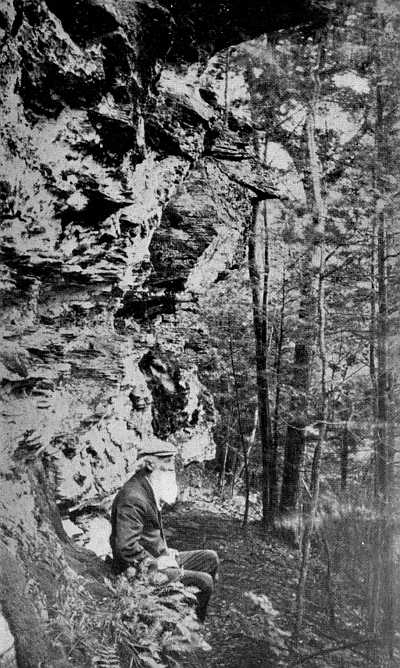
UNDER THE OLD GRAY LEDGE
He enjoyed telling of one certain student—a schoolmate of his who had long curly hair. "His hair was as curly as you ever saw and turned under at the bottom. O, how I longed to have my hair look like his did! I thought it was the prettiest hair I ever saw grow."
Our descent from the mountain top was easy. We followed the path to the right coming down, and the decline was a little more gradual. The upper Burroughs pasture extended almost half-way up the mountain side. It was separated from the lower pasture by a stone wall. I never saw so many stones and small boulders in one place as I saw in this lower pasture. The ground was almost covered. There was certainly a much larger crop of these than of grass. Here I thought Deucalion and Pyrrha must have failed to convert stones into people, but continued throwing, even to the tiring of Jupiter's patience. Rolling them down the long steep hill afforded some fine sport for us. Mr. Burroughs told of a very interesting incident in his early life. "I remember," he said, "when I was a young chap I used to roll stones down this hill very often. One day I got a large, round boulder high up the mountain side and turned it loose with a good push. Those bars down there had just been finished by father and had cost him considerable work and worry. The stone was heavy and was almost a disc, and had gathered considerable momentum as it neared the base of the hill, and ran directly into the bars and literally knocked them to pieces. Perhaps I could not have remembered the incident so well if this had been all, but as a further reminder, father gave me a pretty severe lashing. I remember how out of patience he was at my carelessness."
Passing through these bars we went through the sugar maple bush, that had longer than he could remember, supplied the family with syrup and sugar. The old vat and the furnace were there and the shell of a house to ward off the cold winds of April,
"While smoking Dick doth boil the sap."
I was thinking of Spring Gladness, and The Coming of Phoebe,
"When buckets shine 'gainst maple trees And drop by drop the sap doth flow, When days are warm, but nights do freeze, And deep in woods lie drifts of snow, When cattle low and fret in stall, Then morning brings the phoebe's call, 'Phoebe, Phoebe, Phoebe'."
As we came down to the roadway that leads from the old farm to Woodchuck Lodge, Mr. Burroughs pointed out to us a junco's nest just outside the road. This nest had afforded him much pleasure during his present stay up at Roxbury, as he saw it two or four times a day, as he passed by on his way to his brother's home for milk. On the crest of the hill between the two houses—the old home and Woodchuck Lodge—I stopped and looked for several moments at the place of the naturalist's birth, and at the farm, with all the beautiful meadows and pastures, for I knew that I would not see them again soon. When it was told me that all these meadows and woods and stone walls, look now as they did sixty and more years ago, I could understand how a country lad, born and reared among such scenes, could grow into a great naturalist. I could now enjoy and understand some of the qualities of his literary productions. The country was a new one to me and altogether unlike any I had seen, but having tasted of it through the medium of good literature, I was prepared to make the best of my opportunity to study it. What particularly impressed me, and what was so different from the scenes of my childhood, was the buckwheat fields dotting the meadows here and yonder, and the long straight stone fences marking the meadows and hillsides. "These walls were built by a generation of men that had ginger," Mr. Burroughs said, "a quality so much lacking these days."
No words could express the happiness that had come to me during the week that I was rambling through the Catskills. While going down through the meadow in front of Woodchuck Lodge, on my way to the railroad station, I seemed to be flooded with memories of a happy experience. These memories still haunt me and may they continue to do so even unto the end of time. I had learned better than I ever knew, that "this brown, sun-tanned, sin-stained earth is a sister to the morning and the evening star," and that it has more of beauty and love written on it than has ever been read by all the poets in the distant ages past; that there are still left volumes for the interpreter. I had taken a little journey in the divine ship as it sailed over the divine sea. I had heard one talk of the moral of the solar system,—of its harmony, its balance, its compensation, and I thought that there is no deeper lesson to be learned.