AROUND SLABSIDES AND THE DEN
Reading edition
It was a cloudy day in December when I made my first trip up the Hudson River to the home of John Burroughs, and how well I recall the invitation into the Den. On opening the door I stood face to face with the object of my pilgrimage, the distinguished naturalist, a man of low stature, rather small frame, a well formed head and sharp eyes, and much younger in appearance than his photographs would indicate. His hair is white, but he can read without glasses and see birds better with the natural eye than I can. He had on a brown jersey wool coat or jacket, beneath which was a vest and trousers of spotted brown and dark to match, all of which were well set to his body and limbs. His shoes were of cloth and rubber with rubber bottoms. When he walked out he put on a short gray overcoat, a small crushed brown or gray hat, and arctic overshoes. His general appearance would not indicate that you were with John Burroughs, but if you got a clear view of his face and eye, you could not mistake him for an ordinary man.
West Park, the little station on the West Shore branch of the New York Central and Hudson River R. R., is a small village with not more than a hundred houses, and is quiet and almost puts one in a dreaming mood, when he thinks of being in the land of the great Literary Naturalist, who drew the most of his neighbors there. The Burroughs home, popularly known as Riverby, is in perfect keeping with the nature of the man. Hidden from the street behind a number of evergreens, it presents rather a secluded appearance, and is a part of nature rather than apart from nature. The house seems as if it sprang up from the soil, the lower half not yet above the ground. About twenty-five or thirty yards from the house is the study, which is pre-eminently the place of interest to the visitor. On entering this cozy little den—I found Mr. Burroughs reading Evolution and Ethics, by Huxley, and upon remarking that I noted what he was reading, his reply was that he had thought of writing something along that line and he wished to see what had already been said. "Right at this time," he said, "my mind is rather in a chaotic condition. I am not sure just what I shall hit upon next. I cannot definitely plan out my writing; but rather write when the mood comes on. I feel that I want to write on a particular subject and just get about it."
When I expressed my appreciation of his great service in the way of interpreting nature, and reducing life from the conventional to the simple, he remarked at once: "I have never run after false gods, but have always tried to get at the truth of things, and let come of it what may. I do not believe in hiding the truth. Whatever I have accomplished in the way of writing, I attribute to this fact." This led me to ask him about "Real and Sham Natural History" (an essay written by him that appeared in the March Atlantic, 1903). He leant back in his chair and after a wholesome laugh, "Yes, I found it necessary to say something about the tendency of men like Thompson and Long who were taking advantage of their skill as writers and their popularity, to fool the people with those nature myths. If they had not advertised them as truth, it would have been all right. But when I saw that they persisted in teaching that the stories were true to nature, I could not stand it any longer. I just had to expose them! I could not rest till I had told the people that such stories were false!" Here Mr. Burroughs grew quite spirited, and his very manner indicated his lack of patience with those who make an effort to falsify nature. "I do not think that Long will ever forgive me for telling on him, but Seton Thompson is quite different. He seems to be all right and has shown me much courtesy at two or three dinners in New York. His wife, however, seems to have been hurt worse than Thompson himself. She is a little shy of me yet. I trust however that she will soon be all right. I have dined with them and she treated me very nicely."
"Are these the only two that were offended by the article?" I asked. "What do you think of Miss Blanchon?"
"She is a very pleasing writer, and writes rather for the younger readers. She is generally reliable—never says a thing that she is not convinced is true. I have been out with her and she has a very keen eye. She reads nature well. I think she is a genuine nature student."
"I note that in the preface to your little volume of poems, some one could forgive you everything but your poetry. Who was so unkind to you?"
After talking at length about the polemical essay, it interested me very much to hear Mr. Burroughs say that after all the article was probably of passing importance only and had likely served its purpose, so let it drop. He had seen good evidence of the fruit it had borne.
Already it had become evident that he was worried about this false spirit among certain unreliable writers, and soon he began to tell me of his new article soon to appear in Outing (and which did appear in the February number, 1907). He had no patience with these Fake writers, and did not see any reason for the editors to allow themselves to be duped in such a manner. I shall not forget the expression he used in portraying his efforts to deal with such writers. "I just 'spank' them good for telling such lies. I have no patience with such writers, who doubtless are trying to follow in the steps of Long, and I cannot content myself to remain silent. If they did not vow that such stories were actual observations, I could forgive them. But here is where the danger comes." At times he showed his impatience, then he would tell one of these unbelievable stories, and burst into wholesome laughter. "Nothing but lies," he said. "A bigger lie was never told."
After I had been gone for an hour to walk around the little West Shore station, I returned to the "Study" and found Mr. Burroughs cutting wood for his study fire. I said to him: "You still enjoy cutting your wood, do you?" "Yes," he says, "I find some daily exercise aside from my walks, necessary in order for me to keep my health. I feel better when I take my daily exercise."
"What kind of wood is this you use?"
"Beech."
When we had taken the wood to the study, the time had come for us to journey over the mountains to Slabsides, and that was what I was eager to do. For I was anxious to see the far-famed cabin in the woods. As we followed the beaten pathway up the rugged mountain side, Mr. Burroughs appeared perfectly at ease, and would tell of the famous visitors who had come along the same path with him to Slabsides.
Nothing pleased him more than to speak of his high appreciation of President Roosevelt, and of the day the President and Mrs. Roosevelt spent at Riverby and Slabsides.
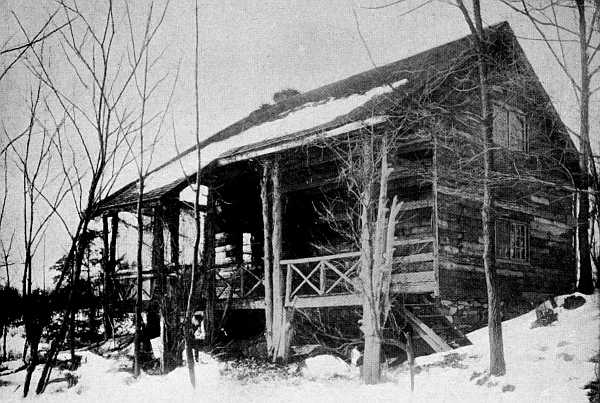
SLABSIDES, THE WOODLAND RETREAT OF JOHN BURROUGHS
"They came right along this path with me that warm August day in 1903. The President was full of life, and would jump and sport along the mountain path as a child would do. I am very much impressed with him as a man."
"Do you remember the incident that occurred between you and the Chicago editor, where he spoke of you going to the Park to teach the President Natural History, in reply to which you state that President Roosevelt knew more western Natural History than four John Burroughs rolled into one?" "Yes, and I believe he does with reference to that big game in the west. You see he lived out west a great deal and has a very keen eye. Where did you see that?"
"How did you enjoy your stay in the Park with the President?"
"Oh! I had a very pleasant time except I got quite tired often and it was cold out there. The ground was covered with snow all the time."
Directly we were beyond the loftiest part of the mountains in a roadway, and with all the anticipation of an enthusiast, I said, "What clearing is that in the distance? Is that Slabsides on the right there? O, I shall never forget this moment!"
Mr. Burroughs answered in a very quiet way: "Yes, there is the little house called Slabsides, which you have heard so much about, and the clearing beyond is my famous celery farm."
Now we were almost in front of Slabsides and Mr. Burroughs cast his eyes to the ground and saw by the roadside a small flower in which he manifested much interest, and called my attention to it. But my eyes were fixed on the very odd, yet beautiful house, that we were about to enter. The thought that here is a house that nature lovers, literateurs, college boys and girls, business men, working men, and all classes and conditions of humanity had made pilgrimages to see, caused my first sight of it to sink deeply into my heart. The house was so well suited to its environment that one might call it Nature's own. The bark covered slabs out of which it was built, the rustic looking doors, floors and steps, made me happier than anything I had ever seen, except the man who built it and called it home. The scattered shelves on the rustic walls filled with all kinds of books indicated what the house was built for. The table on one side of the room, covered with papers of every description, and letters, the little ink-well and goose quill pen, all contributed to my interest in the place. On the table lay a book containing a list of the names of visitors to Slabsides, in which I was asked to write my name. By this time Mr. Burroughs had found a letter from President Roosevelt which I read with considerable anxiety. It was full of sane and healthy thoughts.
Mr. Burroughs did not fail to express his high regard for the President.
The plain open fireplace and the cooking utensils scattered in the room were all suggestive of Mr. Burroughs' philosophy of life; plain living and high thinking, or as Thoreau would have it, "Lessening the Denominator."
To my surprise, there was an upstairs to Slabsides, and the great philosopher and poet, on taking me up in the second story of his little house, told me that he had entertained more than a half dozen men and women, two or three days at a time, at Slabsides.
On returning to the sitting room, we rested for a short while, during which time I asked him some questions on the American poets. He was at home in that field, and freely expressed himself. I asked what he thought of Longfellow, and if he had ever seen him. "No," said he, "I never had but one opportunity of seeing him, and thinking that I might have a better some day, neglected that, but Longfellow died before another opportunity presented itself. I think he was a real poet, and I like him very much. He was not elemental like Whitman, nor as serious as Emerson, but wrote some fine verse."
"Do you enjoy your stay over here at Slabsides?"
"Yes! But not like I did a few years ago. Nature appeals to me here as it does nowhere else. I built this house in order to get further away from the conventionalities of life, and to get a first hand acquaintance with Nature. The Hudson is such a highway for the yachts of millionaires of New York and other cities, that I wanted to withdraw into the wilderness, to get back from the river, and live close to Nature's heart, and I bought this little place. It has given me a great deal of pleasure, and I have never had cause to regret the investment."
Around Slabsides have been built a number of other summer houses, probably the most interesting one of which is that of Ernest Ingersoll, who is a warm friend of John Burroughs, and who bought his land from the latter on which to build.
It was of much interest to me to hear the distinguished Naturalist tell of his celery farm, and the ancient lake bottom in which it is located. To the south of the little farm is a spring which we visited at his suggestion. For the spring is one of the integral parts of Slabsides and the celery farm. While standing at the spring, and discussing the little farm generally, we heard distinctly the whistle of a bird in upper air, which he told me was that of a pine grosbeak come down to spend the winter. I rejoiced to hear also the sound of the goldfinch.
When I was leaving Slabsides, I could not help but turn back two or three times to get another and yet another glimpse, for I had been helped by my visit, my soul had been enriched, and I was loath to wind around the mountain path, beyond the eminence behind which I could no longer see the never-to-be-forgotten little sylvan home. I could not help but say to the naturalist that Thoreau and Walden Pond had been on my mind much of the hour.
Before we reached the Den, I expressed my appreciation of "Bird and Bough," and remarked that the poems were quite musical and suggested the power of natural objects to incite poetic vision, and my belief that such poetry would have a tendency to influence the poets of the future, to sing more songs of nature. About this time we entered the Den again, where John Burroughs gave free expression to his feelings in reference to his own poems. He would have it, that there was more truth than poetry in them, that there was some real good natural history in them.
I referred to some of his critics and what they had said about him, and could not help but feel deeply impressed with his wholesome view about the whole question of literature. "These things do not worry me at all. I take the position that any man's writings must live by merit alone, and the bad will drop out and the good live on. Every writer must be judged finally, by whatever of his writings that stand the test of time."
Just as I heard him make these remarks I arose to bid the great philosopher good-bye, for it was nearing train time and I had to return to New York that evening.
The day had been an epoch making day for me. I had long loved the writings of John Burroughs, and had had some correspondence with him, but now for the first time, had my fondest hope come true. His whole air is one of pleasantness and when he speaks he says words of wisdom. Frequently as I sit in my study, I live that day over, and live in the hope of making many other pilgrimages to Riverby and to Slabsides, and of bringing away renewed inspiration from the poet-naturalist.
His conclusions in natural history are reached after careful study and the closest observation, and are not to be controverted. I was much impressed with his keenness of intellect and frank confessions. He predicted the controversy in the school of nature writers, which was so noticeably before the public last year, 1907-1908, and assured me of the necessity of calling a halt on the Fake Natural History writers, whose stories have duped so many of the Magazine editors. Most of these Fake writers are masters of the English language and to their credit be it said, are able to make the stories sound well and catch the public mind, and if they would only advertise them as myths, they would be of great educational value to the public, but when such myths are held to be actual occurrences in Nature, they destroy the usefulness of such talent, and tend to place editors at a discount. The new writers may consider themselves in advance of the old school naturalists, and more in keeping with the progressive age in which they live, but give me the man or the school that does not trifle with facts in all his nature pictures. Give me the man or school that sees wisely and turns the mirror up to nature. This is what we have in White, Thoreau and Burroughs.