JOHN BURROUGHS IN THE SOUTH
Reading edition
I
Shall I ever forget the morning that John Burroughs, a basket in one hand and hand bag in the other, walked up from the train to my house?
His eyes caught a glimpse of every bird on the ground, in the trees and in the air above, and he would rejoice saying: "I hear the thrasher somewhere!" "There is a robin!" "How many jays you have down here!" "There is a tree in full bloom; it looks like one of the plums!" These bits of natural history made him feel at home, and as if he were among his neighbors. Every flower seemed to be a revelation and an inspiration to him, and his very love for them proved a great inspiration to me. He noted with special emphasis that our Spring in Georgia is at least a month earlier than theirs in New York. The weather was ideal while Mr. Burroughs was here, and, as a result of this, he would often, while walking in the late afternoon, speak of the saffron sky and of the season it foretold.
When urged to feel at ease, he would reply: "I want to invite my soul; just walk around and take things easy. I like to saunter around." It is remarkable to see how vitally all objects of natural history affect him now, and he 72 years of age. They seem to be a part of him. Go to Nature with him and you will be especially impressed with his remarkable keenness of perception, and ability to read and enjoy the 'fine print and foot notes.' He looks into the secrets of Nature and interprets them. He goes to the woods because he loves to go. When he returns he tells, in his essays, just what he saw and felt. In the evenings his conversations lead up to these things, and the philosophy of natural history. He will be found putting two and two together to make four, and of course when he finds that some other writer on these matters makes five out of two and two, he knows it and is ready to challenge it.
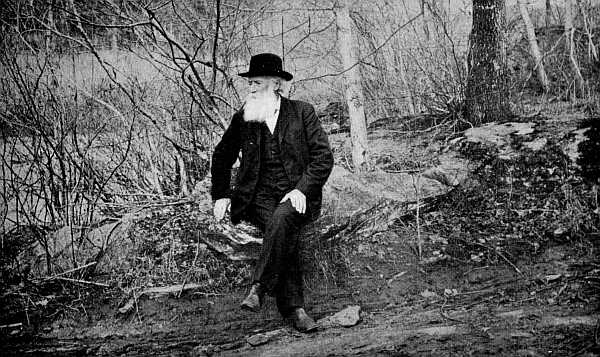
BY A SOUTHERN WOODLAND BROOK, LISTENING TO THE CARDINAL GROSBEAK
Few men are so prominently before the American world of letters at this time as John Burroughs, and any incident in his life interests a great many people. He has long been considered the Dean of American Nature writers, and his essays for the past few years have been drifting toward human interests. Now he is working out a complete system of philosophy about human and animal life, and is at the same time, in a certain sense, a check upon our present crop of Nature writers. No time in the history of any literature has the tendency been so strong to exaggerate about every-day occurrences, as it is at this time among American Nature writers to tell incredible stories about our remaining wild animals and birds. It is this unwarranted tendency that brings forth from Mr. Burroughs such essays as "Real and Sham Natural History," or "The Credible and Incredible in Nature." Under normal conditions, he is a calm, peaceful prophet of Nature, but try to perpetrate upon the reading public such stories as I have suggested above, and he buckles on his sword and goes forth to set straight the crooked paths.
The difference in the time of printing the books is not greater than the difference in the nature of the contents of Wake Robin (1867), and Ways of Nature (1905). The former is the plain and simple record of the observations of an enthusiastic lover of Nature, while the latter goes into animal psychology and natural philosophy, without showing any loss of enthusiasm manifested in the first.
II
His visit through the South during the Winter and early Spring of 1908, is rather significant, especially among his literary and Nature-lover friends. It is another evidence of his determination to understand Nature under all conditions, and removes far from us the idea that he is a local figure like Thoreau or White.
When it was known that Mr. Burroughs intended to spend part of the Spring of 1908, traveling through the South and visiting in Florida, nothing seemed more fitting than to have him stop in Georgia. This he consented to do, and was with us a week beginning March 4. As soon as he consented to visit in Georgia, an effort was made to have him meet "Uncle Remus," and Mr. Harris was invited to call on Mr. Burroughs, but on account of sickness that finally got the better of Mr. Harris and caused his death, July 3, also on account of business details during the combining of The Home Magazine with Uncle Remus's Magazine, the two men did not meet. In expressing his regrets, "Uncle Remus" wrote of his debt and relation to Mr. Burroughs as follows:
There is not in the wide world a man whom I would rather meet than John Burroughs. He is the only man in the country who is living the ideal life. I have just been re-reading his essay on Walt Whitman, and I feel closer to him than ever. There are some details of the deal with the Western Magazine still to settle, and I am sorry indeed, not to be able to accept your invitation. I thank you for thinking of me. Give Mr. Burroughs my love.
Faithfully yours, Joel Chandler Harris.
Both of these men have lived the simple life, and yet, "Uncle Remus" thought that "Oom John," as Mr. Roosevelt calls Burroughs, was the only man in the country living the ideal life. One thing is evident, no man ever enjoyed life more than Mr. Burroughs, and as per his own statement, work has been the secret of his happiness. "Oh, the blessedness of work," he says, "of life-giving and life-sustaining work! The busy man is the happy man; the idle man is the unhappy. When you feel blue and empty and disconsolate, and life seems hardly worth living, go to work with your hands,—delve, hoe, chop, saw, churn, thrash, anything to quicken the pulse and dispel the fumes. The blue devils can be hoed under in less than a half hour."
This, he goes on to say, is his own experience, and therefore he has always found something to do. Not many days ago he wrote: "I have recently got to work again and hope to keep at it." And he will keep at it as long as life shall last.
Mr. Burroughs was born April 3, 1837, on a small farm amid the Catskills at Roxbury, New York, where he lived during the early years of his life. The love of the farm still clings to him, and you will frequently hear him say, "Anything that savors of the farm is very pleasant to me, and recalls my early years at Roxbury on the old home farm." He belongs to that class of men who got an education by working most of the time and going to school when there was little work to do. In order to gain his way to the academy, he had to earn his own money, as his parents were poor and there were nine children in the family. To earn the necessary money, he taught school and with the money he thus earned, went to Ashland Academy. Afterwards, he closed his school days at Cooperstown in 1854, where he studied one term. Upon leaving school, the spirit of adventure seized him, and he went to Illinois and spent some time teaching. But because of the girl he loved, he soon returned to New York, and married in 1857, while teaching in a small town in the east central part of the state. The two have enjoyed a wide acquaintance among the literary characters of America for the last half century. To them has been born one child, Julian Burroughs, who is already known in the literary world as a Nature writer.
III
Mr. Burroughs was teaching when his first essay was accepted and printed in the Atlantic Monthly, November, 1860. He continued teaching till 1863, when he went to Washington City to enlist in the army, but finding many objections to such a life, he entered the Treasury Department in January, 1864. Here he served in various capacities, and finally became chief of the organization division of the Comptroller of Currency. In 1873, he resigned to become receiver of a bank in Middletown, N. Y. He was afterwards made bank examiner in the Eastern part of New York state, which position he held till 1885. Since then he has relied on his writings and his fruit farm for a living.
He has always been an optimist, and at 72 years of age is full of sunshine. In religious belief he is perhaps, a fatalist. He is willing to bide his time fearlessly, for his portion. His experience is largely a home experience, though he has been to England twice, to Alaska once, and to the island of Jamaica, and for the past two years has spent his winters in California and Hawaii. These visits have each been the inspiration for several essays. His literary work has always been a labor of love, and with these few exceptions, together with several short papers on men and literature, his essays have been the outgrowth of his contact with Nature up on the Hudson River and around Washington City. His books number 18 volumes of essays and one volume of poems. Since the recent school of Nature fakers has come so prominently into public notice, his mind has shown remarkable activity in his efforts to hold Nature writers to the truth. Only a few years ago he added some land over the mountain to his estate, and in a beautiful rich valley, about a mile from Riverby, he has built with his own hands, out of rough bark-covered slabs, his rustic retreat called "Slabsides." For several years he has spent part of his time in this primitive-looking house, which he says was built because he wished to get back to Nature. Many books and periodicals are in this sylvan home, and its owner has often spent days at a time there, communing with Nature, and taking notes on the return of Spring, the songs of new bird visitors, and the ways of wood folks. Nothing has ever made so deep an impression on the writer as the sight of Mr. Burroughs in and around "Slabsides."
No man of the century has put himself in an attitude to get more out of life than Burroughs. His peace of mind and satisfaction with life as he finds it and makes it, are largely responsible for his power as a writer. No man can read his sane, wholesome truths about Nature, men, and literature, without growing better and more satisfied with life, and more resigned to the ways of the Powers that be.
Most of what follows is the result of conversations in the evenings with Mr. Burroughs on natural history, literature and people, the three things about which he talks very freely when you know him. The first evening he was with us the discussion led to his recent essay, "The Divine Soil," and he, with a soul full of this interesting subject, went into the matter at length, giving his idea of Man and Nature, of the possible age of the earth, and the gradual wearing away of the continents. As well as I remember, he said:
"It will take only about 6,000,000 years—a brief period in the history of creation—for all the continents to wear away, at the present rate. In trying to indicate what is meant by the long periods of time that it has taken for Nature to reach the present stage of development, one author used this figure: That it had existed and had been forming as long as it would take to wear away the Alps Mountains by sweeping across them with a thin veil once every thousand years.
"What progress man is making upon the earth! At the present rate, he will soon be able to harness the winds, the waves of the sea and even the tide waters. He will store up electricity in batteries to be used at his will. All these things will become necessary when the population grows out of proportion to our present resources. No doubt man's progress will be as great in the future as it has been in the past, and just what he will be found doing when all the present supplies of Nature are exhausted, no one can tell. One thing becomes evident, he will learn to use much of the energy that is now lost. Necessity will soon become the mother of many inventions.
"The largeness of the Universe has always been a subject of much thought for me. I like to think that we are making our voyage on such a large scale. The Heaven and Hell that we used to hear so much about, are no longer considered the one up and the other down. There is no up nor down in Nature, except relative to our own earth. The farthest visible star, so many million times a million miles away, is only a short distance in infinite space, from which we could doubtless see as much further, and as many more worlds as we now see from our old earth. I like Whitman because his largeness puts one in tune with Nature in the larger sense. No other poet with which I am acquainted, gives one such large and wholesome views about the world in which we live."
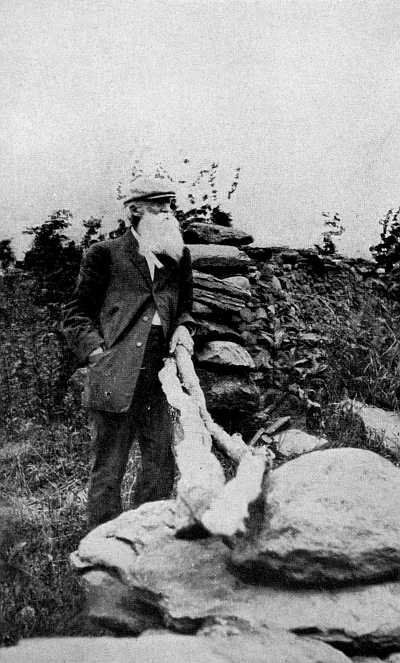
AT THE BARS IN FRONT OF THE OLD HOME BURIAL GROUNDS
IV
On the following evening, which was the evening of March 5, Mr. Burroughs entered fully into a discussion of Emerson, Thoreau and Whitman. His conversation ran about as follows:
"Thoreau was somewhat eccentric and did not reach a large class of people like Emerson, who always savored of youth, and stimulates all who read him. Thoreau was original, however, and his books breathe the breath of real things. Whitman was larger than Thoreau, and encompassed the whole world, instead of a little nook of the woods like Walden Pond. He used to breakfast with us on Sunday mornings when we lived in Washington, and he never reached our house on time for meals. Mrs. Burroughs would fret and worry and get hot while the breakfast would get cold. One moment she would be at the door looking down the street, another she would be fanning with her apron, wishing that man would come on. Presently, Walt could be seen, and he would swing off the car, whistling as if a week was before him in which to get to his breakfast. To have him in our home was a great pleasure to us. He always brought sunshine and a robust, vigorous nature. Once Mrs. Burroughs had prepared an extra good meal, and Walt seemed to enjoy it more than usual. After eating most heartily he smiled, saying: 'Mrs. Burroughs knows how to appeal to the stomach as Mr. Burroughs does to the mind.' I often saw him on the front of a horse car riding up the streets of Washington. Far down the street, before I could see his face, his white beard and hair could be seen distinctly. He usually rode with one foot upon the front railing, and was with Peter Doyle, a popular cab driver, oftener than he was with any one else. Doyle was a large Irishman with much native wit, and was a favorite of Whitman's.
"The Atlantic is my favorite of American periodicals, and I like to see my papers printed in it. It seems always to hold to a very high standard of excellence. I remember well when the magazine was launched in November of 1857. I was teaching at the time, and having purchased a copy, in the town in which I was teaching, I returned home and remarked to Mrs. Burroughs that I liked the new magazine very much and thought it had come to stay. Somehow, the contents made me feel assured of its success. I was married in September before the magazine appeared in November. My first essay was printed in the Atlantic in November of 1860, three years after it had been launched. I was very proud, indeed, when I had received the magazine and found my own work in print in it. The essay was 'Expression' and was purely Emersonian. Now I knew it would never do for me to keep this up, if I hoped for great success. This essay was so like Emerson, that it fooled Lowell, the editor of the Atlantic, and Mr. Hill, the Rhetorician, who quoted a line from it giving Emerson as the author. (Here Mr. Burroughs laughed.) You know, it was not customary to sign names to articles written for periodicals in those days. I was so much worried about this Emersonian mask that I resolved to lay it off. So I began to write of things that I knew about, such as birds and flowers, the weather and all out-door Nature. I soon found that I had hit upon my feet, that I had found my own.
"The title of my first book was 'Notes on Walt Whitman as Poet and Person,' and was published in 1867. Later I wrote a book on 'Whitman: A Study.' Since I first turned attention to Whitman, he has never released hold upon me. I found a more wholesome air in his than in any other poetry, and when I met him and learned to love him, his attractive personality strengthened my love for his writings. He is the one mountain in our American Literary Landscape. There are some beautiful hills.
"I don't seem to be in a mood to write poetry. One cannot write when he thinks to do so. He must have a deep consciousness of his message, if he would say something that will hold water. Probably I shall find my muse again some day; I don't know.
"I have always been a lover of the farm. I am a man of the soil. I enjoyed the smell of that manure as we passed up the road today. It recalled my early days when I used to put it out on the farm. Anything that savors of the farm and of farm life is pleasant to me. Nothing makes me happier than my annual visits back to my old home in the Catskills. When Mrs. Burroughs and I decided to buy a home and move away from Washington, I could not decide just where would be best for us to settle, so we thought to get near New York and at the same time as near the old home as possible. We have enjoyed our life at Riverby very much, and it is convenient in every way. We have a great many visitors, and like to see them come.
"At this time America has no great writer, but many who use pretty English. They seem to have no great message. Stedman wrote well, but his essays always savored too much of the mid-night oil. They read as if the best of his energy had been spent in something else, and the tired mid-night hours turned to literary work. They are not fresh like Lowell's essays. I do not think anything he wrote has lasting qualities, with the possible exception of two or three poems. Aldrich wrote sweet verse, but it is sweet in the sense that a peach or a plum is sweet. It has no fast colors. Trowbridge is one of our best present-day writers, and much of his work will be unknown to the next generation. He is a man of attractive personality and exceptionally pleasing manners. Mrs. Burroughs and I have, for a long time, enjoyed his friendship. As for my own writings, I sometimes wonder just how they have affected people, and what my life has meant. I have always hoped that some would be helped by my books. A short time ago, I had a letter from a preacher in the upper part of New York state, who had just finished a book on 'The Gospel of Christ,' and he asked me if I would write a book on 'The Gospel of Nature.' After I received the letter and began to think about the matter, I was much perplexed as to whether there is a gospel of Nature. I have since then written something along the line suggested, but I do not know whether it will ever appear in print. It is always interesting to have suggestions from any one about what I should write. Writing is more a product of the soul than of the will.
"I once asked President Roosevelt what he would do when he left the White House. He replied quickly: 'Oh, I'll find plenty to do. Don't worry about that.' And he will find plenty to do. He is a man of intense activity, and will always be happiest when he is busiest. I admit that he takes large liberties as the executive of the nation, but he is a natural leader and controller of men. When he sets his head to do a thing, he keeps digging away till it is done. He is full of resources. I have just received a letter from him consenting to be interviewed by my friend, William Bayard Hale. Hale is a good man, and will give a most reliable account of his visit to the White House."
John Burroughs, who is destined to be called "the good gray naturalist," is a man who enters freely into the life of those who admire him and his writings. Recently it was my delight to read and discuss one of his short poems, "The Return," with Mrs. Burroughs, and I could not resist the temptation to remark that Mr. Burroughs must have been homesick for the old place when he wrote it.
The wife said: "Yes; you have no idea how true that is! Mr. Burroughs often goes back to his old home at Roxbury, up in the Catskills, and walks over the farm and through the woods where he used to go when he was a boy, and he always tells me how sad it makes him feel. I sometimes think that he would like to live his life over, he has so many fond memories and pleasant recollections of his early life."
The Return
He sought the old scenes with eager feet, The scenes he had known as a boy, "Oh, for a draught of those fountains sweet, And a taste of that vanished joy!" He roamed the fields, he wooed the streams, His schoolboy paths essayed to trace; The orchard ways recalled his dreams, The hills were like his mother's face. O sad, sad hills! O cold, cold hearth! In sorrow he learned this truth— One may return to the place of his birth, He cannot go back to his youth.