Chapter III · (continued 2)
Reading edition
Connections with the rails of the main line will have to be made in various forms to suit the circumstances of the joining lines or sidings.
Fig. 345 shows a simple double-line junction.
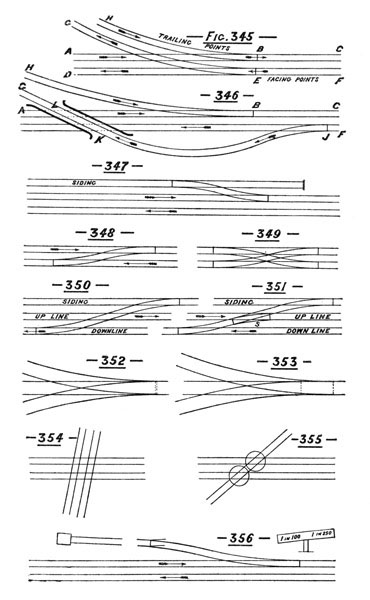
Fig. 346 shows an example of what is termed a flying junction, or a junction of two double lines arranged in such a manner as to cause the least interruption to a constant train traffic passing UP and DOWN over both lines. Upon referring to Fig. 345 it will be seen that a train from F, turning off at the points E and proceeding to G, must block, or close for traffic the section ABC during its passage over that line towards G. With a crowded train-service the blocking of both UP and DOWN main lines for the working of one train would cause much interruption, and to obviate such delay the flying junction is substituted. Fig. 346 shows how a train from F is turned off at the points J and proceeds on to K, where by means of a bridge it passes either over or under both main lines, and continues on to G without in any way interfering with the train service on ABC.
Fig. 347 is an ordinary plain siding or turn-out, including the necessary throw-off or trap-points and short dead end.
Fig. 348 is an ordinary cross-over road from DOWN main line to UP main line, and vice versâ.
Fig. 349 is a double cross-over road, generally termed a scissors cross-over.
Fig. 350 is a simple through cross-over road from DOWN main line to siding alongside UP main line.
Fig. 351 is a similar arrangement of through cross-over road with the addition of a pair of slip points at S to make a connection with the UP main line, thus combining the facilities of the ordinary cross-over and through cross-over road.
Fig. 352 shows a set of three throw-switches with all the sliding tongues placed side by side; and Fig. 353 shows another arrangement of three throws with the sliding-rails of the second set of switches placed just behind the heel of the first set of switches. The latter method works very well where there is sufficient length for the purpose.
Fig. 354 shows a square crossing, where one line of railway crosses another line of railway on the same level.
Fig. 355 shows a connection with a siding by means of an ordinary carriage or waggon turn-table.
Fig. 356 shows a set of “runaway” points which are sometimes placed in the main line at the top of an incline close to a station, the object being to intercept or throw off any portion of a train which may have become detached, and which would, if unchecked, run away back down the incline. By means of a weighted lever or spring the points are set to the normal position of open to the siding, and as they are “trailing” points for the running road they are readily closed by a passing train. One or other of the above forms of connections, or a combination of them, will meet all the requirements which usually occur in railway work.
Fig. 357 is an enlarged sketch of an ordinary cross-over road, and Fig. 358 of a double or scissors cross-over.
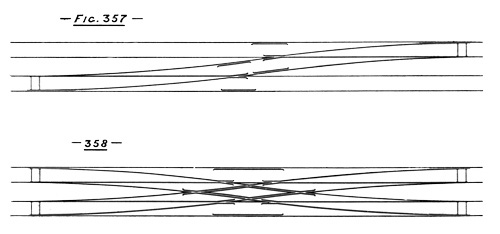
Fig. 359 shows a single-slip point connection, and Fig. 360 a double-slip point connection. In places where slip connections can be introduced they add greatly to the facilities for train movements without curtailing the available standing-room for vehicles on the lines and sidings. They are simple in construction, do not require crossings, and in many cases save a complete cross-over road. At the same time slip connections can only be laid down where the angle of the intersecting lines is sufficiently flat to admit of a connecting curve of workable radius.
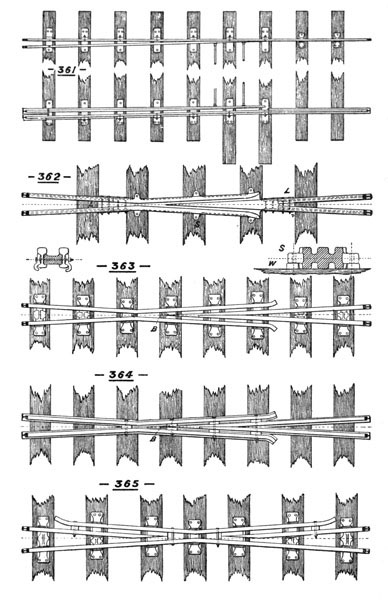
Fig. 361 is an enlarged sketch of a set of ordinary 15-foot switches or points. By placing them about the middle of the stock rails the joints of the latter are kept well beyond the sliding rails, and the road is held firmly together. It is necessary to place the sleepers closer together at the switches to allow for the reduction in section of the sliding rails, which results from planing them down to the requisite shape. By substituting two long timbers for the ordinary sleepers at the points of the switch rails, as shown on the sketch, a more efficient support is obtained for the switch-box or crank in the case of rod-worked switches, and the working distance from the rails is accurately maintained, irrespective of any packing or pulling of the road. In the sketch a steel bull-head rail is shown on one side, and a steel flange rail on the other, each bolted to an ordinary cast-iron switch chair. Switch chairs are sometimes made of plates of wrought-iron or steel, forged to the correct shape, and riveted together. They are, however, much more costly than cast-iron chairs, and deteriorate more quickly from corrosion.
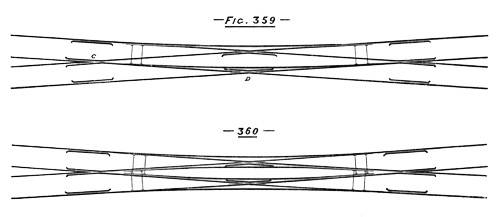
Fig. 362 is an enlarged sketch of an ordinary crossing similar to the one indicated at C (Fig. 359), and composed of a cast-steel reversible block. The ends and lugs, L, L, are formed to suit the connecting rails and fish-plates, as shown in the cross-sections. The casting is secured to the crossing timbers by bolts passing through the side lugs, S, a cast-iron packing-washer, W, being placed between the lug and the timber to ensure a solid seat and avoid rocking. A very important point in the construction of these block crossings is to have the groove or flange-path sufficiently deep to prevent the striking or touching of the flange of a much-worn tyre. A well-made, carefully annealed steel-block reversible crossing is very smooth in the road, and has a long life. It is all in one solid piece; there are no parts to work loose or spread; the wear of the running surface is very uniform, and when the one side is much worn down, there is the other ready for service. The writer has had many of these steel-block reversible crossings in use under heavy and fast traffic for six and eight years without turning.
Fig. 363 shows an ordinary crossing made of steel bull-head rails secured in strong cast-iron chairs; and Fig. 364 is a similar crossing made of steel flange rails. In some cases the two rails forming the V are welded together at the point B, and in others they are riveted or bolted together. Fig. 365 shows a diamond or through crossing similar to the one indicated at D, Fig. 359, made of steel bull-head rails and chairs.
Crossings are constructed in a variety of forms, whether on the principle of the cast-steel block, or made out of ordinary steel rails; and the above sketches merely illustrate some well-recognized types which experience has proved to be efficient and durable in the road. The angles of the crossings will depend upon the divergence of the intersecting lines to be connected; ordinary crossings, to the angle of 1 in 10, work in for very general use in station-yards, but many are required of angles varying from 1 in 6 to 1 in 14, and in some cases 1 in 16.
As a rule, engineers endeavour as far as possible to avoid using ordinary crossings flatter than 1 in 12, or diamond crossings flatter than 1 in 9, because the gap between the running rails becomes very considerable beyond those angles. At the same time, there are many cases of ordinary crossings of 1 in 16, and diamond crossings of 1 in 12 and 1 in 13 laid down in exceptional places, and which have carried heavy and fast traffic for many years. All crossings should be well protected with wing rails and guard rails, as shown on the sketches.
Fig. 366 illustrates a method of bringing the UP and down lines of a double line of railway close to each other, and passing them over a single-line opening bridge, or a bridge where the works for the second line have not been completed. This arrangement avoids the necessity of any switches, and prevents any accidents which would arise from a misplaced switch. Each set of trains is effectually kept to its own line of rails. With proper signalling or pilot working, the double-line traffic can be worked over the single-line bridge without difficulty. The writer has adopted the above arrangement in many cases when renewing double-line bridges or viaducts where the width for traffic working has been restricted to half of the bridge.
In some instances the same system has been extended to the carrying of four lines of rails over a double-line bridge, as shown on Fig. 367.
The principal tool used by platelayers for lifting the permanent way is a long iron-shod wooden lever, as shown in Fig. 368. The point of the lower end is pushed under the sleeper, and the curved shoulder placed on a large stone or piece of wood as a support, and then by pulling down the upper end of the lever the road can be lifted to the height required. Screw lifting-jacks of various kinds are also used for the same purpose, the foot or base of the jack resting on the ballast, while the claws grasp the under side of the rail, and raise it by means of the screw. With appliances which lift by the rails, the sleepers have to be raised by the holding power of the spikes or bolts, an operation which is apt to throw undue strain on spikes. Where possible it is preferable to lift from the under side of the sleepers.
Beaters similar to the one shown on Fig. 369 are used for packing the ballast. One end of the beater is pointed like a pick, and serves to loosen the ballast or broken stone, and the other end is made somewhat in the hammer-head form to pack or beat the ballast under the sleeper. With skilled men the beater is a most useful tool, speedy and effective in its action. Held in both hands, it is raised slightly, and then brought down sharply, the hammer-head striking the gravel or broken stone placed alongside for packing under the sleeper. A series of smart blows can be given with rapidity and without requiring any great muscular effort. In some foreign countries there is difficulty in initiating the natives to work with the ordinary beater, on account of the stooping position necessary for its use. To meet this difficulty the writer has in many cases substituted a packing or tamping bar, as shown in Fig. 370. This bar, about 5 feet long, is made of light round wrought-iron or steel, with a ring-shaped handle at one end, and an ordinary beater head at the other. The workman using this bar stands upright, guides the bar, held loosely, with his left hand, and with his right gives a continuance of smart blows. This tool works well in the hands of light active natives, who can thus give a number of rapid strokes without much exertion.
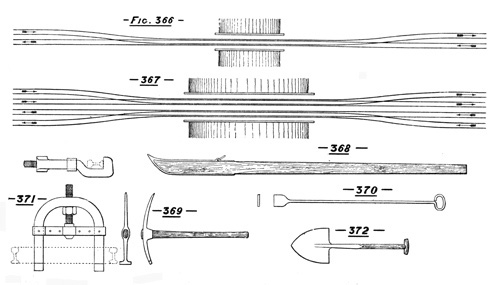
The simple rail-bender, or Jim Crow, of the form shown in Fig. 371, is much used by platelayers for giving a slight bend or set to rails which have to be laid down on sharp curves on main line or cross-over roads. The rail is laid across the two arms, and the screw turned round and downwards by means of an iron bar lever used as a spanner or wrench to the nut shown on the sketch. The same tool is also serviceable for straightening rails which have become crooked or kinked. Large and more comprehensive machines are used for bending rails in large quantities or setting them to exact curvature, but, being heavy and cumbersome, they are rarely taken away from the store-yards.
Strong steel shovels of the form shown in Fig. 372 are the most suitable for platelayers’ general use when working with gravel, sand, or broken stones.
For driving iron spikes and wooden keys in cast-iron chairs a long-handled hammer is the most convenient for work, and its long swinging action produces considerable force without much actual labour.
Road-gauges, nut-wrenches, short straight-edges, spirit-levels, ratchet-drills, augurs, and cold setts of well-tempered steel for cutting rails, are all required by the men engaged in laying permanent way.
The following summaries give the estimated cost of materials alone for one mile of steel bull-head rail and steel flange rail permanent way of different weights. The 90-lb. steel bull-head rail is at present the heaviest of that section laid down to any extent on our home railways, and the chairs and fastenings are made heavy to correspond to the rail and the traffic for which it is intended. As the rails in the summaries become lighter, the weights of the chairs and fastenings are decreased. As yet there are not many samples of the 100-lb. steel flange rail; but in those places where it has been laid down it has been supported with a liberal supply of sleepers, to obtain increased bearing surface. With a 5½-inch flange, and a rectangular sleeper 10 inches wide, the bearing surface on the wood is only about 55 square inches, as compared with about 100 square inches, the bearing surface of a large cast-iron chair for a heavy bull-head rail. As previously explained, a small bearing surface on a sleeper tends to the cutting down into the wood, and rendering the sleeper unsafe and useless even before it has become unserviceable from decay: hence the reason for ample bearing surface on the sleeper. The last two summaries refer to 3-foot narrow-gauge lines. In more than one instance the 45-lb. rails first laid down have been found much too light for the engines required to work the traffic, and when making extensions of the system 65-lb. rails have been adopted. Indeed, when taking into consideration the weight of most of the narrow-gauge engines, generally from 24 to 28 tons in working order, and their short wheel-base, it would appear that a 65-lb. rail is the minimum which should be used both for stability and economy in maintenance.
The summaries are prepared from examples in actual use, and represent the number and weight of sleepers, chairs, and fastenings in each instance. Even with the same weight of rail, the practice differs on various lines as to the weights of the chairs and fastenings; and the selections have been made to show a fair average. On some railways the chairs are secured partly by tree-nails and partly by spikes, or crab bolts; on others only spikes are used. The prices put down are the estimated values of the materials delivered into the Permanent Way Stores of our own home railways, and are exclusive of all costs of freight, carriage, or distribution to the site of laying down. The prices are only comparative, and fluctuate up or down according to the current value of the raw materials from which the various items are manufactured. Lighter rails and smaller fastenings cost more per ton than those of a heavier type, as they involve more labour and workmanship.
Steel Bull-head Rails (90 lbs. per Yard). Estimated Cost of Materials for One Mile of Single Line.
Weight per mile of single line. Price.Amount.
tons.cwt.qrs. lbs. £s.d. £s.d.
Steel bull-head rails, 90 lbs. per yard (30-ft. lengths) 141820 500 70726
Steel fish-plates (deep), 41 lbs. per pair 61000 6150 43176
Fish-bolts and nuts 1400 12150 1560
2112 creosoted sleepers, 9 ft. × 10 in. × 5 in. — 0310 404160
4224 cast-iron chairs, each 50 lbs. 94530 3100 33001
8448 iron cup-headed spikes 31520 1000 37150
8448 tree-nails, at per 1000 — 3100 29114
4224 oak keys, at per 1000 — 500 2125
£158910 10
Steel Bull-head Rails (90 lbs. per Yard). Estimated Cost of Materials for One Mile of Single Line.
Weight per mile of single line.
tons.cwt.qrs. lbs.
Steel bull-head rails, 90 lbs. per yard (30-ft. lengths) 141820
Steel fish-plates (deep), 41 lbs. per pair 61000
Fish-bolts and nuts 1400
2112 creosoted sleepers, 9 ft. × 10 in. × 5 in. —
4224 cast-iron chairs, each 50 lbs. 94530
8448 iron cup-headed spikes 31520
8448 tree-nails, at per 1000 —
4224 oak keys, at per 1000 —
Price. Amount.
£s.d. £s.d.
Steel bull-head rails, 90 lbs. per yard (30-ft. lengths) 500 70726
Steel fish-plates (deep), 41 lbs. per pair 6150 43176
Fish-bolts and nuts 12150 1560
2112 creosoted sleepers, 9 ft. × 10 in. × 5 in. 0310 404160
4224 cast-iron chairs, each 50 lbs. 3100 33001
8448 iron cup-headed spikes 1000 37150
8448 tree-nails, at per 1000 3100 29114
4224 oak keys, at per 1000 500 2125
£158910 10
Steel Bull-head Rails (85 lbs. per Yard). Estimated Cost of Materials for One Mile of Single Line.
Weight per mile of single line. Price.Amount.
tons.cwt.qrs. lbs. £s.d. £s.d.
Steel bull-head rails, 85 lbs. per yard (26-ft. length ) 134000 500 67000
Steel fish-plates (deep), 38 lbs. per pair 61730 6150 46910
Fish-bolts and nuts 1430 12150 15157
2030 creosoted sleepers, 9 ft. × 10 in. × 5 in. — 0310 38918
4060 cast-iron chairs, each 45 lbs. 811110 3100 28595
8120 iron cup-headed spikes 31220 1000 3650
4060 tree-nails, at per 1000 — 3100 1442
4060 oak keys, at per 1000 — 500 060
£1477 118
Steel Bull-head Rails (85 lbs. per Yard). Estimated Cost of Materials for One Mile of Single Line.
Weight per mile of single line.
tons.cwt.qrs. lbs.
Steel bull-head rails, 85 lbs. per yard (26-ft. length ) 134000
Steel fish-plates (deep), 38 lbs. per pair 61730
Fish-bolts and nuts 1430
2030 creosoted sleepers, 9 ft. × 10 in. × 5 in. —
4060 cast-iron chairs, each 45 lbs. 811110
8120 iron cup-headed spikes 31220
4060 tree-nails, at per 1000 —
4060 oak keys, at per 1000 —
Price. Amount.
£s.d. £s.d.
Steel bull-head rails, 85 lbs. per yard (26-ft. length ) 500 67000
Steel fish-plates (deep), 38 lbs. per pair 6150 46910
Fish-bolts and nuts 12150 15157
2030 creosoted sleepers, 9 ft. × 10 in. × 5 in. 0310 38918
4060 cast-iron chairs, each 45 lbs. 3100 28595
8120 iron cup-headed spikes 1000 3650
4060 tree-nails, at per 1000 3100 1442
4060 oak keys, at per 1000 500 060
£1477 118
Steel Bull-head Rails (80 lbs. per Yard). Estimated Cost of Materials for One Mile of Single Line.
Weight per mile of single line. Price.Amount.
tons.cwt. qrs.lbs. £s.d. £s.d.
Steel bull-head rails, 80 lbs. per yard (26-ft. lengths) 125140 0 500 628100
Steel fish-plates (deep), 37 lbs. per pair 6141 0 6150 4562
Fish-bolts and nuts 143 0 12150 15157
2030 creosoted sleepers, 9 ft. × 10 in. × 5 in. — 0310 38918
4060 cast-iron chairs, each 40 lbs. 72100 0 3100 253150
8120 iron cup-headed spikes 3122 0 1000 3650
4060 tree-nails, at per 1000 — 3100 1442
4060 oak keys, at per 1000 — 500 2060
£ 140337
Steel Bull-head Rails (80 lbs. per Yard). Estimated Cost of Materials for One Mile of Single Line.
Weight per mile of single line.
tons.cwt. qrs.lbs.
Steel bull-head rails, 80 lbs. per yard (26-ft. lengths) 125140 0
Steel fish-plates (deep), 37 lbs. per pair 6141 0
Fish-bolts and nuts 143 0
2030 creosoted sleepers, 9 ft. × 10 in. × 5 in. —
4060 cast-iron chairs, each 40 lbs. 72100 0
8120 iron cup-headed spikes 3122 0
4060 tree-nails, at per 1000 —
4060 oak keys, at per 1000 —
Price. Amount.
£s.d. £s.d.
Steel bull-head rails, 80 lbs. per yard (26-ft. lengths) 500 628100
Steel fish-plates (deep), 37 lbs. per pair 6150 4562
Fish-bolts and nuts 12150 15157
2030 creosoted sleepers, 9 ft. × 10 in. × 5 in. 0310 38918
4060 cast-iron chairs, each 40 lbs. 3100 253150
8120 iron cup-headed spikes 1000 3650
4060 tree-nails, at per 1000 3100 1442
4060 oak keys, at per 1000 500 2060
£ 140337
Steel Bull-head Rails (75 lbs. per Yard). Estimated Cost of Materials for One Mile of Single Line.
Weight per mile of single line. Price.Amount.
tons.cwt. qrs.lbs. £s.d. £s.d.
Steel bull-head rails, 75 lbs. per yard (26-ft. lengths) 11700 0 500 58500
Steel fish-plates (deep), 35 lbs. per pair 670 0 6150 42173
Fish-bolts and nuts 143 0 12150 15157
2030 creosoted sleepers, 9 ft. × 10 in. × 5 in. — 0310 38918
4060 cast-iron chairs, each 37 lbs. 6711 0 3100 234145
12,180 iron cup-headed spikes 583 0 1000 5476
4060 oak keys, at per 1000 — 500 2060
£ 134225
Steel Bull-head Rails (75 lbs. per Yard). Estimated Cost of Materials for One Mile of Single Line.
Weight per mile of single line.
tons.cwt. qrs.lbs.
Steel bull-head rails, 75 lbs. per yard (26-ft. lengths) 11700 0
Steel fish-plates (deep), 35 lbs. per pair 670 0
Fish-bolts and nuts 143 0
2030 creosoted sleepers, 9 ft. × 10 in. × 5 in. —
4060 cast-iron chairs, each 37 lbs. 6711 0
12,180 iron cup-headed spikes 583 0
4060 oak keys, at per 1000 —
Price.Amount.
£s.d. £s.d.
Steel bull-head rails, 75 lbs. per yard (26-ft. lengths) 500 58500
Steel fish-plates (deep), 35 lbs. per pair 6150 42173
Fish-bolts and nuts 12150 15157
2030 creosoted sleepers, 9 ft. × 10 in. × 5 in. 0310 38918
4060 cast-iron chairs, each 37 lbs. 3100 234145
12,180 iron cup-headed spikes 1000 5476
4060 oak keys, at per 1000 500 2060
£ 134225
Steel Bull-head Rails (70 lbs. per Yard). Estimated Cost of Materials for One Mile of Single Line.
Weight per mile of single line. Price.Amount.
tons.cwt. qrs.lbs. £s.d. £s.d.
Steel bull-head rails, 70 lbs. per yard (26-ft. lengths) 11000 0 500 55000
Steel fish-plates (deep), 32 lbs. per pair 5160 0 6150 3930
Fish-bolts and nuts 120 0 12150 1406
2030 creosoted sleepers, 9 ft. × 10 in. × 5 in. — 0310 38918
4060 cast-iron chairs, each 34 lbs. 61122 0 3100 215139
8120 iron cup-headed spikes 332 0 1000 31150
4060 oak keys, at per 1000 — 4100 1855
£1257 194
Steel Bull-head Rails (70 lbs. per Yard). Estimated Cost of Materials for One Mile of Single Line.
Weight per mile of single line.
tons.cwt. qrs.lbs.
Steel bull-head rails, 70 lbs. per yard (26-ft. lengths) 11000 0
Steel fish-plates (deep), 32 lbs. per pair 5160 0
Fish-bolts and nuts 120 0
2030 creosoted sleepers, 9 ft. × 10 in. × 5 in. —
4060 cast-iron chairs, each 34 lbs. 61122 0
8120 iron cup-headed spikes 332 0
4060 oak keys, at per 1000 —
Price.Amount.
£s.d. £s.d.
Steel bull-head rails, 70 lbs. per yard (26-ft. lengths) 500 55000
Steel fish-plates (deep), 32 lbs. per pair 6150 3930
Fish-bolts and nuts 12150 1406
2030 creosoted sleepers, 9 ft. × 10 in. × 5 in. 0310 38918
4060 cast-iron chairs, each 34 lbs. 3100 215139
8120 iron cup-headed spikes 1000 31150
4060 oak keys, at per 1000 4100 1855
£1257 194
Steel Bull-head Rails (65 lbs. per Yard). Estimated Cost of Materials for One Mile of Single Line.
Weight per mile of single line. Price.Amount.
tons.cwt. qrs.lbs. £s.d. £s.d.
Steel bull-head rails, 65 lbs. per yard (26-ft. lengths) 10230 0 550 53659
Steel fish-plates (deep), 28 lbs. per pair 512 0 700 35106
Fish-bolts and nuts 110 0 1300 13130
2030 creosoted sleepers, 9 ft. × 9 in. × 4½ in. — 030 304100
4060 cast-iron chairs, each 28 lbs. 50150 0 400 20300
8120 iron cup-headed spikes 2190 0 10100 30196
4060 oak keys, at per 1000 — 400 1649
£1140 36
Steel Bull-head Rails (65 lbs. per Yard). Estimated Cost of Materials for One Mile of Single Line.
Weight per mile of single line.
tons.cwt. qrs.lbs.
Steel bull-head rails, 65 lbs. per yard (26-ft. lengths) 10230 0
Steel fish-plates (deep), 28 lbs. per pair 512 0
Fish-bolts and nuts 110 0
2030 creosoted sleepers, 9 ft. × 9 in. × 4½ in. —
4060 cast-iron chairs, each 28 lbs. 50150 0
8120 iron cup-headed spikes 2190 0
4060 oak keys, at per 1000 —
Price.Amount.
£s.d. £s.d.
Steel bull-head rails, 65 lbs. per yard (26-ft. lengths) 550 53659
Steel fish-plates (deep), 28 lbs. per pair 700 35106
Fish-bolts and nuts 1300 13130
2030 creosoted sleepers, 9 ft. × 9 in. × 4½ in. 030 304100
4060 cast-iron chairs, each 28 lbs. 400 20300
8120 iron cup-headed spikes 10100 30196
4060 oak keys, at per 1000 400 1649
£1140 36
Steel Flange Rails (100 lbs. per Yard). Estimated Cost of Materials for One Mile of Single Line.
Weight per mile of single line. Price.Amount.
tons.cwt. qrs.lbs. £s.d. £s.d.
Steel flange rails, 100 lbs. per yard (30-ft. lengths) 15730 0 500 785150
Steel fish-plates (deep), 42 lbs. per pair 6120 0 6100 42180
Fish-bolts and nuts 150 0 12150 15189
2464 creosoted sleepers, 9 ft. × 10 in. × 5 in. — 0310 47254
8448 dog-head spikes 360 0 12100 4150
704 fang clips 083 0 13100 5182
1408 crab bolts 163 0 12100 16145
£1380 148
Steel Flange Rails (100 lbs. per Yard). Estimated Cost of Materials for One Mile of Single Line.
Weight per mile of single line.
tons.cwt. qrs.lbs.
Steel flange rails, 100 lbs. per yard (30-ft. lengths) 15730 0
Steel fish-plates (deep), 42 lbs. per pair 6120 0
Fish-bolts and nuts 150 0
2464 creosoted sleepers, 9 ft. × 10 in. × 5 in. —
8448 dog-head spikes 360 0
704 fang clips 083 0
1408 crab bolts 163 0
Price.Amount.
£s.d. £s.d.
Steel flange rails, 100 lbs. per yard (30-ft. lengths) 500 785150
Steel fish-plates (deep), 42 lbs. per pair 6100 42180
Fish-bolts and nuts 12150 15189
2464 creosoted sleepers, 9 ft. × 10 in. × 5 in. 0310 47254
8448 dog-head spikes 12100 4150
704 fang clips 13100 5182
1408 crab bolts 12100 16145
£1380 148
Steel Flange Rails (79 lbs. per Yard). Estimated Cost of Materials for One Mile of Single Line.
Weight per mile of single line. Price.Amount.
tons.cwt. qrs.lbs. £s.d. £s.d.
Steel flange rails, 79 lbs. per yard (26-ft. lengths) 12500 0 500 62500
Steel fish-plates (deep), 37 lbs. per pair 6141 0 6100 43128
Fish-bolts and nuts 140 0 12150 1560
2030 creosoted sleepers, 9 ft. × 10 in. × 5 in. — 0310 38918
6496 dog-head spikes 2103 0 12100 31145
812 fang clips 0100 0 13100 6150
1624 crab bolts 1103 0 12100 1945
£1130 142
Steel Flange Rails (79 lbs. per Yard). Estimated Cost of Materials for One Mile of Single Line.
Weight per mile of single line.
tons.cwt. qrs.lbs.
Steel flange rails, 79 lbs. per yard (26-ft. lengths) 12500 0
Steel fish-plates (deep), 37 lbs. per pair 6141 0
Fish-bolts and nuts 140 0
2030 creosoted sleepers, 9 ft. × 10 in. × 5 in. —
6496 dog-head spikes 2103 0
812 fang clips 0100 0
1624 crab bolts 1103 0
Price.Amount.
£s.d. £s.d.
Steel flange rails, 79 lbs. per yard (26-ft. lengths) 500 62500
Steel fish-plates (deep), 37 lbs. per pair 6100 43128
Fish-bolts and nuts 12150 1560
2030 creosoted sleepers, 9 ft. × 10 in. × 5 in. 0310 38918
6496 dog-head spikes 12100 31145
812 fang clips 13100 6150
1624 crab bolts 12100 1945
£1130 142
Steel Flange Rails (74 lbs. per Yard). Estimated Cost of Materials for One Mile of Single Line.
Weight per mile of single line. Price.Amount.
tons.cwt. qrs.lbs. £s.d. £s.d.
Steel flange rails, 74 lbs. per yard (30-ft. lengths) 11653 0 500 58189
Steel fish-plates (deep), 30½ lbs. per pair 4153 0 6100 3125
Fish-bolts and nuts 110 0 12150 1379
1936 creosoted sleepers, ft. × 10 in. × 5 in. — 0310 37114
6336 dog-head spikes 292 0 12100 30189
704 fang clips 083 0 13100 5182
1408 crab bolts 163 0 12100 16145
£1050 117
Steel Flange Rails (74 lbs. per Yard). Estimated Cost of Materials for One Mile of Single Line.
Weight per mile of single line.
tons.cwt. qrs.lbs.
Steel flange rails, 74 lbs. per yard (30-ft. lengths) 11653 0
Steel fish-plates (deep), 30½ lbs. per pair 4153 0
Fish-bolts and nuts 110 0
1936 creosoted sleepers, ft. × 10 in. × 5 in. —
6336 dog-head spikes 292 0
704 fang clips 083 0
1408 crab bolts 163 0
Price.Amount.
£s.d. £s.d.
Steel flange rails, 74 lbs. per yard (30-ft. lengths) 500 58189
Steel fish-plates (deep), 30½ lbs. per pair 6100 3125
Fish-bolts and nuts 12150 1379
1936 creosoted sleepers, ft. × 10 in. × 5 in. 0310 37114
6336 dog-head spikes 12100 30189
704 fang clips 13100 5182
1408 crab bolts 12100 16145
£1050 117
Steel Flange Rails (65 lbs. per Yard). Estimated Cost of Materials for One Mile of Single Line.
Weight per mile of single line. Price.Amount.
tons.cwt. qrs.lbs. £s.d. £s.d.
Steel flange rails, 65 lbs. per yard (30-ft. lengths) 10230 0 5100 561166
Steel fish-plates (deep), 27 lbs. per pair 443 0 750 30145
Fish-bolts and nuts 100 0 1300 1300
1936 creosoted sleepers, 9 ft. × 10 in. × 5 in. — 0310 37114
6336 dog-head spikes 292 0 12100 30189
704 fang clips 080 0 13100 580
1408 crab bolts 163 0 12100 16145
£1029 135
Steel Flange Rails (65 lbs. per Yard). Estimated Cost of Materials for One Mile of Single Line.
Weight per mile of single line.
tons.cwt. qrs.lbs.
Steel flange rails, 65 lbs. per yard (30-ft. lengths) 10230 0
Steel fish-plates (deep), 27 lbs. per pair 443 0
Fish-bolts and nuts 100 0
1936 creosoted sleepers, 9 ft. × 10 in. × 5 in. —
6336 dog-head spikes 292 0
704 fang clips 080 0
1408 crab bolts 163 0
Price.Amount.
£s.d. £s.d.
Steel flange rails, 65 lbs. per yard (30-ft. lengths) 5100 561166
Steel fish-plates (deep), 27 lbs. per pair 750 30145
Fish-bolts and nuts 1300 1300
1936 creosoted sleepers, 9 ft. × 10 in. × 5 in. 0310 37114
6336 dog-head spikes 12100 30189
704 fang clips 13100 580
1408 crab bolts 12100 16145
£1029 135
Steel Flange Rails (60 lbs. per Yard). Estimated Cost of Materials for One Mile of Single Line.
Weight per mile of single line. Price.Amount.
tons.cwt. qrs.lbs. £s.d. £s.d.
Steel flange rails, 60 lbs. per yard (30-ft. lengths) 9453 0 5100 518117
Steel fish-plates (deep), 25 lbs. per pair 3182 0 750 2892
Fish-bolts and nuts 100 0 1300 1300
2112 creosoted sleepers, 9 ft. × 10 in. × 5 in. — 0310 404160
7040 dog-head spikes 2150 0 12100 3476
704 fang clips 080 0 13100 580
1408 crab bolts 163 0 12100 16145
£1021 68
Steel Flange Rails (60 lbs. per Yard). Estimated Cost of Materials for One Mile of Single Line.
Weight per mile of single line.
tons.cwt. qrs.lbs.
Steel flange rails, 60 lbs. per yard (30-ft. lengths) 9453 0
Steel fish-plates (deep), 25 lbs. per pair 3182 0
Fish-bolts and nuts 100 0
2112 creosoted sleepers, 9 ft. × 10 in. × 5 in. —
7040 dog-head spikes 2150 0
704 fang clips 080 0
1408 crab bolts 163 0
Price.Amount.
£s.d. £s.d.
Steel flange rails, 60 lbs. per yard (30-ft. lengths) 5100 518117
Steel fish-plates (deep), 25 lbs. per pair 750 2892
Fish-bolts and nuts 1300 1300
2112 creosoted sleepers, 9 ft. × 10 in. × 5 in. 0310 404160
7040 dog-head spikes 12100 3476
704 fang clips 13100 580
1408 crab bolts 12100 16145
£1021 68
Steel Flange Rails (50 lbs. per Yard). Estimated Cost of Materials for One Mile of Single Line.
Weight per mile of single line. Price.Amount.
tons.cwt. qrs.lbs. £s.d. £s.d.
Steel flange rails, 50 lbs. per yard (30-ft. lengths) 78112 0 5150 451161
Steel fish-plates (deep), 22 lbs. per pair 391 0 7100 25195
Fish-bolts and nuts 0180 0 13100 1230
2112 creosoted sleepers, 9 ft. × 9 in. × 4½ in. — 030 316160
7040 dog-head spikes 271 0 1300 30143
704 fang clips 061 0 1400 476
1408 crab bolts 12 00 1300 1460
£856 23
Steel Flange Rails (50 lbs. per Yard). Estimated Cost of Materials for One Mile of Single Line.
Weight per mile of single line.
tons.cwt. qrs.lbs.
Steel flange rails, 50 lbs. per yard (30-ft. lengths) 78112 0
Steel fish-plates (deep), 22 lbs. per pair 391 0
Fish-bolts and nuts 0180 0
2112 creosoted sleepers, 9 ft. × 9 in. × 4½ in. —
7040 dog-head spikes 271 0
704 fang clips 061 0
1408 crab bolts 12 00
Price.Amount.
£s.d. £s.d.
Steel flange rails, 50 lbs. per yard (30-ft. lengths) 5150 451161
Steel fish-plates (deep), 22 lbs. per pair 7100 25195
Fish-bolts and nuts 13100 1230
2112 creosoted sleepers, 9 ft. × 9 in. × 4½ in. 030 316160
7040 dog-head spikes 1300 30143
704 fang clips 1400 476
1408 crab bolts 1300 1460
£856 23
Steel Flange Rails (65 lbs. per Yard). Estimated Cost of Materials for One Mile of Single Line (3-ft. gauge).
Weight per mile of single line. Price.Amount.
tons.cwt. qrs.lbs. £s.d. £s.d.
Steel flange rails, 65 lbs. per yard (30-ft. lengths) 10230 0 5100 561166
Steel fish-plates (deep), 27 lbs. per pair 443 0 750 30145
Fish-bolts and nuts 100 0 1300 1300
2288 creosoted sleepers, 6 ft. × 9 in. × 4½ in. — 023 25780
7744 dog-head spikes 2170 0 12100 35126
704 fang clips 072 0 13100 513
1408 crab bolts 220 0 12100 2650
£929 178
Steel Flange Rails (65 lbs. per Yard). Estimated Cost of Materials for One Mile of Single Line (3-ft. gauge).
Weight per mile of single line.
tons.cwt. qrs.lbs.
Steel flange rails, 65 lbs. per yard (30-ft. lengths) 10230 0
Steel fish-plates (deep), 27 lbs. per pair 443 0
Fish-bolts and nuts 100 0
2288 creosoted sleepers, 6 ft. × 9 in. × 4½ in. —
7744 dog-head spikes 2170 0
704 fang clips 072 0
1408 crab bolts 220 0
Price.Amount.
£s.d. £s.d.
Steel flange rails, 65 lbs. per yard (30-ft. lengths) 5100 561166
Steel fish-plates (deep), 27 lbs. per pair 750 30145
Fish-bolts and nuts 1300 1300
2288 creosoted sleepers, 6 ft. × 9 in. × 4½ in. 023 25780
7744 dog-head spikes 12100 35126
704 fang clips 13100 513
1408 crab bolts 12100 2650
£929 178
Steel Flange Rails (45 lbs. per Yard). Estimated Cost of Materials for One Mile of Single Line (3-ft. gauge).
Weight per mile of single line. Price.Amount.
tons.cwt. qrs.lbs. £s.d. £s.d.
Steel flange rails, 45 lbs. per yard (26-ft. lengths) 70141 0 5150 406120
Steel fish-plates (deep), 16 lbs. per pair 2180 0 7100 21150
Fish-bolts and nuts 0180 0 13100 1230
2233 creosoted sleepers, 6 ft. × 8 in. × 4 in. — 0110 2041310
7308 dog-head spikes 2140 0 1300 3520
812 fang clips 050 0 1400 3100
1624 crab bolts 0180 0 1300 11140
£695 910
Steel Flange Rails (45 lbs. per Yard). Estimated Cost of Materials for One Mile of Single Line (3-ft. gauge).
Weight per mile of single line.
tons.cwt. qrs.lbs.
Steel flange rails, 45 lbs. per yard (26-ft. lengths) 70141 0
Steel fish-plates (deep), 16 lbs. per pair 2180 0
Fish-bolts and nuts 0180 0
2233 creosoted sleepers, 6 ft. × 8 in. × 4 in. —
7308 dog-head spikes 2140 0
812 fang clips 050 0
1624 crab bolts 0180 0
Price.Amount.
£s.d. £s.d.
Steel flange rails, 45 lbs. per yard (26-ft. lengths) 5150 406120
Steel fish-plates (deep), 16 lbs. per pair 7100 21150
Fish-bolts and nuts 13100 1230
2233 creosoted sleepers, 6 ft. × 8 in. × 4 in. 0110 2041310
7308 dog-head spikes 1300 3520
812 fang clips 1400 3100
1624 crab bolts 1300 11140
£695 910
[Contents]