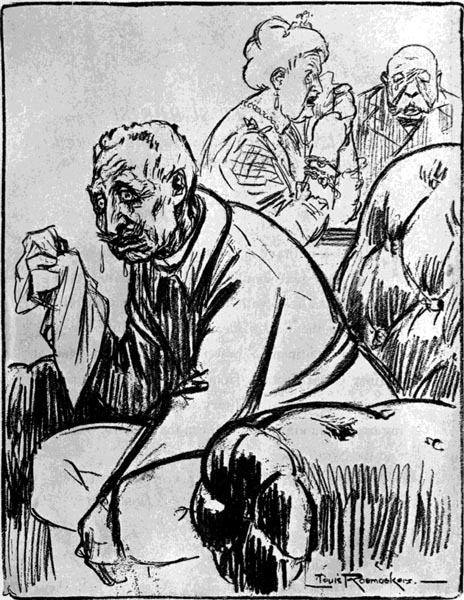
ANOTHER GERMAN “VICTORY”
Reading edition
In June the Germans once more turned to the East and the North-East Coast. On June 4, 1915, there was a raid, doing some slight damage; and two days later there was another, by far the most serious of any that had yet happened. The raiders succeeded in reaching a town on the East Coast during the night and bombed it at their leisure. One large drapery house was struck and was completely wrecked, the entire building—a somewhat old one—collapsing. Some working-class streets were very badly damaged, a number of houses destroyed, and many people injured. It was one of the peculiarities of this raid that, unlike most of the others, all the people injured were struck while indoors. The total casualties here were twenty-four killed, about sixty seriously injured, and a larger number slightly injured.
Times History of the War.
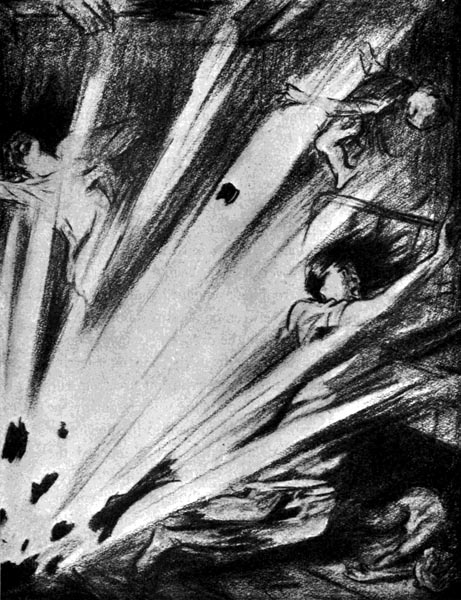
“He was a brave ‘Zepp,’ he had already killed over one hundred women and children”
The outrage (see preceding page) was quickly avenged by a young British naval airman, Flight Sub-Lieut. R. A. J. Warneford, in one of the most brilliant aerial exploits of the war.
On the morning of June 7 at 3 a.m. he encountered a Zeppelin returning from the coast of Flanders to Ghent, and chased it, mounting above it and sailing over it at a height of 6,000 feet. Zeppelin and aeroplane exchanged shots, and when the Zeppelin was between one and two hundred feet immediately below him he dropped six bombs on it. One bomb hit the Zeppelin fairly, causing a terrific explosion, and setting the airship on fire from end to end. Warneford’s aeroplane was caught by the force of the explosion and turned upside down, but he succeeded in righting it before it touched the ground. He was forced to alight within the German lines. Nevertheless he restarted his engine, though not without great difficulty, and in due course returned to his station without damage. Only the framework of the Zeppelin was left, the crew being all burned or mangled, and the body of the machine being completely destroyed.
Times History of the War.