"Quicksilver" (continued 7)
Reading edition
“Pull, then, a hundred more,” cried Dexter excitedly. “Oh, do make it two, Bob! He’ll be tired out by then.”
“I’m a-going to pull a hundred,” grumbled Bob, “and then give it up. Now then!”
The sculls splashed the water almost together, and for a few strokes the boys pulled vigorously and well; but it was like the last bright flashes of an expiring candle, and long before the half-hundred was reached the dippings of the blades grew slower and slower. Then they became irregular, while, to add to the horror of the position, the man in pursuit seemed to have been keeping a reserve of strength ready for such an emergency, and he now came on rapidly.
Bob would have proposed putting ashore once more, but, in avoiding the various crafts, they had now contrived to be about midstream, and in his horror and dread of the coming enemy all thought of scheming seemed to have been driven out of his head.
He uttered a despairing yell, and began to tug at his oar once more; Dexter followed his example, and the distance again increased.
But only for a few minutes, then they seemed to be growing weaker, their arms became like lead; their eyes grew dim, and the end was very near.
“Ah, I’ve got yer at last, have I?” shouted the man, who was not forty yards away now.
“Not yet,” muttered Dexter. “Pull, Bob, pull!”
Bob responded by going through the motion of rowing, but his scull did not dip into the water, and, meeting with no resistance, he went backwards off the seat, with his heels in the air.
Dexter jumped up, seized his companion’s scull, and, weary as he was, with all the stubborn English pluck which never knows when it is beaten, he reseated himself, shipped his scull, and bent forward to try, inexperienced as he was, to make another effort for escape.
As he seated himself, breathless and panting hard, he gave one glance at his enemy, then another over his shoulder at a boat on ahead, which it would be his duty to avoid, for it seemed to be going right across his track.
Then he began to row, putting the little strength he had left into his last strokes.
“Ah, it’s no good,” cried the man triumphantly. “I’ve got yer at last.”
“How—ow!” yelled Bob, with a cry like a Newfoundland dog shut out on a cold night.
“Drop that there rowing, or I’ll—”
Dexter heard no more. He was pulling frantically, but making hardly any way. Then he heard voices ahead, glanced round with his sculls raised, and found that he was running right toward the craft just ahead.
Another moment and there was a bump.
The man had driven his little tub right into the stern of the gig, and as he laid hold he snarled out—
“I knew I should ketch yer.”
“How—ow!” yelled Bob again, from where he lay on his back in the bottom of the boat, his legs still over the seat.
Bump!
There was another shock, and Dexter started up, saw that he had run into the boat ahead, and that one of the two sailors, who had been rowing, had taken hold of the bows.
He saw that at a glance, but he also saw something else which seemed to freeze the blood in his breast.
For there, seated in the stern of that large boat into which he had run, were the Doctor, Sir James Danby, old Dan’l, and Peter.
Chapter Thirty Nine.
Brought to Book.
Dexter did not pause a moment. It did not occur to him that he was utterly exhausted, and could hardly move his arms. All he realised was the fact that on the one side was the man whom he had half-killed with the boat-hook, just about to stretch out his hand to seize him, on the other, those whom he dreaded far more, and with one quick movement he stepped on to the thwart of the gig, joined his hands, dived in, and disappeared from sight, in the muddy water.
For a few moments there was the silence of utter astonishment, and then the man who had pursued the boys down the river began to take advantage of the general excitement by keeping hold of the side of the gig and beginning to draw it away; but Bob set up such a howl of dismay that it drew Peter’s attention, and he too seized the boat from the other end, caught out the chain, and hooked it on to a ring-bolt of the big boat in which he sat.
“You drop that there, will yer!” cried the man. “It’s my boat.”
“How—ow!” cried Bob, in the most canine of yelps; and at the same moment the gig was literally jerked from the man’s hold, for the two sailors had given a tremendous tug at their oars to force the boat in the direction that Dexter was likely to take after his rise, and the next minute a dozen yards were between the tub and the gig.
“For heaven’s sake, mind! stop!” cried the doctor excitedly. “Don’t row, men, or you may strike him down.”
The men ceased rowing, and every eye began to search the surface of the water, but no sign of Dexter could be seen.
“He could not sink like that,” cried Sir James. “He must rise somewhere.”
But must or no, Dexter did not rise, and the men began to paddle softly down-stream, while the doctor stood up in the boat gazing wildly round.
“It was all my doing,” he said to himself. “Poor boy! poor boy!”
A feeling of horror that was unbearable seemed to be creeping over the occupants of the great boat. Even Dan’l, who looked upon Dexter as his mortal enemy, and who had suggested, in the hope of seeing him sent to prison, that the surest way of capturing the boys was to go down to the mouth of the river—even Dan’l felt the chill of horror as he mentally said—
“’Tain’t true. Them as is born to be hanged is sometimes drowned.”
But just then there was a tremendous splash, and the big boat rocked to and fro, the captive gig danced, and Bob uttered another of his canine yelps, for Peter had suddenly stepped on to the gunwale, dived in after something he had seen touch the surface of the water twenty yards lower down, where it had been rolled over and over by the rapid tide, and a minute later, as he swam vigorously, he shouted—“I’ve got him!”
And he was seen holding the boy’s head above the water, as he turned to try and stem the current, and swim back to the boat.
The task was not long, for the two sailors sent her down with a few vigorous sweeps of their oars, and Dexter and his rescuer were dragged over the side, as the man with the tub slowly backed away.
No time was lost in reaching the shore, and the insensible boy was carried up to the principal hotel in the port, where quite an hour elapsed before the surgeon whose services were sought was able to pause from his arduous task, and announce that his patient would live.
For it was a very narrow escape, and the surgeon said, as he shook hands with Dr Grayson—
“Some men would have given it up in despair, sir. But there he is, safe and sound, and, I dare say, boy-like, it will not be very long before he gets into some mischief again.”
Sir James Danby coughed, and Doctor Grayson frowned as he met his friend’s peculiar look. But nothing was said then till the surgeon had been up to see his patient once more, after which he returned, reported that Dexter had sunk into a sound slumber, and then took his leave.
“I suppose we shall not go back to Coleby to-night?” said Sir James.
“I shall not,” said the doctor; “but, my dear Danby, pray don’t let me keep you.”
“Oh! you will not keep me,” said Sir James quietly. “I’ve got to make arrangements about my boat being taken up the river.”
“Why not let my men row it back!” said the doctor.
“Because I did not like to impose on your kindness.”
“Then they may take it?”
“I shall only be too grateful,” said Sir James.
Nothing more was said till they had ordered and sat down to a snug dinner in the hotel, when Sir James opened the ball.
“Now, Grayson,” he said, “I happen to be a magistrate.”
“Yes, of course,” said the doctor uneasily.
“Well, then, I want to have a few words with you about those two boys.”
The doctor nodded.
“Your groom is with your protégé, and your old gardener has that other young scoundrel in charge.”
“In charge?” said the doctor.
“Yes; you may call it so. I told him not to lose sight of the young rascal, and I also told your groom to exercise the same supervision over the other.”
“But surely, my dear Danby, you do not mean to—”
“Deal with them as I would with any other offender? Why not?”
The doctor had no answer ready, so Sir James went on—
“I valued that boat very highly, and certainly I’ve got it back—with the exception of the stains upon the cushions—very little the worse. But this was a serious theft, almost as bad as horse-stealing, and I shall have to make an example of them.”
“But one of them has been terribly punished,” said the doctor eagerly.
“Pooh! not half enough, sir. Come, Grayson, of course this has completely cured you of your mad folly!”
“My mad folly!” cried the doctor excitedly. “May I ask you what you mean?”
“Now, my dear Grayson, pray don’t be angry. I only say, as an old friend and neighbour, surely you must be ready to agree that your wild idea of making a gentleman out of this boy—one of the dregs of our civilisation—is an impossibility?”
“Nothing of the sort, sir,” cried the doctor angrily. “I never felt more certain of the correctness of my ideas.”
“Tut—tut—tut—tut!” ejaculated Sir James. “Really, Grayson, this is too much.”
“Too much, sir? Nothing of the kind. A boyish escapade. Nothing more.”
“Well!” said Sir James drily, “when such cases as this are brought before us at the bench, we are in the habit of calling them thefts.”
“Theft: pooh! No, no!” cried the doctor stubbornly. “A boyish prank. He would have sent the boat back.”
“Would he?” said Sir James drily. “I suppose you think his companion would have done the same?”
“I have nothing to do with the other boy,” said the doctor shortly. “It was a most unfortunate thing that Dexter should have made his acquaintance.”
“Birds of a feather flock together, my dear Grayson,” said Sir James.
“Nothing of the kind, sir. It was my fault,” cried the doctor. “I neglected to let the boy have suitable companions of his own age; and the consequence was that he listened to this young scoundrel, and allowed himself to be led away.”
“Do I understand aright, from your defence of the boy, that you mean to forgive him and take him back!”
“Certainly!” said the doctor.
“Grayson, you amaze me! But if I prove to you that you are utterly wrong, and that the young dog is an arrant thief, what then?”
“Then,” said the doctor, “I’m afraid I should have to— No, I wouldn’t. I would try and reform him.”
“Well,” said Sir James, “if you choose to be so ultra lenient, Grayson, you must; but I feel that I have a duty to do, and as soon as we have had our wine I propose that we have the prisoners here, and listen to what they have to say.”
“Prisoners?”
“Yes. What else would you call them?”
Before the doctor could stand up afresh in Dexter’s defence a waiter entered the room.
“Beg pardon, sir, but your groom says would you be good enough to step upstairs?”
“Bless my heart!” cried the doctor. “Is it a relapse?”
He hurried up to the room where Dexter had been sleeping, to find that, instead of being in bed, he was fully dressed, and lying on the floor, with Peter the groom holding him down.
“Why, what’s the matter!” cried the doctor, as he entered the room hastily, followed by Sir James.
“Matter, sir?” said Peter, “matter enough. If I hadn’t held him down like this here I believe he’d ’a’ been out o’ that window.”
“Why, Dexter!” cried the doctor.
The boy struggled feebly, and then, seeing the futility of his efforts, he lay still and closed his eyes.
“Went off fast asleep, sir, as any one would ha’ thought,” said Peter. “And seeing him like that I thought I’d just go down and fetch myself a cup o’ tea; but no sooner was I out o’ the room than he must have slipped out and dressed hisself—shamming, you know—and if I hadn’t come back in the nick o’ time he’d have been gone.”
The doctor frowned, and Sir James looked satisfied, as he gave him a nod.
“Going to run away, eh!”
“Yes, Sir James,” said the groom; “and it was as much as I could do to hold him.”
“Get up, Peter,” said the doctor.
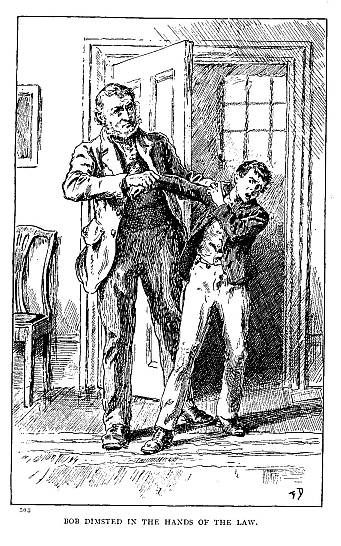
The groom rose, and Dexter leapt up like a bit of spring, and darted toward the door.
But Sir James was close to it, and catching the boy by the arm he held him.
“Take hold, of him, my man,” he said; “and don’t let him go.”
Peter obeyed, getting a tight grip of Dexter’s wrist.
“Now, you give in,” he whispered. “It’s no good, for I shan’t let go.”
“Bring him down,” said Sir James sternly.
Peter shook his head warningly at Dexter, and then, as Sir James and the doctor went down to their room, Peter followed with his prisoner, who looked over the balustrade as if measuring the distance and his chance if he made a jump.
“Now,” said Sir James, as the boy was led into the room; “stand there, sir, and I warn you that if you attempt to run away I shall have in the police, and be more stern. You, my man, go and tell the gardener to bring up the other boy.”
Peter left the room after giving Dexter a glance, and the doctor began to walk up and down angrily. He wanted to take the business into his own hands, but Sir James was a magistrate, and it seemed as if he had a right to take the lead.
There was a painful silence, during which Dexter stood hanging his head, and feeling as if he wished he had been drowned, instead of being brought round to undergo such a painful ordeal as this.
Ten minutes must have elapsed before a scuffling was heard upon the stairs, and Bob Dimsted’s voice whimpering—
“You let me alone, will yer? I never done nothing to you. Pair o’ great cowards, y’are. Don’t knock me about, or it’ll be the worse for yer. Hit one o’ your own size. I never said nothing to you.”
This was continued and repeated right into the room, Dan’l looking very severe and earnest, and holding on by the boy’s collar, half-dragging him, while Peter pushed behind, and then closed the door, and stood before it like a sentry.
“You have not been striking the boy, I hope!” said the doctor.
“Strike him, sir? no, not I,” said Dan’l; “but I should like to. Been a-biting and kicking like a neel to get away.”
Sir James had never seen an eel kick, but he accepted the simile, and turning to Bob, who was whimpering and howling—“knocking me about”—“never said nothing to him”—“if my father was here,” etc.
“Silence!” roared Sir James, in his severest tones; and Bob gave quite a start and stared.
“Now, sir,” said Sir James. “Here, both of you; stand together, and mind this: it will be better for both of you if you are frank and straightforward.”
“I want to go home,” whimpered Bob. “Y’ain’t no business to stop me here.”
“Silence!” roared Sir James; and Bob jumped.
Dexter did not move, but stood with his eyes fixed to the floor.
“Now!” said Sir James, gazing fiercely at Bob; “you know, I suppose, why you are here.”
“No! I don’t,” whimpered Bob. “And y’ain’t no business to stop me. I want to go home.”
“Silence, sir!” roared Sir James again. “You do not know? Well, then, I will tell you. You are before me, sir, charged with stealing a boat.”
“Oh!” ejaculated Bob, in a tone of wondering innocence.
“And I perhaps ought to explain,” said Sir James, looking hard at Dr Grayson, and speaking apologetically, “that in an ordinary way, as the boat was my property, I should feel called upon to leave the bench; but as this is only a preliminary examination, I shall carry it on myself. Now, sir,” he continued, fixing Bob’s shifty eyes, “what have you to say, sir, for stealing my boat?”
“Stealing your boat!” cried Bob volubly; “me steal your boat, sir? I wouldn’t do such a thing.”
“Why, you lying young dog!”
“No, sir, I ain’t, sir,” protested Bob, as Dexter slowly raised his head and gazed at him. “It wasn’t me, sir. It was him, sir. That boy, sir. I begged him not to, sir; but he would do it.”
“Oh, it was Dexter Grayson, was it?” said Sir James, glancing at the doctor, who was gnawing his lip and beating the carpet with his toe.
“Yes, sir; it was him, sir. I was t’other side o’ the river one day, sir,” rattled off Bob, “and he shouts to me, sir, ‘Hi!’ he says, just like that, sir, and when I went to him, sir, he says, ‘Let’s steal the old cock’s boat and go down the river for a game.’”
“Well?” said Sir James.
“Well, sir, I wouldn’t, sir,” continued Bob glibly. “I said it would be like stealing the boat; and I wouldn’t do that.”
“Oh!” said Sir James.
“Is this true, Dexter!” said the doctor sternly.
“No, sir. He wanted me to take the boat.”
“Oh, my!” cried Bob. “Hark at that now! Why, I wouldn’t ha’ done such a thing.”
“No, you look a nice innocent boy,” said Sir James.
“Yes, sir; and he was allus at me about that boat, and said he wanted to go to foreign abroad, he did, and the best way, he said, was to steal that there boat and go.”
“Oh,” said Sir James. “And what more have you to say, sir?”
“It isn’t true, sir,” said Dexter, making an effort to speak, and he gazed angrily at his companion. “Bob here wanted me to go with him, and he persuaded me to take the boat.”
“Oh! only hark at him!” cried Bob, looking from one to the other.
“And I thought it would be like stealing the boat to take it like that.”
“Well, rather like it,” said Sir James sarcastically.
“And so I sent that letter and that money to pay for it, sir, and I meant to send the rest if it wasn’t quite enough.”
“Ah!” ejaculated the doctor eagerly.
“What letter? What money?” said Sir James.
“That money I sent by Bob Dimsted, sir, to put in your letter-box.”
“I never received any money,” cried Sir James. “You sent some money!”
“Yes, sir; before we took the boat, sir.”
“Ah!” ejaculated the doctor again.
“And you sent it by this boy?”
“Yes, sir.”
“Then where is the money?” cried Sir James, turning upon Bob.
“I dunno, sir. I never had no money.”
“You did, Bob, in a letter I gave you,” cried Dexter excitedly.
“Oh!” ejaculated Bob, with an astonished look. “Well, if ever!”
“This is getting interesting,” said Sir James. “Now, sir, where’s that money?”
“He never give me none, sir,” cried Bob indignantly. “I never see no letter.”
“You did. The one I threw across the river to you!” said Dexter.
“Oh, what a cracker!” cried Bob. “I never had no letter, gen’lemen, and I never see no money. Why don’t you tell the truth, and the kind gentlemen won’t be so hard on you?”
“I am telling the truth,” cried Dexter, “It was you asked me to take the boat.”
“Only hark at him!” cried Bob. “Why yer’d better say yer didn’t take all yer clothes off and swim acrost and get it.”
“I did,” said Dexter; “but you made me. You said you’d go.”
“Oh, you can tell ’em!” cried Bob.
“And I did give you the money to take.”
“Oh, well, I’ve done,” said Bob. “I never did hear a chap tell lies like you can!”
“I think that will do,” said Sir James, with a side glance at the doctor, who sat with his brows knit, listening. “Now, you will both go back to the room where you are to sleep, and I warn you that if you attempt to escape, so surely will you be taken by the police, and then this matter will assume a far more serious aspect. You, my men, will have charge of these two boys till the morning. They are not to speak to each other, and I look to you to take them safely back to Coleby by the early train. That will do.”
Dexter darted one glance at the doctor, but his face was averted.
“Please, sir,” he began.
“Silence!” cried Sir James. “I think Dr Grayson understands your character now, and I must say I never heard a more cowardly attempt to fasten a fault upon another. No: not a word. Go!”
Bob Dimsted was already outside with Dan’l’s knuckles in the back of his neck.
Peter was more gentle with his prisoner as he led him away.
“You’ve been and done it now, young fellow,” he said. “I would ha’ told the truth.”
Dexter turned to him with bursting heart, but he could not speak, and as soon as he was in his bedroom he threw himself before a chair, and buried his face in his hands, so as to try and shut out the reproachful face of Helen, which he seemed to see.
“I wish I had not been saved,” he cried at last passionately, and then he glanced at the window, and listened, while downstairs Sir James was saying quietly—
“There, Grayson, I think you understand the boy’s character now.”
“No,” said the doctor shortly. “I don’t think I do.”
“What!”
“And I’d give a hundred pounds,” said the doctor, “to know the truth.”
“Really,” said Sir James, laughing. “You are the most obstinate man I ever knew.”
“Yes,” said the doctor. “I suppose I am.”
Chapter Forty.
“Huzza! We’re Homeward Bound!”
The first wet day there had been for a month. It seemed as if Mother Nature had been saving up all her rain in a great cistern, and was then letting it out at once.
No glorious sapphire seas and brilliant skies; no golden sunshine pouring down on tawny sands, over which waved the long pinnate leaves of the cocoa-nuts palms; no brilliant-coloured fish that seemed to be waiting to be caught; no glorious life of freedom, with their boat to enable them to glide from isle to isle, where it was always summer; but rain, rain, rain, always rain, pouring down from a lead-black sky.
A dreary prospect, but not half so dreary as Dexter’s spirits, as he thought of what was to come.
If ever boy felt miserable, he did that next morning, for they were all going back to Coleby. The romantic adventure was at an end, and he was like a prisoner.
Why had he left the doctor’s? What had he gained by it but misery and wretchedness. Bob had turned out one of the most contemptible cowards that ever stepped. He had proved to be a miserable tyrannical bully when they were alone; and in the face of danger a wretched cur; while now that they were caught he was ready to tell any lie to save his own skin.
What would Helen say to him, and think of him? What would Mr Hippetts say—and Mr Sibery?
He would be sent back to the Union of course; and one moment he found himself wishing that he had never left the schools to be confronted with such misery as he felt now.
They were on their way back by rail. The doctor, who had not even looked at him, was in a first-class carriage with Sir James, and the plans being altered, and the boat sent up to Coleby by a trustworthy man, Bob and Dexter were returning in a second-class carriage, with their custodians, Peter and old Dan’l.
They were the sole occupants of the carriage, and soon after starting Bob turned to Dexter—
“I say!” he exclaimed.
Dexter started, and looked at him indignantly—so angrily, in fact, that Bob grinned.
“Yer needn’t look like that,” he said. “If I forgives yer, and begins to talk to yer, what more d’yer want!”
Dexter turned away, and looked out of the window.
“There’s a sulky one!” said Bob, with a coarse laugh; and as he spoke it was as if he were appealing to old Dan’l and Peter in turn. “He would do it. I tried to hold him back, but he would do it, and he made me come, and now he turns on me like that.”
“You’re a nice un,” said Peter, staring hard at the boy.
“So are you!” said the young scamp insolently. “You mind yer own business, and look arter him. He’s got to look arter me—ain’t yer, sir!”
“Yes,” said old Dan’l sourly; “and I’m going to stuff a hankychy or something else into your mouth if you don’t hold your tongue.”
“Oh, are yer!” said Bob boldly. “I should just like to see yer do it.”
“Then you shall if you don’t keep quiet.”
Bob was silent for a few minutes, and then amused himself by making a derisive grimace at Dan’l as soon as he was looking another way.
“It was all his fault,” he said sullenly. “He would take the boat.”
“Ah, there was about six o’ one of you, and half a dozen of the other,” said Peter, laughing. “You’ll get it, young fellow. Six weeks hard labour, and then four years in a reformatory. That’s about your dose.”
“Is it?” said Bob derisively. “That’s what he’ll get, and serve him right—a sneak.”
Dexter’s cheeks, which were very pale, began to show spots of red, but he stared out of the window.
“I shouldn’t have gone, only he was allus at me,” continued Bob. “Allus. Some chaps ain’t never satisfied.”
Old Dan’l filled his pipe, and began to smoke.
“You’ll get enough to satisfy you,” said Peter. “I say, Dan’l, you wouldn’t mind, would you?”
“Mind what?” grunted Dan’l.
“Giving me one of the noo brooms. One out o’ the last dozen—the long switchy ones. I could just cut the band, and make about three reg’lar teasers out of one broom.”
“What, birch-rods?” said Dan’l, with a sort of cast-iron knocker smile.
“Yes,” said Peter.
“Mind? no, my lad, you may have two of ’em, and I should like to have the laying of it on.”
“Yah! would yer!” said Bob defiantly. “Dessay you would. I should like to see yer.”
“But you wouldn’t like to feel it,” said Peter. “My eye, you will open that pretty mouth of yours! Pig-ringing’ll be nothing to it.”
“Won’t be me,” said Bob. “It’ll be him, and serve him right.”
Dexter’s cheeks grew redder as he pictured the disgrace of a flogging scene.
“Not it,” continued Peter. “You’ll get all that. Sir James’ll give it you as sure as a gun. Won’t he, Dan’l!”
“Ah!” ejaculated the old gardener. “I heerd him say over and over again that ha wouldn’t lose that boat for a hundred pounds. You’ll get it, my gentleman!”
“No, I shan’t, ’cause I didn’t do it. He’ll give it to him, and sarve him right, leading me on to go with him, and boasting and bouncing about, and then pretending he wanted to buy the boat, and saying he sent me with the money.”
“So I did,” cried Dexter, turning sharply round; “and you stole it, and then told lies.”
“That I didn’t,” said Bob. “I never see no money. ’Tain’t likely. It’s all a tale you made up, and—oh!”
Bob burst into a regular bellow of pain, for, as he had been speaking, he had edged along the seat a little from his corner of the carriage, to bring himself nearer Dexter, who occupied the opposite diagonal corner. As Bob spoke he nodded his head, and thrust his face forward at Dexter so temptingly, that, quick as lightning, the latter flung out his right, and gave Bob a back-handed blow in the cheek.
“Oh! how!” cried Bob; and then menacingly, “Here, just you do that again!”
Dexter’s blood was up. There was a long course of bullying to avenge, and he did that again, a good deal harder, with the result that the yell Bob emitted rose well above the rattle of the carriage.
“Well done, young un,” cried Peter delightedly. “That’s right. Give it him again. Here, Dan’l, let ’em have it out, and we’ll see fair!”
“No, no, no!” growled the old gardener, stretching out one hand, and catching Bob by the collar, so as to drag him back into his corner—a job he had not the slightest difficulty in doing. “None o’ that. They’d be blacking one another’s eyes, and there’d be a row.”
“Never mind,” cried Peter, with all the love of excitement of his class.
“No, no,” said Dan’l. “No fighting;” and he gave Dexter a grim look of satisfaction, which had more kindness in it than any the boy had yet seen.
“Here, you let me get at him!” cried Bob.
“No, no, you sit still,” said Dan’l, holding him back with one hand.
The task was very easy. A baby could have held Bob, in spite of the furious show of struggling that he made, while, on the other hand, Peter sat grinning, and was compelled to pass one arm round Dexter, and clasp his own wrist, so as to thoroughly imprison him, and keep him back.
“Better let ’em have it out, Dan’l,” he cried. “My one’s ready.”
“Let me go. Let me get at him,” shrieked Bob.
“Yes, let him go, Dan’l,” cried Peter.
But Dan’l shook his head, and as Bob kept on struggling and uttering threats, the old man turned upon him fiercely—
“Hold your tongue, will you?” he roared. “You so much as say another word, and I’ll make you fight it put.”
Bob’s jaw dropped, and he stared in astonishment at the fierce face before him, reading therein so much determination to carry the threat into effect that he subsided sulkily in his corner, and turned away his face, for every time he glanced at the other end of the carriage it was to see Peter grinning at him.
“Ah!” said Peter at last; “it’s a good job for us as Dan’l held you back. You made me shiver.”
Bob scowled.
“He’s thoroughbred game, he is, Dan’l.”
Dan’l chuckled.
“He’d be a terrible chap when his monkey was up. Oh, I am glad. He’d ha’ been sure to win.”
“Let him alone,” growled Dan’l, with a low chuckling noise that sounded something like the slow turning of a weak watchman’s rattle; and then muttering something about white-livered he subsided into his corner, and solaced himself with his pipe.
Meanwhile Peter sat opposite, talking in a low tone to Dexter, and began to ask him questions about his adventures, listening with the greatest eagerness to the short answers he received, till Dexter looked up at him piteously.
“Don’t talk to me, please, Peter,” he said. “I want to sit and think.”
“And so you shall, my lad,” said the groom; and he too took out a pipe, and smoked till they reached Coleby.
Dexter shivered as he stepped out upon the platform. It seemed to him that the stationmaster and porters were staring at him as the boy who ran away, and he was looking round for a way of retreat, so as to escape what was to come, when Sir James and the doctor came up to them.
“You can let that boy go,” said the doctor to Dan’l.
“Let him go, sir?” cried the gardener, looking at both the gentlemen in turn.
Sir James nodded.
Bob, whose eyes had been rat-like in their eager peering from face to face, whisked himself free, darted to the end of the platform, and uttered a loud yell before he disappeared.
“Look here, Dexter,” said the doctor coldly; “I have been talking to Sir James on our way here. Now sir, will you give me your word not to try and escape?”
Dexter looked at him for a moment or two.
“Yes, sir,” he said at last, with a sigh.
“Then come with me.”
“Come with you, sir?”
Dexter looked at his stained and muddy clothes.
“Yes,” said the doctor; “come with me.”
Sir James shrugged his shoulders slightly, and gave the doctor a meaning look.
“Good-bye, Grayson,” he said, and he shook hands.
“As for you, sir,” he added sternly, as he turned to Dexter, “you and your companion have had a very narrow escape. If it had not been for your good friend here, matters would have gone ill with you—worse perhaps than you think.”
Dexter hung his head, and at a sign from the doctor went to his side, and they walked out of the station with Dan’l and Peter behind.
The doctor stopped.
“You have given me your word, sir, that you will come quietly up to the house,” he said coldly.
“Yes, sir,” said Dexter sadly.
The doctor, signed to Dan’l and Peter to come up to them.
“You can go on first,” he said; and the men passed on.
“I don’t want you to feel as if you were a prisoner, Dexter,” said the doctor gravely. “It is one of the grandest things in a gentleman—his word—which means his word of honour.”
Dexter had nothing he could say; and with a strange swelling at the throat he walked on beside the doctor, gazing at the pavement a couple of yards in front of him, and suffering as a sensitive boy would suffer as he felt how degraded and dirty he looked, and how many people in the town must know of his running away, and be gazing at him, now that he was brought back by the doctor, who looked upon him as a thief.
Every house and shop they passed was familiar. There were several of the tradespeople too standing at their doors ready to salute the doctor, and Dexter’s cheeks burned with shame. His punishment seemed more than he could bear.
In another ten minutes they would be at the house, where Maria would open the door, and give him a peculiar contemptuous look—the old look largely intensified; and but for the doctor’s words, and the promise given, the boy felt that he must have run away down the first side-turning they passed.
Then, as Maria faded from his mental vision, pleasant old Mrs Millett appeared, with her hands raised, and quite a storm of reproaches ready to be administered to him, followed, when she had finished and forgiven him, as he knew she would forgive him, by a dose of physic, deemed by her to be absolutely necessary after his escapade.
The house at last, and everything just as Dexter had anticipated. Maria opened the door, and then wrinkled up her forehead and screwed up her lips in a supercilious smile.
“Your mistress in!” said the doctor.
“Yes, sir, in the drawing-room, sir.”
“Hah!” ejaculated the doctor.
“Found him, sir? And brought him back!” cried a familiar voice; and Mrs Millett hurried into the hall. “O you bold, bad boy!” she cried. “How dare you? And you never took your medicine that night. Oh, for shame! for shame!”
“Hush, hush, Mrs Millett!” said the doctor sternly. “That will do.”
He signed to the old lady, and she left the hall, but turned to shake her head at the returned culprit as she went, while Maria gave him a meaning smile as soon as the doctor’s back was turned, and then passed through the baize door.
The doctor stood there silent and frowning for a few minutes, with his eyes fixed upon the floor, while Dexter awaited his sentence, painfully conscious, and longing for the doctor to speak and put him out of his misery.
“Now, sir,” he said at last; “you had better go in and speak to Miss Grayson. She is waiting, I suppose, to see you in that room. I sent word we were coming.”
“No, no,” said Dexter quickly. “Don’t send me in there, sir. You’d better send me back to the school, sir. I’m no good, and shall only get into trouble again; please send me back. I shouldn’t like to see Miss Grayson now.”
“Why not!” said the doctor sternly.
“Because you don’t believe me, sir, and she won’t, and—and—you had better send me back.”
“I am waiting to see you here, Dexter,” said Helen gravely, and the boy started away with a cry, for the drawing-room door had opened silently, and Helen was standing on the mat.
Chapter Forty One.
How the Doctor punished.
Dexter’s interview with Helen was long and painful, for at first it seemed as if she had lost all confidence and hope in the boy, till, realising all this, he cried in a wild outburst of grief—“I know how wrong it all was, but nearly everybody here seemed to dislike me, and I did tell the truth about the boat, but no one believes. Do—do ask him to send me away.”
There was a long silence here, as, for the first time, in spite of a hard fight, Dexter could not keep back his tears.
The silence was broken by Helen, who took his hand, and said gently—
“I believe you, Dexter. I am sure you would not tell a lie.”
In an instant his arms were round her neck, and he was clinging to her unable to speak, but his eyes, his convulsed face, telling the doctor’s daughter that she was right.
That evening, feeling very strange and terribly depressed, Dexter had gone to his old bedroom, thinking it must be for the last time, and wondering how Mr Sibery would treat him.
Helen had sat talking to him for quite a couple of hours, winning from him a complete account of his adventures, and in return relating to him how concerned every one had been on the discovery of his evasion, and how bitterly the doctor had been mortified on learning later on that the boat had been taken. Who were the culprits was known in the course of the day, with the result that, acting on the suggestion already alluded to, the doctor had gone down to the mouth of the river to wait the coming of the borrowers of the boat.
Helen had exacted no promises from Dexter. He had made none, but sat there with her, his hand in hers, wondering and puzzled how it was that he could have run away, but the more he thought, the more puzzled he grew.
“Well,” said the doctor that evening, as he sat with his daughter, “I told Danby that I was more determined than ever; that it was only a boyish escapade which he must look over to oblige me, and he agreed after making a great many bones about it. But I feel very doubtful, Helen, and I may as well confess it to you.”
“Doubtful?” she said.
“Yes, my dear. I could have forgiven everything if the boy had been frank and honest—if he had owned to his fault in a straightforward way; but when he sought to hide his own fault by trying to throw it on another, I couldn’t help feeling disgusted.”
“But, papa—”
“Let me finish, my dear. I know what you are about to say. Woman-like, you are going to take his part. It will not do. The lying and deceit are such ugly blemishes in the boy’s character that I am out of heart.”
“Indeed, papa?” said Helen, smiling. “Ah, it’s all very well for you to laugh at me because I have failed over my hobby; but I feel I’m right all the same, and I tell you that his ignorance, vulgarity—”
“Both of which are wonderfully changed.”
“Yes, my dear, granted, and he does not talk so much about the workhouse. He was a great deal better, and I could have forgiven this mad, boyish prank—though what could have influenced him, I don’t know.”
“I can tell you,” said Helen. “A boy’s love of adventure. The idea of going off in a boat to discover some wonderful island where he could live a Robinson Crusoe kind of life.”
“A young donkey!” cried the doctor. “But there, it’s all off. I could have forgiven everything, but the cowardly lying.”
“Then, poor fellow, he is forgiven.”
“Indeed, no, my dear. He goes back to the Union to-morrow; but I shall tell Hippetts to apprentice him to some good trade at once, and I will pay a handsome premium. Confound Hippetts! He’ll laugh at me.”
“No, he will not, papa.”
“Yes, he will, my dear. I know the man.”
“But you will not be laughed at.”
“Why not?”
“Because you will not send Dexter back.”
“Indeed, my dear, but I shall. I am beaten, and I give up.”
“But you said you would forgive everything but the deceit and falsehood.”
“Yes, everything.”
“There is no deceit and falsehood to forgive.”
“What?”
“Dexter has told me everything. The simple truth.”
“But he should have told it before, and said he took the boat.”
“He told the truth in every respect, papa.”
“My dear Helen,” said the doctor pettishly, “you are as obstinate as I am. The lying young dog—”
“Hush, papa, stop!” said Helen gently. “Dexter is quite truthful, I am sure.”
“That is your weak woman’s heart pleading for him,” said the doctor. “No, my dear, no; it will not do.”
“I am quite certain, papa,” said Helen firmly, “that he spoke the truth.”
“How do you know, my dear?”
“Because Dexter told me again and again before he went up to bed.”
“And you believe him?”
“Yes, and so will you.”
“Wish I could,” said the doctor earnestly. “I’d give a hundred pounds to feel convinced.”
“You shall be convinced for less than that, papa,” said Helen merrily. “Give me a kiss for my good news.”
“There’s the kiss in advance, my dear. Now, where is the news?”
“Here, papa. If Dexter were the hardened boy you try to make him—”
“No, no: gently. He makes himself one.”
”—he would have gone up to bed to-night careless and indifferent after shedding a few fictitious tears—”
“Very likely.”
”—and be sleeping heartily by now.”
“As he is, I’ll be bound,” cried the doctor energetically.
“Of course, I may be wrong,” said Helen, “but Dexter strikes me as being so sensitive a boy—so easily moved, that, I am ready to say, I am sure that he is lying there half-heartbroken, crying bitterly, now he is alone.”
“I’ll soon prove that,” said the doctor sharply; and, crossing the room in his slippers, he silently lit a candle and went upstairs to Dexter’s door, where he stood listening for a few minutes, to find that all was perfectly still. Then turning the handle quietly, he entered, and it was quite half an hour before he came out.
“Well, papa?” said Helen, as the doctor returned to the drawing-room.
“You’re a witch, my dear,” he said.
“I was right?”
“You always are, my dear.”
“And you will not send him back to the Union schools!”
“Send him back!” said the doctor contemptuously.
“Nor have him apprenticed?” said Helen, with a laughing light in her eyes.
“Have him ap— Now that’s too bad, my dear,” cried the doctor. “Danby will laugh at me enough. You need not join in. Poor boy! I’m glad I went up.”
There was a pause, during which the doctor sat back in his chair.
“Do you know, my dear, I don’t feel very sorry that the young dog went off.”
“Not feel sorry, papa!”
“No, my dear. It shows that the young rascal has plenty of energy and spirit and determination.”
“I hope you did not tell him so!”
“My dear child, what do you think me?” cried the doctor testily. “By the way, though, he seems to thoroughly see through his companion’s character now. I can’t help wishing that he had given that confounded young cad a sound thrashing.”
“Papa!”
“Eh? No, no: of course not,” said the doctor. “I was only thinking aloud.”
Helen sat over her work a little longer, feeling happier than she had felt since Dexter left the house; and then the lights were extinguished, and father and daughter went up to bed.
The doctor was very quiet and thoughtful, and he stopped on the stairs.
“Helen, my dear,” he whispered, “see the women-servants first thing in the morning, and tell them I strictly forbid any allusion whatever to be made to Dexter’s foolish prank.”
Helen nodded.
“I’ll talk to the men myself,” he said. “And whatever you do, make Mrs Millett hold her tongue. Tut—tut—tut! Now, look at that!”
He pointed to a tumbler on a little papier-maché tray standing at Dexter’s door.
“Never mind that, dear,” said Helen, smiling. “I dare say it is only camomile-tea, and it shows that the poor boy has not lost his place in dear old Millett’s heart.”
Helen kissed her father, and stopped at her own door feeling half-amused and half-tearful as she saw the old man go on tiptoe to Dexter’s room, where, with the light of the candle shining on his silver hair and beard, he tapped gently with his knuckles.
“Asleep, Dexter?”
There was a faint “No, sir!” from within.
“Make haste and go to sleep,” said the doctor. “Good-night, my boy. God bless you!”
Helen saw him smile as he turned away from the door, and it may have been fancy, but she thought she saw a glistening as of moisture in one corner of his eye.
“Poor Dexter!” she said softly, as she entered her room, while the boy, as he lay there in the cool, soft sheets, utterly wearied out, but restless and feverish with excitement, felt the doctor’s last words send, as it were, a calm, soothing, restful sensation through his brain, and five minutes later he was sleeping soundly, and dreaming that some one bent over him, and said, “Good-night. God bless you!” once again.
Chapter Forty Two.
Bob Dimsted’s Medicine.
It was some time before Dexter could summon up courage to go down to the breakfast-room. That he was expected, he knew, for Mrs Millett had been to his door twice, and said first that breakfast was ready, and, secondly, that master was waiting.
When he did go in, he could hardly believe that he had been away, for there was a kiss from Helen, and a frank “Good morning,” and shake of the hand from the doctor, not the slightest allusion being made to the past till breakfast was nearly over, when Maria brought in a note.
“Hah! From Limpney,” said the doctor. “I sent Peter on to say that Dexter was back, and that I should like the lessons to be resumed this morning.”
Dexter’s eyes lit up. The idea of being busy over lessons once more seemed delightful.
“Confound his impudence!” said the doctor angrily, as he ran through the note. “Hark here, Helen: ‘Mr Limpney’s compliments, and he begs to decline to continue the tuition at Dr Grayson’s house.’”
Helen made a gesture, and glanced at her father meaningly—
“Eh? Oh! Ah! Yes, my dear. Well, Dexter, you’ll have to amuse yourself in the garden this morning. Go and have a few hours’ fishing.”
“If you please, sir, I’d rather stay in here if I might, and read.”
“No, no, no,” said the doctor cheerily. “Fine morning. Get Peter to dig you some worms, and I’ll come and look at you presently. It’s all right, my boy. We said last night we’d draw a veil over the past, eh? You go and have a good morning’s fishing.”
Dexter was at his side in a moment, had thrust his hand in the doctor’s, and then fled from the room.
“Want to show him we’ve full confidence in him again. Bah, no! That boy couldn’t look you in the face and tell you a lie. My dear Helen, I’m as certain of my theory being correct as of anything in the world. But hang that Limpney for a narrow-minded, classic-stuffed, mathematic-bristling prig! We’ll have a better.”
Dexter felt a strange hesitancy; but the doctor evidently wished him to go and fish, so he took his rod, line, and basket, and was crossing the hall when he encountered Mrs Millett.
“It was very nice of you, my dear, and I’m sure it will do you good. You did take it all now, didn’t you?”
“Yes, every drop,” said Dexter, smiling; and the old lady went away evidently highly gratified.
Old Dan’l was busy tidying up a flower-bed as he reached the lawn, and, to Dexter’s astonishment, he nodded and gave him another of his cast-iron smiles.
Further down the garden Peter was at work.
“Dig you up a few worms, Master Dexter? Course I will. Come round to the back of the old frames.”
A curious sensation of choking troubled Dexter for a few moments, but it passed off, and in a short time he was furnished with a bag of red worms, and walking down to the river he sat down and began to fish with his mind going back to the night of his running away, and he seemed to see it all again; the undressing, the hesitation, and the cold plunge after his clothes, and all the rest of the miserable dreary time which had proved so different from what he had pictured in his mind.
Peter had said that the fish would “bite like fun at them worms.”
But they did not, for they had no chance. The worms crawled round and round the canvas bag, and played at making Gordian knots with each other, while several fish came and looked at the unbaited hook which Dexter offered for their inspection, but preferred to leave the barbed steel alone.
For quite half an hour Dexter sat there dreamily gazing at his float, but seeing nothing but the past, when he started to his feet, for there was a splash in the water close to his feet, the drops flying over him, and there, across the river, grinning and looking very dirty, was Bob Dimsted.
“Yah! Who stole the boat?” he cried.
Dexter flushed up, but he made no reply. Only took out his line, and this time he baited it and threw in again.
“Yah; who stole the boat!” cried Bob again. “I say, ain’t he been licked? Ain’t his back sore?”
Dexter set his teeth hard and stared at his float, as Bob baited his own line, and threw in just opposite, to begin fishing just as if nothing had happened.
It was a painful position. To go on fishing was like taking up with Bob again; to go away seemed like being afraid.
But Dexter determined upon this last, drew out his line, and was stooping to pick up his basket, when Bob broke into a derisive war-dance—
“Yah, yah!” he cried. “Yer ’bliged to go. Yah! yer miserable, white-faced sneak! g’ome! g’ome! yah!”
Dexter banged down his basket again, and threw in his line with a big splash, as his eyes flashed defiance across the stream.
“Ah! it’s all very fine,” said Bob; “but yer dussen’t do that if it weren’t for the river. Why, if I’d got yer here I’d bung both yer eyes up for yer. Yah! yer sneak!”
“Here, you just be off. D’yer hear!” cried an angry voice; and Peter came up, broom in hand.
“She yarn’t,” cried Bob? “Who are you? This ain’t your field. Stop as long as I like. Yah!”
“Wish I was over the other side and I’d pitch you in, you sarcy young vagabond.”
“So are you!” cried Bob. “You dussen’t touch me. Fish here as long as I like. Pair o’ cowards, that’s what you are—pair o’ cowards. Fight either of yer one hand.”
“Wish we was over there,” said Peter; “and we’d make you sing another song, my fine fellow.”
“Would yer? Yah! who cares for you!”
“Look here, you’ve no business to come opposite our place to fish!” cried Peter, “so be off!”
“Yah! ’tain’t your place. Stop and fish here as long as I like; and if ever I meet him anywheres I’ll give him such a licking as’ll make him squeal.”
“You be off!”
“Shan’t.”
“Oh, you won’t, won’t you?” cried a gruff voice; and old Dan’l came from behind a laurustinus clump. “You, Peter—you go and get a basket full o’ them brickbats from down by the frames, and we’ll soon see whether he’ll stop there.”
“Yah! go on with your old brickbats. Who cares for you!” cried Bob. “Yah! look at him! Who stole the boat, and cried to go home again? Who stole the boat?”
“Oh, if I could only get across!” said Dexter, in a hoarse low voice.
“Would you give it him if you could!” said old Dan’l, with a grim laugh.
“Yes,” said Dexter, between his teeth.
“Ay, he would, Dan’l,” said Peter excitedly. “I wish he was over yonder.”
“Yah! yah! look at the old caterpillar-killers,” cried Bob. “Who stole the boat? Yah!”
These last were farewell shots.
“They won’t bite here,” cried Bob, moving off, “but don’t you think you frightened me away. Come as often as I like. Yah! take him home!”
Dexter’s face was scarlet as he watched his departing enemy, thinking the while of his own folly in leaving his friends for such a wretched young cur as that.
“Think he would?” said Peter.
“Ay, two on him,” said Dan’l, after glancing cautiously up toward the house.
“Shall us?”
“Ay, if you like, my lad,” said Dan’l. “Say, youngster, if we help you acrost will you go and start him outer the west medder?”
“Yes,” cried Dexter excitedly.
“All right. Don’t make a row.”
Old Dan’l went off, and Peter followed, to return in five minutes with a great shallow wooden cistern across the long barrow, old Dan’l looking very grim as he walked by his side, and carrying the familiar clothes-prop.
“There, that’s as good as a punt,” he said. “Look here! You’d better kneel down on it; I should take off my jacket and weskit, and roll up my sleeves, if I was you.”
Dexter’s eyes sparkled as he followed this bit of advice, while Dan’l took one end of the cistern, Peter the other, and they gently launched it in the little river.
“Ain’t scared of him, are yer!” said Dan’l.
Dexter gave him a sharp look.
“That he ain’t,” said Peter. “Look here, Master Dexter,” he whispered, “don’t let him hug you, but give it him right straight out, and he’ll be down and howl in two two’s.”
Dexter made no reply, but stepped into the great shallow punt-like contrivance, seized the prop handed to him, and prepared to use it, but the strong steady thrust given by Peter sent him well on his journey, and in less than a minute he was across.
“Come on, Dan’l,” cried Peter. “Don’t I wish we was acrost too!”
They crept among the trees at the extreme corner of the garden, where they could hold on by the boughs, and crane their necks over the river, so as to see Dexter tearing along the opposite bank into the next meadow where Bob was fishing, in happy ignorance of the approach of danger; and, to further take off his attention, he had just hooked a good-sized perch, and was playing it, when Dexter, boiling over with the recollection of many injuries culminating in Bob’s cowardly lies, came close up and gave a formal announcement of his presence by administering a sounding crack on the ear.
Bob dropped his rod into the river, and nearly jumped after it as he uttered a howl.
“Look at that!” cried Peter, giving one of his legs a slap. “Oh, I wish I was there!”
Bob was as big a coward as ever stepped. So is a rat; but when driven to bay a rat will fight.
Bob was at bay, and he, being in pain, began to fight by lowering his head and rushing at his adversary.
Dexter avoided the onslaught, and gave Bob another crack on the ear.
Then, trusting in his superior size and strength, Bob dashed at Dexter again, and for a full quarter of an hour there was a fierce up and down fight, which was exceedingly blackguardly and reprehensible no doubt, but under the circumstances perfectly natural.
Dexter got a good deal knocked about, especially whenever Bob closed with him; but he did not get knocked about for nothing. Very soon there were a number of unpleasant ruddy stains upon his clean white shirt, but the blood was Bob’s, and consequent upon a sensation of his nose being knocked all on one side.
There was a tooth out—a very white one on the grass, but that tooth was Bob’s, and, in addition, that young gentleman’s eyes wore the aspect of his having been interviewing a wasps’ nest, for they were rapidly closing up, and his whole face assuming the appearance of a very large and puffy unbaked bun.
Then there was a cessation of the up and down fighting; Bob was lying on his back howling after his customary canine fashion, and Dexter was standing over him with his doubled fists, his face flushed, his eyes flashing, teeth set, and his curly hair shining in the sun.
“It’s splendid, Dan’l, old man,” cried Peter, slapping his fellow-servant on the back. “I wouldn’t ha’ missed it for half a crown.”
“No,” said Dan’l. “Hang him! he’s got some pluck in him if he ain’t got no breed. Brayvo, young un! I never liked yer half—”
Dan’l stopped short, and Peter stepped back against the dividing fence.
“Beg pardon, sir?”
“I said how did that boy get across the river!” said the doctor sternly.
There was no reply.
“Now no subterfuges,” said the doctor sharply.
Peter looked at Dan’l in dismay, but Dan’l spoke out—
“Well, sir, beg pardon, sir, that young cub come up to the side abusing Master Dexter, and calling him names, and he let us have it too.”
“Yes; go on.”
“Well, sir, Master Dexter was a-chafing like a greyhound again his collar, and Peter and me fetched the old wooden cistern, and let him punt hisself across, and the way he went into him, sir—boy half as big again as hisself, and—”
“That will do,” said the doctor sternly. “Here, Dexter! Come here, sir!”
Dexter turned in dismay, and came faltering back.
“The moment he is home again!” said the doctor angrily.
“Yah! Coward! G’ome, g’ome!” yelled Bob, jumping up on seeing his enemy in retreat. “Come here again and I’ll knock yer silly. Yah!”
“Dexter!” roared the doctor; “go back and knock that young blackguard’s head off. Quick! Give it him! No mercy!”
Dexter flew back, but Bob flew faster to the hedge, where he leaped and stuck; Dexter overtaking him then, and administering one punch which drove his adversary through, and he got up and ran on again.
“Hi! Dexter!” shouted the doctor; and the boy returned slowly, as Peter stood screwing up his face to look serious, and Dan’l gave his master one of his cast-iron smiles.
“Well, yes, Dan’l, it was excusable under the circumstances,” said the doctor. “But I do not approve of fighting, and—er—don’t say anything about it indoors.”
“No, sir, cert’nly not, sir,” said the men, in a breath; and just then Dexter stood on the far bank looking anxiously across.
“Mind how you come,” cried the doctor. “That’s right; be careful. Give me your hand. Bless my soul! the skin’s off your knuckles. We shall have to tell Miss Grayson after all.”
Dexter looked up at him wildly. He could not speak.
“Better put that cistern back,” said the doctor quickly; and then to Dexter—
“There, slip on your things, and go up to your room and bathe your face and hands. No, stop! I’ll go on first, and shut the drawing-room door.”
The doctor hurried away, and as soon as he was out of sight, Dexter, who had slowly put on his waistcoat and jacket, gazed disconsolately at the two men.
“What shall I do?” he said dolefully.
“Do!” cried Peter; “why, you did it splendid: he won’t come no more.”
“But the doctor!” faltered Dexter, with the spirit and effervescence all gone.
“What, master!” cried Dan’l. “He won’t say no more. Here, shake hands, my lad. It was fine.”
“Hi! Dexter! Here, my boy, quick!” came the doctor’s voice. “It’s all right. She has gone out.”
“There!” said Dan’l, laughing; and Dexter ran in.
Chapter Forty Three.
The Right Place for a Backward Boy.
“Where’s Dexter?” said the doctor.
“Down the garden,” said Helen.
“Humph! Hope he is not getting into fresh mischief.”
“I hope not, papa,” said Helen; “and really I think he is trying very hard.”
“Yes,” said the doctor, going on with his writing. “How are his knuckles now? can he hold a pen?”
“I think I would let him wait another day or two. And, papa, have you given him a good talking to about that fight?”
“No. Have you?”
“Yes, two or three times; and he has promised never to fight again.”
“My dear Helen, how can you be so absurd?” cried the doctor testily. “That’s just the way with a woman. You ask the boy to promise what he cannot perform. He is sure to get fighting again at school or somewhere.”
“But it seems such a pity, papa.”
“Pooh! pish! pooh! tchah!” ejaculated the doctor, at intervals. “He gave that young scoundrel a good thrashing, and quite right too. Don’t tell him I said so.”
The doctor had laid down his pen to speak, but he took it up again and began writing, but only to lay it aside once more.
“Dear me! dear me!” he muttered. “I don’t seem to get on with my book as I should like.”
He put down his pen again, rose, took a turn or two up and down the room, and then picked up the newspaper.
“Very awkward of that stupid fellow Limpney,” he said, as he began running down the advertisements.
“What did he say, papa, when you spoke to him?”
“Say? Lot of stuff about losing prestige with his other pupils. Was sure Lady Danby did not like him to be teaching a boy of Dexter’s class and her son. Confound his impudence! Must have a tutor for the boy of some kind.”
Helen glanced uneasily at her father, and then out into the garden.
“Plenty of schools; plenty of private tutors,” muttered the doctor scanning the advertisements. “Hah!”
“What is it, papa!”
The doctor struck the paper in the middle, doubled it up, and then frowned severely as he thrust his gold spectacles up on to his forehead.
“I’ve made a mistake, my dear,—a great mistake.”
“About Dexter!”
“Yes: a very great mistake.”
“But I’m sure he will improve,” said Helen anxiously.
“So am I, my dear. But our mistake is this: we took the boy from the Union schools, and we kept him here at once, where every one knew him and his late position. We ought to have sent him away for two or three years, and he would have come back completely changed, and the past history forgotten.”
“Sent him to a boarding-school!”
“Well—er! Hum! No, not exactly,” said the doctor, pursing up his lips. “Listen here, my dear. The very thing! just as if fate had come to my help.”
The doctor rustled the paper a little, and then began to read—
“‘Backward and disobedient boys.’”
“But Dexter—”
“Hush, my dear; hear it all. Dexter is backward, and he is disobedient; not wilfully perhaps, but disobedient decidedly. Now listen—
“‘Backward and disobedient boys.—The Reverend Septimus Mastrum, MA Oxon, receives a limited number of pupils of neglected education. Firm and kindly treatment. Extensive grounds. Healthy situation. For terms apply to the Reverend Septimus Mastrum, Firlands, Longspruce Station.’”
“There! What do you say to that?” said the doctor.
“I don’t know what to say, papa,” said Helen rather sadly. “Perhaps you are right.”
“Right!” cried the doctor. “The very thing, my dear. I’ll write to Mr Mastrum at once. Three or four years of special education will be the making of the boy.” The doctor sat down and wrote.
The answer resulted in a meeting in London, where the Reverend Septimus Mastrum greatly impressed the doctor. Terms were agreed upon, and the doctor came back.
“Splendid fellow, my dear. Six feet high. Says Mrs Mastrum will act the part of a mother to the boy.”
“Does he seem very severe, papa?”
“Severe, my dear? Man with a perpetual smile on his countenance.”
“I do not like men with perpetual smiles on their countenances, papa.”
“My dear Helen, do not be so prejudiced,” said the doctor angrily. “I have seen Mr Mastrum: you have not. I have told him everything about Dexter; he applauds my plan, and assures me that in two or three years I shall hardly know the boy, he will be so improved.” Helen sighed.
“We had a long discussion about my book, and he agrees that I am quite right. So pray do not begin to throw obstacles in the way.”
Helen rose and kissed her father’s forehead.
“I am going to do everything I can to aid your plans, papa,” she said, smiling. “Of course I do not like parting with Dexter, and I cannot help feeling that there is some truth in what you say about a change being beneficial for a time; but Dexter is a peculiar boy, and I would rather have had him under my own eye.”
“Yes, of course, my dear. Very good of you,” said the doctor; “but this way is the best. Of course he will have holidays, and we shall go to see him, and so on.”
“When is he to go, papa?”
“Directly.”
“Directly?”
“Well, in a day or two.”
Helen was silent for a moment or two, and then she moved toward the door.
“Where are you going!” said the doctor sharply.
“To make preparations, and warn Mrs Millett. He must have a good box of clothes and linen.”
“To be sure, of course,” said the doctor. “Get whatever is necessary. It is the right thing, my dear, and the boy shall go at once.”
The doctor was so energetic and determined that matters progressed very rapidly, and the clothes and other necessaries increased at such a rate in Dexter’s room that most boys would have been in a state of intense excitement.
Dexter was not, and he avoided the house as much as he could, spending a great deal of time in the garden and stables.
“So they’re going to send you off to school, eh, Master Dexter?” said Peter, pausing to rest on his broom-handle.
“Yes, Peter.”
“And you don’t want to go? No wonder! I never liked school. Never had much on it, neither; but I know all I want.”
“Hullo!” said a voice behind them; and, turning, Dexter saw Dan’l standing behind him, with the first dawn of a smile, on his face.
Dexter nodded, and began to move away.
“So you’re going off, are yer!” said Dan’l. “Two floggings a day for a year. You’re in for it, youngster.”
“Get out,” said Dexter. “They don’t flog boys at good schools.”
“Oh, don’t they?” said Dan’l. “You’ll see. Well, never mind! And, look here, I’ll ask master to let me send you a basket o’ apples and pears when they’re ripe.”
“You will, Dan’l!” cried Dexter excitedly.
“Ay: Peter and me’ll do you up a basket, and take it to the station. Be a good boy, and no more Bob Dimsted’s.”
Dan’l chuckled as if he had said something very funny, and walked away.
“Here, don’t look dumpy about it, my lad,” said Peter kindly. “’Tain’t for ever and a day.”
“No, Peter,” said Dexter gloomily, “it isn’t for ever.”
“Sorry you’re going, though, my lad.”
“Are you, Peter!”
“Am I? Course I am. A man can’t help liking a boy as can fight like you.”
Matters were growing harder for Dexter indoors now that his departure was so near. Mrs Millett was particularly anxious about him; and so sure as the boy went up to his room in the middle of the day, it was to find the old housekeeper on her knees, and her spectacles carefully balanced, trying all his buttons to see if they were fast.
“Now I’m going to put you up two bottles of camomile tea, and pack them in the bottom of your box, with an old coffee-cup without a handle. It just holds the right quantity, and you’ll promise me, won’t you, Master Dexter, to take a dose regularly twice a week!”
“Yes; I’ll promise you,” said Dexter.
“Now, that’s a good boy,” cried the old lady, getting up and patting his shoulder. “Look here,” she continued, leading him to the box by the drawers, “I’ve put something else in as well.”
She lifted up a layer of linen, all scented with lavender, and showed him a flat, round, brown-paper parcel.
“It’s not a very rich cake,” she said, “but there are plenty of currants and peel in, and I’m sure it’s wholesome.”
Even Maria became very much interested in Master Dexter’s boots and shoes, and the parting from the doctor’s house for the second time promised to be very hard.
It grew harder as the time approached, for, with the gentleness of an elder sister, Helen exercised plenty of supervision over the preparation. Books, a little well-filled writing-case and a purse, were among the things she added.
“The writing-case is for me, Dexter,” she said, with a smile.
“For you?” he said wonderingly.
“Yes, so that I may have, at least, two letters from you every week. You promise that?”
“Oh yes,” he said, “if you will not mind the writing.”
“And the purse is for you,” she said. “If you want a little more money than papa is going to allow you weekly, you may write and ask me.”
It grew harder still on the morning of departure, and Dexter would have given anything to stay, but he went off manfully with the doctor in the station fly, passing Sir James Danby and Master Edgar on the road.
“Humph!” grunted the doctor. “See that, Dexter!”
“I saw Sir James laugh at you when he nodded.”
“Do you know why!”
Dexter was silent for a few minutes.
“Because he thinks you are foolish to take so much trouble over me.”
“That’s it, Dexter,” said the doctor eagerly. “So, now, I’ll tell you what I want you to do.”
“Yes, sir?”
“Show him that I’m right and he’s wrong.” Dexter looked a promise, for he could not speak just then, nor yet when they had passed through London that afternoon, reached Longspruce station, and been driven to the Reverend Septimus Mastrum’s house, five miles away among the fir-trees and sand of that bleak region.
Here the doctor bade him “Good-bye,” and Dexter, as he was standing in the great cold hall, felt that he was commencing a new phase in his existence.
Chapter Forty Four.
Peter Cribb sees a Ghost.
Helen rang the bell one evening and Maria answered the summons.
“Papa thinks he would like a little supper, Maria, as we dined early to-day. Bring up a tray. There is a cold chicken, I think!”
“Yes, ’m,” said Maria, and disappeared, but was back in a few minutes.
“If you please, ’m, Mrs Millett says there is no cold chicken, ’m.”
“Indeed?” said Helen wonderingly. “Very well, then, the cold veal pie.”
“Yes, ’m.”
Maria disappeared, and came back again. “Please, ’m, Mrs Millett says there is no veal pie.”
“Then tell her to make an omelette.”
“Yes, ’m.” Maria left the room and came back. “Please, ’m, Mrs Millett says there’s no eggs, and it’s too late to get any more.”
“Ask Mrs Millett to come here,” said Helen; and the old lady came up, looking very red.
“Why, Millett,” said Helen, “this is very strange. I don’t like to find fault, but surely there ought to have been a chicken left.”
“I’m very glad you have found fault, Miss,” said Mrs Millett, “for it’s given me a chance to speak. Yes; there ought to have been a chicken, and the veal pie too; but I’m very sorry to say, Miss, they’re gone.”
“Gone?”
“Yes, Miss. I don’t know how to account for it, but the things have begun to go in the most dreadful way. Bread, butter, milk, eggs, meat, everything goes, and we’ve all been trying to find out how, but it’s no good.”
“This is very strange, Millett. Have you no idea how it is they go?”
“No, Miss; but Dan’l fancies it must be that rough boy who led Master Dexter away. He says he’s sure he caught sight of him in the dark last night. Somebody must take the things, and he seems to be the most likely, knowing the place as he does.”
“This must be seen to,” said Helen; and she told the doctor. Consequently a watch was kept by the gardener and the groom, but they found nothing, and the contents of the larder continued to disappear.
“If it were a man,” said the doctor, on being told of what was going on, “I’d set the police to work, but I hate anything of that kind with a boy. Wait a bit, and he will get more impudent from obtaining these things with impunity, and then he will be more easily caught.”
“And then, papa?” said Helen.
“Then, my dear? Do you know that thin Malacca cane in the hall? Yes, you do. Well, my dear, the law says it is an assault to thrash a boy, and that he ought to be left to the law to punish, which means prison and degradation. I’m going to take that cane, my dear, and defy the law.”
But somehow or another Master Bob Dimsted seemed to be as slippery as an eel. He saw Peter one day and grinned at him from the other side of the river. Two days later he was seen by Dan’l, who shook his fist at him, and Bob said—
“Yah!”
“Have you heard from Master Dexter, Miss!” said Mrs Millett one morning.
“No, Millett, and I am rather surprised. He promised so faithfully to write.”
“Ah, yes, Miss,” said the old lady; “and he meant it, poor boy, when he promised, but boys are such one’s to forget.”
Helen went into the library where she found the doctor biting the end of his pen, and gazing up into a corner of the room.
“I don’t seem to be getting on as I could wish, my dear. By the way, we haven’t heard from that young dog lately. He promised me faithfully to write regularly.”
Helen thought of Mrs Millett’s words, but said nothing, and at that moment Maria entered with the letters.
“From Dexter?” said Helen eagerly.
“Humph! No! But from Longspruce! I see: from Mr Mastrum.”
The doctor read the letter and frowned.
Helen read it, and the tears stood in her eyes.
“The young scoun—”
“Stop, papa!” said Helen earnestly. “Do not condemn him unheard.”
“Then I shall have to go on without condemning him, for we’ve seen the last of him, I suppose.”
“O papa!”
“Well, it looks like it, my dear; and I’m afraid I’ve made a great mistake, but I don’t like to own it.”
“Wait, papa, wait!” said Helen.
“What does he say? Been gone a fortnight, and would not write till he had had the country round thoroughly searched. Humph! Afraid he has got to Portsmouth, and gone to sea.”
Helen sighed.
“‘Sorry to give so bad an account of him,’” muttered the doctor, reading bits of the letter—“‘treated him as his own son—seemed to have an undercurrent of evil in his nature, impossible to eradicate—tried everything, but all in vain—was beginning to despair, but still hopeful that patience might overcome the difficulty—patience combined with affectionate treatment, but it was in vain—after trying to persuade his fellow-pupils one by one, and failing, he threatened them savagely if they dared to betray him, and then he escaped from the grounds, and has not been seen since.’”
There was a painful silence in the doctor’s library for a few minutes.
“‘Patience combined with affectionate treatment,’” read the doctor again. “Helen, I believe that man has beaten and ill-used poor Dexter till he could bear it no longer, and has run away.”
“I’m sure of it, papa,” cried Helen excitedly. “Do you think he will come back!”
“I don’t know,” said the doctor. “Yes, I do. No; he would be afraid. I’d give something to know how to go to work to find him.”
“If you please, sir, may I come in?” said a pleasant soft voice.
“Yes, yes, Millett, of course. What is it?”
“Dan’l has been to say, sir, that he caught sight of that boy, Bob Dimsted, crawling in the garden last night when it was dark, and chased him, but the boy climbed one of the trained pear-trees, got on the wall, and escaped.”
“Confound the young rascal!” cried the doctor.
“And I’m sorry to say, sir, that two blankets have been stolen off Master Dexter’s bed.”
There was a week of watching, but Bob Dimsted was not caught, and the doctor sternly said that he would not place the matter in the hands of the police. But all the same the little pilferings went on, and Mrs Millett came one morning, with tears in her eyes, to say that she couldn’t bear it any longer, for only last night a whole quartern loaf had been taken through the larder bars, and, with it, one of the large white jars of black-currant jam.
Mrs Millett was consoled with the promise that the culprit should soon be caught, and two nights later Peter came in to announce to the doctor that he had been so near catching Bob Dimsted that he had touched him as he chased him down the garden, and that he would have caught him, only that, without a moment’s hesitation, the boy had jumped into the river and swum across, and so escaped to the other side.
“Next time I mean to have him,” said Peter confidently, and this he repeated to Mrs Millett and Maria, being rewarded with a basin of the tea which had just come down from the drawing-room.
It was just two days later that, as Helen sat with her work under the old oak-tree in the garden—an old evergreen oak which gave a pleasant shade—she became aware of a faint rustling sound.
She looked up, but could see nothing, though directly after there was a peculiar noise in the tree, which resembled the chopping of wood.
Still she could see nothing, and she had just resumed her work, thinking the while that Dexter would some day write, and that her father’s correspondence with the Reverend Septimus Mastrum had not been very satisfactory, when there was a slight scratching sound.
She turned quickly and saw that a ragged-looking squirrel had run down the grey trunk of the tree, while, as soon as it saw her, it bounded off, and to her surprise passed through the gateway leading into the yard where the old stable stood.
Helen Grayson hardly knew why she did so, but she rose and followed the squirrel, to find that she was not alone, for Peter the groom was in the yard going on tiptoe toward the open door of the old range of buildings.
He touched his cap on seeing her.
“Squir’l, Miss,” he said. “Just run in here.”
“I saw it just now,” said Helen. “Don’t kill the poor thing.”
“Oh no, Miss; I won’t kill it,” said Peter, as Helen went back into the garden. “But I mean to catch it if I can.”
Peter went into the dark old building and looked round, but there was no sign of the squirrel. Still a little animal like that would be sure to go upwards, so Peter climbed the half-rotten ladder, and stood in the long dark range of lofts, peering among the rafters and ties in search of the bushy-tailed little creature.
He walked to the end in one direction, then in the other, till he was stopped by an old boarded partition, in which there was a door which had been nailed up; but he remembered that this had a flight of steps, or rather a broad-stepped old wood ladder, on the other side, leading to a narrower loft right in the gable.
“Wonder where it can be got,” said Peter to himself; and then he turned round, ran along the loft, dropped down through the trap-door, and nearly slipped and fell, so hurried was his flight.
Half-across the yard he came upon Dan’l wheeling a barrow full of mould for potting.
“Hallo! what’s the matter?”
Peter gasped and panted, but said nothing.
“Haven’t seen a ghost, have you?” said Dan’l.
“Ye–es. No,” panted Peter.
“Why, you white-faced, cowardly noodle!” cried Dan’l. “What d’yer mean?”
“I—I. Come out of here into the garden,” whispered Peter.
Dan’l was going down the garden to the potting-shed, so he made no objection, and, arrived there, Peter, with solemn emphasis, told how he had gone in search of the squirrel, and that there was something up in the loft.
“Yes,” said old Dan’l contemptuously—“rats.”
“Yes; I know that,” said Peter excitedly; and his eyes looked wild and dilated; “but there’s something else.”
Dan’l put down the barrow, and sat upon the soft mould as he gave his rough stubbly chin a rub.
“Lookye here, Peter,” he said; “did yer ever hear tell about ghosts being in old buildings?”
“Yes,” said Peter, with an involuntary shiver, and a glance across the wall at a corroded weathercock on the top of the ancient place.
“Well, my lad, ghosts never comes out in the day-time: only o’ nights; and do you know what they are?”
Peter shook his head.
“Well, then, my lad, I’ll tell you. I’ve sin several in my time. Them as you hears and don’t see’s rats; and them as you sees and don’t hear’s howls. What d’yer think o’ that?”
“It wasn’t a rat, nor it wasn’t a howl, as I see,” said Peter solemnly; “but something gashly horrid, as looked down at me from up in the rafters of that there dark place, and it made me feel that bad that I didn’t seem to have no legs to stand on.”
“Tchah!” cried the gardener. “What yer talking about?”
“Anything the matter?” said the doctor, who had come up unheard over the velvety lawn.
“Hush!” whispered Peter imploringly.
“Shan’t hush. Sarves you right,” growled Dan’l. “Here’s Peter, sir, just seen a ghost.”
“Ah! has he?” said the doctor. “Where did you see it, Peter?”
“I didn’t say it were a ghost, sir, I only said as I see something horrid up at end of the old loft when I went up there just now after a squir’l.”
“Squirrel!” said the doctor angrily. “What are you talking about, man? Squirrels live in trees, not in old lofts. You mean a rat.”
“I know a squir’l when I see one, sir,” said Peter; “and I see one go ’crost the yard and into that old stable.”
“Nonsense!” said the doctor.
“Did you find it, Peter!” said Helen from under the tree.
“Find what?” said the doctor.
“A squirrel that ran from here across the yard.”
Peter looked from one to the other triumphantly, as he said—
“No, Miss, I didn’t.”
“Humph!” grunted the doctor. “Then there was a squirrel!”
“Yes, sir.”
“And you saw something strange!”
“Yes, sir, something awful gashly, in the dark end, sir.”
“Bah!” cried the doctor. “There, go and get your stable lanthorn and we’ll see. Helen, my dear, we’ve got a ghost in the old stable loft: like to come and see it!”
“Very much, papa,” said Helen, smiling in a way that put Peter on his mettle, for the moment before he had been ready to beg off.
He went pretty quickly to get his stable lanthorn, and came back with it alight, and looking very pale and sickly, while he bore a stout broomstick in the other hand.
“For shame, man! Put away that absurd thing,” said the doctor, as he led the way through the gate in the wall, followed by Helen, Peter and Dan’l coming behind.
“Go first with the lanthorn,” said the doctor to the old gardener, but Peter was stirred to action now.
“Mayn’t I go first, sir!” he said.
“Oh yes, if you have enough courage,” said the doctor; and Peter, looking very white, led the way to the foot of the ladder, went up, and the others followed him to the loft, and stood together on the old worm-eaten boards.
The lanthorn cast a yellow glow through its horn sides, and this, mingling with the faint pencils of daylight which came between the tiles, gave a very peculiar look to the place, festooned as the blackened beams were with cobwebs, which formed loops and pockets here and there.
“There’s an old door at the extreme end there, or ought to be,” said the doctor. “Go and open it.”
Peter went on in advance.
“Mind the holes, my dear,” said the doctor. “What’s that?”
A curious rustling noise was heard, and, active as a young man, Dan’l ran back to the top of the ladder and descended quickly.
“Well ’tain’t me as is skeart now,” said Peter triumphantly.
Just then there was a sharp clap from somewhere in front, as if a small trap-door had been suddenly closed, and Dan’l’s voice came up through the boards.
“Look out!” he shouted, and his voice sounded distant. “There’s some one up in the far loft there. He tried to get down into one of the hay-racks, but I frightened him back.”
“Stop there!” said the doctor. “We’ll soon see who it is. Go on, Peter, and open that door. That young larder thief for a guinea, my dear,” he continued to Helen, as Peter went on in advance.
“Door’s nailed up, sir,” said the latter worthy, as he reached the old door, and held the lanthorn up and down.
“How came it nailed up?” said the doctor, as he examined the place. “It has no business to be. Go and get an iron chisel or a crowbar. Are you there, Daniel?”
“Yes, sir,” came from below. “I’m on the look-out. It’s that there young poacher chap, Bob Dimsted.”
Peter set the lanthorn on the floor and hurried off, leaving the little party watching and listening till he returned, but not a sound broke the silence, and there was nothing to see but the old worm-eaten wood and blackened tiles.
“I’ve brought both, sir,” said Peter breathlessly, and all eagerness now, for he was ashamed of his fright.
“Wrench it open, then,” said the doctor; and after a few sharp cracks the rotten old door gave way, and swung upon its rusty hinges, when a strange sight met the eyes of those who pressed forward into the further loft.
Chapter Forty Five.
A Startling Discovery.
The rough loft had been turned into a kind of dwelling-place, for there was a bed close under the tiles, composed of hay, upon which, neatly spread, were a couple of blankets. On the other side were a plate, a knife, a piece of bread, and a jam-pot, while in the centre were some rough boxes and an old cage, on the top of which sat the ragged squirrel.
“There,” said Peter triumphantly, as he pointed to the squirrel.
The doctor was looking eagerly round in search of the dweller in this dismal loft, but there was no one visible.
“Found him, sir?” came from below.
“No, not yet,” replied the doctor. “Here, Peter, go up that other place.”
There was no hesitation on the groom’s part now. He sprang up the second ladder and went along under the roof, but only to come back shaking his head.
“No one up there, sir.”
“Are you sure he did not come down!” cried the doctor, as Peter lifted a rough trap at the side, through which, in bygone days, the horses’ hay had been thrust down.
“Quite sure, sir,” shouted back Dan’l. “I just see his legs coming down, and he snatched ’em up again, and slammed the trap.”
“The young rascal!” said the doctor; “he’s here somewhere. There must be some loose boards under which he is hidden.”
But there was not a loose board big enough to hide Bob Dimsted; and after another search the doctor rubbed his head in a perplexed manner.
“Shall I come up, sir, and have a look?” said Dan’l.
“No, no. Stay where you are, and keep a sharp look-out,” cried the doctor. “Why, look here,” he continued to Helen; “the young scoundrel has been leading a nice life here, like a Robinson Crusoe in an uninhabited island. Ah! at last!” shouted the doctor, staring straight before him; “there he is. Here, Peter, hand me the gun!”
Peter stared at his master, whose eyes twinkled with satisfaction, for his feint had had the desired effect—that of startling the hiding intruder.
As the doctor’s words rang out there was a strange rustling sound overhead; and, as they all looked up, there came a loud crack, then another and another, and right up, nearly to the ridge of the roof, a leg came through, and then its fellow, in company with a shower of broken tiles, which rattled upon the rough floor of the loft.
The owner of the legs began to make a desperate effort to withdraw them, and they kicked about in a variety of peculiar evolutions; but before they could be extricated, Peter had climbed up to an oaken beam, which formed one of the roof ties, and from there reached out and seized one of the legs by the ankle.
“I’ve got him,” he cried gleefully. “Which shall we do, sir—pull him through, or get the ladder up to the roof and drag him out?”
“Here, Daniel! Come up,” said the doctor.
The old gardener came up eagerly; and one of his cast-iron grins expanded his face as he grasped the situation.
“Brayvo, Peter!” he cried. “That’s the way to ketch a ghost. Hold him tight, lad!”
The doctor smiled.
“Don’t let them hurt him, papa,” whispered Helen.
“Oh no; they shall not hurt him,” said the doctor quietly. Then, raising his voice—“Now, sir, will you come down quietly, or shall I send for the police to drag you out on to the roof?”
An indistinct murmur came down, after a vigorous struggle to get free.
“Woho! Woho, kicker!” cried Peter, speaking as if to a horse.
“What does he say!” said the doctor.
“Says he’ll come down if I’ll let go.”
“Don’t you trust him, sir,” cried Dan’l excitedly.
“I do not mean to,” said the doctor. “Will you come down quietly?” he shouted.
There was another murmur.
“Says ‘yes,’ sir,” cried Peter.
“Then, look here,” said the doctor, “you hold him tight, and you,” he continued to the gardener, “climb up on that beam and push off a few tiles. Then you can draw him down through there.”
“All right, sir,” cried Dan’l; and as Peter held on to the leg, the old gardener, after a good deal of grunting and grumbling, climbed to his side, and began to let in daylight by thrusting off tile after tile, which slid rattling down the side of the roof into the leaden guttering.
The opening let in so much daylight that the appearance of the old loft was quite transformed, but the group on the worm-eaten beam was the principal object of attention till just as Dan’l thrust off the fourth tile, when there was a loud crack, a crash, and gardener, groom, and their prisoner lay in a heap on the floor of the loft, while pieces of lath and tile rattled about their heads.
The old tie had given way, and they came down with a rush, to the intense astonishment of all; but the distance to fall was only about five feet, and the wonder connected with the fall was as nothing to that felt by Helen and her father, as the smallest figure of the trio struggled to his feet, and revealed the dusty, soot-smeared face of Dexter, with his eyes staring wildly from the Doctor to Helen and back again.
“Dexter!” cried Helen.
“You, sir!” cried the doctor.
“Well, I ham!” ejaculated Peter, getting up and giving his thigh a slap.
Dan’l sat on the floor rubbing his back, and he uttered a grunt as his face expanded till he displayed all his front teeth—a dismal array of four, and not worth a bite.
“Are you hurt?” cried Helen.
Dexter shook his head.
“Are either of you hurt?” said the doctor frowning.
“Screwed my off fetlock a bit, sir,” said Peter, stooping to feel his right ankle.
“Hurt?” growled Dan’l. “Well, sir, them’s ’bout the hardest boards as ever I felt.”
“Go and ask Mrs Millett to give you both some ale,” said the doctor; and the two men smiled as they heard their master’s prescription. “Then go on and tell the builder to come and patch up this old roof. Here, Dexter, come in.”
Dexter gave Peter a reproachful look, and limped after the doctor.
“Well, let’s go and have that glass o’ beer Peter,” said Dan’l. “Talk about pickles!”
“My!” said Peter, slapping his leg again. “Why, it were him we see every night, and as swum across the river. Why, he must ha’ swum back when I’d gone. I say, Dan’l, what a game!”
“Hah!” ejaculated the old gardener, wiping his mouth in anticipation. “It’s my b’lief, Peter, as that there boy’ll turn out either a reg’lar good un, or ’bout the wust as ever stepped.”
“Now, sir!” said the doctor, as he closed the door of the library, and then with a stern look at the grimy object before him took a seat opposite Helen. “What have you to say for yourself!”
Dexter glanced at Helen, who would not meet his gaze.
“Nothing, sir.”
“Oh, you have nothing to say! Let me see, now. You were sent to a good school to be taught by a gentleman, and treated as a special pupil. You behaved badly. You ran away. You came here and made yourself a den; you have been living by plunder ever since, and you have nothing to say!”