"Quicksilver" (continued 6)
Reading edition
It was pretty close, for as the stern of the boat left the shore the foremost man made a dash at it, missed, and nearly fell into the water.
Chapter Thirty Three.
The Life of the Free.
“Here,” cried the man, as he recovered himself, “it’s of no use. Come back!”
Dexter was so influenced by the man’s words that he was ready to go back at once. But Bob was made of different stuff, and he began now to work the boat along by paddling softly, fish-tail fashion.
“Do you hear!” roared the man, just as the other came trotting up, quite out of breath.
“Yah!” cried Bob derisively, as he began to feel safe. “Come back, you young scoundrel!” roared the man fiercely. “Here, Digges, fetch ’em back.”
He was a big black-whiskered man in a velveteen jacket, evidently a gamekeeper, and he spoke to his companion as if he were a dog.
This man hesitated for a moment or two.
“Go on! Fetch ’em back,” cried the keeper.
“But it’s so wet.”
“Wet? Well, do you want me to go? In with you.”
The underkeeper jumped off the bank at once into the water, which was about up to his knees; but by this time Bob was working the boat along more quickly, and before the underkeeper had waded out many yards Bob had seated himself, put out the second scull, and, helped by the stream, was able to laugh defiance at his would-be captors.
“Here, I ain’t going any further,” grumbled the underkeeper. “It will be deep water directly,” and he stopped with the current rippling just about his thigh.
“Are you coming back!” cried the keeper, looking round about him and pretending to pick up a big stone.
“No! Come arter us if you want us,” cried Bob, while Dexter crouched down watching the man’s hand, ready to dodge the missile he expected to see launched at them.
“If you don’t come back I’ll—”
The man did not finish his speech, but threw himself back as if about to hurl the stone.
“Yah!” cried Bob. “Y’ain’t got no stone.”
“No, but I’ve got a boat up yonder.”
“Go and fetch it, then,” cried Bob derisively.
“You young scoundrels! Landing here and destroying our plantations. I’ll send the police after you, and have you before the magistrates, you poaching young vagabonds!”
“So are you!” cried Bob.
“Hush, don’t!” whispered Dexter.
“Who cares for them?” cried Bob. “We weren’t doing no harm.”
“Here, come out, Digges, and you run across and send the men with a boat that way. I’ll go and get ours. We’ll soon have ’em!”
The man slowly waded out while the keeper trampled on the fire, stamping all over it, to extinguish the last spark, so that it should not spread, and then they separated, going in different directions.
“Row, Bob; row hard,” cried Dexter, who was in agony.
“Well, I am a-rowing, ain’t I? We warn’t doing no harm.”
“Let me have an oar.”
“Ketch hold, then,” cried Bob; and as soon as Dexter was seated they began to row as if for their lives, watching in turn the side of the river and the reach they were leaving behind in expectation of seeing the pursuers and the party who were to cut them off.
Dexter’s horror increased. He pictured himself seized and taken before a magistrate, charged with damaging, burning, and trespassing. The perspiration began to stand out in beads upon each side of his nose, his hair grew wet, and his cap stuck to his forehead as he toiled away at his oar, trying hard to obey the injunctions of his companion to pull steady—to keep time—not to dip his scull so deep, and the like.
As for Bob, as he rowed he was constantly uttering derisive and defiant remarks; but all the same his grubby face was rather ashy, and he too grew tremendously hot as he worked away at his scull for quite an hour, during which time they had not seen anything more formidable than half a dozen red oxen standing knee-deep in the water, and swinging their tails to and fro to drive away the tormenting flies.
“They hadn’t got no boat,” said Bob at last. “I know’d it all the time. Pretended to throw a stone at us when there wasn’t one near, only the one we tried to cook with, flee him take hold of it and drop it again!”
“No.”
“I did. Burnt his jolly old fingers, and serve him right. We never said nothing to him. He ain’t everybody.”
“But let’s get further away.”
“Well, we’re getting further away, stream’s taking us down. You are a coward.”
“You were frightened too.”
“No, I wasn’t. I laughed at him. I’d ha’ give him something if he’d touched me.”
“Then why did you run away?”
“’Cause I didn’t want no bother. Here, let’s find another good place, and catch some more fish.”
“It won’t be safe to stop yet, Bob.”
“Here, don’t you talk to me, I know what I’m about. We’ll row round that next bend, and I’ll show you a game then.”
“Hadn’t we better go on till we can buy some bread and butter?” said Dexter; and then as he saw some cattle in a field a happy hunger-engendered thought occurred to him,—“And perhaps we can get some milk.”
“You’re allus thinking of eating and drinking,” cried Bob. “All right! We’ll get some, then.”
They rowed steadily on, with Dexter rapidly improving in the management of his oar, till a farm-house was sighted near the bank; but it was on the same side as that upon which they had had their adventure.
They were afraid to land there, so rowed on for another quarter of a mile before another building was sighted.
This proved to be a farm, and they rowed up to a place where the cattle came down to drink, and a plank ran out on to a couple of posts, evidently for convenience in landing from a boat, or for dipping water.
“Here, I’ll go this time,” said Bob, as the boat glided up against the posts. “No games, you know.”
“What games!”
“No going off and leaving a fellow!”
“Don’t be afraid,” said Dexter.
“I ain’t,” said Bob, with a malicious grin. “Why, if a fellow was to serve me such a trick as that I should half-kill him.”
Bob landed, and as Dexter sat there in the swift-streamed Devon river gazing at the rippling water, and the glorious green pastures and quickly sloping hills, everything seemed to him very beautiful, and he could not help wishing that he had a pleasanter companion and some dinner.
Bob soon returned with a wine bottle full of milk and half a loaf, and a great pat of butter of golden yellow, with a wonderful cow printed upon it, the butter being wrapped in a rhubarb leaf, and the bread swung in Bob’s dirty neckerchief.
“Here y’are!” he cried, as he stepped into the boat and pushed off quickly, as if he felt safer when they were on the move. “We’ll go lower down, and then I’ll show you such a game.”
“Let’s have some bread and butter first,” said Dexter.
“No, we won’t; not till we get further away. We’ll get some fish first and light a fire and cook ’em, and—pull away—I’ll show yer.”
Dexter obeyed; but his curiosity was excited.
“Going to catch some more fish!”
“You wait and you’ll see,” was the reply; and in the expectation of a hearty meal matters looked more bright, especially as the day was glorious, and the scenery beautiful all round.
No signs of pursuit being seen, Dexter was ready to laugh with his companion now.
“I knew all the time,” said Bob, with superior wisdom in every intonation of his voice; “I should only have liked to see them come.”
Dexter said nothing, and the next minute, as they were in a curve of the river, where it flowed dark and deep, they ran the boat in once more beside a meadow edged with pollard willows.
“Now then, I’ll show you some fishing,” cried Bob, as he secured the boat.
“No, not now: let’s have something to eat first,” protested Dexter.
“Just you look here, young un, I’m captain,” cried Bob. “Do you know what cray-fish are!”
Dexter shook his head.
“Well, then, I’m just going to show yer.”
The water was about two feet deep, and ran slowly along by a perpendicular clayey bank on the side where they were, and, deliberately undressing, Bob let himself down into the river, and then began to grope along by the side, stooping from time to time to thrust his hand into some hole.
“Here, undo that chain, and let her drift by me,” he cried. “I shall fish all along here.”
Dexter obeyed—it seemed to be his fate to obey; and taking the boat-hook he held on easily enough by tree after tree, for there was scarcely any stream here, watching intently the while, as Bob kept on thrusting his hand into some hole.
“Oh!” cried Bob suddenly, as he leaned down as far as he could reach, and then rose slowly.
“Got one?”
“No: I missed him. It was an eel; I just felt him, and then he dodged back. Such a big un! They’re so jolly hard to hold.”
This was exciting, and now Dexter began for the first time to be glad that he had come.
“I’ve got him now!” cried Bob excitedly; and, rising from a stooping position, in which his shoulder was right underneath, he threw a dingy-looking little fresh-water lobster into the boat.
Dexter examined it wonderingly, and was favoured with a nip from its claws for his attention.
“Here’s another,” said Bob, and he threw one much larger into the boat, its horny shell rattling on the bottom.
“Are they good to eat?” said Dexter.
“Good to eat? Why, they’re lovely. You wait a bit. And, I say, you look how I do it; I shall make you always catch these here, so you’ve got to learn.”
Dexter paid attention to the process, and felt that there was not much to learn: only to find out a hole—the burrow of the cray-fish,—and then thrust in his hand, and, if the little crustacean were at home, pull it out. The process was soon learned, but the temptation to begin was not great.
Bob evidently found the sport exciting, however, for he searched away with more or less success, and very soon there were a dozen cray-fish of various sizes crawling about the bottom of the boat.
“There’s thousands of them here,” cried Bob, as he searched away all along beneath the steep bank, which was full of holes, some being the homes of rats, some those of the cray-fish, and others of eels which he touched twice over—in one case for the slimy fish to back further in, but in the other, for it to make a rush out into the open water, and swim rapidly away.
The pursuit of the cray-fish lasted till the row of willows came to an end, and with them the steep bank, the river spreading out again, and becoming stony and shallow.
“How many are there?” said Bob, as he climbed out upon the grass, after washing his clayey arm.
“Twenty-one,” said Dexter.
“Ah, just you wait a bit till I’m dressed.”
Bob said no more, but indulged in a natural towel. That is to say, he had a roll on the warm grass, and then rose and ran to and fro in the glowing sunshine for about five minutes, after which he rapidly slipped on his things, which were handed to him from the boat.
“Now,” he cried, as he stepped in once more and seized an oar, “I’ll show you something.”
They rowed on for some distance, till a suitable spot was found at the edge of a low, scrubby oak wood which ran up a high bank.
The place was extremely solitary. There was plenty of wood, and as soon as the boat had been moored Dexter was set to work collecting the sticks in a heap, close up to where there was a steep bare piece of stony bank, and in a few minutes the dry leaves and grass first collected caught fire, then the twigs, and soon a good glowing fire was burning.
The bread and butter and bottle of milk were stood on one side, and close by them there was a peculiar noise made by the unhappy cray-fish which were tied up in Bob’s neckerchief, from which the bread had been released.
“Going to cook ’em!” he said; “in course I am. Wait a bit and I’ll show yer. I say! this is something like a place, ain’t it!”
Dexter agreed that it was, for it was a sylvan nook which a lover of picnics would have considered perfect, the stream ran swiftly by, a few yards away the stony bank rose up, dotted with patches of brown furze and heath, nearly perpendicularly above their heads, and on either side they were shut in by trees and great mossy stones.
The fire burned brightly, and sent up clouds of smoke, which excited dread in Dexter’s breast for a few moments, but the fear was forgotten directly in the anticipation of the coming feast, in preparation for which Bob kept on adding to the central flame the burnt-through pieces of dead wood, while Dexter from time to time fetched more from the ample store beneath the trees, and broke them off ready for his chief.
“What are you going to do, Bob!” he said at last.
“Going to do? You want to know too much.”
“Well, I’m so hungry.”
“Well, I’ll tell yer. I’m going to roast them cray-fish, that’s what I’m going to do.”
“How are you going to kill them!”
“Going to kill ’em? I ain’t going to kill ’em.”
“But you won’t roast them alive.”
“Won’t I? Just you wait till there’s plenty of hot ashes and you’ll see.”
Dexter had made pets of so many creatures that he shrank from inflicting pain, and he looked on at last with something like horror as Bob untied his kerchief, shot all the cray-fish out on the heathy ground, and then, scraping back the glowing embers with his foot till he had left a bare patch of white ash, he rapidly thrust in the captives, which began to hiss and steam and whistle directly.
The whistling noise might easily have been interpreted to mean a cry of pain, but the heat was so great that doubtless death was instantaneous, and there was something in what the boy said in reply to Dexter’s protests.
“Get out! It don’t hurt ’em much.”
“But you might have killed them first.”
“How was I to kill ’em first?” snarled Bob, as he sat tailor fashion and poked the cray-fish into warmer places with a piece of burning stick.
“Stuck your knife into them.”
“Well, wouldn’t that have hurt ’em just as much?”
“Let them die before you cooked them.”
“That would hurt ’em ever so much more, and took ever so much longer.”
“Well I shan’t like to eat them,” said Dexter.
“More for me, then. I say! don’t they smell good?”
Dexter had a whiff just then, and they certainly did smell tempting to a hungry boy; but he made up his mind to partake only of bread and butter, and kept to his determination for quite five minutes after Bob had declared the cookery complete, and picked the tiny lobsters out of the hot ashes with his burnt stick.
“They’re too hot to touch yet,” he said. “Wait a bit and I’ll show you. Cut the bread.”
Dexter obeyed with alacrity, and was soon feasting away on what might very well be called “Boy’s Delight,” the honest bread and butter which has helped to build up our stalwart race.
Bob helped himself to a piece of bread, spread it thickly with butter, and, withdrawing a little way from the fire, hooked a hot cray-fish to his side, calmly picking out the largest; and as soon as he could handle it he treated it as if it were a gigantic shrimp, dividing the shell in the middle by pulling, and holding up the delicate hot tail, which drew easily from its armour-like case.
“Only wants a bit of salt,” he cried, smacking his lips over the little bonne bouche, and then proceeding to pick out the contents of the claws, and as much of the body as he deemed good to eat.
Dexter looked on with a feeling of disgust, while Bob laughed at him, and finished four of the cray-fish, throwing the shells over his shoulder towards the river.
Then Dexter picked up one, drew off the shell, smelt it, tasted it, and five minutes later he was as busy as Bob, though when they finished the whole cooking he was seven fish behind.
“Ain’t they ’lishus?” cried Bob.
“Yes,” said Dexter, unconsciously repeating his companion’s first remark, “only want a bit of salt.”
Chapter Thirty Four.
An Awkward Pursuer.
It was wonderful how different the future looked after that picnic dinner by the river-side. The bread and butter were perfect, and the cray-fish as delicious as the choicest prawns. The water that glided past the bank was like crystal; the evening sun lit up the scene with orange and gold; and as the two boys lolled restfully upon the bank listening to the murmur of the running water, the twitter of birds, and the distant lowing of some ox, they thoroughly appreciated everything, even the rest after their tiring night’s work and toilsome day.
“Are we going on now!” said Dexter at last.
“What for?” asked Bob, as he lay upon his back, with his head in a tuft of heath.
“I don’t know.”
“What’s the good of going on? What’s the good o’ being in a hurry?”
“I’m not in a hurry, only I should like to get to an island where there’s plenty of fruit.”
“Ah, we shan’t get to one to-day!” said Bob, yawning. Then there was silence; and Dexter lay back watching the beautiful river, and the brown boat as it swung easily by its chain.
Soon a butterfly flitted by—a beautiful orange brown butterfly covered with dark spots, dancing here and there over the sylvan nook, and the next minute Dexter as he lay on his back felt cool, and began wondering while he looked straight up at the stars, fancying he had been called.
He felt as if he had never seen so many stars before glittering in the dark purple sky, and he began wondering how it was that one minute he had been looking at that spotted butterfly, and the next at the stars.
And then it dawned upon him that he must have been fast asleep for many hours, and if he had felt any doubt about this being the right solution of his position a low gurgling snore on his left told that Bob Dimsted was sleeping still.
It was a novel and curious sensation that of waking up in the silence and darkness, with the leaves whispering, and that impression still upon him that he had been called.
“It must have been old Dan’l,” he had thought at first. “Perhaps he was in search of them,” and he listened intently. Or it might have been the men who had come upon them where they had the first fire, and they had seen this one.
“No, they couldn’t see this one, for it was out.”
Dexter was about to conclude that it was all imagination, when, from far away in the wood he heard, in the most startling way:—Hoi hoi—hoo hoo!
He started to his feet, and was about to waken Bob, when a great ghostly-looking bird came sweeping along the river, turned in at the nook quite low down, and then seemed to describe a curve, passing just over his head, and uttered a wild and piercing shriek that was appalling.
Dexter’s blood ran cold, as the cry seemed to thrill all down his spine, and in his horror he made a rush to run away anywhere from the terrible thing which had startled him.
But his ill luck made him once more startle Bob from his slumbers, for, as he ran blindly to reach the shelter of the wood, he fell right over the sleeping boy, and went down headlong.
“Here! I—oh, please sir, don’t sir—don’t sir,—it was that other boy, sir, it wasn’t me, sir. It was—was—it was—why, what games are you up to now!”
“Hush! Bob. Quick! Let’s run.”
“Run!” said Bob excitedly, as the frightened boy clung to him. “I thought they’d come.”
“Yes, they’re calling to one another in the wood,” whispered Dexter excitedly; “and there was a horrid something flew up, and shrieked out.”
“Why, I heerd it, and dreamed it was you.”
“Come away—come away!” cried Dexter. “There, hark!”
Hoi hoi—hoi hoi! came from not far away.
“Ha, ha, ha!” laughed Bob. “You are a one!” and putting his hands to his mouth, to Dexter’s great astonishment he produced a very good imitation of the cry.
“Why, you’ll have them hear us and come,” he whispered.
“Yah! you are a coward! Why, it’s an old howl.”
“Owl! calling like that!”
“Yes, to be sure. I’ve heerd ’em lots o’ times when I’ve been late fishing up the river.”
“But there was a big thing flew over my head, and it shrieked out.”
“That was a howl too. Some of ’em shouts, and some of ’em screeches. I say, I hope you’ve kept a heye on the boat!”
“Are you sure that other was an owl too!” said Dexter excitedly.
“Course I am. Think I’ve been out in the woods with father after the fezzans, and stopping out all night, without knowing a howl?”
Dexter felt quite warm now.
“I never heard one before, and it frightened me.”
“Yes, you’re easily frightened,” said Bob contemptuously. “You haven’t been to sleep, have you!”
“Yes, I have.”
“Then you oughtn’t to have been. If you’ve been to sleep and let that boat go, I’ll never forgive you.”
Bob had hardly uttered the words when Dexter, who had forgotten all about the boat, ran to the water’s edge feeling sure that it was gone.
But it was quite safe, and he went back to Bob.
“What shall we do now!” he said.
“Do?” said Bob, yawning. “You sit and keep watch while I go to sleep for a quarter of an hour. Then you may call me, and I’ll take my turn.”
Bob curled himself up after the fashion of a dog, and went off to sleep directly, while, as Dexter, who felt chilly, began to walk up and down between the water’s edge and the steep cliff-like bank, he could not help once more wishing that he was in his comfortable bed at the doctor’s.
He waited for long over a quarter of an hour, keeping his lonely watch, but Bob slept on and snored.
At the end of about an hour and a half he thought it would only be fair to call his companion to take his turn, but he called in vain.
Then he tried shaking, but only to elicit growls, and when he persevered Bob hit out so savagely that Dexter was fain to desist.
“I’ll let him sleep half an hour longer,” he said to himself; and he walked to and fro to keep himself warm.
It must have been after an hour that he called Bob again.
“All right,” said that worthy.
“But it isn’t all right,” cried Dexter. “It ain’t fair. Come: get up.”
“All right! I’ll get up directly. Call me in about ten minutes.”
Dexter waited a little while, and called his companion. But in vain.
And so it went on, with the sleeper sometimes apologetic, sometimes imploring, till it was broad daylight; and then Bob rose and shook himself.
“I say, ’tain’t fair,” said Dexter ill-humouredly.
“Well, why didn’t you make me get up!”
“I did try, lots of times.”
“But you didn’t half try. You should have got me quite awake.”
“It’s too bad, and I’m as sleepy as can be,” grumbled Dexter.
“Here! whatcher going to do?” cried Bob.
“Lie down and sleep till breakfast-time.”
“Oh, are yer?” cried Bob. “We’ve got to go and catch our breakfasts.”
“What, now?”
“To be sure. I’m getting hungry. Come along. I’ll find a good place, and it’s your turn now to get some cray-fish.”
“But I’m so cold and sleepy.”
“Well, that’ll warm yer. There, don’t look sulky.”
Bob got into the boat and unfastened the chain, so that there was nothing left for Dexter to do but follow; and they rowed away down the river, which was widening fast.
The exercise and the rising sun sent warmth and brighter thoughts into Dexter, so that he was better able to undertake the task of searching the holes for cray-fish when the boat was brought up under a suitable bank, and urged on by Bob he had to undress and take an unwilling bath, and a breakfast-hunt at the same time.
He was clumsy, and unaccustomed to the task, but driven by Bob’s bullying tones, and helped by the fact that the little crustaceans were pretty plentiful, he managed to get a dozen and a half in about an hour.
“There, come out, and dress now,” said Bob ill-humouredly. “It’s more trouble to tell you than to have got ’em myself. I’d ha’ found twice as many in the time.”
Dexter shivered, and then began to enjoy the warmth of his garments after as good a wipe as he could manage with a pocket-handkerchief. But it was the row afterwards that gave the required warmth—a row which was continued till another farm-house was seen beside a great cider orchard.
Here Dexter had to land with sixpence and the empty bottle.
“I promised to take that there bottle back,” said Bob, with a grin, “but I shan’t now. Lookye here. You make ’em give you a good lot of bread and butter for the sixpence, and if they asks you any questions, you say we’re two gentlemen out for a holiday.”
Dexter landed, and went up to the farm-house, through whose open door he could see a warm fire, and inhale a most appetising odour of cooking bacon and hot coffee.
A pleasant-faced woman came to the door, and her ways and looks were the first cheery incidents of Dexter’s trip.
“Sixpennyworth of bread and butter, and some milk?” she said. “Yes, of course.”
She prepared a liberal exchange for Dexter’s coin, and then after filling the bottle put the boy’s chivalry to the test.
“Why, you look as if you wanted your breakfast,” she said. “Have a cup of warm coffee?”
Dexter’s eyes brightened, and he was about to say yes. But he said no, for it seemed unfair to live better than his comrade, and just then the vision of Bob Dimsted looking very jealous and ill-humoured rose before him.
“I’m in a hurry to get back,” he said.
The woman nodded, and Dexter hastened back to the water-side.
“I was just a-going without yer,” was his greeting. “What a while you’ve been!”
“I was as quick as I could be,” said Dexter apologetically.
“No, you weren’t, and don’t give me none of your sarce,” said Bob. “Kitch holt o’ that scull and pull. D’yer hear!”
Dexter obeyed, and they rowed on for about a mile before a suitable place was found for landing and lighting a fire, when, after a good deal of ogreish grumbling, consequent upon Bob wanting his breakfast, a similar meal to that of the previous day was eaten, and they started once more on their journey down-stream to the sea, and the golden land which would recompense Dexter, as he told himself, for all this discomfort, the rough brutality of his companion, and the prickings of conscience which he felt whenever Coleby occurred to his mind, and the face of Helen looked reproach into the very depth of his inner consciousness.
All that morning, when they again started, he found the river widen and change. Instead of being clear, and the stones visible at the bottom, the banks were further away, so were the hills, and the water was muddy. What was more strange to Dexter was that instead of the stream carrying them along it came to meet them.
At last Bob decided that they would moor by the bank, and begin once more to fish.
They landed and got some worms, and for a time had very fair sport, taking it in turns to catch some small rounded silvery and creamy transparent fish, something like dace, but what they were even Bob did not know. He was never at a loss, however, and he christened them sea-gudgeon.
Dexter was just landing one when a sour-looking man in a shabby old paintless boat came by close to the shore, and looked at them searchingly. But he looked harder at the boat as he went by, turned in, as it seemed, and rowed right into the land.
“There must be a little river there,” Bob said. “We’ll look presently. I say, didn’t he stare!”
Almost as he spoke the man came out again into the tidal river and rowed away, went up some distance, and they had almost forgotten him when they saw him come slowly along, close inshore.
“Bob,” whispered Dexter, “he’s after us.”
To which Bob responded with a contemptuous—
“Yah!”
“Much sport?” said the man, passing abreast of their boat about half a dozen yards away, and keeping that by dipping his oars from time to time.
“Pretty fair,” said Bob, taking the rod. “’Bout a dozen.”
“What fish are they!” said Dexter eagerly, and he held up one.
“Smelts,” said the man, with a peculiar look. “Come fishing?”
“Yes,” said Bob sharply. “We’ve come for a day or two’s fishing.”
“That’s right,” said the man, with a smile that was a little less pleasant than his scowl. “I’m a fisherman too.”
“Oh, are yer?” said Bob.
“Yes, that’s what I am.”
“He ain’t after us,” whispered Bob. “It’s all right.”
Dexter did not feel as if it was. He had an innate dislike to the man, who looked furtive and underhanded.
“Got a tidy boat there,” said the man at last.
“Yes, she’s a good un to go along,” said Bob.
“Wouldn’t sell her, I s’pose!” said the man.
“What should we sell her for?” said Bob, hooking and landing a fish coolly enough.
“I d’know. Thought you might want to part with her,” said the man. “I wouldn’t mind giving fifteen shillings for a boat like that.”
“Yah!” cried Bob mockingly. “Why, she’s worth thirty at least.”
“Bob!” whispered Dexter excitedly. “You mustn’t sell her.”
“You hold your tongue.”
“I wouldn’t give thirty shillings for her,” said the man, coming close now and mooring his own crazy craft by holding on to the gunwale of the gig. “She’s too old.”
“That she ain’t,” cried Bob. “Why, she’s nearly new.”
“Not she. Only been varnished up, that’s all. I’ll give you a pound for her.”
“No,” said Bob, to Dexter’s great relief.
“I’ll give you a pound for her, and my old ’un chucked in,” said the man. “It’s more than she’s worth, but I know a man who wants such a boat as that.”
“You mustn’t sell her, Bob,” whispered Dexter, who was now in agony.
“You hold your row. I know what I’m a-doing of.”
“Look here,” said the man, “I’m going a little farder, and I’ll fetch the money, and then if you like to take it we’ll trade. It’s more’n she’s worth, though, and you’d get my little boat in, as is as good a boat as ever swum.”
He pushed off and rowed away, while, as soon as he was out of sight, Dexter attacked his companion with vigour.
“We mustn’t sell her, Bob,” he said.
“Why not? She’s our’n now.”
“No, she isn’t; and we’ve promised to take her back.”
“Look here!” said Bob, “have you got any money?”
“No, but we shan’t want any as soon as we get to the island.”
“Yes, we shall, and a pound would be no end of good.”
“But we would have to give up our voyage.”
“No, we shouldn’t. We’d make his boat do.”
“But it’s such a shabby one. We mustn’t sell the boat, Bob.”
“Look here! I’m captain, and I shall do as I like.”
“Then I shall tell the man the boat isn’t ours.”
“If you do I’ll knock your eye out. See if I don’t,” cried Bob fiercely.
Dexter felt hot, and his fists clenched involuntarily, but he sat very still.
“If I like to sell the boat I shall. We want the money, and the other boat will do.”
“I say it won’t,” said Dexter sharply.
“Why, hullo!” cried Bob, laughing. “Here’s cheek.”
“I don’t care, it would be stealing Sir James’s boat, and I say it shan’t be done.”
“Oh, yer do—do yer!” said Bob, in a bullying tone.
“You won’t be happy till I’ve given you such a licking as’ll make yer teeth ache. Now, just you hold your row, and wait till I gets yer ashore, and you shall have it. I’d give it to yer now, only I should knock yer overboard and drown’d yer, and I don’t want to do that the first time.”
Bob went on fishing, and Dexter sat biting his lip, and feeling as he used to feel when he had had a caning for something he had not done.
“I shall do just as I please,” said Bob, giving his head a waggle, as if to show his authority. “So you’ve got to sit still and look on. And if you says anything about where the boat came from, I shall tell the man you took it.”
“And, if you do, I shall tell him it’s a lie,” cried Dexter, as fiercely as his companion; and just then he saw the man coming back.
Chapter Thirty Five.
Bob asks a Question.
“Caught any more?” said the man.
“Only one,” replied Bob.
“Ah! I could show you a place where you could pull ’em up like anything. I say, though, the boat ain’t worth a pound.”
“Oh yes, she is,” said Bob.
“Not a pound and the boat too.”
“Yes, she is,” said Bob, watching Dexter the while out of the corner of one eye.
“I wouldn’t give a pound for her, only there’s a man I know wants just such a boat.”
Dexter sat up, looking very determined, and ready to speak when he thought that the proper time had come, and Bob kept on watching him.
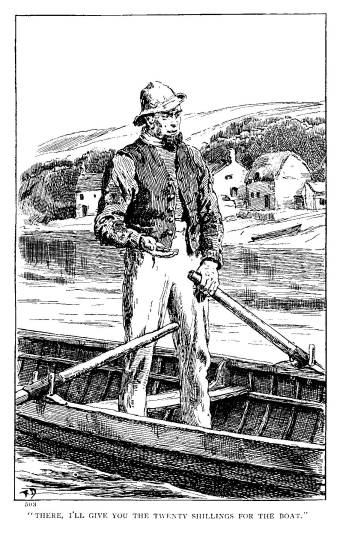
“Look here!” said the man, “as you two’s come out fishing, I’ll give you fifteen shillings and my boat, and that’s more than yours is worth.”
“No, you won’t,” said Bob.
“Well, sixteen, then. Come, that’s a shilling too much.”
Bob shook his head, hooked, and took a good-sized smelt off his hook.
“It’s more than I care to give,” said the man, who grew warm as Bob seemed cold. “There, I’ll go another shilling—seventeen.”
Bob still shook his head, and Dexter sat ready to burst out into an explosion of anger and threat if his companion sold the boat.
“Nineteen, then,” said the man. “Nineteen, and my old un as rides the water like a duck. You won’t?”
“No,” said Bob.
“Well, then,” cried the man, “I’m off.”
“All right,” said Bob coolly.
“There, I’ll give you the twenty shillings, but you’ll have to give me sixpence back. Look here! I’ve got the money.”
He showed and rattled the pound’s worth of silver he had.
“Come on. You get into my boat, and I’ll get into yours.”
“No, yer won’t,” said Bob. “I won’t sell it.”
“What!” cried the man angrily, and he raised one of his oars from the water.
“I won’t sell,” cried Bob, seizing the oars as he dropped his rod into the boat.
“You mean to tell me that you’re going to make a fool of me like that!”
He began to pull the little tub in which he sat toward the gig, but Bob was too quick for him. The gig glided through the water at double the rate possible to the old craft, and though it was boy against man, the former could easily hold his own.
Fortunately they were not moored to the bank or the event might have been different, for the man had raised his oar as if with the intention of striking the boat in which the boys were seated.
“Here, you, stop!” he shouted.
Bob replied in dumb show with his sculls, dipping them as fast as he could, and looking very pale the while, till they were well out of reach, when he rested for a moment, and yelled back in defiant tones the one word—
“Yah!”
“All right, my lads,” shouted the fellow. “I know yer. You stole that boat, that’s what you’ve done!”
“Row hard, Bob!” whispered Dexter.
“It’s all very fine to say row hard. You kitch hold and help.”
Dexter readily seized the second scull, and began to pull with so much energy and effect that they had soon passed the muddy creek up which the man had gone and come, and before long he was out of sight.
“It was all your fun, Bob,” said Dexter, as they went on. “I thought you meant to sell the boat.”
“So I did,” grumbled Bob; “only you were so disagreeable about it. How are we to get on for money when mine’s all done!”
“I don’t know,” said Dexter dolefully. “Can’t we work for some?”
“Yah! How can we work? I say, though, he knew you’d stolen the boat.”
“I didn’t steal it, and it isn’t stolen,” said Dexter indignantly. “I wrote and told Sir James that we had only borrowed it, and I sent some money, and I shall send some more if we cannot find a way to get it back.”
“See if they don’t call it stealing,” said Bob grimly. “Look there at the her’ns.”
He nodded toward where a couple of the tall birds were standing heel-deep in the shallow water, intent upon their fishing, and so well accustomed to being preserved that they did not attempt to rise from their places.
Dexter was so much interested in the birds that he forgot all about their late adventure.
Then they rowed on for about a couple of hours, and their next proceeding was to look out for a suitable spot for their meal.
There were no high cliff-like banks now, but here and there, alternating with meadows, patches of woodland came down to the water’s edge, and at one of these they stopped, fastened the boat to a tree where it was quite out of sight; and now for the first time they began to see boats passing along.
So far the little tub in which the would-be purchaser of their gig was seated was the only one they had seen on the water, but they were approaching a village now, and in low places they had seen high posts a short distance from the water’s edge, on which were festooned long nets such as were used for the salmon at the time they run.
As soon as they had landed, a fire was lit, the fish cleaned, and the remainder of the bread and butter left from the last meal brought ashore. After which, as an experiment, it was decided to roast the smelts before the blaze, a task they achieved with more or less success.
As each fish was deemed sufficiently cooked it was eaten at once—a piece of bread forming the plate—and, with the exception of wanting salt, declared to be delicious.
“Ever so much better than chub, Bob,” said Dexter, to which for a wonder that young gentleman agreed.
Evening soon came on, and as it was considered doubtful whether they could find as satisfactory a place for their night’s rest as that where they were, it was decided to stop, and go on at sunrise next morning.
“We shall get to the sea to-morrow,” said Bob, as he began to yawn. “I’m jolly glad of it, for I’m tired of the river, and I want to catch cod-fish and soles, and something big. Whatcher yawning for?”
“I’m tired and sleepy,” said Dexter, as he sat upon the roots of an old tree, three or four yards from the water’s edge.
“Yah! you’re always sleepy,” said Bob.
“But I had to keep watch while you slept.”
“So you will have to again.”
“But that isn’t fair,” said Dexter, in ill-used tones. “It’s your turn to watch now.”
“Well, I’ll watch half the night, if you watch the other,” said Bob. “That’s fair, isn’t it?”
“Yes.”
“Then I shall lie down now, and you can call me when it’s twelve o’clock.”
“But I shan’t know when it is,” protested Dexter.
“Well, I ain’t particular,” said Bob, stretching himself beneath the tree. “Guess what you think’s fair half, and I’ll get up then.”
“But will you get up!” said Dexter.
“Of course I will, if you call loud enough. There, don’t bother, I’m ever so tired with rowing, and I shall go to sleep at once.”
Bob kept his word as soon as darkness had set in, and Dexter sat listening to the lapping of the water, and wondered whether, if they camped out like this in a foreign land, crocodiles would come out of the rivers and attack them.
He sat down, for he soon grew tired of standing and walking about, and listened to Bob’s heavy breathing, for the boy had gone off at once.
It was very dark under the trees, and he could only see the glint of a star from time to time. It felt cold too, but as he drew himself close together with his chin down upon his knees he soon forgot that, and began thinking about the two owls he had heard the past night. Then he thought about the long-legged herons he had seen fishing in the water; then about their own fishing, and what capital fish the smelts were.
From that he began to think about hunting out the cray-fish from the banks, and how one of the little things had nipped his fingers quite sharply.
Next he began to wonder what Helen Grayson thought about him, and what the doctor had said, and whether he should ever see them again, and whether he should like Bob any better after a time, when camping out with him, and how long it would be before they reached one of the beautiful hot countries, where you could gather cocoa-nuts off the trees and watch the lovely birds as they flitted round.
And then he thought about how long it would be before he might venture to call Bob.
And then he began thinking about nothing at all.
When he opened his eyes next it was morning, with the sun shining brightly, and the birds singing, and Bob Dimsted had just kicked him in the side.
“Here, I say, wake up,” he cried. “Why, you’ve been to sleep.”
“Have I!” said Dexter sheepishly, as he stared helplessly at his companion.
“Have yer? Yes; of course yer have,” cried Bob angrily. “Ain’t to be trusted for a moment. You’re always a-going to sleep. Whatcher been and done with that there boat!”
Chapter Thirty Six.
In Dire Straits.
“Done with the boat?”
“I haven’t done anything with the boat.”
“Then where is it?”
“Fastened up to that old tree.”
“Oh, is it!” cried Bob derisively. “I should like to see it, then. Come and show me!”
Dexter ran to the water’s edge, and found the place on the bark where the chain had rubbed the trunk, but there was no sign of the boat.
“Now then,” cried Bob fiercely, “where is it?”
“I don’t know,” said Dexter dolefully. “Yes, I do,” he cried. “The chain must have come undone, and it’s floating away.”
“Oh, is it?” said Bob derisively. “Then you’d better go and find it!”
“Go and find it?”
“Yes; we can’t go to sea in our boots, can we, stoopid?”
“But which way shall I go, Bob? Sometimes the tide runs up, and sometimes it runs down.”
“Yes, and I’ll make you run up and down. You’re a nice un, you are! I just shet my eyes for a few minutes, and trust you to look after the boat, and when I wake up again you’re fass asleep, and the boat gone.”
“I’m very sorry, Bob, but I was so tired.”
“Tired! You tired! What on? Here, go and find that boat!”
Dexter started off, and ran along the bank in one direction, while Bob went in the other, and at the end of half an hour Dexter came back feeling miserable and despondent as he had never felt before.
“Found it, Bob!” he said.
For answer his companion threw himself down upon his face, and began beating the ground with his fists, as if it were a drum.
“I’ve looked along there as far as I could go,” said Dexter sadly. “What shall we do!”
“I wish this here was your stoopid head,” snarled Bob, as he hammered away at the bare ground beneath the tree. “I never see such a chap!”
“But what shall we do?” said Dexter again.
“Do? I dunno, and I don’t care. You lost the boat, and you’ve got to find it.”
“Let’s go on together and walk all along the bank till we find somebody who has seen it.”
“And when we do find ’em d’yer think they’ll be such softs as to give it to us back again!” This was a startling question.
“I know ’em,” said Bob. “They’ll want to know where we got it from, and how we come by it, and all sorts o’ nonsense o’ that kind. Say we ain’t no right to it. I know what they’ll say.”
“But p’r’aps it’s floating about?”
“P’r’aps you’re floating about!” cried Bob, with a snarl. “Boat like that don’t go floating about without some one in it, and if it does some one gets hold of it, and says it’s his.”
This was a terrible check to their adventurous voyage, as unexpected as it was sudden, and Dexter looked dolefully up in his companion’s face.
“I know’d how it would be, and I was a stoopid to bring such a chap as you,” continued Bob, who seemed happiest when he was scolding. “You’ve lost the boat, and we shall have to go back.”
“Go back!” cried Dexter, with a look of horror, as he saw in imagination the stern countenance of the doctor, his tutor’s searching eyes, Helen’s look of reproach, and Sir James Danby waiting to ask him what had become of the boat, while Master Edgar seemed full of triumph at his downfall.
“Go back?” No he could not go back. He felt as if he would rather jump into the river.
“We shall both get a good leathering, and that won’t hurt so very much.”
A good leathering! If it had been only the thrashing, Dexter felt that he would have suffered that; but his stay at the doctor’s had brought forth other feelings that had been lying dormant, and now the thrashing seemed to him the slightest part of the punishment that he would have to face. No: he could not go back.
“Well, whatcher going to do!” said Bob at last, with provoking coolness. “You lost the boat, and you’ve got to find it.”
“I will try, Bob,” said Dexter humbly. “But come and help me.”
“Help yer? Why should I come and help yer? You lost it, I tell yer.”
Bob jumped up and doubled his fists.
“Now then,” he said; “get on, d’yer hear? get on—get on!”
At every word he struck out at Dexter, giving him heavy blows on the arms—in the chest—anywhere he could reach.
Dexter’s face became like flame, but he contented himself with trying to avoid the blows.
“Look here!” he cried suddenly.
“No, it’s you’ve got to look here,” cried Bob. “You’ve got to find that there boat.”
Dexter had had what he thought was a bright idea, but it was only a spark, and it died out, leaving his spirit dark once more, and he seemed now to be face to face with the greatest trouble of his life. All his cares at the Union, and then at the doctor’s, sank into insignificance before this terrible check to their adventure. For without the boat how could they get out of England? They could not borrow another. There was a great blank before him just at this outset of his career, and try how he would to see something beyond he could find nothing: all was blank, hopeless, and full of despair.
Had his comrade been true to him, and taken his share of the troubles, it would have been bad enough; but it was gradually dawning upon Dexter that the boy he had half-idolised for his cleverness and general knowledge was a contemptible, ill-humoured bully—a despicable young tyrant, ready to seize every opportunity to oppress.
“Are you a-going?” cried Bob, growing more brutal as he found that his victim made no resistance, and giving him a blow on the jaw which sent him staggering against one of the trees.
This was too much; and recovering himself Dexter was about to dash at his assailant when he stopped short, for an idea that seemed incontrovertible struck him so sharply that it drove away all thought of the brutal blow he had received.
“I know, Bob,” he cried.
“Know? What d’yer know?”
“Where the boat is.”
“Yer do?”
“Yes: that man followed us and took it away.”
Bob opened his mouth, and half-closed his eyes to stare at his companion, as he balanced this idea in his rather muddy brain.
“Don’t you see?” cried Dexter excitedly.
“Come arter us and stole it!” said Bob slowly.
“Yes: he must have watched us, and waited till we were asleep.”
“Go on with you!”
“He did. I feel as sure as sure,” cried Dexter.
There was a pause during which Bob went on balancing the matter in his mind.
“He has taken it up the river, and he thinks we shall be afraid to go after it.”
“Then he just thinks wrong,” said Bob, nodding his head a good deal. “I thought something o’ that kind a bit ago, but you made me so wild I forgot it again.”
“But you see now, Bob.”
“See? O’ course I do. I’ll just let him know—a thief. Here, come on, and we’ll drop on to him with a policeman, and show him what stealing boats means.”
“No, no, Bob, we can’t go with a policeman. Let’s go ourselves, and make him give it up.”
“But s’pose he won’t give it to us!”
“We should have to take it,” said Dexter excitedly.
“Come on, then. He’s got my fishing-tackle too, and—why just look at that! Did you put them there?”
He darted to where his bundle and rough fishing-rod lay among the trees.
“No; he must have thrown them out. Let’s make haste. We know where the boat is now!”
The boys started at once, and began to tramp back along the side of the river in the hope of finding the place where the boat was moored; but before they had gone far it was to find that floating down with the stream, or even rowing against the tide, was much easier work than forcing their way through patches of alder-bushes, swampy meadows, leaping, and sometimes wading, little inlets and ditches and the like.
Their progress was very slow, the sun very hot, and at least a dozen times now they came upon spots which struck both as being the muddy bank off which they had captured the smelts.
It was quite afternoon before they were convinced, for their further passage was stopped by the muddy inlet up which they had seen the man row, and not a hundred yards away was the bank under which they had fished.
“Sure this is the place?” said Bob, as he crouched among some osiers and looked cautiously round.
“Yes,” said Dexter; “I’m certain this is the place. I saw him row up here. But—”
“But what?”
“He’d be quite sure not to take the boat up here.”
“Why not?”
“For fear we should come after it.”
“Get out! Where would he take it, then?”
“He’d hide it somewhere else; perhaps on the other side. Look!”
Dexter pointed up the river to where, about a couple of hundred yards further on, a boat could be seen just issuing from a bed of reeds.
Bob seized Dexter’s arm to force him lower down among the osiers, but it was not necessary, for they were both well concealed; and as they continued there watching it was to see the boat come slowly toward them, and in a few minutes they were satisfied that it was the man they sought, propelling it slowly toward where they stooped.
The fellow came along in a furtive manner, looking sharply round from time to time, as if scanning the river to see if he was observed.
He came on and on till he reached the creek at whose mouth the boys were hidden, and as he came so close that they felt it impossible that they could remain unseen he suddenly ceased rowing, and stood up to shade his eyes from the sunshine, and gaze sharply down the river for some minutes.
Then giving a grunt as of satisfaction he reseated himself, and rowed slowly up the creek, till he disappeared among the osiers and reeds which fringed its muddy banks.
As he passed up he disturbed a shoal of large fish which came surging down, making quite a wave in the creek, till they reached the river, where all was still.
“The boat’s up there, Bob,” said Dexter, after a long silence, so as to give the man time to get well out of hearing.
“Yes, but how are we to get to it?”
“Wade,” said Dexter laconically. “’Tain’t deep, only muddy.”
To cross the creek was necessary, and Bob softly let himself down from the bank till his feet were level with the water, then taking hold of a stout osier above his head he bent it down, and then dropped slowly into the water, which came nearly to his waist.
“Come on!” he said, and after getting to the end of the osier he used his rod as a guide to try the depth, and with some difficulty, and the water very nearly to his chest, he got over.
Dexter did not hesitate, but followed, and began to wade, feeling his feet sink at every step into the sticky mud, and very glad to seize hold of the end of the rod Bob was civil enough to hold to him from the further bank, up which they both crept, dripping like water-rats, and hid among the osiers on the other side.
“Come on,” whispered Bob, and with the mud and water trickling from them they crept along through quite a thicket of reeds, osiers, and the red-flowered willow-herb, while great purple patches of loosestrife blossomed above their heads.
Every step took them further from the enemy, but they kept down in their stooping position, and a few yards from the bank of the river, feeling sure that they could not miss their way; and so it proved, for after what seemed to be an interminable journey they found themselves stopped by just such another creek as that which they had left, save and except that the mouth was completely hidden by a bed of reeds some of which showed where a boat had lately passed through.
Whether their boat was there or not they could not tell, but it seemed easy to follow up the creek from the side they were on, and they crept along through the water-growth, which was thicker here than ever, but keeping as close as they could to the side, the scarped bank being about eight feet above the water.
The creek was not above twenty feet wide, and, from the undisturbed state of the vegetation which flourished down its banks to where the tide seemed to rise, it seemed as if it was a rare thing for a boat to pass along.
They stopped at every few yards to make sure that they were not passing that of which they were in search, looking carefully up and down, while the creek twined so much that they could never see any extent of water at a time.
They must have wound in and out for quite three hundred yards, when, all at once, as they stooped there, panting and heated with the exercise, and with the hot sun beating down upon their heads, Dexter, who was in front, stopped short, for on his right the dense growth of reeds suddenly ceased, and on peering out it was to see a broad opening where they had been cut down, while within thirty yards stood a large stack of bundles, and beside it a rough-looking hut, toward which the man they had seen rowing up the other creek was walking.
They had come right upon his home, which seemed to be upon a reedy island formed by the two creeks and the river.
The boys crouched down, afraid to stir, and watching till they saw the man enter the rough reed-thatched hut, when, moving close to the edge of the bank, they crept on again after a few moments’ hesitation, connected with an idea of making a retreat.
Their perseverance was rewarded, for not fifty yards further on they looked down upon what seemed to be a quantity of reeds floating at the side of the creek, but one bundle had slipped off, and there, plainly enough, was the gunwale of the boat, the reeds having been laid across it to act as a concealment in case any one should glance carelessly up the creek.
“Come on, Bob,” whispered Dexter; and he let himself slide down into the muddy water as silently as he could, and began to tumble the bundles of reeds off into the creek.
Bob followed his example, and, to their great delight, they found that the sculls and boat-hook were still in their places, while the boat-chain was secured to a stake thrust down into the mud.
This was soon unloosed after they had climbed in, dripping, and covering the cushions with mud, but all that was forgotten in the delight of having found the boat.
“Now, Bob, you row softly down and I’ll use the boat-hook,” whispered Dexter, as he stood up in the stern, while Bob sat down, seized the oars, and laid them in the rowlocks, ready to make the first stroke, when high above them on the bank they heard a quick, rushing noise, and directly after, to their horror, there stood, apparently too much dumbfounded to speak, the man they had seen a few minutes before going into the reed hut.
Chapter Thirty Seven.
Second-Hand Stealing.
“Here, you, sir! stop!” he roared.
“Pull away, Bob!” whispered Dexter, for Bob had paused, half-paralysed by the nearness of the danger. But he obeyed the second command, and tugged at the oars.
“D’yer hear!” roared the man, with a furious string of oaths. “Hold hard or I’ll—”
He did not say what, but made a gesture as if striking with a great force.
“Don’t speak, Bob: pull hard,” whispered Dexter, bending forward in the boat so as to reach the rower, and encourage him to make fresh efforts, while, for his part, he kept his eyes upon the man.
“D’yer hear what I say?” he roared again. “What d’yer mean by coming here to steal my boat?”
“’Tain’t yours,” cried Dexter.
“What? Didn’t I buy it of yer and pay for it?”
“You came and stole it while we were asleep, you thief!” cried Dexter again.
“Say I stole yer boat and I’ll drown’d yer,” cried the man, forcing his way through the reeds and osiers so as to keep up with them. “If you don’t take that back it’ll be the worse for yer. Stop! D’yer hear? Stop!”
Bob stopped again, for the man’s aspect was alarming, and every moment he seemed as if he was about to leap from the high bank.
Fortunately for all parties he did not do this, as if he had reached the edge of the boat he must have capsized it, and if he had leaped into the bottom, he must have gone right through.
Bob did not realise all this; but he felt certain that the man would jump, and, with great drops of fear upon his forehead he kept on stopping as the man threatened, and, but for Dexter’s urging, the boat would have been given up.
“I can hear yer,” the man roared, with a fierce oath. “I hear yer telling him to row. Just wait till I get hold of you, my gentleman!”
“Row, Bob, row!” panted Dexter, “as soon as we’re out in the river we shall be safe.”
“But he’ll be down upon us d’reckly,” whispered Bob.
“Go on rowing, I tell you, he daren’t jump.”
“You won’t stop, then, won’t yer?” cried the man. “If yer don’t stop I’ll drive a hole through the bottom, and sink yer both.”
“No, he won’t,” whispered Dexter. “Row, Bob, row! He can’t reach us, and he has nothing to throw.”
Bob groaned, but he went on rowing; and in his dread took the boat so near the further side that he kept striking one scull against the muddy bank, and then, in his efforts to get room to catch water, he thrust the head of the boat toward the bank where the man was stamping with fury, and raging at them to go back.
This went on for a hundred yards, and they were still far from the open river, when the man gave a shout at them and ran on, disappearing among the low growth on the bank.
“Now, Bob, he has gone,” said Dexter excitedly, “pull steadily, and as hard as you can. Mind and don’t run her head into the bank, or we shall be caught.”
Bob looked up at him with a face full of abject fear and misery, but he was in that frame of weak-mindedness which made him ready to obey any one who spoke, and he rowed on pretty quickly.
Twice over he nearly went into the opposite bank, with the risk of getting the prow stuck fast in the clayey mud, but a drag at the left scull saved it, and they were getting rapidly on now, when all at once Dexter caught sight of their enemy at a part of the creek where it narrowed and the bank overhung a little.
The man had run on to that spot, and had lain down on his chest, so as to be as far over as he could be to preserve his balance, and he was reaching out with his hands, and a malicious look of satisfaction was in his face, as the boat was close upon him before Dexter caught sight of him, Bob of course having his back in the direction they were going.
“Look out, Bob,” shouted Dexter. “Pull your right! pull your right!”
Bob was so startled that he looked up over his shoulder, saw the enemy, and tugged at the wrong oar so hard that he sent the boat right toward the overhanging bank.
“I’ve got yer now, have I, then?” roared the man fiercely; and as the boat drifted towards him he reached down and made a snatch with his hand at Dexter’s collar.
As a matter of course the boy ducked down, and the man overbalanced himself.
For a moment it seemed as if he would come down into the boat, over which he hung, slanting down and clinging with both hands now, and glaring at them with his mouth open and his eyes starting, looking for all the world like some huge gargoyle on the top of a cathedral tower.
“Stop!” he roared; and then he literally turned over and came so nearly into the boat that he touched the stern as it passed, and the water he raised in a tremendous splash flew all over the boys.
“Now, Bob, pull, pull, pull!” cried Dexter, stamping his foot as he looked back and saw the man rise out of the water to come splashing after them for a few paces; but wading through mud and water was not the way to overtake a retreating boat, and to Dexter’s horror he saw the fellow struggle to the side and begin to scramble up the bank.
Once he slipped back; but he began to clamber up again, and his head was above the edge when, in obedience to Bob’s tugging at the sculls, the boat glided round one of the various curves of the little creek and shut him from their view.
“He’ll drown’d us. He said he would,” whimpered Bob. “Let’s leave the boat and run.”
“No, no!” cried Dexter; “pull hard, and we shall get out into the river, and he can’t follow us.”
“Yes, he can,” cried Bob, blubbering now aloud. “He means it, and he’ll half-kill us. Let’s get out to this side and run.”
“Pull! I tell you, pull!” cried Dexter furiously; and Bob pulled obediently, sending the boat along fast round the curves and bends, but not so fast but that they heard a furious rustling of the osiers and reeds, and saw the figure of the man above them on the bank.
“There, I told you so,” whimpered Bob. “Let’s get out t’other side.”
“Row, I tell you!” roared Dexter; and to his surprise the man did not stop, but hurried on toward the mouth of the creek.
“There!” cried Bob. “He’s gone for his boat, and he’ll stop us, and he’ll drown’d us both.”
“He daren’t,” said Dexter stoutly, though he felt a peculiar sinking all the time.
“But he will, he will. It’s no use to row.”
Dexter felt desperate now, for theirs was an awkward position; and to his horror he saw that Bob was ceasing to row, and looking up at the bank on his left.
“You go on rowing,” cried Dexter fiercely.
“I shan’t,” whimpered Bob; “it’s of no use. I shan’t row no more.”
Thud!
Bob yelled out, more in fear than in pain, for the sound was caused by Dexter swinging the boat-hook round and striking his companion a sharp rap on the side of the head.
“Go on rowing,” cried Dexter, “and keep in the middle.”
Bob howled softly; but, like a horse that has just received an admonition from the whip, he bent to his task, and rowed with all his might, blubbering the while.
“That’s right,” cried Dexter, who felt astonished at his hardihood. “We can’t be far now. Pull—pull hard. There, I can see the river. Hurray, Bob, we’re nearly there!”
Bob sobbed and snuffled, and bent down over his oars, rowing as if for life or death. The boat was speeding swiftly through the muddy water, the opening with its deep fringe of reeds was there, and Dexter was making up his mind to try and direct Bob to pull right or left so as to get to the thinnest place that the boat might glide right out, when he saw something.
“No, Bob, only a little way,” he had said. “Pull with all your might.”
Then he stopped short and stared aghast.
Fortunately Bob was bending down, sobbing, and straining every nerve, as if he expected another blow, otherwise he would have been chilled by Dexter’s look of dread, for there, just as if he had dropped from the bank and begun wading, was their enemy, who, as the boat neared, took up his position right in the middle of the creek, where the water was nearly to his chest, and, with the reeds at his back, waited to seize the boat.
Dexter stood holding the boat-hook, half-paralysed for a few moments, and then, moved by despair, he stepped over the thwart toward Bob.
“No, no,” cried the latter, ducking down his head. “I will pull—I will pull.”
He did pull too, with all his might, and the boat was going swiftly through the water as Dexter stepped right over the left-hand scull, nearly toppled over, but recovered himself, and stood in the bows of the boat, as they were now within twenty yards of the man, who, wet and muddy, stood up out of the creek like some water monster about to seize the occupants of the boat for a meal.
“Pull, Bob, hard!” whispered Dexter, in a low, excited voice; and Bob pulled.
The boat sped on, and the man uttered a savage yell, when, with a cry of horror, Bob ceased rowing.
But the boat had plenty of impetus, and it shot forward so swiftly that, to avoid its impact, the man drew a little on one side as he caught at the gunwale.
Whop!
Dexter struck at him with the light ash pole he held in his hand—struck at their enemy with all his might, and then turned and sat down in the boat, overcome with horror at what he had done, for he saw the man fall backward, and the water close over his head.
Then there was a loud hissing, rustling sound as the boat glided through the reeds, which bent to right and left, and rose again as they passed, hiding everything which followed.
The next moment the force given to the boat was expended, and it stopped outside the reeds, but only to commence another movement, for the tide bore the bows round, and the light gig began to glide softly along.
“I’ve killed him,” thought Dexter; and he turned cold with horror, wondering the while at his temerity and what would follow.
“Was that his head?” said Bob, in rather a piteous voice, as he sat there resting upon his oars.
“Yes,” said Dexter, in a horror-stricken whisper. “I hit him right on the head.”
“You’ve been and gone and done it now, then,” whimpered Bob. “You’ve killed him. That’s what you’ve done. Never did see such a chap as you!”
“I couldn’t help it,” said Dexter huskily.
“Yes, that’s what you always says,” cried Bob, in an ill-used tone. “I wish I hadn’t come with yer, that I do. I say, ought we to go and pick him up? It don’t matter, do it?”
“Yes, Bob; we must go back and pull him out,” said Dexter, with a shudder. “Row back through the reeds. Quick, or he may be drowned!”
“He won’t want any drowning after that whack you give him on the head. I don’t think I shall go back. Look! look!”
Dexter was already looking at the frantic muddy figure upon the bank, up which it had climbed after emerging from the reeds. The man was half-mad with rage and disappointment, and he ran along shaking his fists, dancing about in his fury, and shouting to the boys what he would do.
His appearance worked a miraculous effect upon the two boys. Dexter felt quite light-hearted in his relief, and Bob forgot all his sufferings and dread now that he was safely beyond their enemy’s reach. Laying the blades of the sculls flat, as the boat drifted swiftly on with the tide, he kept on splashing the water, and shouting derisively—
“Yah! yah! Who cares for you? Yah! Go home and hang yourself up to dry! Yah! Who stole the boat!”
Bob’s derision seemed to be like oil poured upon a fire. The man grew half-wild with rage. He yelled, spat at them, shook his fists, and danced about in his impotent fury; and the more he raged, the more delighted Bob seemed to be.
“Yah! Who stole the boat!” he kept on crying; and then added mocking taunts. “Here! hi!” he shouted, his voice travelling easily over the water, so that the man heard each word. “Here! hi! Have her now? Fifteen shillings. Come on. Yah!”
“Quick, Bob, row!” cried Dexter, after several vain efforts to stop his companion’s derisive cries.
“Eh?” said Bob, suddenly stopping short.
“Row, I tell you! Don’t you see what he’s going to do!”
The man had suddenly turned and disappeared.
“No,” said Bob. “I’ve scared him away.”
“You haven’t,” said Dexter, with his feeling of dread coming back. “He’s running across to the other creek to get the boat.”
Bob bent to his oars directly, and sent the gig rapidly along, and more and more into the swift current. He rowed so as to incline toward the further shore, and soon after they passed the mouth of the other creek.
“Get out with yer,” said Bob. “He ain’t coming. And just you look here, young un; you hit me offull on the head with that there boat-hook, and as soon as ever I gits you ashore I’ll make you go down on your knees and cry chi—ike; you see if I don’t, and—”
“There he is, Bob,” said Dexter excitedly; and looking toward the other creek, there, sure enough, was the man in his wretched little tub of a boat, which he was forcing rapidly through the water, and looking over his shoulder from time to time at the objects of his pursuit.
Bob pulled with all his might, growing pallid and muddy of complexion as the gig glided on. Matters had been bad enough before. Now the map would be ten times worse, while, to make things as bad as they could be, it soon became evident that the tide was on the turn, and that, unless they could stem it in the unequal battle of strength, they would be either swept back into their enemy’s arms or else right up the river in a different direction to that which they intended to go, and, with the task before them, should they escape, of passing their enemy’s lair once again.
Chapter Thirty Eight.
The Crowning Point of the Trip.
“Come and lay hold o’ one scull,” said Bob, whose eyes seemed to be fixed as he stared at the back of their enemy. “Oh, do be quick!”
Dexter slipped into his place, took the scull, and began to row.
“Getting closer, ain’t he?” whispered Bob hoarsely. “Yes. I’m afraid so.”
“Pull, pull!”
Dexter needed no telling, and he tugged away at the oar as the boat glided a little more swiftly on.
“Ain’t leaving him behind, are we!” growled Bob, whose face now grew convulsed with horror. “No; I’m afraid he’s coming nearer.”
“Oh dear, oh dear!” groaned Bob. “He’ll half-kill me, and it’s all your fault. Let’s stop rowing and give him the boat.”
“That we won’t,” cried Dexter, setting his teeth. “I’ll row till I die first.”
“But it’ll only make him more savage,” growled Bob. “I wish I was safe at home.”
“You’re not half-pulling, Bob.”
“It’s of no use, matey. He’s sure to ketch us, and the furder we rows, the more wild he’ll be.”
“I don’t care,” cried Dexter; “he shan’t have it if I can help it. Row!”
In his most cowardly moments Bob was obedience itself, and breaking out into a low sobbing whimper, as if it were a song to encourage him in his task, he rowed on with all his might, while only too plainly it could be seen that the man was gaining steadily upon them in spite of the clumsiness of his boat; and consequently it was only a question of time before the boys were overtaken, for the muscles of the man were certain to endure longer than those of Dexter, untrained as they were to such work.
“He’s closer, ain’t he?” whined Bob.
“Yes, ever so much,” replied Dexter, between his set teeth.
“Well, jest you recollect it was you hit him that whack on the head. I didn’t do nothing.”
“Yes, you did,” said Dexter sharply. “You said, yah! at him, and called him names.”
“No, I didn’t. Don’t you be a sneak,” whined Bob. “You were ever so much worse than me. Is he coming closer?”
“Yes.”
It was a fact, closer and closer, and the tide ran so strongly now that the boys had hard work to make much progress. They did progress, though, all the same, for their boat was narrow and sharp. Still the current was dead against them, and their want of movement added to their despair.
Bad as it was for them, however, it was worse for the man in his heavy little broadly-bowed tub; and so it happened that just as Bob began to row more slowly, and burst into a fit of howling, which made Dexter feel as if he would like to turn and hit him over the head with his oar—a contact of scull against skull—the man suddenly ceased rowing, turned in his seat, and sat shaking his fist at them, showing his teeth in his impotent rage.
“There!” cried Bob, who was transformed in an instant. “We’ve bet him. He can’t pull no further. Yah! yah!”
Bob changed back to his state of cowardly prostration, and began to tug once more at his oar, for his derisive yell galvanised the man once more into action, and the pursuit was continued.
“Oh!” howled Bob. “Who’d ha’ thought o’ that?”
“Who’s stupid now?” panted Dexter, as he too rowed with all his might.
Bob did nothing but groan, and the pursuit and flight were once more continued, each moment with despair getting a stronger hold of the fugitives. The oar felt hot in Dexter’s blistered hands, a peculiar sensation of heaving was in his chest, his eyes began to swim, and he was just about to cease rowing, when he could hardly believe his starting eyes—their enemy had once more given up the pursuit, and was sitting wrenched round, and staring after them.
“Don’t, pray, don’t shout at him this time, Bob,” panted Dexter.
“I won’t if you’re afraid,” said the young scoundrel.
“Keep on rowing, or he’ll come after us again.”
Bob’s scull was dipped again directly, and the motion of the boat was kept up sufficiently to counteract the drift of the tide, while the man in the little tub was swept rapidly away.
“Let’s get over the other side to those trees,” said Dexter, as he felt that he could row no further, and the boat’s head was directed half-across the stream so as to reach the clump of willows indicated, where, after a much heavier pull than they had anticipated, the gig was made fast, and Bob’s first act after laying down his scull was to lean over the side and drink heartily of the muddy water.
Dexter would gladly have lain down to rest, but there was a watch to keep up.
Bob mocked at the idea.
“Yah!” he said; “he won’t some any more. I say, are you nearly dry?”
“Nearly,” said Dexter, “all but my boots and socks.”
These he took off, and put in the sun to dry, as he sat there with his elbows on his knees, and his chin on his hands, watching till Bob was asleep.
He was faint and hungry, and the idea was strong in his mind that the man would steal down upon them when he was not expected. This thought completely drove away all drowsiness, though it did not affect his companion in the slightest degree.
The next thing ought to have been to get some food, but there was no likely place within view, and though several boats and a barge or two passed, the fear of being questioned kept the watcher from hailing them, and asking where he could get some bread and milk.
The hours glided slowly by, but there was no sign of the shabby little boat. The tide ran up swiftly, and the gig swung easily from its chain; and as Dexter sat there, hungry and lonely, he could not keep his thoughts at times from the doctor’s comfortable house.
Towards evening the socks and boots were so dry that Dexter replaced them, looking down the while rather ruefully at his mud-stained trousers. He rubbed them and scratched the patches with his nails; but the result was not satisfactory, and once more he sat gazing up the river in expectation of seeing their enemy come round the bend.
It was getting late, and the tide had turned, as Dexter knew at once by the way in which the boat had swung round with its bows now pointing up-stream. And now seemed the time when the man might appear once more in pursuit.
The thought impressed him so that he leaned over and shook Bob, who sat up and stared wonderingly about.
“Hallo!” he said. “What time is it!”
“I don’t know, but the tide has turned, and that man may come after us again.”
“Nay, he won’t come any more,” said Bob confidently. “Let’s go and get something to eat.”
It was a welcome proposal, and the boat being unmoored, Dexter took one of the sculls, and as they rowed slowly down with the tide he kept his eyes busy watching for the coming danger, but it did not appear.
Bob went ashore at a place that looked like a ferry, where there was a little public-house, and this time returned with a small loaf, a piece of boiled bacon, and a bottle of cider.
“I’d ha’ brought the bacon raw, and we’d ha’ cooked it over a fire,” said Bob, “only there don’t seem to be no wood down here, and there’s such lots of houses.”
Dexter did not feel troubled about the way in which the bacon was prepared, but sat in the boat, as it drifted with the tide, and ate his portion ravenously, but did not find the sour cider to his taste.
By the time they had finished, it was growing dark, and lights were twinkling here and there on either bank, showing that they were now in a well-populated part.
“Where are we to sleep to-night, Bob?” said Dexter at last.
“Dunno yet. Can’t see no places.”
“We must be near the sea now, mustn’t we?”
“Yes, pretty handy to it,” said Bob, with the confidence of one in utter ignorance. “We shall be there to-morrow, and then we can catch heaps of cod-fish, and soles, and mack’rel, and find oysters. It’ll be all right then.”
This was encouraging, but somehow Dexter did not feel so much confidence in his companion as of old.
But Bob’s rest, and the disappearance of danger had brought him back to his former state, and he was constantly making references to the departed enemy.
“I should just liked to have ketched him touching me!” he said. “I’d ha’ give his shins such a kicking as would soon have made him cry ‘Leave off.’”
Dexter sat and stared through the gloom at the young Gascon.
“I’d ha’ soon let him know what he’d get if he touched me.”
“Hi, Bob! look out!”
Bob uttered a cry of dread, and nearly jumped overboard as something still and dark suddenly loomed up above him. Then there was a bump, which nearly finished what the boy had felt disposed to do; and then they were gliding along by the side of a vessel anchored in midstream.
As they swept past the stern the boat bumped again against something black and round, which proved to be a floating tub. With this they seemed to have become entangled, for there was a rasping grating noise, then the boat’s chain began to run rapidly over the bows, the boat swung round, and their further progress was checked. A piece of the chain with the hook had been left hanging over, and when they had touched the tub buoy the hook had caught, and they were anchored some little distance astern the large vessel.
“Here’s a game!” cried Bob, as soon as he had recovered from his astonishment. “Well, we can’t go on in the dark. Let’s stop here.”
“But we’ve got to find a place to sleep, Bob,” protested Dexter.
“Yah! you’re always wanting to go to sleep. There ain’t no place to sleep ashore, so let’s sleep in the boat. Why, we shall always have to bunk down there when we get out to sea.”
“But suppose the boat should sink?”
“Yah! suppose it did. We’d swim ashore. Only mind you don’t get outer bed in the night and walk into the water. I don’t want to go to sleep at all.”
Dexter did not feel drowsy, but again he could not help thinking of his room with the white hangings, and of how pleasant it would be to take off his clothes once more and lie between sheets.
“Some chaps is always thinking about going to bed,” said Bob jauntily. “Long as I gets a nap now and then, that’s all I want.”
Dexter did not know it, but Bob Dimsted was a thorough-paced second-hand boy. Every expression of this kind was an old one, such as he had heard from his father, or the rough men who consorted with him, from the bullying down to the most playful remark. But, as aforesaid, Dexter did not realise all this. He had only got as far as the fact that Bob was not half so nice as he used to be, and that, in spite of his boasting and bullying, he was not very brave when put to the test.
“There, I shan’t go to sleep yet. You can have one o’ them cushins forward,” said Bob at last; and, suffering now from a sudden feeling of weariness, Dexter took one of the cushions forward, placed it so as to be as comfortable as possible, realising as he did this that, in spite of his words, Bob was doing the same with two cushions to his one, and before he had been lying there long, listening to the rippling of the water, and gazing up at the stars, a hoarse, wheezing noise proclaimed the fact that Bob Dimsted was once more fast asleep.
Dexter was weary now in the extreme, the exertion and excitement he had gone through had produced, in connection with the irregular feeding, a state of fatigue that under other circumstances might have resulted in his dropping off at once, but now he could only lie and listen, and keep his eyes dilated and wide open, staring for some danger which seemed as if it must be near.
He did not know what the danger might be, unless it was that man with the boat, but something seemed to threaten, and he could not sleep.
Then, too, he felt obliged to think about Bob and about their journey. Where they were going, what sort of a place it would be, and whether they would be any more happy when they got to some beautiful island; for he was fain to confess that matters were very miserable now, and that the more he saw of Bob Dimsted the less he liked him.
He was in the midst of one of his thoughtful moods, with Bob for his theme, and asking himself what he should do if Bob did begin to thrash him first time they were on shore; and he had just come to the conclusion that he would not let Bob thrash him if he could help it, when Bob suddenly leaped forward and hit him a round-handed sort of blow, right in the back of the neck.
This so enraged him that he forgot directly all about companionship, and the sort of tacit brotherly compact into which they had entered, and springing at his assailant he struck him a blow in the chest, which sent him staggering back.
For a moment or two Bob seemed to be beaten; then he came at him furiously, the turf was trampled and slippery, and they both went down; then they got up again, and fought away, giving and taking blows, every one of which sounded with a loud slap.
That fight seemed as if it would never end, and Dexter felt as if he were getting the worst of it, consequent upon an inherent dislike to inflict pain, and his having passed over again and again opportunities for administering effective blows. At last they joined in what became little more than a wrestle, and Dexter felt the ground giving way beneath his feet; the back of his neck hurt him terribly, and he was about to give in, when the boys began to cheer, Mr Sibery ran up with the cane, and the doctor came looking stern and frowning, while he saw Helen Grayson put her hand to her eyes and turn away.
“It’s all Bob Dimsted’s fault,” he cried passionately; and he woke up with the words upon his lips, and a crick in the back of his neck, consequent upon the awkward cramped-up position in which he had lain.
It was broad daylight, and for a few moments he was too much confused to understand where he was; but as he realised it all, and cast a quick look round in search of danger, he saw that they were hooked on to the slimy buoy, that twenty yards further there was the hull of an old schooner, against which they had been nearly capsized the previous evening, and four or five hundred yards beyond that, slowly paddling along, was their enemy, looking over his shoulder as if he had seen them, and meant to make sure of them now.
Dexter hesitated between wakening Bob and setting the boat adrift.
He decided on doing the latter, and hauling on the chain, he drew the boat right up to the buoy, followed the chain with his hands till he could touch the hook, and after some difficulty, his efforts reminding him of the night when he unfastened the chain in the boat-house—he dragged the hook from where it clung to a great rusty link, and all the time his eyes were as much fixed upon the man in the boat as upon the task he had in hand.
Clear at last, and drifting away again. That was something towards safety, and he now stepped over the thwarts and shook Bob.
Bob was too comfortable to open his eyes, and no matter what his companion did he could get no reply till he bent lower, and, inspired by the coming danger, shouted in his ear—
“I’ve got yer at last.”
Bob sprang up as if electrified, saw who spoke, and was about to burst into a torrent of angry abuse, when he followed the direction of Dexter’s pointing hand, caught the approaching danger, and seized an oar.
It was none too soon, for as Dexter seized the other, the man evidently realised that his prey was about to make another effort to escape, and, bending to his work, he sent the little tub-like boat surging through the water.
“Pull, Bob!” said Dexter excitedly, an unnecessary order, for Bob had set his teeth, and, with his face working, was tugging so hard that it needed all Dexter’s efforts to keep the boat from being pulled into the right-hand shore.
The chase had begun in full earnest, and for the next hour, with very little alteration in their positions, it kept on. Then the pace began to tell on the boys. They had for some time been growing slower in their strokes, and they were not pulled so well home. Bob engaged every now and then in a dismal, despairing howl, usually just at the moment when Dexter thrust his oar too deeply in the water, and had hard work to get it out.
But their natural exhaustion was not of such grave consequence as might have been imagined, for their pursuer was growing weary too, and his efforts were greatly wanting in the spirit he displayed at first. On the other hand, though the man came on slowly, he rowed with a steady, stubborn determination, which looked likely to last all the morning, and boded ill for those of whom he was in chase.
Bob’s face was a study, but Dexter’s back was toward him, and he could not study it. The enemy was about two hundred yards behind, and whenever he seemed to flag a little Bob’s face brightened; but so sure as the man glanced over his shoulder, and began to pull harder, the aspect of misery, dread, and pitiable helplessness Bob displayed was ludicrous; and at such times he glanced to right and left to see which was the nearest way to the shore.
As Bob rowed he softly pushed off his boots. Soon after he made three or four hard tugs at his oar, and then, by a quick movement, drew one arm out of his jacket. Then rowing with one hand he shook himself quite clear of the garment, so as to be unencumbered when he began to swim, for that was his intention as soon as the man overtook them, and his peril became great.
“He wants most of all to get the boat,” he thought to himself; and soon after he opened his heart to Dexter.
“Lookye here!” he said, “he wants to get the boat; and if he can get that he won’t come after us. Let’s row pretty close to the bank, and get ashore and run.”
“What! and leave the boat?” cried Dexter. “That I’m sure I will not.”
Dexter pulled all the harder after hearing this proposal, and Bob uttered a moan.
All that morning the flight and pursuit were kept up, till on both sides it became merely a light dipping of the oars, so as to keep the boats’ heads straight, the tide carrying them along.
It was plain enough now that they were getting toward the mouth of the river, which was now quite broad. Houses were growing plentiful, barges lay at wharves or moored with other boats in the stream, and care had to be exercised to avoid coming in collision with the many obstacles in their way.
But they kept on; and though at Bob’s piteous suggestion they wound in and out among the many crafts in the hope of shaking off their pursuer, it was all in vain, for he kept doggedly on after them, with the matter-of-fact determination of a weasel after a rabbit, sure of its scent, and certain that before long the object of the pursuit would resign itself to its fate.
On still in a dreary mechanical way. Dexter could hardly move his arms, and Bob was, in spite of his long experience, almost as helpless.
“It’s of no use,” the latter said at last; and he ceased rowing.
“No, no, Bob; don’t give in!” cried Dexter excitedly. “We shall soon tire him out now. Row! Row!”
“Can’t,” said Bob drearily. “I haven’t another pull in me.”
“Then give me the other scull, and let me try.”
“Yah! you couldn’t pull both,” cried Bob. “There, I’m going to try a hundred more strokes, and then I shall swim ashore. I ain’t going to let him catch me.”