"Quicksilver" (continued 5)
Reading edition
“What are your people doing now?” said Bob, after they had been talking some time.
“Dr Grayson is writing, and Miss Grayson reading.”
“Why, we might go now—easy.”
“No,” said Dexter. “If we did, it would be found out directly, and we should be fetched back, and then, I dare say, they’d send me again to the school.”
“And yer don’t want to go there again, do you!”
“No,” said Dexter, with a shudder. “Don’t forget the ball of string I told you about?”
“No, I’ve got that,” replied Bob sharply. “And p’r’aps that won’t be long enough. It’s very deep in the sea. Now mind, you’re here.”
“Yes, I’ll mind.”
“If yer don’t come, I won’t never forgive you for making a fool of me.”
“I won’t do that,” said Dexter; and then after a little more hesitation as to something he particularly wanted to do, and which he saw no other way of doing, he whispered—
“Bob!”
“Hullo!”
“Will you do something for me before you come!”
“Yes, if I can. But I say, don’t you forget to bring a big bundle of your clothes and things, and if you don’t want ’em all, I can wear some of ’em.”
Dexter was silent.
“And as much money as you can; and, I say, the old un never give you a watch, did he?”
“No.”
“You wouldn’t like to borrow his, would you!”
“No, of course not,” said Dexter indignantly.
“Oh, I don’t want you to, unless you like. Only watches is useful at sea. Sailors find out where they are by their watches. I don’t quite know how, but we could soon find out. Whatcher want me to do!”
“I want you to take a little parcel to Sir James Danby’s.”
“I ain’t going to carry no parcels,” said Bob importantly.
“It’s only a very little one, as big as your hand. You know the letter-box in Sir James’s big door!”
“I should just think I do,” said Bob, with a hoarse laugh. “Me and two more boys put a lighted cracker in last fift’ o’ November.”
“I want you to go there last thing,” said Dexter, as he could not help wondering whether the cracker made a great deal of noise in the letter-box; “and to drop the packet in just as if it was a letter. I mean just before you come.”
“But what for?”
“Because it must be taken there. I want it taken.”
“O very well. Where is it?”
“Here,” said Dexter, taking out his carefully tied and sealed packet.
“Chuck it across.”
“Get up, then, and be ready to catch it.”
“All right! Now then, shy away.”
Dexter drew back from the river, and aiming carefully at where he could see Bob’s dim figure, he measured the distance with his eye, and threw.
Slap!
“Got it!” cried Bob. And then, “Oh!”
There was a splash.
“Just kitched on the top o’ my finger, and bounced off,” whispered the boy excitedly.
“O Bob, what have you done!”
“Well, I couldn’t help it. I ain’t a howl.—How could I see in the dark!”
“Can’t you see where it fell in!”
“Why, ain’t I a-trying. Don’t be in such a fuss.”
Dexter felt as if their expedition was at an end, and he stood listening with a breast full of despair as Bob lay down at the edge of the river, and rolling up his sleeve began feeling about in the shallow water.
“It’s no good,” he said. “It’s gone.”
“O Bob!”
“Well, what’s the good of ‘O Bobbing’ a fellow? I couldn’t help it. It’s gone, and— Here: I got it!”
Bob rose up and gave his arm a whirl to drive off some of the moisture.
“It’s all right,” he said. “I’ll wrap it in my hankychy, and it’ll soon dry in my pocket, I say, what’s inside?”
“Something for Sir James.”
“Oh! S’pose you don’t know!”
“Is the paper undone?” said Dexter anxiously.
“No, it’s all right, I tell yer, and it’ll soon get dry.”
“And you’ll be sure and take it to Sir James’s.”
“Now?”
“No, no, last thing to-night, just before you come, and don’t ring, only drop the thing in the letter-box.”
“All right. Didn’t I get my arm wet! There, I’m going home to get it dry, and put the rest of my things ready. Mind you bring yours all right.”
Dexter did not answer, but his companion’s words made him feel very low-spirited, for he had a good deal in his mind, and he stood listening to Bob, as that young worthy went off, whistling softly, to make his final preparations for the journey down the river to sea, and then to foreign lands, and the attempt seemed now to begin growing very rapidly, till it was like a dense dark cloud rising higher and higher, and something seemed to keep asking the boy whether he was doing right.
He felt that he was not, but, at the same time, the idea that he was thoroughly misunderstood, and that he would never be happy at the doctor’s, came back as strongly as ever.
“They all look upon me as a workhouse boy,” he muttered, “and Bob’s right. I’d better go away.”
Chapter Twenty Eight.
Preparations for Flight.
Dexter listened till Bob Dimsted’s whistle died away, and then stole from the place of appointment to go back to the house, where he struck off to the left, and made his way into the loft, where he took a small piece of candle from his pocket, lit it, and set it in an old ginger-beer bottle.
The light roused the various occupants of the boxes and cages. That and the step were suggestive of food, and sundry squeakings and scratchings arose, with, from time to time, a loud rap on the floor given by one of the rabbits.
There was a lonely desolate feeling in Dexter’s breast as he set the rat at liberty, for the furtive-looking creature to hurry beneath the boards which formed the rough floor.
Then the mice were taken out of their box, and the first movement of the little creatures was to run all over their master, but he hurriedly took them off him, feeling more miserable than ever, and ready to repent of the step he was about to take.
The rabbits were carried downstairs, and turned out into the yard, Dexter having a belief that as they had once grown tame perhaps, many generations back, they might now as easily grow wild, and if in the process they made very free with old Dan’l’s vegetables, until they escaped elsewhere, it would not be very serious.
As it was, they crept here and there over the stones for a few moments, and then went off investigating, and evidently puzzled by their freedom.
The hedgehog and squirrel were brought down together, and carried right into the garden, where the former was placed upon one of the flower-beds, and disappeared at once; the latter held up to a branch of the ornamental spruce, into which it ran, and then there was a scuffling noise, and Dexter ran away back to the stable, afraid to stop, lest the little ragged jacketed animal should leap back upon him, and make him more weak than he was.
He climbed again to the loft, hearing a series of tiny squeaks as he mounted—squeaks emanating from his mice, and directly after he nearly crushed the rat, by stepping upon it as the little animal ran up to be fed.
He had come for the toad and snake, and hurriedly plunging his hand into the big pot he found Sam the toad, seated right at the top, evidently eager to start on a nocturnal ramble, but the snake was coiled up asleep.
It was a curious pet, that toad, but somehow, as it sat nestled up all of a squat in the boy’s warm hand, he felt as if he should like to take it with him. It was not big, and would take up little room, and cost nothing to feed.
Why not?
He hesitated as he descended and crossed the yard to the garden, and decided that he would not. Bob Dimsted might not like it.
He reached the garden, and crossed the lawn to the sunny verbena bed. That seemed a suitable place for the snake, and he tenderly placed it, writhing feebly, among the thin pegged-down strands.
Then came the other reptile’s turn.
They had been friends and even companions together in the big flower-pot, Dexter argued, so they should have the chance of being friends again in the flower-bed.
The toad was in his left hand, and going down on one knee he separated the verbenas a little, and then placed his hand, knuckles downward, on the soft moist earth, opening his fingers slowly the while.
“Good-bye, Sam,” he said, in a low voice. “You and I have had some good fun together, old chap, and I hope you will be very happy when I’m gone.”
He slowly spread his hand flat, so that his fingers and thumb ceased to form so many posts and rails about the reptile, or a fleshly cage. In imagination he saw the dusky grey creature crawl off his hand gladly into the dewy bed, and it made him more sad to find how ready everything was to be free, and he never for a moment thought about how he was going to play as ungrateful a part, and march off too.
“Good-bye, Sam,” he said, as he recalled how he had played with and tickled that toad, and how it had enjoyed it all, and turned over to be rubbed. Then he seemed to see it walk in its heavy, cumbrous way slowly off, with its bright golden eyes glistening, till it sat down in a hollow, and watched him go.
But it was all fancy. The toad did not crawl out of his hand among the verbenas, nor go right away, but sat perfectly motionless where it was, evidently, from its acting, perfectly warm, comfortable, and contented.
“Well, Sam, why don’t you go!” said Dexter softly. “Do you hear?”
He gave his hand a jar by striking the back on the earth, but the toad did not move, and when he touched it with his right hand, it was to find the fat squat reptile squeezed up together like a bun.
He stroked it, and rubbed it, as he had rubbed it scores of times before, and the creature once more pressed up against his fingers, while Dexter forgot everything else in the gratification of finding his ugly pet appreciate his attentions.
“Now then! off you go!” he cried quickly; but the creature did not stir.
“Are you going?” said Dexter. “Come: march.”
Again it did not stir.
“He don’t want to go,” cried the boy, changing it from, one hand to the other; and the next moment he was holding it, nose downward, over his jacket-pocket, when the toad, pretty actively for one of its kind, began to work its legs and dived slowly down beneath the pocket-handkerchief crumpled-up there, and settled itself at the bottom.
“It seems to know,” cried Dexter. “And it shall go with me after all.”
Curious boy! some one may say, but Dexter had had few opportunities for turning his affections in ordinary directions, and hence it was that they were lavished upon a toad.
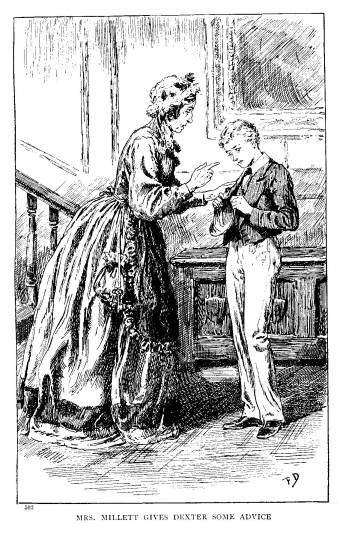
Indoors, when he stole back after setting all his pets at liberty to shift for themselves, Dexter felt very guilty. He encountered Mrs Millett in the hall, and a thrill ran through him as she exclaimed—
“Ah, there you are, Master Dexter, I just want a few words with you.”
“Found out!” thought the guilty conscience, which needs no accuser.
“Now just you look here, sir,” said the old housekeeper, in a loud voice, as she literally button-holed the boy, by hooking one thin finger in his jacket, so that he could not get away, “I know all.”
“You—you know everything,” faltered the boy.
“Yes, sir. Ah, you may well look ’mure. You little thought I knew.”
“How—how did you find out?” he stammered.
“Ah! how did I find out, indeed! Now, look here, am I to go straight to the doctor and tell him!”
“No, no, pray don’t,” whispered Dexter, catching her arm.
“Well, then, I must tell Miss Helen.”
“No, no, not this time,” cried Dexter imploringly; and his tone softened the old lady, who shook the borders of her cap at him.
“Well, I don’t know what to say,” said Mrs Millett softly. “They certainly ought to know.”
Dexter gazed at her wildly. He knew that everything must come out, but it was to have been in a few hours’ time, when he was far away, and deaf to the angry words and reproaches. To hear them now seemed more than he could bear. It could not be. Bob Dimsted must think and say what he liked, and be as angry and unforgiving as was possible. It could not be now. He must plead to the old housekeeper for pardon, and give up all idea of going away.
“Ah!” she said. “I see you are sorry for it, then.”
“Yes, yes,” he whispered. “So sorry, and—and—”
“You’ll take it this time, like a good boy!”
“Take it?”
“Yes, sir. Ah! you can’t deceive me. Last time I saw the empty glass I knew as well as could be that you hadn’t taken it, for the outside of the glass wasn’t sticky, and there were no marks of your mouth at the edge. I always put plenty of sugar in it for you, and that showed.”
“The camomile-tea!” thought Dexter, a dose of which the old lady expected him to take about once a week, and which never did him any harm, if it never did him any good.
“And you’ll take it to-night, sir, like a good boy!”
“Yes, yes, I will indeed,” said Dexter, with the full intention of keeping his word out of gratitude for his escape.
“Now, that’s like being a good boy,” said the old lady, smiling, and extricating her fingers from his button-hole, so as to stroke his hair. “It will do you no end of good; and how you have improved since you have been here, my dear, your hair’s grown so nicely, and you’ve got such a good pink colour in your cheeks. It’s the camomile-tea done that.”
Mrs Millett leaned forward with her hands on the boy’s shoulder, and kissed him in so motherly a way that Dexter felt a catching of the breath, and kissed her again.
“That’s right,” said the old lady. “You ain’t half so bad as Maria pretends you are. ‘It’s only a bit of mischief now and then,’ I says to her, ‘and he’s only a boy,’ and that’s what you are, ain’t it, my dear?”
Dexter did not answer.
“I shall put your dose on your washstand, and you mind and take it the moment you get out of bed to-morrow morning.”
“Yes,” said Dexter dismally.
“No! you’ll forget it. You’ve got to take that camomile-tea to-night, and if you don’t promise me you will, I shall come and see you take it.”
“I promise you,” said Dexter, and the old lady nodded and went upstairs, while the boy hung about in the hall.
How was it that just now, when he was going away, people were beginning to seem more kind to him, and something began to drag at his heart to keep him from going?
He could not tell. An hour before he had felt a wild kind of elation. He was going to be free from lessons, the doctor’s admonitions, and the tame regular life at the house, to be off in search of adventure, and with Bob for his companion, going all over the world in that boat, while now, in spite of all he could do, he did not feel so satisfied and sure.
There was something else he knew that he ought to do. He could not bid Helen good-bye with his lips, but he felt that he must bid her farewell another way, for she had always been kind to him from the day he came.
He crept into the study again, this time without being seen.
There was a faint light in the pleasant room, for the doctor’s lamp had been turned down, but not quite out.
A touch sent the flame brightly round the ring, and the shade cast a warm glow on the boy’s busy fingers as he took out paper and envelope; and then, with trembling hand, sore heart, and a pen that spluttered, he indited another letter, this time to Helen.
My dear Miss Grayson,
I am afraid you will think me a very ungrateful boy, but I am obliged to go away to seek my fortune all over the world. You have been so kind to me, and so has Doctor Grayson sometimes, but everybody else has hated me, and made game of me because I was a workhouse boy, and I could not bear it any longer, and Bob Dimsted said he wouldn’t if he was me, and we are going away together not to come back again any more.—I am,
Your Affec Friend.
Dexter Grayson.
PS—I mean Obed Coleby, for I ought not to call myself Dexter any more, and I would have scratched it out, only you always said it was better not to scratch out mistakes because they made the paper look so untidy.
I like you very much, and Mrs Millett too, but I can’t take her fiz—physick to-night.
Is physick spelt with a k?
There was a tear—a weak tear in each of Dexter’s eyes as he wrote this letter, for it brought up many a pleasant recollection of kindnesses on Helen’s part.
He had just finished, folded and directed this, when he fancied he heard a door open across the hall.
Thrusting the note into his pocket so hastily that one corner went into the toad, he caught up a piece of the doctor’s foolscap, and began rapidly to make a triangle upon it, at whose sides and points he placed letters, and then, feeling like the miserable impostor he was, he rapidly let his pen trace a confused line of A’s and B’s and C’s, and these backwards and forwards.
This went on for some minutes, so that there was a fair show upon the paper, when the door softly opened, Helen peered in, and then coming behind him bent down, and, in a very gentle and sisterly way, placed her hands over his eyes.
“Why, my poor hard-working boy,” she said gently. “So this is where you are; and, oh dear, oh dear! Euclid again. That Mr Limpney will wear your brains all away. There, come along, I am going to play to papa, and then you and I will have a game at draughts.”
Dexter rose with his heart beating, and that strange sensation of something tugging at his conscience. Why were they all so kind to him to-night, just when he was going away?
“Why, you look quite worn out and dazed, Dexter,” said Helen merrily. “There, come along.”
“Eh? Where was he? In mischief?” said the doctor sharply, as they entered the drawing-room.
“Mischief? No, papa: for shame!” cried Helen, with her arm resting on the boy’s shoulders. “In your study, working away at those terrible sides and angles invented by that dreadful old Greek Euclid.”
“Work, eh? Ha! that’s good!” cried the doctor jovially. “Bravo, Dexter! I am glad.”
If ever a boy felt utterly ashamed of himself, Dexter did then. He could not meet the doctor’s eye, but was on his way to get a book to turn over, so as to have something to look at, but this was not to be.
“No, no, you have had enough of books for one day, Dexter. Come and turn over the music for me. Why! what’s that?”
“That?” said Dexter slowly, for he did not comprehend.
“Yes, I felt it move. You have something alive in your pocket.”
He felt prompted to lie, but he could not tell a falsehood then, and he stood with his teeth set.
“Whatever have you got alive in your pocket?” said the doctor. “I know. A young rabbit, for a guinea.”
“Is it?” cried Helen. “Let me look: they are such pretty little things.”
“Yes, out with it, boy, and don’t pet those things too much. Kill them with kindness, you know. Here, let me take it out.”
“No, no!” cried Dexter hastily.
“Well, take it out yourself.”
A spasm of dread had run through the boy, as in imagination he saw the doctor’s hand taking out the letter in his pocket.
“It isn’t a young rabbit,” he faltered.
“Well, what is it, then? Come, out with it.”
Dexter hesitated for a few moments, and now met the doctor’s eye. He could not help himself, but slowly took out his pocket-handkerchief, as he held the note firmly with his left hand outside the jacket. Then, diving in again, he got well hold of Sam, who was snug at the bottom, and, with burning cheeks, and in full expectation of a scolding, drew the toad slowly forth.
“Ugh!” ejaculated Helen.
The doctor, who was in a most amiable temper, burst into a roar of laughter.
“Well, you are a strange boy, Dexter,” he said, as he wiped his eyes. “You ought to be a naturalist by and by. There, open the window, and put the poor thing outside. You can find plenty another time.”
Dexter obeyed, glad to be out of his quandary, and this time, as he put Sam down, the reptile crawled slowly away into the soft dark night.
He closed the window, and went back to find the doctor and Helen all smiles, and ready to joke instead of scold. Then he went to the piano, and turned over the music, the airs and songs making him feel more and more sad, and again and again he found himself saying—
“Why are they so kind to me now, just as I am going away?”
“Shall I stop!” he said to himself, after a time.
“No: I promised Bob I would come, and so I will.”
Chapter Twenty Nine.
An Act of Folly.
Bedtime at last, and as Dexter bade the doctor and his daughter “good-night,” it seemed to him that they had never spoken so kindly to him, and the place had never appeared to be so pleasant and homelike before.
His heart sank as he went up to his room, and he felt as if he could not go away. The lessons Mr Limpney had given him to write out were not done; but he had better stop and face him, and every other trouble, including the window he had broken, and never owned to yet.
It was impossible to go away and leave everybody who was so kind. A harsh word would have kept him to the point; but now he wavered as he sat down on the edge of his bed, with his mind in a whirl.
Then, as he sat there, he pictured in his own mind the figure of Bob Dimsted, waiting for him, laden with articles of outfit necessary for their voyage, and behind Bob loomed up bright sunny scenes by sea and land; and with his imagination once more excited by all that the boy had suggested, Dexter blinded himself to everything but the object he had in view.
He had planned in his own mind what he would take with him, but now it had come to the point he felt a strange compunction. Everything he possessed seemed to him as if it belonged to the doctor, and, finally, he resolved to take nothing with him but the clothes in which he stood.
He began walking about the room in a listless way, looking about at the various familiar objects that he was to see no more, and one of the first things to strike him was a teacup on the washstand, containing Mrs Millett’s infusion, bitter, nauseous, and sweetened to sickliness; and it struck Dexter that the mixture had been placed in a cup instead of a glass, so as to make it less objectionable in appearance.
He could not help smiling as he took up the cup and smelt it, seeing at the same time the old dame’s pleasant earnest face—a face that suddenly seemed to have become very loving, now he was to see it no more.
He set down the cup, and shook his head, and then, as if nerving himself for the task, he went to the drawers, took out a key from his pocket, and then, from the place where it lay, hidden beneath his clean linen, brought forth the old clothes-line twisted and knotted together—the line which had done duty in the loft as a swing.
He listened as he crossed to the door, but all was still downstairs, and it was not likely that any one would come near his room that night; but still he moved about cautiously, and taking the line with his hands, about two feet apart, snapped it again and again with all his might, to try if it was likely to give way now beneath his weight.
It seemed firm as ever, but he could not help a shiver as he laid it by the window, and thought of a boy being found in the shrubbery beneath, with a broken leg, or, worse still, neck.
Then as he waited for the time to glide by, so that all might be in bed before he made his escape, a sudden chill ran through him.
He had remembered everything, as he thought; and yet there was one thing, perhaps the simplest of all, forgotten. He was going to take no bundle, no money, nothing which the doctor had in his kindness provided for him; but he could not go without a cap, and that was hanging in the hall, close to the drawing-room door.
The question arose whether he should venture down to get it now, or after the doctor had gone to bed.
It took him some time to make up his mind; but when he had come to a decision he opened his door softly, listened, and stole out on to the landing.
All was very still as he looked over the balustrade to where the lamp shed its yellow rays all round, and to his mind more strangely upon the object he wanted to obtain than elsewhere.
It was a very simple thing to do, and yet it required a great deal of nerve, for if the drawing-room door were opened just as he reached the hat-stand, and the doctor came out, what should he say?
Then there was the risk of being heard, for there were, he knew, two of the old oaken stairs which always gave a loud crack when any one passed down, and if they cracked now, some one would be sure to come out to see what it meant.
Taking a long catching breath he went quickly to the top of the stairs, and was about to descend in a desperate determination to go through with his task, when an idea struck him, and bending over the balustrade he spread his hands, balanced himself carefully, and then slid down the mahogany rail, round curve after curve as silently as could be, and reaching the curl at the bottom dropped upon the mat.
Only five or six yards now to the hat-stand, and going on tiptoe past the entrance to the drawing-room, he was in the act of taking down the cap, when the handle rattled, the door was thrown open, and the hall grew more light.
In his desperation Dexter snatched down the cap, and stood there trying to think of what he should say in answer to the question that would be asked in a moment—
“What are you doing there!”
It was Helen, chamber-candlestick in hand, and she was in the act of stepping out, when her step was arrested by words which seemed to pierce into the listener’s brain:—
“Oh, about Dexter!”
“Yes, papa,” said Helen, turning.
“What do you think about—”
Dexter heard no more. Taking advantage of Helen’s back being turned as she bent over towards the speaker, the boy stepped quickly to the staircase, ran up, and had reached the first landing before Helen came out into the hall, while before she had closed the door he was up another flight, and gliding softly toward his own room, where he stood panting as he closed the door, just as if he had been running a distance which had taken away his breath.
It was a narrow escape, and he was safe; but his ears tingled still, and he longed to know what the doctor had said about him.
As he stood listening, cap in hand, he heard Helen pass his door singing softly one of the ballads he had heard that evening; and once more a curious dull sensation of misery came over him, as he seemed to feel that he would never hear her sing again, never feel the touch of her soft caressing hand; and somehow there was a vague confused sense of longing to go to one who had treated him with an affectionate interest he had never known before, even now hardly understood, but it seemed to him such gentleness and love as might have come from a mother.
For a moment or two he felt that he must open the door, call to her, throw himself upon his knees before her, and confess everything, but at that moment the laughing, mocking face of Bob Dimsted seemed to rise between them, and his words buzzed in his ear—words that he had often said when listening to some account of Dexter’s troubles—
“Bother the old lessons, and all on ’em! I wouldn’t stand it if I was you. They’ve no right to order you about, and scold you as they do.”
The weak moments passed, and just then there was the doctor’s cough heard, and the closing of his door, while directly after came the chiming of the church clock—a quarter past eleven.
Half an hour to wait and think, and then good-bye to all his troubles, and the beginning of a new life of freedom!
All the freedom and the future seemed to be behind a black cloud; but in the fond belief that all would soon grow clear Dexter waited.
Half-past eleven, and he wondered that he did not feel sleepy.
It was time to begin though now, and he took the line and laid it out in a serpentine fashion upon the carpet, so that there should be no kinks in the way; and then the next thing was to fasten one end tightly so that he could safely slide down.
He had well thought out his plans, and, taking one end of the line, he knotted it securely to the most substantial place he could find in the room, passing it behind two of the bars of the grate. Then cautiously opening his window, a little bit at a time, he thrust it higher and higher, every faint creak sending a chill through him, while, when he looked out upon the dark starlight night, it seemed as if he would have to descend into a black gulf, where something blacker was waiting to seize him.
But he knew that the black things below were only great shrubs, and lowering the rope softly down he at last had the satisfaction of hearing it rustle among the leaves.
Then he waited, and after a glance round to see that everything was straight, and the letter laid ready upon the table, he put out the candle.
“For the last time!” he said to himself, and a great sigh came unbidden from his breast.
A quarter to twelve.
Dexter waited till the last stroke on the bell was thrilling in the air before setting his cap on tightly, and passing one leg over the sill.
He sat astride for a few moments, hesitating for the last time, and then passed the other leg, and lowered himself down till he hung by his hands, then twisted his legs about the rope, seized it with first one hand then the other, and hung by it with his whole weight, in the precarious position of one trusting to an old doubled clothes-line, suspended from a second-floor window.
It was hard work that descent, for he could not slide on account of the knots; and, to make his position more awkward, the rope began to untwist—one line from the other,—and, in consequence, as the boy descended slowly, he bore no small resemblance to a leg of mutton turning before a fire.
That was the only mishap which occurred to him then, for after resting for a few moments upon the first-floor sill he continued his journey, and reached the bottom in the midst of a great laurel, which rustled loudly as he tried to get out, and then tripped over a horizontal branch, and fell flat.
He was up again in an instant, and, trembling and panting, made a couple of bounds which took him over the gravel walk and on to the lawn, where he stood panting and listening.
There was a light in the doctor’s room, and one in Helen’s; and just then the doctor’s shadow, looking horribly threatening, was thrown upon the blind.
He must be coming, Dexter thought, and, turning quickly, he sped down the lawn, avoiding the flower-beds by instinct, and the next minute had reached the kitchen-garden, down whose winding green walk he rapidly made his way.
Chapter Thirty.
Dark Deeds.
It was very dark among the trees as Dexter reached the grass plot which sloped to the willows by the river-side, but he knew his way so well that he crept along in silence till he had one hand resting upon the trunk he had so often climbed, and stood there gazing across the starlit water, trying to make out the figure of his companion in the boat.
All was silent, save that, now and then, the water as it ran among the tree-roots made a peculiar whispering sound, and once or twice there was a faint plash in the distance, as if from the feeding of a fish.
“Hist! Bob! Are you there!”
“Hullo!” came from the other side. “I was just a-going.”
“Going?”
“Yes. I thought you wasn’t a-coming, and I wasn’t going to stop here all night.”
“But you said twelve.”
“Well, it struck twelve an hour ago.”
“No; that was eleven. There—hark!”
As proof of Dexter’s assertion the church clock just then began to chime, and the heavy boom of the tenor bell proclaiming midnight seemed to make the soft night air throb.
“Thought it was twelve long enough ago. Ready!”
“Yes,” said Dexter, in an excited whisper. “Got the boat?”
“No: course I haven’t. It’ll take two to get that boat.”
“But you said you would have it ready.”
“Yes, I know; but we must both of us do that. I waited till you come.”
This was a shock; and Dexter said, in a disappointed tone—
“But how am I to get to you!”
“Come across,” said Bob coolly.
“Come across—in the dark!”
“Why, of course. You ain’t afraid, are you? Well, you are a chap!”
“But it’s too deep to wade.”
“Well, who said it wasn’t!” growled the boy. “You can swim, can’t you?”
“But I shall get so wet.”
“Yah!” ejaculated Bob in tones of disgust. “You are a fellow. Take your clothes off, make ’em in a bundle, and swim over.”
Dexter was half-disposed to say, “You swim across to me,” but nothing would have been gained if he had, so, after a few minutes’ hesitation, and in genuine dread, he obeyed the wishes of his companion, but only to pause when he was half-undressed.
“I say, though,” he whispered, “can’t you get the boat? It’s so cold and dark.”
“Well, you are a fellow!” cried Bob. “Beginning to grumble afore we start. It’s no use to have a mate who’s afraid of a drop of water, and don’t like to get wet.”
“But—”
“There, never mind,” grumbled Bob; “we won’t go.”
“But I didn’t say I wouldn’t come, Bob,” whispered Dexter desperately. “I’ll come.”
There was no answer.
“Bob.” Still silence.
“I say, don’t go, Bob. I’m very sorry. I’m undressing as fast as I can. You haven’t gone, have you?”
Still silence, and Dexter ceased undressing, and stood there in the cold night air, feeling as desolate, despairing, and forlorn as boy could be.
“What shall I do?” he said to himself; and then, in a despondent whisper, “Bob!”
“Hullo!”
“Why, you haven’t gone!” joyfully.
“No; but I’m going directly. It’s no use for me to have a mate who hasn’t got any pluck. Now then, are you coming, or are you not!”
“I’m coming,” said Dexter. “But stop a moment. I’ll be back directly.”
“Whatcher going to do!”
“Wait a moment and I’ll show you.”
Dexter had had a happy thought, and turning and running in his trousers to the tool-shed, he dragged out a small deal box in which seeds had come down from London that spring. It was a well-made tight box, and quite light, and with this he ran back.
“Why, what are you doing?” grumbled Bob, as soon as he heard his companion’s voice.
“Been getting something to put my clothes in,” whispered Dexter. “I don’t want to get them wet.”
“Oh,” said Bob, in a most unconcerned way; and he began to whistle softly, as Dexter finished undressing, tucked all his clothes tightly in the box, and bore it down to the water’s edge, where it floated like a little boat.
“There!” cried Dexter excitedly. “Now they’ll be all dry when I’ve got across. Ugh! how cold the water is,” he continued, as he dipped one foot. “I wish I’d brought a towel.”
“Yah! what does a fellow want with a towel? You soon gets dry if you run about. Going to walk across!”
“I can’t,” said Dexter; “it’s too deep.”
“Well, then, swim. I could swim that with one hand tied behind.”
“I couldn’t,” said Dexter, hesitating, for it was no pleasant task to plunge into the little gliding river at midnight, and with all dark around.
“Now then! Look alive! Don’t make a splash.”
“Oh!”
“What’s the matter?”
“It is cold.”
“Yah! Then, get back to bed with you, and let me go alone.”
“I’m coming as fast as I can,” said Dexter, as he lowered himself into the stream, and then rapidly climbed out again, as the cold water caused a sudden catching of the breath; and a nervous shrinking from trusting himself in the dark river made him draw right away from the edge.
“Why, you ain’t swimming,” said Bob. “Here, look sharp! Why, you ain’t in!”
“N–no, not yet,” said Dexter, shivering.
“There’s a coward!” sneered Bob.
“I’m not a coward, but it seems so dark and horrible to-night, and as if something might lay hold of you.”
“Yes, you are a regular coward,” sneered Bob. “There, jump in, or I’ll shy stones at yer till you do.”
Dexter did not speak, but tumbled all of a heap on the short turf, shrinking more and more from his task.
“I shall have to go without you,” said Bob.
“I can’t help it,” said Dexter, in a low, tremulous whisper. “It’s too horrid to get in there and swim across in the dark.”
“No, it ain’t. I’d do it in a minute. There, jump in.”
“No,” said Dexter sadly. “I must give it up.”
“What, yer won’t do it!”
“I can’t,” said Dexter sadly. “We must try some other way. I’m going to dress again. Oh!”
“What’s the matter now!”
“My clothes!” Splash! Rush!
Dexter had rapidly lowered himself into the black deep stream and was swimming hard and fast, for as he rose and sought for his garments he suddenly recalled the fact that he had turned the box into a tiny barge, laden it with his clothes, and placed them in the river, while now, as he went to take them out, he found that the stream had borne the box away, and it was going down toward the sea.
“Try if you can see them, Bob,” said Dexter, as he panted and struggled on through the water.
“See what?”
“My clothes. They’re floating down the river.”
Bob uttered a low chuckling laugh, and trotted along by the edge of the river; but it was too dark for him to see anything, and Dexter, forgetting cold and dread, swam bravely on, looking well to right and left, without avail, till all at once, just in one of the deepest eddies, some fifty yards down below the doctor’s house, and where an unusually large willow spread its arms over the stream, he caught sight of something which blotted out the starlight for a moment, and then the stars’ reflection beamed out again.
Something was evidently floating there, and he made for it, to find to his great joy that it was the floating box, which he pushed before him as he swam, and a couple of minutes later he was near enough to the edge on the meadow-side to ask Bob’s help.
“Ain’t got ’em, have you?” the latter whispered.
“Yes; all right. I’ll come out there. Give me a hand.”
Dexter swam to the muddy overhanging bank, and seized the hand which Bob extended toward him.
“Now then, shall I duck yer!” said Bob, who had lain down on the wet grass to extend his hand to the swimmer.
“No, no, Bob, don’t. That would be cowardly,” cried Dexter. “Help me to get out my clothes without letting in the wet. It is so cold.”
“But you swam over,” said Bob sneeringly.
“Yes; but you don’t know how chilly it makes you feel. Mind the clothes.”
Bob did mind, and the next minute Dexter and the barge of dry clothes were upon the grass together.
“Oh, isn’t it cold?” said Dexter, with his teeth chattering.
“Cold? no. Not a bit,” said Bob. “Here, whatcher going to do!”
“Do? Dress myself. Here, give me my shirt. Oh, don’t I wish I had a towel!”
“You leave them things alone, stoopid. You can’t dress yet.”
“Not dress!”
“No,” cried Bob loudly.
“What do you mean!”
“You come along and I’ll show yer. Why, we haven’t got the boat.”
“No, but—”
“Well, you’re all ready, and you’ve got to swim across and get it.”
“I’ve got to get it!” cried Dexter in dismay. “Why, you said you would get the boat.”
“Yes, but I didn’t know then that you were going to swim across.”
“But you said it would take two to get it,” protested Dexter.
“Yes, I thought so then, but you’re all ready and can swim across, and get it directly. Here, come along!”
“But—but,” stammered Dexter, who was shivering in the chill night air.
“What, you’re cold? Well, come along. I’ll carry the box. Let’s run. It’ll warm yer.”
Dexter was ready with another protest, but he did not utter it. His companion seemed to carry him along with the force of his will, but all the same there was a troublous feeling forcing itself upon him that he had made a mistake, and he could not help a longing for his room at the doctor’s with its warm bed, comfort, safety, and repose.
But he knew it was too late, and he was too much hurried and confused to do more than try to keep up with Bob Dimsted as he ran by his side carrying the box till they had reached the meadow facing Sir James Danby’s garden; and there, just dimly seen across the river, was the low gable-end of the boat-house beneath the trees.
“Hush! don’t make a row,” whispered Bob. “Now then, slip in and fetch it. Why, you could almost jump it.”
“But, Bob—I—I don’t like to go. I’m so cold.”
“I’ll precious soon warm yer if you don’t look sharp,” cried Bob fiercely. “Don’t you try to make a fool of me. Now then, in with you!”
He had put the box down and gripped Dexter fiercely by the arm, causing him so much pain that instead of alarming it roused the boy’s flagging spirit, and he turned fiercely upon his assailant, and wrested his arm free.
“That’s right,” said Bob. “In with you. And be sharp, and then you can dress yerself as we float down.”
Dexter’s instinct was to resist and give up, but he felt that he had gone too far, and feeling that his companion might consider him a coward if he refused to go, he lowered himself down into the water.
“That’s yer sort,” said Bob, in a loud whisper. “You’ll soon do it.”
“But suppose the chains are locked!”
“They won’t be locked,” said Bob. “You go acrost and see.”
In the eager desire to get an unpleasant task done, Dexter let himself glide down into the swift stream about a dozen yards above the boat-house, and giving himself a good thrust off with his feet, he swam steadily and easily across, the river there being about thirty yards wide, and in a very short time he managed to touch the post at the outer corner of the long low boat-house. Then, hardly knowing how he managed it, he found bottom as his hand grasped the gunwale of the boat, and walking along beside it he soon reached the chain which moored it to the end.
Here in his excitement and dread it seemed as if his mission was to fail. It was dark enough outside, but in the boat-house everything seemed to be of pitchy blackness, and try how he would he could find no way of unfastening the chain.
He tried toward the boat, then downwards, then upwards, and in the boat again, and again. His teeth were chattering, his chest and shoulders felt as if they were freezing, and his hands, as they fumbled with the wet chain, began to grow numbed, while, to add to his excitement and confusion, Bob kept on from time to time sending across the river a quick hissing—
“I say; look sharp.”
Then he heard a sound, and he splashed through the water in retreat toward the river, for it seemed that they were discovered, and some one coming down the garden.
But the sound was repeated, and he realised the fact that it was only the side of the boat striking against a post.
“I say, are you a-coming?” whispered Bob.
“I can’t undo the chain,” Dexter whispered back.
“Yer don’t half try.”
Just then the clock chimed half-past twelve, and Dexter stopped involuntarily; but a fresh summons from his companion roused him to further action, and he passed once more along to the prow of the boat, and seizing the chain felt along it till this time he felt a hook, and, wondering how it was that he had missed it before, he began with trembling fingers to try and get it out from the link through which it was thrust.
It was in very tightly, though, for the point being wedge-shaped the swaying about and jerking to and fro of the boat had driven it further and further in, so that it was not until he had been ready over and over again to give up in despair that the boy got the iron free.
Then panting with dread and excitement he found the rest easy; the chain was passed through a ring-bolt in one of the posts at the head of the boat-house, and through this he drew it back slowly and cautiously on account of the rattling it made.
It seemed of interminable length as he drew and drew, piling up the chain in the bows of the boat till he thought he must have obtained all, when there was a sudden check, and it would come no further.
Simple enough in broad daylight, and to a person in the boat, but Dexter was standing waist deep in the water, and once more he felt that the case was hopeless.
Another call from Bob roused him, and he followed the chain with his hand till he had waded to the post, and found that the hook had merely caught in the ring, and only needed lifting out, and the boat was at liberty.
But just at this moment there was a furious barking, and a dog seemed to be tearing down the garden toward the boat-house.
In an agony of horror Dexter climbed into the boat, and feeling the side of the long shed he thrust and thrust with so much effect that he sent the light gig well out into the stream and half-across the river. Then seizing an oar, as the dog was now down on the bank, snapping and barking more furiously than ever, he got it over into the water, and after a great deal of paddling, and confused counter-action of his efforts, forced the boat onward and along, till it touched the shore where Bob was waiting with the box.
“No, no, don’t come out,” he whispered. “Here, help me get these in.”
Dexter crept to the stern of the boat, and in his effort to embark the box nearly fell overboard, but the treasure was safe. Then Bob handed in a basket, and a bundle of sticks, evidently his rod, and leaping in directly after, gave the boat sufficient impetus to send it well out into the stream, down which it began to glide.
“Ah, bark away, old un,” said Bob contemptuously, as the sound of the dog’s alarm notes grew more distant, and then more distant still, for they were going round a curve, and the garden side of the river was thick with trees.
“Is that Danby’s dog!” whispered Bob.
“I don’t know,” said Dexter, with his teeth chattering from cold and excitement.
“Why! you’re a-cold,” said Bob coolly. “Here, I’ll send her along. You look sharp and dress. I say, where’s your bundle of things?”
“Do you mean my clothes?”
“No! Your bundle.”
“I didn’t bring anything,” said Dexter, hurriedly slipping on his shirt.
“Well, you are a chap!” said Bob sourly, but Dexter hardly heard him, for he was trying to get his wet body covered from the chill night air; and he could think of nothing but the fact that he had taken a very desperate step, and the boat was bearing them rapidly away from what seemed now to have been a very happy home—further out, further away from the doctor and from Helen, downward toward the sea, and over that there was a great black cloud, beyond which, according to Bob Dimsted, there were bright and glorious lands.
At that moment, chill with the cold and damp, Dexter would have given anything to have been back in his old room, but it was too late, the boat was gliding on, and Bob had now got out the sculls. The town lights were receding, and they were going onward toward that dark cloud which Dexter seemed to see more dimly now, for there was a dumb depressing sensation of despair upon him, and he turned his eyes toward the river-bank, asking himself if he could leap ashore.
Chapter Thirty One.
Times of Delight!
“Here we are!” said Bob Dimsted, as he sat handling the sculls very fairly, and, as the stream was with them, sending the boat easily along. “I think we managed that first-rate.”
Dexter made no reply, for he had his teeth fast set, and his lips pressed together to keep the former from chattering, but he thought a great deal, and found himself wondering what Bob had done toward getting the boat.
With the covering up of his goose-skinned body, and the return of some of his surface heat, the terrible fit of despondency began to pass away, and Dexter felt less ready to sit down in helpless misery at the bottom of the boat.
“Getting nice and warm, ain’tcher?”
“Not very, yet.”
“Ah, you soon will be, and if you ain’t you shall take one of these here oars. That’ll soon put you right. But what a while you was!”
“I—I couldn’t help it,” shivered Dexter, drawing in his breath with a quick hissing sound; “the chain was so hard to undo.”
“Ah, well, never mind now,” said Bob, “only, if we’d got to do it again I should go myself.”
Dexter made no protest, but he thought it sounded rather ungrateful. He was too busy, though, with buttons, and getting his fingers to work in their regular way, to pay much heed, and he went on dressing.
“I say, what a jolly long while you are!” continued Bob. “Oh, and look here! I’d forgot again: why didn’t you bring your bundle with all your clothes and things, eh!”
“Because they weren’t mine.”
“Well, you are a chap! Not yourn? Why, they were made for you, and you wore ’em. They can’t be anybody else’s. I never see such a fellow as you are! I brought all mine.”
It was an easy task, judging from the size of the bundle dimly seen in the bottom of the boat, but Dexter said nothing.
“How much money have you got?” said Bob, after a pause.
“None at all.”
“What?”
There was utter astonishment in Bob Dimsted’s tones as he sat motionless, with the sculls balanced on the rowlocks, staring wildly through the gloom, as Dexter now sat down and fought hard with an obstinate stocking, which refused to go on over a wet foot—a way stockings have at such times.
“Did you say you hadn’t got any money?” cried Bob.
“Yes. I sent it all in a letter to pay for the boat in case we kept it.”
“What, for this boat?” cried Bob.
“Yes.”
“And you call yourself a mate?” cried Bob, letting the scull blades drop in the water with a splash, and pulling hard for a few strokes. “Well!”
“I felt obliged to,” said Dexter, whose perseverance was rewarded by a complete victory over the first stocking, when the second yielded it with a better grace, and he soon had on his shoes, and then began to dry his ears by thrusting his handkerchief-covered finger in the various windings of each gristly maze.
“Felt obliged to?”
“Yes, of course. We couldn’t steal the boat.”
“Yah, steal it! Who ever said a word about stealing? We’ve only borrowed it, and if we don’t send it back, old Danby’s got lots of money, and he can buy another. But, got no money! Well!”
“But we don’t want money, do we!” said Dexter, whom the excitement as well as his clothes now began to make comparatively warm. “I thought we were going where we could soon make our fortunes.”
“Yes, of course we are, stoopid; but you can’t make fortunes without money. You can’t ketch fish if yer ain’t got no bait.”
This was a philosophical view of matters which took Dexter aback, and he faltered rather as he spoke next, this time with his ears dry, his hair not so very wet, and his jacket buttoned up to his chin.
“I’m very sorry, Bob,” he said gently.
“Sorry! Being sorry won’t butter no parsneps,” growled Bob.
“No,” said Dexter mildly, “but we haven’t got any parsneps to butter.”
“No, nor ain’t likely to have,” growled Bob, and then returning to a favourite form of expression: “And you call yourself a mate! Here, come and kitch holt of this scull.”
Dexter sat down on the thwart, and took the scull after Bob had contrived to give him a spiteful blow on the back with it before he extricated it from its rowlock.
Dexter winced slightly, but he bore the pain without a word, and began rowing as well as a boy does row who handles a scull for the first time in his life. And there he sat, gazing to right and left at the dark banks of the river, and the stars above and reflected below, as they went slowly on along the bends and reaches of the little river, everything looking strangely distorted and threatening to the boy’s unaccustomed eyes.
The exercise soon began to bring a general feeling of warmth to his chilled frame, and as the inward helplessness passed away it began to give place to an acute sense of fear, and his eyes wandered here and there in search of Sir James Danby, the doctor, and others more terrible, who would charge them with stealing the boat in spite of his protests and the money he had left behind.
And all the time to make his trip more pleasant he had to suffer from jarring blows upon the spine, given by the top of Bob’s oar.
In nearly every case this was intentional, and Bob chuckled to himself, as with the customary outburst of his class he began to abuse his companion.
“Why don’t yer mind and keep time!” he cried. “Who’s to row if you go on like that? I never see such a stoopid.”
“All right, Bob, I’ll mind,” said Dexter, with all the humility of an ignorance which kept him from knowing that as he was rowing stroke Bob should have taken his time from him.
The blows on the back had two good effects, however: they gratified Bob, who had the pleasure of tyrannising over and inflicting pain upon his comrade, while Dexter gained by the rapid increase of warmth, and was most likely saved from a chill and its accompanying fever.
Still that night trip was not pleasant, for when Bob was not grumbling about the regularity of Dexter’s stroke, he had fault to find as to his pulling too hard or not hard enough, and so sending the head of the boat toward the right or left bank of the stream. In addition, the young bully kept up a running fire of comment on his companion’s shortcomings.
“I never see such a mate,” he said. “No money and no clothes. I say,” he added at the end of one grumbling fit, “what made you want to run away!”
“I don’t know,” said Dexter sadly. “I suppose it was because you persuaded me.”
“Oh, come, that’s a good un,” said Bob. “Why, it was you persuaded me! You were always wanting to go away, and you said we could take Danby’s boat, and go right down to the sea.”
“No!” protested Dexter; “it was you said that.”
“Me!” cried Bob. “Oh, come, I like that, ’pon my word I do. It was you always begging of me to go, and to take you with me. Why, I shouldn’t never have thought of such a thing if you hadn’t begun it.”
Dexter was silent, and now getting thoroughly warm he toiled on with his oar, wondering whether Bob would be more amiable when the day came, and trying to think of something to say to divert his thoughts and make him cease his quarrelsome tone.
“I never see such a mate,” growled Bob again. “No money, no clothes! why, I shall have to keep yer, I s’pose.”
“How long will it take us to get down to the sea, Bob?” said Dexter at last.
“I d’know. Week p’r’aps.”
“But we shall begin fishing before then, shan’t we!”
“Fishing! How are you going to fish without any rod and line? Expects me to find ’em for yer, I s’pose!”
“No, but I thought you would catch the fish, and I could light a fire and cook them.”
“Oh, that’s what yer thought, was it? Well, p’r’aps we shall, and p’r’aps we shan’t.”
“Do you think they will come after us!” ventured Dexter, after a time.
“Sure to, I should say; and if they do, and they kitches us, I shall say as it was you who stole the boat.”
“No, you won’t,” said Dexter, plucking up a little spirit now he was getting more himself. “You wouldn’t be such a sneak.”
“If you call me a sneak, I’ll chuck you out of the boat,” cried Bob angrily.
“I didn’t call you a sneak, I only said you wouldn’t be such a sneak,” protested Dexter.
“I know what you said: yer needn’t tell me, and I won’t have it, so now then. If you want to quarrel, you’d better get out and go back.”
“But I don’t want to quarrel, Bob; I want to be the best of friends.”
“Then don’t yer call me a sneak, because if you do it’ll be the worse for you.”
“Oh, I say, Bob,” protested Dexter, as he tugged away at his oar, “don’t be so disagreeable.”
“And now he says I’m disagreeable!” cried Bob. “Well of all the chaps as ever I see you’re about the nastiest. Look here, do you want to fight? because if you do, we’ll just go ashore here and have it out.”
“I don’t want to fight indeed, Bob.”
“Yes, you do; you keep egging of me on, and saying disagreeable things as would have made some chaps give you one for yourself ever so long ago. Lookye here, only one on us can be captain in this here boat, and it is going to be either me or you. I don’t want to be, but I ain’t going to be quite jumped upon, so we’ll get ashore here, and soon see who it’s going to be.”
As Bob Dimsted spoke in a low snarling way, he gave his scull so hard a pull that he sent the boat’s head in toward the bank.
“First you want one thing, and then you want another, and then you try to make out that it was me who stole the boat.”
“I only said it wasn’t me.”
“There,” cried Bob, “hark at that! Why, who was it then?” Didn’t you take yer clothes off and swim over while I stood t’other side?
Dexter did not answer, but went on rowing with a hot feeling of anger rising in his breast.
“Oh, so now you’re sulky, are you? Very well, my lad, we’ll soon see to that. If you don’t know who’s best man, I’m going to show you. It’s dark, but it’s light enough for that, so come ashore and—”
Whish! rush! crash!
“Row! pull! pull!” whispered Bob excitedly, as there was a loud breaking of the low growth on the bank close by them, followed by the loud clap given by a swing-gate violently dashed to.
Dexter pulled, but against the bank, for they were too close in for them to get a dip of the oar in the water; but what he did was not without some effect, and, as Bob backed, the boat’s head gradually glided round, shot into the stream, and they went swiftly on again, pulling as hard as they could.
“Did you see him!” whispered Bob at last.
“No, did you?”
“No, but I nearly did. He has been creeping along the bank for ever so long, and he nearly got hold of the boat.”
“Who was it?” whispered Dexter.
“Pleeceman, but pull hard, and we shall get away from him yet.”
They both pulled a slow stroke for quite an hour, and by that time the horse that had been feeding upon the succulent weedy growth close to the water’s edge had got over its fright, and was grazing peaceably once more.
Bob was quiet after that. The sudden alarm had cut his string of words in two, and he was too much disturbed to take them up again to join. In fact he was afraid to speak lest he should be heard, and he kept his ill-temper—stirred up by the loss of a night’s rest—to himself for the next hour, when suddenly throwing in his oar he said—
“Look here, I’m tired, and I shall lie down in the bottom here and have a nap. You keep a sharp look-out.”
“But I can’t row two oars,” said Dexter.
“Well, nobody asked you to. You’ve got to sit there with the boat-hook, and push her off if ever she runs into the bushes. The stream’ll take her down like it does a float.”
“How far are we away from the town!”
“I d’know.”
“Well, how soon will it be morning!”
“How should I know? I haven’t got a watch, have I? If I’d had one I should have sold it so as to have some money to share with my mate.”
“Have you got any money, Bob?”
“Course I have. Don’t think I’m such a stoopid as you, do yer!”
Dexter was silent, and in the darkness he laid in his oar after the fashion of his companion, and took up the boat-hook, while Bob lifted one of the cushions from the seat, placed it in the bottom of the boat, and then curled up, something after the fashion of a dog, and went off to sleep.
Dexter sat watching him as he could dimly make out his shape, and then found that the stern of the boat had been caught in an eddy and swung round, so that he had some occupation for a few moments trying to alter her position in the water, which he did at last by hooking the trunk of an overhanging willow.
This had the required effect, and the head swung round once more; but in obtaining this result Dexter found himself in this position—the willow refused to give up its hold of the boat-hook. He naturally, on his side, also refused, and, to make matters worse, the current here was quite a race, and the boat was going rapidly on.
He was within an ace of having to leave the boat-hook behind, for he declined to try another bath—this time in his clothes. Just, however, at the crucial moment the bark of the willow gave way, the hook descended with a splash, and Dexter breathed more freely, and sat there with the boat-hook across his knees looking first to right and then to left in search of danger, but seeing nothing but the low-wooded banks of the stream, which was gradually growing wider as they travelled further from the town.
It was a strange experience; and, comparatively happy now in the silence of the night, Dexter kept his lonely watch, thinking how much pleasanter it was for his companion to be asleep, but all the time suffering a peculiar sensation of loneliness, and gazing wonderingly at the strange, dark shapes which he approached.
Men, huge beasts, strange monsters, they seemed sometimes right in front, rising from the river, apparently as if to bar his way, but always proving to be tree, bush, or stump, and their position caused by the bending of the stream.
Once there was a sudden short and peculiar grating, and the boat stopped short, but only to glide on again as he realised that the river was shallow there, and they had touched the clean-washed gravelly bottom.
There was enough excitement now he was left to himself to keep off the depression he had felt, for now the feeling that he was gliding away into a new life was made more impressive by the movement of the boat, which seemed to him to go faster and faster among dimly seen trees, and always over a glistening path that seemed to be paved with stars.
Once, and once only, after leaving the town behind was there any sign of inhabited building, and that was about an hour after they started, when a faint gleam seemed to be burning steadily on the bank, and so near that the light shone down upon the water. But that was soon passed, and the river ran wandering on through a wild and open district, where the only inhabitants were the few shepherds who attended the flocks.
On still, and on, among the low meadows, through which the river had cut its way in bygone times. Serpentine hardly expressed its course, for it so often turned and doubled back over the ground it had passed before; but still it, on the whole, flowed rapidly, and by slow degrees mile after mile was placed between the boys and the town. Twice over a curious sensation of drowsiness came upon Dexter, and he found himself hard at work trying to hunt out some of his pets, which seemed to him to have gone into the most extraordinary places.
For instance, Sam the toad had worked himself down into the very toe of the stocking he had been obliged to take off when he went into the water, and the more he tried to shake it out, the more tightly it clung with its little hands.
Then he woke with a start, and found out that he had dozed off.
Pulling himself together he determined not to give way again, but to try and guide the boat.
To properly effect this he still sat fast with the boat-hook across his knees, and in an instant he was back at the doctor’s house in Coleby, looking on while Helen was busy reading the letter which had been brought down from the bedroom.
Dexter could see her perfectly plainly. It seemed a thoroughly realistic proceeding, and she was wiping her eyes as she read, while, at the same moment, the doctor entered the room with the willow pollard from the bottom of the garden; and lifting it up he called him an ungrateful boy, and struck him a severe blow on the forehead which sent him back on to the carpet.
But it was not on to the carpet, but back into the bottom of the boat, and certainly it was a willow branch which had done the mischief, though not in the doctor’s hand.
Dexter got up again, feeling rather sore and confused, for the boat had drifted under a projecting bough, just on a level with the boy’s head, but his cap had saved him from much harm.
Dexter’s first thought was that Bob would jump up and begin to bully him for going to sleep. But Bob was sleeping heavily, and the bump, the fall, and the rocking of the boat only acted as a lullaby to his pleasant dreams.
And then it seemed that a tree on the bank—a tall poplar—was very much plainer than he had seen any tree before that night. So was another on the other bank, and directly after came a sound with which he was perfectly familiar at the doctor’s—a sound that came beneath his window among the laurustinus bushes.
Chink—chink—chink—chink.
A blackbird—answered by another. And then all at once it seemed to be so cold that it was impossible to help shivering; and to ward off the chilling sensation Dexter began to use the boat-hook as a pole, thrusting it down first on one side of the boat and then on the other as silently as he could, so as not to wake Bob. Sometimes he touched bottom, and was able to give the boat a good impetus, but as often as not he could not reach the river-bed. Still the exercise made his blood circulate, and drove away the dull sense of misery that had been coming on.
As he toiled on with the pole, the trees grew plainer and plainer, and a soft pearly dawn seemed to be floating over the river. The birds uttered their calls, and then, all at once, in a loud burst of melody, up rose a lark from one of the dewy meadows on his right. Then further off there was another, and right away high up in the east one tiny speck of dull red.
Soon this red began to glow as if gradually getting hotter. Then another and another speck appeared—then scores, fifties, hundreds—and Dexter stood bathed in the rich light which played through the curling river mists, as the whole of the eastern heavens became damasked with flecks of gold.
In a comparatively short time these faded, and a warm glow spread around the meadows and wild country on either side, where empurpled hills rose higher and higher, grew more and more glorious, and the river sparkled and danced and ran in smooth curves, formed eddies, and further in advance became one wonderful stretch of dancing golden ripples, so beautiful that Dexter stood on the thwart with the pole balanced in his hand wondering whether everything could be as beautiful at Coleby as he saw it now.
Then there was a sudden shock, so sharp that he could not save himself, but took a kind of header, not into the water, but right on to Bob Dimsted, landing with his knees in Bob’s softest portion, and the pole right across his neck, just as Bob tried to rise, and uttered a tremendous yell. The wonder was that the end of the boat-hook had not gone through the bottom of the boat.
Chapter Thirty Two.
Master and Slave.
“Eee! I say! Whatcher doing of!” roared Bob, beginning to struggle, as Dexter contrived to get his feet once more.
“I—I couldn’t help it, Bob,” he said, in a shame-faced way.
“Couldn’t help it! Here, don’tcher try to wake me again that way.”
“I didn’t. I—”
“Coming jumping on a fellow.”
“I didn’t, Bob. The boat stopped all at once, and I tumbled forward.”
“Then just you tumble on to some one else next time,” growled Bob, sitting up rubbing himself, and then yawning loudly. “Why, hulloa! Whatcher been doing of now?”
“I? Nothing Bob.”
“Yes, you have. You’ve got the boat aground.”
“I—I didn’t indeed, Bob. It went like that all of itself,” stammered Dexter.
“Went all of itself! You are a fellow to leave to manage a boat. I just shut my eyes a few minutes and you get up to them games. Here, give us holt!”
He snatched at the boat-hook, and began to thrust with all his might: but in vain.
“Don’t stand staring like that,” he cried, becoming all at once in a violent hurry to get on. “Come and help. D’yer want them to come and ketch us!”
Dexter went to his help, and by dint of thrusting together the boat was pushed off the shallows, and gliding once more into deep water began to float gently on.
There was a few minutes’ silence, during which Bob took the sculls and began to pull, looking, with his eyes red and swollen up, anything but a pleasant companion; and in spite of himself Dexter began to think that Bob as a conversational friend across the water was a very different being to Bob as the captain of their little vessel, armed with authority, and ready to tyrannise over his comrade to the fullest extent.
Suddenly a thought occurred to Dexter as he ran his eye over the handsome cushions of the well-varnished boat.
“Bob!” he said.
There was no answer.
“Bob, did you take that parcel and drop it in Sir James’s letter-box!”
“What parcel!” said Bob sourly.
“That one I threw over to you last night.”
“Oh! that one as fell in the water?”
“Yes: did you take it?”
“Why, didn’t you tell me to!”
“Yes: but did you?”
“Why, of course I did.”
“That’s right. I say, where are we now?”
“I d’know. Somewhere down the river.”
“Hadn’t we better begin to fish?”
“Fish? What for?”
“Because I’m getting so hungry, and want my breakfast.”
“Yes, you’re a nice fellow to wantcher bragfuss. Got no money and no clothes. I s’pose I shall have to keep yer.”
“No, no, Bob. I’ll work, or fish, or do anything.”
“Yes, so it seems,” said Bob sarcastically; “a-sitting there like a gent, and letting me do everything.”
“Well, let me pull one oar.”
“No, I can do it, and you shall have some bragfuss presently. I don’t want to be took, because you’ve stole a boat.”
Dexter turned pale, and then red with indignation, but he did not say anything, only waited till his lord should feel disposed to see about getting a meal.
This happened when they were about a couple of miles lower down the stream, which steadily opened out and became more beautiful, till at last it seemed to be fully double the size it was at Coleby.
Here they came abreast of a cluster of cottages on the bank, one of which, a long whitewashed stone building, hung out a sign such as showed that it was a place for refreshment.
“There,” said Bob, “we’ll land there—I mean you shall, and go in and buy some bread and cheese.”
“Bread and cheese,” faltered Dexter. “Shan’t we get any tea or coffee, and bread and butter?”
“No! of course not. If we both get out they’ll be asking us questions about the boat.”
Bob backed the boat close to the shore, stern foremost, and then said—
“Now, look here, don’t you make no mistake; but you jump out as soon as I get close in, and go and ask for four pen’orth o’ bread and cheese. I’ll row out again and wait till you come.”
Dexter did not like the task, and he could not help thinking of the pleasant breakfast at the doctor’s, but recalling the fact that a fortune was not to be made without a struggle, he prepared to land.
“But I haven’t got any money,” he said. “No, you haven’t got any money,” said Bob sourly, as he tucked one oar under his knee, so as to get his hand free to plunge into his pocket. “There you are,” he said, bringing out sixpence. “Look sharp.”
Dexter took the money, leaped ashore, and walked up to the little public-house, where a red-faced woman waited upon him, and cut the bread and cheese.
“Well,” she said, looking wonderingly at her customer, “don’t you want no beer!”
Dexter shook his head, lifted up his change, and hurried out of the place in alarm, lest the woman should ask him any more questions.
But she did not attempt to, only came to the door to watch the boy as he went back to the boat, which was backed in so that Dexter could jump aboard; but Bob, whose eyes were looking sharply to right and left in search of danger, just as a sparrow scrutinises everything in dread while it is eating a meal, managed so badly in his eagerness to get away, that, as Dexter leaped in, he gave a tug with the sculls, making the boat jerk so sharply that Dexter’s feet began to move faster than his body, and the said body came down in a sitting position that was more sudden than agreeable.
“Well, you are a fellow!” cried Bob, grinning. “Any one would think you had never been in a boat before.”
Dexter gathered together the portions of food which had been scattered in the bottom of the boat, and then sat looking ruefully at his companion.
“If any of that there’s dirty, you’ve got to eat it,” said Bob sourly. “I shan’t.”
As he spoke he tugged as hard as he could at the sculls, rowing away till they were well round the next bend, and quite out of sight of the woman who stood at the door watching them, and as Bob bent down, and pulled each stroke well home, Dexter sat watching him with a troubled feeling which added to his hunger and discomfort. For once more it began to seem that Bob was not half so pleasant a companion as he had promised to be when he was out fishing, and they sat and chatted on either side of the little river.
But he brightened up again as Bob suddenly began to pull harder with his left-hand scull, turning the boat’s head in toward the shore where a clump of trees stood upon the bank with their branches overhanging, and almost touching the water.
“Look out! Heads!” cried Bob, as the bow of the boat touched the leafage, and they glided on through the pliant twigs; and as the sculls were laid in, Bob rose up in his place, seized a good-sized bough, and holding on by it worked the boat beneath, and in a position which enabled him to throw the chain over, and securely moor the little vessel in what formed quite a leafy arbour with the clear water for floor, and the thwarts of the boat for seats.
“There,” cried Bob, in a satisfied tone, and with a little of his old manner, “whatcher think o’ that? Talk about a place for a bragfuss! Why, it would do to live in.”
Dexter said it was capital, but somehow just then he began to think about the pleasant room at the doctor’s, with the white cloth and china, and the silver coffee-pot, and the odour from the covered dish which contained ham or bacon, or fried soles.
“Now then!” cried Bob; “I’m as hungry as you, and we’re all safe here, so hand over.”
Dexter gave him one of the portions of bread and cheese—the better of the two, but Bob turned it over and examined it in a dissatisfied way, scowling at it the while, and casting an occasional glance at that which Dexter had reserved for himself.
“What I says is—play fair,” he growled. “I don’t want no more than half.”
“But that’s the bigger half, Bob.”
“I dunno so much about that.”
“And this is the one which seemed to be a little gritty.”
“Oh, is it?” said Bob surlily; and he began eating in a wolfish fashion, making fierce snaps and bites at his food, as he held the bread in one hand, the cheese in the other, and taking alternate mouthfuls.
“Hunger is sweet sauce,” and Dexter was not long in following Bob’s example, that is as to the eating, but as he sat there munching away at the cakey home-made bread, and the strong cheese, in spite of its being a glorious morning, and the sun showering down in silver pencils through the overhanging boughs—in spite of the novelty of the scene, and the freedom, there did not seem to be so much romance in the affair as had been expected; and try how he would he could not help longing for a good hot cup of coffee.
This was not heroic, but the boy felt very miserable. He had been up all night, going through adventures that were, in spite of their tameness, unusually exciting, and he was suffering from a nervous depression which robbed him of appetite as much as did his companion’s words. For instead of being merry, confidential, and companionable, Bob scarcely opened his lips now without assuming the overbearing bullying tone he had heard so often from his elders.
“Come, get on with your bragfuss,” said Bob sharply. “We’re going on d’rectly, and you’ve got to pull.”
“I can’t eat much this morning,” said Dexter apologetically; “and I’m thirsty.”
“Well, why don’t yer drink!” said Bob, grinning, and pointing at the river. “Here, I’ll show you how.”
He took off his cap, and placing his chest on the side of the boat, leant over till his lips touched the clear flowing stream.
“Hah!” he said at last, rising and passing his hand across his lips; “that’s something like water, that is. Better than tea, or drinking water out of a mug.”
“Doesn’t it taste fishy?” Dexter ventured to say.
“Fishy! Hark at him!” cried Bob mockingly. “You try.”
Dexter’s mouth felt hot and dry, and laying aside what he had not eaten of his bread and cheese he followed his companion’s example, and was drawing in the cool sweet water, when he suddenly felt Bob’s hand on the back of his, neck, and before he could struggle up his head was thrust down into the water over and over again.
“Don’t, don’t!” he panted, as he thrust against the side of the boat and got free. “You shouldn’t do that.”
There was a flash of anger in his eyes as he faced Bob, and his fists were clenched, but he did not strike out, he contented himself with rubbing the water from his eyes, and then wiping his face upon his handkerchief.
“I shouldn’t do that? Why shouldn’t I do that?” said Bob threateningly. “Serve yer right, sittin’ down to bragfuss without washing yer face. Going to have any more?”
Dexter did not answer; but finished drying his face, and then took up his bread and cheese.
“Oh, that’s it, is it!” said Bob. “Sulky, eh? Don’t you come none o’ them games with me, young fellow, or it will be the worse for yer.”
Dexter made no reply, but went on eating, having hard work to swallow each mouthful.
Time back all this would not have made so much impression upon him, but the social education he had been receiving in his intercourse with Helen Grayson had considerably altered him, and his breast swelled as he felt the change in his companion, and began to wish more than ever that he had not come.
Almost as he thought this he received a curious check.
“It won’t do for you to be sulky with me,” began his tyrant. “You’ve got to go along o’ me now you have come. You couldn’t go back after stealing this boat.”
“Stealing!” cried Dexter, flushing up. “I didn’t steal it. We borrowed it together.”
“Oh, did we?” said Bob mockingly; “I don’t know nothing about no we. It was you stole it, and persuaded me to come.”
“I didn’t,” cried Dexter indignantly. “I only borrowed it, and you helped me do it.”
“Oh, did I? We shall see about that. But you can’t go back never no more, so don’t you think that.”
Bob’s guess at his companion’s thoughts was pretty shrewd; and as Dexter sat looking at him aghast, with the full extent of his delinquency dawning upon him, Bob began to unloose the chain.
“Now then,” he said, “finish that there bread and cheese, or else put it in yer pocket. We’re going on again, and I want to catch our dinner.”
The idea of doing something more in accordance with the object of their trip roused Dexter into action, and, after helping to force the boat from among the branches, he willingly took one of the sculls; and in obedience to the frequently given orders, rowed as well as his inexperience would allow, and they glided swiftly down the stream.
“What are you going to do first, Bob?” said Dexter, who felt more bright and cheerful now out in the sunshine, with the surface all ripple and glow.
“Why, I telled yer just now!” said the boy surlily. “Mind what yer doing, or you’ll catch a crab.”
Dexter did catch one the next moment, thrusting his oar in so deeply that he could hardly withdraw it, and bringing forth quite a little storm of bullying from his companion.
“Here, I shall never make nothing o’ you,” cried Bob. “Give’s that there oar.”
“No, no, let me go on pulling,” said Dexter good-humouredly, for his fit of anger had passed off. “I’m not used to it like you are, but I shall soon learn.”
He tried to emulate Bob’s regular rowing, and by degrees managed to help the boat along till toward midday, when, seeing an attractive bend where the river ran deep and dark round by some willows, Bob softly rowed the boat close up to the bank, moored her to the side, and then began to fit together his tackle, a long willow wand being cut and trimmed to do duty for a rod.
This done, a very necessary preliminary had to be attended to, namely, the finding of bait.
Bob was provided with a little canvas bag, into which he thrust a few green leaves and some scraps of moss, before leaping ashore, and proceeding to kick off patches of the bank in search of worms.
Dexter watched him attentively, and then his eyes fell upon a good-sized, greenish-hued caterpillar which had dropped from a willow branch into the boat.
This seemed so suitable for a bait that Dexter placed it in one of Bob’s tin boxes, and proceeded to search for more; the boughs upon being shaken yielding six or seven.
“Whatcher doing of?” grumbled Bob, coming back to the boat, after securing a few worms. “Yah! they’re no use for bait.”
All the same, though, the boy took one of the caterpillars, passed the hook through its rather tough skin, and threw out some distance in front of the boat, and right under the overhanging boughs.
There was a quick bob of the float, and then it began to glide along the top of the water, while, as Bob skilfully checked it, there was a quick rushing to and fro, two or three minutes’ hard fight, and a half-pound trout was drawn alongside, and hoisted into the boat.
“That’s the way I doos it,” said Bob, whose success suddenly turned him quite amiable. “Fish will take a caterpillar sometimes. Give us another!”
The bait was passed along to the fisherman, who threw out, and in five minutes was again successful, drawing in, after a short struggle, a nice little chub.
After that, it was as if the disturbance of the water had driven the fish away, and though Bob tried in every direction, using the caterpillar, a worm, a bit of bread paste, and a scrap of cheese, he could not get another bite.
Bob tried after that till he was tired, but no fish would bite, so he handed the rod to Dexter, who also fished for some time in vain, when a removal was determined upon; but though they tried place after place there were no more bites, and hunger having asserted itself once more, they landed to prepare their dinner.
The place chosen was very solitary, being where the river ran deeply beneath a high limestone cliff, and landing, a few sticks were soon gathered together ready for a fire.
“But we have no matches,” said Dexter.
“You mean you ain’t got none,” sneered Bob, taking a box out of his pocket. “I’m captain, and captains always thinks of these things. Now then, clean them fish, while I lights this fire. Got a knife, ain’t yer!”
Dexter had a knife, and he opened it and proceeded to perform the rather disgusting task, while Bob lay down and began blowing at the fire to get it into a blaze.
That fish-cleaning was very necessary, but somehow it did not add to the charm of the alfresco preparations; and Dexter could not help thinking once how uncomfortable it would be if it came on to rain and put out the fire.
But it did not come on to rain; the wood burned merrily, and after a piece of shaley limestone had been found it was placed in the fire where the embers were most clear, and the fish laid upon it to cook.
The success was not great, for when the fish began to feel the heat, and hissed and sputtered, the piece of stone began to send off splinters, with a loud crack, from time to time. Then a pocket-knife, though useful, is not a convenient cooking implement, especially when, for want of lard or butter, the fish began to stick to the stone, and refused to be turned over without leaving their skins behind.
“Ain’t it fun?” said Bob.
Dexter said it was. He did not know why, for at that moment a piece of green wood had sent a jet of hot, steamy smoke in his eyes, which gave him intense pain, and set him rubbing the smarting places in a way which made them worse.
“Here, don’t make such a fuss over a bit o’ smoke,” said Bob. “You’ll soon get used to that. Mind, that one’s tail’s burning!”
Dexter did mind, but the fish stuck so close to the stone that its tail was burned off before it could be moved, a mishap which drew from Bob the remark—
“Well, you are a chap!”
Before the fish were done, more and more wood had to be collected; and as a great deal of this was green, a great smoke arose, and, whenever a puff of wind came, this was far from agreeable.
“How small they are getting!” said Dexter, as he watched the browning fish.
Bang!
A great piece of the stone splintered off with a report like that of a gun, but, fortunately, neither of the boys was hurt.
“We shall have to buy a frying-pan and a kittle,” said Bob, as soon as examination proved that the fish were safe, but stuck all over splinters of stone, which promised ill for the repast. “Can’t do everything at once.”
“I’m getting very hungry again,” said Dexter; “and, I say, we haven’t got any bread.”
“Well, what o’ that?”
“And no salt.”
“Oh, you’ll get salt enough as soon as we go down to the sea. You may think yourself jolly lucky as you’ve got fish, and some one as knows how to kitch ’em. They’re done now. I’ll let you have that one. ’Tain’t so burnt as this is. There, kitch hold!”
A fish hissing hot and burnt on one side is not a pleasant thing to take in a bare hand, so Dexter received his upon his pocket-handkerchief, as it was pushed toward him with a piece of stick; and then, following his companion’s example, he began to pick off pieces with the blade of his pocket-knife, and to burn his mouth.
“’Lishus, ain’t it?” said Bob, making a very unpleasant noise suggestive of pigs.
Dexter made no reply, his eyes were watering, and he was in difficulties with a bone.
“I said ’lishus, ain’t it!” said Bob again, after more pig noise.
“Mine isn’t very nice,” said Dexter.
“Not nice? Well, you are a chap to grumble! I give you the best one, because this here one had its tail burnt off, and now you ain’t satisfied.”
“But it tastes bitter, and as if it wants some bread and salt.”
“Well, we ain’t got any, have we? Can’t yer wait?”
“Yes,” said Dexter; “but it’s so full of bones.”
“So are you full of bones. Go on, mate. Why, I’m half done.”
Dexter did go on, wondering in his own mind whether his companion’s fish was as unpleasant and coarse eating as the one he discussed, giving him credit the while for his disinterestedness, he being in happy ignorance of the comparative merits of fresh-water fish when cooked; and therefore he struggled with his miserable, watery, insipid, bony, ill-cooked chub, while Bob picked the fat flakes off the vertebra of his juicy trout.
“Wish we’d got some more,” said Bob, as he licked his fingers, and then wiped his knife-blade on the leg of his trousers.
“I don’t,” thought Dexter; but he was silent, and busy picking out the thin sharp bones which filled his fish.
“Tell you what,” said Bob, “we’ll— Look out!”
He leaped up and dashed to the boat, rapidly unfastening the chain from where it was secured to a stump.
Dexter had needed no further telling, for he had caught sight of two men at the same time as Bob; and as it was evident that they were running toward the fire, and as Dexter knew intuitively that he was trespassing, he sprang up, leaving half his chub, and leaped aboard, just as Bob sprang from the bank, seized an oar, and thrust the boat away.