Volume 99 — CHAPTER III.
Reading edition
After TAMMAS had finished boring half-a-dozen holes in the old sow with his sarcastic eye, he looked up, and addressed HENDRY MCQUMPHA.
"HENDRY," he said, "ye ken I'm a humorist, div ye no?"
HENDRY scratched the old sow meditatively, before he answered.
"Ou ay," he said, at length. "I'm no saying 'at ye're no a humorist. I ken fine ye're a sarcesticist, but there's other humorists in the world, am thinkin."
This was scarcely what TAMMAS had expected. HENDRY was usually one of his most devoted admirers. There was an awkward silence which made me feel uncomfortable. I am only a poor Dominie, but some of my happiest hours had been passed on the pig-sty. Were these merry meetings to come to an end? PETE took up the talking.
"HENDRY, my man," he observed, as he helped himself out of TAMMAS'S snuff-mull, "ye're ower kyow-owy. Ye ken humour's a thing 'at spouts out o' its ain accord, an' there's no nae spouter in Thrums 'at can match wi' TAMMAS."
He looked defiantly at HENDRY, who was engaged in searching for coppers in his north-east-by-east-trouser pocket. T'NOWHEAD said nothing, and HOOKEY was similarly occupied. At last, the stranger spoke.
"Gentlemen," he began, "may I say a word? I may lay claim to some experience in the matter. I travel in humour, and generally manage to do a large business."
He looked round interrogatively. TAMMAS eyed him with one of his keen glances. Then he worked his mouth round and round to clear the course for a sarcasm.
"So you're the puir crittur," said the stone-breaker, "'at's meanin' to be a humorist."
This was the challenge. We all knew what it meant, and fixed our eyes on the stranger.
"Certainly," was his answer; "that is exactly my meaning. I trust I make myself plain, I'm willing to meet any man at catch-weights. Now here, he continued," are some of my samples. This story about a house-boat, for instance, has been much appreciated. It's almost in the style of Mr. JEROME'S masterpiece; or this screamer about my wife's tobacco-pipe and the smoking mixture. "Observe," he went on, holding the sample near to his mouth, "I can expand it to any extent. Puff, puff! Ah! it has burst. No matter, these accidents sometimes happen to the best regulated humorists. Now, just look at these," he produced half-a-dozen packets rapidly from his bundle. "Here we have a packet of sarcasm—equal to dynamite. I left it on the steps of the Savile Club, but it missed fire somehow. Then here are some particularly neat things in cheques. I use them myself to paper my bedroom. It's simpler and easier than cashing them, and besides," adjusting his mouth to his sleeve, and laughing, "it's quite killing when you come to think of it in that way. Lastly, there's this banking-account sample, thoroughly suitable for journalists and children. You see how it's done. I open it, you draw on it. Oh, you don't want a drawing-master, any fellow can do it, and the point is it never varies. Now," he concluded, aggressively, "what have you got to set against that, my friend?"
We all looked at TAMMAS. HENDRY kicked the pail towards him, and he put his foot on it. Thus we knew that HEHDRY had returned to his ancient allegiance, and that the stranger would be crushed. Then TAMMAS began—
"Man, man, there's no nae doubt at ye lauoh at havers, an' there's mony 'at lauchs 'at your clipper-clapper, but they're no Thrums fowk, and they canna' lauch richt. But we maun juist settle this matter. When we're ta'en up wi' the makkin' o' humour, we're a' dependent on other fowk to tak' note o' the humour. There's no nane o' us 'at's lauched at anything you've telt us. But they'll lauch at me. Noo then," he roared out, "'A pie sat on a pear-tree.'"
We all knew this song of TAMMAS'S. A shout of laughter went up from the whole gathering. The stranger fell backwards into the sty a senseless mass.
"Man, man," said HOOKEY to TAMMAS, as we walked home; "what a crittur ye are! What pit that in your heed?"
"It juist took a grip o' me," replied TAMMAS, without moving a muscle; "it flashed upon me 'at he'd no stand that auld song. That's where the humour o' it comes in."
"Ou, ay," added HENDRY, "Thrums is the place for rale humour." On the whole, I agree with him.
SUGGESTIVE.—My Musical Experiences, by BETTINA WALKER, will probably be followed by My Eye, by BETTINA MARTIN.
THE YOUNG SPARK AND THE OLD FLAME.
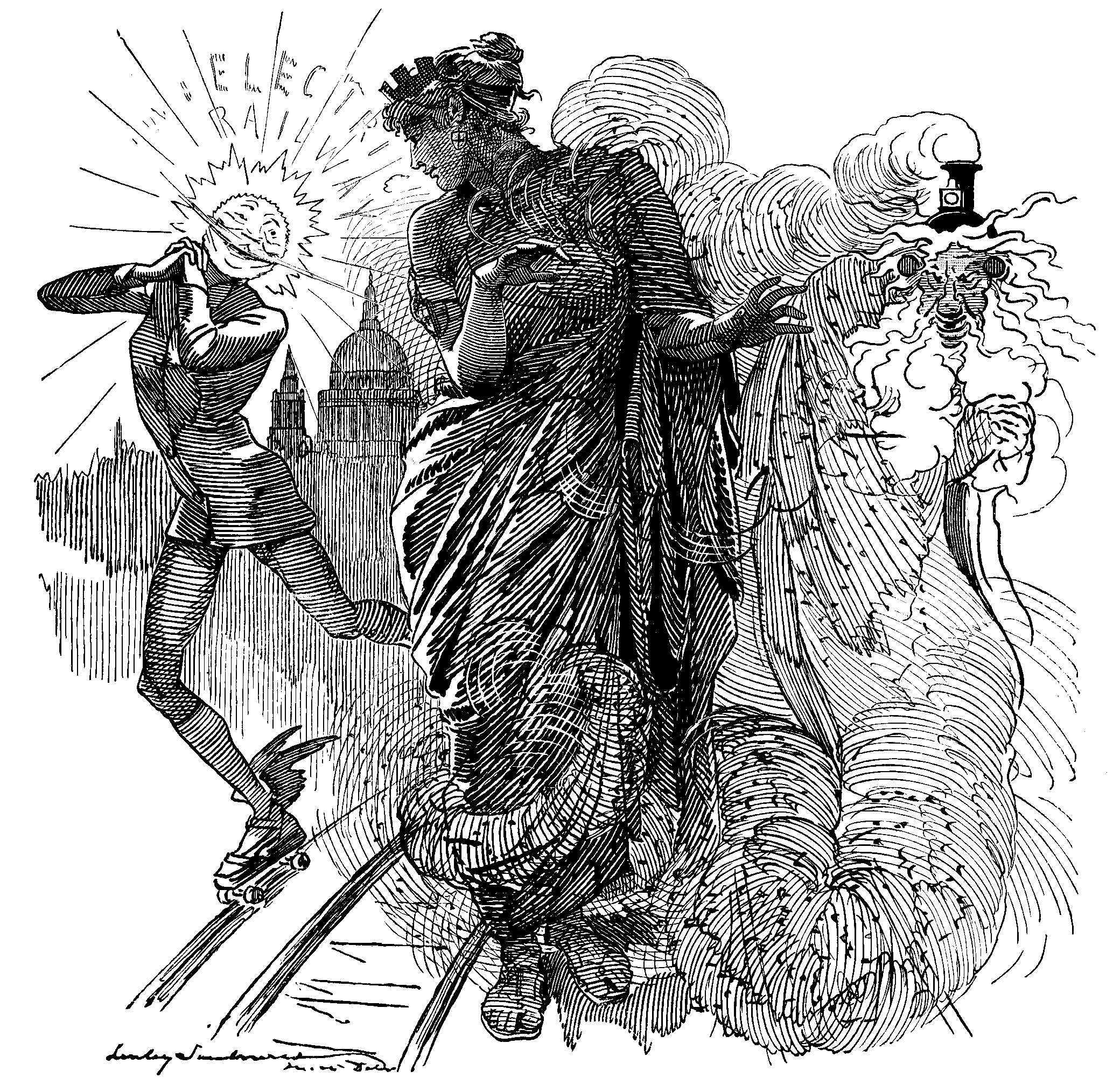
Young Spark. "TRY ME! YOU'VE TOLERATED THAT FUSTY OLD FOGEY LONG ENOUGH!"
Old Flame (aside). "FLASHY YOUNG UPSTART!"
["It is obvious that small tunnels for single lines, of the usual standard gauge, may be constructed some distance below the ground, and yet the atmosphere of such tunnels be as pure as upon a railway on the surface."—Illustrated London News, on the City & South London Electric Company.]
"Young Spark" loquitur:—
Your arm, my dear Madam! This way, down the lift, Ma'am! No danger at all, no discomfort, no dirt! You love Sweetness and Light? They are both in my gift, Ma'am; I'll prove like a shot what I boldly assert. Don't heed your Old Flame, Ma'am, he's bitterly jealous, 'Tis natural, quite, with his nose out of joint; You just let him bluster and blow like old bellows, And try me instead—I will not disappoint! Old Flame? He's a very fuliginous "Flame," Ma'am; I wonder, I'm sure, how you've stood him so long; He has choked you for years—'tis a thundering shame, Ma'am! High time the Young Spark put a term to his wrong. Just look at me! Am I not trim, smart, and sparkling, As clean as a pin, and as bright as a star? Compare me with him, who stands scowling and darkling! So gazed the old gallant on Young LOCHINVAR. He's ugly and huffy, and smoky, and stuffy, And pokey, and chokey, and black as my hat. As wooer he's dull, for his breath smells of sulphur; Asphyxia incarnate, and horrid at that! You cannot see beauty in one who's so sooty, So dusty, and dingy, and dismal, and dark. He's feeble and footy; 'tis plainly your duty To "chuck" the Old Flame, and take on the Young Spark. A Cyclops for lover, no doubt you discover, My dear Lady LONDON, is not comme il faut; If I do not woo you the sunny earth over. At least I lend light to love-making below. He's just like old Pluto, Persephone's prigger; You'll follow Apollo the Younger—that's me! He's sombre as Styx, and as black as a nigger. His lady-love, LONDON! Bah! Fiddle-de-dee! His murky monopoly, Madam, is ended. Come down, my dear love, to my subterrene hall! I think you'll admit it is sparkling and splendid, As clean as a palace, not black as a pall. Electrical traction with sheer stupefaction Strikes Steam, the old buffer, and spoils his small game. You're off with the old Love, so try the new bold Love, And let the Young Spark supersede the Old Flame.
[Carries her off in triumph.
PARS ABOUT PICTURES.
Close upon a hundred years ago, when GEORGE THE THIRD was King, MENDOZA opened a saloon in the Strand, whereat various studies in Black and Blue might be enjoyed. To-day MENDOZA has a gallery in King Street, which is devoted to studies in Black and White. You may say, history repeats itself. Nothing of the kind. The gentleman of GEORGE THE THIRD'S time devoted himself to the pugilistic art; the gentleman of the time of VICTORIA gives his attention to graphic art. The one was the patron of fists, the other of fingers—that makes all the difference. MENDOZA the Past, closed eyes—MENDOZA the Present opens them, and, if you go to the St. James's Gallery, you will find a pleasant collection of Eye Art—open to all peepers. It is true it may not be High Art, but you will find it, like Epps's Cocoa, "grateful and comforting."
Mr. MCLEAN, who has had an Art-show in the Haymarket since the days of GEORGE THE THIRD, or rather his ancestor had, is "quite up to time, and smiling," with his present collection (your Old PAR can't help using the argot of the P.R., and brings COLE, not to Newcastle, but to the Haymarket, in "A Bend in the River, near Maple Durham." He shows us the views of BURTON BARBER on "Compulsory Education," also a wondrous picture of the "Gate of the Great Mosque of Damascus," by BAUERNFEIND, "A Venetian Brunette," by FILDES, and many other works that will well repay inspection, but of which there is no space for anything more to be said by yours par-enthetically,
OLD PAR.
THE GENTLE ART (OF SNIGGLING).
["Whoever walks beside the river (the Ettrick), will observe five or six or more men and boys, equipped with gigantic wading-breeches, busy in each pool. They are only armed with rods and flies, and thus have a false appearance of being fair fishers.... The truth is that the apparent sportsmen are snigglers, not anglers. They drive the top part of their rods deep into the water, so as to rake the bottom, and then bring the hook out with a jerk. Every now and then ... one of the persecuted fishes ... is hauled out with short shrift."—Daily News.]
Oh! the world's very bad, and our hearts they are sore As we think of the errors and wrongs we have got to Endure uncomplaining, and oh! we deplore The things people do, that they really ought not to! With Courtesy dead, and with Justice "a-bed," When the mention of Love only causes a giggle,— But we'd manage to live and still hold up our head, Were it not for the villain who ventures to sniggle. With his rod and his hook see him carefully rake The bed of the river, and gallantly wading, Arrayed in his breeches, endeavour to make Of genuine sport but a mere masquerading. You might think him a fool for his trouble—but look! (And it's true, though at first it appears to be gammon) With a horrible jerk, as he pulls up his hook, The sportsmanlike sniggler has landed a salmon! As a nation of sportsmen, it rouses our ire To hear of sport ruined by such a proceeding; And to snigglers we earnestly wish and desire To give the advice they so sadly seem needing. Let them think, as they work their inglorious plan, How old IZAAK must turn in his grave and must wriggle; And may they in future all see if they can, By learning to angle, forget how to sniggle!