Volume 99 — THE "LAIDLY WORM" OF LONDON;
Reading edition
Or, The Great Slum Dragon and Little Master County Council.
["The Worm (at first neglected) grew till it was too large for its habitation.... It became the terror of the country, and, among other enormities, levied a daily contribution ... in default of which it would devour both man and beast.... Young LAMBTON was extremely shocked at witnessing the effects of his youthful imprudence, and immediately undertook the adventure."—Legend of "The Lambton Worm," as related by Surtees.]
Old stories tell how Hercules At Lerna slew a "Dragon;" And the "Lambton Worm" (told by SURTEES) The Durham men still brag on. How the "Laidly Worm" was made to squirm Old legends tell (they can't lie!); And of MORE, of More-hall, when, "with nothing at all," He slew the Dragon of Wantley. Our Dragon here is a bigger beast Than LAMBTON slew, or MORE did; On poor men's bodies he doth feast, And ill-got gold long hoarded. He hath iron claws, and from his jaws Foul fumings are emitted. The folks, his prey, who cross his way, Are sorely to be pitied. Have you not heard how the Trojan horse Held seventy men inside him? This Dragon's bigger, and of such force That none may rein or ride him. Men hour by hour he doth devour, And would they with him grapple, At one big sup he'll gobble them up, As schoolboys munch an apple. All sorts of prey this Dragon doth eat; But his favourite food's poor people, But he 'd swallow a city, street by street, From cottage to church steeple. Like the Worm of Wear, this Dragon drear, Hath grown, and grown, and grown, Sir, And many a lair of dim despair The Worm hath made its own, Sir. In Bethnal Green our Laidly Worm Hath made a loathly den, And there hath fed for a weary term On the bodies and souls of men. There doth it writhe, and ramp, and slower, Whilst in its coils close prest Are the things it thrives on—"Landlord Power," And "Vested Interest." Now, who shall tackle this Dragon bold? Lo! a champion appears. He seems but small, and he looks not old— A youth of scarce three years. But "he hath put on his coat of mail, Thick set with razors all," And a blade as big as a thresher's nail, On that Dragon's crest to fall. And like young LAMBTON, or young MORE, He to the fight advances. Yet looks to that Slum Dragon o'er, With caution in his glances. If he make shift that sword to lift, And smite that Dragon dead, No hero young song yet hath sung A fouler pest hath sped. Now guard ye, guard ye, young County C.! That two-edged blade is big, Sir! That Dragon's so spiky, he well might be "Some Egyptian porcupig," Sir, (As the singer of Wantley's Dragon says, In his quaint and curious story.) If this Dragon he slays, he shall win men's praise, And legendary glory. When London's streets are haunts of health (Ah! happy if distant, when) And the death-rate ruleth low, and Wealth Feeds not on the filthy den; The men to this champion's memory Shall lift the brimming flagon, And drink with glee to young County C, Who slew the Grim Slum Dragon!
A "DARK CONTINENT" HINT.—Mr. STANLEY, it is said, now wishes he had gone on his exploration journey quite alone, without any travelling TROUP. It is a curious fact, but worth mentioning here, that, up to now, the only mention of difficulties with a "Travelling Troupe" is to be found in a little shilling book recently published by Messrs. TRISCHLER & CO., at present nearing its fifty thousandth copy, entitled, A New Light thrown across the Darkest Africa. Whether H.M. STANLEY will appeal to this as evidence remains to be seen. We must have the whole truth out about STANLEY'S Rear Column before we rear a column to STANLEY.
The "NORFOLK BROADS," according to the Standard, are in future to be the English cradle of the German "Bass." Not beer, but fish. There are to be "no takers" at present, so the cradle will not be a Bass-in-net.
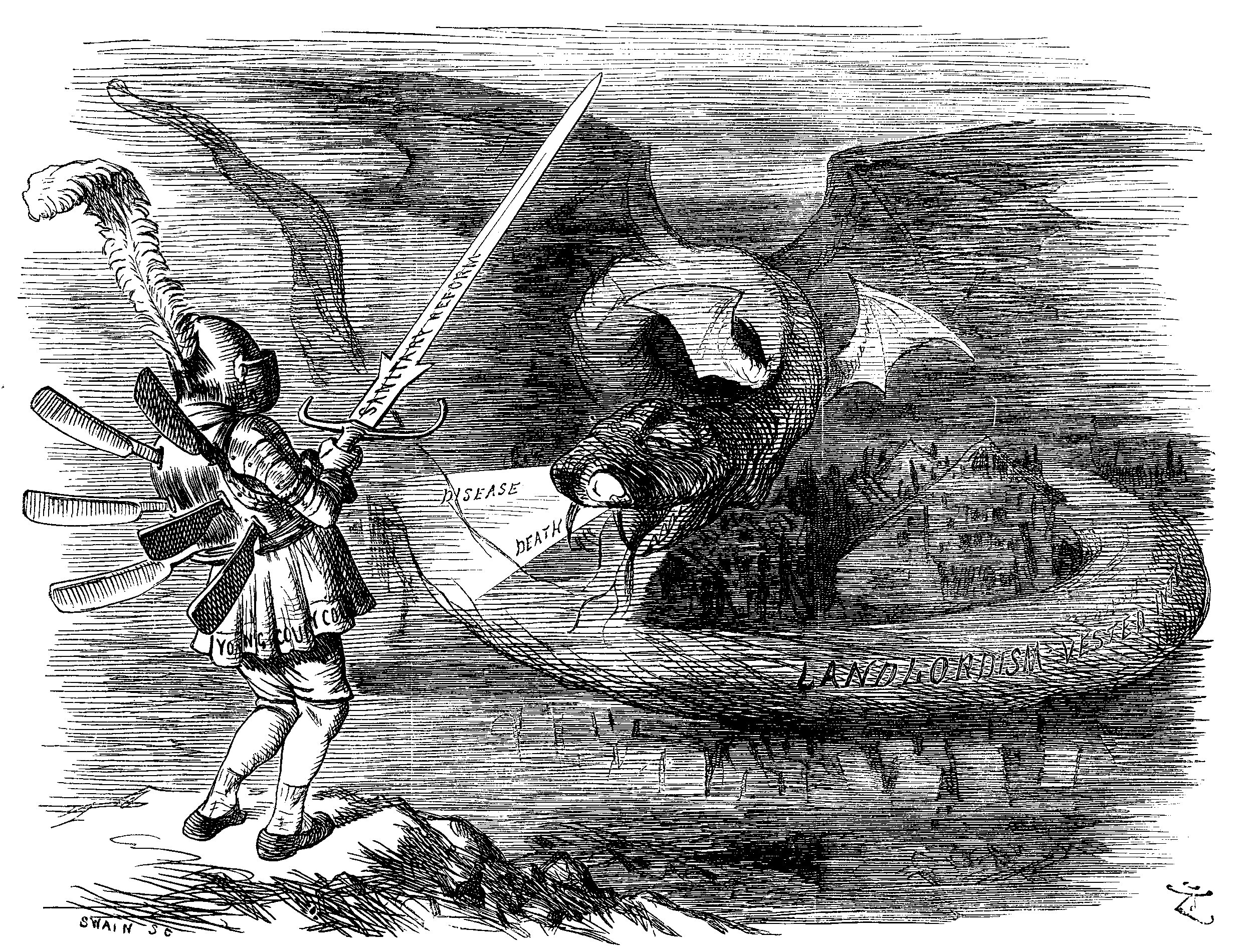
THE "LAIDLY WORM" OF LONDON—AND YOUNG COUNTY COUNCIL.
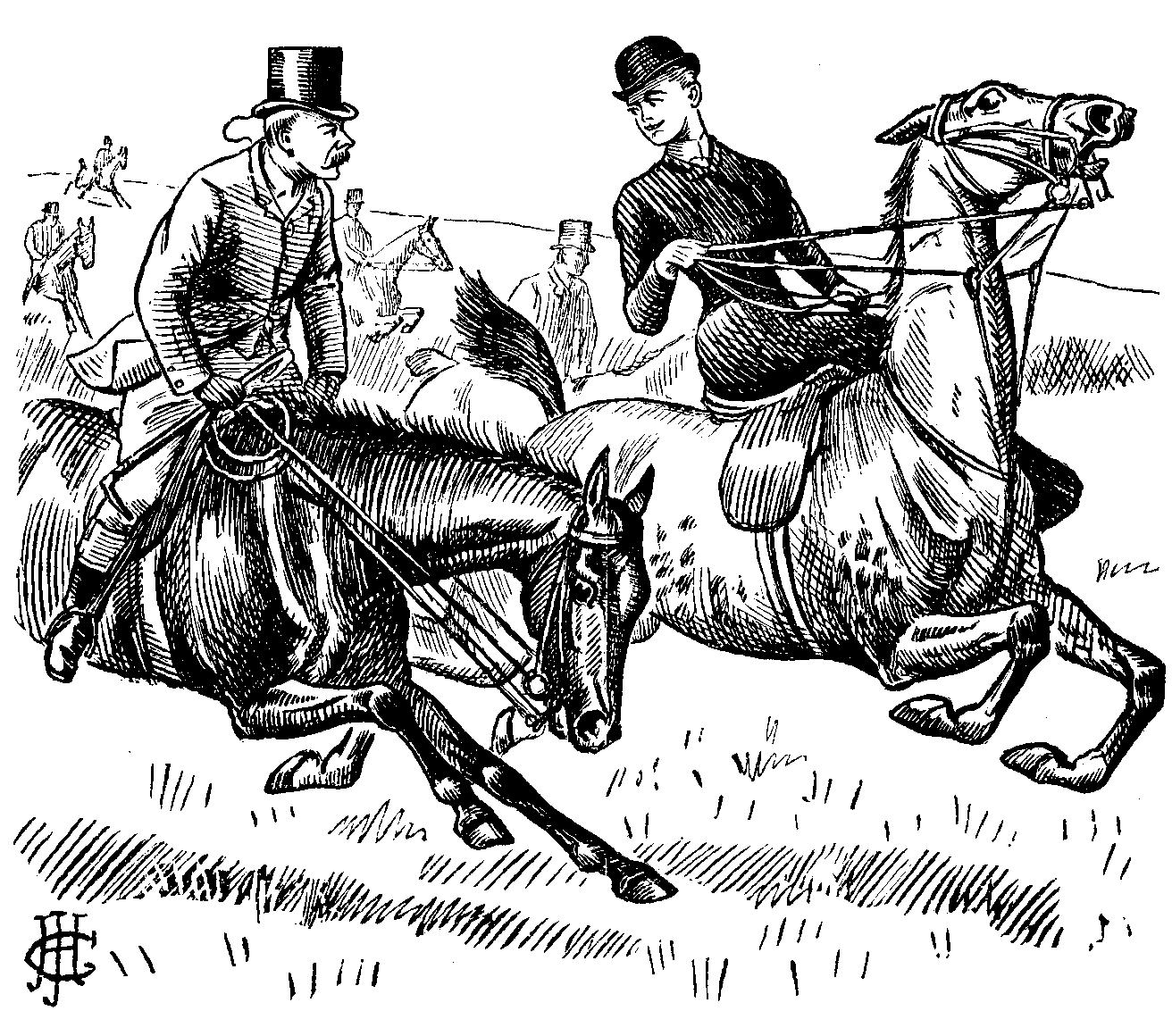
HUNTING PREDICAMENTS. No. 1.
Miss Nelly (to her Slave, in the middle of the best thing of the Season). "OH, MR. ROWEL, DO YOU MIND GOING BACK? I DROPPED MY WHIP AT THE LAST FENCE!"
OPERATIC NOTES.
Wednesday.—Welcome once more to our old friend, Norma, the Deceived Druidess, who was called Norma for short, she being an orphan, and having "nor par, nor ma." The Ancient Order of Druids, with Arch-Druid Oroveso in the chair, might have had a better brass band. Norma nowadays is not particularly attractive, and the house, when it is given, cannot be expected to be more than normal or ordinary.
Thursday.—Orféo. First appearance of Miles. GIULIA and SOFIA RAVOGLI in GLÜCK'S beautiful Opera, which has not been seen here for many years, but—judging from its reception by a full and delighted house—will be seen many times before Signor LAGO'S season comes to an end. Enthusiastic reception of GIULIA RAVOGLI as Orpheus; double recall after three of the four Acts; house insisting on having "Che farò" all over again. Orchestra, under Signor BEVIGNANI, admirable. Recreations of Demons and Furies, when let out of Gates of Erebus for a half-holiday, peculiar, not to say eccentric. Demons lie on rocks, with silver serpents round their necks as comforters, claw the air, and trot round in circles, after which they exhibit Dutch-metalled walking-sticks to one another with sombre pride. Furies trip measures and strike attitudes in pink tights and draperies of unæsthetic hues, when not engaged in witnessing, with qualified interest, incidental dances by two premières danseuses. Hades evidently less dull than generally supposed.
SUGGESTION.—Curious that no enterprising shaving-soap proprietor has as yet, as far as we know, advertised his invention as "Tabula Rasa." This is worth thousands, and takes the cake—of soap.
QUIS NOMINABIT?
(Being a few Remarks à Apropos of a "British Academy of Letters.")
MR. PUNCH, SIR,
I have been reading with some morbid interest a series of contributions to the pages of a contemporary from several more or less distinguished literary men who have apparently been invited to express their opinions, favourable or the reverse, on the recently launched proposition to establish in our midst, after the French model, a "British Academy of Letters." Some ask, "What's the use?" Others want to know who is to elect the elected, and seem much exercised in their minds as to the status and qualifications of those who ought to be chosen for the purpose of discharging this all-important function. As to what would be the use of an institution of the kind, the answer is so obvious that I will not attempt to reply to it. But if it comes to naming a representative body capable of selecting the two or three thousand aspirants who have already, in imagination, seen their claims to the distinction recognised by the elective body to which has been entrusted the duty of weighing their respective merits—well then, to use a colloquial phrase, I may confidently say that "I am all there!"
Of course. Royalty must head it, so I head the list of, say, twelve Academic Electors, with the name of H.R.H. the Prince of WALES. This should be followed up by that of some generally widely-known personage, who has the literary confidence of the public, and in this connection, I have no hesitation in supplying it by that of the Compiler of Bradshaw's Railway Guide. Several now should follow, of varied and even conflicting interests, so as to satisfy any over-captious criticism inclined to question the thoroughly cosmopolitan character of the elective body. And so I next add, Mr. Sheriff AUGUSTUS HARRIS, H.R.H. the Duke of CAMBRIDGE, the Proprietor of PEARS' Soap, and the Beadle of the Burlington Arcade.
It might now be well to give a distinctively literary flavour to the body, and so I am disposed to continue my list with the names of the Poet Laureate and the City Editor of Tit Bits, following them up with the representatives of commercial enterprise, speculative art, and sportive leisure, guaranteed respectively by the names of the Chairman of the Chelsea Steam-boat Company, Mr. R. D'OYLY CARTE, and Prince HENRY OP BATTENBERG. For the twelfth, and remaining name, I would suggest that of Mr. HENRY IRVING, the Archbishop of CANTERBURY, the Manager of Madame TUSSAUD'S Wax Works, Sir WILFRID LAWSON, General BOOTH, Mr. SLAVIN, Mr. J.L. TOOLE, or any other striking or notable one that arrests the eye with the familiarity of long acquaintance. With the existing deplorable position of the Pantomime literature of the country, there can be little need to question further the necessity of a British Academy of Letters. The naming of those who are to constitute that institution is another thing; but if an authoritative fountain-head, to discharge this inevitable function, is sought, and the public puts the question, "Quis Nominabit?" I think, Sir, you will admit that I have most satisfactorily supplied the answer. Trusting to your judicious appreciation of the full gravity of the matter at issue, to publish this communication,
I am, Sir, your obedient servant,
A VERY POSSIBLE FUTURE ACADEMICIAN.
BEFORE AND BEHIND.
(From a Thoughtful Grammarian.)
SIR,—In the Times' Court Circular, on Friday last, I read that—
"Mr. WILLIAM NICHOLL had the honour of singing before Her MAJESTY and the Royal Family."
This was indeed an honour. I regret that the Courtly Circularist did not tell us what Mr. NICHOLL sang before the QUEEN and Royal Family, and also what the QUEEN and Royal Family sang (solo and chorus?) after Mr. NICHOLL. But suppose "before" does not here relate to time, but to position. It would have been a novelty indeed, and one well worth recording, if Mr. NICHOLL had had the honour of sinking behind the Royal Family. And then, what a compliment if Her Gracious MAJESTY and the Royal Family had all turned round to listen to him! If I am wrong in my interpretation of the Court Circular's Circular Note, wouldn't it have prevented any possible error to have said, "In the presence of"? I only ask for information, and am
Yours,
FIDELITER.
A NEW TRACT FOR THE SALVATION ARMY.—The "General," who is the biggest BOOTH in the show, announced last week that he had been offered a big tract of land. Hear! Hear! Where? Where? "Anywhere, anywhere out of the world "—at least, out of our little world of Great Britain & Co. Let not "the General" be too particular, but accept the tract,—though he is more used to distributing tracts than accepting them,—and let him and his army, his lads and lasses, go away and leave us to enjoy our Sundays in peace and quiet.
NEW CITY FIRM (adapted from West End by Our Own Scotchman).—"SAVORY AND MAYOR."
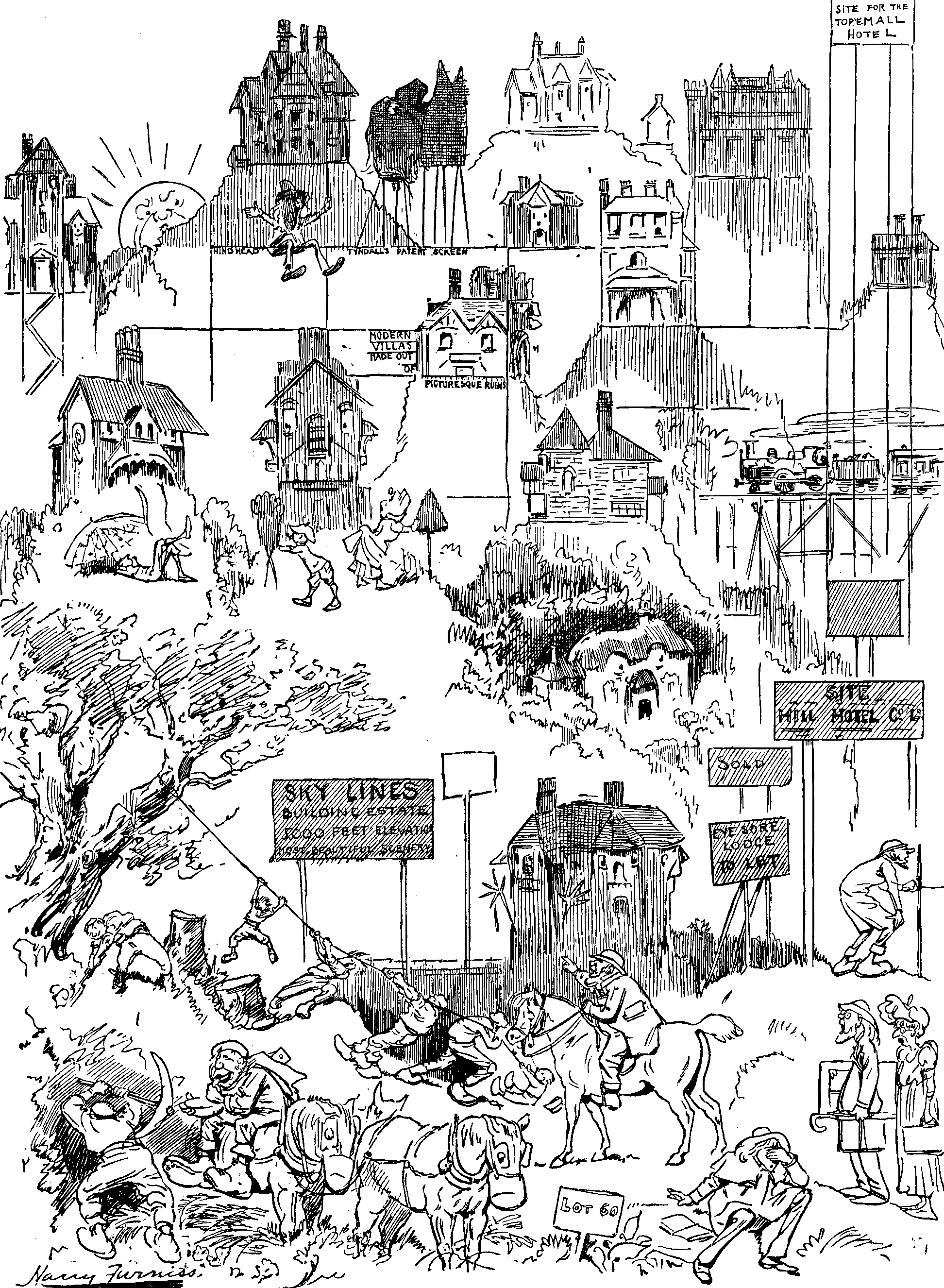
SKY-SIGNS IN THE COUNTRY. (AS SEEN BY OUR ARTIST IN SEARCH OF THE PICTURESQUE.)
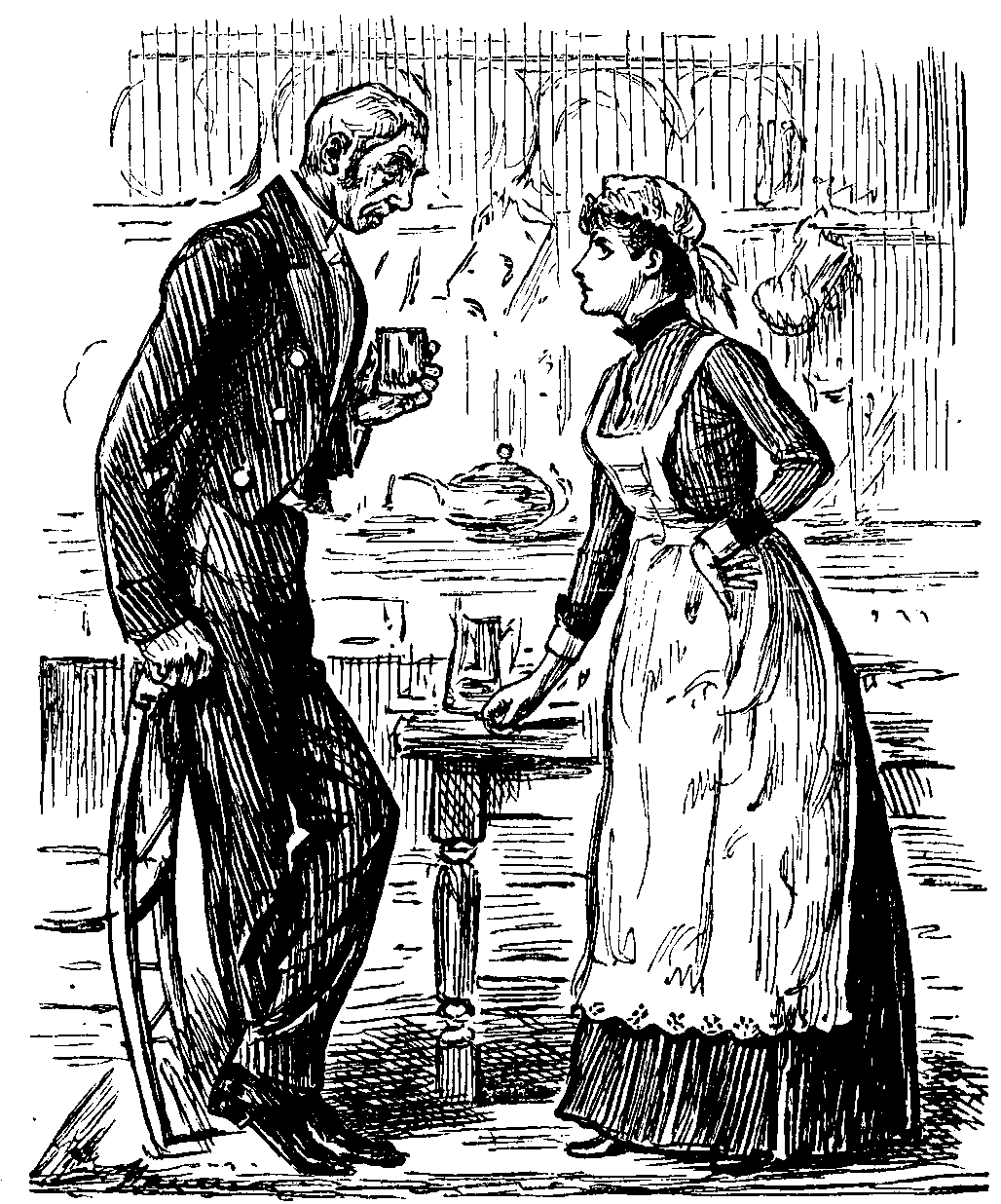
NOSTALGIA.
"YOU SEEM OUT OF SORTS, JAMES, EVER SINCE WE'VE COME NORTH. IT'S THE CHANGE OF CLIMATE AND SCENERY, I S'POSE!"
"IT'S WUSS NOR THAT, MARIAR. IT'S THE CHANGE OF BEER!"