Volume 99 — OUR BOOKING-OFFICE.
Reading edition
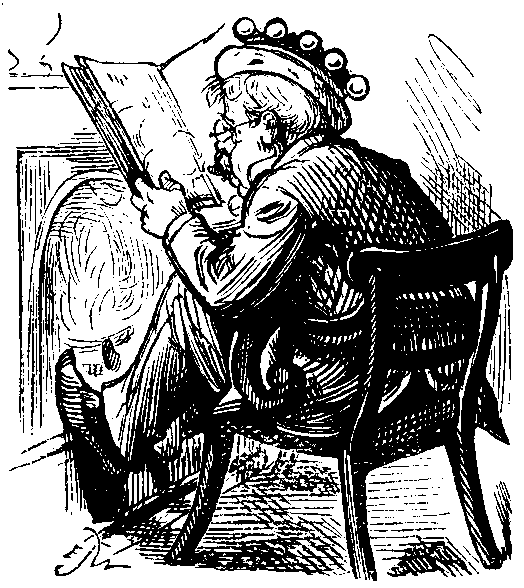
Read The World and the Will, by JAMES PAYN, says the Baron. Successful novelist is our "J.P." for England and the Colonies generally. "The profits blazoned on the Payn," is a line he quotes, with a slight difference of spelling, in his present three volumes, which is full of good things; his own "asides" being, to my thinking, quoth the Baron, by far the most enjoyable part of his books. Herein he resembles THACKERAY, who used to delight in taking the reader behind the scenes, and exhibiting the wires. Not so JAMES PAYN. He comes in front, and comments upon the actions of his puppets, or upon men and morals in general, or he makes a quip, or utters a quirk, or proposes a quiddity, and pauses to laugh with you, before he resumes the story, and says, with the older romancers, "But to our tale." Most companionable writer is JAMES PAYN. Tells his story so clearly. A PAYN to be seen through.
In the christening of his Christmas books, Mr. MERRY ANDREW LANG has hit upon a genuine Happy Thought, on which the Baron begs sincerely to congratulate him. It is a perfect little gold mine as a book-title series. Last year M. ANDREW LANG wrote, and LANGMAN'S—no, beg pardon—LONGMANS published The Blue Fairy Book. The Blue Fairy Book, when it appeared, however, was read everywhere, so this year the MERRY ANDREW issues The Red Fairy Book, which, of course, will be more read than the other. Excellent notion! Where will it stop? Why should it stop? Next year there'll be The Green Fairy Book; in '92 the Yellow Fairy Book (commencing with new version of Yellow Dwarf), then the White, then the Black, then the Ver-millionth edition, and so on and so on, ad infinitum, through all the possible stages of the combination and permutation of colour.
The Magazine of Art for 1890, published by CASSELL & Co., is one of the best of its kind for pictures and Art-articles, The Mixture as before.
"Christmas is coming"—but the Publishers seem to think that the Merry Old Gentleman will be here to-morrow. Yet we know the proverbial history of to-morrow. However, to humour the up-to-date notion, the Baron recommends to his young friends who wish to amuse their elders, Dolldom, a dolls' opera, by CLIFTON BINGHAM, set to music by FLORIAN PASCAL. Some of the songs are exquisite. It would make a very funny play, children imitating dolls. Published by J. WILLIAMS.
BLACKIE AND SON, are going it. Here are two more, by their indefatigable writer, G.A. HENTY: By Right of Conquest; or, With Cortez in Mexico. The young Sixteenth-Century boy, by his marvellous adventures, proves his right to be a hero in the Conquest of Mexico. Of a more modern date is A Chapter of Accidents, which deals with the Bombardment of Alexandria. The young fisher-lad has to go through many chapters of adventure before he reaches a happy ending. A Rough Shaking, by GEORGE MACDONALD, is a capital boys' book, while The Light Princess, and other Fairy Stories, by the same author, will please the Baron's old-fashioned fairy-book readers at Christmas-time.
Whoever possesses the Henry Irving Shakspeare,—started originally by my dear old enthusiastic friend the late FRANK MARSHALL, and now concluded by the new volume of plays, poems, and sonnets,—possesses a literary treasure. The notes are varied, interesting, and all valuable. The illustrations exactly serve their purpose, which is the highest praise.
MR. SMALLEY'S Letters are not to an Inconnue. They were written to his paper, the Tribune, and have redressed the balance between the Old World and the New by furnishing New York from week to week with brilliant, incisive, and faithful pictures of life in London. The initials, "G.W.S.," appended in their original form, are as familiar throughout the United States as are those of our own "G.A.S." in the still United Kingdom. Mr. SMALLEY goes everywhere, sees everything, knows everybody, and his readers in New York learn a great deal more of what is going on in London than some of us who live here. Most public men of the present day, whether in politics, literature, or art, have, all unconsciously, sat to "G.W.S." He has a wonderful gift of seizing the salient points of a character, and reproducing them in a few pellucid sentences. The men he treats of have many friends who will be delighted to find that Mr. SMALLEY'S pen is dipped in just enough gall to make the writing pleasant to those who are not its topic. Personalities is the alluring title of the first volume, which contains forty-two studies of character. It is dangerous kind of work; but Mr. SMALLEY has skilfully steered his passage. Written for a newspaper, London Letters (MACMILLAN & CO.) rank higher than journalism. They will take their place in Literature.
November Number of the English Illustrated Magazine, excellent. Wykehamists, please note Mr. GALE'S article, and Lord SELBORNE'S introduction. The COOKE who presides in this particular kitchen serves up a capital dish every month—and "quite English, you know."
My faithful "Co." has been rather startled by a volume called The Decline and Fall of the British Empire, written by "Anonymous," and published by the Messrs. TRISCHLER. The tome deals with Australia, rather than England, and is dated a thousand years hence; so those who have no immediate leisure will have plenty of time to read it before the events therein recorded, so to speak, reach maturity.
I notice an advertisement of a book by Major ELLIS, entitled The Ewe-speaking People of the Slave Coast of West Africa. These Ewe-speaking folk must be a sheepish lot. Black-sheepish lot apparently, as being in West Africa. Major ELLIS is the author also of The Tshi-speaking People. These last must be either timidly bashful, or else a very T-shi lot. After this, there's nothing ELLIS this week, says
THE BARON DE BOOK-WORMS.
"QUITE A LITTLE (ROMAN) HOLIDAY."
(An Intercepted Letter.)
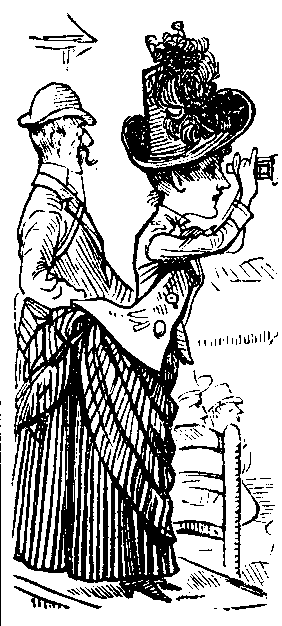
DEAREST BECKY,—I have had such luck! Oh, so fortunate! Fancy, we did get in, after all! You know Mr. TENTERFORE, of Somerset House, has a friend a barrister, and this friend said, if we would be by the door of the Court at eleven, he thought he could slip us in. And he did, my dear—he did! We got capital places, and as we had brought with us some sherry and sandwiches, we had "a real good time of it," as your brother calls it! We had our work, too, and so were quite comfortable. The night-charges were such fun! A lot of men and women were brought before the Magistrate for being "drunk and incapable" (that's a legal term, my dear), and got so chaffed! One of the women was very old—such a silly frump!—she was still dreadfully intoxicated I am afraid! Very sad, of course, but we couldn't help laughing! She was such a figure before they got rid of her! But this was only the overture to the drama. After the night-charges were over, the Court was cleared, but we were allowed to remain, as Mr. WIGINBLOCK (our barrister friend) declared we belonged to the Press! He said that MARY contributed to the Blood and Thunder News, and I to the Murder Gazette! I am sure it must have been in fun, for we have never seen the papers. When lunch was over, in came the Magistrate with a number of the "smartest" people! Really, I was quite delighted to be in such good company. All sorts of nice people. And then—oh—it was lovely! We saw her quite close, and could watch the colour come and go in her cheeks! She is rather pretty! She was wearing her ordinary clothes; not the workhouse, nor the ones with the blood on them, but some that had been sent in to her since the inquest. I tried your opera-glasses. They are simply capital, darling! We were much amused with his evidence; and it was really excellent fun to listen to the howls of the crowd outside! But I am not sure he cared for them! We got away in excellent time, and I hope to go again. I am trying very hard (should it come to anything) to be present at the last scene of all! Wouldn't that be lovely? I should have to be at the place, though, at ten minutes to eight o'clock! I don't think I should go to bed that night at all! If I did, I am sure I should not sleep! It would be so very, very interesting! And now, my dearest, good-bye.
Your ever most affectionate friend,
LUCRETIA.
"MINE EASE AT MY CLUB."—In its most useful and instructive theatrical column last Sunday's Observer (the only Observer of a Sunday in London!) inserted this notice:—
"Mr. H.A. JONES is to read a paper at the Playgoers' Club, Henrietta Street, Tuesday next."
Why announce it? Why not let the hard-worked HENRY AUTHOR JONES read his paper at his Club in peace and quietness? Very hard on poor HENRY DRAMATIC AUTHOR JONES, if he can't have a few minutes of peace (not "piece," bien entendu) to himself. Leave him alone to take his ease at his Club.
UNSATISFACTORY FOR LAW-ABIDING CITIZENS.—At a recent meeting of Anarchists at New Jersey some were arrested, but MOST escaped.
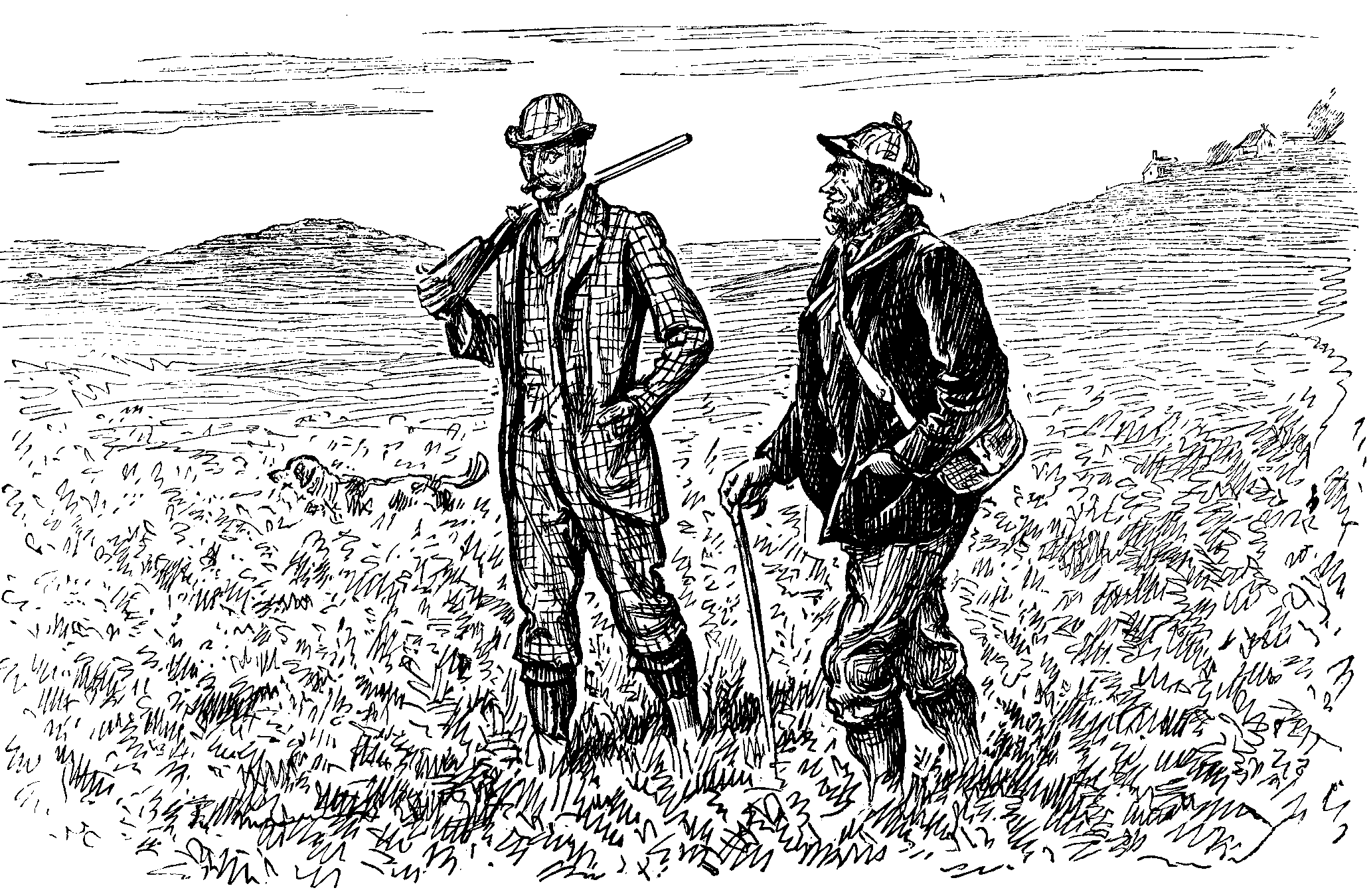
A LAMENT FROM THE NORTH.
"AND THEN THE WEATHER'S BEEN SO BAD, DONALD!"
"OU AY, SIR. ONLY THREE FINE DAYS—AND TWA OF THEM SNAPPIT UP BY THE SAWBATH!"