Volume 98 — ESSENCE OF PARLIAMENT.
Reading edition
EXTRACTED FROM THE DIARY OF TOBY, M.P.
House of Commons, May 9.—This has been great occasion for Windbag Sexton. Excelled himself, and there is no other point of comparison useful or usable. Saunderson, who always takes friendly views of his countrymen opposite, pleads that Sexton's windbaggism is partly due to his birth. In Ireland, he assures me, a mile is longer than in other parts of the Empire; and so, kind-hearted Colonel pleads, some allowance should be made for Sexton when he gets on the oratorical tramp. That's all very well; but, for a man to talk two hours and three-quarters in a so-called Debate, is even more than the national tendency towards exaggeration illustrated by the Irish mile will excuse. Why couldn't Sexton have windbagged on some day of last week? Suppose, for example, his self-sacrificing friends had made a House for him at a quarter to nine on Friday night, and he had then talked for three hours and a quarter?—or on Wednesday there was opportunity; whilst openings might have been made on Tuesday or Thursday.
"No, Toby," said Sexton, when I suggested this in interests of House and public time, "you're a well-meaning fellow, but you don't understand everything. You see in debate of this kind all principal men stand off till the last day. We might have twinkled on several days of last week, but we prefer to coruscate on last night. Sure of an audience; Whips out; crowds in; excitement everywhere. I and Harcourt, and Chamberlain, and Balfour, all save ourselves for the last night. Can't all speak, perhaps, especially if I get on first: but they must take their chance. With the Universe waiting and listening for me, other things and other people must stand aside. Very serious thing to disappoint the Universe."
So Sexton, rising at five o'clock, with the windbag conveniently disposed under arm, pumped and pumped away for two mortal hours, and an odd three-quarters that seemed more than mortal. Grandolph waiting to make a speech; Arthur Balfour longing to be at 'em. Members knowing what was in store, "expecting," as Sheehy said, that "every moment would be his next." But Sexton flowed on for ever, with aggravating pauses, with a smile of sublime, unruffled satisfaction, that made the position ten times as aggravating as it otherwise would have been. To smile and smile, and play such a villanous trick as this on a suffering House was worse than most disordered fancy painted.
"If," said Arthur Balfour, in one of his agonised asides, "the fellow did not undisguisedly enjoy such supreme happiness, our lot would be more bearable."
"Never mind," said Old Morality. "Bad enough, I admit. But do you know why persons are sometimes killed by having a charcoal fire in their bedrooms? Because the carbon of burning charcoal unites with the oxygen of air, and forms carbonic acid gas, which is a narcotic poison. So it is here. Sexton has got hold of some good points; he is not inapt as a speaker; if his inordinate vanity had only permitted him to be satisfied with occupying time of House for half an hour, or, say, three-quarters, he would have made damaging speech; as it is, he wearies House to death, swamps us all and himself in waste of verbiage, and the people he attacks escape in the general misery. In other words, his carbon of burning vanity, uniting with the oxygen of opportunity, forms a speech two hours and three-quarters long; which is a narcotic poison."
Mr. G., with the ardour of youth, and the training of an athlete, proposed to himself to hear what Sexton had to say. Accordingly took up convenient seat below Gangway. Stayed there an hour. Then walked back an altered man; shattered; aged; almost in a state of coma.
"Well, you ought to have known better," I said, somewhat sharply, having no sympathies with these vagaries.
"And I was so well and strong when I entered the House," Mr. G. said, wearily. "Quite elate with my correspondence with Tyndall. Didn't you think that a nice turn in the concluding sentence?—'My only desire is to meet you on the terms on which, long ago, we stood when, under my roof, you gallantly offered to take me up the Matterhorn, and guaranteed my safe return! Wouldn't trust myself on the Matterhorn with Tyndall now;" and Mr. G., warily shaking his head, walked forth in search of rest and refreshment.
Business done.—Mr. G.'s Amendment to Old Morality's Resolution on Parnell Commission Report negatived by 339 votes against 268.
Tuesday.—This has been Grandolph's night. Broke the silence of the still young Session with memorable speech; been in diligent attendance on Debate; sat through interminable speeches with patience only excelled by Mr. G.; sometimes looked as if were about to deliver his soul; but succeeded in bottling it up. To-night soul drove out the cork; burst the bottle, so to speak.
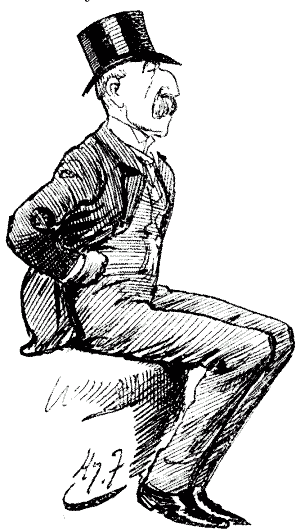
The Reverberating Colomb.
Grandolph a man of many phases. Tonight presented himself in his highest character; a statesman; a champion of constitutional principles at whatever expense to prospects and sensibilities of his most revered friends on Treasury Bench and elsewhere. Quite a new style of speech for Grandolph, testifying to remarkable range of his genius. Nothing personal: free from acrimony; inspired with profound, unfeigned, reverence for constitutional principles. Here and there a touch of pathos as he recalled former times when, as Dizzy said of Peel on a famous occasion, "they had been so proud to follow one who had been so proud to lead them."
Awful splutter in Ministerial circles. A gleam of delight flashed through the shadow when it was discovered that Jennings had rebelled against Randolph's new revolt. "Ha! ha!" said the Reverberating Colomb, after Jennings had made his speech, "the army has dismissed its general."
This all very well; not here concerned with Grandolph's relations with his Party or his faithful friend; merely note that the speech itself lifts Grandolph once more into the very front rank of political personages. The Liberal Party cannot ignore nor the Conservatives dispense with the man who made that speech.
Jokim not a particular friend of Grandolph's. "Leg quite on other boot," as Sheehy says. But he did the enemy a service to-night. To complete Grandolph's triumph it only required that some Member of the Ministry whose ineptitude he had demonstrated should rise and, with loud voice, ungainly gestures, drag the Debate down from the heights to which it had been lifted, debasing it by personal attacks hoarsely shrieked across the table at former friends and colleagues. Jokim did this amidst uproarious cheers from Johnston of Ballykilbeg, who began to think that, after all, there is something in the Right Hon. Gentleman.
Business done.—Old Morality's Motion carried.
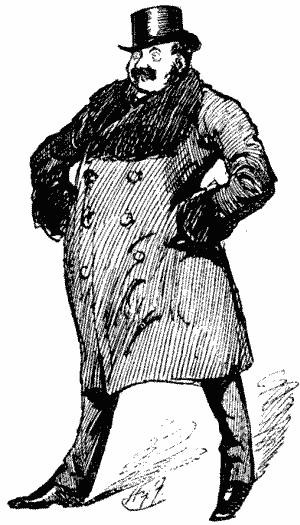
Our Whip (at present without a Handle to his Name).
Wednesday.—Attempt by some noisy outsiders who know nothing of House to make things unpleasant for Akers-Douglas, because House Counted Out last Friday. Said he has been wigged; assume he will retire. All arrant nonsense. Everybody in House, Conservative, Liberal, Dissentient, Irish, whatever we be, all know Akers-Douglas as one of best Whips of present generation. Assiduous, persuasive, courteous, yet firm; always at his post, never fussy, never cross, apparently never tired, he is a model of a Whip. His Party could better spare an occasional Secretary of State.
For purely business arrangements Ministers have a unique combination of three men. Old Morality, as Leader of House; Akers-Douglas, as Whip; and Jackson, as Financial Secretary, are strong enough to balance effects of any reasonable amount of blundering in high politics. They take care of the pence of efficiency and popularity, and leave the Markiss an occasional pound to spend.
Business Done.—New Irish Land Bill brought in, and cast out.
Thursday.—Teynham on in the Lords, but what he's on about the Lords only know, and not all of them. Something to do with Camperdown; Granville not entirely out of it; and the Markiss at least compromised. Teynham, standing at Cross Benches, holding on to the rail of Bench before him, as if he were in pulpit, swings about his body, turns to right and left, sometimes presenting his back to Lord Chancellor, whilst he contemplates emptiness of Strangers' Galleries. In plaintive voice, full of tears, he babbles o' Camperdown, green fields, nemine contradicente, and Standing Order No. XXI.
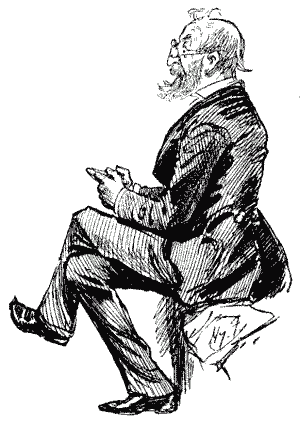
A Mental Struggle.
Pretty to watch Hobhouse whilst Teynham on his legs. Sits intently listening; first crossed one knee, then the other; puts his two forefingers together as if connecting the matter of Teynham's speech; gradually, as muddle grows thicker, two locks of hair on top of his head slowly rise and remained standing, as it were, till Teynham reseated himself. Most remarkable testimony to mental struggle. Even Hobhouse, having thus given his mind to it, couldn't make out what Teynham was at. As for Denman he, after first ten minutes of speech, flouted out of House.
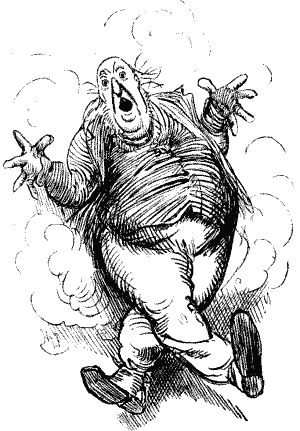
Sir William Burning.
(See the Chancellor of the Exchequer's Speech, March 11th.)
"Toby," said he, passing me in the Lobby; "if this is what the House of Lords is coming to, I shall vote with Rosebery for its immediate reform. Don't like to say anything disrespectful of a Peer; but I must observe that Teynham is a little lacking in coherency. His observations fail in point; in short, if he were not a Peer I should say his mind was wandering. Whatever we do, Toby, let us be intelligent and intelligible. I trust I am not prejudiced, but I really can't stand Teynham."
Business done.—In Commons, Government defeated, in resisting Hamley's proposal to stump up for Volunteers.
Friday Night.—Trevelyan brought forward Motion proposing that Parliament shall rise at beginning of July, making up necessary time in winter months. Supported proposition in speech graceful and strong, a model of rare combination of literary art, with Parliamentary aptitude. After brisk debate, resolution negatived by 173 votes against 169. "A majority of four won't long stand in our way," said Charles Forster, who having, some Sessions ago, fortuitously found his hat, never now deserts it.
Business done.—Government vainly tried to get into Committee of Supply.
The Difference.—Sir George Trevelyan wants the House of Commons to "rise at the beginning of July." Mr. Punch wishes it to rise at all times—above rowdyism.

NOTICE.—Rejected Communications or Contributions, whether MS., Printed Matter, Drawings, or Pictures of any description, will in no case be returned, not even when accompanied by Stamped and Addressed Envelope, Cover, or Wrapper. To this rule there will be no exception.