Volume 159 — OUR INVINCIBLE NAVY
Reading edition
.
Prize-Money.
The really intriguing thing about Naval prize-money is the fact that no one knows exactly where it comes from. You don't win it by any definite act of superlative daring—I mean to say, you don't have to creep out under cover of darkness and return in the morning with an enemy battleship in tow to qualify for a modicum of this mysterious treasure. You just proceed serenely on your lawful occasions, confident in the knowledge that incredible sums of prize-money are piling themselves up for your ultimate benefit. I suppose the authorities understand all about it; nobody else does. One just lets it pile. It is a most gratifying thought.
During the more or less stormy times of the First Great War, we of the Navy were always able to buttress our resolution with golden hopes of a future opulence denied to our less fortunate comrades in the trenches. Whenever the struggle was going particularly badly for us—when, for instance, a well-earned shore-leave had been unexpectedly jammed or a tin of condensed milk had overturned into somebody's sea-boot—we used to console each other with cheerful reminders of this accumulating fruit of our endeavours. "Think of the prize-money, my boy," we used to exclaim; "meditate upon the jingling millions that will be yours when the dreary vigil is ended;" and as by magic the unseemly mutterings of wrath would give place to purrs of pleasurable anticipation. Even we of the R.N.V.R., mere temporary face-fringes, as it were, which the razor of peace was soon to remove from the war-time visage of the Service—even we fell under the spell. "Fourteen million pounds!" we would gurgle, hugging ourselves with joy in the darkness of the night-watches.
In the months immediately following demobilisation I was frequently stimulated by glittering visions of vast wealth presently to be showered upon me from the swelling coffers of a grateful Admiralty. During periods of more or less temporary financial embarrassment I would mention these expectations to my tailor and other restless tradespeople of my acquaintance. "Fourteen millions—prize-money, you know," I would say confidentially; "may come in at any time now." I found this had a soothing effect upon them.
As the seasons rolled by, however; as summer and winter ran their appointed courses and again the primrose pranked the lea unaccompanied by any signs of vernal activity on the part of the Paymaster-in-Chief, these visions of mine became less insistent. I was at length obliged to confess that another youthful illusion was fading; prize-money began to take its place in my mind along with the sea-serpent and similar figures of marine mythology. I was frankly hurt; I ceased even to raise my hat when passing the Admiralty Offices on the top of a bus.
That was a month or two ago; everything is all right again now. I once more experience the old pleasing thrill of emotion when riding down Whitehall. I have come to see how ungracious my recent attitude was.
A chance meeting with Bunbury, late sub-Loot R.N.V.R. and a sometime shipmate of mine—Bunbury and I had squandered our valour recklessly together aboard the Tyne drifters in the great days when Bellona wore bell-bottoms—sufficed to bring me head-to-wind.
In the course of conversation I referred to the non-fulfilment of our early dreams; I spoke rather bitterly.
"And there are fourteen millions somewhere belonging to us," I concluded mutinously.
Bunbury regarded me with pained surprise. "Really, old sea-dog," he said, "this won't do. Never let the engine-oil of discontent leak into the rum-cask of loyal memories, you know. Now listen to me. Two years ago you and I wore the wavy gold braid of a valiant life; we surged along irresistibly in the wake of Nelson; we kept the watch assigned. Does not your bosom very nearly burst with pride to call those days to mind? It does. What then? Has it never once occurred to you that the last remaining link between us and the stirring past is this very prize-money you are so eager to soil with the grimy clutch of avarice? Don't you realize that this alone exists to keep our memory green in the minds of our old leaders at Whitehall? Picture the scene as it is. Someone mentions the word 'prize-money.' Immediately the Lords of the Admiralty reach for their record files and begin turning over the pages. They come upon the names of John Augustus Plimsoll—yourself—and Horatio Bunbury—me. 'Ah,' they exclaim fondly, 'two of our old gunroom veterans—when shall we look upon their like again?' Then they get up and go out to lunch.
"A month or so later the same thing occurs; once more our names leap out from the type-written page. 'Brave boys,' they murmur, 'gallant lads! What should we have done without them in the dark days? They shall have their prize-money this very—why, bless my soul, if it isn't one o'clock!'
"Surely," pursued Bunbury earnestly, "you appreciate the fine sentimental value of this one last tie? As long as our prize-money is in the keeping of the Service we can still think of it with intimate regard; we can still call ourselves Beatty's boys and hide our blushes when the people sing 'Rule, Britannia.' You must see that this is the only large-hearted way of looking at the matter."
"Bunbury, old sailor," I said, swallowing a lump in my throat, "you have done me good; you have made me feel ashamed of myself."
There can be no doubt that Bunbury is right. I am so convinced of it that when next my tailor inquires anxiously what steps are being taken for the distribution of prize-money I shall put the matter to him just as Bunbury put it to me. He is certain to understand.
Commercial Candour.
"The newest fashions are now being displayed in ——'s new dress salons, so that it is an easy matter to select an entire winter outfit with the minimum of ease."
—Evening Paper.
"Sir Harry Johnston's 'The Gay Donkeys' has passed its fifth edition in London."
—Australian Magazine.
A clear case for the S.P.C.A. (Society for the Prevention of Cruelty to Authors).
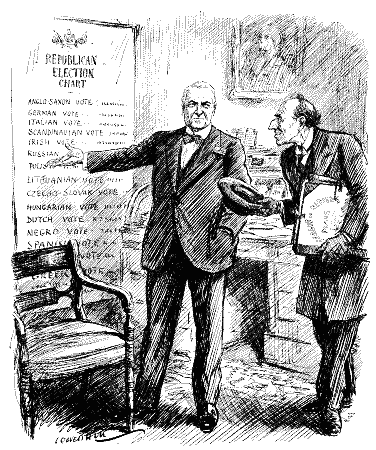
ENCOURAGE HOME INDUSTRIES.
Lord Robert Cecil. "I TRUST THAT AFTER ALL WE MAY SECURE AT LEAST YOUR QUALIFIED SUPPORT FOR OUR LEAGUE OF NATIONS?"
U.S.A. President-Elect: "WHY, WHAT'S THE MATTER WITH OURS?"
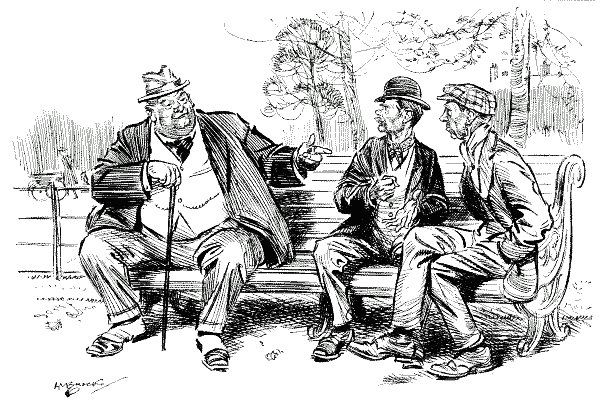
Stout Gentleman (overhearing political discussion). "Look here, my good fellow—I've been listening to your arguments; and let me tell you we're all in the same boat."
Politician. "Lumme, guv'nor, you'd better come in the middle of it then."
UNAUTHENTIC IMPRESSIONS.
I think the time has come for me to follow the example of so many other people and offer to the world a few pen pictures of prominent statesmen of the day. I shall not call them "Shaving Papers from Downing Street," nor adopt the pseudonym of "The Man with the Hot Water (or the Morning Tea)," nor shall I roundly assert that I have been the private secretary, the doctor, the dentist or the washerwoman of the great men of whom I speak. Nevertheless I have sources of information which I do not mean to disclose, except to say that heavy persons who sit down carelessly on sofas may unknowingly inflict considerable pain, through the sharp ends of broken springs, on those beneath.
I shall begin naturally with Mr. Lloyd George.
There is probably no statesman of whom such widely different estimates have been formed as the present Prime Minister of Great Britain. I have heard him compared with Themistocles, with Macchiavelli, with Mirabeau (I think it was Mirabeau, but it may have been one of those other people beginning with "M" in French history. Almost everybody in French history began with an "M," like the things that were drawn by the three little girls in the well), and even with the younger Pitt. I have heard him spoken of as a charlatan, as a chameleon, as a chatterbox, and, by a man who had hoped that the Kaiser would be hanged in Piccadilly Circus, as a chouser. Almost all of these estimates are thoroughly fallacious. Let us take, for instance, Macchiavelli. It was the declared opinion of Macchiavelli that for the establishment and maintenance of authority all means may be resorted to and that the worst and most treacherous acts of the ruler, however unlawful in themselves, are justified by the wickedness and treachery of the governed. Has Mr. Lloyd George ever said this? He may have thought it, of course, but has he ever said it? No. When one considers that besides this dictum Macchiavelli wrote seven books on the art of war, a highly improper comedy, a life of Castruccio Castracani (unfinished, and can you wonder?), and was very naturally put to the torture in 1513, it will be seen how hopelessly the parallel with Mr. Lloyd George breaks down.
Let us turn then to the younger Pitt. I have read somewhere of the younger Pitt that he cared more for power than for measures, and was ready to sacrifice great causes with which he had sincerely sympathised rather than raise an opposition that might imperil his ascendency. That is just the kind of nasty and long-winded thing that anybody might say about anybody. It was by disregarding this kind of criticism that the younger Pitt kept on being younger. But apart from this, does Mr. Lloyd George quote Horace in the House? Never, thank goodness. How many times did William Pitt cross the English Channel? Only once in his whole life. That settles it.
The predominant note—I may almost say the keynote—of the Prime Minister's character is rather a personal magnetism such as has never been exercised by any statesman before or after. When he rises to speak in the House all eyes are riveted on him as though with a vice until he has finished speaking. Even when he has finished they sometimes have to be removed by the Serjeant-at-Arms with a chisel. His speeches have the moral fervour and intensity of one of the Minor Prophets—Nahum or Amos, in the opinion of some critics, though I personally incline to Malachi or Habakkuk. This personal magnetism which Mr. Lloyd George radiates in the House he radiates no less in 10, Downing Street, where a special radiatorium has been added to the breakfast-room to radiate it. Imagine an April morning, a kingfisher on a woody stream, poplar-leaves in the wind, a shower of sugar shaken suddenly from a sifter, and you have the man.
It has been said that Mr. Lloyd George has quarrelled with some of his nearest friends; but this again is a thing that might happen to anybody. Mr. Lloyd George may have had certain slight differences of opinion with Lord Northcliffe, but what about Henry VIII. and Wolsey? and Henry V. and Falstaff? and Henry II. and Thomas à Becket?
Talking of Thomas à Becket, rather a curious story has been told to me, which I give for what it is worth. It is stated that some time ago Mr. Lloyd George was so enraged by attacks in a certain section of the Press that he shouted suddenly, after breakfast one morning in Downing Street, "Will no one rid me of this turbulent scribe?" Whereupon four knights in his secretarial retinue drew their swords and set out immediately for Printing House Square. Fortunately there happened to be a breakdown on the Metropolitan Railway that day, so that nothing untoward occurred.
I sometimes think that if one can imagine the eloquence of Savonarola blended with the wiliness of Ulysses and grafted on to the strength and firmness of Oliver Cromwell, we have the best historical parallel for Mr. Lloyd George. It ought to be remembered that the grandfather of Oliver Cromwell came from Wales and that the Protector is somewhere described as "Oliver Cromwell alias Williams." Something of that old power of dispensing with stupid Parliamentary opinion seems to have descended to our present Prime Minister. There is one difference, however. Oliver Cromwell's famous advice to his followers was to trust in Divine Providence "and keep your powder dry." Mr. Lloyd George puts his powder in jam.
K.
Our Patient Fishermen.
"Mr. ——, jun., had another salmon on the Finavon Water. This is the second he has secured since the flood."
—Scotch Paper.
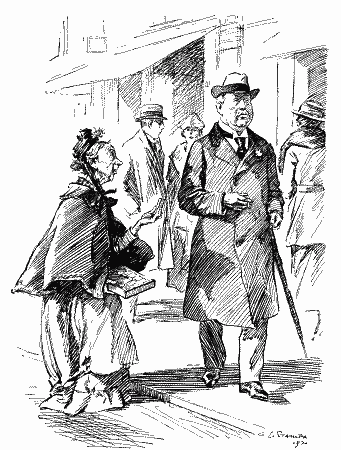
"Don't turn your 'ead away, my lord. Why, durin' the War it was all 'Ma, Ma, 'ave you any matches?'"
NEW RHYMES FOR OLD CHILDREN.
The Whale.
Air.—"The Tarpaulin Jacket."
The whale has a beautiful figure, Which he makes every effort to spoil, For he knows if he gets a bit bigger He increases the output of oil. That is why he insists upon swathing His person with layers of fat. You have seen a financier bathing? Well, the whale is a little like that. At heart he's as mild as a pigeon And extremely attached to his wife, But getting mixed up with religion Has ruined the animal's life. For in spite of his tact and discretion There is fixed in the popular mind A wholly mistaken impression That the whale is abrupt and unkind. And it's simply because of the prophet Who got into a ship for Tarshish But was thrown (very properly) off it And swallowed alive by "a fish." Now I should not, of course, have contested The material truth of the tale If the prophet himself had suggested That the creature at fault was a whale. But the prophet had no such suspicion, And that is convincing because He was constantly in a position To see what the miscreant was. And this is what punctures the bubble, As Jonah, no doubt, was aware: "A fish" was the cause of the trouble, But the whale is a mammal. So there! A. P. H.