Volume 159 — GENF AND THE LEAGUE OF NATIONS
Reading edition
"Genf," like "Genève," is the Swiss for "Geneva." It was selected, nearly two years ago, as the seat of the League of Nations. In a few days the League arrives; and I doubt if any person, firm, company, corporation or league, having provided itself with a seat, ever waited so long before it came and sat upon it.
You will remember a learned treatise of mine in these pages on the subject of Lucerne, written in August last, when our Prime Minister came and sat there. I make my living by writing up the towns of Switzerland as one by one they get sat on. As there are not more than half-a-dozen eligible towns in Switzerland, and as we shall have exhausted two of them in less than half a year, the living I make is a precarious one; in other words I shall soon be dead. Well, well! A short life and a merry one, say I. You must admit a touch of subtle merriment in that word "Genf."
To get to Geneva you provide yourself with a passport, a book of rail and steamer tickets, a ticket for a seat in the Pulman car, a ticket for a berth in the sleeping-car and a ticket for the registration of your luggage. In short, by the time you are in France you will have had pass through your hands one passport and eleven tickets; and the first thing you will do upon settling down into the French train is to compete and intrigue to get a twelfth ticket for your lunch. You will find that this useless ticket will follow you all the way to Geneva and will always assert itself when you are accosted by a ticket inspector. I even know a traveller who arrived eventually at the Swiss frontier with no other paper of identity or justification; for a passport which should have given his name, address, motive for travelling, shape of mouth, size of nose and any other peculiarities, he could only tender documentary evidence of his having eaten the nineteenth lunch of the first series of the day before.
Two things catch the eye about Geneva. In the first place it is on a lake, and in the second place it is always brimful of International Unions, Leagues, Congresses and Conferences. The lake is navigated in the season by a fleet of sizeable steamers, and one of these, a two-hundred tonner, used to call every morning of the season at the little pier outside my house to take me to business, and brought me back again every evening. By the pier rests an old, old man whose only duty in life it is to catch the hawser as it is thrown from the incoming liner. Twice a day for four months that hawser was thrown for the old man to catch, and twice a day for four months he missed it. I spoke to him about this on the last day, and he showed a fine courage which nothing can depress. Next season he means to try again. As he will be out of a job in the interval I am plotting to secure for him the post of naval expert to the League.
Turning from the lake to the international delegates, who abound in Geneva, it is to be noted that the last lot here were the International Congress of Leagues of Women. Their main agendum was to pronounce their complete independence of men. One of these delegates went for a row on the lake and fell in. She was pulled out again by a man.
You will find that Geneva was nominated as the seat of the League in the Peace Treaty of Versailles. Ever since, the people of Geneva have been busy conjecturing what the League of Nations will do upon its arrival in Geneva. It will do exactly what you and I would do in similar circumstances. Stepping out of the station exit it will hurry off to its hotel. But when Leagues go to hotels they buy the darned things outright. I don't know what they do about notices on the walls; alter some and remove others, no doubt. The international delegates will be requested to ring once for the political expert, twice for the military expert and three times for the naval expert. If my old man gets the last-named job they will have to ring rather more than three times if they want him to come up at once and discuss schemes for readjusting the various oceans.
As to the other usual decorations of hotel bedroom walls, the notice will be removed which informs all concerned that the management will not be held responsible for valuables, unless these be deposited in the office safe, though this will not be intended to indicate that the new management has doubts as to the safety even of its own safe.
The "Hôtel National," which is the hotel in question, was in process of complete reconstruction when the purchase took place. A bathroom has been annexed to every room. Presumably every international delegate will have a suite allotted to his nation. The question I ask myself is this, Will he put himself in the room and his secretaries in the bathroom, or himself in the bathroom and the secretaries in the room? And the answer I make to myself is as follows: The delegate will appoint the room to be his room and the bathroom to be his bathroom and will leave his secretaries to make the best of things out in the corridor. The suggestion you will probably make is that there are more suites of rooms than nations; that I must leave you to work out for yourself. The number of suites of rooms is ascertainable, but no one seems able to inform me how many nations there are. Personally every time I pick up a newspaper I seem to discover a new one. However that may be, the nations are now all formed into their League, and may the best one win the Cup Final, say I!
F. O. L.
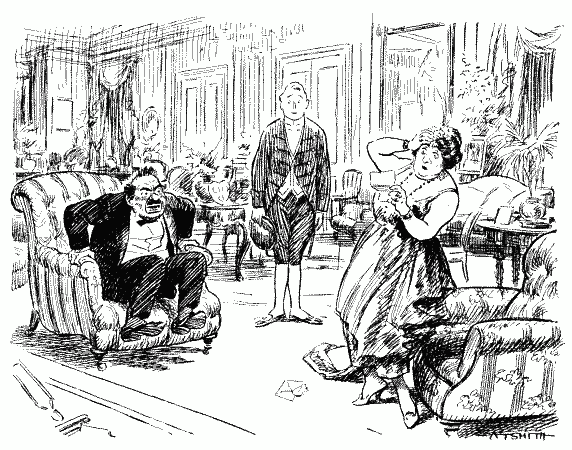
The Profiteer's Wife. "Heavens! Margaret has eloped with the chauffeur in the car."
The Profiteer. "What! Not the new Rolls-Royce?"
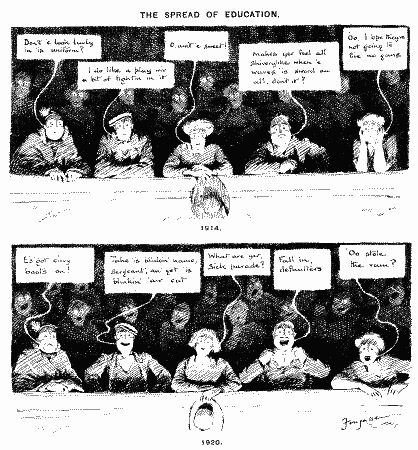
THE SPREAD OF EDUCATION.
1914. 1920.
"Don't 'e look lovely in 'is uniform?" "E's got civvy boots on!"
"I do like a play wiv a bit of fightin' in it." "Take 'is blinkin' name, Sergeant, an' get 'is blinkin' 'air cut."
"O, ain't 'e sweet!" "What are yer, Sick Parade?"
"Makes you feel all shiverylike when 'e waves 'is sword an' all, don't it?" "Fall in, defaulters."
"Oo, I 'ope they're not going to fire no guns." "'Oo stole the rum?"
FOR THE CHILDREN
Mr. Punch comes once more, hat in hand, to beg for help in a good cause. This time he asks the generous aid of his readers on behalf of the Victoria Home at Margate, of which Her Majesty the Queen is Patroness. This Home cares for invalid children, from very little ones of only a few months old, to boys of twelve years and girls of fifteen. There is room for between fifty and sixty of them and they stay, on an average, for the best part of a year, during which they receive careful medical attention, and have all their needs tended, body and mind. Many of them have lost a leg or an arm and nearly all have some bandaged limb, yet, with these disabilities, they contrive to learn the duties of a loyal Scout and are very proud of their uniform.
The cost of drugs, of surgical dressings and all house-keeping necessaries has risen enormously and the Home is compelled to plead for further help. Mr. Punch invites his readers to send for a report and see for themselves the very touching pictures which it gives, in an admirable set of photographs, of the life of these children in their happy surroundings.
All communications and gifts should be addressed to the Secretary of the Victoria Home for Invalid Children, at 75, Denison House, Vauxhall Bridge Road, S.W.
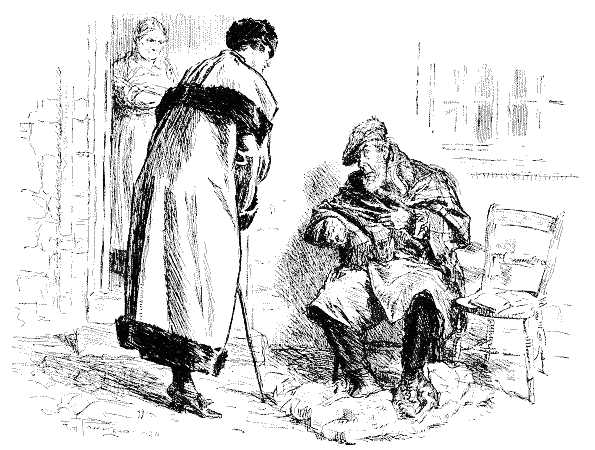
Minister's Wife. "Are you always as feeble as this, Mr. Macpherson? Do you never feel stronger?"
Macpherson. "Ah weel, Me'm, as the Meenister wad tell ye himsel', any sma' measure o' health that ah hae is just aboot mealtimes."

Westminster Abbey, November 11th, 1920.
Here lies a warrior, he alone Nameless among the named and known; None nobler, though by word and deed Nobly they served their country's need, And won their rest by right of worth Within this storied plot of earth. Great gifts to her they gave, but he— He gave his life to keep her free. O. S.
THE NEW JOURNALISM.
["In New York Mr. Harding leads by a figure something like the circulation of The Daily Mail. Pennsylvania gives him a majority which appears equal to the circulation of The Evening News. It is phenomenal."
—The Evening News.]
The method which is being used just now by some of Mr. Punch's contemporaries to draw attention to their circulations does not, it will be seen, tend to numerical nicety, though doubtless it has its advantages from the advertising point of view. The following items of news are intelligently anticipated.
The licences cancelled in one district in Scotland, as a result of the recent local veto poll, total exactly half the number of quires of "returns" of last week's Pawkiesheils Gazette. It is insignificant.
An analysis of the miners' votes in the Lancashire coalfield proves that there were as many men in favour of rejecting the Government proposals as would have provided ten readers for each copy sold (not merely printed) of the last issue of The Chowbent and Chequerbent Chronicle. It is magnificent.
It is estimated that, if three more distinguished statesmen and another woman of letters can be prevailed upon to write piquant reviews of Mrs. Asquith's autobiography, the sale of the work will probably greatly exceed the numbers of copies of the latest Blue Book issued by H.M. Stationery Office. It is unthinkable.
It is confidently expected that, if the protests against a certain cinema plot can be sustained for a few days longer, as many people will go to see the show in the first week as there are feet in the film—without counting those who will sneak round for a free view of "The Stage Door of the Diadem Theatre." It is good business.
"An ex-Army officer was charged with stealing cooks valued at 51/- from Messrs. ——'s."
—Sunday Paper.
At that price they must have been very plain cooks.
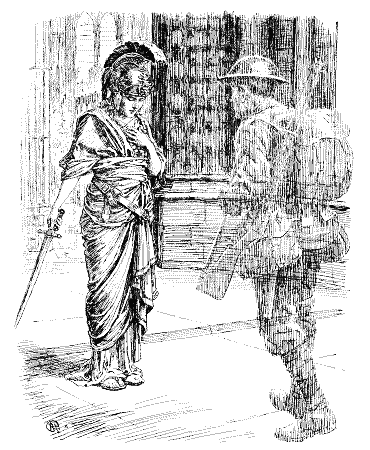
THE SHRINE OF HONOUR.
"WHO GOES THERE?"
"I HAVE NO NAME. I DIED FOR MY COUNTRY."
"PASS, UNKNOWN WARRIOR."