Volume 159 — ESSENCE OF PARLIAMENT.
Reading edition
Monday, November 1st.—In response to a renewed demand for the Admiralty's account of the Battle of Jutland the Prime Minister made the remarkable statement that it was very difficult to get "an official and impartial account," but he added that the Government were willing to publish all the reports and despatches on the subject and leave the public to judge.
Who shall decide, when Admirals disagree? Why, Julian Corbett, or the great B.P.
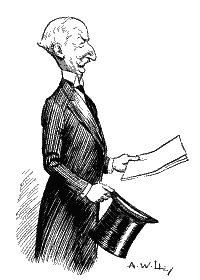
"ATHANASIUS CONTRA MUNDUM."
Sir Frederick Banbury.
Owing to the unexpectedly rapid passage through Committee of the Government of Ireland Bill last Friday, the way was cleared for a number of British measures. Although dealing with the most diverse subjects they were alike in one respect—without exception they incurred the hostility of Sir F. Banbury. Whether it was a proposal to reduce the dangers of employing women in lead processes or to give married women in Scotland the same privileges as their English sisters (including the duty of supporting an indigent husband), or to hold an Empire Exhibition, or to set up Juvenile Courts, the hon. baronet found reason for opposing them all.
Once or twice he secured the support of Sir John Rees, but for the most part he was Athanasius contra mundum, maintaining his equanimity even when Mr. Hogge advised him to "marry a Scotswoman;" or Lady Astor expressed her regret that he had not women, instead of bankers, for his constituents.
The Government had no reason to complain of his activity, which may indeed have prevented the intrusion of more dangerous critics; for despite his efforts every Bill went through.
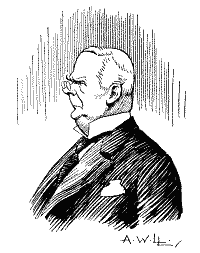
"No supporter of Mr. Asquith."
Lord Loreburn.
Tuesday, November 2nd.—The most striking thing in Lord Loreburn's speech upon Irish affairs seemed to me to be his uncompromising declaration that he was "no supporter of Mr. Asquith." He endorsed, however, his former chief's demand for an independent inquiry into the reprisals, but his motion was defeated by 44 to 13.
Ever since Sir W. Joynson-Hicks defeated Mr. Churchill at Manchester he has felt it his duty to keep on his track. Convinced that our policy in Mesopotamia is due to the War Minister's megalomania he is most anxious to bring him to book. The prospect of a Supplementary Estimate for the Army seemed likely to furnish the desired occasion. But when he pressed Mr. Churchill on the subject the alleged spendthrift airily replied that there was no hurry; "I do not immediately require money."
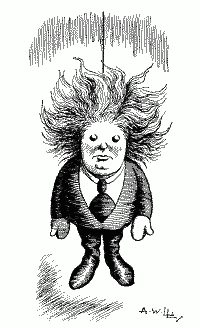
"OLD GOLLIWOG."
Mr. C. B. Stanton (As viewed by Mr. Jack Jones).
The gloom of the daily Irish catechism was a little brightened by an interchange of pleasantries between Mr. Stanton and Mr. Jack Jones. On this occasion the latter had rather the best of it. "Golliwog!" he shouted in allusion to his opponent's luxuriant chevelure. Mr. Stanton could think of no better retort than the stereotyped "Bolshie!" and when Mr. Jones rejoined with "You ought to be put into Madame Tussaud's" Mr. Stanton was reduced to silence. But is it not a scandal that these entertaining comedians should only get four hundred a year?
On the Agriculture Bill Sir A. Griffith-Boscawen was faced with an urgent demand for a separate Wages Board for Wales. First he wouldn't; it would be "an exceedingly inconvenient and expensive arrangement." But the Welshmen were so insistent that he changed his mind, and when the vigilant Sir Frederick Banbury challenged the new clause on the ground that it would impose a fresh charge on the Exchequer Sir Arthur was able to convince the Speaker that, though there would be "additional expenditure," there would be no "fresh charge." Such are the nice distinctions of our Parliamentary system.
Wednesday, November 3rd.—When Mr. Churchill, some sixteen years ago, crossed the floor of the House, his manœuvre was regarded as a portent, and men talked of "a sinking ship." It cannot be said that Lord Henry Bentinck's sudden appearance among the Labour Members created anything like the same sensation, even though he was joined a little later by Mr. Oswald Mosley. Lord Henry has always derived his political opinions rather from his heart than his head, and has lately developed a habit of firing explosive Questions at Ministers from his eyrie behind their backs. They will probably find his frontal attacks less disconcerting.
While Lord Henry was in the House, off and on, for thirty-four years before discovering that he was on the wrong side, Mr. Mosley has made the same discovery after an experience of barely as many weeks. From his new perch he inquired this afternoon if Government cement was being sent abroad, to the detriment of British builders. Dr. Addison contented himself with professing ignorance of any such transaction. A less serious Minister might have replied that the Government needed all their cement to mend the cracks in the Coalition.
News that the coal-strike was over reached the House during the evening. Mr. Bridgeman, always cautious, "understood" that the men had been "recommended" to go back to work. Mr. Adamson, fresh from the Conference, was much more downright. "The strike," he said, "has been declared off, and the men return to work." So that's that.
Thursday, November 4th.—Lord Salisbury's complaint that the Government's policy in Egypt was shrouded in more than Egyptian darkness brought a spirited reply from Lord Curzon, who declared that every stage in the negotiations had been fully revealed in the Press. If no definite decision as to the future government of the country had been published that was simply because the Cabinet had not yet had time to make up its collective mind. Judging by Lord Milner's subsequent account of his Mission, it would appear that the process will be long and stormy. The Mission went to Cairo to sound the feeling of the Nationalists, but for all practical purposes they might as well have stopped in London, where they ultimately interviewed Zaghlul Pasha and his colleagues, and obtained information which materially altered and softened their previous views. The best Nationalists were not anti-British, but simply pro-Egyptian. Lord Milner's final appeal, that his piece should not be hissed off the stage before it had been heard, sounded a little ominous.
Mr. L'Estrange Malone is not very popular in the House of Commons just now. When he rose to address a "Supplementary" to the War Minister he was so persistently "boo-ed" that the Speaker had to intervene to secure him a hearing. Mr. Lowther probably repented his kindness when it appeared that Mr. Malone had nothing more urgent to say than that Mr. Churchill would be better employed in looking after the troops in Ireland than in reviewing books for The Daily Mail.
For the third day in succession Mr. T. P. O'Connor essayed to move the adjournment in order to call attention to what he called "the policy of frightfulness" in Ireland. This time the Speaker accepted the motion, but the ensuing debate was of the usual inconclusive kind. Mr. Devlin gave another exhibition of stage-fury. He objected to the word "reprisals" being used for the "infamies" going on in Ireland, declared that the Government were responsible for all the murders and prophesied that the present Chief Secretary, "with all his outward appearance of great masculinity," would fail, as Balfour and Cromwell—the House enjoyed this concatenation—had failed before him.
In points of detail Sir Hamar Greenwood conceded a little more to his critics than on some former occasions. He undertook to consider whether the Government should compensate the owners of creameries or other property wrongfully destroyed; and he admitted that some constables had exceeded their duty, nine of them being actually under arrest on various charges. But on the main point he was adamant. Quoting the remark of a police-sergeant at Tralee, "They have declared war upon us and I suppose war it must be," the Chief Secretary said in his most emphatic tones, "War it will be until assassination stops."
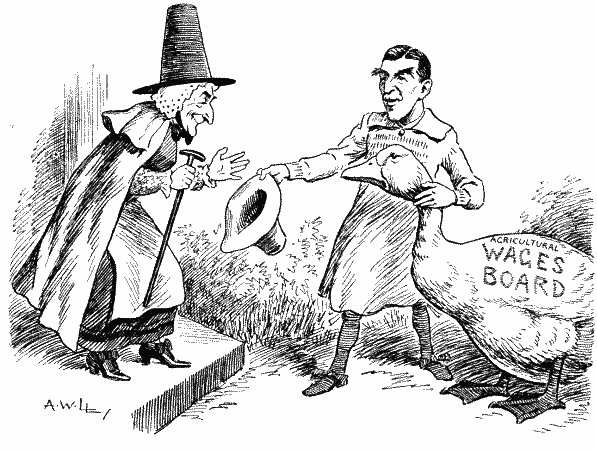
"Old Mother Goose was delighted when she saw what a fine bird her son had provided her with."
Wales and Sir A. Griffith-Boscawen.
STUTTFIELD AND THE REDS.
Stuttfield was nothing of a Nero. He would never have fiddled while Rome burned. He would have been more likely to imagine that Rome was burning when there was really nothing more going on than a bonfire. He is one more example of the pernicious influence of sensational literature upon a nervous temperament.
It all began through Stuttfield finding a copy of The Daily Blast in a railway carriage last June. This journal is printed on white paper, but the tendency of its contents is ruddy—that is to say, it has "Red" leanings. It was a revelation to Stuttfield.
"Are people allowed to say such things?" he asked me in horror.
"My dear fellow, no one takes it seriously," I said. "Don't you worry."
But Stuttfield did worry. The Daily Blast had the same effect upon him as a snake has upon a rabbit; it terrified him, yet he could not run away from it. In fact he became a regular subscriber and continued so despite some rumours that it was supported financially by the Rougetanians—rumours which required, and received, a great deal of explanation.
Then, through the offices of his man-servant, he obtained a copy of The Volcano.
The Volcano appears to be in advance of The Daily Blast in its ideals, and immensely so in their expression. But here again I assured Stuttfield that no one took them seriously. "I don't suppose they take themselves seriously," I assured him. "They want to sell The Volcano, that's all."
"Yes," said Stuttfield, "but they do sell it, and people read it."
"I expect the circulation's about two thousand a week," I said consolingly. But Stuttfield, as I could see, was not consoled.
I met him at intervals after that, and on each occasion he seemed to be more obsessed with the notion that the "Reds" would overwhelm us all shortly.
"Russia is Red," he whispered; he always whispers now for fear of being overheard by a Red agent, though there was not very much risk of that in St. James's Street. "And what about India and China?"
"Red, black and yellow—the Zingari colours," I said ribaldly, and Stuttfield left me in disgust.
Then I heard from a friend that he had sold his cottage at Redhill. This was a bad sign, and I went to see him. I found him much worse.
"You've taken an overdose of The Volcano," I said.
He seized my arm with trembling fingers.
"The Red Revolution is upon us," he hissed.
I laughed. "Don't you worry about the Red Revolution. You come out to lunch."
He would hardly be persuaded. Clubs and restaurants would be attacked first, he thought. If we lunched together it had better be in an eating-house in Bermondsey. "I have a disguise," he said, and disclosed a complete proletarian outfit.
"Well, I haven't," I said. "Not that these clothes of mine will lead anyone to mistake me for a capitalist. But, so far as lunch goes, hadn't we better be killed by a Red bomb at the Fitz than by tripe in Bermondsey?"
Stuttfield could not but admit the sense of this, so we started out.
It is widely recognised that Flag Days, however admirable their objects, have been a little overdone. But it was sheer bad luck that brought Stuttfield face to face with a flag-seller just as we were entering the Fitz. She came at him with a determined aspect and began "The Red Cr——"
It was enough. Poor Stuttfield was across the pavement and into a taxi before I could stop him. There was nothing for me to do but follow him.
"Where are we going?" I asked.
"Waterloo," he answered through blanched lips. I could get nothing more from him.
At Waterloo he sprang out, leaving me to pay the cab, and disappeared into the station. I followed as quickly as I could, but he was nowhere to be seen.
"Where would he go to hide from the Reds?" I asked myself. Suddenly I had an idea about his destination.
I was right. In the foremost carriage I found him. I tried to persuade him to come out, but he clung to the rack. So I left him. I have not seen him since.
I hope he feels safe in the Isle of Wight.
"You can burn your slack cook in oven in our —— Grate."
—Advt. in Daily Paper.
But now that the coal strike is over we shall try to put up with our cook a little longer.
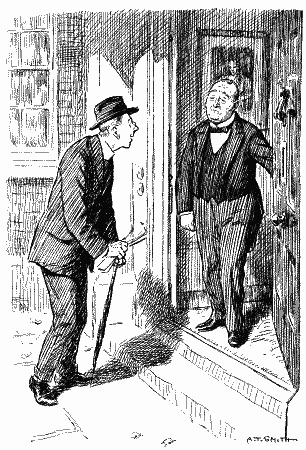
Our Reverend Spoonerist (calling at the Deanery). "Is the Bean dizzy?"
"WALLASEY'S LOW FIGURE.
Population Jump—From 21,192 to 99,493 in 28 Days."
Liverpool Paper.
We do not know why this should be described as a "low figure." To us it seems remarkably good going.
"The weather forecast for Sheffield and district for the next twenty-four years is as follows:—
Wind southerly, light, freshening later; cloudy or overcast; probably some rain later; visibility indifferent to fair; mild."
Yorkshire Paper.
It is hoped however that some improvement may be shown in 1945.
Puck's Record Eclipsed.
"For five minutes I was in the Mercantile Marine and the Navy. During these five minutes I made a complete circuit of the globe."
—Letter in Welsh Paper.
"The pruning-fork is being applied in order to bring the staff within the capacity of the accommodation."
—Provincial Paper.
After which harmony will be restored by means of the tuning-knife.
"It did one good, on entering the Queen's Hall last night, to find every seat in the building, even to those at the back of the rostrum, occupied by the London Symphony Orchestra."
—Evening Paper.
An audience is often so distracting.
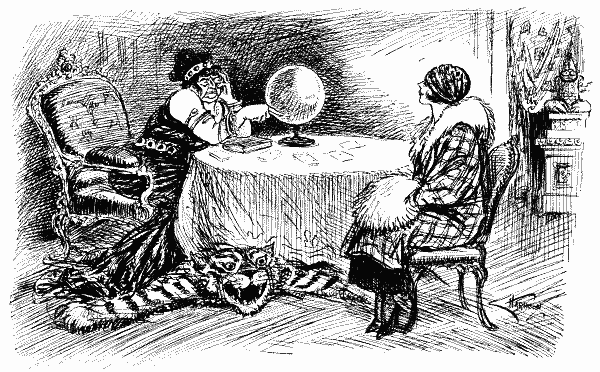
Fortune-Teller (to client). "A dark man has been hovering about your path for the last month."
Client. "Oh, that must be the agent who's been worrying me to insure my life."
THE MOTHER-IN-LAW MYSTERY.
In a provincial paper I find the following passage:—
"Counsel stated that the prisoner's mother was in court. Later he informed the Judge that he had made a mistake; it was the prisoner's mother-in-law. A general laugh throughout the court followed this 'correction.'"
We have here in a nutshell the case for traditional communal humour, and once again we are set to wondering why—except possibly to allay some whimsical twinges of self-respect—dramatists ever try to invent new jokes at all. Even more are we set to wondering why this particular joke never fails.
In the present case the injustice done to an honourable class of women—that is to say, those who provide lovers with their loves (for that is how these relationships begin)—was the greater because no doubt, when the laughter had subsided a little, every eye sought for the lady in question. Normally we have not the opportunity of visualising the butt at all. It is enough that she should be mentioned. Nor would any grotesque details in her costume or physiognomy make the joke appreciably better. It requires no such assistance; it is rich enough without them; to possess a married daughter is all that is necessary to cause gusts of joyful mirth.
That it is not the lady herself who is funny could—no matter how Gothic her figure—be proved in a moment by placing her in the witness-box and asking her to state her relationship to the prisoner's wife. She would say, "I am her mother," and nothing would happen. But if the question were, "What is your relationship to the prisoner?" and she replied, "I am his mother-in-law," sides would split. Similarly one can imagine that if the husband's reply to the counsel's question, "Who was with you?" had been, "My wife was with me," there would have been no risible reaction whatever; but if the reply had been, "My wife's mother was with me," the place would have been convulsed. Of course the true artist in effect would never say, "My wife's mother," but "My mother-in-law." It is the "in-law" that is so exquisitely amusing and irresistible.
But both would be the same person: the gravest thing on earth, it might be, in every other respect—even sad and dignified—but ludicrous because her daughter happened to have found a husband.
To inquire why the bare mention of the mother of a man's wife should excite merriment is to find oneself instantly deep in sociology—and in some of its seamiest strata too. While exploring them one would make the odd discovery that, whereas the humour that surrounds and saturates the idea of a wife possessing a maternal relative is inexhaustible, there is nothing laughable about the mother of a husband. A wife can talk of her husband's mother all day and never have the reputation of a wit, whereas her husband has but to mention her mother and he is the rival of the Robeys.
As for fathers-in-law, low comedians would starve if they had to depend on the help that fathers-in-law give them. Fathers-in-law do not exist. Nor do brothers-in-law or sisters-in-law, except as facts; but the joke is that they can be far more interfering (interference being at the root of the matter, I take it) than anyone in the world. It is the brother-in-law who knows of absolutely safe gilt-edged investments (which rarely succeed), and has to be helped while waiting for something to turn up; it is the sister-in-law who is so firmly convinced that dear Clara (her brother's wife) is spoiling the children. But both escape; while many really charming old ladies, to whom their sons-in-law are devoted, continue to be riddled by the world's satirical bullets.
What is to be done about it? Nothing. Only the destruction of the institution of marriage could affect it.
E. V. L.
MY APOLOGIA.
(Lines accidentally omitted from a notorious volume of Memoirs.)
If life is dull and day by day I see that wittier, wiser England where I was wont to play (Being as bold as I was gay) Keep passing rapidly away All through the German Kaiser; If "Souls" are not the things they were, If caste declines and Vandals Go practically everywhere From Cavendish to Berkeley Square, And dowdy frumps without the "air" Monopolise the scandals; There is but one thing left to do— And what's a sporting flutter worth Unless one takes a risk or two?— "I'll shock the world," I thought, "anew," And (ultimately) did so through The firm of Thornton Butterworth. Two worlds indeed. The mighty West Poured out her untold money To gaze upon my palimpsest; I think that Codex A was best, But parts of this have been suppressed; Publishers are so funny. And now my fame through London rings In well-bred speech and argot; At mild suburban tea-makings The postman knocks, and poor dear things Tear wildly at the parcel-strings When Mudie gives them Margot. Pressmen have tried to make a lot Out of a certain instance Of mild misstatement as to what Happened in 1914. Rot! All I can say is that my plot Has much more verve than Winston's. Well, never mind. The work is done; People who do not need it— The wit, the fire, the force, the fun, The pathos—let them simply shun This frightful book, shout "Shame!" and run; Nobody's forced to read it. Evoe.
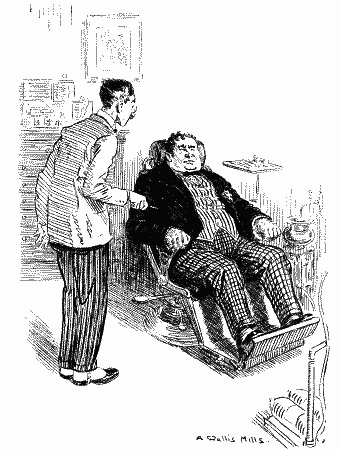
Dentist (after preliminary inspection). "Extraordinary thing—there's one of your teeth only half stopped."
Patient. "Ah, that were t'oother dentist. T' laad 'urt me, so ah gave 'im a good lick in t' jaw."
NOMEN, OMEN.
(By our Medical Correspondent.)
No one who is interested in the possibilities of psycho-therapy can view without serious misgiving recent tendencies in artistic nomenclature. Some of us are old enough to remember when the trend was in the direction of Italianisation; when Foley became Signor Foli; Campbell, Campobello, and an American from Brooklyn was transformed into Broccolini. The vogue of alien aliases has passed, but it may return, and it is to guard against the formidable and deleterious results of its recrudescence that the following suggestions, are propounded, not merely in the interests of Gongorism or of an intensive cultivation of syncretic euphuism, but in accordance with the most approved conclusions of psycho-analytic research.
It may be urged—and the objection is natural—that there can be little danger of a relapse in view of the heroic and patriotic adhesion of some of our most distinguished artists to their homely patronymics. No doubt the noble example of Clara Butt and Carrie Tubb is fortifying and reassuring, and there are also clamant proofs that denationalisation is no passport to eminence. But it would be foolish to overlook the existence of powerful influences operating in an antipodal direction. I confess to a feeling approaching to dismay when I study the advertisement columns of the daily papers and note the recurrence, in the announcements of impending concerts, of names of a strangely outlandish and exotic form. In a single issue I have encountered Krish, Arrau, Kouns and Dinh Gilly. The Christian names of some of these eminent performers are equally momentous and perturbing, e.g., Jascha, Kofza and Utt.
My grounds for perturbation are not imaginary or based on the hallucinations of a hypersensitive mind. They are prompted and justified by the notorious facts, established by the leading psycho-analysts, that, just as mellifluous and melodious names exercise a mollifying influence on the activities of the sub-conscious self, so the possession or choice of strange or ferocious appellations incites the bearer, if I may be permitted to use so commonplace a term, to live up to his label.
It is therefore with all the force at my command that I entreat and implore singers, players and dancers to think, not once but twice or thrice, before they yield to the fascination of the unfamiliar and adopt artistic pseudonyms calculated to intensify the "urges" of their primitive instincts. It is not too much to say that a singer who deliberately assumes the name of Pongo, Og or Botuloffsky runs a serious risk, in virtue of the inherent magic of names, of developing qualities wholly unfitted for the atmosphere of a well-conducted concert-hall.
I believe that the question of establishing a censorship of artists' names has been seriously considered by Dr. Addison, in view of its bearing on public hygiene, and that he estimates the cost of staffing the new department as not likely to exceed seven hundred and fifty thousand pounds a year. Still, in these days when State economy is so needful, it would be better if the desired effect were attained by the pressure of enlightened public opinion rather than by the operations of even so inexpensive a department as that contemplated by the Minister of Health.
IN FLANDERS FIELDS.
These famous verses, which originally appeared in Punch, December 8th, 1915, being the work of a Canadian officer, Lieut.-Colonel McCrae, who fell in the War, have been subjected to so many perversions—the latest in a letter to The Times from a Minister of the Crown, where the closing lines are misquoted as follows:
"If ye break faith with those of us who died, We shall not sleep, though poppies bloom in fields of France"—
that Mr. Punch thinks it would be well to reproduce them in their correct form:—
In Flanders fields the poppies blow Between the crosses, row on row, That mark our place; and in the sky The larks, still bravely singing, fly Scarce heard amid the guns below. We are the Dead. Short days ago We lived, felt dawn, saw sunset glow, Loved and were loved, and now we lie In Flanders fields. Take up our quarrel with the foe: To you from failing hands we throw The torch; be yours to hold it high. If ye break faith with us who die We shall not sleep, though poppies grow In Flanders fields.
AT THE PLAY.
"Fédora."
It may or may not be well that the War has modified our estimate of the value of life; but it is a bad thing for the legitimate drama. And in the case of Fédora the bloody régime of Lenin has so paled our memory of the terrors of Nihilism that Sardou's play seems almost further away from us than the tragedy of Agamemnon. In our callous incapacity to be thrilled by the ancient horrors of forty years ago we fall back on the satisfaction to be got out of the author's dexterity in the mechanics of his craft.
And here the critic's judgment is also apt to be more cold-blooded. He recognises the crude improbability of certain details which are essential to the tragic development of the play. The death of Count Vladimir (accented on the first or second syllable according to the temporary emotion of the speaker) was due to the discovery of a letter in an unlocked drawer where it could never possibly have been thrown, being an extremely private letter of assignation. The death of Fédora, again, was the direct result of a letter which she despatched to Petersburg denouncing a man who proved, in the light of fresh facts learned a few minutes later, to be the last (or last but one) that she would wish to injure. It is incredible that she should not have hastened to send a second letter withdrawing her charge; "instead of which" she goes casually off on a honeymoon with his brother, and apparently never gives another thought to the matter till it is fatally too late.
However, I am not really concerned at this time of day with the improbabilities of so well-established a tragedy, but only with the most recent interpretation of it. And let me say at once that, for the best of reasons, I do not propose to compete with the erudition of my fellow-critics in the matter of previous interpreters, for I bring a virgin mind to my consideration of the merits of the present cast.
Fédora is the most exhausting test to which Miss Marie Löhr has yet put her talent. The heroine's emotions are worked at top-pressure almost throughout the play. At the very start she is torn with passionate grief for the death of her lover and a still more passionate desire to take vengeance on the man who killed him. When she learns the unworthiness of the one and the justification of the other those emotions are instantly exchanged for a passionate worship of the late object of her vengeance, to be followed by bitter remorse for the harm she has done him and terror of the consequences when he comes to know the truth. And so to suicide.
I will confess that I was astonished at the power with which Miss Löhr met these exigent demands upon her emotional forces. It was indeed a remarkable performance. My only reservation is that in one passage she was too anxious to convey to the audience the intensity of her remorse, when it was a first necessity that she should conceal it from the other actor on the stage. It was nice and loyal of Mr. Basil Rathbone to behave as if he didn't notice anything unusual, but it must have been as patent to him as to us.
Of his Loris I cannot say too much in admiration. At first Mr. Rathbone seemed a little stiff in his admirably-fitting dress-clothes, but in the last scene he moved through those swift changes of emotion—from joy to grief, from rage to pity and the final anguish and horror—with extraordinary imagination and resource.
Of the others, Mr. Allan Aynesworth, as Jean de Siriex, played in a quiet and assured undertone that served to correct the rather expansive methods of Miss Ellis Jeffreys, whose humour, always delightful, afforded a little more relief than was perhaps consistent with the author's designs and her own dignity as a great lady in the person of the Countess Olga.
O. S.
A Matinée in aid of the Great Ormond Street Hospital for Sick Children will be given at the Garrick Theatre on Wednesday, November 17th, at 2.30, when a comedy by Mr. Louis N. Parker will be presented, entitled, Pomander Walk (period 1805).
It is hoped that at the Alhambra Matinée on November 16th one thousand pounds will be raised to complete the special pension fund for actors, which is to be a tribute of affection to the memory of Mr. Sydney Valentine, who, in the words of Mr. McKinnel, "did more for the rank and file of the theatrical profession than any actor, living or dead."
"The Dog it was who Died."
"At Dovey Board of Conservators at Barmouth it was decided to ask Major Dd. Davies to hunt the district with his otter hounds, and failing this the water bailiffs themselves should attempt to stamp them out."
—Welsh Paper.
Major Dd. Davies' answer is not known to us, but we assume that he said, "Well, I'm Dd."
"Royal Surrey Theatre. Grand Opera. To-night, 8, Cav. and Pag."
—Daily Paper.
More evidence of the paper-shortage.
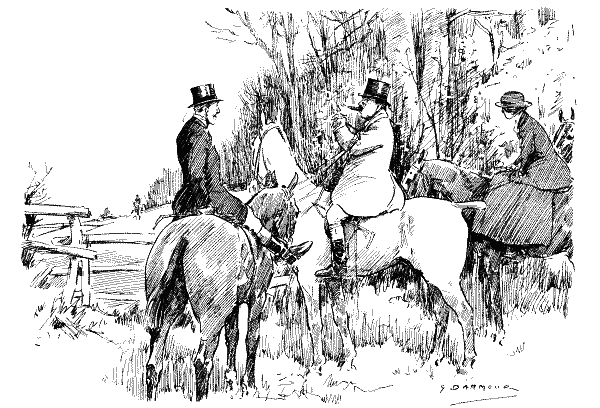
Affluent Sportsman (after a long blank draw). "Now I bet you we'll find as soon as I light one of my half-dollar cigars."
Friend. "Don't you think we might make a certainty of it if I lit one too?"
OUR BOOKING-OFFICE.
(By Mr. Punch's Staff of Learned Clerks.)
I do not think that even the most phlegmatic of Englishmen could read Francis and Riversdale Grenfell: a Memoir (Nelson) without a quickening of the pulses. This is not to suggest that Mr. John Buchan has sought to make an emotional appeal—indeed he has told the tale of these devoted brothers with a simplicity beyond praise—but it is a tale so fine that it must fill the heart, even of those who were strangers to them, with joy and pride. I beg you to read the memoir for yourselves, and see how and why it was that these twin brothers, from Eton onwards, radiated cheerfulness and a happy keenness wherever they went. "Neither," Mr. Buchan writes, "could be angry for long, and neither was capable of harshness or rancour. Their endearing grace of manner made a pleasant warmth in any society which they entered; and since this gentleness was joined to a perpetual glow of enthusiasm the effect was triumphant. One's recollection was of something lithe, alert, eager, like a finely-bred greyhound." Those of us who were not personally acquainted with Francis and Riversdale Grenfell will, after reading this Memoir and the Preface by their uncle, Field-Marshal Lord Grenfell, seem to know them intimately. Francis won the first V.C. gained in the War, but when he read the announcement of it in The Gazette his brother was already killed and his joy of life was quenched. "I feel," he wrote to his uncle, "that I know so many who have done and are doing so much more than I have been able to do for England. I also feel very strongly that any honour belongs to my regiment and not to me." In that spirit he met his death a few months later. In work and sport, in war or peace, the twins were ardent, generous and brave, and their deaths were as glorious as their lives were gracious and radiant. The profits of Mr. Buchan's book are to be devoted to the funds of the Invalid Children's Aid Association, in which the brothers were deeply interested.
There are certain tasks which, like virtue, carry their reward with them. No doubt Miss Eleanour Sinclair Rohde would be gratified if her book, A Garden of Herbs (Lee Warner), were to pass into several editions—as I trust it will—and receive commendation on every hand—as it surely must—but such results would be irrelevancies. She has already, I am convinced, tasted so much delight in the making of this, the most fragrant book that I ever read, in her delving and selecting, that nothing else matters. Not only is the book fragrant from cover to cover, but it is practical too. It tells us how our ancestors of not so many generations ago—in Stuart times chiefly—went to the herb garden as we go to the chemist's and the perfumer's and the spice-box, and gave that part of the demesne much of the honour which we reserve for the rock-garden, the herbaceous borders and the pergola. And no wonder, when from the herbs that grow there you can make so many of the lenitives of life—from elecampane a sovran tonic, and from purslane an assured appetiser, and from marjoram a pungent tea, and from wood-sorrel a wholesome water-gruel, and from gillyflowers "a comfortable cordial to cheer the heart," and from thyme an eye-lotion that will "enable one to see the fairies." Miss Rohde tells us all, intermingling her information with mottoes from old writers and new. Sometimes she even tells too much, for, though she says nothing as to how lovage got its pretty name, we are told that "lovage should be sown in March in any good garden soil." Did we need to be told that? Is it not a rule of life? "In the Spring a young man's fancy...."
To my mind, amongst the least forgettable books of the present year will be that to which Mr. Seton Gordon, F.Z.S., has given the title of The Land of the Hills and the Glens (Cassell). Mr. Gordon has already a considerable reputation as a chronicler of the birds and beasts (especially the less approachable birds) of his native Highlands. The present volume is chiefly the result of spare-moment activities during his service as coast-watcher among the Hebrides. Despite its unpropitious title, I must describe it without hyperbole as a production of wonder and delight. Of its forty-eight photographic illustrations not one is short of amazing. We are become used to fine achievement in this kind, but I am inclined to think Mr. Gordon goes one better, both in the "atmosphere" of his mountain pictures and in his studies of birds at home upon their nests. To judge, indeed, by the unruffled domesticity of these latter, one would suppose Mr. Gordon to have been regarded less as the prying ornithologist than as the trusted family photographer. I except the golden eagle, last of European autocrats, whose greeting appears always as a super-imperial scowl. Chiefly these happy results seem to have been due to a triumph of patient camouflage, concerning which the author suggests the interesting theory that birds do not count beyond unity, i.e., if two stalkers enter an ambush and one subsequently emerges, the vigilance of the feathered watchers is immediately relaxed. Should this be true, I can only hope that Mr. Gordon will get in another book before the spread of higher education increases his difficulties.
I should be inclined to call Mr. Norman Douglas our only example of the romantic satirist, though, unless you have some previous knowledge of his work, I almost despair of condensing the significance of this into a paragraph. For one thing the mere exuberance of his imagination is a rare refreshment in this restricted age. His latest book, with the stimulating title of They Went (Chapman and Hall), is an admirable example of this. Certainly no one else could have created this exotic city with its painted palaces and copper-encrusted towers, a vision of sea-mists and rainbows; or peopled it with so iridescent a company—the strange princess; the queen, her mother; the senile king who should have been (but wasn't) her father; Theophilus, the Greek artist; the philosophic old Druidess, and the dwarfs who "chanted squeaky hymns amid sacrifices of mushrooms and gold-dust." Perhaps this random quotation may hint at the fantastic nature of the tale; it can give no idea of the intelligence that directs it, mocking, iconoclastic, almost violently individual. Plot, I fancy, seldom troubles Mr. Douglas greatly; it happens, or it does not. Meanwhile he is far more concerned in fitting a double meaning (at least) to the most simple-sounding phrase. To sum up, They Went is perhaps not for idle, certainly not for unintelligent, reading; for those who can appreciate quality in a strange guise it will provide a feast of unfamiliar flavours that may well create an appetite for more.
That clever writer, Mr. A. P. Herbert, would lightly describe his story, The House by the River (Methuen), as a "shocker." But there are ways and ways of shocking. He might wish to show us the embarrassments of a fairly respectable member of the intellectual classes, living in a highly respectable environment, when he finds that he has committed homicide; and he might make the details as gruesome as he liked. But there was no need to shock the sensitive when he made his choice of the circumstances in which the poet, Stephen Byrne, inadvertently throttles his housemaid. It is a fault, too, that his scheme only interests him so far as it concerns Stephen and his society, and that the horror of the tragedy from what one may loosely call the victim's point of view does not seem to affect him at all. Otherwise, even for the sake of brevity, he could not so flippantly refer to the body, sewn in a sack and thrown into the river, as just "Eliza." He may argue that he never thought of the corpse as a real one and that the whole thing was merely an experiment in imaginative art; but his details are too well realised for that, and so is his admirable picture of the society of Hammerton Chase, W., a thin disguise for a riverside neighbourhood easy to recognise. I could never get myself quite to believe that Stephen's friend, Egerton, accessory after the fact, would so long and so tamely have borne the suspicion of it; but for the rest Mr. Herbert's study of his milieu shows a very intimate observation. If his Stephen, in whom the highest poetic talents are found tainted with a touch of coarseness, may not always be credible, the passion for self-expression which leads him on to versify his own experience in the form of a mediæval idyll, and so give himself away, is true to life. But my final impression of Mr. Herbert's book—he will perhaps think I am taking him too seriously—is that his many gifts and notably his humour, whose gaiety I prefer to its grimness, are here exercised on a rather unworthy theme.
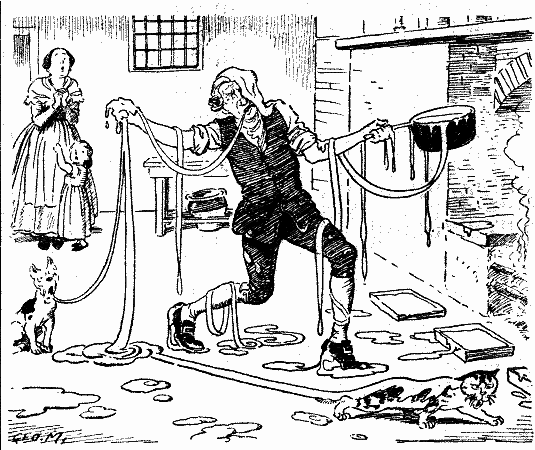
MARTYRS OF SCIENCE:—THE INVENTOR OF TOFFEE.
Fashions for Proxy-Fathers.
"The bride entered the church on the arm of Mr. T. ——, of Happy Valley (who acted in loco parentis and was charmingly attired in crepe-de-chine)."
—South African Paper.
"Is there anyone amongst the thousands of men who will benefit who will be some an (please let the word remain, Mr. Editor) as not to show his appreciation in the same way?"
—Educational Paper.
Personally we think the Editor was a little too complaisant.
Transcriber's Note: Page 361: Changed "corresponent" to "correspondent" A corresponent writes to a contemporary Page 362: Removed extraneous single closing quote. "Sir Harry Johnston's 'The Gay Donkeys' has passed its fifth edition in London.'"—_Australian Magazine_. Page 368: Changed "Pulman" to "Pullman" a ticket for a seat in the Pulman car