Volume 159 — THOUGHTS ON "THE TIMES."
Reading edition
(From a Train.)
Really the news is very bad this morning. On the front page there are two Foreign crises and a Home one. On the next page there is one Grave Warning and two probable strikes. On every other page there is either a political murder or a new war. It is awful ...
Yet somehow I don't feel depressed. I rather feel like giggling. An empty smoker in the Cornish express—empty except for me! Extraordinary! And all my luggage in the right van, labelled for Helston, and not for Hull or Harwich or Hastings. That porter was a splendid fellow, so respectful, so keen on his work—no Bolshevism about him. I gave him a shilling. I gave the taxi-man a shilling too. That guard is a pleasant fellow also; I shall give him two shillings, perhaps half-a-crown. Yet I see that the railways are seething with unrest.
I have just read The Times' leader. Everything seems to be coming undone ... Persia, Mesopotamia, Egypt, India. This Bolshevist business ... dreadful. The guard has got me a ticket for the Second Luncheon. A capital fellow. I gave him three shillings. Absurd. I have no more shillings now. I am overdrawn. There is a financial crisis. But that, of course, is general. I see that Mr. Iselbaum anticipates a general smash this winter. A terrible winter it is going to be ... no coal, no food ... We ought to be in by five, in time for a fat late tea ... Cornish cream ... jam. Gwen will be at the station, with the children, all in blue ... or pink perhaps. How jolly the country looks! Superficial, of course; the harvest's ruined; no wheat, no fruit. And unemployment will be very bad. And the more people there are unemployed the more people will strike ... Sounds funny, that; but true ... Hope they've given us the usual table in the coffee-room, that jolly window-table in the corner, where one can look across the bay to the cliffs and the corn-fields and the hills ... Only there's no corn, I suppose, this year ... And one has a good view of the rest of the room there ... can study the new arrivals at dinner, instead of having to wait till afterwards. Dinner is much the best time to study them; you can see at once how they eat. And it is so much easier to decide which is the sister and which the fiancée of the young man when they are all stationary at a table. When you only see them rushing about passages in ones it takes days.
All the usual families will be there, I suppose—the Bradleys and the Clinks, old Mrs. Puntage and the kids—if they can afford it this year ... Very likely they can't. I can't, certainly. But I'm going.
"Not since the fateful week-end of August, 1914, when the destinies of Europe were decided in a few hours, have issues of such gravity engaged the attention of the British race...." Dreadful. I shall get some tennis tomorrow. I shan't be called. I shall get up when the sun is on my face and not before. I shall dress very, very slowly, looking at the sea and the sands and the sun, not rushing, not shaving properly, not thinking, not washing a great deal, just sort of falling into an old coat and some grey flannels.... Then I shall just sort of fall downstairs—about half-past nine, and give the old barometer a bang. Then breakfast, very deliberate, but cheerful, because the glass went up when I banged it—it always goes up at that hotel ... like the cost of living. Up another five points to-day, I see. Bread's going to be one-and-threepence. But of course there won't be any bread this winter, so the price doesn't much matter. But what about coal? and milk? and meat? "Several new sets of wage claims are due for decision within the next few weeks, and it is possible that two of them at least may not be determined without a cessation of work." More strikes ... But not for a week or two. To-morrow there won't be any papers at breakfast; there won't be any letters. I shan't catch the 9.5. After breakfast I shall smoke on the cliff—then some tennis. Most of the balls will go over the cliff, but when they have all gone one just slips down and bathes, and picks them up on the way. Undress on the rocks—no machines, no tents. Jolly bathing. Mixed, of course. This Tonbridge councillor is on about that again, I see. He ought to come to Mullion. Mixed bathing depends entirely on the mixture. He doesn't realise that. Of course, if he will bathe at Tonbridge ...
"In diplomatic circles no one is attempting to conceal that the situation is extremely grave." Now which situation is that? That must be one of these world-plots. Don't really see how civilisation can carry on more than a week or two now. Lucky I only took a single, perhaps. It was only two pounds, but I hadn't enough for a return. Never shall have enough, probably—but no matter. If the world is coming to an end, might as well be in a good part of it at the time. And it would be sickening to be snuffed out with an unused return-ticket in one's pocket.
On the sands after lunch—build a few castles and dams and things for the children—at least, not altogether for the children, not so much as they think, anyhow. Tea at the farm, with plenty of cream, possibly an egg ... No eggs this winter, I see; some question of non-unionists. Then a little golf before dinner—and perhaps a little dancing afterwards. Coffee, anyhow ...
Then The Times arrives, all wrapped up, just as one is explaining about the seventh hole. It is all stiff and crinkly, and one spends a long time rearranging it, flattening out the folds ...
And one never reads it. That's the best of all.
A.P.H.
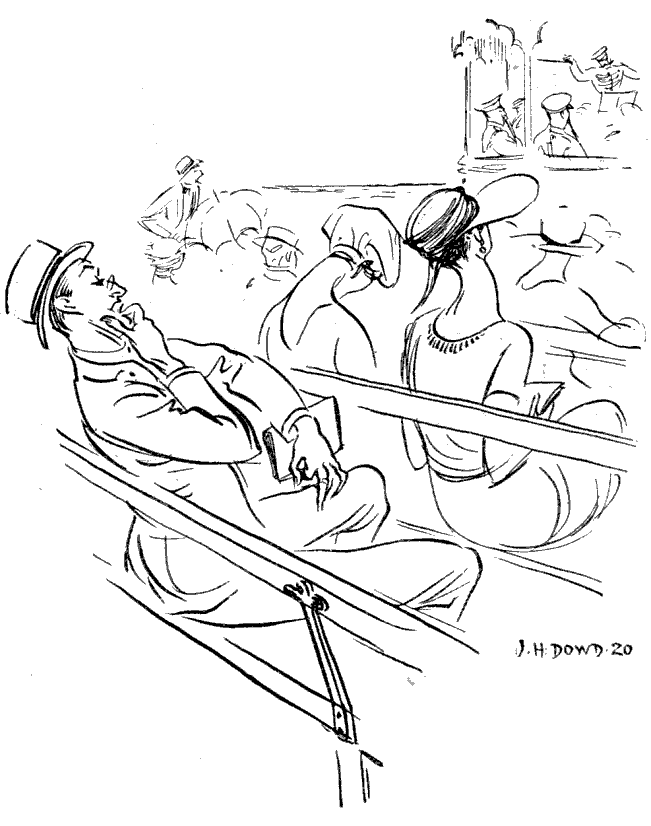
NATIONAL RESEARCH.
The Daily Quest, ever with its finger on the public pulse, sends a Special Commissioner to our holiday resorts to discover which has the nicest necks.
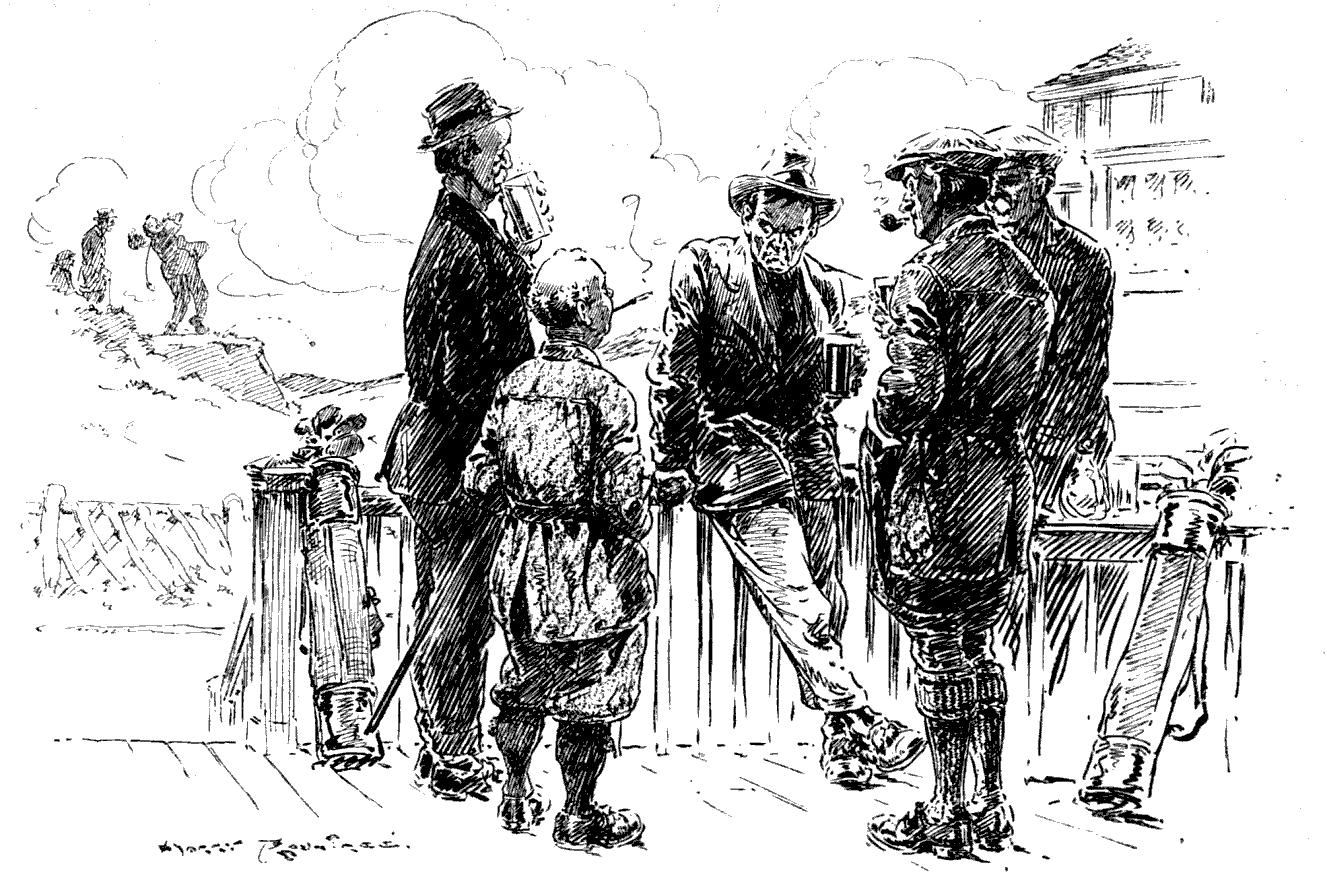
The Cheerful One. "Congratulations, old chap, on finding your game again."
Club Grouser. "Finding my game! Why, I've just offered to sell every damned club in my bag."
The Cheerful One. "Yes, I know. But yesterday you were giving them away."
PRONE.
To the Editor of "Punch."
Sir,—I am an architect (of forty-three years' standing) and I like to keep au courant with everything in the world of building (or of being about to build). Consequently anything new in constructional material interests me, and in this connection I would like to ask you what is or what are Prone? I have only seen it (or them) mentioned once, and from the context I gather that the word "prone" stands for the plural of "prone" (as "grouse" is the plural of "grouse," and as "house" might well stand for the plural of "house" nowadays, considering the shortage of dwellings), and that it (or they) is (or are) used either as a floor covering or otherwise in connection with working on the floor or ground.
My reason for so thinking is contained in the following interesting item, culled from a well-known daily newspaper:—
"There is in London one man at least who works hard every day and has to lay prone to do it.
He may be seen daily in the cloisters of Westminster Abbey re-cutting the names on the flagged gravestones which have been worn by countless pilgrims' feet. He has picked out many illustrious names, and others are to follow."
The sex and species of this hard-worker preclude the notion of any oviparous act, and I take it that one "lays prone" as one lays a mat or strip of carpet, for the purpose of facilitating labour that is done on the knees or stomach. If I am right I should like to get my builder to order some for his workmen absolutely at once.
Anything which would help to defeat the Trade Unions in their fight against speeding-up would be a blessing, especially to the architectural world, so perhaps you will be good enough to enlighten me on the nature of Prone, and where obtainable.
Believe me, Yours very gravely, Onesimus Stone (F.R.I.B.A.).
From an American book on "How and What to Read":—
"Other great American short story writers include Bret Harte, Edward Everett Hale, Frank Stockton, and Mary E. Wilkins. With these may be included Thomas Hardy's 'Life's Little Ironies,' which are full of fun."
Mr. Hardy will be glad, no doubt, to add this little irony to his collection.
THE KELPIE.
The scoffer rails at ancient tales Of lake and stream and river; The wise man owns that in his bones The kelpie makes him shiver. Big salmon-flies the scoffer buys, Long rods and wading stockings; Unpicturesque he walks in Esk With unbelief and mockings. "A river-horse! O-ho, of course!" And shouts with ribald laughter; He does not see in his cheap glee The kelpie trotting after. The storm comes chill from off the hill; An eerie wind doth holloa; And near and near by surges drear The water-horse doth follow. A snort, a snuff; enough, enough; Past prayer or human help he Comes never more to mortal door Who meets the water-kelpie.
"THE KING ARRIVES IN SCOTLAND
ASKED TO LEAVE."
Consecutive Headlines in "The Daily Mirror."
The habit of reading the headlines in our pictorial newspapers without glancing at the pictures beneath them is liable to create false impressions.
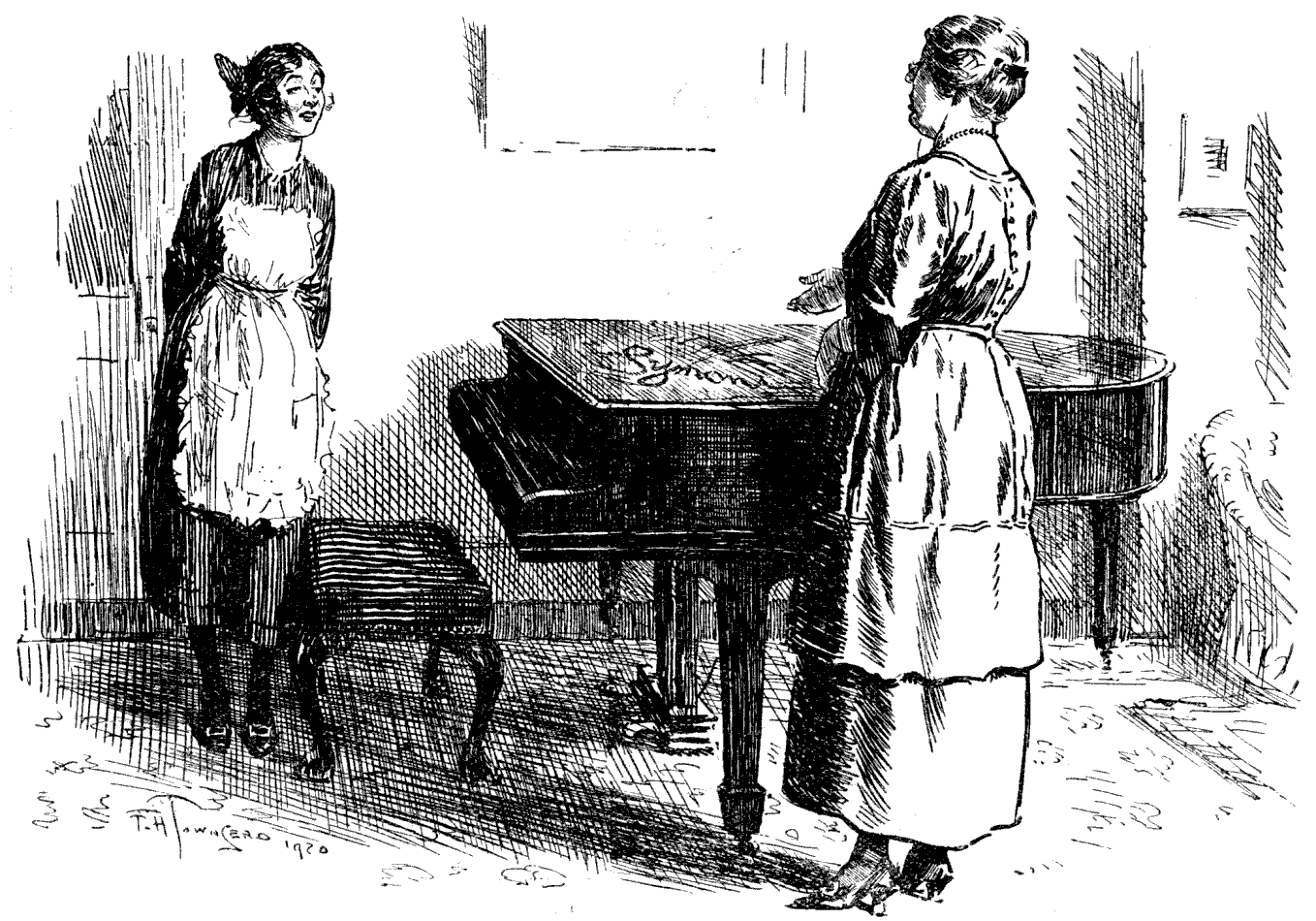
Mrs. Symons (wishing to draw attention, in the time-honoured manner, to the amount of dust on the drawing-room furniture). "Look at that, Martha; I can write my name on the piano."
Martha. "Fancy, now, you spelling it with a 'y.'"
TO A MAKER OF PILLS.
"The Pill Trade has fallen on evil days; no ex-service men seem to require pills."—A pill manufacturer summoned for rates at Willesden.
O Benefactor of the British Tommy, So often sick in far unfriendly climes, What tears of sympathy are flowing from me To learn that you have fallen on evil times! Yea, to my mind 'tis little short of tragic That men no longer buy your potent spheres of magic! Scarce less detested than the Bulgar bullet Your bitter pellets of Quin. Sulph. gr. 5 Have often stuck in my long-suffering gullet, Leaving me barely more than half alive, Whilst the accursed drug, whose taste I dread, Hummed like an aeroplane within my throbbing head. And what about Acetyl-Salicylic, And what of Calomels and Soda Sals? Existence had been even less idyllic Without those powerful and faithful pals! Why, midst the fevers of the Struma plain you Furnished the greater part of Tommy's daily menu. Or what of that infallible specific, Your Pil. Cathartic Comp., or No. 9, Whose world-wide influence must have been terrific Since first it found its footing in the Line? The British Tommy took it by the million— Why should it fail to sell now he has turned civilian? It is not base ingratitude that blinds him To recognition of an ancient debt, But rather that the sight of these reminds him Of painful days which he would fain forget. When life was one long round of guards and drills, Marches, patrols, fatigues and sick parades—and pills. Yet hear me, maker of the potent pilule: Although my days of soldiering are o'er, I'm fondly trusting that, when next I'm ill, you Come to my rescue as you came of yore; Meanwhile you'll understand that I, for one, Refuse to buy your wares and eat them just for fun.
A Dead Heat.
"In the high jump final, Landen (U.S.A.) was first with a jump of 6ft. 4½in.; Muller (U.S.A.) and E. Keleend (Sweeden) died for second place."—Provincial Paper.
"I heard Lord Rosebery say: 'Your little girl has got beautiful eyes.' I repeated this upstairs with joy and excitement to the family, who ... said they thought it was true enough if my eyes had not been so close together."—Extract from Autobiography of Margot Asquith.
Her "I's" are generally rather close together.
"The policy which should be adopted is first to take steps to prevent prices continuing to rise, and then to endeavour to reduce them until the purchasing power of the pound sterling is equal to the purchasing power of the dollar."—Financial Paper.
Judging by the New York exchange good progress has been made in this direction.
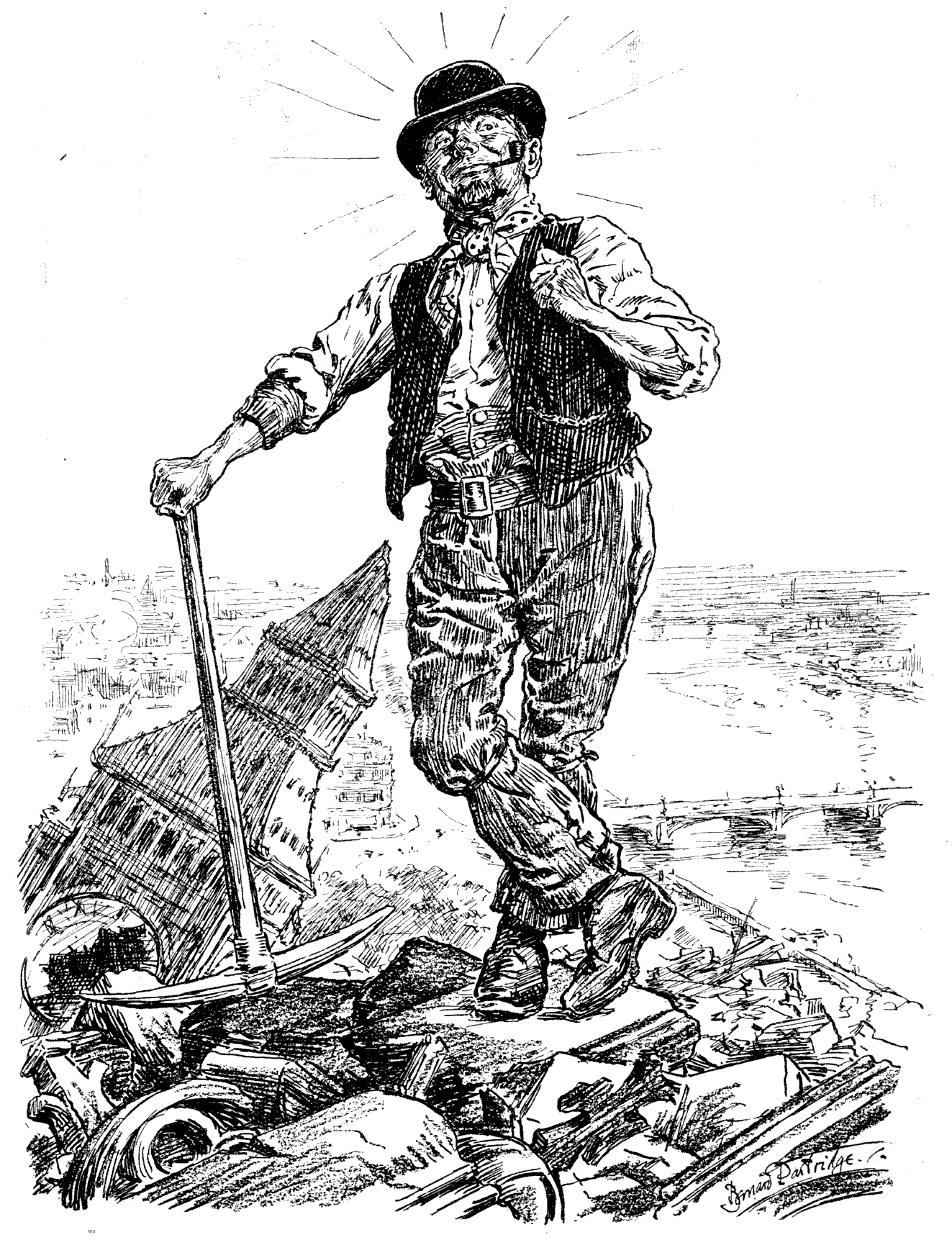
THE "HOUSE"-BREAKER.
OVERTHROW OF THE PARLIAMENT OF DEMOCRACY; A DREAM OF THE "COUNCIL OF ACTION."
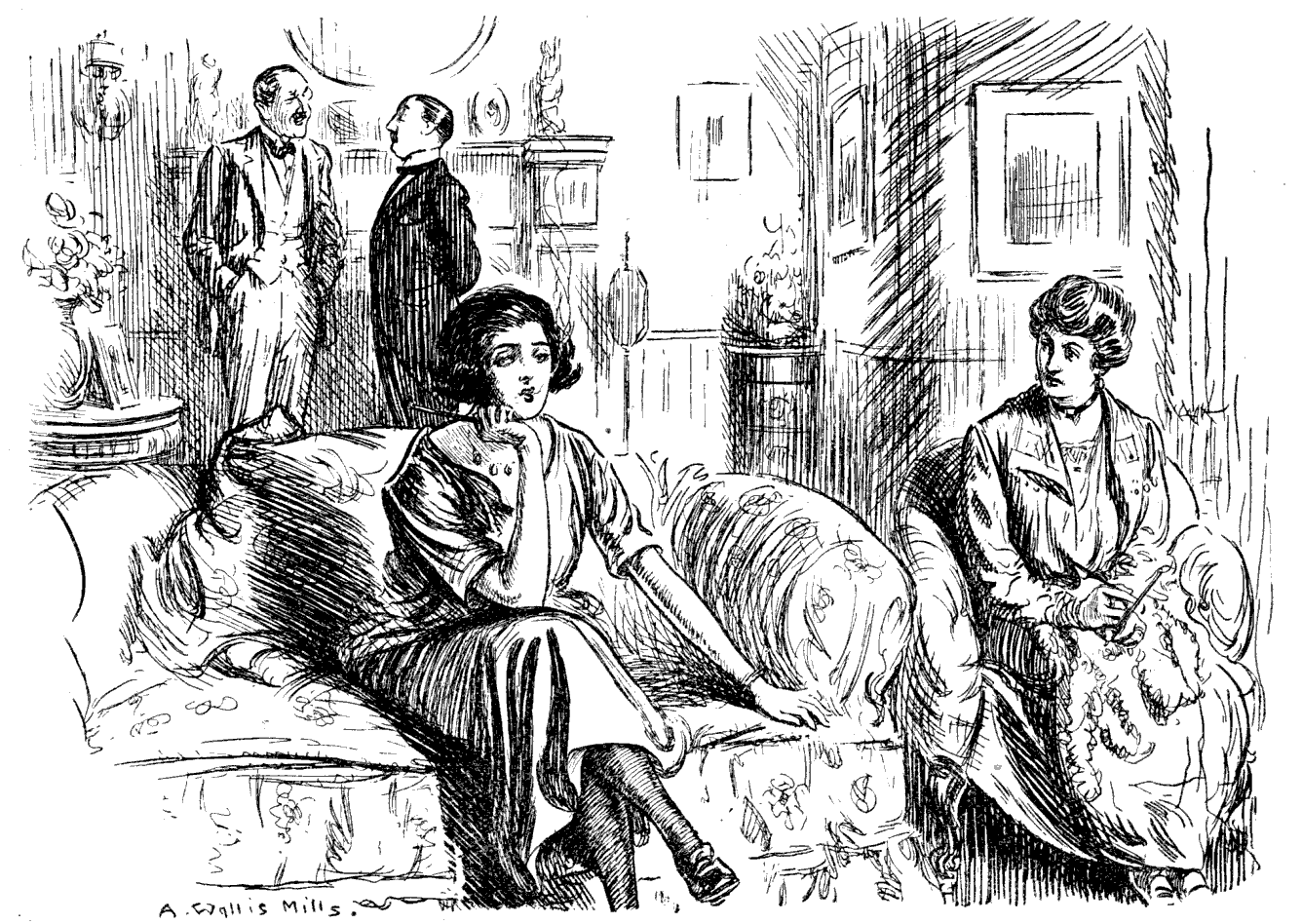
Mother. "Your cousin Jim has offered to take you to dinner and a theatre to-night. Aren't you pleased?"
Daughter. "Oh, it's all right, but he looks so rottenly respectable."