Volume 159 — THE RABBITS GAME.
Reading edition
"Don't forget to say 'Rabbits' to-morrow," said Angela. Angela is aged nine and my younger sister; I am thirteen and my name is Anne.
We both looked inquiringly at Father, and, as he didn't seem to remember, Angela in pained surprise began to explain. "If you say 'Rabbits' before you say anything else on the first day of a month you get a present during the month, but you mustn't say anything else first, or you won't."
It all came out in one breath and, though it looks clear enough now, Father was very stupid.
"I dislike rabbits," he said, "and I am very busy; your Mother will probably be glad of them for the servants."
The rebuke in Angela's eyes was severe. "We haven't got any rabbits," she said; "we are only going to say 'Rabbits' to-morrow morning when we wake up and we thought you might like to do the same."
"Oh, I should," said Father; "thank you very much, I won't forget." And he wrote "Rabbits" down on his blotting-paper. "Now go and tell your Mother; she would like to say 'Rabbits' too, I know."
That seemed to terminate the interview, so we left him; but altogether it was not very satisfactory. You see, when we had "Bon-jour-Philippines," Father used to provide the presents; at least that was some time ago; we haven't had any "Bon-jour-Philippines" lately. The last time we did, Jack, that is my brother at Oxford, found one and split it with Father, and the next morning he said, "Bon-jour-Philippine" first and then asked for a present. Father asked him what he wanted, and he gave Father a letter that he had had that morning. Father got very angry and said that it was a disgrace the way tailors allowed credit to young wasters nowadays. He didn't say it quite like that, it was rather worse, and Mother said, "Hush, dear; remember the children," and Father said that they were all as bad and in the conspiracy to ruin him, and he went out of the room and banged the door.
Mother told Jack that he should have chosen a better moment, and Jack owned he had made a mistake and said that he ought to have got it in before Father had looked at the paper and seen the latest news of Lloyd George. I don't quite know what he meant, but Father often talks about Lloyd George, and he must be a beast.
I asked Jack later if he got his present, and he said that he had, but—and here he copied Father's voice so well that I had to laugh—"It is the very last time, my boy; when I was at Oxford I used to consider my Father, and I would have worked in the fields and earned money sooner than have given him bills to pay." Jack said that he knew one of the dons at Oxford who knew Father, and from what he said he thought that Father must have spent as long in the fields as Nebuchadnezzar did.
I remembered all this as I went to find mother about "Rabbits," and I wasn't quite sure that we should get our present even if we did say it, so I told Angela, and she had a brilliant idea. "We will make Father say 'Rabbits' and give him a present ourselves, and he is sure to give us something in return." Angela is younger than I am, but she often thinks quite clever things like that, and they come in very useful sometimes.
We went to the summer-house in the garden to make plans. First we thought what would be the best present to give Father. Last Christmas we gave him a pipe, and he said that it was just what he wanted; it cost ninepence and was made like a man's head, and you put the tobacco in a hole in his hat.
Father lit it at once after breakfast, but two days after I saw Jakes the gardener smoking it. We thought at first that he had stolen it, and I went to Father, but he said that Jakes had thirteen children, and when a man was in trouble like that you ought to give up what you valued most to try to make that man happy, and that Jakes was awfully pleased when he gave him the pipe.
You see that made it very difficult, as we had to get something that Father would like and Jakes too, as he still had thirteen children; and then I remembered that Mrs. Jakes had once looked at a woollen jumper that I had on, and said that it would be just the thing for her Mary Ann, who had a delicate chest, and Jakes would be sure to like what Mrs. Jakes liked, or else he wouldn't have married her. Of course a jumper wasn't really the sort of thing that Father could wear, but I thought he might wrap his foot up in it when he next had gout, and besides I shouldn't be wanting it much more myself, as the summer was coming on.
Angela said that she thought that would do well, and she wouldn't mind giving Father her jumper next month if he said "Rabbits," and it would do for Mrs. Jakes' next little girl.
So that was decided, and then we had to arrange the plan. The most important thing was for us to wake before Father, so that we could wake him and remind him before he had time to say anything else, and Angela remembered that Ellen, that's the housemaid, had an alarm clock, which she used to set at a quarter to six each morning. We waited until Ellen had gone downstairs and then took it and hid it in Angela's bed.
Next morning the clock went off. We were both rather frightened, and it was very cold and the room looked funny, as the blinds hadn't been pulled up, but we put our dressing-gowns on. Then Angela said that she had heard that if you woke a person who was walking in their sleep they sometimes called out, so I took a pair of stockings from the basket that had just come back from the wash to hold over Father's mouth while we woke him. They were waiting to be mended and had a hole in them, but that didn't matter much, as I screwed them up tight, and then we went into Father's room. They were both asleep, and Father had his mouth open all ready for the stockings, which was very lucky, as I was wondering how I could get them in.
We crept up to the bed, and I know I shivered, and I think Angela did too, as I was holding her hand. Then she called out "Boo" as loud as she could, and I stuffed the stockings into Father's mouth, and then they both woke up, and everything went wrong.
Mother thought the house was on fire and screamed, and it made Angela begin to cry. I quite forgot to tell Father to say "Rabbits," and just pressed the stockings further into his mouth.
Father struggled and made awful noises, and when he did get the stockings out the things he said weren't a bit like "Rabbits," and the only thing that he did say that I could write down here was that he thought he was going to be sick. The rest was dreadful.
We were both sent back to bed, and that morning as a punishment we were not allowed into the dining-room until Father and Mother had finished their breakfast; and Angela, who often thinks quite clever things, said that we had better not do "Rabbits" again for a good long time. But after all it didn't matter much as the weather got a great deal colder, and I wore my jumper a lot, and so did Angela.
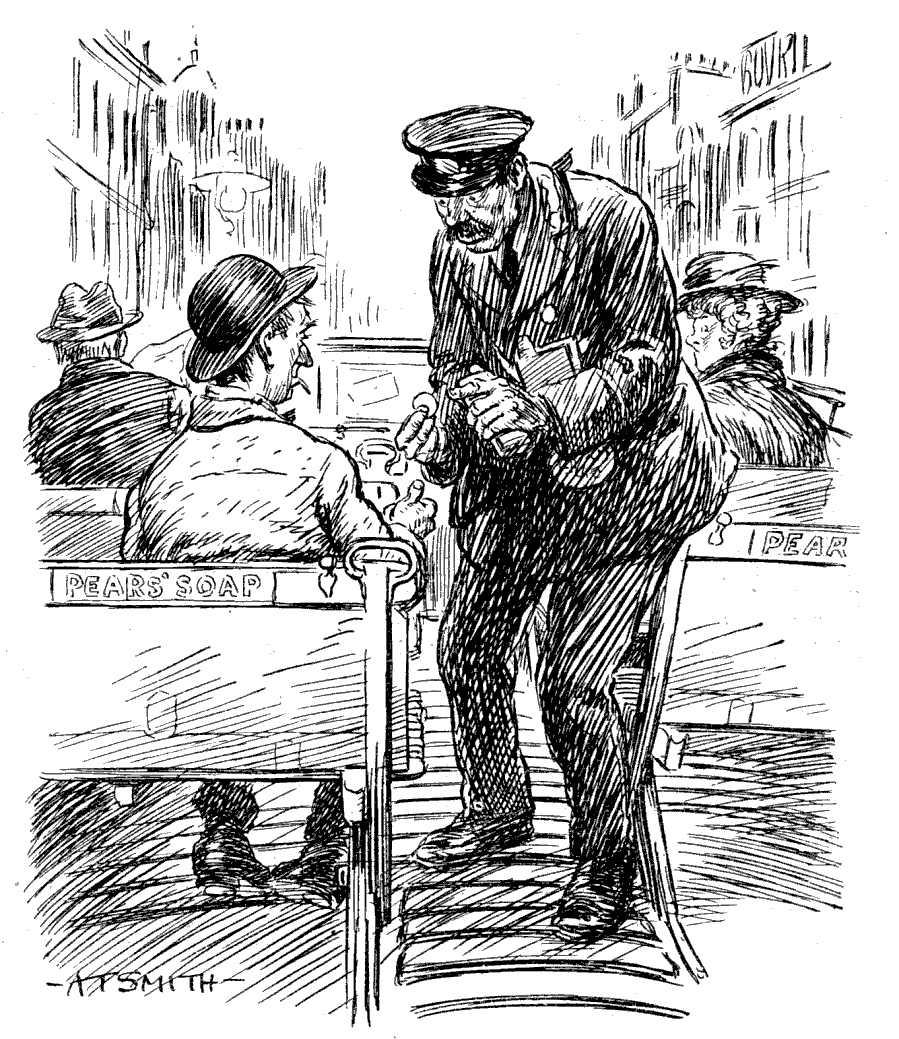
"Look 'ere—this arf-crown won't do. It ain't got no milling on its hedge."
"Blimy! Nor it 'as! I knew I'd forgotten somefink."
FLOWERS' NAMES.
Dame's Delight. There was a Lady walked a wood; She never smiled, nor never could. One day a sunbeam from the South Kissed full her petulant proud mouth; She laughed, and there, beneath the trees, Fluttering in the April breeze, Spread tracts of blossom, green and white, Curtseying to the golden light— The broken laugh of Dame's Delight.
FIRST LOVE AND LAST.
[It is pointed out by a contemporary that the dressmaker's waxen model has quite lost her old insipid air. The latest examples of the modeller's art show the "glad eye" and features with which "any man might fall in love."]
In the days when I started to toddle I loved with a frenzy sublime A dressmaker's beauteous model— I think I was three at the time; She was fair in the foolish old fashion, And they found me again and again With my nose in an access of passion Glued tight to the pane. But I thought they were gone past returning Till Time should go back on his tracks, Those days of a child's undiscerning But fervent devotion to wax; Could a heart, though admittedly restive, Recapture that innocent mood At sixty next birthday? I'm blest if I thought that it could. But Art, ever bent on progression, Has taken the model in hand, And brought in the line of succession A figure more pleasingly planned; Her eyes with the gladdest of glances, Her lips and her hair and her cheek Can puncture like so many lances A bosom of teak.
HARD TIMES FOR HEROINES.
"Oh, Bertram," breathed Eunice as she glided into his arms, "if Ernest knew, what would he think?"
At this point of my story I admit that I was held up. I myself couldn't help wondering how Ernest would regard the situation. He was a perfectly good husband and, personally, I preferred him to Bertram the lover. I might get unpopular with my readers, however, if they suspected this, so I continued:—
"Ernest can never appreciate you as I do, dearest," Bertram whispered hoarsely; "he is cold, hard, indifferent—"
Again I paused. If Eunice had been the really nice girl I meant her to be she would have asked Bertram what on earth he meant by saying such things about her husband, and would have told him the shortest cut to the front-door. In which case she might never have got into print.
The fact is the poor heroine of fiction has a hard time of it nowadays. Someone ought to write a treatise on "How to be Happy though a Heroine," or uphold her cause in some way. Twenty-five years ago she lived in a halo of romance. Her wooers were tender, respectful and adoring; she was never without a chaperon. Her love-story was conventional and ended in wedding bells. To-day—just see how her position has altered. Generally she begins by being married already. Then her lover comes along to place her in awkward predicaments and put her to no end of inconvenience, very often only to make her realise that she prefers her husband after all. Or, on the other hand, the modern writer does not mind killing off, on the barest pretext, a husband who is perfectly sound in wind and limb and had never suffered from anything in his life until the lover appeared. The poor girl will tell you herself that it isn't natural.
Then there is the compromising situation. Magazine editors clamour for it—in fiction, I mean. We find the heroine flung on a desert island, with the one man above all others in the world that she detests as her sole companion. It is rather rough on her, but often still more rough on other people, as it may necessitate drowning the entire crew and passengers of a large liner just in order to leave the couple alone for a while to get to know each other better. And not until they find that they care for one another after all does the rescue party arrive. It will cruise about, or be at anchor round the corner, for weeks and weeks, so that it can appear on the horizon at the moment of the first embrace. This situation is so popular at present that it is surprising that there are enough desert islands to go round.
Again, the lonely bungalow episode is pretty cheerless for the heroine. She accepts an apparently harmless invitation to spend a week-end with friends in the country. When she arrives at the station there is no one to meet her. After a course of desert islands this ought to arouse her suspicions, but she never seems to benefit by experience. At the bungalow, reached in a hired fly and a blinding snowstorm, she finds the whole household away. The four other week-end guests, her host and hostess and their five children, the invalid aunt who resides with the family, the three female servants and the boot-boy who lives in—all have completely vanished. The only sign of life for miles is the hero standing on the doorstep looking bewildered and troubled, as well he might, for he knows that he must spend the night in a snowstorm to avoid compromising the heroine.
And when the family return next morning and explain that they went out to look at the sunset, but were held up at a neighbour's by the weather, nobody seems to think the excuse a little thin.
The heroine can never hope for a tranquil existence like other people. I read of one only recently who, just because she strongly objected to the man her parents wanted her to marry, was flung with him on an iceberg that had only seating capacity for two. And when the iceberg began to melt—writers must at times manipulate the elements—it meant that she must either watch the man drown or share the same seat with him. The rescue party held off, of course, until the harassed girl was sitting on his knees, and then received the pair as they slid down, announcing their engagement.
What do I intend to do with Bertram and Eunice? I am undecided whether to place them in the vicinity of a volcano, which, unknown to Bertram, has eruptive tendencies, or to send them up in an aeroplane and break the propeller in mid-Atlantic just as the rescue party (including the husband)—What? Do I understand anything about aeroplanes? Certainly not; but I know everything about heroines.
EVIDENCE.
"What's all this I hear about the Abbey?" said my friend Truscott when I met him yesterday.
Truscott has just returned from New Zealand and is for the moment a little behind the times. But he can pick up the threads as quickly as most men.
"It's in a bad way," I told him. "All kinds of defects in the fabric, and there's a public fund to make it sound again. You ought to subscribe."
"It may be in disrepair," he replied, "but it isn't going to fall down just yet. I know; I went to see it this morning."
"But how do you know?" I asked. "You may guess; you can't know."
"I know," he said, "because I was told. A little bird told me, and there's no authority half so good. Do you remember a few years ago a terrific storm that blew down half the elms in Kensington Gardens?"
I remembered. I had reason; for the trunks and branches were all over the road and my omnibus from Church Street to Piccadilly Circus had to make wide detours.
"Well," Truscott continued, "someone wrote to the papers to say that two or three days before the storm all the rooks left the trees and did not return. They knew what was coming. Birds do know, you know, and that's why I feel no immediate anxiety about the Abbey."
"Explain," I said.
"Well," he continued, "when I was there this morning I watched a sparrow popping in and out of a nest built in a niche in the stonework over the north door."
MANNERS AND MODES.
THEN AND NOW.
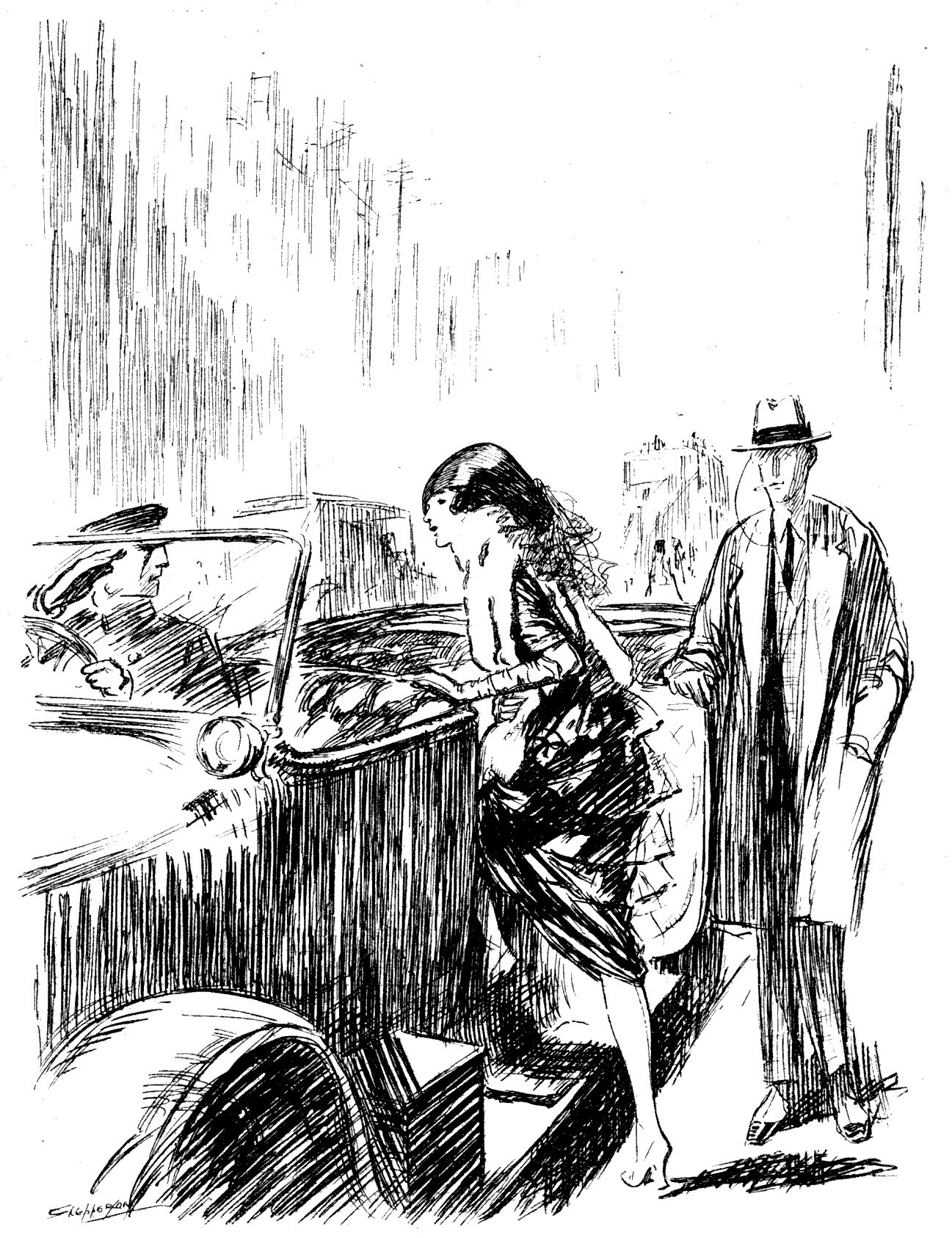
From an Early-Victorian "Etiquette for Gentlemen."— "A gentleman cannot be too careful to avoid stepping on a lady's dress when about to get in or out of a carriage."