Volume 158 — RATES OF EXCHANGE.
Reading edition
Jones was reading his morning paper in the opposite corner seat with unusual attention, and he disregarded my greeting.
"Why this absorption?" I inquired. "Usually you come to the station with a piece of toast behind one ear, fastening your boots as you run, and wake us all up with your first fine morning rapture."
"I was just taking a look at the exchanges," he replied. "The mark's about the same price as fly-paper, and, judging by the news from New York, your chewing-gum is going to cost you more shortly. Do you know anything about the money market?"
"I occasionally see it stated that 'money is plentiful' in it," I returned. "I should think it must be an ideal place."
"The most gorgeous thing in the world is to make a bit on exchange," he said. "There's such a splendid feeling of not having earned it, you know."
"I understand exactly," I replied. "Cox once credited me with an extra month's pay by mistake. But I didn't realise that you ever had to think about money matters after having run our Mess in France."
He appeared to take no offence. His capacity for being insulted in that direction had probably been exhausted during the period in point.
"I know quite a lot about exchange," he remarked with a reminiscent smile. "You remember that when I got pipped in France in '15, they sent me out next time to Salonica. I hadn't been there very long before the question of exchange cropped up. In the early days most of us had English money only, and the villagers used to rook us frightfully changing it. I remember sending my batman, MacGusgogh, to a place for eggs, and he came back with the change for my Bradbury in nickel. I had a good look at it, and on each coin was the mystic inscription, 'DIHAP,' which is pronounced 'dinar.'
"'MacGusgogh,' I said, 'you pretend to be a Scotsman and yet you've been diddled. This is Serbian money, and not worth a bean.'
"'Oh the deceitfu' deevils,' said he, 'there's neither truth nor honesty in the leein' buddies, Sir. But here's your Bradbury, an', at onny rate, we hae the eggs, Sir, for I paid for them wi' a label off yin o' they Japaneesy beer bottles. It seemed an awfu' waste to spend guid siller on folk that dinna ken when they see it.'"
I began to see the possibilities of the money market.
"I was round about there till the Armistice," Jones went on, "then I drifted by stages to South Russia. All the Eastern countries live by exchange. Practically the only trade they have is playing tennis with each others' currency, and the headquarters of the industry in 1918 was South Russia. I thought I'd seen the limit of low finance when I'd experienced the franc, lira, drachma, dinar, lev and piastre; but they were all child's play to the rouble in 1918."
"I thought Russian money was all dud before that," I remarked.
"Not a bit of it," said Jones. "You see, it's not as if there were one breed, so to speak, of rouble. There were Kerensky roubles, and Duma roubles, and Nicholas roubles, and every little town had a rouble-works which was turning out local notes as hard as they, could go. I missed a fortune there by inches."
"Tell me," I said, in response to his anecdotal eye.
"I had a job there which consisted of going backwards and forwards on the railway between Otwiski and Triadropoldir in the Caucasus, a six days' trip. The possibilities of the situation never struck me till one day I, asked a shopman in Triadropoldir to give me my change in Otwiski roubles—both towns had their own currency, of course. He gave me five Otwiski roubles for one of his own town. I thought a bit about that, and when I got back to Otwiski I tried the same thing, and found I could get three Triadropoldir roubles there for one Otwiski."
"I see," I remarked, as the beauty of this arrangement dawned upon me.
"All I had to do therefore was to change my money in Otwiski for three times as much Triadropoldir currency, and then go up the line to the other place and change it back again, making fifteen hundred per cent, on the round trip. Of course you couldn't always change the full amount, but in a couple of months I had sixty thousand roubles—my valise was crammed with them—and I was only waiting to get down to the Field Cashier to change out and make my fortune."
"And did you?" I asked.
"No, I didn't. One morning the Reds arrived in Triadropoldir, and my servant and I only just got away with the valise on one of those inspection cars which you propel by pulling a handle backwards and forwards. A section of Red Cavalry came after us, and we took it in turns to work the handle."
"Your servant won't ever be short of a job," I commented. "He ought to take to film-acting after that like a duck to water."
"We soon finished my servant's ammunition and they were closing in on us fast. My hair had appreciably lifted my tin hat when I had a brain-wave and threw out a double handful of rouble notes. It worked like a charm; they all stopped to collect the money, and we had gone quite a distance before they caught us up again, I threw out more notes at intervals, and the last thousand roubles went just as we came in sight of Denikin's outposts fifteen miles down the line. We were saved, but I had lost my fortune, for there was no chance of repeating the operation."
I sighed. Then, without any regard for the conclusions of my fellow-passengers, I silently raised both my hands above my head.
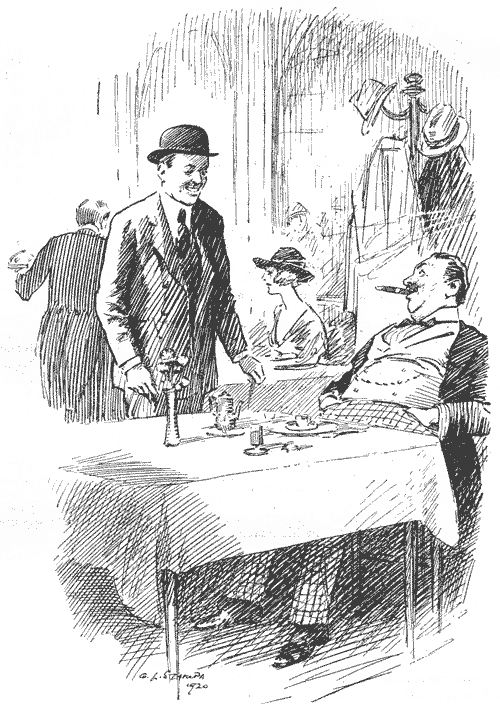
Ordinary Man (to well-fed friend). "Hullo! How are things with you? Making lots of money, I suppose?"
Yorkshireman. "No. We don't make money at Bradford—we just pick it oop."
"She had her hair cut short, and claimed to be a member of a tilted family."—Provincial Paper.
One with a bend sinister, we presume.
A leader of fashion at Ely Whose clothes were a bit down-at-heely Was quite overcome When he found he'd the sum That would buy him a Mallaby-Deeley.
"BLACK CATS' STRIKE THREAT."
Heading in a Sunday Paper of a report of a demand made by Viennese clerks for doubled salaries.
For "Cats'," read "Coats'." O the diff! as Wordsworth said.
"Retriever Wanted; steady good worker: retrieve feather or fur, land or water."—Provincial Paper.
The exile of Amerongen could do with one of this breed.
"The act of the donor suggests the lines:
"'How far doth that little candle throw its beams On like a good deed in a naughty world.'" Daily Graphic.
The author's name is not given, but we do not think he has improved much on Shakspeare.
THE YEOMAN TRANSFORMED.
[In accordance with the new Territorial organisation some famous Yeomanry Regiments are to become Motor Machine-Gun Units.]
Can a horseman turn from his heart's desire at the stroke of a statesman's pen? Can we learn to fight from a motor-car—we who were mounted men? In a petrol-tank and a sparking-plug shall we strive to put our trust, And hang our spurs as a souvenir to gather reproachful rust? Shall we never again ride knee to knee in the pomp of squadron line, With head-ropes white as a mountain drift and curb chains all a-shine? Will they dawn no more, those glorious days when the world seemed all our own, Who rode as scouts on an errant quest, alive, alert, alone? Can a man be made by a motor-car as a man is made by a horse, With strength in his back and legs and arms, and a brain of swift resource? We cared for our mounts before ourselves, their thirst before our thirst; Shall we come to learn, with the same content, to think of an engine first? Grousing enough. Though times have changed a man may be needed yet. Shall we stand aloof in an idle dream to nourish a vain regret? Whatever England may ask of us our service must be hers; And a horseman's quality 's in his heart and not in a pair of spurs.
W.K.H.
THE GREAT MUTTON CAMPAIGN.
The recent disclosures concerning the enormous stocks of frozen mutton held by the Ministry of Food—some of it killed two years ago—have put the Government on their mettle, and a vigorous campaign is now in preparation with the object of inducing the public to assist in the disposal of these overgrown supplies. Mr. Punch, being in touch with sources of information not accessible to the general Press, has been able to secure an advance copy of a popular appeal Which is about to be issued broadcast by the Government. It runs as follows:—
"Men, Women and Children of the United Kingdom!"
"The time has now arrived when each one of you is privileged to illumine these drab days of peace with a show of patriotism no less brilliant than that which lit up the dark years of war. The task that is demanded is a simple one, and no heavy price is exacted; all that is required is a single-minded concentration upon the one essential need of the moment.
"Your Government, solicitous as always for your welfare, has during the past two years accumulated a vast store of nutritious mutton to safeguard you against the peril of starvation. That danger being happily averted, it is now up to you to eat the stuff. This is not a problem that can be tackled by half-measures. If you desire to preserve the financial stability of the Empire, and if you do not wish to go on eating antiquated corpses of Australasian sheep for the rest of your lives, you must set your teeth in grim earnest, eating against time and chewing over time. You must consume mutton for breakfast, mutton for luncheon, mutton for tea and mutton for dinner. In fact, each one of you must in the interests of the State become a mutton glutton.
"Do you shrink from the task? Do you shirk the chop now that you know what is at stake? An army marches on its stomach; the nation's well-being hangs on yours. Henceforth, until the 'Cease Fire' sounds, you must fall upon the domestic enemy as our gallant soldiers fell upon the alien foe. No quarter must be given, no quarter, fore or hind, be permitted to escape. Beef must be banned and veal avoided as the plague; no Briton worthy of the name will claim a fowl.
"What are you going to do about it? Do you intend (to borrow a Trans-atlantic phrase) to give the frozen mitt to the frozen mutt? Or are you going to take it to your bosom and give it there, or thereabouts, the home for which it has so long been vainly seeking?
"Do it now and do it always. Let your daily motto be—'Revenons à nos moutons.'"
In addition to the foregoing, every British housewife is to be supplied with a valuable booklet containing a number of official recipes for dealing with mutton. Among the tasty dishes thus described may be mentioned Whitehall Hash, Ministerial Mince, Reconstruction Rissoles, Control Cutlets and Separation Stew.
Mr. Punch also learns that in honour of the campaign the Yeomen of the Guard are henceforth to be popularly known as the "Muttoneaters."
WHAT OF THE DUMPS?
["We repeat our question, therefore, and expect a 'Yes' or 'No' answer: Have all the dumps been sold, or have they not?"—Daily Mail.]
While wealth untold lies heaped in idleness We will not see the nation go to pot; We ask you (kindly answer "No" or "Yes"): Have all the dumps been sold, or have they not? By many a shell-torn desolate chateau Stand monumental piles of martial store Reared up long since to stem a savage foe By labours of the Army Service Corps; And day by day, in spite of our advice, They linger wastefully to rust and rot; We ask (and let your answer be concise): Have all the dumps been sold, or have they not? No more may Kellaway in bland retort Disguise the truth with verbal circumstance; Our special correspondents still report: "Entrenching tools obscure the face of France.". The case is plain; the issue is distinct; You either answer now or out you trot (And kindly make that answer quite succinct): Have all the dumps been sold, or have they not?
"WEDDING ROMANCE.
"The acquaintanceship soon developed into a house where Miss —— was living."—Daily Paper.
The chief obstacle to matrimony being thus removed, there could, of course, be only one end to the story.
"The Committee has decided to call the contest the 'Golden Apple Challenge,' having in mind the legend of Paris giving a golden apple to Helen of Troy as the fairest of the three beautiful women who came to ask his judgment."—Daily Mail.
Personally we never attach much importance to these Paris legends.
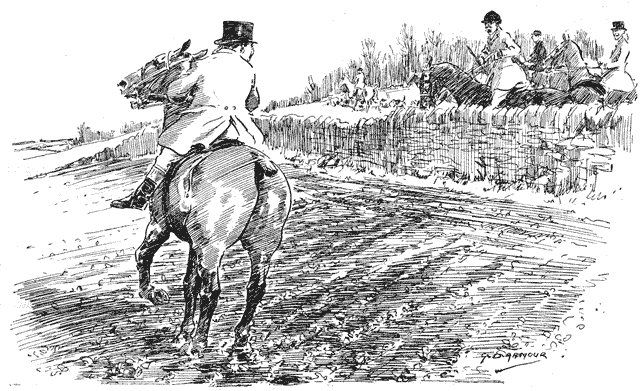
MORE ADVENTURES OF A POST-WAR SPORTSMAN.
Master. "Hi! you! 'Ware beans. Don't you know beans when you see 'em?"
P.-W.S. "They're the little things they puts in tins with pork, ain't they?"