Volume 158 — ESSENCE OF PARLIAMENT.
Reading edition
Monday, March 8th.—I should hesitate to call Sir Hamar Greenwood the Pooh-Bah of the Ministry, though he has something of that worthy's sublime self-confidence and his capacity for taking any number of posts. The House, which knows him both as Under-Secretary for Foreign Affairs and Secretary to the Overseas Trade Department of the Board of Trade, was surprised to hear him answering questions relating to the nascent oil-wells in the United Kingdom, and to learn that he had become "Minister for Petroleum Affairs." But there the likeness ceases to be exact. Pooh Bah's interest was in palm-oil.
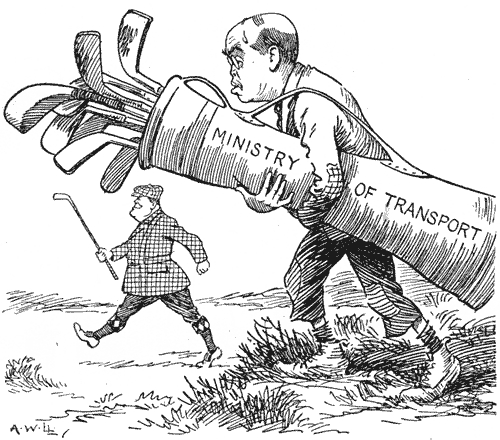
CARRYING ON.
Mr. Neal caddies for Sir Eric Geddes.
A few days ago the Chancellor of the Exchequer facetiously compared the critics of the Government to the poet of Rejected Addresses who declared that it was Buonaparte "who makes the quartern loaf and Luddites rise." Out of the Government's own mouth the critics are now, at any rate, partially justified, for the Prime Minister announced that the bread subsidy was to be halved, and that on and after April 12th the quartern loaf would rise—he did not quite know where.
In view of the occasional rumours of friction between Government departments it is pleasant to record that the Ministry of Transport and the War Office are on the friendliest terms. Invited to abolish, in the interests of the taxpayer, the cheap railway tickets now issued to soldiers, Mr. Neal said it was primarily a question for the War Office, as in this matter Sir Eric Geddes would wish to move in harmony with Mr. Churchill. As the War Secretary promptly announced his intention of doing his best to maintain the soldiers' privilege it is conjectured that he will return from the ride with Sir Eric inside.
The new Member for Paisley delivered his maiden speech to-night, and acquitted himself so well that in the opinion of Members many months his senior he is likely to go far. The Government had proposed to "guillotine" the remaining Supplementary Estimates in order to get them through before March 31st. Some ardent economists, mainly drawn from the Coalition, while ready to concede the end, protested against the means, and proposed that the House should make its own arrangements.
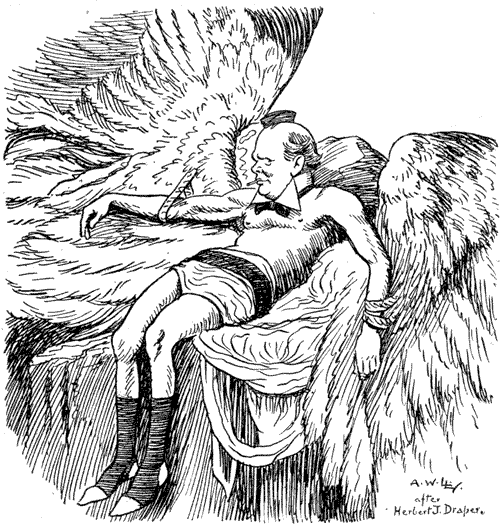
RARA AVIS IN TERRIS
.
"Never since the days of Icarus had there been an aviator quite like the right hon. gentleman [Mr. Winston Churchill]. He had displayed much sympathy with the Air Force and had almost been one of its martyrs."—Lord Hugh Cecil.
Mr. Bonar Law promptly perceived the advantage of transferring from the Government to the House a disagreeable responsibility. Forgetting that he was cast for the executioner, not the hero, he murmured, "It is a far, far better thing," and graciously accepted the proposed alternative. Mr. Asquith, not unwilling to help in establishing a precedent which some day he himself may find useful, backed him up, and the House, as a whole, congratulating itself on its escape from the public executioner, cheerfully proceeded to commit harakiri.
Tuesday, March 9th.—Mr. Shortt relieved our apprehensions by stating that the few spurious "Bradburys" in circulation are of home manufacture, and that, while a few specimens emanating from Russia had been sent here for identification, they were so poorly executed that they would scarcely pass muster in this country. It is comforting to think that there is one British industry which has nothing to fear from foreign dumping, but is cheerfully forging ahead.
The Home Secretary also denied that there had been any remarkable increase in pocket-picking or that schools existed for the training of young criminals. As Sir Maurice Dockrell pointed out, there is indeed no need for them so long as the cinemas provide their present facilities. Fagin has been quite knocked out by the film.
The Parliamentary vocabulary extends apace. Mr. Rendall, whose motion on divorce had been postponed under the new arrangements for business until after Easter, complained that Sir Frederick Banbury had "done him down."
Part of the evening was devoted to the bread-subsidy. The debate incidentally illustrated the intellectual independence of Ministers. A few days ago Mr. Lloyd George, in advocating the resumption of trade with Russia, declared that "the corn-bins of Russia were bulging with grain." To-night Mr. McCurdy told the House that, according to his information, the resumption of trade With Russia was not likely to open up any large store of wheat or grain in the near future. Possibly there is no real incongruity. The grain may be there, but the Russians, greedy creatures, may be going to eat it themselves.
Wednesday, March 10th.—Even in the gloomy atmosphere of the Upper Chamber the subject of divorce lends itself to humour. Lord Buckmaster, who introduced a Bill founded on the recommendations of the Royal Commission, performed his task with due solemnity, but some of the noble Lords who opposed it were positively skittish. Lord Braye, for example, thought that, if the Bill passed, Who's Who would require a supplement entitled Who's Who's Wife; and Lord Phillimore illustrated the effects of easy divorce by a story of a Swiss marriage in which the bride-elect was attended by four of the happy man's previous spouses. He also told another of an American judge who, having explained that in this department of his duties he was "very strict," added, "Of course I make no difficulty the first time, but if they come again within twelve months I want a good reason."
Mr. Hogge led a vigorous attack on the Ministry of Transport, which he seemed to think had done very little for its money except to divert the omnibuses at Westminster and so make it more difficult for Members of Parliament to get to the House. Mr. Kennedy Jones, who was responsible for the innovation, rather hinted that in the case of some Members this might not be altogether an objection. The brunt of the defence fell upon Mr. Neal, owing to the regretted absence of his chief, who had been ordered away by his doctor for a much-needed holiday and was reported to be recruiting himself on the golf-links. If exercise is what he needs he could have got plenty of it in the House to-night. Thanks to a persistent minority, Members were kept tramping through the Lobbies for the best part of five hours, and did not complete the full round of eighteen divisions until 2.15 A.M.
Thursday, March 11th.—Possibly the news of "direct action's" heavy cropper at the Trade Union Conference had reached the Front Bench before the Prime Minister, in reply to a question regarding the shortage of labour in the building trades, bluntly attributed it to the stringency of the Trade Union regulations. When Mr. Adamson attempted to shift the blame on to a Government Department Mr. Lloyd George retorted that he would be perfectly ready to deal with any peccant official if the Labour Leader for his part would deal with the Trade Unions.
General Seely repeated his familiar arguments in favour of an independent Air Ministry, and Mr. Churchill once more defended his position, urging that it was better for the Air Service to have half a Minister in the Cabinet than none at all. To a suggestion that the lives of the Armenians might have been saved if we had sent more aeroplanes to Asia Minor, Mr. Churchill replied that unfortunately the Armenian and Turkish populations were so intermingled that our bombs would be dropping indiscriminately, like the rain, "upon the just and unjust feller."
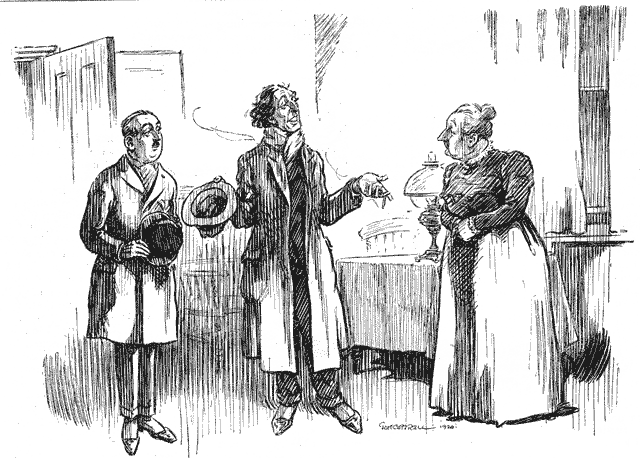
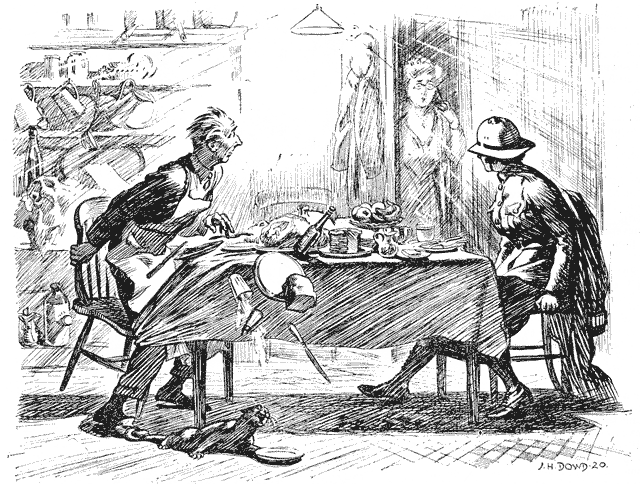
Actor (who has brought friend in for supper—to lodging-house keeper). "Tut, tut, Ma! Cease your apologies. What if there is but twopennyworth of fish and chips? Bring it forth. This is Bohemia!"
Ma (politely bowing to stranger). "How d'ye do, Sir?"
BUBBLE AND SQUEAK.
(By a Grateful Student of the New English Dictionary.) I can conjugate the modern verb "to wangle," And, if required, translate it into Greek; I can even tell a wurzel from a mangel; But I cannot tell a bubble from a squeak. I still can march eight furlongs at the double, Although I shall be seventy next week; I can separate a bubble from a bubble; But I cannot tell a bubble from a squeak. I know a catfish differs from a seamew; I don't expect Bellaggio at Belleek; I know a cassowary from an emu; But I cannot tell a bubble from a squeak. I'm acquainted with the works of Henry Purzell (My mastery of spelling is unique); I repeat, I know a mangel from a wurzel; But I cannot tell a bubble from a squeak. I'm proficient both in jotting and in tittling; I know a certain cure for boots that creak; I can see through Mr. Keynes and Mr. Britling; But I cannot tell a bubble from a squeak. I can always tell a hari from a kari ("Harakiri" is a silly pedant's freak); I can tell the style of Caine from that of Marie; But I cannot tell a bubble from a squeak. I never take a Deeley for a Dooley; I never take a putter for a cleek; I never talk of Healy, meaning Hooley; But I cannot tell a bubble from a squeak. I understand the sense of "oils are spotty"; I know the height of Siniolchum's peak; I know that some may think my ditty dotty; But I cannot tell a bubble from a squeak. P.S. I know the market price of eggs in Surrey, The acreage of maize in Mozambique— And now at last, thanks to immortal "Murray," I've learned to tell a bubble from a squeak.
" Oh, George we must have stepped off with the wrong foot!"
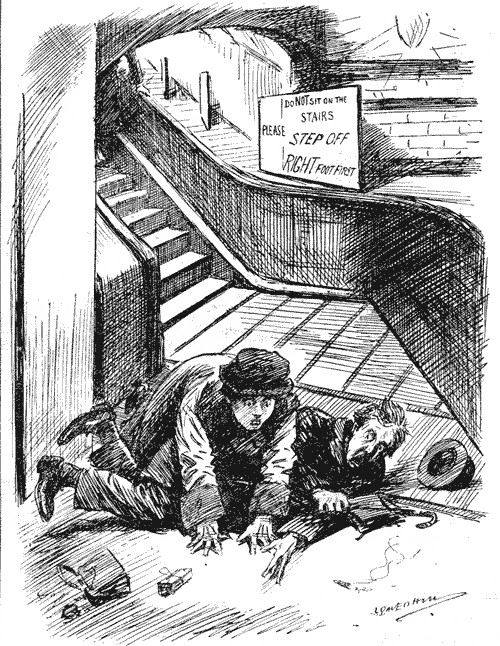
THE CONSERVATISM OF THE LIBERAL PARTY.
Dear Mr. Punch,—I know you take no sides in party politics, but I still think you would like to hear why it is that I have gone over to the Independent Liberals. No, it has nothing to do with Mr. Asquith's triumphal procession and still less with the Northcliffe Press. The fact is that till quite recently I belonged to the true blue Tory school—was indeed probably the last survivor of the Old Guard—and I found myself out of touch with the progressive tendencies of modern Toryism, its deplorable way of moving with the times, its hopeless habit of discarding what it would call the old shibboleths when it wrongly imagined them to be outworn. My decision to leave a party that has long ceased to deserve its honoured name was immediately due to a Liberal Paper which editorially ridiculed the Liberty League, formed for the defeat of Bolshevist propaganda, and pooh-poohed the idea of the existence of dangerous Bolshevist elements in the country. This attitude attracted me enormously; for I recalled the standpoint of the same paper in the days before the War—how it ridiculed the alleged German menace and pooh-poohed the idea of the existence of hostile German elements in our midst. Here, I said, is the party for me; here is your authentic Bourbon spirit—the type that learns nothing and forgets nothing; that in the midst of a changing world remains immovable as a rock. Yes, Sir, for a Tory of the old school there is no place to-day except in the ranks of Liberalism.
Yours faithfully, Semper Eadem.
MODERN DRAMA BELOW STAIRS.
THE "MAID'S" HOSPITALITY TO "ROBERT."