Volume 156 — THE ROAD TO THE RHINE.
Reading edition
A LITTLE LOOT.
It was at the time when men still imagined that to be a pivotal man in some way enhanced their chances of being demobilised that an abnormal wave of acquisitiveness passed over us. Before it passed, I regret to say, it hovered, chiefly on account of the prospect of a speedy return home and the desire to take back some kind of trophy to satisfy the still small voice of inquiry concerning papa and the Great War.
The very first day after we had arrived in the most unimportant village imaginable (our usual luck), Roley, the fattest subaltern on record, lurched into the room and told us of the discovery of a wonderful trainload of abandoned Bosch material, Being a Regular soldier, acquisitiveness runs through his whole being, of course, and he gave us a most glowing account of the wonders to be found. "Full of things," he cried, "coal, Bosch beds, field-guns and souvenirs—hundreds of 'em."
I know no rabbit that could have pricked up his ears quicker than did the pivotal men at the sound of that magic word. "Hail, Roley!" we cried; "we who are about to be demobilised salute you!"
That evening a select conclave of super-scroungers met with great solemnity. Beds for the men and coal for all—certainly, and then we would start collecting. By the morrow each man slept in luxury, while subalterns from other companies came in to warm themselves by our roaring fires. Not till then did we feel justified in turning our thoughts to the furnishing of the baronial hall at home.
Some day, we pivotal men are still ready to believe, when demobilisation is nearly complete we shall return to our bowler hats and civic respectability, but meantime, let me tell you, respectable elderly subalterns enjoy things like clambering over a forbidden Bosch train in search of loot. When we had climbed to the end of the trucks and were thoroughly dirty, we found we had done very badly. The souvenirs were there all right, but no matter how interesting and desirable it may be, you simply cannot pack up a field-gun and send it home—the tail part does stick out so.
Chardenal and I had picked up the best thing we could find, brass cartridge cases (about three feet high) of a 5·9 gun, and some shorter eight-inch affairs. It was hard work. I carried four of the former and Chardenal carried two of each, and we looked as if we had come to mend a main drain. Not having been in the Army long enough to have lost all sense of shame, Chardenal began by trying to hide his cases under his British warm. His biggest effort at concealment was made when passing the sentry of the Brigade Headquarters' guard, and the noise he made doing it brought the whole guard out. However, being sentries, they took very little notice of what we did, except that the N.C.O. in charge certainly did pick up one of the dropped cases and hand it to Chardenal. This was after I had tried to help him and we had dropped the whole lot.
After this Chardenal gave up all idea of concealment and tried to express by his carriage that he accepted no responsibility whatever for the souvenirs. He didn't want the things, not he! They were there, certainly, and—well, yes, he was carrying them, but why he was carrying them (here he would have shrugged his shoulders if he could) he really couldn't tell you; it was a matter of absolute indifference to him, anyway. Histrionically I have no doubt it was a great piece of work, but the only possible inference anybody could have drawn was that he might have been carrying them to oblige me—which I resented.
Heavens, how our arms ached, for it was over two miles to the billet! A collision of milk-trains could hardly have made more noise than we did as we clashed and clanged down the main street. Of course we met everybody we knew. People we hadn't seen for years, people we didn't like, people who didn't like us—all seemed to have been paraded especially for the occasion.
We got home in the end, and it was a great triumph. The only unenthusiastic person was Mr. Brown, my batman, who surveyed the things in silence, betokening that he knew quite well he would be called upon to sew them up in sacking and label them "Officer's Spare Kit, c/o Cox and Co." Then he looked sadly at my soiled tunic and my British warm and asked if I had carried them far.
"Over two miles," I replied proudly. "Pity," he said; "there's a whole dump of them at the bottom of the garden here."
There the matter might have ended if the fat Roley had not lurched up again the next day with a steel box containing a dial-sight off a field-gun. The dial-sight was a complicated affair of prisms and lenses which probably cost the Bosch about sixty pounds, and we felt a little sick at having overlooked such a find.
"Awful job I had too," he went on. "Some fellows were seen yesterday taking stuff away and they've put a sentry on the train."
"Serve them right," we said.
Next day we returned to the trucks to try again. The sentry was engaged in a little conversation, and whilst Chardenal took his photograph (ostensibly for The Daily Snap as "Sentry Guarding a Train") I slipped behind the trucks, opened a couple of lids in the tails of some field-guns, picked out two cases of sights and hurried off. Chardenal joined me later and, concealing our swag under our British warms, we walked as quickly as we could until the Brigadier stopped and had a little chat with us about things in general. And there we had to stand for a quarter of an hour on a freezing afternoon with two fingers holding the box and the other fingers holding the coat down to effect better concealment. Chardenal was in so much pain and wore such an expression of agonized innocence that the Brigadier wanted him to come into headquarters until he felt better.
"Well, what have you got?" asked Carfax, another candidate for demobilisation, when we finally got back and showed him the cases.
"Only two?" he cried, "and you promised me one!" We said things.
"What lenses are they?" he asked.
"I don't know," said Chardenal, "but, whatever's the heaviest kind, that's the kind we've brought."
And we opened the boxes and they were empty.
The baronial hall will remain unfurnished. I'm fed up with the whole business.
L.
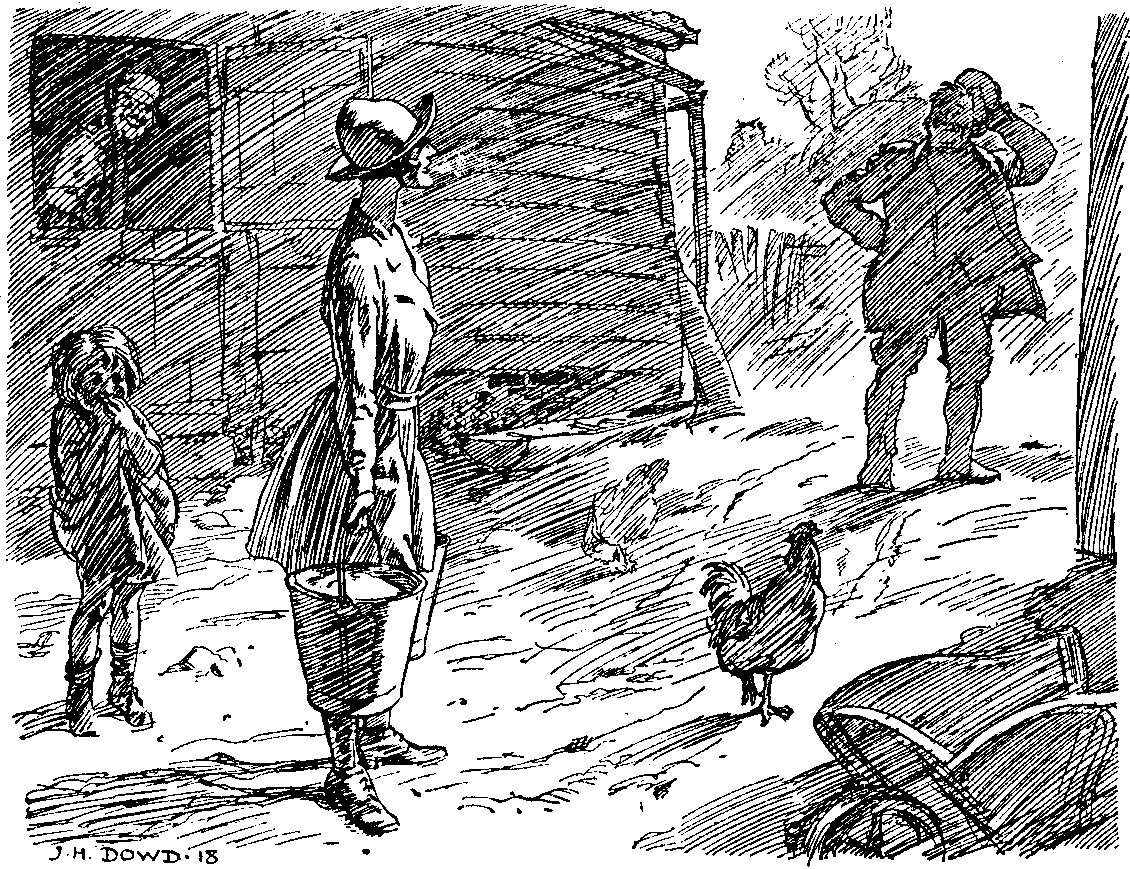
Farmer (to land-girl, who has been sent to feed the pigs). "WHY HAVE YOU BROUGHT THE SWILL BACK?"
Land Girl. "WELL, THEY WERE ASLEEP AND LOOKED SO COMFY—I SIMPLY HADN'T THE HEART TO DISTURB THEM."
The Language Test for V.A.D.'s.
From an Official Form of Application for stripes:—
"I certify that these Members have diligently attended their duties at the Hospital, are always neat in appearance, punctual in their habits and proficient in their cursing. I recommend they be allowed to enter for the Blue Stripe Examination."
From the announcement of a musical service:—
"Soprano Solo, 'With Verger clad'. (Creation), Miss Dorothy ——,"—Canadian Paper.
Quite a new "creation."
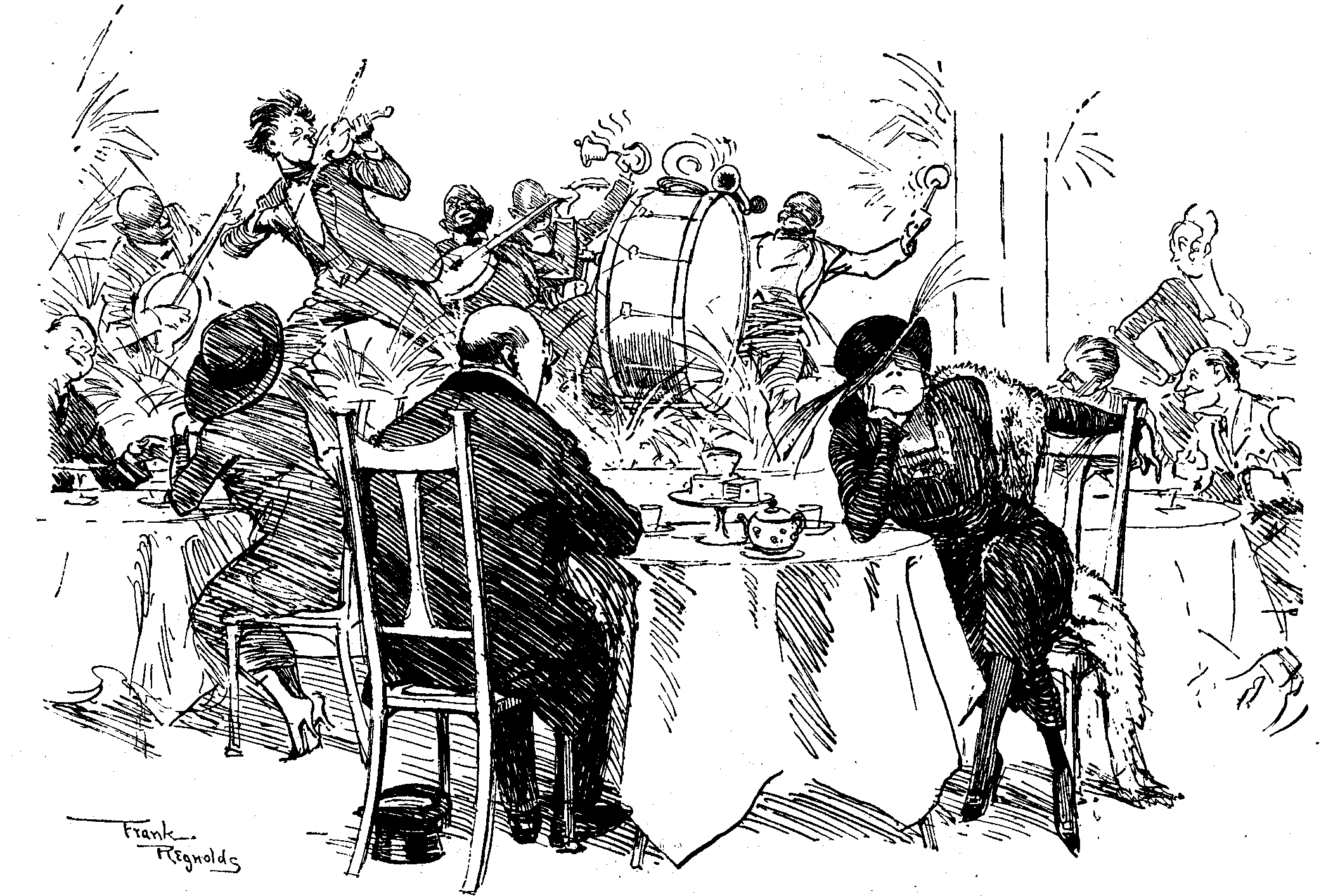
CASTING PEARLS.
Philistine (who has been dragged by wife to Jazz tea-shop). "WHAT IS IT THEY'BE TRYING TO PLAY, DEAR?"
Modern Wife. "OH, YOU WOULDN'T BE ANY THE WISER.—NOTHING OUT OF 'THE BOHEMIAN GIRL.'"
THE HOUSE HISTRIONIC.
The enterprise of Mr. C.B. COCHRAN, who announces that the oak-parlour used in his play at the St. Martin's Theatre will be sold by auction at the conclusion of the run, has not unnaturally provoked a certain liveliness in architectural circles. Should advertisements of houses for sale ever reappear in the newspapers, it is thought likely that they may include something like this:—
Desirable Family Mansion of unique interest, suit dramatist seeking congenial associations. Exceptionally fine dining-hall, as used in the supper scene in Macbeth, and equipped with convenient Banquo sliding-panel to kitchen. The latter apartment deserves the epithet Baronial, being transported direct from the successful pantomime, Puss-in-Boots, and capable of accommodating a ballet of two hundred cooks. The elegantly proportioned drawing-room (to which a fourth wall has been since added) was the subject of special mention in several leading newspapers after the production of Epigrams at the Niobe Theatre; while each of the twelve bedrooms represents some recent triumph in the Problematical Drama. An attractive feature is the fitting of an artificial sunlight attachment to the outside of each window; while every room is provided with one or more telephones.
Snug Bachelor Flat, direct from the phenomenally successful farce, Peers and Pyjamas, at the Plenipotentiaries Theatre. The fine central living-room contains sixteen doors, opening into bedrooms, kitchen, coal-cellar, etc. May be as conveniently entered by the window as by the doors. All the latter work upon the well-known dramatic hinge, by which as soon as one shuts another opens. Unlimited facilities for hide-and-seek. Exceptional opportunity for active tenant.
From The Mistress of Court Regina, by Mr. CHARLES GARVICE:—
"He kissed her, taking his cigarette out of his mouth to do so."
This courteous consideration is invariably shown in the best circles.
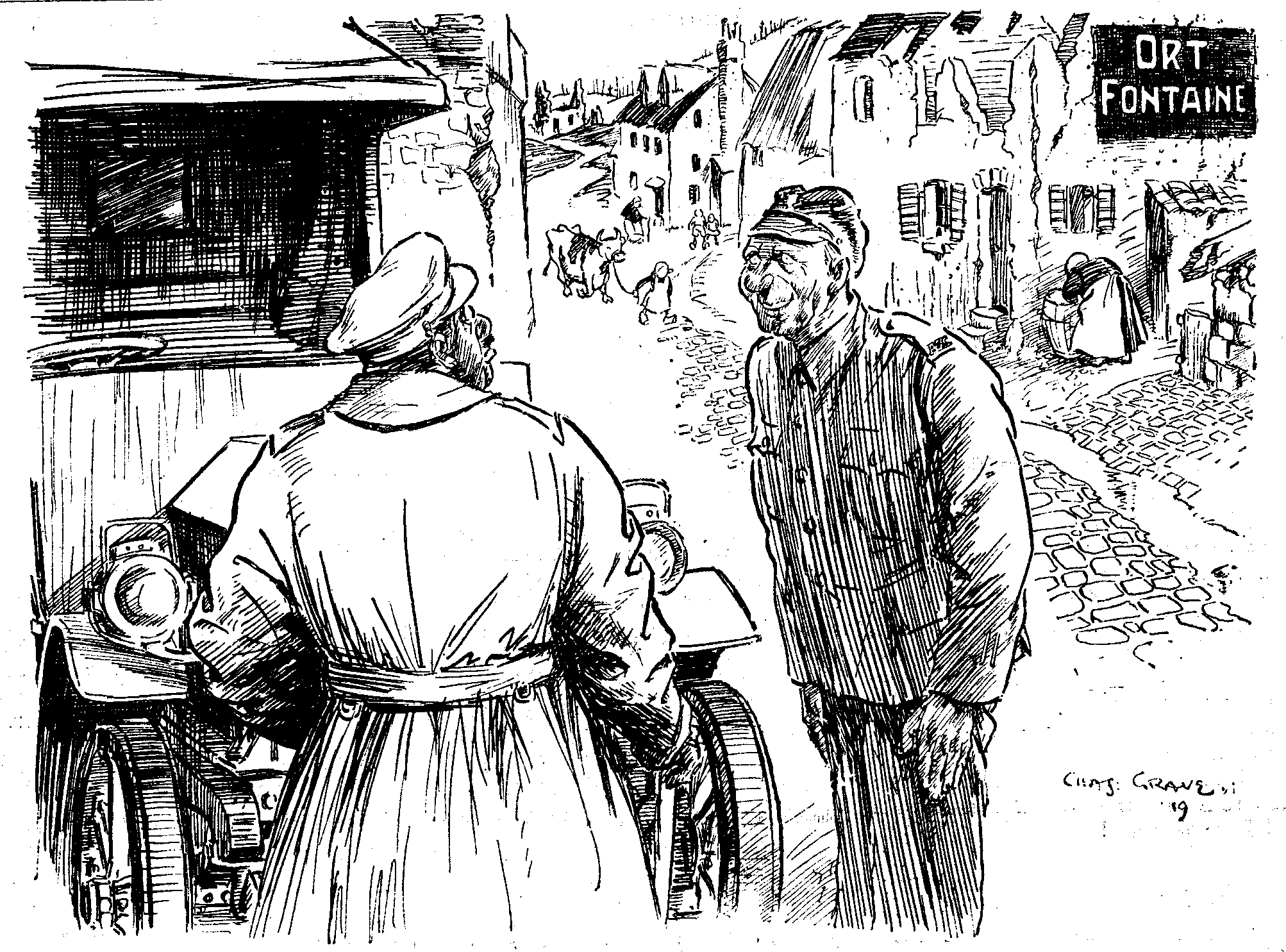
Geordie. "WELL, AH'M BLOWED! THEY'M NAMED YON PLAACE AFTER T'OWD DOOG-OUT ON T' SOMME!"
THE SUBALTERNS' PARADISE.
I met Bilsden and congratulated him on being in "civvies."
"What are you going to do now?" I asked. "Back to the old firm?"
"No," said Bilsden gravely; "when a man has acquired the power of leading men he's thrown away in an accountant's office, especially as the junior member of the staff. I see no prospect in England. I have offered to take charge of large departments of English firms, and be responsible for entire supervision, but they fail to recognise what the capacity for leadership gained in the army will do. I'm off to Ceylon—tea-planting. Just to control big gangs of coolies and see that they work. It will be child's play for me. Lovely climate; elephants. An absolutely ideal job."
It seemed to me on that foggy frosty day, that to lie in a hammock in the shade, with the temperature about ninety, watching coolies work, would be the perfect form of labour.
I congratulated Bilsden on having found his métier.
Half-an-hour later I met Parkinson, another second-loot who had just shed his pip.
"Well, what are you going to do now?" I asked.
"I'm a bit dubious," he said.
"Try tea-planting in Ceylon," I suggested. "Elephants, spicy breezes, swing in a hammock all day watching coolies. My dear boy, were I twenty years younger I should be inquiring about a berth on the next steamer."
"Ah," said Parkinson, "of course Ceylon's all right, and I've a lot of pals going out there; but what about rubber-planting in the Malay Peninsula? They've got tigers there. That's rather a pull."
I admitted the attraction of tigers to certain tastes, but not to mine. In my case the pull, I thought, might be on the tiger's side.
Since these interviews I have been going the rounds of my military acquaintances and I find a general feeling in favour of Ceylon or the Malay Peninsula.
Of course it's an excellent thing that they should take up the white man's burden and make the coolies work, only I'm in dread lest the overcrowding we suffer from in England may be extended to the Orient. Will there be enough plantations, coolies and big game to go round amongst our subalterns?
I can see the Government introducing several Bills—
(1) For the extension of the Isle of Ceylon;
(2) For the lengthening of the Malay Peninsula;
(3) For the importation of five million coolies, estimated at the rate of five hundred coolies each, to give employment to ten thousand second-loots;
(4) For the importation of elephants, tigers, lions, buffalo, hippopotami, giraffes and capercailzie*.
AT PRINTING-HOUSE SQUARE.
[Mr. GEOFFREY DAWSON has resigned the Editorship of The Times, owing to a disagreement with Lord NORTHCLIFFE over matters of policy, and has been succeeded by Mr. H. WICKHAM STEED, formerly foreign editor.]
"Once more upon the waters! Yet once more! And the waves bound beneath me as a Steed That knows his master."
Byron, "Childe Harold's Pilgrimage."
Inspecting Officer. "WHICH IS THE MOST IMPORTANT NUT ON THIS LORRY?" Driver (ex-infantry). "I AM, SIR."
A CAREER.
(The Right Man in the Right Place.)
You should see our son James! You should just see our James! As bright as a button, as sharp as a knife! My wife says to me and I say to my wife, "You'll never have seen such a son in your life As our jammy son, James." He is now three years old; He's a good three years old; When the fellow was two you could see by his brow (At the age of a year, you could guess by the row) That this was a coming celebrity. Now He's a stout three-year-old. Question: What shall he be? Tell us, what shall he be? Shall he follow his father and go to the Bar, Where, passing his father, he's bound to go far? "But one knows," says his mother,"what barristers are. Something else he must be!" Do you fancy a Haig? Shall our James be a Haig? The War Office tell me he's late for this war, Have the honour to add there won't be any more Since that's what the League of the Nations is for; So it's off about Haig. But his mother sees light (Mothers always see light). "This League of the Nations we mentioned above, With the motto, 'Be Quiet,' the trade-mark, a Dove, Will be wanting a President, won't it, my love?" Jimmy's mother sees light. Yes, that could be arranged; Nay, it must be arranged. In the matter of years Master Jimmy would meet Presidential requirements. What age can compete, In avoiding the gawdy, achieving the neat, With forty to fifty? Thus, forty-five be't. Given forty-two years, he'll be finding his feet And the Treaty of Peace should be getting complete.... And so that's all arranged.
HENRY.
"I am sorry to have to say that this statement is a ———, and if any of my readers have any doubt as to whether I used that strong term without just reason, I invite them to communicate with the Ministry of Shipping on the subject."—Letter in "The Observer."
We respect our contemporary's discretion, but we should like to know what was the "strong term".
"The Literary Class has grown beyond all expectations, the numbers attending the last few meetings averaging nearly 100. Papers have been read and discussed on Dickens' Works, Tess, Tale of Two Cities."
The Highway.
Flushed with success, the Literary Class is expected next to tackle HARDY; Jude the Obscure and The Mystery of Edwin Drood being the first objectives.
NOUVELLES DE PARIS.
Paris, March 3rd, 1919.
DEAREST POPPY,—You know, don't you, that I write for the Press? You must write, ma chère, if you want to be dans le mouvement nowadays. It's getting to be almost as big a craze as jazzing and is quite as exciting. It has its difficulties, of course, but so has the jazz roll. And if you've got a title or have been mixed up in a cause célèbre you can write on anything sans aucune connaissance spéciale. Camilla Blythely says she just sends in her photo and signature and those obliging newspaper people do the rest—which is most helpful to a busy person. But then we can't all be as notorious as dear Camilla.
I hope it isn't getting just a little overdone. But I hear that lots of papers are offering only three guineas a column now for quite important signatures, while others actually insist on contributors writing their own articles.
Quant à moi, I'm writing up the light side of the Peace Conference. I do those snappy pars about LLOYD GEORGE'S ties and CLEMENCEAU'S gloves and all those little domestic touches that people would much rather read about than such remote things as Czecho-Slovaks and Jugo-Slavs. I did a most thrilling three columns about the hats of the delegates, from the bowler of Mr. BONAR LAW to the "coffieh" and "igal" headdress of EMIR FAISUL, the Arab Prince. (It's always so effective if you can stick in a word or two like that that nobody understands. You never need get them right).
Talking of odd words, the latest boutade over here is to find new names and epithets for our dress materials—some of them quite weird. If you want a silk tricot you ask for "djersador," while a coarser texture is "djersacier"; "mousseux" now describes velvet as well as champagne; ninon is known as "vapoureuse"; while to make one of the newest Spring dresses you require only three-and-a-half yards of "Salomé." Some of the couturiers in the Rue de la Paix are issuing fashion-pronouncing handbooks, while others have their own interpreters to assist customers.
The theatres over here are getting extremely—well, what our grandparents termed "risqués," but it really goes further than that. And the worst of it is my countrypeople seem to think it's the smart thing to go to them, which they do most indiscriminately. Heureusement they don't understand the stuff. Whenever I see a most circumspect and highly proper British matron entering one of the Boulevard theatres nowadays I think what a mercy it is that we as a nation rely so much on pronouncing phrase-books for acquiring foreign languages. It keeps one so single-minded in the midst of a wicked world.
But, after all, propriety is a question de localité. Else why do people do things here which would badly shock us at home? Par exemple, dancing between the courses of a meal is our latest caprice here; but I was un peu étonnée, the other evening, to see the Duchess of Mintford, at a restaurant of the most chic, jazzing off the effects of the turbot with light-hearted abandon.
Unfortunately a waiter carrying a tray darted across the track at the very moment when she was involved in that step so embrouillant, the side-roll.
It took quite a long time to collect, and put in their proper order, the waiter, the contents of the tray, her Grace and all the other jazzers who were coming up behind.
But, après tout, little comment was roused because most of the onlookers thought the incident was just part of the dance.
So long, old thing.
Bien à vous,
ANNE.
THE TRUMP SUIT.
Those who wield Britannia's power Have decreed a blissful hour, When the mellow bugle-note Sounds in every ship afloat, And you see the forrard decks Littered up with leathernecks, Seamen sprawling on the hatches, Darning socks and fitting patches, Cleaning jumpers, sewing, smoking, Writing, fighting, sleeping, joking, Baiting foe and twitting friend— Sailors call it "Make and Mend." In this jolly throng each day Gunner 'Erbert, R.M.A., Sat and smoked serenely bored, So that I must needs record When that precious hour was ended He had neither made nor mended. 'Erbert was a crumpled rose In the beds of N.C.O.'s, And a blot on the escutcheon Which they pride themselves so much on; For, in spite of threat and curse, Cells and badges lost, or worse, Captain's frown or sergeants' oaths, 'Erbert wouldn't mend his clothes. In a distant Eastern land Certain tribes got out of hand, And, to comfort little Mary, Sought to stew the missionary. Our Marines were duly sent To apportion chastisement, And they snatched him from the larder, But alas! pursuing harder Than was wise in such a scrap, They were landed in a trap. For the wily natives got All around and copped the lot, Stripping off them every stitch Of the clothes they stood in, which, I am sure you'll all agree, Was a great indignity. Copped the lot? No, there was one Absent when the deed was done. 'Erb, with his accustomed push, Was advancing when the bush Dragged the last remaining stitches From the bag he called his breeches, Leaving nothing but the dregs Of the red stripe down his legs. 'Erbert paused; though not a prude, He had never liked the nude. Seated in a distant clearing. He remarked the natives cheering, And, directed by the din, Saw the plight his mates were in. When he thought the time was ripe, Clad in little but his stripe 'Erbert charged.... The tribes in wonder Promptly bolted with the plunder. 'Erbert with averted head Quickly gathered every shred Of his late-lamented kit, Saying, as he handed it To the Major, "I infer You have lost your breeches, Sir." With his glasses in his hands On his deck the Captain stands, Watching with surprise and fear His detachment reappear— First the Major, garbed in dirt And the tail of 'Erbert's shirt; Then the Sergeant, better dressed In the sleeves of 'Erbert's vest; Then the rest in fragments torn From the jumper he had worn. Last comes 'Erbert, proud as NELSON, With a smile and nothing else on. Is it Fortune's final stroke, Or the Skipper's little joke? As the ladder they ascend Comes the bugle "Make and Mend."
"A flotilla of Portuguese warships is actively maintaining the blockade between the mouth of the Volga and that of the Minho."
Daily Paper.
The report that the Bolshevists have borrowed a "Big Bertha" and are meditating a bombardment of Lisbon by way of reprisal is as yet unconfirmed.
"Mr. W.A. Appleton, secretary of the Feedration of Trade Unions, declares that since the Armistice the federation 'has lost no opportunity of endeavouring to smash the controls that meant continued high prices (of food)."—Evening Paper.
More power to the "Feedration" in its self-sacrificing campaign.
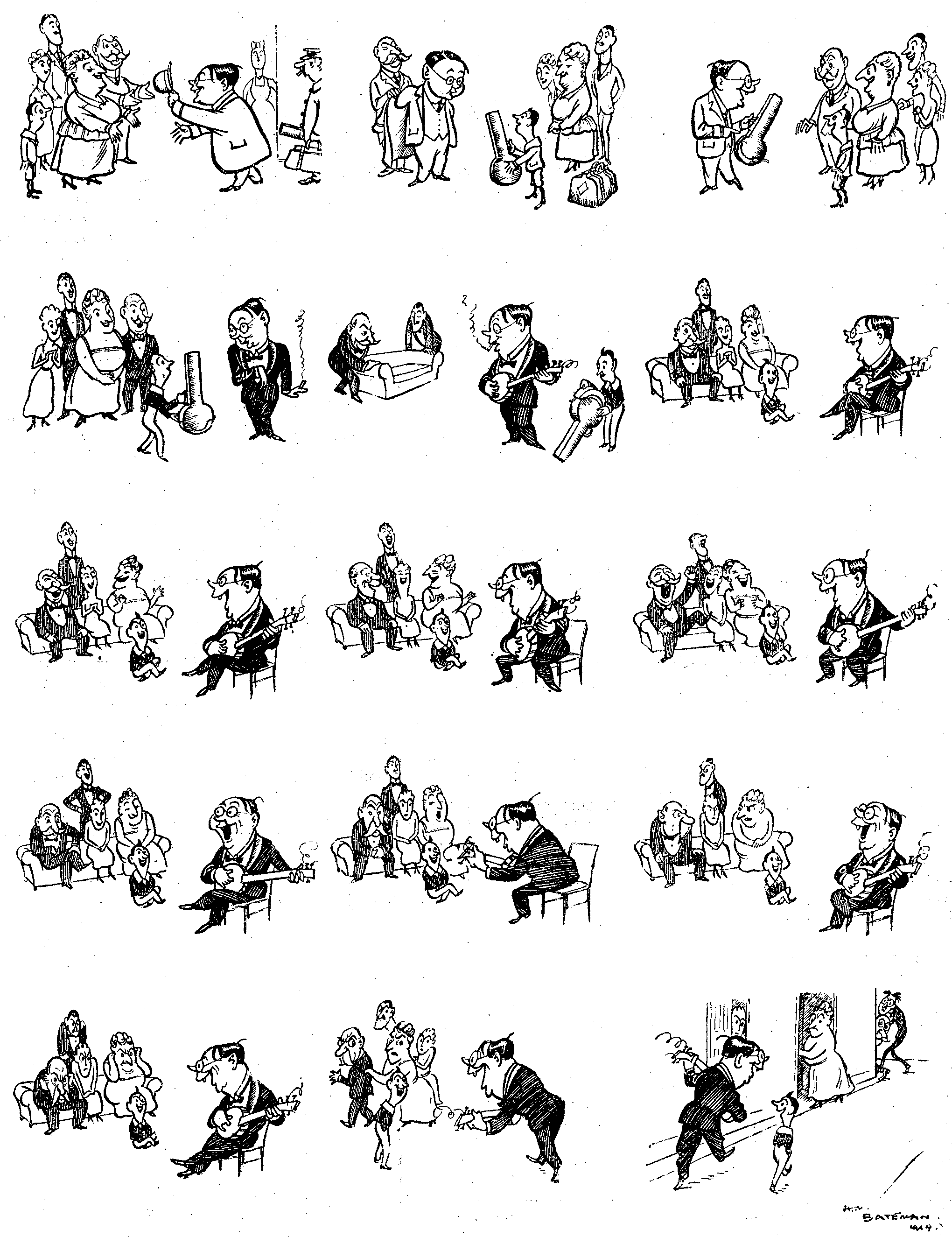
THE GUEST WHO BROUGHT A BANJO.
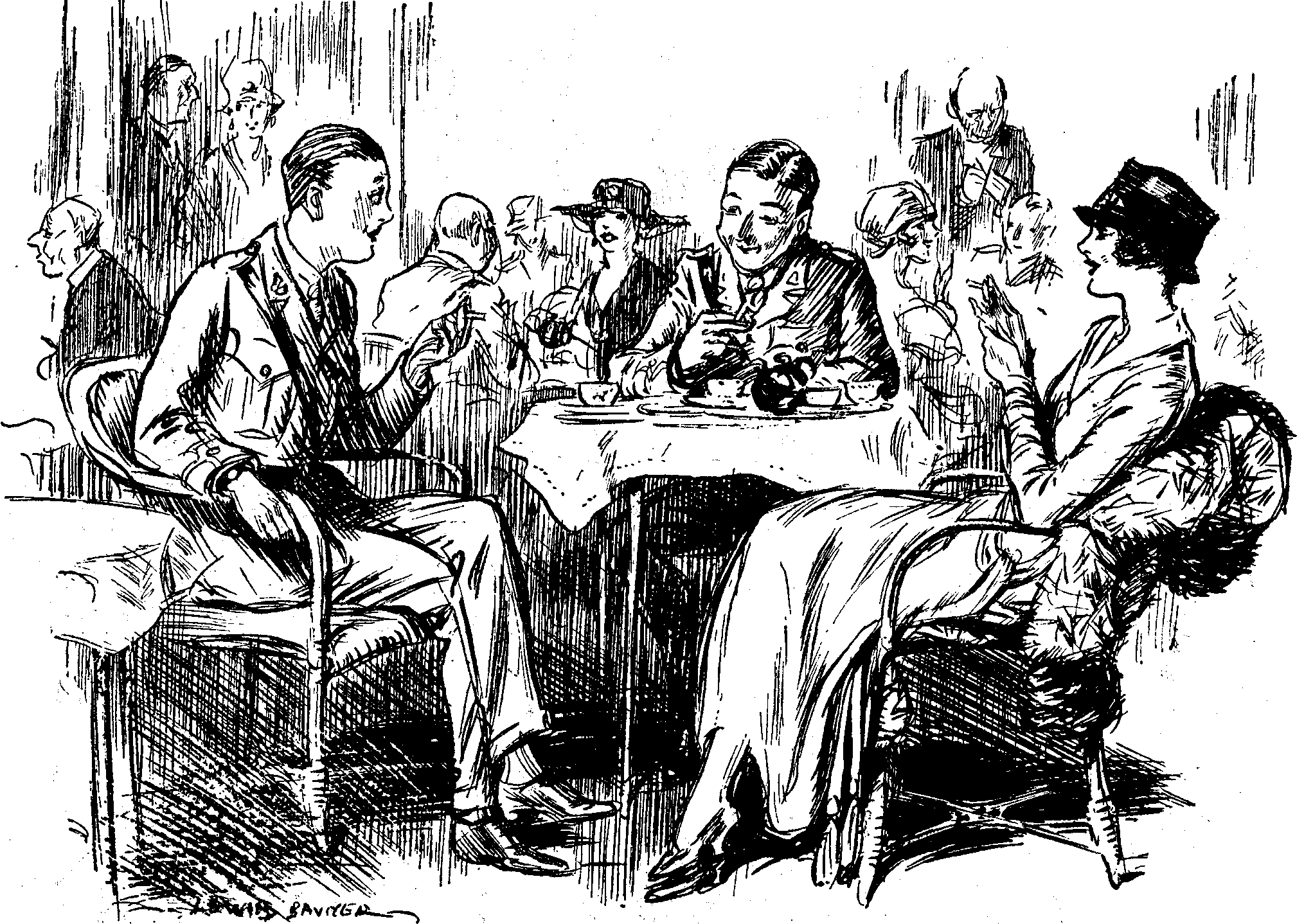
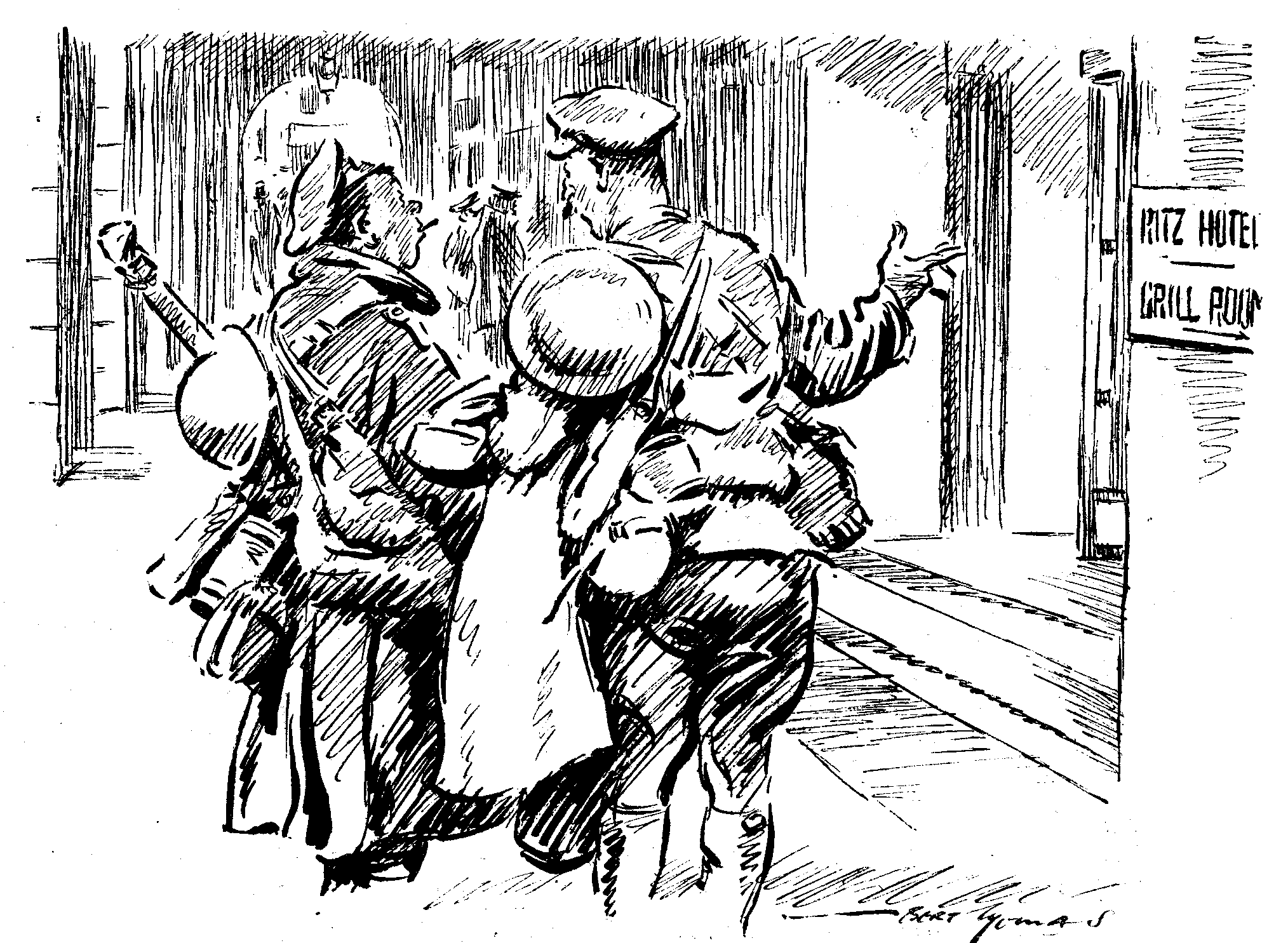
:"THERE'S A BIT OF A FINANCIAL CRISIS ON AT THE PRESENT MOMENT. I BLEW INTO COX'S ON THE WAY HERE, ON THE OFF CHANCE, BUT—NOTHING DOING!"
"I S'POSE YOUR OVERDRAFT BLEW YOU OUT AGAIN—WHAT?"
THE RIGHTS OF LABOUR.
(Extract from "The Times and Mail" of January 1st, 1925.)
A significant case was heard yesterday in the courts, when William Blogg, bricklayer's labourer, recovered twenty-five pounds damages from James Buskin Carruthers, artist, for injury done to the plaintiff's eight-cylinder car through defendant's culpable negligence in allowing himself to be run over by it.
Plaintiff urged that he was a labouring-man, who worked eight hours a day. The court was at once adjourned, while restoratives were applied to the Bench.
On the resumption of the proceedings it was explained that since the passing of the Two Hours Maximum Day Bill the supply of labour had been inadequate to meet the demands made upon it, and plaintiff had patriotically filled four posts, at the minimum rate of fifteen shillings an hour. It was while he was hurrying from one sphere of activity to another that the collision occurred, resulting in injury to the plaintiff's mud-guard and loss of valuable time.
Defendant, who admitted negligence, pleaded poverty and threw himself upon the mercy of the Court.
The Bench, in summing up, called the jury's attention to the fact that defendant was not a labourer, but only a professional man; at the same time he reminded them of the impartiality of British justice, which did not admit that there was one law for the rich and another for the poor. Even the wealthiest labouring-man must be protected in the exercise of his inalienable right to work.
The accompanying photograph shows the plaintiff in the act of assisting to build a wall.; He is a self-made man, having started life as a solicitor and by sheer perseverance raised himself to the lucrative and responsible' position of an unskilled bricklayer's labourer.
TO M. GEORGES CLEMENCEAU.
Strong son of France, whose words were ever lit By lightning flashes of ironic wit; More fond of power than of pelf or place, Eternal foeman of the mean and base, And always ready in a righteous cause To suffer odium and contemn applause— Men call you still the "tiger," but the name Has long outworn the faintest hint of blame, Since in your country's direst hour of need You have revealed your true heroic breed; A tiger—yes, to enemies and Huns, But trusted, idolised, by France's sons. So when of late a traitor's felon blow Was like to lay you, old and ailing, low, And France was sorely stricken in her Chief, The wide world shared her anguish—and relief; For the assassin, resolute to kill, Was foiled by your indomitable will. Immortal France! she cannot spare you yet, Till you have paid in full your filial debt, And by the great Redemption and Release Stamped Victory with the final seal of Peace.
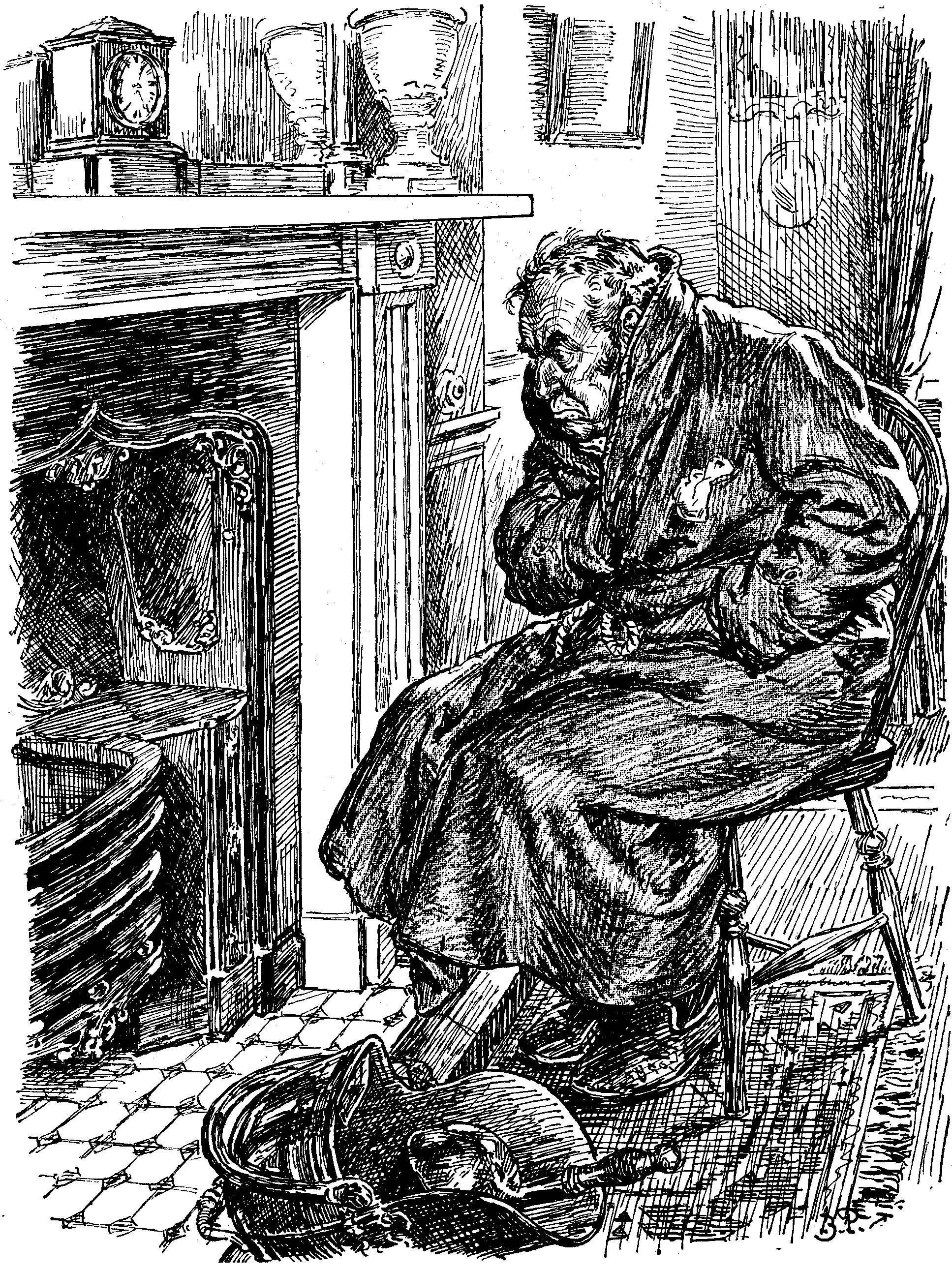
CINDERELLA.
[No representative of the General Public seems to have been invited to sit on the Coal Industry Commission.]