Volume 156 — CHARIVARIA
Reading edition
.
"What is whisky?" asks an evening paper headline. Our memory is not what is was, but we have certainly seen the name somewhere.
"Bitter," says the Kölnische Zeitung, "is the taste of defeat." A reference, presumably, to the thirty thousand tons of American bacon sold to Germany by the Allies.
"The Octopus," said the Lord Mayor of DUBLIN in his inaugural address, "is showing its fangs." Meanwhile Cardinal GIBBONS is busy twisting the Lion's tentacles.
The owner of a mule found wandering at Walton-on-Thames is being advertised for. "Trooper," writing from Mesopotamia, says that if it had a portion of khaki breeching and a stirrup in its mouth it is probably the brute which slipped out of his hands about six months ago.
With regard to the man who was seen struggling in the river last week, the report that his house was immediately taken by a passer-by is untrue. The man who pushed him in had got there first.
So much controversy has been caused by DE VALERA'S escape from prison that there is some idea of getting him to go back and do it again.
It is reported that just before his escape DE VALERA had been greatly affected by the account of some labour strike. He is supposed to have come out in sympathy.
There are now, it is announced, thirty-six prices at which bottled beer may be sold. It is only fair to our readers to state that the price it used to be is not included in the thirty-six.
A Servant Girls' Trade Union has been formed. So far there is no suggestion of interfering with the mistresses' evening out.
Mr. Punch has already called attention to the statement that is costs the nation a guinea every time a question is asked in Parliament. The only difference between Westminster and the haunts of the General Practitioner is that in the latter case (1) you pay out of your own pocket, and (2) your tongue is protruded instead of being kept in the cheek.
Burglars are very superstitious, says a press-gossip. For example the appearance of a policeman while a burglar is drilling a safe is considered distinctly unlucky.
"The pores of the ordinary individual," says a, weekly paper, "would reach nearly forty miles if placed end to end." We hope that nothing of the kind will be attempted, as the traffic difficulties are bad enough already.
A Thames bargee is reported to have sworn at a policeman for eleven minutes without stopping. We understand that there is talk of having the oration set to music.
Considerable damage has been caused in the Isle of Wight by rats. A description of the offenders has been furnished to the police.
In order to cope with the traffic problem the L.G.O. Company have placed one hundred additional omnibuses on the London streets. This is such an admirable solution of a serious difficulty that people are wondering what member of the Government first suggested it.
Despite the fact that his wife has attempted to shoot him eleven times a Detroit architect declares that he will never leave her. He appears to be one of those men who can never take a hint.
Mr. F.M.B. FISHER reports that in New Zealand some convicts recently went on hunger-strike because a band played outside the prison. It seems that their ground of complaint was that this was not included in the sentence.
A correspondent writing to The Daily News points out that the reign of Satan has been cut short by eighty thousand years, and that the end of the world is at hand. Several people in search of flats are now wondering whether it is worth while after all.
Mr. SEAN T.O. KELLY, the Sinn Fein M.P., has handed M. CLEMENCEAU a copy of the "Declaration of Independence of Ireland." Other means have also been employed to entertain and amuse the distinguished invalid during his enforced rest.
We understand that a West-End lady has just been appointed mistress to a young parlourmaid.
We hear that the soldier who, after being demobilised, at once returned to barracks in order to say a few suitable words to his late sergeant-major, was put off on being told that he would have to take his turn in the queue.
"NO, MADAM. NINE GUINEAS—NOT NINE-AND-NINEPENCE."
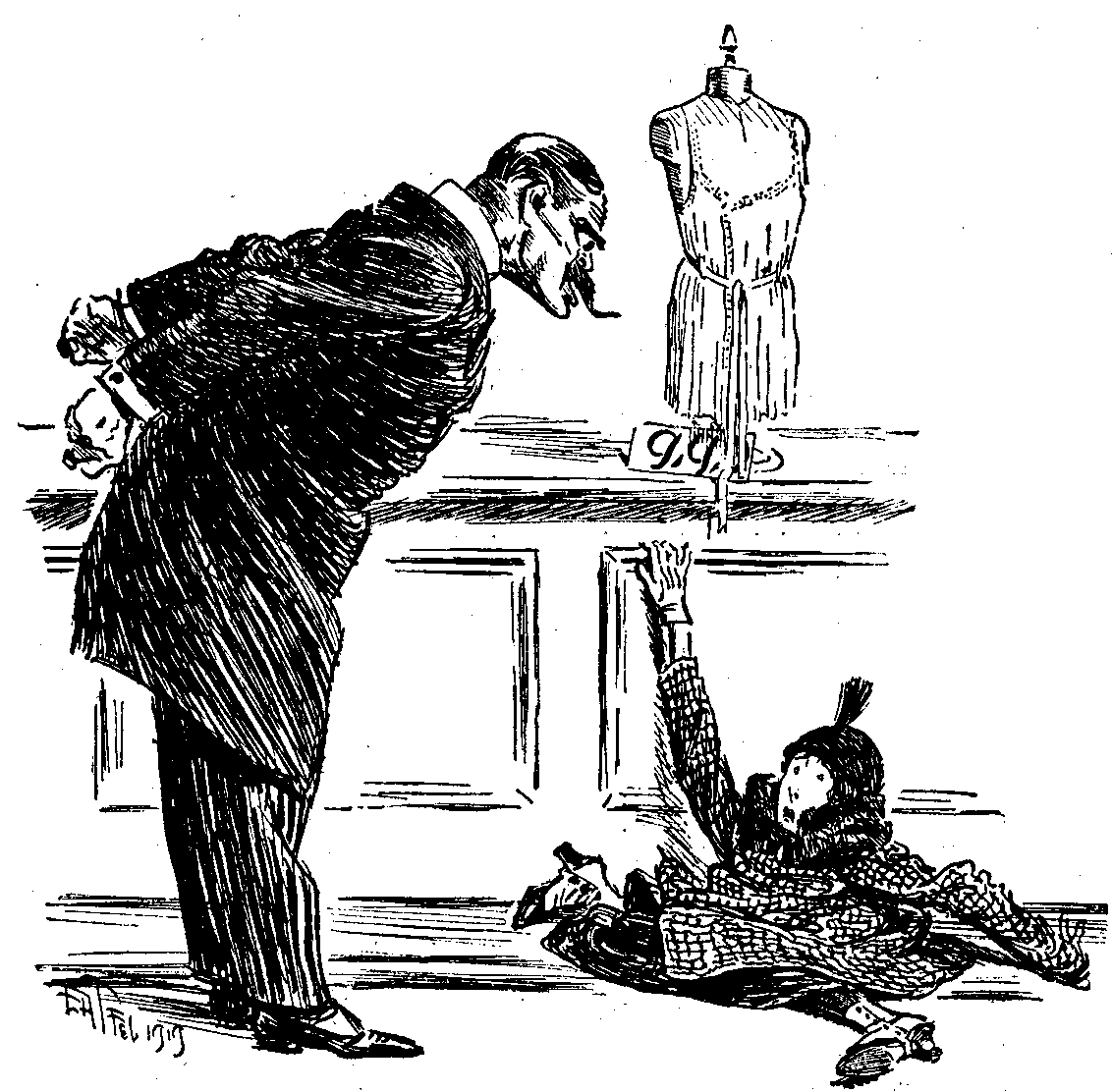
The Pre-war Habit.
"Clerk (male) quick and accurate at figures; one used to wages preferred."—Daily Paper.
"The engine, which is based on the principle of the turbine, is designed to produce 30,000 revolutions a minute."—Daily Paper.
Bolshevists please note.
"Commander Ramsay and the Princess themselves had a private survey of their new possessions yesterday before the guests appeared, and report has it warmly congratulated one another on the interest and beauty of most of the things, and the unusual percentage of unimaginative and ugly offerings."
Daily Sketch.
Although the statement is somewhat ambiguous, we feel sure that the writer meant well.
THE TONIC OF MARCH
.
(With acknowledgments to the author).
Month of the Winds (especially the East) That staunch the young year's floods by dyke and dam, Who enter like a lion, that great beast, And make your egress like a woolly lamb; Who come, as Mars full-armed for battle's shocks, From lethargy of Winter's sloth to wean us, Then melt (about the vernal equinox), As he did in the softer arms of Venus;— O Month, before your final moon is set, Much may have happened—anything, in fact; More than in any March that I have met (Last year excepted) fearful nerves are racked; Anarchy does with Russia what it likes; Paris is put conundrums very knotty; And here in England, with its talk of strikes, Men, like your own March hares, seem going dotty. Blow, then, with all your gales and clear our skies! We did not win that War the other day To please the Huns or gladden TROTSKY'S eyes By fighting, kin with kin, this futile way; Blow—not too hard, of course—I should not care To inconvenience Mr. WILSON on his voyage— But just enough to clean the germy air And usher in the universal Joy-Age.
O.S.
GOOD-BYE TO THE AUXILIARY PATROL.
II.—THE SHIP'S COMPANY.
Demobilisation in the Navy, whatever it may be in the Army, is a simple affair. You are first sent for by the Master-at-Arms, who glares, thrusts papers into your trembling hand and ejects you violently in the direction of the Demobilising Office. Here they regard you curiously, stifle a yawn, languidly inspect your papers and send you to the Paymaster, who, after wandering disconsolately round the Pay Office, exclaiming pathetically, "I say, hasn't anyone seen that Mixed Muster book? It must be somewhere, you know," returns you without thanks to the D.O., where they tell you to call again in three days' time. On returning you are provided with a P.I.O. and numerous necessary papers, requested to sign a few dozen forms, overwhelmed with an unexpected largesse of pay and sent forth on that twenty-eight days' leave from which no traveller returns. There's nothing in it at all; the whole thing only lasts four days. They do it by a system, I believe.
As we assembled on board for the last time, awaiting our railway warrants, there were some moving spectacles. The Mate and the Second-Engineer were bidding each other affectionate and tearful farewells behind the winch. "You won't quite forget me, Bill, will yer?" I heard the Second exclaim brokenly, but the only reply was a strangled sob. The Steward, seated on his kit-bag, was murmuring a snatch of song that asserted the rather personal fact that "our gel's a big plump lass." He is an oyster-dredger in civil life and is eagerly looking forward to experiencing once more the delicate thrills and excitement of this hazardous sport. Jones, our Signaller, who recently wrote a poem which opened with the lines,
"I for one will be surprised When we are demobilised,"
was struggling painfully to insert a pair of boots into a recalcitrant kit-bag, and exhibited an expression of dogged determination rather than the astonishment he had predicted. The Trimmer was heard complaining mournfully that when he left the Patrol Office for the last time they never said good-bye. He seemed to feel this keenly.
All of us were more or less excited, all as it were on tip-toe with expectancy, like school-boys on breaking-up morning. All, did I say? No, there was one member of the crew who sat supremely indifferent to the prevailing atmosphere of emotion, gazing calmly before him with his solitary lacklustre eye. The Silent Menace, the ship's dog, betrayed none of our childlike sentiment. Demobilisation was nothing to him—he was too old a campaigner to let a little matter like that agitate his habitual reserve. To us the recent period of hostilities had been "The War," the only war in which we had ever been privileged to fight; but to him it was just one of the numberless affrays of an adventurous life, and, judging by the worn condition of his ears and the veteran scars that tattooed his tail, some of the previous ones had had their share of frightfulness. And to-morrow, no doubt, he will try the game again.
It was the Third Hand who suddenly propounded the unsolvable question: "Who's goin' to keep that there Menace?"
There was an almost universal chorus of "Me!" I say "almost universal" because Jones, who is R.N.V.R. and educated, probably said, "I," and the Chief Engineer was lighting his pipe and merely succeeded in blowing the match out.
"You can't all have him," said the Third Hand, "so I think I'll take him along with me. I knows a bit about dawgs."
There was instant and clamant disapproval, each one of us urging an unquestionable claim to the guardianship of the orphan Menace. The Steward said he was the only one with the ghost of a right to the dog; had it not always been the Menace's custom to help him wash up the plates and dishes? A Deck Hand, however, protested that as he had eaten one of his mittens the Silent Menace was already in part his property. The Mate and the Second-Engineer nearly came to blows about it.
The question was still unsettled when the warrants arrived. As time was short it was finally decided that whomsoever he should follow was to be adjudged his future owner. We climbed ashore and spread out fanwise, looking back and uttering those noises best calculated to incline the unyielding heart of the Menace towards us. He himself rose from the deck and strolled on to the wharf, where he stood coolly regarding us. Without emotion his Cyclopean orb directed its gaze from one to another till, midway between the Third Hand and the Second-Engineer, it was observed to irradiate a sudden and unaccustomed luminosity.
"Come along then, Menace," wheedled the Second.
"Yoicks, old dawg!" exclaimed the Third Hand, patting his knee encouragingly.
But they had misinterpreted their Menace, for in the middle distance, on a pile of timber directly behind the expectant twain, had appeared the sleek person of a sandy cat which proved to be the attraction. For an instant the Menace stood motionless, his spine bristling and his tail growing stiff; then with a short sharp bark he sprang forward like an arrow from a bow in the direction of the feline objective. We saw a streak of yellow as she fled for safety and life; a cloud of dust, and the Menace and his quarry disappeared from view. Faintly from afar floated an eager yelp, telling that the chase was still in full cry.
"Well, sink me," said the Second-Engineer, "that settles it."
There were trains to be caught, and so, slowly and sadly, we turned away.
Thus did the Silent Menace, with the rest of his shipmates, bid good-bye to the Auxiliary Patrol.
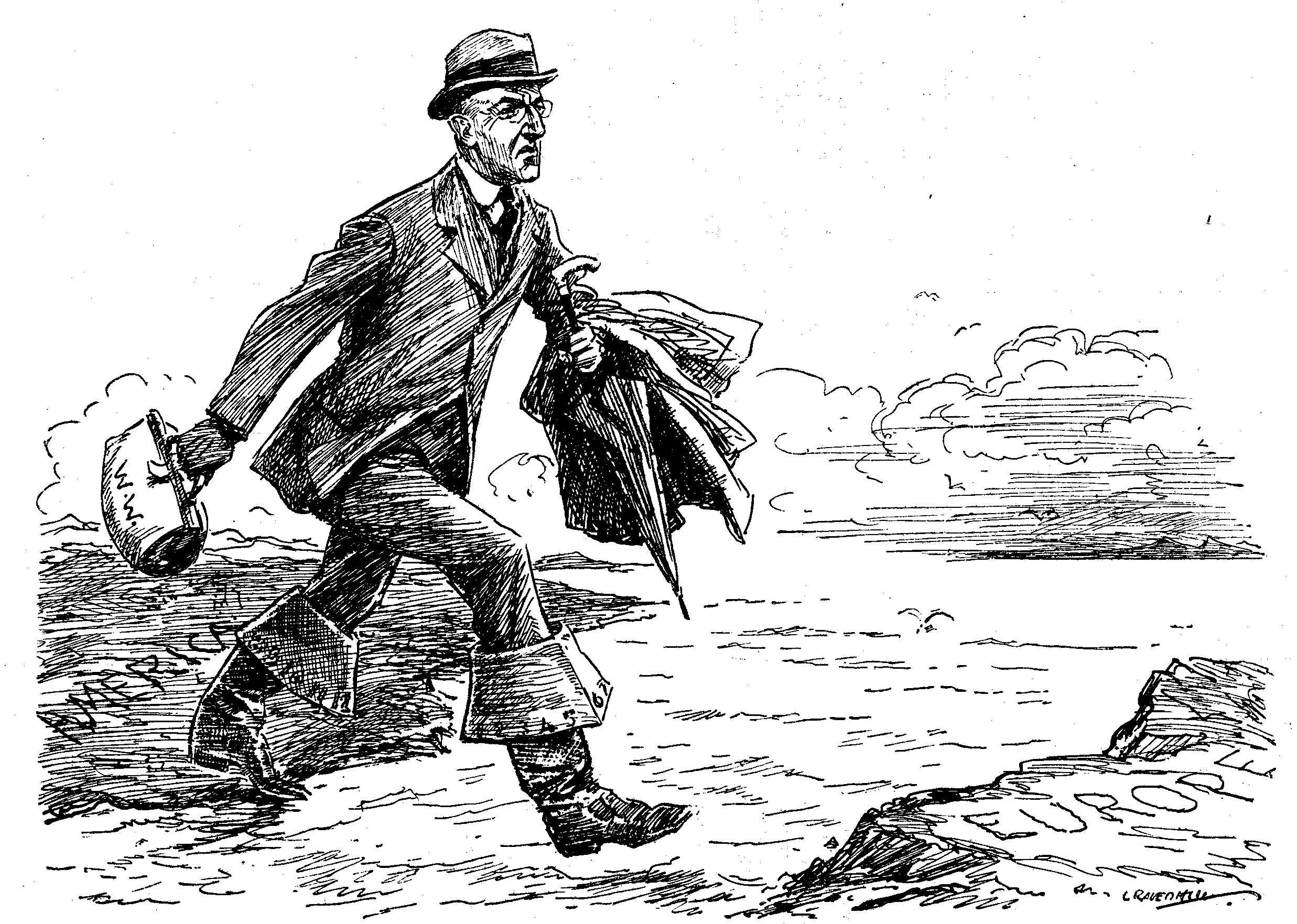
A HOME FROM HOME.
PRESIDENT WILSON (quitting America in his Fourteen-League-of-Nations Boots). "IT'S TIME I WAS GETTING BACK TO A HEMISPHERE WHERE I REALLY AM APPRECIATED."