Volume 156 — THE ART OF LEAVING
Reading edition
.
If I had a son one of the first things I should teach him would be the art of leaving. I would have him swift in all ways, but swiftest when the time came to go. And when he went he should go absolutely. For although the people who leave slowly are bad enough, they are as nothing compared with the people who make false exits and return with afterthoughts.
The other day the necessity came for me to visit a house agent. Life has these chequered moments. There is something of despatch and order wanting about most house-agents, possibly the result of their very odd and difficult business, which is for the greater part carried on with people who don't know their own minds and apparently are least likely to take an eligible residence when they most profess satisfaction with it. Be that as it may, house agents' offices in general have a want of definiteness unknown to, say, banks or pawnbrokers'. There is no exact spot for you to stand or sit; you are unaware as to which of the clerks is going to attend to you, and the odds are heavy that the one you approach will transfer you to another. There is also a certain air of familiarity or friendliness: not, of course, approaching the camaraderie of the dealer in motor cars, who leans against the wall with his hands in his pockets and talks to customers through a cigarette; but something much more human than the attitude of a female clerk in a post-office.
Being pressed for time and having only the very briefest transaction to perform, it follows that I was kept waiting for my turn with "our Mr. Plausible," in whose optimistic hands my affairs at the moment repose.
Occupying his far too tolerant ear was another client, whose need was a country house surrounded by enough grass-land for a small stud farm.
This is what happened (he had, by the way, the only chair at that desk):—
Our Mr. Plausible (for the fortieth time). I understand perfectly. A nice house, out-buildings and about twenty acres of meadow.
Client. Twenty to thirty.
Our Mr. P. Yes, or thirty.
C. You see, what I want is to breed stock—cattle and horses too.
Our Mr. P. Exactly. Well, the three places I have given you are all well-adapted.
C. When a man gets to my age and has put a little money by he may just as well take it quietly as not. I don't want a real farm; I want just a smallish place where I can play at raising pedigree animals.
Our Mr. P. That's just the kind of place I've given you. The one near Newbury is probably the most suitable. I should see that first, and then the one near Alton.
C. You understand, I don't want a big farm. Anybody else can have the arable. Just a comfortable house and some meadows; about twenty acres or even thirty.
Our Mr. P. The biggest one I've given you is thirty. The place near Newbury is twenty-three.
C. Well, I'11 go and see them as soon as I can. [Gets up.
Our Mr. P. The sooner the better, I should advise. There's a great demand for country-houses just now.
C.(sitting solidly down again). Ah, yes, but this is different. What I want is not so much a country-house in the ordinary meaning of the term as a farm-house, but without possessing a farm. Just enough buildings and meadow-land to breed a few shorthorns and a yearling or two. The house must be comfortable, you know, roomy, but not anything pretentious. [Gets up again.
Our Mr.P. I quite understand. That's just what I've given you.
C. (again seating himself). The whole scheme may be foolishness. My wife says it is. But (here I believe I groaned audibly; at any rate all the other clerks looked up) there it is. When a man has enough to retire on and pay the piper he's entitled to call the tune; isn't he?
[At this point I resist the temptation to take him by the shoulders and push him out.
Our Mr. P. Quite, quite. Well, Sir, if you take my advice you'11 go to Newbury as quickly as you can. It's a first-rate place—most highly recommended.
[Here the client very deliberately puts the three "orders to view" in his inside pocket and slowly buttons his coat. I flutter on tiptoe, eager for his chair.
C. If these won't do you'11 find me some more?
Our Mr. P. With pleasure.
C. Very well; good morning.
[Moves away. I have just begun to speak when he returns.
C. Don't forget what I want it for. And not too far from London or my wife will dislike it.
Our Mr. P. Yes, you told me that. I've got a note of it here.
C. And you won't forget about the acreage?
Our Mr. P. No."
C.(addressing me). I'm afraid I've kept you waiting.
I (like the craven liar I am). It's all right.
[Client ultimately withdraws, but still with reluctance, and after two or three hesitations and half-turns back.
And the tragic part of it is that his name is Legion.
That is why if I had a boy I should teach him the art of leaving. Almost nothing else matters.
OFFICIAL EUPHEMISM.
DR. ADDISON has stated that for some time past it has been the practice riot to use the word "pauper" in official documents when it was possible to use another expression; and no well-conditioned person will cavil at the spirit which has prompted the use of a less invidious substitute. But surely the process might be carried a good deal further. The practice of giving a dog a bad name is not only condemned by the proverbial philosophy of the ancients but by the most emancipated of the orthopsychical educationists of to-day.
If you keep on calling a man a "criminal," you will end by making him one. How much wiser it would be to refer to the impulses which occasionally bring him into conflict with the custodians of law and order as emanating from a dynamic individualism! In that way you may very possibly convert him into a static individualist and sterilize his potential malignance by a subliminal serum..
The amount of harm done by disparaging nomenclature is incalculable. Take the word "thief," for example. Its meaning can be expressed with infinitely greater precision and delicacy in the phrase, "one who is unable to discriminate between meum and tuum." Here you have in place of one mean little word a well-cadenced phrase of ten. Euphony as well as humanity prompts the variation.
Classical writers may have objected to the use of sesquipedalian words, but we know better, and Mr. WINSTON CHURCHILL'S famous synonym for "lie" is permanently enshrined in the annals of circumlocution. One of the most offensive words in the language is "idiot"; yet it can be shorn of nearly all its sting when replaced by the definition, "a person of infra-normal mentality."
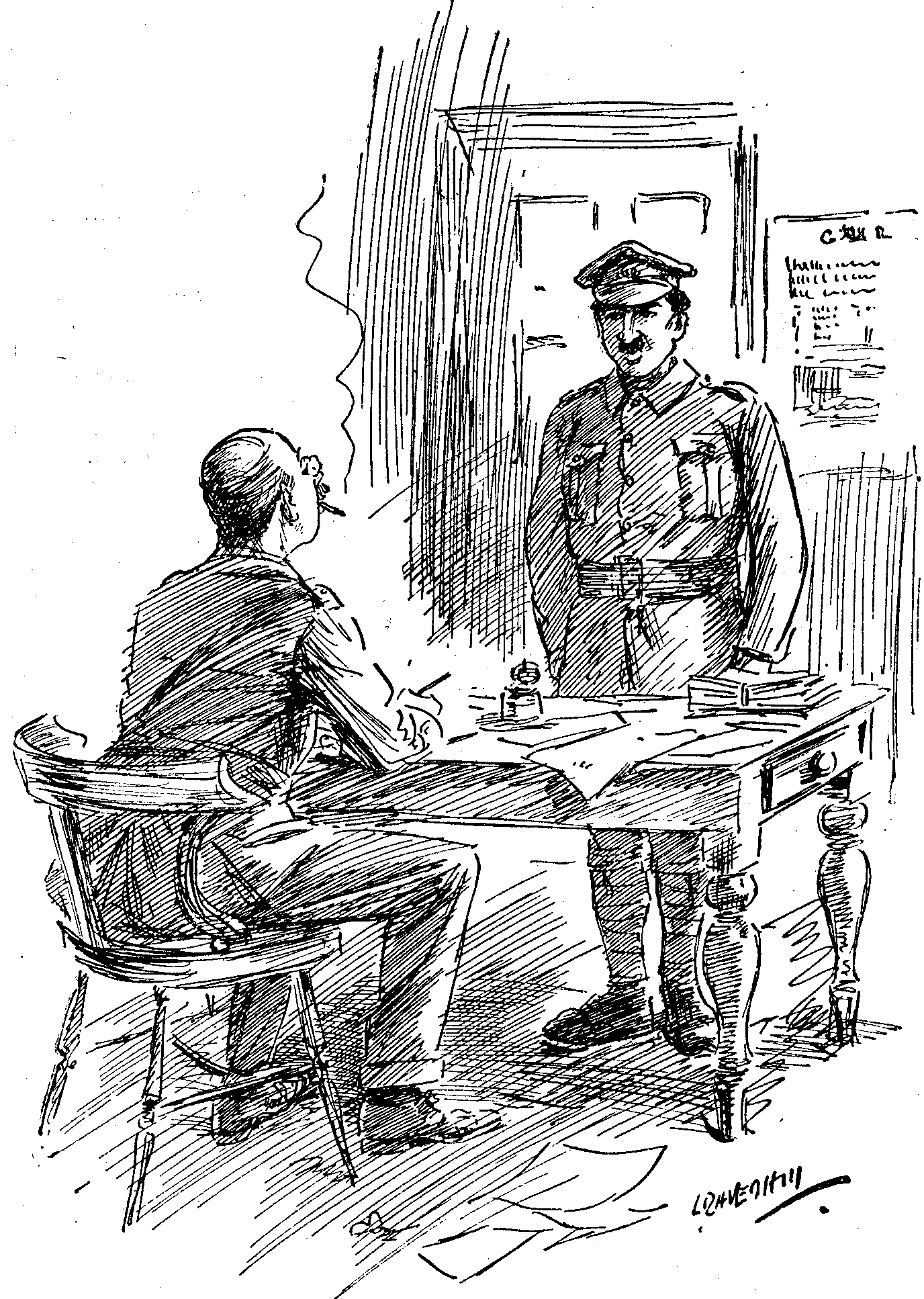
Demolilisation Officer. "WHAT IS THE NUMBER OF YOUR GROUP?"
Private. "I DON'T KNOW, SIR. I WAS A TURF ACCOUNTANT."
Demobilisation Officer. "AH! AGRICULTURE—GROUP 1."
"London, Dec. 16.—At a meeting of the County Cricket Advisory Committee it was decided to run the County Championship during 1919, the matches to be limited to two days. There will be no change in the number of balls in the over.—Reuter's.
The Soviets are preparing the sharpest counter-measure.—Reuter's."—Canton Times.
But we are confident that whatever the Soviets' little game is it will not be cricket.