Volume 156 — THE PATRIOT PIG.
Reading edition
Last Spring I was discussing food with our local doctor. Last Spring it was quite a favourite topic.
"Now," I said, "we can manage to scratch along somehow. But next year . . ."
The Doctor, a hearty man, gave me a smashing blow on the shoulder. "I have it!" he trumpeted. "We'll start a Patriot Pig Club."
Before he left I found myself an important pillar of the scheme. Pillars, you know, are the parts of an edifice that bear the weight. Their function is to be sat upon by the arches. In this case the arches were Jones the doctor and Perkins the butcher.
The Committee began sitting. I put five pounds into the preliminary pool and promised them all my pig-swill. I know I did, because the Doctor came straight from the meeting to my house to tell me I had, and to collect the cheque.
The pigs arrived. I myself and a number of other enthusiasts turned out to welcome them. The Doctor, I remember, made a happy little speech, and we all laughed a lot. The Committee were very pleased with themselves. They were dear little chaps—the pigs, I mean—very small, of course, but that gave me the opening for what was undoubtedly the most successful sally of the afternoon. Someone said they weighed five pounds apiece. "One pound per pound," I remarked.
A week later the Doctor called for my second instalment. "Pig going strong," he chattered gaily while I wrote out the cheque; "best of a good litter—bust its pink ribbon yesterday; twice the weight it was when it came."
It was on the tip of my tongue to repeat my witticism, which was still true, but I refrained.
I paid the first dozen five-pound instalments without comment. Up till then I had been fully occupied in studying how FOCH was getting on with the other sort of pig over there. But now I began to think.
I was thinking heavily when I put on my hat, but when I reached the premises of the Patriot Pigs I was thinking things that I prefer not to talk about. To begin with, they were housing the poor little beasts in a place you wouldn't dream of inflicting on the poorest labourer. And the overcrowding! And the dirt! And the pigs themselves! They were positively uncanny. There was something almost human about them. They were all heads and no bodies. It was just as though the other half of the wits of the half-witted boy who looked after them had distributed itself among the whole herd. I could have wept when I thought how my purse and my swill-tub had been emptied to keep such puny monstrosities in the land of the living.
I had my pig taken out and weighed. He turned the scale at forty-eight pounds.
A week later I went and weighed him again; he had shrunk to forty.
I am a man of action. In a flash my mind was made up. I put him on a string and led him home.
My wife seemed rather surprised when we entered the drawing-room, but I hastened to explain.
"I paid five pounds," I said, "for a five-pound pig. Since then I 've paid fifty-five pounds more, and I have been led to expect, that at the very least the pig was keeping pace. But it isn't. The sterling is increasing by leaps and bounds; the avoirdupois is not even stationary. That's not counting several tons of swill that ought to be inside him but aren't. It can't go on." I paused and added darkly, "That pig shall not return."
"But surely you're not going to have him live with us, Henry?"
I controlled myself.
"No, Maria," I said, "I am not. At a late hour to-night we will take him out into the country and lose him."
"Oh, Henry," she began, "supposing—"
I interrupted gently but firmly.
"My mind," said I, "like BERT COOTE'S, is made up. He is my pig and I may do what I like with him. There is no law against one losing one's pig. Besides, he is ruining me."
At 10 P.M. we set out en famille. It was July. I remember the date rather particularly because it was just then that they ceased to ration bacon altogether. At 10.30 the pig was safely lost. At 11 the front-door closed upon us. At 11.1 little Willy Perkins, the butcher's son, arrived with the pig and claimed something for restoring lost property.
A man with a position to keep up simply can't afford to be caught in the act of feloniously making away with pigs in war-time; besides DORA was still alive and she might have something to say; so I had to pretend how pleased I was, and I gave the scamp half-a-crown.
Now I know Perkins and Son well enough to realise that if the animal had been worth more than half-a-crown they would have allowed me to lose my pig free of charge. So I made another resolution. It was pretty drastic, but in a crisis like this severe measures are often the best. In short, it was murder I contemplated—nothing less.
I went to work carefully. I let four months slip by to allay any possible suspicion. I paid my weekly cheque without being asked; without a murmur I parted daily with my swill; in fact I comported myself as though the unholy plot maturing in my breast was nonexistent.
At length the night arrived. I took down my long magazine Lee Enfield and my cartridge (I am not a Volunteer for nothing) and crept to the Patriot Pig H.Q.
The once-crowded sty lay dark and still. I entered and switched on my torch: it shone on the loathsome features that I knew so well. He was all alone, so there could be no mistake. His head was as large as ever, but his body seemed scarcely visible. I weighed him; he registered fourteen pounds.:
I will not harrow you, my reader, with details. Suffice it to say my nerve was sure, my eye true and my hand steady. I killed that pig with a single shot and went home to bed.
The Doctor arrived next morning while I was shaving. He was white with rage. He said:
"What the deuce do you mean by killing my pig?"
"Your pig ?" I smiled. "No, my Pig!"
"Stuff and nonsense!" he spluttered. "Your pig died four months ago—caught cold last July through being out so late at night and died next day."
That roused me. "Do you mean to tell me," I asked coldly, "that I've been paying five pounds a week for the last four months for a dead pig?"
"Very kind of you, I'm sure," replied the Doctor, "but no one asked you to, you know."
Adding together all my expenses—the weekly subscription for my pig; a similar sum paid to the Doctor for his; the value of my swill; the fine imposed (by DORA) for improper use of firearms; ditto (by the Magistrate) for shooting game without a licence; alleged damage to the P.P. premises and the remaining wits of their custodian; and finally, the bill from Mr. Perkins for a pound of pork purchased in July, and the account from Dr. Jones for professional attendance subsequent to consumption of same—adding all these together I find that from first to last I disbursed £385 5s. 5-1/2d. on the patriot.
With pork at two shillings a pound my outlay should have produced a pig that weighed 1 ton 14-1/2 cwt. Truly that would have been a very Hindenburg of a pig. It was almost worth trying.
OUR EUPHEMISTS.
"General Servant wanted, by middle of February; no small family."—Oxford Times.
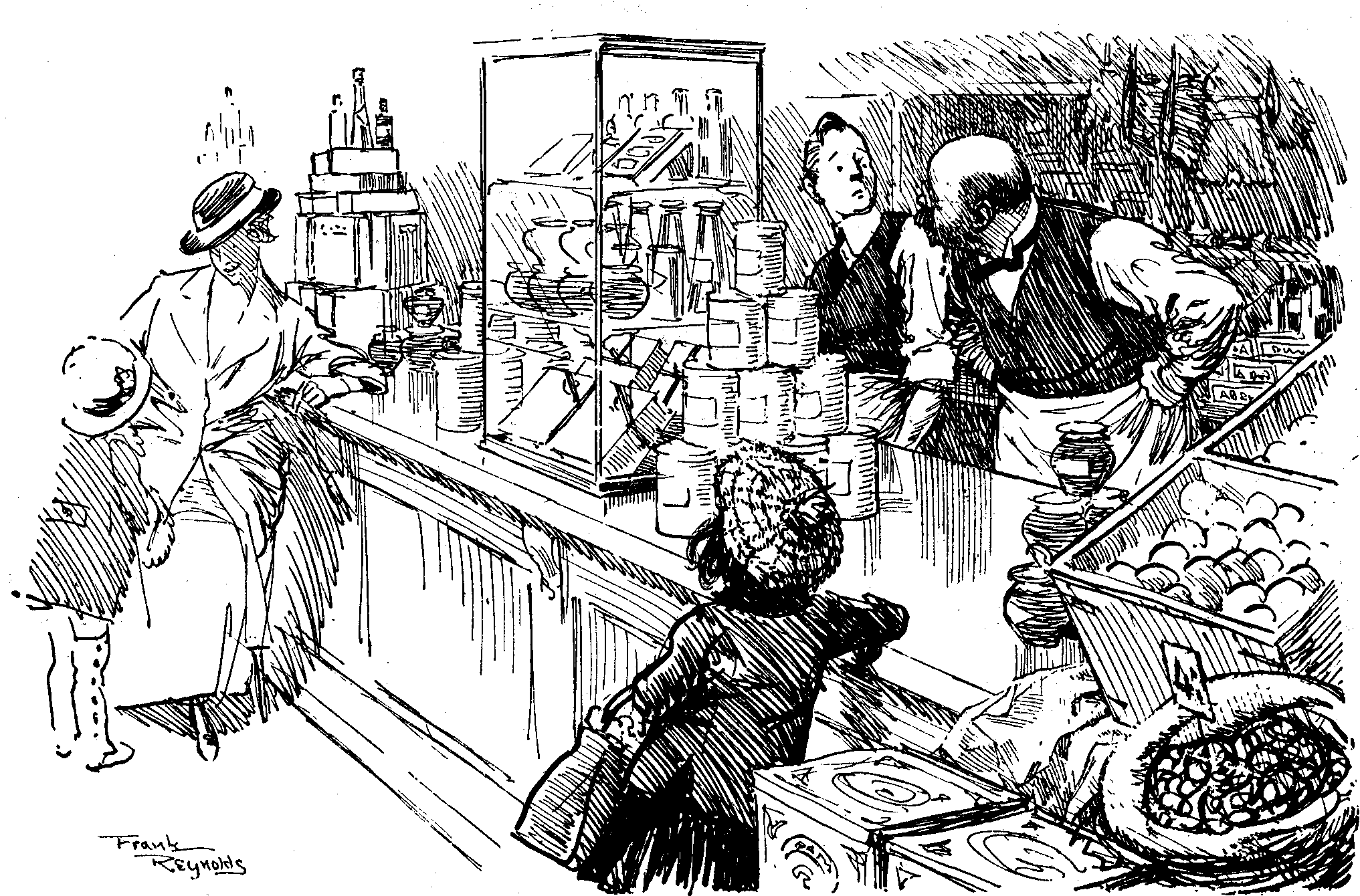
Proprietor (to assistant recently released from the Army). "WHY, WHATEVER MADE YOU OFFER TO SEND THE GOODS HOME FOR HER? ANY FOOL COULD TELL YOU'VE BEEN OUT OF CIVILISATION DURING THE WAR."
TO THE SPEAKER ON HIS RE-ELECTION.
Good Mr. SPEAKER, in this troublous time, When it is hard to string a cheerful rhyme, Your genial influence unshaken bides Amid the flux of shifting sands and tides; And, re-electing you by acclamation, The Parliament has acted for the nation, Which, while acknowledging the Members' nous, Congratulates not you, Sir, but the House. 'Tis fourteen years since you were called to bear The heavy burdens of your "perilous Chair"— What years, what burdens! Yet your steadfast mien Has never failed to dominate the scene. Others have found the post a giant's robe Or lacked the needful patience of a Job; But you, by dint of fearless common sense, Have won and held all Parties' confidence; Firm as the rock and as the crystal clear, When need arises righteously austere, Ready, not eager, your advice to lend, And not afraid in season to unbend. Thus, tested by a strain that very few, If any, of your predecessors knew, You come at last, among the lesser fry, To loom so largely in the public eye, That, we regard you, greatest of your clan, More as an institution than a man.
THE REST-CURE.
"Will young officer requiring rest help farmer catch rabbits for a month?"—Church Family Newspaper.
THE RETURN.
It was at tea last Sunday that we met for the first time for three-and-a-half years. He was sadly altered. To the casual observer he may still appear his own attractive self; the change in him is deeper.
He isn't what he was, but none the less it is wonderfully delightful to have him among us again. A girl at the next table noticed him and spoke smilingly to her companion. But I—I sat and looked at him and never said a word.
Before the War I was fond of him, but I doubt if I could ever have realised how much I should miss him; and nothing has brought home to me so surely the astounding fact that at last it is over as his return.
Sitting opposite to him here brought back the jolly memories of other teas in that distant pre-war life of ours—memories of bright faces, gentle clatter of cups, charm of soft clothes, strange forgotten sense of comforts, and one particular smile; and, throwing off from me the gathering gloom of the war-weary, I dug my fork joyously into his brown bosom and raised the chocolate éclair to my lips.
"By placing a lemon in the oven for a few minutes nearly the entire pulp turns to juice. When next you want orange-juice try this."—Glasgow Citizen.
But why not use an orange?
"As a woman married to an Army officer for nineteen years I do not consider that I could possibly, on less than our present income, provide my children and husband with the necessary education and comfort."—Letter in Daily Paper.
Some husbands take a lot of educating.
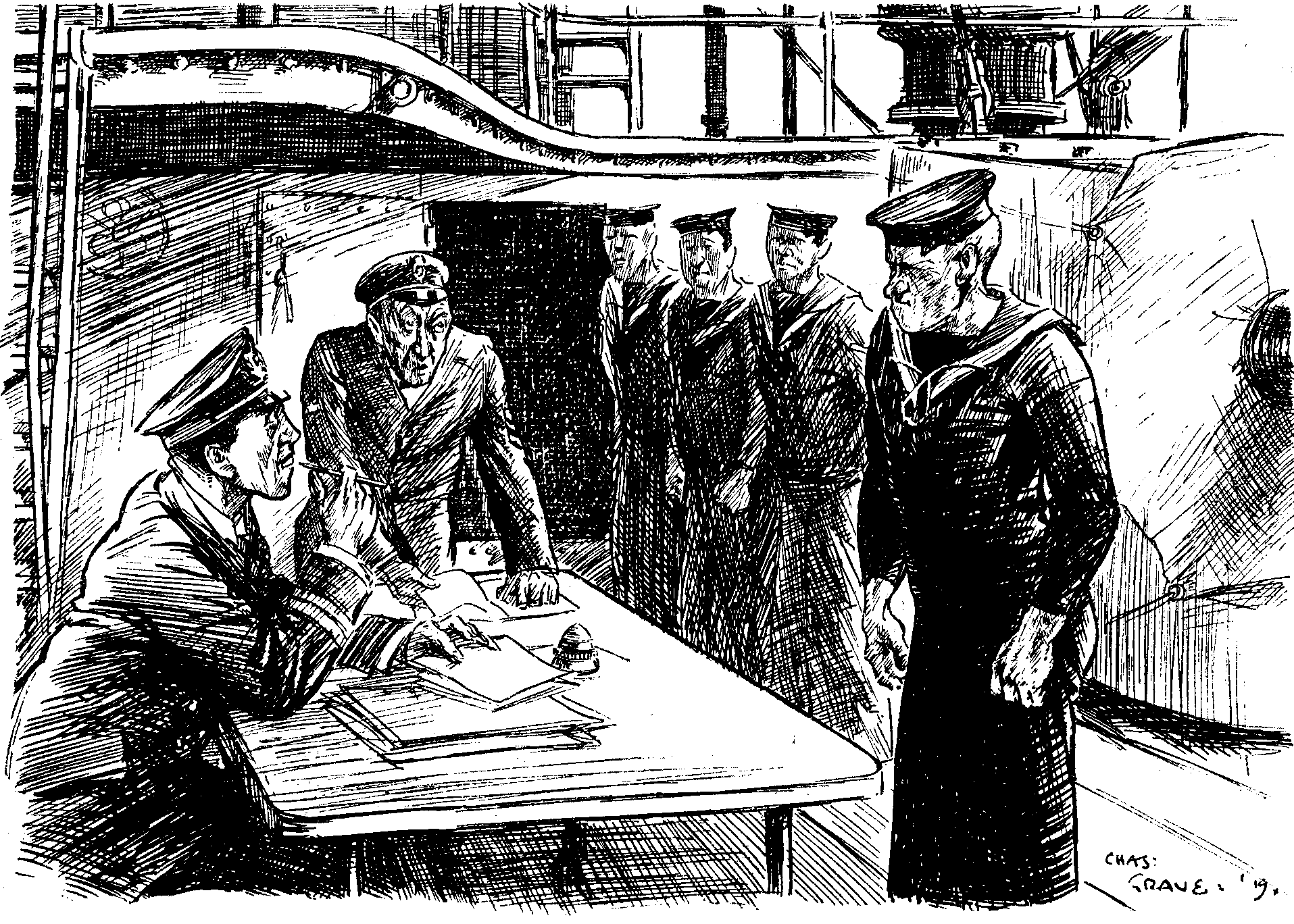
Assistant Paymaster, "HOW LONG WERE YOU IN YOUR LAST JOB?" "Hostilities Only" Man. "THREE MONTHS, SIR."
A.P. "WHAT WERE YOU DOING?" H.O.M. "THREE MONTHS."
THE MAN WHO STAYED AT HOME
(A SOLILOQUY AFTER A DAY'S WORK AT THE MINISTRY OF FOOD).
[Sir JOHN FIELD BEALE, formerly First Secretary of the Ministry of Food, has been in consultation with the Supreme Council for Supply and Relief in Paris. Sir WILLIAM BEVERIDGE has just returned from a mission of inquiry into the food situation in Austria.]
Let others speed to far Sequanian shores To end the War that was to end all wars, Where peace-pursuing Discord loud debates And all hotels are packed with Delegates; Where pundits in the Parliament of Man Discuss or Georgian or Wilsonian Plan; Where fickle Fate dispenses weal or woe Respectively assigned to friend and foe; Where Cornucopia meekly comes to heel Under instructions from Sir JOHN FIELD BEALE. Let others in Icarian feats engage With the ingenious aid of HANDLEY PAGE; Haste to discover all that may be known About the situation in Cologne; Or, like Sir WILLIAM BEVERIDGE, to appease The clamourings of esurient Viennese— In none of these things Fortune waits for me, Nor Knighthood cheap, nor unctuous O.B.E. Ah, not for me to note with facile pen Successive stages of the L. of N. With calorimetric and statistic arts Administer the prog of Foreign Parts, Or, eager not to do the thing by halves, To reconcile the Czechs and Jugo-Slavs— I will, resigning honours, kudos, pelf, Administer hot cocoa to myself; Then to repose; for it is truly said The best location of mankind is BED.
EMANCIPATION.
"Wanted by respectable woman, a couple of Gentleman's Trousers (left off)."—Irish Paper.
"A Caproni machine flew a distance of 325 miles in four fours."—Scottish Paper.
A correspondent writes to ask if this is double the time usually described as "two two's."
"At 11 o'clock the muster roll at many shops and offices was still incomplete. Indeed assistants were reported 'missing' at many establishments an hour later. There were girls—Government and others—who stayed at home."—Evening Paper.
Little pigs who wouldn't go to market.
"At Bolton on Saturday the United Textile Factory Workers' Association decided to put forward a demand for a 4-hours week, with the same rate of pay as for 55-1/2 hours."—Provincial Paper.
We trust this is a misprint and not an "intelligent anticipation" of what we are coming to.
"The teachers of —— are not satisfied with the scale of salary fixed by the Education Committee, and yesterday morning a deputation waited upon the Special Salaries Committee to state their case. The Education Committee decided to increase the salary of the borough Director of Education from £450 to £500."
Provincial Paper.
And if that don't satisfy 'em—Bolshevism, my dear Sir, Bolshevism!
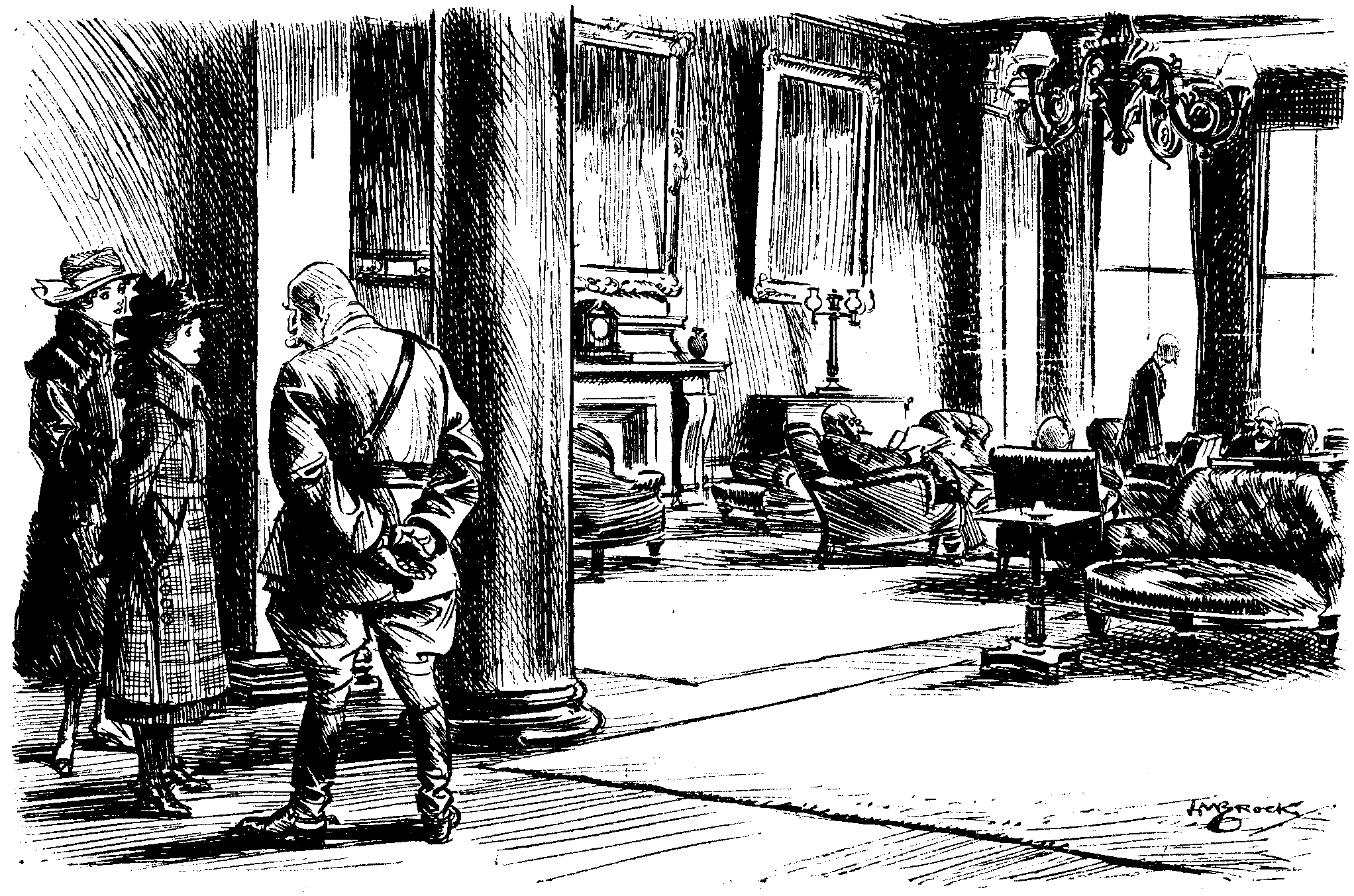
The General (showing his nieces round Club). "THERE'S BEEN A LOT OF ARM-CHAIR FIGHTING DONE IN THIS ROOM."
School-Girl. "HOW TOPPING! THAT BEATS PILLOW-FIGHTING. BUT ISN'T IT RATHER DANGEROUS?"
OLD HEN-PECK.
Captain Edwin Peck, E.N., Had the habits of a hen. Edwin's nose was like a bone, And his teeth were not his own; Neither, I regret to tell, Did they fit him very well. It was not his fault, no doubt, That they tried to tumble out, And in fact he seldom dropped them, For he almost always copped them Just as they became unstuck By ejaculating, "Cluck." Yoked to this elusive plate, Did our Edwin curse his fate? No, he was content to live, For he was inquisitive. If he saw a speck of grit He must needs examine it, Not as any other might, Standing at his proper height, But with body slightly slanted And his head obliquely canted, While with small unblinking eye He surveyed it wickedly. One fine Sunday Captain Peek Stalked along the lower deck, Pausing now and then to stare, Poking here and scratching there, Like a pullet in her prime Clucking softly all the time. Presently the Captain spied One small scuttle open wide. "Cluck!" he said, and likewise. "Tut! "Every scuttle should be shut;" And with a malignant snort Poked his head out through the port. That was easy, but, alack! When he tried to get it back There was heard an angry cluck— Captain Edwin Peck was stuck! Strange at first as it appears, He had overlooked his ears; But it's not so queer, perhaps, When you ask, "Have hens got flaps?" Silence! You'd have heard a pin Fall upon the deck within, Till the Bloke was heard to shout, "Stick it, Sir! We'll get you out!" Everybody had a go— Chief, Commander, P.M.O., Padre, Carpenter and Stoker, Using engine-grease and poker, Hawser, marlin-spike and soap, Till at length they gave up hope, For, in spite of all they did, Edwin fitted like a lid. Suddenly upon the scene Came a German submarine. Then a flash, a roar, a groan; "We are sinking like a stone!" Cried the Bloke with angry frown; "Can we leave poor Peck to drown? Really, this is too absurd;" Then a miracle occurred. As the cold green waters roll Round poor Edwin in his hole, Are the watchers wrong in thinking That the Captain's neck is shrinking? As she took her final list on, Sighing, "üdor mén äriston!" Long-enduring Captain Peck Gracefully withdrew his neck, Poked it out again and spoke To the sorrow-stricken Bloke: "Nothing more that we can do? No? Then sound the 'Sove kee poo!'" Need I tell how Captain Peck Was the last to leave the wreck, How the good ship perished, or How he brought them safe to shore, Landing, after all his men, Clucking softly like a hen?
Up-to date quotation for foot-sore Londoners: "Et Tube, brute!"