Volume 156 — THE MUD LARKS.
Reading edition
One reads a lot nowadays about the "slavery" of various habits (drug, drink, bigamy, etc.) and loud is the outcry. But there is yet another bondage, just as binding and far more widespread, which nobody ever seems to mention, namely, the drill habit. Drill the young soldier up in the way he should go and for ever after his body will spring to the word of command, whether his soul approves or no.
Once upon a time two men turned up in a railway construction camp deep in the Rhodesian bush. They were a silent, furtive, friendless pair, dwelling apart, and nobody could discover whence they came, whither they were bound, or, in fact, anything about them. It was generally conceded that they had some horrid secret to bury (camp optimists voted for "murder") and left it at that. Time went by and so did the rail-head, leaving the two mysteries behind as permanent-way gangers. Solitude seemed to suit them. Years passed along and still the two remained in that abomination of desolation guarding their stretch of track and their horrid secret. Then one day ROBERTS rolled by on his way to Victoria Falls, and, his train halting to tank-up, the old Field-Marshal stepped ashore and called to the two gangers, who happened to be close at hand tinkering at their trolley. The guard, who was taking a bottle of Bass with the steward on the platform of the diner, suddenly jabbed his friend in the brisket.
"Look, for the love of Mike!" he giggled.
The two gangers were standing talking to "BOBS," shoulder to shoulder, heels together, feet spread at an angle of forty-five degrees, knees braced, thumbs behind the seams of their trousers, backs hollowed, heads erect—in short in the correct position of attention as decreed in the Book of Infantry Training. The old man finished speaking and the two saluted smartly and broke away. The steward looked at his friend and nodded, "Old soldiers."
"Old deserters, you mean," retorted the guard. "Now we know."
The drill habit had been too strong for those two fugitives even after ten years.
The other night our Babe, as Orderly Officer, sat up alone in the Mess, consuming other people's cigarettes and whisky until midnight, then, being knocked up by the Orderly Sergeant, gave the worthy fellow a tot to restore circulation, pulled on his gum-boots and sallied forth on the rounds. By 12.45 he had assured himself that the line guards were functioning in the prescribed "brisk and soldierly manner," and that the horses were all properly tucked up in bed, and so turned for home.
He paused at the cross-roads to hear the end of the Sergeant's reminiscences of happy days when he, the Sergeant, (then full-private, full in more senses than one) had held the responsible position of beer-taster to a regiment at Jaipurbad ("an ideal drinkin' climate, Sir"), then, dismissing the old connoisseur, continued on his way bedward.
It must have been one o'clock by then, a black wind-noisy night. As the Babe turned into the home straight, he saw a light flash for an instant in a big cart-shed opposite the Mess—just a flicker as of a match scratched and instantly extinguished.
This struck him as curious; it was no weather or hour for decent folk to be abroad. The Babe then remembered that the mess-cart was in the shed, and it occurred to him that somebody might be monkeying with the harness. He thereupon marched straight for the shed (treading quite noiselessly in his gum-boots) and, pulling out his electric torch, flashed it, not on some cringing Picard peasant, as he had expected, but on three unshorn, unwashed, villainous, whopping big Bosch infantrymen! It would be difficult to say who was the most staggered for the moment, the Huns blinking in the sudden glare of the torch or the Babe well aware that he was up against a trio of escaped and probably quite desperate prisoners of war. "Victory," says M. HILAIRE BELLOC (or was it NAPOLEON? I am always getting them mixed) "is to him who can bring the greatest force to bear on a given position." That is as may be, but, after personal participation in one or two of the major disputes in the late lamented war, I put it this way. Two opposing factions bump, utter chaos reigns supreme and the side which recovers first wins. In this case the Babe was the first to recover. A year before the War he found himself in a seminary in the suburbs of Berlin, learning to cough his vowels, roll his r's and utter German phonetically. Potsdam was near at hand, and many a pleasant hour did the Babe spend on a bench outside the old Stadt Palast, watching young recruits of the Prussian Guard having their souls painfully extracted from them by Feldwebels of great muzzle velocity and booting force. The sight of those three Hun uniforms standing before him must have pricked a memory, which in turn set some sub-conscious mechanism to work, for suddenly the Babe heard a voice bawling orders in German. It was fully five seconds, he swears, before he recognised it as his own. "Attention!" snarled the voice in proper Potsdammer style. "Quick march! Right wheel!" The three great hooligans trembled all over, clicked their heels and stepped off the mark as punctiliously as though on the Tempelhofer Feld at the Spring Parade.
In two minutes the Babe, snarling like a Zoo tiger at dinner-time, had manoeuvred them across a hundred yards of bog and filed them, goose-stepping, into a Nissen Hut full of sleeping Atkinses. The Atkinses rolled, gaping, off their beds at the Babe's first shout, and the game was up.
Ten minutes later the Bosch gentlemen were en route for the main guard under strong, if déshabillé, escort.
It turned out that one of them spoke English quite badly and on reaching the Guard Room he opened out.
They had escaped from a prison camp at Abbeville, he said, and were heading for Holland, travelling by night.
Passing the farm at about midnight they espied our hooded mess-cart and, feeling tired and footsore, had conceived the bright idea of stealing a horse to fit the cart and driving to Holland in style and comfort. Just as they were getting things shipshape along came the Babe and clapped the lid on—"verfluchte kleine Teufel!"
When the Main Guard lads inquired how it was that after all their trouble they had allowed one lone unarmed infant to corral the three of them, instead of quietly biffing him on the head, as they quite easily might have done, the Huns were very confused. At one moment they were in the shed, they said, fascinated like moths in the glare of the torch, and the next thing they knew they were in the midst of a horde of underclothed Tommies—trapped. As to what had happened in the interval, or how they had been spirited from one place to the other, they were not in the least clear—couldn't explain it at all.
The Drill Habit again.
PATLANDER.
ARMISTICE-TIME ECONOMY.
"The Consecrating Officers were elected Honorary Members of the Lodge and were presented with a souvenir in the form of a solid silver cigar ash-tray, made from the lead used in the production of shrapnel bullets."
Freemason's Chronicle.
"Several persons dropped to the pavement, several dripping with blood. One man had his head partially opened, and he lay writing on the ground."—Provincial Paper.
If the poor fellow was, as we presume, a reporter, we cannot too much applaud his devotion to duty.
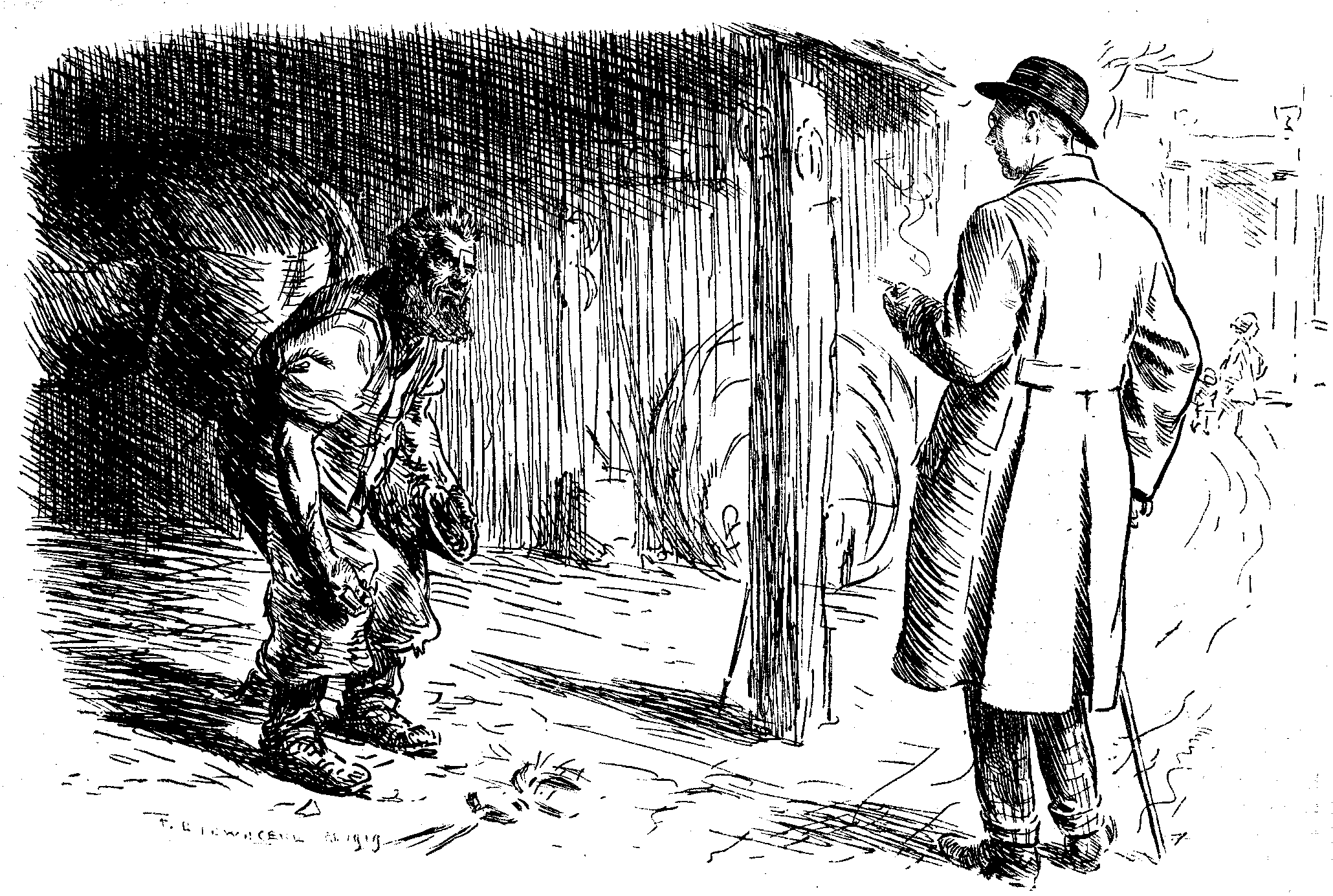
NEWS FROM THE SHIRES.
Customer. "WELL, JARVIS, WHAT'S THE LATEST?"
Farrier. "I HEAR AS HOW THAT ADMIRAL BEATTY IS LIKELY TO BECOME A PUBLIC MAN."
Customer. "HOW DO YOU MEAN?"
Farrier. "WHY, I HEAR SOME TALK OF HIM BEING MASTER OF THE QUORN."
THE BET.
The Colonel was, as usual, laying down the law.
"Economy!" he said with a snort; "economy's dead. No one cares about saving money any more. No one cares about the value of money. We are asked excessive prices and we pay them. We eat, drink and are merry—or approximately so—and be hanged to you! With the exception of the halfpenny stamp we put on circulars I can think of nothing that has not gone up or, in other words, lost buying power. I defy anyone to name a thing that hasn't."
He glowered fiercely and challengingly around.
"I repeat," he said, "that the purchasing power of money is not what it was in any respect. The other day, for instance, I bought a new hat. I used to pay a guinea; it is now thirty-two and six. And a worse hat probably. What do you think I was charged for soling and heeling shoes? One pound ten! And worse leather. That's partly what I mean by the loss of purchasing power; where the price may in some extraordinary way remain the same, the quality of the article paid for is inferior. There's a steady deterioration. Can anyone name a case where I am wrong?"
His red eyes again defied us.
"Yes, I can," said a meek voice.
The Colonel subjected the speaker to a long and ferocious scrutiny.
"You can'?" he said at last.
"Yes," replied the meek voice. "Will you bet on it?"
"Bet on it? Most certainly I will," said the Colonel, who has done fairly well in wagers in his time. "How much?"
"What you like," replied the meek voice.
"Very well," said the Colonel, "make it a tenner."
"With pleasure," was the rejoinder. "The bet is that I can't name a single thing which has not either increased in price or decreased in quality since the War?"
"Yes," said the Colonel.
We all sat up and waited, as though for the maroons in the old, old days.
"Well," said the meek voice, "the cost of pulling a communication cord is I still five pounds, and you can have just as good a pull as ever."
ON THE SAFE SIDE.
"Why, what's this, Ben, they're telling me?— Eighty and going to get a wife! Gaffer, I thought you'd surely be A snug old bachelor for life." "Well, Sur, ye see I allus meant To take ole Martha some fine day; But 'wed in haste and then repent' I heer'd as many folks did say. "But now, thinks I, there's sure no fear Through too much haste o' goin' wrong; "An', anyways, at eighty year I can't repent fur wery long."
THE GREATEST PATRIOT OF ALL: A public servant who did not strike during the War—Big Ben.
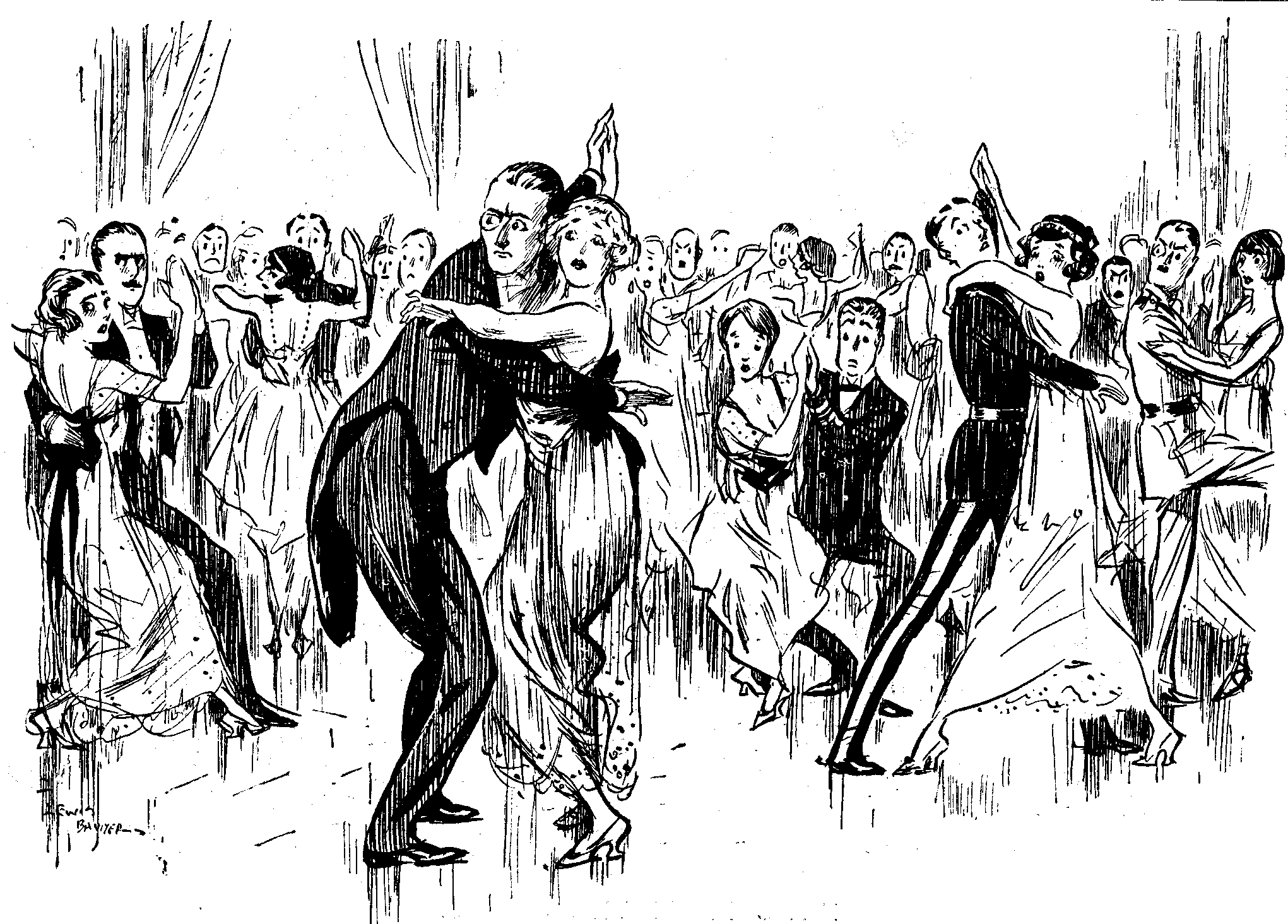
EFFECT ON BALLROOM IF, OWING TO THE STRIKE MANIA, THE MUSICIANS WERE SUDDENLY TO "DOWN INSTRUMENTS".
THE APPOINTMENT.
They tell me there is work for most, However tired they be, That there are Offices engrossed In finding me a well-paid post Of suitable degree; That there are businesses that itch To make the young lieutenant rich, Yet I have not discovered which Is itching after me. And this is strange; for I could shine In any place you please, Although, if there is any line Which is most obviously mine, It is the man of ease— The man whose intellect is such He never has to labour much, But does the literary touch In comfort at "The Leas." Or I could be a splendid Squire And watch the harvest grow, Could urge the reaper to perspire And put the cattle in the byre (If that is where they go), And every morning do the rounds Of my immense ancestral grounds With six or seven faithful hounds, And say, "It looks like snow." And there are moments when I feel The diplomatic call; No trickery would long conceal The state of things at Bubazeel When I was at the Ball, To spy across the "brilliant floors" On daughters of Ambassadors, And "obviate" impending wars By dancing with them all. A bishopric I can't afford, Though I could give it tone, And often when the people snored I've felt they would not be so bored By sermons of my own; But if the Secretaries cry For secretaries—here am I; Or nobly would I occupy The taxi-driver's throne. For I should beam across the street When people waved at me, And say, "My petrol's incomplete, I haven't had my bit of meat Nor yet my bit of tea, But just because I like your face I'll take you out to any place However distant from my base— And ask no extra fee." And yet I doubt could England bear To see my rest destroyed? A soul so delicate and fair Should simply saunter through the air And cultivate the void; One would not readily degrade One's loveliness in any trade, Only, of course, one must be paid For being unemployed.
A. P. H.
SMITH MINOR PROFFERS A REQUEST.
(An authentic document.)
Will you please send me a fountain pen because nearly every boy but me has a fountain pen and I should so like to have one because I often want to write something outside and I carn't and then when I come in I don't no what it is and I miss something out of my letter then when I have writen my letter I remember what it was and genulry I remember it in lesons and when I begin to write my next letter I have for goten it and it goes on like that till at last I remember it and then some times I don't rember it all and that is why I want a fontin pen.
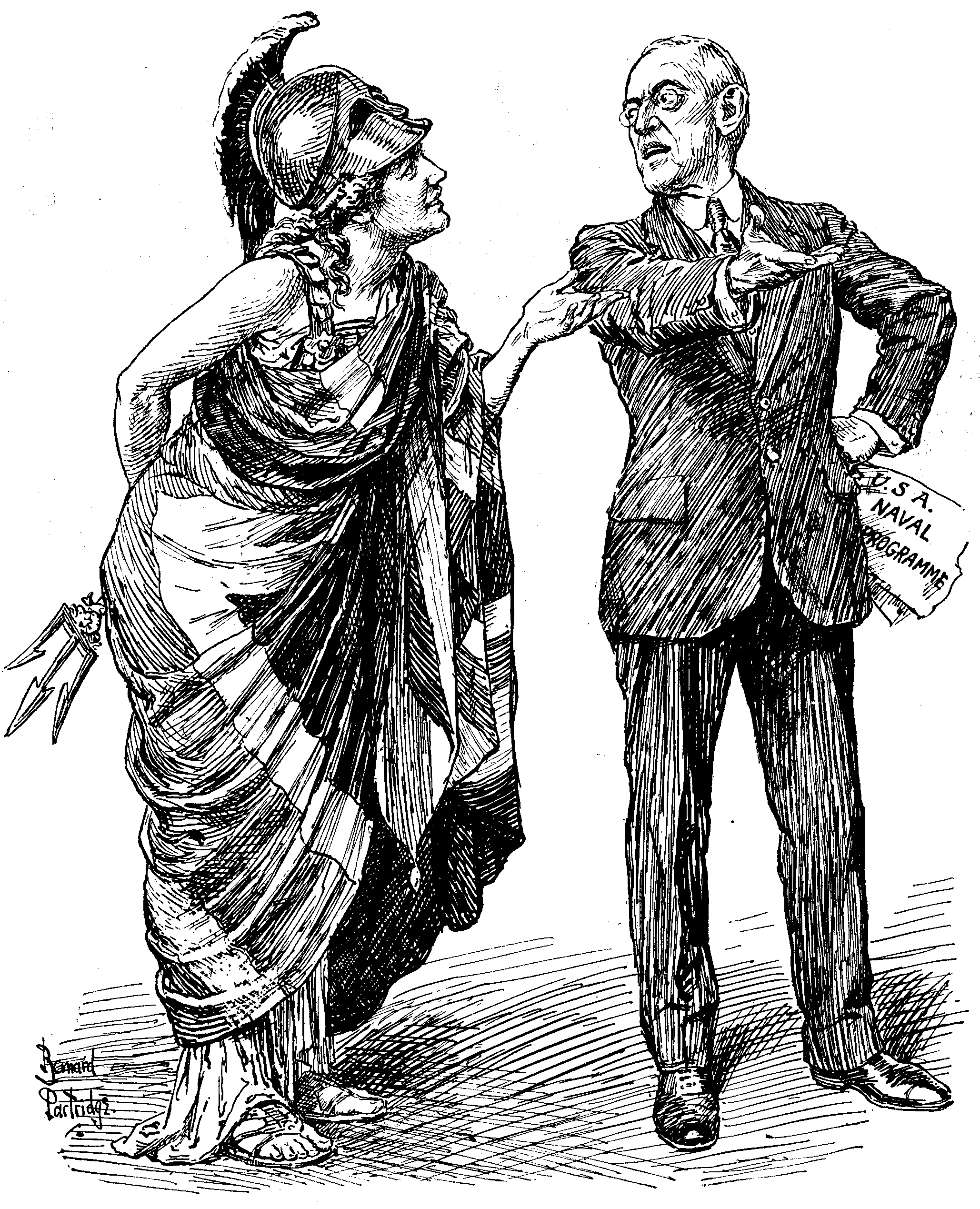
"DRY" HUMOUR.
PRESIDENT WILSON. "OUR FUTURE LIES UPON THE WATER!"
BRITANNIA. "ALLUDING, I PRESUME, TO YOUR PROHIBITION MOVEMENT?"
ESSENCE OF PARLIAMENT.
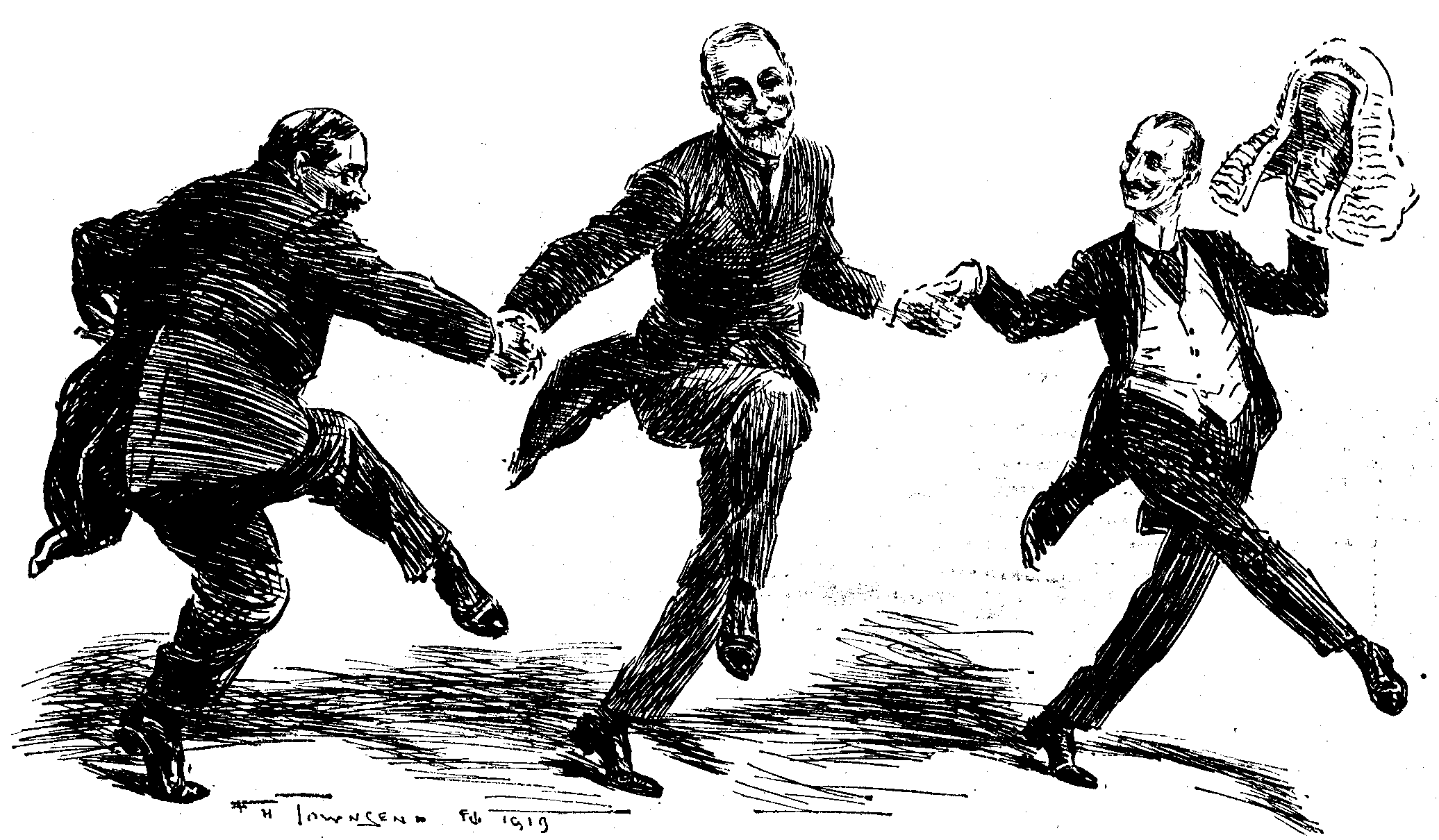
MR. LOWTHER TAKES THE CHAIR FOR "POSITIVELY THE LAST TIME." HIS ENTHUSIASTIC PROPOSER AND SECONDER (COLONEL MILDMAY AND SIR HENRY DALZIEL), BITTEN BY THE POPULAR CRAZE, PUT A BIT OF "JAZZ" INTO THE PROCEEDINGS.]
Tuesday, February 4th.—There is much virtue in horsehair. Few who attended the informal opening of the Third Parliament of KING GEORGE THE FIFTH would have guessed that under the full-bottomed wig and gorgeous black-and-gold robes of the dignified figure on the Woolsack lay the volatile personality of "F. E." He played his new part nobly. A trifling error in the setting of his three-cornered hat, whose rakish cock was for the moment reminiscent of the "Galloper," was quickly corrected on the advice of one of the Lords Commissioners at his side; and by the time the faithful Commons were admitted to hear the Commission read there was nothing to differentiate Lord BIRKENHEAD (as he had now become) from any previous occupant of his exalted position. Nor was there any lack of dignity in his delivery of the instructions to the Commons to "proceed to the choice of some proper person to be your Speaker"—though I fancy that when he bade them "repair to the place where you are to sit" he must have been tempted to add the words, "provided that you can find room there."
For the Lower House, when we returned there, was a seething mass of humanity. How many of the 707 duly elected Members were present I know not; but there were enough to swamp the floor and surge over into the Galleries. Seeing that the "Tubes" were closed and taxis few and far between, some of them were obliged to resort to unusual methods of locomotion. Sir HENRY NORMAN surprised the police in Palace Yard by arriving on a motor-scooter, and there is an unconfirmed rumour that the Editor of John Bull made his rentrée to the House in a flying-boat drawn by four canards sauvages. Anyhow, there they were, so thick and slab that Mr. DE VALERA, who was reported to have escaped from durance vile with the intention of presenting himself at the House and creating a disturbance, would have found it impossible to gain entry unless preceded by a charge of gelignite. As it was, none of the Sinn Feiners was present, nor indeed any representative of Irish Nationalism at all, and the proceedings were as orderly as a Quaker funeral.
Not that they were by any means dull. For both Colonel MILDMAY, who proposed, and Sir HENRY DALZIEL, who seconded, the re-election of Mr. LOWTHER as Speaker, spiced their compliments with humour. The former was confident that even if Woman appeared on the floor of the House the SPEAKER-ELECT'S "consummate tact" would be equal to coping with her artfullest endeavours to get round the rules of procedure; while the latter attributed his priceless gift of humour to "Scottish ancestry on the mother's side."
Horsehair again! I hardly recognised in the quietly-dressed Member who rose from the Bench behind Ministers to acknowledge these encomiums the man whose awe-inspiring appearance (when clothed in wig and gown) has quelled so many storms in the last four Parliaments. Let us hope that the fifth, of which, being the outcome of his famous Conference, he may in a sense be described as the "onlie begetter," will not disgrace its parentage.
Already there are elements of difficulty. Through the non-return of Mr. ASQUITH the Opposition has lost its head literally and is in some danger of losing it figuratively, for the remnant of the un-"couponed" Liberals and the Labour Party are at present acutely divided on the question upon whom the lost Leader's mantle should fall. Today Sir DONALD MACLEAN, as senior Privy Councillor, took the pas and was able from personal experience to give his conception of the ideal Speaker, who "must not only have good vision but be sometimes quite blind; not only have acute hearing but occasionally be almost stone-deaf." Fortunately the SPEAKER-ELECT can assume these physical defects at will; for, despite its quiet opening, I doubt if the new Parliament when it gets to work will prove precisely a Lowther Arcadia.
Wednesday, February 5th.—To the Lords again, where the SPEAKER-ELECT, attired in Court dress and accompanied by the SERGEANT-AT-ARMS dandling the Mace as if it ware a refractory infant, presented himself at the Bar to hear from the LORD CHANCELLOR the pleasing intelligence that HIS MAJESTY was convinced of his "ample sufficiency" to execute his arduous duties, and readily approved his election. Thereupon Sir COLIN KEPPEL swung the Mace on to his shoulder and escorted the SPEAKER, now confirmed in his rank, back to the Commons.
There was an unusual rush of Members to take the oath. This was not entirely due to the new Members, naturally desirous of completing their initiatory rites, but was shared by many of the older hands, for the good and sufficient reason that, until a Member is certified as having been duly sworn, he cannot recover his one hundred and fifty pounds deposit from the Returning Officer. In their zeal to be in a position to reimburse themselves Members crowded in such numbers to the tables that there was some danger that they would be overturned. As one of our Latinists remarked, "It looks as if we should have novae res outside and novae tabulae inside."
Thursday, February 6th.—The process, once immortalized by a Lords' reporter in the sentence, "A few Bishops looked in, swore, and went away again," went on in both Houses; but in the Commons in a more orderly fashion than yesterday. For the SPEAKER, ever ready, as he said on his election, "to carry out the old rules in a modern spirit," directed the waiting Members to form up in line. One of the Coalitionists evinced a little surprise. He had always understood that when coupons were issued queues were superfluous.
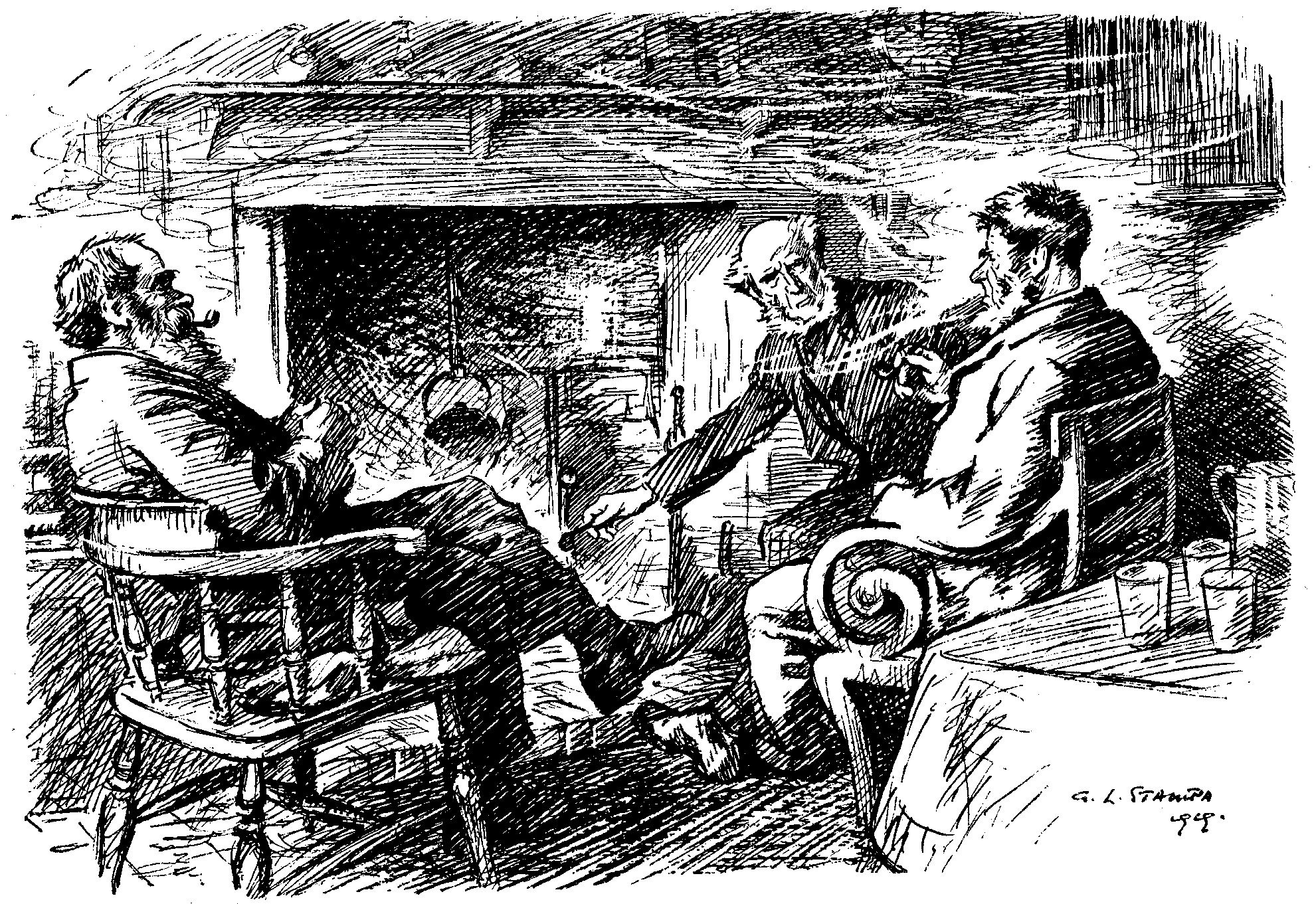
Donald (who a short time before had put the bottle in the cupboard "for another day" breaking long silence). "SAXPENCE FOR YOUR THOUGHTS, SANDY."
Sandy. "WEEL, I'M THENKIN' IT'S JEST TWA MEENITS SEN THE CLOCK STRUCK TWELVE—AN' IT'LL BE ANITHER DAY."
"Wanted a Certificated (Resilient) Lady Teacher for Std. V."—Times of India.
A sort of WINSTON in petticoats, we suppose.
TENDENCIES
(Being some extracts from the daily Press of, say, 1925).
.... The bi-monthly strike of Clyde workers took place yesterday. The proceedings were quite orderly. The matter in dispute this time is a very simple affair. The men, who are now working on a full half-hour a week basis at one hundred and sixty-eight hours' pay, with three snap meal-times of ten minutes each per day, are not pressing for any alteration in pay or hours, but demand the dismissal of Mr. John Smith, the managing director of one of the large shipbuilding yards, who rudely refused to fetch a pint of beer for one of the rivetters. The Government department dealing with strike questions is full up for three months yet, but hopes are entertained that, unless a critical by-election should intervene, it will be possible to deal with the matter at the expiration of that period.
.... Much interest was aroused last evening by the production of a new musical show, both the book and music of which have been written by natives of this country. A strong protest has been lodged by the United States Embassy.
.... A passenger on one of the Tube railways alleges that he entered a train at Oxford Circus Station last evening. No confirmation is as yet forthcoming, and the rumour must be treated with reserve.
.... The Peace Conference held a sitting yesterday and definitely decided that the ex-Kaiser should be tried one of these days. It is confidently stated in the inner circles of Paris that peace will inevitably be concluded within the next ten or twelve years.
.... Dancing still holds its own as the principal amusement of the bulk of the population. The latest dance, the Guzz-Jinx, which is danced on the hands with the right foot placed in the mouth of one's partner, is stated to be very graceful indeed. The correct music is provided by a band performing entirely on hair-combs and tea-trays.
.... A reduction is promised in the price of tobacco shortly. An ounce recently changed hands at a well-known Piccadilly shop at two hundred and seven pounds, but the new season's prices are not expected to be much above one hundred and fifty pounds.
A man was charged at Bow Street yesterday with endeavouring to ride in a motor-bus on Tuesday, the 12th of the month, when his permit was only for Thursday, the 15th of each month. He was severely cautioned and ordered to get a new calendar.
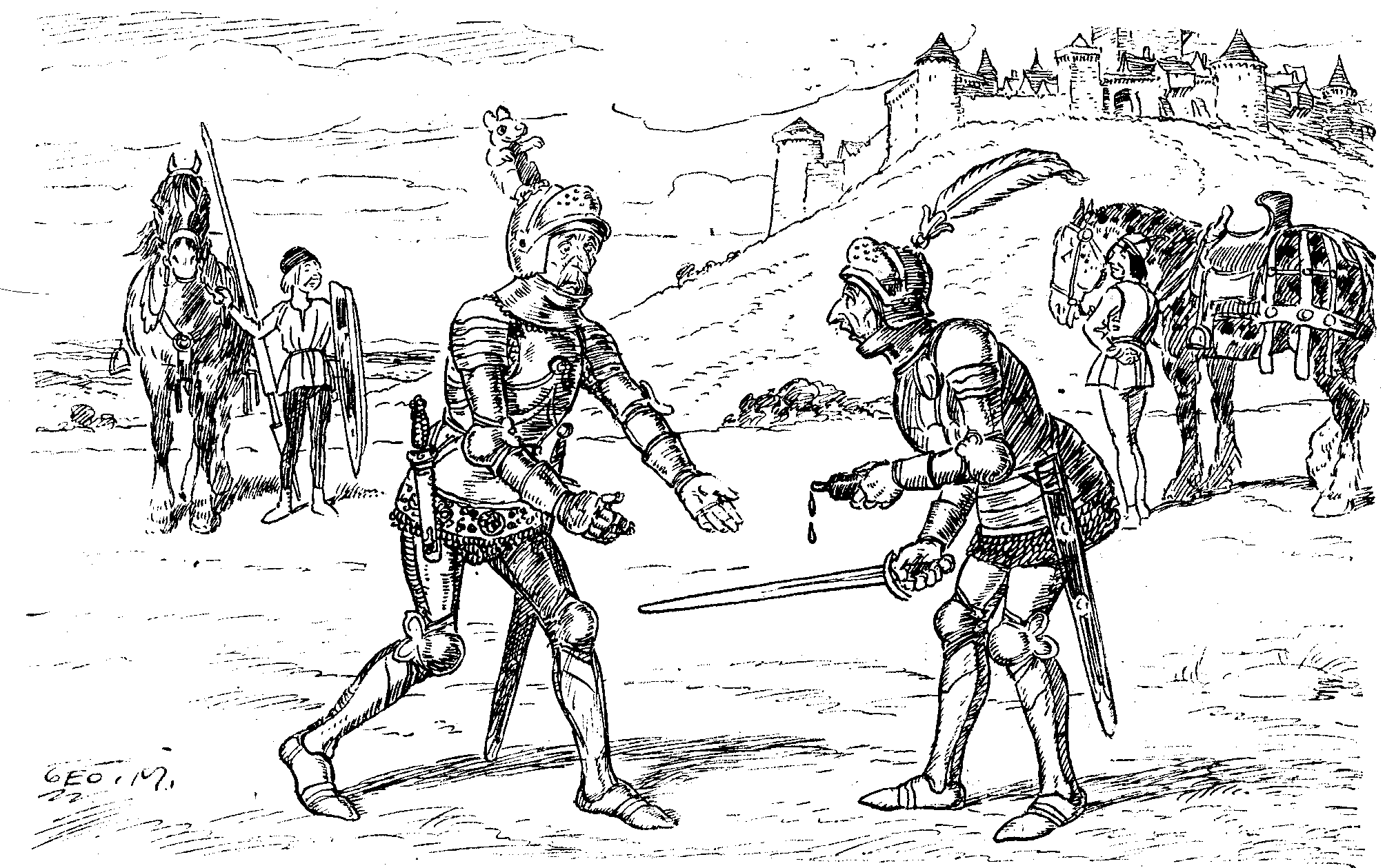
BEFORE THE COMBAT.
Excited Duellist. "WHAT ARE YOU DOING?"
Nervous Opponent. "I'M PUTTING MAGIC DROPS ON MY SWORD, WHICH WILL MAKE IT IRRESISTIBLE."
Excited Duellist. "BUT THAT'S NOT FAIR TO ME."
Nervous Opponent (relieved). "ALL RIGHT, YOU CAN HAVE SOME AND WE'LL CALL IT A DRAW."
A VALENTINE.
Dear Lydia, long before your time, When I was half the 'teen you own to, Don Valentine was in his prime, The world not yet the thing it's grown to. The postman then with double knocks This morning many a heart was thrilling, And brought a shining cardboard box With round red hearts in paper frilling. A simpler world, and well content With what seems small by modern measure; And winters came and roses went, Yet Time dulls pain as well as pleasure. Though, with this fashion out of date, His hand to-day weighs almost lightly If this my war-time chocolate Makes two dark eyes to shine more brightly.
HINTS FOR THE GARDEN.
To those who are about to re-establish their herbaceous borders it will come as a welcome surprise that restrictions as to the sale of the following foodstuffs by nurserymen have now been withdrawn:—
Stucky's Germania (Lamb's Ear).
Scolopendrium (Hart's Tongue).
No coupons will be required for these in future.
Fatsia Horrida.—This is no longer grown by nurserymen, but can be obtained at any butcher's, large quantities having recently arrived from Greece. Smith minor, possibly a prejudiced witness, says he gets it at school; that it is beastly and only another name for Cod Liver Oil.
Sambucus (the Elder).—A correspondent inquires if anything is known of the younger branch of this family. On being appealed to the Secretary of the Linnaean Society sent the following somewhat enigmatic telegram: "Recommend CLEMENCEAU non-Papa, who may know something of Uncle Sam."
Hydrangea.—This hardy shrub is so called as it was originally raised by the Ranger of Hyde Park. The American variety "radiata" succeeds well indoors if grown on hot-water pipes.
Pirus.—There are several varieties of this species. The best known, however, comes from Cornwall and was raised by the late Sir W.S. GILBERT, who introduced the Savoy cabbage. It is called the Pirus of Penzance.
DANCING DEMOBILISED.
[It is said that demobilised officers, anxious to dance, are finding it almost impossible to buy dress-shirts and evening pumps.]
Now that I've been demobilised I'm going again to dances— I do not care with whom or where, I'm taking any chances. And evening dress, I've been advised, Will never become transitional; Yet once or twice I've been surprised To find my khaki pals disguised In new dress suits and old trench boots, Which scarcely seems traditional. I met my Colonel at a hop Jazzing in his goloshes, With a dress-tie pert on a cricket-shirt That had shrunk in various washes; And my Major was doing the Donkey-Drop Between a couple of rippers— Yet his pink-and-white pyjama-top If anything seemed a shade de trop, And his faultless coat hardly echoed the note Of his worsted bedroom slippers. But the world long since went off its chump, And the cry of the man from France is, "I simply refuse to let shirts and shoes Prevent me from going to dances. I'll take the shine out of collar and pump, And their wearers will look silly When I once begin the Giraffe-Galump, The Chicken-Run and the Jaguar-Jump, The Wombat-Walk and the Buffalo-Bump, With a chamois vest on my manly chest, And football-boots and the smartest of suits They can cut in Piccadilly."
THE GRAND TRUNK LINE.
"The following are some alternative routes which could be used by people going home this evening from the City or West End:—
"Clapham Common.—By Elephant, trams and 'buses."—Evening News.
LOCAL COLOUR.
I ran upstairs after lunch to-day to see old Harris. He has the flat over mine, you know. In addition to this Harris is an author. Sometimes he even gets money for it.
"Doin' a bit of work to-day, Harris?" I remarked casually.
"I'm doing a little flying story," he informed me with dignity.
"Oh, yes," I agreed carelessly, then woke up and stared hard.
"Flying?" I repeated. "But what the—I mean, what do you know about flying, anyway?"
Brutality is the only thing with Harris. He was very hurt. He gasped and glared at me in a most annoyed manner.
"I know a pretty good lot," he announced with some asperity. "I've talked to dozens of pilots about it and I've read books on flying—and the newspapers—"
"And don't forget you once passed Hendon in the train too, old son," I soothed him. "I'd no idea you were so well up in it. Sorry I spoke. Let's see it; may I?"
Harris picked up a couple of sheets of paper from the desk and, coughing imposingly, proceeded to read out his masterpiece:—
"Lionel Marchant came slowly out of the hangar, drawing on his long fur gloves and studying his maps with an intent and keen face.
"His machine, a single-seater scout of the latest type, was just being wheeled out and now stood glistening in the bright autumn sunshine, which danced on the shining brasswork and threw deep shadows on the grass beneath.
"The airman swung lightly into his seat; a final word or two with his commanding officer and he flung over the levers and gave a sharp turn to the starting handle.
"The powerful engine in front of him woke into life deafeningly and, waving away the mechanics holding the wings, he pressed the clutch pedal and moved slowly forward.
"His face is very grim and determined—he throws across another lever and the low hum of the motor changes into a deep-throated roar. Gathering speed, he goes faster and faster—now he is in the air—now a little speck in the sky, heading for the enemy's lines—"
"Oh, no, please," I broke in feebly. "I can't stand any more just now. You're not seriously thinking of having this published, are you?"
As in a dream I took the manuscript from his fingers and gazed blankly at it whilst his indignant flow of speech passed harmlessly over my head.
"But, Harris," I said at length, with infinite compassion in my voice, "Harris, I love you as a brother, but this really is awful—why—well, listen here"—
"'As the second German machine came down on them in a steep dive Lionel gave a hasty glance behind him, where the huge engine raced madly, and shouted excitedly to his observer.
"'The latter, swinging the machine gun round sharply, took rapid aim and pressed the trigger—'"
I stopped.
"Well?" demanded the author icily.
"No, it's too frightful," I bleated. "Harris, this might conceivably be read by a real pilot. Heaven forbid, of course! And he'd simply hate this scout 'bus with the engine ahead to change into a 'pusher' two-seater in six paragraphs."
Harris was routed, absolutely demoralised. "They told me to put in lots of flying talk," he murmured abjectly, "and tons of local colour to make it lifelike."
"Yes," I said grimly, "but this colour's too local for words."
"Of course, if you think you could do it better yourself," Harris observed with heavy sarcasm, "well, then—"
"Certainly," I agreed heartily. "I don't mind showing you, Harris, seeing you're a pal of mine. Just pass the ink and let your uncle get to work."
Behold my effort!—
"'Orderly, what about tea?'
"'Very nearly ready, Sir.'
"'Right. Then I think a small piece of toast is indicated;' and he proceeded to hack the loaf to pieces with great vigour.
"'Hun over somewhere, sounds like,' said a sleepy voice as the throb of an engine was heard overhead.
"'Oh, I can't help his troubles,' observed the toast-maker airily. 'He's got no right to come at tea-time. In about half-an-hour or so I might think about—'
"Here the telephone bell rang.
"'Now that's a splendid joke,' said his unfeeling friend as he laid down the receiver. 'You've got to go up after that chap. They're getting your 'bus out now, so—'
"'What!' came in disgusted tones from the fireside. 'Don't be so dam funny. What do you mean?'
"'Not ragging, really, Bill. The C.O. said he wanted you to have a shot at that fellow. Run like a hare. You may catch him up over Berlin somewhere. I'll eat your toast for you.'
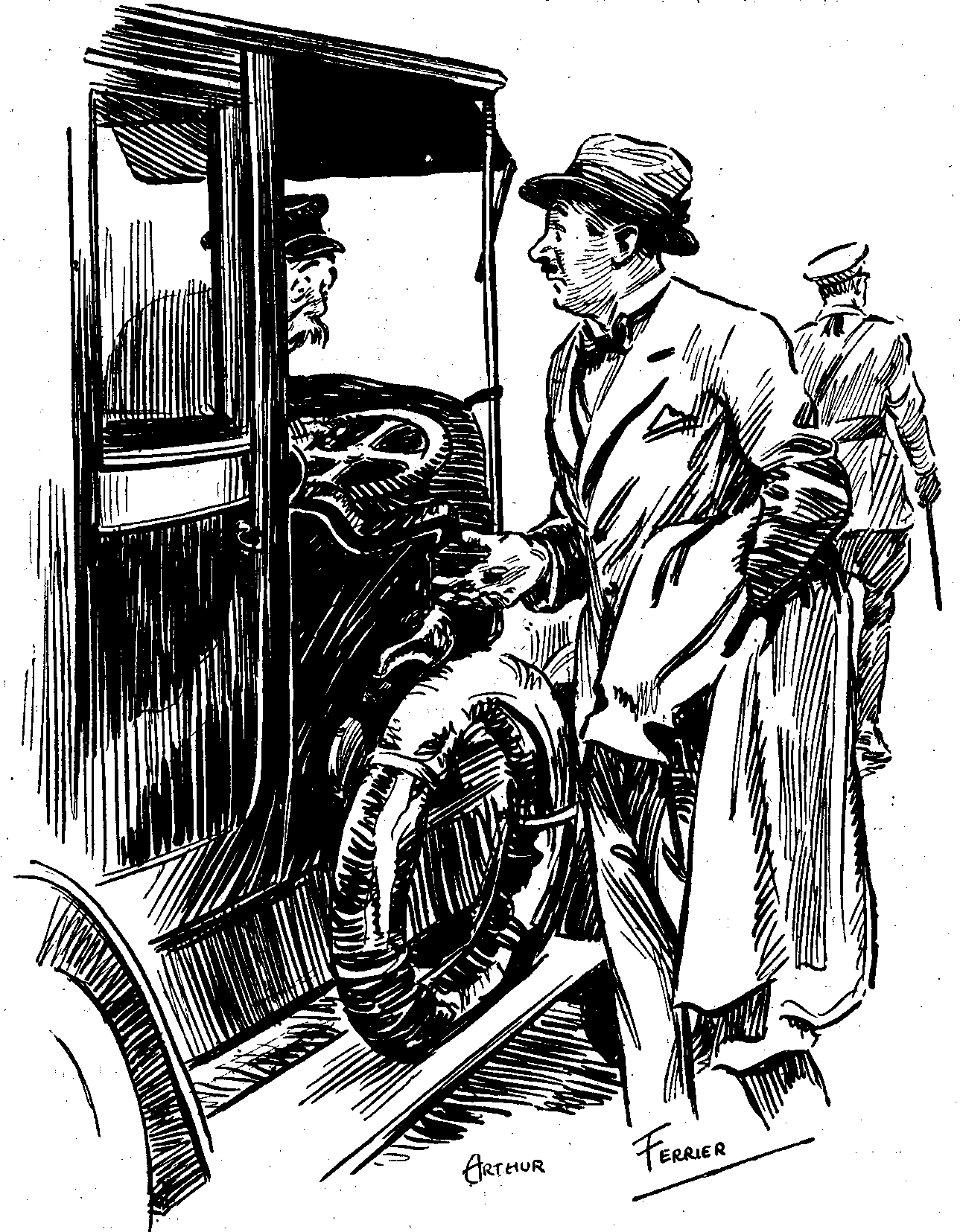
"I SAY, TAXI, I'VE ONLY GOT ENOUGH CHANGE TO PAY THE EXACT FARE. D'YOU MIND TAKING A CHEQUE FOR THE TIP?"
"'Oh, will you?' grunted the other. 'What awful rot it is! Oh, the devil—where's my hat?' and out he plunged.
"Two minutes later he was struggling into a heavy leather coat and, feeling thoroughly ill-used, climbed into his machine.
"The propeller was swung, emitting one hollow cough.
"'Switch off. All right, contact.'
"At the third attempt the engine remembered its manners and started up with a jerk. A few moments to get her running smoothly, a rapid test to see that she was 'giving her revs.' and the chocks, were waved away from the wheels.
"Within twenty yards he was off the ground and, throttle wide open, climbing towards the little white dot thousands of feet above.
"And all the time he was grumbling.
"'What awful rot it is! I've about as much chance of reaching the blighter as ... Running my engine to bits as it is ... May be able to cut him off when he's dropped his eggs.'
"Which is precisely what happened. The last gift had been thankfully received in a ploughed field beneath and the Hun was turning for home when the scout struggled to his level.
"The watchers on the ground saw the small machine press determinedly towards the bigger and a faint crackle of gun-fire broke out.
"It was answered by all the guns on board the enemy craft and the single-seater wavered undecidedly.
"Then he got his adversary fairly in his ring sight again and' risking everything, fired burst after burst.
"All at once the big machine heeled over and dived—a flash and a sudden sheet of flame from the engine and down dropped the raider, to dash to pieces in the French fields three miles below.
"Ten minutes later the British machine slithered on to the ground and switched off in front of the sheds.
"'By Jove, Bill,' said his friend, rushing up excitedly, 'that was the best show—'
"'Not so much of it,' interposed the 'hero,' scrambling out of his seat. 'What about my tea? Did you look after my toast for me? No, might have known you wouldn't.'"
WHAT OUR POETS HAVE TO PUT UP WITH.
"They who faced the terrors of the deep, Who guarded our snores-while we were asleep."
Scottish Paper.
"Though his career was entirely that of a public servant, he had personality and that self-evident efficiency which mark a man out for promotion."—Times.
That "though" is rather cynical.
RECIPROCITY.
[Discussing the unruliness of modern children, a correspondent in the Press suggests that parents might exchange offspring for educational purposes.]
Hector, one thought alone forbade Your stout progenitor to squirm Through all the months the Huns essayed To pink his epiderm— The thought that you, through what he'd done, Might find a better world, my son. Now must you do your bit for me, For, guided by the sage's lore, I mean to barter progeny With Brown, the man next door, And educate in place of you Bertram, his brazen-lunged Yahoo. Too long, too long have I been banned From giving what he's been denied, The checkings of a chiding hand, Impartially applied, But now he's going to get it, Hec (Though not exactly in the neck). Exile from your ancestral hut At first may fill your soul with pain; If so, this filial thought should cut Your tears off at the main: The hours he spends across my knee Will mean a better world for me.
IT HAPPENED IN IRELAND.
"Mr. —— held that purchased meat would be better than that supplied by contractors, who were not saints. He knew of one case where cattle were actually killed after they died."—Irish Times.
"The following has been issued by the Sinn Fein Executive:—
"At the weekly meeting of the Executive it was unanimously decided to appeal to the subscribers to the Mansion House Anti-Subscription Fund."—Irish Times.
"This enabled him [Mr. Bottomley] to provide a sum sufficient to yap the other shareholders 12. in the pound."—Evening Paper.
We always thought him a bit of a dog.