Volume 156 — ESSENCE OF PARLIAMENT.
Reading edition
Monday, March 31st.—Colonel WILLIAM THORNE has the credit of eliciting from the Government the most hopeful statement about Peace which has yet been made. To the hon. and gallant Member's suggestion that May 1st should be declared a general holiday, if Peace was signed before that date, Mr. BONAR LAW replied that it would be considered.
It is fortunate that the PARLIAMENTARY SECRETARY TO THE BOARD OF TRADE possesses a most imperturbable character. He is daily bombarded with the most diverse questions regarding the effects of the Government's fiscal policy. The paper manufacturers are being ruined because paper is being allowed in; export traders are suffering because glass bottles are kept out; the textile trades cannot compete with their foreign rivals because of the high price of olive-oil. But for all inquirers Mr. BRIDGEMAN has a soft answer, delivered in level tones, discouraging further catechism.
A delightful inconsistency is one of Lord HENRY CAVENDISH-BENTINCK'S many claims upon the affection of the House. Not long ago he wrote a book in praise of Toryism as a democratic creed; so it was perfectly natural that when Mr. CECIL HARMSWORTH (a Coalition Liberal) had explained that law and order must be restored before an inquiry could usefully be held into the causes of the Egyptian riots Lord HENRY should burst out with, "When will my hon. friend begin to apply Liberal principles?"
Mr. BOTTOMLEY is the latest convert to "P.R.," as the result of a mock-election in which he came out top of the poll, with the PRIME MINISTER second, Mr. HOGGE third, and Messrs. BALFOUR and ASQUITH among the "also ran;" but Mr. BONAR LAW, who can be very dense when he likes, did not see in that an argument for the general adoption of the system.
The "Wee Frees" made a last and unavailing attempt to defeat the new Military Service Bill. Mr. GEORGE THORNE, Major HAYWARD and others made great play with the PRIME MINISTER'S "No Conscription" pledge, and Mr. NEWBOULD in a maiden speech declared that what West Leyton had said yesterday England would say to-morrow. But it was noticeable that not one of the opponents of the Bill was unwilling to give the Government the powers they required if they were really necessary.
Mr. CHURCHILL revealed himself in a new rôle as a financier, and proved to his own satisfaction that the Army Estimates of £506,500,000 would, if properly manipulated, work out at little more than a fourth of that amount. Between now and the Budget Mr. CHAMBERLAIN might do worse than get his versatile colleague to explain away the National Debt.
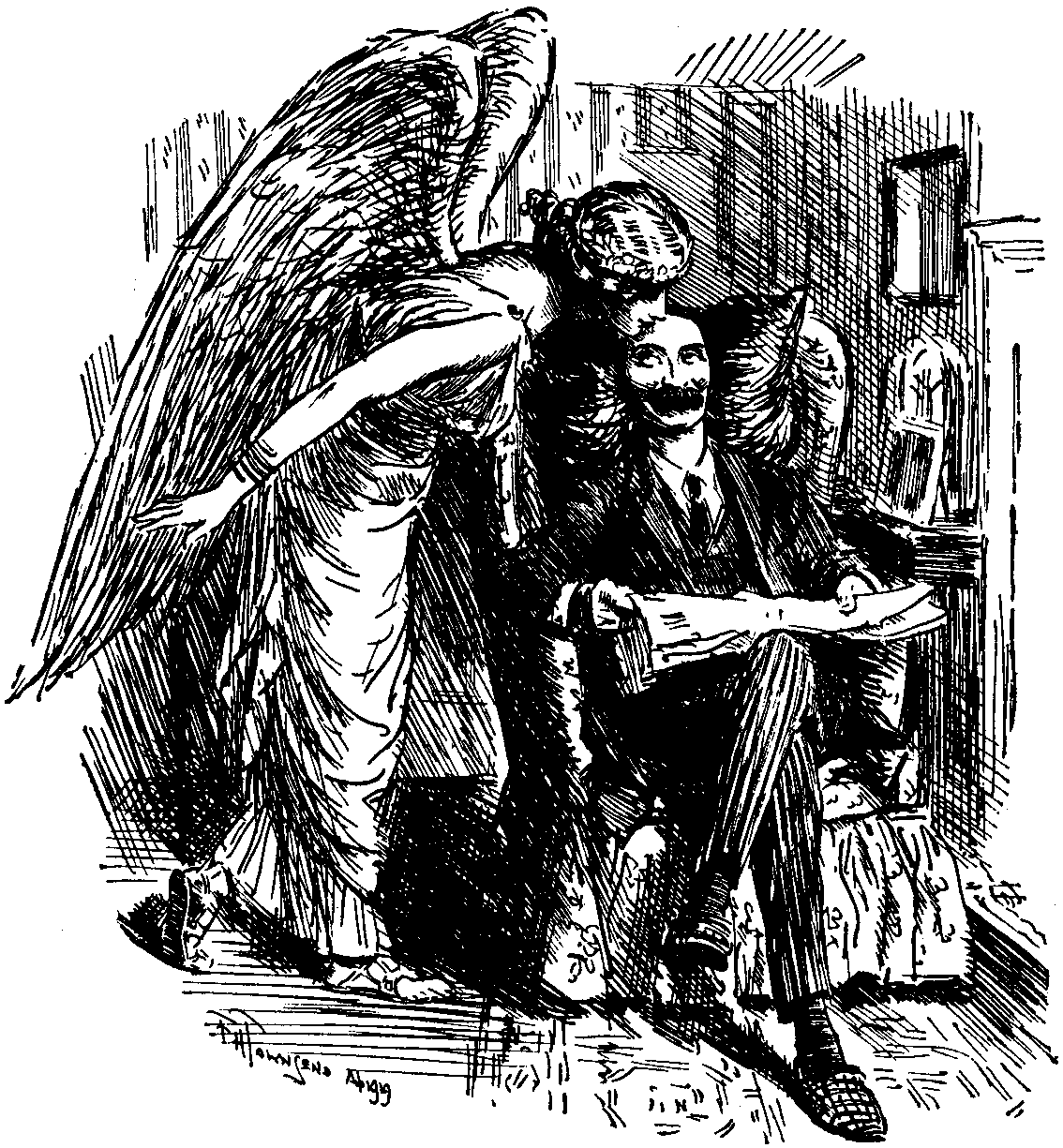
THE PROMISE OF MAY.
Peace
. "IF YOU'RE WAKING, CALL ME EARLY, CALL ME EARLY, BONAR DEAR, FOR I'M TO BE QUEEN OF THE MAY, BONAR; I'M TO BE QUEEN OF THE MAY."
Tuesday, April 1st.—Twenty years ago there used to be a not infrequent headline in The Times, "The Duke of Devonshire on Technical Education," which always struck on my frivolous spirit with a touch of infinite prose. It is the same nowadays, I regret to say, with a Lords' debate on the national resources. The Upper House is filled with eminent financiers—men who think in millions and who under our glorious Constitution may not propose an expenditure of sixpence without the consent of Tom, Dick and Harry in the Commons—and they all talk the most excellent good sense. But whether such unimpeachable truisms as that "this huge Debt is going to be a terrible handicap to this country" (Lord LANSDOWNE), or that "what applies to private credit and private economy may be in the main taken to apply to public economy and also to public credit" (Lord CREWE), are going to have much effect upon the demands of the Labour Party, to whom they were directly addressed, I am rather inclined to doubt.
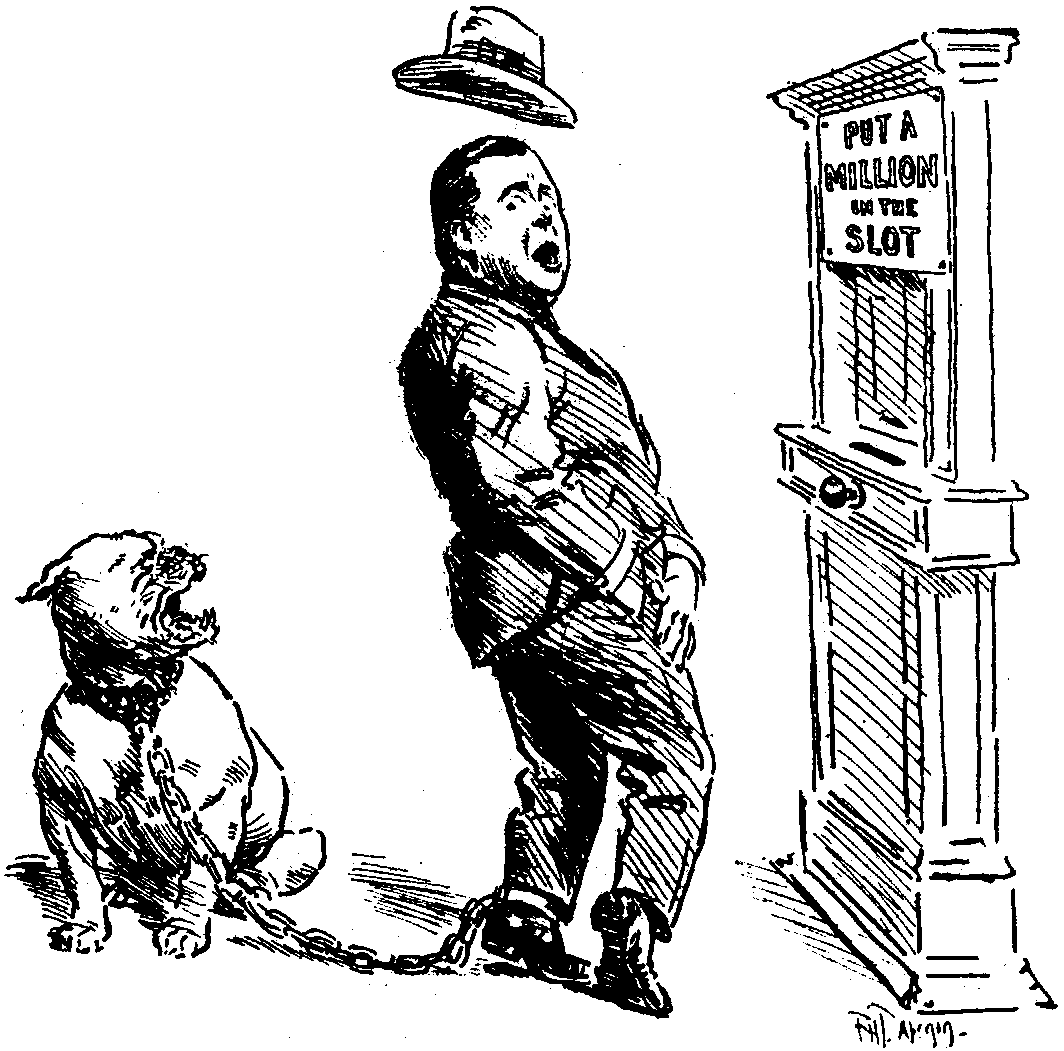
It is refreshing to note, however, that the Commons had a brief spasm of economy. Under the financial resolution of the Ways and Communications Bill the new Minister would have had almost unlimited powers of initiating great enterprises without the consent of Parliament. Mr. R.J. MCNEILL alluded (without acknowledgment to Mr. Punch) to the hero Eric; or, Little by Little, and urged that not even "a Napoleon of administration" ought to be trusted with a blank cheque. He rather spoilt a good case by referring to the new Minister's financial relations with his late employers, the North-Eastern Railway; but his argument was so far successful that Mr. BONAR LAW undertook first that a Treasury watchdog should be permanently installed in the new Ministry, with instructions to bark whenever he saw any sign of extravagance; and, secondly, that the Minister should not have power to initiate any enterprise involving large expenditure—he suggested a million as a moderate limit—without the direct sanction of Parliament.
After this achievement Members felt that a rest was necessary. So the Housing Bill was postponed, and after two or three Scottish Bills had received a second reading the House counted itself out, and Members went to their dinners feeling as comfortably virtuous as the Boy Scout who has done his good deed for the day.
Wednesday, April 2nd.—The unemployment donation was the theme of innumerable inquiries. The MINISTER OF LABOUR was forced to admit that Parliament had at present furnished him with no direct authority to spend a million or so a week on this form of out-door relief, but hoped that it would be kind enough to do so when the Appropriation Bill came along. A statement that in Ireland men were coming for their donation in motorcars aroused the sympathy of Mr. JACK JONES, who said that surely they were entitled to an occasional ride, but did not go so far as to suggest that the Government should organise a service of cars to be at their disposal.
A suggestion to incorporate in the Army Annual Bill one of Dora's most stringent regulations for the prevention of criticism upon military matters aroused much indignation. Mr. BEN TILLETT observed that, if it were retained, Lord NORTHCLIFFE, Mr. BOTTOMLEY and even Sir HENRY DALZIEL might soon be conducting their various journals from a prison-cell. This possibility may have mitigated but it did not wholly remove the objections to the clause, which Mr. CHURCHILL ultimately withdrew.
Treasury Bulldog (to Minister of Transportation). "ERIC—NAUGHTY!"
A debate on the popular theme, "Make Germany Pay!" was initiated by Col. CLAUDE LOWTHER, who not long ago produced a specific scheme for extracting twenty-five thousand millions from the enemy—a scheme which by its unconventional handling of the rules of arithmetic excited the amazed admiration of professional financiers. Possibly Mr. BONAR LAW, as ex-Chancellor of the Exchequer, was jealous because he had not thought of it first. At any rate he subjected the plan to so much caustic criticism that Col. LOWTHER, having appealed in vain for the protection of his namesake in the Chair, walked out of the House.
Thursday, April 3rd.—Some of NAPOLEON'S many complaints of his treatment at St. Helena concerned the cost and quality of his food. The exile of Amerongen need have no fears on that score should the Allies decide to remove him to Longwood, for the present Governor has been so successful in keeping down the price of foodstuffs that the merchants of the island have petitioned for his recall.
The CHANCELLOR OF THE EXCHEQUER has so far relaxed his non-possumus attitude on the joint income-tax question as to consent to receive a deputation of Members interested, and even to allow them to be accompanied by a small number of ladies. Mr. CHAMBERLAIN, by the way, has exchanged his hereditary monocle for a pair of ordinary spectacles, which may account for his taking a less one-sided view of this question.
Mr. T.P. O'CONNOR now enjoys the distinction of being the "Father" of the House of Commons, having sat there uninterruptedly since the General Election of 1880. Perhaps his new dignity sits rather heavily on his youthful spirit, for his speech on the Irish Estimates was painfully lugubrious. He took some comfort from a statement in The Times that "We are all Home Rulers now," but as a veteran journalist he is probably aware that what The Times says to-day it will not necessarily say to-morrow.
"Leave politics alone and give us decent houses for our people and better education for our children" was Sir EDWARD CARSON'S prescription for invalid Erin; and Mr. IAN MACPHERSON, making his first speech as Chief Secretary, indicated that he meant to apply it. But the patient is suffering from so many disorders at present that she must have a tonic—with iron in it—before her Constitution can be regarded as completely restored.
P.B.
Oft when the world was bent Solely on killing Heard we in Parliament PEMBERTON billing. Now the Dove hovers near, Now the League's brewing, May we not hope to hear PEMBERTON cooing?