Volume 153 — THE LITERARY ADVISER.
Reading edition
No, he does not appear in the Gazette. War establishments know him not and his appointment throws no additional labour upon the staff of Messrs. COX AND CO. Unofficially he is known as O.C. Split Infinitives. His duties are to see that the standard of literary excellence, which makes the correspondence of the Corps a pleasure to receive, is maintained at the high level set by the Corps Commander himself. Indeed the velvety quality of our prose is the envy of all other formations.
Apart from duties wholly literary, he is also O.C. Code Names. The stock-in-trade for this skilled labour is an H.B. pencil and a Webster Dictionary. The routine is simplicity itself. As soon as anybody informs him of a new arrival in the area he fishes out the dictionary, plays Tit-Tat-Toe with the H.B., writes out the word that it lands upon at the end of his rhyme, and, hey presto! there is another day's work done.
But one day, for the sake of greater secrecy, it became necessary to rename all the units of the area, and the Literary Adviser suddenly found himself put to it to provide about three hundred new Code Names at once. Heroically he set to work with his dictionary, his H.B. pencil, and his little rhyme. For two days the Resplendent Ones in the General Staff Office bore patiently with the muttering madman in the corner. For two days he fluttered the leaves of his dictionary and whispered hoarsely to himself, "Tit-tat-toe, my-first-go, three-jolly-nigger-boys-all-in-a-row," picking out word after word with unerring accuracy until the dictionary was a waste of punctures and three generations of H.B.'s had passed away. Before the second day was out the jingle had done its dreadful work. It was as much as the clerks could do to avoid keeping step with it. The climax came when the Senior Resplendent One, looking down at the telegram he was writing, found to his horror that he had written, "Situation quiet Tit-Tat-Toe. Hostile artillery activity normal Tit-Tat-Toe," and so on, substituting this abomination in place of the official stop, ("Ack-Ack-Ack") throughout.
It was enough. Still gibbering, the Literary Adviser was hurled forth from the office and told to work his witchcraft in solitude.
Paler, thinner and older by years he emerged from his retirement triumphant, and the new code names went forth to a flourish of trumpets or rather of the hooters of the despatch-riders.
Then it began. For days he was subjected to rigorous criticisms of his selection. "Signals" tripped him up first by pointing out two units with the same name, and they also went on to point out that the word was spelt "cable" in the first instance and "cabal" in the second. The gunners, working in groups, complained bitterly that a babel had arisen through the similarity of the words allotted to their groups. One infuriated battery commander said it was as much as he could do to get anyone else on the telephone but himself.
Touched to the quick by criticism (when was it ever otherwise amongst his kind?) the Adviser set aside his real work (he was, of course, writing a book about the War) and applied himself to, the task of straightening the tangle. Obviously the ideal combination would be for each unit to have a code name that nobody could mistake no matter how badly it was pronounced. And to this ideal he applied himself. Often, on fine afternoons, the serenity of the country-side was disturbed by the voice of one crying in the wilderness, "Soap—Silk—Salvage—Sympathy," to see if any dangerous similarity existed. At dinner a glaze would suddenly come over his eyes, his lips would move involuntarily and mutter, as he gazed into vacancy, "Mustard—Mutton—Meat—Muffin."
Histrionic effort played no small part in these attempts and led to a good deal of misunderstanding, for he felt it incumbent on him to try his codes in every possible dialect. Instead of the usual cheery "Good morning," a major of a famous Highland regiment was scandalised by an elderly subaltern blethering out, "Cannibal—Custard—Claymore—Caramel," in an abominable Scotch accent. Another day (on receipt of written orders) he was compelled to visit the line to see if things had been built as reported, or, if it was just optimism again. Half-an-hour later a sentry brought him down the trench at the point of the bayonet for muttering as he rounded the traverse, "Galoot—Gunning—Grumble—Grumpy," in pseudo-Wessex. Naturally, to Native Yorkshire this sounded like pure Bosch.
Ah! but he won through in the end. The man who has stood five years of unsuccessful story-writing for magazines is not the kind to let himself be beaten easily. There could be no doubt of the final result. When the revised list was issued the response to the inquiry, "Hullo, is that Sink?" was met by a "No, this is Smack," that crashed through the thickest intellect.
But vaulting ambition had o'erleapt itself. As a covering note to the new issue he had put up the following letter:—
"Ref. G K etc., etc., of 10th inst. On November 3rd all previous issues of Code Names will be cancelled in favour of the more euphonious nomenclature which is forwarded herewith."
A shriek of joy echoed through the corps. "Euphonious!" What a word! What a discovery in a foreign country! The joy of the signal operators, on whom something of the spirit of the old-time bus-drivers has descended, was indescribable. You had only to pick up the receiver at any time and the still small voices of the busy signal world could be heard chortling, "Hullo-oo? Hullo, Euphonious! How's your father? Yes, give me Crump." Or, "No, I can't get the General; he's left his euphonious receiver off."
Poor Euphonious (he has never been called by anything else since)—they have threatened to make him O.C. Recreations for Troops.
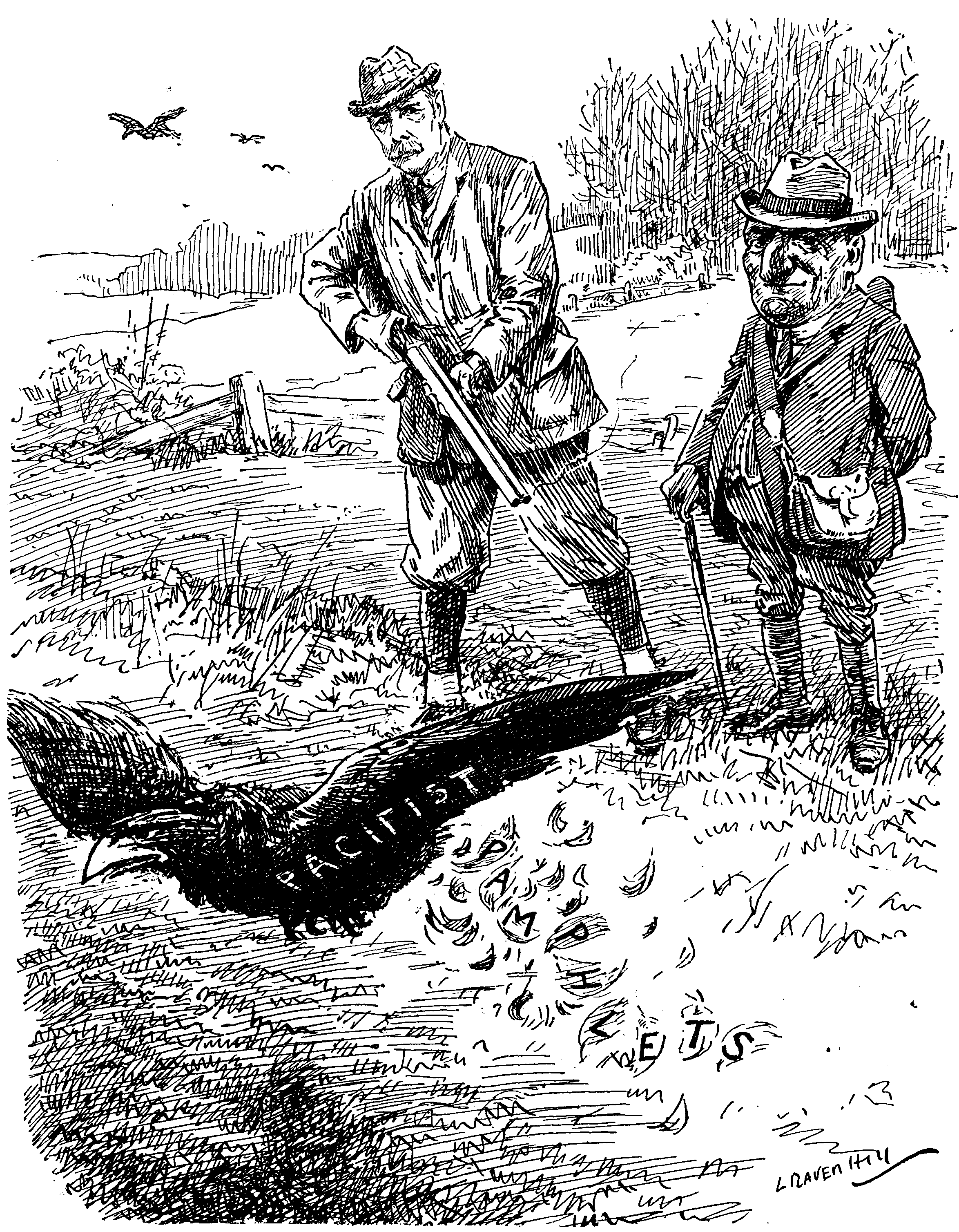
BIRDS OF ILL OMEN.
MR. PUNCH. "ONLY GOT HIM IN THE TAIL, SIR."
THE MAN FROM WHITEHALL. "YES, BUT I MEAN TO GET THE NEXT ONE IN THE NECK."
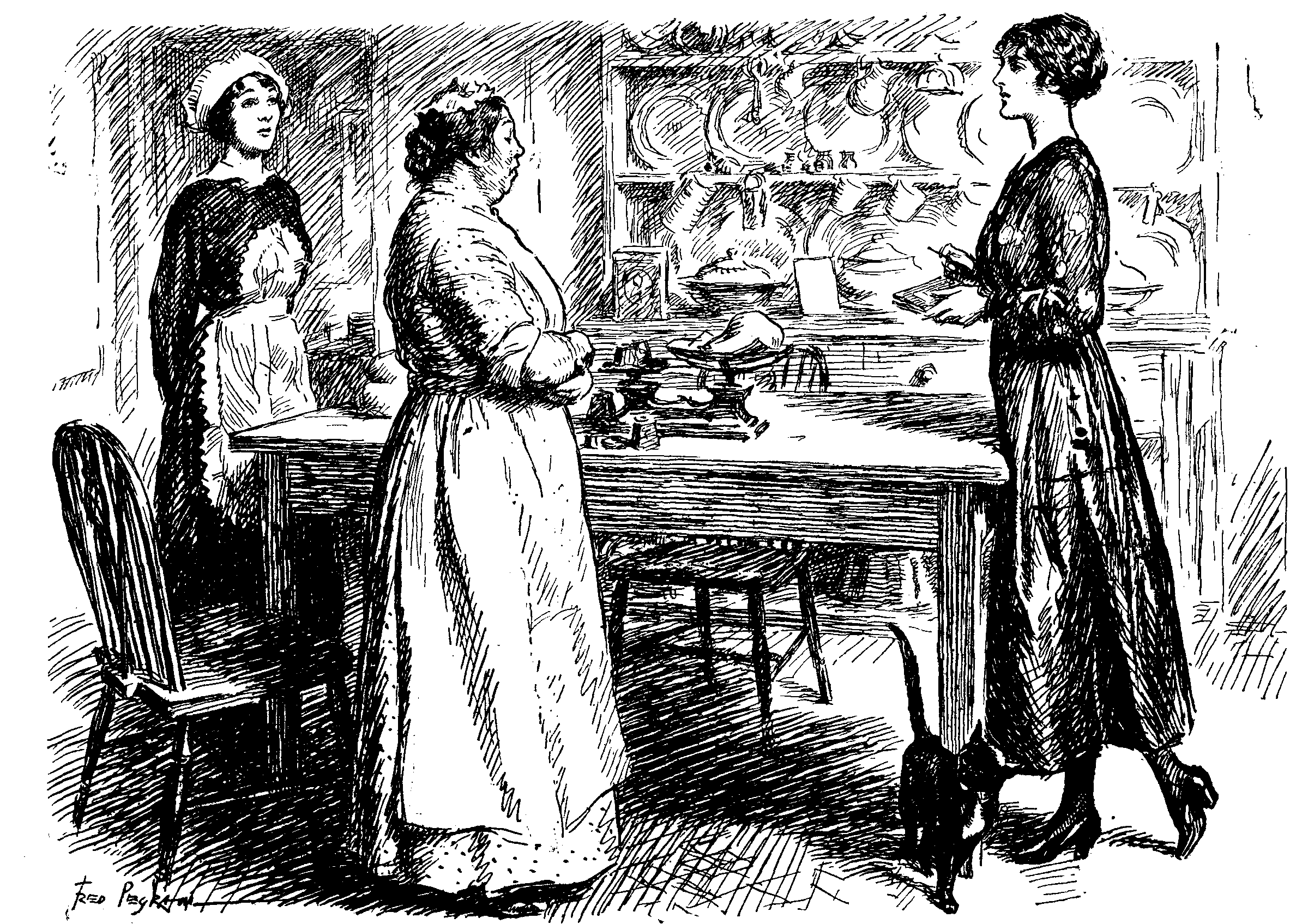
Mistress. "I HOPE YOU'RE DOING WHAT YOU CAN TO ECONOMISE THE FOOD."
Cook. "OH, YES'M. WE'VE PUT THE CAT ON MILK-AN'-WATER."
PARS WITH A PUNCH.
ALL THE REAL NEWS ABOUT MEN, WOMEN AND THINGS. BY OUR RAMBLING GOSSIP. (With acknowledgments to some of our contemporaries.)
A Long-Felt Want.
The opening, next week, of a Training School for Bus and Tube Travellers will, it is hoped, supply a long-felt want in the Metropolis. I understand that a month's course at the establishment will enable the feeblest of mortals to hold his own and more in the fearful mêlée that rages daily round train and vehicle. I have a prospectus before me as I write; here are some of its sub-heads: "The Strap-Hanger's Stranglehold," "Foot Frightfulness," "How to Enter a Bus Secretly," "The Umbrella Barrage," "Explosives—When their Use is Justified," "What to do when the Conductor Falls off the Bus." This certainly promises a speedy amelioration of present-day travelling conditions.
Timbuctoo Tosh.
Last week, when all those ridiculous rumours anent Timbuctoo were flying about, you will remember how I warned you to set no faith in them. You will admit that I was a good counsellor. Nothing has happened at Timbuctoo. I doubt very much whether anything could happen there.
Hush!
On the other hand, keep your eye on a spot not a thousand miles away from Clubland. Something will certainly happen there some day, and, when it does, bear in mind that I warned you.
Amazing Discovery.
Mr. ROOSEVELT'S discovery that, unknown to himself, he has been blind in one eye for over a year, is surely surpassed by the experience of Mr. Caractacus Crowsfeet, the popular M.P. for Slushington, who has just learnt, as the result of a cerebral operation, that he possesses no brain whatever. "It is indeed remarkable," said Mr. C. to me the other day, "for I can truthfully assert that in all my arduous political labours of the past ten years I have never felt the need or even noticed the absence of this organ." He coughed modestly. "I have always maintained that in politics it is the man, not the mind, that counts."
She Has One!
Mrs. Zebulon Napthaliski proposes to spend the winter on her Brighton estate. "Yes—I have received my sugar card," she told me, in answer to my eager query. "More than that I cannot say."
Fare and Foliage.
That charming fashion of decorating the dinner-table with foliage will be all the rage this winter. Well-known London hostesses, basket on arm, may daily be seen in Mayfair garnering fallen leaves from lawn, path or roadside. Some very daring Society women are dispensing altogether with a cloth, the table being covered with a complete layer of leaves. I doubt, however, whether this will become popular, guests showing a tendency to mislay their knives and forks in the foliage.
A Bon Mot.
Have you heard the latest bon mot that is going the round of the clubs? Mrs. Savory Beet, of Pacifist fame, has, as you will recall, announced her intention of taking up war work. "Ah!" was the comment of a cynical bachelor, "it was a case of her taking up something or being taken up herself!" His audience simply screamed with laughter.
Watch Out!
Don't be surprised if you hear of some sensational political developments in the near future. The Minister who said recently that the inevitable sequel to war was peace, was, in the opinion of those competent to judge but, by reason of their official position, unable to criticise, hinting at proposals which, if the signs and portents of the time go for anything, would have far-reaching effects on the question of Electoral Representation. I will say no more. Time alone will disclose my meaning.
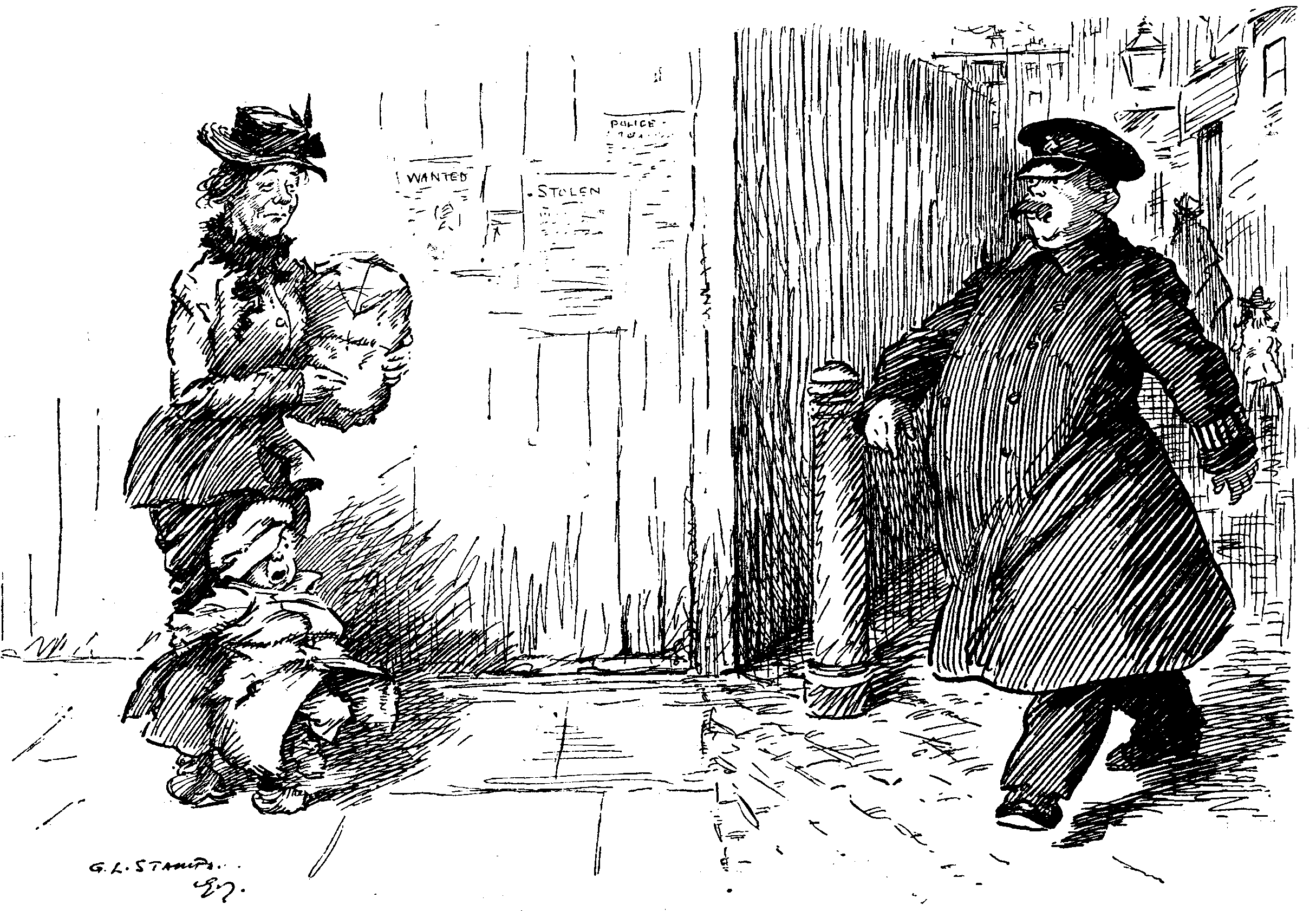
Urchin (with an inborn terror of the Force). "OO, MUVVER! IT WON'T, WILL IT?"
OMINOUS.
"——went every morning to a firm of sausage-makers by whom he was employed as a horse-dealer."—Irish Paper.
"Rome, Saturday.
"The announcement is made to-day of the award by the King [of Italy] of gold medals to Lieutenant Giuseppe Castruccio and I sentence him to three months' hard."—Manchester Evening Chronicle.
When will British journalists learn not to interfere with the internal affairs of friendly nations?
THE LAST MATCH.
This is the last, the very, very last. Its gay companions, who so snugly lay Within the corners of their fragile home, All, all are lightly fled and surely gone; And their survivor lingers in his pride, The last of all the matches in the house; For Mr. Siftings says he has no more, And Siftings is an honourable man, And would not state a fact that was not so. For now he has himself to do without The flaming boon of matches, having none, And cannot furnish us as he desires, Being a grocer and the best of men, But murmurs vaguely of a future week When matches shall be numerous again As leaves in Vallombrosa and as cheap. Blinks, the tobacconist, he too is spent With weary waiting in a matchless land; What Siftings cannot get cannot be got By men like Blinks, that young tobacconist, Who tried with all a patriot's fiery zeal To join the Army, but was sent away For varicose and too protuberant veins; And being foiled of all his high intent Now minds the shop and is a Volunteer, Drilling on Sundays with the rest of them; He too, amid his hoards of cigarettes, Is void of matches as he's full of veins. So here's a good match in a naughty world, And what to do with it I do not know, Save that somehow, when all the place is still, It shall explode and spurt and flame and burn Slowly away, not having thus achieved The lighting of a pipe or any act Of usefulness, but having spent itself In lonely grandeur as befits the last Of all the varied matches I have known.
OUR SAMSONS.
"Wanted at once.—Reliable Man for carrying off motor lorry."—Clitheroe Advertiser.
"To-day the man possesses a second tumb, serviceable for all ordinary purposes."—Belfast Evening Telegraph.
In these days of restricted rations it seems a superflous luxury.
"Diamond Brooch, 15 cwt., set with three blue white diamonds; make a handsome present; £9 9s."—Derby Daily Telegraph.
It seems a lot for the money; but personally we would sooner have the same weight of coals.