Volume 153 — ESSENCE OF PARLIAMENT.
Reading edition
Monday, November 19th.—Such a rush of Peers to the House of Commons has seldom been seen. Lord WIMBORNE, who knows something of congested districts, arrived early and secured the coveted seat over the clock. Lord CURZON, holding a watching brief for the War Cabinet, was only just in time to secure a place; and Lord COURTNEY and several others found "standing room only." If we have many more crises Sir ALFRED MOND will have to make provision for strap-hangers.
"His foil was carefully buttoned." MR. ASQUITH.
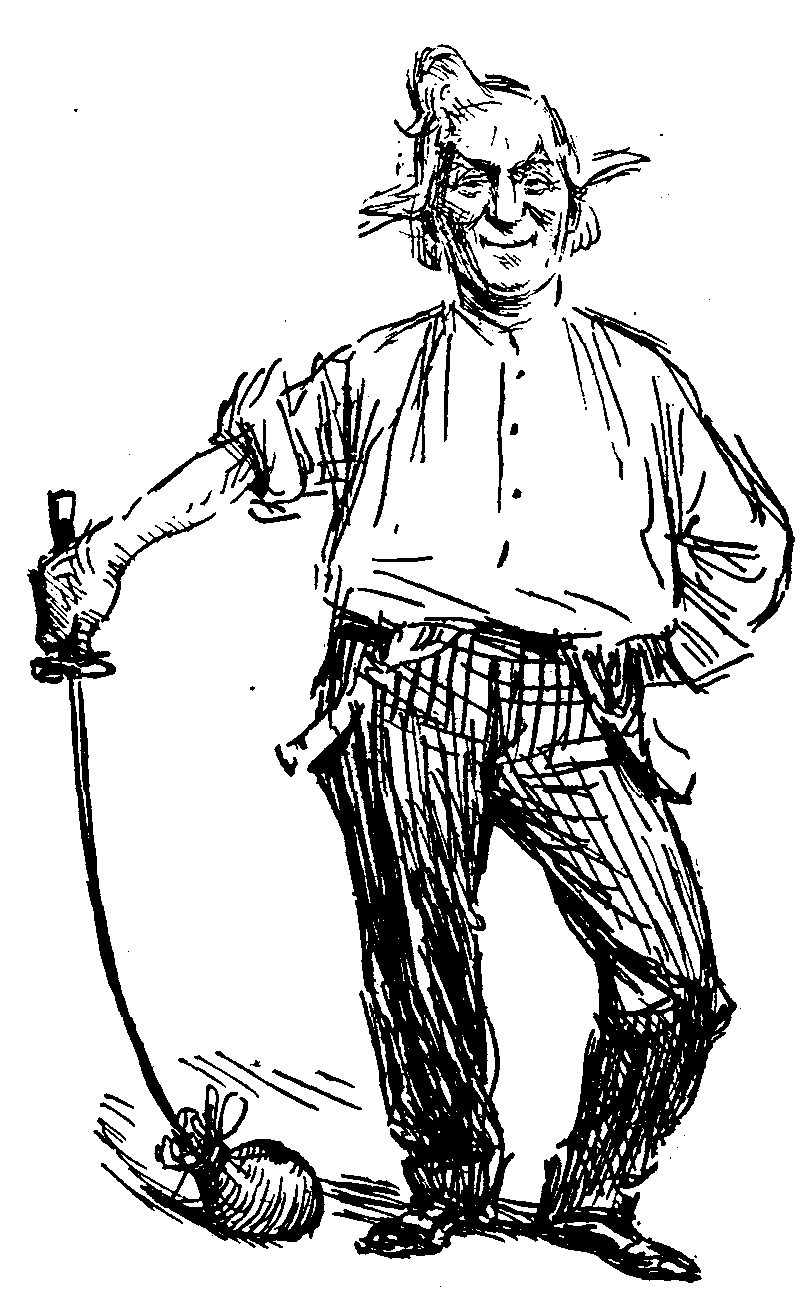
There was very little sign of passion in Mr. ASQUITH'S measured criticism of the Allied Council and of the PRIME MINISTER'S speech on the subject in Paris. His foil was carefully buttoned, and though it administered a shrewd thrust now and again it was not intended to draw blood.
At first the PRIME MINISTER followed this excellent example, and contented himself with defending, and incidentally re-composing, his Paris oration. The Allied Council, as now depicted, was a horse of quite another colour from what it seemed in Paris. A further example of camouflage, I suppose.
Only when he came to deal with his Press critics did he let himself go, to the delight of the House, which loves him in his swashbuckling mood. As he confessed, however, that he had deliberately made "a disagreeable speech" in Paris in order to get it talked about, the Press will probably consider itself absolved.
Tuesday, November 20th.—Like John Bull, as represented in last week's cartoon, Lord LAMINGTON has arrived at the conclusion that compulsory rationing must come, and the sooner the better. Lord RHONDDA, however, is still hopeful that John will tighten his own belt, and save him the trouble. "More Yapping and Less Biting" should be our motto. But if we fail to live up to it, the machinery for compulsory rationing is all ready. Indeed, according to Lord DEVONPORT, it has been ready since April last, when an "S.O.S." to the local authorities was on the point of being sent, but a timely increase in imports stopped it.
Nobody doubts Commander WEDGWOOD'S essential patriotism; he has proved it like a knight of old on his body; but he is unfortunate in some of his political associates, who take advantage of his good-nature. A book with a preface by himself had been seized by the police on suspicion of being seditious, and he loudly demanded to be prosecuted. But Sir GEORGE CAVE was not inclined to set up a legal presumption that the writer of a preface is responsible for the rest of the book. If he were, a good many "forewords" would, I imagine, never have been written.
Wednesday, November 21st.—By a strange oversight the Royal Marines were not specifically mentioned in the recent Vote of Thanks to the Services. Apparently the fact that this country is proud of them is one of those things that must not be told to the Marines. But Dr. MACNAMARA assured the House that the omission should now be repaired.
There has been a shortage of provisions in the city where Lady Godiva suffered from a shortage of clothes. Mr. CLYNES was prompt with a remedy. A representative of the FOOD-CONTROLLER has already been sent to Coventry.
Conscientious Objectors found a doughty champion in Lord HUGH CECIL. Rarely has an unpopular case been fortified with a greater wealth of legal, historical and ethical argument. Only once, when he accused Mr. BONAR LAW of holding the same doctrine as Herr BETHMANN-HOLLWEG, did he lose, for a moment, the sympathy of his audience. But he soon recovered himself, and thereafter held the House rapt with Cecilian harmonies.
To such a lofty plane, indeed, had the debate been lifted that Mr. RONALD MCNEILL, tall as he is, had some difficulty in bringing it down to earth again; and when the division was called the spell was still working, and in a very big House the "Conchies" only lost their votes by thirty-eight.
Thursday, November 22nd.—Pending the introduction of the promised censorship of Parliamentary Questions, Mr. JOSEPH KING is working overtime. No story is too fantastically impossible to find a shelter under his hospitable hat. To-day it was a secret treaty between the Russian Government (old style) and the French Republic, by which Belgium was to be compensated at the expense of Holland. Lord ROBERT CECIL denounced it as an invention of the enemy. But I don't suppose the denial had the smallest effect upon Mr. KING, who probably went off and dined heartily on a magnum of mare's-nest soup.
A tremendous accession to the ranks of the Sinn Feiners has been narrowly averted. When Members read the menu which, according to Major NEWMAN, the Irish Government has adopted for political prisoners—three good square meals a day, including an egg, ten ounces of meat, a pound and a half of bread, two pints and a half of milk, and real butter—they were strongly minded to enlist under Mr. DE VALERA'S banner and get themselves arrested forthwith. But Mr. DUKE'S emphatic denial shattered their dream of repletion at the taxpayers' expense.
A final attempt to get proportional representation included in the Franchise Bill was heavily defeated. In a dashing attempt to save it Sir MARK SYKES declared that the old Eatanswill methods of electioneering had gone for ever—"no mouth was large enough to kiss thirty thousand babies." But the majority of the House seemed to be more impressed by the self-sacrificing argument of that eminent temperance advocate, Sir THOMAS WHITTAKER, who feared that "P.R." would lead to an increase in "milk-and-water politicians."
ALWAYS SOMETHING NEW FROM AFRICA.
"A Belgian East African communiqué says that before the converging advance of the Anglo-German Belgian columns, the enemy retired to the south bank of the Kilimbero."—Mombasa Times.
We seem to have met some of these Anglo-German columns in the Pacifist Press.
"Our machines then bombed the General, in which the German Head-quarters at Constantinople are reported to be situated."—Times.
The General must have been stout, even for a German.
"Not having regained consciousness the police are left with little tangible evidence to work upon."—Daily Telegraph.
Let us hope they will soon come to.
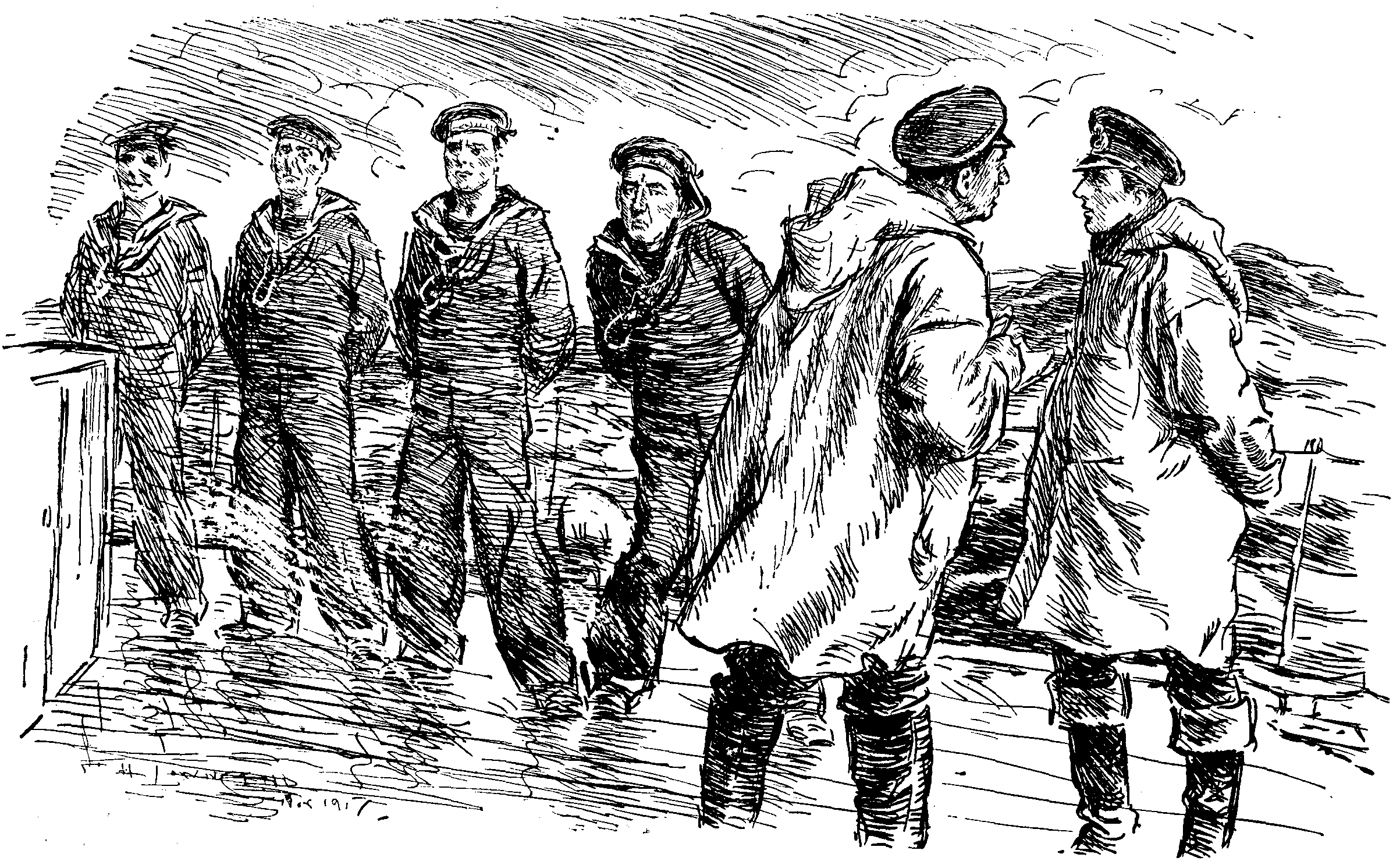
HOW TO UTILISE OUR SKILLED CRAFTSMEN.
First Lieutenant. "WHAT WAS THIS MAN BEFORE HE JOINED?" Petty Officer. "OPTICIAN, SIR."
First Lieutenant. "WHAT HAD WE BETTER GIVE HIM TO DO?" Petty Officer. "THERE'S THEM PRISMATIC SPOTTING GLASSES, SIR. THE LEATHER STRAP IS BROKEN OFF THEM. HE COULD SPLICE IN A PIECE O' COD LINE."
LE POILU DE CARCASSONNE.
THE poilus of France on the Western Front are brave as brave can be, Whether they hail from rich Provence or from ruined Picardie; It's the self-same heart from the lazy Loire and the busy banks of Seine, Undaunted by perpetual mud or cold or gas or pain; And all are as gay as men know how whose wealth and friends are gone, But the gayest of all is a little white dog that came from Carcassonne. He was brought as a pup by a Midi man to a sector along the Aisne, But his man laid the wire one pitch-black night and never came back again. The pup stood by with one ear down and the other a question mark, And at times he licked his dead friend's face and at times he tried to bark, Till the listening sentry heard the sound, and when the daylight shone He looked abroad and cried, "Bon Guieu! C'est le poilu de Carcassonne!" So the dead man's copains kept the dog on the strength of the company. And whoever went short it was not the pup, though a greedy pup was he; They gave him their choicest bits of sinje and drops of pinard too; He was warm and safe when he crept beneath a cloak of horizon-blue; They clipped fresh brisques in his rough white coat as the weary months dragged on, And all the sector knows him now as le Poilu de Carcassonne. And in return he keeps their hearts from that haunting foe, l'ennui; He's their plaything, friend, and sentry too, and a lover of devilry; He helps them to hunt out rats or Boches; he burrows and sniffs for mines, And he growls when the murderous shrapnel flies screaming above the lines; His little black nose is a-quiver with glee whenever a raid is on, And they say with pride, "C'est la guerre elle-même, notre Poilu de Carcassonne!" There was none more glad when they went to rest in their billet, a ruined shack, But when they returned to the front-line trench he was just as pleased to be back; He's the spirit of fun itself, and so when other men feel blue, His friends remark, "Le cafard, quoi? On l'connait pas chez nous!" So when you drink to the valiant French and the glorious fights they've won Just raise your glass to a little white dog that came from Carcassonne.