Volume 153 — AT THE PLAY.
Reading edition
"LOYALTY."
If you are a pernickety intellectual (soi-disant) you may really permit yourself to be faintly amused at the fiery zeal of the mystery-wrapt author of Loyalty for his (or, quite possibly, her) country's cause in this difficult hour. If you are cast in the common human mould that nowadays is seen for the glorious thing it is, you will respond to many single-minded, wholesome thoughts in the impassioned statement of his thesis. And if you happen to belong to that simple discredited breed, the English, so long overshadowed by the nimbler Britons, you may have quite a nice little private thrill of your own, a thrill of pride in your precious stone, and begin to think with seriousness of the advantages of "home rule all round" in an England-for-the-English mood, and of the value of a nationalism that is as irrational as conjugal or mother love—and as fine.
The author's hero is an Englishman of the wandering type, assistant editor on a crank paper. The play is a protracted debate in four sessions, June, 1914; July, 1914; August, 1914; September, 1916. And here the author makes his most serious mistake, the mistake made by Mr. HENRY ARTHUR JONES in his recent squib. If he had contrived his Little Navy folk, the proprietor, editor and revolving cranks as something more than mere caricatures, brands of straw prepared for his consuming bonfires, he would have strengthened, not weakened, his excellent case. He has quoted his enemies' mistakes without their excuses, their texts without their contexts. And that is a form of propaganda which can only touch the converted, or such of them as are not stirred by a sporting instinct to a certain mood of protest and a wish that the other fellow should be given a better start in the heresy hunt.
The dramatis personae, then, divide themselves into the men of straw and the right sort. Of the former you have first Sir Andrew Craig, chairman of the party in his constituency and editor of The New Standard (there were indeed altogether new standards of efficiency, mentality and hospitality in that rather imaginative newspaper office of the First Act). Mr. FISHER WHITE gave us the courtly-obstinate old man to the life (this player has a way of removing straw). In the dramatic passage in which, returning after being broken in a German prison, he relates some of the horrors of which it is good for us to be reminded, he rose to the height of his fine talent. His exquisite elocution—a remarkable feat of virtuosity—was in itself a sheer delight.
Mr. Stutchbury, the editor, pacifist and sentimental democrat, was dealt to Mr. LENNOX PAWLE. He played his hand well. There was never such an editor outside Bedlam; but Mr. PAWLE is a resourceful person and by a score of clever tricks of gesture and business made a reasonable figure of fun for our obloquy. All but broken in the end, but still claiming that he had "the larger vision" (as he certainly had the larger diameter), there was a certain dignity of pathos in his exit, a late amende by an otherwise remorseless puppet-maker. Mr. SYDNEY PAXTON as a pillar of Nonconformity offered a clever study in the unctuous-grotesque; Mr. VINCENT STERNROYD sketched a portrait of a nut-consuming impenitent disarmamentist. The author is the first, so far as I know, to give public emphasis to the queer fact of natural history that there is some connection between extreme opinions and the prominence of the Adam's apple of the holder of them—a fact on which I have often pondered.
Mr. M. MORAND, the aggressive Scots member of the election committee, inspired to great heights of insobriety by the return of his London-Scottish nephew from the Front, sounded a welcome human note, as did Mr. SAM LIVESEY, the Labour Member of the committee, shaken out of his detachment into an extreme explicitness of language by a Zeppelin raid experience. Mr. GEORGE BELLAMY'S Welsh Disestablisher and Mr. GRIFFITH HUMPHREYS' exuberant German press-agent of the pre-war period were both really shrewd studies.
Of the right sort there were but five—and one of these, the editor's secretary, at heart an honest patriot, but in fact eating the bread of shame, was perhaps not altogether of the right sort. Still he did get off his chest at last the pent-up passion of years, and very well he did it, with the help of Mr. RANDLE AYRTON, whose subtle little touches, building up a picture of a disheartened hack, were very adroit indeed.
THE LIGHTER SIDE OF EDITORIAL LIFE. Frank Aylett . . . . . . . . MR. C. AUBREY SMITH. Anthea Craig . . . . . . . . . . . MISS VIOLA TREE.
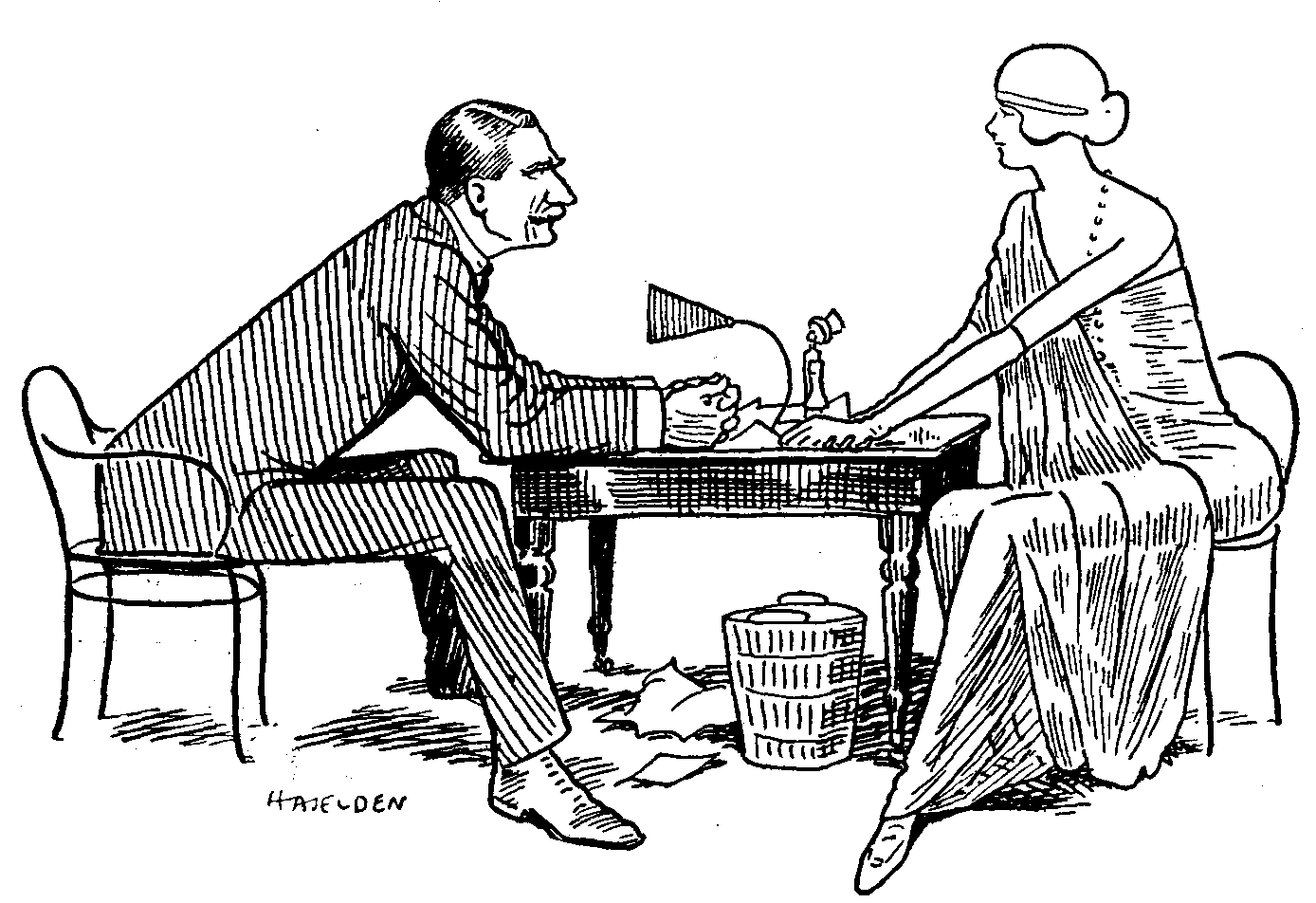
Then there was young Henry Craig, at the beginning an undergraduate in his last term, at the end a V.C. in his last resting-place. Mr. PERCIVAL CLARKE'S was an adequate pleasant study. So also was Mr. PHILIP ANTHONY'S of a Canadian, full of strange idioms, who butted in to just the wrong corner of Fleet Street to put the editor wise about the intentions of a Germany in which he had spent his last two years. And then there was splendidly English Frank Aylett, exile returned, unspoilt by the cynicism of party and paper, whose fortune came to him just at the psychological moment, enabling him to give his proprietor notice and fight and win a by-election in the astonied man's own constituency, besides carrying off his daughter (Miss VIOLA TREE), who was the fifth of the right sort. What more plausible English hero than Mr. C. AUBREY SMITH, except that he had to talk a good deal more than seemed appropriate to his type? There was a well-managed post-election scene when he was at his best (as was the author). And all through there was good and sometimes glorious sense for those to hear who had ears.
The programme promised us about a month's interval between Acts I. and II. It was actually less than that; but if Mr. J.H. SQUIRE's musicianly orchestra had not been there to charm us we might conceivably have been bored.
T.
More Commercial Candour.
"FOR SALE.—A 45 H.P., 6 cyl.—Car, touring body, fitted with every latest convenience. Exceptionally well sprung. Just purchased by owner and run under 1,000 miles. Guaranteed over 25-galls. to the mile by Agents. Rs. 11,000."—Indian Paper.
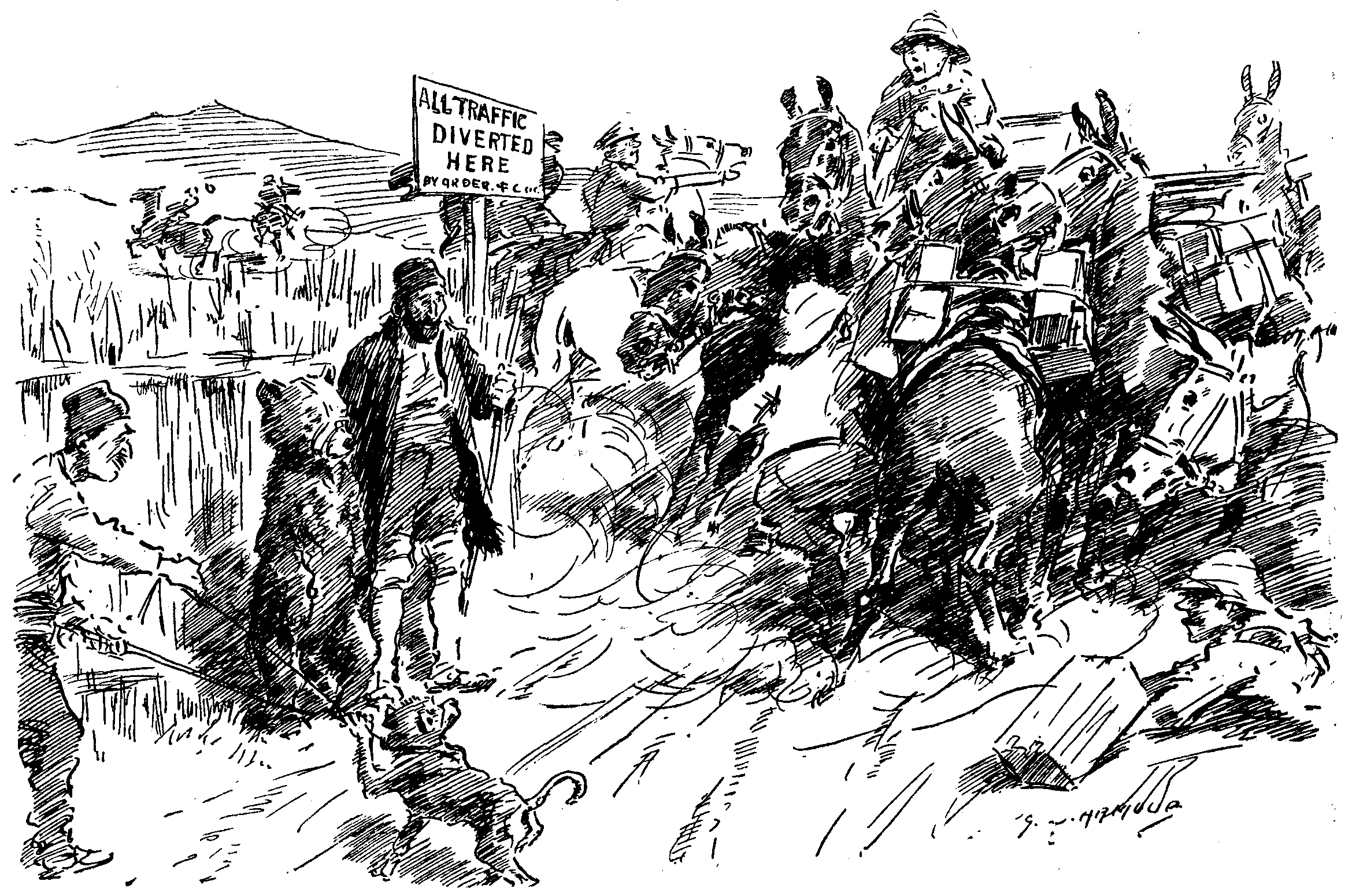
"DIVERSION" IN THE BALKANS.
HEROES.
If the question were put to a company of young women, "What is the most thrilling experience you can have in a London street?" the odds are a thousand to one that they would reply that nothing could be more thrilling than to meet a famous actor in plain clothes and identify him. I am not a young woman myself, but I should be inclined to share their opinion. There is something about an actor in real life, moving along like a human being—one of us—that always stirs my pulse. It is exciting enough to see Mr. LLOYD GEORGE or Mr. ASQUITH or Sir OLIVER LODGE; but no one stirs the imagination like an actor.
That is why I still tremble a little whenever I think of my good fortune the other afternoon in the Haymarket, and why my pen shakes as I commit the adventure to paper. For I met face to face two of the most successful actors in London—at the present moment, in the world.
I was walking up the Haymarket in the rain, hoping, in spite of the new prohibitive rates, that I might see an empty cab, when I met them coming down. They were walking with a man whom I did not recognise, and, like me, were getting wet. One thinks of successful actors as riding always in taxis; but taxis are very rare nowadays, particularly in the wet, and somehow it did not seem unnatural that they should be on foot. I am glad enough that they were, or I should have missed my frisson; and others would have suffered a similar loss, for the recognition was not only on my part but on that of several passers-by, and it was instantaneous. Indeed, I heard one lady tell her companion the name of the play they are in and the extraordinary length of its run, and since she spoke loudly I thought how delightful it must be to be a theatrical celebrity and hear cordial things like that as you move about. Neither of them paid any attention, however, although their friend showed signs that the flattery had not escaped him; the two Illustrions (to coin a word) merely walked on, superior to our homage, and disappeared into Charles Street, where the stage door of His Majesty's is.
Pouring though it was, and grovelling admirer of footlight favourites as I am, somehow I never thought to offer either of them my umbrella. But then one doesn't offer an umbrella to a donkey or a camel, even though they are two of the stars of Chu Chin Chow.
ANOTHER INJUSTICE.
From a Sinn Fein speech:—
"When Ireland was silent England did not hear her cry out."—Wicklow News-Letter.
"WHY SHOULD A RABBIT COST 2s. 3d.?
"This question from a reader induces me to postpone until next week my analysis of the high cost of onions."—Empire News.
On the principle that it is better to make sure of the rabbit before arranging about the stuffing.
"Stockholm, Tuesday.
"News from Finland shows that the Socialist leaders have lost control of the workmen, and all kinds of excesses are taking place. The present Commandant at Tornea was a sailor, the head of the passport office was a tailor, and the chief telegraphic censor a tinker."—Central News.
We miss the soldier, to say nothing of "apothecary, ploughboy, thief."
"Scholars and tragedians between them seem to have appropriated the right to keep Shakespeare's memory green. But there are other Richmonds in the field, humble Richmonds, not well read ... John of Gaunt, crying that his England 'never did nor never shall lie at the proud foot of a conqueror....'"—The Times.
The writer who thus deprived the Bastard in King John of his famous lines was, we infer, one of the "other Richmonds."
SUGAR.
AN ELEGIAC ODE.
Queen of the palate! Universal Sweet! Gastronomy's delectable Gioconda! Since with submission loyally I greet And follow out the regimen of RHONDDA, I cannot be considered indiscreet If I essay, but never go beyond, a Brief elegiac tribute to a sway By sterner needs now largely swept away. Thy candy soothes the infant in its pram; Thou addest mellowness to old brown sherry; Thou glorifiest marmalade, on Cam And Isis making breakfast-tables merry; Thou lendest magic to the meanest jam Compounded of the most insipid berry; And canst convert the sourest crabs and quinces To jellies fit for epicures and princes. Thou charmest unalloyed, in loaf or lumps Or crystals; brown and moist, or white and pounded; I never was so deeply in the dumps That, once thy fount of sweetness I had sounded, Courage returned not; even with the mumps I still could view with gratitude unbounded The navigators of heroic Spain Who found the New World—and the sugar-cane. Sprinkled on buttered bread thou dost excite In human boys insatiable cravings; On Turkish (I regret to say) Delight Thou lurest them to dissipate their savings, Instead of banking them, or sitting tight, Or buying useful books and good engravings; And lastly, mixed with strawberries and cream, Thou art more than a dish, thou art a dream. Before necessity, that knows no ruth, Ordained thy frugal use in tea and coffee, Some Stoics banned thee—men who in their youth Showed an unnatural dislike of toffee; For sweetness charms the normal human tooth, Sweetness inspires the singer's tenderest strophe, Since old LUCRETIUS musically chid The curse of life—amari aliquid. Eau sucrée, I admit, is rather tame Compared with beer or whisky blent with soda; But gallant Frenchmen, experts at this game, Commend it highly either as a coda Or prelude to their meals, and much the same Is sherbet, which the Gaekwar of Baroda And other Oriental satraps quaff In preference to ale or half-and-half. Nor must I fail, O potent saccharin! Thou chemic offspring of by-products coaly, Late comer on the culinary scene, To hail thy aid, although it may be lowly Even compared with beet; for thou hast been Employed in sweetening my roly-poly— Thou whom I once regarded as a dose And now the active rival of glucose! But still I hear some jaundiced critic say, Some rigid self-appointed censor morum, "Why harp upon the pleasures of a day When freely sweetened was each cup and jorum, Ere stern controllers had begun to stay The genial outflow of the fons leporum? Now sugar's scarce, and we must do without it, Why let regretful fancy play about it?" True, yet it greatly goes against the grain, Unless one has the patience of Ulysses, Wholly and resolutely to refrain From dwelling on the memory of past blisses; Forbidden fruits allure the strong and sane; Joys loved but lost are what one chiefly misses; This is my best excuse if I deplore "So sad, so sweet, the days that are no more."
'TATERS.
SCENE: At "The Plough and Horses."
"You seen Parson lately, George?"
"Not lately I ain't, Luther."
"Not since 'is 'taters be out o' ground?"
"No. Finest crop in village, some do say."
"That be right—sev'ral ton of 'em there be."
"What to goodness do 'e want 'em all for, then? 'Im an' 's wife an' a maid 'll never eat all them 'taters."
"I'll tell you what 'e says to me, for 'appen 'e'll say it to you, George, when 'e comes acrost you next. 'E says to me, 'I've growed as many potatoes as I've had strength to grow, an' they've prospered exceedin'ly,' 'e says, 'thank God! So if any deservin' folk in my parish gets through wi' their own crop an' wants more later on they 'as only to come to me, for I've growed more 'an my 'ouse'old 'll eat if they was to eat all day.'"
"'E be proud o' that?"
"Fine an' proud 'e be."
"An' yet it be some'at unfort'nate too. For all of us as is left in this 'ere parish 'as growed as many 'taters as they'll be like to need, same as 'e. So I don't see nought but disappointment for Parson an' a lot o' good 'taters lyin' to rot in their pies."
"Some there be too fond o' Parson to let that 'appen. Me an' my wife be sendin' few of ours to London ev'ry week or so. So in due season we shall be free to go to Parson an' 'elp 'im through wi' 'is, same as 'e wants us to. I 'ears as others is doin' some'at the same as us—fear is as too many'll tumble to the idea, which is why I'd 'ave you keep it fro' goin' further, George."
"Silent as th' grave I'll be. So you're givin' your 'taters 'way to please Parson? Yet I do allus say as 'taters what a man grows wi' sweat of 'is own brow do beat all others in t' eatin'."
"That may be; but us can't afford to be so mighty pernickerty in time o' war. Nor we ain't givin' nothin 'way in manner o' speakin'. Fair market price they gives for 'em in London. So it be somethin' in 'and in these 'ard times as well as savin' Parson from a bitter disappointment what 'e ain't done nothin' to deserve, so far as I can see."
"Two organ grinders, aged 23 and 16, were taken to Charing Cross Hospital to-day with bad injuries and severe shock, the result of a barrel organ getting out of control in Rosebery-avenue."—Evening Paper.
They should try a less dangerous instrument next time.
"'Seed potatoes' means potatoes grown in Scotland or Ireland in the year 1917, or grown in England or Wales in the year 1917 from seed grown in Scotland or Ireland in the year 1916, which will pass through a riddle having a 1-5/8-in. mesh, and will not pass through a riddle having a 1-5/8-in. mesh."—Journal of the Board of Agriculture.
We ourselves cannot get through any riddle of this kind.
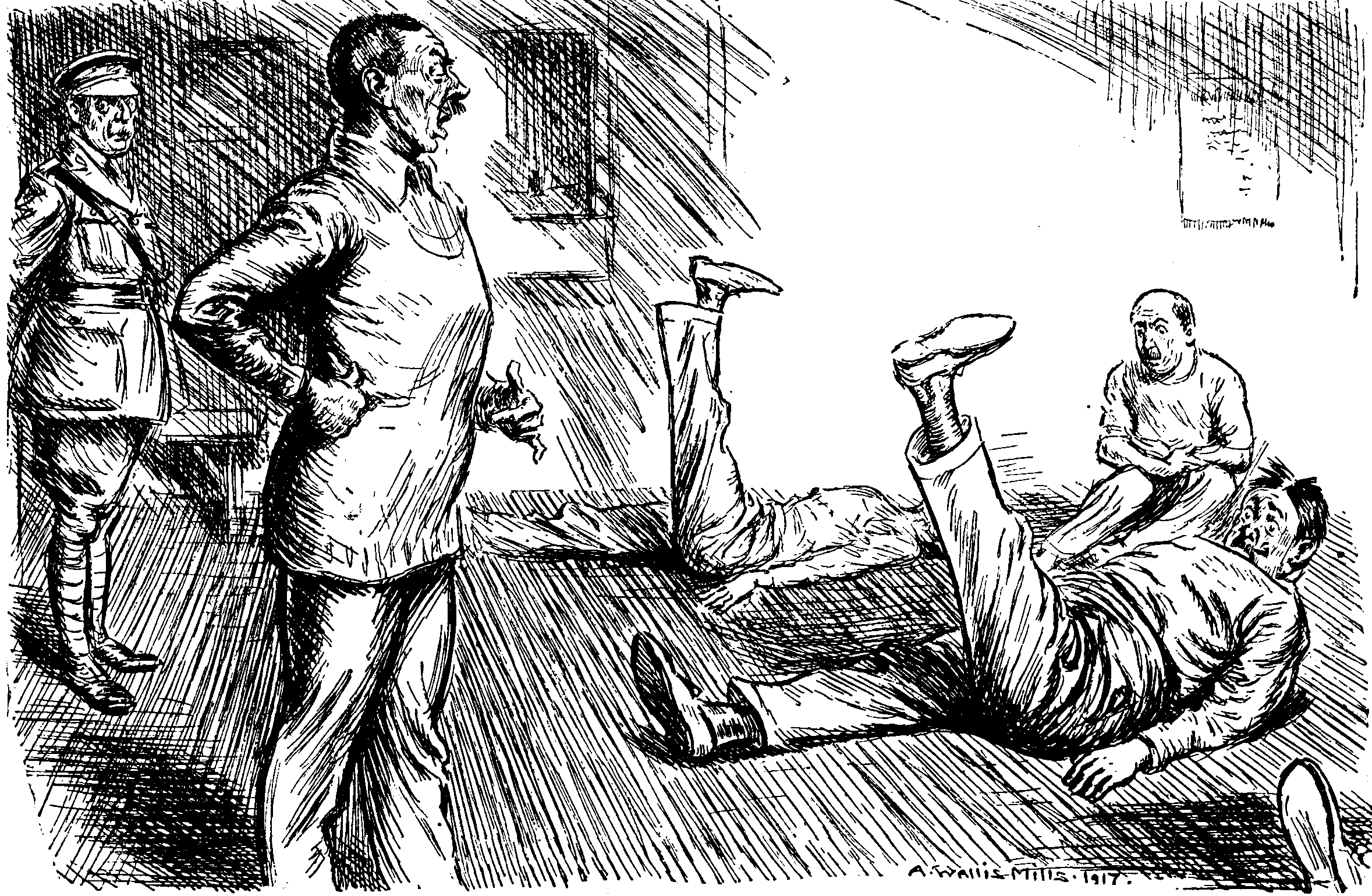
Sergeant (instructing squad of volunteers in physical drill). "THIS 'ERE HEXERCISE IS INTENDED TO 'ARDEN THE MUSCLES OF THE STUMMICK AND MAKE IT HIMPERVIOUS TO GERMAN BULLETS HIN CASE OF HINVASION."